Author: Loveland Magazine

  • Lawmakers seek Ohio moratorium on evictions, foreclosures

    Lawmakers seek Ohio moratorium on evictions, foreclosures

    State Reps. David Leland, D-Columbus, and Jeffrey Crossman, D-Parma

    By Tyler Buchanan and the Ohio Capital Journal

    Ohioans struggling to pay their rents or mortgages may head into 2021 without the housing protections and public assistance that have carried them through much of the pandemic this year.

    A federal moratorium on evictions is about to expire. Two other relief programs helping unemployed Americans are set to run out. There are believed to be thousands of Ohioans who are in immediate risk of eviction due to unpaid rent, with many low-income earners still working reduced hours or remaining out of work entirely. 

    Back in March, two Democratic lawmakers proposed a statewide moratorium on eviction and foreclosure actions so long as Ohio stayed under a state of emergency amid the COVID-19 pandemic. The economy has rebounded somewhat from historic unemployment in the spring, but the virus outlook looks grim as the state heads into the cold winter months.

    State Reps. David Leland of Columbus and Jeffrey Crossman of Parma believe the moratorium is needed now more than ever. 

    “This is not just a humane thing to do,” Leland said in a committee hearing on the bill Thursday morning, “it’s not just asking you to embrace the holiday spirit. Instead, as we survey the landscape after these tumultuous nine months and ahead of next year’s budget negotiations, this is a way to save numerous low-income Ohioans’ from unimaginable hardship.”

    “The urgency of this legislation is really right now,” Leland continued.

    Under House Bill 562, landlords could still file eviction actions, but courts would be prevented from acting on them while the state of emergency is in place. Law enforcement officers could not carry out eviction orders either. Courts would not be able to conduct any business pertaining to foreclosures and must halt all pending foreclosure actions.

    This moratorium would apply to residential and commercial properties.

    Nearly two-dozen Democrats and one Republican have supported the bill as cosponsors.

    iStock / Getty Images Plus

    ‘Last remnants of the safety net’

    The large-scale CARES Act signed into law in March has provided trillions of dollars of relief, but many of its programs benefiting Ohio tenants have already run out or are about to. 

    This includes the Pandemic Emergency Unemployment Compensation and the Pandemic Unemployment Assistance programs, which have helped those who have lost work during the crisis. Both programs end the day after Christmas.

    In September, the Centers for Disease Control and Prevention (CDC) issued a nationwide moratorium on evictions for residential properties. It prohibits U.S. landlords and property owners from evicting a tenant for unpaid rent. 

    That moratorium is set to expire on New Year’s Eve.

    “Just as covid cases are exploding and our hospitals are filling, and just as the coldest parts of winter are setting in, hundreds of thousands of Ohioans are set to be stripped of the last remnants of the safety net Congress put in place back in March,” Leland said.

    Ohioans struggled to pay their housing costs even with that safety net in place. A survey from this past summer found more than a half-million residents could not pay rent in June 2020.

    Now these same residents potentially face 2021 without the CDC moratorium and without relief assistance — unless Congress acts again to pass a relief bill to close the gaps left by the still struggling economy.

    A total of $50 million from the CARES Act was allocated for emergency rental assistance in October. But advocates say more is needed.

    “Unless the Senate stops blocking any meaningful relief, we’re really worried about what’s going to happen in 2021,” said Marcus Roth, a spokesman for the Coalition on Housing and Homelessness in Ohio, last month.

    That’s also the hope of Gov. Mike DeWine, who again called on Congress to pass a relief bill during his COVID-19 press conference on Thursday. 

    DeWine was asked if he supported the CDC extending its eviction moratorium into 2021. 

    “I’d have to take a look at that. I don’t know,” DeWine answered. “But look, this is a problem. This is a problem and is something that we are in fact focused on.”

    Lt. Gov. Jon Husted argued that a moratorium alone does not address the costs faced by property owners and suggested such action should be paired with further government relief.

    “There’s still somebody that has a mortgage to pay on that facility, who has a default that could potentially happen with their lender, which creates a whole chain of events and series of events,” Husted said. “So there has to be a financial solution to go along with any moratorium so that we don’t create a chain reaction in the system that causes additional problems.”

    Unintended consequences to a moratorium?

    In committee, state Rep. D.J. Swearingen, R-Huron asked the HB 562 sponsors about the “unintended consequences” of continuing a moratorium in Ohio. Swearingen noted that property owners still have costs such as repairs and that smaller banks may not be able to carry so many unpaid loans.

    State Rep. D.J. Swearingen, R-Huron

    Crossman acknowledged those concerns but said the ramifications of doing nothing would have a greater impact on individuals.

    “I think we just have to ask ourselves, who’s in a better position to bear the burden here? The individual who is not making any income trying to keep their family fed and clothed and in a housing situation during the middle of a pandemic, particularly if they don’t have a job, or a lender who can maybe take a two- or three-month pause from getting their mortgage payments?”

    Crossman said the latter is in “a far better position financially” to handle the issue. 

    Lawmakers also heard testimony from Dan Acton, a lobbyist for the Ohio Real Estate Investors Association who spoke in opposition to passing an Ohio moratorium. He said his organization consists of a few thousand “smaller” real estate investors who typically own single-family housing units.

    He claimed these property investors operate on “razor-thin profit margins.” When tenants do not pay their rent bills, Acton said, this reduces the “profits for a property owner that could otherwise be used to reduce the overall debt on a property or make improvements.”

    “The pandemic and the resulting eviction moratoria and payment delays are leaving our members on the brink of failure,” Acton said, arguing it would be “dangerous” for the government to “interfere” with a private leasing contract. 

    Leland said a moratorium is not meant to be a “long term-solution,” but would allow Ohioans to stay in their home until winter passes, the economy rebounds and a vaccine is made available.

    Separately, Leland and fellow Democratic Rep. Juanita Brent of Cleveland also sponsored House Bill 744 that would allocate around $270 million from the state’s “rainy day fund” to pay for a new COVID-19 Emergency Rental Assistance Program. No action has been taken on this bill.

  • The steel was weakening:  When you watch the video, the first bend is right where the inspection revealed the soft spot

    The steel was weakening: When you watch the video, the first bend is right where the inspection revealed the soft spot

    Five, four, three, two, one…

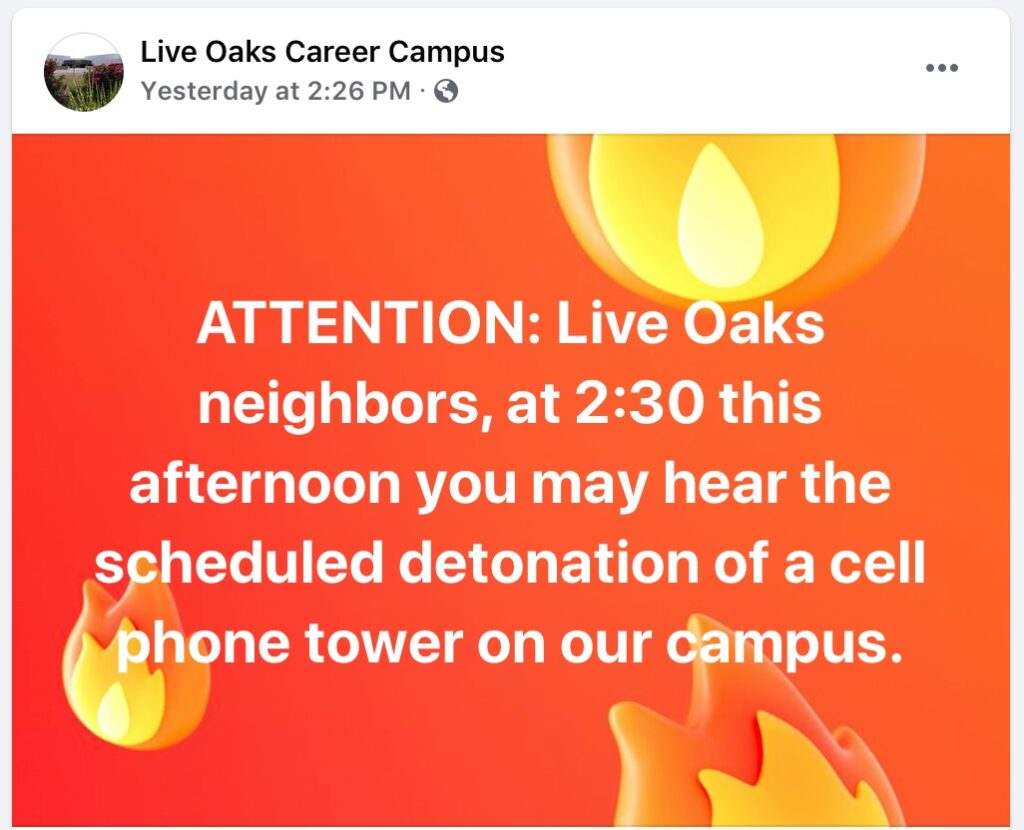
    Miami Township, Ohio – The demolition of the radio tower near the Live Oaks campus on Buckwheat Road took place yesterday afternoon.

    https://www.facebook.com/MiamiTownshipPD/posts/3662126307140928

    The tower was owned by Mobilcomm, Inc. and used by the Clermont County Communications Center to dispatch police, fire and other emergency units. It was taken down by O’Rourke Wrecking Company.

    The steel was weakening. When you watch the video, the first bend is right where an inspection revealed the weakening.

    If you visit the Miami Township Police FaceBook page you can view Drone footage of the tower coming down.


  • [VIDEO] Governor visits RSS Warehouse site as State prepares for vaccine distribution

    [VIDEO] Governor visits RSS Warehouse site as State prepares for vaccine distribution

    BREAKING UPDATE: Bloomberg News has reported this morning (12-2-2020) that the Pfizer vaccine scheduled for the Loveland Area has received approval in Britain. “The emergency authorization clears the way for the deployment of a vaccine that Pfizer and its German partner have said is 95% effective in preventing illness. The shot will be available in Britain from next week.” This is ahead of decisions in the U.S. and European Union. Read on…

    Today, Ohio Governor Mike DeWine toured the Ohio Department of Health’s Receipt, Store, and Stage (RSS) warehouse facility located in Central Ohio, to see the facility and review the process that will be used to redistribute the COVID-19 vaccine in Ohio.

    The Ohio Department of Health’s Vaccine Preparedness Office has been preparing for the arrival of the vaccine for months, distributing adult influenza vaccine with the same process that will be used to distribute the COVID-19 as a test exercise, and running daily drills with prototype packaging to break down and repackage the vaccine in smaller units.

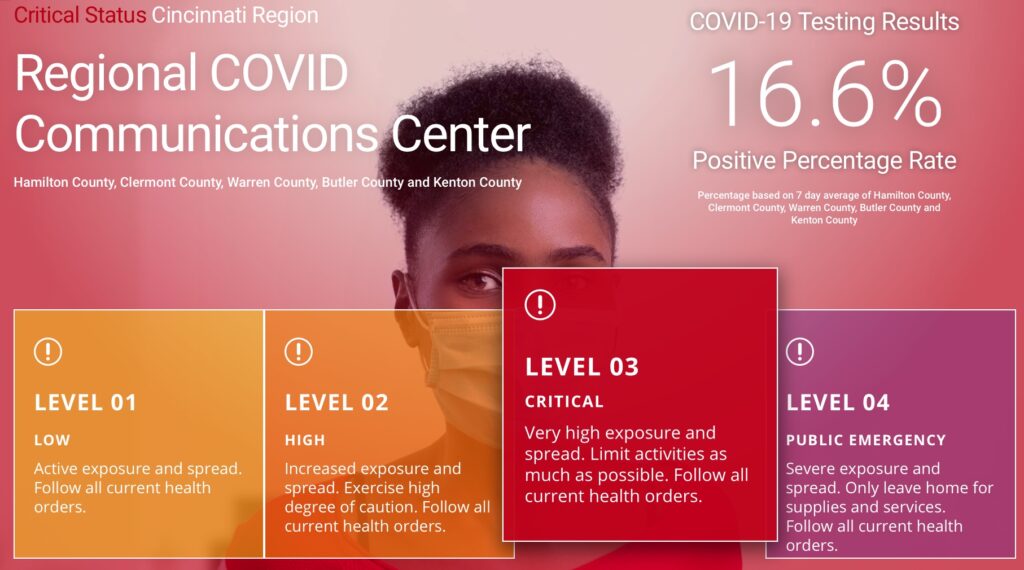
    There are currently 2,931 active COVID 19 cases in Clermont County

    There are currently 33,498 active COVID 19 cases in Hamilton County.

    There are currently 9,421 active COVID 19 cases in Warren County.

    On Monday, the Ohio Department of Health took part in a nationwide end-to-end training exercise with the packaging that will be used to distribute the Pfizer vaccine. The Pfizer vaccine is expected to be the first manufacturer to receive the Emergency Use Authorization (EUA) by the Food and Drug Administration (FDA). The vaccine will be shipped to Ohio using the following process:

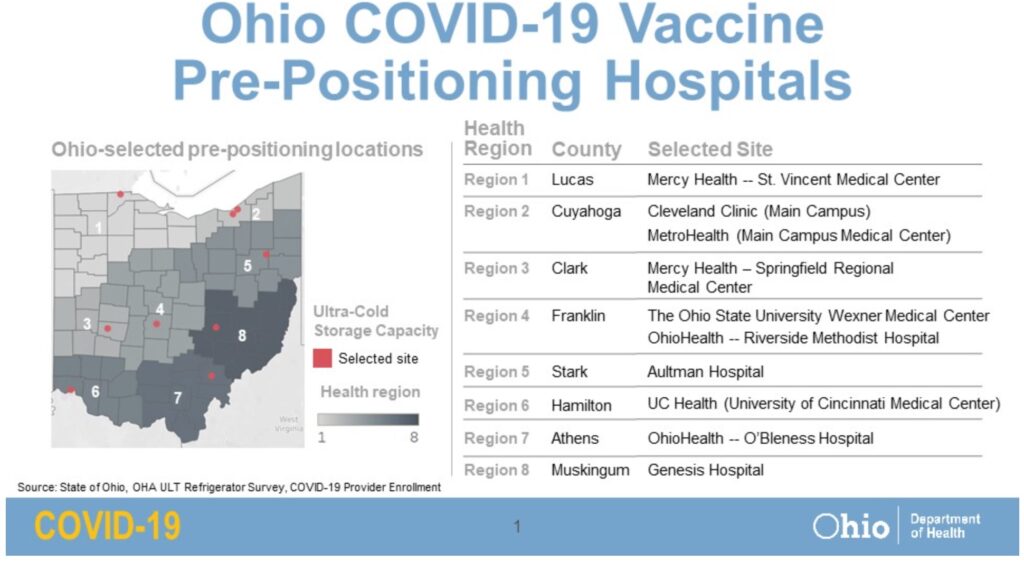
    • The Pfizer vaccine will be shipped directly to Ohio’s 10 prepositioned hospital sites. As vaccine supply increases, additional providers will receive direct shipments if ordering 975 doses or more of the vaccine.
    • Providers requiring fewer than 975 doses, such as smaller local health departments and physician’s offices, will not receive a direct shipment from Pfizer. In these cases, Pfizer will ship the vaccine to the ODH RSS warehouse, where the vaccine will be redistributed in increments of 100. The warehouse is equipped with ultracold freezers that can each hold up to 720,000 doses to be stored in the RSS at any one time.
      • When vaccinations are ready to be shipped from the RSS warehouse, they must be removed from ultracold storage and repackaged with dry ice in under two minutes. To ensure the vaccine can be repackaged safely, quickly, and effectively, ODH staff and members of the Ohio National Guard are running daily practice drills that include the following steps:
        • Each box is transported to a table where the vials are counted.
        • The box is closed and handed off to another team member who will place the vaccine box in a larger cold shipping container lined with bubble wrap..
        • Once the correct number of doses are placed in the larger cold shipping container, dry ice is added to the package, along with a sheet of cardboard. The lid is replaced and the package proceeds to the next step.
        • The package is sealed, a shipping label is applied, and the package is moved out for delivery.
        • All packages will be delivered to the providers within six hours. The vaccine will remain stable if sealed in the original shipping container from the RSS warehouse with dry ice for up to 5 days.
    • Vaccine National Drug Control (NDC) and lot number information will all be tracked electronically, and parcels will be tracked as they are delivered. Each delivery vehicle will contain a GPS enabled device.

    U.C. Health at the Cincinnati Medical Center is one of Ohio’s 10 prepositioned hospital sites.

    Here is video of ODH staff and members of the Ohio National Guard practice drills

    Upon granting of an emergency use authorization, it is anticipated that the Moderna vaccine will be shipped directly to providers administering the vaccine and will not be processed by ODH at the RSS warehouse.

    Health care workers and nursing home residents should be at the front of the line when the first coronavirus vaccine shots become available, an influential government advisory panel said on Tuesday.

    The Advisory Committee on Immunization Practices who make recommendations to the Centers for Disease Control and Prevention voted 13-1 today that Health care workers and nursing home residents should receive coronavirus vaccine shots when they become available.

    The vaccine requires two doses to be effective.


  • LIFE Food Pantry Holiday Giving Shop Wish List

    LIFE Food Pantry Holiday Giving Shop Wish List

    LIFE Food Pantry Holiday Giving Shop Wish List

    LIFE is gearing up for their annual Holiday Giving Shop!

    A note from the L.I.F.E. Food Pantry:

    “Hope everyone had a wonderful Thanksgiving and survived the turkey coma! We are now full swing into the holiday season and the Holiday Giving Shop is rapidly approaching. We have wish lists on Amazon to have things shipped directly to us or, of course, you can do your own choices if you’d prefer and drop to us during open pantry hours.

    Here is a LINK where you can go directly to Amazon and buy one of the many gifts they suggest.

  • DeWine today announced a new program to help improve indoor air quality and reduce the transmission of COVID-19 at senior living facilities

    DeWine today announced a new program to help improve indoor air quality and reduce the transmission of COVID-19 at senior living facilities

    Columbus, Ohio – Governor DeWine today announced a new program today to help improve indoor air quality and reduce the transmission of COVID-19 at senior living facilities, including nursing homes, assisted living centers, and adult day centers. 

    The $28 million program was created using federal CARES Act funding to address indoor air quality through HVAC inspections, portable air filtration systems, new filtration systems, maintenance on current systems, and other interventions. Eligible recipients can receive up to $15,000.

    “As we move into colder months and spend more time inside, proper ventilation and filtration are even more important to stop the spread of COVID-19,” said Governor DeWine.

    The program was approved by the Bureau of Workers’ Compensation (BWC) Board of Directors at a special meeting Wednesday. BWC will administer the program and applications are available at bwc.ohio.gov. Additional questions about the program should be emailed to grants@bwc.state.oh.us.


    Help your hometown newspaper publish more stories like this that keep everyone safe and warm

  • How school goes when it snows

    How school goes when it snows

    Inclement Weather Information

    Loveland, Ohio – The Loveland City School District operates on a two-hour delay schedule for weather-related delays. This means all buildings will begin classes on a two-hour delay from regular start times, and all buses will run on a two-hour delay to pick up students. Individual school schedules will be sent from each building. 

    The Remote Learning Academy will follow the same delay or closure schedule. 

    Families will be notified about weather-related delays and closings through the district’s alert notification system, the district website, and on the district’s Facebook (Loveland City Schools) and Twitter (@lovelandtigers). Traditional media outlets will also run listings of school delays and closings.

    The District will re-evaluate plans for delays and closures before the second semester.

  • Utility rights for tenants

    Utility rights for tenants

    Loveland, Ohio – As the first winter storm approaches and you worry more about staying warm, you don’t have to be a homeowner to have rights when it comes to electric and natural gas service. Tenants also have options for energy assistance if they directly pay their own utility bills.

    Here are several resources that can guide you on what to do if you or your landlord is facing service disconnection:

    Whether you’re a tenant or otherwise, you can always contact the PUCO for help if you are facing disconnection.


    Help your hometown newspaper publish more stories like this that keep everyone safe and warm

  • Groups ramp up work on budget agenda for Ohio children

    Groups ramp up work on budget agenda for Ohio children

    by Mary Schuermann Kuhlman, Public News Service – OH

    Columbus, Ohio – More than a dozen groups are banding together to make sure Ohio does right by its children in the next state budget cycle.

    The Ohio Children’s Budget Coalition is ramping up efforts to maintain, protect and strengthen public resources that support children.

    The Coalition on Homelessness and Housing in Ohio is among the organizations involved.

    Gina Wilt, advocacy director for the housing group, said they’ll use their collective voice to outline policy priorities in the coming months.

    Gina Wilt is Advocacy Director for the Coalition on Homelessness and Housing in Ohio

    “All of our issues intersect,” Wilt noted. “And sometimes we get into these silos, and we can’t afford to be in silos right now. There’s a potential $2 billion shortfall. The governor, he’s going to have a lot to look through, and we must be in sync.”

    Wilt said they hope to build on their success of the last budget cycle, when funding was increased for seven of 11 issues in the coalition’s agenda for children.

    Specifically, Wilt said the last budget improved support for evidence-based home visiting, for mitigating children’s lead exposure, and for wrap-around support in schools. 

    “Really being able to focus on families and children is a top priority,” Wilt explained. “That’s something that we think Gov. DeWine can get on board with. And he has shown that this is a top priority in work that he’s already done. We need to make sure that that’s continued.”

    Wilt added longstanding structural barriers and public-policy choices have created an uneven playing field for Ohio children. She noted the economic downturn has disproportionately affected children and families of color. 

    “We have seen huge gaps in our safety net for children and families of color,” Wilt contended. “That will definitely be a priority as we talk about all of these issues; child health, child care, education, justice issues related to our youth, housing and homelessness, and food security.”

    Gov. Mike DeWine is expected to release his budget recommendations for Fiscal Years 2022 to 2023 by mid-March, and the budget bill must be signed by June 30 to take effect July 1.

  • Teachers unions urge veto on school funding bill

    Teachers unions urge veto on school funding bill

    By Susan Tebben the Ohio Capital Journal

    Two of Ohio’s top teachers unions are asking the governor to veto a new education bill just passed by the legislature.

    The Ohio Senate and House passed Senate Bill 89 last week after it spent months in a conference committee being revised and developed into a bill that, among other things, focuses on the private school voucher program, EdChoice.

    The bill passed along partisan lines in both houses of the legislature, with Republican supporters saying the bill was necessary to keep the list of EdChoice eligible schools from ballooning to more than 1,200, and to address one of the biggest barriers to education — poverty.

    Democrats challenged the idea that the bill was a solution to the state’s problems, and accused supporters of pushing the bill through without the appropriate amount of public input.

    OEA President Scott DiMauro

    The leader of the Ohio Education Association said the current version of SB 89 “removes positive aspects of the bill passed by the House and increases voucher eligibility beyond 2020-2021 levels.”

    “By grandfathering in previously voucher-eligible students, whether they had used the vouchers or not, SB 89 fails to curb the destructive explosion of the voucher program, contrary to proponents’ claims,” wrote OEA President Scott DiMauro in a statement. “There was no compromise and no consultation with the education community to strike the deal that was passed out by the conference committee.”

    Melissa Cropper, head of the Ohio Federation of Teachers, said the bill would only exacerbate the already dire school funding crisis.

    Melissa Cropper, head of the Ohio Federation of Teachers

    “SB 89 throws more fuel on the fire without providing remedies to ensure that the 90% of Ohio students who attend public schools have the resources they need for a quality education,” Cropper said.

    The bill also comes as the House and Senate consider companion bills to overhaul the education system entirely, in response to a decades-old Ohio Supreme Court case that called the system wholly unconstitutional.

    DiMauro and Cropper both said if the governor doesn’t veto SB 89, “it is more critical than ever” that House Bill 305 be passed to directly fund charter schools and the voucher program.