Author: Loveland Magazine

  • Ohio Education Association urges statewide suspension of in-person classes

    Ohio Education Association urges statewide suspension of in-person classes

    By Susan Tebben and the Ohio Capital Journal

    The state’s largest public schools union is asking that all public schools suspend in-person instruction until mid-January “in light of the alarming explosion in community spread of the coronavirus in recent weeks.”

    The Ohio Education Association said in a statement that they plan on calling “state leaders and school districts” to discuss a new plan they have related to the COVID-19 pandemic.

    As part of the plan, the OEA wants all districts to go back to remote learning until Jan. 11, including a 14-day quarantine after Christmas.

    As part of the plan, the OEA wants all districts to go back to remote learning until Jan. 11, including a 14-day quarantine after Christmas.

    “This reset period, whether schools delay instruction educate student in a fully remote model, is critical not only to ensure student and staff safety, but also to give schools time to refine their delivery model and make other necessary adjustments to execute their instructional plan so students can receive the best education possible in the face of all the challenges the pandemic presents,” said Scott DiMauro, president of the OEA, in the statement.

    Currently, student cases in schools have surpassed 20,000 in the state, according to data from the Ohio Department of Health. As of Monday, children accounted for 37,623 reported COVID-19 cases in the state, or 8% of all cases. A total of 434 children have been hospitalized with COVID-19 and three children have died, according to state data.

    Scott DiMauro, president of the OEA

    Franklin County reported the most cases in children, with 5,432, followed by Hamilton (3,256), Cuyahoga (3,210) and Montgomery (2,231).

    Franklin County reported the most cases in children followed by Hamilton County

    The OEA board of directors adopted the recommended steps on Dec. 3. Along with the pushing districts to go online, the OEA’s plan would require approval of their “instructional model and staff safety plan” from the local board of health before reopening.

    “Schools that are unable to obtain sign-off must be required to operate fully remote and shall not hold extracurricular activities,” according to the plan.

    The Ohio Department of Education said the decision to hold classes in person or remotely “remains a local decision.”

    The ODE recently released “considerations for schools and districts in purple counties” on the state’s Public Health Advisory System. The map showed a total of seven purple counties as of Monday.

    “Ohio’s education system must continue to be flexible and responsive to ensure the health and safety of all students, teachers and employees,” the department said in it’s directive for districts in purple counties.

    The other two steps in the OEA recommendations are for state and local governments rather than school districts.

    The plan calls on governmental bodies to “do whatever is necessary to slow the spread of this disease and diminish its impact on the delivery of instruction.”

    “OEA fully supports maintaining the authority of the Governor and Ohio Department of Health to implement and enforce efforts to contain community spread, including but not limited to expanding contact tracing and testing programs and strict enforcement mask orders, limits on large gatherings, and closure of non-essential businesses and services that are known to increase the risk of community spread of the virus,” the OEA board of directors stated.

    The union also pushed for the funding of a new federal coronavirus relief bill, something Gov. Mike DeWine also did at a Monday press conference.

    14 new positive cases of COVID-19 in Loveland schools

    Loveland Magazine –  Dec 7, 2020
  • House passes abortion burial bill, now moves to governor for signature

    House passes abortion burial bill, now moves to governor for signature

    By Susan Tebben and the Ohio Capital Journal

    The House passed a bill on Thursday to require abortion providers to bury or cremate fetal remains, despite arguments from religious groups and health clinics in the state.

    State representatives passed the bill on a 60 to 35 vote along party lines.

    The bill passed out of the House Civil Justice Committee the same day where members of state right-to-life groups acknowledged existing law regarding disposal of fetal remains, but said Senate Bill 27 was needed to further specify the role of abortion providers.

    “Current Ohio law requires the humane disposition of fetal remains but it is vague and open to interpretation,” said Meg DeBlase, of Right to Life of Greater Cincinnati.

    Opponents to the bill noted that the bill requires the burial or cremation of fetal remains from surgical abortions, but leaves out those from medication abortions, stillborns, miscarriages, and embryos from fertility clinics.

    Several opponents to the bill held a press conference Thursday morning because they felt due to the pandemic it was unsafe to testify at the Ohio Statehouse. During the press conference, members of clinics who provide abortions and abortion access advocacy groups said the bill had little to do with the need for burial services, and more to do with closing abortion clinics by creating another cost for them.

    Chrisse France, of Pre-Term Cleveland, said the law “does not serve any public health interest,” and places the legislature as a faith advisor and doctor, rather than lawmaking body. According to Lauren Blauvelt-Copeland, of Planned Parenthood of Ohio, the laws already made in the state cover what Senate Bill 27 does.

    “There are already laws in place that require safe medical tissue disposal and Planned Parenthood and other providers follow them,” Blauvelt-Copeland said.

    On the House floor, state Rep. Erica Crawley, D-Columbus, called it “unacceptable” that the General Assembly has quickly taken up the measure while legislation regarding infant mortality and maternal mortality remain stalled in committees. Ohio stands as one of the top states in infant and maternal mortality rates.

    “That leaves me to believe that we are okay with women dying during childbirth or after, and babies dying within one year of their life,” Crawley said. “I do not hear the same passion for these women and infants who are dying.”

    State Rep. Candice Keller, R-Middletown, one of the authors of the the total ban on abortion in the state which is currently being fought in court, stood in support of the bill, saying the abortion “industry” should take up the cost of disposing of the fetal remains.

    She also accused a Democratic legislator, state Rep. and physician, Beth Liston, D-Dublin, of “age discrimination” for arguing that fetal remains at a certain point are about the size of a grain of rice, and therefore “untenable” to dispose of in a burial or cremation.

    “This industry can afford to bury these babies, and they deserve it, and their mothers deserve it,” Keller said.

    The bill now moves to the governor for a signature, and with a pattern of support for anti-abortion measures, Gov. Mike DeWine is expected to support the bill.

  • Ohio Has the 20th Fewest Remote-Friendly Jobs

    Ohio Has the 20th Fewest Remote-Friendly Jobs

    by Krista Doyle Outdoorsy Author

    Krista Doyle

    In a nationwide effort to slow the spread of COVID-19, millions of Americans have transitioned to remote work. An impending vaccine may leave many wondering whether the influx of remote work will recede with the virus. Some companies have already committed to remote working conditions beyond 2020—even permanently—but there are several jobs that simply cannot be carried out from home. Those who work in maintenance, food preparation, construction, and much of the healthcare industry are often (or always) required to physically be somewhere other than home.

    Still, approximately one-third of all jobs can be conducted remotely. Analyzing two surveys conducted by the Occupational Information Network, researchers at the University of Chicago formulated a work-from-home measure for each of 22 major occupational groups. Using that measure and recent employment data from the U.S. Bureau of Labor Statistics (BLS), researchers at Outdoorsy calculated the percentage of each U.S. metropolitan area’s workforce that can conduct work exclusively from home. Applying educational attainment, wage, and minority population data to the analysis, researchers identified some key takeaways.

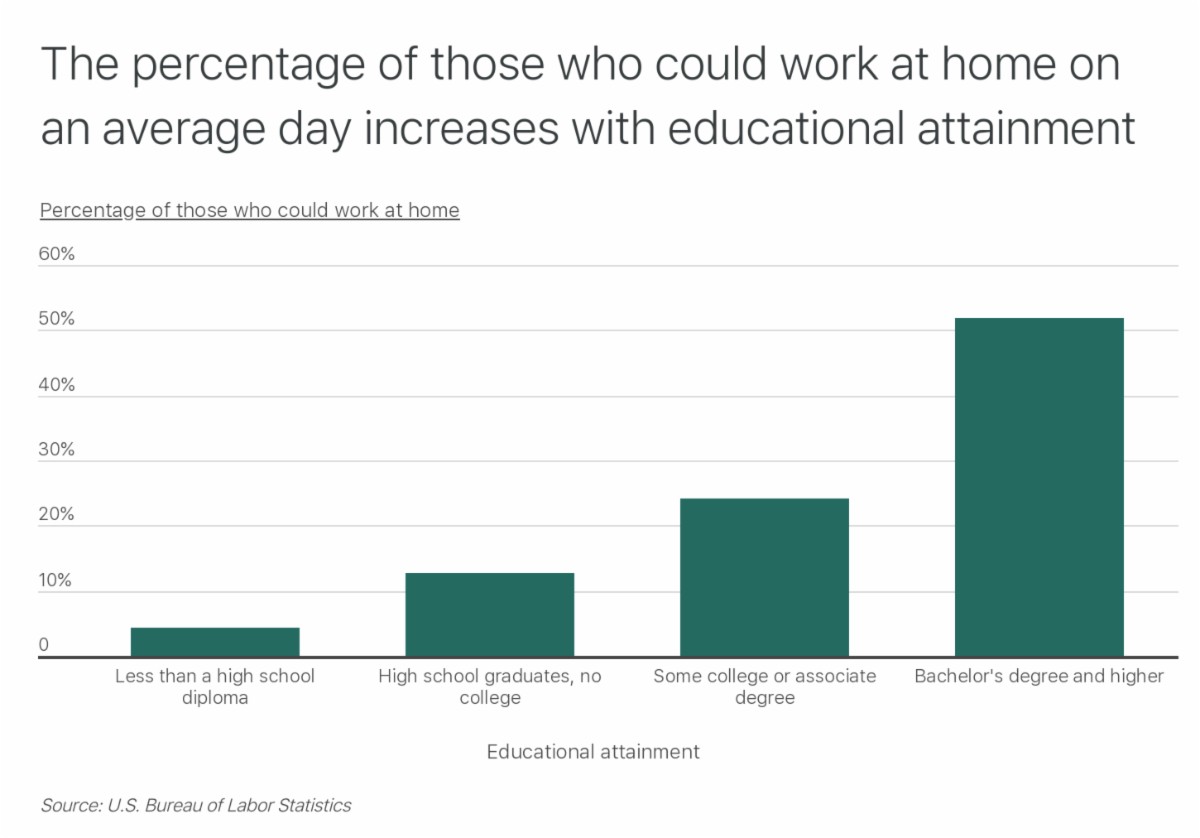
    As it turns out, educational attainment is a strong predictor of the ability to work remote. Citing responses provided in the annual American Time Use Survey (ATUS), the BLS discovered that the percentage of workers who could do at least some work from home on an average day increases significantly based on educational attainment. While less than 5 percent of workers who did not finish high school report being capable of doing some work from home, more than 50 percent of those with a bachelor’s degree or higher could.

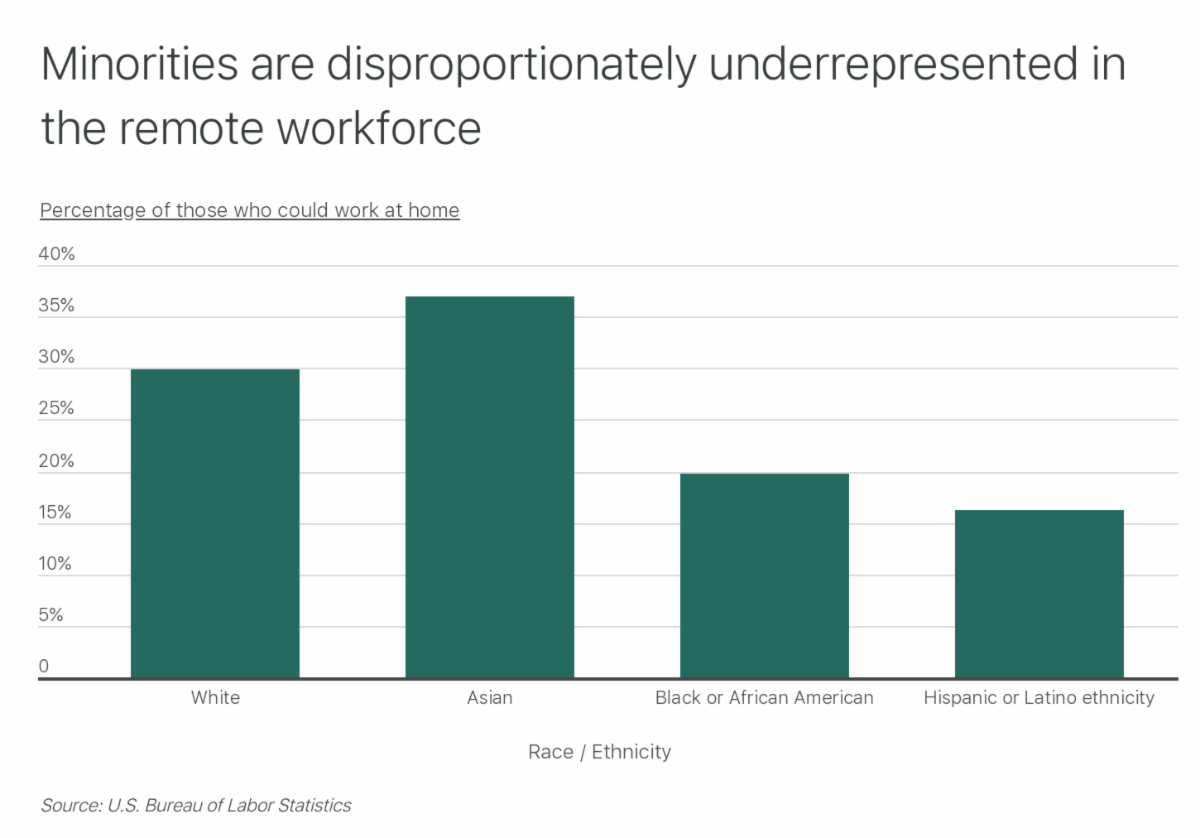
    Educational attainment is not the only predictive measure of remote work. The ATUS found that certain minorities were disproportionately underrepresented in the potential remote workforce. Overall, only 16.2 percent of Hispanic or Latino workers and 19.7 percent of Black or African American workers report being able to do some of their work from home compared to 29.9 percent and 37 percent of White and Asian workers, respectively. In addition to occupation, living arrangements—including access to computers and broadband internet—may impact the ability of many minorities to work remotely. Pew research found that prior to the pandemic, only 57 percent of Hispanics and 58 percent of Blacks had access to a computer at home compared to 82 percent of Whites.

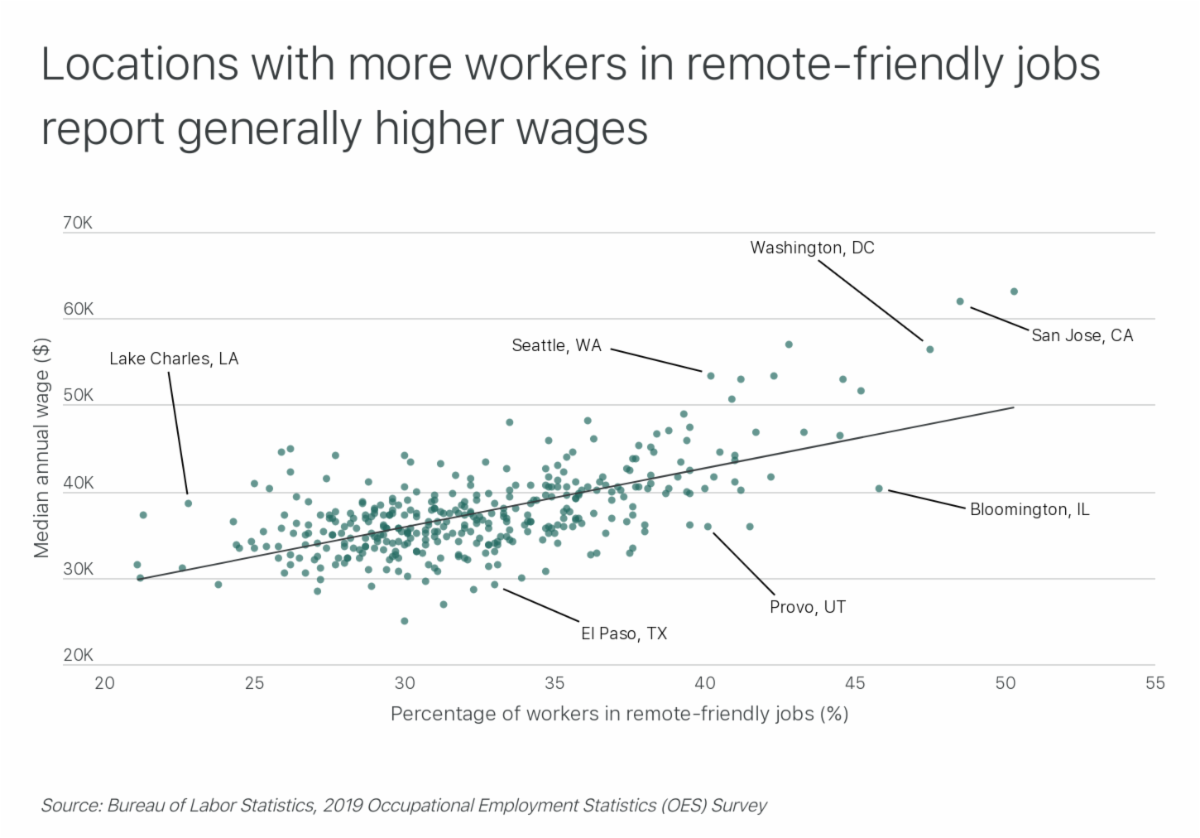
    The ability to work from home has not only kept millions of Americans employed this year, remote work is also financially rewarding. While remote jobs make up 35.5 percent of all U.S. employment, they account for 45.8 percent of all U.S. wages. As a result, locations throughout the country with higher percentages of workers in remote-friendly occupations report generally higher median annual wages.

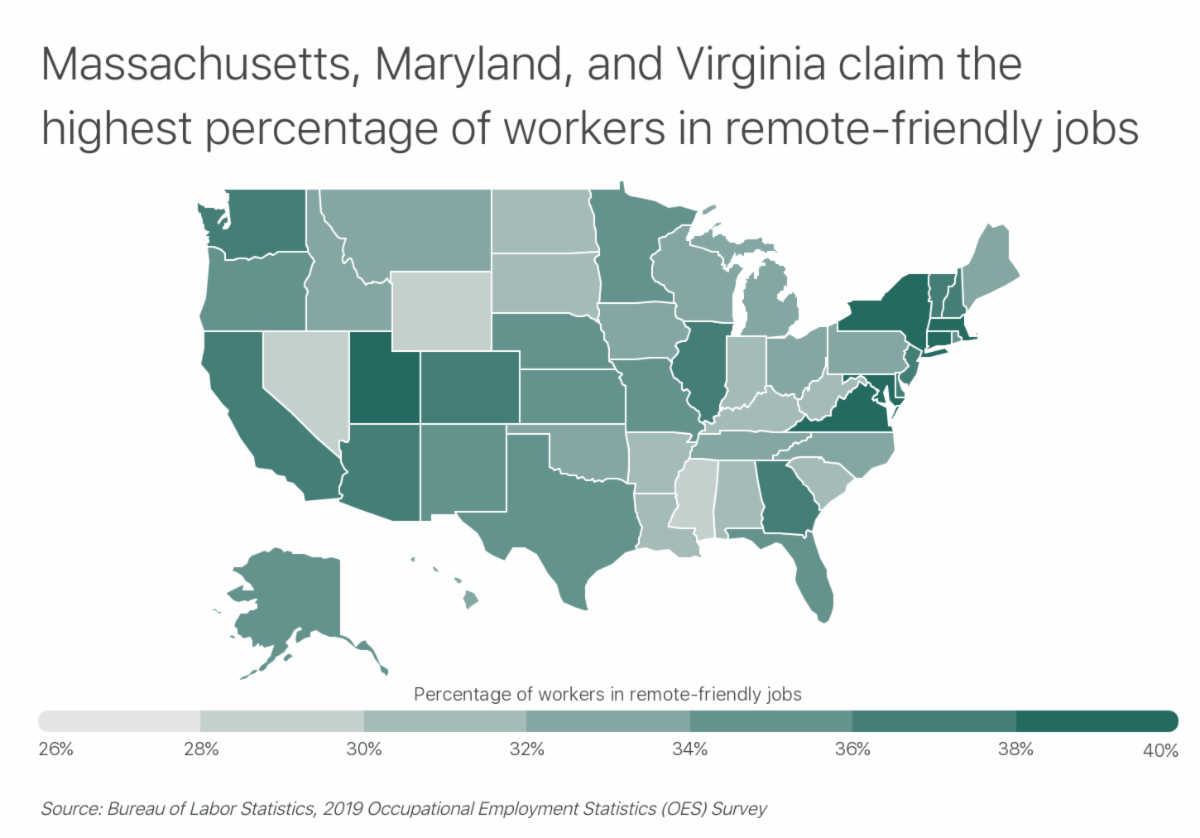
    The prevalence of remote work varies significantly at the state level. Massachusetts, Maryland, and Virginia top the list of states with the highest percentage of workers in remote-friendly jobs, reporting 40.2 percent, 39.6 percent, and 38.9 percent, respectively. Utah, Colorado, Washington, and California also show high percentages, all ranking in the top 10. The lowest percentage of workers in remote-friendly jobs—just 29.7 percent—is in Mississippi.

    To find the states with the most remote-friendly jobs, researchers at Outdoorsy analyzed the most recent employment data from the BLS’s 2019 Occupational Employment (OES) Survey. A work-from-home measure that rates an occupation’s viability for remote work created by the Booth School of Business at the University of Chicago was used to calculate the percentage of workers in remote-friendly jobs in each metro. Researchers ranked states accordingly. The report also includes the total number of workers in remote-friendly jobs, the median annual wage, the population with a bachelor’s degree or higher, and the minority population share of each location.

    The analysis found that in Ohio, 33.7% of all wage and salary workers have a remote-friendly job, defined for the purposes of this analysis as being a job that can be performed entirely remotely. Out of all U.S. states, Ohio has the 20th lowest percentage of workers in remote-friendly jobs. Here is a summary of the data for Ohio:

    • Percentage of workers in remote-friendly jobs: 33.7%
    • Total workers in remote-friendly jobs: 1,833,629
    • Median annual wage: $38,560
    • Population with a bachelor’s degree or higher: 29.3%
    • Minority population share: 20.8%

    For reference, here are the statistics for the entire United States:

    • Percentage of workers in remote-friendly jobs: 35.5%
    • Total workers in remote-friendly jobs: 52,108,014
    • Median annual wage: $39,810
    • Population with a bachelor’s degree or higher: 33.1%
    • Minority population share: 38.9%

    For more information, a detailed methodology, and complete results, you can find the original report on Outdoorsy’s website: https://www.outdoorsy.com/blog/top-remote-friendly-cities

    Read the profiles of the Large metros with the highest percentage of workers in remote-friendly jobs

  • Donations can be dropped off at RP Diamond Printing & Embroidery

    Donations can be dropped off at RP Diamond Printing & Embroidery

    Promoted Post

    Loveland, Ohio – RP Diamond Printing & Embroidery and Jarvis Global Investments are once again collecting NEW and UNWRAPPED TOYS along with CANNED GOODS to donate to the LIFE Food Pantry.

    Donations can be dropped off at RP Diamond Printing & Embroidery located at 368 Loveland-Madeira Rd. Monday-Friday 11:00-6:00, Saturday 11:00-3:00. We will be collecting now through Saturday, December 19.

    If you prefer a curbside drop off just pull up out front and give us a call at 513-583-8447 and we will be glad to come out and accept your donation.

    David Terry says, “Happy Holidays from all of us here at RP Diamond and Jarvis Global Investments.”

  • 14 new positive cases of COVID-19 in Loveland schools

    14 new positive cases of COVID-19 in Loveland schools

    Loveland, Ohio – The Loveland City School District today reported 14 new positive cases of COVID-19.

    • On 12/4/20, a teaching staff member at Loveland High School, last at school on 12/2/20;
    • On 12/5/20, a non-teaching staff member at the Loveland Early Childhood Center, last at school on 12/4/20;
    • On 12/5/20, a student at Loveland Elementary School, last at school on 12/2/20;
    • On 12/5/20, a student at Loveland Middle School, last at school on 12/2/20;
    • On 12/5/20, a student at Loveland Middle School, last at school on 12/2/20;
    • On 12/6/20, a student at Loveland High School, last at school on 11/30/20;
    • On 12/7/20, a teaching staff member at the Loveland Early Childhood Center, last at school on 12/1/20;
    • On 12/7/20, a student at Loveland Elementary School, last at school on 12/4/20;
    • On 12/7/20, a student at Loveland Intermediate School, last at school on 12/4/20;
    • On 12/7/20, an non-teaching staff member at Loveland Middle School, last at school on 12/4/20;
    • On 12/7/20, a teaching staff member at Loveland Middle School, last at school on 12/4/20;
    • On 12/7/20, a student at Loveland Middle School, last at school on 12/2/20;
    • On 12/7/20, a teaching staff member at Loveland High School, last at school on 12/1/20; and
    • On 12/7/20, a student at Loveland High School, last at school on 12/1/20.

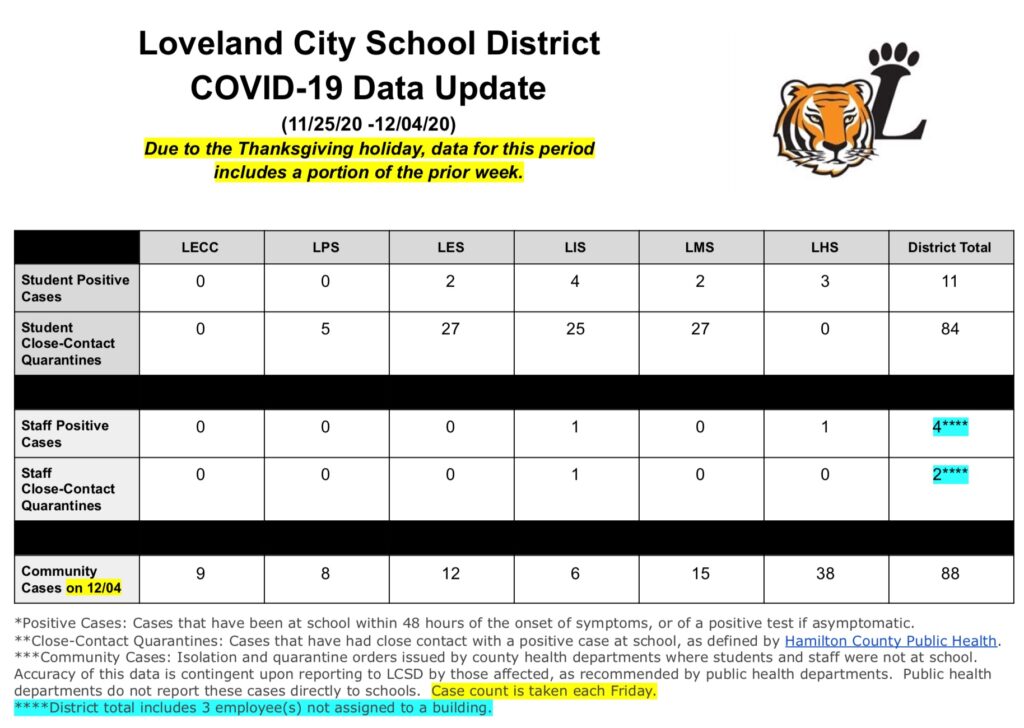
    The report does not say how many students or staff are in quarantine. The District has refused to list quarantines on a daily basis and only release the number on Fridays. Today, Loveland Magazine repeated our request for these numbers.

    Here is that data from Last Friday:

    Last Friday the District announced that during the next few weeks, some school buildings may have to temporarily switch to remote learning because of staff absences.

    Read:

    District responds to staff shortage by adopting shorter quarantine period

    Loveland District says staff absences may cause last-minute notice of school closing

  • BREAKING: Portion of Kemper Road will be closed Tuesday morning

    BREAKING: Portion of Kemper Road will be closed Tuesday morning

    Symmes Township, Ohio – Eric J. Beck, Hamilton County Engineer, just announced a full road closure on Kemper Road between Loveland Madeira and Twightwee Road in Symmes Township.

    Indiana Ohio Railway will be repairing the railroad track on Tuesday, December 8, between the hours of 8 AM and – 6 PM (weather permitting).

    The contractor’s detour route will be from Kemper – Loveland Madeira – South Riverside – Kemper and vice versa.

    Any problems/questions should be directed to Geoff Reeder (330) 749-1906 with Indiana Ohio Railway or Dan Jones at (513) 946-8430 with the Hamilton County Engineers.


    If you appreciate these kinds of heads ups that might make your daily life better, please consider sending a donation to keep them coming your way. There are many behind the scene expenses that make these stories possible. These kinds of reports are FREE for you, however, they are not CHEAP for Loveland Magazine to publish.

  • That’s a wrap!: Miami Trails’ Drive-Through Holiday Toy Drive

    That’s a wrap!: Miami Trails’ Drive-Through Holiday Toy Drive

    Miami Township, Ohio – Today, the Neighborhood Network of Miami Trails’ held their first ever drive-through toy drive benefiting local children through Loveland’s LIFE Food Pantry.

    Nicole Kormos said this afternoon, “That’s a wrap! It was a busy but successful day.”

    The event was specially designed to offer the subdivision neighbors a “COVID-friendly” family giving experience for the holidays. Neighbors came through a convenient drop-off line to give their un-wrapped gift donations and dollars, receive some fun holiday goodies including hot chocolate, candy canes, reindeer treats, and waved to Santa. His wife was there too.

    “Overall, we had more than 60 families donate around 150 new toys that will benefit Loveland’s LIFE Food Pantry,” said Kormos.

    The neighbors used  SignUpGenius to select a child’s age and gender so everyone knew which age appropriate gifts to shop for and so there would’t be too many duplicates. It was sort of a Dear Santa letter with a wish list to shop from.

    Learn more about the LIFE Food Pantry and how you too can help.

    Photos provided by Nicole Kormos

  • Ohio announces initial vaccine plan

    Ohio announces initial vaccine plan

    By Marty Schladen and Ohio Capital Journal

    If approvals go according to plan, Ohio will get more than a half-million doses of coronavirus vaccine between Dec. 15 and the end of the month, Gov. Mike DeWine said on Friday.

    While more than expected, the amount is far from adequate in a state with a population approaching 12 million.

    “The race has started and it’s started in a very robust way,” said Bruce Vanderhoff, medical director for the Ohio Department of Health.

    Even so, officials had to make some painful choices about who would be first in line for a first dose, to be followed by a booster either three or four weeks later, depending on the vaccine, DeWine said. 

    That means prisons and jails, where inmates and staff have been dying of covid since the start of the pandemic, will not be among the first to be vaccinated. Nor will service workers such as grocery store clerks, who potentially are exposed to the virus every day.

    “We have not gotten beyond (determining who will be in the first group) but the goal will be to save the most lives,” DeWine said on a day when more than 10,000 new coronavirus cases and 129 more deaths were reported.

    Among those in the first group will be:

    • Health care workers and staff caring for covid patients
    • Emergency medical responders
    • People with underlying health conditions living close to each other and their caregivers. They include people and workers in nursing homes, assisted living centers, veterans homes and the like.

    DeWine stressed that the exact number of doses won’t be known until the week they’re due to arrive. He added that as initial rounds are doled out, they’ll be paired with boosters to be sent later.

    Joseph Gastaldo, director of infectious diseases at OhioHealth, said the vaccines awaited in Ohio are being made by Pfizer and Moderna. They still are awaiting final approval by independent panels of experts working under the auspices of the U.S. Food and Drug Administration and the Centers for Disease Control and Prevention. That approval is expected in the next two weeks.

    Approvals of other vaccines are hoped for, but there are a few factors that make it hard to predict when a big enough portion of the Ohio population will have been vaccinated to it difficult for the virus to spread.

    One is that about half of Ohioans are reluctant to get it, DeWine said. He said he hopes public information campaigns and news of the vaccines’ safety and efficacy will counteract the skepticism.

    Also, it’s unclear what other vaccines might be coming online, how quickly, or how fast production and distribution can be scaled up. Add those together and it’s uncertain when average folks can line up for a shot in the arm.

    “I don’t think anyone knows that,” DeWine said.

  • District responds to staff shortage by adopting shorter quarantine period

    District responds to staff shortage by adopting shorter quarantine period

    Loveland District says staff absences may cause last-minute notice of school closing

    Loveland, Ohio – In a news release issued this afternoon, the Loveland School District said that during the next few weeks, some school buildings may have to temporarily switch to remote learning because of staff absences.

    The District said in the release, “This year it has become challenging to find substitute teachers, and we may run short on staffing due to COVID-19 cases or quarantines.” If this happens, a switch to remote learning will happen on a school-by-school basis. The District said they are trying to plan ahead so that families can plan ahead, however, these changes may happen as late as the morning of scheduled attendance.

    They suggest that parents and caregivers should begin considering how they might handle a possible late-notice class cancelation.

    The District said they will notify families as “quickly as possible” about closings through their alert notification system, the website, Facebook (Loveland City Schools), and Twitter (@lovelandtigers) pages.

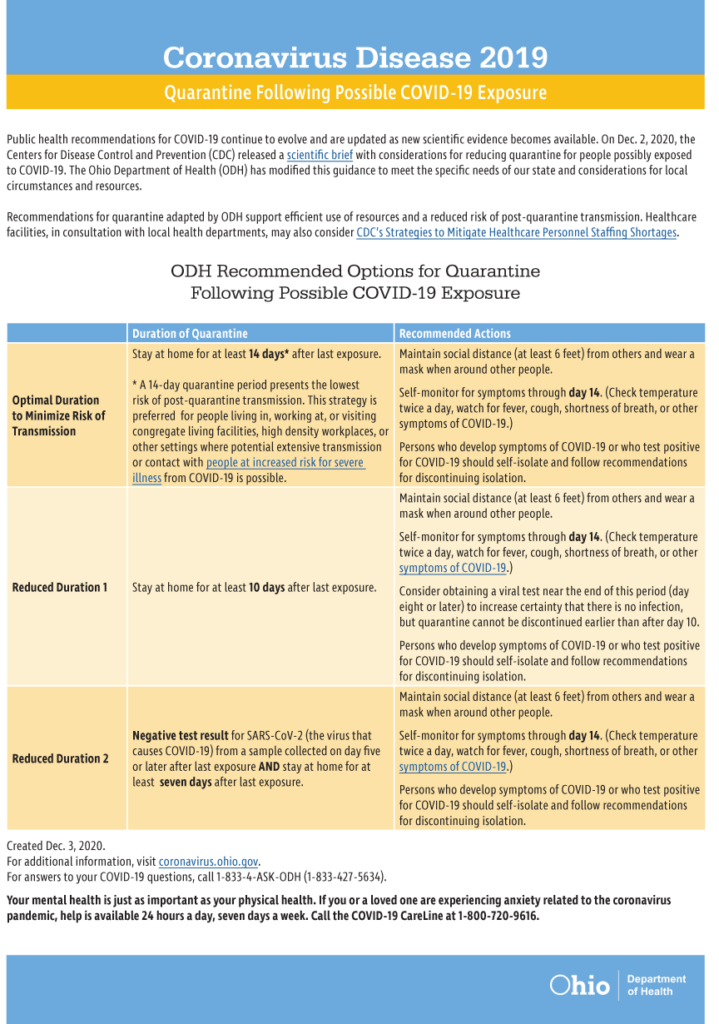
    CDC still recommends 14 days however District adopts a less restrictive “acceptable alternative” quarantine period

    The Centers for Disease Control and Prevention (CDC) announced a change in guidance for quarantines. The new guidance shortens the quarantine period for someone who has been exposed to a positive COVID-19 case. The Ohio Department of Health has also adopted the new CDC guidelines, as has Hamilton County Public Health. 

    The District said in the release that the new less restrictive guideline notification came to them late today. They will begin implementing those directives and will personally notify families affected.

    The Centers for Disease Control and Prevention announced new quarantine guidelines for people who were exposed to coronavirus, reducing the length of time from 14 days to 10 days without symptoms or seven days with no symptoms and a negative test. Officials said the shorter time period is intended to encourage more people to quarantine.

    Ohio Department of Health Chief Medical Officer Dr. Bruce Vanderhoff said today, “Staying home for 14 days after contact is still the safest way to limit possible spread of COVID-19. We continue to recommend this time period for people in congregate living facilities, such as nursing homes; in workplaces with a large number of employees; and in other settings in which COVID-19 could spread extensively.”

    Dr. Andy Thomas, chief clinical officer at The Ohio State University Wexner Medical Center, yesterday warned that “Ohio is not yet seeing the impact of gatherings that took place over Thanksgiving because hospitalizations are a lagging indicator. Symptoms generally develop within 10 days of transmission, and hospitalizations typically occur a week after diagnosis.”

    According to CBS News the CDC rationale for the less restrictive guidelines is:

    “Reducing the length of quarantine may encourage more people to do so, especially when they may not be able to work during quarantine time,” CDC’s COVID-19 Incident Manager, Dr. Henry Walke, told reporters on a call Wednesday. He said the agency still recommends 14 days, but is now offering two “acceptable alternative quarantine periods.” 

    According to the District, “We are pleased with these new recommendations from an educational perspective. Our goal is to keep students learning in our school buildings and shortening the required quarantine time is key.”

    This is the District’s COVID 19 Dashboard published today:

    On 12/03/20, the district was notified that a non-teaching, non-school-based staff member tested positive for COVID-19. This staff member was last at work on 11/30/20.

    On 12/03/20, the district was notified that a student at Loveland Intermediate School tested positive for COVID-19. This student was last at school on 11/18/20.

    On 12/03/20, the district was notified that a student at Loveland Middle School tested positive for COVID-19. This student was last at school on 11/18/20.

    On 12/04/20, the district was notified that a student at Loveland Elementary School tested positive for COVID-19. This student was last at school on 11/30/20.

    On 12/04/20, the district was notified that a student at Loveland Intermediate School tested positive for COVID-19. This student was last at school on 12/02/20. 

    On 12/03/20, the district was notified that a student at Loveland Intermediate School tested positive for COVID-19. This student was last at school on 12/01/20.

    On 12/02/20, the district was notified that a teaching staff member at Loveland Intermediate School tested positive for COVID-19. This staff member was last at school on 11/24/20. No close contacts were identified for this confirmed case.

    On 12/02/20, the district was notified that a student at Loveland Elementary School tested positive for COVID-19. This student was last at school on 11/30/20.

    On 12/1/20, the district was notified that a non-teaching staff member at Loveland High School tested positive for COVID-19. This staff member was last at work on 11/18/20. No close contacts were identified for this confirmed case.

  • Ohio and Loveland Area coronavirus picture darkens rapidly

    Ohio and Loveland Area coronavirus picture darkens rapidly

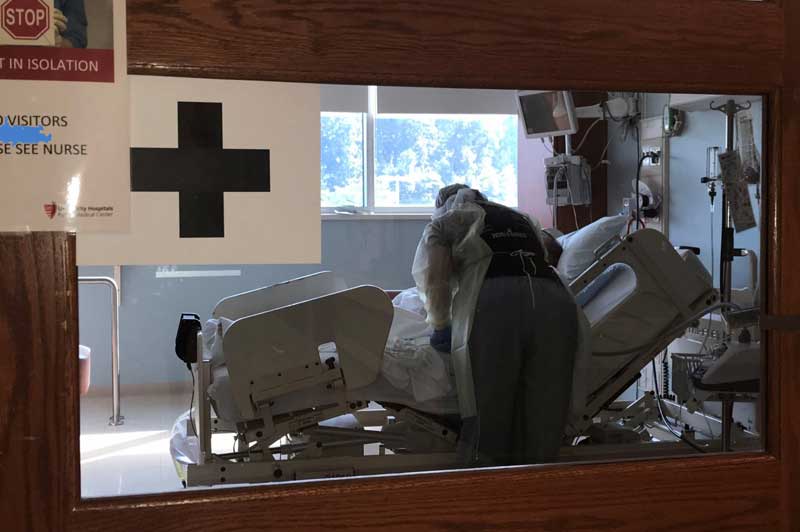
    Medical staff tend to a COVID-19 patient. Courtesy of University Hospitals

    By Marty Schladen and the Ohio Capital Journal

    By many measures, the Ohio coronavirus pandemic is quickly worsening — and that’s before any of the effects of holiday travel and visiting are factored in.

    Thursday saw almost 9,000 new cases in the state, with almost 400 new hospitalizations due to COVID-19 and 82 more dead, bringing the toll throughout the pandemic to 6,753.

    Also, with 33 new admissions to Ohio intensive-care units, the state now has more than 1,200 coronavirus patients in those beds, many for long stretches.

    “That’s been one of the biggest concerns around the state right now,” said Andrew Thomas, chief clinical officer at Ohio State’s Wexner Medical Center. “The hardest area for hospitals to increase their capacity or increase the number of beds is in their intensive care unit.”

    “In those intensive care units, right now one out of every three patients has covid,” Thomas said. “If that number continues to grow, that is going to crowd out the ability of non-covid patients to get the care they need in the intensive care unit. Hospitals do not have the capacity to in unending ways grow the number of ICU beds that they have.”

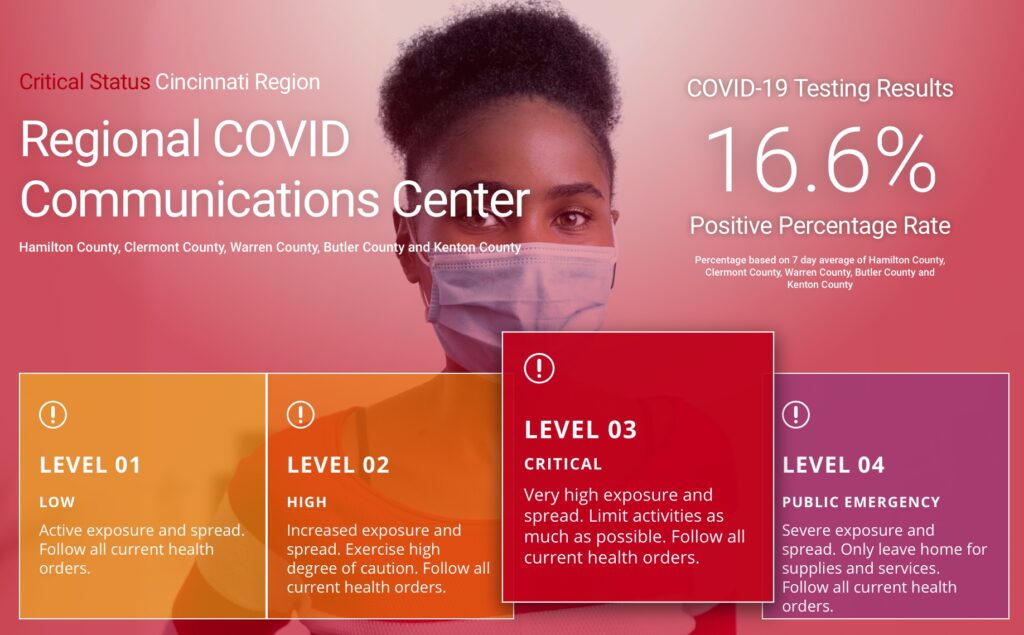
    Even worse, perhaps, is that as the number of Ohioans who are tested for coronavirus rises, the percentage of positive results is also rising — to alarming levels. That means the spread of the disease is snowballing instead of levelling off.

    On Tuesday, 16.1% of the 53,000 tested came back positive for the virus, the highest positivity rate since mid-April. Back then, fewer than 5,000 tests a day were available, so they were more likely to be used for people displaying obvious symptoms of the disease.

    That and other data combine to show the inexorable march of the disease across Ohio.

    The increasing positivity rate prompted Gov. Mike DeWine to add Ohio to the list of states that he warned people not to travel to.

    “We warn people about going to any state with above 15% positivity,” DeWine said. “Now we’re one of those states.”

    In a press conference hosted by the governor, Thomas and other health officials warned that hospitals across the state already are canceling non-emergency procedures such as knee replacements and diagnostics to keep strained capacity and overworked staff from being overwhelmed by the pandemic. 

    And the expected surge from Thanksgiving isn’t even showing itself yet.

    Thomas explained that from the time of exposure to the onset of symptoms is usually three to 10 days, while the time from exposure to hospitalization is typically seven to 14 day. So that window only began to crack open on Thursday.

    “The surge that you’re seeing is not about Thanksgiving,” Thomas said.

    When Thanksgiving-related cases begin showing up at hospitals, their numbers are likely to be large. Federal officials reported that record numbers of Americans traveled for the holiday despite admonitions to stay home.

    Top U.S. health officials also are forecasting a dire few months ahead — even though vaccines are expected to start flowing in a few weeks, including an initial 98,000 doses to Ohio.

    On Wednesday, Centers for Disease Control and Prevention Director Richard Redfield said the United States might see more than half as many covid deaths over the next two months as we’ve seen over the previous nine.

    “The mortality concerns are real,” Redfield said. “And I do think unfortunately, before we see February, we could be close to 450,000 Americans (who) have died from this virus.”

    Redfield, DeWine and other officials have repeatedly implored Americans to protect themselves and others against the disease, but they’re up against fatigue and a powerful strain of coronavirus denial. 

    Despite Redfield’s warnings, the Trump White House and State Department both are planning large, indoor holiday gatherings. They’ll be replete with food and drink that will require attendees to remove masks — if they’re even wearing them. In previous White House superspreaders, masks were notoriously absent.

    In Ohio, DeWine on Thursday vetoed a bill passed by his fellow Republicans in the state legislature that would gut the governor’s ability to issue health orders in a pandemic. 

    The GOP-led Ohio House had already shot down a requirement that its members mask up while in the state Capitol.

    “Having essential strategies to protect the public against the spread of infectious, contagious disease is not only important in our efforts to eradicate COVID-19, but it is also necessary to help stop the spread of all infectious diseases and prevent future health crises in Ohio,” DeWine said in his veto message.

    However, Senate President Larry Obhof said he has the votes to override DeWine’s veto.

    Altogether, it would appear that we’re in for a long, painful winter.

    “This is not the beginning of the end,” Thomas said. “This is not even the end of the beginning. We are really in a difficult spot here.”