Author: Loveland Magazine

  • Ohio might have performed its last execution

    Ohio might have performed its last execution

    By Marty Schladen and Ohio Capital News

    Gov. Mike Dewine’s latest statement on lethal injections could mean the Ohio death house has seen its last execution.

    The state hasn’t executed anybody since July 2018, when convicted killer Robert Van Hook wheezed and gasped as he died on a gurney at the Southern Ohio Correctional Facility outside Lucasville.

    DeWine, who took office the following January, started canceling executions late that month after a federal magistrate compared Ohio’s three-drug protocol to waterboarding and wrote that experts convinced him that one of the drugs “would feel as though fire was being poured” into a prisoner’s veins.

    The 6th U.S. Circuit Court of Appeals later ruled that Ohio’s lethal injection protocol is constitutional, but by that time publicity surrounding the issue prompted drug makers to step up their pressure on the state to stop using their products in executions. DeWine has cancelled all subsequent executions as drug makers have threatened not to sell the state drugs for any purpose if they kept ending up in the death chamber.
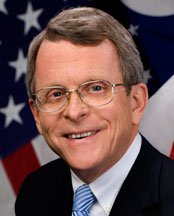
    Ohio Governor Mike DeWine

    On Tuesday, DeWine told the Associated Press that lethal injection as an execution method was no longer an option for Ohio.

    The comment was greeted enthusiastically by groups seeking to stop the death penalty.

    “We’re living in such a politically divisive climate nationally and in state, but the left, right, and everyone in between can agree on one thing: the death penalty is irreparably flawed,” Hannah Kubbins, executive director of Ohioans to Stop Executions, said in an email. “Governor DeWine’s comments were big news, but it’s also common sense that the death penalty doesn’t work to deter crime or keep communities safe — we know this. The death penalty is purely security theater and no longer aligns with Ohio’s values.”

    The death penalty has fallen out of favor in some conservative circles as 170 people on death row have been shown to be innocent, it is disproportionately used against minorities, and its application can have more to do with who’s prosecuting the case than the severity of the offense.

    Legislative action in Ohio on Wednesday might be a sign of changing conservative attitudes. The GOP-controlled Ohio Senate overwhelmingly passed a bill that would prohibit using the death penalty against people deemed to be mentally ill at the time they kill.

    A national group of conservatives opposed to the death penalty praised DeWine for taking lethal injections off the table — at least while he’s in office.

    Hannah Cox

    “We continue to applaud Governor DeWine’s strong conservative leadership and are excited to see the groundswell of support especially among Republicans — for ending this failed system in the state of Ohio,” Hannah Cox, national manager of Conservatives Concerned about the Death Penalty, said in an email.

    As lethal injections become more problematic, DeWine has few alternatives — even if he wanted to employ them.

    “All indications are that Gov. DeWine is not pushing for alternative methods,” said Robert Dunham, executive director if the Death Penalty Information Center. “I think (DeWine’s Tuesday statement) is a very significant development.”

    Some states have alternative methods on their books.

    In December 2019, as Tennessee executed a man in the electric chair, witnesses said they saw smoke or steam rising from his head. When another man was electrocuted there in February, witnesses didn’t make any similar reports, but nationally, no other state has used the electric chair since 2013.

    Utah still has death by firing squad on its books, but that state hasn’t executed anybody in more than a decade.

    Oklahoma, Alabama and Mississippi allow for executions using nitrogen gas to suffocate a prisoner but Dunham said that, as with death drugs, manufacturers have been unwilling to supply the gas for that use.

    “We’re essentially looking at a process in which the market has opted out,” Dunham said of businesses’ unwillingness to participate. “Nobody wants to be seen as participating in killing people.”

    Nobody, that is, other than the Trump administration.

    As the coronavirus pandemic took hold, no states conducted executions since the summer. Meanwhile, no federal prisoners had been executed since 2003. But on July 14, the first of eight were executed at the federal prison in Terre Haute, Ind. 

    The men were killed with an injection of pentobarbital, which Dunham said the government obtained from an unnamed compounding pharmacy.

    Another federal prisoner is slated for execution today (Thursday), and another for Friday.
  • History Thursday: Ohio headlines from the last year Ohio State-Michigan didn’t play

    History Thursday: Ohio headlines from the last year Ohio State-Michigan didn’t play

    By Tyler Buchanan and Ohio Capital Journal

    A winter without an Ohio State-Michigan football game is, well, it’s like hot soup without a spoon. It’s like an Ohio highway without orange barrels. 

    “I know that life in Ohio is not complete without the glory of Ohio State football and other football,” President Trump told supporters in Circleville.

    The rivalry is older than the Circleville Pumpkin Show. The two teams first played in 1897 and competed in most years over the next decade or two, though they took several years off during World War I.

    Starting in 1918, though, the Buckeyes and Wolverines faced off in every season thereafter. Until this year. A yearly tradition that began the year of the Spanish flu pandemic ends the year of the COVID-19 pandemic. 

    The streak of playing 102 years in a row predates Kewpee burgers in Lima and Skyline chili in Cincinnati. It predates the construction of the Cedar Point causeway in Sandusky and the Terminal Tower in Cleveland.

    It even predates the founding of the NFL in Canton.

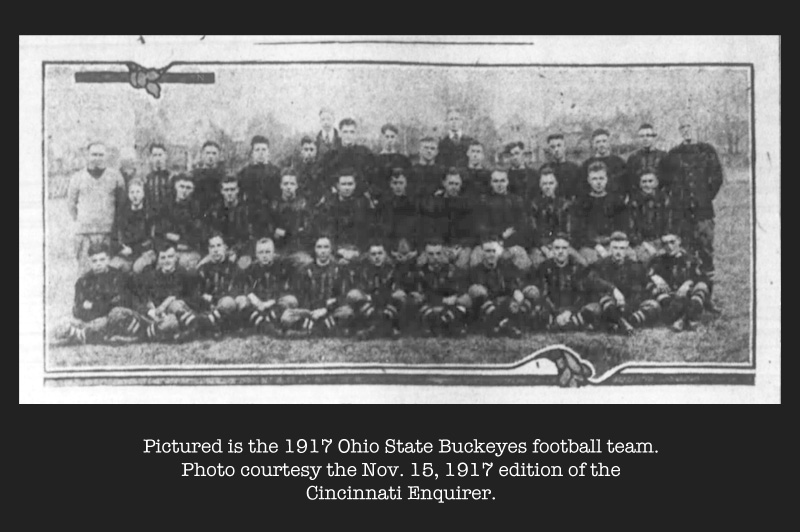
    Life was different in 1917, the last year the two teams didn’t play. Let’s look at a few news storylines from that year:

    Darke County newspaper: Ohio lawmakers are stupid

    The Greenville Journal in western Ohio offered a rather provocative headline on March 15, 1917: “General Assembly Noted As Peculiar.” The subheadline: “Legislature, Taken in the Aggregate, Is Below Average Ohio Body in Intellectual Force.”

    Newspapers weren’t nearly as polite back then.

    Dr. Clarence Maris, a Columbus physician and political writer, offered an explanation as to why the 1917-18 Ohio General Assembly was, in his view, lacking in intelligence. 

    “(M)any of the Democrats elected in normally Republican counties or senatorial districts were thought by the party managers to have no chance for election,” Maris wrote,” and men were put up to be sacrificed, but the (Woodrow) Wilson peace wave carried them into office.”

    Maris went on to list a number of legislative projects undertaken by the legislature to back up his claim. In defense of Ohio’s lawmakers from the 1910s, Maris made a lot of wild claims. A decade later, the New York Times quoted him as saying Ohio State University was rife with communism and that the “youth movement” at OSU was controlled by Moscow. 

    Ohio overhauls its statewide health authority

    The above Greenville Journal paper had another noteworthy article on March 15 in a separate column called “News Culled In The Capital.”

    The Ohio House of Representatives had just voted to abolish the state board of health. Instead, lawmakers wanted to have a singular state health commissioner run the show, which would be aided by an advisory council. Governor James Cox supported the move. 

    The reason for this change? The Marion Star reported the health board “has been in the limelight repeatedly during the last year because of internal dissensions.”

    The Lima Times-Democrat reported that “too much bickering” from the seven health board members made them the “subject of considerable criticism.” The newspaper continued: “The health commissioner, to be chosen by the council, with the governor’s approval, will be endowed with administrative and executive powers.”

    The new law specified the commissioner had to be a physician and be skilled in sanitary science. The term would be for five years. Dr. A. W. Freeman of Cincinnati was chosen in September 1917 to be the first state health commissioner.

    New Cleveland Indians pitcher paid a pretty penny

    Team owner Jim Dunn made a big bet in signing pitcher Joe Wood ahead of the 1917 season.

    This illustration of “Smoky” Joe Wood printed in a 1917 edition of the Sandusky Star-Journal.

    After all, Dunn paid $15,000 for his prized new hurler. 

    “Smoky” Joe Wood, formerly of the Boston Red Sox, didn’t pitch in 1916. But the Tribe hoped he would return to form in ‘17.

    “Tris Speaker, Wood’s former teammate and close friend, has said that he believes Joe is in as good of shape as he ever was,” the Sandusky Star-Journal reported. “But of course till Wood shows the goods on the diamond the deal is completely a gamble.”

    For reference, a century later, Cleveland Indians star Carlos Santana was paid $20,333,333 for the 2019 season. He came to bat 686 times that year, earning $29,640 per plate appearance.

    In essence, Santana earned “Smoky” Joe Wood’s 1917 salary twice over every time he stepped in to hit.

  • Brown, Warner lead Senate colleagues in calling for equity in vaccine distribution

    Brown, Warner lead Senate colleagues in calling for equity in vaccine distribution

    Coordination with the CDC Advisory Committee on Immunization Practices Recommendations Will Ensure Access to Vaccines for Minority Communities and Other Groups at Disproportionate Risk to Covid-19

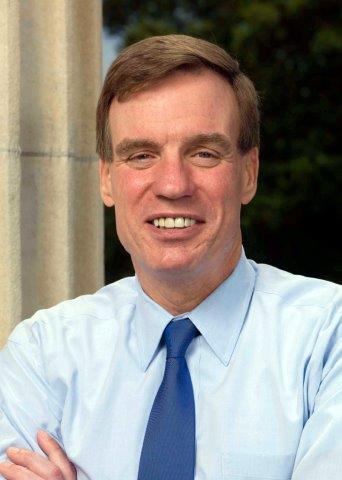
    Washington, D.C. – As the Food and Drug Administration’s (FDA) independent vaccine review panel meets to consider the emergency use authorization of an initial COVID-19 vaccine, U.S. Sens. Sherrod Brown (D-OH) and Mark Warner (D-VA) led eight of their colleagues in urging Health and Human Services (HHS) Secretary Alex Azar and Centers for Disease Control and Prevention (CDC) Director Robert Redfield to ensure a fair and equitable vaccine distribution.

    The letter follows HHS Secretary Azar’s comments that states should decide who gets the first round of the federally approved COVID-19 vaccine, which could lead to a patchwork of varying distribution plans and affect vaccine access for minority and high-risk populations disproportionately impacted by the virus. The senators’ letter calls on federal health officials to provide more support to states so that they fully understand and appropriately implement expert guidelines ensuring equity. 

    Mark Warner (D-VA)

    “We are writing to urge the Department of Health and Human Services to ensure a fair and equitable distribution of a COVID-19 vaccine by working closely with states to understand and appropriately implement COVID-19 vaccine distribution recommendations made by the Centers for Disease Control and Prevention’s (CDC) Advisory Committee on Immunization Practices (ACIP). As we approach potential emergency use authorization by the Food and Drug Administration for one or more COVID-19 vaccines, it is essential that we do everything we can to ensure access to the vaccine for communities and populations hit hardest by the pandemic,” wrote the senators to HHS Secretary Azar and CDC Director Redfield.

    The CDC’s Advisory Committee on Immunization Practices (ACIP) is a 15-member panel comprised of leading medical and public health experts with a focus on the fields of immunization practices and public health. The Advisory Committee reports to the CDC Director and is responsible for developing evidence-based public health recommendations for the safe and ethical use of vaccines. In the case of COVID-19, where initial supplies of a vaccine will be limited, ACIP will make recommendations to ensure the vaccine is equitably distributed. Historically, states and localities – in coordination with federal health authorities – use ACIP recommendations to develop their vaccination strategies. Ohio plans to incorporate recommendations from ACIP to plan and execute its vaccine distribution program.

    In their letter, the senators also underscore how the COVID-19 crisis has continued to disproportionately affect older Americans, communities of color, and essential workers. In many cases, these disparities have been exacerbated by factors like overrepresentation in front-line jobs, higher rates of chronic disease, inequitable access to health care, and longstanding bias within the health care system itself.

    The senators also urge that HHS and CDC work closely with state and local officials to ensure they fully understand and implement ACIP’s recommendations in a manner that prioritizes public health, equity, and the wellbeing of vulnerable communities.

    Sens. Brown and Warner were also joined on the letter by Sens. Michael Bennet (D-CO), Angus King (I-ME), Cory Booker (D-NJ), Maggie Hassan (D-NH), Tammy Duckworth (D-IL), Bob Menendez (D-NJ), Jeff Merkley (D-OR) and Richard Blumenthal (D-CT).

    A copy of the letter can be found here.

  • From 16-year-old ride operator to GM: Meet Tony Carovillano from Loveland, Ohio

    From 16-year-old ride operator to GM: Meet Tony Carovillano from Loveland, Ohio

    Loveland, Ohio – Tony Carovillano graduated from Loveland High School in 1987.

    Mother-in-law Lynne McManus Lee told Loveland Magazine this morning, “Our family is so proud of him. He’s one of the best!”

    FROM 16-YEAR-OLD RIDE OPERATOR TO GM: MEET TONY CAROVILLANO

    As the vice president and general manager of Worlds of Fun, Tony Carovillano is responsible for leading the operation of the park’s 235 acres and all of its rides and slides. His day typically starts at the front gate where he welcomes ambassadors and guests. From there, he bounces around attending meetings, checking on projects, leading his directors and planning for upcoming events. The day usually stretches past 8 hours, and the workweek almost always stretches beyond five days, but just as Tony did when he started – he relies on the energy of the park to keep him going.

    For the past 35 years, amusement parks have been Tony’s life. He fell in love with the industry soon after he started as a train conductor at Kings Island in Mason, Ohio outside of Cincinnati. He was 16, and he’s been along for the ride ever since that whistle blew.

    Working on the Railroad at Kings Island

    After turning 16, it was time for Tony to get a job. To his delight, he was hired to work in rides at Kings Island after his sister, who was a supervisor at the log flume, put in a good word for him. Decked out in his train conductor uniform, Tony went to work on the K.I. & Miami Valley Railroad.

    Read the full feature on Tony in…


  • First COVID 19 Vaccine Should Be Administered in Cincinnati Area In…

    First COVID 19 Vaccine Should Be Administered in Cincinnati Area In…

    [wpdevart_countdown text_for_day=”Days” text_for_hour=”Hours” text_for_minut=”Minutes” text_for_second=”Seconds” countdown_end_type=”date” end_date=”15-12-2020 08:28″ start_time=”1607606561″ end_time=”0,1,1″ action_end_time=”hide” content_position=”center” top_ditance=”10″ bottom_distance=”10″ countdown_type=”button” font_color=”#000000″ button_bg_color=”#3DA8CC” circle_size=”130″ circle_border=”5″ border_radius=”8″ font_size=”30″ countdown_font_famaly=”monospace” animation_type=””]First Vaccine Should Be Administered in Cincinnati Area[/wpdevart_countdown]
  • TONIGHT: “Family Wellness” parent seminar

    TONIGHT: “Family Wellness” parent seminar

    Wednesday, December 9th @ 7 PM

    LM/INT PTSA is hosting a parent seminar “Ending the Silence”

    Join here

    Enjoy this handout on Anxiety

    Presented by the National Alliance on Mental Illness (NAMI)

    “This engaging 1-hour presentation for parents helps us learn about the warning signs of mental health conditions, what steps to take if you or a loved one are showing symptoms of a mental health condition, as well as how to talk with your child and how to work with school staff.“

    The presentation includes two leaders: one who shares an informative presentation and a young adult with a mental health condition who shares their journey of recovery.

    Audience members can ask questions and gain understanding of an often-misunderstood topic.”

    With the current isolation and the upcoming holiday break, this is especially timely for many of our families.

    NOTE: to protect the young adult speakers, we are unable to record and re-share this event.

  • Huge Ohio Rivalry College Football Games Scheduled for Saturday are Canceled

    Huge Ohio Rivalry College Football Games Scheduled for Saturday are Canceled

    Cassie Mattia is the Associate Editor of Loveland Magazine and lives in Historic Downtown Loveland

    by Cassie Mattia

    Loveland, Ohio – Many college football fans across Ohio are devastated due to the announcement that was delivered by the American Athletic Conference and the Michigan Athletic Department on Tuesday that both the OSU vs. Michigan game and the Cincinnati vs. Tulsa game are officially canceled.

    Both rivalry games were scheduled for Saturday, December 12th, but because of the rise in positive COVID-19 cases in Cincinnati and in Michigan, it was advised by UC’s conference Medical Advisory Group and Michigan’s health experts that they cancel the games. The UC vs. Tulsa game will not be rescheduled but both teams are scheduled to play again on Saturday, December 19th in the AAC Championship Game.
     
    Both UC’s and Michigan’s Athletic Directors spoke about the spike in positive COVID-19 cases in their student-athletes and around campus.

    “Like so much of our country, the Bearcats football program has dealt with rising cases of COVID-19 over the last several weeks,” UC’s AD John Cunningham said in a press release, “Since returning from Orlando on Nov. 21, 2020, we had an increased number of positives among our student-athletes, coaches and staff. Thankfully, we have had very few symptomatic cases and those who did show symptoms appear to be doing well. This week, UC began a slow, measured return to activities, fully aware of the importance of monitoring our student-athletes who are returning after time away from practice. If we are selected to host the AAC Championship game on Dec. 19, we have requested a variance with the state of Ohio to allow a limited number of fans in the stadium. We look forward to continuing our season on Saturday, Dec. 19.”

    Michigan’s Athletic Director Ward Manuel said, “The number of positive tests has continued to trend in an upward direction over the last seven days. We have not been cleared to participate in practice at this time. Unfortunately, we will not be able to field a team due to COVID-19 positives and the associated quarantining required of close-contact individuals. This decision is disappointing for our team and coaches but their health and safety are paramount, and it will always come first in our decision-making.”

    The Wolverines will continue daily testing in hopes that they will be cleared to be apart of the Big Ten Champions Week, which will be held December 18th-19th.

    Due to the OSU vs. Michigan game cancellation, the Buckeyes are now facing their third game cancellation this season resulting in the team being ineligible for the Big Ten Champions Title. This particular rule was established before the season began.

    Thankfully for both UC and OSU fans, both teams are still ranked in the Associated Press Top 10. Below are the rankings as of December 9th.

    COLLEGE FOOTBALL RANKINGS: ASSOCIATED PRESS TOP 10 (12-9-2020)

    1. Alabama (9-0)

    2. Notre Dame (10-0)

    3. Clemson (9-1)

    4. Ohio State (5-0)

    5. Texas A&M (7-1)

    6. Florida (8-1)

    7. Iowa State (8-2)

    8. Cincinnati (8-0)

    9. Georgia (6-2)

    10. Miami (8-1)

    11. Oklahoma (7-2)

    12. Indiana (6-1)

    13. Coastal Carolina (10-0)

    14. Northwestern (5-1)

    15. USC (3-0)

    For more of your latest Ohio and Loveland sports updates stay tuned to the Sports 411 With Me, Cassie Mattia!

  • It’s ok to not be ok

    It’s ok to not be ok

    The Ohio CareLine is @OhioMHAS’s free emotional support call service. Behavioral health professionals staff the CareLine 24 hours a day, 7 days/week.

    Call 1-800-720-9616 to connect

  • 7 new COVID 19 cases in the Loveland District

    7 new COVID 19 cases in the Loveland District

    Loveland, Ohio – The Loveland City School District said today that there have been 7 new COVID 19 cases in the District. Yesterday the District reported 14 new positive cases. The District did not release any information on the number of quarantines.

    • On 12/8/20, a student at Loveland Elementary School, last at school on 12/3/20;
    • On 12/8/20, a student at Loveland Intermediate School, last at school on 12/3/20;
    • On 12/8/20, a student at Loveland Intermediate School, last at school on 12/3/20;
    • On 12/8/20, a student at Loveland Intermediate School, last at school on 12/4/20;
    • On 12/8/20, a student at Loveland Middle School, last at school on 12/3/30
    • On 12/8/20, a student at Loveland Middle School, last at school on 12/4/20; and
    • On 12/8/20, a teaching staff member at Loveland High School, last at school on 12/3/20.
  • In Ohio, 32.7% of parents work in remote-friendly jobs

    In Ohio, 32.7% of parents work in remote-friendly jobs

    The COVID-19 pandemic has resulted in a major shift towards remote work. While working from home has its benefits for certain individuals, including no commute time, a better work-life balance, and increased productivity, it can be hard for parents—especially mothers—to work from home while juggling family responsibilities. Additionally, not all occupations are conducive to remote work. A recent study by University of Chicago researchers shows that 37 percent of jobs in the U.S. are able to be performed entirely at home, but this varies substantially across cities. When considering working parents, Census Bureau data combined with data from the aforementioned study show that about 34 percent hold remote-friendly jobs.

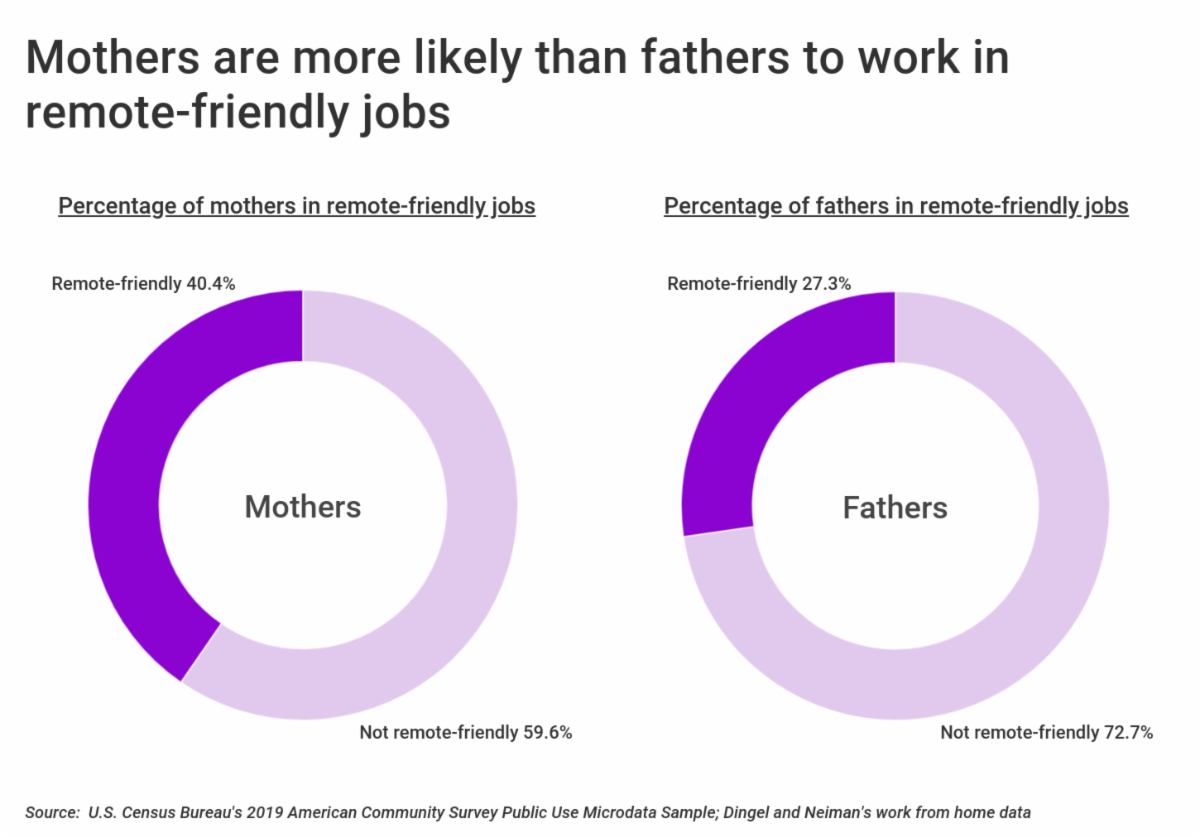
    According to occupational data from the U.S. Census Bureau, working mothers are more likely than working fathers to work in remote-friendly jobs. Over 40 percent of working mothers work in remote-friendly jobs compared to just 27 percent of working fathers. However, several studies show that working from home is harder for moms than it is for dads. As schools and day care centers closed during the pandemic, the gender gap in household chores and child care has widened. Research indicates that women working from home are more likely to take on a disproportionate share of housework and child care, while men are more likely to report an increase in productivity.

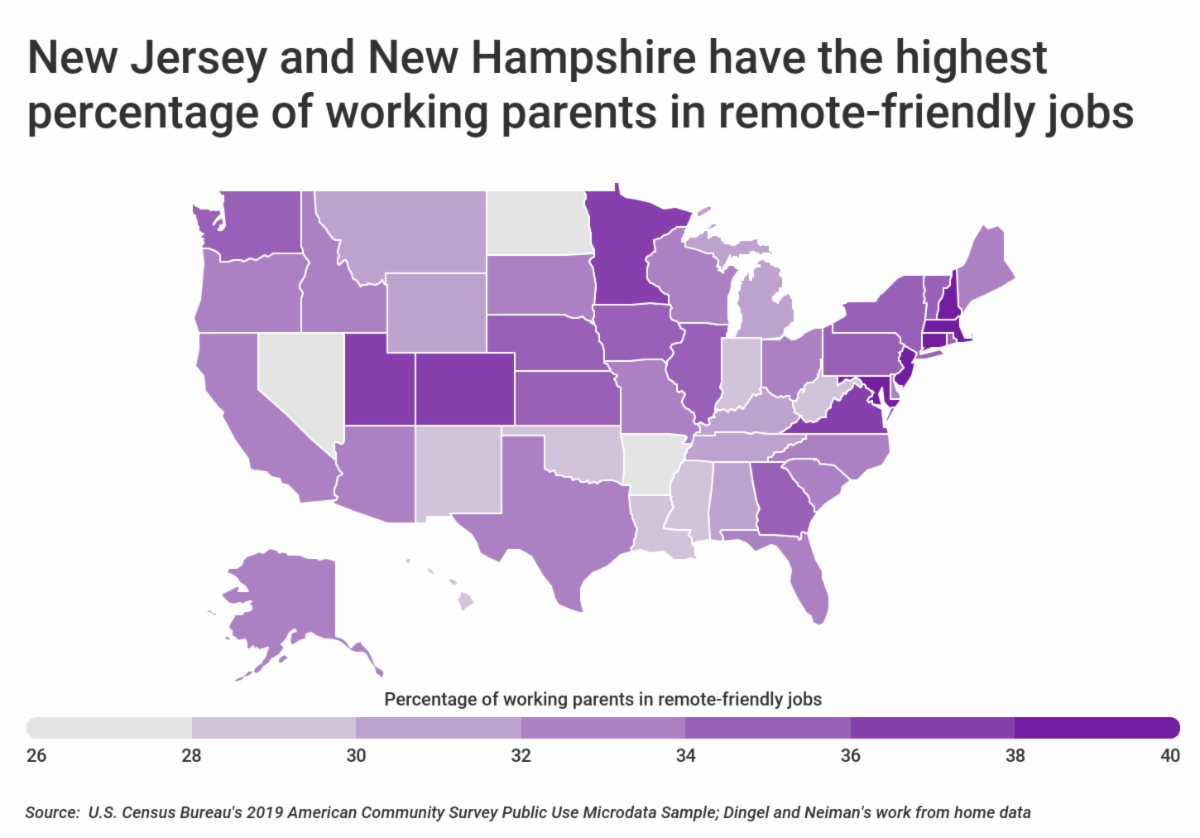
    Due to differences in local economies, there is significant variation in the share of jobs that can be performed at home across cities and states. For instance, places that rely heavily on agriculture, manufacturing, retail, and hospitality tend to have fewer jobs that can be performed at home, while areas with more business and professional jobs tend to have a large share of jobs that can be done remotely. At the state level, the Northeast tends to have more working parents in remote-friendly jobs with New Jersey and New Hampshire boasting the highest shares at 40.1 and 38.6 percent, respectively. At the opposite end of the spectrum, North Dakota and Nevada have the lowest shares of working parents in remote-friendly jobs, at 27.4 and 25.9 percent, respectively.

    To find the states with the most parents working from home, researchers at RetailMeNot analyzed the latest data from the U.S. Census Bureau as well as data from a University of Chicago study on remote-friendly occupations. The researchers ranked states according to the percentage of working parents in remote-friendly jobs. Researchers also calculated the percentage of working fathers and mothers in remote-friendly jobs and the percentage of fathers and mothers who work (either full-time or part-time).

    The analysis found that in Ohio, 32.7% of working parents have remote-friendly jobs. Here is a summary of the data for Ohio:

    • Percentage of working parents in remote-friendly jobs: 32.7%
    • Percentage of working fathers in remote-friendly jobs: 26.3%
    • Percentage of working mothers in remote-friendly jobs: 39.3%
    • Percentage of fathers who work: 91.5%
    • Percentage of mothers who work: 74.2%

    For reference, here are the statistics for the entire United States:

    • Percentage of working parents in remote-friendly jobs: 33.6%
    • Percentage of working fathers in remote-friendly jobs: 27.3%
    • Percentage of working mothers in remote-friendly jobs: 40.4%
    • Percentage of fathers who work: 92.1%
    • Percentage of mothers who work: 72.4%

    For more information, a detailed methodology, and complete results, you can find the original report on RetailMeNot’s website: https://www.retailmenot.com/blog/cities-with-most-parents-working-from-home.html