Author: Loveland Magazine

  • Revised Meeting Date to appoint new Loveland School Board member

    Revised Meeting Date to appoint new Loveland School Board member

    Loveland, Ohio – The Loveland Board of Education will hold a Special Meeting on  Monday, July 17th, at 6 PM. The purpose is to conduct interviews for a vacant Board seat and consider a resolution to appoint a resident to fill the seat.

    The meeting will be held in the LIS/LMS Media Center at 757 South Lebanon Road.

    The District had previously said their decision would likely be at a meeting on Tuesday, July 18.

    Due to the resignation of Kevin Daugherty, the Loveland Board of Education is seeking to fill his seat for the remainder of his term, which is through the end of the current calendar year, December 31, 2023.

    According to a press release from the District:

    “In accordance with Policy 0169.1, public participation may be permitted at scheduled business meetings of the Board. Hearing of the public will not be included on the agenda of this meeting.  Additionally, this meeting will not be streamed but will be recorded.”

    How to Apply

    Qualified candidates must be registered voters residing in the Loveland City School District.

    Submit a letter of interest by Thursday, July 13th, 2023, at 6 PM, including qualifications and contact information, to:

    Robert Giuffre’, Interim Treasurer

    757 S. Lebanon Rd.

    Loveland, Ohio 45140

    giuffrro@lovelandschools.org

    513 683-5697 – Fax

    513 774-6207 – Phone

    The Board is expected to make its appointment at their July 18th, Regular Session.


  • “Corners are cut to dispense prescriptions,” CVS employee tells Ohio Board of Pharmacy

    “Corners are cut to dispense prescriptions,” CVS employee tells Ohio Board of Pharmacy

    A CVS store. Photo by Lynne Terry, Oregon Capital Chronicle, States Newsroom.

    After years of buying and closing competitors, CVS understaffing leads to chaos and delays, Ohio regulator says

    BY:  – Ohio Capital Journal

    At least eight CVS pharmacies in Ohio are so understaffed that they have seen rampant turnover, dirty conditions, lack of controls over dangerous drugs and wait times as long as a month for prescriptions, according to reports by the Ohio Board of Pharmacy.

    The waits have been so long that a harried CVS pharmacist in Wooster said he was “actively triaging prescriptions to ensure lifesaving, life-sustaining medications are filled in a timely manner.”

    In one case, pharmacy workers told inspectors they begged their superiors — unsuccessfully — to close their pharmacies so they could catch up. In another, a pharmacy did intermittently close, making it impossible for patients to get their medicines during the closures.

    In another instance, Board of Pharmacy inspectors couldn’t tell if employees were stealing controlled substances. In yet another, they couldn’t tell if CVS was improperly billing insurers for scripts it didn’t fill.

    And in several additional cases, inspectors repeatedly found expired and adulterated drugs on pharmacy shelves and filled prescriptions that gave patients the wrong instructions.

    “Corners are cut to dispense prescriptions,” at least one employee at Toledo’s CVS store No. 10246 told investigators last year. Workers there added, “Supervisors/District Managers do not respond to staff calls for help,” the report said.

    The accounts come from inspection reports going back to 2020 that the Capital Journal obtained under the Ohio Public Records Act. At least some of the inspections came in response to patient complaints to the board, which licenses Ohio pharmacies.

    The inspections come after CVS — already the nation’s largest pharmacy retailer — has for years bought up competitors, closed them and moved the prescriptions of the closed pharmacies to existing CVS stores. Critics raised concerns about the practice, known as “buy and close,” at least as early as 2019.

    “Staff at this location was not increased,” a pharmacist at Dayton’s CVS store No. 2528 said last September after the store had absorbed two other closed pharmacies’ prescriptions. She quit the following month.

    For its part, CVS didn’t answer questions about specific allegations in the reports, which it referred to as “isolated incidents.”

    “We’re working with the Board of Pharmacy to resolve allegations of isolated incidents, most of which date back a year or more,” Amy Thibault, director of communications for CVS Pharmacy said in an email Wednesday. “The health and well-being of our patients is our number one priority.”

    Rampant turnover

    Pharmacies across the country found themselves under siege as the coronavirus pandemic took hold in the spring of 2020. They were conducting tests and, when they became available, providing COVID vaccines in addition to already administering those for flu and shingles.

    At the same time, some pharmacy employees were reluctant to work face-to-face with the public in a health care setting — especially before there were vaccines against a disease that has killed more than 1 million Americans.

    But according to the Board of Pharmacy reports, turnover in the CVS stores they investigated seemed particularly bad. And it seemed to be linked to stress from overwork — as well as the parent corporation’s inability or unwillingness to do anything about it.

    For example, when an inspector arrived at CVS store No. 2063 in Canton on Sept. 13, 2020, the staff was so harried that it took them 20 minutes to even acknowledge the inspector. The staff said that the store had lost a pharmacist and six technicians “within a short time.”

    As workers scrambled, they sweltered in a pharmacy in which the air conditioning unit was broken and an alarm in a drug cooler failed to warn them that it was too warm at 46.4 degrees Fahrenheit.

    “Pharmacy staff and an assistant store manager stated they have asked district leaders to close the store down temporarily to get caught up filling prescriptions as well as clean and organize the pharmacy, but this request was denied,” the report said.

    When an inspector returned to the pharmacy on Oct. 29, 2021, things had only gotten worse.

    “All pharmacy staff that was present for the September 2021 inspection quit or transferred out of CVS #2063,” the report said.

    Even more alarmingly, understaffing there created delays that easily could have harmed patients’ health — despite workers’ best efforts to “triage” which prescriptions to fill first.

    “The pharmacy was over a month behind in filling prescriptions,” the report said.

    Especially bad at CVS

    During the pandemic, conditions were universally difficult for pharmacies, but CVS might have been a special case.

    An owner of an independent pharmacy in Northern Ohio said things were rough for everybody, and that he’s still having trouble keeping enough pharmacy technicians on his staff. But, he said, that never led him to consider temporary closures, or anything like the delays filling prescriptions and other problems seen at some CVS stores.

    The pharmacist depends on CVS Caremark — the corporation’s gargantuan pharmacy benefit manager — for his business and asked not to be named. But, he said, he’s talked to CVS pharmacists who have been under pressure so great that it affected their mental health.

    The stress appeared to extend even to the upper ranks of CVS’s pharmacy operation.

    In July 2021, Ken Sidwell became leader of the district which includes Canton CVS store #2063. When he was interviewed by the Board of Pharmacy, he said the store was short-staffed when he got the job.

    Just three months later, Sidwell was gone. On Oct. 29, 2021, the new district leader, Kenneth Cook, told the Board of Pharmacy that the store “is in the process of hiring new pharmacy staff as well as transferring staff from an overstaffed CVS location.”

    CVS spokeswoman Thibault said the company’s policies ensure that its stores are not dangerously short of pharmacy workers.

    “Decisions about staffing, labor hours, workflow process, technology enhancements and other operational factors are made to ensure we have appropriate levels of staffing and resources in place at our pharmacies,” she said. “We have comprehensive policies and procedures in place to support prescription safety and we continue to make important strides, including using technology to support our pharmacy teams.”

    Buy and close

    Not only is CVS the nation’s largest pharmacy retailer, its parent corporation also owns Aetna, a top-10 insurer. It’s also buying up medical centers and physicians practices, helping to make it the nation’s sixth-largest corporation.

    And crucially for pharmacies everywhere, CVS owns the nation’s largest pharmacy benefit manager, CVS Caremark. It and Express Scripts and OptumRx are estimated to control more than 80% of the marketplace and they’re under investigation for possible anti-competitive practices by the Federal Trade Commission.

    Pharmacy benefit managers, or PBMs, act as middlemen for insurers in the drug supply chain. They decide which drugs are covered, so they have great power to negotiate huge, non-transparent rebates and other discounts from drugmakers.

    At the same time, they create pharmacy networks. And, because they control access to so many millions of patients, most small-chain and independent pharmacists think they have little choice about contracting with them on whatever terms the big PBMs choose.

    “Take-it-or-leave-it” contracts, the pharmacists call them.

    CVS has long said that it maintains strict firewalls between its retail and PBM operations, but small pharmacy operations in Ohio and elsewhere aren’t so sure.

    After seeing their reimbursements from CVS Caremark plummet in late 2016, CVS’s “Acquisition Unit” in 2017 sent many of its competitor pharmacies letters saying that it knew times were hard for them and offering to buy them out.

    In many instances, CVS didn’t put its sign on the store it had just purchased. CVS instead closed the stores and folded all of their prescriptions into an existing CVS pharmacy.

    Some pharmacists call the practice “buy and close.”

    In 2019, when CVS bought 20 stores owned by Medina-based Ritzman Pharmacy and closed all but three, critics said it was classic buy-and-close.

    Two of the now-closed pharmacies were in Wooster, one of the cities in which inspectors now find problems in a still-open CVS pharmacy. Three more — in Sugarcreek, Millersburg and Dover — were to the rural south of Canton and Massillon, where CVS stores found themselves seriously stretched in the years since.

    Mount Vernon-based Conway’s Pharmacy in 2019 partnered with Knox County to open a pharmacy in Danville on the edge of Amish Country after CVS bought and closed the only pharmacy there a few years earlier. The closure meant that Danville residents — many poor, disabled or both — had to drive 20 minutes or more to get their medicines or to consult with a pharmacist.

    Such practices have fueled fears that pharmacy deserts are being created in Ohio and elsewhere.

    Lack of accountability

    The constant churn in CVS staffing found by Board of Pharmacy investigators led to breakdowns in accounting for dangerous drugs, including opioids, the inspection reports said.

    For example, between June 10 and Sept. 22, 2022 Dayton’s CVS store No. 2528 reported 75 oxycodone, 100 hydromorphone and 70 amphetamine pills were missing. In each instance, “CVS Pharmacy was unable to determine a reason for the loss,” the inspection report said.

    For most of that period, no “Responsible Person” was in charge.

    The role is as the name implies. The Ohio Administrative Code says, “The Responsible Person shall be responsible for the practice of the profession of pharmacy, including, but not limited to, the supervision and control of dangerous drugs as required…”

    That person would normally be the managing pharmacist at a drugstore. But for months after May 26, 2022, there was no such person at the Dayton CVS, according to the report. Inspectors interviewed pharmacist Jean Getter, who said she was asked to serve as temporary manager after the previous Responsible Person, pharmacist Tyler Philo, left.

    Getter said that even though she wasn’t the Responsible Person, she asked for help sorting out the safe that contained controlled substances because “it was a mess.”

    “She asked the previous Responsible Person and also the District Leader about cleaning up the safe, but it never happened,” the report said.

    An inventory of dangerous drugs is supposed to be conducted whenever there is a change of Responsible Person at a pharmacy, but that kept not happening at the Dayton CVS, Getter said.

    “No one ever became the permanent Responsible Person, which is why Ms. Getter left CVS in August,” the report said.

    Then Pharmacy Board investigators interviewed Philo, the previous Responsible Person and learned something even more confounding.

    “He was not aware (four months after he left that) he was still listed as the Responsible Person for CVS Pharmacy #2528,” the report said.

    Controlled substances

    Board of Pharmacy inspectors also found serious potential problems in CVS stores’ tracking controlled drugs — including the kinds of drugs that have fueled Ohio’s opioid crisis.

    Some problems were as simple as leaving deliveries of dangerous drugs at the front of the store for nine hours because pharmacy staffers were too busy to get them. But others might have been more sophisticated.

    At Toledo CVS store No. 10246, inspectors conducted, “Multiple audits consisting of 241 controlled substances were conducted by representatives from the Board between on or about November 11, 2021 and on or about April 27, 2022.”

    In 42% of cases, they found that too much or too little of the drugs had been provided. They discovered “significant losses” of amphetamines and the painkiller tramadol.

    “Additional losses and overages were discovered, some of which were reported to the board, but many were not reported at all, or not reported in a timely fashion,” report said. It added that auditing what happened to controlled substances was difficult “because CVS records showed multiple significant inventory adjustments and changes in medication counts…”

    Counterintuitively, investigators found that on some days when controlled substances were delivered to the Toledo pharmacy, inventories of the drugs actually went down. That might indicate “diversion” — a term used in the industry for stealing drugs.

    “It remains questionable if counts were entered as negative numbers in error, or if staff were entering negative numbers to mask the diversion of drugs received on that day,” the report said.

    In the same store, inspectors discovered chaotic conditions.

    On repeated visits, inspectors found “expired/adulterated” medications on pharmacy shelves and workers told them they hadn’t had time to address the issue. The inspectors also painted a picture of general chaos.

    “Shelving for drug storage had collapsed and medications were crushed beneath the shelving units. Drug stock crowded the aisle floors,” the report said, adding, “The counter used for non-sterile compounding was overflowing with (over-the-counter) medications and return-to-stock bottles. Staff food and beverages were also stored in this area. Moldy/rotting food was found on the counter.”

    Beyond delays and lacking controls, inspectors found another problem at the store that could endanger patients’ health.

    Inspectors on March 3, 2022 reviewed 49 prescriptions filled at the store. They found that seven “had errors in the directions to patients.”

    And when inspectors talked to employees, they heard echoes of the complaints at other CVS pharmacies they’d visited.

    • “The pharmacy is always short staffed.”
    • “The workplace was described as hectic. There is no downtime to catch up on tasks.”
    • “Morale among store employees is poor.”

    Delays and questions about improper billing

    When inspectors visited CVS store No. 8248 in Massillon in late 2021, they found a pharmacy so understaffed that “the pharmacy would close intermittently,” meaning “patients were unable to pick-up/receive their prescriptions.”

    They again found confusion over who was legally responsible.

    “The Responsible Person, Abbey Yannerella, was listed as the Responsible Person at this location as well as CVS #2063; however, she was no longer working at” the Massillon store, the report said.

    They found something else that raised serious questions.

    The store in October 2021 had more than 2,000 prescriptions waiting to be filled, the oldest of which had been waiting for 13 days. A month later, the pharmacist on duty told inspectors that after scripts go unfilled for 14 days, they’re “deleted from the queue.”

    The inspectors found one such prescription that was labeled “Print Ready.”

    “The prescription’s status indicating ‘Print Ready’ means the prescription was processed through insurance,” the report said. “When a prescription is deleted from the queue, the pharmacy does not reverse the insurance claim.”

    CVS didn’t respond directly when asked how often scenarios like this occur — or whether it routinely bills insurers for prescriptions it fails to fill for two weeks and then deletes from its system.

    On Nov. 28, 2021 a new Responsible Person, pharmacist Nayan Patel, had been named. He told investigators that the deletion of prescriptions after 14 days was a requirement of the U.S. Centers for Medicare and Medicaid Services. He added that the scripts are placed back into the queue after their deletion.

    However, “When asked to explain this process further, he could not elaborate,” the report said.

    Then on Feb. 4, 2022, the Board of Pharmacy learned that Patel was Responsible Person for two CVS pharmacies without the special permission required by the board. When the board notified a CVS district leader of that fact, “The district leader notified the board Mr. Patel is no longer the Responsible Person of” Massillon CVS store No. 8248, the report said.

    Penalties

    The board has notified CVS that it can impose penalties ranging from fines to revoking their licenses as a “Terminal Distributor of Dangerous Drugs” at each of the locations in which it found violations.

    So far, CVS store #3613 in Columbus received a $1,000 fine and a written reprimand last August, Board of Pharmacy spokesman Cameron McNamee said in an email Thursday. The violations outlined in that report seem considerably less severe than those found in some other CVS pharmacies.

    Violations found at CVS’s Canton store No. 2063 — where staff turnover was particularly rampant — are slated to be considered at the board’s Nov. 7-8 meeting McNamee said.

    Hearings for the other stores are yet to be scheduled.


    Marty Schladen
    MARTY SCHLADEN

    Marty Schladen has been a reporter for decades, working in Indiana, Texas and other places before returning to his native Ohio to work at The Columbus Dispatch in 2017. He’s won state and national journalism awards for investigations into utility regulation, public corruption, the environment, prescription drug spending and other matters.

    MORE FROM AUTHOR

  • Ramsey-Paxton Cemetery featured at Clermont County Recorder’s office

    Ramsey-Paxton Cemetery featured at Clermont County Recorder’s office

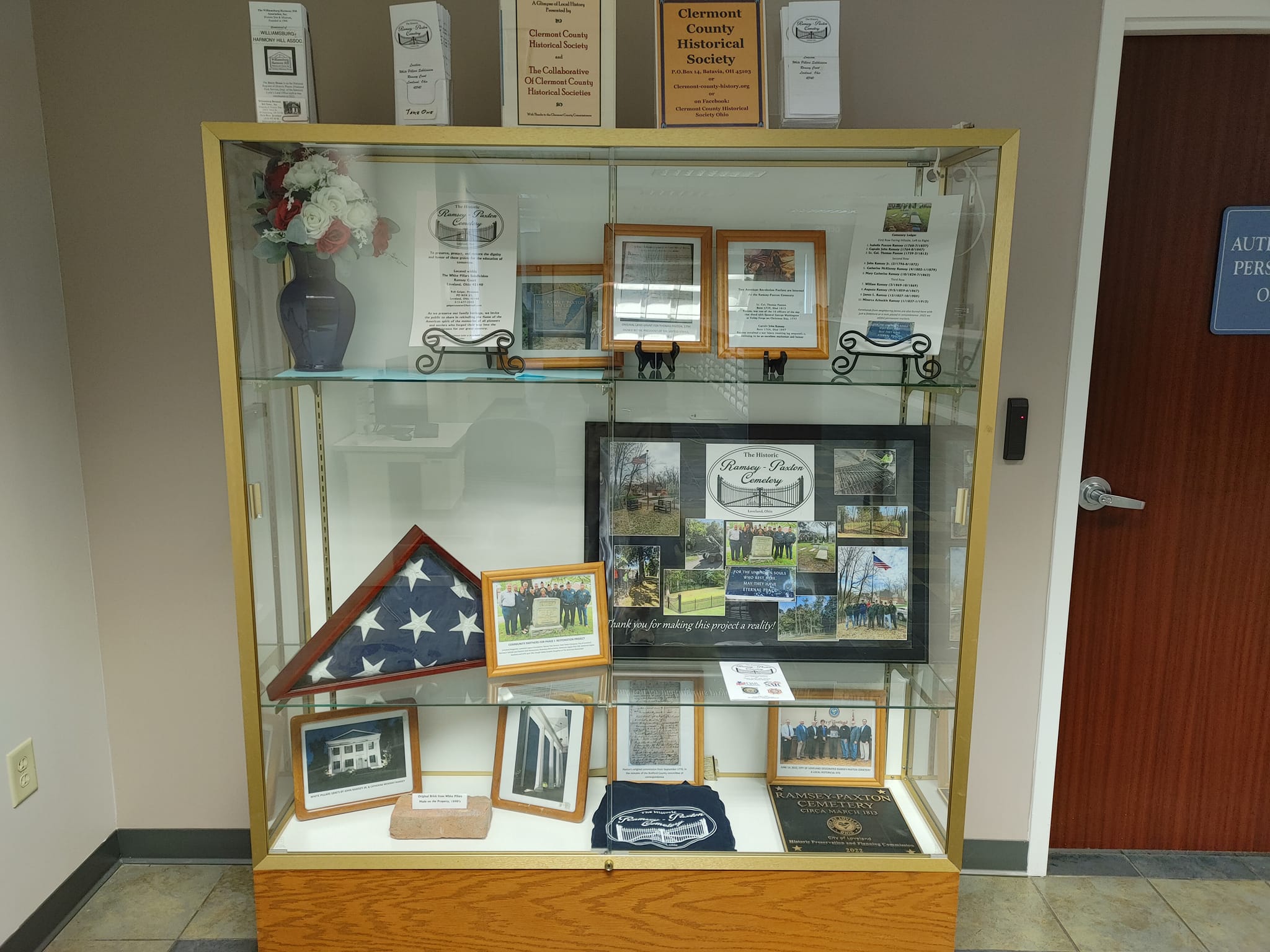
    Loveland, Ohio – This month, a Ramsey-Paxton Cemetery display is at the Clermont County Administration Building, Recorder’s office.

    The Ramsey-Paxton Cemetery officially has been classified as a historical site within the city.
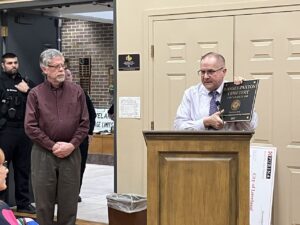
    Rob Geiger  (L) receives historical marker from City Manager Dave Kennedy
    At the Jan. 24, 2023, Loveland City Council meeting, Rob Geiger of the Ramsey-Paxton Cemetery Association was presented with the plaque for a designated historical place. The plaque will be installed at the cemetery.
    The cemetery is located in the White Pillars subdivision off SR 48.
    The Ramsey-Paxton Cemetery originated in 1813 with the burial of Lt. Col. Thomas Paxton, a Revolutionary War Soldier, on land that he received for his military service.
    _______________________

    BACKGROUND:

  • Will you help our Back-To-School program?

    Will you help our Back-To-School program?

    Promoted Post

    Loveland, Ohio – The LIFE Food Pantry says that it is time for us to start packing school bags for the 2023-24 school year. It is thanks to supporters like you that our students will be able to go back to school with everything they need.


    Like in previous years, students registered at the pantry will receive a backpack filled with grade appropriate supplies, socks and underwear, a Spirit Wear shirt, shoes, and personal care items (toothpaste, deodorant, shampoo, etc.). The distribution will be during the first two weeks of August.

    Are you willing to help us?

    We are expecting at least 160 students to receive supplies this year. We are still seeing many new clients, so the number might be higher. Last year we planned for 120 and distributed 150 bags and supplies!

    We are looking for our generous donors to help us by donating backpacks with supplies (with a list of supplies provided), individual school supplies or personal care items.

    We will need donations by July 20th. They may be dropped off at the LIFE Food Pantry at 541 Loveland Madeira Road, Tuesday through Saturday 9:30 – noon; Tuesday, Wednesday and Thursday 3:30 – 6:30, or by appointment.

    You can also purchase items though our Amazon shop here.

    Please contact backtoschool@lifefoodpantry.org or Carolina Maurer at (513)319-4881 for more information. Thank you for donating to the LIFE Food Pantry—we truly could not do this without your support.

    Click here to visit our Amazon page here to buy school supplies for those in need!

    Prefer to shop locally? Here is a list of items needed:

    • Large backpacks that can hold a laptop for older students
    • Composition notebooks
    • Crayola wide markers
    • Headphones for young students
    • Earphones for older students
    • 3 prong folders in red, blue, yellow, or green
    • Clorox wipes


  • Josh Carrington memorial bench dedication at Loveland High School

    Josh Carrington memorial bench dedication at Loveland High School

    Loveland, Ohio – There will be a dedication ceremony for the Joshua Benjamin Carrington memorial bench next Friday, July 14 at 7:30 PM at the entrance to the Loveland high school athletic fields.

    The Loveland community is invited to attend this event celebrating Josh’s life. Josh graduated from Loveland High School with the class of 2010. Over those four years, Josh participated in football, track (pole vaulting), and wrestling. He was nicknamed “Josh the Spladle” for his wrestling moves.

    Josh was also on the Homecoming Court his Senior Year. Josh passed in 2015.

    His family is creating a space for athletes and students to wait for their ride, and to keep Josh’s memory alive.

  • Bob Kessler caught the rockets being launched from Kiwanis Park

    Bob Kessler caught the rockets being launched from Kiwanis Park

    Loveland Photographer Bob Kessler 3-stories high at the Loveland Stage Company in 2017.

    Loveland, Ohio – These photos of City Hall’s fireworks show on the 4th of July were taken by resident Bob Kessler. Bob shot these photos from the bank of the State and National Scenic Little Miami River across from Kiwanis Park where each rocket was sent into orbit. Bob was on the small beach at Nisbet Park.

    Click on a photo to enlarge them and scroll to see them all. (All photos © Bob Kessler 2023.)

  • Ohio abortion rights supporters submit signatures, gunning for November ballot

    Ohio abortion rights supporters submit signatures, gunning for November ballot

    BY:  – Ohio Capital Journal

    Two trucks loaded with more than 400 boxes rolled into the Ohio Secretary of State’s Office Wednesday. In those boxes were 710,000 signatures abortions rights advocates say prove they have the support they need to bring a ballot measure asking voters to put abortion care in the Ohio Constitution.

    “Those (402) boxes are filled with hope, and love, and freedom of bodily autonomy … of being able to say ‘we decide what happens to us,’” said Kellie Copeland, executive director of Pro-Choice Ohio.

    In the last 12 weeks, advocates from groups including Ohioans for Reproductive Freedom and Ohio Physicians for Reproductive Rights have gone to farmer’s markets, held drive-through signing events, and reached across the state to collect the nearly 414,000 signatures required of them to place a measure on an Ohio voting ballot. Signature-gatherers collect far more than that minimum in an attempt to make sure enough signatures are correct and valid to meet the threshold.

     COLUMBUS, Ohio — JULY 05: Field staffer for Ohioans United for Reproductive Rights, Carlos Ortiz unloads the first of 402 boxes of petitions with over 700,000 signatures being delivered to Ohio Secretary of State Frank LaRose, July 5, 2023, at the loading dock of the Office of the Ohio Secretary of State, downtown Columbus, Ohio. (Photo by Graham Stokes for Ohio Capital Journal. Republish photo only with original article.) 

    Bill Wood was one of many collecting signatures, and he said he was overwhelmed by the support he saw the past three months.

    “What amazed me is that even late in this process, there were people who were coming up to us and saying, ‘I have been looking forward to signing this, thank you for being here,’” Wood said. “The number of thank-you’s and compliments and wonderful support that we got from people at every stage was amazing.”

    As part of the Westerville Progressive Alliance, he said he has participated in many signature drives and campaigns over the years.

    “I will tell you when we brought this to our people, we have never seen an outpouring of interest and commitment like we’ve seen this year,” Wood said.

    He said the Westerville group alone collected 9,000 signatures.

    The measure would allow abortion in the state via an amendment to the Ohio Constitution, that states “every individual has a right to make and carry out one’s own reproductive decisions, including but not limited to decisions on contraception, fertility treatment, continuing one’s own pregnancy, miscarriage care and abortion.”

    “Ultimately, this is about giving my patients, our patients, our friends, our families, their power back,” said Dr. Marcela Azevedo, co-founder of OPRR.

    If approved, the amendment would bar the state from doing anything to “directly or indirectly burden, penalize, prohibit, interfere with, or discriminate against either an individual’s voluntary exercise of this right or a person or entity that assists an individual exercising this right, unless the state demonstrates that it is using the least restrictive means to advance the individual’s health in accordance with widely accepted and evidence-based standards of care,” according to the ballot language certified by the Ohio Ballot Board.

    Abortion can, however, be prohibited “after fetal viability,” defined in the proposed amendment as “the point in pregnancy when, in the professional judgment of the pregnant patient’s treating physician, the fetus has a significant likelihood of survival outside the uterus with reasonable measures.”

    Pro-abortion rights groups say signatures were collected in every Ohio county, something that may come in handy with another constitutional amendment, Issue 1, on the ballot in August that would require 60% of Ohio voters to approve of a measure, and require signatures to come from all 88 counties, rather than just the 44 of 88 required in current law.

    Now, the Secretary of State’s Office will have until July 25 to verify the signatures and determine whether the measure has enough valid Ohio voter support to move forward.

    If the number falls short of the required amount, advocates have 10 days to file a supplementary petition with more signatures, which must be from registered Ohio voters who didn’t sign the previous petition.

    The groups working to get the measure on the ballot estimate the campaign to do it may cost approximately $35 million.

    A spokesperson for Secretary of State Frank LaRose did not respond to requests for comment.


    Susan Tebben
    SUSAN TEBBEN

    Susan Tebben is an award-winning journalist with a decade of experience covering Ohio news, including courts and crime, Appalachian social issues, government, education, diversity and culture. She has worked for The Newark Advocate, The Glasgow (KY) Daily Times, The Athens Messenger, and WOUB Public Media. She has also had work featured on National Public Radio.

    MORE FROM AUTHOR

  • [Revised Deadline] Apply for open Loveland school board seat

    [Revised Deadline] Apply for open Loveland school board seat

    Loveland, Ohio – Due to the resignation of Kevin Daugherty, the Loveland Board of Education is seeking to fill his seat for the remainder of his term, which is through the end of the current calendar year, 2023.

    Qualified candidates must be registered voters residing in the Loveland City School District.

    Submit a letter of interest by Thursday, July 13th, 2023, at 6 PM, including qualifications and contact information, to:

    Robert Giuffre’, Interim Treasurer

    757 S. Lebanon Rd.

    Loveland, Ohio 45140

    giuffrro@lovelandschools.org

    513 683-5697 – Fax

    513 774-6207 – Phone

    The Board is expected to make its appointment at their July 18th, Regular Session.


  • Ohio utilities could resume energy efficiency programs under bipartisan bill

    Ohio utilities could resume energy efficiency programs under bipartisan bill

    Getty Images.

    BY:  – Ohio Capital Journal

    A bipartisan proposal advancing in the Republican-controlled Ohio House would allow gas and electric utilities to reintroduce programs designed to help customers save energy.

    Prior utility-run programs to reduce electricity use ended after Ohio’s energy efficiency standard was gutted as part of House Bill 6, the 2019 law at the heart of the state’s still unfolding bribery and corruption scandal.

    House Bill 79 would let utilities bring back some of those programs, but on a voluntary basis with capped monthly charges and smaller expectations for energy savings.

    The legislation is co-sponsored by House Majority Floor Leader Bill Seitz, a Cincinnati Republican who was a perennial critic of the programs before HB 6 passed in 2019.

    “The wide support that this bill has received from both sides of the aisle, all utilities, and all the environmental groups is a testimony to the fact that we have built a better mouse trap as we reintroduce responsible energy efficiency programming targeted to those who most need it — residential customers and small businesses,” Seitz said.

    The other lead sponsor is a Democrat, Rep. Bride Rose Sweeney of Westlake.

    While the bill has broad support, it has critics, too, including customer advocates who worry the programs will lack accountability and become another cash grab for utilities.

    What’s in the bill

    Under the new legislation, utilities would get to choose whether to offer a portfolio of energy efficiency programs. Utilities would need approval from the Public Utilities Commission of Ohio before offering their group of programs for a period of up to five years.

    Residential customers would automatically be included unless they opt out, and their monthly charges would be capped at $1.50. Small commercial customers would also be automatically included, with a cap on monthly charges of $7.50. Mercantile customers would be automatically excluded unless they take action in writing to opt in.

    Any portfolio of programs must be cost-effective. In other words, the charges to participating customers must be less than the programs’ combined savings on energy costs, reductions in energy market prices from lower demands, and other quantifiable system benefits. Utilities would have to make yearly filings with the PUCO to show if their portfolios were in fact cost-effective.

    Any portfolio offered under HB 79 would have to be designed to achieve at least 0.5% of yearly energy savings, based on the prior year’s retail sales to participating customers. But for HB 6, utility energy efficiency programs would have had to show 2%  savings per year from 2021 through 2027.

    Additionally, at least one program and 15% of the proposed costs for residential customers must be geared toward low-income residential customers.

    “The bill offers a balanced approach to lower energy use and is the result of the hard work of many parties,” said Scott Blake, a spokesperson for AEP Ohio. HB 79 would help “lower energy use for individual customers and the overall cost of energy.” Beyond that, “it creates economic opportunities and jobs through selling and installing energy-efficient equipment and offers opportunities for efficient new construction.”

    Energy efficiency after HB 6

    The lower targets mean the overall program savings and emissions reductions would be less than what utilities would have had to do without HB 6, but more than what’s been achieved in the last four years. Although some argue that Ohio law still allows voluntary energy efficiency programs, the PUCO rejected a voluntary plan by Duke Energy in June 2020, and agency staff balked about a proposed AEP plan that was ultimately withdrawn.

    In some ways, though, HB 79 would improve on earlier programs, said attorney Rob Kelter of the Environmental Law & Policy Center. The bill would prohibit utilities from sending out energy savings kits to customers who don’t request them, and steps would be taken to avoid counting activities that customers would already take on their own.

    “Moreover, HB 79 specifically emphasizes smart technologies that will help drive market changes,” Kelter said. In contrast to earlier programs that pushed customers to use different types of light bulbs, “today, the programs focus on innovative technologies that not only reduce overall usage, but reduce usage at peak times when prices are high.”

    HB 79 would also complement federal rebates under the Inflation Reduction Act, said Nolan Rutschilling, managing director of energy policy for the Ohio Environmental Council Action Fund. For example, a 30% credit, subject to income restrictions, is already available for certain equipment, such as qualified heat pumps.

    “Utility-run programs are easily accessible and navigable to consumers, establishing a ‘low hanging fruit’ that is necessary to create long-term buy-in,” Rutschilling said in his testimony on the bill. Without those programs, however, “only the most knowledgeable and experienced homeowners will enjoy the household benefits of efficiency.”

    Critics are concerned about certain language in the bill and think the state should play a bigger role in connecting residents and businesses with efficiency funding and opportunities.

    “Under the new federal programs, Ohio is receiving huge grants to administer its own programs,” attorney Thomas Hays said in his testimony for the Northwest Ohio Aggregation Coalition. “These programs are voluntary, the customer keeps every penny of the rebate or tax credit, and no charge is added to any electric bill.”

    Rep. Sean Brennan, D-Parma, is among a dozen lawmakers who signed on as additional co-sponsors to the bill, but he became concerned after hearing opponent testimony from the aggregation coalition and the Office of the Ohio Consumers’ Counsel and voted against the bill in committee. Among other things, the groups object to provisions for utilities to collect “utility incentives” and “lost distribution revenue.” Vagueness or loopholes in the bill could turn energy efficiency programs into profit centers at customers’ expense, the groups fear.

    Seitz said the bill won’t let utilities get incentives if they merely facilitate participation in the new federal programs. And allowing weather-normalized decoupling or lost distribution revenue aims “to keep the utilities whole against the declining sale of electrons brought about by the programs.”

    But loose definitions for terms like “behavioral energy savings” are a problem, testified Lindsey Short, director of public policy services for the Ohio Manufacturers’ Association. “Moreover, electric utilities are already guaranteed to recover all of their costs through base distribution rates.”

    The bill’s language calling for plans to improve “utility control to reduce demand or impacts of intermittent resources on the grid” also “stands out as odd,” Short said, noting that some types of renewable energy are intermittent resources.

    The legislation cleared the Ohio House Public Utilities Committee on June 21. The next step would be a full House vote. The timing depends on whether Speaker Jason Stephens, R-Kitts Hill, schedules a vote right after negotiations on Ohio’s two-year budget wrap up, or if he opts to wait until September.

    This article first appeared on Energy News Network and is republished here under a Creative Commons license.


    ____________________

    Kathiann M. Kowalski
    KATHIANN M. KOWALSKI

    Kathi is the author of 25 books and more than 600 articles, and writes often on science and policy issues. In addition to her journalism career, Kathi is an alumna of Harvard Law School and has spent 15 years practicing law. She is a member of the Society of Environmental Journalists and the National Association of Science Writers. Kathi covers the state of Ohio.

    MORE FROM AUTHOR

  • David M. DelloStritto: June 15, 1976 – July 2, 2023

    David M. DelloStritto: June 15, 1976 – July 2, 2023

    It is with profound sadness that the family of David M. DelloStritto, 47, announce his passing on July 2, 2023, after a lengthy, courageous battle with colon cancer.

    David was born on June 15, 1976, to Dennis and Carol DelloStritto. He attended Howland Schools and graduated from Ohio University in 1998 with a BBA in Business Management/Operations. After college, he worked for ADP in Columbus, Ohio, where he met his wife, Amy. They were married on August 14, 2004. He eventually transferred to Cincinnati. He continued to work through most of his illness, most recently for SAP Concur, where he worked as a senior software sales executive. Through his career, Dave achieved great success and was able to travel the world.

    The pride and joy of his life was his daughter, Alexa and son, Colin. Together with Amy, he raised two incredibly intelligent, loving, compassionate, amazing children. Nothing gave him more happiness than watching Alexa play softball and volleyball and Colin play soccer, basketball, and football. He especially loved coaching Alexa in softball and Colin in basketball. Dave loved and was deeply devoted to his family and treasured every memory made with them. His family will carry these beautiful memories with them for the rest of their lives.

    Dave is survived by his wife Amy, daughter Alexa (16), and son Colin (12), his parents; sister Danielle (Nate) Mailach and niece Mallory; Father-in-law Tom (Dawn) Freeman; brother-in-law Thomas (Cami) Freeman and nephews Thomas and Mathias; many loving aunts, uncles, and cousins; and many cherished friends.

    Dave wished to leave these words to his adored family and friends: “If ever there is a tomorrow when we are not together, there is something you must always remember. You are braver than you seem and smarter than you think. But the most important thing is, even if we’re apart…I’ll always be with you.”

    Per Dave’s wishes, no services will be held. A private family Celebration of Life will be held at his home.

    In lieu of gifts or flowers, donations may be made in his memory to Hospice of Cincinnati, C/O Bethesda Foundation, Inc., P.O. Box 633597, Cincinnati, OH, 45263, or online at www.hospiceofcincinnati.org. His family wishes to thank the amazing doctor, nurses, hospice aides, staff, and volunteers who provided such excellent, compassionate care to us.

    He was deeply loved and will be forever missed by all who knew him.