Author: Loveland Magazine

  • ROAD TO HEALTH – HEALTH & WELLNESS EXPO

    ROAD TO HEALTH – HEALTH & WELLNESS EXPO

    Promoted Post

    Loveland, Ohio – The Little Miami River Chamber Alliance is pleased to announce the Road to Health, a Health & Wellness Expo at Nisbet Park: 126 Karl Brown Way in Loveland on July 29th from 9 AM – 12 PM.  “Loveland by nature lends itself to health and wellness; the beautiful parks, flowing river, and overall landscaping offer opportunity to exercise and live a better life,” CeeCee Collins, President/CEO of the LMRCA chamber said. “When we combine the natural landscaping with an array of health, wellness, and recreational businesses in the area, we felt that it made sense to showcase and offer to our community.”

    The free event will bring in Mental, Physical, and Financial health professio als and enthusiasts to communicate to the community the benefits of living a life balanced with health and wellness. The event will include swag bags for attendees, health and wellness booths, free 20 min workouts and much more!

    Vendor applications are still being accepted. This event is free to attend and is open to the public. No registration required for attendance, show up and have fun!

    Vendors register here:

    http://business.lovelandchamber.org/events/details/road-to-health-health-wellness-expo-2023-6909

    The event includes:

    *mammograms available through Mercy Health Mammography Mobile

    *Cincinnati’s FIRST Acai Bowl Food Truck

    *local business vendors specializing in physical, mental & financial wellness, and senior care

    *free fitness classes for the whole family in the park

    *local businesses showcasing their fresh juices & healthy snacks

     For more information visit www.lmrchamberalliance.org or call our office at 513-683-1544. 

  • Ohio’s congressional redistricting case moves back to state supreme court

    Ohio’s congressional redistricting case moves back to state supreme court

    BY:  – Ohio Capital Journal

    In an expected move, the U.S. Supreme Court on Friday sent back an Ohio congressional redistricting appeal for reconsideration by the state’s highest court.

    Following its decision in Moore v. Harper, in which a majority of the court rejected the concept of the independent state legislature theory, the court entered a short order regarding the Ohio case, directing the state supreme court to reconsider the case “in light of Moore v. Harper.”

    The Moore v. Harper decision essentially rejected all of the arguments attorneys for Huffman and GOP leadership made for legislative authority over district maps.

    Using a very old and often rejected legal theory, arguments were made in the North Carolina case that a state legislature holds power over the administration of elections, therefore rise above the scrutiny of the judicial system when setting voting districts.

    SCOTUS Chief Justice John Roberts said the Elections Clause of the U.S. Constitution “does not insulate state legislatures” from judicial review.

    But the Ohio case, listed under the lead parties Senate President Matt Huffman and district map challenger Meryl Neiman, is headed back to a state supreme court with a new chief justice, one who led the dissent in each of the court’s rejections of congressional (and, for that matter, statehouse) redistricting maps, leading to the appeal sent to the U.S. Supreme Court.

    Chief Justice Sharon Kennedy would have upheld the very first map presented to the court nearly two years ago, and every map thereafter.

    Freda Levenson, legal director for the ACLU of Ohio said Friday that if Moore v. Harper is applied correctly by the Ohio Supreme Court, the court would uphold its previous decision, rejecting the current congressional maps.

    “What SCOTUS said in Moore was that legislatures must follow their state constitutions — consistent with what the Ohio Supreme Court already decided,” Levenson said.

    Before the court made either decision regarding redistricting, Huffman told reporters it “may simply be that we have the same congressional districts for the 2024 race as the one we have now.”

    Regarding the SCOTUS decision, Huffman released a statement on Friday praising the court’s move, and saying the appeal “clearly recognized serious constitutional concerns with the narrow majority opinions rendered under the former Chief Justice.

    “We are reviewing the U.S. Supreme Court’s message to determine the path forward,” Huffman said in a statement.

    The Ohio Redistricting Commission would need to be reconvened by Gov. Mike DeWine, but a spokesperson for the governor suggested that won’t happen until after the state budget is finalized.

    Also of note is DeWine’s son, Pat DeWine, who is a sitting justice on the supreme court. Pat DeWine has recused himself from previous cases in which the court considered contempt proceedings on ORC members (including DeWine) for missing redistricting deadlines, but has not recused himself from general redistricting lawsuits coming before the state supreme court.


    Susan Tebben
    SUSAN TEBBEN

    Susan Tebben is an award-winning journalist with a decade of experience covering Ohio news, including courts and crime, Appalachian social issues, government, education, diversity and culture. She has worked for The Newark Advocate, The Glasgow (KY) Daily Times, The Athens Messenger, and WOUB Public Media. She has also had work featured on National Public Radio.

    MORE FROM AUTHOR

  • Federal judge blasts disgraced Ohio House speaker as a “bully,” sends him straight to jail

    Federal judge blasts disgraced Ohio House speaker as a “bully,” sends him straight to jail

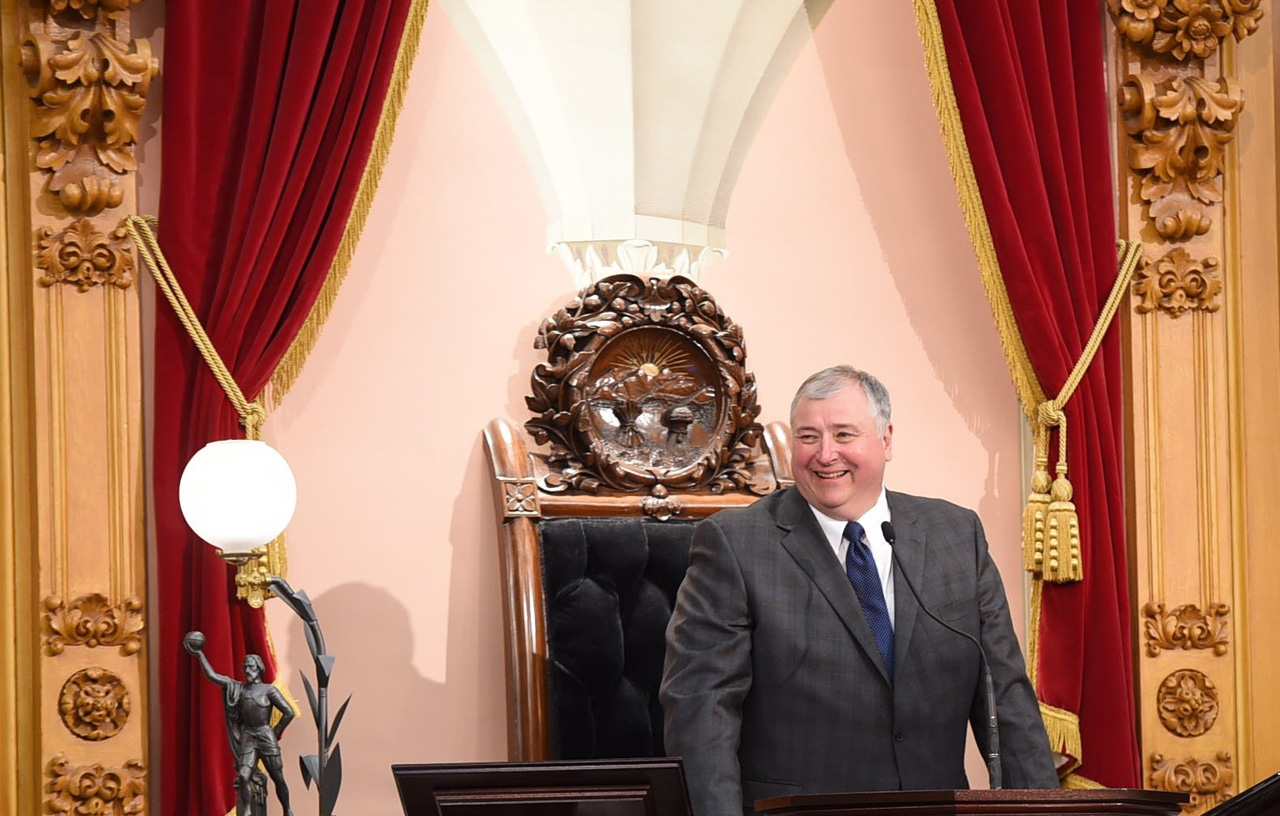
    Former House Speaker Larry Householder, R-Glenford. Source: Ohio General Assembly.

    BY:  – Ohio Capital Journal

    CINCINNATI — Former Ohio House Speaker Larry Householder spent possibly his last moments as a free man around 2:30 p.m. Thursday and they couldn’t have been pleasant.

    U.S. District Judge Timothy Black gave the Glenford Republican the maximum possible sentence of 20 years and then ordered blue-shirted U.S. Marshals to immediately take him into custody. He rose, put his hands behind his back, the marshals cuffed him and led the once-powerful pol away.

    But before that humiliation, the judge blistered Householder for being the ringleader of a racketeering scandal in which Akron-based FirstEnergy paid him more than $59 million in bribes in exchange for a $1.3 billion bailout, most of which was intended to save two failing nuclear plants in Northern Ohio.

    Ratepayers could have used that money for things like education, health care or to start businesses, the judge said.

    “You handed that money to suits in private jets,” Black said.

    The judge made the speech and imposed the sentence after saying Householder clearly perjured himself during his criminal trial, which lasted from late January until mid-March.

    In it, Householder claimed to barely know FirstEnergy executives as federal prosecutors put on a mountain of evidence that Householder flew on their corporate jets, sat in their luxury boxes and dined in fancy restaurants as they plowed tens of millions of the corporation’s dollars into dark-money accounts.

    “You conned the people of Ohio and you tried to con the jury, too,” Black said in his gravely voice as Householder, clad in a gray suit and red tie, slumped his bulk back in his chair.

    The money from FirstEnergy and one of its subsidiaries was used to elect fellow Republicans in 2018 who would vote to make Householder speaker in early 2019. More than $500,000 of it was used to pay off Householder’s credit card bills, settle a lawsuit and to repair a house he owned in Florida.

    Tens of millions more went to pass the corrupt bailout — House Bill 6 — and to fund a thuggish campaign to thwart a citizen-initiated repeal.

    Earlier in the hearing, Assistant U.S. Attorney Emily Glatfelter said Householder used FirstEnergy’s dark money to crush a “citizen veto” and “because of this House Bill 6 remains in effect today.”

    That’s also because Republican supermajorities in Ohio’s gerrymandered legislature have refused to repeal the corrupt law even after arrests were made, and as they try to make it virtually impossible for citizens to initiate amendments to the Ohio Constitution.

    Also arrested in the scandal were lobbyists Juan Cespedes and Jeffrey Longstreth — who cooperated with prosecutors within days of their arrests — and Neil Clark, who died by suicide. Former Ohio GOP Chairman Matt Borges is slated for sentencing at 11 a.m. today, Friday.

    Steven Bradley, Householder’s attorney, sought leniency for his client. Referring to the possibility of a 20-year sentence, he said “That is effectively a life sentence for Larry Householder given his age and health situation.”

    Householder is 64 and overweight.

    Bradley argued that his client was around 60 when the racketeering conspiracy began in late 2016 and that prior to that, Householder did “innumerable” good deeds “for decades.” A 20-year sentence would “effectively give no consideration” to those good deeds, Bradley said.

    But when he spoke on his own behalf, Householder appeared to do more to harm his case than to help it, just as he did at trial.

    “My greatest commitment is to my creator… My next commitment is to my family,” he read from a prepared statement as he stood at the podium.

    Householder said that in the course of 38 years of marriage, “I can count on one hand” the number of nights he spent away from his wife, Taundra. Householder also described the crushing pain they suffered when they lost a four-year-old daughter.

    But then he pushed his claims past the point of plausibility.

    He said Taundra was planning to retire from her teaching position and next year, when he turns 65, he wanted to retire as well, saying he planned to “hang up my suit and tie.”

    Householder made that statement in the same courtroom where, only three months earlier, prosecutors put on testimony and displayed bank records and written messages from early 2020 that showed FirstEnergy and AEP putting money into dark money groups intended to fund an effort to change the state’s term limits so Householder could stay in office for as long as 16 more years.

    The former House speaker also implied that he wanted a lenient sentence not for himself, but for his family. Taundra, he said, would be alone while “I’ll be in a cold cell hours away.”

    But what might really have set Judge Black off was Householder’s profession of selfless public service.

    “My life has been a total and full dedication to making life better for those I serve,” he said.

    Black described voters who put out Householder yard signs, donated their hard-earned money to his campaigns, and pushed a button for him in the voting booth.

    “I’m not talking about some corporation or the (former FirstEnergy CEO) Chuck Joneses of the world,” Black said. Householder’s constituents who supported him “were saying, ‘I’m choosing to trust you,’ and you betrayed that trust,” the judge said.

    Black used Householder’s own words to give the lie to his claims. He quoted several recordings of Householder that were surreptitiously made during the conspiracy and played at trial.

    “If you’re going to fk with me, I’m going to fk with your kids,” Householder said in one of them.

    “Bottom line, you were a bully,” the judge said.

    If the federal racketeering statute didn’t cap sentences for a single count at 20 years, sentencing guidelines would have recommended life for the former House speaker, Black said. One reason for that is because Householder’s use of a mountain of hidden corporate money to elect a legislature, pass an exponentially bigger bailout for the company, and to crush a citizen repeal is “an assault on democracy,” the judge said.

    Black explained the special harm done by public corruption like that committed by Householder and his co-conspirators. To do so, he quoted former President Theodore Roosevelt, who ironically advocated the citizen-initiated amendment process in Ohio that Householder’s former Republican colleagues in state government are now trying to gut.

    “There can be no crime more serious than bribery,” Roosevelt said in a 1903 message. “Other offenses violate one law while corruption strikes at the foundation of all law.”

    When Borges, the former GOP chair, is sentenced today, it’s unclear what he’ll face. His involvement in the conspiracy was considerably less than Householder’s, but Judge Black showed that he’s not much in the mood for leniency when it comes to Ohio’s corrupt political culture.

    Also uncertain is when — or if — others might be charged.

    Former FirstEnergy CEO Chuck Jones and Vice President Micheal Dowling — as well as former FirstEnergy Solutions President John Kiani — directed the flood of corporate dollars into the Householder-controlled dark money groups, according to prosecutors.

    And FirstEnergy admitted in a deferred prosecution agreement that it paid  a $4.3 million bribe to Sam Randazzo just as Gov. Mike DeWine was appointing him to chair the Public Utilities Commission. Randazzo the helped draft the corrupt bailout law, according to trial testimony.

    On the steps of the Potter Stewart U.S. Courthouse just after the sentencing, U.S. Attorney Kenneth Parker was asked when or whether those men or others might be charged.

    “We continue to look through evidence and we continue to listen to recordings and speak to individuals, so if something’s there we’re going to go there, too, and address it,” he said.


    Marty Schladen
    MARTY SCHLADEN

    Marty Schladen has been a reporter for decades, working in Indiana, Texas and other places before returning to his native Ohio to work at The Columbus Dispatch in 2017. He’s won state and national journalism awards for investigations into utility regulation, public corruption, the environment, prescription drug spending and other matters.

    MORE FROM AUTHOR

  • Ohio Capital Journal wins seven Society of Professional Journalists awards

    Ohio Capital Journal wins seven Society of Professional Journalists awards

     States Newsroom photo


    “Congratulation to Loveland Magazine’s invaluable news source that reports from the Ohio Capital for you.” – David and Cassie

    Commentary by David DeWitt

    In the “Ohio’s Best Journalism Contest” from the Society of Professional Journalists, the Ohio Capital Journal won seven awards, including five first place finishes and two in second place. The contest covered stories and editorial from 2022.

    In digital media categories, OCJ Senior Reporter Marty Schladen won first place for best news story; OCJ/WEWS Reporter Morgan Trau won first place for best government/political reporting and first place for best education issues reporting; OCJ Editor David DeWitt won first place for best editorial writing; OCJ Editor David DeWitt and Columnist Marilou Johanek won first place for best overall commentary/opinion blog section; and OCJ Reporter Susan Tebben won second place for best government/political reporting and second place for best education issues reporting.

    We are incredibly honored and grateful for this recognition from our fellow journalists. We are also humbled by and grateful for all of the support we receive from our readers and Ohioans across the state.

    Below we will share the award-winning entries.

    If you’d like to support our work, please follow us on Facebook and Twitter, share our free newsletter subscription with family and friends, and consider making a tax-deductible donation.

    Best News Story – Marty Schladen – First Place

    Ohio docs say new abortion law has them working against oaths to do no harm

    Affidavits: More pregnant minors who were raped denied Ohio abortions

    While in effect, Ohio’s abortion ban led to chaos, suffering, and worse health care, doctor says

    Best Editorial/Criticism Writing – David DeWitt – First Place

    Ohio redistricting charade continues as GOP again passes more clearly rigged maps

    Campaign finance and pay-to-play corruption is also destroying the American Republic

    In 1912, Ohio voters asserted their democratic authority. Now Ohio Republicans want to rip it away

    Best Overall Commentary/Opinion blog (news organization) – David DeWitt and Marilou Johanek – First Place

    In 1912, Ohio voters asserted their democratic authority. Now Ohio Republicans want to rip it away

    Ohio Republicans’ attempted erasure of a 10-year-old rape victim is incredibly sick and disturbed

    Extremist Ohio legislators created the law forcing child rape victims to give birth

    Best Education Issues Reporting – Morgan Trau – First Place

    Comments about the Holocaust from representative sponsoring ‘divisive concepts’ bill raise concerns

    GOP passes bill aiming to root out ‘suspected’ transgender female athletes with genital inspection

    Former OSU professor begs for job back after ‘manic episode,’ university refuses

    Best Government/Political Reporting – Morgan Trau – First Place

    Comments about the Holocaust from representative sponsoring ‘divisive concepts’ bill raise concerns

    Ohio lawmaker who wrote bill requiring gun training for teachers owns gun training business

    Ohio Rep. behind bill limiting transgender care had never spoken to community

    Best Education Issues Reporting – Susan Tebben – Second Place

    Ohio governor, education groups at odds over board of ed district deadlines

    No changes planned for state board of education districts, despite redistricting changes

    Resolution condemning LGBTQ anti-discrimination language passed by Ohio’s state Board of Education

    Best News Story – Susan Tebben – Second Place

    Ohio Republicans abandon independent mapmakers to pass slightly modified GOP maps

    Deja Vu: Republicans use simple majority to pass 4-year maps

    Redistricting commission punts again, defies court order


    David DeWitt
    DAVID DEWITT

    OCJ Editor-in-Chief and Columnist David DeWitt has been covering government, politics, and policy in Ohio since 2007, including education, health care, crime and courts, poverty, state and local government, business, labor, energy, environment, and social issues. He has worked for the National Journal, The New York Observer, The Athens NEWS, and Plunderbund.com. He holds a bachelor’s degree from Ohio University’s E.W. Scripps School of Journalism and is a board member of the E.W. Scripps Society of Alumni and Friends. He can be found on Twitter @DC_DeWitt

    MORE FROM AUTHOR

  • More Ohio universities added to Senate bill that would create ‘intellectual diversity’ centers

    More Ohio universities added to Senate bill that would create ‘intellectual diversity’ centers

    Miami University, Cleveland State University, and the University of Cincinnati were added to Senate Bill 117, which was voted out of the Senate

    BY:  – Ohio Capital Journal

    The Ohio Senate passed a bill Wednesday that would create “intellectual diversity” centers at Ohio State University, the University of Toledo, Miami University, Cleveland State University, and the University of Cincinnati.

    The party line vote came after an amendment was added during the Senate session that tacks on Miami, Cleveland State, and Cincinnati to Senate Bill 117. The bill now moves to the House for committee consideration.

    SB 117 would create the Salmon P. Chase Center for Civics, Culture, and Society at Ohio State University’s College of Public Affairs and the Institute of American Constitutional Thought and Leadership at the University of Toledo’s College of Law. It would also now create centers for civics, culture and society at Miami, Cleveland State and Cincinnati.

    “The (Ohio State) center will educate students by means of free, open and rigorous intellectual inquiry, to seek truth, equip students with the skills they need to reach their own informed conclusions in matters of social and political importance,” said Sen. Jerry Cirino, R-Kirtland, one of the bill’s sponsors.

    SB 117 amendment

    Many Senate Democrats slammed SB 117 and the amendment during Wednesday’s session.

    “SB 117 is forcing the installation of conservative think-tanks at our public universities across the state of Ohio and they are using taxpayer money to do it,” said state Sen. Bill DeMora, D-Columbus.

    “The amendment is atrocious,” said Sen. Catherine Ingram, D-Cincinnati.

    Miami and Cleveland State were not aware of the potential amendment adding them to the bill before Wednesday afternoon’s Senate Session.

    “They had absolutely no idea,” Senate Minority Leader Nickie Antonio, D-Lakewood, told reporters when she reached out to her alma mater Cleveland State. “They did not ask for it … and are very concerned about this being imposed on them.”

    State Sen. Kent Smith, D-Euclid, did something similar with his alma maters Miami and Cleveland State, and both institutions of higher education said this was the first time they were hearing about the amendment.

    “Committees are the best forums for thoroughly studying bills,” he said.

    Senate President Matt Huffman said making the amendment on the Senate floor was not ideal.

    “Certainly that’s not the best way to do these things,” he said to reporters. “I don’t like substantive floor amendments. We’re at a lengthy legislative break. Secondly, the House in their negotiations of essentially, at least for the moment, have rejected the concept of this higher education reform that we want to have. And so what we really want to do is tee these things up.”

    The amendments also clarified that both these centers are “independent academic units in their respective universities,” Cirino said.

     COLUMBUS, Ohio — JUNE 15: Senate Majority Floor Leader Rob McColley, R-Napoleon, speaks during the Ohio Senate session, June 15, 2023, at the Statehouse in Columbus, Ohio. (Photo by Graham Stokes for Ohio Capital Journal) 

    He introduced the bill in May along with Sen. Rob McColley, R-Napoleon — arguing that university faculty are predominantly liberal.

    But McColley insisted Wednesday that SB 117 is not a conservative takeover of higher education.

    “There is not a single letter, there is not a single word, there is not a single phrase that requires this to teach conservative principles,” he said. “The University of Toledo Law is supportive of this. The Ohio State University does not oppose this either.”

    But Ohio State already has more than 70 centers, and many students and professors at both universities have spoken out against SB 117.

    State Sen. Andrew Brenner, R-Delaware, said college students do want these centers, but are afraid to speak out.

    “If they speak out, they are afraid it might impact their academic career,” he claimed.

    The bill would give UT $1 million in fiscal year 2024 and $2 million in fiscal year 2025 for the Institute, and Ohio State $5 million in fiscal years 2024 and 2025 for the Center.

    The bill’s amendment would each give Miami, Cleveland, and Cincinnati $2 million each fiscal year to support the centers, Cirino said.

    State budget

    SB 117 is one of the bills that the Senate added to their version of the state budget, which is currently in conference committee.

    McColley clarified that what’s in the proposed budget when it comes to SB 117 doesn’t include the three new universities that were added to the bill through Wednesday’s amendment.

    The Ohio House has pushed back on the higher education bills being added to the budget.

    “We’re maybe not going to get 117 in the budget,” Huffman said. “You don’t know what the deal is until there’s a deal. So we’re just putting 117 forward as a bill.”

    Senate Bill 83, also introduced by Cirino and which would overhaul higher education, was added to the budget by the Senate.

    Among other things, SB 83 would ban university staff and employees from striking, college students would be forced to take certain American history courses, professor tenure would be based around “bias,” and mandatory diversity, equity and inclusion training would be prohibited, with only specific exemptions.

    “The House are not fans of 83,” Huffman said. “I think we’ve offered a pretty good higher education package that they rejected.”

    While the constitutional deadline for Ohio Gov. Mike DeWine to sign the budget is Friday, it seems unclear at this point if that is actually going to happen.

    “I’m optimistic and I think we’ll see what happens on Friday,” Huffmann said.

    Lee Strang

     Professor Lee Strang is the John W. Stoepler Professor of Law & Values at the University of Toledo Law School. (Photo from University of Toledo website.) 

    UT Law Professor Lee Strang first got the idea for the Institute of American Constitutional Thought and Leadership in 2019 after visiting the Georgetown Center for the Constitution and Princeton University’s James Madison Program.

    He has also helped lawmakers get Issue 1 on the ballot in a special Aug. 8 election, which would make it harder for voters to amend the state constitution.

    Lawmakers have insisted Issue 1 is not about abortion, but Ohio Secretary of State Frank LaRose recently said it is “100%” because of efforts to legalize abortion.

    Strang has closely aligned himself with groups trying to stop an abortion rights amendment and has shown support for banning abortion care.

    Follow OCJ Reporter Megan Henry on Twitter.


    Megan Henry
    MEGAN HENRY

    Megan Henry is a reporter for the Ohio Capital Journal and has spent the last five years reporting on various topics including education, healthcare, business and crime at The Columbus Dispatch, part of the USA Today Network.

    MORE FROM AUTHOR

  • Interested in applying to serve the remainder of Daugherty’s term on School Board?

    Interested in applying to serve the remainder of Daugherty’s term on School Board?

    Loveland, Ohio – Due to the resignation of Kevin Daugherty, the Loveland Board of Education is seeking to fill the vacant seat for the remainder of the term, which is through the end of the current calendar year, 2023. 

    Qualified candidates must be registered voters residing in the Loveland City School District. If you are interested in applying to serve the remainder of Daugherty’s term, submit a letter of interest including qualifications and contact information to:

    Robert Giuffre’, Interim Treasurer
    757 S. Lebanon Rd.
    Loveland, Ohio 45140

    giuffrro@lovelandschools.org

    513 683-5697 – Fax or 513 774-6207 – Phone

    The Board expects to make its appointment at their July 18th, Regular Session.


  • Loveland Youth Baseball 13U team plays for the District Championship tonight

    Loveland Youth Baseball 13U team plays for the District Championship tonight

    Symmes Township, Ohio – Tonight, June 29, the Loveland Youth Baseball 13U team plays for the District Championship at 6:15 PM at Home of the Brave Park.

    Loveland teams hosted this year’s tournament and will play Lakota. Earlier in the week Loveland beat Lakota 13-3 and Lakota would have to beat Loveland twice to be champion, whereas Loveland just needs Thursday’s win to advance.

    If Loveland wins, they advance to the Ohio State Intermediate Tournament in Ashtabula and the road to the Intermediate (50/70) World Series in Livermore, California.

    Scott Carr is the coach of the Loveland All Star team.


  • Rape survivor advocates push for ‘right to know’ provisions in state budget

    Rape survivor advocates push for ‘right to know’ provisions in state budget

    Sexual assault examination kit. (photo from Department of Justice, Office of Justice Programs, Bureau of Justice Assistance)

    Ohio already tracks rape kits, but the House included a more robust system for keeping survivors informed. The Senate pulled it, arguing it should pass as a standalone bill.

    BY:  – Ohio Capital Journal

    The Ohio House put language in the state budget granting sexual assault survivors the “right to know” what’s happening with their rape kit and developments in their case. The state Senate pulled that provision out. Not because they oppose the idea, but because they contend it should advance as a standalone bill. The state has taken numerous steps to track kits already, they add.

    But as budget negotiators prepare for what could be a long scuffle, advocates are working behind the scenes to get the proposal back into the finished product.

    The right to know

    Rep. Michele Grim, D-Toledo, submitted the budget amendment establishing the right to know. The language allows survivors to request updates about the testing of their kit including the date, results, whether they got a DNA profile and whether it matched one in the database, as well as the estimated date of destruction. Survivors can also request updates about the progress of their case, for instance if investigators decide to close or reopen it.

    “Removing that provision, I think that’s really disheartening to a lot of survivors,” she said. “They need a sense of closure, they need to make sure that they have the right to know the status of their rape kits, and the status of where it is and making sure that it’s processed in a timely manner.”

    “It’s a piece of them, you know?” Grim explained. “It’s something that, they feel like they own, because it’s a piece of them. It’s their DNA.”

    Ohio has a tracking system for kits. But Grim said survivors need to know more than just where it is — they need to know where their case stands.

    Thirty one states around the country have passed their own versions of right to know legislation, Ilse Knecht explained. The Joyful Heart Foundation policy and advocacy director heads up the organization’s effort to end the backlog of untested rape kits.

    The organization tracks states according to six pillars relating to how states inventory and test kits as well as inform survivors. Ohio has five of those six covered. The only one missing? Legislation ensuring a survivor’s “right to know” about their kit and case.

    Most survivors, Knecht said, leave the hospital having just gone through an intrusive, uncomfortable procedure right after a traumatic experience. And then they never hear what happened with their kit.

    “Think about if you went in to get a test for cancer or something, right?” Knecht said. “And you left and you could never get a hold of anybody who will tell you what the result was. I mean, it’s a little different — that’s a life and death kind of your medical situation, but I think that survivors feel like that.”

     Ohio Senate President Matt Huffman (R-Lima) and state Sen. Matt Dolan. (Photo by Graham Stokes for Ohio Capital Journal. Republish photo only with original story.) 

    Senate reticence

    In an emailed statement, Senate spokesman John Fortney explained why lawmakers removed the language.

    “Determining the best practice is paramount to these cases and to finding justice for survivors,” he said. “That discussion would be better served by a thorough debate and discussion devoted to a stand-alone bill.”

    Senate President Matt Huffman made a similar point while defending the inclusion of a higher-ed overhaul in the budget. He said lawmakers have looked to the budget as a vehicle for policy changes for years.

    “And my answer to that, and I think when I was Speaker Pro Tem the answer in the House was, we’re not just going to put a bill in the budget, a piece of policy, because we don’t want to talk about it, or it’s easier than having lots of committee hearings and witnesses and things like that,” Huffman explained.

    “Don’t just show up two weeks before the budget and say I got a good bill, throw it in there,” he added.

    It’s worth noting the Senate’s budget maintains a $1 million earmark to fund kit testing and related expenses for local law enforcement. The Senate also included a modest increase beyond the governor and House’s proposal to double spending on rape crisis centers.

    Carrying out the right to know changes would largely fall on the Attorney General’s office. The office didn’t request the changes in its budget request, and it already operates a kit tracking system.

    Didn’t we just do this?

    That tracking system comes from work that began under then-Attorney General Mike DeWine. As recently as 2018, Ohio had a backlog of untested rape kits that ran into the thousands. DeWine’s administration cleared that backlog, and Sen. Stephanie Kunze, R-Dublin, and Rep. Dorothy Pelanda, R-Marysville backed legislation directing the AG’s office to establish a tracking system.

    The system allows survivors to use a unique reference number to track the path of their kit from law enforcement agency to testing lab and back. That puts the onus on survivors to track their kit rather than requiring agencies to inform survivors at their request.

    Grim’s proposed changes also grant survivors more visibility into the investigative process.

    And although Ohio cleared its backlog of untested kits, the fact that the state had one at all gives Grim pause. “We need to make sure that there isn’t that issue again,” she said. To that end, her amendment would also require an annual audit and summary report prepared by the Attorney General’s office.

    The removal of the amendment is a setback, but Grim and Knecht say they’ll keep pushing for its inclusion in the final budget package.

    “It definitely needs to go back (in) in conference committee,” Grim said. “It’s a really important provision.”

    Follow OCJ Reporter Nick Evans on Twitter.


    Nick Evans
    NICK EVANS

    Nick Evans has spent the past seven years reporting for NPR member stations in Florida and Ohio. He got his start in Tallahassee, covering issues like redistricting, same sex marriage and medical marijuana. Since arriving in Columbus in 2018, he has covered everything from city council to football. His work on Ohio politics and local policing have been featured numerous times on NPR.

    MORE FROM AUTHOR

  • Loveland H. S. grad Alex Marcero at helm of USS Antietam

    Loveland H. S. grad Alex Marcero at helm of USS Antietam

    DA NANG, VIETNAM – As the USS Antietam arrived in Da Nang, Vietnam, Loveland H. S. grad Alex Marcero was at the at helm. Marcero is 2020 graduate of Loveland High School.

    The Antietam is attached to Commander, Task Force 70/ Carrier Strike Group 5 is conducting operations in the Indo-Pacific.

    In May 2022, the Antietam was homeported at Yokosuka, Japan. She was part of Carrier Strike Group 5 led by USS Ronald Reagan.

    The missile guided cruiser USS Antietam (CG 54) (2003 Navy Photo by Photographer’s Mate Airman Aaron Hampton)
    USS Ronald Reagan (CVN 76) sails through the Straits of Magellan on its way to the Pacific Ocean. (2004 U.S. Navy photo by Photographerís Mate 3rd Class (AW) Elizabeth Thompson.)
  • Loveland Names New Principal for Early Childhood Center

    Loveland Names New Principal for Early Childhood Center

    Loveland, Ohio – Loveland City School District has selected Matt Patterson as the next principal of Loveland Early Childhood Center.

    “Loveland Early Childhood Center is where our youngest students get their start, and I believe Matt will be a great person to lead the building. He has the qualities that we value in a building principal – caring for kids and building relationships with our families, staff, and community,” Superintendent Mike Broadwater said.

    Mr. Patterson’s experiences in Lakota, Mariemont, and Forest Hills school districts include intervention specialist, gifted coordinator, and assistant principal. He also has experience at the preschool and kindergarten levels, according to a news release by the District.

    Patterson attended Miami University for his Bachelor’s Degree and Xavier University for his Education Administration Licensure. He lives in West Chester, with his wife, Kristin, and their three children.

    Patterson is quoted in the news release:

    “I’m extremely excited to join such a high-performing school district and lead the Loveland Early Childhood Center as their principal. I look forward to meeting my students and staff and serving this community.”

    Sara Gehring, the previous LECC principal, has taken a new role in Madeira City Schools. (Loveland City Schools Seeking New Early Childhood Center Principal)

    Patterson will take on the role effective August 1, pending approval by the Loveland City School District Board of Education.