Author: Ohio Capital Journal

  • FirstEnergy gave heavily to Trump and Trump worked for a federal bailout, report says

    FirstEnergy gave heavily to Trump and Trump worked for a federal bailout, report says

    The Republican presidential nominee, former President Donald Trump. (Photo by Win McNamee/Getty Images)

    By:  – Ohio Capital Journal

    As it sought a massive, corrupt bailout in Ohio, Akron-based FirstEnergy also spent lavishly on Trump-aligned dark money groups and at hotels and golf courses owned by the former president, a new report said this week.

    Trump and his aides wanted to provide a federal bailout for the company’s coal and nuclear plants, but they hit a brick wall — first in the form of a regulator, and then by public opposition to corporate bailouts, the report said.

    Done by the Energy and Policy Institute, the report is a deep dive into otherwise-secret records that have been pried out as a result of prosecutions and litigation around the Ohio bailout scandal. Called one of the biggest bribery scandals in Ohio history, FirstEnergy funneled $61 million through dark money groups to pass a $1.3 billion ratepayer bailout through the state’s gerrymandered legislature and then protect it from popular opposition.

    Former Ohio House Speaker Larry Householder is serving a 20-year federal prison sentence as a consequence of his involvement, former state Republican Party Chair Matt Borges is serving five years and two others have pleaded guilty and await sentencing. Two others were charged and then died by suicide.

    Former FirstEnergy CEO Chuck Jones and Vice President Michael Dowling face state felony charges related to their involvement in the scandal. Testimony during last year’s federal trial in Cincinnati showed that the pair were desperate for a bailout anywhere they could get one.

    FirstEnergy was heavily invested in coal and nuclear generation when the natural gas boom and the advent of cheap renewables made them uncompetitive. In other words, FirstEnergy’s millionaire leaders had made poor business decisions, and they wanted to escape the consequences.

    So by 2016, the executives were seeking bailouts to prop up the plants so they could spin them — and their environmental liabilities — off.

    Starting in 2015, FirstEnergy had already contributed $1.25 million to the Cleveland Host Committee to support the 2016 Republican National Convention in that city.

    Then, nine days after Trump became the party’s nominee, FirstEnergy CEO Jones met on July 28, 2016 with Trump at Trump Tower. The two discussed electricity generation and how Trump could deliver on his “promise to save coal jobs,” according to a letter the Energy and Policy Institute obtained.

    Some time after, Jones met Trump at a Canton fundraiser where Jones “did explain to Mr. Trump that while I was working behind the scenes to help his campaign, because of a (regulatory proceeding) in Ohio I could not be out front and he completely understood that,” Jones said in an email detailed in the report.

    Trump’s campaign didn’t respond to questions for this story.

    By late 2016, Jones and Dowling were courting Householder at World Series games in Cleveland. And after Trump’s election, they flew the now-imprisoned former speaker to Washington, D.C. aboard FirstEnergy’s corporate jet for Trump’s January 2017 inauguration.

    By April 2017, FirstEnergy had engaged Avenue Strategies — a lobbying firm founded by former Trump Campaign Manager Corey Lewandowski — to help it get “federal relief for nuclear and coal-fired plants,” the Energy and Policy Institute report said. The following month, Lewandowski stepped away from the firm amid accusations that he was violating federal lobbying laws by not registering, Politico reported.

    Lewandowski, who is again working for Trump, later denied that he lobbied on FirstEnergy’s behalf.

    On May 1, 2017, FirstEnergy started really putting money into its efforts, paying $5 million to America First Policies, a 501(c)(4) dark money group founded and run by supporters of Trump. The company financed its bribes in Ohio by pumping tens of millions through such groups, which don’t have to disclose their donors.

    As Jones undertook his charm offensive, he used FirstEnergy money to enrich Trump personally. His expense reports show that on a July 2017 trip to Washington, D.C., Jones spent $1,400 on drinks, another $5,400 for dinner and $900 for a room at the Trump International Hotel, as well as $400 on caddie fees at the Trump National Golf Club.

    And as he spread around the FirstEnergy largesse, Jones had broad interactions with Trump officials. They include Vice President Mike Pence, EPA Administrator Scott Pruitt, Chief of Staff Rick Dearborn, Chief Strategist Steven Bannon, White House Counsel Don McGahn, Energy and Environmental Policy Advisor Mike Catanzaro, and National Economic Council Director Gary Cohn and Deputy Director Jeremy Katz, according to documents assembled by the Energy and Policy Institute.

    To save FirstEnergy’s power-generating subsidiary from bankruptcy, then-Energy Secretary Rick Perry in September 2017 proposed to allow special subsidies for coal and nuclear plants.

    The Federal Energy Regulatory Commission rejected the proposal in early 2018, saying allowing it would upend wholesale markets for electricity generation. In other words, the regulator said it would give unfair special treatment to FirstEnergy and other companies that missed the boat on fracking and renewables.

    In June 2018, Trump ordered Perry to use a provision in the Defense Production Act to prop up coal and nuclear energy — a step that could cost as much as $11 billion a year. That effort also collapsed as the (correct) public perception grew that both measures proposed by the Trump administration were corporate bailouts, the Energy and Policy Institute report said.

    In 2018, Perry called on the states to bail out their own coal and nuclear plants.

    Ohio did just that with the corrupt House Bill 6. Householder shepherded it through Ohio’s gerrymandered legislature and Gov. Mike DeWine signed it immediately.

    Prosecutors haven’t accused them of wrongdoing, but DeWineLt. Gov. Jon HustedAttorney General Dave Yost and Secretary of State Frank LaRose all played roles in the passage and protection of the billion-dollar bailout that they haven’t fully explained.

    For its part, FirstEnergy entered into a deferred prosecution agreement with the Justice Department, admitted wrongdoing and paid a $230 million fine. It fired Jones and Dowling and now says it has new ethical standards.

    However, a group of institutional investors suing the utility accuse it of trying to limit accountability to the two former top executives, Jones and Dowling.

    FirstEnergy spokeswoman Jennifer Young was asked whether FirstEnergy thought it was proper to enrich Trump-aligned groups and Trump personally as it sought taxpayer bailouts from his administration. She was also asked whether it was proper for a regulated utility to — as Jones claimed — play political kingmaker for the ratepayers the utility serves.

    “While we’re unable to respond to your specific questions due to ongoing litigation, it’s important to note that in early 2022, FirstEnergy Corp. adopted a new Political & Public Engagement Policy and Practice grounded in integrity and transparency to ensure principled political and public policy engagement by its Board of Directors, officers, employees, and those acting on the company’s behalf,” Young said in an email. “Positions we take will align with the company’s core values and responsibilities to shareholders and other stakeholders.”

    She added, “Led by a reconstituted Board of Directors and executive team, FirstEnergy has taken significant steps to move the company forward and put past issues behind us. Today, FirstEnergy is a different, stronger company with a sound strategy, a highly effective compliance program and a companywide culture of ethics, integrity and accountability.”

    Marty Schladen
    Marty Schladen

    Marty Schladen has been a reporter for decades, working in Indiana, Texas and other places before returning to his native Ohio to work at The Columbus Dispatch in 2017. He’s won state and national journalism awards for investigations into utility regulation, public corruption, the environment, prescription drug spending and other matters.

    Ohio Capital Journal is part of States Newsroom, the nation’s largest state-focused nonprofit news organization.

    MORE FROM AUTHOR

  • Ohio voters face critical choices in 2024. No one is coming to the rescue. It’s up to us.

    Ohio voters face critical choices in 2024. No one is coming to the rescue. It’s up to us.

    Getty Image

    Commentary

    Verify that you are a registered voter in Ohio before you go to the polls on Vote.gov.

    by Marilou Johanek – Ohio Capital Journal

    And so, it begins. In-person early voting and absentee voting by mail — from Tuesday, Oct. 8 through Sunday, Nov. 3 — is now officially underway in Ohio. Even before closing arguments are made in the 2024 election, registered Ohio voters (roughly 8 million) can start casting their ballots at their county board of elections before Election Day. Check location and times for your county board of elections.

    If you haven’t voted since the last presidential election in 2020, you could be in for a rude awakening when you get to the polls. Many Ohioans (not obsessively preoccupied with politics, like yours truly) are unaware that Republican lawmakers in Columbus enacted one of the strictest voter ID laws in the country in 2023 — despite no evidence of significant voter fraud, by impersonation or otherwise.

    Voting restrictions (in GOP-controlled legislatures) to address nonexistent problems of pervasive voting fraud were turbocharged in the wake of Donald Trump’s fraudulent efforts to overturn the results of the 2020 election. (This is usually when I have to breathe deeply). Since then, some 28 states, including Ohio, have passed new laws making it harder to vote in order to “combat concerns” generated by false Republican claims about widespread voting scams.

    Ohio Republicans dove into more voter suppression at the front-end last year with legislated hurdles to ballot access that caught surprised voters off guard. Thousands who had voted uneventfully for years with previously acceptable IDs (i.e., utility bills, bank statements) were suddenly prevented from voting under new, stringent rules rolled out right before the May 2023 primary.

    Those who showed up without the proper, government-issued photo ID could fill out a provisional ballot and double-back to their board of elections with the right credentials in a fast clip (four days, reduced from 10) to hopefully have their vote counted. Tough luck if voters lacked the resources or transportation to obtain the newly prescribed documentation in time.

    The number of provisional ballots thrown out for failure to produce the right paperwork rose tenfold after the Republican law went into effect, according to one report that raised the specter of historic levels of rejected ballots in Ohio’s 2024 presidential election. The Madison Township Republican who sponsored the bill that erected the additional obstacles to voting, state Rep. Thomas Hall, told cleveland.com (ludicrously) that disenfranchising so many voters, particularly the Democratic-leaning kind, was never his intention.

    He could have followed up with, “If you believe that, I have a bridge to sell you.” Don’t hold your breath waiting for any ubiquitous outreach by state Republicans to broadly educate the voting public on all the legal changes and requirements (impediments?) that could affect how and whether Ohioans have a voice in the upcoming election. So, do your homework. Share what you know with other would-be voters in your life.

    Verify that you are a registered voter in Ohio before you go to the polls on Vote.gov. Be sure you have not been wrongly purged by Ohio’s desperately partisan and mistake-prone Secretary of State Frank LaRose — who has notoriously swept eligible voters off the rolls in removal practices deemed among the worst in the nation.

    Make a plan to vote. I know that sounds almost cliché, but when you plan to vote you actually have to think through the how, when and where of getting it done. That’s important. So is the choice you make between now and Nov. 5 to either engage in your most fundamental voting right (upon which all our civil liberties rest) or to live with the consequences of not voting.

    But understand that real decisions are going to be made by the next president, by the next U.S. senator from Ohio, by the next justices who control the state supreme court, by the next state senator and state representative on your 2024 Ohio general election ballot. What do you want next and who do you believe, based on incontrovertible fact, will deliver on that? Are you willing to show up and be a part of making it happen?

    The outcome of this particular election on the state and federal level will profoundly affect whether and to what degree we ultimately endure as a nation “conceived in liberty and dedicated to the proposition that all men are created equal.” It is a referendum on the value we place on freedoms once considered inalienable from the freedom of voting and representational equality to the freedom of women to determine their own destiny and the freedom of all Americans to not live in fear of another mass shooting.

    This election in Ohio and nationwide is a referendum on our republic itself and whether, as Benjamin Franklin mused with prescience, we “can keep it.” What’s it worth to you to navigate the exhausting barriers to participate in self-governance, to exercise your birthright franchise defiantly despite massive voter purges and extreme voting laws?

    Think about it. No one is coming to the rescue. It’s up to us. Always has been.


    Marilou Johanek
    Marilou Johanek

    Marilou Johanek is a veteran Ohio print and broadcast journalist who has covered state and national politics as a longtime newspaper editorial writer and columnist.

    MORE FROM AUTHOR

  • How the Ohio Supreme Court races intersect with Issue 1 and redistricting

    How the Ohio Supreme Court races intersect with Issue 1 and redistricting

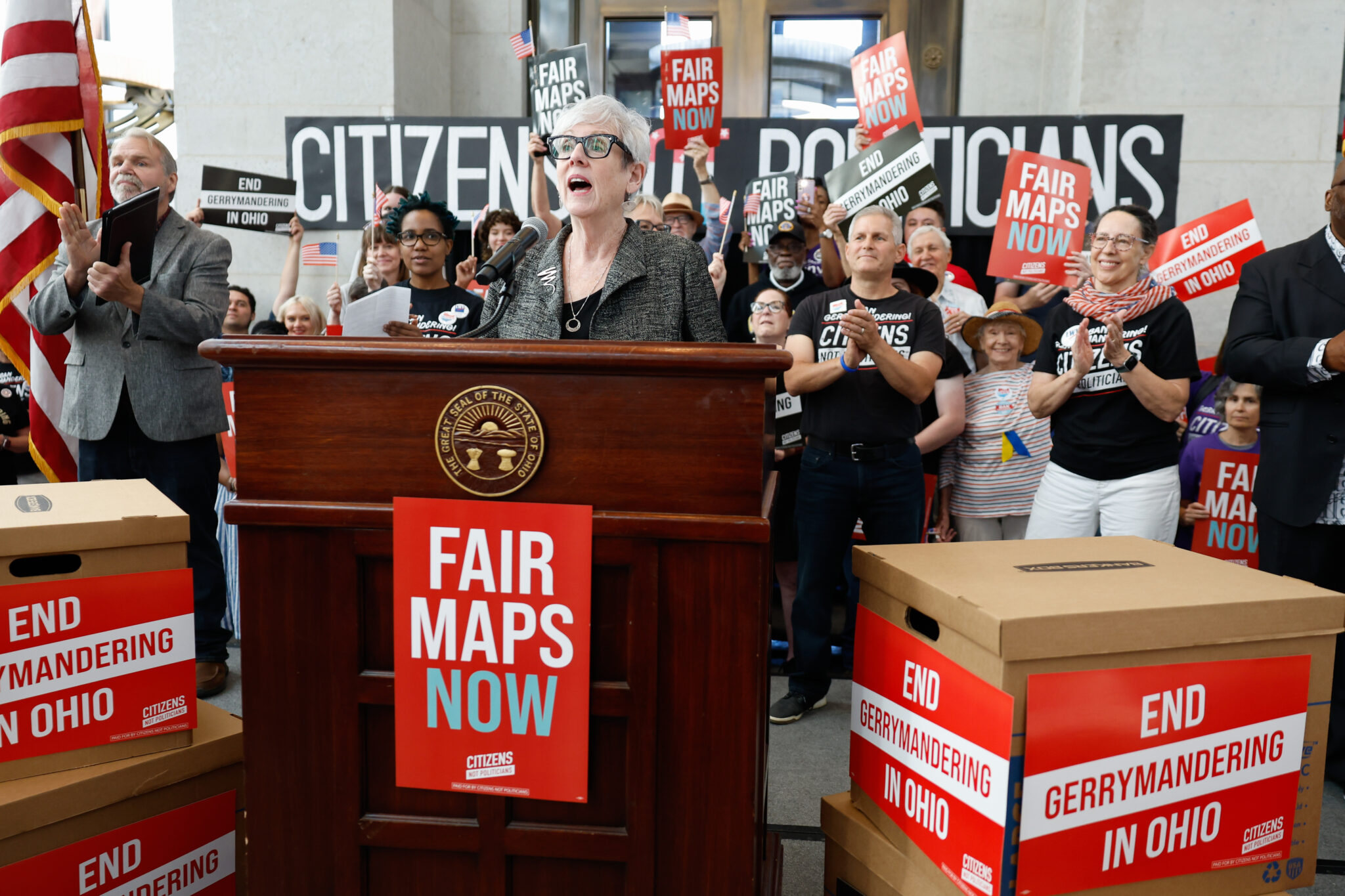
    Retired Ohio Supreme Court Chief Justice Maureen O’Connor speaks to supporters at the Citizens Not Politicians rally, July 1, 2024, at the Statehouse in Columbus, Ohio. (Photo by Graham Stokes for Ohio Capital Journal. Republish only with original story.)

    Even though Ohioans will be voting on Issue 1, which would remove politicians from the redistricting if approved, it’s possible redistricting will go before the state’s high court again.

    By:  Ohio Capital Journal

    The justices elected to the Ohio Supreme Court in 2024 will be the ones deciding on any challenges to new maps if Ohio voters pass the proposed Issue 1 anti-gerrymandering amendment this November.

    Even though Ohioans will be voting on Issue 1, which would remove politicians from redistricting if approved, it’s possible redistricting will go before the state’s high court again.

    “Maps, no matter who draws them, are certainly subject to challenge, and they’re subject to challenge for violating the provisions of the Ohio Constitution,”said University of Cincinnati Political Science Professor David Niven. “So we’re not done no matter what happens with Issue One. … There are still unhappy political actors who will go to the courts in some cases, questioning the process.”

    Redistricting and past Supreme Court rulings

    Redistricting is currently done through the Ohio Redistricting Commission — which includes the governor, the secretary of state, the state auditor and four legislative leaders (two from each party). In 2015, 71% of Ohioans voted in favor of a constitutional amendment to create a bipartisan redistricting commission to draw legislative districts in 2021.

    Six different Statehouse district maps and two congressional maps have gone through the current redistricting process. The Ohio Supreme Court ruled five of the Statehouse maps unconstitutionally gerrymandered and both congressional maps were rejected as unconstitutional.

    A federal court ordered Ohio voters to use the last of the gerrymandered Statehouse maps in 2022 since the commission ran out of time to come up with a constitutionally approved map. State lawmakers are currently occupying those districts.

    Republican former Ohio Supreme Court Chief Justice Maureen O’Connor, who served on the state’s high court from 2003 to 2022, talked about this in an ad for Issue 1.

    “Seven times career politicians have so blatantly gerrymandered our voting district maps that the Ohio Supreme Court ruled the maps unconstitutional. Seven times,” she said in the ad. “Issue One bans politicians from drawing voting maps. It will restore power to where it belongs, with citizens not politicians.”

    Citizens Not Politicians, a nonpartisan coalition, is behind the proposed constitutional amendment. Issue 1 would create a 15-member Ohio Citizens Redistricting Commission made up of Republicans, Democratic and independent citizens. It would prohibit current or former politicians, political party officials, lobbyists and large political donors from being on the commission.

    Ohio Supreme Court races

    Republicans currently have a 4-3 majority on the Ohio Supreme Court. Depending on the outcome of the election, the Democrats could flip the court or the Republicans could tighten their grip.

    “The makeup of the court makes a tremendous difference,” Executive Director of Common Cause Ohio Catherine Turcer said. “Are these folks that are going to serve on the court going to look at new voting districts with an eye to what’s in the Ohio Constitution and to what is actually good for Ohio voters, or are they going to be swayed by partisan interests?”

    Ohio Republican lawmakers added party labels to the previously nonpartisan Ohio Supreme Court races starting in 2022.

    Incumbent Democratic Justice Michael P. Donnelly is being challenged by Republican Hamilton County Court of Common Pleas Judge Megan Shanahan.

    Incumbent Democratic Justice Melody Stewart is being challenged by incumbent Republican Justice Joseph Deters, who decided not to run for his current seat and instead chose to go up against Stewart.

    Democratic candidate Lisa Forbes, of the Eighth District Court of Appeals, and Republican candidate Dan Hawkins, of the Franklin County Court of Common Pleas, are fighting for Deters’ open seat.

    Deters recently talked briefly about redistricting on a right-wing Cleveland radio show.

    “I think it’s kind of humorous to watch when the other side can’t win, they want to change the rules whether it’s hacking the U.S. Supreme Court because they don’t have the justices they like, or getting rid of the Electoral College because they don’t have a clear advantage in the Electoral College like they do, and it’s just a flat popular vote. And now redistricting,” he said on Strictly Speaking with Bob Frantz.

    Follow OCJ Reporter Megan Henry on X.


    Megan Henry
    Megan Henry

    Megan Henry is a reporter for the Ohio Capital Journal and has spent the past five years reporting in Ohio on various topics including education, healthcare, business and crime. She previously worked at The Columbus Dispatch, part of the USA Today Network.

    Ohio Capital Journal is part of States Newsroom, the nation’s largest state-focused nonprofit news organization.

    MORE FROM AUTHOR


  • Ohio recreational marijuana sales exceed $76 million in less than 50 days

    Ohio recreational marijuana sales exceed $76 million in less than 50 days

    Amplify Dispensary in Columbus. (Ohio Capital Journal photo.)

    By:  Ohio Capital Journal

    Ohio recreational marijuana sales have surpassed $76.2 million in less than two months.

    The state’s total recreational marijuana sales was $76,280,490 as of Sept. 21, according to the Ohio Department of Commerce Division of Cannabis Control. Ohio has a 10% tax at the point of sales for every non-medical marijuana transaction.

    Recreational marijuana sales started in Ohio on Aug. 6 and sales topped $11.5 million in less than a week. Fifty-seven percent of Ohioans voted to legalize marijuana last November through the passage of Issue 2, which also legalized home grow for Ohioans 21 and older with a cap of six plants per person and 12 plants per residence.

    There have been 8,813 pounds of plant materials sold and 1,187,395 units of manufactured products, according to the DCC.

    There are 124 dual-use marijuana dispensaries in Ohio, meaning they can sell both medical and non-medical marijuana, according to the division. Columbus has 13 dual-use marijuana dispensaries, Cincinnati has 10, Dayton has six and Cleveland has five.

    Ohio has more than 107 local moratoriums prohibiting adult-use cannabis business as of Monday, according to Ohio State University’s Moritz College of Law.

    Follow OCJ Reporter Megan Henry on X.


    Megan Henry
    Megan Henry

    Megan Henry is a reporter for the Ohio Capital Journal and has spent the past five years reporting in Ohio on various topics including education, healthcare, business and crime. She previously worked at The Columbus Dispatch, part of the USA Today Network.

    Ohio Capital Journal is part of States Newsroom, the nation’s largest state-focused nonprofit news organization.

    MORE FROM AUTHOR

  • Independents, Republicans chide Moreno over comments about older women and abortion

    Independents, Republicans chide Moreno over comments about older women and abortion

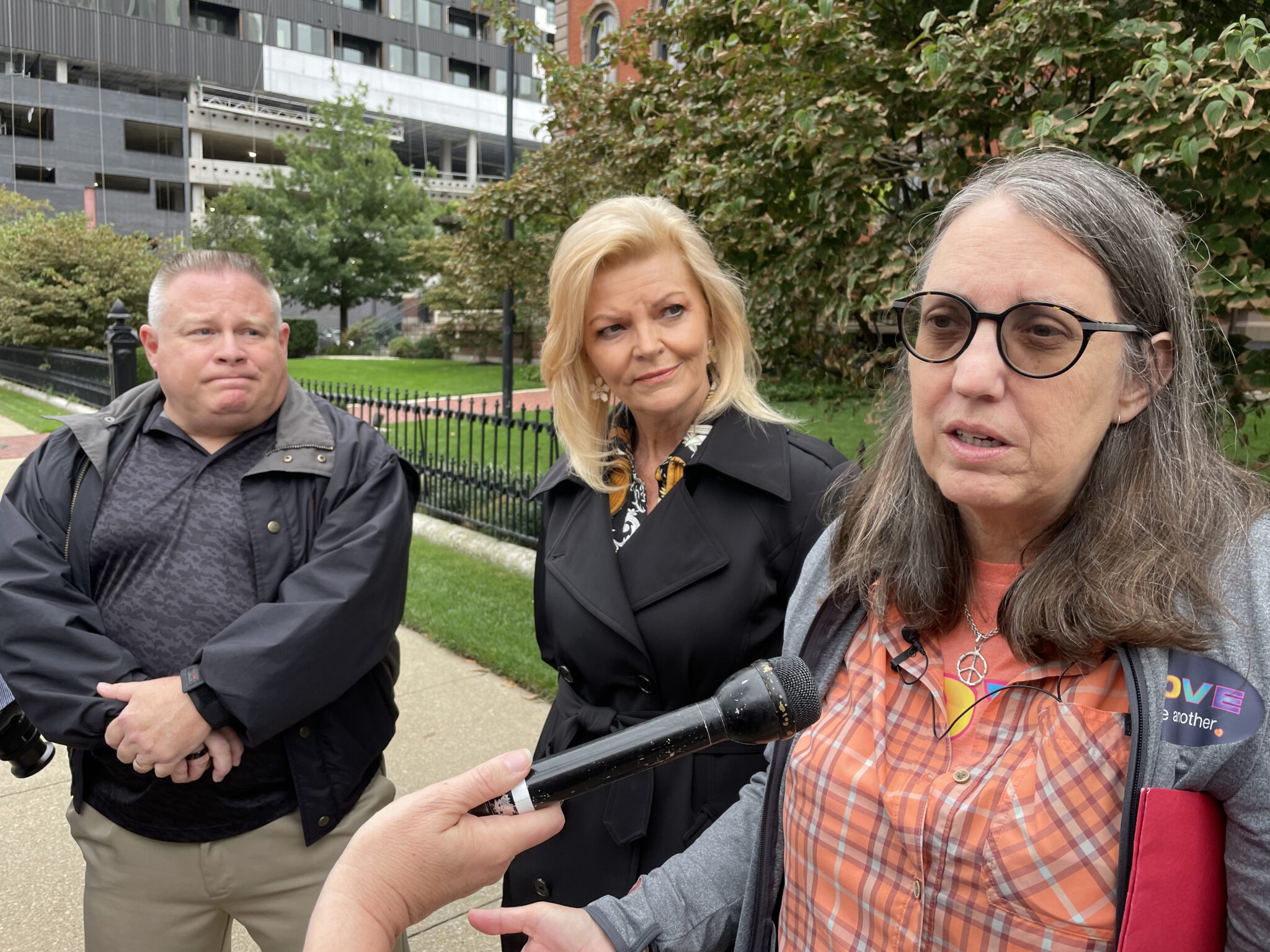
    Lea Maceyko, speaking, alongside Tammy Krings and Arthur “Ed” Dunn. (Photo by Nick Evans, Ohio Capital Journal.)

    The Republican U.S. Senate candidate said it’s “a little crazy” for women over 50 to prioritize abortion policy when deciding on a candidate

    By:  Ohio Capital Journal

    Republican and independent voters are criticizing Republican U.S. Senate candidate Bernie Moreno after he referred to women as “a little crazy” for making abortion policy the deciding factor for their vote. In a video obtained by WCMH, Moreno told a crowd in Warren County “(there’s) a lot of suburban women that are like, ‘Listen, abortion is it. If I can’t have an abortion in this country whenever I want, I will vote for anybody else.”

    “It’s a little crazy by the way,” he went on, “but — especially for women that are like past 50 — I’m thinking to myself, ‘I don’t think that’s an issue for you.’”

    “I’m 63,” Tammy Krings said, “When I turned 50, I didn’t stop caring about my daughter’s body and her choices and her rights.”

    Krings described herself as an independent voter, and she spoke alongside two Republicans Thursday on the sidewalk outside the Columbus Club where Moreno was hosting a fundraiser. The event was organized by Moreno’s opponent, Democratic U.S. Sen. Sherrod Brown.

    “I didn’t stop caring about my future grandchildren and their rights,” Krings added. “Just because you’re not of childbearing age, and just because you’re not a woman doesn’t mean this isn’t important to you.”

     U.S. Senate candidate Bernie Moreno (R-OH) speaks to guests during a campaign rally with Republican vice presidential nominee Sen. JD Vance (R-OH) at Middletown High School on July 22, 2024 in Middletown, Ohio. (Photo by Scott Olson/Getty Images) 

    Moreno’s comments in context

    In an emailed statement, Moreno campaign spokeswoman Reagan McCarthy said, “Bernie was clearly making a tongue-in-cheek joke about how Sherrod Brown and members of the left-wing media like to pretend that the only issue that matters to women voters is abortion.”

    “Bernie’s view,” she continued, “is that women voters care just as much about the economy, rising prices, crime, and our open southern border as male voters do, and it’s disgusting that Democrats and their friends in the left-wing media constantly treat all women as if they’re automatically single-issue voters on abortion.”

    Still, Brown’s campaign has latched on to Moreno’s comments. Just days after Ohio voters approved the reproductive rights amendment known as Issue 1 last November, state Democratic officials made it clear they would make politicians’ stance on the issue a central theme of this year’s campaign.


    Moreno’s team says he favors exceptions for rape, incest and the life of the mother, but when he ran in 2022, before the U.S. Supreme Court struck down Roe, he described himself as “100% pro-life no exceptions.” He’s also embraced the idea of a national “15-week floor” for abortion, but has been less willing to assert that outside of being an aspiration after former President Donald Trump abandoned the idea in April. Now Moreno argues the matter should be settled “primarily” at the state level. Following a surprise Alabama Supreme Court ruling that threatened access to IVF treatment, Moreno dismissed concerns as “a left-wing, media-created issue.” And Wednesday, The Columbus Dispatch reported that Moreno claimed the Founding Fathers would “murder you” for supporting abortion rights.

    Moreno isn’t the only Republican candidate struggling to thread the needle on an issue where the majority of voters don’t appear to align with their position. But even within his party, Moreno’s comments sparked pushback. Former GOP presidential candidate Nikki Haley asked, “are you trying to lose the election?” on social media Tuesday.

    Republicans and Independents weigh in

    “Fifty-seven percent of Ohioans voted,” Krings argued, in reference to Issue 1 last November, “and Bernie Moreno wants to just toss that out the window.”

    She insisted politicians need to “understand the assignment.” It’s their job, she said, to uphold the will of the voters not second guess it.

    “He thinks he knows better,” she said. “We the people — his job is to execute on what the people vote for. It’s really kind of simple.”

    Krings is backing Brown because of his record of bringing people together, listening, and striving to represent all of the people in the state, she said. In addition to Krings, Ed Dunn and Lea Maceyko had harsh words for Moreno. They’re both supporting Brown as well.

     Arthur “Ed” Dunn speaking outside the Columbus Club in downtown Columbus. (Photo by Nick Evans, Ohio Capital Journal.) 

    Dunn is from Beavercreek and described himself as a lifelong Republican. Like Krings he argued that even a policy doesn’t affect him personally, that doesn’t preclude him from caring about it.

    “We just want women, including my family, friends and others, now and in the future, to have the right to make their own health care decisions,” he said. “The government or politicians shouldn’t be involved in those extremely personal matters.”

    “That’s not crazy,” Dunn added, “that’s just common sense.”

    Lea Maceyko is a Republican, too and comes from “a little one-stoplight town called Cardington.” She described herself as an Ohio woman over 50. “I won’t tell you exactly how far over 50 I am,” she added, “but I’m over 50.” Maceyko was a bit shocked that Moreno would not just disregard the results of Issue 1, but that he’d make light of it.

    “(He’s) making fun of people for caring about our rights and the rights of others,” she said. “And frankly, I just don’t think that’s very funny.”

    “I have grandchildren, nieces, friends and other women in my life that I love and care about, and I don’t think it’s very crazy that I care about their rights.” Maceyko added. “Bernie said I was crazy, but really, I think he’s a little crazy to be mocking people that he wants to represent.”

    Follow OCJ Reporter Nick Evans on Twitter.


    Nick Evans
    Nick Evans

    Nick Evans has spent the past seven years reporting for NPR member stations in Florida and Ohio. He got his start in Tallahassee, covering issues like redistricting, same sex marriage and medical marijuana. Since arriving in Columbus in 2018, he has covered everything from city council to football. His work on Ohio politics and local policing have been featured numerous times on NPR.

    Ohio Capital Journal is part of States Newsroom, the nation’s largest state-focused nonprofit news organization.

    MORE FROM AUTHOR

  • New report praises Ohio saving rescue plan funds, but warns of ‘precarious’ state of child care

    New report praises Ohio saving rescue plan funds, but warns of ‘precarious’ state of child care

    Photo courtesy Wikimedia Commons.

    “The annual cost of care for two children in a center is 93% more than the average rent payment and 28% more than the average mortgage payment in Ohio,” the study stated.

    By:  Oho Capital Journal

    A new analysis looking at child care in several states, including Ohio, shows big costs and staffing shortages, but also some proactive actions taken by states to prepare for the expiration of pandemic-era federal funding.

    The Century Foundation released a new report showing “a wave of increasing prices, economic damage, staffing shortages and reduced wages for early childhood educators,” and a “dire need for investment at the state and federal levels in child care to lower costs for working families,” according to a release announcing the report.

    “The annual cost of care for two children in a center is 93% more than the average rent payment and 28% more than the average mortgage payment in Ohio,” the study stated.

    Julie Kashen, director of women’s economic justice at the Century Foundation said the report showed what many parents are contending with every day: “finding and affording child care is taking a huge toll on families’ budgets and remains a big source of stress.”

    “At the same time, we’re seeing these are solvable problems: when elected leaders listen to parents and invest in care, it makes a difference,” Kashen said in a statement.

    The states chosen in the study were Ohio, New York, Pennsylvania, Virginia and Wisconsin, due to the “outsized political attention right now in light of the 2024 election,” the study stated.

    Taking all of the states together, the Century Foundation study showed 30 to 40% of child care programs in the five states would have been forced to close without the ARPA “stabilization grants” distributed to the child care sector.

    “These challenges existed long before anyone had heard of COVID-19, but were exacerbated by the pandemic and made better by the ARPA funds,” the study stated.

    The end of pandemic-era funding began in September of 2023, with the Century Foundation estimated that more than three million children nationally would lose access to child care. Ohio was reported to have 6,265 child care programs which received ARPA grants, with 33% that would have closed without them, according to the most recent study by the Century Foundation.

    The foundation previously projected more than 130,000 Ohio children would lose child care, and more than 2,000 child care programs expected to close because of the so-called “child care cliff.”

    While the study of ARPA funding usages in Ohio showed the state having only spent 2/3 of its supplemental Child Care Development Block Grant from the ARPA monies “left room for longer term investments,” the state’s child care sector is still “in a precarious state.”

    Between 2019 and 2023, Ohio’s child care employment levels fell by 26%, 11% of the state’s programs were lost in that period and 10% of the licensed programs have disappeared since 2019.

    Citing state data, the study found “worsening” supply shortages. The data showed that in 2024, Ohio had 30%, or 2,700, fewer providers compared to 2018 levels.

    Alongside the decreases came a 25% increase in the price of child care since 2019, with the average annual price for an infant listed as $12,351 in the foundation’s most recent study.

    Child care has been a hot topic in Ohio, with advocacy groups and families throughout the state sounding the alarm of the state of child care, including its inaccessibility and high costs. The child care sector’s issues could have longterm impacts on the entire state economy, amounting to billions in impacts, according to policy advisors and advocates brought together by the Federal Reserve Bank of Cleveland.

    Before they left for a summer break that will continue until after the November general election, the Ohio General Assembly saw the introduction of several bills aimed at addressing the child care system in the state, thought it’s unclear whether those bills will see passage before the end of the current GA in December. If they aren’t passed through by the end of the year, all bills would have to be reintroduced in 2025.


    Susan Tebben
    Susan Tebben

    Susan Tebben is an award-winning journalist with a decade of experience covering Ohio news, including courts and crime, Appalachian social issues, government, education, diversity and culture. She has worked for The Newark Advocate, The Glasgow (KY) Daily Times, The Athens Messenger, and WOUB Public Media. She has also had work featured on National Public Radio.

    Ohio Capital Journal is part of States Newsroom, the nation’s largest state-focused nonprofit news organization.

    MORE FROM AUTHOR

  • Ohio teachers connect presidential election to classroom curriculum

    Ohio teachers connect presidential election to classroom curriculum

     A student concentrating and taking notes while working in a classroom with her classmates. (Getty Images)

    By:  Ohio Capital Journal

    As the presidential election inches closer, Ohio social studies and government teachers are using this as an opportunity to engage their students in civics education.

    The Ohio Capital Journal talked to three current teachers — elementary, middle and high school — about how they are incorporating the presidential election into their curriculum.

    “This is just another opportunity that only comes around once every four years,” Westerville South High School Government Teacher Kelley Stocker said. “The most rewarding part is knowing that I am helping to create a citizenry that understands how our country works.”

    She typically tries to find current events that tie into what they are learning about in her class to help give real life examples to her students at the suburban high school just north of Columbus.

    “You have to help them understand how government touches their lives and the real world applications,” said Stocker, who is in her 11th year teaching. “I just want them to start to understand why this stuff matters. I always tell them, you know, you can be anything you want to be in (her classroom), except apathetic or ignorant.”

    Stocker rearranged her curriculum this semester to cover elections, campaigns, political parties and the First Amendment in a unit called “the role of the people.” Before she starts the unit, she sends letters home to the families to let them know she plans on covering the election in class and encourages parents to reach out if they have any questions.

    One activity she has her students do is make a prediction map on 270 to Win.

    “It’s like doing the (March Madness) brackets,” she said.

    When talking politics in the classroom, Stocker has one boundary with her students — they can talk about issues, not people.

    “You can say, I don’t agree with this position, not I don’t like these people,” she said. “I try to separate issues from people.”

    Government is a high school graduation requirement in Ohio and Cleveland Teachers Union President Shari Obrenski previously taught high school government and history for more than 20 years.

    “I always enjoyed seeing students at the beginning of an election cycle who have absolutely no interest in what’s going on that by the time we get to the presidential election, or a big election of some sort, be able to talk about platforms, be able to analyze commercials, be excited about the process and interested in how it was going to turn out,” she said.

    Obrenski fondly looks back on her time in the classroom teaching the political process.

    “We would talk about campaign commercials and the techniques that are used in campaign advertising, and having them take a look at different platforms from different political parties, having them analyze their own viewpoints, to see kind of where they line up ideologically with different political parties,” she said.

    Some of Obrenski’s former students have reached back out to her and said they vote because of what they learned in her class.

    “It reinforces that the work is important and reinforces that civic education is important,” Obrenski said.

    James Lautzenheiser, an eighth grade history teacher at Crestview Middle School in Van Wert County in Northwest Ohio, said he views teaching how government works as an introduction to citizenship for his middle schoolers.

    “I really like helping kids distinguish between what they think history and government is, and helping them kind of figure out some things for themselves,” Lautzenheiser, who has been a teacher for 15 years, said.

    Even though Angel Dyer Sanchez’s fifth grade students aren’t old enough to vote, she hopes what they talk about in class will lead to conversations about voting at the dinner table. The elementary school teacher in Columbus City Schools encourages her students to think for themselves when it comes to which candidate they want to win.

    “Don’t just vote because it’s who your parents or grandparents are voting for,” she said. “You should have your own opinion. … You should know who you’re voting for and what they stand for.”

    Voting

    Stocker keeps voter registration forms, stamps and envelopes in her classroom, so students can come to her if they are ready to register to vote.

    “The only thing they have to do by themselves is we have a mail drop box across the street, and they just have to walk it over,” Stocker said.

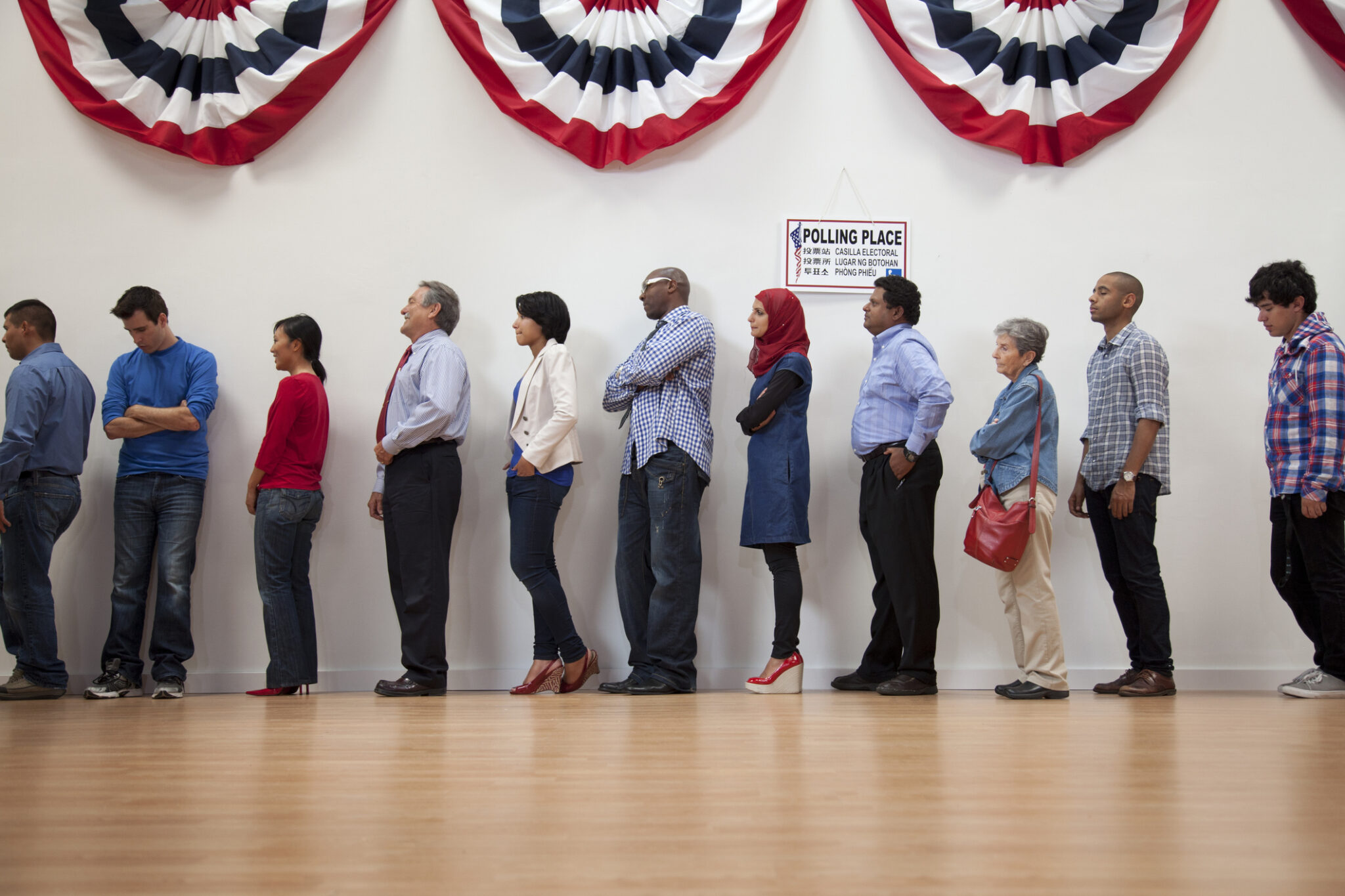
     Voting location. (Photo by the New Jersey Monitor/States Newsroom.) 

    In a similar vein, Obrenski helped eligible students register to vote and would teach a unit on voting and the country’s evolution of voting rights.

    “Students are often really surprised to know that it’s only been 100 years since women have had the right to vote,” she said. “It’s inconceivable to them that that’s possible.”

    Sanchez, who is her 20th year of teaching, gives lessons about voting and the three branches of government while encouraging her students to go to the voting polls with their parents.

    “I just want to instill in them early that it is a right, and they need to make sure they take advantage of that right,” Sanchez said.

    Lautzenheiser’s students are excited about the idea of voting.  

    “A lot of them have already expressed that it’s frustrating that their parents don’t always vote,” he said.

    Only 32% of Ohio’s 18-year-olds are registered to vote as of May, according to the Civics Center, a nonpartisan organization trying to increase voter registration.

    “When you look at the types of issues that are on the ballot with the candidates that we have on the ballot, young people are often more impacted by these decisions than other age groups, so it’s so important for them to see value in the process and to try to get them to go to the polls,” Obrenski said.

    Teaching about the election doesn’t end once the votes are counted. Stocker plans on analyzing the outcome with her class to see how accurate the polls were.

    “If they weren’t accurate how can we maybe explain that?” she said.

    Teaching students media literacy goes hand-in-hand with teaching about the election.

    “One of my personal goals is that I want them to be able to read the news and understand it,” Stocker said. “I’m teaching them all of the things that they need and the tools that they need to be able to think critically about the news, what they read, what they hear, and to be able to understand it.”

    Sanchez said she teaches her fifth graders how to identify if a news outlet is a trustworthy site.

    “Half the battle is, are you sure you’re getting truthful information?” she said.

    Follow OCJ Reporter Megan Henry on X.


    Megan Henry
    Megan Henry

    Megan Henry is a reporter for the Ohio Capital Journal and has spent the past five years reporting in Ohio on various topics including education, healthcare, business and crime. She previously worked at The Columbus Dispatch, part of the USA Today Network.

    Ohio Capital Journal is part of States Newsroom, the nation’s largest state-focused nonprofit news organization.

    MORE FROM AUTHOR

  • Amid ongoing threats, Ohio GOP US Senate candidate calls for deporting Springfield legal immigrants

    Amid ongoing threats, Ohio GOP US Senate candidate calls for deporting Springfield legal immigrants

     U.S. Senator J.D. Vance (R-OH) and Ohio Republican candidate for US Senate Bernie Moreno listen as Republican presidential candidate former President Donald Trump speaks during a rally at the Dayton International Airport on March 16, 2024 in Vandalia, Ohio. (Photo by Scott Olson/Getty Images.)

    By:  Ohio Capital Journal

    Terroristic threats continued against Springfield officials and public buildings over the weekend and into Monday. In the midst of them, Republican U.S. Senate candidate Bernie Moreno called for the protected status of legal Haitian migrants in Springfield to be revoked and for them to be deported back to their violence-riven country.

     The Republican presidential nominee, former President Donald Trump, debates the Democratic presidential nominee, Vice President Kamala Harris, for the first time during the presidential election campaign at The National Constitution Center on Sept. 10, 2024 in Philadelphia, Pennsylvania. (Photo by Win McNamee/Getty Images) 

    The city in southwestern Ohio has been the center of a national political firestorm after former president Donald Trump in last Tuesday’s debate repeated a debunked claim that Haitian immigrants who have flocked to the community over the past five years were stealing neighbors’ pets and eating them.

    The claim has been debunked by public safety officials, Gov. Mike DeWine, and even one of the first people to post it on Facebook. She said she misunderstood what a neighbor told her about “an acquaintance of a friend” whose cat was missing.

    Other GOP officials, including Ohio Attorney General Dave Yost, have amplified rumors that Black immigrants to Springfield have been killing and eating geese. Officials said there was no evidence to support that claim, either.

    Springfield’s health and education infrastructure has been strained as 12,000 to 15,000 Haitians fleeing chaos in their country have moved over the past five years to what had been a shrinking community. A big reason was the availability of warehouse and manufacturing jobs.

    The strains and the influx of immigrants of color has sparked a wave of hatred. An armed neo-Nazi group marched through the city last month, and over the weekend, Ku Klux Klan fliers appeared in Springfield neighborhoods, saying, “Foreigners and Haitians Out.”

    Schools, City Hall and other public buildings were evacuated and closed every day since Thursday due to bomb threats, some explicitly tied to the Haitian immigrants. Most recently, two elementary schools were evacuated on Monday after receiving bomb threats, WKEF reported. DeWine said Monday that “at least 33” bomb threats have been made.

    Public officials have received death threats, and Mayor Rob Rue, Republican, on Friday blamed Trump and his running mate, Ohio U.S. Sen. J.D. Vance for the strife.

    “All these federal politicians that have negatively spun our city, they need to know they’re hurting our city, and it was their words that did it,” Rue told Columbus TV station WSYX.

    Despite Rue’s plea, Trump on Friday falsely claimed Springfield had been destroyed by the immigrants, who are in the United States legally, and promised to deport them.

    On Sunday, Vance appeared on CNN and defended his false statements about Springfield.

    If I have to create stories so that the American media actually pays attention to the suffering of the American people, then that’s what I’m going to do,” he said, then adding that he was “creating the American media focusing on it.”

    Moreno, a Cleveland car dealer who is challenging Democratic Ohio U.S. Sen. Sherrod Brown, went to Springfield on Saturday and called for the legal immigrants’ deportation.

    “What’s happened is that Sherrod Brown and Kamala Harris have waved the magic wand, corrupted our immigration system and shielded them through Temporary Protected Status and asylum — two loopholes in our immigration system that were corrupted by corrupt politicians,” Moreno said, according to the Springfield News-Sun.

    Asked on Monday if Moreno was concerned that such comments would encourage more hate and further threats, his spokeswoman took umbrage at the suggestion. Despite the Republican mayor’s admonishment, she attacked the press and linked the matter to an apparent assassination attempt Sunday against Trump at one of his South Florida golf courses.

    “It is vile that the liberal media is blaming Republicans for these threats in Springfield — with no evidence — when a leftwing lunatic who echoed talking points from Joe Biden and Kamala Harris attempted to assassinate President Trump just yesterday,” the spokeswoman, Reagan McCarthy, said in an email.

    The man who allegedly wanted to shoot Trump, Ryan Wesley Routh, wrote that he voted for Trump, soured on him and then encouraged the Iranian government to assassinate the former president, the Associated Press reported.

    Meanwhile, the situation in Springfield continues to be tense.

    In addition to bomb threats leveled at schools, government buildings and health care facilities, Rue, city commissioners and staffers have received multiple death threats, WSYX reporter Darrel Rowland posted on X.

    In midst of the tension, Rue discouraged a possible visit from Trump, which he is reportedly considering, and one from Vice President Kamala Harris, which hasn’t been mentioned, Rowland also posted.

    Spectrum News’s Taylor Popielarz posted a list of public buildings that had been “placed on lockdown, evacuated, closed, or searched at some point over the last week due to threats.” There were 21 facilities, including eight educational institutions, four county buildings, three related to car and driver licensing, two health facilities, and two municipal government buildings.

    For his part, Moreno, the Senate candidate, blames problems in Springfield not on false claims by Trump, Vance or himself, but on their political opponents.

    “Kamala Harris and Sherrod Brown wreaked havoc on Springfield with their reckless decision to extend (temporary protected status) and allow thousands of unvetted migrants to resettle in Springfield, with no regard for the devastating effects it would have on the citizens of that community,” McCarthy, Moreno’s spokeswoman, said.

    Brown isn’t part of the executive branch and the Department of Homeland Security determines whom to grant temporary protected status. So Brown wasn’t involved in that determination for the Haitians in Springfield.

    It’s also false that the migrants there are unvetted. The U.S. Citizenship and Immigration Services last month posted a document entitled “Processes for Cubans, Haitians, Nicaraguans, and Venezuelans.” It says that people from those counties receiving temporary protected status must “Undergo and clear robust security vetting.”

    For his part, Brown, the senator whom Moreno is challenging, said it’s time to stop politicizing what’s happening in Springfield.

    “Springfield reminds me of Mansfield, my hometown,” he said in a Monday post on X. “It’s a proud city with a rich manufacturing history. This community deserves better than to be used as a political pawn. We must work together to keep everyone safe & address the city’s challenges. That’s what I’ll keep doing.”

    Moreno is himself an immigrant, moving with his family from Colombia to South Florida in the early 1970s. His father was a politically connected surgeon. Unlike the often-impoverished undocumented, Moreno says, his family came to the United States the right way.

    McCarthy didn’t respond to a question asking whether, now that Moreno wants to deport refugees who are here legally, he believes only the wealthy and well-connected should be the only ones eligible to immigrate.

    Moreno has claimed that immigrants have “destroyed” Ohio cities. Such rhetoric, along with claims of an immigrant “invasion” and the “great replacement theory” have helped motivate racist massacres over the past six years in El PasoBuffalo, and Pittsburgh.

    Lynn Tramonte, director of the Ohio Immigrant Alliance, urged public figures to think about the consequences their rhetoric might have.

    “I don’t know how the people peddling lies about immigrants can live with themselves,” she said. “Most Ohioans are horrified at their behavior and its consequences. We choose love, not hate.”


    Marty Schladen
    Marty Schladen

    Marty Schladen has been a reporter for decades, working in Indiana, Texas and other places before returning to his native Ohio to work at The Columbus Dispatch in 2017. He’s won state and national journalism awards for investigations into utility regulation, public corruption, the environment, prescription drug spending and other matters.

    Ohio Capital Journal is part of States Newsroom, the nation’s largest state-focused nonprofit news organization.

    MORE FROM AUTHOR

  • Ohio Capital Journal 2024 Voter Guide

    Ohio Capital Journal 2024 Voter Guide


    What You Need to Know

    Ohio voters have some big decisions ahead of them in November 2024. In addition to voting for president, Ohio voters will be asked to decide on a proposed constitutional amendment on redistricting that would replace the politicians on the Ohio Redistricting Commission with a citizen commission.

    Ohio Democratic U.S. Sen. Sherrod Brown is also facing a reelection challenge from Republican businessman Bernie Moreno, and three Ohio Supreme Court races will decide control over Ohio’s judicial branch of government.

    You can use the following voter guide, powered by guides.vote, to help decide who should represent you in elected office.

    Races

    Ohio Democratic U.S. Sen. Sherrod Brown is facing a reelection challenge from Republican businessman Bernie Moreno, and three Ohio Supreme Court races will decide control over Ohio’s judicial branch of government.

    Ballot Measures

    Ohio voters will be asked to decide on a proposed constitutional amendment on redistricting that would replace the politicians on the Ohio Redistricting Commission with a citizen commission.

    Issue 1

    Ohio Issue 1, Establish the Ohio Citizens Redistricting Commission


    Reporting For The People

    © Ohio Capital Journal, 2024

    ABOUT US

    The Ohio Capital Journal is an independent, nonprofit news organization dedicated to connecting Ohioans to their state government and its impact on their lives. The Capital Journal combines Ohio state government coverage with incisive investigative journalism, reporting on the consequences of policy, political insight and principled commentary.

    We’re part of States Newsroom, the nation’s largest state-focused nonprofit news organization.

  • Ohio Supreme Court approves redistricting summary with only two small revisions

    Ohio Supreme Court approves redistricting summary with only two small revisions

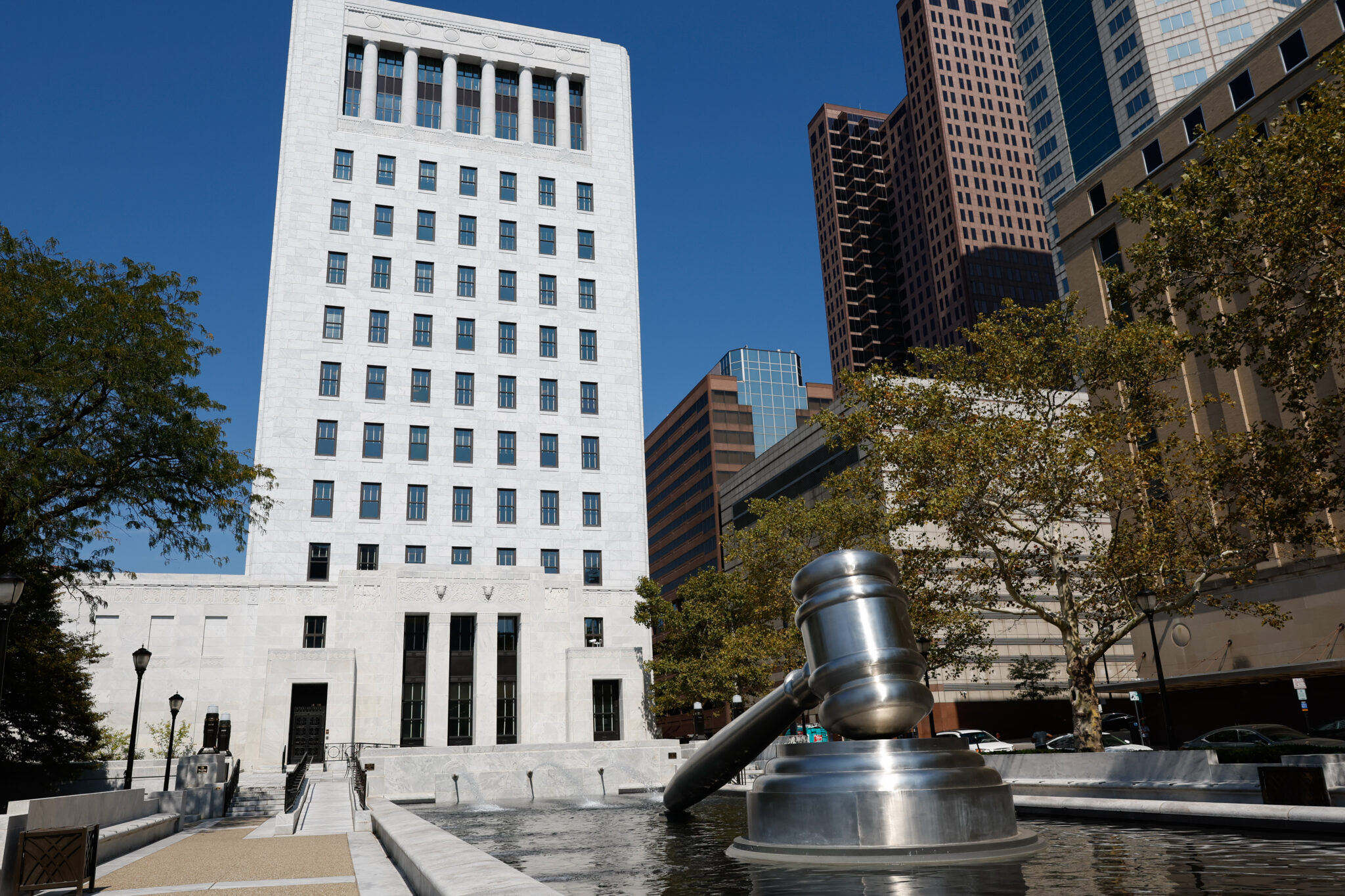
    The Gavel outside the Supreme Court of the State of Ohio, September 20, 2023, at 65 S. Front Street, Columbus, Ohio. (Photo by Graham Stokes for Ohio Capital Journal. Republish photo only with original article.)

    Republican majority rejects 6 of 8 changes requested by anti-gerrymandering advocates proposing the amendment

    By:  Ohio Capital Journal

    The Ohio Supreme Court largely approved ballot summary language for November’s Issue 1 anti-gerrymandering amendment on Monday, sending the language back to the Ohio Ballot Board for two revisions.

    A 4-3 Republican majority rejected 6 of 8 revisions requested by anti-gerrymandering advocates, while Democratic justices on the court said that was inadequate and that the summary needed “a nearly complete redrafting.”

    The summary was written by Ohio Secretary of State Frank LaRose, who opposes the amendment, and approved 3-2 by the Ohio Ballot Board, which is chaired by LaRose. LaRose is also a member of the current Ohio Redistricting Commission that the amendment proposes to replace with citizen commissioners.

    While the court allowed most of the summary language in a decision released Monday night, it ordered the board to include in the summary “language that accurately conveys” that “the public would have the right to express itself to the new redistricting commission” under the terms of the amendment, written by anti-gerrymandering coalition Citizens Not Politicians.

    “Distilled, the proposed amendment would provide the rights of public participation in the redistricting process through meetings, hearings and an online public portal, and would forbid communication with the commission members and staff outside the public-meeting and portal context,” the court wrote.

    The other change ordered by the court compels the ballot board to make it clear that judicial review of the amendment is not limited to a “proportionality standard.”

    The current seven-member Ohio Redistricting Commission includes the Ohio House Speaker and Ohio Senate President, along with the governor, secretary of state, auditor of state, and two minority party legislative leaders.

    If approved by the voters, the amendment would replace the politician commission with the Ohio Citizens Redistricting Commission, which would have 15 members made up of five Republican citizens, five Democratic citizens, and five independents.

    The summary language does not change the text of the proposed redistricting reform or what the amendment would actually do; it’s just the summary language used to describe the amendment on voter ballots.

    An average of Ohio voter preferences over the last 10 years including 2022 show a 56-43 Republican-to-Democratic preference of Ohio voters, but Republicans control supermajorities of 67 out of 99 Ohio House seats and 26 out of 33 Ohio Senate seats. Ohio voters were forced to vote under unconstitutionally gerrymandered districts in 2022 after Republicans on the Ohio Redistricting Commission ran out of time to produce constitutional maps and a split federal court ruled the maps that were declared gerrymandered by a bipartisan majority on the then-Ohio Supreme Court had to be used.

    Republican politicians on the Ohio Redistricting Commission battled with the bipartisan court majority for nearly two years over the maps in 2021 and 2022, with five Statehouse maps and two U.S. Congressional district maps being rejected as unconstitutionally gerrymandered. The swing vote in those cases, Republican Supreme Court Justice Maureen O’Connor, was forced to retire due to age. She is now leading the Citizens Not Politicians amendment effort.

    One provision challenged by Citizens Not Politicians but allowed by the court states the amendment would “repeal constitutional protections against gerrymandering approved by nearly three-quarters of Ohio electors participating in the statewide elections of 2015 and 2018, and eliminate the longstanding ability of Ohio citizens to hold their representatives accountable for establishing fair state and legislative and congressional districts.”

    Citizens Not Politicians attorneys argued mention of the vote margin and method were not necessary, and the court said challengers laid out arguments that the language was “tantamount to an argument against adopting the proposed amendment.”

    But the court majority found that “at worst” including the vote margin and method could be “questioned on relevance grounds” not on “accuracy grounds.”

    “This information is factually accurate, and relators have not shown that the information would ‘mislead, deceive or defraud the voters,’” the court majority stated in their decision.

    The court also allowed language added by state Sen. Theresa Gavarone during the Aug. 16 board meeting, which states the amendment would “establish a new taxpayer-funded commission of appointees required to gerrymander the boundaries of state legislative and congressional districts to favor the two largest political parties in the state of Ohio.”

    Justices dismissed Citizens Not Politicians arguments that the language leads voters to believe the amendment would “require gerrymandering,” despite the fact that the amendment states it would ban partisan gerrymandering.

    The court said “the fact that the proposed amendment announces that it would ‘ban partisan gerrymandering,’ … is of little assistance in ascertaining whether the ballot language’s use of the word ‘gerrymander’ is improper.”

    The court explored various definitions of “gerrymandering” in coming to its decision, finding that the requirement the amendment uses to dictate the drawing of Statehouse and congressional maps “falls within the meaning of ‘gerrymander.’”

    “Because the board’s use of the term ‘gerrymander’ is consistent with dictionary definitions and how the United States Supreme Court has used the term, it does not mislead, deceive or defraud voters,” the decision stated.

    The court did not order any changes to the ballot title, though that was included in the changes requested by Citizens Not Politicians.

    “We conclude that the secretary did not err in crafting the ballot title,” the court wrote.

    While all the justices agreed to the changes, they were split on how many changes needed to be made.

    In his concurrence, Justice Patrick Fischer claimed “gerrymandering, though in a bipartisan manner, is absolutely ‘required under the proposed amendment,” and that the state constitution “would dictate” that independent and third-party voters would have their voice “removed from Ohio’s political world.”

    Justice Michael Donnelly agreed to the decision that ordered changes to the ballot language, but “vehemently” disagreed “that those corrections are even remotely adequate to prevent the ballot language as a whole from being misleading.”

    He and Justice Melody Stewart joined Justice Jennifer Brunner in an opinion that agreed to the changes, but said the majority opinion “reflects an abject failure of this court to perform an honest constitutional check on the ballot board’s work.”

    “We should be requiring a nearly complete redrafting of what is perhaps the most stunningly stilted ballot language that Ohio voters have ever seen,” Brunner wrote.

    She went on to say the ballot board language “is tantamount to performing a virtual chewing of food before the voters can taste it for themselves to decide whether they like it or not.”

    While the summary language will appear on ballots in the November general election, the actual language of the proposed amendment will be posted in polling places.

    The Ohio Secretary of State’s office said the ballot board will meet to make the revisions on Wednesday morning.

    Reactions

    Citizens Not Politicians released a statement saying they disagreed with “much of the decision” but agreed with the court’s “repudiation of the politicians on the ballot board for violating the Ohio Constitution.”

    Ballot Board chair Frank LaRose released his own statement, calling the court’s decision “a huge win for Ohio voters, who deserve an honest explanation of what they’re being asked to decide.”

    Former Ohio Redistricting Commission co-chair and Auditor of State Keith Faber said the court was “thoughtful in its approach and they got it right.”

    Senate President Matt Huffman and Gov. Mike DeWine have both spoken against the measure publicly.

    Faber’s fellow co-chair Senate Minority Leader Nickie Antonio said while the decision “enables Ohioans to make a more informed choice by addressing some of the most deceptive language, other misleading and argumentative language still remains.”


    Susan Tebben
    Susan Tebben

    Susan Tebben is an award-winning journalist with a decade of experience covering Ohio news, including courts and crime, Appalachian social issues, government, education, diversity and culture. She has worked for The Newark Advocate, The Glasgow (KY) Daily Times, The Athens Messenger, and WOUB Public Media. She has also had work featured on National Public Radio.

    Ohio Capital Journal is part of States Newsroom, the nation’s largest state-focused nonprofit news organization.

    MORE FROM AUTHOR