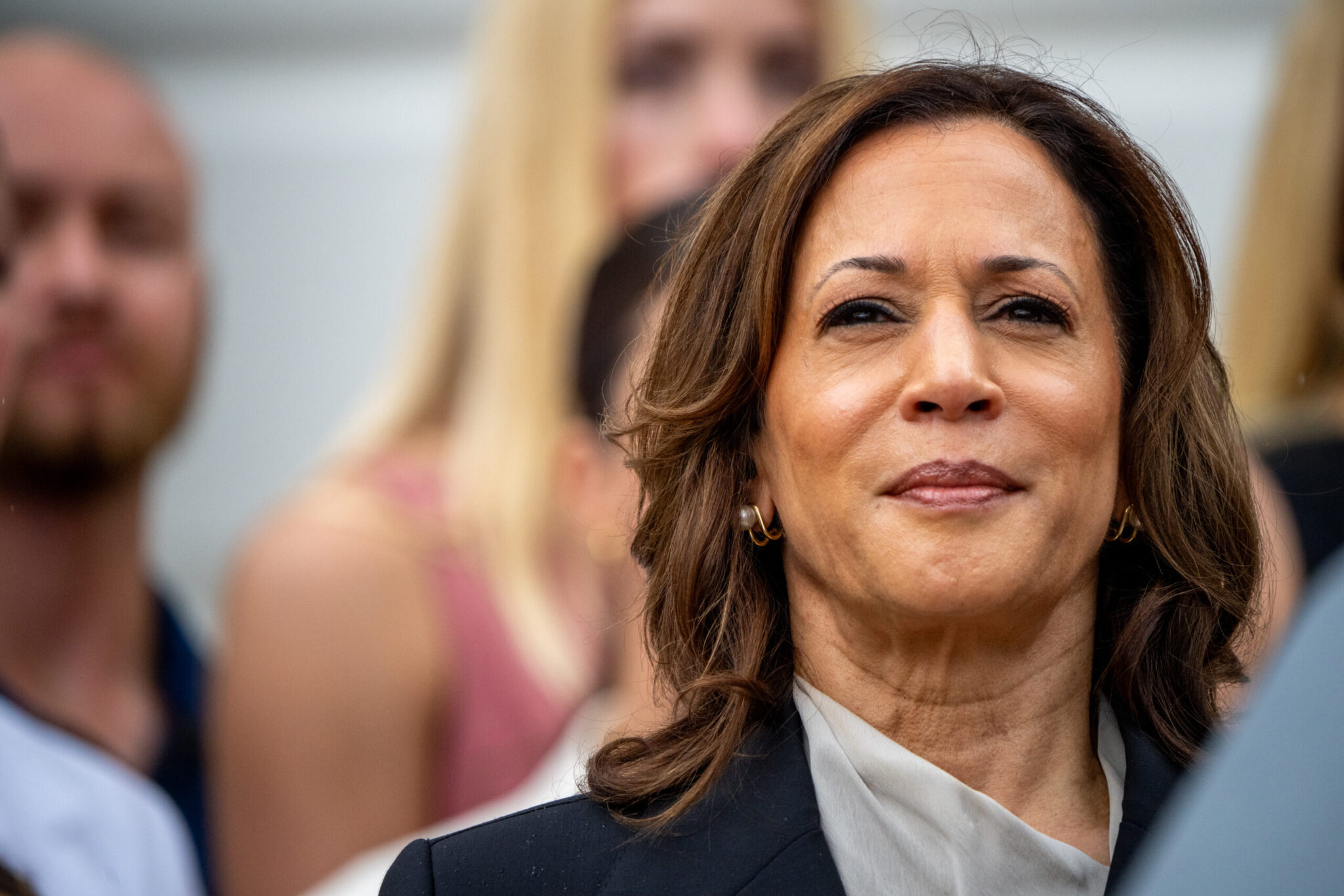
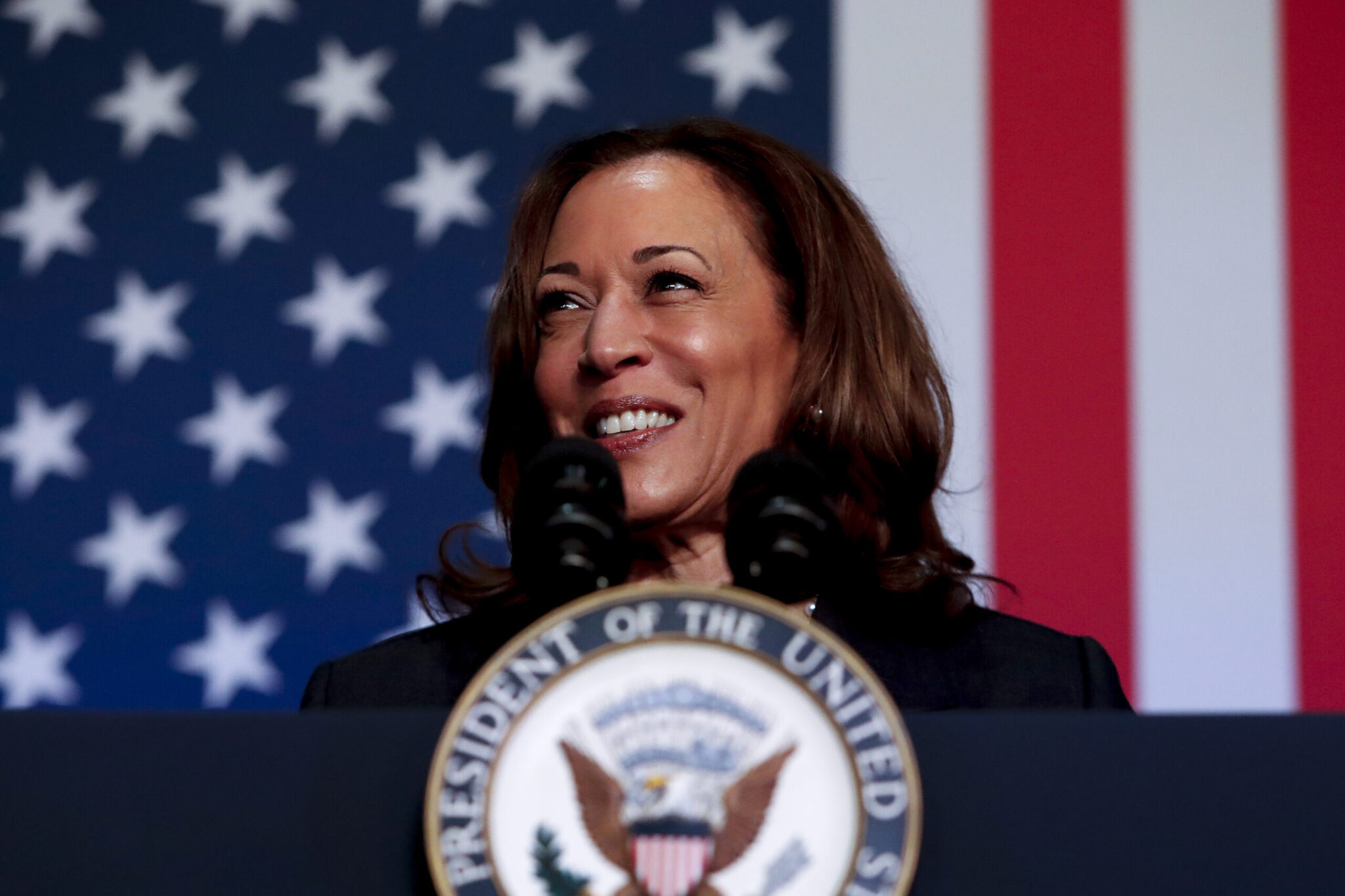
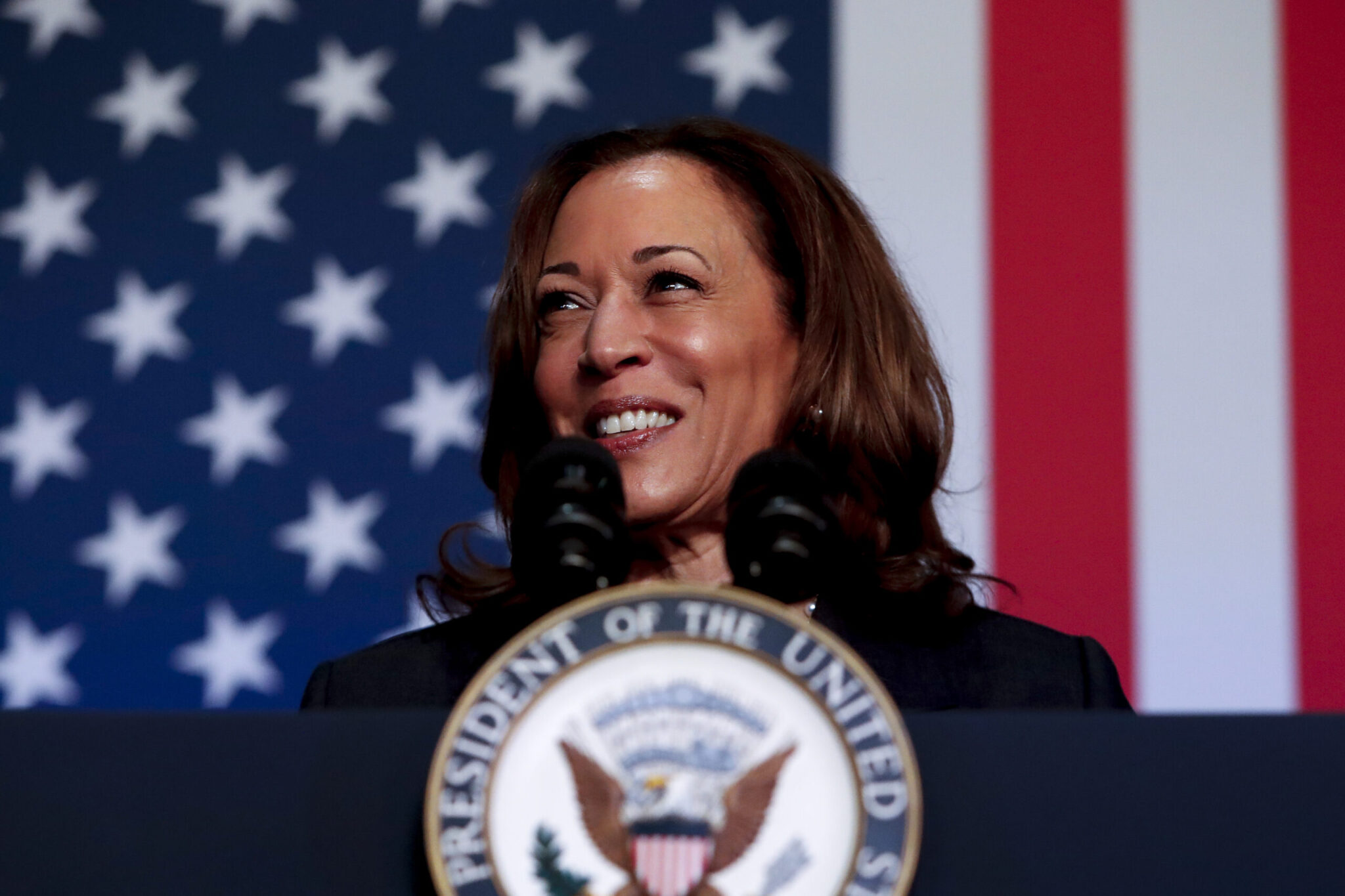
WASHINGTON — Enough Democratic delegates selected Kamala Harris to make her the party’s presidential nominee by Friday, during an ongoing virtual vote that began less than two weeks after President Joe Biden ended his reelection campaign.
The vote, which will not officially close until Monday evening, was held in advance of the Democratic National Convention, scheduled to take place in Chicago later this month, to assuage concerns about state registration deadlines that begin in August.
The DNC began laying the groundwork for the virtual nomination months before Biden announced his decision to step aside.
Harris said on a call with supporters Friday that she was happy to have surpassed the threshold needed to win the nomination.
“Of course, I will officially accept your nomination next week once the virtual voting period has closed, but already I’m happy to know that we have enough delegates to secure the nomination,” Harris said.
DNC Chair Jaime Harrison encouraged DNC delegates to keep sending in their ballots during the Zoom call, but said the support for Harris so far has been overwhelming.
“I am so proud to confirm that Vice President Harris has earned more than a majority of votes from all convention delegates and will be the nominee of the Democratic Party following the close of voting on Monday,” he said.
“The outpouring of support we have witnessed for the vice president has been unprecedented,” Harrison added. “We knew your ballots would come back quickly. But the fact that we can say today, just one day after we opened voting, that the vice president has crossed the majority threshold and will officially be our nominee next week — folks, that is simply outstanding.”
The virtual roll call vote began Thursday at 9 a.m. Eastern and will conclude Monday at 6 p.m. Eastern. Harris was the only candidate to qualify.
The DNC plans to announce the final results afterward, including a state-by-state breakdown.
One of Harris’ first official acts will be selecting a running mate from a list that holds several governors as well as at least one senator. Her decision will set the tone for the sprint to the ballot box.
Harris and her running mate are expected to hold rallies in swing states next week, including Pennsylvania on Tuesday, Wisconsin and Michigan on Wednesday, North Carolina on Thursday, Georgia and Arizona on Friday, and Nevada on Saturday.
Jennifer Shutt
Jennifer covers the nation’s capital as a senior reporter for States Newsroom. Her coverage areas include congressional policy, politics and legal challenges with a focus on health care, unemployment, housing and aid to families.
Ohio Capital Journal is part of States Newsroom, the nation’s largest state-focused nonprofit news organization.
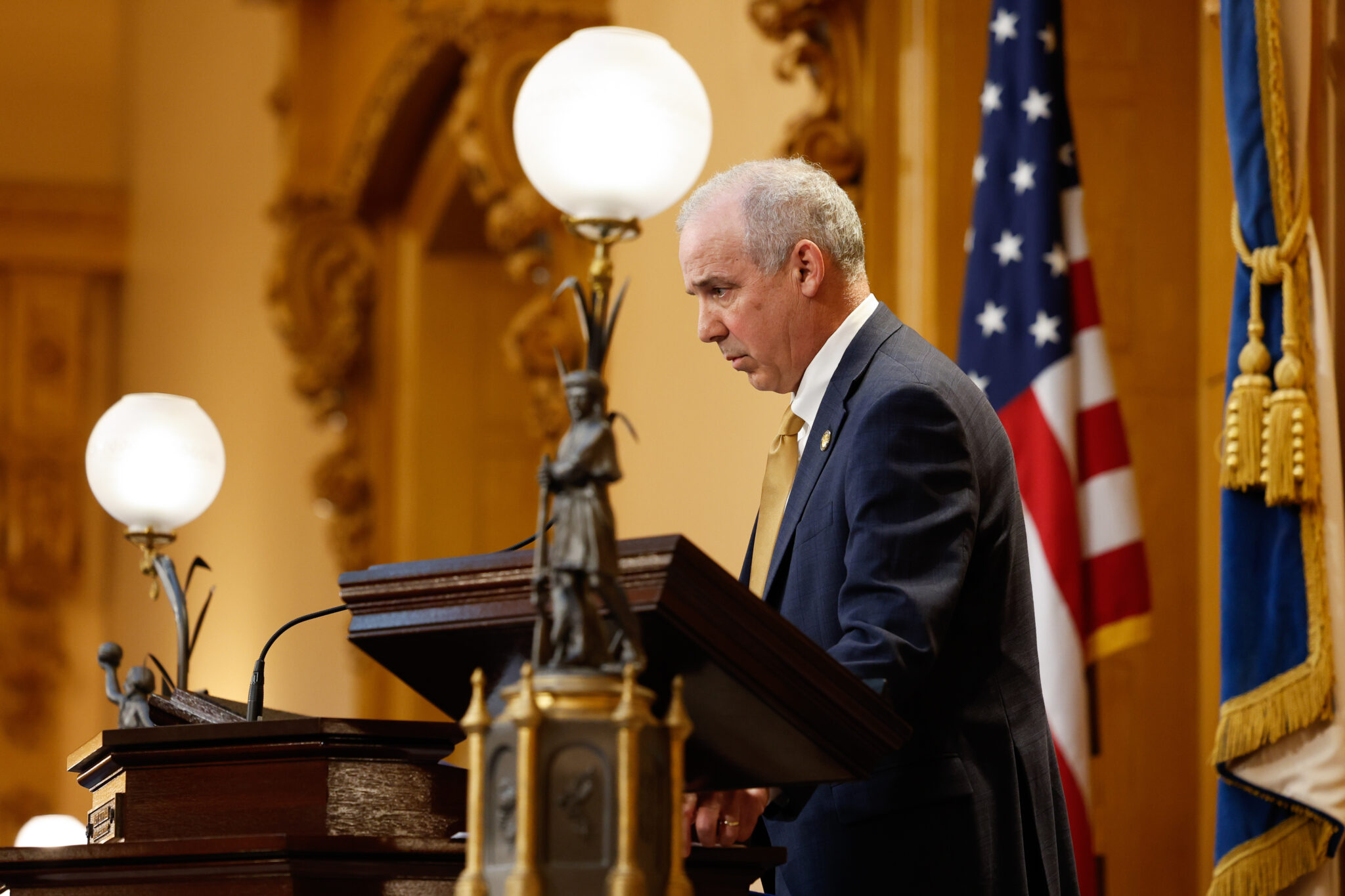
Ohio Gov. Mike DeWine stood in staunch opposition Wednesday to an anti-gerrymandering proposal heading to voters in November that would replace politicians with a citizen redistricting commission, but he stopped short of presenting a competing proposal this year.
DeWine held a press conference on Wednesday, not only to criticize the Citizens Not Politicians ballot initiative, but to acknowledge the process that’s currently in place in Ohio — a process that includes him — doesn’t work either.
“We need to end this writing and re-writing of our constitution, and we must defeat this misguided ballot initiative,” DeWine said.
Asked whether he thought it was possible the initiative headed to the ballot could work, despite his misgivings, the governor said, “No. No way in hell.”
DeWine instead presented his preference for an “Iowa plan,” where Ohio lawmakers would draw up a redistricting amendment proposal of their own early next year, based on the state of Iowa’s.
Iowa has a non-partisan legislative services agency draw maps for approval by lawmakers and the governor. If a map doesn’t get passed by the legislature and governor on its first two attempts, Iowa lawmakers are able to make amendments to the map plan as they see fit on the third attempt. This gives Iowa lawmakers final authority on maps.
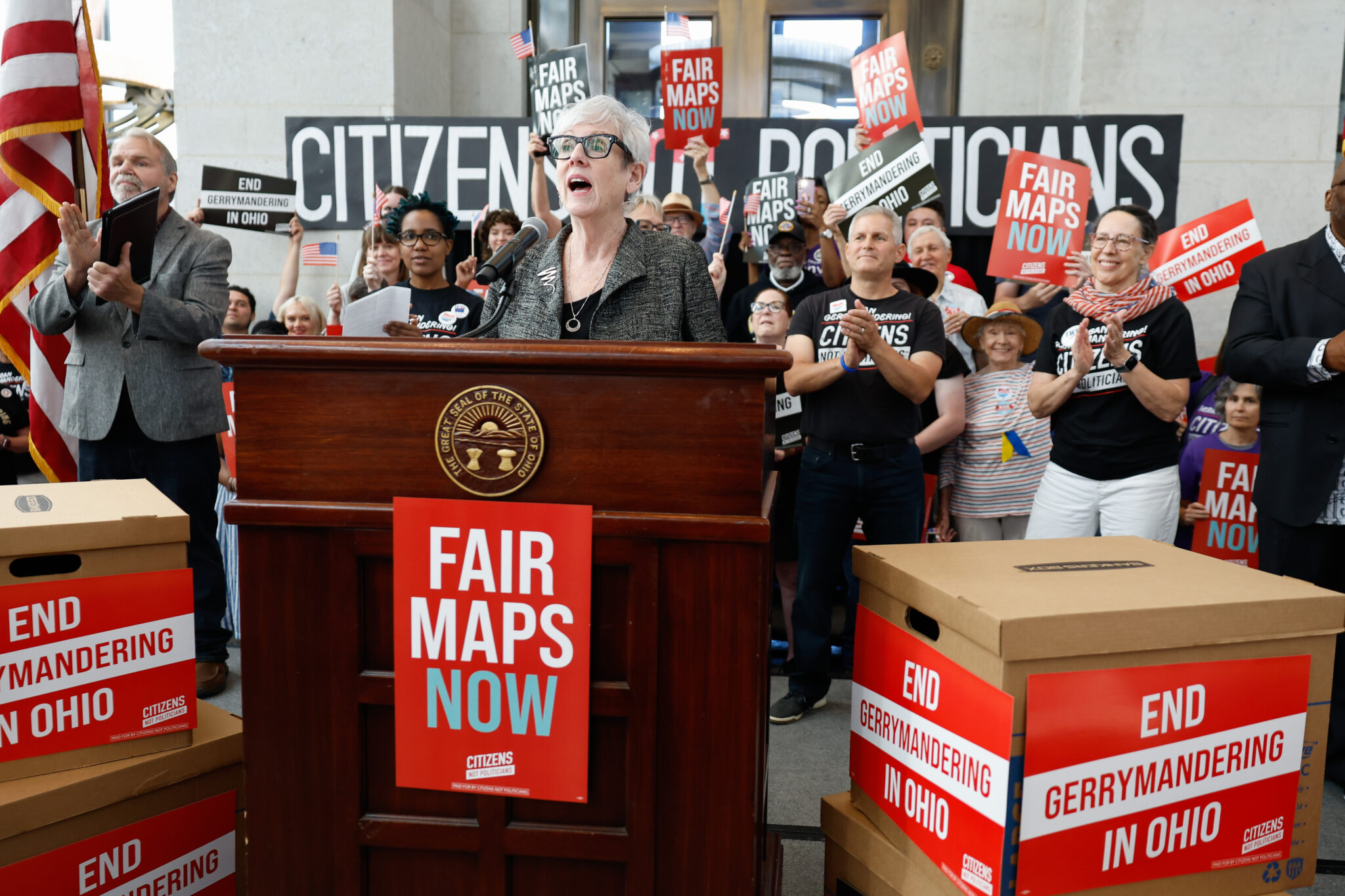
In a response issued after DeWine’s news conference, Citizens Not Politicians leader and retired Republican Ohio Supreme Court Chief Justice Maureen O’Connor issued a statement saying that the “disinformation from the governor today is insulting to everyone in Ohio.”
Redistricting in Ohio
The governor was a member of the Ohio Redistricting Commission (as dictated by current state law regarding redistricting), so he saw firsthand the process over the two years that the commission adopted six Statehouse maps and two U.S. congressional maps.
All of the maps were challenged in court, with five of the Statehouse maps rejected by the Ohio Supreme Court, and both of the congressional maps ruled unconstitutionally partisan. The sixth map was not rejected by a state supreme court led by new Chief Justice Sharon Kennedy, rather than the previous swing vote on all the maps, now-retired Chief Justice Maureen O’Connor.
The process also saw two independent map-drawers, who were brought in at the behest of the court, but whose suggestions and draft maps were rejected by the commission at the last minute, in favor of a previous draft drawn up by Republican staffers.
“This was a decision that I have consciously made after having watched the turmoil, political partisanship that’s been going on for a long time in Ohio,” DeWine said on Wednesday as he decried the Citizens Not Politicians proposal.
The one thing DeWine said did need to happen in redistricting reform that matches up with the current ballot proposal is a removal of politics as part of the process.
“Ohio should have a constitutional provision that instructs the mapmakers that they can not consider past voting data, that the map-drawers know will lead to a pre-determined partisan outcome,” he said.
He said the proposal set to come before voters would need replaced once again after voters realized they were “unhappy,” and that the new process “will make things much worse.”
“If this ballot proposal were to be adopted, Ohio would actually end up with a system that mandates, that compels map-drawers to produce gerrymandered districts,” DeWine alleged.
The proposal headed for voters after the Ohio Ballot Board approves ballot language for it, would create a 15-person independent redistricting commission made up of citizens, and without elected officials, according to the proposal. The citizens would be chosen through a vetting process done by local judges, and public hearings would be a part of the process as maps are drafted, Citizens Not Politicians has stated.
The main problem with the proposal for DeWine is that proportionality “supersedes” all when it comes to drawing maps and determining Statehouse and congressional districts. Proportionality requires representation based on the voting trends in past elections.
The governor critiqued the initiative for having proportionality supersede things like communities of interests and township/county/municipality lines.
Ohio Gov. Mike DeWine points to a proposed Ohio voting district during a Wednesday press conference. At the press conference, he spoke out against the Citizens Not Politicians redistricting reform proposal, and brought up his own plan for reform after the November election. (Photo by Susan Tebben, Ohio Capital Journal.)
Using two examples of maps drawn with the simulation software Dave’s Redistricting App — one done by “Kevin” with a proportionality score of 100 out of 100, and another officially submitted by the Ohio Democrats — he endeavored to show possible problems with maps that focus solely on proportionality.
He mentioned the “snake on the lake” — a nickname for a northeast district based on its shape — comparing it to a district in one simulation that connected Sandusky and Lorain counties. He said another district in the proposals reminded him of an ice cream cone in its “scooping” out of parts of the area.
“This is what proportionality does if you adhere to it,” he said.
DeWine’s plan
Whether or not the Citizens Not Politicians initiative goes through, Ohio might see DeWine and the legislature attempting to rewrite the constitution again.
If the initiative doesn’t pass, DeWine was resolute in his plan to “work with the General Assembly to introduce a resolution in the next session.”
“We’ll vet that proposal, there’ll be hearings on it, we’ll hear from citizens on all sides,” DeWine said. “And I hope then, approve the resolution to place an initiative on the ballot for voters to approve the way the process should be.”
He said he will ask for passage of “a version of the Iowa ballot language that’s been in effect … for about 40 years now.”
The Iowa system has gone through its share of changes, but in the 1980 legislative session, state legislators established the current process, in which the Legislative Service Bureau, “a nonpartisan bill drafting agency of the General Assembly” is given the “primary responsibility for drawing proposed congressional and legislative districts, subject to legislative and gubernatorial approval,” according to a legislative guide to the process produced by the Iowa Legislative Services Agency, a combination of agencies including the LSB.
The plan requires a first redistricting plan to be submitted to the General Assembly, after which a “Temporary Redistricting Advisory Commission” holds at least three hearings in “different geographic regions of the state,” submitting a report after the hearings.
If that map fails to be approved by the legislature or the governor, specific reasons must be given via resolution or governor’s veto message. The GA then has 35 days to get a second plan to a vote. No public hearings are required for the second plan.
If there is need for a third plan, the process repeats, but this time “the third plan is subject to amendment in the same manner as any other bill,” meaning that Iowa lawmakers can make desired changes directly.
If no agreement can be made or if that plan is legally challenged, judicial intervention from the state supreme court begins.
The Iowa Constitution “provides that the Iowa Supreme Court will likely assume or be given the responsibility for establishing a valid redistricting plan,” according to the LSA.
As DeWine explained the Iowa process, he said the Legislative Service Commission in Ohio would be the non-partisan entity to start the process, but Ohio’s version would perhaps not follow the rest of the process, including the provision that states the Iowa Legislature has the formal passage power on maps.
As for enforcement measures to keep the redistricting leaders in check under the plan he’s proposing, DeWine said “none of that changes” from the process now.
The biggest part of the system that DeWine wants to see in Ohio is the map-drawing criteria.
“The Iowa criteria makes it impossible for someone legally following the constitution to use partisan politics,” the governor said.
He acknowledged Iowa’s smaller population and more compact counties, but said the “basic principle” works in both states.
“Do you want politics in it, or do you want politics prohibited from being in it?”
If an Ohio GA plan “deviates very much” from the Iowa system, DeWine said he “will not be in favor of it.”
Even if the ballot measure does pass in November, DeWine still wouldn’t rule out the possibility that he would push for the Iowa plan to be on the ballot at a later date.
“What I’m not going to say is ‘never, never, never’ will I ever do that, I’m not going to say it,” DeWine said. “What I hope happens is that we can defeat this in the fall … and I will push and I will do whatever I can to lead so that we end up with something that’s better than what we have now.”
He went further, saying even if the legislature does not bring about the plan he envisions, “I will do everything I can to get it on the ballot by initiative.”
Despite his fervor for the plan, DeWine said he would not be calling a special session for the legislature to work on the initiative now, to try to beat the Aug. 7 petition-filing date.
“I don’t have time to go to the ballot, number one; number two, I don’t know that at this late date if there’s support in the House to do that; three, the advantage that you have by waiting …is that we can go through a normal process where there are public hearings and things can be vetted,” DeWine told reporters on Wednesday.
The governor alleged that the Citizens Not Politicians amendment had not been properly vetted, saying if voters understood the proposal, they wouldn’t want it, even if they support proportionality as a lead method in redistricting. The proposal made the ballot with 535,005 valid Ohio voter signatures.
“The idea of proportionality sounds good, it sounds fair,” DeWine said. “However, we see how requiring a map-drawer to draw districts, each of which favors one political party … obliterates all other good government objectives.”
Reactions
The Citizens Not Politicians leaders were unsurprisingly against DeWine’s comments and his new plan.
“The disinformation from the governor today is insulting to everyone in Ohio, and especially insulting to the half-a-million Ohioans – Republicans, Democrats and Independents – who put the Citizens Not Politicians amendment on the November ballot,” said retired Chief Justice Maureen O’Connor, in a statement with Citizens Not Politicians.
O’Connor offered to sit down with the governor and “explain” the plan since, she said, “the governor demonstrated in his rambling and disjointed press conference today that he does not understand our amendment.”
Senate Minority Leader Nickie Antonio, D-Lakewood, who was on the Ohio Redistricting Commission with DeWine when they passed the most recent statehouse district map, said the governor’s proposal “appears to be another eleventh-hour attempt to subvert the will of the people and keep a stranglehold on the GOP artificial supermajority.”
House Minority Leader Allison Russo, D-Upper Arlington, also served on the commission with DeWine through a number of maps, and commented after the most recent map adoption that she agreed to the map solely to take the process out of the hands of the ORC.
On Wednesday, she called the DeWine’s press conference a “manufactured attempt to confuse and misdirect voters from the truth.”
“Republicans are desperate because they know their gerrymandered grip on power is coming to an end, so they’re once again attacking Ohioans’ fundamental freedoms and putting their own self-interest ahead of the interest of the people,” Russo said in a statement.
The governor wasn’t without his supporters in the effort, however. A spokesperson for Senate President Matt Huffman said the governor “is correct about proportionality, also known as ‘representational fairness,’ it is the textbook definition of gerrymandering.”
“It’s important to remember that the current system, approved by more than 70% of the voters, produced a unanimous bipartisan vote that approved maps for the General Assembly over the remainder of the decade,” spokesperson John Fortney said.
House Speaker Jason Stephens posted a statement on X after DeWine’s press conference, saying “I look forward to working with the governor, the Senate and the entire GOP Caucus to defeat Issue 1 in November.”
“Once Issue 1 is defeated, we will continue to work to ensure all Ohioans voices are heard and represented,” the statement read.
Susan Tebben
Susan Tebben is an award-winning journalist with a decade of experience covering Ohio news, including courts and crime, Appalachian social issues, government, education, diversity and culture. She has worked for The Newark Advocate, The Glasgow (KY) Daily Times, The Athens Messenger, and WOUB Public Media. She has also had work featured on National Public Radio.
Ohio Capital Journal is part of States Newsroom, the nation’s largest state-focused nonprofit news organization.
After sounding the alarm on fracking waste injection wells for more than a decade, Roxanne Groff from Athens County is now finally starting to see some of the fruits of her and her friends’ labor.
A handful of Athens County injection wells were suspended after Ohio Department of Natural Resources determined they pose an “imminent danger to the health and safety of the public and is likely to result in immediate substantial damage to the natural resources of the state,” according to letters from Chief of the Division of Oil and Gas Resources Management Eric Vendel.
“I cried,” the 75-year-old activist said when she heard the news.
Groff’s advocacy against injection wells started back in 2012 with the Hazel–Ginsburg well. It has since grown to include many Southeast Ohio residents who are also sounding the alarm — something Groff believes helped led to the wells being suspended.
“All of us together, all of the community members stood up for themselves and pushed back,” Groff said. “We know that this is dangerous.”
Injection wells in Athens
There are seven class 2 injection wells in Athens County, but five are no longer in operation and the ODNR Division of Oil & Gas Resources Management expects those wells to be plugged, ODNR spokesperson Karina Cheung said in an email. Historically, three injection wells have been plugged in the county, she said.
Class 2 wells are used to inject fluids — primarily brines — associated with oil and natural gas production, according to the EPA.
Included in the five Athens wells that are out of operation are three K&H injection wells that were operational until a decision by the Oil and Gas Commission on April 19.
The plugging permits for the three K&H wells will be issued soon and will be effective for two years once they are issued, Cheung said. She said the wells will be plugged this summer (according to the company Tallgrass Energy that owns the K&H wells).
The Frost well was last used in 2021 and has been ordered to be plugged by the Chief of the Division of Oil & Gas Resources Management.
“The company is in receivership and the Division has been in communication with the receiver about their obligation to plug the well,” Cheung said in an email.
Plugging a well includes removing all uncemented casing and tubing from the well, and using cement to plug the well “ in a manner to isolate all oil, gas, and brine to formations that they originate in,” Cheung said.
The exact cost of plugging a well is tough to determine.
“Plugging costs vary due to differences in wells and the costs of abandonment and decommissioning of the surface storage facilities associated with the wells,” Cheung said in an email.
But just because the wells will eventually be plugged doesn’t mean the environmental risks are gone, Athens County resident Susie Quinn said.
“All the stuff that they’ve injected down there, it’s still down there,” she said. “This is not a cleanup. It’s just there stopping anymore from going in.”
The Quinns got earthquake insurance for their house nearly a decade ago because “we’ve had so many little ones because of the fracking and injection wells.”
Groff echoed Quinn’s sentiments about the plugged wells.
“The threat remains … all that waste is there,” she said. “It’s down there. It’s under pressure. If it feels like going somewhere, it’s going to find a crack, and it’s going to keep going through that crack … until it gets to someplace where it either comes up to the surface or it just stops fracturing.”
Advocacy against the wells
The first Athens County injection well was the Hazel–Ginsburg well in 1984, Groff said. At the time Groff was an Athens County Commissioner, a role she served in from 1983 to 1995.
Roxanne Groff (left) at the Mad Hatter’s Tea Party protest against the injection wells in Athens County. (Photo provided by Roxanne Groff.)
It wasn’t until 2012 when her advocacy related to fracking began, after Madeline ffitch was arrested for chaining herself to two barrels and blocking the driveway to the Ginsburg well.
The Ginsburg well was last used in 2015, Cheung said.
“The Division of Oil & Gas Resources Management granted a permit to plug the Ginsberg well, but the owner of the well did not plug it within the permit’s two-year expiration date,” Cheung said in an email. “The Division is conducting regulatory enforcement regarding the Ginsberg well.”
Local environmental groups started popping up, like Athens County’s Future Action Network and Torch CAN DO, which stands for Torch Clean Air Now, Defend Ohio. These groups helped organize informational meetings with epidemiologists and geologists as well as protests to spread the word about fracking and raise awareness. One of their protests was a Mad Hatter’s Tea Party complete with a Queen of Hearts and little toxic tea bottles.
Groff, along with the other activists who joined the fight, have been preaching for years about the environmental impact of injection wells.
“You drill a hole into the ground and then you shove toxic radioactive waste under immense pressure,” Groff said. “Now what kind of fool do you think we are that you don’t think that that’s going to go somewhere?”
There were more than 1,400 fracking incidents associated with oil and gas wells in Ohio between 2018 and September 2023, according to FracTracker Alliance — a nonprofit that collects data on fracking pipelines.
There have been 26 incidents in Athens County during that same time period involving release, unintentional gas release and a fire, according to FracTracker.
“Everybody knew that was going to happen,” Groff said. “We absolutely unequivocally knew that we were right. There was nothing that swayed anybody in this group from thinking that we were making stuff up.”
The Athens County Commissioners also got involved and held meetings.
“These wells are just terrible and what they’ve done and everything that was said that was going to happen, happened,” Athens County Commissioner Charlie Adkins said.
Groff and the team of activists were overjoyed when ODNR ordered the injection wells to suspend operations.
“The language they used is exactly what the people have been saying … they’re an imminent threat to the health and the welfare and well being of the environment and the people who live here,” Groff said.
Quinn always believed they could make a difference.
“We went from Torch CAN DO to Torch can done,” she said. “We’d like to pass our homesteads on to our children. We want to do this for our grandchildren.”
Fight continues
Even though some of the wells are no longer in use, Groff isn’t hanging up her activist hat just yet.
For one, not all injection wells are suspended. The last two remaining wells in operation in Athens County are in Canaan Township and Lee Township, Cheung said.
The long-term effects of the injection wells are not totally known at the moment and could not show up for years or decades, Groff said.
Athens County Commissioner President Lenny Eliason said he would like to focus on long-term monitoring.
“Appalachia has been extracted for years for a number of different materials and the pain of the short term gains sticks around a long time after,” he said. “So we have to get people that are more forward thinking about balancing what that short term gain is going to bring in the long term.”
When asked if the drinking water had been affected by the injection wells, Groff and Quinn said they don’t know yet.
Referring to the state, Groff said ““Your incompetence caused this to happen. If you want to assure people that this is not an imminent threat and danger, then prove it and the only way you can prove it is to continue to test the water.”
Even though their advocacy is not quite done, they are relishing their victory.
“It’s not only just a huge win for everybody here in Athens County, it’s a message to the rest of the people in the state that, with due diligence, you can be in control,” Groff said. “You just have to fight like hell to make yourself heard.”
Megan Henry is a reporter for the Ohio Capital Journal and has spent the past five years reporting in Ohio on various topics including education, healthcare, business and crime. She previously worked at The Columbus Dispatch, part of the USA Today Network.
Ohio Capital Journal is part of States Newsroom, the nation’s largest state-focused nonprofit news organization.
A Colorado judge has issued an order temporarily blocking the proposed $24.6 billion merger between the nation’s two largest supermarket chains ahead of an antitrust trial in state court set to begin in September.
Colorado Attorney General Phil Weiser in February sued to block the merger between grocery giant Kroger, which operates King Soopers and City Market stores in Colorado, and Albertsons, which operates the Safeway brand. Weiser’s suit alleges that the deal violates state antitrust laws and would have “harmful impacts on consumers, workers, and suppliers.” The U.S. Federal Trade Commission and Washington Attorney General Bob Ferguson have also challenged the merger in court.
Denver District Court Judge Andrew Luxen on Thursday granted Weiser’s request for a preliminary injunction against the merger, barring the two companies from completing their deal before a ruling is issued in the case.
CHASE WOODRUFF
Chase Woodruff is a senior reporter for Colorado Newsline. His beats include the environment, money in politics, and the economy.
The Democratic National Committee will move forward with a virtual nomination vote for its presidential candidate as soon as Aug. 1, after its Rules Committee approved the process on Wednesday.
The DNC has been moving forward with plans to hold a virtual nomination roll call since well before President Joe Biden announced his withdrawal from the race and endorsed Vice President Kamala Harris to take his place.
The pre-convention vote is necessary to avoid potential legal pitfalls that could arise if the DNC waits to formally nominate its candidate until during its convention in late August, since some states have deadlines to place candidates on their ballots before or during that week.
DNC Chair Jaime Harrison said at the beginning of the Rules Committee’s meeting the party is striving to “execute this nomination with transparency, with fairness and efficiency.”
“Many of you have probably seen the reporting that Vice President Harris has received the expressed support from the majority of pledged delegates and might wonder what that means for this process,” Harrison said.
“Delegates are free to support who they choose and we are glad that they are engaging in this important moment in history,” Harrison said. “As a party we have an obligation to design and implement a fair nomination process for delegates to officially express their preferences through a vote resulting in eventually an official nominee of the Democratic Party who will go on to the top ballot in November.”
Multi-step process
Under the process adopted during the panel’s meeting, Harris as well as other presidential hopefuls have from July 25 through July 27 at 6 p.m. Eastern to register their intent to seek the nomination with the DNC Convention secretary.
Candidates then have until July 30 at 6 p.m. to meet the requirements, including collecting at least 300 signatures from DNC delegates with a maximum of 50 of those people representing any one state.
DNC Rules Committee Co-Chair Leah D. Daughtry said during the live-streamed meeting that if only one presidential candidate qualifies, she expects the virtual roll call would take place on Aug. 1.
If more than one candidate qualifies, Daughtry anticipates the virtual roll call would take place on or around Aug. 3.
Democrats will still hold a ceremonial roll call of the states from the floor of the United Center in Chicago during their convention week, but have argued for months they must certify their nominee beforehand.
‘Consistent with our values’
Minyon Moore, chair of the 2024 Democratic National Convention, said the party has “the guideposts and the expertise in place to ensure that we will do this right and in a manner that is consistent with our values as Democrats.”
“We understand that this is an unprecedented situation but I’m confident that we will find a path forward together,” Moore said.
DNC outside counsel Pat Moore said the virtual roll call will provide an avenue for all 4,699 delegates to cast a vote for the presidential nominee.
The DNC waiting until the in-person convention to officially certify its presidential nominee, he said, would open the party up to lawsuits.
“Make no mistake, we have strong legal arguments in response to any such claims and we’re prepared to make them,” Pat Moore said. “But we also have opponents who are willing to make specious arguments and drag out the process in an effort to confuse voters and muddy the waters. And in some states, we will face an unfriendly judiciary.”
Pat Moore said that ensuring the DNC formally nominates its presidential and vice presidential candidates ahead of any state deadlines is about ensuring voters in every state have their ballots counted in November.
“Past is precedent: Trump and Republicans have already made it 100% clear that they will challenge the validity of the results if they lose on Election Day,” Pat Moore said.
“If we take chances with state processes and deadlines, Republican groups could make the same argument to challenge Democratic votes in the post-election setting, arguing that our nominee should never have been on the ballot in the first place,” Pat Moore added. “We should not and must not give them that opportunity.”
JENNIFER SHUTT
Jennifer covers the nation’s capital as a senior reporter for States Newsroom. Her coverage areas include congressional policy, politics and legal challenges with a focus on health care, unemployment, housing and aid to families.
Ohio Capital Journal is part of States Newsroom, the nation’s largest state-focused nonprofit news organization.
The Ohio Supreme Court has agreed to hear arguments as part of a lawsuit against private school vouchers in the state, to decide whether or not Senate President Matt Huffman needs to answer questions on the topic.
The court announced on Tuesday that it would take up the case, in which Huffman is asking to avoid answering questions related to the state’s private school voucher program challenge taking place in the Franklin County Court of Common Pleas.
Huffman appealed to the high court in April, invoking Article 11 of the Ohio Constitution, which states during a session of the General Assembly, senators and representatives are protected from treason, felony, or breach of the peace, “and for any speech, or debate, in either house, they shall not be questioned elsewhere.”
“This appeal raises significant – and, to date, unanswered – questions about the scope of the constitutional protections provided to the Ohio General Assembly’s members that ‘for any speech, or debate, in either house, they shall not be questioned elsewhere,’ which is commonly referred to as the Speech and Debate Clause,” Columbus attorney Mark D. Wagoner wrote on behalf of Huffman.
Huffman was one of many parties asked to participate in a deposition or answer questions about the program and its funding. The Senate president was subpoenaed – and is now fighting the subpoena – for an April 2023 deposition “on his knowledge of school funding in Ohio and his involvement in the enactment and expansion of the EdChoice program.”
The case for which Huffman doesn’t want to provide a deposition is an effort to eliminate the private school voucher program in the state, a program that provides subsidies for public school students enrolled in what are considered by the state to be underperforming schools, allowing those students to attend private schools, often religiously affiliated.
Huffman was Senate president when when the budget bill that included the private voucher expansion was passed in 2021.
In December of last year, Franklin County Common Pleas Judge Jaiza Page said Huffman did not need to submit to the in-person deposition, but instead could answer questions “that do not implicate legislative privilege” in a written form.
The judge ruled that the legislative privilege Huffman argued didn’t extend to everything done or related to a legislative process, “but attaches only to meetings, processes, conversations and documents which are an integral part of the deliberative and communicative process by which legislators participate in legislative or committee proceedings.”
Page also said if the written deposition demonstrated “that an in-person oral deposition of Huffman is likely to provide additional information,” the judge would reconsider the written deposition order.
Huffman appealed to the Tenth District Court of Appeals in January of this year, asking to be released from the order for written deposition answers, citing the same “legislative testimonial privilege” in the Speech and Debate Clause.
The appellate court dismissed Huffman’s appeal in March, saying the lower court’s order “permits (voucher challengers) to submit questions but stops short of compelling (Huffman) to answer.”
The appellate decision said Huffman could again sue on legislative privilege grounds after the questions were submitted to him, “and the trial court will have the opportunity to review (Huffman’s) concerns in the context of the questions being posed.”
In his appeal to the state supreme court, Huffman’s attorney said “the importance of this language is clear.”
“The Speech and Debate Clause does not require President Huffman to jump through the additional hoops suggested by the Tenth District Court of Appeals,” the appeal stated.
Justice Michael Donnelly, Melody Stewart and Jennifer Brunner all voted against accepting the case. Ninth District Court of Appeals Judge Jill Flagg Lanzinger sat in for Justice Joe Deters.
The court will now set deadlines for documents to be submitted to the court, and oral arguments will be scheduled in the case.
SUSAN TEBBEN
Susan Tebben is an award-winning journalist with a decade of experience covering Ohio news, including courts and crime, Appalachian social issues, government, education, diversity and culture. She has worked for The Newark Advocate, The Glasgow (KY) Daily Times, The Athens Messenger, and WOUB Public Media. She has also had work featured on National Public Radio.
Ohio Capital Journal is part of States Newsroom, the nation’s largest state-focused nonprofit news organization.
A proposed anti-gerrymandering amendment in Ohio that would remove politicians from the redistricting process in favor of a citizens commission has gathered enough signatures to proceed to voters on the November ballot.
The Ohio Secretary of State’s Office certified 535,005 signatures for the Citizens Not Politicians ballot initiative that would create an independent redistricting commission and replace the Ohio Redistricting Commission made up entirely of elected officials.
The coalition of voting rights groups and anti-gerrymandering advocates who made up Citizens Not Politicians submitted more than 731,000 signatures on July 1, well above the required 413,487. The Secretary of State’s Office reviewed the signatures for duplicate or invalid signatures, finalizing the total on Tuesday.
The office also said the initiative received signatures from 58 of the 88 counties, and at least 5% of the total vote cast for governor in the last gubernatorial election. Ohio law requires measures to have signatures in at least 44 counties.
“This certification is a historic step towards restoring fairness in Ohio’s electoral process,” retired Ohio Supreme Court Chief Justice Maureen O’Connor said in a CNP statement after the signatures were certified.
The former chief justice came on to the effort early in the process after leaving the Ohio Supreme Court due to age limits. As a member the state’s highest court, she was part of a majority that rejected six maps, both Ohio Statehouse and congressional, adopted by the Ohio Redistricting Commission, which includes the governor, auditor of state, and secretary of state, along with legislative leaders, all of whom are elected officials, as dictated by the current redistricting laws.
O’Connor told supporters at a rally when the signatures were submitted to the Secretary of State’s Office that the measure was “one of the most widely supported citizen-initiated constitutional amendments in Ohio’s history.”
According to CNP, the ballot board, which has not yet scheduled the meeting for the measure’s consideration, has until Aug. 22 to “write and adopt the language that will appear on the Nov. 5 ballot” based on constitutional requirements to “properly identify the substance of the proposal to be voted on.”
“We are confident that Ohio voters will see simple, accurate language when they go to the polls on Nov. 5 to vote for this amendment,” O’Connor said in the CNP statement.
In addition to creating a 15-member independent redistricting commission, the constitutional amendment would ban current or former politicians and party officials, along with lobbyists from having a seat on the commission, and “require the creation of fair and impartial districts, prohibiting any drawing of voting districts that discriminate against or favor any political party or individual politician,” according to the coalition.
Supporters also say the amendment would create a more transparent process than has been seen in past redistricting efforts.
Opponents of the measure include Ohio Senate President Matt Huffman, who took during a post-primary event by the Ohio Chamber of Commerce to make the case against the effort.
He argued the new process would provoke an “extraordinary” amount of legal challenges, and he also defended the current process.
“When allowed to work in the summer of 2023, (the redistricting process) did work,” Huffman said in March.
After ballot board approval, the initiative will then be included in the November ballot issues statewide.
SUSAN TEBBEN
Susan Tebben is an award-winning journalist with a decade of experience covering Ohio news, including courts and crime, Appalachian social issues, government, education, diversity and culture. She has worked for The Newark Advocate, The Glasgow (KY) Daily Times, The Athens Messenger, and WOUB Public Media. She has also had work featured on National Public Radio.
Ohio Capital Journal is part of States Newsroom, the nation’s largest state-focused nonprofit news organization.
A federal judge this week blocked part of a sweeping 2022 Ohio elections law that placed sharp restrictions on who may return an absentee ballot. Under that law, only certain close relatives can assist someone with absentee ballots. Anyone outside that narrow list would face a fourth-degree felony if they were caught with someone else’s ballot.
The challenge, brought by disabled Ohio resident and activist Jennifer Kucera and the League of Women Voters, argued federal law allows a disabled voter to seek assistance from whoever they want — so long as that person isn’t their employer or union leader.
In her order, U.S. District Court judge Bridget Meehan Brennan determined the Voting Rights Act grants disabled voters that broad discretion, and permanently enjoined enforcement of Ohio’s absentee ballot assistance provisions for disabled voters.
But she cautioned her order is narrow in scope.
“The limited injunction relates only to: (a) disabled voters; (b) who want to utilize absentee voting; and (c) who do not want or cannot obtain assistance from one of state’s specified assistors.” Brennan wrote.
The Ohio law’s strict photo strict photo ID requirements, for instance, are not affected by the order.
Nature of the case
At the heart of the challenge is Kucera, a woman living a form of muscular dystrophy that leaves her wheelchair bound with limited motor function. She relies on the help of in-home caregivers for many daily tasks like bathing, dressing and cooking.
Under Ohio’s law, the only eligible family member who could return Kucera’s ballot is her mother who is elderly, lives half an hour away and faces her own health and mobility issues. Kucera argued her caregivers should be able to assist her with absentee voting under Section 208 of the Voting Rights Act.
Ohio Secretary of State Frank LaRose and Attorney General Dave Yost argued those provisions only applied to assistance at the ballot box — not for absentee voting. Judge Brennan rejected that narrow interpretation.
“As written, the statutory language encapsulates absentee voting since it refers to ‘all action necessary to make a vote effective,’” Brennan wrote, adding later, “The broad language chosen by Congress is determinative. Section 208 applies in equal force to absentee voting.”
State officials also argued Ohio law doesn’t conflict the VRA because the state can define who qualifies as a “person” under the law. Because section 208 refers to “a person” rather than “any” or “the” person, they argued, the statute presumes some “undetermined or unspecific particular” that state lawmakers may define. But Brennan said Ohio’s leaders are focusing on the wrong part of the phrase.
“Congress has already defined for the states — and the courts — who the unspecified person is: “a person of the voter’s choice,” Brennan wrote.
The judge added that because Congress included exceptions (a voter can’t look to their boss or an agent of their union) in the legislative text, the appropriate supposition is that those carve outs are the only ones lawmakers wanted — not that state officials are free to add more.
Looking around the country, Brennan added, courts have reached similar conclusions. In Arkansas, a law criminalizing people from assisting more than six voters “essentially added a clause to Section 208 that is not there.” In Wisconsin, a court rejected a legal interpretation prohibiting any third party from returning ballots, and in Texas a judge invalidated a law limiting who could serve as an interpreter.
“Use of an indefinite article is not an invitation for states to act in contravention of Congress’ clear intent: allowing disabled voters to choose for themselves a person to assist them with voting,” Brennan insisted.
“If Congress wanted to allow states to modify or this right, it would have said so,” she added.
“It did not.”
Relief & Response
In addition to Ohio officials defending the state’s restrictions, the Republican National Committee and the Ohio Republican Party intervened in the case. They argued enjoining the state law “would erode ‘Republican voters’ confidence,’” and could threaten GOP turnout.
“Intervenors cite no evidence that Republican voters would be dissuaded from voting if disabled voters are able to choose who assists them in submitting an absentee ballot,” Brennan wrote. “In any event, the clear violation of a federally guaranteed voting right in this case outweighs any harm.”
The parties and state officials also argued it’s too close to an election to make any changes. Judge Brennan applied a multi-factor test from an earlier case known as Purcell — timing, potential confusion, and burdens. Brennan determined with months to go until early voting begins timing isn’t a problem, and doing nothing would create confusion for disabled voters because of the disagreement between state and federal law. As for burdens following from her order, Brennan emphasized that protecting disabled voters who need assistance amounts to a subset of a subset of voters.
In a flurry of statements, leaders from the organizations challenging the state law praised the ruling. Jen Miller who heads up the League of Women Voter of Ohio, hailed it as a “victory for voters.”
“We applaud the court for upholding the Voting Rights Act because grandkids, roommates, and other common-sense helpers should be able to assist their loved ones without fear of a felony sentence,” she said. “Many Ohio voters with disabilities cannot easily travel to the one -county drop box while others may struggle to reach their mailbox or seal the ballot envelope.”
ACLU of Ohio’s legal director Freda Levinson said, “We are thrilled that the court ordered the state to stop denying Ohioans with disabilities the opportunity to cast their ballots via assistance from a trusted person of their choice. This is the correct reading of the Voting Rights Act and a validating decision for Ohio voters.”
Secretary of State Frank LaRose did not respond to a request for comment.
Nick Evans has spent the past seven years reporting for NPR member stations in Florida and Ohio. He got his start in Tallahassee, covering issues like redistricting, same sex marriage and medical marijuana. Since arriving in Columbus in 2018, he has covered everything from city council to football. His work on Ohio politics and local policing have been featured numerous times on NPR.
Ohio Capital Journal is part of States Newsroom, the nation’s largest state-focused nonprofit news organization.
WASHINGTON — President Joe Biden on Sunday endorsed Vice President Kamala Harris to be the new Democratic presidential nominee, passing the torch to the California native who has helmed administration initiatives on reproductive rights and gun violence prevention.
A former U.S. senator from California who vied for her party’s presidential nomination in the 2020 primaries, Harris, 59, would represent a new generation at the top of the ticket after Biden, 81, withdrew from the race under pressure from Democratic leaders following a disastrous late June debate performance.
Harris, the nation’s first woman vice president, now has a chance to become the first woman president, depending on what Democrats decide. She is also the first Black vice president and first person of South Asian descent to serve as vice president.
Some in the party publicly floated her as a potential replacement for Biden following the debate. Biden initially refused to end his reelection bid despite a growing number of calls within the Democratic Party for him to step aside. He bowed out on Sunday.
“Today I want to offer my full support and endorsement for Kamala to be the nominee of our party this year. Democrats — it’s time to come together and beat Trump. Let’s do this,” Biden said in a Sunday post on X.
Policy initiatives
During her time as vice president, Harris became a leading voice in the administration’s fight for reproductive rights and abortion access — often seen as Democrats’ strongest issue since the U.S. Supreme Court overturned Roe v. Wade in June 2022, which ended nearly half a century of the federal constitutional right to abortion.
Harris launched a “Fight for Reproductive Freedoms” tour in early 2024, bringing her to several swing states. And after touring a Planned Parenthood clinic in Minnesota, Harris was believed to be the first sitting president or vice president to tour an abortion clinic.
Harris has also focused on gun safety throughout her vice presidential tenure. She announced the launch of the National Extreme Risk Protection Order Resource Center in March to assist states, local governments and others in “optimizing the usage of red flag laws,” according to the White House.
She also called on states to pass so-called red flag laws — which enable law enforcement to petition civil courts to take away firearms from those who could pose a danger to themselves or others — and use Bipartisan Safer Communities Act funding to “to help implement laws already enacted.”
She’s also been a sharp opponent, alongside Biden and other Democrats, of Project 2025 — the nearly 900-page document from the Heritage Foundation that proposes a sweeping conservative agenda if former President Donald J. Trump is elected. Though Trump has distanced himself from the platform, some former members of his administration helped write it.
Harris has also drawn criticism on both sides of the aisle for her efforts surrounding immigration. Biden tapped her in 2021 to help address the “root causes” of migration in Central America.
She visited the U.S.-Mexico border in June 2021 after making stops in Guatemala and Mexico earlier that month, the first international trip for her as vice president.
Republicans have repeatedly called her a “border czar” despite her focus being on migration’s “root causes” in Central American countries.
During the Republican National Convention in Milwaukee, Rep. Matt Gaetz of Florida was one of several speakers who dubbed her a “border czar,” adding the barb that “appointing Kamala Harris to oversee the border is like appointing Bernie Madoff to oversee your retirement plan.”
Harris also holds the record for the highest number of tie-breaking votes cast in the U.S. Senate.
Public polling and perception
Since the fallout from the June 27 debate, a slew of polls have offered mixed outcomes as to whether voters would choose Harris over Trump if the two were up against each other.
Only 39% said they would choose Harris, compared to 44% who would vote for Trump. Similarly, 41% said they would vote for Biden, compared to 43% choosing Trump.
As of mid-July, her approval ratings also appeared dim, with 50.4% of Americans disapproving of her and 38.6% approving.
California background
Prior to serving as vice president, Harris was a U.S. senator from California from 2017 to 2021. With a long career in law enforcement, she served as the attorney general of California and was also the district attorney of San Francisco.
Harris vied for the Democratic nomination in the 2020 presidential election before ultimately withdrawing her candidacy months later and subsequently endorsing Biden. She dropped out prior to the Iowa caucuses, ending her bid in December 2019, despite being initially viewed as a top Democratic contender.
She was born in Oakland, California, in 1964 to immigrant parents. She is married to Doug Emhoff, who is the first Jewish spouse of either a U.S. president or vice president, according to the White House. He’s also the first second gentleman in U.S. history.
Harris is an alumna of Howard University, a historically Black institution, and received her law degree from the University of California, Hastings.
SHAUNEEN MIRANDA
Shauneen Miranda is a reporter for States Newsroom’s Washington bureau. An alumna of the University of Maryland, she previously covered breaking news for Axios.
Ohio Capital Journal is part of States Newsroom, the nation’s largest state-focused nonprofit news organization.
WASHINGTON — President Joe Biden dropped out of the 2024 presidential race Sunday, he said in a letter posted to social media, creating an unprecedented vacancy atop the Democratic ticket one month before he was scheduled to officially accept his party’s nomination.
In a followup post less than 30 minutes later, Biden endorsed Vice President Kamala Harris to take his place as the Democratic nominee.
Biden’s withdrawal came after a weeks-long pressure campaign from party insiders following a disastrous June 27 debate performance against GOP candidate former President Donald Trump.
The move throws an already-unusual presidential race into further chaos, and it was not immediately clear Sunday how Democrats would choose a replacement for Biden in November’s election, though Harris would have a strong claim to lead the ticket.
Biden praised Harris as “an extraordinary partner” in the administration’s accomplishments.
Biden, who has been fighting a COVID-19 infection at home in Delaware since last week, was not specific about his reasons for stepping aside, but said he believed it was in the country’s best interest.
“It has been the great honor of my life to serve as your President,” he wrote in the one-page letter. “And while it has been my intention to seek reelection, I believe it is in the best interest of my party and the country for me to stand down and to focus solely on fulfilling my duties as President for the remainder of my term.”
Biden, 81, appeared frail and confused at several points throughout the debate, leading to worries among elected Democrats and the party’s voters that he was no longer up to the task of governing or contesting Trump’s bid to win back the White House.
As several congressional Democrats called for him to quit the race, others asked that he ramp up his public schedule and include more unrehearsed appearances that could demonstrate his fitness.
But a more robust schedule of news interviews, press conferences and campaign rallies did not sufficiently quiet the Democratic voices saying Biden’s candidacy was likely to throw the presidential race to Trump – whom Biden and others have described as an existential threat to U.S. democracy – and deeply handicap Democrats in other races up and down November’s ballot.
On Friday, Sens. Sherrod Brown of Ohio and Martin Heinrich of New Mexico brought the number of senators calling on Biden to drop out to four. A day earlier, Montana Sen. Jon Tester said Biden should drop his reelection campaign and that Democrats should hold an open nomination process at their Chicago convention next month.
In the U.S. House, 29 Democrats had called for Biden to withdraw from the race by the end of the day July 19.
In a post following the announcement to his social media site, Truth Social, Trump said Biden was “never” fit to serve as president.
“Crooked Joe Biden was not fit to run for President, and is certainly not fit to serve – And never was!” Trump wrote. “He only attained the position of President by lies, Fake News, and not leaving his Basement. All those around him, including his Doctor and the Media, knew that he wasn’t capable of being President, and he wasn’t – And now, look what he’s done to our Country.”
More details of announcement
In the letter, Biden praised his administration’s accomplishments over three-and-a-half years, saying he’d worked to make “historic investments” in the country, lowered prescription drug costs, nominated the first Black woman to the U.S. Supreme Court and “passed the most significant climate legislation in the history of the world.”
“Together we overcame a once in a century pandemic and the worst economic crisis since the Great Depression,” Biden wrote. “We’ve protected and preserved our Democracy. And we’ve revitalized and strengthened our alliances around the world.”
Biden said he would “speak to the Nation later this week” about the decision.
He praised Harris and other supporters.
“For now, let me express my deepest gratitude to all those who have worked so hard to see me reelected,” he wrote. “I want to thank Vice President Kamala Harris for being an extraordinary partner in all this work. And let me express my heartfelt appreciation to the American people for the faith and trust you have placed in me.”
In follow-up posts, Biden said he was endorsing Harris and added a fundraising link.
“My very first decision as the party nominee in 2020 was to pick Kamala Harris as my Vice President,” he said. “And it’s been the best decision I’ve made. Today I want to offer my full support and endorsement for Kamala to be the nominee of our party this year. Democrats — it’s time to come together and beat Trump. Let’s do this.”
Trump gains in polls
The about face in what was to be a 2020 presidential election rematch leaves Democrats searching for a new candidate as Trump, who promises authoritarian-style leadership, has gained support in recent polls.
With just 107 days until Election Day, Biden’s move marks the latest date in modern presidential history that a candidate has withdrawn from the race.
President Lyndon Johnson announced in March 1968 that he would not seek reelection that year, leaving Democratic delegates to decide on a replacement – ultimately Vice President Hubert Humphrey – at the party’s convention that summer in Chicago.
Harris appears to be in a strong position to replace Biden as the party’s standard bearer, though questions remain about how the process will play out and who would become the vice presidential nominee.
Democrats praise decision
Reaction poured in shortly after the Sunday afternoon announcement, with Democrats largely praising Biden’s record and calling his decision courageous.
Senate Majority Leader Chuck Schumer said in a statement that he understood Biden’s decision to step out of the race was “not easy, but he once again put his country, his party, and our future first.”
“Joe Biden has not only been a great president and a great legislative leader but he is a truly amazing human being,” the New York Democrat said.
Several Republicans called for Biden to resign his office.
“If Joe Biden is not fit to run for President, he is not fit to serve as President,” House Speaker Mike Johnson wrote on X. “He must resign the office immediately. November 5 cannot arrive soon enough.”
A crescendoing chorus to step down
Biden faced calls for him to abandon his reelection bid from congressional Democrats, even as he tried to stabilize the debate aftershock by holding a series of campaign rallies, sitting down for interviews and holding a press conference at the annual NATO conference.
Democratic lawmakers largelypresented a public front of support for Biden in statements and passing interviews in the U.S. Capitol hallways with reporters.
What began as a trickle of dissent from rank-and-file Democrats — beginning with Rep. Lloyd Doggett of Texas and a handful of doubtful senior House Democrats — steadily grew to a torrent by Friday.
50-year career in Washington
Biden’s exit marks the closure of a long, storied career in Washington, including 38 years in the U.S. Senate, featuring stints leading the Foreign Affairs and Judiciary committees, and eight years as vice president under President Barack Obama.
Biden’s presidency was punctuated with major economic wins for Democrats, beginning with nearly $2 trillion to combat the fallout from the COVID-19 pandemic.
His leadership with a Democratic majority in Congress resulted in substantial nationwide infrastructure investments, drove financial incentives to tackle climate change and revive the U.S. global role in semiconductor manufacturing, and strengthened flagging tax enforcement.
However, low approval ratings followed Biden throughout his presidency as Americans aimed their frustrations over inflation at the White House and assigned blame for record numbers of border crossings as a divided Congress – after Democrats lost their House majority in the 2022 midterms – failed to pass immigration restrictions negotiated with the administration.
Biden’s handling of the Israel-Hamas war also hurt his support among young and progressive voters as Israel’s continued offensive against Hamas militants in the Palestinian territory of the Gaza Strip killed tens of thousands of civilians. Protesters against the U.S. supply of weapons to Israel interrupted dozens of Biden’s reelection campaign events through 2024.
Ariana Figueroa contributed to this report.
JACOB FISCHLER
Jacob covers federal policy as a senior reporter for States Newsroom. Based in Oregon, he focuses on Western issues. His coverage areas include climate, energy development, public lands and infrastructure.
Ohio Capital Journal is part of States Newsroom, the nation’s largest state-focused nonprofit news organization.