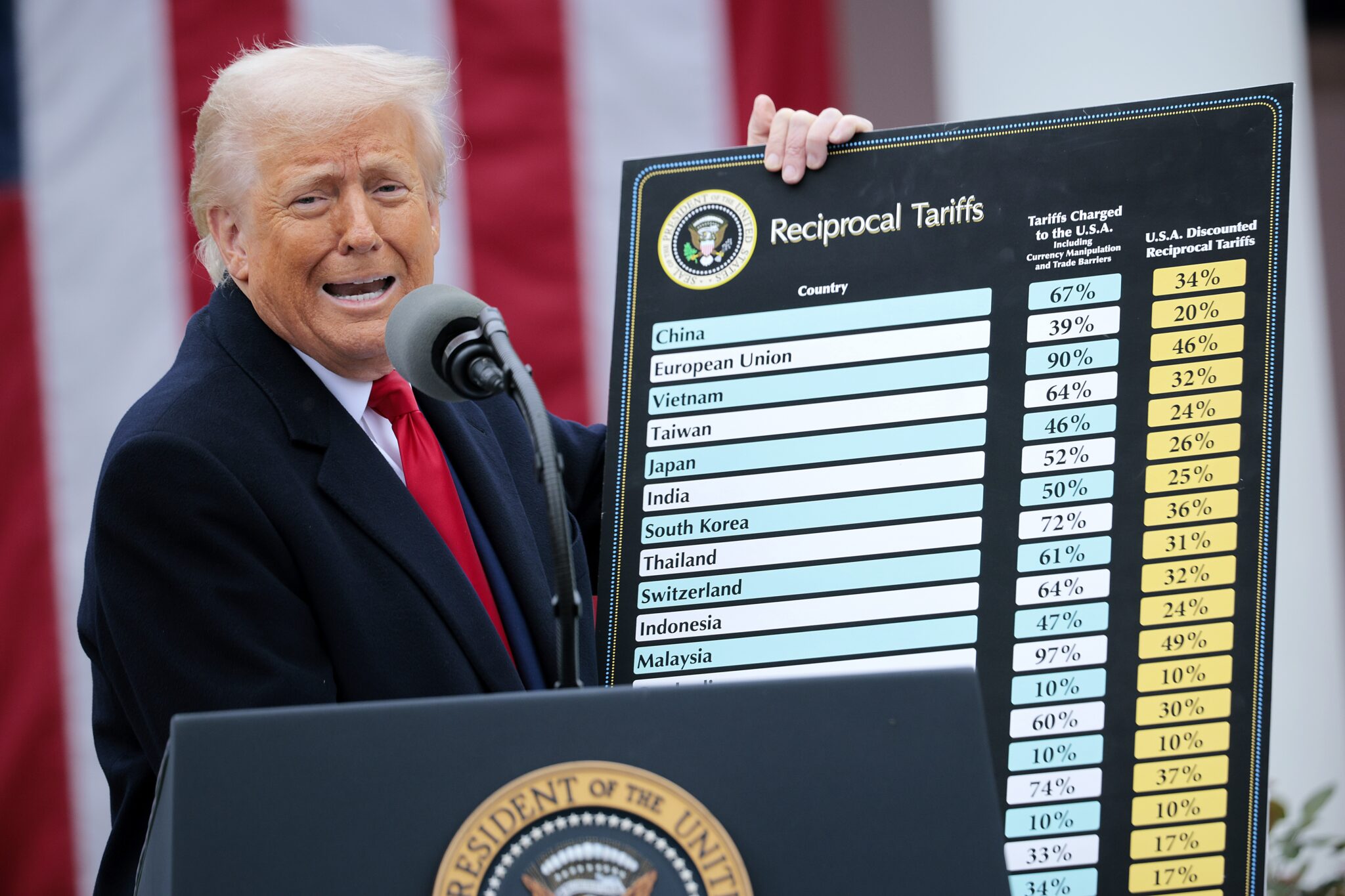
President Donald Trump holds up a chart while speaking during a “Make America Wealthy Again” trade announcement event in the Rose Garden at the White House on April 2, 2025 in Washington, D.C. (Photo by Chip Somodevilla/Getty Images)
Tariffs — and uncertainty over them — are forcing up costs for businesses in Ohio and parts of three other states, according to market surveillance published last week by the Federal Reserve Bank of Cleveland. At least some of those costs are being passed on to customers, the report said.
The news comes as recent polls show that voters strongly disapprove of the way President Donald Trump, the author of huge new tariffs, is handling the economy.
Federal fallout
As federal funding and systems dwindle, states are left to decide how and whether to make up the difference. Read the latest >
The Cleveland Fed represents the Federal Reserve System’s Fourth District — a region that covers all of Ohio and parts of Pennsylvania, Kentucky and West Virginia. Eight times a year, it conducts interviews and online questionnaires with businesses, community organizations, economists and other sources.
The Beige Book report released last week said those sources “continued to suggest flat business activity in the Fourth District in recent weeks, and they expected activity to remain flat in the months ahead. Retailers noted a pullback in consumer spending, and manufacturers said that ongoing economic and trade policy uncertainty continued to dampen demand for their goods. Demand for professional and business services increased driven by higher demand for consultations amid the shifting regulatory environment.”
A tariff is a tax on imports that is sometimes imposed to foster domestic industry. Sometimes they’re imposed in retaliation against perceived unfair practices by trading partners, such as China.
Since taking office, Trump has announced a bewildering array of on-again, off-again tariffs, including 50% ones on steel and aluminum that took effect last week.
The Consumer Price Index grew at a relatively moderate 2.4% in May, but the New York Times pointed out that it reflects only the initial impacts of the tariffs. While many of Trump’s tariffs have been delayed or are just beginning to take effect, the Cleveland Fed report said their effects are being felt.
“On balance, contacts indicated that nonlabor input costs rose at a robust pace in recent weeks, continuing an upward trend that began after a period of stability in 2024,” it said. “Contacts from multiple sectors noted that tariffs were now increasing the costs of materials that they import. Some contacts also noted secondary impacts of tariff-related cost increases from domestic producers. For example, one manufacturer said that their U.S.-based raw materials suppliers raised prices to factor in the overtime needed to meet increased domestic demand.”
It added that its sources of food and hospitality information voiced relief over dropping egg prices. But they “generally expected costs to grow at a strong pace in the coming months.”
More of the fed’s sources said they increased prices than did in the previous reporting period. Some blamed tariffs.
“Contacts across industries, particularly those in manufacturing and construction, said that they raised prices to cover costs related to tariffs and to elevated prices of materials such as steel,” the report said. “Auto dealers generally mentioned raising prices of new and used vehicles, and one said that they were offering less discounting because of higher demand.”
Some of that demand, the report said, was from consumers trying to buy vehicles now because they anticipate higher prices in the future.
The news comes as Ohio has the nation’s sixth-highest unemployment, consumer confidence remains relatively low, and Americans disapprove of Trump’s handling of the economy.
A Quinippiac University poll released on Tuesday said that respondents disapproved of him on the economy by a 16-point margin. The president had an overall approval rating of 38%.
Marty Schladen
Marty Schladen has been a reporter for decades, working in Indiana, Texas and other places before returning to his native Ohio to work at The Columbus Dispatch in 2017. He’s won state and national journalism awards for investigations into utility regulation, public corruption, the environment, prescription drug spending and other matters.
Ohio Capital Journal is part of States Newsroom, the nation’s largest state-focused nonprofit news organization.
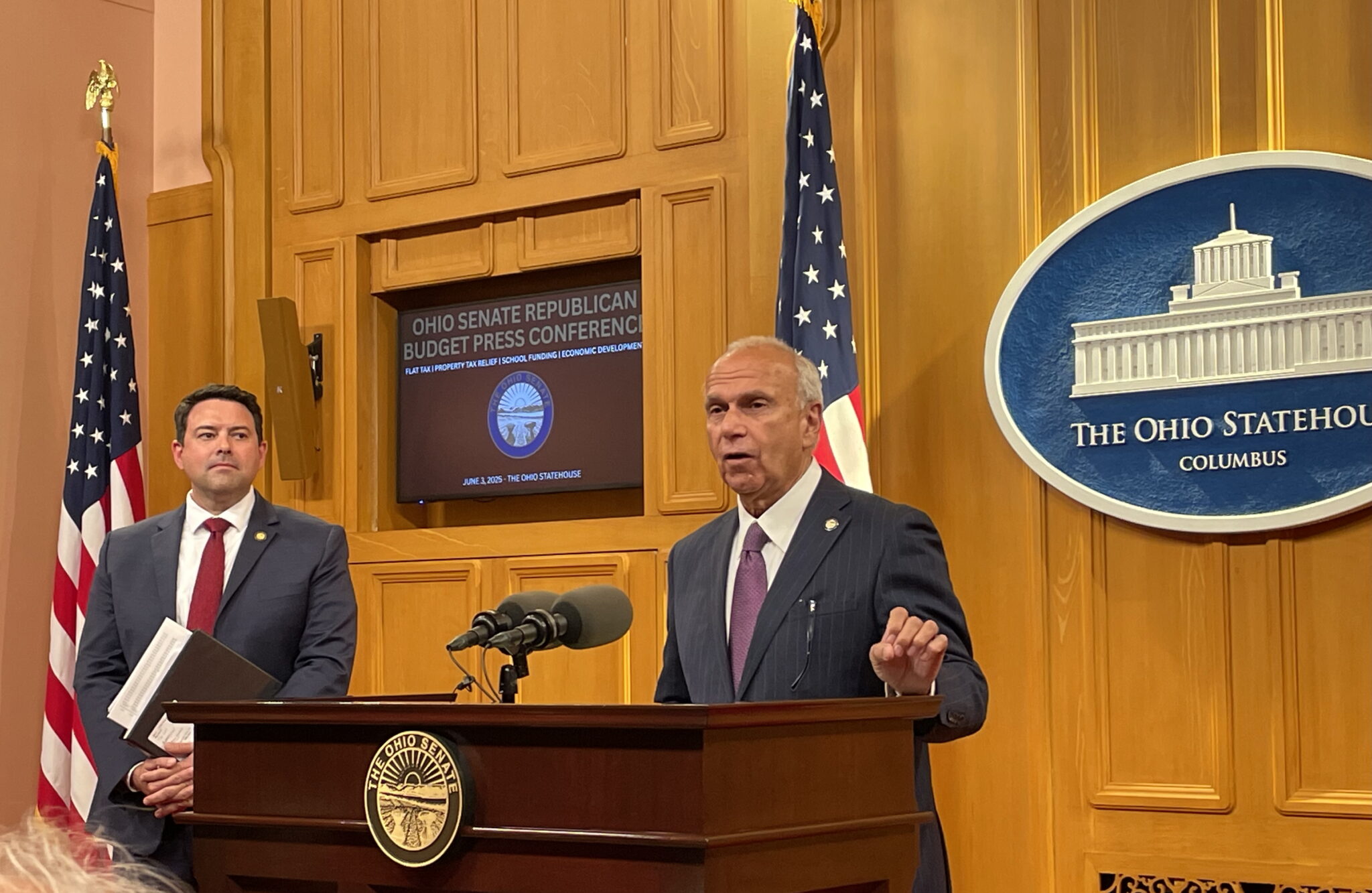
Sen. Jerry Cirino, R-Kirtland, discussing the Senate’s budget proposal alongside Senate President Rob McColley. (Photo by Nick Evans, Ohio Capital Journal.)
Ohio Republicans largely agree that shelling out $600 million to fund a new Cleveland Browns stadium is a good idea. They just disagree on how to pay for it. Gov. Mike DeWine proposed increasing the taxes on gambling and Ohio House lawmakers favored issuing state bonds.
State senators thought way outside the box.
Every state oversees unclaimed funds — think old security deposits, uncashed checks, or even bank accounts. The state acts as a custodian for that money, holding it until the rightful owner comes forward to claim it.
State senators are now eyeing that money for stadium funding.
The Ohio Senate funding plan
GET THE MORNING HEADLINES.
The Ohio Senate’s budget, approved Wednesday, would redefine all unclaimed funds that passed into state custody prior to 2016 as “abandoned.” That money would then “escheat” — a legal term for transferring ownership — to the state.
“What this does is it takes idle money and puts it to work to create jobs, to create incremental taxes, and that’s why we’re so excited about this project,” Senate budget chief Sen. Jerry Cirino, R-Kirtland, said at a press conference introducing the idea earlier this month.
Ohio officials would use a newly created fund, estimated at $1.7 billion, to put up the $600 million the Browns need while maintaining a nest egg for future sports and cultural facilities.
The Browns would pay its share back through tax revenue generated by the project. The team would also put up $100 million in case that tax revenue falls short.
Going forward, any unclaimed funds would move to the new stadium fund if no one claimed them within 10 years. Cirino emphasized companies often spend several years attempting to return funds before money ever gets transferred to the state’s custody.
Ohio Senate President Rob McColley added, “If you look at the $600 million amount, I believe all of those are at least 18 years or older. So, they’ve been sitting in the fund for some time.”
The alternatives, Cirino agued, aren’t particularly attractive. Raising taxes, even on gambling, is a nonstarter in his caucus. And borrowing money, even if the team pays back every penny, would carry substantial costs.
Over 25 years, those bonds would carry $400 million in debt servicing, Cirino said, “and the debt service would be paid out of the general fund.”
The plan’s supporters are quick to emphasize the safeguards. Anyone whose property gets rolled over in that first sweep to the stadium fund will have a ten-year grace period — extending to January 1, 2036 — in which they can still claim their money.
The Senate budget also appropriates an additional $1 million annually to support more outreach to the owners of unclaimed funds.
“Any property that belongs to anybody, rightfully and legitimately, we want them to get what they have coming to them,” Cirino said in an interview. “And we’re not suggesting anything to the contrary. We’re just simply setting a time period here, that is, we think, reasonable.”
Can they do that?
In Ohio, the state Department of Commerce oversees unclaimed funds, but in many other states that’s the state treasurer’s job. And the National Association of State Treasurers is unequivocal about how unclaimed property programs should run.
“We actually have official policy stating that we believe that state unclaimed property programs should make these funds available to their owners in perpetuity,” NAST Executive Director Shaun Snyder explained.
The group’s policy statement raises concerns about potential legal challenges and emphasizes a state taking custody of unclaimed property isn’t the same as taking ownership of it. At their heart, Snyder argued, unclaimed funds programs are built on trust.
“You get that trust by telling people, ‘Look, if you lose your property, you will be able to claim it. We will keep it for you and protect it for you,’” he explained. “When states decide to essentially add in a cut-off of some kind, that can undermine that process.”
Snyder noted there are just four states with policies that escheat unclaimed funds to the state after a specific period of time.
Two of them, Arizona and Indiana, wait much longer than Ohio proposes, only transferring funds to the state after 25 years. Hawaii and Rhode Island set the cut off at 10 years, but only for small amounts — less than $100 in Hawaii and less than $50 in Rhode Island.
Like Snyder, the Urban Institute’s Lucy Dadayan argued that “redirecting these funds for public projects, even after a long dormancy period, risks undermining public trust and confidence in government.”
She also raised doubts about the sustainability of the idea. If the stadium funding plan raises awareness, more people could come forward with claims and reduce the amount of money flowing to the stadium fund.
“Well, it’s definitely outside-the-box,” University of Chicago Professor Justin Marlowe said of the proposal.
Marlowe heads up the school’s Center for Municipal Finance and explained he hasn’t heard of any other state using unclaimed quite like Ohio is considering.
One of the virtues of that approach, he said, is it provides the necessary upfront costs without raising taxes or borrowing a lot of money.
“I suppose that’s a tradeoff that’s worth making if you’re willing to get over the conceptual leap of using unclaimed property to this effect,” he said. “I get what they’re trying to solve for, and this is definitely a creative way to solve for that, for better or for worse.”
But Marlowe raised some notable concerns. His center runs a podcast, he said, and they’ve spoken with about 15 state treasurers. All of them have a story about reconnecting people with long-lost property.
“That’s not a 10-year arc, that’s a several decades long arc,” he said. “And so, it does kind of raise that question of, is 10 years the right timeframe? Because no one’s ever really done this, I don’t think there’s any right or wrong answer. That’s kind of a policy choice, but it does seem short.”
Marlowe added the systematic transfer of citizens’ property raises legal complications that aren’t easy to answer.
The Fifth Amendment of the U.S. Constitution prohibits the government from taking private property without “just compensation.”
Ohio’s Constitution carries similar requirements and puts the onus on the state to show that taking was necessary and for public use.
Additionally, the escheatment program could raise due process questions.
“I’m sure they can write the law in a way to insulate them from a lot of that, but at some level, these are not statutory questions. These are much broader, constitutional — almost philosophical — questions,” he said. “Which might be why no one has done this to date, right?”
Reactions closer to home
In testimony submitted to the Ohio Senate Finance Committee, the City of Cleveland set aside questions about the source of the money and argued that the new Browns stadium would harm their lakefront redevelopment efforts.
“Public funds — whether from the General Revenue Fund or the unclaimed property fund — should be used to strengthen cities, not undermine them,” the city argued.
Cuyahoga County Executive Chris Ronayne wasn’t bashful about criticizing the unclaimed property idea though.
“This is not robbing Peter to pay Paul,” he argued. “This is robbing Bob and Betty Buckeye to pay (Browns owners) Jimmy and Dee Haslam.”
Cirino bristled at that characterization.
“That’s a load of garbage, okay? We’re not stealing any money from anybody,” he insisted. “I found his comments about the Senate quite insulting as a matter of fact.”
He noted lawmakers have dipped into unclaimed funds “at least a dozen times previously.”
A Legislative Service Commission memo shared with Ohio Capital Journal notes lawmakers have authorized $1.2 billion in cash transfers out of the fund and used it to capitalize the state’s mortgage insurance and housing development funds. However, that money is subject to recall if it’s needed to pay the rightful owners of unclaimed funds.
The proposal got support from the Ohio Business Roundtable. In a letter to the Senate Finance Committee, the group’s President and CEO Pat Tiberi argued it’s a “strategic and fiscally responsible approach” to funding venues.
“A statewide fund ensures Ohio is positioned to proactively support these capital-intensive projects as a means of regional growth and long-term economic competitiveness — not just for a single city or franchise, but for the benefit of all regions,” Tiberi wrote.
“Importantly,” he added, “the Senate’s proposal avoids placing new tax burdens on Ohioans, taking general revenue funds or increasing the state’s debt obligations.”
Like Cirino, Tiberi emphasized the plan would put “idle” resources to more productive use.
Follow Ohio Capital Journal Reporter Nick Evans on X or on Bluesky.
Nick Evans
Nick Evans has spent the past seven years reporting for NPR member stations in Florida and Ohio. He got his start in Tallahassee, covering issues like redistricting, same sex marriage and medical marijuana. Since arriving in Columbus in 2018, he has covered everything from city council to football. His work on Ohio politics and local policing have been featured numerous times on NPR.
Ohio Capital Journal is part of States Newsroom, the nation’s largest state-focused nonprofit news organization.
The Ohio Senate has passed a $60 billion state biennial operating budget, which includes a tax cut for the wealthy, some increased public education funding, and $600 million in funding to the Cleveland Browns for their new stadium.
The total budget is expected to be around $200 billion once federal dollars come in.
Ohio House Bill 96 was voted on mainly along party lines, 23-10. State Sen. Bill Blessing, R-Colerain Township, joined the Democrats to vote no.
The proposals have gotten more attention for requiring proof of citizenship and eliminating ballot drop boxes, but they carry significant changes to signature gathering, too
A coalition of government watchdog groups are warning state legislation could hobble Ohio’s initiative process. Direct democracy has been available to Ohioans since 1912, and citizen-led groups can organize initiated statutes or constitutional amendments.
The proposals would create strict new paperwork requirements and add other administrative hurdles like requiring many circulators wear a badge identifying themselves as “paid” even if they’re given something as small as a pen for signature collection.
Above and beyond changes to the initiative process, the bills would also eliminate ballot drop boxes and require all voters to show proof of citizenship to cast a ballot.
“Bottom line, this is attack on direct democracy,” Jen Miller from Ohio’s League of Women Voters argued. “This is an attack on local control. It’s an attempt to bully, intimidate, harass, and possibly prosecute people just because they want to take part in democracy,”
Nitty-gritty
Common Cause Ohio Executive Director Catherine Turcer praised the people who grab clipboards and collect signatures to put proposals on the ballot.
“This extreme legislation is an attempt to bully, intimidate, and hassle these front-line heroes,” she argued.
The paperwork involved in signature gathering is already complex and time consuming. She explained circulators have to fill out a standard form — name, address, employer, etc. — when they turn in petitions. But the new bills would ratchet up the stakes of that relatively banal procedure. Right now, if the circulator messes something up, they can cross it out and write their initials.
“And it is accepted as a change that was legally made,” Turcer explained. “House bill 233, and Senate bill 153, would make it so that any error here, anything that you made a mistake on, it would mean that the entire booklet would be invalid. And just, I can’t imagine the number of signatures that would just get tossed out.”
She added that provisions requiring circulators to wear a badge identifying themselves as “paid” if they accept “anything of value,” sets an unrealistic standard.
“If I were to give a clipboard and a pen to a volunteer, and a t-shirt that says the name of the campaign,” she explained, “anything of value would then mean that a circulator would have to get a badge.”
That’s more paperwork, she said, and thus more chances for something to go wrong.
Turcer also criticized a provision requiring an individual to be registered to vote prior to signing a petition, rather than by the time the petition gets filed with election officials.
“One of the things that we often do is check registration before people sign,” Turcer explained, “so that we can get somebody registered as we’re doing a ballot measure.”
Taking that opportunity away doesn’t just reduce their signature count, Turcer argued, “it also stops that opportunity for a voter-to-voter conversation about, well, this is why you should get registered. These are the things that are coming up on the upcoming ballot.”
Stakes
Ohio Unity Coalition Executive Director Petee Talley drew a straight line from 2023’s Issue 1 defeat, which rejected a GOP-led effort to make it harder to amend the state constitution, and the current slate of legislation. She argued the latest bills are “retribution” for that defeat.
Talley took particular offense at the provision requiring signature gatherers wear a badge if they’re compensated.
“If I wanted to give a can of cold pop and a slice of pizza to someone and maybe even a t-shirt that (Turcer) alluded to, suddenly they’re going to have to add wearing a badge to all of that stuff?” she asked.
“It’s nothing but intimidation. It’s nothing but bullying,” she argued. “It’s voter harassment, and this is an attack on our voice and our rights, and we’re not going to stand for it.”
Miller walked through the follow-on consequences of requiring paid circulator badges. Some voters will mistakenly think volunteers who got a slice of pizza are actually getting a paycheck, she said.
“We should expect opposition trackers attempting to catch circulators without their badges,” she added. “And with the increase in uncivil and polarized rhetoric in political venues, this could result in intimidation or even violence against circulators or voters signing those petitions.”
What’s more, Miller said, “boards of elections would have to become badge police.” It’s a task they don’t have the money, manpower or expertise to carry out, she argued. The requirement voters be registered before signing a petition? Miller said that might be a problem, too.
“We don’t even know if boards of elections have the technical capacity right now to verify that a voter registration was valid on the date that the voter signed,” she said.
One reason that might not have come up is that, so far, county boards haven’t been able to weigh in. The bill’s first and second hearing happened during the early voting period for this May’s primary election. The third hearing landed on the day boards had to certify the election.
Asked whether she thought that was intentional, Miller said, “I don’t think it matters. It’s shameful, either way. There is no more important constituent when it comes to democracy bills than the boards of elections.”
Follow Ohio Capital Journal Reporter Nick Evans on X or on Bluesky.
Nick Evans
Nick Evans has spent the past seven years reporting for NPR member stations in Florida and Ohio. He got his start in Tallahassee, covering issues like redistricting, same sex marriage and medical marijuana. Since arriving in Columbus in 2018, he has covered everything from city council to football. His work on Ohio politics and local policing have been featured numerous times on NPR.
Ohio Capital Journal is part of States Newsroom, the nation’s largest state-focused nonprofit news organization.
Nearly 50 anti-LGBTQ incidents happened in Ohio in a year, according to a new report by the Gay and Lesbian Alliance Against Defamation.
GLAAD’s Anti-LGBTQ Extremism Reporting Tracker (ALERT) documented 932 anti-LGBTQ incidents nationwide from May 1, 2024 to May 1, 2025. A little more than half of all nationwide incidents targeted transgender and gender non-conforming people.
GET THE MORNING HEADLINES.
These incidents led to 84 injuries (including one in Ohio) and 10 deaths, according to the report.
ALERT tracked these incidents through self-reports, media, social media posts and data sharing from partner organizations and law enforcement.
“This year, rollbacks in LGBTQ visibility and challenges to our rights are coupled with a sharp rise in anti-LGBTQ rhetoric and disinformation across social media and political campaigns,” GLAAD President & CEO Sarah Kate Ellis said in a statement. “It’s only through awareness, collective action, and community that we can turn the tide toward greater safety and acceptance.”
Nearly half of the incidents in Ohio involved the Dayton Street Preachers hosting anti-LGBTQ protests at universities, events, street corners, Pride events, or outside the Great American Ballpark in Cincinnati.
Many of the Ohio incidents involved Pride flags being stolen last summer.
A transgender woman was injured while bartending a drag show in Columbus last July, according to the report. A man disrupted the show and was kicked out by the bartender, but the man punched the bartender and kicked down the glass door while yelling homophobic slurs, according to NBC4.
Back in March, someone threatened to shoot up an upcoming drag show event in Columbus in the comments of a Facebook event, according to the report.
Ohio bills
In terms of anti-LGBTQ legislation, some anti-LGBTQ laws took effect in Ohio earlier this year, including banning Ohio transgender students from using school bathrooms and locker rooms that align with their gender identity. It also bans students from sharing overnight accommodations with people of the opposite sex from their assigned sex at birth at a K-12 school.
Republicans have introduced other measures targeting the LGBTQ community this year.
Ohio House Bill 190 would prohibit school employees from calling a student a name that is not listed on their birth certificate and would ban them from using pronouns that do not align with their biological sex.
Ohio House Bill 172 would not allow minors age 14 and older to receive mental health services without parental consent. Currently, mental health professionals are permitted to provide outpatient mental health services to minors 14 and older on a temporary basis without parental consent.
On the Democratic side, state Reps. Eric Synenberg and Anita Somani recently introduced the Marriage Equality Act which would place put a constitutional amendment on the November 2026 ballot that would enshrine marriage equality in the state constitution. This is in response to a constitutional amendment Ohioans passed in 2004 that defines marriage as “only a union between one man and one woman.”
Megan Henry is a reporter for the Ohio Capital Journal and has spent the past five years reporting in Ohio on various topics including education, healthcare, business and crime. She previously worked at The Columbus Dispatch, part of the USA Today Network.
Ohio Capital Journal is part of States Newsroom, the nation’s largest state-focused nonprofit news organization.
A proposal to abolish Ohio property taxes will increase volatility and cut funding for schools, a majority of economists said in a recent survey on the matter.
The group Citizens for Property Tax Reform is pushing a constitutional amendment to repeal the state’s property tax. Earlier this month, the Ohio Ballot Board signed off on a portion of the effort, saying that the amendment deals with a specific issue.
It is still far from becoming reality. Hundreds of thousands of registered voters have to sign verified petitions to get it on the ballot and then voters have to approve it.
Taxes of any sort are typically unpopular with those have to pay them. But those taxes support popular local services, such as schools, libraries and first responders.
When it comes to property taxes generally, people might not be so generous. But some experts say getting rid of them is a terrible idea.
“Many of the property tax reform proposals offered by policymakers, like assessment limits and tax swaps (including full abolition of the property tax), create more problems than they solve, distorting property markets and undermining long-term housing affordability,” the nonpartisan Tax Foundation said on its website. “Property taxes are the primary tool for financing local governments and the single largest source of state and local revenue in the U.S., helping fund schools, roads, police, and other services.”
Property taxes also play an important role in public finance, the foundation said, adding that they are “more efficient, pro-growth, aligned with benefits received, and generally better suited to municipal finance than any of the alternatives.”
Ohio economists appear to agree.
Scioto Analysis surveyed 16 of them, asking if they agreed that “replacing property taxes in Ohio with higher sales and income tax rates will reduce the volatility of tax payments for Ohio households.” Nine disagreed, just one agreed and the rest said they were uncertain.
In the comments section of the survey, many who disagreed said property taxes were more stable than income or sales taxes, which soar in good economic times and plummet in bad.
“Sales and income fluctuate with the business cycle,” wrote Kevin Egan of the University of Toledo. “Having property taxes, especially taxes directly on the value of the land (not what is built on it) is one of the first-best tax options due to the amount of land to be taxed does not change.”
A “land value tax” would tax land much more heavily than the buildings on it. Some economists like the idea because they say:
A land tax would be fairer to lower-income property owners because they pay a greater percentage of their income for housing.
By taxing land and not buildings you’d encourage development of vacant, blighted properties not by taxing their development, but instead by creating a disincentive to leave them dormant.
Overall real estate values are prone to bubbles and other heavy swings due to market inefficiencies, while land values are more stable. Therefore, taxing only land would give government officials greater predictability when they budget.
The only economist who agreed that eliminating property taxes would be good for Ohio seemed to say the opposite in the comments section.
“This will mainly benefit wealthy older people who don’t work,” wrote Charles Kroncke of Mount St. Joseph University. “This will not help working class younger people who spend their income on consumer goods.”
The economists were also asked whether they agreed that “removing property taxes will decrease overall per pupil spending in Ohio’s public schools.” Twelve agreed, only one disagreed and three said they were uncertain.
“It depends on whether the government raises other taxes to replace the lost revenue,” said Jonathan Andreas of Bluffton University. “Because property taxes are more efficient than many other taxes that local governments levy, it can be hard to replace them so it is likely that revenues will go down which will hurt schools.”
_____________
Marty Schladen
Marty Schladen has been a reporter for decades, working in Indiana, Texas and other places before returning to his native Ohio to work at The Columbus Dispatch in 2017. He’s won state and national journalism awards for investigations into utility regulation, public corruption, the environment, prescription drug spending and other matters.
Ohio Capital Journal is part of States Newsroom, the nation’s largest state-focused nonprofit news organization.
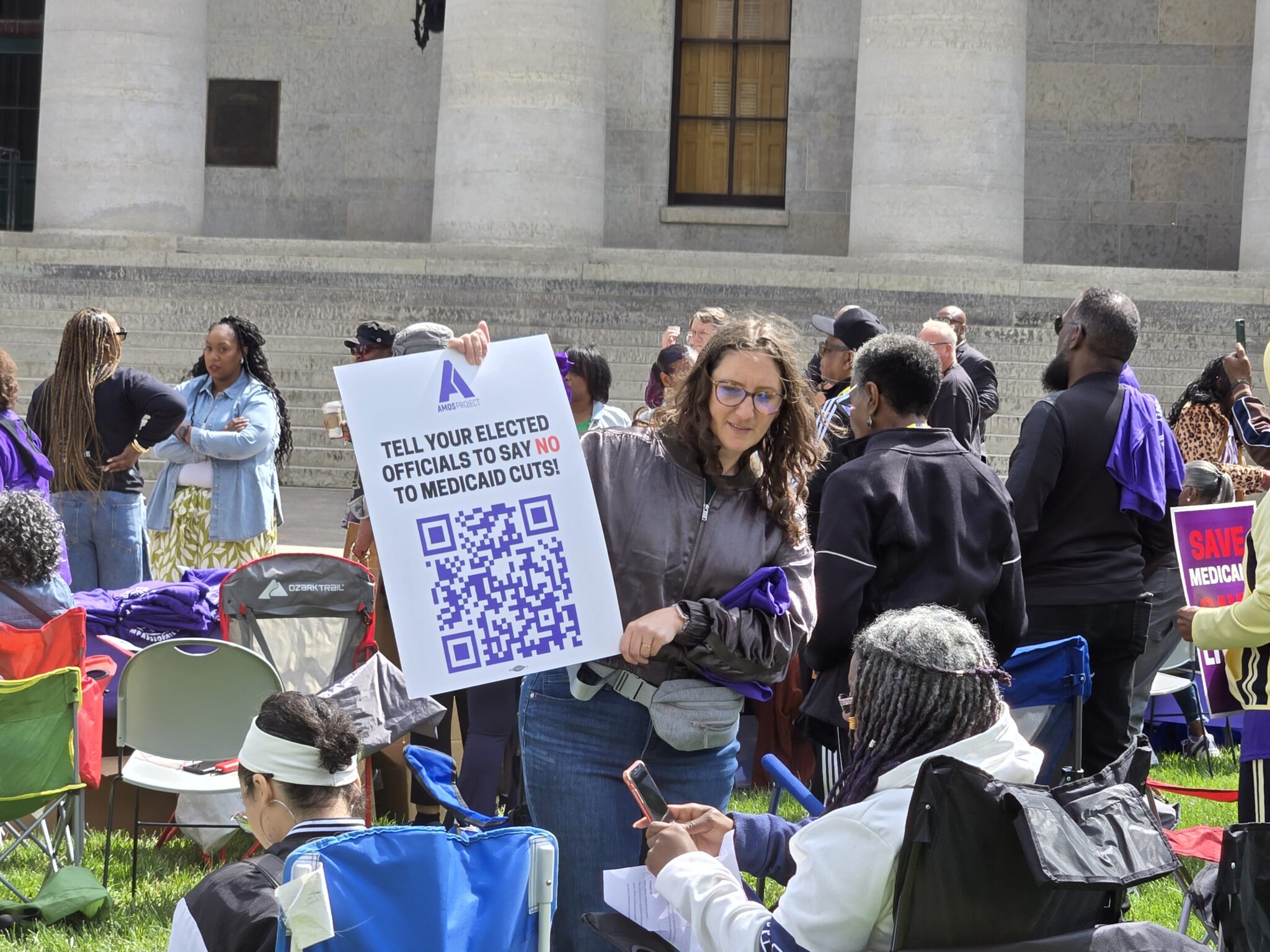
As threats build to Medicaid, the federal-state health program for the poor, even many Ohioans who stand to be affected don’t know it, advocates said Saturday.
Federal fallout
As federal funding and systems dwindle, states are left to decide how and whether to make up the difference. Read the latest >
Dozens gathered on the west lawn of the Ohio Statehouse to raise awareness that a massive spending bill passed by Republicans in Congress could end up ending health care for more than 750,000 Ohioans.
“People say, ‘Oh, I’m not on Medicaid,’” said Bria Bennett of the Ohio Organizing Collaborative. “But when they hear Caresource (Ohio’s biggest Medicaid managed-care provider), they say ‘Oh yeah, my kids are on Caresource.’ That’s a problem everywhere. People are so focused on ‘How am I getting to work? Is my car going to get me to work? Is my uniform clean for work?’ They’re worried about all those things that trying to dip into the policy things that our politicians talk about is difficult.”
The U.S. House-passed Republican reconciliation budget — President Donald Trump’s “One Big Beautiful Bill” — would hand out $4.6 trillion in tax cuts over 10 years. The University of Pennsylvania’s Wharton School estimated that 70% of the benefit would go to the richest 10% of Americans.
Republicans, such as Iowa Sen. Joni Ernst, have denied that the budget would cut health benefits for Americans. But then she undermined her own argument by saying “We all are going to die.”
GET THE MORNING HEADLINES.
Parts of the bill, including a strict new work requirement, led the independent, nonpartisan Congressional Budget Office to conclude that it would cost about 10 million Americans their health insurance. That’s nearly half of the 24.6 million Americans who are covered under the Medicaid expansion that was passed as part of the 2010 Affordable Care Act.
Meanwhile, work requirements have been shown to be ineffective for anything other than hassling people off of the system. Researchers at Harvard University and the Urban Institute found that Arkansas’s work requirement did nothing to boost employment in the state.
The federal government covers 90% of the cost of the Medicaid expansion. In Ohio, Gov. Mike DeWine proposed that if a significant portion of that funding were eliminated, the state would cut those people off — ending health coverage for 770,000 Ohioans.
Bennett of the Ohio Organizing Collaborative said it’s jargon like that that obscures the dire reality in which millions of Ohioans live.
“I don’t know what 200% of whatever is,” she said. “That’s just a number to me. We’re trying to make things relatable because people don’t necessarily know that it affects them.”
For the record, for a family of four 200% of the federal poverty level is $62,400 a year.
Bennett said such households would be devastated if they lost Medicaid benefits.
“I know folks who have four-plus kids. Because of what they make, all of their kids are on Medicaid,” she said. “If that’s taken away, there are no more doctor’s appointments. There’s no more dentist’s appointments.”
And, she said, those life-saving services shouldn’t be axed to pad the pockets of the wealthy in an era of exploding income inequality.
“We should not be giving tax breaks to the wealthy when the poorest and most vulnerable of us cannot even afford health care,” Bennett said.
Marty Schladen
Marty Schladen has been a reporter for decades, working in Indiana, Texas and other places before returning to his native Ohio to work at The Columbus Dispatch in 2017. He’s won state and national journalism awards for investigations into utility regulation, public corruption, the environment, prescription drug spending and other matters.
Ohio Capital Journal is part of States Newsroom, the nation’s largest state-focused nonprofit news organization.
The executive director of the Ohio Association of Foodbanks is trying to get the word out: If the budget passed by the U.S. House of Representatives becomes reality, it could trash the state budget and make many, many Ohioans go hungry.
The matter goes next to the U.S. Senate. But the members of the Ohio delegation aren’t talking.
The House-passed Republican reconciliation budget — President Donald Trump’s “One Big Beautiful Bill” — would hand out $4.6 trillion in tax cuts over 10 years. In an analysis, Trump’s alma mater, the University of Pennsylvania’s Wharton School, estimated that 70% of the benefit would go to the “top 10% of the income distribution.”
Meanwhile, the “Department of Government Efficiency” — led by the world’s richest man — has been looking to cut services for average Americans. One place the Republican House budget seeks to achieve some of those cuts is to the Supplemental Nutrition Assistance Program, or SNAP.
Also known as food stamps, the program provides debit cards for food. To qualify, Ohio recipients generally have to have net income at or below federal poverty guidelines — $32,150 a year for a family of four.
Benefits awarded under the program are pretty modest, $6.28 per person, per day on average last year. And, as a reflection of the high level of poverty in the state, one in nine Ohioans — or 1.4 million — received them last year.
Whether Ohio’s poorest will get those food benefits in future years is an open question in light of the One Big Beautiful Bill.
“The House-passed Republican reconciliation plan would cut nearly $300 billion from the Supplemental Nutrition Assistance Program (SNAP) through 2034, based on Congressional Budget Office (CBO) estimates — by far the largest cut to SNAP in history,” the Center on Budget and Policy Priorities wrote last week. “As a result of these cuts and other policies in the legislation — which are being used to pay partly for trillions in tax cuts skewed to the wealthy — millions of people would lose some or all of the food assistance they need to afford groceries, when many low-income households are struggling to afford the high cost of food and other basic needs.”
The bill would force states to take up the slack by forcing them to pay based on error rates. In other words, they’d have to pay at least 5% more and then go up a sliding scale based on how often they were found to pay recipients too little or too much in benefits. It also would greatly increase error rates by eliminating the current tolerance for small errors — those up to $57.
This all might sound technical, but the consequences for Ohio would be huge.
If it had an error rate of 6% or less (which it doesn’t, even under the current, more-tolerant system), the state would have to pay $158 million more a year into the program, according to the Center for Budget and Policy Priorities. At the top end, with an error rate of 25% or more, Ohio would have to pay $790 million more a year.
Under the Republican bill, error rates would surely go sharply up. But even under Ohio’s most recent rate, the state would take a massive hit. At 15% errors, the state would have to come up with $473 million a year.
“That’s almost $500 million in new state revenue that they would have to come up with just to maintain current levels of benefits,” said Joree Novotny, executive director of the Ohio Association of Foodbanks. “That’s roughly equivalent to the entire state investment in the Ohio Department of Job and Family Services” which administers SNAP in addition to many other programs.
“We know that we can’t ever make up for the value that SNAP benefits provide to low-income working families, seniors and people with disabilities,” she said. “We’re not designed to be a first-line grocery store. SNAP invests directly in local economies. Benefits are spent at local grocers. The removal of this investment in that supply chain… I’m not only concerned about access to affordable food for people with lower resources, but also sustainability and resilience in the food-supply sector as a whole.”
Novotny said two bad-but-likely results would be bigger food deserts and less access to healthy nutrition. Those outcomes would be particularly devastating to low-income families who have seen food prices grow 27% between mid-2020 and the beginning of this year.
Asked whether Gov. Mike DeWine opposed the SNAP cuts in the Republican bill, his press secretary, Dan Tierney, was noncommittal.
“As we have seen, these proposals can change dramatically as the process proceeds,” Tierney said in an email. “We have generally reserved comments until after final proposals have been adopted.”
The offices of Sens. Jon Husted and Bernie Moreno were asked if they would support the cuts when the House bill came before them. Neither replied.
For her part, Novotny said she has an even deeper concern than overwhelmed food banks and growing food deserts.
Asked what would happen if states can’t or won’t find the money the House budget is demanding for SNAP, she said, “We can’t get a good answer to that.”
“Fundamentally, will SNAP remain an entitlement? Will states have to administer the program at all?” she asked. “Fundamentally, it’s hard to understand how it would be required of a state to participate in the program if there’s such a significant cost burden.”
The question, at bottom, is whether the already huge number of poor Ohioans will swell and whether they’ll be pushed even deeper into poverty and food insecurity.
“I’m most concerned about what it would mean for the structure of the federal nutrition safety net,” Novotny said. “SNAP is and always has been an entitlement program. If you’re a worker who, through no fault of your own, loses your job and while you’re seeking work you need help affording groceries so that you can stay in your house… SNAP is there. Or if you’re a person who receives a really serious cancer diagnosis and you have to use some (Family and Medical Leave Act benefits) to come and get treatment, SNAP is there. If you’re a low-wage working family, or if you’re a senior on a fixed income, SNAP is there and the benefit has always been fully federally funded.”
Marty Schladen
Marty Schladen has been a reporter for decades, working in Indiana, Texas and other places before returning to his native Ohio to work at The Columbus Dispatch in 2017. He’s won state and national journalism awards for investigations into utility regulation, public corruption, the environment, prescription drug spending and other matters.
Ohio Capital Journal is part of States Newsroom, the nation’s largest state-focused nonprofit news organization.
Ohio had the sixth-highest unemployment of any state in April. The news comes after years of state officials spending billions on economic growth programs tilted heavily toward the wealthy.
It might seem ironic, but Ohio’s economy added jobs in April even as unemployment continued to grow. That’s because job growth isn’t keeping up with the numbers joining the workforce. And there are reasons to believe that things will get worse, according to the think tank Policy Matters Ohio.
Data released last week by the Ohio Department of Job and Family Services estimated that the state added 22,200 jobs in April. But statewide unemployment rose for the fifth consecutive month, to 4.9%. That’s the sixth-highest of any state, according to the U.S. Bureau of Labor Statistics.
Heather Smith, a researcher at Policy Matters Ohio, said the new state data raise some questions.
“The civilian labor force has increased at about the same rate as the number of unemployed workers, suggesting that while more Ohioans are entering the job market, they are not all securing employment,” she said in a written statement. “This raises questions around the reported increases in jobs across service-providing industries – why aren’t Ohioans getting hired?”
The Department of Job and Family Services conducts a monthly survey, releases its estimate of the number of new jobs, and then often revises it downward. For example, it initially estimated that 7,500 jobs were created in March, and then cut that number to 5,200.
Of the jobs thought to be created in April, the great majority were in the service sector, 18,800. More than 6,500 of those were in hospitality as those businesses staff up for summer.
Construction and manufacturing added 1,200 and 1,100 jobs, respectively, while the number of government jobs increased by 1,300.
A separate household survey indicated that 15,000 joined the Ohio job market in April. But only 6,000 found jobs while the rest were unemployed.
“Legislators ought to pay attention to the growing unemployment rate, given its steady increase over the last five months,” Smith said. “The last time we saw the unemployment rate in Ohio decrease was between September and October – prior to the November election.”
Ohio’s economy has lagged for more than a decade after the creation of billion-dollar programs mostly benefitting the well off on the promise that they would create jobs for average Ohioans.
Created in 2013 under the auspices of then-Gov. John Kasich, the LLC tax loophole costs about $1 billion a year.
Started around the same time, JobsOhio is funded through a state liquor franchise that used to flow into state coffers. Its well-paid staff has grown rapidly as it has doled out more than $1 billion in incentives to businesses. But it hasn’t proven that those incentives have created any jobs.
Even so, the Ohio Controlling Board in February extended JobsOhio’s control of the state liquor franchise to 2053. The “private” corporation paid the state $1.41 billion for its initial lease of the franchise. But the state didn’t require an additional penny to extend it another 15 years.
Meanwhile, Smith of Policy Matters Ohio warned that several developments at the federal level could further drag down the Ohio job market.
“A recent survey of Fourth District businesses by the Federal Reserve of Cleveland found that 22% of respondents anticipated the tariffs would force them to decrease their staff,” she wrote. “This is already underway: Several large employers across the state have submitted mass layoff notices, including 744 manufacturing jobs in Fremont. A Chillicothe paper plant, which was set to layoff 826 union workers by the end of June, agreed to remain open until December. While this buys impacted Ohioans a bit more time, the plant closing will be a devastating hit to workers in the area.”
“Ohio policymakers need to hold their federal counterparts accountable for the impact of funding cuts on the state and stop preemptively cutting critical public services with trigger language in the state budget,” Smith said. “If federal budget hawks get their way and force the state to pick up a greater share of the Medicaid budget, proposed trigger language could cut off the health insurance of 770,000 Ohioans.”
Marty Schladen
Marty Schladen has been a reporter for decades, working in Indiana, Texas and other places before returning to his native Ohio to work at The Columbus Dispatch in 2017. He’s won state and national journalism awards for investigations into utility regulation, public corruption, the environment, prescription drug spending and other matters.
Ohio Capital Journal is part of States Newsroom, the nation’s largest state-focused nonprofit news organization.
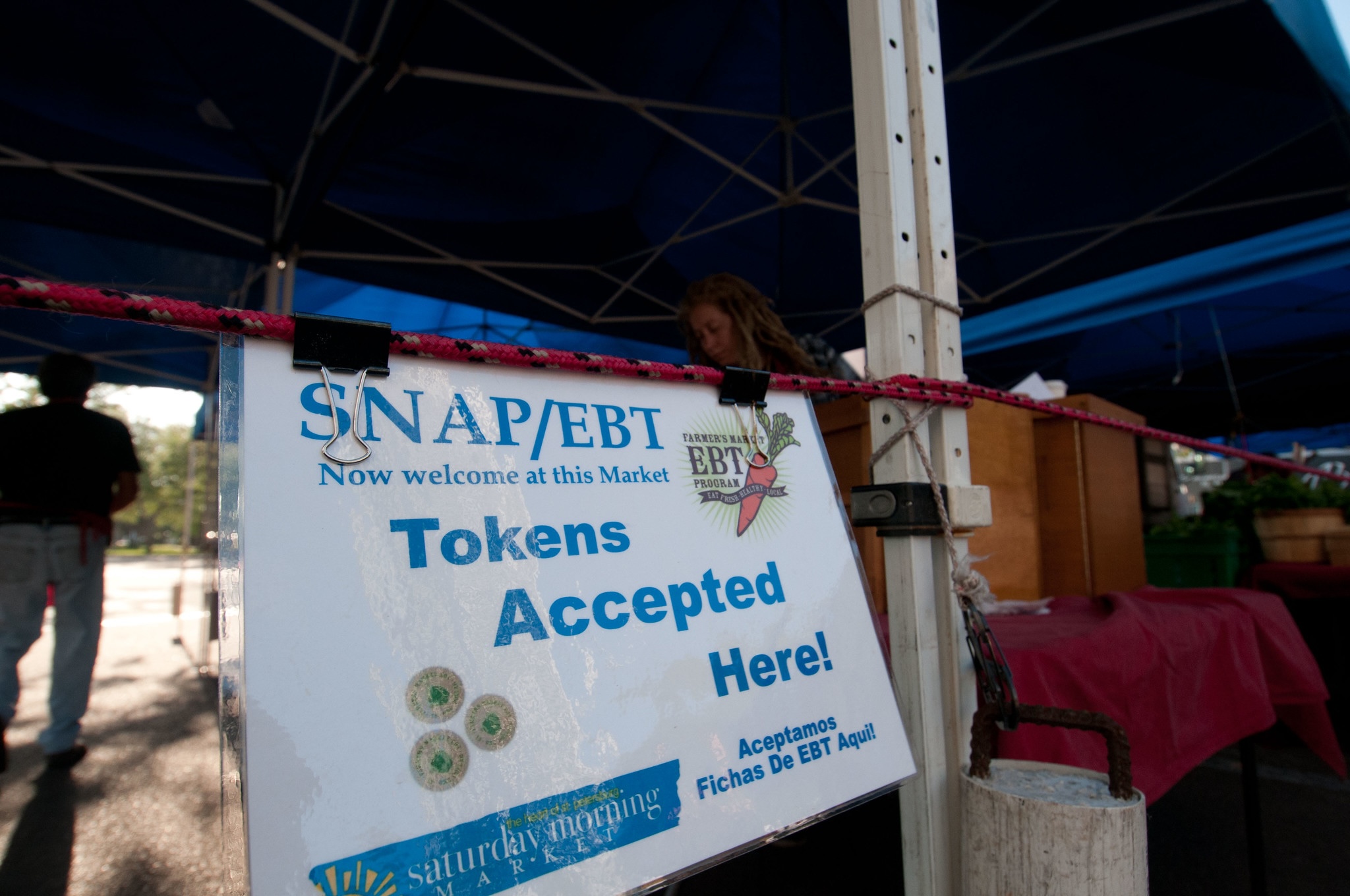
At a farm market in St. Petersburg, Florida, SNAP recipients were able to use their Electronic Benefits Transfer cards for food. (Photo by Lance Cheung/USDA).
The massive tax and spending bill passed by U.S. House Republicans would likely result in 3.2 million people losing food assistance benefits, and saddle states with around $14 billion a year in costs, according to a new analysis from the nonpartisan Congressional Budget Office.
Democrats have argued the bill, which the House passed, 215-214 early Thursday without any Democrats in support, would cut programs for the needy to fund tax breaks for high earners.
The CBO document, issued late Thursday, responded to a request to the office from the top Democrats on the Senate and House Agriculture committees, Sen. Amy Klobuchar and Rep. Angie Craig, both of Minnesota, and somewhat bolsters that claim. The panels oversee federal food aid programs.
“This report is truly devastating,” Craig said in a Friday statement to States Newsroom. “As a mother and someone who at times relied on food assistance as a child, these numbers are heartbreaking. It is infuriating that Republicans in Congress are willing to make our children go hungry so they can give tax breaks to the already rich.”
A provision in the bill to tighten work requirements, including by excluding single parents of children older than 6 and by raising the age of adults to whom the work requirements apply, of the Supplemental Nutrition Assistance Program, or SNAP, would result in 3.2 million people losing access to the program in an average month, the CBO report said.
Of those, 1.4 million would be people who currently have a state waiver from work requirements that would be disallowed under the bill and 800,000 would be adults who live with children 7 or older, the report said.
In a Friday statement, Ben Nichols, a spokesman for the House Agriculture Committee led by Pennsylvania Republican Glenn ‘GT’ Thompson, said the proposed change would be more fair to the people SNAP is supposed to help and noted the program is the only state-administered entitlement program that is paid fully by the federal government.
“No one who is able-bodied and working, volunteering, or training for 20 hours a week will lose benefits,” Nichols wrote.
Republicans want to use the legislative package to extend the 2017 tax law and its cuts, increase spending on border security and defense by hundreds of billions of dollars, overhaul American energy production, restructure higher education aid and cut spending.
Toll on states
The cost-share changes, which would require states for the first time to pay for a portion of SNAP benefits, would also limit participation and add a massive line item to state budgets, according to the CBO.
Starting in 2028, states would be responsible for paying 5% to 25% of SNAP benefits, with a state’s share rising with its payment error rate. The federal government currently pays for all SNAP benefits.
Under the House bill, which will likely undergo substantial changes as the Senate considers it in the coming weeks, states collectively would be responsible for just less than $100 billion from 2028 to 2034, about $14 billion per year.
States would respond in a variety of ways, CBO Director Phillip Swagel wrote, including potentially dropping out of the program.
“CBO expects that some states would maintain current benefits and eligibility and others would modify benefits or eligibility or possibly leave the program altogether because of the increased costs,” he wrote.
The office took a “probabilistic approach to account for a range of possible outcomes” to determine what the effect on households would be and estimated that 1.3 million people would lose benefits because of state responses to the new cost-share.
Nichols, with the House Agriculture Committee, disputed the CBO’s estimate regarding the cost share change. The lowest state cost-share of 5% would be available for states with error rates below 6%. Every state has hit that mark at some point in the last decade, he said.
With that favorable of a cost-share, the Republican committee members did not believe states would drop out of the program, he added.
“We reject the hypothetical assumption that some states may not chip into 5 percent of a supplemental nutrition program,” Nichols wrote. “Every state is capable of paying for a portion SNAP… Federal policy should encourage states to administer the SNAP program more efficiently and effectively, and this bill does just that.”
CBO’s forecasters determined the impacts of the work requirements and cost-share provisions separately, meaning some people potentially losing benefits could have been counted in both categories.
Move to the Senate
The House vote Thursday sent the measure to the Senate, where the debate over SNAP benefits may fall along similar party lines.
Republicans who hold control in that chamber are planning to employ the budget reconciliation process, which allows them to skirt the Senate’s usual 60-vote requirement for legislation.
During the House Agriculture Committee’s debate over its portion of the legislation, Republicans on the panel said the work requirement and state cost-share measures were needed reforms to SNAP that would protect the program for those it was meant to serve, while limiting the costs associated with benefits to adults who were able and unwilling to work or in the country illegally.
In a Friday statement, Sara Lasure, a spokeswoman for Senate Agriculture Committee Chair John Boozman, an Arkansas Republican, also said the panel would seek reforms to the program but did not offer specifics.
“The Senate Agriculture Committee is in the process of crafting its budget reconciliation package and will work as good stewards of taxpayer dollars to make commonsense reforms to SNAP that encourage employment,” she wrote in an email.
Klobuchar, in a statement after House passage Thursday, blasted the House bill and indicated she would oppose efforts to cut SNAP benefits.
“House Republicans are pulling the rug out from under millions of families by taking away federal assistance to put food on the table,” she said. “They’re doing that even as President Trump’s tariff taxes raise food prices by more than $200 for the average family, all to fund more tax breaks for the wealthy. That’s so very wrong —and we will fight against it in the Senate.”
Jacob Fischler
Jacob covers federal policy and helps direct national coverage as deputy Washington bureau chief for States Newsroom. Based in Oregon, he focuses on Western issues. His coverage areas include climate, energy development, public lands and infrastructure.
Ohio Capital Journal is part of States Newsroom, the nation’s largest state-focused nonprofit news organization.