Housing advocates are urging Ohio senators to remove an amendment from the state’s two-year operating budget that would significantly affect a source of funding for local homelessness and affordable housing programs.
The Ohio House added language to their version of the budget that would change the Ohio Housing Trust Fund. The Ohio Senate is currently working on the budget and will send it back to Ohio Gov. Mike DeWine, who must sign it into law by June 30.
GET THE MORNING HEADLINES.
“The Ohio Housing Trust Fund is the primary source of state funding for local homelessness, emergency home repair and affordable housing development,” the Coalition on Homelessness and Housing in Ohio’s executive director Amy Riegel said during a press conference Thursday. “We see that making any type of change and overhauling it would be drastic and would make huge ripple impacts across the state.”
The trust fund was created in 1991 and is administered by the Ohio Department of Development. It is funded by a portion of the fees collected by county recorders, with half of the fees staying with the county and the other half going back to the fund — which requires at least 50% of the funds be spent in non-urban areas.
The House budget proposal would remove the requirement for county recorders to send the state Department of Development money to reallocate the funds, making it less effective across the state.
“This would leave counties with only the funds that they are able to collect, which creates a drastic impact on communities where they might not be collecting as many revenues as other counties,” Riegel said. “Shifting to a county-by-county approach will negatively impact folks who are struggling to just keep her roof over their heads.”
Robert Bender, CEO of the Provident Companies, is concerned counties could lose their leveraging ability and wouldn’t have the capacity to administer funds.
“We have an easy solution: just don’t mess with it,” he said. “This is really elected officials who don’t have enough information trying to tinker with something to make it better when it’s going to make it worse.”
The Housing Trust Fund provided emergency shelter for more than 27,000 Ohioans last year, Riegel said.
“That’s just one year,” Riegel said. “Multiply that by the last 23 years, and you can see this has a huge impact across our state.”
Housing advocates asked House lawmakers why the amendment was added, but Riegel said the rationale behind it remains unclear. Now, they are talking to Ohio senators about trying to remove the amendment.
“We have heard from many of them that they do support removing the language … however, it is the decision of the entire body of how to move forward,” Riegel said.
Habitat for Humanity of Ohio’s Executive Director Ryan Miller said they serve primarily populations of people who have paid off their homes, are living on fixed incomes and dealing with health issues.
“They have no other option, and we must keep the current funding structure in place to let them live in dignity and peace,” he said.
The trust fund is one of the most effective tools to reduce homelessness, said Becky Eddy, chief community development officer for the Integrated Services for Behavioral Health.
“The current regional approach isn’t broken,” she said. “Shifting to a fractured county-by-county model would slow things down, drive the administrative costs and ultimately increase homelessness across the state.”
Megan Henry is a reporter for the Ohio Capital Journal and has spent the past five years reporting in Ohio on various topics including education, healthcare, business and crime. She previously worked at The Columbus Dispatch, part of the USA Today Network.
Ohio Capital Journal is part of States Newsroom, the nation’s largest state-focused nonprofit news organization.
One of the largest utility scandals in U.S. history has remained largely unknown outside Ohio — until now.
Last week, HBO released a documentary that covers the long, sordid saga, which led to the federal criminal convictions of a former speaker of the Ohio House of Representatives and a former head of the Ohio Republican Party.
“The Dark Money Game: Ohio Confidential” follows the story of how utility companies used roughly $60 million in bribes to public officials to secure more than $1.5 billion in ratepayer subsidies for aging, uneconomical coal and nuclear plants.
Canary Media contributing reporter Kathiann Kowalski has spent more than a decade covering the House Bill 6 saga and Ohio utilities’ other efforts to get ratepayer-funded bailouts. Dan Haugen, a senior editor at Canary Media, recently spoke with Kowalski about her reactions to the new film.
The following transcript has been edited slightly for length and clarity.
Haugen: So, you watched this new HBO documentary “Ohio Confidential” the other day. What about it is still on your mind today?
Kowalski: I was struck by the focus they used of how dark money and gerrymandering undermined voters’ will in the wake of a 2010 Supreme Court case that opened the door for unlimited corporate spending on political campaigns, subject to few conditions.
Haugen: Was there any factual information that wasn’t previously reported by you or others?
Kowalski: A lot of it was very familiar, given the fact that I had read through most of the exhibits, read Neil Clark’s book, gone to part of the trial, and been following this for years. There was an interesting scene where they were able to get footage of the FBI observing a private detective that former Ohio GOP Chair Matt Borges and company had apparently retained to follow Tyler Fehrman, who was a witness in the federal criminal case.
Haugen: Did the film change your understanding of the HB6 story in any way?
Kowalski: They did a decent job connecting some dots. I had not thought through how former Ohio House Speaker Larry Householder’s actions also enabled a far-right coalition in the Legislature to push through an anti-abortion law in 2019. It gave me a broader perspective on the anti-democracy angle of the public corruption, but my understanding of the basic story did not change.
Haugen: Where did the abortion legislation appear on the timeline?
Kowalski: The way that the filmmaker presents it is that once Householder helped these people get the anti-abortion legislation passed, he then had people who felt they owed him something. I looked at the timing, and Gov. Mike DeWine signed the anti-abortion legislation the day before House Bill 6 was introduced.
Haugen: One of the biggest unknowns still today is what, if any, role the governor’s office had in all this. You and others have reported on a December 2018 dinner with FirstEnergy executives, DeWine, and Jon Husted, just weeks before the latter two took office as governor and lieutenant governor. Neither has been charged nor accused of any wrongdoing. Does the film shed any new light on their connections?
Kowalski: The filmmakers include an allegation of $5 million going from FirstEnergy to help elect DeWine. And they note a disclaimer from DeWine’s office that it was all within the confines of what was allowed under the law. That’s basically about all they did. It was not a deep dive into the governor’s actions or Husted, who was recently appointed to fill Vice President JD Vance’s U.S. Senate seat. I think maybe they wanted to keep their story tightly focused on the legislature and what has been proven in the first federal criminal case. That also avoids having to include more disclaimers about how nothing’s been proven against others, everybody denies wrongdoing, etc., etc.
Haugen: So is this something you would recommend that your readers watch?
Kowalski: Yes. It’s compelling storytelling. It does a good job of explaining things in plain terms. There’s a limited cast of characters, and you can follow the story. If House Bill 6 is new to you, it’s definitely worth watching. And it’s certainly important now as we’re looking at not only the continued use of dark money in politics through either nonprofits or limited liability corporations, but also, with technology, likely more ways to cover up potential bribes. So, yes, people should be aware of this.
________________
Kathiann M. Kowalski, Canary Media
Kathiann M. Kowalski is a contributing reporter at Canary Media who covers Ohio. She reports on energy, science, and policy issues and is the author of 25 books. In addition to her journalism career, Kathi is an alumna of Harvard Law School and has spent 15 years practicing law. She is a member of the Society of Environmental Journalists, the National Association of Science Writers, and the Society of Professional Journalists.
Dan Haugen is a senior editor at Canary Media. He joined Canary Media as part of its 2025 merger with the Energy News Network, where he was managing editor and oversaw state and local reporting on clean energy policy. He previously worked as a newspaper reporter, freelance writer, and watchdog editor at a Gannett-owned newsroom in South Dakota. He currently lives with his wife and two kids in Minneapolis, where he enjoys reading books, collecting vinyl, and watching baseball.
With a final few tweaks, Ohio senators advanced a major piece of energy legislation.
The Senate Energy Committee vote was unanimous. With both chambers in session Wednesday, it’s likely lawmakers could sign off on the legislation and send it along to the governor.
The most substantive change had to do with the Public Utility Commission of Ohio clock — it moved from 320 days to 360. Lawmakers are putting a ceiling on PUCO deliberations because they want rate cases to move more quickly.
GET THE MORNING HEADLINES.
After Tuesday’s hearing, state Sen. Bill Reineke, R-Tiffin, connected the longer shot clock to broader changes in the ratemaking process. Utilities must come before the PUCO every three years, and they’ll be able to set rates in three-year increments with annual “true-ups” to reflect the companies’ actual balance sheet. Reineke explained the longer timeline will give regulators a bit of breathing room.
Final testimony
Before lawmakers put the bill to a vote, Ohio Consumers’ Counsel Maureen Willis made a final bid to remove a provision on consumer refunds. Under the changes, bill payers could receive refunds after the Supreme Court determines a charge was unwarranted, but any payments prior to that decision would be out of reach.
Willis explained her office in the middle of a case against Dayton-area AES Ohio which could yield more than $300 in refunds per customer.
“If HB 15 becomes law as written AES’s half a million consumers would lose that refund opportunity that has been in the making since 2019,” she said.
The final version of the bill also left out a passage subjecting more power line projects to state oversight. Willis called that omission “disappointing.”
“No one is reviewing these projects,” she argued. “Not the Ohio Power Siting Board, not the PUCO and not (the Federal Energy Regulatory Commission). Ohio consumers, your constituents, pay 100% of those costs through transmission riders.”
Rebecca Mellino from the Nature Conservancy praised lawmakers for repealing a controversial coal subsidy approved as part of 2019’s HB 6 but argued “Ohio lags far behind neighboring states” when it comes to renewable energy. She suggested provisions encouraging brownfield redevelopment could offer an opportunity for renewable energy investment.
Bigger picture
The core incentive for new energy production is a reduction in tangible personal property taxes — levied on things like machinery and equipment. But while lawmakers attempt to boost energy production with a tax cut, they’re also trying to find reductions in property taxes. Energy committee chairman, Sen. Brian Chavez, R-Marietta, insisted the reductions won’t undermine services.
“We’re not changing any taxes that are in effect right now,” he explained. “So any taxes from power plants that are in place will stay in place as they depreciate out — this is only on new generation.”
Sen. Kent Smith, D-Euclid, argued the tax break is an important cue to companies. When lawmakers passed HB 6, he said, they subsidized coal and nuclear facilities.
“It was not just putting your thumb on the scale,” he said, “I mean, it wreaked havoc in natural gas generation.” With the current bill, lawmakers will remove the last of those subsidies.
“So we’ve sort of restored capitalism in the energy generation space,” Smith argued. “And by reducing the tangible personal property percentage, hopefully that sends a signal.”
Still, there’s little Ohio’s legislation can do to address lawmakers’ central concern about power demand outstripping supply. The 13-state power network PJM has a substantial backlog of power plants that want to connect to the grid, and large-scale consumers like data centers are pushing demand for power higher.
“That’s why we focused on behind the meter generation,” Chavez said, “so that any new industry that comes into Ohio is not adding additional strain on the existing grid.”
Behind the meter generation involves building a bespoke power plant directly connected to a given business.
“PJM is aware of the concerns that are out there. They’re hearing that from all 13 states,” Chavez added. “They are on our list. We’re going to go talk to them in the fall, and we’re going to have some frank conversations with them to see how we can partner to get through this.”
Follow Ohio Capital Journal Reporter Nick Evans on X or on Bluesky.
Nick Evans
Nick Evans has spent the past seven years reporting for NPR member stations in Florida and Ohio. He got his start in Tallahassee, covering issues like redistricting, same sex marriage and medical marijuana. Since arriving in Columbus in 2018, he has covered everything from city council to football. His work on Ohio politics and local policing have been featured numerous times on NPR.
Ohio Capital Journal is part of States Newsroom, the nation’s largest state-focused nonprofit news organization.
Ohio House Speaker Matt Huffman. (Photo by Morgan Trau, WEWS.)
by Marilou Johanek – Ohio Capital Journal
Just as Elon Musk’s so-called Department of Government Efficiency (DOGE) was never really about improving government efficiency – quite the opposite, in fact – the 5,000-plus page biennial budget rewrite the Ohio House slapped together and sent to the Ohio Senate was never really about improving the common good of everyday Ohioans.
It was about advancing the hard-right priorities of powerful politicians who answer to big money – not constituents in gerrymandered voting districts.
Yet even for the supremely arrogant kingpin of state government, Ohio House Speaker Matt Huffman, the budget bill passed out of the General Assembly’s lower chamber on April 9 was beyond the pale in cruelty and cunning.
It is the Ohio version of Project 2025 with all the unsparing, exacting hallmarks of the Trumpian blueprint, recklessly destroying federal institutions and agencies that, however imperfectly, protect, serve and promote the welfare of we, the people.
But that’s the MAGA nihilistic way and Ohio Republicans are doing their part in tearing down what made Ohio great. Huffman, the Lima Republican who runs the state under the one party rule he rigged with unconstitutional redistricting, is in the catbird seat calling the shots. The speaker (and former Ohio Senate president) lords over the GOP supermajority in the Ohio House while his political protégé, Ohio Senate President Rob McColley, accommodates the boss.
Huffman, who once said the quiet part out loud about GOP gerrymandering (“We can kind of do what we want”), now has a straight runway to enact his blueprint on Ohioans whether they like it or not. I suspect his budget proposal will survive, largely intact, with the House caucus he controls and the one he led with an iron fist for four years in the Senate.
Local public schools, public libraries, clean drinking initiatives, lead poisoning prevention, pediatric cancer funding, home visits for new mothers, food assistance programs and health care coverage for the poor are all on the chopping block in Huffman’s House Bill 96.
What wasn’t on his slash-and-burn budget list were government handouts (taxpayer-funded vouchers) to upper-income private school families. But doling out unlimited government subsidies to the affluent, whose darlings are already attending and affording elite high schools and religious institutions, is Huffman’s thing.
He is on a crusade to shower hundreds of millions of public education dollars on unaccountable private and predominantly religious schools – despite clear prohibitions against such a diversion of public money in the Ohio Constitution.
“No religious or other sect, or sects, shall ever have any exclusive right to, or control of, any part of the school funds of this state,” the state constitution reads.
But Huffman has defied the state constitution before with impunity (on gerrymandering) and did so again by ramrodding his universal voucher bonanza through the legislature for everyone, regardless of income. Never mind that the giant state giveaway – to offset private school costs for the well-off – blew a $1 billion dollar hole in the general revenue budget its first year.
Never mind that public schools in the state, forever cash-strapped and dependent on tapped out property owners, labored under an unequal, inadequate school funding formula (ruled unconstitutional by the Ohio Supreme Court) for 26 years before a bipartisan coalition agreed to a phased-in funding solution over six years. The final two-year phase was expected to be fully funded in the current biennial budget negotiations.
Not under Huffman. Not in a state where the Republican lock on power is absolute and the Statehouse heavyweight has free, unchecked rein to flout the law and grossly defund the public schools that educate the vast majority of Ohio students (approximately 1.6 million) while greatly expanding appropriations for private school tuitions, homeschooling expenses and even unchartered, nonpublic schools with deeply held religious beliefs that are virtually unregulated by the state!
Funding for the “thorough and efficient system of common schools” state government is constitutionally obligated to secure – and that would have been secured under the Fair School Funding Plan from 2021 – shrank by over $400 million. House Republicans added insult to injury by robbing fiscally prudent school districts of surplus revenue for future planning to give uneven, one-time property tax relief in some districts and not others. They also ensured that property tax owners will face more school levies from local districts forced to deplete that surplus operating revenue. Sound policymaking (or genuine property tax relief) this is not.
But it is a gut punch to public schools, just as a $100 million reduction in funding to Ohio’s public libraries is, or cutting over $22 million from the Help Me Grow program is for in-home visits to newborn babies to mitigate the state’s infant mortality problem. But Matt Huffman’s Ohio-centric Project 2025 is also a kick in the teeth to democratic self-governance.
Last budget go-around Republican lawmakers stripped the Ohio Board of Education of most of its power and gave it to the governor. This two-year budget proposes cutting all 11 elected members of the board and shrinking the gubernatorial appointments from nine to five. This is Matt Huffman removing voters entirely from state education policy as he engineers total opaque privatization of Ohio schools.
How is silencing the electorate improving the common good?
Marilou Johanek is a veteran Ohio print and broadcast journalist who has covered state and national politics as a longtime newspaper editorial writer and columnist.
Ohio University will close the Pride Center, the Women’s Center and the Multicultural Center in response to a new higher education law banning diversity efforts that takes effect this summer, the university president announced Tuesday.
OU will sunset the Division of Diversity and Inclusion — which includes those three centers — “over the next several weeks,” Ohio University President Lori Stewart Gonzalez said in a statement.
GET THE MORNING HEADLINES.
There is no definitive date for when the division or the centers will close, but the centers will not be open beyond when the law takes effect on June 23, according to university spokesperson Dan Pittman.
“Work managed by the division that remains within the law will be moved to other areas of the university,” the university said.
State Sen. Jerry Cirino, R-Kirtland, introduced Senate Bill 1 at the end of January, it quickly passed both chambers and Gov. Mike DeWine signed it into law on March 28. Youngstown State University faculty are trying to get a referendum on the November ballot to block S.B. 1. The law affects Ohio’s public universities and community colleges.
The new law will also prohibit faculty strikes, regulate classroom discussion of “controversial” topics, create post-tenure reviews, put diversity scholarships at risk, create a retrenchment provision that blocks unions from negotiating on tenure, shorten university board of trustees terms from nine years down to six years, and require students take an American history course, among other things.
“We must continue to ensure every person we invite to be a part of our university community finds their place here and develops connections,” Gonzalez said in her letter to the university. “Without forgetting that essential commitment, we must also follow the law.”
All employee positions within the Division of Diversity and Inclusion will be eliminated. The three centers have eight full-time staffers, according to their websites. The centers also have student workers.
“Employees will continue in their current roles for the next several weeks and will be given the opportunity to interview for any open university position for which they apply and meet minimum qualifications,” Gonzalez said.
Employees who don’t continue to work at OU will receive full separation benefits, according to the university.
Support for the university’s Templeton, Urban, Appalachian, and Margaret Boyd Scholars programs will move under the Honors Tutorial College.
Ohio University’s Heritage College of Osteopathic Medicine’s Office of Inclusion will also close because of the new law.
The university said it will be reaching out to students, faculty and staff for their input on inclusion and belonging moving forward.
“I want to be clear that the task ahead for all of us is not to look for ways to recreate the same approaches under a different name,” Gonzalez said. “Rather, the charge is to invent something new that meets the moment and delivers results for our students.”
This comes as Ohio’s public universities are in the midst of figuring out how the controversial law affects them. The University of Toledo recently announced they are suspending nine undergraduate programs in response to S.B. 1.
Megan Henry is a reporter for the Ohio Capital Journal and has spent the past five years reporting in Ohio on various topics including education, healthcare, business and crime. She previously worked at The Columbus Dispatch, part of the USA Today Network.
Ohio Capital Journal is part of States Newsroom, the nation’s largest state-focused nonprofit news organization.
Ohio lawmakers seem committed to delivering property tax relief in the current session, but they’re still zeroing in on their approach. They’ve introduced at least seven measures tweaking the homestead exemption — for disabled vets, military spouses, the elderly — and a handful more changing how counties calculate what homeowners owe.
Most notably, however, House lawmakers have proposed an automatic rollback in the state budget that triggers if a school district carries over any more than 30% of their operating revenue.
An organization backed by realtors, county auditors, and the Ohio Chamber of Commerce is wading into that debate. The Ohio Taxpayer Protection Coalition is urging lawmakers to avoid “unvoted” property tax increases.
“Our point isn’t to take away revenue from school districts,” coalition chair and former state tax commissioner Tom Zaino explained. “Our point is to reduce the rate of increase of revenue without a vote of school district residents.”
House Bill 920
Zaino argued that state lawmakers need to revisit a measure passed in the 1970s meant to insulate homeowners from rising home values. Property taxes are calculated in mills — one mill is one thousandth of a dollar, or one tenth of a percent.
In every county, taxing authorities like local governments, schools, and parks, can levy a total of 10 mills that will grow as home values increase. Any share beyond those 10 mills has to get approval from voters. Meanwhile, to receive state funding, school districts must levy at least 20 mills, or 2% of assessed property value.
House Bill 920 placed a check on those voted levies to ensure rising home prices don’t result in a taxing authority raising extra money. In effect, if your home value goes up, that slice of your property tax rate would decrease to keep your tax bill steady.
“What’s happened, though, over the last 50 years,” Zaino said, “is that these protections have been eroded by many changes made by the General Assembly, which has effectively created loopholes.”
The tax reductions in HB 920 apply to most levies beyond a school district’s 20 mill floor. So, school districts have been resourceful and looked to other sources of funding like emergency levies or local income taxes. That way they can meet immediate funding needs and still benefit from rising property values.
Zaino argued that amounts to an increase in taxes that voters didn’t approve, and lawmakers should prevent that strategy. To that end, the Ohio Taxpayer Protection Coalition is supporting legislation that would recalculate the 20 mill floor to include those other funding sources.
Bailey Williams, from the liberal think tank Policy Matters Ohio argued Zaino’s coalition is blowing the problem out of proportion. “While property values across the state have seen significant growth coming out of the pandemic,” he argued, “property tax revenues have only grown at a fraction of that rate.”
Making the changes Zaino wants “will harm schools, put more levies on the ballot, and will not fix the fact residential taxpayers are overburdened,” Williams argued.
School districts’ view
School leaders argue the problem isn’t just districts making clever use of the system. As property values rise, HB 920 will reduce a homeowner’s rate — but there’s a hard stop at 20 mills. That means if property values rise high enough, the reductions stop working.
Paul Imhoff from the Buckeye Association of School Administrators told lawmakers in 2019, there were 168 districts at the 20 mill floor. By 2023, that figure had ballooned to 409.
“Eighty-nine percent of the new floor districts went through reappraisal or update in 2023,” he explained, “which indicates that the driving force in 20 mill floor districts clearly is rising property values.”
He warned adding new levies to the calculation to generate more reductions won’t help homeowners in the 203 districts that don’t have those extra levies. In the end the bill would “force the affected school districts to either cut essential services or place more levies on the ballot in response, or both,” he argued.
In a written statement, Jennifer Hogue from the Ohio School Boards Association explained the group supports “thoughtful, targeted property tax relief that helps those most in need without undermining the essential funding public schools rely on.” She argued any property tax discussion relies on a “clear recognition of the vital role local taxes play” in funding public schools.
“While we are open to reform, we cannot support measures that limit local control or compromise a district’s ability to meet the needs of their students,” Hogue added. “Any changes must protect the stability and predictability of school funding.”
A different proposal would allow revenue increases from rising property values, but they wouldn’t be able to exceed the general inflation rate over the past three years. In his testimony, Imhoff noted his organization is still reviewing the bill.
Zaino allowed that it would be an improvement and address some of the school funding concerns. Still, he grumbled districts “can’t rely on unvoted tax increases,” and insisted lawmakers shouldn’t give up on closing the loopholes districts have been taking advantage of for years. “There’s not any one bill that is the silver bullet here,” he said.
Other legislation
Zaino offered a tempered response to the various homestead and other property tax exemptions lawmakers have proposed. Those changes are relatively easy to understand and offer immediate relief, but that targeted approach usually winds up shifting the tax burden to others.
“Somebody’s paying for this, Zaino said, “so it’s not like taxpayers are completely saving on that.”
Williams argued instead of rejiggering the property tax calculation or providing new exemptions, lawmakers should employ a circuit breaker, like the one proposed by state Sen. Louis Blessing, R-Colerain Twp. That approach makes tax reductions based on a share of the homeowner’s income rather than the amount of funding a school district is expecting.
Williams explained one group regularly cited for property tax exemptions is seniors.
“There are some seniors who do not need property tax relief,” he said. “The best way to tell is by how much of their income is consumed by property taxes, not looking at their age. The circuit breaker is targeted enough to get those seniors who need the most help, while asking those who can afford it to pay their fair share.”
As for the budget proposal capping school district carryover balances, Zaino said they’re still considering their position. He noted it might encourage districts to allocate that funding or just spend it down to avoid the reduction.
Follow Ohio Capital Journal Reporter Nick Evans on X or on Bluesky.
Nick Evans
Nick Evans has spent the past seven years reporting for NPR member stations in Florida and Ohio. He got his start in Tallahassee, covering issues like redistricting, same sex marriage and medical marijuana. Since arriving in Columbus in 2018, he has covered everything from city council to football. His work on Ohio politics and local policing have been featured numerous times on NPR.
Ohio Capital Journal is part of States Newsroom, the nation’s largest state-focused nonprofit news organization.
Rep. Brian Stewart, R-Ashville, testifying in the Ohio House. (Photo by Nick Evans, Ohio Capital Journal.)
____________________
In particular, Stewart and state Rep. Jean Schmidt, R-Loveland, complained about cases dragging on. Schmidt, like Stewart, has been on the receiving end of a multi-year OEC case.
____________________
Lawmakers argue the Ohio Election Commission has outlived its usefulness and the Secretary of State or county boards of elections should handle campaign finance violations
The Ohio House’s version of the budget would eliminate the independent group charged with enforcing state campaign finance laws. With the Ohio Election Commission gone, those duties would fall to the Secretary of State and county boards of elections. Lawmakers slipped the provision into the 5,000-plus page bill as part of a wide-ranging amendment the day before the vote.
But lawmakers’ frustrations with the commission became apparent months ago.
At a February hearing, state Rep. Brian Stewart, R-Ashville, expressed “grave concerns” about the commission and said its process is “substantially broken.”
“I’m getting texts and calls here from other members saying, this is the time to make some reforms,” he said at the time, “and I hope we do that as part of this process.”
Stewart’s irritation stems in part from his own case before the commission, which took roughly three years to resolve. The commission determined he made no violation; the challenger is appealing that decision.
Even critics of the House plan acknowledge the commission’s shortcomings. But they contend such drastic changes belong in a standalone bill with plenty of opportunity for public testimony.
Ohio state Rep. Brian Stewart, R-Ashville, discussing the House budget. (Photo by Nick Evans, Ohio Capital Journal.)
Lawmakers’ complaints
GET THE MORNING HEADLINES.
With a current annual budget of about $642,000, the Ohio Elections Commission is a rounding error in a budget spending more than $44.5 billion General Revenue Fund dollars a year. The governor’s spending proposal pushed its annual budget north of $800,000. At that February hearing, OEC Executive Director Phil Richter showed up to explain how the extra funding would cover a new filing system and an additional employee to take over when he retires.
Instead, lawmakers lit into the commission.
In particular, Stewart and state Rep. Jean Schmidt, R-Loveland, complained about cases dragging on.
“There are multiple committees over the last several years,” Schmidt said, “who have been required to attend hearings, and the decisions go into a year, two years, delay, delay, delay, before a decision is rendered. Sir, that costs people time. It also costs people money.”
State Rep. Jean Schmidt, R-Loveland. (Photo from the Ohio House website.)
Schmidt, like Stewart, has been on the receiving end of a multi-year OEC case.
In an interview, Stewart argued lawmakers have been raising concerns about the commission for years. He pointed to a 2014 U.S. Supreme Court ruling invalidating an Ohio law against false campaign statements. That decision eliminated an entire class of OEC complaints, he argued, “but of course, (the) government never sort of adjusted and kind of right-sized the operation.”
Stewart also brushed off concerns about lawmakers who have faced OEC complaints leading the effort to eliminate the agency.
“The best people in the position to reform an agency,” he argued, “are those who have spent years being drug through the mud and seeing how completely inefficient it is.”
More important, Stewart stressed, lawmakers aren’t changing campaign finance law — they’re looking for better enforcement.
“Everything that’s legal is still legal,” he said. “Everything that’s illegal is still illegal, and you will still have all the same appeal rights that you do today to take your matter to court.”
Traffic cops
Chris Hicks hates a liar. Talking with him for 10 minutes and it’s obvious his skin crawls seeing powerful people get away with it. He’s unabashedly conservative but has no problem going after members of his own party if they’re breaking the law. He’s filed numerous complaints with OEC, including the ones against Stewart and Schmidt.
In Hicks’ telling, it started with a different candidate named Allen Freeman. In 2020, he was one of several candidates backed by then-House Speaker Larry Householder. Freeman blanketed Cincinnati airwaves with ads, which struck Hicks as weird — the vast majority of that audience wasn’t in his district, and he reported spending only about $15,000.
Hicks found Federal Communications Commission reports of more than $100,000 in ad buys on Freeman’s behalf, paid for by Householder-aligned groups. The OEC eventually fined Freeman $50,000, but his campaign wound up burning through its cash to pay for his defense.
Hicks explained the Freeman case was just a starting point for him. “Some of these invoices had a bunch of other candidates on them,” he said. Since then, he’s driven back and forth more than a dozen times from his home outside Cincinnati to OEC hearings in Columbus, pursuing various campaign finance cases.
“I have no love for the OEC at all, as you can tell,” he said. “But everything about what’s happening right now is demonstrative of how f-ed up things in Ohio are.”
He complained about lawmakers “dumping” the changes into the budget to evade public hearings and can’t believe Democrats aren’t making a bigger issue of it.
Hicks thinks maybe it’s got to get worse before it gets better.
“The funny part is, if it stays in there, it’s probably better than the OEC,” he said. “Because it’s going to create absolute chaos — absolute chaos.”
Catherine Turcer with Common Cause Ohio March 22, 2023, at the Statehouse in Columbus, Ohio. (Photo by Graham Stokes for Ohio Capital Journal)
Putting the process in the hands of county boards, whose members are often local party leaders, or a state hearing officer, hand-selected by the Secretary of State, will remove any semblance of neutrality, he contended.
Catherine Turcer, who heads up the government watchdog group Common Cause Ohio, has her own frustrations with the OEC, but she’s decidedly against the burn-it-all-down approach. She agrees the process takes too long and the results can be lackluster, but she argued lawmakers abolishing the commission is the wrong answer.
“As opposed to thinking about how they could create greater transparency,” she said, “and how they could make an elections commission that would be functional and strong and robust, they’re thinking about eliminating it.”
Turcer criticized lawmakers for scrapping the commission as part of the budget, rather than in a standalone bill. And she rejected Stewart’s suggestion that nothing’s lost in handing off the commission’s responsibilities.
“That doesn’t take care of making sure that these, you know, traffic cops, essentially, that they’re as independent as possible,” she argued. “I think the problem is, by eliminating it, you’re essentially setting up a system of cronyism.”
The stakes
Phil Richter understands the complaints about his agency and said he’s open to working on improvements. But he insists the foundational idea — an independent body overseeing campaign finance — was a good one.
“For the state of Ohio to take this step, and step away from an independent, bipartisan organization reviewing these kinds of matters, I think that, to me, would be a black mark on the state,” he said.
With oversight in the purview of partisan actors, he warned, any decision will be open to claims of partisanship. Beyond the optics, Richter argued devolving decisions to county boards could be a mess. He described explaining the House proposal to a former member recently who interrupted, “wait a minute, that means there could be 88 different versions and 88 different interpretations of the statutes.” Richter added there’s a conflict of interest in asking the same body to audit campaign filings and judge cases, too.
“Again,” he said, “that’s why this commission was created — was to separate those instances.”
None of those concerns make an impact on Stewart.
“You have seven folks who don’t even have to be lawyers, playing judge and trying to hear cases over a period of years,” he said. “That’s a silly system.”
Follow Ohio Capital Journal Reporter Nick Evans on X or on Bluesky.
Nick Evans
Nick Evans has spent the past seven years reporting for NPR member stations in Florida and Ohio. He got his start in Tallahassee, covering issues like redistricting, same sex marriage and medical marijuana. Since arriving in Columbus in 2018, he has covered everything from city council to football. His work on Ohio politics and local policing have been featured numerous times on NPR.
Ohio Capital Journal is part of States Newsroom, the nation’s largest state-focused nonprofit news organization.
WASHINGTON — The U.S. Department of Education said Monday that it will resume collections May 5 for defaulted federal student loans.
After pausing during the early weeks of the COVID-19 pandemic, the agency has not collected on defaulted loans in over five years. More than 5 million borrowers sit in default on their federal student loans, and just 38% of borrowers are current on their payments, the department said.
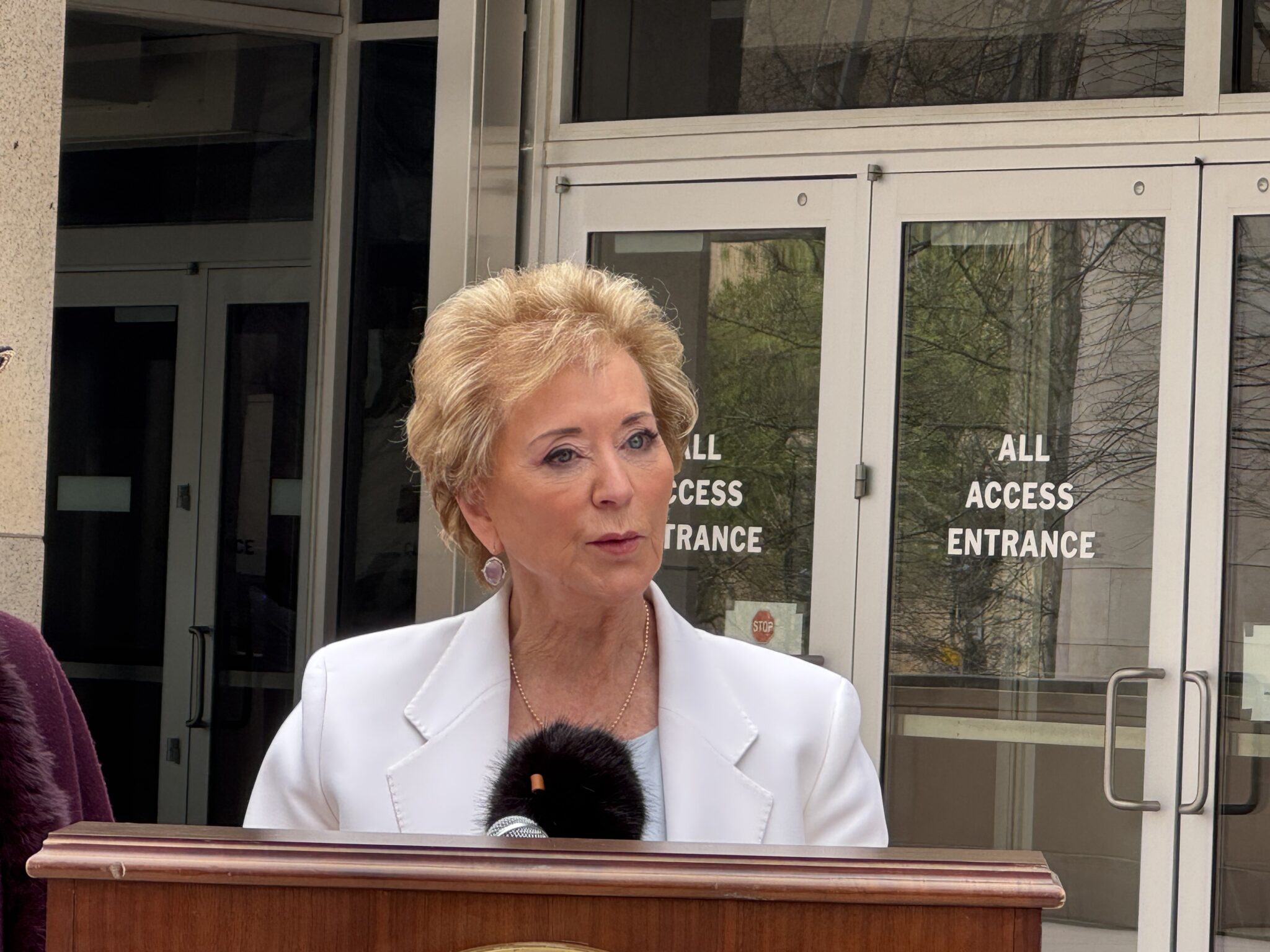
“American taxpayers will no longer be forced to serve as collateral for irresponsible student loan policies,” U.S. Secretary of Education Linda McMahon said in a statement Monday.
During last year’s presidential campaign, President Donald Trump criticized his predecessor and successor, President Joe Biden, for his efforts to erase student debt. McMahon resumed that line of attack Monday, blaming Biden’s administration for unreasonably raising borrowers’ expectations of forgiveness.
“The Biden Administration misled borrowers: the executive branch does not have the constitutional authority to wipe debt away, nor do the loan balances simply disappear. Hundreds of billions have already been transferred to taxpayers,” McMahon said.
She added that “going forward, the Department of Education, in conjunction with the Department of Treasury, will shepherd the student loan program responsibly and according to the law, which means helping borrowers return to repayment — both for the sake of their own financial health and our nation’s economic outlook.”
The department said the Office of Federal Student Aid will restart the Treasury Offset Program, which the U.S. Treasury Department administers, on May 5.
The Education Department statement said all borrowers who are in default will get emails over the next two weeks “making them aware of these developments and urging them to contact the Default Resolution Group to make a monthly payment, enroll in an income-driven repayment plan, or sign up for loan rehabilitation.”
The department said the Office of Federal Student Aid will “send required notices beginning administrative wage garnishment” later this summer.
More than 42.7 million borrowers owe more than $1.6 trillion in student debt, according to the department.
The administration claims that “instead of protecting responsible taxpayers, the Biden-Harris Administration put them on the hook for irresponsible lending, pushing the federal student loan portfolio toward a fiscal cliff.”
____________
Shauneen Miranda
Shauneen Miranda is a reporter for States Newsroom’s Washington bureau. An alumna of the University of Maryland, she previously covered breaking news for Axios.
Ohio Capital Journal is part of States Newsroom, the nation’s largest state-focused nonprofit news organization.
A new analysis of state public health systems shows Ohio’s has some of the worst funding support in the nation, and that funding could go down even more in the newest state budget.
Using 2021 data from the State Health Access Data Assistance Center, the Health Policy Institute of Ohio found that the state spent $24 per person on public health, “far less than most other states.”
“Overall, Ohio’s investment in public health is lower than many other states at both the state and local levels,” the institute stated.
According to the data, only 12 states are worse than Ohio for state public health funding, with the worst being Missouri, at $6.54 per person in 2021. The highest ranked was the District of Columbia, at $370.56 in per-capita spending that year.
Source: Health Policy Institute of Ohio
Public health involves everything from vaccine awareness and health education to food and water safety.
While health outcomes are influenced by clinical care like primary care check-ups, health behaviors and the social, economic, and physical environment make up a bigger part of the health outcome influences, according to policy briefs by the institute.
“Public health workers focus on stopping health problems before they start,” the HPIO stated in a recent policy brief. “For example, public health workers prevent injuries and deaths by providing parents with information about how to correctly install infant car seats, distributing drug overdose reversal medication and raising awareness of senior fall prevention programs.”
Other public health roles include nurses at school-based health centers, restaurant inspectors, public assistance program nutritionists, epidemiologists who look at health trends like infant mortality, and workers who conduct home visits as part of the Help Me Grow program.
That program, along with infant vitality programs are portions of the state budget that may see cuts, even as public health advocates ask the state to support the sector more than it already does.
In the Ohio House’s version of the state budget, $22.5 million would be cut from the Help Me Grow program in fiscal year 2027, representing a 26% reduction. Infant vitality programs would see cuts of more than $2 million each in 2026 and 2027, a nearly 10% cut. The programs, both housed under the Ohio Department of Children and Youth, are still awaiting final numbers, as the Ohio Senate takes up its budget discussions. A final draft will then be developed by both chambers, before it’s sent to the governor by July 1.
GET THE MORNING HEADLINES.
The House version of the budget leaves local health department support unchanged, with that support set at the same $2.379 million the line item received in 2024 and this year. State funding for infectious disease prevention and control within the Ohio Department of Health will also receive relatively the same amount of funding as it received in 2024, though the House version drops the budget slightly from the estimated 2025 funding. The 2025 estimate by the state has funding at $5.2 million, and the House set funding for 2026 and 2027 at $4.9 million per year.
In Ohio, 2023 annual financial reports from the Ohio Department of Health and the Association of Ohio Health Commissioners showed 72% of local health department revenue comes from the local level, including local government funds, public health levies in some areas and fees. Federal funding distributed by the state makes up 16% of the revenue, 6% is from other state sources, and 5% comes from direct federal funding to local departments. Local health departments only receive 1% of their revenue via state subsidy, according to the data.
Source: Health Policy Institute of Ohio
The Health Policy Institute’s review of 2024 Ohio Department of Health data shows it receives half of its revenue from federal sources, 31% from the state and 19% came from the federal response to the COVID-19 pandemic.
With $979 million in state fiscal year 2024, the state used that revenue almost equally across three topics: disease prevention, implementation of the federal Women, Infant and Children (WIC) program, and services related to COVID-19 and other infectious diseases, according to an HPIO policy brief on public health basics. These three topics each took 22% to 23% in ODH expenditures.
Another 11% went to family and community health services, 6% went to maternal and infant vitality, 5% to administrative services, 4% to “quality assurance” for long-term care facilities, 4% for public health preparedness information and 2% for “other family and community health services” passed through local health districts.
Public health initiatives yield an average return on investment of $14 for every dollar spent, through improved health outcomes, reduced health care costs and increased productivity, according to the institute’s public health analysis.
Among other policy recommendations, the instituted urged continued or even increased support for the federal Public Health Infrastructure Grant would be important to “strengthen the public health workforce, foundational capabilities and data systems through the end of 2027.”
The public health sector has faced struggles like high turnover, high burnout rates in existing employees and a lack of adequate pay.
“Consistent delivery of these services across the state depends upon an adequate public health workforce,” the HPIO stated.
Susan Tebben
Susan Tebben is an award-winning journalist with a decade of experience covering Ohio news, including courts and crime, Appalachian social issues, government, education, diversity and culture. She has worked for The Newark Advocate, The Glasgow (KY) Daily Times, The Athens Messenger, and WOUB Public Media. She has also had work featured on National Public Radio.
Ohio Capital Journal is part of States Newsroom, the nation’s largest state-focused nonprofit news organization.
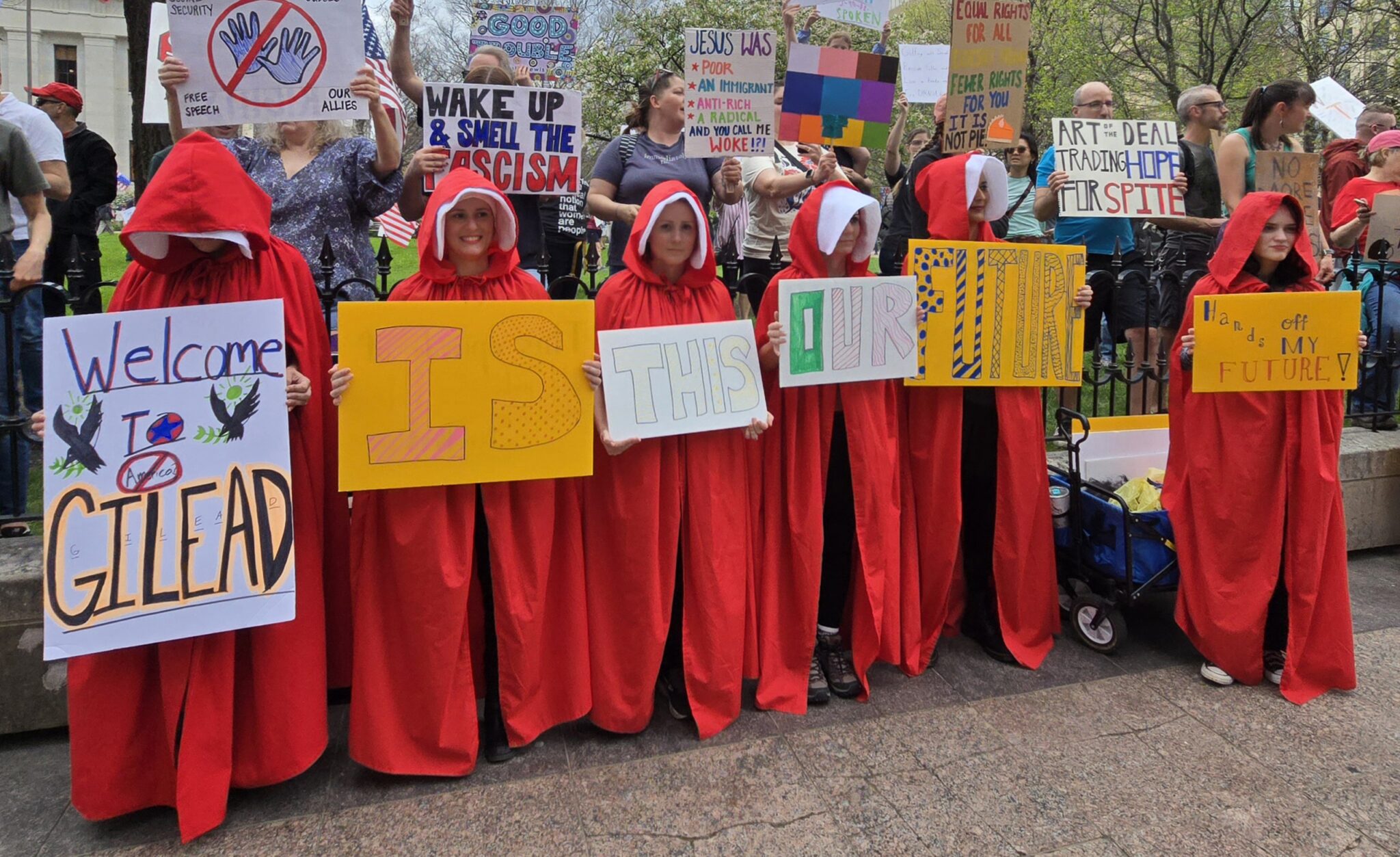
Protesters dressed as characters in “The Handmaid’s Tale,” a dystopian novel about life under a totalitarian regime. They were protesting President Donald Trump at the Ohio Capitol on April 19. (Photo by Marty Schladen, Ohio Capital Journal.)
A larger-than-expected crowd went to the Ohio capitol on Saturday to protest President Donald Trump and the many controversial actions of his young administration. It was one of at least 47 across Ohio and more than 700 across the United States.
Columbus police said that the crowd appeared to approach 3,000. That was smaller than the roughly 5,000 who turned out on April 5, when millions protested nationwide. But with the Easter holiday and fewer sponsoring organizations, smaller crowds were expected on Saturday.
Large crowds also gathered in Cincinnati, rainy Akron, and other cities across the Buckeye State. They were sponsored by the group 50501.
Photo by Marty Schladen, Ohio Capital Journal.
Organizers chose April 19 to protest in part for its symbolic value. On that day in 1775, the first battles of the Revolutionary War were fought in Lexington and Concord, Mass.
Playing off of that theme, many carried signs Saturday denouncing Trump and accusing him of trying to be a king.
But perhaps more concerning is that his administration has been invoking a law not used in 80 years, accusing some migrants of membership in gangs, and deporting them to a notorious Salvadorean prison. He has defied court orders — including one to bring back a man whom the administration admitted was deported in error.
The U.S. Supreme Court early Saturday morning ordered a temporary halt to the deportations. So the stage seems to be setting for a confrontation between the judiciary — which has no army to enforce its orders — and an executive who sometimes has been disinclined to heed them.
That was on the minds of many at the Columbus protest. Chuck Ardo of Lancaster said that his family migrated to the United States from Slovakia when he was a child, and that his parents survived the Holocaust.
“Fascism is something I’ve always been aware of,” he said. “Due process and the Constitution, that’s what matters. I don’t know if these people are deportable or not. But they all deserve due process and that’s what’s missing here. They’ve labeled them ‘terrorists,’ but on what grounds? What proof have they shown?”
Sen. Chris Van Hollen, D-Md., last week visited the wrongly deported man, Kilmar Armando Abrego Garcia, at the Salvadorean prison. He said that if Trump has evidence that Abrego Garcia is in a gang, he needs to present it court — not just claim it on social media.
For Ardo, Trump’s actions have a disturbing historical echo.
“Donald Trump is doing many of the things Hitler did as he rose to power,” he said. “Hitler attacked the courts. He attacked the universities. I’m not accusing anybody of being a Nazi here, but while history doesn’t repeat itself, it rhymes.”
Debbie Wood of Powell said the president has been acting like a king in other ways as well.
“Trump did not win in a landslide,” she said. “More people voted for someone else than for him. He does not have a mandate. Even the people who voted for him did not vote to ruin the VA. They didn’t vote to fire people who do cancer research. They didn’t vote to take food out of the mouths of hungry people. Ruining the national parks. Nobody voted for any of that stuff.”
She added, “People are getting more and more angry. He’s sending people away to concentration camps without due process. Ignoring court orders. Who does that? We would be in jail.”
Photo by Marty Schladen, Ohio Capital Journal.
Gary Bennett of St. Clairsville stood at the base of a monument to former President William McKinley holding a sign that mocked Trump and slammed him for gutting the staff at the National Park Service. He said that’s just one problem among many he has with the new administration.
“We could make signs every day of the week and there would still be signs to make,” he said. “Me and my wife just retired, and we don’t want him to take away our Social Security. That’s just one thing.”
Chris Glass of Delaware said she’s also upset about many things Trump is doing, and that protesting helps.
“There is something very nice about the camaraderie,” she said. “It’s a sense that people do care. I think we represent the country better than our current government does.”
Last updated 5:03 a.m., Apr. 21, 2025
Marty Schladen
Marty Schladen has been a reporter for decades, working in Indiana, Texas and other places before returning to his native Ohio to work at The Columbus Dispatch in 2017. He’s won state and national journalism awards for investigations into utility regulation, public corruption, the environment, prescription drug spending and other matters.
Ohio Capital Journal is part of States Newsroom, the nation’s largest state-focused nonprofit news organization.




 Last week,