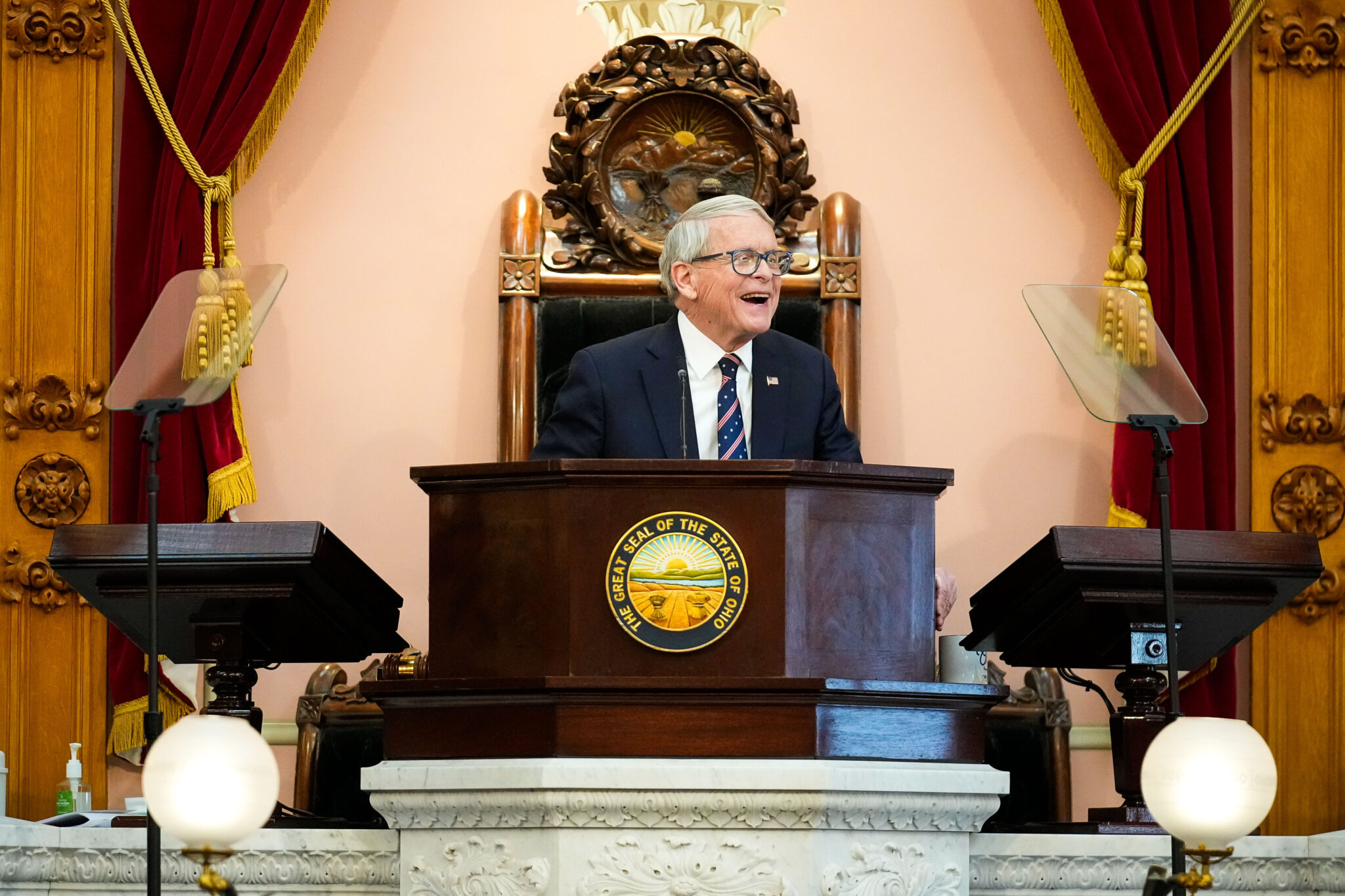
Ohio Gov. Mike DeWine on Friday signed into law a massive higher education overhaul to ban diversity efforts, regulate classroom discussion, and prohibit faculty strikes, among other things. The law will take effect in 90 days.
S.B. 1 will set rules around classroom discussion, create post-tenure reviews, put diversity scholarships at risk, create a retrenchment provision that block unions from negotiating on tenure, shorten university board of trustees terms from nine years down to six years, and require students take an American history course, among other things.
For classroom discussion, the bill will set rules around topics involving “controversial beliefs” such as climate policies, electoral politics, foreign policy, diversity and inclusion programs, immigration policy, marriage, or abortion. S.B. 1 would only affect Ohio’s public universities.
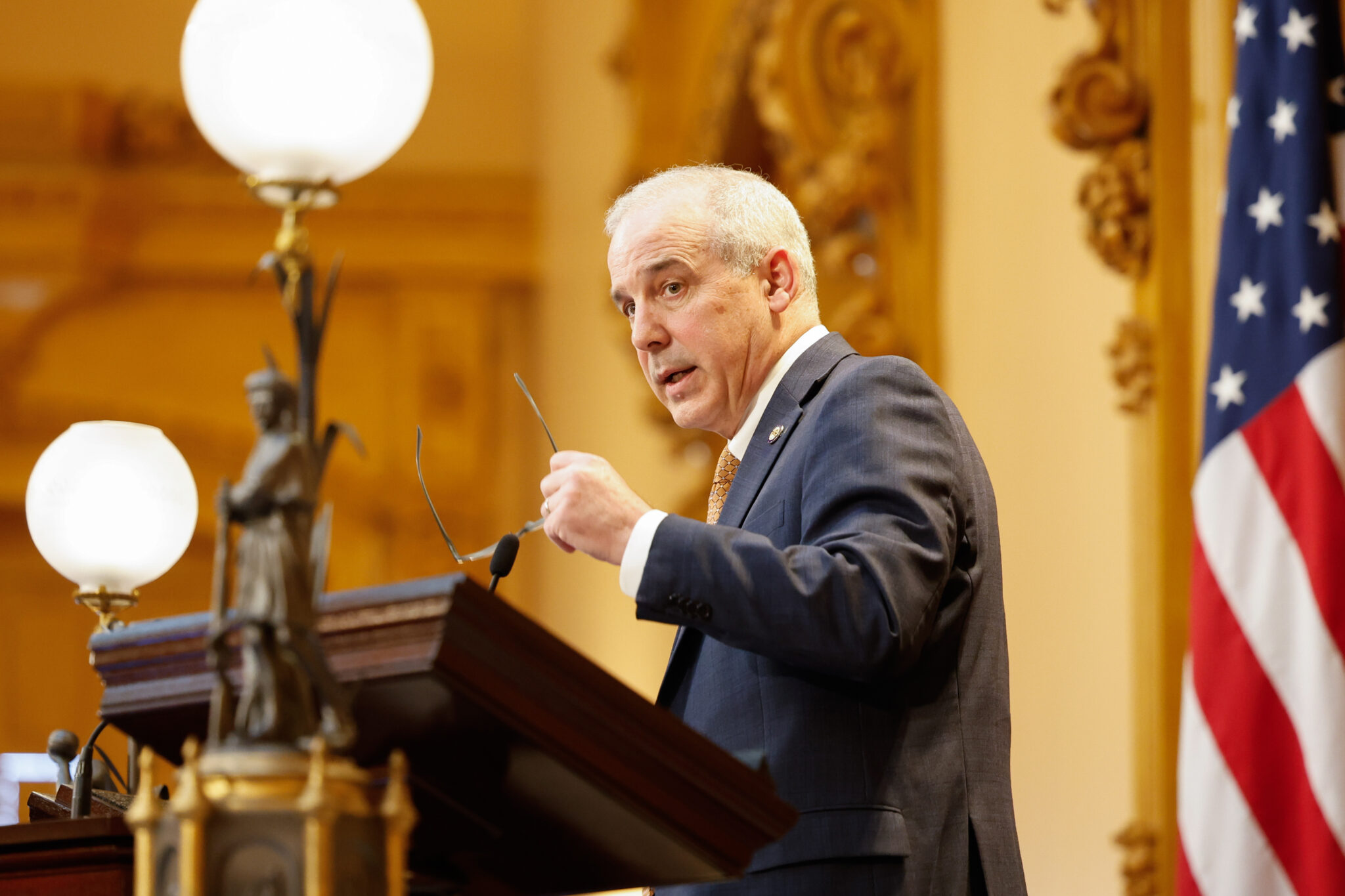
The bill moved quickly through the Statehouse. State Sen. Jerry Cirino, R-Kirtland, introduced S.B. 1, which passed the Ohio Senate in February and the Ohio House in March. Cirino introduced a nearly identical bill during the last General Assembly that went through several revisions, but the bill never made it the House floor and ultimately died.
Megan Henry is a reporter for the Ohio Capital Journal and has spent the past five years reporting in Ohio on various topics including education, healthcare, business and crime. She previously worked at The Columbus Dispatch, part of the USA Today Network.
Ohio Capital Journal is part of States Newsroom, the nation’s largest state-focused nonprofit news organization.
Health clinics that provide abortion services are already battling against threats to funds and the work they do. But services like contraception, STI testing, and preventative health screenings are also at risk with Trump administration plans to freeze “family planning” grants in Ohio and across the country.
At risk is funding through Title X, a federal pot of money that goes to clinics that “have played a critical role in ensuring access to a broad range of family planning and preventive health services,” according to the U.S. Department of Health & Human Services.
A 2023 annual report from HHS’ Office on Population Affairs on the Title X program lists services provided under the grants, including FDA-approved contraception, pregnancy testing and counseling, “assistance to achieve pregnancy,” infertility services, sexually transmitted infection services and other “preconception health services.”
“Title X services are client-centered, culturally and linguistically appropriate, inclusive, trauma-informed and provided in a manner that ensures equitable and quality service delivery consistent with nationally recognized standards of care,” the annual report stated.
As part of a whirlwind of efforts to cut government spending, the Trump administration reportedly wants to freeze more than $27 million in grants from the program.
That cut would have the largest impact on Planned Parenthoods across the country, which receive $20 million of that funding.
GET THE MORNING HEADLINES.
In a March memo, the Planned Parenthood Federation of America underscored the importance of Title X funding, saying its clinics were the largest Title X provider in 2018, the year before the first Trump administration, serving 40% of patients under the program.
The group left the program in 2019, but came back in 2021 after former President Joe Biden rolled back some Trump-era policies.
“If Planned Parenthood patients can’t get quality, affordable health services … there would be grave nationwide consequences,” the memo stated.
Planned Parenthood of Greater Ohio was one of the recipients of Title X grants in 2024, when it was awarded $1.98 million. The Ohio Department of Health also received a Title X grant that year of nearly $7 million, about the same amount as it received in both 2023 and 2022.
“Any insinuation to take away critical family planning services from people with lower incomes to afford Trump’s tax cuts to billionaires is dangerous and unprecedented,” Planned Parenthood of Greater Ohio said in a statement to the Capital Journal.
The group said they served 600 fewer patients than the Ohio Department of Health in 2023, but did it “for $5 million less in Title X funds.”
“Planned Parenthood of Greater Ohio will continue to fight for our right to be a trusted, safety net provider in reproductive health care services like birth control, cancer screenings, testing and treatment for sexually transmitted infections, among other Title X-eligible services.”
In their most recent annual report, the organization reported more than 66,700 visits to their health and surgical centers, providing care for 47,480 patients between 2022 and 2023.
Of those visits, the group provided 86,346 tests for sexually transmitted diseases, administered 16,817 pregnancy tests, served 11,803 patients for contraception-related care and conducted 9,340 HIV tests. The facilities also had 7,734 preventive care visits, 7,136 telehealth visits and 3,255 visits regarding gender-affirming care.
At the greater Ohio arm of Planned Parenthood, 56% of the patient base lives at or below 200% of the federal poverty line. That’s $62,400 for a family of four. Seventy four percent are between ages 18 and 34, 85% identify as female and 46% of patients rely on Medicaid for care, according to the annual report.
The Ohio-based group receives 12.4% of its revenue through state and federal grants, with Medicaid and Medicare reimbursements making up 17.7% of revenue and 14.5% of funds coming from private or commercial insurance payments.
The main source of revenue for Planned Parenthood of Greater Ohio in 2022-2023 was individual, institutional and “legacy giving.” It made up 35.3% of the agency’s revenue stream.
As for spending that money, the annual report stated that 80% of the expenses are for program services, including the health services at clinics, education and outreach, and government and community relations. Another 14% went to management and “general” expenses, with 6% going to fundraising over that period.
YOU MAKE OUR WORK POSSIBLE.
__________________
Susan Tebben
Susan Tebben is an award-winning journalist with a decade of experience covering Ohio news, including courts and crime, Appalachian social issues, government, education, diversity and culture. She has worked for The Newark Advocate, The Glasgow (KY) Daily Times, The Athens Messenger, and WOUB Public Media. She has also had work featured on National Public Radio.
Ohio Capital Journal is part of States Newsroom, the nation’s largest state-focused nonprofit news organization.
Ohio college students, faculty and staff are calling on Gov. Mike DeWine to veto a massive higher education bill that would ban diversity and inclusion on campus and prevent faculty from striking.
Lawmakers concurred with tweaks made to Senate Bill 1 during Wednesday’s Senate session, sending the bill to DeWine’s desk for his signature. DeWine received the bill Wednesday and has 10 days to sign the bill into law or veto it. If DeWine vetoes the bill, lawmakers would need a 3/5 vote from each chamber to override it.
DeWine, however, has previously said he would sign the bill.
GET THE MORNING HEADLINES.
S.B. 1 would set rules around classroom discussion, create post-tenure reviews, put diversity scholarships at risk, create a retrenchment provision that blocks unions from negotiating on tenure, shorten university board of trustees terms from nine years down to six years, and require students take an American history course, among other things.
For classroom discussion, the bill would set rules around topics involving “controversial beliefs” such as climate policies, electoral politics, foreign policy, diversity and inclusion programs, immigration policy, marriage, or abortion, and forbid “indoctrination,” though that remains undefined. S.B. 1 would only affect Ohio’s public universities.
“Republicans showed us they’d rather gamble with our economic future than solve real problems in our state,” Ohio Democratic Party Chair Elizabeth Walters said in a statement. “Instead of growing our state, Republicans are driving students, young adults, and business away from Ohio. We’re urging Governor DeWine to do the right thing and veto this legislation.”
“This legislation is a misguided attempt by overreaching legislators to impose their ideological beliefs on our public universities,” the letter said. “The bill undermines academic freedom, attacks collective bargaining rights, and jeopardizes the future of higher education in our state.”
The Ohio House Minority Caucus also sent a letter to DeWine asking him to veto the bill.
“You have an opportunity to protect the future of Ohio’s institutions of higher education, and your legacy as Ohio’s governor, by vetoing this bill and requiring the legislature to negate terms that are more amenable to the will of Ohioans,” the letter read.
The ACLU of Ohio wants DeWine to veto S.B. 1 and protect free speech on campus.
“By dismantling DEI structures, Senate Bill 1 sends a clear, harmful message to students that their unique backgrounds, experiences, and perspectives are not welcome in Ohio,” ACLU of Ohio Policy Director Jocelyn Rosnick said in a statement.
Anticipating S.B. 1 would pass during Wednesday’s Senate session, members of the Ohio Legislative Black Caucus urged DeWine to veto S.B. 1 during a press conference earlier that day.
“This is one of the worst government overhauls that I’ve seen to date,” said state Rep. Terrence Upchurch, D-Cleveland. “It will not only limit our First Amendment right to free speech, ban strikes and collective bargaining rights for professors, it threatens opportunities for our students, undermines workforce development and disproportionately harms black and minority communities.”
State Rep. Desiree Tims, D-Dayton, said S.B. 1 is toxic, racist and a threat to free speech and academic freedom.
“Since when is diversity, equity and inclusion a bad thing?” she asked. “Why is this necessary? The only answer is, so that we can move backwards, pre-civil rights … progress that this country and this nation has stood for. … Senate Bill 1 turns the ugly page back in history, somewhere we do not want to go, where we should not go.”
“The diversity scholarships weren’t designed to discriminate against white students,” she said. “The diversity scholarships were designed to encourage more students of color to come to little old, white Athens, Ohio and get a quality education.”
S.B. 1 will be detrimental to Ohio’s higher education, Dashiell said.
“If it hadn’t been for an extra effort at Ohio University to diversify the faculty, I would still be in Tennessee,” she said. “We also urge that Governor DeWine veto this bill because it’s going to hurt our students. It’s going to hurt those who will benefit from diversity programs and benefit from these diversity scholarships.”
Ohio State University’s Chair of the Undergraduate Black Caucus Jessica Asante-Tutu said this bill runs the risk of forcing Ohioans to move out of state.
“Students learn best in environments that encourage exchanges, where ideas flow freely and where differences are respected,” she said. “This bill stifles all of that.”
As an Olentangy Liberty High School student in Delaware County, Michelle Huang said S.B. 1 hangs over her head as she thinks about applying for colleges this fall.
“The threat of this bill passing is a deterrent from us attending Ohio State in the first place,” she said. “What DEI is actually doing is actually promoting more discourse and promoting more intellectual diversity.”
Megan Henry is a reporter for the Ohio Capital Journal and has spent the past five years reporting in Ohio on various topics including education, healthcare, business and crime. She previously worked at The Columbus Dispatch, part of the USA Today Network.
Ohio Capital Journal is part of States Newsroom, the nation’s largest state-focused nonprofit news organization.
President Donald Trump signed an executive order March 14, 2025, imposing dramatic cuts on seven federal agencies, including the Institute of Museum and Library Services. (Catherine McQueen/Getty Images)
Public libraries in Ohio have taken on many identities over the last 25 years, from literature distributors and internet hubs, to social services researchers and providers of basic needs like free food. But funding has stagnated, failing to match growing demands.
The Toledo Lucas County Public Library works to cultivate reading skills and technology access. But along with those services, the system works with partners to distribute meals to children in the community. It also hosts a small business and non-profit team, a program that has provided training, education, research services, technology and physical space, equating to more than $3.1 million in value to entrepreneurs and businesses, according to Jason Kucsma, executive director and fiscal officer for the library system.
“Folks tend to think of their libraries as where they grew up and had their story times,” Kucsma told the Capital Journal. “But we’re part of the public infrastructure.”
Libraries are also jumping in as potential funding cuts and actual job cuts to agencies like the IRS and the Social Security Administration leave Ohioans with questions and a lack of answers.
“When it comes to federal agencies, that’s probably something we’re going to see more of,” said Michelle Francis, executive director of the Ohio Library Council.
Ohio libraries are in the thick of it with tax season going strong, as they partner with organizations like the AARP to help people finish their filings.
“We can’t keep up with the demand for tax services,” Kucsma said. “Once we open that up, those slots fill up pretty quickly.”
In one year, Ohio public libraries saw visits from enough people to fill Ohio Stadium 434 times, according to council data.
However, over the last 25 years, the funding from the state hasn’t always matched the influx of roles libraries have included in their portfolio.
State funding
The Public Library Fund, which is the state’s funding source for all public libraries dropped by $27 million last year, putting the funding at the same level it was 25 years ago.
“When you’re funding libraries at the same level you were 25 years ago, but yet the demand, the expectation is growing, something’s gotta give,” Francis said.
The local libraries have significant support from their communities in the form of property tax levies, but there are still 48 library systems of the 251 in the state that rely solely on state funding for their main revenue, according to Francis.
“We see our relationship with the state as one where when we receive funding from the Public Library Fund, it goes straight to those services on the local level,” she said.
GET THE MORNING HEADLINES.
The state also provided $4.5 million to the State Library of Ohio in the last budget, money which supports the research areas of the library, including conservation of things like the official photograph of the Ohio House from 1890, documents about the state dating back to 1876 and even a celebration of the 35th birthday of the United States
The SLO gets some funding from libraries with which the it collaborates, but the biggest chunk, $5.4 million, comes from the federal Institute for Museum and Library Services.
“We’ve been here for 200 years, we have to plan like we’re going to be here for 200 more years,” Knapp said.
Without help from both the federal and state sides, the library is going to have trouble, particularly with its current facility.
In asking for a one-time increase in the 2026 operating budget of $525,000, Mandy Knapp, who heads the state library, told the Ohio House Workforce and Higher Education Committee their current facility is “no longer suitable” with the work needed to remediate HVAC issues threatening the preservation of “one-of-a-kind and rare materials” that include medieval manuscripts and writings from state political leaders.
“Due to the condition of our facility, we are unable to correctly preserve and care for these materials,” Knapp told the committee in February.
Federal funding
Along with the battle for state funding, the state library is facing potential cuts on a federal level after an executive order from President Donald Trump listed the Institute of Museum and Library Services as part of a group of governmental entities to be “eliminated to the maximum extent consistent with applicable law,” and ordered to “reduce the performance of their statutory functions and associated personnel to the minimum presence and function required by law,” according to the executive order, which was released March 14.
Among the other entities listed for elimination with the library-services agency were the United States Interagency Council on Homelessness, the Minority Business Development Agency, the Community Development Financial Institutions Fund, the Woodrow Wilson International Center for Scholars in the Smithsonian Institution, and the United States Agency for Global Media and the Federal Mediation and Conciliation Service.
The museum and library services institute provides funding to libraries and museums nationwide, including the State Library of Ohio. The library was praised by Francis and Kucsma as an entity that provides statewide benefits from those federal funds, including resource-sharing, summer learning programs, reading programs for the blind and deaf, and the Ohio Digital Library, which helps local libraries big and small provide audiobooks and e-books.
“These resources are not large amounts of money, but they go to help support projects and programs that the people of Ohio benefit from every day,” Francis said.
As of Friday afternoon, the State Library of Ohio hadn’t heard whether or not its funding would be cut, specifically the Grants to States Program, which is where the state library receives most of its funding.
Source: State Library of Ohio
The $5.4 million from the federal Institute of Museum and Library Services is a drop in the bucket among the trillions of dollars the U.S. Congress handles, as Knapp looks at it.
“It’s like finding $20 in your wallet that you didn’t know was there, that’s what it is to Congress,” she said.
But for the State Library and the local libraries who work with it, that money is the difference between needed partnerships – digital services, consortiums for smaller libraries, the conservation of historic materials including parts of the state’s founding history – and being reduced to one singular role as a research library without the ability to help fellow libraries.
“It would totally and utterly devastate the State Library of Ohio,” Knapp said.
As it happens, the Toledo Lucas County Public Library was one of the recipients of the National Medal for Museum and Library Services, given out by the Institute of Museum and Library Services to “institutions that make significant and exceptional contributions to their communities.”
Part of that contribution includes opening its meeting rooms to local governments and elected officials. At Toledo’s libraries, 27% of their meeting space usage in the last year was government-related, according to Kucsma, something the library encourages as a way to “meaningfully engage with people.”
“As we see people’s trust in general institutions erode, especially in the last 10 years, that hasn’t happened with people’s trust in libraries,” Kucsma said. “I think it’s only grown.”
Gov. Mike DeWine’s executive budget proposal had an increase to the Public Library Fund from 1.7% to 1.75%. But Francis said “we still have a long way to go with the budget,” and they plan to push even harder to show the importance of public libraries.
“I’m optimistic that (legislators) see the value,” Francis said.
YOU MAKE OUR WORK POSSIBLE.
____________
Susan Tebben
Susan Tebben is an award-winning journalist with a decade of experience covering Ohio news, including courts and crime, Appalachian social issues, government, education, diversity and culture. She has worked for The Newark Advocate, The Glasgow (KY) Daily Times, The Athens Messenger, and WOUB Public Media. She has also had work featured on National Public Radio.
Ohio Capital Journal is part of States Newsroom, the nation’s largest state-focused nonprofit news organization.
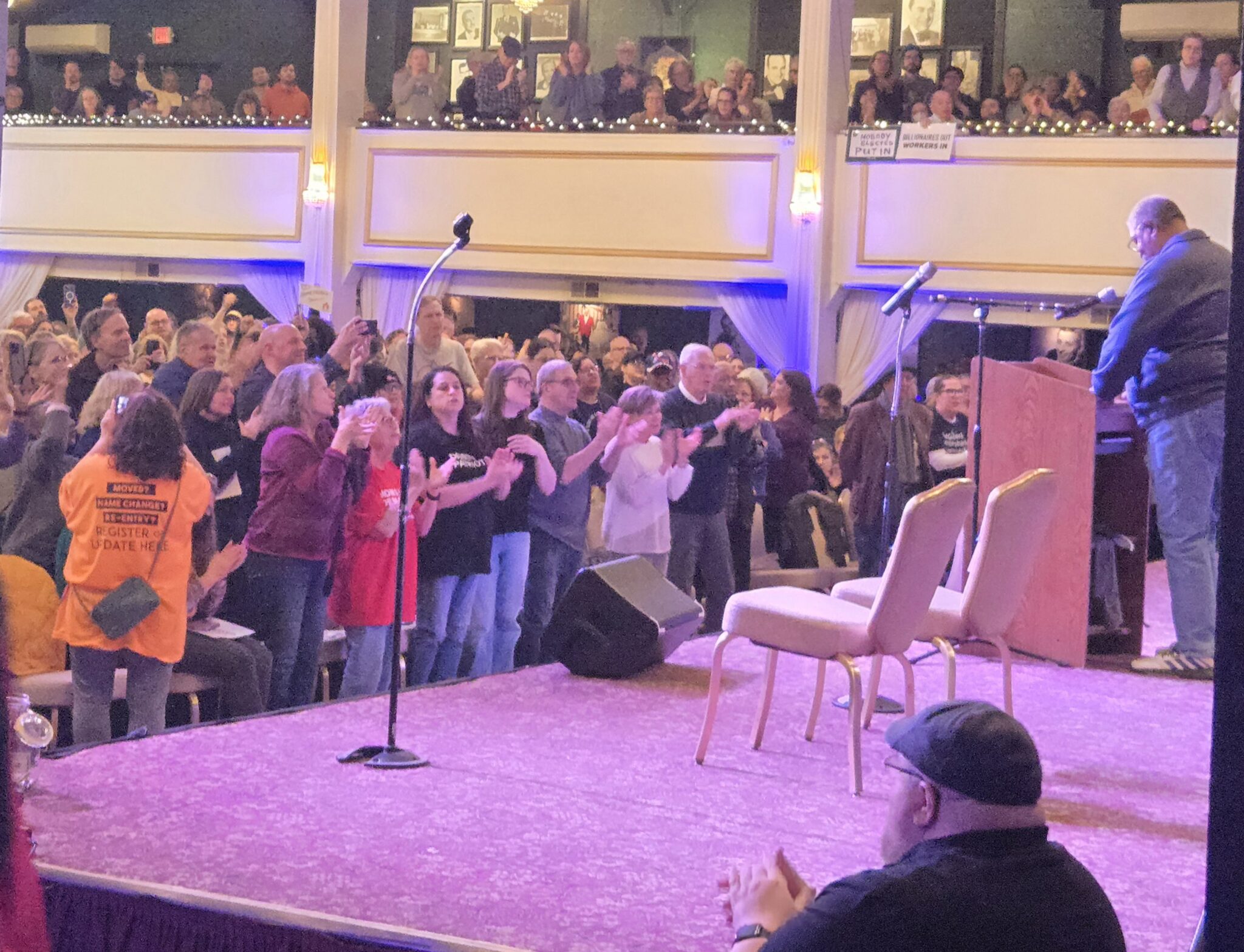
The audience at a packed Valley Dale Ball chants “Do Your Job” to empty chairs meant for U.S. Sens. Bernie Moreno and Jon Husted, both Ohio Republicans. (Photo by Marty Schladen, Ohio Capital Journal.)
An enthusiastic crowd of about 1,400 Ohioans on Saturday packed the Valley Dale Ballroom to say their federal officials aren’t representing them — and that they’re not standing up to President Donald Trump as he allows the world’s richest man to slash federal programs.
The event, staged by Indivisible Central Ohio, was facetiously called a town hall.
Chairs were placed on the stage for U.S. Sens. Bernie Moreno and Jon Husted, both Republicans. They sat empty, and organizers said the senators’ offices didn’t even bother to say they wouldn’t be coming.
Instead, organizers asked the questions they would have put to the senators to the AI program Chat GPT. The program said that the massive layoffs and cuts to federal programs would cost Ohio jobs, harm university research and stunt the biomedical sector.
Mia Lewis, an organizer, urged the crowd to turn out regularly to protest what’s happening.
“This is an unprecedented moment in our country. This shit is not normal,” she said of an administration that regularly attacks the judiciary, and allows an unelected, unconfirmed Elon Musk hack wildly at the federal government. “Just two people standing on a highway is not the same thing as 50 people being there every day.”
Members of the audience held signs that said things like “Nobody elected Putin,” “Nobody elected Musk,” and other things that aren’t publishable by a general-audiences news organization.
Moreno and Husted weren’t the only ones to be mocked for their absence. Joyce Beatty, a Democrat and longtime congresswoman from Columbus, begged off, citing a “prior commitment.” An unfortunate constituent was regularly heckled as she tried to read in first person a letter Beatty had sent.
When the constituent read a passage implying Beatty was present, a man yelled out, “You’re not here!” The crowd laughed.
Arnold Scott summed up the general tenor.
“As an ex-federal employee and a union member, I’m mad as hell,” he said. “How about these billionaires pay their taxes? When they cut employees at the various agencies, actually what they’re doing is cutting the services that the taxpayers are paying for. When they cut the VA, they’re cutting veterans. You stand there and say you support the veterans, but then you cut the veterans. When you cut them, that translates into it taking longer for them to receive the services that they’re entitled to.”
Scott said an Ohio federal worker lost her job and complained to one of the Ohio senators. “What do you want me to do?” Scott claimed the senator responded.
Then Scott turned to the two empty chairs and said, “Mr. Senator, what we want you to do… we want you to do your job.”
That brought the crowd to its feet to chant “Do your job!”
“Every dollar we don’t have is produce we don’t grow,” Duffy said.
YOU MAKE OUR WORK POSSIBLE.
_______________
Marty Schladen
Marty Schladen has been a reporter for decades, working in Indiana, Texas and other places before returning to his native Ohio to work at The Columbus Dispatch in 2017. He’s won state and national journalism awards for investigations into utility regulation, public corruption, the environment, prescription drug spending and other matters.
Ohio Capital Journal is part of States Newsroom, the nation’s largest state-focused nonprofit news organization.
Ohio Gov. Mike DeWine joined other Republican governors in attending Trump’s signing of the executive order Thursday afternoon at the White House. The executive order does not automatically close the department since eliminating a federal agency requires congressional approval.
“I joined President Trump and several fellow governors at the White House in support of the president’s proposal to return education back to the states,” DeWine said in a statement posted on X, formerly known as Twitter. “By giving states more authority over education, we will have the flexibility to focus our effort on tailoring an educational experience that is best for our children and meets Ohio’s needs, rather than trying to chase federal priorities.”
The Ohio Department of Education and Workforce said the department agrees with DeWine’s statement, said ODEW spokesperson Lacey Snoke.
“Education policy belongs in the states and the federal government’s ‘one size fits all’ meddling has hurt our country for decades,” McColley said in a statement. “President Trump’s order will allow our 50 laboratories of democracy to deliver innovative solutions that meet each state’s unique needs.”
The Department of Education was established as a cabinet-level agency by Congress in 1979 under President Jimmy Carter and it doesn’t determine what is taught in schools. Instead, learning standards are set at the state level and curriculum is adopted by local school boards.
The department allocates Title I funds, which are federal funds given to school districts with a high percentage of low-income students, and administers the Individuals with Disabilities Education Act (IDEA), a law guaranteeing a free public education for children with disabilities.
Ohio school districts on average receive about 10% of their revenue from the federal government, Ohio Education Association President Scott DiMauro said. About 90% of Ohio students attended public school during the 2023-24 school year, according to the Ohio Department of Education and Workforce.
“Every single student in Ohio will pay the price for the move to dismantle the U.S. Department of Education,” DiMauro said in a statement. “Any measures to stop the vital work of Department employees to serve Ohio’s students or to reduce federal education funding will cause terrible harm to our students, our state, and our future.”
About 16% of Ohio public school students had a disability during the 2023-24 school year, according to the Ohio education department.
“Anyone who cares for a child who has struggled in school because of a disability or had to advocate for access to school services or opportunities should be concerned with the actions of the federal and state governments, regardless of political affiliation or how one voted in the last election,” Policy Matters Ohio Executive Director Hannah Halbert said in a statement.
Abolishing the Department of Education will mean chaos and uncertainty for Ohio schools, Ohio Federation of Teachers President Melissa Cropper said.
“The need for federal funding and support for public education will be even more critical if our upcoming state budget cuts school funding, as Governor DeWine’s own budget proposal does with $103 million in cuts to public school districts,” she said in a statement.
Megan Henry is a reporter for the Ohio Capital Journal and has spent the past five years reporting in Ohio on various topics including education, healthcare, business and crime. She previously worked at The Columbus Dispatch, part of the USA Today Network.
Ohio Capital Journal is part of States Newsroom, the nation’s largest state-focused nonprofit news organization.
Ohio House Republican lawmakers voted to pass a massive higher education overhaul bill Wednesday that would ban diversity and inclusion efforts and prevent faculty from striking.
State Sen. Jerry Cirino, R-Kirtland, introduced S.B. 1, which passed the Ohio Senate last month.
Now that it’s been passed by the House, it now heads back to the Ohio Senate for concurrence with changes made to the bill by the House.
Ohio Senate President Rob McColley, R-Napoleon, said Wednesday the Senate will concur with House changes at a later date.
After the Senate concurs with the House changes, the bill will go to Ohio Gov. Mike DeWine’s desk and DeWine will have 10 days to sign the bill into law or veto it once he receives it. If DeWine vetoes the bill, lawmakers would need three-fifths vote from each chamber to override it.
In addition to the bans on diversity efforts and faculty strikes, S.B. 1 would also set rules around classroom discussion, create post-tenure reviews, put diversity scholarships at risk, create a retrenchment provision that block unions from negotiating on tenure, shorten university board of trustees terms from nine years down to six years, and require students take an American history course, among other things.
For classroom discussion, the bill would set rules around topics involving “controversial beliefs” such as climate policies, electoral politics, foreign policy, diversity and inclusion programs, immigration policy, marriage, or abortion. S.B. 1 would only affect Ohio’s public universities.
The Ohio House Higher Education Committee voted the bill out of committee Wednesday morning with a 9-4 party-line vote after listening to people testify in support of the bill.
The committee also approved amendments to S.B. 1 that would require universities to stop accepting funds for scholarships with diversity and inclusion requirements four years after the bill becomes law.
Another amendment requires the Chancellor of Higher Education to do a diversity study of students enrolled in universities based on race, ethnicity, and biological sex and submit the report to lawmakers within six years.
Outside of the Ohio Statehouse, a mass of college students and protesters rallied against the bill, saying it would destroy freedom of thought and expression on university campuses and push students out-of-state.
(Photos by David DeWitt, Ohio Capital Journal.) Ohio college students and protesters rally at the Statehouse on March 19, 2025, against Senate Bill 1, a higher education overhaul that bans diversity efforts and faculty strikes, and sets rules around classroom discussion, among other things.
Megan Henry is a reporter for the Ohio Capital Journal and has spent the past five years reporting in Ohio on various topics including education, healthcare, business and crime. She previously worked at The Columbus Dispatch, part of the USA Today Network.
Ohio Capital Journal is part of States Newsroom, the nation’s largest state-focused nonprofit news organization.
Marijuana advocates called bills to change Ohio’s weed laws “a slap in the face” to voters.
The National Organization for the Reform of Marijuana Laws hosted a webinar last week about two bills that are trying to change Ohio’s marijuana laws.
“Whether one believes that cannabis ought to be legal or not is almost a secondary issue,” said NORML Deputy Director Paul Armentano. “The primary issue ought to be that elections have consequences, and the results of elections should matter.”
“Ohio looks like it has been rolling along very smoothly, and implementation has been going well,” said NORML Political Director Morgan Fox. “There have been no major complaints from Ohioans, and it’s premature for the legislature to try to interfere with it.”
“It’s not as if this pushback is coming because there have been negative or adverse consequences of Issue Two being implemented,” Armentano said. “The law is working just fine, and Ohioans are happy with it. Lawmakers are trying to meddle with it and act as if there are issues with the law, when in fact, we’re seeing the laws playing out the way voters intended.”
These bills would be dangerous for cannabis users in Ohio, said Cat Packer, director of drug markets and legal regulation at Drug Policy Alliance.
“There are so many ways that if you are a cannabis consumer in Ohio, with either of these bills passed, you should consider that the law will consider you a criminal,” she said.
S.B. 56 would cut the number of Ohio’s home grow plants in half from 12 plants down to six, reduce the THC levels in adult-use marijuana extracts from a maximum of 90% down to a maximum of 70%, and require marijuana can only be used in a private residence.
THC potency caps are a solution in search of a problem, Armentano said.
“Voters, by and large, don’t like potency caps for cannabis,” he said. “If we simply remove these products from the market, we’re not going to get rid of the demand, but what we’re going to do is drive the production of these products to the unregulated market.”
S.B. 56 does allow someone to apply to the sentencing court to have their record expunged, but they would have to pay a $50 filing fee. The bill would require marijuana to only be transported in the trunk of a car when traveling and would limit the number of active dispensaries to 350.
The Ohio Senate passed S.B. 56 last month, which would ban Ohioans from using marijuana that is not either from a licensed Ohio dispensary or cultivated at a consumer’s home — meaning it would be illegal for Ohioans to drive up to Michigan to buy marijuana and bring it back over state lines. The bill has yet to have a hearing in the House.
“If you were to pass a joint or share your home grown cannabis, or share your cannabis with your spouse or your roommate, you would be a criminal again,” said Karen O’Keefe, director of state policies at Marijuana Policy Project.
House Bill 160 would keep home grow and tax levels the same, but reduce THC levels and redirect most of the tax revenue to the state’s general fund.
The current tax revenue is divided up in several ways — 36% to the cannabis social equity and jobs fund, 36% to the host community cannabis fund, 25% to the substance abuse and addiction fund and 3% to the Division of Cannabis Control and Tax Commissioner Fund.
“My concern is we wouldn’t be dedicating those monies where voters decided that the money should go,” Packer said.
Ohio Gov. Mike DeWine’s budget proposal would increase the tax on marijuana from 10% to 20%. The Ohio House is currently working on the budget, which is due July 1.
Megan Henry is a reporter for the Ohio Capital Journal and has spent the past five years reporting in Ohio on various topics including education, healthcare, business and crime. She previously worked at The Columbus Dispatch, part of the USA Today Network.
Ohio Capital Journal is part of States Newsroom, the nation’s largest state-focused nonprofit news organization.
Jael Malenke (left) and Kevin Ely, standing next to their solar array. They’re supposed to get reimbursed for half of the system’s cost, but that funding is in limbo after USDA halted payments pending review. (Photo by Nick Evans, Ohio Capital Journal.)
Wooly Pig Farm Brewery sits on a gentle rise above Highway 36 and the Tuscarawas River in Fresno, Ohio. It takes its name from the Mangalitsa pigs covered in coats of thick curly wool, that roam the pastures nearby. Kevin Ely and Jael Malenke are the husband-and-wife team that run the brewery — Ely handles the beer and Malenke manages the business. They met in Utah and moved back to the area in 2014 when a farmstead near Malenke’s childhood home went up for sale.
Ely is a tinkerer. Two work gloves stick out of one coat pocket and the fat carpenter pencil in his chest pocket has left graphite stains where it’s rubbed against the jacket. He’s constantly looking for ways to make the brewery more efficient and even does talks for other brewers looking to streamline their operations.
Kevin Ely and Jael Malenke with a few of the Mangalista pigs they raise at the Wooly Pig Farm Brewery. (Photo by Nick Evans, Ohio Capital Journal.)
From his experience at other breweries, he said, “solar comes last.” There are too many other strategies to reduce energy consumption that are simpler and cheaper. That could be reducing water use or rigging up a cheap DIY system that takes advantage of the steam generated by the brewing process.
“You can reduce your energy consumption by like, 5, 10, 15, sometimes 20, 25%,” he said.
“But we’ve done those things,” Malenke cut in.
So that’s why they were so interested in the Rural Energy for America Program. The initiative, administered by the U.S. Department of Agriculture, offers loan financing or grant funding for farmers and rural businesses that invest in renewable energy projects to improve their energy efficiency.
At Wooly Pig, that’s a roughly $300,000 solar array on a hill above the brewery. In all, the roughly 100 kilowatt system includes more than 200 panels.
“They’re ranged in a double row on each of these six arrays — sets of arrays,” Malenke said as half a dozen pigs rooted around in the grass or played with their dogs. “They’re all high enough that we can have sheep grazing underneath them,” she added.
Under their REAP agreement, Ely and Malenke are expecting federal officials to cover $143,000 of the total investment. “That’s more than we pay in payroll here,” Malenke said, “and that includes what we take home.” But they’re currently in limbo, following the Elon Musk-linked Department of Government Efficiency’s efforts at the USDA.
For Ely and Malenke, as well as others expecting REAP funding, those dollars are “indefinitely suspended,” and subject to review by USDA Secretary Brooke Rollins.
“I welcome DOGE’s efforts at USDA because we know that its work makes us better, stronger, faster and more efficient,” Rollins said on her first day in office. “I will expect full access and transparency to DOGE in the days and weeks to come.”
Jael Malenke and Kevin Ely in the Wooly Pig Farm Brewery tap room. (Photo by Nick Evans, Ohio Capital Journal.)
The stakes for the brewery
Ely and Malenke have apps on their cellphones that monitor the amount of energy their array generates in real time.
“I’m probably looking, depending on the day, between four and six times a day,” Malenke said with a grin.
“Yeah, I might be doing — well, I might be eight or 10,” Ely said.
He’s tracking it closely because he’s looking for ways to stretch that power past sunset. They don’t have a battery system, so Ely said he’s working on running a boiler during the day and then using a heat exchanger to make use of that hot water in the evening.
Malenke said the brewery spends between $1,500 and $2,500 a month on power. The new solar array is designed to cover half of that, and with a few tweaks here or there, Ely is hoping they can push that to 60%.
GET THE MORNING HEADLINES.
Saving about $12,000 a year on energy costs would make a big difference for their business.
“I mean, that’s pay raises for our employees,” Ely said.
But losing out on the REAP reimbursement would be a major setback.
“And that’s it,” Ely explained. “The thing is, is that we probably wouldn’t have built — we would not have built an array for this price. We would have built something half as big or maybe we would have done it ourselves.”
Although working with a reputable contractor was more expensive, they went forward because it would leave them with a better built and longer lasting system while allowing them to focus on doing their actual jobs.
“There was very little risk associated with this project,” Ely said.
“We thought it was a risk-free project,” Malenke cut in.
“If we knew there was significant risk …” Ely broke off. “I mean, there was no evidence of it being risky.”
Rich Mushrush, owner of Gemstone Gas & Welding Supplies. (Photo by Nick Evans, Ohio Capital Journal.)
Gemstone Gas & Welding Supply
About half an hour from Wooly Pig in New Philadelphia, Rich Mushrush runs Gemstone Gas and Welding Supplies. In addition to gear for welders, they pump their own gases, “oxygen, argon, nitrogen, CO2, all the mixes,” he said, before his phone started ringing. He’s been calling around, twisting arms, to get a mechanic out to fix the muffler on a delivery truck.
“We pride ourselves on service,” he explained after securing a visit. “That’s how we kind of get over with the big companies. They can’t do what we do.”
Mushrush qualified for the REAP program and construction on his solar array started this week. Based on the project plans, he thinks the system will save him about $1,000 on his electric bill each month. If that back of the envelope math holds, the system would pay for itself in about two and a half years. But without the federal subsidy, Mushrush explained, that timeline stretches to more like 12 or 13 years.
“I thought s—, I might be dead by then,” he chuckled. “I’m 65 years old.”
Mushrush is frustrated about the financial pinch he’ll feel if the REAP funding doesn’t come through. “It’s a stinger to me,” he acknowledged, “and a lot of other small businesses — farmers.”
But his biggest objection is a moral one. If the federal government has decided the program is too generous, he argued, there’s nothing wrong with dialing it back going forward. “But the ones that are already in it,” he argued, “I think they should be grandfathered.”
“I just go from a commonsense standpoint,” Mushrush said. “How can they renege or back-claw on you, on a contract that is signed, sealed and delivered?
Broader picture
Both Wooly Pig and Gemstone worked with Paradise Energy Solutions to install their solar arrays, and company CEO Dale Good said their stories aren’t unique. The company operates in eight states and Good said Ohio is getting hit particularly hard by the suspension of REAP funding.
In an average year, he said, they handle around 40 or so solar projects with REAP contracts, and USDA’s funding halt has affected nearly three quarters of their projects.
In a written statement, a USDA spokesperson blamed the funding delay on the Biden administration for “exploit(ing) Congressional intent” by misusing funds from the Inflation Reduction Act and Infrastructure and Jobs Act.
REAP has been around since 2014, preceding both of those pieces of legislation. And far from exceeding congressional intent, the Inflation Reduction Act specifically appropriated additional funding for the program.
The spokesperson went on to suggest that with a flurry of last-minute funding decisions, the Biden administration was “making promises they knew the department would not be able to keep.”
But for the Wooly Pig project at least, they submitted their initial application in September 2023 and got notice of their award more than a year ago in February 2024. Gemstone’s application went in last June and got approved in September.
“Fortunately,” the USDA spokesperson continued, “President Trump is taking strong action to rein in reckless spending, cut needless regulations and make the entire federal government more effective at serving the American people, including our farmers.”
“As part of this effort,” the spokesperson added, “Secretary Rollins is carefully reviewing this funding and will provide updates as soon as they are made available.”
And at the end of the day, everything might work out fine. Wooly Pig has had their array up and running for about two weeks, but they need proof of it running for a month to make their final submission to release the funds they’ve been awarded. With the Gemstone array still under construction, Mushrush is a few months behind them.
But Ely and Malenke are nervous and already working on contingency plans if the funding doesn’t come through.
“Because, I mean, even if it does,” Ely said, “maybe it’s going to be, like, a lot longer down the road.”
“Our safety net — our cushion is gone,” he added. “So, right now, like nothing else seriously bad can happen.”
“Yeah, that’s our other plan,” Malenke laughed. “Have no more bad things happen.”
YOU MAKE OUR WORK POSSIBLE.
Follow Ohio Capital Journal Reporter Nick Evans on X or on Bluesky.
Nick Evans
Nick Evans has spent the past seven years reporting for NPR member stations in Florida and Ohio. He got his start in Tallahassee, covering issues like redistricting, same sex marriage and medical marijuana. Since arriving in Columbus in 2018, he has covered everything from city council to football. His work on Ohio politics and local policing have been featured numerous times on NPR.
Ohio Capital Journal is part of States Newsroom, the nation’s largest state-focused nonprofit news organization.
Another bill has entered the Ohio General Assembly in an attempt to address student hunger in schools, this time in the form of a Democratic measure that would still hold households accountable for student meal debt, but keep the child from feeling the consequences.
State Reps. Darnell Brewer, D-Cleveland, and Ismail Mohamed, D-Columbus, introduced House Bill 97 in a Tuesday hearing of the Ohio House Education Committee. The bill would require public schools to provide a meal to any student and bars districts from requiring “chores” or other activities from students due to outstanding meal debt. The bill also requires the Ohio Department of Education and Workforce to “provide guidance” to districts and schools about the collection of student meal debt.
“It’s a really common-sense solution to something that has been happening for so long and has such a negative impact on kids,” Mohamed told the committee on Tuesday.
Brewer and Mohamed pointed to statistics in their testimony to the committee that show more than 1.6 million Ohioans are considered food insecure, with 1 in 6 children in the state living in poverty in 2023.
Brewer said ideally, the “most sustainable and compassionate way” to address the problem would be with mandatory participation in the federal Community Eligibility Provision – a program that allows schools with large numbers of low-income children to serve free breakfast and lunch to all students in the school – or with a universal breakfast and lunch program in the state.
The Community Eligibility Provision’s future is uncertain as federal budget reconciliation continues. Back in January, a document from the U.S. House Ways and Means Committee listed potential cuts to the national budget through reconciliation, which included raising the threshold for school districts to qualify for the provision.
Eligibility is based on the amount of households in a school and district that receive Supplemental Nutrition Assistance Program (SNAP) and Temporary Assistance for Needy Families (TANF) funding. The document release in January proposed raising the eligibility from 40% of students in a school who receive the program assistance, to 60%.
The Food Research & Action Center has said the changes to the provision, which it found served more than 23 million children nationwide in the last school year, would “worsen childhood hunger, hurt struggling families and create unnecessary burdens for schools and districts.”
“Community eligibility is a proven success, ensuring tens of millions of students have access to nutritious meals while easing burdens on families and schools,” said Crystal FitzSimons, interim president of FRAC in a Tuesday statement on the provision’s uncertainty. “Instead of cutting community eligibility, (federal) lawmakers should be expanding it to allow more high-need schools and districts to adopt the options.”
Ohio-specific data on the impact of the provision from the Food Research & Action Center and the Center on Budget and Policy Priorities found the cuts would mean 728 schools in the state would not be able to provide free school meals, and more than 287,000 children would no longer have access to free meals through the provision.
GET THE MORNING HEADLINES.
Columbus Public Schools alone would see 110 schools and more than 44,000 students impacted by the changes, if implemented.
The sponsors said Ohio’s H.B. 97 wasn’t a way to allow parents and guardians to be released from the debt they owe, considering districts have to pay the debt whether the parents are accountable or not.
“We’re not letting the parents get away with the debt, what we’re saying in this bill is that the student will still be served,” Brewer said.
The bill is a way to get food that is already ready to be served to the students to those kids without the recognition that a student is part of the federal National School Lunch Program, or any other program that provides students from low-income households access to lunch at no cost or a reduced cost.
“All it does is just refocus where our priorities lie,” Mohamed said.
Schools would be prohibited from discarding a meal because the student isn’t able to pay for it, and it would ban “publicly identifying or stigmatizing a student who cannot pay for a meal or owes a meal debt,” according to an analysis of H.B. 97 by the Legislative Service Commission.
Guidance from the ODEW about school debt would include “best practices” and information on the establishment of an online system to allow payment of the debt, under the bill.
The bill comes shortly after comments were made by House Speaker Matt Huffman, R-Lima, rebuffing efforts to create a universal school breakfast and lunch program. According to reporting from the Statehouse News Bureau, Huffman made comments last week that a program like that would have a “huge amount of waste,” and many Ohio parents can pay for breakfast and lunch already.
A member of Huffman’s own party is part of a bipartisan effort that would do just that, and the public has expressed support for such a program. The legislature seemed to be somewhat swayed as well, at least in the previous state operating budget, when eligibility for free lunches was raised to include those who qualified for reduced-price lunches. It fell short of hopes for a universal meal program, but was praised as progress when the measure was implemented in the budget.
State Sen. Bill Blessing, R-Colerain Twp., who is a co-sponsor of the bipartisan bill to create a universal school meal program, said he wants to push for the language of his bill to appear in the new state budget, which is currently in the legislature, pushing toward a July 1 deadline.
YOU MAKE OUR WORK POSSIBLE.
_________________
Susan Tebben
Susan Tebben is an award-winning journalist with a decade of experience covering Ohio news, including courts and crime, Appalachian social issues, government, education, diversity and culture. She has worked for The Newark Advocate, The Glasgow (KY) Daily Times, The Athens Messenger, and WOUB Public Media. She has also had work featured on National Public Radio.
Ohio Capital Journal is part of States Newsroom, the nation’s largest state-focused nonprofit news organization.


![[BREAKING] Ohio Gov. DeWine signs higher ed bill regulating classroom discussion and banning diversity efforts](https://lovelandmagazine.com/wp-content/uploads/2025/03/Gov.-Mike-DeWine-signs-ed-bill.jpg)