Author: Ohio Capital Journal

  • Another wave of Trump protests planned in Ohio and across the country today

    Another wave of Trump protests planned in Ohio and across the country today

    The “Hands Off” protest April 5, 2025 at the Ohio Statehouse in downtown Columbus. (Photo by David DeWitt, Ohio Capital Journal.)

    Stand Up OxfordCincinnati National Day of Action: Rally ‘Heard Round the World • Wilmington National Day of Action: Rally Heard ‘Round the World • Middleton National Day of Action: Rally Heard ‘Round the World,

    By:  Ohio Capital Journal

    At least 47 protests of President Donald Trump and his administration are planned in Ohio for on Saturday. They’ll be part of more than 600 events planned nationwide.

    The group 50501 is organizing the effort after joining dozens of others in sponsoring massive “Hands Off!” rallies across the country on April 5. It says its mission is to “fight to uphold the Constitution and end executive overreach.”

    Since his inauguration, Trump has raised numerous concerns in that regard. He’s ignored court orders, tried to gut the independent federal antitrust watchdog, empowered the world’s richest man to fire tens of thousands from the Social Security and Veterans administrations, the Park Service, and numerous other agencies.

    Trump also is trying to unilaterally alter the status of hundreds of thousands of migrants who are legally in the country and force them back to hazardous homelands such as Afghanistan and Haiti. In addition, Trump is trying to use the government to attack law firms that have sued him and his enemies, and go after a state attorney general who successfully sued him in 2023.

    Melissa Portala, a leader of Toledo Persist, said that it’s vital for people to exercise their right to protest to protect all their other democratic rights.

    GET THE MORNING HEADLINES.


    “We need people to stand up and show the rest of the public that people are speaking out,” she said. “If they don’t see that, then they feel helpless, and a lot of people do feel helpless until they see other people speaking out… Public protest is the only way that people have to be visible. This is how we can have our voices heard.”

    On April 5, millions turned out across the country to protest the actions of Trump and his administration — including tens of thousands across Ohio. In Toledo alone, between 3,000 and 4,000 showed up, according to the estimates of organizers who used clickers, Portala said.

    “We started on one side of a bridge,” she said. “It took 45 minutes to walk across it, the crowd was so big.”

    Portala said she expected smaller crowds this time around for several reasons.

    The group 50501 is the sole national organizer, while dozens of groups were behind the April 5 protests. This one was called with less lead time for local organizers to plan and get the word out. And this Saturday’s protests fall the day before Easter, when many have longstanding family obligations, Portala said.

    Details about the 47 Ohio protests can be found here. A national listing can be found here.

    Portala said she expects participation in such events to grow in the coming months.

    “I think the population is waking up and saying, ‘Oh my goodness, we’re in some deep trouble here, we need to actually take some action,’” she said.


    Marty Schladen
    Marty Schladen

    Marty Schladen has been a reporter for decades, working in Indiana, Texas and other places before returning to his native Ohio to work at The Columbus Dispatch in 2017. He’s won state and national journalism awards for investigations into utility regulation, public corruption, the environment, prescription drug spending and other matters.

    Ohio Capital Journal is part of States Newsroom, the nation’s largest state-focused nonprofit news organization.

    MORE FROM AUTHOR

  • Ohio House budget would cut all elected members of the State Board of Education, limit board to five

    Ohio House budget would cut all elected members of the State Board of Education, limit board to five

    The Ohio Statehouse. (Photo by David DeWitt, Ohio Capital Journal.)

    By:  Ohio Capital Journal

    A provision in the version of the two-year state budget passed by Ohio House Republicans would eliminate elected members from the State Board of Education. This comes after the last budget stripped the board of most of its power.

    The budget passed by the House last week would reduce the board membership from 11 elected members and eight governor-appointed members to five, all appointed by the governor.

    When the terms of the current elected board members expire or the positions become vacant in another way, the seats would be eliminated. Three of the governor-appointed spots would also.

    The House budget also changes the requirements for appointed board members to require “at least one member to represent each of a rural, suburban, and urban school district, a community school and a chartered nonpublic school.”

    According to budget documents, the reduction would save Ohio about $50,000. Board members received an average of $3,500 in compensation in 2024, according to state data.

    The budget is now in the hands of the Senate.

    The House changes come along with a proposal that public education advocates say would cut public school funding and eliminate the Fair School Funding model that has been in place for the last four years. The existing model calls for $666 million, but the House budget would cut that by roughly two-thirds, to $226 million.

    The board’s budget could be coming from a separate fund, rather than its own licensure fund on which it’s been relying since the last budget cycle limited their power within the state education system.

    With the establishment of the Ohio Department of Education and Workforce two years ago, the board’s powers were largely stripped away and what powers remained were centered on teacher licensure and territorial disputes. It was strongly opposed by board members and members of  the public.

    The last two years have been a financial struggle after the change to the teacher licensure fund as well. Superintendent of Public Instruction Paul Craft came to legislators with funding requests, telling lawmakers and the board that the uncertainty of the teacher licensure fund could harm the board’s bottom line, when staffing and expense cuts had been exhausted.

    GET THE MORNING HEADLINES.


    The fund’s revenue surges at certain points of the year, when teachers get or renew their licenses. The rest of the year, the board has to live on the funds provided by the state.

    With the start of a new budget cycle, Craft asked for additional state support to help with the costs of annual background checks for school staff. He also asked to eliminate the video assessment portion of the Ohio Teacher Residency Program to save more than $1 million.

    The House’s budget eliminates the teacher licensure fund, with the board’s operating expenses paid from the Occupational Licensing and Regulatory Fund. The fund already exists to pay into assistance funds for nursing education, certified public accountant education and veterinary student debt.

    A Legislative Service Commission analysis of the budget changes noted that the moving to the occupational licensing fund “may provide greater financial stability” for the board, because that fund “serves as a shared operating fund for many occupational licensing and regulatory boards and commissions.” They are supported by license fees, fines, penalties and “other assessments” put in the fund by those boards and commissions.

    The House also added $2 million from the General Revenue Fund in each fiscal year for the educator background check service, called the Retained Applicant Fingerprint Database (or Rapback).

    While a spokesperson for the board of education said it was “premature” to comment on the reduction in board members at this point, he said the House changes to the funding, along with the elimination of the video teacher assessment, could mean good things for the board.

    “We were actually very happy with the financial side of things,” said board spokesman Alex Goodman.

    Appropriations based on the House draft would give the board $16.3 million in fiscal year 2026, and $16.8 million in fiscal year 2027.

    A spokesperson for the House majority caucus did not comment specifically on the elimination of elected officials in the budget, but said the funding changes “reflect the recent restructuring of the board’s responsibility for licensing and conduct of educators.”

    “Aligning with the funding of nearly all other licensing boards, this shift addresses the long-standing status of the state board as somewhat of an outlier,” said Olivia Wile, caucus press secretary. “It promotes consistency across the system and is expected to be advantageous over time, potentially reducing the pressure for increased licensing fees in the future.”

    Goodman said board leaders are already preparing to testify to the Senate the budget process moves to that chamber over the next month.


    Susan Tebben
    Susan Tebben

    Susan Tebben is an award-winning journalist with a decade of experience covering Ohio news, including courts and crime, Appalachian social issues, government, education, diversity and culture. She has worked for The Newark Advocate, The Glasgow (KY) Daily Times, The Athens Messenger, and WOUB Public Media. She has also had work featured on National Public Radio.

    Ohio Capital Journal is part of States Newsroom, the nation’s largest state-focused nonprofit news organization.

    MORE FROM AUTHOR

  • ‘Founding documents’ act could put the Ten Commandments in Ohio classrooms

    ‘Founding documents’ act could put the Ten Commandments in Ohio classrooms

     (Photo by Morgan Trau, WEWS.)

    By:  Ohio Capital Journal

    A measure moving through the Ohio Senate would direct public schools to display historical documents like the Declaration of Independence or the Bill of Rights. It also includes the Ten Commandments, a religious document. The measure is one example in a wave of state legislation attempting to roll back a bright line separating religious displays from public school classrooms.

    The proposals take their cue from a bill in Louisiana requiring the display of the Ten Commandments. Five school districts challenged that law. A district court judge blocked it from taking effect, but only in those districts. The case is currently before the U.S. 5th Circuit Court of Appeals.

    In 1980, the U.S. Supreme Court overturned a Ten Commandments law in Kentucky. But following a 2022 decision in favor of a high school football coach who regularly prayed with players at games, religious organizations sense an opening.

    Stateline report earlier this year found legislation modeled on Louisiana’s bill in 15 states. That list doesn’t include Ohio’s measure.

    What it does

    The sponsor, Sen. Terry Johnson, R-McDermott, contends the bill will expose students to documents that have “served as the backbone of our legal and moral traditions as a people.” Schools can also set up monuments inscribed with one of the documents on the list.

    An amendment, adopted last week, directs classrooms to display at least four of the approved documents for all classes from 4th grade to 12th.

    The lineup includes what you’d expect. In addition to the Declaration and the Bill of Rights the Constitution is an option. But several others, while significant, are a bit of a stretch for a grade school classroom. Schools could display the Articles of Confederation or the Northwest Ordinance. They could go back even further to the Mayflower Compact or Magna Carta.

    “Simply put,” Johnson argued, “This legislation intends to reintroduce disciplined historic principles — those same principles upon which our Founding Fathers drew inspiration and put to writing — back to the classroom.”

    Classes could also display the United States or Ohio motto. Both were established in the 1950s more than a century after the last Founding Father died.

    Support and pushback

    For all Johnson’s insistence on legal traditions and historic principles, his supporters give the game away. Among those urging lawmakers to pass the bill, there are no historians or legal scholars, no societies dedicated to the founding or to teaching young people.

    Instead, there are just three groups, all of them Christian organizations, backing the effort: The Family Research Council, Christian Business Partnership, and Ohio Christian Alliance.

    Last week Ohio Christian Alliance President Chris Long testified that the displays offer “a complement” to existing social studies curriculum. “Students remember better when they have visual aids,” he said.

    Democrats on the committee asked whether they should leave decisions about displays to the teachers actually leading classes. Sen. Kent Smith, D-Euclid, drew comparison to the Christian Alliance’s longstanding offer to provide state lawmakers with a framed copy of the Ten Commandments.

    “Do you think that might be the way to go in this case?” he asked, suggesting school districts should have the same choice.

    Sen. Catherine Ingram, D-Cincinnati, zeroed in on a provision setting a July 1, 2026 deadline, but only for displays stemming from donations. Although Republicans on the panel didn’t offer a straight answer, it appears the deadline would apply to all displays. The measure requires districts to determine the overall cost and then accept either donated funds or donated displays to meet the requirements.

    The measure received much harsher criticism at an earlier hearing. Gary Daniels, chief lobbyist for the ACLU of Ohio, rejected arguments that the Ten Commandments are one choice among many, or fundamental the country’s founding. The organizations supporting the bill will start lobbying districts if the bill passes, he argued, and commandments about worship, respecting parents or prohibiting adultery have nothing to do with the founding of the United States.

    In short, he said, the bill is “a plainly obvious attempt to impose explicit religious beliefs and practices on young, captive audiences in our public schools.”

    Follow Ohio Capital Journal Reporter Nick Evans on X or on Bluesky.

    YOU MAKE OUR WORK POSSIBLE.

    _______________
    Nick Evans
    Nick Evans

    Nick Evans has spent the past seven years reporting for NPR member stations in Florida and Ohio. He got his start in Tallahassee, covering issues like redistricting, same sex marriage and medical marijuana. Since arriving in Columbus in 2018, he has covered everything from city council to football. His work on Ohio politics and local policing have been featured numerous times on NPR.

    Ohio Capital Journal is part of States Newsroom, the nation’s largest state-focused nonprofit news organization.

    MORE FROM AUTHOR

  • Hunger assistance, student meal support, take hits in final Ohio House budget draft

    Hunger assistance, student meal support, take hits in final Ohio House budget draft

    By:  Ohio Capital Journal

    Anti-hunger advocates saw a mixed bag with the final Ohio House version of the state budget, and they’re hoping to claw back some losses via the Senate’s draft.

    The House’s budget was approved by the chamber on Wednesday with only five Republicans voting against it.

    It maintained some reductions to a children’s hunger initiative, and gave food banks across the state only “core funding,” without an increase that they say they need as the number of people asking for food continues to increase. And federal food assistance through the Supplemental Nutrition Assistance Program (SNAP) often doesn’t cover the needs of Ohio residents.

    The final House budget draft still includes SNAP work requirements and regulations, some of which were in Gov. Mike DeWine’s executive budget, and some were added by the House.

    GET THE MORNING HEADLINES.


    The Children’s Hunger Alliance will still fight against cuts to its programs as the budget moves to the Senate. DeWine’s proposal asked for $3.75 million each year in federal Temporary Assistance for Needy Families (TANF) funds to be given to the alliance. The House reduced that amount to $2.5 million.

    The cut could cause major problems for children in Ohio who need the help, according to the alliance. They include 2.8 million fewer meals and a doubling of the number of schools on a waitlist to join the program.

    The hunger alliance’s president and CEO, Michelle Brown, said Columbiana and Athens counties would lose 150,000 meals in an Appalachian region that sees significant food insecurity already.

    “We are urging the Senate to honor their commitment to children and by increasing CHA’s funding by $2.5 million over the biennium, to restore flat funding as proposed by the governor,” the alliance said in a statement after the House budget was passed.

    The Hunger Network in Ohio criticized not only the hunger program cuts, but also cuts to the Fair School Funding Plan and the Housing Trust Fund. The network pressed the Senate to “adopt fiscally responsible investments to create a stronger Ohio that prioritizes Ohio neighbors who are struggling to make ends meet.”

    The House-passed version of the bill didn’t include a provision of DeWine’s budget that would have provided free breakfast or lunch to school districts that participate in federal school meal programs and have a student population with at least 25% eligible for free or reduced-priced meals.

    The measure removed from the budget by the House used the federal Community Eligibility Provision, something that also could be up for cuts on the federal end. The provision allows schools to participate based on the percentage of students in a school district who participate in other assistance programs like SNAP and TANF. Currently, schools are eligible if they have up to 40% participation in such programs.

    Earlier this year, a congressional committee proposed changing the eligibility level for the provision. It would raise the participation percentage to 60%, a change that hunger relief advocates said could impact more than 280,000 Ohio children, and millions nationwide.

    The House budget did retain DeWine’s language on the state’s school meal programs. It would reimburse districts to allow those eligible for reduced-priced meals to receive them for free. The previous state operating budget included $4 million for that purpose.

    For the Ohio Association of Foodbanks, an earmark from TANF dollars of up to $24.5 million a year made it from the governor’s budget proposal to the House’s draft. The association is expected to use the money for food distribution, summer meal programs, SNAP outreach and even free tax filing services, according to budget documents. The provision also mentions “capacity building” equipment as part of the earmarked funding.

    But the group still sees the need to fight for more on the Senate side, especially amid increasing demand and potential cuts to federal food assistance. The U.S. House passed a budget on Thursday, with funding cuts that could number in the trillions. They could include at least $880 billion in programs such as the SNAP program.

    The Center on Budget and Policy Priorities stated at least $230 billion in federal cuts have been proposed through 2034 from the U.S. House Agriculture Committee, overseers the SNAP program, and reductions could come “largely or entirely” from SNAP.

    Data from the Ohio Department of Job and Family Services noted nearly 1.5 million SNAP recipients in the state as of last month.

    The association’s executive director, Joree Novotny, said the group plans to ask the Senate to add $4.93 million per fiscal year to help offset rising food costs and allow the food banks to continue to source food locally.

    “Since 2020, food prices have surged by nearly 24%, meaning the same level of funding buys significantly less, both in consumers’ grocery carts and in our own purchasing power as a statewide hunger relief network,” Novotny said in a statement. “…With modest additional support, Ohio’s foodbanks will continue to stretch every dollar to maintain access to healthy foods when seniors and working families are forced to turn to us for help.”

    YOU MAKE OUR WORK POSSIBLE.

    _______________
    Susan Tebben
    Susan Tebben

    Susan Tebben is an award-winning journalist with a decade of experience covering Ohio news, including courts and crime, Appalachian social issues, government, education, diversity and culture. She has worked for The Newark Advocate, The Glasgow (KY) Daily Times, The Athens Messenger, and WOUB Public Media. She has also had work featured on National Public Radio.

    Ohio Capital Journal is part of States Newsroom, the nation’s largest state-focused nonprofit news organization.

    MORE FROM AUTHOR

  • Ohio House advances its two-year budget proposal

    Ohio House advances its two-year budget proposal

    Rep. Brian Stewart, R-Ashville, testifying in the Ohio House. (Photo by Nick Evans, Ohio Capital Journal.)

    By:  – Ohio Capital Journal

    The Ohio House advanced its two-year spending plan Wednesday despite sharp criticism from the chamber’s Democrats. The House’s version of the operating budget nixes several of the governor’s policy priorities and helps fund a new stadium for the Cleveland Browns.

    The bill also walks back of some the House’s initial plans, but only slightly.

    A proposal to force property tax reductions on the back of school district rainy day funds will allow administrators to carry over 30% of their budget instead of 25%. Budget drafters are scrapping a new population-based system for distributing library funding, but they’re not giving up on moving to a dollar figure appropriation instead of a percentage of the general revenue fund.

    With Wednesday’s vote, the budget now moves to the state Senate, where lawmakers are sure to roll out on their own slate of changes. They’ll have time to mull it over as lawmakers leave for a two-week Easter recess.

    The 2026 fiscal year begins on July 1; lawmakers have until then to finish off the budget.

    Stadium funding skirmish

    Ohio House Finance Chairman, state Rep. Brian Stewart, R- Ashville, kicked off testimony, describing how the spending plan eliminates taxes from the governor’s proposal and spends $4.4 billion less in state money.

    Those tax increases in governor’s proposal would’ve paid for a $1,000 child tax credit and a new fund for future stadium deals.

    Instead, House Republicans favor a $600 million bond package in support of Cleveland’s proposed facility. “It is the most conservative stadium funding proposal in America,” Stewart insisted, arguing tax receipts from the project will pay back the debt. He went on to offer an amendment increasing from $38.5 million to $50 million a deposit paid by Brown’s ownership.

    And that’s about where things went off the rails.

    Rep. Sean Brennan, D-Parma, piped up with an amendment to Stewart’s eliminating the bond package entirely.

    Rather than letting that Brennan proceed, House Speaker Matt Huffman ordered the chamber to stand at ease for several minutes. When session resumed, Huffman quickly called a vote despite Democratic lawmakers’ objections and points of order.

    In the confusion, many Democrats didn’t wind up voting on the amendment at all. It passed 55-15.

    Schools, property taxes, libraries and Medicaid

    Many Democrats objected to a K-12 funding model that abandons the so-called fair school funding plan lawmakers have been working toward in the last two budget cycles. State Rep. Bride Rose Sweeney, D-Westlake, said that setting aside that formula returns to an ad hoc funding approach the Ohio Supreme Court ruled unconstitutional.

    “This proposal is leading Ohio students and taxpayers back down a path of artificial guarantees, back to square one, back to residual funding, back to the days where school (funding) was based not on what it cost to educate a child, but what the General Assembly decides that it feels like paying for education.”

    While school districts worry about how much funding is coming in, they could also have to consider how much is sitting on their balance sheet. The budget would direct county officials to pare back the property taxes which support schools if a district maintains a balance worth more than 30% of their annual budget.

    “We are saying that government is not a piggy bank,” state Rep. David Thomas, R-Jefferson, argued, criticizing those carryovers as a poor return on taxpayers’ investment.

    State Rep. Jack Daniels, R-New Franklin, defended the changes to library funding. He said “no agency is entitled to an increase,” and that making appropriations based on a percentage of the general revenue fund amounts to an “obligation.” And he complained the budget isn’t actually cutting dollars to libraries.

    “They feel they’re being cut, when in fact, we are not cutting,” he said. “We’re just not providing the increase they expect.”

    Notably, the Ohio Library Council determined the House proposal would appropriate at least $40 million less each year than the governor’s proposal.

    Democrats also worry that the budget locks the state into radical changes to the Medicaid program if federal government makes even modest reductions to its 90% share of the program.

    “If federal funding drops even slightly, say from 90% to 89% the entire program would be ended,” Rep. Rachel Baker, D-Cincinnati said. “That’s right, a 1% cut in federal funding would terminate the program that provides health care access to almost 800,000 Ohioans.”

    Rep. Stewart downplayed the likelihood of federal changes, but argued the state expanded the program on the promise that the federal government would cover 90% of the program.

    Rep. Jean Schmidt, R-Loveland, meanwhile praised the budget for “push(ing) back against the wokeness we are facing by prohibiting Medicaid funds from being used for discriminatory DEI programs and establishing a statewide policy recognize that there are only two sexes.”

    Final tally

    Rep. Dani Isaacsohn, D-Cincinnati said, “We are not the sexiest state, but that’s not what makes Ohio so special.”

    Ohio doesn’t have beaches or mountains to draw people in, but it can offer quality of life.

    “People move here because they want to start family, they want to buy a home, they want to send their kids to a great school,” he said. But with the House proposal, lawmakers “are failing to meet those basic benchmarks.”

    “The only piece of this budget — that is big and complicated — that got the full breadth of the creativity of this body,” he argued, “is a $600 million subsidy for billionaires who own a failing sports team,”

    In his closing remarks, Rep. Stewart dismissed Democrats’ criticism.

    “You know how many GRF general revenue fund dollars that are being spent for the Cleveland Browns in this budget?” he said. “Zero — zero, not one dollar.”

    Stewart concluded the House proposal represents more money than the current budget for K-12 schools, higher ed, child care, and libraries. The measure would also amount to more than $4 billion in property tax relief — the largest, he said, in state history.

    “Voting no on this budget means you are voting against all of those things,” he said. “That’s a tough vote, folks. Voting no on this budget is a master’s class in missing the forest for the trees.”

    In the end, five Republicans voted against the proposal, but it still passed easily 60-39.

    Follow Ohio Capital Journal Reporter Nick Evans on X or on Bluesky.


    Nick Evans
    Nick Evans

    Nick Evans has spent the past seven years reporting for NPR member stations in Florida and Ohio. He got his start in Tallahassee, covering issues like redistricting, same sex marriage and medical marijuana. Since arriving in Columbus in 2018, he has covered everything from city council to football. His work on Ohio politics and local policing have been featured numerous times on NPR.

    Ohio Capital Journal is part of States Newsroom, the nation’s largest state-focused nonprofit news organization.

    MORE FROM AUTHOR

  • Trump Jan. 6 pardons demoralized cops across the nation, U.S. Capitol Police chief says

    Trump Jan. 6 pardons demoralized cops across the nation, U.S. Capitol Police chief says

    By:  – Ohio Capital Journal

    WASHINGTON — The U.S. Capitol Police chief testified Tuesday that President Donald Trump’s decision to pardon people convicted of assaulting police officers on Jan. 6, 2021, had negative repercussions on morale within the department and for police across the country.

    “I think there was an impact, not only to the Capitol Police, but an impact nationwide when you see folks that are pardoned — and I’m really referring to the ones that were convicted of assaulting police officers,” J. Thomas Manger said during a hearing on the department’s budget request.

    “I think that’s what bothered most cops and it did certainly have an impact on the USCP,” Manger added. “We’ve got so much change that officers are experiencing over the last four years, so I’m trying to keep them focused on moving forward. But it certainly did have a negative impact. For cops all over this country, you wonder when you put your life on the line every day, and does it matter?”

    On Trump’s first day in office, he pardoned nearly 1,500 people who were convicted of crimes related to attacking the U.S. Capitol on Jan. 6, 2021, while members of Congress moved through the process to certify President Joe Biden’s win of the Electoral College vote.

    Many of those people went to the Capitol after attending a rally near the White House where Trump repeated false claims about winning the 2020 presidential election, despite numerous failed court cases and no evidence of widespread voter fraud.

    Manger testified during the House Appropriations Legislative Branch Subcommittee hearing that the department has made numerous improvements since the attacks, but that its nearly $1 billion budget request is necessary to hire more officers and continue updating equipment.

    “I recognize that there are other police departments of a similar size whose budget is not as large as ours. But we’re not an ordinary law enforcement agency,” Manger said. “The USCP is unlike any traditional police department. In fact, our mission incorporates elements similar to the FBI, U.S. Secret Service and the federal protective service.”

    Manger said that in the four years since the Jan. 6 attack, USCP has made substantial changes to how it operates and that many of its “mission requirements simply did not exist four years ago.”

    _____________

    Jennifer Shutt
    Jennifer Shutt

    Jennifer covers the nation’s capital as a senior reporter for States Newsroom. Her coverage areas include congressional policy, politics and legal challenges with a focus on health care, unemployment, housing and aid to families.

    Ohio Capital Journal is part of States Newsroom, the nation’s largest state-focused nonprofit news organization.

    MORE FROM AUTHOR

  • Child health programs including even pediatric cancer research see cuts in Ohio House budget draft

    Child health programs including even pediatric cancer research see cuts in Ohio House budget draft

    By:  Ohio Capital Journal

    From changes to Medicaid to cuts to pediatric cancer research, the Ohio House budget proposal concerns many who have championed child wellbeing and improvement on issues where Ohio struggles — like infant mortality — as important budget priorities.

    “It just felt like they had taken a hacksaw to some of these line-items without real consideration to what they did,” said Kathryn Poe, budget and health researcher for the think tank Policy Matters Ohio.

    Poe said it seems as though state legislators are taking cues from the federal government are trying to drastically cut spending, but that don’t improve the state in the process.

    “These cuts at the federal level also feel really haphazard,” Poe said. “But the state doesn’t have the amount of money or time or influence to make these sort of haphazard cuts.”

    Specifically, Poe sees the elimination of Ohio’s Medicaid expansion as a significant change that will create struggles for low-wage workers who count on Medicaid for their health insurance, and who will be prevented from planning for the future without the ability to count on proper health insurance.

    As Poe put it, “what do you do when 700,000 people lose their insurance overnight?”

    The House’s version of the budget absorbed a proposal by Gov. Mike DeWine in his executive budget that creates a trigger effect, eliminating Group VIII, or the Medicaid expansion eligibility group, “if the federal government sets the federal medical assistance percentage below (its current level of) 90%,” according to budget documents.

    The federal medical assistance percentage (or FMAP) refers to the amount of federal funding the state receives for Medicaid, based on a state’s per capita income.

    GET THE MORNING HEADLINES.


    The expansion group is made up of Ohioans ages 19 to 64 who have household incomes of less than 138% of the federal poverty line and aren’t eligible in other Medicaid categories. According to the Health Policy Institute of Ohio, the Medicaid expansion “has been a major contributor to Ohio’s uninsured rate dropping by half from 14% in 2010 to 7% in 2022.”

    The group said the expansion has also improved access to care, with data showing a 31% decrease in Ohioans who went without care due to cost from 2013 to 2023.

    According to the state, the expansion population caseload is projected to be 779,000 Ohioans in fiscal year 2026, and 772,000 in 2027. That would account for more than $13.5 billion in expenditures over the two fiscal years.

    Without the expansion, workers under the program would be less likely to have insurance, partly because many workers earning less than 138% of the federal poverty line are working jobs where they aren’t given enough hours to receive medical benefits, such as entry-level retail jobs or customer service.

    Citing data from the U.S. Bureau of Labor Statistics, the Health Policy Institute of Ohio said even workers in the skilled trades like electricians and medical assistants could lose benefits, considering the federal poverty level of 138% for a family of three represents an annual income of $36,777.

    “It would be a devastating economic loss,” Poe said. “The answers (for Ohioans who would lose the coverage) are everything from going to the emergency room, to not getting care, to letting that pain in your abdomen go on so long that you have to go to the emergency room anyway.”

    The budget proposal comes amid attempts by DeWine and the state to apply work requirements to that particular group of Medicaid participants.

    Not only will it create expensive health decisions, but the ripple effects will extend to the ability to afford groceries or have reliable transportation, according to Poe.

    Those effects would trickle all the way down to Ohio’s children as well, according to advocates. Groundwork Ohio criticized a House measure that would end a requirement that the Medicaid department “seek approval to provide continuous Medicaid enrollment for Medicaid-eligible children from birth through age three

    Budget documents say the change could create “possible service cost savings.”

    Groundwork called on the legislature to take back the changes, saying nearly 48% of all Ohio children under the age of 6 “depend on Medicaid for health coverage.”

    “The program covers about half of all births in the state and thousands of Ohio women rely on Medicaid to ensure a healthy pregnancy and support postpartum recovery,” according to an analysis of budgetary proposals in the House draft.

    The organization also criticized a provision of the budget that would limit Medicaid coverage for doulas, leaving the coverage for only the six counties with the highest infant mortality rates.

    The House plan also cuts pediatric cancer research by $5 million and eliminates lead abatement programs within the Ohio Department of Health. Groundwork Ohio noted the lead abatement program as part of their analysis of the budget plan, saying Ohio has “nearly double the national rate of children with elevated blood lead levels.”

    “Even small amounts of lead exposure in early childhood can harm the brain, delaying growth and development, and may cause learning, behavior, speech and other health problems,” the group stated.

    Advocates have already been publicly critical of the House plan to slash public education funding and drop a child tax credit proposed by DeWine in his budget plan. But adding the Medicaid changes, along with reducing funding in the areas of child development and a $1.5 million cut to “infant vitality” programming just make things worse, advocates say.

    “The House’s proposal represents a step backward at a time when we can least afford it,” said Lynanne Gutierrez, president and CEO of Groundwork Ohio, in a statement. “We urge lawmakers to fully restore these investments and prioritize Ohio’s future.”


    Susan Tebben
    Susan Tebben

    Susan Tebben is an award-winning journalist with a decade of experience covering Ohio news, including courts and crime, Appalachian social issues, government, education, diversity and culture. She has worked for The Newark Advocate, The Glasgow (KY) Daily Times, The Athens Messenger, and WOUB Public Media. She has also had work featured on National Public Radio.

    Ohio Capital Journal is part of States Newsroom, the nation’s largest state-focused nonprofit news organization.

    MORE FROM AUTHOR

  • Scores of protests planned in Ohio Saturday, more than 1,000 across U.S.

    Scores of protests planned in Ohio Saturday, more than 1,000 across U.S.

    More than 1,000 turned out to protest outside a Columbus Tesla dealership. They’re angered by the deep cuts Elon Musk and President Donald Trump are attempting to make. (Photo by Marty Schladen, Ohio Capital Journal.)

    By:  Ohio Capital Journal

    Fifty-five protests are planned throughout Ohio for this weekend, and more were being added as of mid-morning on Friday, an organizer said. They’re part of more than 1,000 protests of the Trump administration slated for all 50 states and Washington, D.C.

    _______________

    __________________

    Organizers have posted an interactive map of where they’re planned.

    A backlash has been building to the nascent administration’s actions that many see as harming democracyveteransthe public health, immigrantsconsumersretireesthe working poorscientific researchthe national parksfederal employees and others. With global markets plummeting in the wake of the deep, sweeping tariffs Trump unilaterally imposed this week, antipathy toward him and his administration is likely to grow.

     A map of protests of the Trump administration planned for Ohio on April 5 and 6. (Image provided by HandsOff 2025.) 

    Those sponsoring this weekend’s rallies include dozens of advocacy organizations, including the AFL-CIO, Americans for Financial Reform, Common Cause, the Consumer Federation of America, Indivisible, and Planned Parenthood.

    A website for the demonstrations explains their goal.

    “Donald Trump and Elon Musk believe this country belongs to them,” it says. “They’re taking everything they can get their hands on, and daring the world to stop them. On Saturday, April 5th, we’re taking to the streets nationwide to fight back with a clear message: Hands Off!”

    It adds, “A core principle of Hands Off! is a commitment to nonviolent action. We expect all participants to de-escalate any potential confrontations with those who disagree with our values, and to act lawfully at these events.”

    In Ohio at least, protests are planned for Saturday and Sunday. One is slated for noon on Saturday on the Western Plaza of the Ohio Statehouse in Columbus. Others are planned for Cleveland, Cincinnati, Dayton, Akron, and Toledo, in addition to smaller cities and towns such as Portsmouth, Marietta, Sandusky, and others.

    Mia Lewis of Common Cause Ohio provided a Facebook page listing the events that are being planned for the Buckeye State. It continues to be updated, she said.

    “For many people, this will be the first protest they have attended,” Lewis said in an email. “They are coming out not to tear anything down, but to stand up for the Constitution, for the rule of law, for our democracy. Enough is enough!”

    She added that a broad swath of Ohioans are expected.

    “The folks planning to attend range from the elderly — I’ve had many questions about accessible parking — to young families bringing their children. Yes, WE THE PEOPLE are showing up to say enough is enough! Hands off our government and our democracy.”

    YOU MAKE OUR WORK POSSIBLE.

    GET THE MORNING HEADLINES.

    _____________
    Marty Schladen
    Marty Schladen

    Marty Schladen has been a reporter for decades, working in Indiana, Texas and other places before returning to his native Ohio to work at The Columbus Dispatch in 2017. He’s won state and national journalism awards for investigations into utility regulation, public corruption, the environment, prescription drug spending and other matters.

    Ohio Capital Journal is part of States Newsroom, the nation’s largest state-focused nonprofit news organization.

    MORE FROM AUTHOR

  • Ohio college students, educators disappointed in Gov. DeWine for signing higher ed overhaul

    Ohio college students, educators disappointed in Gov. DeWine for signing higher ed overhaul

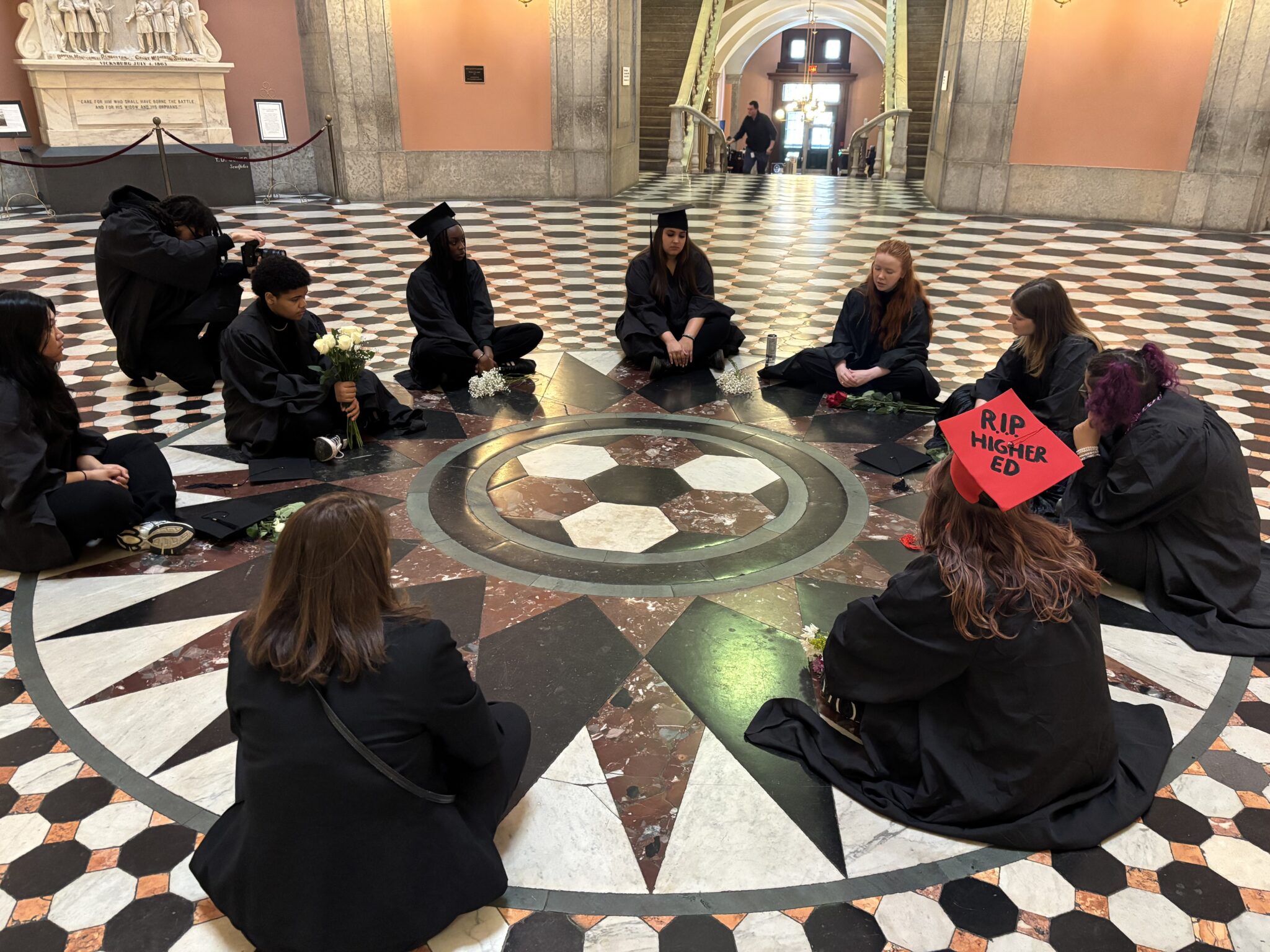
     Members of the Ohio Student Association held a mock funeral for the death of higher education on March 31

    Photo by Megan Henry, Ohio Capital Journal

    The Ohio Student Association organized the mock funeral, which took place Monday afternoon in the Ohio Statehouse Rotunda, days after DeWine signed Senate Bill

    By:  Ohio Capital Journal

    Students donning black graduation robes held a mock funeral for the death of higher education after Ohio Gov. Mike DeWine signed a bill into law that will overhaul the state’s public universities.

    The Ohio Student Association organized the event, which took place Monday afternoon in the Statehouse Rotunda, days after DeWine signed Ohio Senate Bill 1.

    S.B. 1 will ban diversity efforts, prohibit faculty strikes, regulate classroom discussion of “controversial” topics, create post-tenure reviews, put diversity scholarships at risk, create a retrenchment provision that block unions from negotiating on tenure, shorten university board of trustees terms from nine years down to six years, and require students take an American history course, among other things.

    GET THE MORNING HEADLINES.


    For classroom discussion, the bill will set rules around topics involving “controversial beliefs” such as climate policies, electoral politics, foreign policy, diversity and inclusion programs, immigration policy, marriage, or abortion. It prohibits professors from “indoctrination,” and while it doesn’t define that, it allows complaints to be filed against professors for review by the Chancellor of the Ohio Department of Higher Education. S.B. 1 will only affect Ohio’s public universities and community colleges.

    “It was really surprising, the quickness that it was signed,” said Ohio State University junior Brielle Shorter. “I think signing it at such a time was really interesting as well, but it was truly heartbreaking.”

    DeWine got the bill Wednesday — the same day the Ohio Senate concurred with changes to the bill made by the Ohio House — and he signed it Friday.

    “As a Black student on campus, our spaces have already been slowly getting demolished,” Shorter said. “I believe that with this bill there’s going to be more changes like that.”

    Ohio State recently closed its Office of Diversity and Inclusion and the Office of Student Life’s Center for Belonging and Social Change in response to the U.S. Department of Education’s Dear Colleague letter that threatened to rescind federal funds for schools that use race-conscious practices in admissions, programming, training, hiring, scholarships, and other aspects of student life.

    Shorter said she has seen Ohio high school students post on social media how they are no longer interested in attending Ohio universities and instead plan to go to school out of state.

    Scott DiMauro, president of the Ohio Education Association, said it is unfortunate DeWine signed S.B. 1 into law.

    “It’s disappointing to see that he did that, even though the overwhelming amount of opposition that was expressed on the bill from faculty and from students and from concerned citizens was strongly against it,” he said. “I think it’s unfortunate to see collective bargaining rights of people who work in higher education diminished.”

    Pranav Jani, president of Ohio State’s American Association of University Professors chapter, said they will fight the impact of the bill as it becomes law.

    “We know that we stand with thousands of educators, students, and parents, who are disgusted by this naked display of governmental repression of higher education,” he said in a statement.

    State Sen. Jerry Cirino, R-Kirtland, introduced S.B. 1, which took just over two months to pass both chambers and be signed into law.

    “I believe this is monumentally significant legislation that will allow Ohio’s public universities and community colleges to deal with looming enrollment challenges and usher in a renaissance of academic excellence,” Cirino said in a statement.

    Follow Capital Journal Reporter Megan Henry on Bluesky.


    Megan Henry
    Megan Henry

    Megan Henry is a reporter for the Ohio Capital Journal and has spent the past five years reporting in Ohio on various topics including education, healthcare, business and crime. She previously worked at The Columbus Dispatch, part of the USA Today Network.

    Ohio Capital Journal is part of States Newsroom, the nation’s largest state-focused nonprofit news organization.

    MORE FROM AUTHOR

  • Large crowd of Ohioans turn out at Columbus Tesla dealership to protest Elon Musk, Trump cuts

    Large crowd of Ohioans turn out at Columbus Tesla dealership to protest Elon Musk, Trump cuts

    More than 1,000 turned out to protest outside a Columbus Tesla dealership. They’re angered by the deep cuts Elon Musk and President Donald Trump are attempting to make. (Photo by Marty Schladen, Ohio Capital Journal.)

    By:  Ohio Capital Journal

    More than 1,000 from across Ohio turned out Saturday to protest outside a Columbus Tesla dealership. Among other objections, they were protesting the sweeping powers President Donald Trump has given the world’s richest man and the way that man is using them.

    A much smaller number — fewer than 50 — came out to show their support for Trump and Tesla founder Elon Musk, who holds an unofficial position in Trump’s administration.

    GET THE MORNING HEADLINES.


    There have been weekly protests outside the dealership in the Easton shopping development and in other cities since Trump took office in January. By Saturday, warm weather and rumors that the Proud Boys would come out in support of Trump and Musk swelled the ranks of those who wanted to protest the billionaires. Similar protests were held across the United States and around the world.

    Police separated demonstrators and counter-demonstrators. But both groups were peaceful, and in some instances talked seriously with each other.

     More than 1,000 turned out to protest outside a Columbus Tesla dealership. (Photo by Marty Schladen, Ohio Capital Journal.) 

    People protesting Trump and Musk lined both sides of the street and wound around the corner. They expressed anger over many of the actions of the new administration, including its heavy-handed treatment of immigrants, its decimation of antitrust and consumer-protection watchdogs, and its perceived abandonment of Ukraine.

    But the major target of the protests was Musk and the power Trump has given him.

    Musk wasn’t elected and he hasn’t been confirmed by the U.S. Senate. But as he runs the so-called “Department of Government Efficiency,” he’s tried to hack away at government programs, many of which benefit the poor and average Americans.

    For example, Musk is trying to fire 80,000 people from the Department of Veterans Affairs, he axed a program that pays farmers for produce for food pantries, and he’s trying to lay off tens of thousands at such agencies as the Food and Drug Administration, the Department of Health and Human Services and the Department of Education. As he has, Musk’s unofficial agency has committed a series of blunders that have left many to question his competence. Even so, Musk has become even richer under the new administration.

    Protesters held signs with a picture of Musk doing a now-infamous gesture mirroring a Nazi salute in January. Some noted that Musk’s own companies get millions a day in government subsidies as he targets what he sees as waste in other programs.

     Protesters outside a Columbus Tesla dealership. (Photo by Marty Schladen, Ohio Capital Journal.) 

    “We don’t want no swasticars,” went one chant that took jabs at Musk’s electric car and rocket companies. “Take a one-way trip to Mars.”

    Peggy Kissel of Westerville said she was protesting because she felt like she needed to do something.

    “I don’t feel like we have a say in what’s happening because Congress and the courts haven’t been able to stand up to the things that are happening,” she said as cars drove past, honking in support.

    A man who helped organize the counter-protest declined to identify himself except to call himself “Patriot Dad.” He said he came out to defend the Tesla dealership after acts of vandalism and the discovery of incendiary devices in other cities.

     A counter-protester outside of the Columbus Tesla dealership. (Photo by Marty Schladen, Ohio Capital Journal.) 

    “There actually are Americans who care about protecting an American company and American workers,” he said. “I thought maybe we should create a shield or create a wall around a building that is clearly a target for domestic terrorism right now.”

    Asked about the cuts Musk and Trump are making, the man said, “Most of us who voted for Donald Trump knew what Elon Musk was going to be doing when he got in there. Quite honestly Trump has all the authority he needs to go in and create efficiencies and that’s what Elon Musk is doing.”

    Many of those who were protesting the new administration were adamant that Trump is abusing his power.

    Miriam Scudder said she’s traveled to several foreign countries, including in Africa. She said she’s worried that Americans don’t appreciate the rights Trump and Musk are trying to erode.

    “We have a certain privilege here in the United States that I don’t see in other countries,” she said. “I don’t think we really appreciate how much we have here and I feel like we’re throwing it away. I feel like we’re the spoiled child throwing a temper tantrum because of something we can’t agree on. No. 1 is immigration because hate and fear are powerful things.”

    YOU MAKE OUR WORK POSSIBLE.

    ______________
    Marty Schladen
    Marty Schladen

    Marty Schladen has been a reporter for decades, working in Indiana, Texas and other places before returning to his native Ohio to work at The Columbus Dispatch in 2017. He’s won state and national journalism awards for investigations into utility regulation, public corruption, the environment, prescription drug spending and other matters.

    Ohio Capital Journal is part of States Newsroom, the nation’s largest state-focused nonprofit news organization.

    MORE FROM AUTHOR