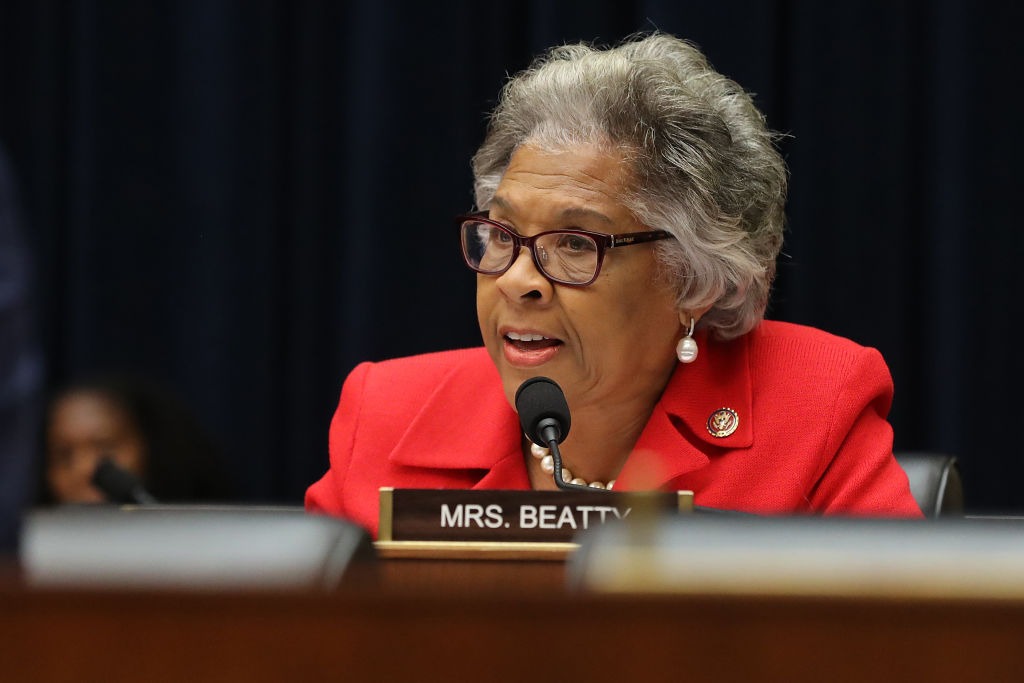
Tuesday night went about as well as Ohio’s Republican U.S. Senate nominee Bernie Moreno could’ve dreamed. Despite a three-person race, Moreno was able to secure a majority of GOP voters and won in all 88 of Ohio’s counties. And it’s a victory that cements former President’s Donald Trump’s influence in the state. In two elections in a row, Trump’s favored candidates have been able to fend off challengers from the party’s establishment conservative wings.
Turnout
But the primary also offered an interesting test: with Trump’s own nomination in the bag, would his backing still drive MAGA voters to the polls?
The answer was a qualified yes. Tuesday’s primary election brought out 22% of registered voters. That’s far lower than 2016’s still-hotly contested presidential primary in Ohio, but it falls right between the two most recent primaries in 2020 and 2022. When it comes the raw figures, GOP voters cast a nearly identical number of ballots as they did in 2022 and about 200,000 more than they did in 2020.
“I think most experts were expecting a drop off,” University of Akron political scientist David Cohen said. “I think the (Matt) Dolan and (Frank) LaRose campaigns were hoping for a drop off, but obviously that didn’t happen.”
“The numbers for Moreno are really kind of surprising,” he added, calling it “a clean sweep.”
“Most people including myself were expecting a Moreno win, but I wasn’t expecting (a margin of) almost 18% — that’s crazy. A three-person race where he wins a majority of the Republican vote? That is really unexpected,” Cohen said.
Meanwhile, political scientist David Niven from the University of Cincinnati turned the question of turnout back on the Democrats.
“The lowest turnout in the state was Hamilton County. The second lowest turnout in the state was Franklin County,” Niven said. “Democrats obviously didn’t have a competitive Senate race, but oh my — I mean, the 87 and 88th counties for turnout were two of the absolute lynchpins of any kind of Democratic path to success.”
Niven downplayed the overall turnout figures, though, as reflecting “an overall dearth of energy.” Even if it didn’t crater, he said, matching an off-cycle primary and a by-then uncontested presidential primary, during a pandemic no less, isn’t that high a bar.
Still, Niven said, “It is really notable that more than twice as many Republicans showed up as Democrats. Even with a competitive Senate primary, that is a major red flag for Democrats.”
Trump effect
Former president Donald Trump cast a long shadow over Ohio’s GOP Senate primary. While Moreno and Ohio Secretary of State Frank LaRose jockeyed for his endorsement, state Sen. Matt Dolan, R-Chagrin Falls, argued his legislative record best mirrored Trump’s platform. All three built their pitch to voters around issues like immigration and border enforcement that Trump has made the centerpiece of his campaign.
“It sure looks like Donald Trump was really able to motivate his base to vote yesterday,” Cohen said.
“I just think that the results yesterday show that the Ohio Republican Party is now Trump’s party,” Cohen continued, “the Republican base in Ohio is Trump’s base, and there doesn’t really seem to be any going back.”
He argued that’s not necessarily a recipe for long-term success but it’s still pretty hard to ignore.
As Election Day drew nearer, polls had indicated the race was close and Dolan might even have an advantage. More establishment-leaning GOP figures like Gov. Mike DeWine former U.S. Sen. Rob Portman, broke for Dolan before Trump announced his visit.
“I don’t think it would be a shock to anybody to realize that the country club, polite-mannered (Republican) party in Ohio is no more,” Niven said. “I do think it’s notable that Portman and DeWine thought they could ride in and save Dolan. I do think that’s the very last gasp of that sort of thing in Ohio politics —their day has passed.”
Niven as well pointed to the rally as an important factor in Moreno’s success. It created a “saturation point,” he said, reminding Ohioans who’d begun tuning out election ads that Moreno is Trump’s pick.
“If every Republican in Ohio knows who the endorsed candidate is,” he explained, “Bernie Moreno wins the primary, and the rally went a long way toward that.”
One mission
In the final weeks of the primary campaign the attacks grew personal and bitter. It was clear during his victory speech that Moreno was still smarting, but he brushed off the campaign season hostility.
“One of the things that we do as Republicans is we have spirited debates,” Moreno said, “Now maybe it’s like a little too spirited, could’ve been a little less spirited, right? But we have spirited debates and that’s okay.”
“What we have to do now is, as a fully united party, understand we have one mission which is to get rid of Sherrod Brown,” Moreno said.
In a social media post conceding the race, LaRose struck a similar note, saying, “The family disagreements that define partisan primaries are behind us.”
Moreno could get a boost from having Donald Trump at the top of the ticket. The former president has twice won Ohio by eight points. But that track record could cut the other way, too. A cash-strapped Trump campaign may focus its efforts on states that are in play rather than a state it’s likely to win.
Despite recent polling that shows Trump with an even bigger advantage, Cohen predicted the race will tighten before November. Given an improving economy and Republicans taking the losing side on a 2023 reproductive rights ballot measure, he doubts Trump will be able to match his previous showings in the state. Cohen also pointed to former South Carolina Gov. Nikki Haley collecting 14% of Ohio’s Republican presidential votes despite exiting the race about two weeks before the election.
Ohio’s recent history of split-ticket could also present an opening for Brown even if Trump carries the state. Brown benefitted from voters backing candidates from both parties in 2018, but Niven noted the state has shifted to the right in the past six years.
“The bottom line here is if Sherrod Brown’s campaign can make this a choice between two people, he can still win this thing,” Niven said. “If this campaign boils down to a choice between two parties, he cannot win this thing, the gulf is too large.”
“So, if it’s a question of people, I think the Brown campaign looks at this as an ideal outcome,” he added. “If it’s a question of party, he’s swimming against a tide that’s just getting bigger and stronger.”
Nick Evans has spent the past seven years reporting for NPR member stations in Florida and Ohio. He got his start in Tallahassee, covering issues like redistricting, same sex marriage and medical marijuana. Since arriving in Columbus in 2018, he has covered everything from city council to football. His work on Ohio politics and local policing have been featured numerous times on NPR.
Ohio Capital Journal is part of States Newsroom, the nation’s largest state-focused nonprofit news organization.
Christina Collins’ journey to become an educator started when she helped her grandfather read his mail.
He had dropped out in middle school, and had trouble with reading and understanding words, even ones specifically written for him.
Collins’ dad and brother both struggled in school as well, and it was through their struggles that she saw “how hard it was for some people to be successful.”
“So, those moments all kind of led to, for me, believing that literacy is a key civil rights issue,” Collins told the Capital Journal. “I mean, the ability to participate in the world around you is to be a literate human being.”
The Gahanna native became a high school English teacher, and cherished the interactions she’d have with students, the kids who seemed to be doing fine and the kids who struggled or made trouble.
“I was always very driven about recognizing every student, and getting other people to recognize every student to help support every student,” Collins said.
To this day, she gets messages from students who have moved on to become educators themselves.
That new generation of teachers is facing a whole host of new challenges, from culture war battles to ever-changing education standards, and Collins sees the developments in education statewide and nationally as a departure from the true aims of the field.
“Our pendulum has swung way too far over to seeing kids as test scores,” she said. “We should be finding every kid’s talents and getting them going in the right direction.”
Joining the board
While Collins was an educator, she taught her classes, kept up with the curriculum and all the other everyday roles of a high school teacher.
But she realized that, for other teachers, those roles didn’t include staying up all night reading legislation.
“I thought that was just a thing all teachers did,” she said. “I thought ‘well this is part of education, everybody’s reading legislation.’”
When her colleagues dispelled that belief, she realized perhaps her next move might be toward honing the policy that came from the statehouse into local school districts.
She became an administrator with the purpose of “being a filter for the noise” coming out of Columbus via policy mandates and standard changes, from Race to the Top and performance evaluations to the third-grade reading guarantee.
“There was a time when I was in a district as curriculum director where in five years there were four different sets of graduation requirements,” Collins said.
Feeling the impact of constant and rapid changes coming from legislative bodies who included many non-educators compelled Collins to run for a spot on the Ohio State Board of Education. She took her spot on the board right as one of the biggest level-sets ever to happen to Ohio education unfolded: the COVID-19 pandemic.
The pandemic brought school closures, virtual learning, a scramble to decide whether testing made sense among uncertain learning environments, and a reckoning when it came to what kids really needed from their educational facilities.
Amid the stress of teachers learning new roles, and parents learning what it takes to be a teacher, Collins saw the era as a point of hope, as a needed reflection period for policymakers and districts alike.
“I saw it as a key moment where we could just blank-slate reset and think differently about our education system,” she said.
Surely, she thought, the adaptation that students had gone through in their methods of socialization and learning will lead to changes in the way education is conducted. Surely things like student hunger and poverty that were so starkly spotlighted amid a global pandemic would stay at the forefront of the minds of leadership as they move forward.
“My experience on the board, especially that first year, I was like ‘can we think differently, can we think about competency-based learning models, how can we meet their needs?’”
As a member of the board, she was part of many discussions when it came to coming out of the pandemic and the needs of the education system. But those discussions didn’t go the way she’d hoped.
“It was like the rush to return to normal was the sole focus, and that was coming straight from the statehouse,” she said.
She wasn’t naive to the fact that the state Board of Education, whose candidates appear on nonpartisan ballots, had its conservative and liberal members. But discussions during the pandemic were markedly bipartisan, with some “more known conservative members” hearing the ideas of education reform related to pandemic-era impacts and thinking “maybe we should think differently,” according to Collins.
“Coming out of the pandemic, this culture of kids has changed, and I don’t think that we’re focused on the right things to meet their needs,” she said.
The tune coming to Collins and the rest of the board was the return of state testing and the return of “normal” in-person instruction, despite a years-long pivot to learning alternatives.
“At no point did (the state) slow down and address how we’re throwing (the students) all back together,” Collins said.
The legislature paused testing amid the pandemic, and policymakers sought to allow schools to move forward without reflection on the tests that were conducted, some through federal mandate, at least for a while. But as 2022 rolled around, the restart of testing became a discussion at the legislative level again, a decision Collins thinks should have been put on the back-burner a little longer.
“That was a moment where we should have delayed, there should have been a bit longer before that happened again,” she said.
Culture wars over change
When the pandemic seemed to be in the rearview mirror, the board’s work didn’t slow down, instead shifting to an area Collins wasn’t quite expecting: culture wars.
She hadn’t been fully caught off-guard when anti-racism resolutions brought white-hot debate to the board’s door, or when proposed Title IX language changes brought along talk of transgender rights in schools. Her seat on the board was barely warm when she started receiving emails accusing her of being anti-American and even socialist, all based purely on the fact that she was an educator, she said.
“I think I’m still a little shocked that in Ohio we’re at a point where we’ve had those kinds of culture war issues,” Collins said. “I don’t believe the majority of Ohioans want those issues to be at the forefront.”
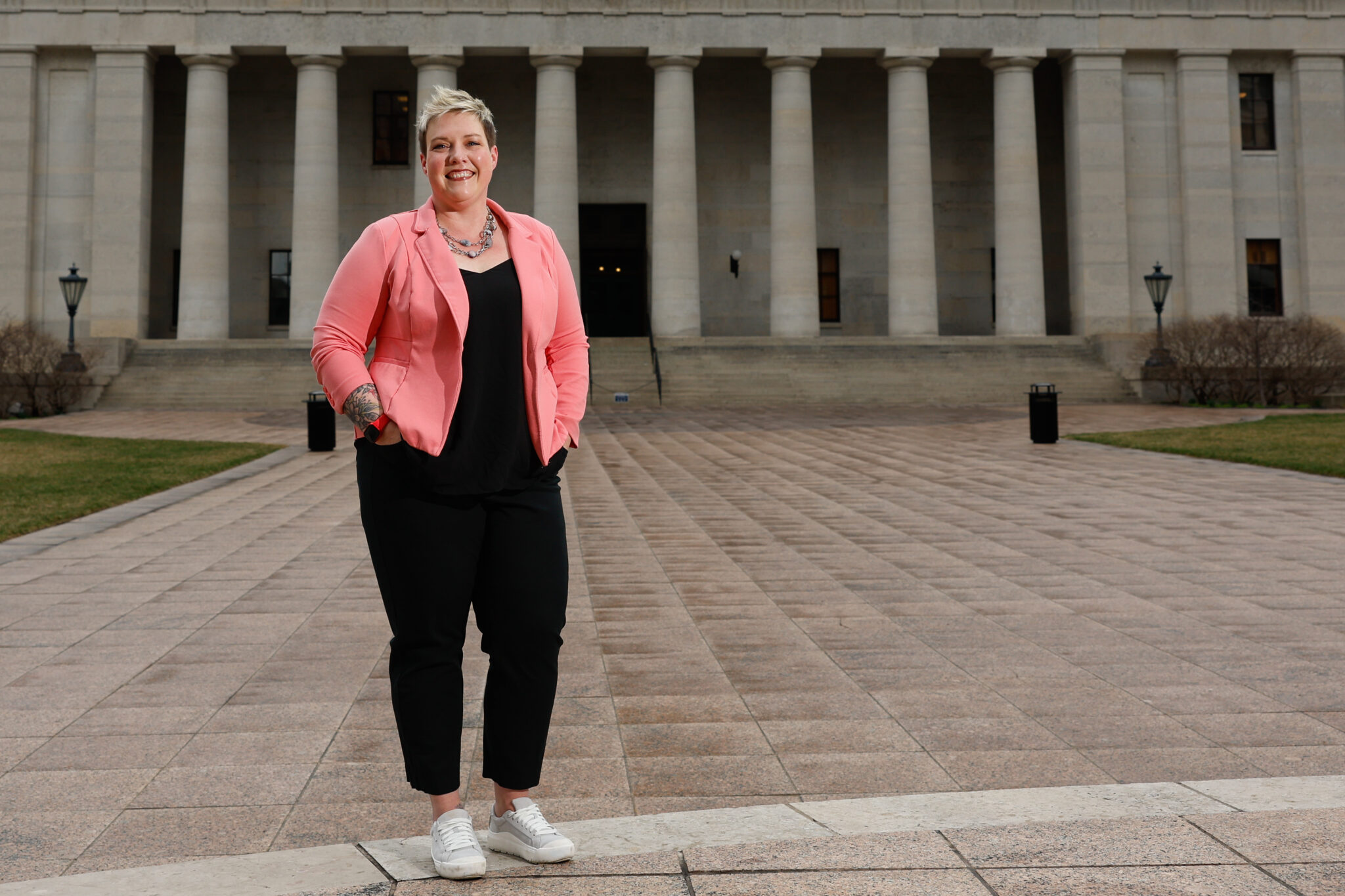
COLUMBUS, OH — MARCH 05: Christina Collins, former State Board of Education member and currently the head of Honesty for Ohio Education a pro-public schools organization that testifies in favor of fair school funding, March 5, 2024, outside the Statehouse in Columbus, Ohio. (Photo by Graham Stokes for Ohio Capital Journal. Republish photo only with original article.)
Having those issues, which Collins acknowledged weren’t necessarily within the board’s purview, become months-long debates with resolution approval, then reversal, meant other things that the board could have been doing within the education space weren’t seeing the light of day.
“All of that was happening at the same time, which I think is how we lost that potential for change,” she said.
A bigger change was headed for the board, that would remove many of its responsibilities, and cause a shift that would eventually convince Collins to move on.
A bill had been floating in the Ohio legislature for more than a year. The more than 2,000-page policy would not only change the name of the Ohio Department of Education to the Ohio Department of Education and Workforce, but it would restructure the department to have two leaders under the umbrella of the governor’s cabinet, one for education and another for workforce.
The ODEW would still include the State Board of Education, but board members would be mainly focused on teacher licensure, educator disciplinary actions and district territory disputes.
State Sen. Andrew Brenner, R-Delaware, an ex-officio member of the board of education, was not the main sponsor of the bill, but pushed hard for it as chairman of the Ohio Senate Education Committee.
Arguments were made that the board was ineffectual and inefficient. Collins sees no reason to place blame for the way the board has worked, but from her perspective, the board filters legislative measures to the local districts as another cog in a wheel that needs improvement.
“The board’s seeming inability to get things done – which I don’t believe, but the rhetoric around it – I think that’s a reflection of what our local districts are dealing with because they are struggling to implement all of the things,” Collins said.
During committee hearings on the bill, members of the state board, including Collins, submitted testimony against the changes, saying putting the leaders under the governor’s cabinet would decrease the level of accountability they could have to districts and voters.
Collins brought up the many mandates under which the board had guided local districts, and the source of any and all of those mandates.
“These were all legislated efforts, but you’re still saying our schools are failing,” she wrote in her testimony. “I ask, who holds this (General) Assembly accountable when the unending educational initiatives it doles out do not work?”
The overhaul of the ODE did not play out in the first General Assembly in which it was introduced, but shortly after a new General Assembly came to work, the push for Senate Bill 1 and the changes to the department were introduced again.
Teachers unions, board of education members and advocacy groups alike all came out in opposition to the bill, representing hours of testimony in committee. Supporters of the bill included the Ohio Chamber of Commerce.
The bill passed the Senate last March, but it wasn’t until it was inserted into the state budget in the summer of 2023 that it saw full passage.
Collins was one of a number of board members who signed a letter asking Gov. Mike DeWine to line-item veto the changes to the state board’s roles in the budget document.
“From my experience being on the board, I think the way that (SB 1) was shoved through and how it was shoved through and when it was shoved through was a little bit unbelievable,” Collins told the Capital Journal. “Something that had essentially stalled in process was added (to the budget) and pushed through the way it was, and then that quickly it was (passed).”
Honesty for Ohio Education
As the board faced drastic legislative changes and a significant reduction in the authority it held, Collins started to wonder if being a member would help her make the most change, something she says she looks for in any career move she makes.
Armed with a superintendent’s license, she debated going back into schools. Ultimately, the departure of Honesty for Ohio Education’s executive director at the end of 2023, and the fact that she’d just had a baby that November made Collins reflect on all the aspects of education and the changes needed.
“It’s a scary time as a parent, it’s a scary time for education,” she said. “I’m worried about my own kids, I’m worried about everyone else’s kids.”
As a staunch supporter of public education, the changes being made on a state level with the transformation of the ODEW and the implementation of near-universal private school vouchers made her nervous about the future of her chosen field.
But like the times with her grandfather years ago, the connection between education and civic duty floated to the top of her mind.
“On a grander scale, I’m really, really, really worried that we’re losing our democracy, and for me education and democracy are in this reciprocal relationship,” Collins said.
Honesty for Ohio Education started in 2021 as a reaction to “critical race theory” bills that sought to keep children from learning the connection between race and American history, with claims that the bills would protect children from feeling guilt for history.
The group started small, but as they began testifying against CRT bills, among others, the group’s numbers grew, and now the coalition “has outgrown itself” from its nascent days, according to Collins.
“That’s a response to the attacks on education, it’s the attacks on LGBTQ+ kids, it’s the attacks on multi-racial education, it’s the attacks on honest history,” she said. “All of that … has created this avalanche with Honesty where we’re at this influx, where we have to decide how we step into adulthood, essentially.”
But as the coalition makes its next moves, Collins said it plans to stay focused on things like state curriculum, fights against book bans and how schools can work better, even for the 10% of students outside of the public school system.
“It’s not just public education … it’s about the kids everywhere in any educational environment who deserve to be safe and have honest and diverse, inclusive education,” Collins told the Capital Journal.
The coalition focuses on content in schools, but Collins said the ability for school districts to succeed certainly comes down to how well they’re funded and supported by state and local sources.
Public education is a “common good” for Collins, and that means the 90% of Ohio children in public education should be taken care of in the way the Ohio Constitution dictates. For public education unions, advocacy groups and for Collins, that includes full implementation of the Fair School Funding Plan.
That reform of the state’s public school funding model emphasizes a formula based around the needs of individual school districts, to allow schools who have more need than others to build up their performance.
The plan as it is now began it’s push through the legislature in August 2020 but negotiations and the hesitance of legislative leaders like Senate President Matt Huffman to push out the entire $10 billion per year plan in one shot led to a six-year phase-in. The plan is currently up to about 66% implementation.
Meanwhile, however, the General Assembly fully funded what amounts to a near-universal private school voucher program in the last budget cycle, allowing students in what are considered under-performing public school districts to leave and take state-funded scholarships with them to nearby private schools if their household income is up to 450% of the federal poverty level, or $135,000 for a family of four.
“When we pass universal voucher bills that give more money to students when they leave the school than a lot of the schools receive for that student, that’s a sign of the value that at least our legislature places on public education kids,” Collins said.
SUSAN TEBBEN
Susan Tebben is an award-winning journalist with a decade of experience covering Ohio news, including courts and crime, Appalachian social issues, government, education, diversity and culture. She has worked for The Newark Advocate, The Glasgow (KY) Daily Times, The Athens Messenger, and WOUB Public Media. She has also had work featured on National Public Radio.
Ostroh, Ukraine mayor Yurii Yahodka, left, and Athens Mayor Steve Patterson, right. Patterson is pointing in the direction of his city as displayed on a sign placed in Ostroh. Patterson traveled there as part of a program to help cities grow in governance. (Photo courtesy of Steve Patterson.)
There’s a good chance Southeast Ohio pawpaws are now growing in a small garden in Ukraine.
That’s thanks to Athens mayor Steve Patterson, who brought some of PawPaw Festival founder Chris Chmiel’s stash on a trip to get to know the city of Ostroh, a city similar in many ways to Athens with its small-town charm and educational institutions that are almost as old as the city itself.
Patterson made the trip in February – specifically choosing that time period to mark the second anniversary of Russia’s military invasion – to learn more about the city and establish the two far-away towns as sister cities.
“To see the resolve and the patriotism coming from the cities that I got to see, they’re all in,” Patterson said. “Everybody’s doing everything they possible can.”
Athens Mayor Steve Patterson (center) speaks as part of a panel of representatives from the United States Agency for International Development’s Ukraine Governance and Local Accountability program. (Photo courtesy of Steve Patterson.)
The trip was made possible after Patterson attended a National League of Cities conference in 2022, where he met with the United States Agency for International Development representatives at a reception. USAID has a specific program called the Ukraine Governance and Local Accountability program that “helps create and strengthen local governance systems, processes, and institutions so they are more self-reliant, inclusive, effective, and accountable to citizens,” according to a USAID fact sheet on the program.
“We’re making ties between different sectors of commerce, we establish relationships with K-12 schools in both areas, and we’re looking at how to engage our institutions of higher ed,” Patterson said.
When the Athens mayor was setting up the trip, he asked organizers to connect him with a city that was similar geographically to Athens, and which had a lot of the same facilities and functions. That’s where Ostroh comes in, located in the oblast (a term for the regions of Ukraine) of Rivne.
“Geographically, (Ostroh) is in the southeast corner of the Rivne oblast, it has two rivers that run through it, it has rolling hills, and it’s got the Ostroh Academy,” Patterson said.
When the opportunity to become a sister city with Ostroh came up, the Athens mayor said he never planned to make it just an on-paper association.
“It wasn’t like just checking a box; I had to go over,” he said.
Armed with local goods such as Passion Works flowers painted in Ukraine yellow and blue, and pawpaw seeds and homemade jam, he made the trek, flying from Ohio to Krakow, Poland. A security detail then took him and a group of translators and organizers across the border to Ukraine.
From there, Patterson’s trip was marked by emotions more than landmarks. He started his trip in Lviv, a “cosmopolitan” city that also houses a hospital Patterson called “the epicenter in the whole nation for trauma, amputations, surgeries and prosthetics.”
The city has been the subject of Russian air attacks during the course of the war, and throughout his trip through Ukraine, Patterson was a part of multiple air raid alerts.
In one case, he talked to a class from the Ostroh Academy in an old crypt, because that was the closest air raid shelter to the classroom they were preparing to enter.
“They’re so used to this that they had seats already in there,” Patterson said. “Because this is their life at this point.”
Athens Mayor Steve Patterson talks to a class at the Ukrainian Ostroh Academy as they take shelter during an air raid alert. (Photo courtesy of Steve Patterson.)
Touring an elementary school in Ostroh, the Athens mayor walked through several “themed” rooms. One displayed the history and culture of Ostroh. Another was meant to teach kids how to react to an air raid siren, and the correct way to put on a gas mask.
School administrators opened a book case with stuffed animals, chocolate boxes, and purses, then showed Patterson the deactivated explosives the items hid. He was told Russian soldiers gave the toys to kids in Ukrainian neighborhoods.
One student showed Patterson traditional embroidered shirts and tablecloths from the region, and afterward, a teacher said his father had died less than a week ago on the front lines of the war.
“It was crushing for me,” Patterson said. “I was sitting there having to manage that and stay engaged while they were showing me things.”
In a volunteer center — one of many opened up after February 2022 across the country — he helped make candles to be used by soldiers (called “defenders”) in the trenches, and watched a group of predominantly women weave camouflage netting.
“Most of them are there because their spouse is on the front line, or they’ve lost their husband (in the war),” Patterson was told.
Every morning at 9 a.m., cities amplify a message through their town-squares PA systems, recognizing soldiers fighting and leading a moment of silence for those that have been lost. The cities come to a halt, with pedestrians pausing their days and drivers standing on the side of roads, according to Patterson.
“It moved me so much that for the next two days, whatever we were doing, even if we were inside, I would go outside just to experience it again,” he said.
Now that he’s back home, Patterson plans to continue the work he started with the trip. After talking to government leaders in Ostroh about Ohio’s Home Rule designation, and August and November’s ballot initiatives for constitutional amendments, and even Athens’ plastic bag ordinance, he also bragged about Ohio University’s Heritage College of Medicine and the training programs at the Athens Fire Department.
Patterson said he’s since met with leaders from OUHCOM and Athens Fire Chief Robert Rymer about connecting with related officials in Ostroh for help with projects like a clinic to study psychology, and technical fire skills training.
“There’s a lot of enthusiasm and hope within the areas that I engaged in,” Patterson said.
He also said he plans to take the experiences he had in Ukraine to the National League of Cities Conference this year in DC, meeting with representatives on Capitol Hill and Ohio’s U.S. Congress members like U.S. Rep. Troy Balderson and U.S. Sen. J.D. Vance, who has been an outspoken critic of the U.S. offering assistance to Ukraine.
“I want to tell the story of having been eyes and ears on the ground in a war-torn nation, in a conflict zone, and having to truly endure what they endure every day,” Patterson said. “It’s heavy, but this is real, and this is what they’re going through to become a whole country again.”
SUSAN TEBBEN
Susan Tebben is an award-winning journalist with a decade of experience covering Ohio news, including courts and crime, Appalachian social issues, government, education, diversity and culture. She has worked for The Newark Advocate, The Glasgow (KY) Daily Times, The Athens Messenger, and WOUB Public Media. She has also had work featured on National Public Radio.
Two weeks ago early voting began in Ohio’s primary election. In two weeks more, the election will be decided. So far, county officials report turnout has been steady, but the figures have been far from overwhelming. By the end of last week, just shy of 60,000 voters had cast a ballot in-person and another 37,000 returned absentee ballots by mail or at their county board.
Compared to the 2022 primary, early in-person voting is on track to finish slightly higher while mail-in votes are lagging. The thing is, 2022 didn’t have a presidential race at the top of the ticket.
The presidential contest has yet to make a serious impression in Ohio. Without a serious rival to the Democratic incumbent, and a challenger well on his way to clinching the Republican nomination, it’s as if they’re skipping over the primary to focus on an increasingly likely rematch of the 2020 general election.
That leaves the Ohio’s U.S. Senate race as the biggest game in town. But again, the Democratic incumbent isn’t facing a challenge, and for all the sharp elbows on the Republican side of the race, many voters remain undecided.
This week, early voting runs 8:00 am-5:00 pm through Friday, and 8:00 am-4:00 pm Saturday. Next week, county boards will offer extended hours running from 7:30 am-7:30 pm, and they’ll offer limited hours on that Saturday and Sunday. The Secretary of State’s office has the full voting schedule posted on its website.
The view from county boards
Aaron Ockerman, who heads up the Ohio Association of Election officials, said so far the primary isn’t far off from expectations. “It’s not super crazy like it will be in November,” he said, noting he hasn’t heard stories about long lines, “but it’s not as slow as a typical primary.”
In Franklin County, board of elections spokesman Aaron Sellers described early vote traffic as steady, “but it’s certainly on the lower end of turnout models.” He chalked up the sluggish turnout to a less than competitive presidential race.
“People have an understanding of who is going to be running in November, so it feels like there’s not much for them to vote on,” he suggested.
Sellers added it feels like a lull after enormous turnout in 2023. Those elections, led by high profile ballot measures, drove enormous early voting turnout around the state. In August, almost half a million Ohioans voted early in person. In November, they cleared that mark, finishing at more than 570,000 ballots cast.
For comparison, on an average day about 7,400 Ohioans are voting early in-person in the current election. Last August, an average day saw more than three times that many voters.
Licking County Board of Elections director Brian Mead described current turnout as “lower than what I expected.” He said early in-person voting will likely pick up, but he doubts mail-in ballots will match his expectations. Like Seller’s he pointed to a presidential race that seems all but decided.
“The Senate (race) is going to push some,” he said, “but it’s a heavy lift.”
In Hamilton County, board director Sherry Poland said, “primaries are hard to gauge.”
She described her current turnout as roughly on par with the 2016 presidential primary and said part of the explanation is the lack of a county wide issue on the ballot. So far, Poland said, Hamilton County’s early in-person voting traffic has been no lines, walk in-walk out.
Tonya Wichman, who heads up the Defiance County board, said they’ve had a “steady flow” of voters but acknowledged it’s “not the normal turnout we’d have in a presidential year at this point.”
Like Poland she pointed to the lack of local ballot issues.
Nick Evans has spent the past seven years reporting for NPR member stations in Florida and Ohio. He got his start in Tallahassee, covering issues like redistricting, same sex marriage and medical marijuana. Since arriving in Columbus in 2018, he has covered everything from city council to football. His work on Ohio politics and local policing have been featured numerous times on NPR.
After an Alabama Supreme Court decision that ruled frozen embryos housed outside of a human body were still considered children, states across the country are debating the implications of such a decision.
Ohio legislative leaders are saying bills that would ban IVF are not being considered, but one lawmaker who has introduced a “personhood” bill in the past says it’s still “great policy” that’s being blocked by politics.
National groups have said the Alabama decision will have impacts on the work that embryologists do, with the Society of Reproductive Biologists and Technologists saying the state’s supreme court ruling “stands in stark contrast to scientific understanding and the experiences of individuals navigating fertility treatments.”
The concept of “fetal personhood” is not a new one for Ohio. Long before the Alabama decision threw into question the concept of in-vitro fertilization treatments in that state, legislators in the Buckeye state were considering a bill that would consider life’s beginning at conception, a theory conservatives and pro-life politicians have long pushed.
Ohio House Bill 704 was introduced in 2022 by state Rep. Gary Click, R-Vickery, who claimed “one class of people has erroneously been denied their constitutional rights: the unborn.”
“From the moment of fertilization, that zygote, embryo or whichever depersonalizing term you choose to use is not merely a potential human but rather (a) human with potential,” Click said in a statement announcing the legislation.
The bill died as the General Assembly’s two-year session ended, but the fact that the idea was broached is still being brought up by Democrats and pro-choice groups around the state.
Click himself didn’t rule out the idea of reintroducing his personhood legislation, saying in a Feb. 23 tweet that reintroducing it has “not been my plan at the moment.”
“But plans do change,” the tweet went on.
The legislator — who was also the creator of a successful bill that bans gender-affirming care for transgender minors, a controversial bill that succeeded with a veto-override in January — also told the Statehouse News Bureau in February that while he supported IVF if all embryos are used, he considered his personhood bill “great policy” blocked by politics.
Since Click’s bill was introduced (and subsequently foiled by time limits), however, 57% of Ohio voters passed November’s Issue 1, which not only enshrined abortion rights into the Ohio Constitution, but also listed “fertility treatment” as one of the rights Ohio individuals have to “make and carry out one’s own reproductive decisions,” according to the amendment.
But Republican legislators in particular have not seen this development as the roadblock to reproductive rights legislation one might expect, as policymakers at the Statehouse have continued to push anti-abortion legislation and bills that target the rights now protected under the state constitution.
The state’s legal representatives are also still pushing against a lawsuit that seeks to eliminate a six-week abortion ban that became law in 2019 (and has been tied up in court ever since).
Still, Ohio’s legislative leaders have said the Alabama decision has yet to spur any policy in the state at this point.
Left, Ohio House Speaker Jason Stephens. Right, Ohio Senate President Matt Huffman. (Photos by Graham Stokes for the Ohio Capital Journal. Republish only with original article.)
House Speaker Jason Stephens, R-Kitts Hill, said the chamber is “monitoring any potential ramifications the Alabama decision may have in Ohio,” but also said, from his perspective, “IVF provides hope and is 100% pro-family.”
“We look forward to advancing our values and continuing our pro-life legislative agenda,” Stephens told the OCJ in a statement.
Senate President Matt Huffman said he has not heard of any legislation and there hasn’t been “any discussion by any member of my caucus or anybody else as far as in the state of Ohio as far as I know.”
“We seem to be in this national culture that if some court in Alabama or some other state says something that we all should be reacting to it,” Huffman said.
The senate leader acknowledged that “we have a constitutional amendment that affects some of this.”
“But you know, with other things going on right now, it’s just not a discussion that’s taking place,” he said.
A spokesperson for Gov. Mike DeWine said his office would “continue to monitor any bills in this policy area,” but they were not aware of any at the moment.
DeWine’s office did not respond to questions as to whether or not the governor supported the consideration of frozen embryos as children.
Megan Henry contributed to this story.
_____________
SUSAN TEBBEN
Susan Tebben is an award-winning journalist with a decade of experience covering Ohio news, including courts and crime, Appalachian social issues, government, education, diversity and culture. She has worked for The Newark Advocate, The Glasgow (KY) Daily Times, The Athens Messenger, and WOUB Public Media. She has also had work featured on National Public Radio.
College students walk on campus. (Klaus Vedfelt/Getty Images)
The University of Akron, the University of Toledo, Cleveland State University, Kent State University, Ohio University, Ohio State University and Youngstown State University all said they are in the process of reviewing their scholarships.
At least seven Ohio public universities are reviewing scholarships in the wake of comments Ohio Attorney General Dave Yost made about race-based scholarships after the U.S. Supreme Court ruled against race-conscious admissions.
Cleveland State University, Kent State University, the University of Akron, the University of Toledo and Youngstown State University all said they are in the process of reviewing their scholarships. This is in addition to Ohio University and Ohio State University, as previously reported by the Capital Journal.
“The University of Toledo has paused the distribution of scholarships that consider race as a part of their award criteria following the U.S. Supreme Court ruling on the use of affirmative action in higher education admissions,” university spokesperson Tyrel Linkhorn said in email.
This affects 6% of Toledo’s nearly 1,200 donor-supported scholarships, which is worth $500,000, he said in an email.
“The University and The University of Toledo Foundation are actively working with donors to explore potential revisions to scholarship agreements so we can continue to support our donors’ goals in a way that fully complies with the Supreme Court decision,” Linkhorn said in an email.
Kent State and Youngstown State mentioned the Supreme Court case and “guidance from the state of Ohio” as reasons for their review. Cleveland State just mentioned the Supreme Court case and Akron didn’t give a specific reason.
The Capital Journal previously reported that Ohio University is “temporarily pausing” awarding race-based diversity scholarships and that Ohio State University is in the “process of updating scholarship criteria to ensure compliance with the law,” according to the university’s website.
Ohio University has 130 gift agreements that are currently under review that represent $450,000 in potential scholarship awards, university spokesperson Dan Pittman said in an email.
“The review is to ensure language in the gift agreements remains lawful,” Pittman said. “If deemed necessary, the University will work with donors to make revisions to language in the agreements.”
Ohio State University expects to give away approximately $448 million dollars in financial aid this fiscal year, university spokesperson Ben Johnson said in an email.
Bowling Green State University, Miami University, Northeast Ohio Medical Center, Shawnee State University, the University of Cincinnati and Wright State University did not answer questions about the status of their race-based scholarships.
A university spokesperson for Central State University, Ohio’s only public historically Black university, said in email they don’t have race based scholarships.
Supreme Court decision
The U.S. Supreme Court. (Al Drago/Getty Images)
Last summer, the U.S. Supreme Court ruled Harvard and the University of North Carolina violated the equal protections clause of the 14th Amendment by using race as a factor in applications.
The next day, Yost sent a letter to Ohio colleges and universities saying “employees must immediately cease considering race when making admissions decisions,” according to the letter. It also said his office won’t legally protect someone at a college or university who uses race as a factor.
The topic of race-based scholarships came up on a Jan. 26 call with universities, said Yost’s spokesperson Bethany McCorkle.
“What was said in response to a question was after the recent Supreme Court decision, scholarships will need to be looked at to ensure compliance with the law,” McCorkle said in an email. “Although the Court did not expressly prohibit race-based scholarships, it indicated that ‘eliminating racial discrimination means eliminating all of it.’ Race-based scholarships discriminate on the basis of race in awarding benefits. Therefore, it would follow that such programs are unconstitutional.”
The Harvard Supreme Court decision is being “weaponized to intimidate and create fear,” said Sara Kilpatrick, executive director of the Ohio Conference of the American Association of University Professors.
“We obviously disagree with the Harvard decision, and we also disagree with how the Attorney General is trying to extrapolate it to apply to virtually anything that touches race,” she said. “We hope that institutions are not being pushed into a direction that ultimately will harm students.”
If race-based scholarships are removed from universities, Kilpatrick said it could prevent Ohio students from earning degrees.
“This is a dangerous slippery slope, and they should be cautious about how far they’re trying to push this,” she said. “This will undoubtedly dry up desperately needed revenue streams for institutions.”
Megan Henry is a reporter for the Ohio Capital Journal and has spent the past five years reporting in Ohio on various topics including education, healthcare, business and crime. She previously worked at The Columbus Dispatch, part of the USA Today Network.
Meaghan Robbins doesn’t like when her husband, a member of the Army National Guard, is deployed for long stints. But with a toddler in need of child care, she can’t argue with the extra money.
“When he comes home and goes back to being a first responder, that changes,” the Marysville resident said.
Robbins doesn’t want to saddle her police officer husband with the overtime that would be necessary to keep her from working while also affording child care.
The cost of child care for the family, set to go up to $350 a month from the current $300 monthly, means two incomes are a must. But so, too, is the care and education their daughter receives.
“The things that she has been able to do or express because of lessons learned (at the daycare), I can’t provide that,” Robbins told the OCJ.
Addy Cary, mom to two young kids, had a family member to take care of her youngest until she was about eight months old. But once child care became necessary when they lived in Columbus, the religiously-affiliated daycare they found to meet their needs cost about the same as the family’s mortgage – more than $1,000 a month.
“And that was considered really cheap when I talked to other people about it,” Cary said.
Cary and her family moved to her hometown of Wooster to be closer to family, and the problem then became availability of care. So while she and her husband always wanted to have a family and considered it an important step in their lives, they realized they’d have to make unexpected decisions on how to care for their family.
“How are we going to get by when the cost of everything is going up so much, and we’re stuck just trying to think about how we’re going to pay for child care,” Cary and her family pondered.
Robbins works in HR and has a steady job at a family-oriented company now, but when she was laid off from a previous job, finding a job that paid enough to keep her youngest child in a quality learning environment while also allowing her the flexibility to take care of the child when she was home was a struggle she hadn’t anticipated before becoming a mother.
“If it works pay wise, it doesn’t work hours wise,” Robbins said. “If it works hours wise, it definitely doesn’t work pay wise.”
In the years before she had the job she currently has, she started working at her daughter’s daycare to partially offset the costs.
“I was pretty much working for free,” she said.
Campaign for Childcare
The frustration that came from wanting a quality education for their children but struggling with the ever-rising costs of it led Robbins and Cary to join a new effort, the Campaign for Childcare, putting pressure on federal leadership to support families and stem the flood of overwhelming costs families pay just to take care of children.
“I think it is very glossed over because having children, you’re seen as ‘you made this decision, now it’s all on you,’” Robbins said. “If we can make sure that people have access to daycare that is affordable, that is safe, we all get more out of it.”
The Campaign for Childcare identifies as a grassroots organization seeking to advocate for “large scale change in our childcare system to expand capacity, quality, accessibility and affordability of childcare nationwide,” according to their website.
Children at day care. (Getty Images)
CFC field organizer Katie Holler, who is also a Steubenville mom, said the group is looking into targeted spending on the federal level for child care, but it also hopes to bring the issue to the forefront as voters head to the polls this March and November in Ohio.
“We hope it’s a talking point everywhere, and I think it’s just a matter of voters knowing they can ask candidates about child care and feel confident in talking to the candidates,” Holler said.
According to Holler, local members of the group have already reached out to Ohio’s U.S. Sen. J.D. Vance to urge him to support supplemental funding for child care.
For Robbins, helping families get the quality child care they need not only helps them, but brings about a more prepared workforce (current and future) and allows potential parents to feel more confident that they could bring a child into the country.
“The United States is not built for parents, at least it’s not built for you to be a successful parent,” she said. “We’re not at that place where we support parents.”
In Ohio, 40% of residents live in what’s considered a “child care desert,” according to think tank Policy Matters Ohio. That lack of facilities to keep up with area population combines with the fact that the child care workforce is falling, with a decrease of almost 36% between 2017 and 2022, Policy Matters researchers found.
As families face their own tightened budgets to make child care a possibility, Cary thinks the priorities of the country should be the same as any ordinary family’s.
“It seems like in a country that has the kind of budget that we do, it really seems like this would be a blip in the grand scheme of things,” Cary said.
That funding should extend not only to the families who need child care, but to those who provide it, the moms said.
Robbins saw firsthand the work that goes into providing child care, and the lack of support received from the workers who do it.
“I see teachers feeling forgotten, I see them dealing with attendance policies when they get sick,” Robbins said. “I see the struggle of not being able to afford health insurance or care for their own son or daughter.”
Pushing on the idea that the fight for child care should influence Ohioans at the polls, Cary said if society wants to continue to improve, the place to start is in early education of children, and quality sources of that education.
“We have to think of ourselves as a society when we go to the polls, not just ourselves,” Cary said. “I think if you care about families, you need to show it.”
SUSAN TEBBEN
Susan Tebben is an award-winning journalist with a decade of experience covering Ohio news, including courts and crime, Appalachian social issues, government, education, diversity and culture. She has worked for The Newark Advocate, The Glasgow (KY) Daily Times, The Athens Messenger, and WOUB Public Media. She has also had work featured on National Public Radio.
Many politicians — especially conservatives — are loath to approve anything that could be construed as a tax increase.
But since 2009, Ohio’s leadership has gone along with a number of questionable rate hikes demanded by regulated utilities. They’ve functioned in the same manner as tax increases — regressive ones with unsavory origins.
There were new state charges earlier this month in Ohio’s massive FirstEnergy bribery scandal. They brought new attention to the issue, but that scandal is hardly the only time Ohio utilities have been able to impose questionable rate increases on their unsuspecting customers.
In the scandal, Akron-based FirstEnergy paid more than $61 million in bribes in exchange for the 2019 passage and protection of a $1.3 billion ratepayer bailout. As a consequence, former House Speaker Larry Householder, R-Glenford, is serving a 20-year federal prison sentence.
The state charges filed this month against two top FirstEnergy executives and the state’s top regulator pertain to those crimes. But they also describe more than a decade’s worth of additional shady increases in which payoffs played a central role.
They accuse Sam Randazzo — whom Ohio Gov. Mike DeWine later appointed to be top regulator — of secretly helping FirstEnergy make huge, secret payments to powerful energy users. In exchange, the charges say, the industrial users dropped their opposition to rate increases FirstEnergy wanted to impose on all its customers.
The payments might not have been illegal, but they functioned as kickbacks all the same.
The Columbus Dispatch on Sunday reported that in 2008 then-Gov. Ted Strickland, a Democrat, tried to negotiate an end to the shady practice, but then-House Speaker Jon Husted killed the attempt, a former aide to Strickland told the paper. Husted is now DeWine’s lieutenant governor and is said to be planning a run in the 2026 Ohio Republican primary to be governor in his own right.
Those increases are in addition to a whole slew of other rate hikes that Ohio’s erstwhile regulator has granted, but the state Supreme Court later ruled to be illegal. They total more than $1.5 billion worth altogether. Even though the gains have been ruled unlawful, utilities have gotten to keep them because the Public Utilities Commission of Ohio keeps granting such increases without building in a refund mechanism in the event they’re struck down.
Jenifer French, DeWine’s appointment to replace the disgraced Randazzo, has repeated PUCO staff claims that such refund mechanisms are illegal. But the legal case seems dubious and watchdogs and lawmakers from both parties dispute it.
So Ohio ratepayers have shelled out billions in illegal electric payments and untold millions more as the consequence of shady kickbacks to powerful companies. Those who allowed such payments are responsible for what is the functional equivalent of a tax increase, said Rob Moore, principal of Scioto Analysis, a Columbus firm that applies economics to questions of public policy.
One reason they work the same as a tax is because one has little choice in 2024 about paying for electrical service, he said.
“You can’t get away from it,” Moore said. “You’re going to have to pay something for electricity.” He later added, “That’s functionally no different from a tax.”
And it’s one that falls extra-hard on the poor.
Disconnected electricity and gas can destroy perishable food while also taking away the ability to cook it. For those who are struggling, finding money and getting to the store for one batch of food can already be a challenge. Having to do it again after arranging a reconnection can be even more difficult.
The news outlet reported that as part of a story about nearly 200,000 disconnections by Ohio electric utilities at the height of the coronavirus pandemic. Advocates asked the PUCO for relief, but the regulatory agency said it was powerless to act.
Moore said that if you view utilities as the practical equivalent of a tax, it’s a regressive one.
“In general, lower-income people pay more of their income on utilities than upper-income people,” he said.
Moore cited a 2013 report by the U.S. Energy Information Agency saying that households in the bottom 20% of incomes made 6% of their total expenditures on home energy, while those in the top 20% paid half that.
Energy-insecure households are likely to be poorer still. The agency last year reported that they paid 27% more in real terms than everybody else — $1.24 per square foot vs. 98 cents.
As with the state and local tax burden, the extra costs Householder, the PUCO and others have imposed on Ohio seem to be falling most heavily on those least able to pay it.
“Basically, he just levied a tax and lined his pockets with it,” Moore said of the former speaker.
MARTY SCHLADEN
Marty Schladen has been a reporter for decades, working in Indiana, Texas and other places before returning to his native Ohio to work at The Columbus Dispatch in 2017. He’s won state and national journalism awards for investigations into utility regulation, public corruption, the environment, prescription drug spending and other matters.
An Ohio grand jury has handed up a 44-count indictment against three players in what is likely the biggest bribery scandal in state history. And when the 50-page indictment was unveiled Monday, it provided new details about a decade of payoffs and conflicts as one of them — who became the state’s top regulator — allegedly did a huge electric utility’s bidding.
The indictment concerns a $1.3 billion dollar bailout that Akron-based FirstEnergy has already admitted to the federal government that it paid more than $60 million in bribes to purchase.
Former Ohio House Speaker Larry Householder, R-Glenford, and former state GOP Chairman Matt Borges are serving federal prison sentences for their roles in the 2019 passage of the bailout and the dirty-but-succesful fight to thwart a voter-led repeal.
When federal prosecutors in 2021 charged those two and three others, they said their investigation continued. But it wasn’t until December that they charged another in the case — Sam Randazzo, a lawyer and longtime energy consultant whom Gov. Mike DeWine nominated to chair the state’s top regulator, the Public Utilities Commission of Ohio.
That left the people who paid the alleged bribes — FirstEnergy’s top executives — uncharged in a scheme that took place more than four years ago.
Double dealing
All that changed Monday when Ohio Attorney General Dave Yost announced state charges against Randazzo and former First Energy CEO Chuck Jones and former Vice President Michael Dowling for their alleged roles in the criminal conspiracy. The three were arraigned in Akron on Tuesday and each pleaded not guilty.
They were charged in an indictment that alleged shady dealings between the them stretching back 13 years.
“It all began with a well-lawyered theft in 2010,” the indictment said.
It went on to describe how Randazzo was general counsel for a group of large FirstEnergy customers — the Industrial Energy Users of Ohio — while also working as a FirstEnergy consultant. Only, the Industrial Energy Users didn’t know that Randazzo was also being paid by the company they were paying him to fight, the indictment said.
It accuses Randazzo of settling the industries’ claims against FirstEnergy on terms acceptable to FirstEnergy and running the settlements through Randazzo-controlled shell companies where he took a skim — again, unknown to the industrial energy users.
“His clients, the industrial members of IEU-Ohio, did not know he was a consultant for FirstEnergy,” the indictment said. “Randazzo did not tell them. Years later, some of the money would make its way to IEU-Ohio. Some of it would end up in Randazzo’s pocket.”
The Industrial Energy Users appear to have engaged in some cynical conduct of their own, however. The indictment describes a 2015 agreement in which FirstEnergy was to pay Randazzo’s company $8.5 million for “consulting services.”
It was really a cash “side deal” in which FirstEnergy paid the industrial users to drop their objections to a rate hike FirstEnergy wanted, supposedly in the name of “energy security,” the indictment said. In other words, prosecutors said that with Randazzo’s facilitation, FirstEnergy paid off a wealthy, powerful group of electricity users in order to raise rates on everybody else.
Such arrangements proved quite profitable for Randazzo.
“Between 2016 and 2019, FirstEnergy paid… $13,152,639.94 to Randazzo’s two shell companies,” the indictment said. “Of that total, Randazzo gave $7,756.903.84 to his IEU-Ohio Client and kept $5,395,736.10 for himself.”
Cozy relationships
This is the guy the incoming DeWine-Husted administration thought would be a good candidate to regulate utilities — companies to which Ohioans have little choice in paying their billions.
The state indictment describes how, on Dec. 18, 2018, FirstEnergy execs Jones and Dowling met with Gov.-elect DeWine and Lt. Gov.-elect Jon Husted at the Columbus Athletic Club and discussed whether the executives wanted Randazzo to regulate their massive electric utility.
The notion that a governor would ask a huge utility who might be acceptable as a regulator might itself seem startling. But after the dinner, according to the indictment, Jones and Dowling did something even more brazen.
They went to Randazzo’s German Village condo and pursuant to that, Randazzo solicited a $4.3 million payment from Jones and Dowling, the indictment said. FirstEnergy paid the money “without ever having received an invoice for the payment and without any work or consulting services being performed,” the indictment said. It added that the executives made the payment over the objections of a company lawyer.
Randazzo told Laurel Dawson, DeWine’s chief of staff, about the payment, calling it a “consulting agreement.” But he didn’t tell her of the other millions he’d gotten from the utility he was seeking to regulate, the indictment said. Randazzo also never told the Ohio Ethics Commission about any of the money he’d gotten from FirstEnergy, the indictment said.
In Dawson, Randazzo might have had a sympathetic audience. Her husband, Michael Dawson, was a “paid FirstEnergy lobbyist” in 2016, when he’d gotten a $10,000 loan from Randazzo, the indictment said.
But if his chief of staff told DeWine about the huge payoff Randazzo got from FirstEnergy, it must not have fazed the new governor. DeWine nominated Randazzo to be chairman of the Public Utilities Commission — the ratepayers’ supposed protector — on Feb. 4, 2019.
Versatile player
During Householder’s six-week trial in Cincinnati last year, federal prosecutors put on exhaustive evidence of how the FirstEnergy executives financed Householder’s bid to become speaker and to pass the notorious bailout known as House Bill 6.
“Together, Jones, Dowling, Randazzo and his shell companies worked in concert to steal the power of government and bend it to the will of FirstEnergy,” was the way the state indictment unveiled on Monday put it.
Most of the details of Randazzo’s involvement in the creation and passage of HB 6 are already known from the federal trial. They show him acting in multiple, conflicting, often-undisclosed capacities — similar to those the state indictment alleges he had already played with FirstEnergy and the industrial energy users.
Even though he was supposed to be a regulator, Randazzo drafted portions of the bailout legislation and passed them between FirstEnergy officials and a Householder employee who had recently worked for the PUCO. They sometimes only shared printed copies of the huge bill, out of an apparent apprehension about leaving electronic fingerprints.
According to text messages between Jones and Dowling, Randazzo went so far as to actively lobby for passage of the bailout — which would seem a big departure from the traditional duties of a disinterested regulator.
Jones and Dowling discussed a meeting about HB 6 that Randazzo had with Sen. Steve Wilson, R-Maineville, and the Senate’s counsel. “We have a good plan to help,” Dowling told his boss.
Other officials
Despite the fact that DeWine had reason to know Randazzo was connected to FirstEnergy, the governor made him the state’s top utility regulator and he signed the billion-dollar bailout that benefitted the company the day it passed. And on July 21, 2021 — the day Householder was arrested — DeWine said he wasn’t in favor of repealing the measure.
DeWine wasn’t the only state official to act at least peripherally in the scandal.
Secretary of State Frank LaRose has refused to explain the “private” updates that FirstEnergy CEO Jones said the state’s chief elections official was providing during an attempt to gather signatures to put an HB 6 repeal on the ballot.
And Yost himself dealt a mortal blow to the signature gathering when he initially rejected the ballot language — cutting nearly in half the time HB 6 opponents had to gather a quarter-million valid signatures. And in text messages presented in the federal trial, Borges told a co-conspirator that Yost thought HB 6 was a bad law, but wouldn’t speak up because of help he’d gotten from FirstEnergy in the past.
Beyond the bailout
Randazzo’s alleged help to FirstEnergy wasn’t limited to HB 6. He also thwarted a PUCO look into the company’s books that was likely to force a cut in electricity bills. That would have caused falling stock prices and a hit to Jones’ and Dowling’s portfolios, the indictment said.
The erstwhile regulator was apparently so helpful that Jones at one point told a FirstEnergy subordinate to back off for fear of being too obvious. In a text message included in the indictment, Jones told Dennis Chack that Randazzo’s pro-FirstEnergy conduct “has a lot of talk going on in the halls of PUCO about does he work there or for us?”
Even so, Randazzo’s behavior at the PUCO continued to be shameless, urging fellow regulators to join him in lobbying for the corrupt bailout, the indictment said.
Randazzo “began internally lobbying PUCO staff members between July 2020 and September 2020 to generate strategies to save HB 6, despite facing internal objections about the inappropriateness of the effort to save HB 6,” it said.
The indictment included a Sept. 15, 2020 email in which Randazzo told subordinates, “One option (and I really think we need to get other commissioners and staff into a proactive mode): We could, on our own initiative, issue a show-cause order to (FirstEnergy) directing (FirstEnergy) to show that no costs associated with HB 6 have been included in any riders or base rates.”
Marty Schladen has been a reporter for decades, working in Indiana, Texas and other places before returning to his native Ohio to work at The Columbus Dispatch in 2017. He’s won state and national journalism awards for investigations into utility regulation, public corruption, the environment, prescription drug spending and other matters.
Referencing the recent case of an Ohio woman who faced charges after her miscarriage, Ohio Democratic U.S. Rep. Joyce Beatty joined with other congressional Democrats to urge the Biden administration to push further against “pregnancy criminalization.”
The Democratic Women’s Caucus, led by its White House liaison, Beatty, sent a letter last week to President Joe Biden, Attorney General Merrick B. Garland and U.S. Health and Human Services Secretary Xavier Bacerra, asking that federal leaders “provide all legal and medical support available within your respective authorities to prevent the criminalization of pregnancies and pregnancy outcomes.”
“One alarming example of this was the case of Brittany Watts, an Ohio woman who was unjustly charged with a crime related to her miscarriage,” the letter stated. “While a grand jury refused to move the case forward, irreparable harm has already been done and we must ensure this never happens to anyone again.”
Watts’ case received local and national coverage, including coverage of the outrage after she was charged with abuse of a corpse in Trumbull County. She was charged after prosecutors said she improperly disposed of the remains of her miscarriage, despite the fact that she’d sought medical treatment for the unviable pregnancy.
The Democratic Caucus said in their letter to the Biden administration that Watts’ experience “is all too common for Black women, who disproportionately experience adverse pregnancy outcomes due to inadequate health care, and disproportionately experience disrespect, abuse and punitive responses when they seek pregnancy-related care.”
On a press call about the letter, Beatty said it was important for her and her colleagues to “continue to make sure that we don’t continue to have Brittany stories.”
“It’s not an Ohio issue, it’s an issue that goes across the wonderful America that we live in,” Beatty said.
Beatty was joined by fellow U.S. Rep. Teresa Leger Fernandez of New Mexico, who said she has experienced miscarriage and life-threatening pregnancy complications, and said what happened to Watts was “a direct result of the Dobbs decision,” which overturned Roe v. Wade and abortion legalization nationwide.
She said the landscape and politicization of reproductive health in America has also led to pregnancy decisions sometimes being in the hands of the justice system, not the health system.
“Women need help, not handcuffs,” Leger Fernandez said.
Two decades of study
The legal reproductive rights advocacy group If/When/How released a report in 2023 analyzed court records and media reporting from 2000 to 2020 “in which someone was criminally investigated or arrested for allegedly self-managing their own abortion or helping someone else do so.”
“Some of the reasons for self-managing that emerged included affordability of self-managed care versus clinical care; the belief that someone was too far along in their pregnancy for clinical care in their state; the inaccessibility of clinical care due to abortion policy restrictions in the individual’s home state; the distance to a clinic; and the pregnant person’s experience with interpersonal violence or trauma,” the study stated.
The group found 61 people who were criminally investigated or arrested on allegations related to their pregnancy, but the research is “likely still an undercount,” they said.
“Case data requested was not received from all jurisdictions and offices,” the study stated, and not all court cases are reported by media.
Ohio was one of the 26 states in which a case was found — a 2002 case in which the study said a woman attempted to terminate her pregnancy through “self injury,” but didn’t cause harm to the fetus. The case was eventually dismissed, but the study used the case as an example of dismissals as “a recognized win” but one where “the process to get to that point still subjects people to harmful criminal system consequences.”
“Decades of stigma and legal restrictions on abortion have fueled an aura of illegality that now surrounds self-managed abortion and seeking abortion in general, turning it into something seen as suspicious or deserving of punitive state action,” researchers stated in the study.
One of the authors of the study, If/When/How senior counsel and legal director Farah Diaz-Tello, was with Beatty and Leger Fernandez during their press call, saying it is becoming “increasingly dangerous to be pregnant in the United States.”
“What happened (in the Watts case) was that what was essentially a health care matter was turned into a criminal justice matter,” Diaz-Tello said.
Moving forward
The congressional Democrats want to see federal agencies investigate “any prosecutions of people with pregnancy-related conditions as unlawful under federal statutes that prohibit discrimination by law enforcement on the basis of sex, including on the basis of pregnancy.”
They also want to see stronger oversight on violations of the Health Insurance Portability and Accountability Act (HIPAA) and enforcement of an anti-discrimination provision in the Affordable Care Act that bars federally-funded health care entities “whose personnel improperly report to law enforcement when patients miscarry, terminate a pregnancy or seek other pregnancy-related care,” according to the Democrat letter.
Beatty said the fact that voters strongly passed the abortion rights constitutional amendment in November and staunchly rebuffed attempts by Republican leadership to change the approval percentage for constitutional changes in an August vote shows Ohioans “have beat the odds,” and are looking for change, despite gerrymandered voting districts that lean Republican.
“Ohio is on the upswing because of the people in this community, in this state,” Beatty said. “They are tired of getting their rights taken away.”
She said she and her federal counterparts have been working with the state legislature, but the primary way to change is still increasing voter turnout and education.
“People have to do one of two things, in my opinion,” she said. “They have to be excited or they have to get mad.”
SUSAN TEBBEN
Susan Tebben is an award-winning journalist with a decade of experience covering Ohio news, including courts and crime, Appalachian social issues, government, education, diversity and culture. She has worked for The Newark Advocate, The Glasgow (KY) Daily Times, The Athens Messenger, and WOUB Public Media. She has also had work featured on National Public Radio.




 Collins’ dad and brother both struggled in school as well, and it was through their struggles that she saw “how hard it was for some people to be successful.”