Author: Ohio Capital Journal

  • Ohio lawmakers insist Biden will be on November’s ballot, but they’re fuzzy on details

    Ohio lawmakers insist Biden will be on November’s ballot, but they’re fuzzy on details

    BY:  AND Ohio Capital Journal

    In a surprise move, the Ohio House decided not to take up legislation to ensure President Joe Biden appears on the November ballot in Ohio.

    But elected leaders from both parties insist Biden will appear on voters’ ballots. They have said so many times. But the thing is, they’re not exactly sure how, and an obscure provision in state law gives them a deadline they may not be able to meet.

    Ohio law provides that political parties must certify their candidates with the Secretary of State “on or before” the 90th day prior to an election. The Democratic National Convention, the meeting at which the party will officially nominate Biden, won’t happen until August 22 — 75 days prior to the election.

    This week, lawmakers hammered out two competing proposals, one in the House and one in the Senate, that would push that deadline to 74 days instead.

    But because laws passed without an emergency clause don’t take effect for 90 days, lawmakers inadvertently gave themselves a deadline of May 9 to get the measure signed, sealed and delivered.

    At the eleventh hour, the House and Senate were still wrangling over which bill should serve as the vehicle for passage. The Senate approved its bill and adjourned, but unrelated amendments soured some House members – mostly Democrats – on the proposal.

    Rather than put the Senate bill to a vote, House Speaker Jason Stephens adjourned, over howls of protest from conservative members. They jeered “shame” at Stephens, and “Russo wins again” in reference to the House Minority Leader, Allison Russo, after the motion to adjourn passed.

    “I think there’s a lot of different options in order to get him on the ballot,” Stephens told reporters after the session concluded. “You guys have probably went through a lot of the different possibilities. So you know, I’m not concerned about that happening.”

     COLUMBUS, Ohio — MAY 31: Senate President Matt Huffman, R-Lima (left), talks to Senate Majority Floor Leader Rob McColley, R-Napoleon, after the Ohio Senate session, May 31, 2023, at the Statehouse in Columbus, Ohio. (Photo by Graham Stokes for Ohio Capital Journal. Republish photo only with original story.) 

    The Senate approach

    The Ohio Senate significantly changed and ultimately passed House Bill 114, a campaign child care bill, by adding amendments to put Biden on Ohio’s ballot for November’s presidential election and ban foreign nationals from contributing to political campaigns.

    HB 114 passed in the Senate on Wednesday afternoon with a vote of 24-7, with Democrats voting against it.

    The bill moves the date Biden would need to be certified as the Democratic candidate from Aug. 7 to Aug. 23 in order to get him on Ohio’s ballot.

    “That should allow for the Democratic National Committee to provide the nominee so we’ll have that choice on the ballot when they go to vote,” Sen. Rob McColley, R-Napoleon, said on the Senate floor.

    This bill is a temporary change and it doesn’t change the deadline for future presidential elections.

    “My personal opinion is that this should not be a permanent law change, given how quickly we’ve had to go through and deal with this issue,” McColley said. “If we are going to deal with a permanent fix, that wouldn’t even be necessary, in theory, until at least four years from now, hopefully longer. We should take our time and try to get it right. But I understand under the circumstances that we got to act quickly regarding this upcoming election. … We shouldn’t be using state law as a weapon to keep somebody off the ballot.”

    The substitute bill would also ban foreign nationals from providing contributions for campaigns, similar to the language of Senate Bill 215 that passed the Senate earlier this year.

    “Our intention will be to ensure that we don’t have foreign election interference in the state of Ohio, via the campaign contributions by foreigners and foreign nationals,” said McColley, who is also a sponsor of SB 215.

    McColley said organizations linked to foreign nationals contributed almost $14 million in the state last year, “related to the elections that occurred in August and November.”

    Senate President Matt Huffman, R-Lima, said weaving SB 215 into HB 114 was the only option.

    “Republicans in both the House and the Senate aren’t going to vote for a standalone Biden bill,” he said. “There’s not enough support for it. … There’s a little bit of things in this bill for both sides to like and dislike, and I think this puts the Biden issue to rest,” he said.

    Republican Senators added a substitute bill to HB 114 on Wednesday morning during the Senate General Government Committee.

    State Reps. Latyna Humphrey, D-Columbus, and Bill Seitz, R-Cincinnati, introduced HB 114 last year to allow political candidates to use their campaign funds to pay for child care. The bill passed in the House over the summer, and would bring Ohio campaign finance regulations in line with federal campaign finance regulations.

    Senate Democrats spoke out against the amendments made to HB 114.

    “This was not a compromise bill,” said Ohio Senate Minority Leader Nickie Antonio, D-Lakewood. “That’s why the Democrats all voted no.”

    State Sen. Bill DeMora, D-Columbus, called the move the worst kind of partisan politics.

    “Senate Republicans held us hostage by slapping completely irrelevant partisan nonsense onto this bill because they know it needs to pass,” DeMora said.

    Antonio is confident Biden will get on Ohio’s ballot one way or another — whether it be through the legislature, through the courts or through another avenue. Biden won the Democratic nomination in Ohio during the March primary with 87% of the vote.

    “There are different paths to get to the end result that Biden’s on the ballot,” she said. “I’m confident he will be on the ballot. It benefits everyone that he is on the ballot.”

    The House approach

    Early this week, the House amended the new nomination timeline onto a different bill, and they chose an interesting proposal for the task. In the run up to last year’s August election, state senators fast-tracked a bill allowing them to hold an August election in the first place. Lawmakers had prohibited them just a few months prior.

    But that Senate bill, SB 92, stalled out in committee. The election wound up going forward anyway because the courts decided to allow lawmakers to set the date in the resolution itself – without altering the underlying law.

    But with an election crisis looming, SB 92 had one thing going for it – it had already passed the Senate.

     COLUMBUS, OH — MAY 08: House Minority Leader Allison Russo, D-Upper Arlington, during the Ohio House session, May 8, 2024, at the Statehouse in Columbus, Ohio. (Photo by Graham Stokes for Ohio Capital Journal) 

    So the House gutted it, removing everything to do with special elections, and then plugged in the presidential nomination language. The result was a clean bill, importantly, in all but name.

    “You know, sometimes it’s about knowing the process and procedures around here,” Minority Leader Allison Russo said, “and you (can) turn a lemon into lemonade.”

    The House committee took up and passed the amended bill with little fanfare. Afterward the chairman, state Rep. Bob Peterson, R-Selina, downplayed the last minute wrangling.

    “I think it’s just kind of common sense,” he said. “Consistently, people have said, of both parties, Joe Biden is gonna be on the ballot in Ohio, and he should be on the ballot in Ohio.”

    In addition to pushing the date for parties to certify their nominee in the current election, the House proposal would’ve given them greater flexibility for future elections as well. Notably, since setting the 90-day deadline in state law, Ohio has been forced to pass legislative fixes – twice – to clear a presidential nominee for the ballot.


    But that clean bill approach rankled some Republicans in the House, such as state Rep. Brian Stewart, R-Ashville, who tweeted about the issue. Why, if Republicans are voting for legislation to help a Democratic presidential candidate, wouldn’t they at least try to extract concessions?

    At the same time, the Senate’s inclusion of language prohibiting campaign funding from foreign nationals was a non-starter for Democrats.

    “Foreign money is already illegal for federal campaign finance laws and state finance laws,” Minority Leader Allison Russo argued. “What they are actually doing is undermining ballot initiatives and silencing the peoples’ voices.”

    “But you know, listen,” she said, “Biden will be on the ballot. We’ve always known that the legislative fix was not the only route.”

    Although she didn’t close the door on addressing the matter with legislation, she acknowledged the timeline isn’t working in their favor. Lawmakers can always pass a bill with an emergency clause to ensure it takes effect immediately, but that raises the bar for passage – two-thirds of the members have to agree. Other options on the table include going to court or holding a kind of virtual convention to declare Biden’s nomination early.

    The problem with the Democratic National Convention’s timing was first brought to light by Republican Secretary of State Frank LaRose. He’s thrown up his hands, claiming he’s powerless to do anything, but he took a different tack when it comes to ballot access for his own party’s candidate.

    The secretary went so far as to travel to Washington, D.C., for oral arguments in a U.S. Supreme Court case considering whether states could keep former President Donald Trump off the ballot. A Colorado court determined Trump’s attempt to overturn the 2020 election on January 6, amounted to an insurrection under the 14th Amendment.

    “I owe a duty to the people of Ohio,” he said in a video outside the court building, “eight million registered voters, to make sure that they have the opportunity to cast their vote, and that that vote will result in them being able to choose their party’s nominee for president and eventually their president.”

    “I think that the court should send down a very clear decision that the voters – not a judge, not a secretary of state – gets to decide,” he added.

    In a unanimous decision, the justices said only Congress can make a determination about insurrection. But with the tables turned, and Democrats’ “opportunity to cast their vote” in the balance, his response has been different.

    In a Wednesday statement, he insisted “the easiest way” to get Biden on the ballot, “is to pass temporary legislation that adjusts the deadline by which they can certify their nominee to my office.”

    He laid the blame for inaction at the feet of the minority party, rather than the Republican leaders who control both chambers of the legislature.

     COLUMBUS, OH — MAY 08: State Rep. Ron Ferguson, R-Wintersville, tries to get the attention of Speaker Jason Stephens, R-Kitts Hill, during the Ohio House session, May 8, 2024, at the Statehouse in Columbus, Ohio. (Photo by Graham Stokes for Ohio Capital Journal) 

    The neverending Speaker’s race

    Speaker Stephens has faced dissension within his party’s ranks since winning the gavel, because he built that majority with the help of Democrats. At the very outset of Wednesday’s session, half a dozen hard-right members stood and shouted out motions to vacate his speakership. Stephens didn’t entertain those motions. At least one of those members packed up his things and left the chamber.

    His decision to adjourn without taking up the Senate proposal shocked many Republican members.

    “What about 114?” Rep. Scott Lipps, R-Franklin, shouted.

    Rep. Rodney Creech, R-West Alexandria, who had shouted out a motion to vacate earlier, mad the comment “you’re consistent – you take care of the 32,” in reference to the chamber’s Democratic members.

    Speaking after the session, Stephens bristled somewhat at the focus on the presidential ballot changes.

    “We did pass a lot of really good bills today, which I think is important,” he said. “I think that you know President Biden will end up on the Ohio ballot as we go forward.”

    Remarkably, the House’s legislative fix, SB 92, still isn’t dead. Lawmakers “informally passed” the bill which leaves it in a kind of limbo. It’s still on the legislative calendar, and the Speaker can call it up for a vote whenever he likes. But taking that route would require an emergency clause.

    “I mean, it’s a technical issue, so it should be able to be done,” Stephens said about the possibility of approving emergency legislation.

    “But if we can’t, we can’t.”

    Follow OCJ Reporter Nick Evans on Twitter.

    Follow OCJ Reporter Megan Henry on Twitter.


    Nick Evans
    NICK EVANS

    Nick Evans has spent the past seven years reporting for NPR member stations in Florida and Ohio. He got his start in Tallahassee, covering issues like redistricting, same sex marriage and medical marijuana. Since arriving in Columbus in 2018, he has covered everything from city council to football. His work on Ohio politics and local policing have been featured numerous times on NPR.

    Ohio Capital Journal is part of States Newsroom, the nation’s largest state-focused nonprofit news organization.

    MORE FROM AUTHOR

    Megan Henry
    MEGAN HENRY

    Megan Henry is a reporter for the Ohio Capital Journal and has spent the past five years reporting in Ohio on various topics including education, healthcare, business and crime. She previously worked at The Columbus Dispatch, part of the USA Today Network.

    Ohio Capital Journal is part of States Newsroom, the nation’s largest state-focused nonprofit news organization.

    MORE FROM AUTHOR

  • Ohio abortion law court cases moving slowly forward after amendment

    Ohio abortion law court cases moving slowly forward after amendment

    2024 Election has candidates taking stances on amendment passed by voters, Ohio law, and potential national ban

    BY:  Ohio Capital Journal

    The road toward the November general election will include many more debates about abortion and reproductive rights in Ohio.

    The conversation is taking shape in the form of campaigning candidates and their stances on upholding the constitutional amendment approved by 57% of voters last November, and the potential for a national abortion ban floated by Republicans on the federal level.

    Several lawsuits and legislative measures are working their way through the Ohio Statehouse and the court system.

    Most recently, Ohio Attorney General Dave Yost filed his opposition to a request in a Franklin County court by abortion providers that would pause a 24-hour waiting period required in state law before an abortion can be conducted, among other laws the suit challenges.

    In the court documents, Yost acknowledged the new amendment to the Ohio Constitution that legalized abortion services and other reproductive treatments, and maintained a previous concession that the amendment “invalidated Ohio’s 2019 law prohibiting most abortions, absent certain exceptions, after a fetal heartbeat was detected – around six weeks after conception.”

    That law is still the subject of its own lawsuit in Hamilton County, where clinics have asked for the six-week abortion ban to be eliminated, and for which the Ohio Supreme Court said it would not intervene in an enforcement pause  “due to a change in law.”

    But the attorney general would not bend to the idea he said was being argued by providers: that the amendment “bars all laws that touch on abortion – and even some laws that have nothing to do with abortion or anything else the amendment mentions.”

    “Just as it is the state government’s duty to respect the will of the people by conceding the invalidity of a statutory provision that conflicts with the current language of the Ohio Constitution, it is also the state governor’s duty to respect the will of the people by defending statutory provisions that the amendment does not invalidate against meritless attack,” Yost’s office said in the court filing last week.

    Yost also argues the abortion clinics “lack standing to challenge” laws like the waiting period provision, the requirement that patients attend in-person appointments to hear possible risks and other information about abortion, and a requirement that an ultrasound be conducted to identify a heartbeat.

     Ohio Attorney General Dave Yost. Official photo. 

    Yost’s argument explains that though the amendment keeps the state from burdening, penalizing, prohibiting, interfering with or discriminating against anyone seeking an abortion or assisting with an abortion, “only the physician plaintiff must comply with the challenged statutes, and only she can be penalized for the violations of those laws.” Thus, the clinics as a whole can’t claim a violation of rights, only the physicians themselves.

    “No party in this case has asserted a claim based on the individual right to obtain an abortion created by the amendment,” Yost’s office wrote.

    Because the amendment was enacted to restore the rights from the national abortion legalization in Roe v. Wade, which was overturned in the U.S. Supreme Court’s Dobbs decision of June 2022, and not the laws of the state related to abortion, “these laws remain valid under the amendment,” the attorney general claims.

    Responding to claims by clinics, which argued the 24-hour waiting period creates a situation in which “in practice, patients are often forced to wait much longer” based on physician availability, procedural requirements like fasting for sedation and anesthesia, and even things like transportation barriers for the patients, Yost said delays were not a legal issue.

    “But the fact that patients often wait longer than 24 hours is not because of the law, but rather is attributable to several factors outside of the state’s control,” Yost’s filing stated.

    The opposition filing further argues the requirement to check for a fetal heartbeat before an abortion “in no way acts to prevent any abortion, and indeed, plaintiffs have long admitted that they easily complied with that law for years.”

    Blocking enforcement of the laws at issue in the lawsuit “would irreparably harm the public,” Yost concluded. The public interest would be at stake in the lawsuit as well, “because the General Assembly is democratically elected to represent the public interest of the state as a whole.”

    Abortion and the 2024 general election

    The General Assembly election and the race for the U.S. Senate seat that Sen. Sherrod Brown currently holds could become a referendum on how Ohioans feel about abortion and the candidates’ stances on it.

    One legislator running for reelection in the 45th Ohio House district, the staunchly anti-abortion GOP state Rep. Jennifer Gross, has said she “will not swear allegiance” to the reproductive rights amendment included in the Ohio Constitution if she’s reelected. She also made comments to the public that she believes Issue 1 is unconstitutional, and helped author a bill in the legislature to take enforcement of Issue 1 away from the judicial branch and lay the authority upon the legislature itself. House Speaker Jason Stephens has dismissed concerns about the bill, or even the likelihood that the bill will be taken up.

    Also up for reelection is state Sen. Sandra O’Brien, R-Ashtabula, in the 32nd state Senate district. She introduced a bill that would allow tax credits for those who donate to “pregnancy resource centers,” highly criticized centers who are often affiliated with anti-abortion entities, and does not allow for a tax credit for a donation going to any center that performs or is affiliated with abortion services.

    The bill was brought to committee just weeks after the abortion amendment passed, and currently sits in the Senate Finance Committee.

    Most recently, the incumbent up for reelection in the 41st House district, state Rep. Josh Williams, R-Sylvania, introduced a bill that would keep state funds from going to “any entity that supports, promotes or provides abortions,” even threatening to withhold local government funds from municipalities found to reimburse for abortion services. It’s been assigned to the Ohio House Government Oversight Committee, but has yet to receive a hearing.

    Days after the constitutional amendment passed last year, the Ohio Democratic Party was already working to connect the anti-abortion rights views that failed to convince a majority of voters in Ohio on Issue 1 to the opinions of Brown’s November opponent, Bernie Moreno, and the other candidates in the March primary.

    Fundraising emails and press releases sent out in the months that followed continued to spotlight Moreno’s anti-abortion views and comments about a national 15-week abortion ban that has been floated by Republicans.

    Even in Ohio after the abortion amendment passed, Senate President Matt Huffman pondered the idea of a 15-week ban as a potential idea in the future.

    Dr. Courtney Kerestes, an OB/GYN practicing in Columbus and a member of Physicians for Reproductive Health said there is “no medical significance” to the 15th week as a landmark to ban abortion, but sees the marker as merely a talking point to bolster supporters against abortion rights. The Mississippi case that would become the Dobbs case through which the U.S. Supreme Court overturned Roe v. Wade involved a 15-week ban.

    According to the most recent induced abortion report released by the Ohio Department of Health, only 10.4% of all abortions happened between 13 and 22 weeks gestation, with a vast majority (67.4%) happening at less than nine weeks.

    But the talk of an abortion ban at any gestational age causes confusion for patients in Ohio, who also know the amendment exists with a provision stating the decision about pregnancy and abortion is left up to the patient and their treating physician based around fetal viability.

    Kerestes said patients who had “strongly desired pregnancies” came to her afraid that a fetal anomaly could arise in their pregnancy, and that the decision as to whether or not they were allowed a say in the fate of the pregnancy may not be up to them. The same would not be said of someone getting a colonoscopy, or those in need of cardiac care, she said.

    “It’s important to think of all of these unfortunate complications that can come with pregnancy,” Kerestes said. “I don’t want to be sitting there wondering if I need to refer to a lawyer before I provide care.”

    Moreno did not respond to requests for comment from the Capital Journal, but has previously said he would support a national 15-week abortion ban and has called himself “100% pro-life, no exceptions.”

    On Twitter, he called Roe v. Wade “a terrible decision made over 50 years ago that led to the ending of millions of unborn lives.”

    A statement from Brown’s campaign said the incumbent U.S. senator “stands with the overwhelming majority of Ohioans who voted to protect abortion rights in Ohio’s constitution last year.”


    Susan Tebben
    SUSAN TEBBEN

    Susan Tebben is an award-winning journalist with a decade of experience covering Ohio news, including courts and crime, Appalachian social issues, government, education, diversity and culture. She has worked for The Newark Advocate, The Glasgow (KY) Daily Times, The Athens Messenger, and WOUB Public Media. She has also had work featured on National Public Radio.

    Ohio Capital Journal is part of States Newsroom, the nation’s largest state-focused nonprofit news organization.

    MORE FROM AUTHOR

  • Biden administration to greatly ease marijuana regulations

    Biden administration to greatly ease marijuana regulations

    BY:  Ohio Capital Journal

    The Biden administration plans to remove marijuana from a list of the most dangerous and highly regulated drugs, the Department of Justice said Tuesday night.

    The Drug Enforcement Administration will propose moving the drug from a Schedule I substance, which also includes heroin and methamphetamine, to Schedule III, which is the category for regulated-but-legal drugs including testosterone and Tylenol with codeine.

    “Today, the Attorney General circulated a proposal to reclassify marijuana from Schedule I to Schedule III,” DOJ spokesperson Xochitl Hinojosa said in a statement to States Newsroom. “Once published by the Federal Register, it will initiate a formal rulemaking process as prescribed by Congress in the Controlled Substances Act.”

    Cannabis has been listed as a Schedule I drug under the Controlled Substances Act since 1971, even as many states have moved to legalize recreational use for more than a decade and medicinal use for even longer.

    State-legal marijuana businesses make up a multibillion-dollar industry, but the illegal status of the drug under federal law creates barriers unseen by other industries, including a lack of access to banking and the inability to deduct business expenses from taxes.

    Social justice advocates have also noted that prosecutions for marijuana-related crimes have hurt communities of color. Many of those convicted for offenses related to marijuana have not benefited from the recent decriminalization in many states.

    Moving cannabis to Schedule III would allow a more permissive approach to the drug, including permitting greater study of medicinal uses and allowing related businesses to use a common tax deduction.

    Schumer praises development

    Congressional leaders on the issue and other advocates of changing marijuana’s status welcomed the news Tuesday afternoon, even as they called for further action.

    “It is great news that DEA is finally recognizing that restrictive and Draconian cannabis laws need to change to catch up to what science and the majority of Americans have said loud and clear,” Senate Majority Leader Chuck Schumer said in a statement.

    The New York Democrat added that other legislation, including bills to provide cannabis businesses with greater access to banking and to completely delist the drug, is still needed.

    “Congress must do everything we can to end the federal prohibition on cannabis and address longstanding harms caused by the war on drugs,” he said.

    Sen. John Hickenlooper, a Democrat from Colorado who was the state’s governor when it and Washington became the first states to legalize recreational use in 2012, said the news was welcome but did not go far enough.

    “Rescheduling marijuana is a step in the right direction. But – just a step,” he posted to X. “Marijuana should be DEscheduled altogether.”

    The state’s current Gov. Jared Polis, also a Democrat, cheered the move in a written statement.

    “I am thrilled by the Biden Administration’s decision to begin the process of finally rescheduling cannabis, following the lead of Colorado and 37 other states that have already legalized it for medical or adult use, correcting decades of outdated federal policy,” Polis said.

    “This action is good for Colorado businesses and our economy, it will improve public safety, and will support a more just and equitable system for all.”

    The U.S. Cannabis Council, a business group, applauded the expected change.

    The move was based on U.S. Department of Health and Human Services research and would have myriad benefits for business, Executive Director Edward Conklin said in a written statement.

    The update would put marijuana on a path to full legalization and make it easier for state-legal businesses to run profitable operations, he said.

    “Moving to Schedule III represents a tectonic shift in our nation’s drug laws. The US Cannabis Council is committed to ending federal cannabis prohibition, and we believe that reclassification is a necessary and critical step toward that goal,” he wrote. “In the coming days, we will submit comments to the DEA in support of the proposed rule.”

    Jennifer Shutt contributed to this report.


    Jacob Fischler
    JACOB FISCHLER

    Jacob covers federal policy as a senior reporter for States Newsroom. Based in Oregon, he focuses on Western issues. His coverage areas include climate, energy development, public lands and infrastructure.

    Ohio Capital Journal is part of States Newsroom, the nation’s largest state-focused nonprofit news organization.

    MORE FROM AUTHOR

    _____________
    Jennifer Shutt
    JENNIFER SHUTT

    Jennifer covers the nation’s capital as a senior reporter for States Newsroom. Her coverage areas include congressional policy, politics and legal challenges with a focus on health care, unemployment, housing and aid to families.

    Ohio Capital Journal is part of States Newsroom, the nation’s largest state-focused nonprofit news organization.

    MORE FROM AUTHOR


  • Hundreds of Ohio college students protest Israel-Hamas war

    Hundreds of Ohio college students protest Israel-Hamas war

     Hundreds of Ohio State University students, faculty and community members protested the ongoing Israel-Hamas war in Gaza on May 1, 2024. (Photo by Megan Henry, Ohio Capital Journal.)

    Ohio State University, Case Western Reserve University, Oberlin College, Ohio University, Miami University and Denison University have all had campus protests the past couple of weeks.

    BY:  Ohio Capital Journal

    Ohio colleges and universities have been the site of recent protests over the Israel-Hamas war in Gaza.

    Ohio State University, Case Western Reserve University, Oberlin College, Ohio University, Miami University and Denison University have all had campus protests the past couple of weeks as the semester winds downs.

    Kent State University has a protest planned for Saturday — which also happens to be the 54th anniversary of when the Ohio National Guard shot and killed four students on campus who were protesting the Vietnam War.

    Protesters are calling for universities to divest their finances from companies and institutions with connections to Israel, transparency over their financial investments and an immediate ceasefire in Palestine.

    However, Ohio law stands in the way of some of their demands. Ohio Revised Code Section 9.76 prohibits state agencies like universities from contracting with companies that are boycotting or disinvesting from Israel.

    Former Ohio lawmaker Kirk Schuring introduced the bill in 2016 and then-Gov. John Kasich signed it into law later that year. The law was then amended in 2022.

    Protests at colleges and universities have ramped up across the nation after more than a hundred protesters at Columbia University were arrested after setting up an encampment on April 18. The University of Southern California canceled its commencement ceremony over safety concerns due to recent protests.

    More than 34,000 people have been killed and more than 77,000 have been injured in Gaza since the Israeli invasion after a Hamas-led attack in October that killed nearly 1,200 people in Israel, according to Al Jazeera. Women and children make up nearly three-fourths of those who have been killed in Gaza, according to an update by Gaza’s Government Media Office.

    President Joe Biden said he respects the rights of people to express their opinions during the campus protests, but said it must be done without violence or destruction.

    “Violent protest is not protected,” he said in a speech Thursday morning. “Peaceful protest is. It’s against the law when violence occurs. Destroying property is not a peaceful protest. It’s against the law. Vandalism, trespassing, breaking windows, shutting down campus, forcing the cancellation of classes and graduation. None of this is a peaceful protest. … To dissent is essential to democracy. But dissent must never lead to disorder, or to denying the rights of others so students can finish a semester and their college education.”

    Ohio State University

    Hundreds of Ohio State students and faculty as well as community members peacefully protested Wednesday night on the South Oval.

    A chorus of chants rang out throughout the protest:

    “From the river, to the sea, Palestine will be free.” 

    “From the river, to the sea, Palestine will live forever.” 

    “Ohio wants divestment now.” 

    “Divestment is our demand. No more bloodshed on our hands.” 

    “Disclose. Divest. We will not stop, we will not rest.”

    There were no encampments erected on the South Oval. Ohio State University Police were present as well as Ohio State Highway Patrol cars. An electronic sign near the South Oval read “no overnight events permitted … to include encampments.”

    Protesters voluntarily dispersed after a few hours and no arrests were made — a stark contrast to last week when 41 people were arrested at various campus protests. Nineteen of those arrested were Ohio State students, one was an Ohio State staff member and the rest were not affiliated with the university.

    Tent camping is not permitted on the lawn of the Oval without prior approval, according to Ohio State’s space rules.

    “Encampments are not allowed on campus regardless of the reason for them,” Ohio State University President Ted Carter wrote in a campus-wide letter after last week’s protests. “They create the need for around-the-clock safety and security resources, which takes these resources away from the rest of our community.”

    “As a public university, demonstrations, protests and disagreement regularly occur on our campus — so much so that we have trained staff and public safety professionals on-site for student demonstrations for safety and to support everyone’s right to engage in these activities,” Carter went on to write in his letter. “Sadly, in recent days, I have watched significant safety issues be created by encampments on other campuses across our nation. These situations have caused in-person learning and commencement ceremonies to be canceled. Ohio State’s campus will not be overtaken in this manner.”

    Ohio House Speaker Jason Stephens, R-Kitts Hill, said he supports Carter’s actions.

    “There’s always a challenge whenever you have protests and whatnot,” Stephens said when asked about last week’s arrests at Ohio State. “But, again, I think it’s important for the safety of everyone at a campus that the rules be followed.”

    Case Western Reserve University

    There have been no arrests so far at any protests at Case Western Reserve University in Cleveland, but about 20 protesters were detained and released from police custody Monday morning, a university spokesperson said.

    The private university originally put a 8 p.m. curfew in place, but has allowed students to camp on the university’s Kelvin Smith Library Oval Monday, Tuesday and Wednesday nights, a university spokesperson said.

    Oberlin College

    More than 100 students at Oberlin College in Lorain County protested Monday night and no arrests were made.

    “Oberlin supports the right of our students to gather and demonstrate peacefully,” the university said in a statement. “Oberlin expects all who participate to conduct themselves in ways that are respectful of others, that do not disrupt the day-to-day activities of the school and that uphold our shared values: respect for each other and our community.”

    Miami University

    Miami University Students for Justice in Palestine organized a walkout on April 19 to support the protesters who were arrested at Columbia University and a march is planned for Thursday night.

    Denison University

    No arrests were made when about 100 students and faculty members protested Tuesday at Denison University in Granville.

    Ohio University

    About 100-125 people attended a protest at Ohio University Wednesday night where people chanted up and down the escalators at Baker Center. No one was arrested.

    Ohio State University protest photo gallery

    Follow OCJ Reporter Megan Henry on Twitter.


    Megan Henry
    MEGAN HENRY

    Megan Henry is a reporter for the Ohio Capital Journal and has spent the past five years reporting in Ohio on various topics including education, healthcare, business and crime. She previously worked at The Columbus Dispatch, part of the USA Today Network.

    Ohio Capital Journal is part of States Newsroom, the nation’s largest state-focused nonprofit news organization.

    MORE FROM AUTHOR

  • As deadline for reform measure nears, advocates look to future of Ohio redistricting

    As deadline for reform measure nears, advocates look to future of Ohio redistricting

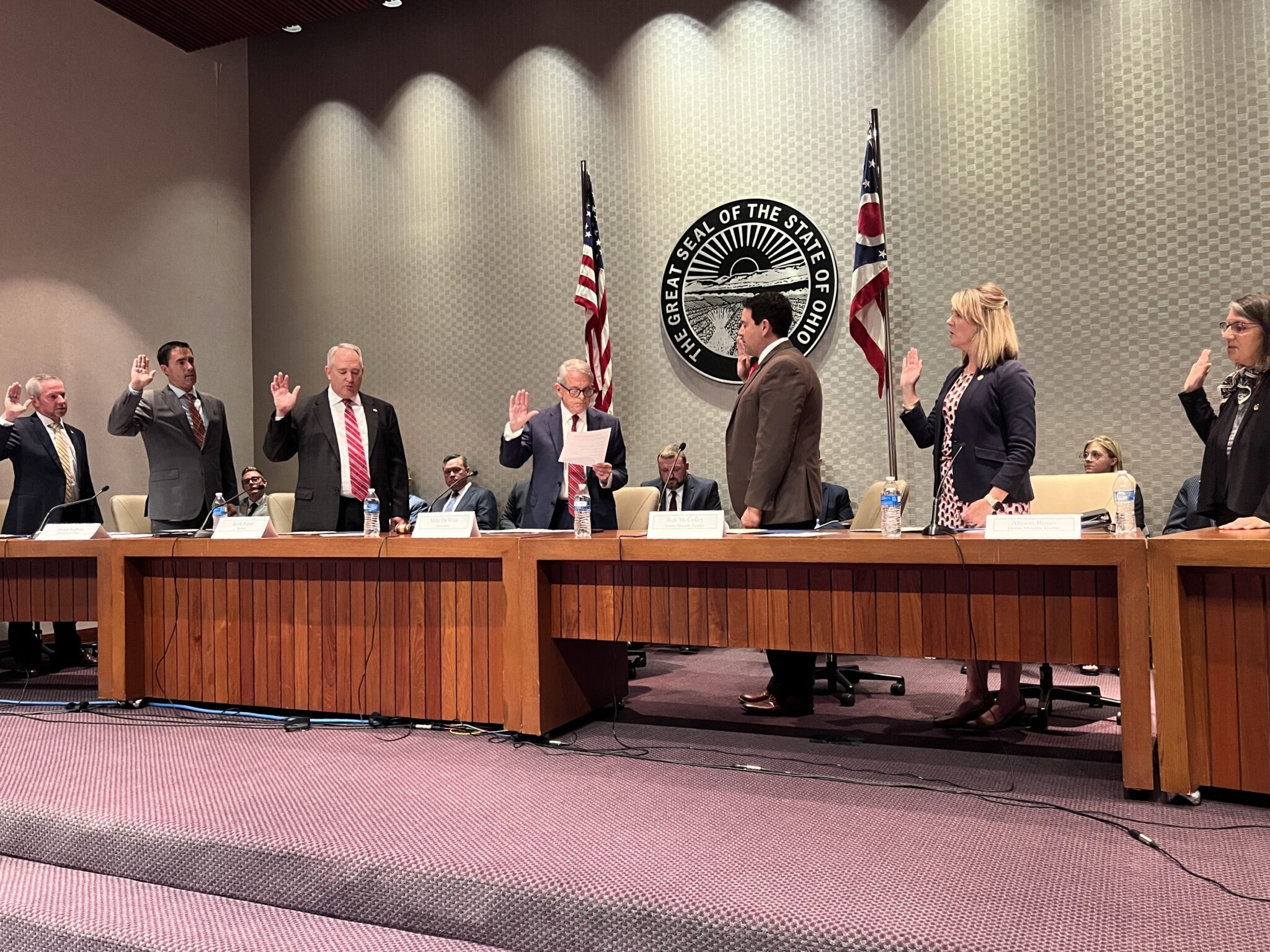
    The members of the Ohio Redistricting Commission are sworn in by Gov. Mike DeWine on Wednesday. Left to right: State Rep. Jeff LaRe, Secretary of State Frank LaRose, Auditor of State Keith Faber, DeWine, Senate Majority Floor Leader Rob McColley, House Minority Leader Allison Russo and Senate Minority Leader Nickie Antonio. (Photo by Susan Tebben, OCJ.)

    BY:  Ohio Capital Journal

    Signature collection continues for an anti-gerrymandering ballot measure in Ohio that would replace politicians on the redistricting commission with citizens. As the July deadline approaches, supporters are pointing to a new study showing how uncompetitive Statehouse races are.

    The Brennan Center for Justice at NYU’s law school analyzed Ohio’s current maps alongside the results of the most recent primary election.

    Authors of the study said the data “reveals one of the tangible ways Ohio’s gerrymandered maps undermine electoral competition, and how the districts leave millions of Ohio voters without a significant voice in the Ohio House elections slated for this November.”

    “An overwhelming majority of Ohioans will cast ballots this November in legislative districts that were drawn to lock in general election outcomes, and few districts featured meaningful primary contests,” the Brennan Center report stated. “These are the predictable consequences of living in a gerrymandered state.”

    One of the authors of the report, released Tuesday, is Yurij Rudensky, who spoke in support of the new ballot initiative proposed to hit voters in November. If it gets on the ballot and is passed by voters, the reforms would replace the current Ohio Redistricting Commission made up of elected officials with a citizen-run, judge-vetted commission to draw the next Statehouse and U.S. Congressional maps.

    Rudensky spoke in a March panel, alongside former Ohio Supreme Court Chief Justice Maureen O’Connor and others, about the difference between the reforms passed in 2015 and 2018 and the proposed amendment that voters may see on their general election ballots.

    At the March panel discussion, Rudensky hesitated to call the last two measures reforms because he argued no changes were made and the previous amendments merely demonstrated that “political insiders have no business being in the process.”

    Since those amendments passed — reforms made through legislative negotiation before hitting the voters — the Ohio Redistricting Commission has been built on a Republican majority, with Gov. Mike DeWine, Senate President Matt Huffman, former House Speaker Bob Cupp, Secretary of State Frank LaRose and Auditor of State Keith Faber all standing on the commission during some or all of the proceedings over the two years it took for the group to pass six Statehouse maps and two congressional maps. State Rep. Jeff LaRe, R-Violet Twp., replaced Cupp and state Sen. Rob McColley, R-Napoleon, came in for Huffman toward the end of the two-year span.

    The Statehouse maps were declared unconstitutionally gerrymandered five times by a bipartisan majority on the Ohio Supreme Court, but voters were forced by federal judges to use them for the 2022 Election.

    Statehouse maps passed by the redistricting commission this past September, and set to be used for this year’s election, were the only to receive bipartisan agreement (with Senate Minority Leader Nickie Antonio and House Minority Leader Allison Russo’s votes), while the state’s Congressional map is still considered unconstitutional under an Ohio Supreme Court ruling.

    In analyzing the current Ohio Statehouse maps, Rudensky and co-author Gina Feliz concluded that about 77% of the state’s population live in “districts where elections for state representatives are not in serious dispute.”

    “That is, these districts are either uncontested, or they give one party a disproportionate advantage in the general election so that the district is uncompetitive, even if it’s formally contested,” the researchers wrote.

    The report defines “uncompetitive” as districts where the partisan draw favors one party by 55% or more.

     Source: Brennan Center analysis of Ohio Secretary of State’s Office Unofficial 2024 Primary Election Results. 

    Nearly half of the districts in the Ohio House didn’t have a primary contest in March to drive a November general election race, the Brennan Center research found, citing data from the Ohio Secretary of State.

    “In all, there are 15 districts (out of 99 total) that will give voters no choice between Democratic and Republican candidates for state representative,” according to the study.

    The report also recognized the low turnout in the state during the primary season, with an average of 18.8% of registered voters casting ballots in districts with competitive primaries.

    Because of that, Rudensky and Feliz counted fewer than 450,000 voters who “all but decided who would serve as state representatives on behalf of more than 2.3 million registered voters and 3.5 million constituents.”

    The report pointed to the proposed ballot initiative led by Citizens Not Politicians as a redistricting reform that could “center community needs and voter preferences rather than the interests of incumbents.”

    Looking to a future that may have an independent redistricting commission, the voting rights group Common Cause put out its own report, a summary of a 2023 conference where members reflected on states who already have such a system in place, and those like Ohio that could see the change come in November.

    “Unsurprisingly, all those who attended the conference believed in the possibilities of fair and representative maps and that independent redistricting commissions were the best strategy to achieve this goal,” Common Cause stated in the new report.

    The “Roadmap for Fair Maps in 2030,” a summary of the 2023 National Citizen Redistricting Commissioners Conference, talked about the need to make redistricting a transparent process that is “responsive to community needs.” At the conference, the report said a “model commission” was organized for Ohio and neighbor state Indiana “to demonstrate how an alternative process based on community input and transparency can work.”

    In a previous report, released shortly after the Ohio Redistricting Commission adopted the current Statehouse district maps, Common Cause gave the state a failing grade, calling the current map-drawing process and the results that came from it “unmitigated disasters.”

    Ideally in redistricting, Common Cause members said the process should “ensure that commissions reflect the diversity of the jurisdiction” and engage community-based organizations and leaders to build resident trust and hold commissions accountable.

    What should not be included in the process, according to the report, are legislature-appointed commissioners or any legislative role in the mapping process.

    “Commission decisions on maps should be final, except for judicial review, with no approval from elected officials required,” the report stated.

    The Citizens Not Politicians initiative was supported in the report as part of strategies to “increase fair representation in 2030,” the next time the process is set to start, though maps in Ohio would need to be redrawn in 2025 if the ballot measure passes in November.

    Opposition to the initiative has been led by Huffman, who helped formulate the previous redistricting reforms. In an Ohio Chamber of Commerce event following the March primaries, he laid out his arguments against the initiative, saying litigation would pile up with the proposed system, and that “when allowed to work,” the current system did its job.

    In order for the measure to appear on Ohio ballots in the general election, supporters must collect 413,487 valid state voter signatures by July 3.


    Susan Tebben
    SUSAN TEBBEN

    Susan Tebben is an award-winning journalist with a decade of experience covering Ohio news, including courts and crime, Appalachian social issues, government, education, diversity and culture. She has worked for The Newark Advocate, The Glasgow (KY) Daily Times, The Athens Messenger, and WOUB Public Media. She has also had work featured on National Public Radio.

    Ohio Capital Journal is part of States Newsroom, the nation’s largest state-focused nonprofit news organization.

    MORE FROM AUTHOR

  • 12 race-based scholarships worth $46,000 weren’t awarded to Ohio University journalism students

    12 race-based scholarships worth $46,000 weren’t awarded to Ohio University journalism students

    That’s only a fraction of $450,000 worth of scholarship money at OU that’s under review after advice from Ohio Attorney General Dave Yost.

    BY:  Ohio Capital Journal

    Twelve race-based scholarships totaling $46,000 weren’t given out at Ohio University’s E.W. Scripps School of Journalism’s awards banquet this week, said Journalism School Director Eddith Dashiell.

    And that’s only a fraction of the 130 gift agreements that represent $450,000 worth of scholarship money under review by the university after comments Ohio Attorney General Dave Yost made about race-based scholarships after the U.S. Supreme Court ruled against race-conscious admissions.

    “I’m disappointed that the university chose this route,” Dashiell said to the Ohio Capital Journal. “It would have been a clear, very easy way to demonstrate their true commitment to diversity and by cowardly cowering to one person’s opinion about how to interpret the U.S. Supreme Court’s decision has resulted in at least 12 of our students not getting scholarships they need.”

    Ohio University’s scholarship review is ongoing, university spokesperson Dan Pittman said in an email.

    “It would be premature for us to speculate on any potential outcomes, including the scope of impacted scholarships and/or gift agreements,” Pittman said.

    Dashiell said it’s misleading for a university to say the scholarships are still under review at the tail end of spring semester.

    “To me, when the university says their official position is the scholarships are still under review, that is code for they haven’t been given out,” she said. “Scholarship season is over. … The decision has already been made.”

    The Capital Journal reported in March that at least seven Ohio public universities — including OU — are reviewing scholarships. The other universities include Cleveland State University, Kent State University, the University of Akron, the University of Toledo, Youngstown State University and Ohio State University. Bowling Green State University is also reviewing race-based scholarships.

    Cleveland State University said the scholarships in questions remain under review and Bowling Green said it “continues to evaluate next steps.” The rest of the universities did not respond by the Capital Journal’s deadline.

    Dave Yost’s remarks

     Ohio Attorney General Dave Yost. (Photo by Morgan Trau, WEWS.) 

    The day after the Supreme Court decision, Yost sent a letter to Ohio colleges and universities saying his office won’t legally protect someone at a college or university who uses race as a factor.

    Race-based scholarships came up on a January call Yost had with universities — even though scholarships were not mentioned in the Supreme Court decision.

    “What was said in response to a question was after the recent Supreme Court decision, scholarships will need to be looked at to ensure compliance with the law,” Yost’s spokesperson Bethany McCorkle said in a Febuary email. “… Race-based scholarships discriminate on the basis of race in awarding benefits. Therefore, it would follow that such programs are unconstitutional.”

    Not long after that phone call, university faculty and staff across the state got wind that diversity scholarships were under review.

    “A public institution of higher education is … supposed to follow the law,” Dashiell said. “(OU is) following one man’s opinion of what the law is.”

    12 missing scholarships

    Dashiell compared this year’s list of journalism scholarships to last year’s list and noticed 12 scholarships were missing.

    “They aren’t there,” she said. “That’s more than under review. They made a decision. They deleted them.”

    OU’s journalism school is made up of 84% white students, Dashiell said.

    “The diversity scholarships weren’t created to keep white students from getting any money,” she said. “They were designed to help encourage African American students to come to a little bitty town called Athens, Ohio. … To say that these 12 scholarships somehow according to the Ohio Attorney General’s Office, somehow that these scholarships discriminate against whites, is so blatantly racist, I don’t even know how to explain that.”

    Dashiell apologized to the donors whose scholarships weren’t awarded in her speech during Tuesday’s awards banquet.

    “On behalf of the E. W. Scripps School of Journalism: To our donors, please accept our deepest apology for our inability to share your generosity with our students for next academic year,” she said.

    Some of the donors whose scholarships weren’t awarded include Pulitzer Prize winning journalist and columnist Clarence Page and former Washington Post ombudsman Andrew Alexander.

    Dashiell is worried how else the Supreme Court decision is going to be interpreted.

    “If it’s diversity scholarships this year, what are they going to pause next year?” she asked. How are they going to stretch the U.S. Supreme Court decision again?”

    Follow OCJ Reporter Megan Henry on X.


    Megan Henry
    MEGAN HENRY

    Megan Henry is a reporter for the Ohio Capital Journal and has spent the past five years reporting in Ohio on various topics including education, healthcare, business and crime. She previously worked at The Columbus Dispatch, part of the USA Today Network.

    Ohio Capital Journal is part of States Newsroom, the nation’s largest state-focused nonprofit news organization.

    MORE FROM AUTHOR

  • Ohio near bottom in preschool spending compared to other states

    Ohio near bottom in preschool spending compared to other states

    BY:  Ohio Capital Journal

    Ohio Gov. Mike DeWine used his recent State of the State speech to proclaim the importance of child care and education, but a national report released last week ranks Ohio near the bottom of the country in preschool spending.

    The National Institute for Early Education Research’s annual “state of preschool” report showed nationwide disparities in access, quality and funding for preschool, with Ohio sitting at 43rd in total reported spending on the early education.

    “Most states have not committed to serving all children, and even those states that have often fall short,” W. Steven Barnett, senior co-director and founder of NIEER at Rutgers University, said in a statement. “Most states need to increase funding per child substantially to enable providers to meet minimal standards for a high-quality, effective program.”

    The report called inadequate funding “a near universal problem.”

    Barnett did praise a 2023 increase in state-level funding of $122 million over two years as part of the most recent state budget, as well as a $250 increase in per-pupil funding, the first in the state since 2009. Ohio ranked 36th in state-specific spending on preschool in the new report, which specifically studied the Ohio Department of Education and Workforce’s publicly funded Early Childhood Education program for the 2022-2023 school year.

     Source: National Institute for Early Education Research 

    That boost followed a reduction in the 2022-2023 school year, when state spending dropped $268 per child from the 2021-2022 year.

    “We encourage Ohio to keep up the progress, as much work remains to provide access to full-day, adequately funded early learning opportunities that will help children develop and parents earn a living,” Barnett wrote in a release on the new data.

    Ohio has a total of 18,000 children enrolled in pre-K education, with 35% of the school districts offering a state-funded program. The federally funded Head Start program for ages 3 and 4 has a state enrollment of 24,649. No state contributions go to the Head Start program for 3 or 4 year olds, according to the study.

    Nationally, preschool enrollment rose to 35% of 4-year-olds and 7% of 3-year-olds, with overall state expenditures increasing by 11% compared to 2021-2022 data.

    “However, despite this notable progress, most states still fell short of their pre-pandemic preschool enrollment,” NIEER stated.

    In terms of access, Ohio ranked 36th for 4-year-olds and 26th for 3-year-olds.

    Last year’s report saw Ohio in 36th for 4-year-old enrollment, but slightly lower at 27th for three-year-old enrollment.

    In the 2024 research, Ohio only met half of the 10 benchmarks noted in the report.

    Benchmarks met by the state in the most recent NIEER report included early learning and development standards; curriculum supports; specialized training for teachers; screening and referral; and its continuous quality improvement system.

    Researchers found the state hadn’t met benchmarks in teacher degrees, assistant teacher degrees, staff professional development, maximum class size and staff-to-child ratios. This data was identical to last year’s met and unmet benchmarks for Ohio.

    An associate degree is required in the state for pre-K teachers, but the NIEER benchmark is a bachelor’s degree. For assistant preschool teachers, the Ohio requirement is a high school diploma, though the NIEER sets a benchmark of a child development associate credential or equivalent credential.

    Maximum class size set in Ohio is 24 for 3-year-olds and 28 for 4-year-olds, though NIEER recommends 20 or lower.


    Susan Tebben
    SUSAN TEBBEN

    Susan Tebben is an award-winning journalist with a decade of experience covering Ohio news, including courts and crime, Appalachian social issues, government, education, diversity and culture. She has worked for The Newark Advocate, The Glasgow (KY) Daily Times, The Athens Messenger, and WOUB Public Media. She has also had work featured on National Public Radio.

    Ohio Capital Journal is part of States Newsroom, the nation’s largest state-focused nonprofit news organization.

    MORE FROM AUTHOR

  • Bill to rid Ohio of spousal rape exception receives support in state Senate

    Bill to rid Ohio of spousal rape exception receives support in state Senate

    BY:  Ohio Capital Journal

    This story mentions rape and sexual assault. If you or someone you know needs help, the National Sexual Assault Hotline is 1-800-656-4673.

    Survivors of sexual assault perpetrated by their spouses had a simple request for the Ohio Legislature with regard to a loophole in state law that keeps their spouses from being held accountable.

    “Please help us,” Sarah Tucker said.

    Tucker said she not only endured rape from her former husband, but also a lack of action by law enforcement because of an exception for married couples within Ohio sex offense laws.

    While she was finally able to separate herself from her spouse, Tucker still has not received the justice she demands for herself and for her kids. Her journey out of the situation included mental health treatment and other assistance to deal with the “lasting effects of this trauma.”

    “Going through something like this changes a person, changes them to lose faith in the justice system, changes how they see themselves, changes how they face new relationships,” Tucker told the Ohio Senate Judiciary Committee.

    The committee heard proponent testimony recently on House Bill 161, which would eliminate spousal exceptions to rape, sexual battery, unlawful sexual conduct with a minor, gross sexual imposition and sexual imposition, according to the language of the bill.

    “The spousal exception for rape is distinct from the others because it currently applies only if the spouse lives with the offender,” according to an analysis of the bill by the Legislative Service Commission. “Under the bill, a person could be convicted of rape involving the spouse, regardless of whether the spouse lives with or apart from the offender.”

    HB 161 would also allow an individual to testify against their spouse in the prosecution of one of the crimes listed in the bill, and allows testimony “concerning a communication made by one to the other in a case involving any of those offenses, as well as public indecency,” the LSC analysis stated.

    Ohio currently stands as one of only 11 states who still holds an exception for marriage in rape and sexual assault cases, according to the bill’s sponsors.

    Those who advocate for rape and sexual assault survivors see the bill as necessary closure of loose ends that can leave law enforcement without options, and survivors with even less.

    “There can be many obstacles in the path of justice for survivors of sexual violence, but to not even have the option of justice is negligent and re-traumatizing for Ohio survivors,” said Rebecca Peckinpaugh, a licensed social worker and director for Allen County and Putnam County’s Crime Victim Services, and regional director of the Ohio Alliance to End Sexual Violence.

    Maria York, policy director for the Ohio Domestic Violence Network said in her 10 years as a victim advocate prior to working for ODVN, intimate partner sexual assault and spousal sex offenses were seen “repeatedly.”

    “The law enforcement, the prosecutor’s office, did a fantastic job trying to get justice for victims, but unfortunately the law isn’t there,” York told the Senate committee.

    She cited data from the National Institute of Justice, which found 40% to 45% of women in abusive relationships experience sexual assault from a partner.

    The need for a resolution is increasing in the state as well, according to Davina Cooper, director of rural services for Women Helping Women, a rape crisis center serving Adams, Brown, Butler, Clermont and Hamilton counties.

    “Intimate partner violence is a public health epidemic that impacts the lives of survivors, their children, family members and the community,” Cooper said.

    The center saw a 25% increase in “hospital response for sexual assault by a spouse” in 2023, according to Cooper. That number was the highest in WHW’s history, and necessitated an increase in staff for rural programming, she said.

    HB 161, which has bipartisan sponsors, has already passed the Ohio House, and approval from the state Senate would take the bill to the governor’s desk for signature.


    Susan Tebben
    SUSAN TEBBEN

    Susan Tebben is an award-winning journalist with a decade of experience covering Ohio news, including courts and crime, Appalachian social issues, government, education, diversity and culture. She has worked for The Newark Advocate, The Glasgow (KY) Daily Times, The Athens Messenger, and WOUB Public Media. She has also had work featured on National Public Radio.

    Ohio Capital Journal is part of States Newsroom, the nation’s largest state-focused nonprofit news organization.

    MORE FROM AUTHOR

  • DeWine says Randazzo’s ties to First Energy were well known, but the evidence of this is lacking

    DeWine says Randazzo’s ties to First Energy were well known, but the evidence of this is lacking

    BY:  Ohio Capital Journal

    The office of Gov. Mike DeWine has for months been saying that connections between the guy he picked to be the state’s top regulator and a utility at the center of an epic bribery scandal were well known around Capitol Square when DeWine nominated him in January 2019.

    If the relationship were common knowledge, it might seem more innocent that some in DeWine’s administration knew the utility had paid the regulator $4.3 million just before the governor nominated him. However, the administration has provided scant evidence that the claim is true — and there’s considerable evidence suggesting it isn’t.

    The regulator, Sam Randazzo, died by suicide earlier this month and the utility, Akron-based FirstEnergy, has admitted to its role in a scandal that has sent one public official to prison for 20 years and seen yet another defendant die by suicide.

    Meanwhile, DeWine’s lieutenant governor, Jon Husted, won’t talk about a $1 million FirstEnergy contribution to a group supporting him. And DeWine himself hasn’t explained what senior people in his administration with FirstEnergy connections knew about the scheme — in which $61 million in bribes were paid for a $1.3 billion ratepayer bailout.

    Multiple ties

    Among them is Laurel Dawson, who was chief of staff of the incoming DeWine administration at the beginning of 2019. At the same time, her husband, Mike Dawson, was a lobbyist for FirstEnergy.

    A few weeks before, on Dec. 18, 2018, Gov.-elect DeWine and Lt. Gov.-elect Jon Husted had dinner at the Columbus Athletic Club with FirstEnergy CEO Chuck Jones and Vice President Micheal Dowling. At the dinner, they discussed whether Randazzo would be acceptable to head up the Public Utilities Commission of Ohio — the agency that was supposed to regulate the executives’ utility, according to a state indictment of Randazzo, Jones, and Dowling that was filed in February.

    After the dinner, the FirstEnergy executives drove about a mile to Randazzo’s condo and negotiated a $4.3 million payment to Randazzo, the indictment said. FirstEnergy later said the payment was a bribe in a deferred prosecution agreement with the U.S. Justice Department.

    As PUCO chairman, Randazzo helped draft and lobby for the bailout law and did several other lucrative favors for FirstEnergy. His indictment said it capped off a decade-long relationship in which he was a paid “consultant” for FirstEnergy unbeknownst to his law firm or a group of industrial energy users on whose behalf Randazzo was supposed to be negotiating concessions.

    The indictment says at least one person in the DeWine administration — Laurel Dawson — knew that Randazzo had gotten a huge payment from FirstEnergy in the weeks before DeWine nominated him to chair the PUCO at the beginning of February 2019.

    Randazzo told “the Governor-elect through his incoming Chief of Staff that he had received $4.3 million from FirstEnergy, which he claimed was final payment of a ‘consulting agreement,’” Randazzo’s indictment said.

    For her part, Laurel Dawson is cooperating with the state prosecution, but she isn’t commenting publicly.

    Common knowledge?

    In the months since the state indictment of Randazzo and the FirstEnergy executives, DeWine Press Secretary Dan Tierney has been saying that Randazzo’s ties to FirstEnergy weren’t news even at the time the governor was considering him in early 2019 to head the PUCO.

    In February, he told Cleveland’s News Channel 5, “it was well known that Randazzo was a paid consultant for FirstEnergy.”

    Tierney modified that somewhat, telling the Capital Journal earlier this month, “it was well known to our staff that Mr. Randazzo was an energy consultant, and it was well-known to them and many people that Mr. Randazzo was a consultant employed by First Energy.”

    However, it appears that Randazzo and FirstEnergy’s top leadership went to great lengths to keep their relationship secret.

    Many of the counts Randazzo was charged with have to do with his failure to report income from FirstEnergy on state ethics disclosures while he was PUCO chairman. A bill of particulars accompanying the indictment adds that Randazzo didn’t disclose a 2015 consulting agreement with FirstEnergy to the members of his own law firm, McNees, Wallace and Nurick. Randazzo’s membership agreement in the firm barred barred him from outside employment, the filing said.

    Pressed on the matter this week, Tierney said in an email, “Mr. Randazzo testified numerous times at the General Assembly prior to his appointment to the PUCO. In addition, Mr. Randazzo served on the PUCO Nominating Council, which requires ethics disclosures. These were among the reasons Mr. Randazzo’s relationships with utilities and FirstEnergy were well known at the Statehouse and on Capitol Square.”

    The Capital Journal obtained Randazzo’s disclosures from the Ohio Ethics Commission for the period he served on the PUCO Nominating Council — 2007 to 2017. “FirstEnergy” doesn’t appear on any of them.

    Tierney was informed of that and asked whether DeWine’s office could point to any testimony Randazzo gave to the General Assembly in which he divulged his long, profitable relationship with FirstEnergy. Tierney didn’t answer that question, saying instead, “My understanding is that Mr. Randazzo’s business entities are listed on the ethics form(s), and those business entities not only were well known to be associated with Mr. Randazzo on Capitol Square, but also well known to have First Energy as clients.”

    Shell game

    The entity that appears on Randazzo’s ethics disclosures is the Sustainability Funding Alliance of Ohio — a group prosecutors accused Randazzo of using as a shell corporation to skim millions in FirstEnergy money earmarked for his industrial clients. The group’s relationship with FirstEnergy was so secret that the corporation’s top executives feared that a partial disclosure would tank Randazzo’s nomination to the PUCO.

    FirstEnergy Solutions — a subsidiary Jones and Dowling desperately wanted ratepayers to bail out — was going through bankruptcy. One of its filings mentioned the Sustainability Funding Alliance, which Randazzo had also listed on his ethics disclosures.

    The FirstEnergy executives were in a panic about it and their communications show that the connection between their company and Randazzo’s entity was far from well known.

    The DeWine administration is “going to be mad at Sam (and hopefully not us) for not disclosing the financial relationship,” Dowling texted Jones on Jan. 30, 2019, less than a week before DeWine nominated Randazzo. “That’s Sam’s responsibility.”

    When the nomination went through anyway, Dowling told Jones, “A bullet grazed temple,” to which the FirstEnergy CEO replied, “Forced DeWine/Husted to perform battlefield triage.”

    “Secret for-profit entity”

    In his email Monday, Tierney also said, “What media has described as the ‘dossier’ regarding Randazzo’s relationship with First Energy, which is a collection of public domain documents from the time in 2019, shows that much of this was colloquially known on Capitol Square and within the energy advocacy community.”

    The “dossier” Tierney referred to was a 198-page document from a former aide warning DeWine about Randazzo’s murky relationships. It was delivered to Laurel Dawson on Jan. 28, 2019 — about a week before her boss nominated Randazzo.

    Tierney said the document shows that Randazzo’s ties to FirstEnergy were well known. But the first page of the dossier says something quite different.

    “Publicly available documents suggest that PUCO applicant Sam Randazzo has opaque, undisclosed financial ties to FirstEnergy that should be fully examined and made public,” it says. “The enclosed evidence demonstrates that Randazzo personally profits from a secret for-profit entity funded by FirstEnergy Solutions.”

    Catherine Turcer, executive director of Common Cause Ohio, said that it’s past time for DeWine, Husted and their staffs to be much more forthcoming about their involvement in the bailout and about what DeWine and Husted did to investigate whether any member of the administration acted improperly.

    “It makes sense to be as clear as possible about what actually happened,” she said. “And I don’t just want to hear from the governor. I want to hear from the lieutenant governor.”


    Marty Schladen
    MARTY SCHLADEN

    Marty Schladen has been a reporter for decades, working in Indiana, Texas and other places before returning to his native Ohio to work at The Columbus Dispatch in 2017. He’s won state and national journalism awards for investigations into utility regulation, public corruption, the environment, prescription drug spending and other matters.

    Ohio Capital Journal is part of States Newsroom, the nation’s largest state-focused nonprofit news organization.

    MORE FROM AUTHOR

  • Ohio House holds first hearing for new nitrogen gas death penalty method

    Ohio House holds first hearing for new nitrogen gas death penalty method

    Ohio would join four other states that explicitly permit nitrogen hypoxia for executions if the bill passes

    BY: Ohio Capital Journal

    House lawmakers have begun hearings on a controversial new execution method known as nitrogen hypoxia. The protocol, used in Alabama for the first time recently, subjects a prisoner to a high concentration of nitrogen which causes them to eventually suffocate. Right now, four states explicitly allow nitrogen hypoxia and four other allow for “lethal gas” generally. Outside of Ohio, Nebraska lawmakers are considering the approach as well.

     State Rep. Phil Plummer, R-Dayton. State Rep. Phil Plummer, R-Dayton. (Photo by Graham Stokes for Ohio Capital Journal. Republish photo only with original article.) 

    In its initial hearing, Reps. Brian Stewart, R-Ashville, and Phil Plummer, R-Dayton, presented the proposal as procedural update rather than a wholesale change. Currently there are almost 200 people on death row in Ohio, but executions have been on hold since 2018.

    “We have a situation today where for six years, we have refused to carry out capital punishment — in violation of the law,” Stewart argued. “It is the law. And until this body votes to do something different, then we need to give (the Ohio Department of Rehabilitation and Corrections) the tools to carry out these sentences.”

    “Plan B”

    For the most part, Stewart sought to downplay the additional execution method. He cited an example of an inmate requesting nitrogen hypoxia, and defense attorneys arguing they believed the process is “humane” and “completely painless.”

    The inclusion of nitrogen hypoxia, Stewart argued, is a way to break up the backlog. Assuming lethal injection is available, death row inmates could select the method of their choice, and in the event that lethal injection drugs are unavailable, nitrogen hypoxia would allow executions to continue.

    “In our view nitrogen hypoxia is a plan B,” Stewart described. “It is a set of suspenders to go along with the belt. It would be preferable to continue using lethal injection, but we need to do something.”

    Stewart and Plummer presented their idea as a value-neutral response to a stated lack of lethal injection drugs. “Despite his decision to delay the executions,” Plummer said, “Governor DeWine has indicated that the legislature could address this issue by authorizing an alternative method.”

    Stewart dismissed criticism of Alabama’s “botched” nitrogen hypoxia execution as death penalty abolitionists speaking in sensational terms. An AP reporter who viewed the execution described Kenneth Smith thrashing and gasping as prison officials administered the gas. Stewart acknowledged their bill isn’t likely to change the minds of people who already oppose the death penalty.

    “Respectfully, though, I think there’s another bill for that,” Stewart said, referring to measures in the Ohio House and Senate that would abolish the death penalty.

    “This bill is saying we have the law that we have, and until we change it, we need to find a way to carry out what juries have already imposed,” he said.

    Pushback

    While some inmates may have requested nitrogen hypoxia and some defense attorneys have looked favorably on the protocol, it’s acceptance isn’t universal. The American Veterinary Medical Association, for instance, OK’d the procedure under some circumstances for euthanasia of chickens, turkeys and pigs. For all other mammals, though, the panel warned it’s inappropriate and likely to cause distress.s

    “Now, if we’re going to use gas, which, frankly, our veterinarians will not use on our animals, why would we use that on human beings?” state Rep. Michele Grim, D-Toledo, asked.

    Stewart argued it’s “vastly more humane” than the violence that put inmates on death row in the first place. He added that in countries where assisted suicide is legal, nitrogen hypoxia is one of the approaches people use.

    State Rep. Bill Seitz, R-Cincinnati, meanwhile, said the problem with Ohio’s capital punishment system is the length of time it takes to pursue appeals. “That is the problem in a nutshell,” he said, “plus the unavailability of the three-drug injection.” But he noted if the U.S. Supreme Court hasn’t explicitly blessed the protocol, the proposal might just lead to more appeals.

    “To my knowledge,” he said, “the United States Supreme Court has only signed off on hanging, electric chair, firing squad, and lethal drug injection as being constitutional — don’t violate the Eighth Amendment.”

    “I believe what you’re saying about nitrogen hypoxia,” Seitz added, “but it hasn’t yet been blessed, if you will.”

    Stewart argued the likelihood of nitrogen hypoxia passing muster in the court is high, but added their preferred method remains lethal injection. Notably, nothing about the long and complex appeals process unique to death penalty cases will change under Stewart and Plummer’s measure.

    Follow OCJ Reporter Nick Evans on Twitter.


    Nick Evans
    NICK EVANS
    Nick Evans has spent the past seven years reporting for NPR member stations in Florida and Ohio. He got his start in Tallahassee, covering issues like redistricting, same sex marriage and medical marijuana. Since arriving in Columbus in 2018, he has covered everything from city council to football. His work on Ohio politics and local policing have been featured numerous times on NPR.

    Ohio Capital Journal is part of States Newsroom, the nation’s largest state-focused nonprofit news organization.

    MORE FROM AUTHOR