Author: Ohio Capital Journal

  • As Memorial Day arrives, bill unveiled in Congress to assist Purple Heart recipients

    As Memorial Day arrives, bill unveiled in Congress to assist Purple Heart recipients

    BY:  Ohio Capital Journal

    WASHINGTON — When a Purple Heart recipient named Pat reached out to U.S. Sen. Patty Murray in November to inform her that he couldn’t transfer his GI bill benefits to his children, he wasn’t expecting congressional action to solve the problem.

    He simply just wanted to let the Washington state Democrat know, he told States Newsroom in an exclusive interview.

    With a child about to head to college, Pat, who didn’t want his last name used, had recently been told by the Army that he couldn’t transfer his education benefits to them because he received the Purple Heart after he was medically discharged. This rule does not apply to those who receive the medal while still in service.

    Murray and Thom Tillis, a North Carolina Republican, introduced a bipartisan bill Thursday aimed at closing that loophole.

    The legislation, titled the Purple Heart Veterans Education Act, would permit retroactive award recipients who served on or after Sept. 11, 2001 to transfer their education benefits to one or more dependents. It was unveiled just ahead of Memorial Day, when the nation honors its deceased service members.

    “As the daughter of a Purple Heart recipient, I’ve seen firsthand the enormous sacrifices Purple Heart veterans make to defend our freedoms, and I feel strongly that we should be doing absolutely everything we can to help all veterans and their families thrive,” Murray said in a statement Thursday.

    “It doesn’t make any sense that service members who are awarded a Purple Heart after their service can’t transfer their GI benefits to their dependents, while those who receive it during their service can—and I am grateful to Pat, my constituent in Washington state who brought this gap in the law to my attention,” continued Murray, a senior member of the Senate Committee on Veterans Affairs.

    “Our legislation will close this loophole and allow more children of Purple Heart veterans to further their education. I want to thank Senator Tillis for joining me on this legislation and I’ll be working hard to get it passed into law.”

    Glitch in education benefits

    Pat was medically discharged from the U.S. Army and retroactively received a Purple Heart for his actions during Iran’s retaliatory missile barrage in January 2020 on an Iraq airbase, after a U.S. drone strike killed Iranian Gen. Qassem Soleimani.

    The Army later approved 39 Purple Hearts for service members who experienced the attack, according to a December 2021 report by the Army Times.

    As his teenager looks to enroll at Central Washington University next year, Pat found out that by law his education benefits would only be available for transfer if he had received the award while still in service.

    “My thought was, ‘I doubt that legislators would have done that intentionally.’ I just thought, you know, people probably just didn’t think about how that happens — that some people are going to get retroactive Purple Hearts, or for whatever reason in evaluating them, they’re delayed. So it’s not like an unusual thing,” Pat said in a phone interview.

    “I wasn’t thinking much was going to happen, but I just wanted to write Senator Murray, who is my local senator, and let her know the issue. They responded by saying, ‘That’s an oversight on our part, and we want to make good on that.’”

    Pat said he’s “grateful for Sen. Murray” and hopes his action is able to help other Purple Heart veterans. For now, his family is moving forward with the college enrollment process for his child, he said.

    Benefits and dependents

    Among the provisions in the legislation, Murray and Tillis’ bill would also allow veterans to split up 36 months worth of benefits to each of their dependents. For example, they could transfer 20 months to one and 16 months to another.

    The bill, if enacted, would also prohibit the benefits from being treated as marital property or a marital estate asset.

    And, the bill would permit dependents to access unused benefits if their veteran family member has died.

    “Purple Heart recipients are heroes who honorably served our country at great costs, and this oversight that prevents servicemembers who received this distinguished award after their service from transferring their GI bill benefits to their dependents needs to be corrected immediately,” Tillis said in a statement Thursday.

    “I am proud to co-introduce this commonsense legislation with Senator Murray to close this loophole and ensure every Purple Heart recipient and dependents are able to further their education,” continued Tillis, who also sits on the Senate’s Veterans’ Affairs Committee.

    The number of veterans who retroactively received the Purple Heart after their post-9/11 service is unclear. The bill is estimated to cost $500,000 in mandatory spending over 10 years, according to an informal analysis provided to Murray’s office by the nonpartisan Congressional Budget Office.

    The bill has received praise from veterans groups, including the Iraq and Afghanistan Veterans of America.

    “Unfortunately, not every veteran’s service and sacrifice on behalf of the United States of America is fully recognized while they’re still in uniform,” IAVA CEO and Iraq War veteran Allison Jaslow said in a statement Thursday.

    “The Purple Heart Veterans Education Act ensures that those veterans who’ve endured bodily harm on behalf of our nation, but weren’t recognized for it until their service concluded, are able to turn that recognition into an investment in the education of their loved ones.”

    More Purple Heart recipients

    The wars in Afghanistan and Iraq have “greatly increased” the number of Purple Heart recipients as the Department of Defense has added some traumatic brain injuries as a recognized condition for the award, according to the nonpartisan Congressional Research Service.

    It wasn’t until a 2017 law that Purple Heart recipients were able to receive full post-9/11 GI Bill benefits regardless of their length of service. Previously, the recipients had to have 36 months of active service.

    The Department of Defense does not maintain a record of the number of recipients, according to the CRS, but by law they do maintain a publicly accessible list with the permission of the veteran or next of kin.

    Military historians and the National Purple Heart Hall of Honor estimate about 1.8 million Purple Hearts have been awarded since 1932. The Army Historical Foundation estimated as of 2016 that 30,000 Purple Hearts had been awarded since 2001. The CRS cited this statistic.


    Ashley Murray
    ASHLEY MURRAY

    Ashley Murray covers the nation’s capital as a senior reporter for States Newsroom. Her coverage areas include domestic policy and appropriations.

    Ohio Capital Journal is part of States Newsroom, the nation’s largest state-focused nonprofit news organization.

    MORE FROM AUTHOR


  • Ohio servers and bartenders oppose potential ballot measure to raise minimum wage, survey says

    Ohio servers and bartenders oppose potential ballot measure to raise minimum wage, survey says

    BY:  – Ohio Capital Journal

    A new survey shows 93% of Ohio servers and bartenders want to keep the current tipping system with a base wage and tips.

    The Ohio Restaurant & Hospitality Alliance released the results of the survey earlier this week, which received 990 responses from tipped employees working at full-service restaurants across Ohio. The online survey was conducted in April by national research and consulting firm CorCom Inc. and had a 3% margin of error.

    The survey comes as Raise the Wage Ohio is collecting signatures to put a proposed constitutional amendment on Ohio’s ballot that would raise the minimum wage to $12.75 an hour starting Jan. 1, 2025 and would eliminate Ohio’s tipped wage. Minimum wage would go up to $15 an hour starting on Jan. 1, 2026. Raise the Wage is part of a national campaign run by One Fair Wage.

    “We believe it would really devastate the third largest industry in our state, which employs about 550,000 Ohioans and is still trying to recover from the pandemic,” said John Barker, president and CEO of the Ohio Restaurant and Hospitality Alliance. “Our industry is currently trying to weather the cumulative effect of record high inflation over the last three years.”

    Raise the Wage Ohio needs to collect more than 413,000 signatures by July and they currently have more than 410,000 signatures, said Mariah Ross, the executive director of One Fair Wage.

    Ohio’s current minimum wage is $10.45 an hour for non-tipped employees and $5.25 for tipped employees. An employer in Ohio can pay tipped employees half the starting wage, so tipped employees are guaranteed to receive the full minimum wage, but most earn a lot more through tipping.

    “Zero restaurant workers make less than minimum wage by law. This has always been true,” said Todd Bowen, ORHA’s managing director of external affairs and government relations.

    The median income for tipped workers in Ohio is $27 an hour, according to ORHA.

    “The current system works well, but this proposal would force servers and bartenders to live on an hourly wage, which we know would lower their income, and it would nearly triple labor costs for restaurants and bars and other businesses employ tip workers,” Barker said.

    Raising the minimum wage would force restaurant operators to raise their menu prices by about 20-30%, he said.

    The survey also revealed 83% of tipped employees are earning $20 per hour or more and 64% of tipped employees are earning anywhere between $25 to more than $40 per hour.

    Nearly 70% said they make more now than they could in a job in a different industry and 64% like having a flexible schedule.

    “You might have a mom, you may have a student in college who can work when they want and they can make good money while they’re doing it,” said Lloyd Corder, a professor at Carnegie Mellon University who leads the consulting firm.

    If tipped wages are eliminated, 91% worry tipped employees would earn less money and 85% think customers would not tip on top of a mandatory service charge.

    One Fair Wage called the results misleading.

    “This is a mischaracterization of One Fair Wage’s proposal, which advocates for a full minimum wage plus tips, not one in place of the other,” One Fair Wage said in a statement. “The survey employs questions that skew the true nature of the policy and is part of an ongoing strategy to mislead workers.”

    Workers speak out against raising minimum wage

    Laurie Torres, owner & operator of Mallorca Restaurant in Cleveland, worries raising minimum wage could potentially close her restaurant. She said she would have to raise her prices more than 22% if the minimum wage ballot measure passed — something she has shared with her customers.

    “Time and time again customers say they would visit less often,” Torres said. “And tip less dollars. If the ballot initiative passes my guests would pay more. My servers would make less and there is a real chance I would have to close my restaurant and the doors to a place so many call home. … My restaurant is just like your favorite restaurant. Are you ready to say goodbye to it?”

    Lindsay Odell, a bartender at Submarine House in Huber Heights, said she easily makes more than $30 an hour — more than her engineer husband.

    “If this did pass, this would change my life,” she said. “This would be terrible. I would never be a bartender and I love being a bartender. That’s all I’ve ever done. It’s all I ever want to do.”

    The potential ballot measure could have a “devastating impact” on communities, Bowen said.

    “It’s often a cool restaurant or a cool brewery that makes a neighborhood or development or a small community vibrant and anything that negatively impacts hospitality negatively impacts those communities,” he said.

    Senate Bill 256

    State Sen. Bill Blessing, R-Colerain Township, recently introduced a bill as a way to stop the proposed constitutional amendment.

    Senate Bill 256 would raise the minimum wage for non-tipped workers to $15 and tipped to $7.50 by 2028.

    “We think Senator Blessing’s approach has a slower, thoughtful, measured approach to $15 that gets there over a number of years … but do so without devastating Ohio’s businesses and the communities that they rely on,” Bowen said.

    Follow OCJ Reporter Megan Henry on X.


    Megan Henry
    MEGAN HENRY

    Megan Henry is a reporter for the Ohio Capital Journal and has spent the past five years reporting in Ohio on various topics including education, healthcare, business and crime. She previously worked at The Columbus Dispatch, part of the USA Today Network.

    Ohio Capital Journal is part of States Newsroom, the nation’s largest state-focused nonprofit news organization.

    MORE FROM AUTHOR


  • Ohio AG Yost is prosecuting others in utility scandal, but he won’t discuss his own involvement

    Ohio AG Yost is prosecuting others in utility scandal, but he won’t discuss his own involvement

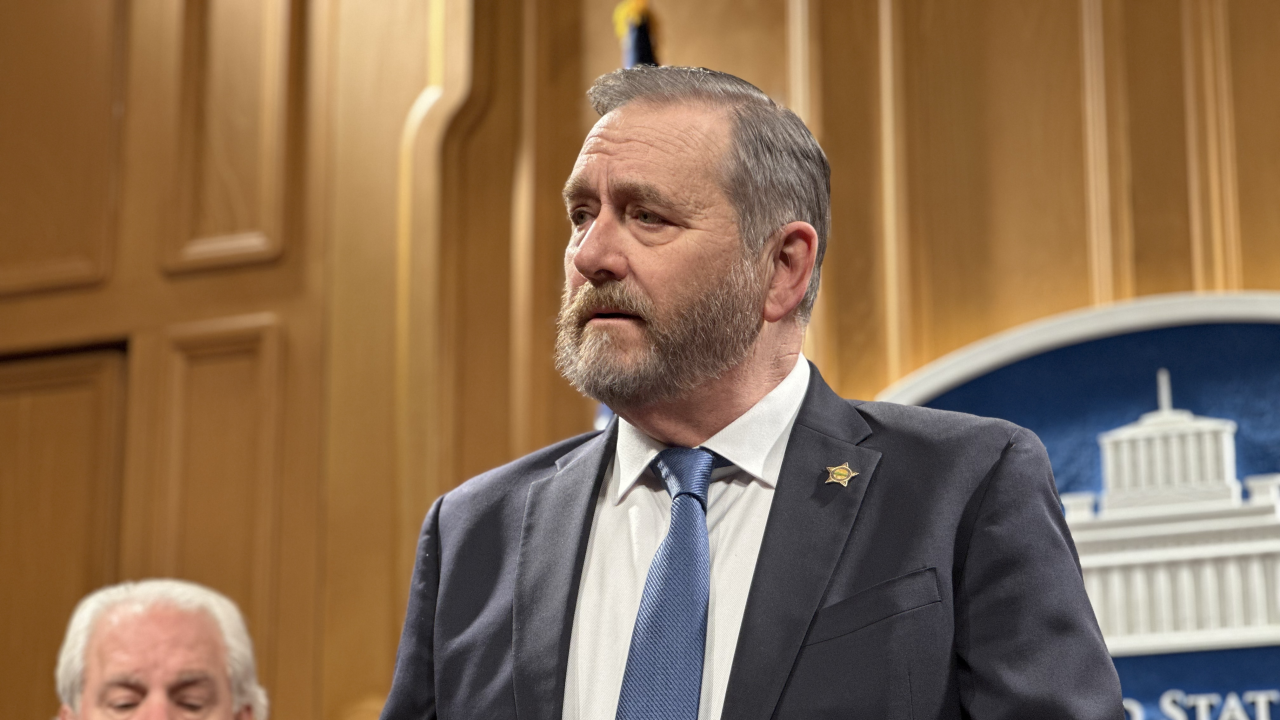
    Ohio Attorney General Dave Yost. (Photo by Morgan Trau, WEWS.)

    BY:  Ohio Capital Journal

    Ohio Attorney General Dave Yost this year brought criminal charges against four figures who were involved in the biggest bribery scandal in state history.

    Many thought they were long overdue. That’s especially true of cases filed against men accused of funding the conspiracy, but who still hadn’t been charged by federal prosecutors four years after the last of the alleged wrongdoing took place — and almost a year after two others began lengthy prison sentences.

    But Yost’s own name came up several times in the federal trial and his office last week again ignored detailed questions about the matter.

    The attorney general played an important role in the defeat of an attempted repeal of the corrupt bailout. And there were claims that he believed that the bailout was a bad law, but kept his mouth shut out of loyalty to one of the conspirators — and to the law’s major beneficiary.

    The issue is politically fraught for Yost because the state charges he filed this year have raised new questions about Lt. Gov. Jon Husted’s involvement in the scandal. Yost and Husted are widely expected to face each other in the 2026 race to be Ohio’s Republican nominee for governor.

    New charges

    Former House Speaker Larry Householder, R-Glenford, was sentenced to 20 years in federal prison last June for his role in a scheme in which Akron-based FirstEnergy paid more than $60 million to make him speaker in 2018 and to pass and protect a $1.3 billion ratepayer bailout the following year. It’s one of the biggest scandals in Ohio history, and so far it has also sent former GOP Chairman Matt Borges to prison for five years, resulted in two more guilty pleas — and seen two defendants die by suicide.

    But U.S. Attorney Kenneth Parker sidestepped a pretty important question last June when he stood in front of the federal courthouse in Cincinnati and boasted to the press about the convictions and sentences his assistants had just won. He was asked, what about the people who paid the bribes? Would they be charged? If so, when?

    All Parker would say was that the investigation was ongoing.

    In December, his team indicted Sam Randazzo, Gov. Mike DeWine’s nominee to be Ohio’s top utility regulator. In a deferred prosecution agreement, FirstEnergy said it paid Randazzo a $4.3 million bribe just before he became regulator. From that post, he did a number of lucrative favors for the company related to the bailout and he improperly helped with other matters as well, according to the indictment.

    But still uncharged by the feds are former FirstEnergy CEO Chuck Jones and Vice President Michael Dowling, the executives alleged to have directed truckloads of company money into 501(c)(4) dark money groups that financed the scandal.

    In February, a team of state prosecutors led by Yost stepped into the void by securing a grand jury indictment against Jones, Dowling and Randazzo. The charges relate to the bailout scandal, and also to a decade’s worth of shady dealings that allegedly paid Randazzo more than $10 million and ripped off industrial energy users and residential customers alike.

    In April, Randazzo died by suicide.

    Other questions

    The state indictment also raised new questions about the cozy relationships between the DeWine/Husted administration, FirstEnergy and Randazzo.

    Weeks before they were inaugurated, DeWine and Husted had dinner in downtown Columbus with Jones and Dowling — FirstEnergy’s top leadership — and discussed whether Randazzo would be acceptable to regulate the company. Jones and Dowling then drove about a mile to Randazzo’s German Village residence and negotiated the $4.3 million payoff, according to text messages that are being used in multiple court proceedings.

    The state indictment alleges that DeWine’s chief of staff, Laurel Dawson, knew about the payoff before the governor appointed Randazzo to chair the Public Utilities Commission of Ohio. But Dawson — whose husband was a FirstEnergy lobbyist who allegedly received a $10,000 loan from Randazzo — isn’t talking publicly about what she knew or what she told her boss.

    DeWine also continues to stand behind his former governmental affairs director, Dan McCarthy, who lobbied the legislature on DeWine’s behalf to pass the bailout law.

    Just before taking that job, McCarthy, too, was a FirstEnergy lobbyist — a job in which he set up a dark-money group that became a conduit for tens of millions in funding for the scandal. In last year’s trial, the prosecution presented evidence that FirstEnergy VP Dowling in 2019 ordered a subordinate to keep the then-DeWine aide’s name off of a $10 million infusion into the corrupt bailout even after being told that it would violate IRS rules to do so.

    DeWine and his staff haven’t explained what McCarthy and Dawson knew about the corrupt machinations as the bailout law was in the works — or when DeWine signed it mere hours after its passage.

    DeWine, Husted and their administration also haven’t explained what they knew about the long, shady relationship between Randazzo and FirstEnergy described in the state indictment. The governor’s spokesman has tried to suggest that it was common knowledge, but extensive evidence shows that Randazzo and FirstEnergy went to great lengths to conceal it.

    DeWine also has said he didn’t know about millions in dark money contributions FirstEnergy made in 2018 to support his gubernatorial bid. But a University of Cincinnati political scientist said it’s simply not believable that a company would make that kind of an expenditure and not make sure the beneficiary knew about it. That seems especially true for a company that subsequently admitted that it paid millions more in outright bribes.

    For his part, Husted won’t comment on the $1 million in dark money FirstEnergy spent supporting his 2018 bid for governor, or whether he  promoted Randazzo for the regulatory job when he dropped his bid and joined DeWine’s ticket.

    The two had history. As House speaker in 2007, Husted appointed Randazzo to the PUCO Nominating Council — a position he held until DeWine nominated him to chair the agency.

    Questions for the Attorney General

    Husted and Yost, the attorney general, are widely regarded as the frontrunners for the 2026 GOP gubernatorial nomination in a state that hasn’t elected a Democrat to that job since 2006.

    There hasn’t been any suggestion that Yost brought charges in the bailout scandal as a way of embarrassing his likely opponent. But at the same time, Yost’s office has avoided questions about his own involvement in the bailout controversy.

    According to text messages presented at last year’s federal court trial, Yost was drawn into the fight at a critical time. The bailout passed the Householder-run House at the end of May 2019, but a month later, opposition was growing in the state Senate.

    Borges, the former GOP chair who had run some of Yost’s political campaigns, had a June 26, 2019 text conversation with Juan Cespedes, who was also being paid to push the corrupt bailout law. Borges intimated that Yost believed that the law was a bad one.

    The AG “‘would be out front (in opposition) if not for (FirstEnergy) support and your involvement,’” Borges quoted Yost as saying.

    A spokesperson for Yost declined to comment at the time, citing the fact that he’d been subpoenaed in the case.

    Regardless of the AG’s view, so many people agreed that the bailout was a horrible law that an effort to undertake the cumbersome repeal process was getting underway even before it passed. Borges noted to Cespedes that Yost would have to give his approval before a repeal could get on the ballot. The AG would try to help them there, too, Borges said.

    If there’s any way the law will allow him to reject the language, he will do it,” Borges texted.

    Regardless of why, Yost ended up doing just that.

    Crucial lost time

    DeWine signed the bailout, House Bill 6, the day the Senate passed it — July 23, 2019. Six days later, repeal advocates had gathered 1,000 signatures from registered voters and submitted a summary of the repeal to Yost for his approval.

    Time was of the essence because under Ohio law, repeal advocates had to gather another 265,000 voters’ signatures within 90 days of the law’s passage to get it on the ballot. But first they had to wait for Yost to approve the ballot summary.

    The attorney general waited the full 10 days allotted him and then issued a rejection letter that seems at odds with any concept of “summary.”

    It was a six-page, 1,535-word document that picked apart the summary in excruciating detail.

    “He listed a lot of different things,” said Rachael Belz, CEO of Ohio Citizen Action, which was strongly opposed to the bailout. “It seemed like a lot to overcome. It didn’t seem very neutral.”

    The repeal was a referendum — the only one for which Yost has considered summary language since he’s been attorney general. Of the 26 other summaries he’s rejected, the vast majority were for proposed constitutional amendments and the rest were for initiated statutes.

    His rejection of the summary for the bailout repeal stands out for its length. It’s more than twice as long as his other rejections are on average, according to information available on the attorney general’s website.

    In the event, Yost’s initial rejection did heavy damage to the repeal effort.

    Proponents on Aug. 16, 2019 submitted a new summary, which Yost certified on Aug. 29, 2019. But by that time, the repeal team had only 54 days left of the original 90 to gather and submit more than a quarter-million valid signatures. Their time to complete the gargantuan task was cut almost in half, in other words.

    What followed was a lying, xenophobic and sometimes-violent campaign to defeat the repeal into which FirstEnergy plowed $36 million in dark money. Perhaps unsurprisingly, the repeal couldn’t get enough signatures and parts of the corrupt bailout law are still on the books.

    Yost’s office didn’t respond to questions about his role in the repeal — or Borge’s statements that were presented at the former political boss’s criminal trial. But for Belz of Citizen Action, there’s plenty of blame to spread among Ohio’s statewide leaders.

    “I don’t think Yost’s hands are clean,” she said. “I don’t think Husted’s hands are clean. I don’t think DeWine’s hands are clean. I don’t know whose hands are clean. Frankly, that’d be a shorter list.”


    Marty Schladen
    MARTY SCHLADEN

    Marty Schladen has been a reporter for decades, working in Indiana, Texas and other places before returning to his native Ohio to work at The Columbus Dispatch in 2017. He’s won state and national journalism awards for investigations into utility regulation, public corruption, the environment, prescription drug spending and other matters.

    Ohio Capital Journal is part of States Newsroom, the nation’s largest state-focused nonprofit news organization.

    MORE FROM AUTHOR

  • New Ohio Senate resolution asks feds not to include sexual orientation, gender identity in Title IX

    New Ohio Senate resolution asks feds not to include sexual orientation, gender identity in Title IX

    Resolution comes after Ohio Attorney General joins lawsuit against the move

    BY:  Ohio Capital Journal

    A recently offered resolution in the Ohio Senate urges the federal government to keep sexual orientation and gender identification out of anti-discrimination rules used in education funding.

    State Sen. Andrew Brenner, R-Delaware, brought forth the resolution, Senate Concurrent Resolution 11, on Tuesday, asking the United States Department of Education to “exclude sexual orientation and gender identity from Title IX,” according to the resolution language.

    Title IX is a 1970’s-era law that prohibits gender discrimination in education where federal funding is received. New changes would add the LGBTQ+ supports based on gender identity and sexual orientation, along with harassment protections for pregnant students and students with children. The changes were released by the DOE in April, and would take effect in August.

    Brenner’s resolution states that, if passed, the 135th General Assembly in Ohio “find that this broad expansion of Title IX is damaging to all women’s sports,” and urges the U.S. DOE to “remove all references to sexual orientation and gender identity” from the law.

    It also asks that Congress and President Joe Biden amend the law “to specify that ‘sex’ does not include sexual orientation or gender identity.”

    A resolution is merely a request of the legislature, not a law or enforceable duty. But the resolution furthers messages from the Republican side of the General Assembly against transgender and other LGBTQ+ issues.

    Bills currently under consideration in the Ohio Legislature related to transgender issues include House Bill 183, which would keep transgender students from using bathrooms and locker rooms assigned to their gender identity, and House Bill 8, which requires public schools to tell parents about sexuality content in class materials and allow alternatives to the content. HB 8 would also require school districts to notify parents about a student’s sexuality in a mandatory disclosure clause.

    HB 183 was voted out of its committee recently, and HB 8 has already passed the House, with hearings continuing in the Senate Education Committee.

    The General Assembly already passed House Bill 68, banning gender-affirming care for minors and keeping transgender students from playing on sports teams that fit with their gender identity.

    Enforcement of HB 68 has been temporarily put on hold by a Franklin County judge as a lawsuit against the law works its way through the common pleas court.

    Ohio Attorney General Dave Yost asked the Ohio Supreme Court to lift the temporary pause in enforcement of the law in a late-April filing, saying “one judge from one county does not have more power than the governor’s veto pen.”

    Gov. Mike DeWine vetoed the bill, but his veto was overridden by legislators.

    Yost has taken a state stance when it comes to Title IX as well. Before the new proposed resolution came about, the attorney general joined a lawsuit against changes to the Title IX language, announced at the end of April by Yost’s office.

    He represents the state of Ohio in the suit led by Tennessee, and also joined by leaders in Kentucky, Indiana, Virginia and West Virginia against the U.S. DOE and the Secretary of Education, Miguel Cardona.

    As part of the lawsuit, Yost argues the final Title IX rule with inclusion of sexual orientation and gender identity would “preempt Ohio laws governing athletics … causing irreparable harm to the State of Ohio’s sovereign lawmaking authority,” citing laws that provide separate teams for males and females.

    The suit states that Ohio received more than $5.2 billion in federal funding in 2023, and “expects to receive additional funds of equal or greater amount in future fiscal years.”


    Susan Tebben
    SUSAN TEBBEN

    Susan Tebben is an award-winning journalist with a decade of experience covering Ohio news, including courts and crime, Appalachian social issues, government, education, diversity and culture. She has worked for The Newark Advocate, The Glasgow (KY) Daily Times, The Athens Messenger, and WOUB Public Media. She has also had work featured on National Public Radio.

    Ohio Capital Journal is part of States Newsroom, the nation’s largest state-focused nonprofit news organization.

    MORE FROM AUTHOR

  • Ohio Gov. Mike DeWine signs legislation to limit cellphones in schools

    Ohio Gov. Mike DeWine signs legislation to limit cellphones in schools

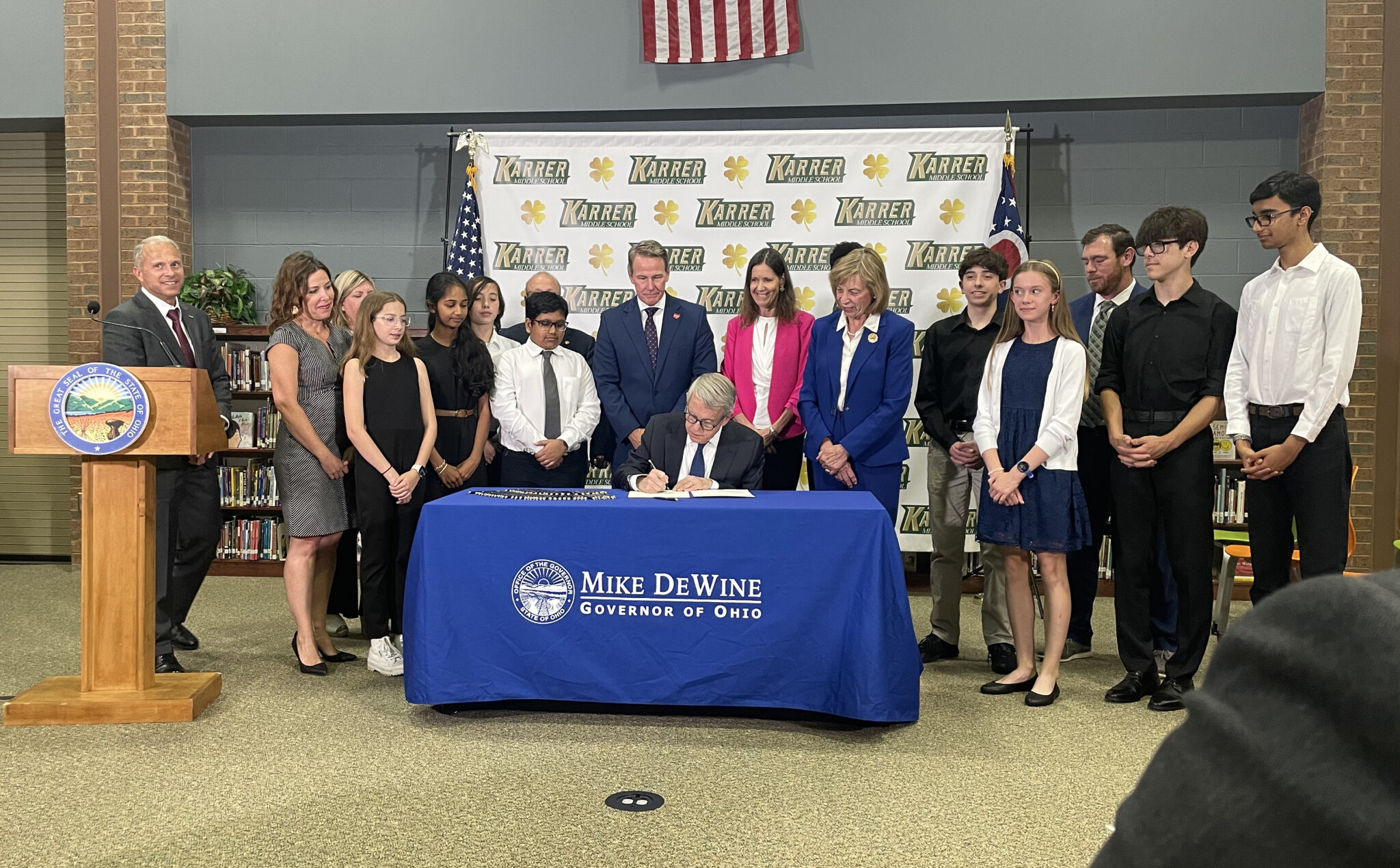
     Gov. Mike DeWine signing legislation to limit cellphones in schools. (Photo by Nick Evans, Ohio Capital Journal.)

    BY:  Ohio Capital Journal

    At a Dublin middle school Wednesday, Ohio Gov. Mike DeWine signed legislation ordering school districts around the state to develop written policies for cellphones on campus. The state education department will write it’s own model policy that districts may adopt, but so long as they come up with something to keep cellphone use “as limited as possible” districts can do what they like.

    District level view

    Several districts around the state stood up their own cellphone policies well before state lawmakers acted. Dublin City Schools, for instance, prohibited cell phones in high school classrooms this year, but they eliminated them completely for middle schools.

    “It’s so much fun to walk into a middle school lunch again,” Superintendent John Marschhausen explained. “Because it used to be you’d go in and it’d be somewhat quiet, kids looking down at their phones. But now that it’s loud, it’s fun, and the interaction and the interpersonal skills that students learn is increasing.”

     Dublin City Schools Superintendent John Marschhausen. (Photo by Nick Evans, Ohio Capital Journal.) 

    The law carries a provision retroactively blessing the policies Dublin and other school districts instituted if they meet the minimum standards laid out in law. Although it’s too soon to connect the policy changes to outcomes like test scores, Marschhausen explained the impact is still showing up in noticeable ways.

    “Our discipline is down, our bullying is down,” he explained. Without kids on social media during the day, he added, teachers and administrators aren’t forced to respond to the latest post and students’ group chats aren’t fanning the flames of that day’s drama.

    “When they go to class they learn,” Marschhausen said. “So we have statistical data for discipline that shows an improvement.”

    In a press release, Ohio Education Association President Scott DiMauro applauded the legislation, but he argued teachers — the eventual frontline of whatever policy a district establishes — need to be included in the planning process.

    “This law will ensure educators have clear guidance and support while allowing for local flexibility to set policies that will improve learning conditions,” he stated. “Our members must be included in the development of those local policies.”

    Signing ceremony

    In the Karrer Middle School library, DeWine emphasized the potential for distraction that cellphones present. Nearly all teenagers have a phone, he argued, and notifications roll in according to one study, about once every five minutes.

    “Even when students don’t check their cell phones — or when adults don’t check their cell phones — the presence of the phone impacts their ability to think,” DeWine said.

    Like Superintendent Marschhausen, the governor brought up the return of noisy lunchrooms. Lt. Gov. Jon Husted reported district leaders who have restricted access to phones report “the facts are clear.”

    “Eliminating smartphones in schools leads to improved academic performance, reduces bullying and lessens disciplinary issues,” Husted said.

    In his statements, DeWine referenced author Johnathan Haidt’s book “The Anxious Generation,” which kicked off a national discussion about removing phones in schools a few months ago.

    The administration’s victory lap comes after a brief and painless trip through the state legislature. DeWine urged lawmakers to act just five weeks ago in his State of the State address, and after hitching a ride on a noncontroversial bill dealing with military seals on high school diplomas, the idea passed both chambers unanimously.

    “You don’t get a unanimous vote out this legislature, or very few legislatures, on anything other than naming roads,” DeWine quipped after signing the bill.

    The governor said he expects state education officials to have their model policy ready for districts within the next ten days or so. The law take effect in mid-August, right in time for kids to head back to school.

    Follow OCJ Reporter Nick Evans on Twitter.


    Nick Evans
    NICK EVANS

    Nick Evans has spent the past seven years reporting for NPR member stations in Florida and Ohio. He got his start in Tallahassee, covering issues like redistricting, same sex marriage and medical marijuana. Since arriving in Columbus in 2018, he has covered everything from city council to football. His work on Ohio politics and local policing have been featured numerous times on NPR.

    Ohio Capital Journal is part of States Newsroom, the nation’s largest state-focused nonprofit news organization.

    MORE FROM AUTHOR


  • Ohio abortion rights groups add challenges to other laws to their 2021 telehealth lawsuit

    Ohio abortion rights groups add challenges to other laws to their 2021 telehealth lawsuit

    The FDA approved mifepristone under the brand-name Mifeprex. (Photo by Peter Dazeley/GettyImages).

    BY:  Ohio Capital Journal

    A long-standing lawsuit challenging Ohio law with regard to telehealth abortions might now challenge other abortion-related laws in the state, according to a new filing.

    The ACLU, the Planned Parenthood Federation of America and two other law firms filed an amendment to their original lawsuit, asking a Hamilton County Court of Common Pleas judge to add new complaints against state laws that keep certain medical professionals from prescribing a drug called mifepristone, commonly used in combination with misoprostol for medication abortions.

    A separate law being challenged prohibits physician assistants, nurse practitioners and certified nurse midwives from providing medication abortions, according to a press release by the ACLU announcing the new challenges.

    The amended complaint is an update to a lawsuit that has been active since 2021 in Hamilton County. The suit started out as a case against a law banning telehealth abortion services, that is, medication abortion appointments conducted virtually.

    Senate Bill 260

    Back in April 2021, Planned Parenthood groups sued to stop Senate Bill 260, which had been passed months prior to ban the telehealth option for medication abortions, requiring in-person visits with a physician to receive medication abortion treatment and making it a fourth-degree felony for a physician to violate the law.

    Hamilton County Common Pleas Judge Alison Hatheway has twice granted a preliminary injunction in the case, which keeps SB 260 from being enforced. The most recent preliminary injunction was put in place “until final judgment is entered in this case,” according to Hatheway’s order.

    The U.S. Food and Drug Administration lifted in-person dispensing requirements for mifepristone that same year.

    When the health clinics first sued the state over the law, they argued the law “irrationally prohibits abortion providers from using telemedicine to provide medication abortion to Ohioans.”

    The clinics also said the law violates the state constitution’s due process, equal protection and “free choice in health care” guarantees.

    An attorney for the Ohio Attorney General’s Office argued at the time that there was “no fundamental right at issue” in the case, and that the law impacted “a very narrow subset” of patients seeking abortions.

    As of November of last year, there’s a new amendment in the Ohio Constitution, one that protects the right to reproductive health, including abortion and miscarriage care. The mifepristone-misoprostol treatment can also be used in miscarriages, which are referred to in medical terms as “spontaneous abortions.”

    Attorneys hope to use the newest constitutional amendment as an argument against not only the telehealth law, but the other laws they’ve added in as well.

    “The Amendment therefore creates a new cause of action that applies directly to the challenged law … further rendering it unconstitutional,” attorneys wrote in the most recent court filing.

    They call the amendment’s passage “a major legal development” that “establishes a clear and unequivocal right to abortion” while also barring the state from interfering in abortion care.

    “Individually and collectively, the challenged laws ‘burden, penalize … interfere with, (and) discriminate against’ both Ohioans who seek to exercise their fundamental right to abortion and plaintiffs who assist Ohioans in exercising that right by providing abortion care, by delaying, impeding and restricting access to medication abortion,” court documents stated.

    Other law(suits)

    Ohio law already requires a minimum of two visits to a provider before an abortion can take place, identification of fetal cardiac activity before the procedure and a 24-hour waiting period before the procedure is conducted. All of these laws are now being challenged in one court case or another.

    In Franklin County, a lawsuit asks the court to eliminate the 24-hour waiting period before an abortion can take place and the requirements that doctors provide certain information and a fetal heartbeat exam before they can provide an abortion.

    A separate lawsuit is still chugging along in Hamilton County as well, seeking to kill the six-week abortion ban enacted in 2019. The law was almost immediately challenged, but the state was able to bring the ban back after the Dobbs decision by the U.S. Supreme Court that overturned the national abortion legalization in Roe. v. Wade.

    After the Ohio Supreme Court didn’t act on a lawsuit submitted to them, clinics moved the lawsuit to Hamilton County, where they successfully got the ban paused as the lawsuit continues.

    The state tried to appeal the pause to the state’s highest court, but the court cited “a change in law” when it rejected the appeal.

    Ohio Attorney General Dave Yost has pushed back against the Franklin County lawsuit, along with certain aspects of the six-week abortion ban suit.

    In both cases, he acknowledged the constitutional amendment “invalidated” the six-week ban, but he pushed back on arguments that the amendment covers abortion issues as broadly as abortion rights advocates think it does.

    In a filing related to the six-week abortion ban case, Yost said the amendment does not bar “all laws that touch on abortion – and even some laws that have nothing to do with abortion or anything else the amendment mentions.”

    Telehealth abortions went up following the U.S. Supreme Court decision in Dobbs. A national study from the Society of Family Planning showed 16% of abortions were conducted via telehealth as of September 2023, up from 4% pre-Dobbs.


    Susan Tebben
    SUSAN TEBBEN

    Susan Tebben is an award-winning journalist with a decade of experience covering Ohio news, including courts and crime, Appalachian social issues, government, education, diversity and culture. She has worked for The Newark Advocate, The Glasgow (KY) Daily Times, The Athens Messenger, and WOUB Public Media. She has also had work featured on National Public Radio.

    Ohio Capital Journal is part of States Newsroom, the nation’s largest state-focused nonprofit news organization.

    MORE FROM AUTHOR

  • What’s next after the FTC said the biggest grocers were inflating food costs?

    What’s next after the FTC said the biggest grocers were inflating food costs?

    BY:  Ohio Capital Journal

    The Federal Trade Commission in March released a report saying that the three largest grocers “accelerated and distorted” food costs amid supply disruptions caused by the coronavirus pandemic. It also said that prices — and profits — remain high for Kroger, Walmart and Amazon even after the supply kinks have straightened themselves out.

    But the country’s trade watchdog didn’t say in its report what might be done about it. The agency this week might have given a hint.

    The commission is already suing to block a proposed merger between Cincinnati-based Kroger and Boise, Idaho-based Albertsons, arguing that the deal will “eliminate fierce competition … leading to higher prices for groceries and other essential household items for millions of Americans.”

    But that’s unrelated to the findings of the “6(b)” report, which was started during the pandemic in November 2021. It found problems with consolidation in the grocery sector even without the Kroger-Albersons merger.

    Asked if the FTC planned to do anything about those problems, an agency official speaking on background on Monday said, “The report outlines several areas where further scrutiny by the FTC and policymakers is warranted. The report doesn’t specifically spell out any enforcement actions to be taken as a result of the report, but the report will inform the FTC’s future work as the Commission reviews potentially anticompetitive mergers and conduct as it works to protect consumers.”

    The report itself found several broad areas in which it said the three big grocers were using their size to suppress competition.

    One had to do with the big boys’ use of “on time, in full,” or OTIF, contracts with their suppliers. Because they’re such huge customers, they’re able to get strict guarantees that they’ll have their orders completely and promptly fulfilled or the supplier has to pay a steep penalty.

    The FTC report said that at the beginning of the pandemic, virtually no grocers were insisting that the terms of their OTIF contracts be met — an acknowledgement that supply-chain disruptions made it impossible. But as time wore on, some of the biggest grocers reimposed them with a vengeance, the report said.

    “Even as the supply chain crisis brought on by the pandemic continued, some retailers reimposed or even heightened the standards for their OTIF policies later in 2020,” it said. “For example, Walmart tightened its OTIF requirements in September 2020, requiring suppliers to achieve 98 percent OTIF compliance to avoid fines of 3%.”

    Imposition of the contracts had an anticompetitive effect because, in a time of scarcity, they directed limited supplies of some items to the biggest grocers while their smaller competitors went begging, the report said.

    In addition, large grocers are able to use their heft to negotiate constant, relatively low prices from suppliers, a practice known as “everyday low pricing.” Meanwhile, their smaller competitors depend on producer promotions to offer certain items at temporarily low rates.

    As the pandemic set in and producers were already struggling to fill orders, they had little incentive to voluntarily reduce prices. That created another mismatch between the biggest grocers and their smaller competitors, the FTC report said.

    “Promotions designed to increase sales made little sense when those producers were unable to meet existing demand,” it said. “These changes affected retailers differently depending on their pricing model. Most notably, these trade promotions reflect a significant amount of money within the industry, and so the competitive impact of these differential effects (or of the promotions generally), may warrant further study.”

    More broadly, food prices have jumped 25% over four years and they remain high even as supply problems related to covid have eased. Grocers have said their costs remain high, but according to the FTC report, food and beverage retailers saw their revenue rise to 6% over total costs in 2021 — higher than the previous peak of 5.6% in 2015. Then in the first three quarters of 2023, it went even higher — to 7% over costs.

    It seems that might be an avenue of further inquiry.

    “This profit trend casts doubt on assertions that rising prices at the grocery store are simply moving in lockstep with retailers’ own rising costs,” the report said. “Examining the cause or nature of rising industry profits is beyond the scope of this limited study into pandemic-related supply chain disruptions. However, the question warrants further inquiry by the Commission and policymakers.”


    Marty Schladen
    MARTY SCHLADEN

    Marty Schladen has been a reporter for decades, working in Indiana, Texas and other places before returning to his native Ohio to work at The Columbus Dispatch in 2017. He’s won state and national journalism awards for investigations into utility regulation, public corruption, the environment, prescription drug spending and other matters.

    Ohio Capital Journal is part of States Newsroom, the nation’s largest state-focused nonprofit news organization.

    MORE FROM AUTHOR

  • Ohio lawmakers balance motherhood and legislative duties

    Ohio lawmakers balance motherhood and legislative duties

    Only about 4% of Ohio state legislators are moms with children under 18 in 2022, according to Vote Mama Foundation.

    BY:  – Ohio Capital Journal

    The Mother LoadMom lawmakers grow in visibility but their proportional representation is still lacking

    A few Ohio mom lawmakers said they had an important thing to do before officially deciding to run for office — conduct a family meeting.

    “I’m a single mom, so I’m the only adult support in our family,” said state Rep. Rachel Baker, D-Cincinnati. “I knew to run and to serve would be a family endeavor, so I needed my kids to be on board.”

    In honor of Mother’s Day, the Ohio Capital Journal talked to four state lawmakers about balancing motherhood and legislative responsibilities. Only about 4% of Ohio state legislators are moms with children under 18 in 2022, according to the Vote Mama Foundation.

    Child care can be a big obstacle for moms to figure out when campaigning and, ultimately, as a lawmaker. House Minority Leader Allison Russo, D-Upper Arlington, remembers spending thousands of dollars in extra child care costs when she first campaigned in 2018. Her youngest daughter hadn’t celebrated her second birthday yet and her two sons were in elementary school at that time.

    “It was a big, expensive part of my first campaign that we paid out of pocket,” she said. “I am privileged to have the circumstance that I have with family nearby and the support network, but not everybody has that, and I think if we want more parents with young children, especially women to run for office, we have to think about how do we create this support at work.”

    Mom lawmakers and their families face additional attention and scrutiny by being in such a public position, especially on social media and during campaign season, lawmakers said.

    “Running for office where the campaigns are not always friendly can be very difficult on families,” said State Rep. Beth Liston, D-Dublin. “When you have mail pieces that come to your house that say horrible things or TV ads or YouTube streaming, I think that’s something that women feel a lot that will hurt their kids at school.”

    Ohio House Minority Leader Allison Russo, D-Upper Arlington

    Being a mom to three children influences everything Russo does in the Statehouse.

    “I am always thinking about what are we doing that is setting up our children, not just my children, but all children, for success in the future,” she said.

     COLUMBUS, OH — MAY 08: House Minority Leader Allison Russo, D-Upper Arlington, during the Ohio House session, May 8, 2024, at the Statehouse in Columbus, Ohio. (Photo by Graham Stokes for Ohio Capital Journal) 

    Russo’s children are 17, 14 and 7, and they were often with her on the campaign trail.

    “I think it was a good thing for my kids to be with me knocking on doors, because I think voters recognized that I’m just a normal person trying to balance all the things that most people are trying to balance,” she said. “It reminds people that yes, I’m a real person.”

    Her children would often get rewarded with ice cream or a cookie at a reception after being on the campaign trail with Russo.

    “(The Statehouse) certainly has been a big part of their childhood,” she said.

    Her children are in elementary, middle and high school, so she has a good understanding of what’s going on in schools — something that comes in handy with various education legislation.

    “What is clear to me, often, is legislation gets passed, or gets introduced rather, by people who don’t necessarily have kids that are currently in school,” she said.

    Russo is grateful to live about 15 minutes from the Statehouse.

    “It does give me that flexibility to be able to balance, particularly at this stage in my kids’ lives where they are very busy and involved in activities,” she said. “I want to be able to see their games. I go to school activities during the middle of the week, so because of my proximity to the Statehouse, I’m able to balance those things.”

    She leans on her husband, a set of grandparents that live nearby and supportive neighbors and friends for help with the kids and their various activities.

    “A lot of it is my husband and I, a lot of negotiation between the two of us as we both balance careers and figuring out how we’re going to make it work,” she said. “If we can’t be there, can a grandparent be there? Or do we have a friend who can take a picture or text us to let us know how the game is going?”

    State Rep. Rachel Baker, D-Cincinnati

     State Rep. Rachel Baker, D-Cincinnati, is a single mom to three adopted children. (Photo from the Ohio General Assembly website). 

    One of the biggest reasons Baker ran for office was because of her three adopted children (ages 18, 15, and 12).

    “I want to make Ohio a place that my kids want to stay, a place that my kids want to study and want to build their own life,” she said.

    Baker, who is a single mom, has continued her career as a nurse so her three children took it upon themselves to help out around the house.

    “I can’t work full time, serve in the legislature, be your mom, and do everything around the house,” she recalls thinking. “So something has to give and what it’s going to be is stuff around the house and they were like, this is important. We should do this as a family.”

    Her oldest helps with car rides, her middle son cooks dinner every night and her youngest walks the dog.

    “They really see the need for all of us to pitch in and all of us to be a family and contribute to the family and also help each other out,” Baker said, noting her son has become quite the cook.

    “No one wants to go back to my cooking,” she said. “He started that in the middle of my campaign and he still cooks dinner every night.”

    She drives up to Columbus on Tuesdays for committee meetings, stays the night in a hotel and drives back home on Wednesdays.

    “I try to do a ton of my work Tuesday evening … and try to get as much done Tuesday and Wednesday, so that I’m not doing as much in the evenings the other days when I’m home and taking time away from them,” she said.

    Being so busy has forced her family to be more deliberate in spending time together and they prioritize going out to dinner as a family every Sunday night.

    “It’s been so nice,” she said. “Everyone enjoys it.”

    State Rep. Monica Robb Blasdel, R-Columbiana

     COLUMBUS, OH — MAY 08: State Rep. Monica Robb Blasdel, R-Columbiana County, during the Ohio House session, May 8, 2024, at the Statehouse in Columbus, Ohio. (Photo by Graham Stokes for Ohio Capital Journal) 

    The distance from Blasdel’s home in Columbiana to the Statehouse is the hardest part of her job. She uses the two-and-a-half to three hour drive to take calls from constituents and listen to committee hearings.

    Blasdel does nightly FaceTime calls with her daughters (ages 7 and 5) before they go to bed when she spends the night in Columbus for her job at the Statehouse.

    “I just try to make the most of my time that I’m away from home, so that I can be more present when I am home,” she said.  “As long as I’m transparent with my girls and they understand when mommy’s coming home and how many days I’ll be away, they’re usually pretty good.”

    Her daughters were five and three when she first started campaigning for office. She is currently serving in her first term.

    “I did make a promise to my family when we made this decision together (to run for office) that they would always come first,” Blasdel said. “I included my children as much as possible when it’s appropriate on the campaign trail. I like to take them to events. I like them to see me interacting with my constituents and understand the work that I do.”

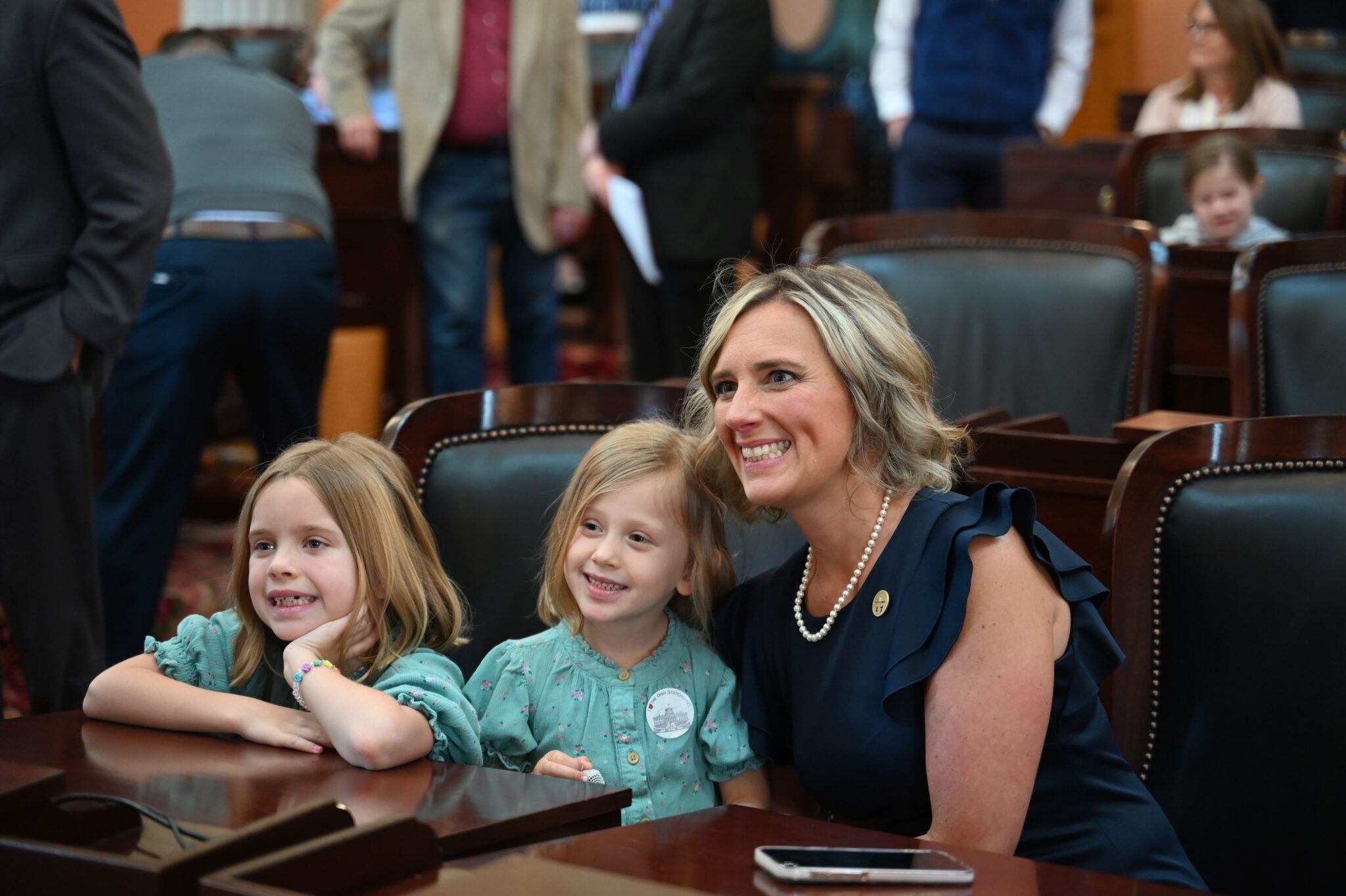
    Blasdel recently brought her daughters to the Statehouse so they could see what their mom does in Columbus.

    “That answers a lot of questions in their head,” she said. “They have a better understanding of what I’m doing when I’m down here and what my schedule looks like.”

    State Rep. Beth Liston, D-Dublin

    When Liston started running for office in 2017, her daughter (who was 13 at the time) knocked on a lot of neighborhood doors to help her mom’s campaign. Her son, who was 11 at the time, would occasionally wear a shirt to support his mom’s campaign.

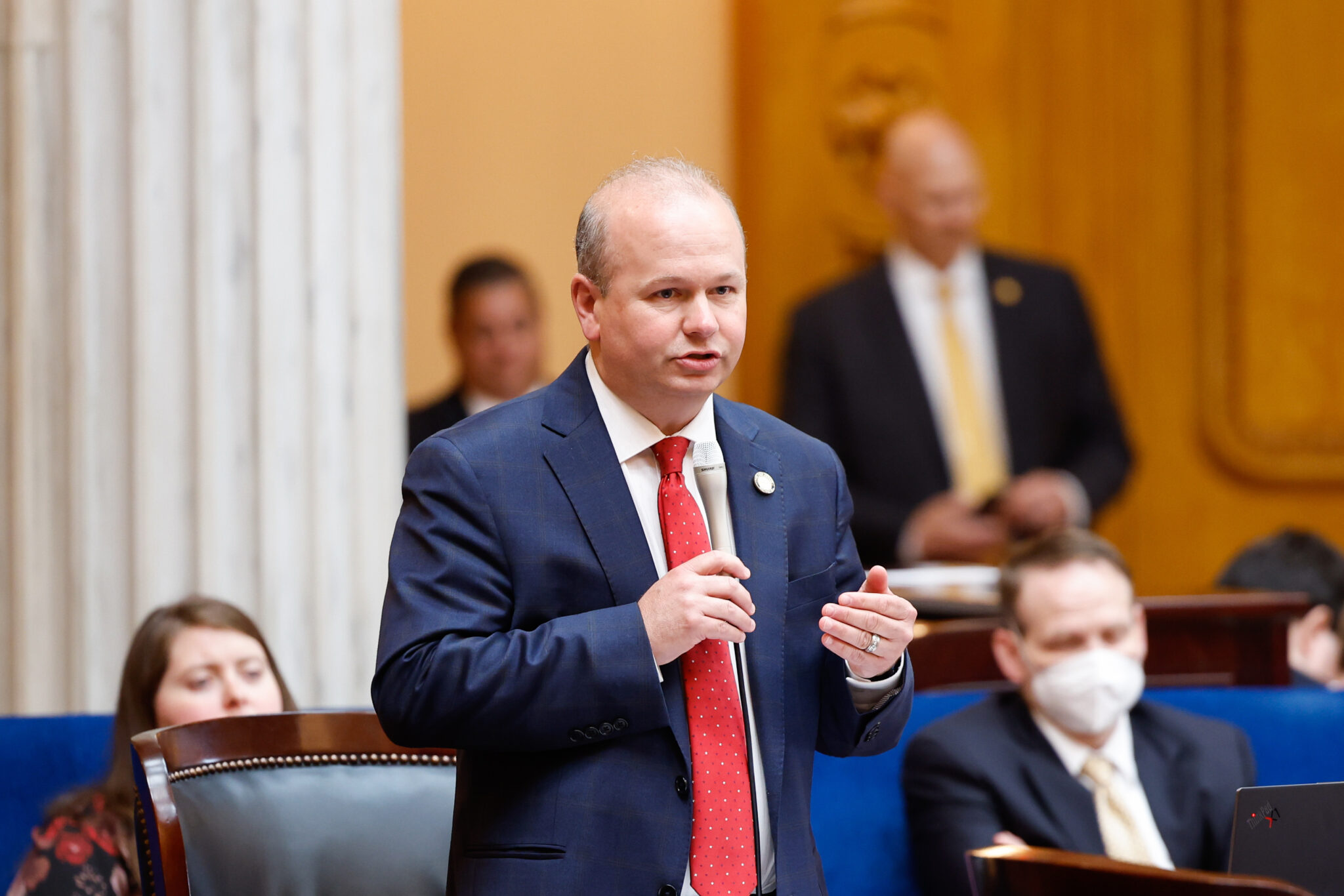
     COLUMBUS, OH — MAY 08: State Rep. Beth Liston, D-Dublin, speaks during the Ohio House session, May 8, 2024, at the Statehouse in Columbus, Ohio. (Photo by Graham Stokes for Ohio Capital Journal) 

    Her husband was a stay-at-home dad then, so he was able to help with child care.

    “I’m very lucky that way in terms of being a mom and running for office,” she said. “I know other women that I work with certainly had a lot more stress in terms of figuring out what to do with their kids.”

    But that doesn’t mean balancing being a mom and being a lawmaker doesn’t come with challenges.

    “You still don’t want to miss the things that they’re doing,” Liston said. “Even if you had someone to watch them, you still miss portions of their lives which are important to you.”

    She considers herself lucky to live near the Statehouse.

    “The role involves weird hours,” she said. “A lot of events in the evening, which isn’t really all that great for family. … It’s always deciding whether I should go to those receptions and take those evening opportunities or be at home and make sure that I see my kids and have dinner together.”

    As her children have ventured into their teenage years (her daughter is now 19 and her son is 17), she said “touch points” with her kids when they get home from school or an event have become important.

    “Those are their important points that I think it’s hard to maintain when you have such atypical hours that are not really predictable,” she said.

    House Bill 114

    An Ohio bill, among other things, is trying to help make it easier for parents to run for office by allowing political candidates to use their campaign funds to pay for child care and bring Ohio campaign finance regulations in line with federal campaign finance regulations.

    “I think it’ll help a lot of people to really start thinking about actually pursuing a role in politics and running for office,” said state Rep. Latyna Humphrey, D-Columbus. “… It’s hard to run for office and having to carry your kids with you. It makes it hard for them to do their job and really run the way that they want to because they’re trying to have that balancing act.”

    Humphrey, who has an 11-year-old son, and fellow state Rep. Bill Seitz, R-Cincinnati, introduced House Bill 114 last year and it passed the House over the summer.

    The Ohio Senate recently passed the bill but not before making significant changes by adding amendments that would allow President Joe Biden to be on Ohio’s ballot for November’s presidential election and ban foreign nationals from contributions for campaigns.

    “The original intent of (HB) 114 was to make it allow campaign funds to be used for child care for candidates running for office,” State Sen. Bill DeMora, D-Columbus, said. “Senate Republicans held us hostage by slapping completely irrelevant partisan nonsense onto this bill because they know it needs to pass.”

    Follow OCJ Reporter Megan Henry on X.


    Megan Henry
    MEGAN HENRY

    Megan Henry is a reporter for the Ohio Capital Journal and has spent the past five years reporting in Ohio on various topics including education, healthcare, business and crime. She previously worked at The Columbus Dispatch, part of the USA Today Network.

    Ohio Capital Journal is part of States Newsroom, the nation’s largest state-focused nonprofit news organization.

    MORE FROM AUTHOR

  • Ohio lawmakers approve cellphones in school measure

    Ohio lawmakers approve cellphones in school measure

    BY:  Ohio Capital Journal

    Ohio lawmakers signed off on changes to the military seal for high school diplomas on Wednesday. But the bill’s most notable provision was a last minute amendment regarding cellphones in K-12 schools that caught a ride on the non-controversial measure.

    Recently, Gov. Mike DeWine urged lawmakers to address cellphones in classrooms during his state of the state address. Now, about a month later, those changes are headed to his desk.

    Some lawmakers casually refer to the changes as a “cellphone ban,” but that’s a bit of a misnomer. Instead, the law directs every district to develop a written policy aimed at minimizing phone use during school hours and potential distractions during class instruction.

    The bill also includes an exception for students who need a phone to assist in learning or to track a health concern, so long as it is reflected in their individual education plan.

    On the Senate floor, the cellphone provision’s chief backer, Sen. Andrew Brenner, R-Delaware, explained “the legislation does not require districts to adopt a ban on all students’ cell phone use, though that is an option if the school district chooses to do so.”

    He added that those districts with cellphone policies in place don’t need to change them so long as the policy “emphasize(s) minimal use and least amount of distraction.”

    “The language also directs the Department of Education and Workforce to develop a model policy informed by evidence-based research on the effects of smartphones and classrooms, that districts may choose to adopt as their policy if they wish to do so,” Brenner said.

     COLUMBUS, Ohio — JANUARY 10: Newly sworn in State Rep. Beryl Brown Piccolantonio, D-Gahanna. (Photo by Graham Stokes for Ohio Capital Journal) 

    Across the hall in the House, Rep. Tracy Richardson, R-Marysville, emphasized how their approach gives districts direction without being prescriptive.

    “Each school district is required to create their own policy, thus ensuring — and let me make this very clear — local control,” she said.

    Up until this January, Rep. Beryl Piccolantonio, D-Gahanna, was serving as president of the Gahanna-Jefferson School Board, and she described the changes as “critically important.”

    “A frequent issue that was raised to us by staff, and by students, quite frankly, was how difficult it was for staff to enforce their own classroom policies because they didn’t have broader support to back up that enforcement.”

    She praised the measure for giving districts the “flexibility” to develop their own approaches to deal with the issue. Highlighting a recent take your child to work day event where kids debated cellphones in schools, she noted “even some of the students acknowledge the distraction that cellphones have within their classroom.”

    Follow OCJ Reporter Nick Evans on Twitter.


    Nick Evans
    NICK EVANS

    Nick Evans has spent the past seven years reporting for NPR member stations in Florida and Ohio. He got his start in Tallahassee, covering issues like redistricting, same sex marriage and medical marijuana. Since arriving in Columbus in 2018, he has covered everything from city council to football. His work on Ohio politics and local policing have been featured numerous times on NPR.

    Ohio Capital Journal is part of States Newsroom, the nation’s largest state-focused nonprofit news organization.

    MORE FROM AUTHOR

  • Gov. signals looming scandal at teachers’ pension fund

    Gov. signals looming scandal at teachers’ pension fund

    The entrance to the Ohio State Teachers Retirement System headquarters in Columbus. Photo by Marty Schladen, Ohio Capital Journal.

    BY:  Ohio Capital Journal

    After years of complaints about gold-plated salaries, billions in investment fees and lackluster returns, things seem poised to hit the fan at Ohio’s State Teachers Retirement System.

    Gov. Mike DeWine on Wednesday issued a press release saying that he was alarmed at the news that a consultant for the $90 billion retirement plan, Aon, was severing its contract.

    “This is a huge red flag, calling into question how STRS is operating and providing oversight,” the press release said. “The unstated implication is that the governance issues at STRS are so concerning that Aon could not continue its contract in good faith. STRS may now be out of compliance with portions of audit recommendations due to Aon ending the contract.”

    The statement also cited unspecified allegations against members of the pension fund’s board, to which the governor appoints some members.

    “Additionally, my office has received documents containing some other disturbing allegations regarding the STRS board,” the statement said. “I have directed my staff to forward these documents to a number of relevant offices, including the Ohio Ethics Commission, the Ohio Retirement Study Council, Attorney General Yost, Auditor Faber, Treasurer Sprague, Secretary of State LaRose, and relevant members of the Ohio General Assembly. I encourage them to review the document and take any action that may be appropriate under any jurisdiction they may have.”

    Retirees have long complained of rarely getting cost-of-living increases while the retirement system awarded huge bonuses to already well-paid investment managers. For example, the system in 2022 handed out $10 million in bonuses just before announcing that the system’s investments  lost $5.3 billion that year.

    Last November, the system’s executive director, Bill Neville, was suspended amid employee complaints of inappropriate behavior.

    DeWine himself has fueled some of the controversy at the retirement system. Exactly a year ago, just as reformers were about to achieve a majority on the board, DeWine terminated a reform member.

    DeWine said the member, Wade Steen, didn’t attend board meetings regularly enough. But Steen countered that the charge was trumped up. The Ohio 10th District Court of Appeals said DeWine’s termination of Steen was unlawful and ordered that Steen be restored to his position.

    The turmoil at the teachers’ pension fund isn’t the only controversy facing the DeWine administration.

    DeWine and his lieutenant governor, Jon Hustedhaven’t explained their and their staffs’ involvement in an epic utility scandal that featured $61 million in bribes and a $1.3 billion ratepayer bailout as the payoff. A former house speaker and a former state GOP chairman are serving lengthy federal prison sentences in the scandal, which has also resulted in two suicides.


    Marty Schladen
    MARTY SCHLADEN

    Marty Schladen has been a reporter for decades, working in Indiana, Texas and other places before returning to his native Ohio to work at The Columbus Dispatch in 2017. He’s won state and national journalism awards for investigations into utility regulation, public corruption, the environment, prescription drug spending and other matters.

    Ohio Capital Journal is part of States Newsroom, the nation’s largest state-focused nonprofit news organization.

    MORE FROM AUTHOR