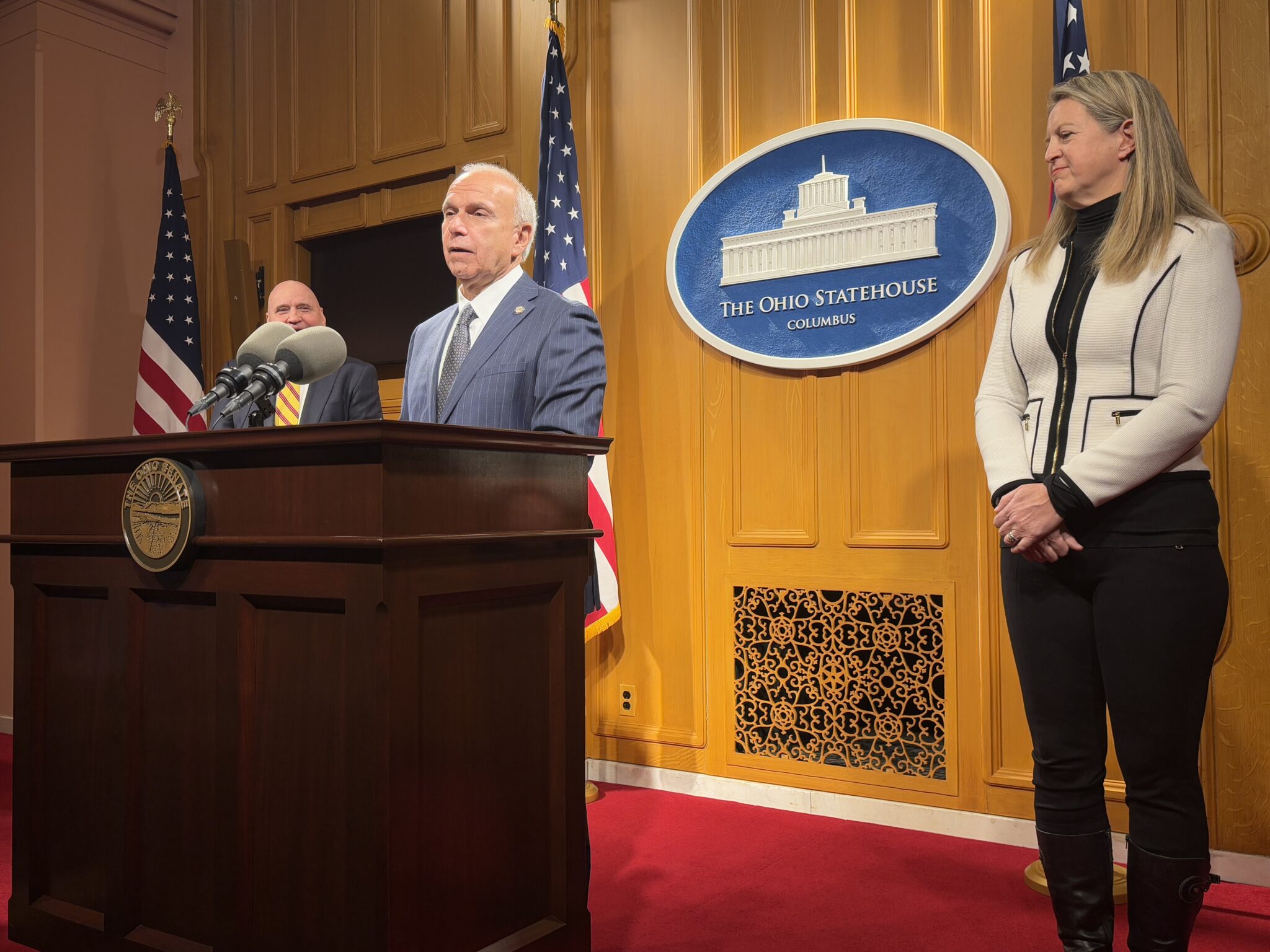
A bipartisan bill introduced in the Ohio General Assembly seeks to establish a pipeline from foster care to college or careers.
The sponsors of House Bill 25 are targeting a population of Ohioans who struggle to get through high school, and therefore may not have the guidance needed to lead them to a fruitful career in the state after leaving the foster care system.
“They are experiencing some of the worst outcomes of our state and yet the state could and should do more,” said bill co-sponsor state Rep. Dontavius Jarrells, D-Columbus.
GET THE MORNING HEADLINES.
The bill is a reintroduction of a similar bill that didn’t get through the last General Assembly before it ended in December. House Bill 164, which Jarrells co-sponsored with former state Rep. Bill Seitz, passed 85-5 in the House in June 2024, before getting tied up in the Ohio Senate Finance Committee.
Also as before, state Sen. Michele Reynolds, R-Canal Winchester, has introduced a companion bill, Senate Bill 13, for consideration in the Senate.
According to the National Foster Youth Institute, just 3-4% of former foster youth across the country obtain a four-year college degree, and between 2% and 6% receive a two-year degree. The NFYI also found that high school dropout rates are higher for foster youth than even other low-income children and more than 40% of foster children in school face “educational difficulties.”
“Aspiring to attend college motivates students to stay in school and keep their grades up,” the Children’s Defense Fund of Ohio said in support of the previous foster-to-college legislative effort. “Reducing financial barriers increases the likelihood that a student will complete their degree.”
H.B. 25 would create a scholarship program for Ohioans who are in foster care after their 13th birthday, funding tuition, fees or other education expenses outside of federal or state financial aid, according to Jarrells.
When word got out that Jarrells was reintroducing the bill, state Rep. Sharon Ray, R-Wadsworth, said she quickly reached out to become a co-sponsor, hoping to help the state and the “strong” foster care system she has in her district.
She compared the scholarship program to the GI Bill that subsidizes educational opportunities for military personnel, saying that in the same way the GI Bill “changed so many lives” by giving them the financial support they needed, this new bill could create change for foster kids.
“These kids, when they’re 18, they just age out of the system, and for these kids that have been working hard, we want to make sure they have the best chance at life,” Ray said.
Under the bill, which would appropriate $7.5 million each over the next two years, “foster care student navigators” would be hired by the state to guide those coming out of foster care with applications, higher education admission processes and things like career tech or post-high school training.
“When we invest in them, they invest back in Ohio,” Jarrells said.
According to the Children’s Defense Fund of Ohio, 35 states, including Texas and Florida, had already voted in favor of legislation like Ohio’s bill at the time it was introduced in the last GA.
The House bill has been referred to the House Workforce & Higher Education Committee, and the Senate bill has been sent to the Senate Finance Committee for consideration.
Jarrells and Ray are hopeful the fact that the bill was introduced early in the GA gives it a better chance of passage, though they also see potential for budget negotiations to include the measures in their bill.
“We want this just to be a win for the future, and hopefully something that gets continued investment so we can reach as many foster kids as we can,” Jarrells said.
YOU MAKE OUR WORK POSSIBLE.
________________
Susan Tebben
Susan Tebben is an award-winning journalist with a decade of experience covering Ohio news, including courts and crime, Appalachian social issues, government, education, diversity and culture. She has worked for The Newark Advocate, The Glasgow (KY) Daily Times, The Athens Messenger, and WOUB Public Media. She has also had work featured on National Public Radio.
Ohio Capital Journal is part of States Newsroom, the nation’s largest state-focused nonprofit news organization.
A Republican lawmaker is trying to reduce the amount of marijuana grown at home, lower the level of THC in recreational marijuana, increase the tax, and redirect the revenue from it.
Ohio Sen. Steve Huffman, R-Tipp City, recently introduced Senate Bill 56 which would make several changes to the state’s marijuana laws.
“This bill is about government efficiency, consumer and child safety, and maintaining access to voter-approved adult-use marijuana,” Huffman said in his sponsor testimony last week.
Ohioans voters passed a citizen-initiated law to legalize recreational marijuana in 2023 and sales started in August 2024. Since it was passed as a citizen initiative, Ohio lawmakers have the ability to change the law.
The bill would lower THC levels in adult-use marijuana extracts from a maximum of 90% to a maximum of 70% and merge the state’s medical and recreational marijuana programs under the Division of Cannabis Control.
“Consolidating both programs under the Division will allow for consistent requirements regarding testing, packaging, labeling, and advertising, especially those related to protecting children,” Huffman said in his testimony. “It also provides for streamlined licensing standards and general compliance procedures, cutting down on bureaucracy, red tape, and government waste.”
On the home grow side, the law currently allows 12 marijuana plants to be cultivated at a single residence, but the bill would cut that in half. Huffman said folks who are growing marijuana at home could be supplying the illicit market.
“The people did vote for home grow,” Huffman said. “I think that this is an example that we’re trying to move it to a little bit more reasonable.”
S.B. 56 would require marijuana to be transported in the trunk of a car when traveling and it specifies that marijuana is only allowed in a private residence.
“Ohio has long established open container laws regarding alcohol in motor vehicles; common sense mandates a similar rule for adult-use and medical marijuana access in motor vehicles,” said Steve Barnett, the Carroll County Prosecuting Attorney and a current officer of the Ohio Prosecuting Attorneys Association.
The bill would also up the tax on adult-use marijuana from 10% to 15%, cap the number of active dispensaries at 350, and funnel all revenue from the adult-use tax to the state general fund. There are currently 128 marijuana dispensaries in Ohio as of Friday, according to the Ohio Department of Commerce.
The current tax revenue is divided up in multiple ways — 36% to the cannabis social equity and jobs fund, 36% to the host community cannabis fund, 25% to the substance abuse and addiction fund and 3% to the Division of Cannabis Control and Tax Commissioner Fund.
Ohio Senators tried to pass a similar bill during the previous General Assembly, but it died in the House.
“So we’re basically telling the voters … screw you,” said Sen. Bill DeMora, D-Columbus. “You don’t know what you’re talking about. You passed it with an overwhelming majority of the state, but we know better.”
Huffman responded by saying he believes his bill corrects “some of the societal needs.”
“I don’t want to sit at the ball game and the guy next to my nine-year-old kid is smoking marijuana,” he said. “I think that’s wrong. That’s what the voters voted for. … I wouldn’t say we’re gutting everything. We’re trying to improve it.”
There is currently nothing in the bill related to expungement, so DeMora asked about the possibility of adding expungement to the bill and Huffman sounded open to that possibility.
“Through this committee process, we will certainly be open to any type of amendments to do something along that line,” Huffman said.
Despite Ohio Gov. Mike DeWine pleas to lawmakers to regulate or ban delta-8 THC products, hemp is not included in the bill. There was a bill in the last General Assembly that would have banned the sale of intoxicating hemp, but the bill never made it out committee.
However, Huffman hinted that a separate bill dealing with hemp will be introduced soon.
“I find both of them to be very complex issues,” he said.
Megan Henry is a reporter for the Ohio Capital Journal and has spent the past five years reporting in Ohio on various topics including education, healthcare, business and crime. She previously worked at The Columbus Dispatch, part of the USA Today Network.
Ohio Capital Journal is part of States Newsroom, the nation’s largest state-focused nonprofit news organization.
As Ohio math scores continue to be below pre-pandemic levels, a proposed bill would bring math interventions to Ohio school districts that score below certain proficiency standards.
Ohio Sen. Andrew Brenner, R-Delaware, recently introduced Senate Bill 19 which would require school districts or individual schools to come up with a math achievement improvement plan if they don’t have at least 52% of students receive a proficient score in math comprehension. A student’s comprehension is rated at one of five levels of proficiency: limited, basic, proficient, accomplished, and advanced.
The bill would also require every district to create a math improvement and monitoring plan for students who qualify for math intervention services.
During the 2022-23 school year, almost a third of Ohio students scored “limited” on their math proficiency, Brenner said Wednesday during his sponsor testimony.
“Clearly, a disturbing number of Ohio children are in need of significant and prolonged academic intervention before it is too late to address their desperately-needed learning deficiency,” Brenner said to the Senate Education Committee.
“It is still needed to address the critical need for learning acceleration for Ohio’s students most in need of additional academic support,” Brenner said in his sponsor testimony.
GET THE MORNING HEADLINES.
Under the bill, schools would be required to develop math improvement and monitoring plans for each student that qualifies for math intervention services within 60 days after getting the student’s third grade assessment math results.
A math improvement and monitoring plan would identify the student’s “specific math deficiencies,” describe the additional instructional services they will receive, offer a chance for their parent or guardian to be involved, outline a monitoring process and offer high-dosage tutoring at least three days a week.
Alabama, Mississippi, and Tennessee have enacted math legislation similar to what Ohio is proposing and those states have seen their math scores improve, said Lindsey Henderson, math policy director for ExcelinEd.
“It’s never too late to get policy in place to move the needle on math improvement,” she said. “It’s really exciting to see states really taking a leap and going after it like they did literacy.”
A lot of education policy at the state level has focused on reading in recent years.
Ohio’s 2023 budget included provisions that are going toward implementing the science of reading, which is based on decades of research that shows how the human brain learns to read and incorporates phonemic awareness, phonics, fluency, vocabulary, and comprehension.
Forty states and the District of Columbia have passed or implemented new policies related to evidence-based reading instruction since 2013, according to Education Week.
“Reading has taken a lot of oxygen, for good reason,” Henderson said. “Reading and writing is a skill you can’t be an engaged citizen without, but the next most important skill is going to be mathematics. … We would never say I’m not a literacy person, that’s not socially acceptable. But to say that I’m not a math person is a socially acceptable thing to say, and we’re really trying to change that narrative.”
S.B. 19 is not just limited to math. The bill would also require school districts to provide evidence-based academic intervention services to students based on their English language arts state assessment.
The Nation’s 2024 Report Card was released this week and the only increase at the national level was a slight bump in fourth grade math. There was no significant change with eighth grade math and scores declined in four and eighth grade reading.
Approximately 235,000 fourth-graders from 6,100 schools and 230,000 eighth-graders from 5,400 schools participated in the 2024 math and reading assessments between January and March of last year.
For Ohio, the average fourth-grade math score was 239, two points higher than the national average and one point higher than the state’s fourth grade math scores in 2022. The scale for NAEP scores is 0-500.
The state’s average eighth-grade math score was 279, seven points higher than the national average and three points higher than the state’s 2022 test.
Ohio’s average fourth-grade reading score was 216, two points higher than the national average, but three points less than the state average in 2022.
The state’s average eighth-grade reading score was 260, three points higher than the national average, but two points lower than Ohio’s score in 2022.
Aaron Churchill, Ohio Research Director for the Thomas B. Fordham Institute, called the state’s NAEP scores a disappointment.
“Overall, these results indicate that far too many Ohio students are struggling to master core math and reading skills,” he said in a statement.
Megan Henry is a reporter for the Ohio Capital Journal and has spent the past five years reporting in Ohio on various topics including education, healthcare, business and crime. She previously worked at The Columbus Dispatch, part of the USA Today Network.
Ohio Capital Journal is part of States Newsroom, the nation’s largest state-focused nonprofit news organization.
An executive order signed by President Donald Trump directs an emphasis on school choice and private school voucher programs when it comes to education funding, something that’s been happening in Ohio for several decades now.
While it’s unclear how much power the executive order will have with spending decisions decided by Congress, the executive order directs to the U.S. Department of Education to prioritize “school choice” programs in grant funding, and requires the U.S. Department of Health and Human Services to guide states on block grants that can be used for private schools.
The executive order also directs the U.S. Department of Education to release guidance on using federal funding formulas for private school scholarship programs, and for military families in particular to be given information on scholarships.
It’s not yet clear how this will affect individual states, but Ohio has already vastly expanded its private school voucher programs over the last two decades, and recently passed near-universal levels eligibility.
Huffman called the future of the current funding model – also called the Fair School Funding Plan or the Cupp-Patterson plan – a “fantasy,” but has seemingly softened his stance for now after hearing from members of his own party.
A spokesperson for Huffman and the House Majority Caucus did not respond to a request for comment on the executive order.
GET THE MORNING HEADLINES.
The president and CEO of EdChoice, Ohio’s private voucher program, praised the order in a statement, saying prioritizing and expanding such programs “is a crucial step toward empowering families and giving them greater control over their children’s education.”
“This initiative reflects a commitment to funding students not systems and to ensuring the proper role of the federal government in education,” EdChoice President and CEO Robert Enlow said in the Wednesday statement. “It recognizes both the appropriate role of the federal government on education and the fact that education is primarily a state function.”
Public school advocates feel the same way about a federal push for private school funding expansion as they do about state-level funding increases, for which a lawsuit was filed in Franklin County Common Pleas Court to eliminate the private school voucher program.
The lawsuit argues that funding for private schools is coming out of the coffers of the public school system, something the state is constitutionally obligated to fund properly.
“Diverting public money to unaccountable and ineffective private schools is a failed strategy that runs counter to public opinion,” Ohio Federation of Teachers head Melissa Cropper told the Capital Journal.
A 2024 survey done by All4Ed, Lake Research Partners and the Tarrance Group, found a majority of American voters support public education, and an increase in funding to improve public schools. This included 58% of Republicans surveyed. Only 34% of GOP voters polled said funding for voucher programs should be increased.
“Voters view public schools, including their local public school, more favorably than charter, private or religious schools,” the study stated.
Cropper called the move by the Trump administration “a strategy straight of Project 2025,” the playbook written and supported by right-wing Heritage Foundation members, some of whom have become players in the Trump administration, including the White House budget office.
“Regardless of what politicians do, Ohio educators and school staff will continue fighting for the resources that our students deserve,” Cropper said.
YOU MAKE OUR WORK POSSIBLE.
_______________
Susan Tebben
Susan Tebben is an award-winning journalist with a decade of experience covering Ohio news, including courts and crime, Appalachian social issues, government, education, diversity and culture. She has worked for The Newark Advocate, The Glasgow (KY) Daily Times, The Athens Messenger, and WOUB Public Media. She has also had work featured on National Public Radio.
Ohio Capital Journal is part of States Newsroom, the nation’s largest state-focused nonprofit news organization.
President Donald Trump attends inauguration ceremonies in the rotunda of the U.S. Capitol on Jan. 20, 2025, in Washington, D.C. (Photo by Chip Somodevilla/Getty Images)
WASHINGTON — A second federal judge appears ready to issue an order blocking the Trump administration from freezing funding on grant and loan programs, despite a move by the Office of Management and Budget to rescind a controversial memo Wednesday just before the hearing.
Chief Judge John J. McConnell Jr. of the U.S. District Court in Rhode Island opted not to issue his ruling during the virtual hearing, saying that he first wanted the Democratic attorneys general who filed the suit to suggest how such an order might be worded. He then wants to hear from the Justice Department lawyer arguing the case on behalf of the Trump administration about the scope of that possible order.
McConnell, who was appointed by former President Barack Obama, said the state attorneys general had convinced him that the Trump administration was likely to continue with the funding halt detailed in the now-revoked OMB memo in some way, based on a social media post from White House press secretary Karoline Leavitt.
“That hasn’t changed based on comments by the president’s press secretary,” McConnell said. “And so I’m inclined to grant the restraining order, though I’m struggling with how it would be worded and what effect it would have.”
A ruling from McConnell would be the second order blocking the Trump administration from implementing a spending pause on certain grant and loan programs.
District Judge Loren L. AliKhan on Tuesday issued a short-term administrative stay preventing President Donald Trump’s administration from starting the spending freeze. She then set a hearing in that case, brought by organizations that receive federal funding, for Feb. 3.
The original memo, released Monday evening by the Office of Management and Budget, led to widespread confusion and frustration among organizations like Meals on Wheels and grantees that rely on funding from the Department of Veterans’ Affairs, as well as members of Congress from both political parties.
Memo rescinded
The Trump administration’s Office of Management and Budget rescinded that memo Wednesday, though comments from Leavitt just afterward led to even more confusion just before the hearing began.
Leavitt wrote in a social media post that OMB rescinding the memo was “NOT a rescission of the federal funding freeze.”
“It is simply a rescission of the OMB memo,” Leavitt wrote. “Why? To end any confusion created by the court’s injunction.”
“The President’s EO’s on federal funding remain in full force and effect, and will be rigorously implemented,” she added.
Separately, Leavitt issued a written statement to reporters that seemed to suggest rescinding the OMB funding freeze memo was meant to get around AliKhan’s order.
“In light of the injunction, OMB has rescinded the memo to end any confusion on federal policy created by the court ruling and the dishonest media coverage,” Leavitt wrote in a statement. “The Executive Orders issued by the President on funding reviews remain in full force and effect and will be rigorously implemented by all agencies and departments. This action should effectively end the court case and allow the government to focus on enforcing the President’s orders on controlling federal spending. In the coming weeks and months, more executive action will continue to end the egregious waste of federal funding.”
Appropriators praise withdrawal of memo
Maine Republican Sen. Susan Collins, chairwoman of the Senate Appropriations Committee, welcomed OMB’s action before Leavitt’s post and the hearing.
“I am pleased that OMB is rescinding the memo imposing sweeping pauses in federal programs,” Collins wrote in a statement. “While it is not unusual for incoming administrations to review federal programs and policies, this memo was overreaching and created unnecessary confusion and consternation.”
Senate Appropriations Committee ranking member Patty Murray, D-Wash., released a statement that the Trump administration reversal was the right decision. That was also before Leavitt weighed in.
“This is an important victory for the American people whose voices were heard after massive pressure from every corner of this country — real people made a difference by speaking out,” Murray wrote. “Still, the Trump administration — through a combination of sheer incompetence, cruel intentions, and a willful disregard of the law — caused real harm and chaos for millions over the span of the last 48 hours which is still ongoing.”
White House assurances
OMB’s decision to rescind the memo Wednesday followed the White House making public assurances Tuesday that the spending freeze wouldn’t impact Social Security, Medicare, Medicaid and direct food assistance programs like the Supplemental Nutrition Assistance Program, or SNAP.
Two separate lawsuits seeking to block the OMB memo from taking effect on Tuesday evening at 5 p.m. were filed in federal district court.
The lawsuit filed by the National Council of Nonprofits, American Public Health Association and Main Street Alliance led to federal District Court Judge AliKhan placing a temporary hold on the planned spending freeze until Feb. 3 at 5 p.m.
The second lawsuit, heard Wednesday, was filed by Democratic attorneys general from New York, Arizona, California, Colorado, Connecticut, Delaware, Hawaii, Illinois, Maine, Maryland, Massachusetts, Michigan, Minnesota, Nevada, North Carolina, New Jersey, New Mexico, Oregon, Rhode Island, Vermont, Washington, Wisconsin, and the District of Columbia.
Last updated 5:42 p.m., Jan. 29, 2025
Jennifer Shutt
Jennifer covers the nation’s capital as a senior reporter for States Newsroom. Her coverage areas include congressional policy, politics and legal challenges with a focus on health care, unemployment, housing and aid to families.
Ohio Capital Journal is part of States Newsroom, the nation’s largest state-focused nonprofit news organization.
As the federal government looks at ways to cut costs and fund Trump-administration measures, a congressional committee is considering a cut that could take billions from school breakfast and lunch programs.
That cut could impact more than 280,000 students in Ohio alone, and 728 schools in the state, according to data from the Food Research & Action Center.
FRAC identified this loss from a proposal being discussed by the Republican-led U.S. House Ways and Means Committee — membership of which includes Ohio Reps. Mike Carey and Max Miller — as part of upcoming budget reconciliation in the Capitol. The proposal would chop $3 billion from school breakfast and lunch programs.
“Taking away this important and effective way for local schools to offer breakfast and lunch at no charge to all their students would increase hunger in the classroom, reintroduce unnecessary paperwork for families and schools, increase school meal debt and bring stigma back into the cafeteria,” according to FRAC senior child nutrition policy analyst Erin Hysom and interim child nutrition programs and policy director Alexis Bylander.
The proposal would directly impact schools that don’t fall under the Community Eligibility Provision, a service based out of the federal National School Lunch Program, that serves districts in high poverty areas, allowing them to distribute meals at no cost to the students.
Schools are deemed eligible for CEP based on their participation with other programs like the Supplemental Nutrition Assistance Program (SNAP) and the Temporary Assistance for Needy Families (TANF).
According to a summary of the proposal among a list of possible budget reconciliation plans obtained by Politico, the CEP eligibility would be raised from the previous level of schools with 40% participation in the other federal programs to 60%.
GET THE MORNING HEADLINES.
Hysom and Bylander say the new proposal would reduce eligibility for CEP, making more than 24,000 schools nationwide and 12 million children no longer eligible, including the more than 280,000 Ohio children impacted.
The advocacy group Children’s Defense Fund-Ohio said the loss from this proposal would impact more Ohio children “than there are residents in the city of Toledo, Ohio’s fourth-largest city.”
“As I’ve said before, free meals can help our students thrive mentally, socially and physically, especially those whose parents are currently trying to do all they can to support their children while juggling their responsibilities at work and fighting inflationary costs at home,” Dr. John Stanford, state director of CDF-Ohio, told the Capital Journal.
Stanford also pointed to public opinion and a 2024 Republican research firm poll that showed a majority of Ohioans support universal free school breakfast and lunch programs for public schools.
“So why would our lawmakers on Capitol Hill look to pass federal legislation that goes against the wishes of all Ohioans and effectively reduces access to free meals for students by increasing bureaucratic paperwork for school administrators,” Stanford asked.
A 2023 report from the CDF-Ohio showed 1 in 6 children live in a household that experiences hunger and more than 1 in 3 children who live in households with food insecurity already don’t qualify for school meals.
Both Stanford and FRAC said the changes proposed by the Ways and Means Committee would create further opportunities for students to “fall through the cracks” by requiring proof of income to apply for free and reduced meals. The meal programs had already seen decreases in participation, due to the lapsing of COVID-19 pandemic waivers of school meals costs.
Ohio saw a 14% drop in average lunch participation due to the loss of the waivers.
“We need our lawmakers to be completely focused on helping children and not creating unnecessary bureaucratic red tape for an evidence-based, best practices program that’s working,” Stanford added. “This proposal would achieve the opposite.”
The state used its own budget in 2023 to make meals free for those who qualified for reduced-price meals, along with those who qualified for no-cost meals, but didn’t go the distance on universal school meals. The state is set to pass another operating budget this year that could include the discussion again, with a new House Speaker and Senate President at the helm.
YOU MAKE OUR WORK POSSIBLE.
_______________
Susan Tebben
Susan Tebben is an award-winning journalist with a decade of experience covering Ohio news, including courts and crime, Appalachian social issues, government, education, diversity and culture. She has worked for The Newark Advocate, The Glasgow (KY) Daily Times, The Athens Messenger, and WOUB Public Media. She has also had work featured on National Public Radio.
Ohio Capital Journal is part of States Newsroom, the nation’s largest state-focused nonprofit news organization.
This story is about suicide. If you or someone you know needs support now, call, text or chat the 988 Lifeline.
More than 1,700 Ohioans died by suicide in 2023, according to the Ohio Department of Health.
The number of Ohioans who died by suicide decreased 1% in 2023, according to ODH’s 2023 Suicide Report.
“Every death by suicide is a tragedy that deeply affects so many,” said ODH Director Bruce Vanderhoff. “This is a sobering fact, and it is why, even though we take some encouragement from this slight decline, we are committed to continuing to work hard to drive those numbers down further.”
This is the first time in three years there has been a decrease. 1 ,777 Ohioans died by suicide in 2023 — 20 fewer than 2022.
“While this decrease in suicide deaths is certainly a step in the right direction, we must continue to make improvements in suicide prevention and mental health,” Ohio Gov. Mike DeWine said in a statement. “Depression and suicide remain a serious threat – especially to our kids. If anything, our progress should inspire us to further advance our commitment to this life-saving work, because the life of every Ohioan is precious.”
GET THE MORNING HEADLINES.
Nearly five Ohioans died by suicide each day — including one person ages 10-24 every 36 hours, according to the report.
“These are moms, dads, brothers, sisters, neighbors, co-workers and all of these losses are truly a human tragedy and a reminder that we have to do more,” said LeeAnne Cornyn, director of the Ohio Department of Mental Health and Addiction Services. “We want all Ohioans to be well, get well and stay well, so that they can live up to their full God given potential every single day.”
Suicide was the 12th leading cause of death overall in Ohio and was the second-leading cause of death among Ohioans ages 10-14 and 20-34, according to the report.
Nearly 70% of Ohio suicide deaths were white-non-Hispanic males and Ohioans ages 45-54 was the age group with the highest rate of suicide deaths, according to the report.
Firearms were used in more than half of all Ohio suicide deaths and and the use of drug poisoning increased by 11% in 2023, according to the report.
Black non-Hispanic females and white non-Hispanic females saw the largest decrease in rate of suicide deaths, both by 6%, according to the report.
The 988 Suicide & Crisis Lifeline launched in July 2022 and Ohio’s 19 call centers have responded to more than 440,000 calls, chats and texts.
“Every single Ohioan plays a role in reducing suicides, and that’s why we have also worked to equip thousands and thousands of Ohioans with the skills that they need to recognize mental illness or substance use disorder and have the skills that they need to talk to their peers, to talk to their family members and help connect them to care,” Cornyn said.
Megan Henry is a reporter for the Ohio Capital Journal and has spent the past five years reporting in Ohio on various topics including education, healthcare, business and crime. She previously worked at The Columbus Dispatch, part of the USA Today Network.
Ohio Capital Journal is part of States Newsroom, the nation’s largest state-focused nonprofit news organization.
Ohio State Sen. Jerry Cirino, R-Kirtland, introduced Senate Bill 1 on Jan. 22, 2025. (Photo by Megan Henry, Ohio Capital Journal).
Cirino’s proposed overhaul failed to move forward under previous Ohio House Speaker Jason Stephens, but has new potential life under Speaker Matt Huffman
A Republican state senator has reintroduced a controversial proposal to massively overhaul higher education in Ohio, including a ban on diversity and inclusion efforts as well as a ban on labor strikes by faculty and staff.
Kirtland Republican state Sen. Jerry Cirino’s proposed Senate Bill 1 — the Advance Ohio Higher Education Act — was introduced during a press conference Wednesday and is similar to the bill Cirino introduced during the last General Assembly, with some additions.
“It’s called Senate Bill 1 for a reason,” Cirino said. “It is our top priority, and we’re going to move this along quickly. … We’ve already had a lot of hearings on Senate Bill 83.”
He said the bill is going to be on a fast track and Senate Higher Education Committee Chair Kristina Roegner said hearings on the bill will likely start next week.
“We are promoting more speech, not less speech, as some of our opponents have said, more discussion and debate on all topics, less indoctrination, institutional support by trustee actions and policy moves that we’re requiring the trustees to make, to support an environment of diversity of thought,” Cirino claimed.
S.B. 1 includes “virtually everything from Senate Bill 83,” said Cirino, who is the vice chair of the Ohio Senate Higher Education Committee.
GET THE MORNING HEADLINES.
Cirino’s former higher education bill, Senate Bill 83, was unable to make it across the finish line during the previous General Assembly. It passed in the Senate and in the House committee, but former Ohio House Speaker Jason Stephens, R-Kitt Hill, never brought it to the House floor for a vote. The previous bill underwent 11 revisions.
Cirino made good on his promise to reintroduce a similar bill in January and the bill could have an easier time in the House now that Matt Huffman, R-Lima, is the House Speaker. Lawmakers in the Ohio House plan on introducing a companion bill.
What is in S.B. 1?
S.B. 1 has yet to be posted online, but Cirino said the bill includes a post-tenure review, annual performance reviews of faculty, a retrenchment provision that would block unions from negotiating on tenure and public syllabuses. The bill would prohibit political and ideological litmus tests in hiring, promotion, and admissions decisions.
A big change with S.B. 1 is banning diversity, equity and inclusion courses in addition to the trainings. The former bill would have banned mandatory diversity, equity and inclusion training unless it is required to comply with state and federal law, professional licensure requirements or receiving accreditation or grants.
“(DEI) has become institutionalized discrimination paid for by the taxpayers,” Cirino said.
Ohio House Rep. Bob Young, R-Dayton, said the focus of the bill shouldn’t be the DEI ban.
“Let’s truly focus on why we’re here and who we are in higher education, and that is to educate a workforce to compete globally and grow Ohio and jobs and families and attract more people to come in,” Young said.
The on faculty and staff’s ability to strike is back in the bill, something Cirino claimed was not an anti-labor issue.
“When a student signs up for instruction for a semester, they pay in advance, or they can’t go into the class,” Cirino said. “That represents a contract between the students and the institution, and because there are public institutions, therefore a contract with the state, they have to deliver that instruction and trade for the dollars per pen.”
Youngstown State University workers went on strike for a few days in 2020 over pay disputes, and Wright State University went on strike for almost three weeks in January 2019 over pay disputes and health care.
“The threat of (a strike) is what is used, and the students are being used as pawns in order to get better working hours, a better dental plan, or whatever the case may be,” Cirino said. “If we value higher education the way we do, we should also value the fact that that contract needs to be fulfilled, and nothing except force majeure should ever get in the way of students getting what they have paid in advance for.”
S.B. 1 would shorten university board of trustees terms from nine years down to six years.
“It’s been difficult to find trustees willing to make nine year commitments and the governor agrees with this,” Cirino said. “We’re talking about not just changing their terms, but also requiring new trustee training programs that would be adjudicated through the Chancellor’s Office.”
Requiring students to take an American history course is also back in the bill.
“I have become more and more convinced of that necessity over time now, since we first wrote the bill, as I’ve talked with more and more young people who have no clue about so many important things about our history and our founding documents and so on,” Cirino said.
Opposition to S.B. 1
Cirino acknowledged there will be lots of opposition with S.B. 1, just as there was with his previous bill.
“Senate Bill 1 is a misguided attempt to micromanage higher education in Ohio, imposing unnecessary restrictions on our universities, faculty, and students,” state Sen. Casey Weinstein, D-Hudson, said in a statement.
More than a dozen students from the Ohio Student Association protested S.B. 1 with chants of “When Black studies are under attack, what do we do? Stand up, fight,” and “Higher ed will be dead,” among others.
“The students that were out here protesting are probably getting extra credit for being here,” Cirino said. “I don’t believe that they have studied the bill and all the implications of this legislation and the impact on higher education in Ohio. I believe that they were asked to be here by their professors.”
Brielle Shorter, a 20-year-old Ohio State University student, protests against Senate Bill 1 on Jan. 22, 2025. (Photo by Megan Henry, Ohio Capital Journal).
Brielle Shorter, a 20-year-old Ohio State University student, was among the students who protested against the bill Wednesday.
“No, we are not here for extra credit,” she said. “That’s not how this works. I believe that this bill is being pushed very fast and very rapidly.”
Pranav Jani, president of the Ohio State University chapter of the American Association of University Professors and an English professor, said Cirino’s quip about students protesting for extra credit is “one of the most insulting things I’ve ever heard said about students.”
“It shows how out of touch he is with what happens in the classroom,” Jani said.
If this bill is signed into law, Shorter — who is from Cincinnati and wants to be a psychiatrist — said she would go out-of-state to continue her education.
“I fear that I can no longer call Ohio my home,” Shorter said. “It feels like students are being pushed out, and it feels like I might be one of them.”
Many college students have said they would move out of Ohio if this bill was signed into law, but Cirino called that “a red herring” during Wednesday’s press conference.
Education organizations were quick to oppose S.B. 1.
“(S.B. 1) uses culture war politics to attack workers’ rights and turn campuses into hostile environments for people of color, immigrants, and other marginalized communities,” Ohio Federation of Teachers President Melissa Cropper said in a statement.
Ohio Conference of the American Association of University Professors Executive Director Sara Kilpatrick hopes Cirino will listen to the students’ concerns with this bill.
“He’s not interested in hearing opposing views, which shows that this bill isn’t about intellectual diversity, but is actually about pushing a partisan agenda,” Kilpatrick said in a statement.
Megan Henry is a reporter for the Ohio Capital Journal and has spent the past five years reporting in Ohio on various topics including education, healthcare, business and crime. She previously worked at The Columbus Dispatch, part of the USA Today Network.
Ohio Capital Journal is part of States Newsroom, the nation’s largest state-focused nonprofit news organization.
Joe Calhoun launched his activism during the 1968 Memphis sanitation workers strike, listening to Rev. Martin Luther King Jr. and other leaders in the Civil Rights Movement
MEMPHIS — At the National Civil Rights Museum at the Lorraine Motel in Memphis one September day, tourists pause solemnly before a group of life-size statues, some crafted in Tennessee National Guard uniforms, others with red and white signs draped around their necks that proclaim, “I Am a Man.”
The visitors are of all ages. Some of the older people doubtless remember the genesis of the “I Am a Man” slogan — the 1968 Memphis sanitation workers strike in which workers wore the signs to point out their humanity in the face of hazardous working conditions.
One man stands apart from the whispering guests. Joe Calhoun needs no videos or displays to remind him of the strike depicted in the museum exhibit.
He lived it.
Calhoun, now 75, assembled the strikers’ signs as a teen during the three-week period he worked adjacent to Rev. Martin Luther King Jr. during the civil rights icon’s final visit to Memphis before he was assassinated on April 4, 1968.
“I didn’t understand the scope”
Calhoun moved with his family to Memphis in 1967. His father was a U.S. Air Force officer and was stationed overseas until Calhoun was 15. Life in Memphis was a culture shock.
“I lived in Memphis towards the end of the Jim Crow laws, but the treatment was still the same,” Calhoun said. “There was segregation in stores. Black people could buy clothes but you couldn’t try them on.”
“It was completely foreign to anything I had experienced,” he said. “I came from a very protected and multicultural environment in the military and living out of the country. My background didn’t give me what I needed to arm myself.”
Just months before Calhoun graduated from Melrose High School in Orange Mound, a Black neighborhood on the south side of Memphis, two trash collectors — Echol Cole and Robert Walker — were crushed as they loaded garbage into a malfunctioning truck. The February 1968 incident wasn’t the first time workers had been killed in a similarly gruesome fashion, but Memphis officials still refused to replace the faulty equipment.
The deaths of Cole and Walker were the last straw for their fellow workers, most of whom were Black and worked for low pay in filthy and dangerous conditions, treated more like animals than humans, they would say while on strike.
When a call went out for volunteers to assist with the strike, Calhoun saw an opportunity to get involved, assembling the iconic signs with the phrase on them chosen as a statement of the workers’ humanity.
“The whole civil rights thing was new to me, and I just thought that what was going on was wrong,” Calhoun said. “So when a call went out for high school and college students to help with the strike, I saw an opportunity.”
Calhoun said his parents were concerned about him traveling from their home to the staging site of the strike at the Clayborn Temple near Beale Street in the heart of downtown Memphis. The city was tense, a curfew was imposed and the National Guard deployed to keep order.
For three weeks, Calhoun lived in the church attic, listening as King and other national civil rights leaders, like Bayard Rustin, James Bevel, Rev. James Lawson and Stokely Carmichael, planned how to get better conditions and higher pay for the sanitation workers.
Joe Calhoun lived in the attic of the Clayborn Temple in Memphis for three weeks in 1968 while working on the sanitation workers strike. The strike is commemorated with the I Am a Man Plaza at the now vacant church. (Photo by John Partipilo) “I was in a meeting with them. I got coffee and cigarettes for Rev. King and others. I was a runner for them,” Calhoun said. “But I didn’t understand the scope of what was happening. You know when you are young, and your teacher tells you to do something, you do it without thinking about the long-term ramifications of what you are doing.”
The 1968 strike wasn’t the first time workers had tried to gain concessions from Memphis. They had been granted a charter for a local union from the American Federation of State, County, and Municipal Employees (AFSCME) in 1964 and also went on strike in 1966 but failed. King’s presence in 1968 drew national attention to the workers’ plight, and it was in Memphis the day before his assassination that he gave his last speech, known as “I’ve Been to the Mountaintop.”.
Organizers with AFSCME negotiated a deal with Memphis officials to recognize a sanitation workers union, bringing the strike to a close on April 16.
Feet in the movement
King was assassinated at the Lorraine Motel. Just as the Civil Rights Movement didn’t die with him, neither did Calhoun cease his activity.
Shortly after King’s murder, Calhoun traveled to Washington, D.C., to help fulfill King’s plan for a Poor People’s Campaign, living in Resurrection City, the 42-day tent encampment on the National Mall.
In 1969, as a member of the Memphis Invaders, a group that fused the organizing strategies of the Student Nonviolent Coordinating Committee and the more militant Black Panthers, Calhoun participated in 1969’s Walk Against Fear from Memphis to Little Rock, Arkansas.
Calhoun had met Invaders leader Lance “Sweet Willie Wine” Watson — he later changed his name to Suhkara A. Yahweh — during the sanitation strike. By the time Watson staged the Walk Against Fear, Calhoun was working for VISTA, a federal anti-poverty program, in Forrest City, Arkansas, Watson’s staging point for the march.
During the 135-mile walk, Calhoun and other members of the group faced daily threats of violence from white Arkansans, including, he recalled, from members of the University of Arkansas football team packed into a flatbed truck in Hazen.
Calhoun, left, marched in 1969’s Walk Against Fear with Memphis Invaders leader Lance “Sweet Willie Wine” Watson. (Photo by Ernest Withers, courtesy of Joe Calhoun)
Taking a break and finding a new mission
Around 1970, the Invaders disbanded. Calhoun married in 1974, had children and devoted himself to them and his career as a historian.
His children grew up and moved away.
“After they moved to California, I woke up and thought: now what?” Calhoun said. “Over the last 10 or 12 years, I’ve gotten reinvolved.”
In 2020, after police in Minneapolis killed George Floyd, Calhoun joined a Memphis Black Lives Matters march in protest. He carried a sign that read: “I marched in ‘68. Marching in 2020.” Now, he said, he’s updated the sign.
“I changed 2020 to 2021, then 2022, and now I’m changing it to 2025.
“People ask me what is different about marches today and in the ’60s. Seventy percent of the marchers in Black Lives Matter marches were not of color,” Calhoun said. “Marchers were seeing how people in other parts of the country were treated.”
He has mentored Tennessee state Rep. Justin Pearson, the Memphis Democrat who made national news as one of the Tennessee Three when the Republican-dominated Tennessee House expelled Pearson for leading a gun safety rally on the House floor in 2023.
These days, Calhoun serves as operations manager for The Withers Collection, a museum just around the corner from the Lorraine Motel that houses the work of Black photojournalist Ernest Withers. He documented the Civil Rights Movement, and the museum features photos of the significant figures in the movement — including Calhoun.
“Everything I do is for my grandchildren,” he said. “It may be selfish, but I want them to live in a better world.”
YOU MAKE OUR WORK POSSIBLE.
GET THE MORNING HEADLINES.
____________
J. Holly McCall
Holly McCall is the editor of the Tennessee Lookout. She has been a fixture in Tennessee media and politics for decades. She covered city hall for papers in Columbus, Ohio and Joplin, Missouri before returning to Tennessee with the Nashville Business Journal. She has served as political analyst for WZTV Fox 17 and provided communications consulting for political campaigns at all levels, from city council to presidential. Holly brings a deep wealth of knowledge about Tennessee’s political processes and players and likes nothing better than getting into the weeds of how political deals are made.
TikTok could be banned in the United States on Sunday, which could impact how many Ohio small businesses reach customers.
Hoggy’s BBQ, which opened in 1991, has been using TikTok since 2020 and posts daily videos that gives viewers a behind-the-scenes look at the restaurant. Their videos range from breaking down their recipes to going through various items on the menu.
“We’ve worked really hard on it,” said Kyle Turner, the restaurant’s director of marketing and business. “It’s not the end of the world. We will survive and we’re on the other platforms, which will help with marketing, but it will limit our reach. It’ll definitely hurt our marketing capacity a little bit.”
Small businesses have used TikTok to connect with customers in new ways.
“To have (TikTok) just sort of taken away all of a sudden could feel very alarming and just be a really difficult pill for many businesses to swallow, having built their following … and a real connection with those people on that platform,” said Alexa Fox, an associate professor of marketing at the University of Akron who teaches a social media marketing class.
President Joe Biden signed legislation into law last year that requires TikTok’s parent company ByteDance to sell TikTok or the social media platform will be banned out of concern that ByteDance would share user data with the Chinese government or push propaganda and misinformation.
TikTok argues the ban would violate the U.S. Constitution’s First Amendment free speech protection.
The United States Supreme Court heard arguments on banning TikTok last week and can make a decision at any moment. President-elect Donald Trump will be inaugurated on Monday and he recently called on the court to pause the ban from taking effect.
If the ban goes through over the weekend, new users would be unable to download TikTok. Current users would still have the app on their smartphones, but the app would eventually become not usable over time.
GET THE MORNING HEADLINES.
TikTok was released in 2016 and has grown to more than 1 billion monthly active users, including more than 170 million users in the U.S. — making it one of the most popular social media platforms. Other platforms like Instagram, Facebook and YouTube Shorts also promote short-form videos, but that doesn’t necessarily mean accounts will have the same success they currently do on TikTok.
“To say it’s going to be a one-to-one comparison is probably not very accurate,” Fox said. “Other social media platforms have not been very successful at replicating the environment that TikTok offers in order to really build a large following and connect with people using the features that the platform offers.”
Hoggy’s BBQ
Hoggy’s BBQ has more than 27,600 followers on their TikTok account and they have posted a video every day for the past three and a half years.
“(TikTok) increased our visibility,” Turner said. “It introduced us to a lot of different ideas, different people, and it definitely played a major role in the success and the growth we’ve had the last five years.”
They didn’t want the restaurant’s TikTok account to be like a television commercial, he said.
“The main goal is just to have a face to the place, be authentic, and don’t be overly corporate,” Turner said.
Their TikTok has garnered national attention and even caught the eye of Texas Monthly’s BBQ Editor Daniel Vaughn, who paid a visit to Hoggy’s BBQ. People from Indianapolis, Detroit and Philadelphia have come to Columbus just to eat at Hoggy’s, Turner said.
“They literally drove from those places to come to eat Hoggy’s and drive back, which was pretty crazy to me, but really cool,” he said. “Before TikTok, we didn’t really have that.”
Megan Henry is a reporter for the Ohio Capital Journal and has spent the past five years reporting in Ohio on various topics including education, healthcare, business and crime. She previously worked at The Columbus Dispatch, part of the USA Today Network.
Ohio Capital Journal is part of States Newsroom, the nation’s largest state-focused nonprofit news organization.