Loveland, Ohio – At the Loveland Board of Education meeting held on August 11, 2020, the Board adopted a revised district calendar for the 2020-21 school year.
The first day of school for all Loveland students has been moved from Wednesday, August 26 to Monday, August 31.
This change allows for the staff and teachers to have three additional in-service/planning days prior to the first day of school. Staff will now have from August 17-28 to be trained in the new health and safety protocols with additional time for designing curriculum for the in-person and remote learning models.
There will be no change in the number of instructional days for students. The teacher planning days added on August 26, 27, and 28 replace one of the planning days scheduled at the end of each quarter. The planning days on October 23, January 15, and March 19 are now scheduled instructional days with students in attendance.
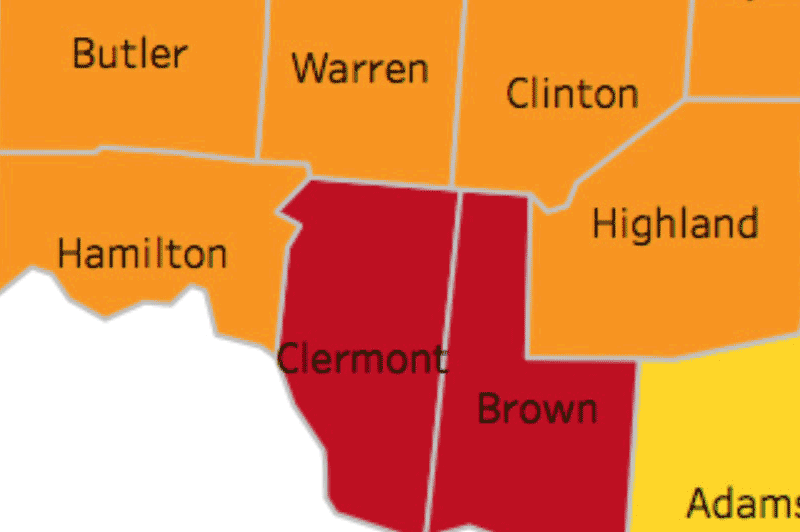
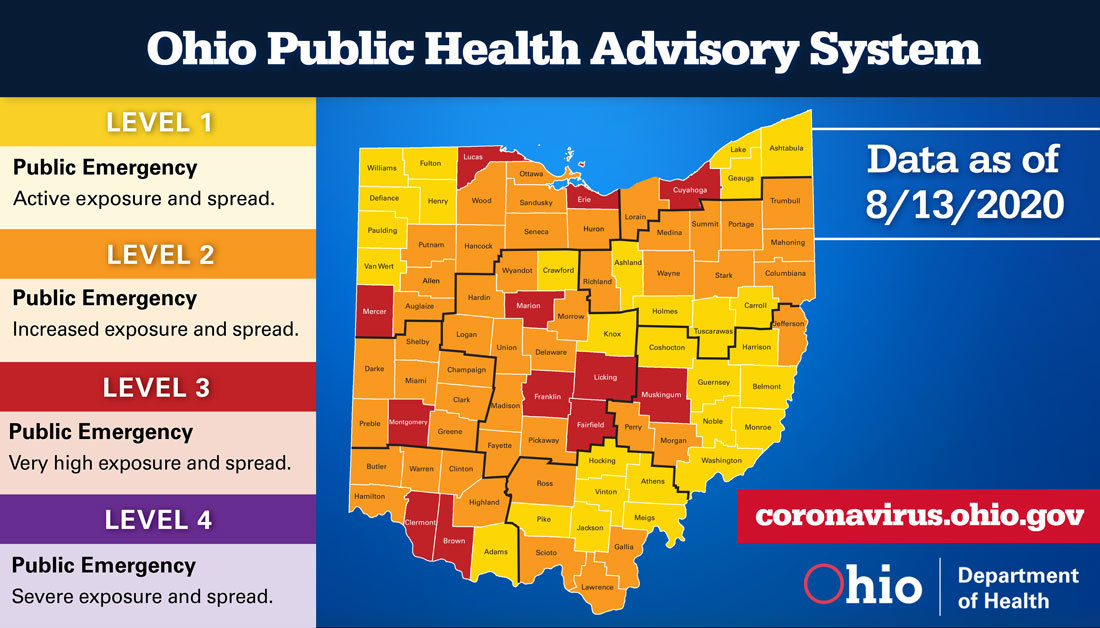
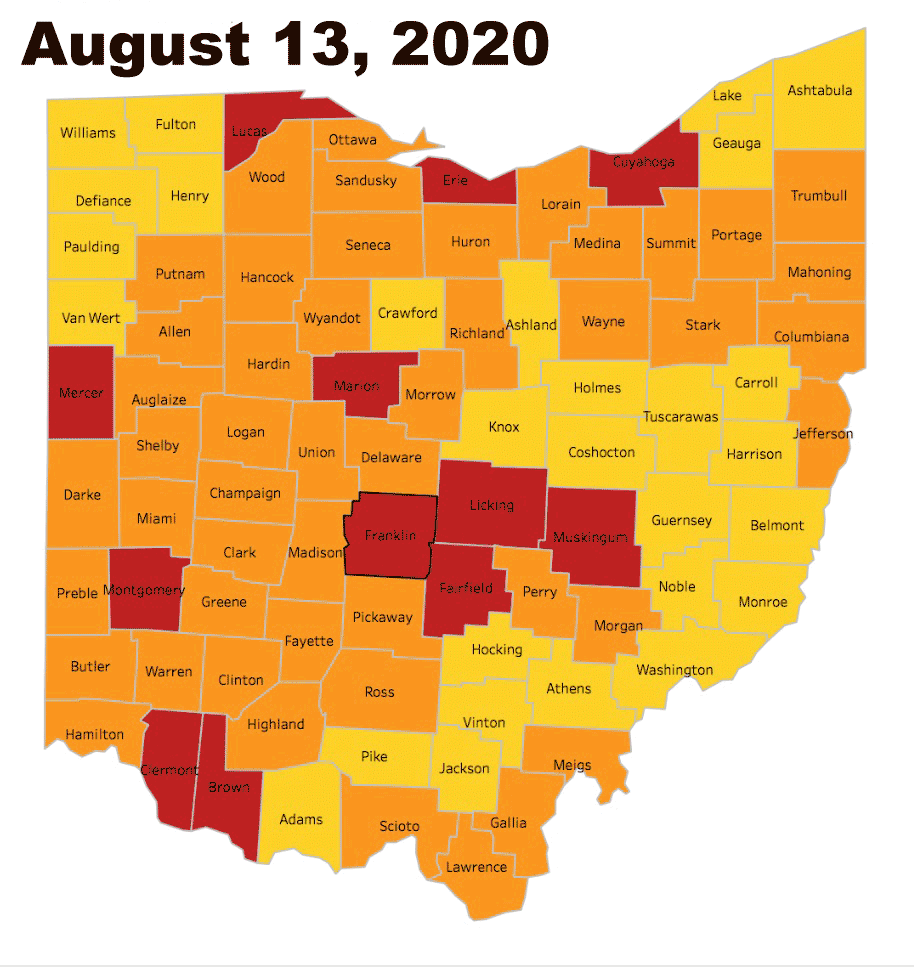
Clermont County, Ohio – The county was again elevated to the “Red” Level 3 in the Ohio Public Health Advisory System.
Hamilton and Warren Counties remain in Level 2.
The system consists of four levels that provide Ohioans with guidance as to the severity of the problem in the counties in which they live. The levels are determined by seven data indicators that identify the risk level for each county and a corresponding color code to represent that risk level.
Level 3 Public Emergency Means
Very high exposure and spread. Limit activities as much as possible. Follow all current health orders.
4–5 Indicators met; or if previously at Level 3, a county stays at Level 3 until it drops below the high incidence threshold of over 100 cases per 100,000 over a two-week period.
Level 2 Public Emergency Means
Increased exposure and spread. Exercise high degree of caution. Follow all current health orders.
1. Require face coverings for employers and recommend them for clients/customers at all times.
2. Conduct daily health assessments by employers and employees (self-evaluation) to determine if “fit-for-duty”.
3. Maintain good hygiene at all times -hand washing, sanitizing, and social distancing.
4. Clean and sanitize workplaces throughout the workday and at the close of business or between shifts.
5. Limit capacity to meet social distancing guidelines.
•Establish maximum capacity at 50% of the fire code. • And, use appointment setting where possible to limit congestion.
Frequently Asked Questions
Q. Will I have to wear a mask or face covering while I am at work? A. Yes. Face coverings are required for employees except if any of the following apply:
1. Facial coverings in the work setting are prohibited by law or regulation;
2. Facial coverings are in violation of documented industry standards;
3. Facial coverings are not advisable for health reasons;
4. Facial coverings are in violation of the business’ documented safety policies;
5. Facial coverings are not required when the employee works alone in an assigned work area; or There is a functional (practical) reason for an employee not to wear a facial covering in the workplace.
Q. Will I have to wear a mask or face covering if I am a customer at a business? A. Yes. Under the level 3 Public Health Emergency issued on July 10, customers must wear masks while inside businesses or other buildings.
Q. Will I need to take my temperature before coming to work? A. Yes. Employees must take their temperature and watch for other symptoms such as coughing or difficulty breathing. Sick employees should stay at home.
Q. What safety precautions should my employer be taking? A. All businesses should follow these protocols
1. Require face coverings for employers and customers.
2. Conduct daily health assessments by employers and employees (self-evaluation) to determine if “fit-for-duty”.
3. Maintain good hygiene at all times -hand washing, sanitizing, and social distancing.
4. Clean and sanitize workplaces throughout the workday and at the close of business or between shifts.
5. Limit capacity to meet social distancing guidelines.
•Establish maximum capacity at 50% of the fire code. • And, use appointment setting where possible to limit congestion.
Q. What should I do if my co-workers aren’t wearing facial coverings at work? A. If an employee of a business is not wearing a facial covering, ask the employer/business for written justification on why the employee isn’t wearing a face covering.
Q. What should I do if my employer is not following proper safety precautions? A. If an employer is not following the above safety protocols, you can file an online complaint here.
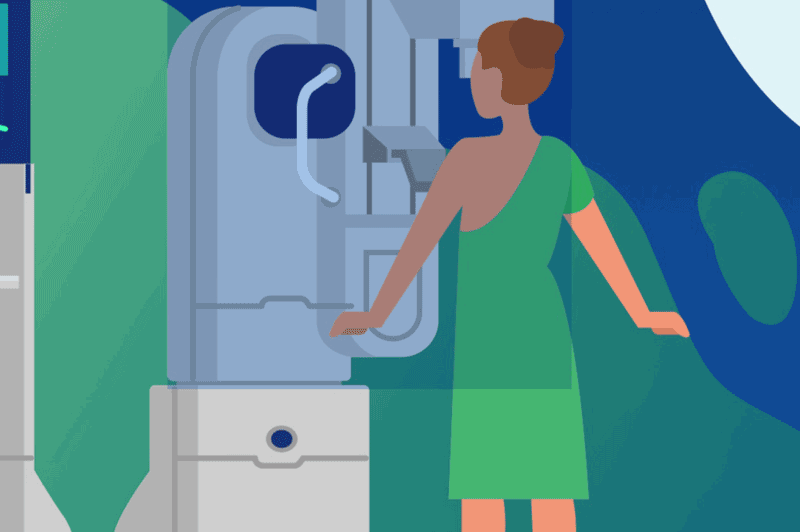
Loveland, Ohio – Mercy Health Mobile Mammography offers women screening mammograms in 15 minutes. This screening is covered by most health plans. For the best coverage, verify that Mercy Health and The Jewish Hospital are in-network providers with your insurance carrier. You may be eligible for financial assistance.
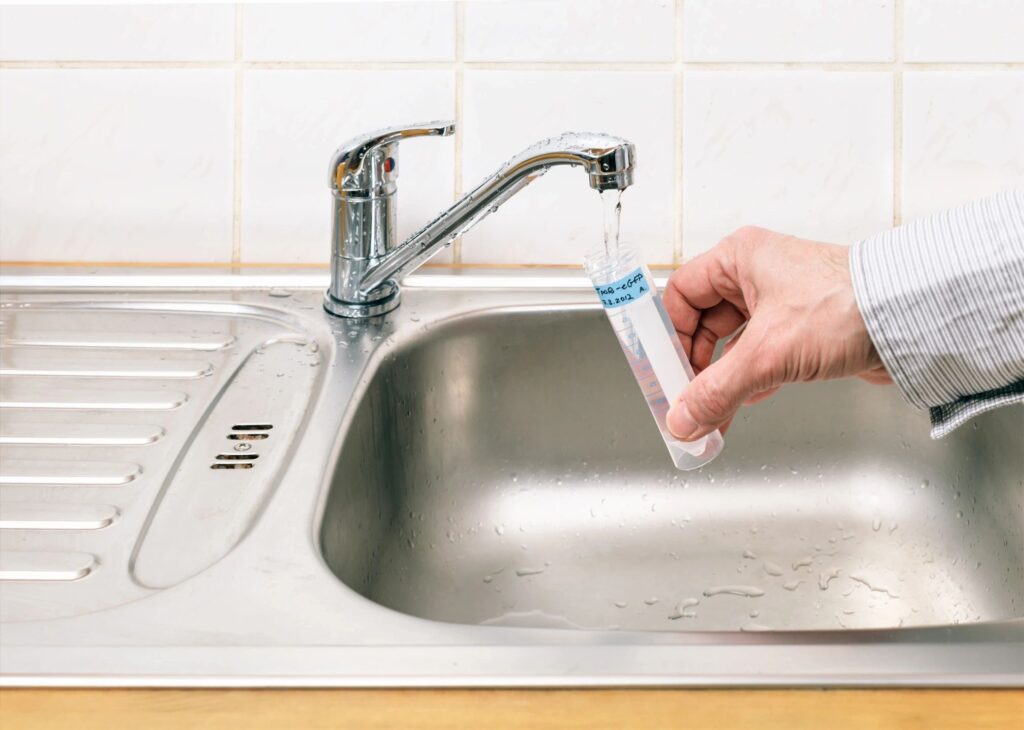
Batavia, Ohio – A recent sampling of Clermont County’s water system for chemicals called Per and Polyfluoroalkyl Substances (PFAS) found no detection of harmful substances in our water. As a real-life parallel to the movie Dark Waters, which portrayed a town in West Virginia whose groundwater is contaminated by a neighboring chemical company, the Ohio Environmental Protection Agency (OEPA) has been sampling water systems across the state.
“This is very good news,” said Lyle Bloom, Director of Clermont County Water Resources. “All three of Clermont County’s water treatment plants were sampled as part of Ohio’s Statewide PFAS Action Plan for Drinking Water and there was no detection of PFAS from the raw or finished water at any of our treatment facilities.”
The Ohio Environmental Protection Agency (OEPA) has been sampling water systems across the state.
The plan calls for Ohio EPA to gather data from public water systems statewide to determine if PFAS are present in drinking water. The water system was sampled for six individual PFAS contaminants: PFOA, PFOS, GenX, PFBS, PFHxS, and PFNA.
PFAS are a group of man-made chemicals applied to many consumer goods to make them waterproof, stain resistant, or nonstick. PFAS are also used in products like cosmetics, fast food packaging, and a type of firefighting foam called aqueous film forming foam (AFFF) (which are used mainly on large spills of flammable liquids, such as jet fuel). PFAS is also called the “forever chemical” because they are not easily broken down by sunlight or other natural processes. They may remain in the environment for many years.
Recent sampling of Clermont County’s water system for chemicals called Per and Polyfluoroalkyl Substances (PFAS) found no detection of PFAS
PFAS can enter drinking water at sites where they are made, used, disposed of, or spilled. Some, but not all, studies in humans with PFAS exposure have shown that certain PFAS may: affect growth, learning and behavior of infants and children; lower a woman’s chance of getting pregnant; interfere with the body’s natural hormones; increase cholesterol levels; affect the immune system; or increase the risk of certain cancers. Scientists are still learning about the health effects of exposures to mixtures of PFAS.
In 2013, Clermont County performed sampling and analysis at all three of its water treatment plants. At that time, there was also zero detection of PFAS. There are currently no national drinking water standards (Maximum Contaminant Levels or MCLs) established for PFAS compounds; however, OEPA adopted Action Levels ranging from 21 to 140,000 ng/L for various PFAS chemicals. Ohio EPA will be establishing response protocols for public water systems in Ohio when action levels are exceeded, including public notification and issuance of drinking water advisories.
On whether schools will open on the date planned, Dr. Crouse said,
“It’s sort of a dance there on whether we will be able to do that fully at first or whether we have to roll into that.”
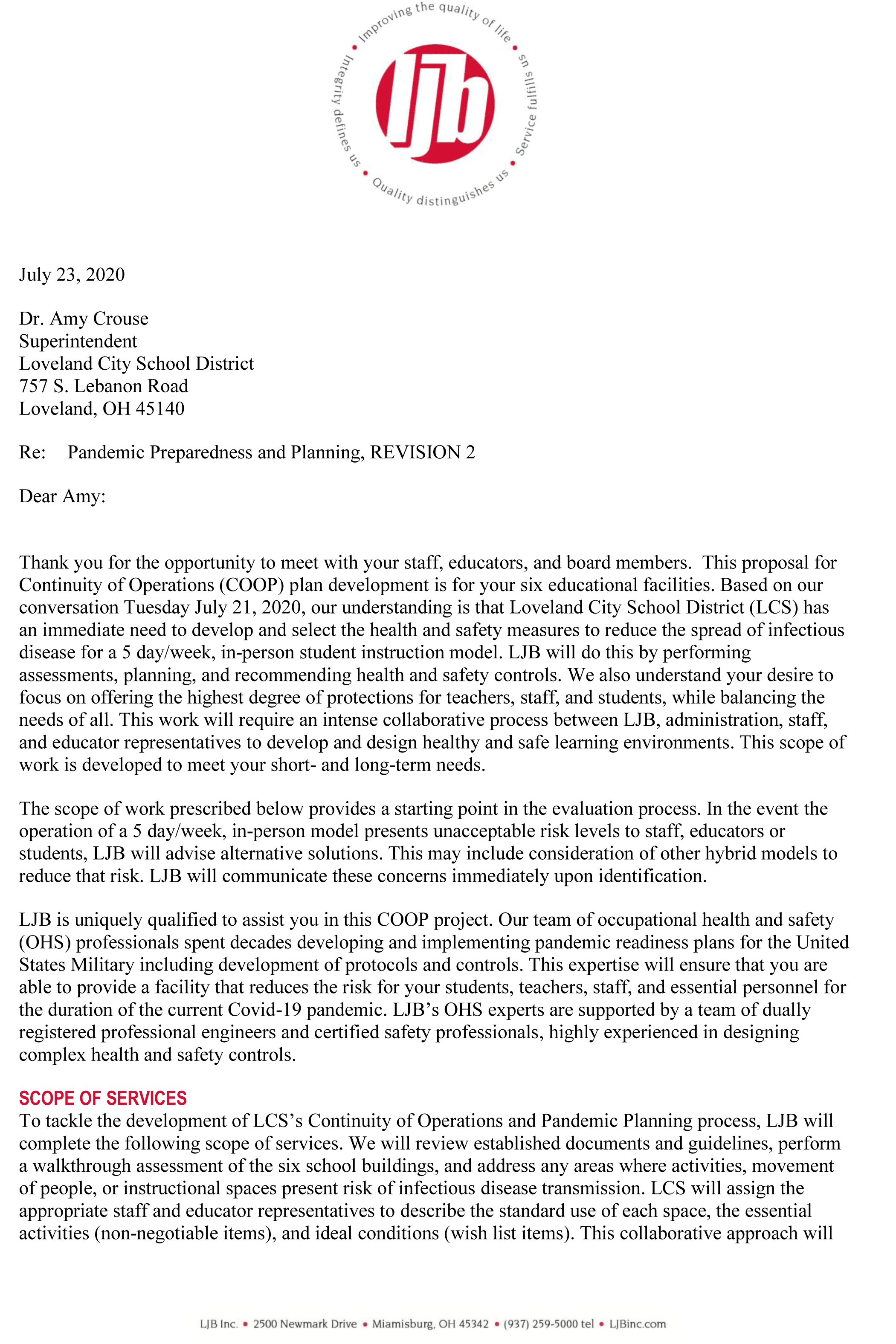
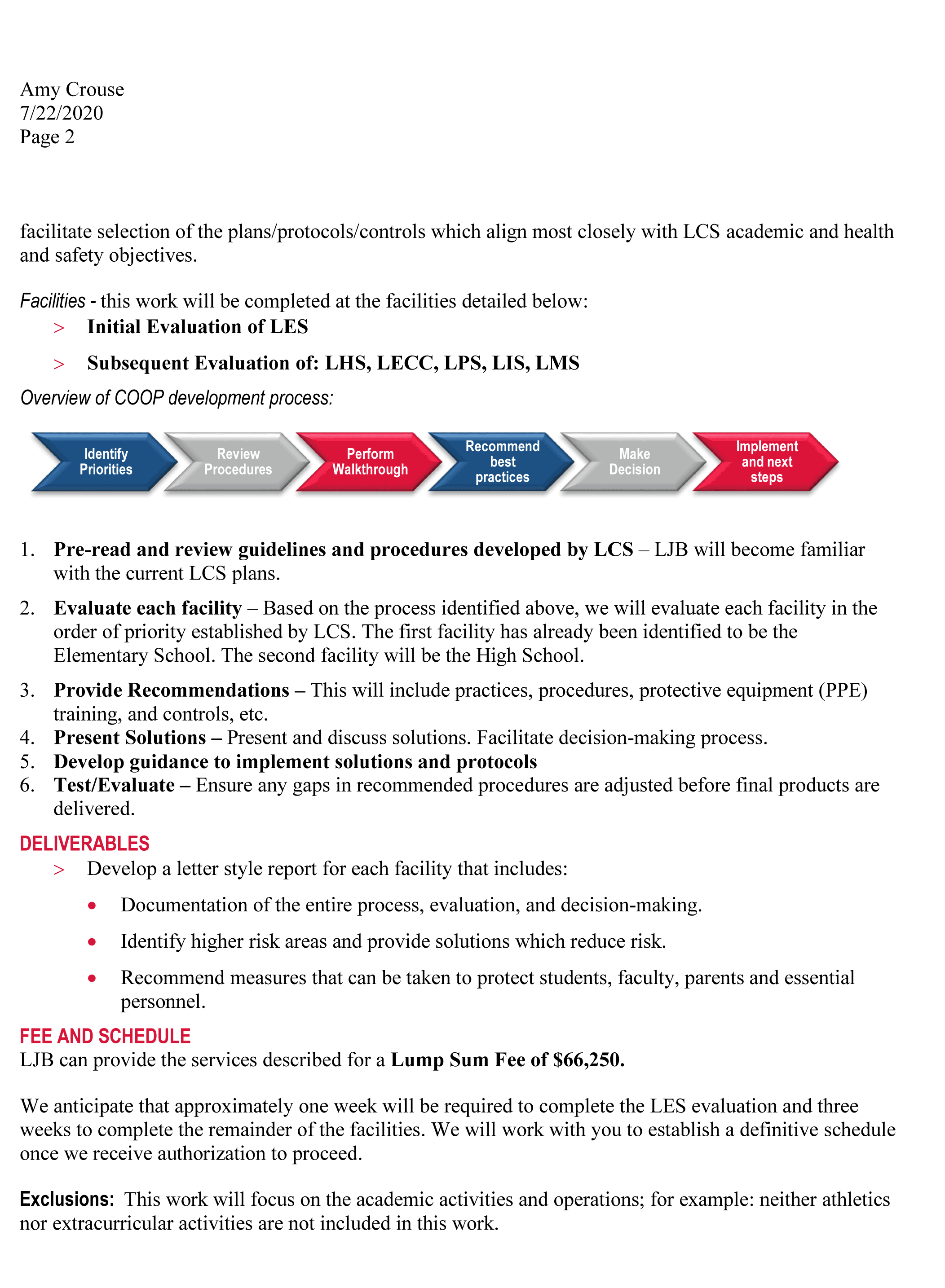
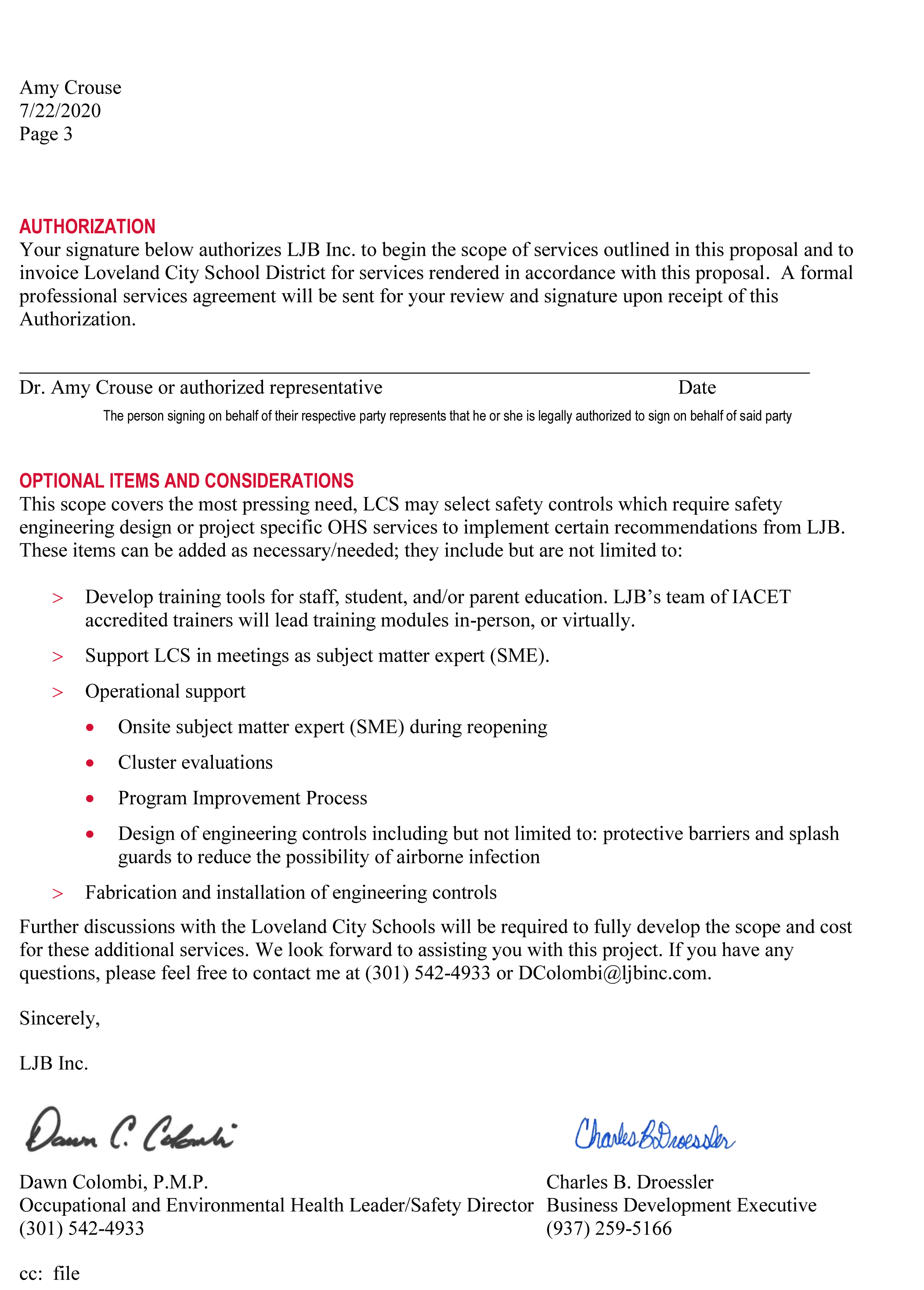
Loveland, Ohio – With a unanimous vote this afternoon in a Special Meeting the Loveland School Board gave authorization to the administration to sign a proposal from LJB Inc. for “Pandemic Preparedness and Planning” services.
LJB will provide the services for a “lump sum fee” of $66,250.
The “terms of the contract” were not available for the Board and after questions from Eileen Washburn about them, Superindent Dr. Amy Crouse said she did not understand the question. After further discussion by Washburn who asked about a cancellation clause and other things in a typical contract, Board President Dr. Kathy Lorenz pointed them to a sentence in the proposal that said, “A formal professional services agreement will be sent for your review and signature upon receipt of this Authorization.”
Kevin Dougherty said it would be standard to negotiate terms. Crouse said she doesn’t currently have it, “But I can provide that to you.”
Dr. Crouse said that after the first week of the study, which will be of the Elementary School, there may be a need to have further discussion about whether classes can begin as scheduled.
The complete study will take four weeks and will begin on Monday, July 27.
At a previous Special Meeting on Wednesday, July 15, with a unanimous vote, the Loveland Board of Education approved a reopening plan for the Loveland City School District for the 2020-2021 school year. Preschool, kindergarten, and 1st through 12th grades will attend 5 days per week at “full capacity” (no “all-day” kindergarten) with the option of choosing to attend school online.
The first day of instruction for all students is scheduled to be Wednesday, August 26.
Michele Pettit asked if after the study of the Elementary building was complete would the opening of instruction go as planned or would there have to be a delay.
Crouse answered, “It’s sort of a dance there on whether we will be able to do that fully at first or whether we have to roll into that.”
Crouse also talked about the unknowns of COVID 19 spread in the community.
Crouse told the Board that it is likely that there will be times throughout the year that they will not be able to provide in-person learning, and the study will provide guidance for that.
Loveland Magazine will up-date this story when the “Terms” of the contract are known.
Loveland, Ohio – At a Special Meeting on Wednesday, July 15, with a unanimous vote, the Loveland Board of Education approved a reopening plan for the Loveland City School District for the 2020-2021 school year. Dr. Eric Schwetschenau moved to adopt the plan, and it was seconded by Eileen Washburn. Schwetschenau, Washburn, Board President Kathryn Lorenz, Vice President Michele Pettit, and Kevin Dougherty voted, “Yes”.
Preschool, kindergarten, and 1st through 12th grades will attend 5 days per week at “full capacity” (no “all-day” kindergarten) with the option of choosing to attend school online.
The first day of instruction for all students is Wednesday, August 26.
High school student arrival time will be 30 minutes later this Fall. Bus guidelines for COVID 19 protection have not been finalized. The District is waiting for State guidelines to be released.
Parents can make a choice each semester about their child attending the “in-person model” or remote learning.
A press release issued by the District said that parents will also have a “full” remote learning option for their children.
Source: 2020 Reopening Planning Updates
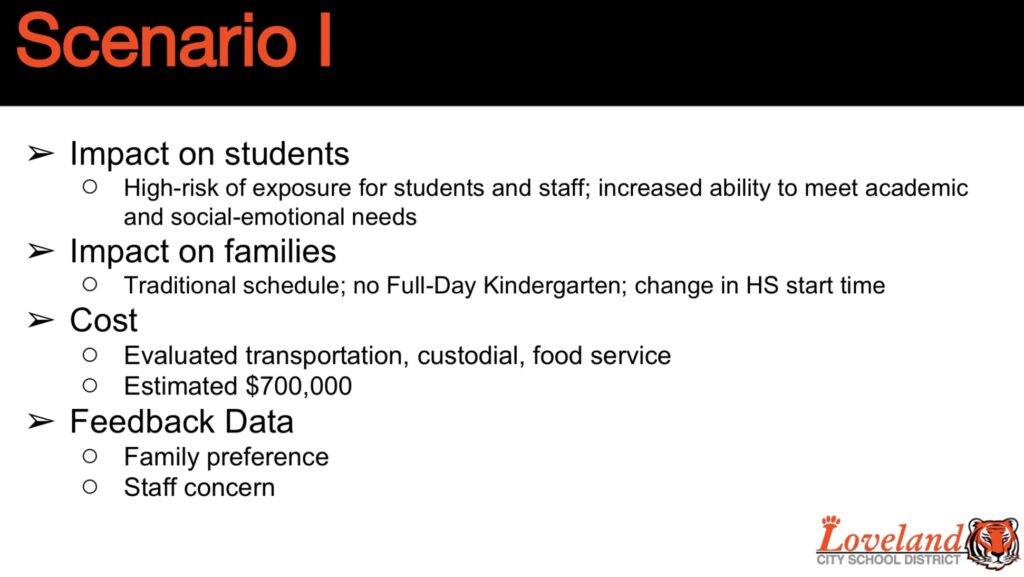
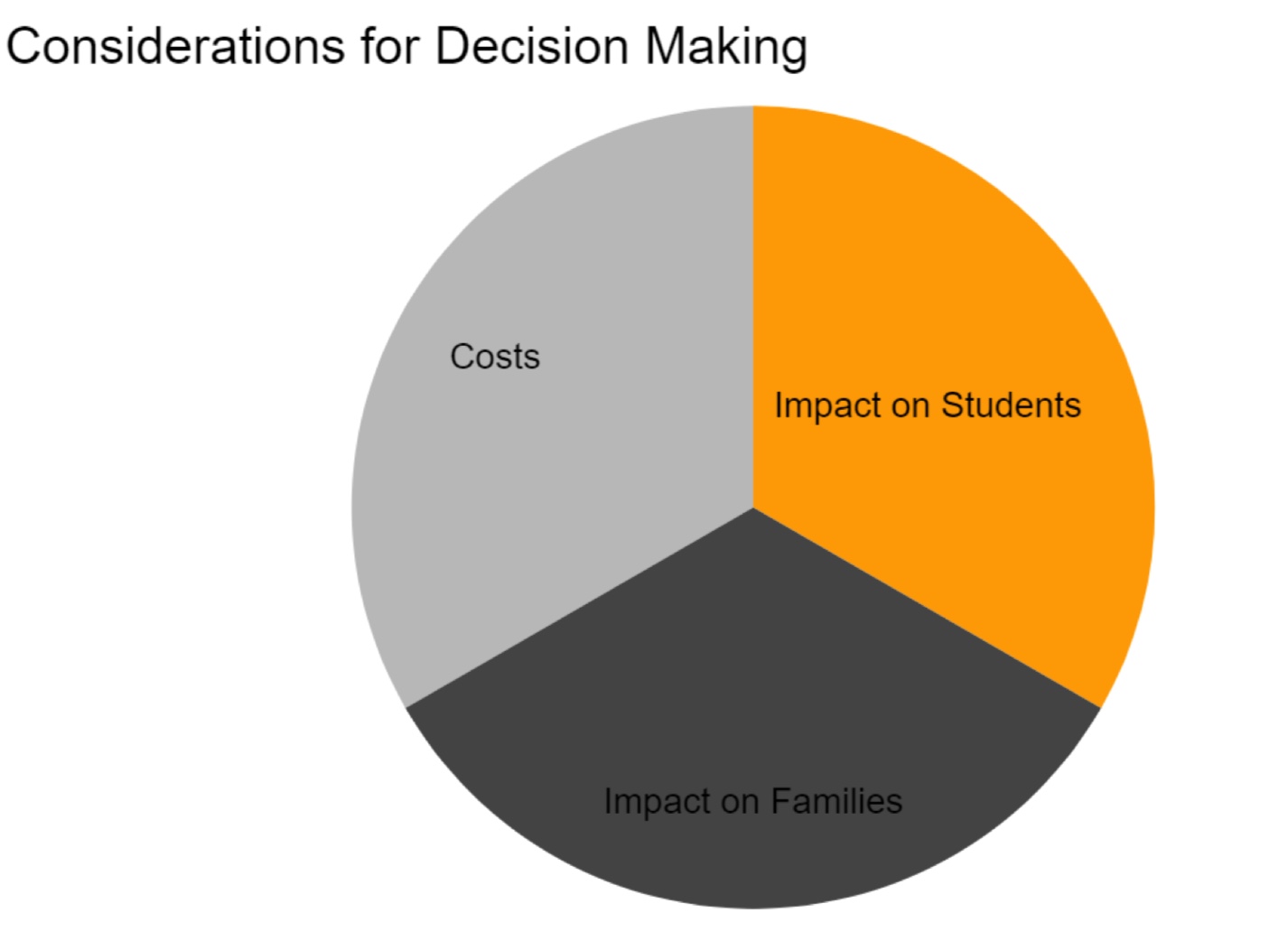
Here is the DOCUMENT the Board reviewed while making their decision. You can look in particular at Scenario I the re-opening model chosen by the Board. Under the headline “Impact on students” the first bullet point says, “High-risk of exposure for students and staff; increased ability to meet academic and social-emotional needs.”
There was no “Hearing of the Public” at the meeting.
Additional details of Loveland’s 2020-2021 Reopening Plan is expected to be released next week.
Parent Q & A sessions are being planned for July 27, 29, and 30.
Parents will be required to select either the in-person or remote learning model for the first semester. Each semester thereafter, parents can re-evaluate and choose a different option. The deadline for selection is Sunday, August 2.
Below is the resolution passed by the Board. Exhibit A referenced in the document was not available to the Board or public when the Board approved the Resolution to re-open the schools.
Jul 15, 2020 – Board Special Meeting
cc
Superintendent Resolutions
cc
Approve resolution adopting the 2020-2021 Academic Plans and Options Program for the Reopening of the Loveland City School District
cc
Motion to approve a resolution adopting the 2020-2021 Academic Plans and Options Program for the Reopening of the Loveland City School District and granting the Superintendent authority related thereto.
________________moved, seconded by ____________________ to approve a resolution adopting the 2020-2021 Academic Plans and Options Program for the Reopening of the Loveland City School District and granting the Superintendent authority relate thereto.
WHEREAS, COVID-19 is a respiratory disease that can result in serious illness or death and can easily spread from person to person between individuals who are in close contact with each other (within about 6 feet) or through the touching of a surface that has the virus on it then touching one’s own mouth, nose or eyes; and
WHEREAS, the Governor and the 133rd General Assembly of the Ohio Legislature have declared a state of emergency with respect to the spread of the novel coronavirus; and,
WHEREAS, during the 2019-2020 school year, the Ohio Department of Health ordered that all K-12 schools be closed to students but it is anticipated that schools will be permitted to reopen for the 2020-2021 school year; and
WHEREAS, boards of education in Ohio have been given substantial authority to revise their methods of instruction for the 2020-2021 school year to adopt to the pandemic.
NOW, THEREFORE BE IT RESOLVED, by the Board of Education of the Loveland City School District, Hamilton County, Ohio as follows:
SECTION I
The Board hereby authorizes and adopts the attached Academic Plans and Options Proposal identified as Exhibit A (to reflect the discussion under item 2.1) to provide for the learning opportunities either in-person, remote, or a combination in accordance with the authority granted by Am. Sub. H.B. 164 and blended learning opportunities authorized by R.C. 3302.41. The Superintendent is hereby authorized to take any and all actions necessary to implement the attached Academic Plans and Options Proposal. In addition, given the uncertain nature of the pandemic, the Superintendent shall be authorized to revise the Academic Plans and Options Proposal as necessary during the 2020-2021 school year so long as such revisions are not inconsistent with Ohio law, state and local health department orders, and orders of the Governor, and so long as the Superintendent updates this Board on any such revisions at the Board’s next public meeting after such revisions are made.
SECTION II
This Resolution shall be in full force and effect from and immediately after its adoption and shall supersede and replace any prior resolution or act of this Board of Education that may be inconsistent or duplicative with the provisions of this Resolution.
SECTION III
The Board of Education hereby finds and determines that all formal actions relative to the adoption of this Resolution were taken in an open meeting of this Board of Education, and that all deliberations of this Board of Education and of its committees, if any, which resulted in formal action, were taken in meetings open to the public, in full compliance with applicable legal requirements, including Section 121.22, ORC.
Cincinnati and Hamilton County, Ohio – “The health and safety of customers and staff is our first priority,” said Paula Brehm-Heeger in an announcement issued July 2 by the Public Library of Cincinnati and Hamilton County. Paula Brehm-Heeger is the Director of the system of libraries.
Paula Brehm-Heeger is the Director of the Public Library of Cincinnati and Hamilton County
Her statement was issued after Thursday’s announcement by Governor DeWine and his team of health professionals unveiled a new monitoring and reporting system for COVID 19 infections in each county.
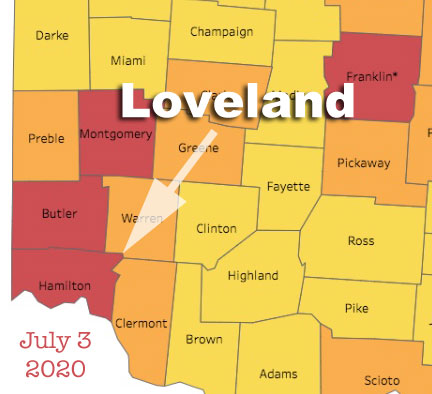
The “Ohio Public Health Advisory System” is based upon a set of criteria and categorizes all Ohio counties in one of four levels. Counties are rated as: 1) yellow, 2) orange, 3) red or 4) purple — with purple being the highest cautionary rating.
Seven counties in Ohio are rated “red” including Hamilton County. The description and guidelines for level three include:
Very high exposure and spread
Limit activities as much as possible
Follow all current health orders
“Based upon this new information, we have made the difficult decision to pause in-person services in our buildings beginning Monday, July 6,” said Brehm-Heeger. All of the 28 open locations will continue to provide curbside or drive-thru service, and they will continue to open nine more locations to provide these services throughout July.
This temporary change is a proactive decision to help limit the spread of the virus, according to Brehm-Heeger. “We will monitor news and information from health officials daily so we can bring back in-person service as soon as the situation improves and the key alert indicators start trending downward. We have repeatedly been reminded that the pandemic is fast moving and requires our quick response and ability to adjust plans accordingly.” Thank you for your continued patience and understanding as we adjust to the pandemic and find new ways to serve you.”
Between now and the middle of July, the Library is phasing services back in, with new locations being added each week. The goal is to be providing services at all locations by mid-July. The exception is Price Hill, as that location is currently closed through the end of 2020 for a major renovation and expansion project. “We’ll use this space to keep you up to date on what is going on. We are excited to see you again,” said Kathy Taylor, Regional Manager in a statement issued on July 3.
The Loveland Branch currently has Curbside Service only and no Drive-Thru Service is planned.
Brehm-Heeger said, “Thank you for your continued patience and understanding as we adjust to the pandemic and find new ways to serve you.”
Hours of Service
Beginning June 15, all open locations will be operating from 10 a.m. to 6 p.m., Monday through Saturday.
Book Drops
All locations are accepting returns through their book drops, except Price Hill. Materials are being quarantined for 3 days before being checked-in, so it will be a few days before you see any changes reflected on your account.
Curbside Service
Curbside: Avondale, Blue Ash, Clifton, College Hill, Delhi, Forest Park, Green Township, Hyde Park, Loveland, Madisonville, Mariemont, Monfort Heights, North Central, Oakley, Pleasant Ridge, St. Bernard, Sharonville, Symmes, Walnut Hills, Westwood, West End and Wyoming
Beginning July 6th these branches will open curbside service: Madeira, Mt. Washington
Beginning July 13 these branches will open for curbside service: Bond Hill, Cheviot, Corryville, Deer Park, Green Hills, Miami Township, Northside, Norwood
Scheduled appointments are not required for curbside service, but calling ahead will make the process more efficient for you, especially if you need to do something other than pick up a hold.
When you arrive at your location for curbside pick-up, look for the curbside service sign, park, and call the branch at the number on the sign.
Drive-Thru Service
Drive-thrus are at these locations: Anderson, Covedale, Groesbeck, Harrison, Reading, and the Downtown Main Library
Scheduled appointments are not required drive-thru service, but calling ahead will make the process more efficient for you, especially for curbside service, or if you need to do something other than pick up a hold. Find phone numbers for all branches on this web page.
Holds/Borrowing Items
If you would like to borrow an item from the library, search our catalog, find the item you want, place a hold on it, and choose which location you’d like to pick up the item from. Or you can call us, and we’ll place the hold for you.
When the item is ready, you will receive an email notice. You can pick it up anytime between 10 a.m. and 6 p.m., Monday through Saturday. If you’d like, you can call the location and schedule a time for pick-up.
In-Person Services
Due to the wide community spread of the virus in Hamilton County right now, the Library made the decision to temporarily suspend in-person services. Read more in this blog post from the director.
We’re Here for You Online and on the Phone
Our eBranch is always open, and we are continuing to provide events like storytimes online on a regular basis. Check our calendar for more information.
Call, email or chat with us seven days a week for help with job searching, finding trusted health information, getting assistance with a library resource, and more.
For the latest Library service updates and resources, please visit our COVID-19 resource page.
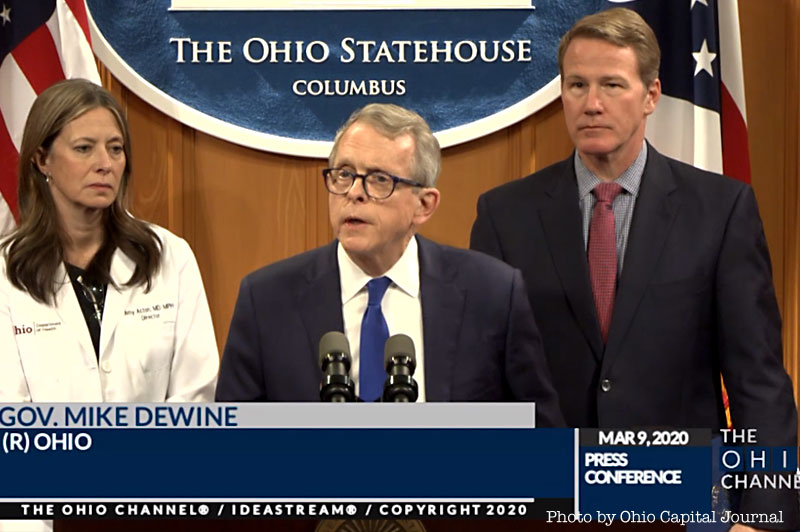
Columbus, Ohio – Ohio Gov. Mike DeWine laid out reopening guidelines for state K-12 schools on Thursday, including a mask requirement for teachers, but no such mandate for students.
DeWine said it is “the state’s strong recommendation” that children from the third grade on wear face masks, but maintained that local control for school districts will be in place as reopenings begin.
“A great deal of flexibility is allowed, as it should be,” DeWine said in his Thursday COVID-19 press conference.
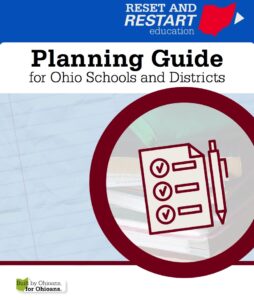
Ohio Department of Education’s 36-page planning guide
The governor announced that the Ohio Department of Education published a 36-page planning guide that includes recommendations on everything testing to field trips and recess precautions.
The guidance is specifically noted as “not mandatory” in the documents and emphasized the need for schools and districts to develop and implement their own protocols, while using the information provided by local and state health departments.
“Planning teams should include school leaders, local health department officials, local school board members, educators, education support professionals, school health professionals, parents, students, community partners and local business leaders,” the planning documents stated.
In developing coronavirus related-protocols, DeWine said before anyone enters a school facility, parents and school officials should “vigilantly assess” symptoms, and take the temperatures of everyone coming into the schools. In the guidance, outside individuals such as delivery personnel, student teachers and faculty of student teachers are all treated the same as official school personnel.
The Loveland District is currently working on models for reopening school in the fall, “which can be adjusted based on the pending guidance from state and local health agencies.”
The planning guide said flare-ups are considered “expected” by state officials, and warns that school buildings may need to close in the event of said flare-up.
Schools were told to work with local health departments to develop a testing strategy, thoroughly clean and sanitize schools, and teach and practice social distancing and hand-washing.
Social distancing in places like school buses will be more difficult, and DeWine said as much distance as is possible will benefit students and staff.
“(Specific measurements of distance is) all relative and it’s somewhat arbitrary,” DeWine said. “But the more distance you can have the better.”
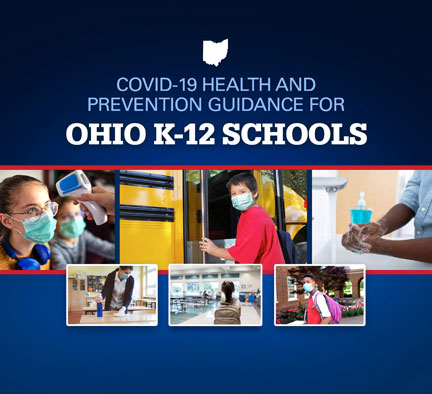
COVID 19 Health and Prevention Guidance for Ohio K-12 Schools
Face coverings are required by staff unless it is unsafe or if doing so “could interfere with the learning process,” DeWine said on Thursday.
Ohio Federation of Teachers Executive Director Melissa Cropper appreciated the moves by the governor, but said the OFT worries about the financial demands of the new protocols.
“We are concerned that local governments and school districts will have to make decisions about the governor’s recommendations at a time when they are anticipating budget crunches and beginning to make spending cuts,” Cropper said in a statement.
DeWine said it “is not right for me or (other departments) to micromanage” school buildings or districts.
The governor did say he plans to meet with House Speaker Larry Householder, Senate President Larry Obhof, and minority leaders to discuss extra funding, along with the use of CARES Act funding.
Cropper said schools would benefit from HEROES Act funding as well, a bank of about $2 billion in monies for K-12 education, but the act is still awaiting U.S. Senate consideration after passing the House.
The guidance comes as the state faces continual growth in coronavirus cases, and data showing that cases are passed through the individuals within the area. DeWine noted that 80% of confirmed cases in Montgomery County have been linked to community spread.
Columbus, Ohio – Governor Mike DeWine Thursday declared that “We’re in a crisis S/state in Ohio.” He was speaking at a COVID 10 news briefing in Columbus.
The governor dithered. The state legislature said no way.
So on Tuesday, the Springfield City Commission took it upon itself to pass a resolution (which lacks the force of law) calling for all residents to cover their faces while indoors, a practice research says will slow the spread of COVID-19 through Ohio.
By Wednesday, Dayton became the first major city in Ohio to require masks by law. Similarly,Yellow Springs passed a resolution andBexley passed a local ordinance requiring masks.
“The mask is a symbol of freedom,” said David Estrop, a Springfield city commissioner, at a hearing, echoing comments from the governor. “It allows us to continue to reopen this state, yet do so in a way that’s safe.”
By Wednesday, Dayton became the first major city in Ohio to require masks by law. Similarly, Yellow Springs passed a resolution and Bexley passed a local ordinance requiring masks.
On Wednesday, the Ohio Department of Health reported more than 1,000 new cases, the first time that stat has reached quadruple digits since officials mass-tested inmates in three state prisons in late April. Wednesday marks 16 days of the coronavirus accelerating its spread, as measured by the 10-day average new caseload.
Despite the worsening coronavirus outlook in Ohio and nationwide, state lawmakers continue to whip up anti-mask fervor. While Gov. Mike DeWine encourages everyone to wear masks, he has refrained from issuing any statewide mandate as the national epidemic worsens and states pause their economic re-openings.
DeWine demurs
In April, Gov. Mike DeWine took a hardline stance on masks, saying they’d be the only way business can reopen after he lifted the stay-at-home order.
Last week, referencing worsening outbreaks in Montgomery and Hamilton counties, DeWine floated the idea of implementing a mask mandate on a county-by-county basis.
However, he has yet to issue any such order. A spokesman declined to say whether DeWine will announce any mask requirement at his next briefing.
In a statement Wednesday, DeWine applauded Dayton Mayor Nan Whaley, a Democrat, for requiring the use of face coverings.
“Wearing a mask will allow us to help keep businesses open and help prevent further spikes,” he said. “I encourage other communities to consider following Dayton’s lead.”
Voted down
Where masks have found friends in the public health community and Ohio cities, they found enemies in the GOP-controlled state General Assembly.
Where masks have found friends in the public health community and Ohio cities, they found enemies in the GOP-controlled state General Assembly.
Both the Speaker of the House and the Senate President have refused to wear masks at legislative functions.
“It’s my RIGHT not to wear a mask, and I do NOT support a government that tries to quarantine the healthy,” he wrote.
Rep. Nino Vitale, R-Urbana, takes to social media regularly to promote baseless conspiracy theories about masks limiting blood oxygen or how they “force virus into the brain.”
Rep. Candice Keller, R-Middletown criticizes Bureau of Workers’ Compensation for distributing masks to Ohio businesses.
Rep. Candice Keller, R-Middletown,produced a Facebook video June 25 criticizing Ohio’s Bureau of Workers’ Compensation for distributing masks to Ohio businesses.
Despite the lawmakers’ claims, research suggests masks are an effective, inexpensive and non-invasive way to slow the spread of COVID-19.
Hamilton County, Ohio – On Tuesday Hamilton County Commissioner Victoria Parks unveiled a resolution to declare racism a public health crisis in Hamilton County. At the Board meeting on Tuesday, the Commission discussed the resolution and how to proceed to a vote.
That discussion can be seen in the video below and begins at the 7:35 minute mark.
Today’s meeting of the Board which will include the Public Hearing on the resolution to “Declare Racism a Public Health Crisis” in Hamilton County.
Board President Denise Driehaus said that the Commission will take the next week to review the public comments which they receive today and revisit the draft before taking a final vote on the resolution. The final vote of the commission is expected to take place the week of July 13th.





 In 2013, Clermont County performed sampling and analysis at all three of its water treatment plants. At that time, there was also zero detection of PFAS. There are currently no national drinking water standards (Maximum Contaminant Levels or MCLs) established for PFAS compounds; however, OEPA adopted Action Levels ranging from 21 to 140,000 ng/L for various PFAS chemicals. Ohio EPA will be establishing response protocols for public water systems in Ohio when action levels are exceeded, including public notification and issuance of drinking water advisories.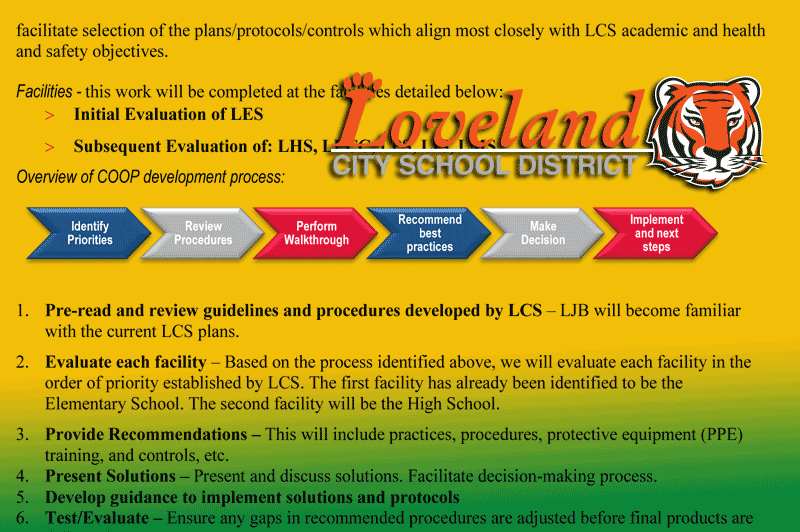



 Seven counties in Ohio are rated “red” including Hamilton County. The description and guidelines for level three include:
 “Based upon this new information, we have made the difficult decision to pause in-person services in our buildings beginning Monday, July 6,” said Brehm-Heeger. All of the 28 open locations will continue to provide curbside or drive-thru service, and they will continue to open nine more locations to provide these services throughout July.