Loveland Magazine is one of the 400 news outlets worldwide, with a combined audience of over 2 billion people “Covering Climate Now”, a global journalism initiative committed to bringing more and better coverage to the defining story of our time.
The initiative, was co-founded by The Nation and Columbia Journalism Review
Mihaela Manova is “Covering Climate Now” in Loveland, Ohio as an editor for Loveland Magazine
By: Mihaela Manova
Ten years after her death, Hazel M. Johnson’s impact doesn’t seem to stop.
Dubbed “the mother of environmental justice,” Johnson started her campaign in Altgeld Gardens, located in South Side Chicago. In the mid-1950s, the New Orleans native dedicated herself to changing her new community and removing the noxious chemicals caused by various forms of pollution.
According to Vice, Altgeld Gardens is a 4,000 resident public housing complex, “surrounded by landfills, factories, and sewage treatment plans.” In the South Side, there has been a spike in deaths from cancer, mainly from air and water pollution.
Grist reports that there were “roughly 50 documented landfills and nearly 300 underground chemical storage tanks.” The water in the area was contaminated with elements like nitrogen and phosphorus, affecting the community’s health in the years to come.
In 1969, Hazel’s husband, John Johnson, died of lung cancer at age 41.
In Altgeld Gardens, there was a rise in cancer cases and respiratory ailments. One of the instances were Johnson’s neighbors, four little girls, that died from cancer due to the poor conditions.
As the cancer rates were increasing, Johnson decided to do something about it.
The People for Community Recovery, or PCR, was founded by Johnson in 1979 and was dubbed a nonprofit in 1982. At the start of the program, Johnson gathered her neighbors to conduct health surveys of the community, proving how harsh the environment impacted its residents.
The organization had many triumphs through their actions and advocacy, drawing attention to the cause on a larger scale.
With countless other accomplishments, Johnson was credited for her work numerous times in the White House.
According to the National Catholic Reporter, during President George H.W. Bush’s presidency, Johnson was presented with the EPA’s Environment and Conservation Challenge Award.
Two years later, President Bill Clinton signed the first executive order on environmental justice. The order directed the EPA and the federal government to pay attention to at-risk communities. During Al Gore’s candidacy for president, Johnson also worked with him on his climate and environmental platform.
But Johnson worked with one president before his candidacy.
During Barack Obama’s role as executive director of the Developing Communities Project, he collaborated with Johnson and other leaders to talk about Altgeld Gardens’ problems. As reported by NCR, before Obama was accepted to Harvard Law School, he would be seen strategizing with Johnson at the family’s kitchen table.
And to this day, Johnson’s legacy still lives on.
Bobby Rush, a Democrat that represents the Southeast Side community in Congress, introduced a new bill that could make April “Hazel M. Johnson Environmental Justice Month.” As Grist revealed, the award would posthumously award her with the Congressional Gold Medal and her own postage stamp.
The bill has been introduced as of February 2, 2021 and was proposed by the House – Energy and Commerce and Natural Resources committees. As it is also sponsored by Rush, the bill urges the people of the U.S. to recognize the month of April as “Hazel M. Johnson Environmental Justice Month.” To read the bill in full, click here.
Now, Johnson’s role is passed onto generations.
At this time, PCR is led by Cheryl Johnson, Hazel’s daughter. Under her leadership, Cheryl and her team have stopped the Chicago Housing Authority to demolish 648 vacant apartments and continue redeveloping Altgeld Gardens. Cheryl’s team has also advocated against a scrapyard being relocated to their community, as it was closed down in a wealthier and whiter neighborhood.
As the front page of the PCR website reads, “The Voice of the Voiceless,” many residents have been able to rise and collaborate against their unjust conditions.
Loveland Magazine is one of the 400 news outlets worldwide, with a combined audience of over 2 billion people “Covering Climate Now”, a global journalism initiative committed to bringing more and better coverage to the defining story of our time.
The initiative, was co-founded by The Nation and Columbia Journalism Review
Mihaela Manova is “Covering Climate Now” in Loveland, Ohio as an editor for Loveland Magazine
Today’s article is written by Piers Forster for The Conversation. Forster talks about climate from a scientific point of view, summarizing the key points of his findings during COVID-19. According to the website, “The Conversation is a nonprofit, independent news organization dedicated to unlocking the knowledge of experts for the public good.” Permission to repost: Covering Climate Now.
The planet had already warmed by around 1.2℃ since pre-industrial times when the World Health Organization officially declared a pandemic on March 11 2020. This began a sudden and unprecedented drop in human activity, as much of the world went into lockdown and factories stopped operating, cars kept their engines off and planes were grounded.
There have been many monumental changes since then, but for those of us who work as climate scientists this period has also brought some entirely new and sometimes unexpected insights.
Here are three things we have learned:
1. Climate science can operate in real time
The pandemic made us think on our feet about how to get around some of the difficulties of monitoring greenhouse gas emissions, and CO₂ in particular, in real time. When many lockdowns were beginning in March 2020, the next comprehensive Global Carbon Budget setting out the year’s emissions trends was not due until the end of the year. So climate scientists set about looking for other data that might indicate how CO₂ was changing.
We used information on lockdown as a mirror for global emissions. In other words, if we knew what the emissions were from various economic sectors or countries pre-pandemic, and we knew by how much activity had fallen, we could assume that their emissions had fallen by the same amount.
By May 2020, a landmark study combined government lockdown policies and activity data from around the world to predict a 7% fall in CO₂ emissions by the end of the year, a figure later confirmed by the Global Carbon Project. This was soon followed by research by my own team, which used Google and Apple mobility data to reflect changes in ten different pollutants, while a third study again tracked CO₂ emissions using data on fossil fuel combustion and cement production.
The latest Google mobility data shows that although daily activity hasn’t yet returned to pre-pandemic levels, it has recovered to some extent. This is reflected in our latest emissions estimate, which shows, following a limited bounce back after the first lockdown, a fairly steady growth in global emissions during the second half of 2020. This was followed by a second and smaller dip representing the second wave in late 2020/early 2021.
Meanwhile, as the pandemic progressed, the Carbon Monitorproject established methods for tracking CO₂ emissions in close to real time, giving us a valuable new way to do this kind of science.
2. No dramatic effect on climate change
In both the short and long term, the pandemic will have less effect on efforts to tackle climate change than many people had hoped.
Despite the clear and quiet skies, research I was involved in found that lockdown actually had a slight warming effect in spring 2020: as industry ground to a halt, air pollution dropped and so did the ability of aerosols, tiny particles produced by the burning of fossil fuels, to cool the planet by reflecting sunlight away from the Earth. The impact on global temperatures was short-lived and very small (just 0.03°C), but it was still bigger than anything caused by lockdown-related changes in ozone, CO₂ or aviation.
Looking further ahead to 2030, simple climate models have estimated that global temperatures will only be around 0.01°C lower as a result of COVID-19 than if countries followed the emissions pledges they already had in place at the height of the pandemic. These findings were later backed up by more complex model simulations.
3. This isn’t a plan for climate action
The temporary halt to normal life we have now seen with successive lockdowns is not only not enough to stop climate change, it is also not sustainable: like climate change, COVID-19 has hit the most vulnerable the hardest. We need to find ways to reduce emissions without the economic and social impacts of lockdowns, and find solutions that also promote health, welfare and equity. Widespread climate ambition and action by individuals, institutions and businesses is still vital, but it must be underpinned and supported by structural economic change.
Colleagues and I have estimated that investing just 1.2% of global GDP in economic recovery packages could mean the difference between keeping global temperature rise below 1.5°C, and a future where we are facing much more severe impacts – and higher costs.
Unfortunately, green investment is not being made at anything like the level needed. However, many more investments will be made over the next few months. It’s essential that strong climate action is integrated into future investments. The stakes may seem high, but the potential rewards are far higher.
Loveland Magazine is one of the 400 news outlets worldwide, with a combined audience of over 2 billion people “Covering Climate Now”, a global journalism initiative committed to bringing more and better coverage to the defining story of our time.
The initiative, was co-founded by The Nation and Columbia Journalism Review
Mihaela Manova is “Covering Climate Now” in Loveland, Ohio as an editor for Loveland Magazine
In today’s Covering Climate Now post written by Jenessa Duncombe for EOS, Duncombe writes about racial slurs still being present in geographical landscapes and shares an open letter from four graduate MIT students.
An open letter from geoscientists supports a bill to remove racist slurs from federally recognized lakes, creeks, canyons, and other small landforms.
Content warning: This article contains examples of racist slurs used in federally recognized place-names. This language has been used to harass and discriminate against people of color.
More than a thousand geographic features in the United States have racial slurs in their name. The slurs include derogatory terms for people who are Black, Indigenous, and of Asian descent and are used in names for small features across the landscape, like valleys, creeks, and lakes.“These place-names serve a silent, yet visibly obtrusive and constant reminder of the deeply rooted white supremacist ideologies that continue to haunt many of these landscapes.”Now an open letter from four graduate students at the Massachusetts Institute of Technology is calling on geoscientists to support a recent bill in Congress to help remove the names. The Reconciliation in Place Names Act would give a federal board more power to change offensive place-names. The letter authors say that geoscientists must make the outdoors safe for people of color by removing harmful language that makes the profession less welcoming.
“There hasn’t been a push within the geosciences to figure out how we handle the fact that these are historical names,” said coauthor Meghana Ranganathan, who studies Antarctic ice sheets. The group became aware of the issue after one encountered a racial slur on a geologic map.
“These place-names serve a silent, yet visibly obtrusive and constant reminder of the deeply rooted white supremacist ideologies that continue to haunt many of these landscapes,” said Tamara Pico, one of the more than 400 scientists who have signed the letter.
A Legacy of Oppression Written on the Land
A 2015 survey counted at least 1,441 federally recognized place-names that contain slurs.An investigation in 2015 by the data-mining company Vocativ found 1,441 federally recognized place-names that contained slurs. Every state contains at least one, and Western and Southern states had the most instances.
Vocativ found at least 558 places across the United States that have offensive words for Black people, including the words “Negro,” “Uncle Tom,” and “Jim Crow.” They also found derogatory names for Asian Americans. By far the most common term was the slur “Squaw,” considered an offensive term for Indigenous women, which appears on the map 828 times.
“A lot of [the offensive names] are in places where a lot of science is being done, which is why this became something that we thought would be a great way for the geoscience community to get behind the bill because it is relevant to all of us,” Ranganathan said.
A Racist Slur in a New Mexican Canyon
Wilcots found at least 11 instances of the slur in the scientific report.The letter came about from the experience of letter writer Julia Wilcots, who was surprised to see a racist name used in a place-name for a canyon in New Mexico at one of her potential field sites. The canyon was identified as “(N-word) Ed Canyon.”
Although the U.S. Board on Geographic Names removed all instances of this particular word in 1963 (as well as a slur for Japanese people in 1974), the predominant geologic map of the area was published before the name change. Wilcots found at least 11 instances of the slur in the scientific report. The feature’s formal name today is Negro Ed Canyon.
With help from a lab partner, Wilcots redacted all instances of the slur in the document, changing it to “Ed Canyon,” and shared it with her adviser, who passed it along to colleagues.
Wilcots urges others to redact racist slurs from their research materials as an act of anti-racism.
“You could say, ‘I’m not going to be racist myself. When I write my paper about this area, I’m not going to use the N-word. I’m going to use the formal name on the map,’” she said. But that doesn’t go far enough to protect researchers of color, she explained.
“I’m pretty fully committed to geology, and this hasn’t deterred me from continuing in the field. It’s emboldened me to be more outspoken in the field,” Wilcots said. “But I think people should recognize that…if you hand this map to a Black student who is considering geosciences and it’s full of the N-word, you know that has an impact.”
Proposed Bill Would Streamline Name Changes
Haaland: “It’s past time to change the offensive names of public lands.”In September 2020, then New Mexico Congresswoman Deb Haaland (D) and Texas Congressman Al Green (D) introduced a bill that would speed up name changes. Haaland was sworn in on 16 March to lead the Department of the Interior under the Biden administration, the first Native American to do so.
The U.S. Board on Geographic Names handles alterations to names, but the board can’t actively seek out names to change: They merely review proposals and are not a rubber stamp for submitted changes. The board blocked the state of Texas from removing the word “Negro” from nearly two dozen place-names, for instance, because of the lack of both local support and a historical connection to the new names.
Instead of relying on proposals to the board, the new bill creates an advisory committee that will seek out offensive names to change. People appointed to the committee will have backgrounds in civil rights and race relations, as well as come from tribes or tribal organizations. The committee will be required to make recommendations to the board, thus speeding up the process.“It still honors the person that the canyon was originally named after.”
“It’s past time to change the offensive names of public lands, especially with input from groups who have been discriminated against,” said Haaland, a member of New Mexico’s Laguna Pueblo. The bill targets names with racial slurs as well as places named in honor of individuals who “held racially repugnant views, committed atrocities against Native Americans, or supported or effectuated discriminatory policies,” stated the bill.
Name changes can be simple, said Ranganathan. In Utah, the board approved changing the name of Negro Bill Canyon to Grandstaff Canyon in 2017. William Grandstaff was a mixed-race rancher in the area for whom the canyon was named.
“It still honors the person that the canyon was originally named after,” Ranganathan said, “but it does so in a way that is not offensive.”
Loveland Magazine is one of the 400 news outlets worldwide, with a combined audience of over 2 billion people “Covering Climate Now”, a global journalism initiative committed to bringing more and better coverage to the defining story of our time.
The initiative, was co-founded by The Nation and Columbia Journalism Review
Mihaela Manova is “Covering Climate Now” in Loveland, Ohio as an editor for Loveland Magazine
In today’s Covering Climate Now story, Ingrid Lobet for Capital & Main writes about the current fight in preservation of the air quality in Central Valley.
According to their website, “Capital & Main is an award-winning journalism nonprofit that reports from California on the most pressing economic, environmental and social issues of our time.” Permission for republishing from theCovering Climate Now newsletter.
Oil and gas producers could find themselves increasingly on the defensive in California now that two communities near the heart of the state’s largest concentration of oilfields have won inclusion under its community air protection law on Thursday.
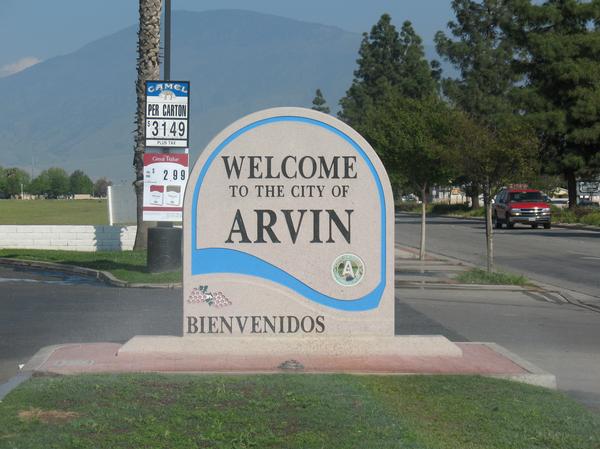
Residents of Arvin and unincorporated Lamont, both in rural Kern County, have been organizing for three years with the goal of gaining status under Assembly Bill 617, a law intended to force California’s regional air pollution districts and Air Resources Board to share power with communities and reckon with their priorities. All members of the Board save one voted for the inclusion of Arvin and Lamont after hours of public testimony Thursday night.
The prospect of having a voice in the environmental protection of her community is gratifying to Estela Escoto, president of the Committee for a Better Arvin. “We have a lot of respiratory illness,” she said in Spanish. “I’m really pleased, especially for all those who are sick with cancer.”
Arvin and Lamont suffer some of the worst air pollution in a state that routinely tops the list nationally for smog and soot, elevating their candidacy for the special designation above more than 200 other communities in the state. The pollution comes from oil and gas wells, refineries, agriculture, heavily trafficked highways and cities upwind.
“Oil will be a top priority,” said Byanka Santoyo, a community steering committee member, organizer with the Center on Race, Poverty & the Environment and resident of Arvin. She estimates she has attended more than 100 meetings held for neighboring communities who are two years ahead in the process. Santoyo recently took a meeting outside and panned her phone across the horizon to show officials the mountain landscape she loves, but often cannot see due to the smog.
“This is huge. If the Legislature and Air Resources Board are serious, then we are going to tackle the issue of oil and gas. But exactly how?”
— Juan Flores, Central Valley community organizer
The process for setting community priorities can be grueling, with long hours in night meetings after work. But leaders with the Committee for a Better Arvin and Comité Progreso de Lamont and other groups have been putting in those hours so they can learn how best to use the law when their own turn comes. “We have people ready to work in Arvin and Lamont,” Santoyo said.
The fact that a community in the heart of California’s oil country will have a say in how money is spent to address pollution is significant. “This is huge,” said Juan Flores, who has been organizing in the Central Valley for eight years on climate, oil and gas. “That is where the community gets excited. If the Legislature and Air Resources Board are serious, then we are going to tackle the issue of oil and gas. But exactly how? Are we going to get setbacks of no less than 2,500 feet, or does it mean we are going to shut them all down? What exactly is it going to look like?”
Flores is referring to an effort to put greater physical distance between residents and oil and gas wells. This setback issue is playing out statewide, and Arvin has already been at it for years. Oil wells can leak carcinogenic chemicals like benzene, and some wells are powered by internal combustion engines that give off exhaust.
The Committee for a Better Arvin was originally focused on clean water, pesticides and manure. But in 2014, it shifted to oil and gas after people were sickened by a leaking pipeline. The group has fought the oil industry several times since.
* * *
The California Independent Petroleum Association says it is not an adversary in these communities. Sabrina Lockhart, vice president for communications, said companies pay millions of dollars in fees each year that are reinvested in programs that advance California’s priorities for clean air and greenhouse gas emissions reductions. “Other AB 617 community monitoring programs in oil and natural gas bearing areas have shown no adverse impacts as a result of responsible production, proving that California’s strictest on the planet environmental protections are working,” she said in a statement.
Oil in Kern County goes back 150 years, if you count the kerosene and asphalt that preceded the gushers. It is the center of California production, accounting for 70% to 80%. But production has been falling for years, and money for local government with it. Declining assessed value of oil properties means that where oil companies contributed 33% of all property taxes in 2010, that fell to 16% in 2019.
Central Valley residents expect Kern County to push back against oil industry regulation. When Shafter residents proposed a 2,500 foot distance between people and wells, the county opposed it.
Despite the production declines, oil companies remain the largest contributors to Kern County discretionary spending, according to the assessor’s office. Chevron was its highest taxpayer in 2019, with $64 million paid on assessed value of $5.6 billion on oil land.
Now the county is lurching into the energy transition. A 2018 article in the Bakersfield Californian called Kern the Wind Turbine Capital of the World. The county website says it is “quickly becoming the renewable energy center for California.”
But Valley residents expect the county to push back against regulation of the oil industry. When residents of Shafter advocated for the 2,500 foot distance between people and wells, the county submitted a letter opposing it. The county is currently engaged in a fight over a blanket permit it granted to drill up to 70,000 more wells.
Arvin and Lamont will not be the first communities located near oil facilities to gain negotiating power under AB 617. Richmond in the Bay Area is a refinery community. And the Wilmington-Carson-West Long Beach area is close to four refineries plus still active oil wells. That community negotiated a 50% reduction in volatile organic compounds — a type of pollution — in 10 years. Residents of Shafter raised concerns about the issue of air pollution from oil production and related processing, but much of their time was spent in a lengthy fight at several levels of government over whether the law protected them from pesticides, which were also a community priority.
“The entire month of January all you see is smoke” from burning vineyard and orchard waste, says Jesus Alonso, who grieves that he often can’t take his son outside.
If the aim of AB 617 is to give residents a seat at the table, across from them at that table will be employees of the San Joaquin Valley Air Pollution Control District. They will spend many dozens of hours in meetings together. Jaime Holt, chief of communications for the district, said her agency backs the addition of Arvin and Lamont, “assuming there are resources to support the programs,” as there have been for the three other communities under its jurisdiction — Shafter, Stockton and South Central Fresno. The air agency has received $12 million per community to initially implement the law, plus $35 million to carry out the air pollution actions the community decides on.
Arvin and Lamont are beset by other kinds of air pollution as well, which might even surpass fossil fuel production and refining among the communities’ priorities. The towns are surrounded by agricultural fields, increasingly almonds. Growers use special machines that grab the trunks of the almond trees at harvest time and sharply vibrate them, sending up clouds of ash, soot and dust — whatever has fallen from the Valley’s blurred sky over the last year.
Then there is the burning. “The entire month of January all you see is smoke,” Jesus Alonso, a lifelong resident of Lamont said. It grieves him that he often can’t take his son outside, describing a persistent, nauseating stench from the refinery nearby. “What I am most excited about is that our children in the community will be able to spend more time outside without increasing their risk of lung or cardiovascular issues.”
This story has been updatedto reflect the results of Thursday’s Air Resources Board meeting.
Loveland Magazine is one of the 400 news outlets worldwide, with a combined audience of over 2 billion people “Covering Climate Now”, a global journalism initiative committed to bringing more and better coverage to the defining story of our time.
The initiative, was co-founded by The Nation and Columbia Journalism Review
Mihaela Manova is “Covering Climate Now” in Loveland, Ohio as an editor for Loveland Magazine
In today’s Covering Climate Now article written by Jerry Redfern for Capital & Main, Redfern tells the story of a New Mexico family stuck in a “waste zone.”
“Something just blew up!”
Cora Gonzales was in her room on Jan. 4 when she heard her father yell. In the evenings he watches TV while sitting by the living room window, and that’s where she found him, looking outside and not at the tube. The rest of the family quickly joined them and they stared through the picture window as flames shot into the night sky from a nearby well pad.
This particular fire was uncommon. That’s because it was quiet. “Usually whenever things blow up,” she says, “we can feel the house shake and also hear a boom.”
Gonzales and her family live on a 160-acre ranch outside Loving, New Mexico. Their land is dotted with drilling pads and tank batteries that hold and pump oil and natural gas. A couple of times a year, she says, the whole house shakes when one of those pumps or batteries catches fire and goes “boom.”
“It’s just the normal thing around here … just another day,” Gonzales says. “We look and watch and we get tired of watching it and then go back to our normal program.”
State regulations require operators to report accidents, what triggered them, and how much oil, gas and water were lost or spilled, but it’s not clear operators always file those reports.
It’s unclear how common these explosions are here in the Permian Basin in southeastern New Mexico. About 129,000 people live amid more than 20,000 wells actively churning out oil and gas in this panthecake-flat stretch of the Chihuahuan Desert. Despite state regulations that require operators to report accidents, what triggered them, and how much oil, gas and water were lost or spilled, it’s not clear operators always file those reports. Furthermore, the state of New Mexico still lacks comprehensive regulations covering leaks, spills and other accidents in the oil and gas production process. That leaves families like the Gonzaleses scratching their heads.
* * *
A security camera on the front of the Gonzales home caught the explosion and subsequent fire. In stark black and white it shows the darkness explode into a burning white light. Caza Petroleum of Texas operates the facility and filed an incident report with New Mexico’s Oil Conservation Division (OCD).
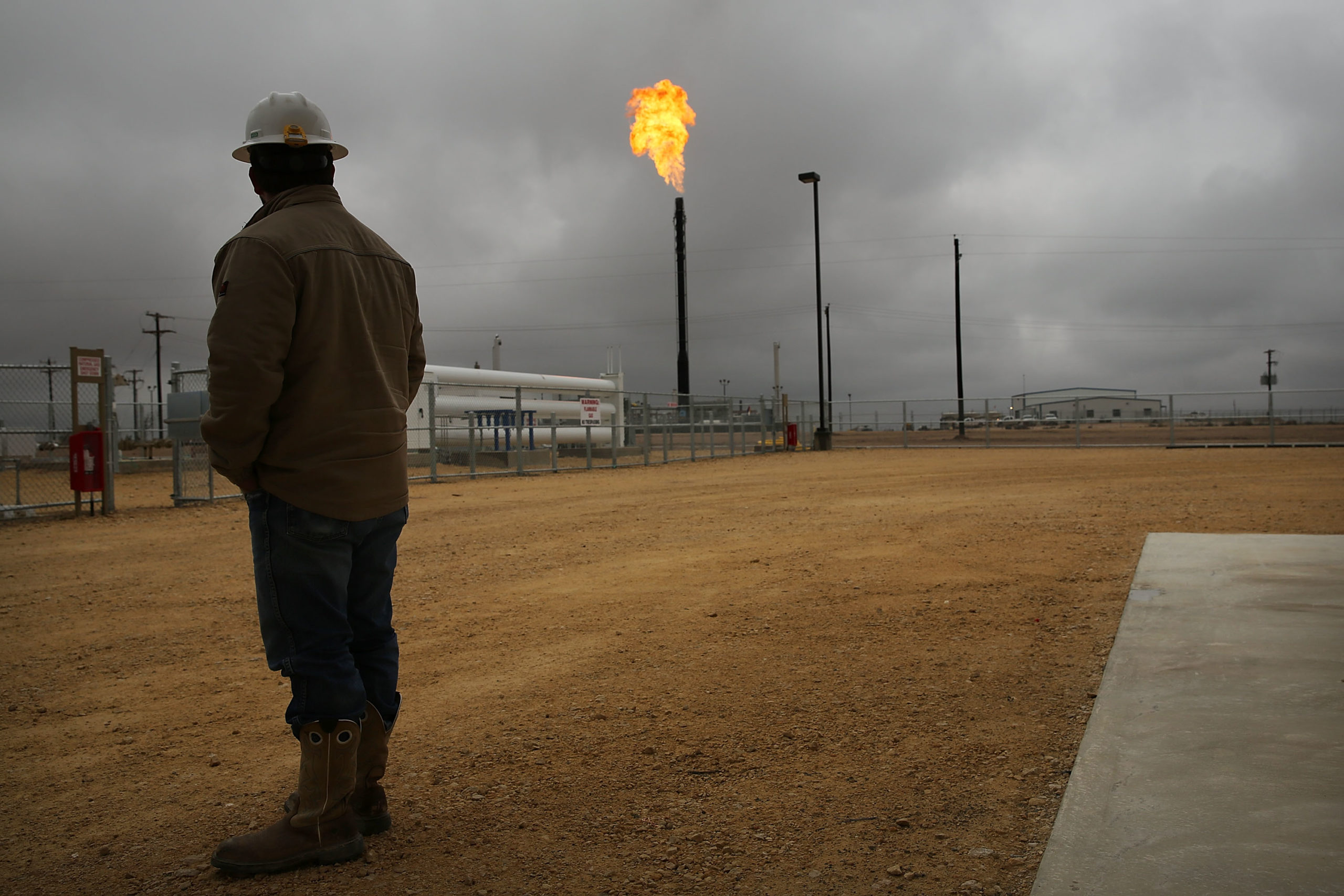
In a phone call, Tony Sam, vice president of operations at the company, says that he doesn’t know exactly what happened that night or why, but he thinks it was a stack fire – when a flare that burns off natural gas and impurities from a well malfunctions and burns out of control. According to the OCD report, the fire was considered a “major release” since it included a fire or explosion. It also spilled 47 Mcf of natural gas, two barrels of oil and two barrels of produced water. Sam did not respond to follow-up questions about the accident.
There are approximately 80 large-scale wells, as defined by OCD, within a two-mile radius of the Gonzales family ranch. In the past five years, operators have reported 20 facility fires in the surrounding OCD district, which covers thousands of wells across half of New Mexico’s portion of the Permian Basin. The Jan. 4 fire was the only one listed close to their home, even though Gonzales says they see fires at nearby drilling and tank sites a couple of times a year.
When a pipe burst one night in 2020, briny ‘produced water’ rained down on the home of Penny Aucoin and Carl Dee George. Their chickens, a dog and a goat were all drenched — and had to be euthanized.
When they see these fires, she says they call 911. “We usually see the emergency lights head (out) but then they always get lost and turn around” in the local maze of country roads winding across the desert. She tries to find out what happened from the local newspaper or by searching online “but we never hear anything of it.”
Not only that, but OCD’s regulators may not be hearing about explosions and leaks either.
It’s up to operators to file emergency reports. Susan Torres, public information officer at OCD, notes that major releases must be reported within 24 hours. If OCD finds out they didn’t, the operator risks daily penalties of several thousand dollars, up to a maximum possible fine of $200,000. Sometimes, she says, first responders notify OCD, but the obligation still rests with the operators.
* * *
Oilfield work is inherently dangerous. Extraction, heavy construction and transportation all play integral parts in the oil and gas industry, and all rank among the country’s most dangerous jobs according to the U.S. Bureau of Labor Statistics. In March 2020, two men were electrocuted and died while working with a forklift in the rain on a pad site south of Malaga. COG, a subsidiary of Concho Resources – which was recently purchased by ConocoPhillips for $13.3 billion – operates the site.
But the dangers don’t end at the edge of the drilling pad.
Throughout the Permian Basin, there are many families like the Gonzaleses, whose homes and ranches are surrounded by drilling operations. Sometimes the pipes carrying gas and oil and contaminated water run right through people’s yards.
“In the oilfield, it’s your property. But they do as they please.”
— Cora Gonzales
Gonzales says that her family no longer runs cattle on their ranch. Instead they charge producers to run pipes across the land. But that brings other problems, like broken water lines from the heavy trenching machinery. And in another instance, a contract company digging a trench was fired mid-job and left behind a “big, gaping hole.”
“In the oilfield, it’s your property,” she says, “but they do as they please.”
When oilfield workers enter a wellsite, drilling pad or tank farm, they know and expect the serious risks involved with bringing toxic and highly flammable oil and gas up from the bowels of the earth. But they often don’t live there. Families like the Gonzaleses live among the dangers year after year, and they are often closest when things go wrong.
In January 2020, for example, a pipe carrying so-called produced water ruptured near Carlsbad in the middle of the night. Produced water is the briny solution that comes up with oil and gas in a well. Heavy in salts, it also has varying amounts of oil and grease, chemicals from the fracking process and, often, naturally occurring radioactive minerals.
When the pipe burst, that water rained down on the home of Penny Aucoin and Carl Dee George. Their chickens, a dog and a goat were all drenched — and had to be euthanized. The family developed rashes and pustules from the water that soaked them as they tried to save their animals.
To a certain extent, the state government’s hands are tied by New Mexico’s lack of regulations and a lack of funding.
WPX, the company that operates the pipeline, eventually dug up and carted off 40 barrels of contaminated soil from the yard.
Aucoin says she called state officials repeatedly about the incident, but says their response was slow.
Ironically, the day that Aucoin and her husband announced a settlement with WPX was the same day that the well stack near Cora Gonzales caught fire. And the next day, WPX was bought by Devon Energy – another major producer in the Permian – in a deal worth about$2.6 billion. Aucoin and George wouldn’t say how much they received in their settlement, but they are using the money to move away from the area, to Clovis.
In a January press conference announcing the family’s settlement with WPX, Aucoin said, “We need our government to stand up to the big oil and gas … There should be someone standing up for the victims.”
But to a certain extent, the state government’s hands are tied by New Mexico’s lack of regulations and a lack of funding.
While the New Mexico Environment Department normally regulates and monitors water and air pollution across the state, produced water is different. Maddy Hayden, public information officer at NMED, explains that this type of water, while it is “under the control of owners and operators” like WPX, falls under the purview of the OCD, in accordance with the 2019 Produced Water Act, which clarified jurisdiction between the two agencies.
She continues, “We recognize the need for enforceable requirements and increased oversight of this industry.”
Torres at OCD points out that spills in and of themselves are not violations under current OCD rules. The violation occurs if the company doesn’t report the spill. So when the ruptured pipeline sprayed the Aucoin/George home with contaminated water, and WPX filed a report, there was no OCD violation. Torres adds that the authority to levy fines was only reinstated at the end of February 2020.
This lack of regulatory teeth for the OCD stems from a 2009 New Mexico Supreme Court ruling that sided in favor of oil and gas companies against the state, saying the division doesn’t have the authority to assess penalties and sanctions against companies without backing legislation.
In light of these gaps in spill regulation, state Sen. Antoinette Sedillo López (D-Albuquerque) has introduced Senate Bill 86, which adds new prohibitions and penalties for spills under the state Oil and Gas Act. It provides a penalty schedule for spills of all types, requires producers to track produced water and disclose the chemicals found in it, creates a data collection fund and controls the use of produced water outside the oil field, among many other proposals. Torres says the agency is analyzing the bill, but that “additional regulations could be difficult to enforce effectively without additional funding tied to the mandate.”
“We’re in a battle with our country fields and our nature. And the oilfields are winning.”
— Ervie Ornelas
When she heard of the accident at the Aucoin/George residence, Sedillo López said, “See? I told you. There is no regulation down there and this is the kind of thing that happens.”
According to Sedillo López, a fellow legislator who owns an oil and gas company told her the chemicals used in fracking were no different from the bottles of chemicals under her sink. “And I said, you know, ‘Would you drink that stuff?’”
When Sedillo López introduced a bill to pause fracking so the state could study its effects and possible legislation, “The oil and gas industry just went crazy,” she says. But she says she also received calls at her office from people across the Permian Basin telling her stories of explosions, smoke, spills and smells. They wanted her to know what they had seen, and “It was just stunning,” she says.
“In every single case I said, ‘Would you be willing to testify on behalf of my bills?’ and in every single case they said, ‘Absolutely not.’” Sedillo López says they were afraid of angering the oil and gas companies. “They’re so scared.”
Sedillo López, whose district in Albuquerque is many hours’ drive from the Permian, says legislators from the basin have asked why she cares. She says a fellow legislator told her the area is “already a waste. All we can do is make sure it just doesn’t spread.”
She says, “We should not have any corner of the planet that is a waste zone.”
* * *
Ervie Ornelas grew up on the outskirts of Loving and has lived in the Permian Basin for all his 49 years. When he was a kid, he would run around the sage fields in the wide-open vistas surrounding his home, hunting rabbits in the gullies, watching for burrowing owls and catching fish in a nearby pond.
Then in the 1990s, oil wells started popping up. The rabbits and owls slowly disappeared. The pond was fenced in and a “KEEP OUT” sign posted. All of the open vistas were rimmed with machinery.
“We’re in a battle with our country fields and our nature,” he says today. “And the oilfields are winning.”
Ornelas says he understands people need to make a living, and oilfield work pays good money. But “Loving just isn’t Loving anymore.”
These days he works at a children’s day care in Carlsbad and, until November, he would visit his mother at his childhood home on weekends.
From his mother’s place, he can see four tank farms. “And from the very beginning you can smell it from the front yard,” he says. “My mother used to get dizzy, dizzy with the smells.” A search of the online OCD Oil and Gas Map shows 15 wells within a mile of the house.
Ornelas’ mother lived in that house until she died of COVID-19 in November. Pervasive air pollution – the kind produced by the oil and gas industry and monitored in the Permian – is tied to increased risks of dying from COVID-19. A peer-reviewed study published in October estimates that “about 15% of deaths worldwide from COVID-19 could be attributed to long-term exposure to air pollution.” Hearing that “made my heart drop just thinking it could have added more to her problem,” he says.
Just before his mother died, Ornelas’ 24-year-old son Zach died from brain cancer. Zach was diagnosed just after graduating from high school, and he fought off the disease for six years before succumbing in October.
For the last three months of his life, Ervie and his wife wouldn’t let him outside.
“My wife is a registered nurse, and she was afraid that the (air pollution) would mess up his breathing.”
* * *
Pastor Nick King moved to Carlsbad eight years ago to preach at the Mennonite Church. In his spare time, he looks at his corner of the state from space, courtesy of Google Maps. “Miles and miles and miles,” he says, “all you see is oil wells all over the place.”
“That’s how we care for the Earth God’s given us.”
King sees the spread of oil and gas wells and the problems associated with them as the antithesis of the Christian beliefs trumpeted by people in the area. In fact, he calls the thinking “a kind of religious blasphemy.”
“We don’t worry about the environment,” he says. “We don’t worry about the future. If it’s money for me – now – then we do it.”
For his part, Ornelas still roams the country around his childhood home. Now, instead of hunting and fishing, he’s taking photos, trying to capture on silicon what remains of his memories made outdoors. But that isn’t going so well, either.
“When we were kids, we’d see maybe one or two oilfields,” he says. “Now, It’s like a blanket of them. And that’s what hurts.
Loveland Magazine is one of the 400 news outlets worldwide, with a combined audience of over 2 billion people “Covering Climate Now”, a global journalism initiative committed to bringing more and better coverage to the defining story of our time.
The initiative, was co-founded by The Nation and Columbia Journalism Review
Mihaela Manova is “Covering Climate Now” in Loveland, Ohio as an editor for Loveland Magazine
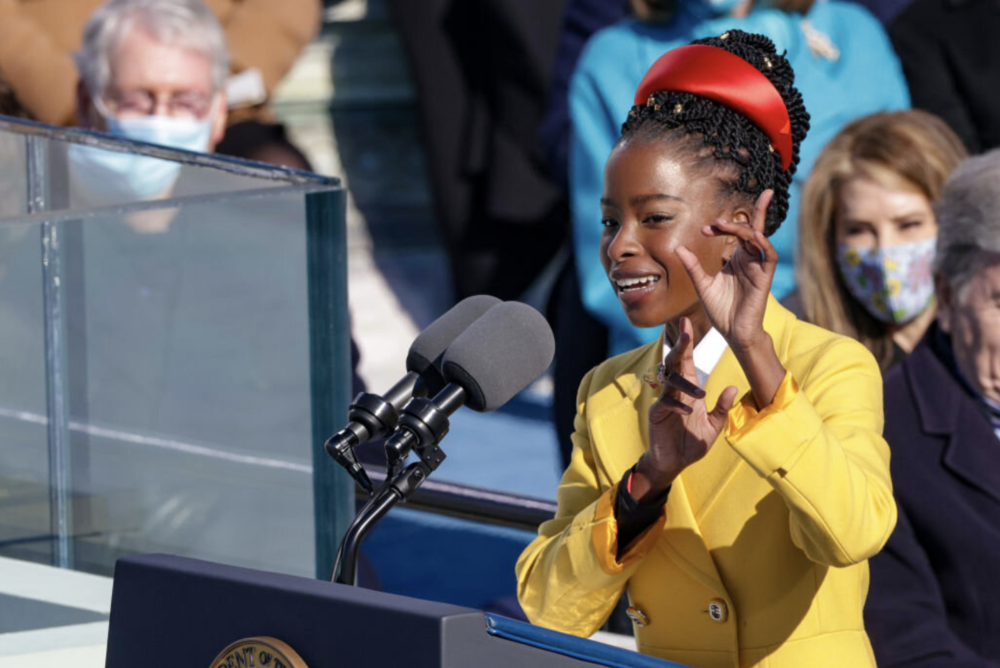
Covering Climate Now writer, Mark Hertsgaard, highlights Amanda Gorman’s poem and alludes to an anticipated climate change reform in the United States.
“The Hill We Climb” offers both inspiration and warning in the face of the climate emergency.
For there is always light
If only we’re brave enough to see it
If only we’re brave enough to be it.
Those are the closing words of “The Hill We Climb,” the stunning poem Amanda Gorman, the first Youth Poet Laureate of the United States, delivered yesterday at the inauguration of now-president Joe Biden and vice president Kamala Harris. For those worried about climate change, the ever-shining light referenced in Gorman’s poem was perhaps difficult to make out during Donald Trump’s presidency. Now, a new day has dawned that brings great possibilities and equally great challenges.
Biden ran on the strongest climate platform of any major presidential candidate in US history. He was pushed to that stance by his erstwhile rival Senator Bernie Sanders and pressure from a younger generation of activists who insist on centering economic, racial, and gender justice in climate policy. And to Biden’s credit, he agreed to be pushed. Now, Biden has named a team of Cabinet officials and aides who are experienced, diverse, and more committed to climate progress than their counterparts in any previous administration.
Biden and Harris have repeatedly described climate change as one of four intertwined crises—along with the covid pandemic, the collapsed economy, and racial justice—that will be addressed by every part of the federal government. For example, Janet Yellin, Biden’s nominee for Treasury Secretary—who has supported taxing carbon polluters and returning the proceeds to all Americans—said during her Senate confirmation hearing Tuesday that climate change is “an existential threat” to the US economy, and she pledged to appoint a “very senior” official to oversee Treasury’s handling of the problem.
The 180-degree reversal in US climate policy was also clear from the executive orders president Biden signed on the afternoon of his inauguration. The US will rejoin the Paris Agreement. The Keystone XL pipeline, a landmark climate battle during the Obama years, will be cancelled once and for all. And the Trump administration’s weakening of regulations covering vehicle fuel efficiency, emissions of methane and other greenhouse gases, and other climate-related policies will be reviewed and likely overturned. (The day before Biden’s inauguration, a federal court separately struck down Trump’s attempt to weaken Obama’s Clean Power Plan that would have slashed emissions from electricity generation.)
Now, attention turns to Capitol Hill. Conventional wisdom inside the Beltway says there is little chance of passing transformative climate legislation. After all, Democrats have only a one-vote majority in the Senate, with vice-president Harris casting tie breaking votes, while Democrat Joe Manchin of West Virginia has long been hostile to restricting coal and other fossil fuels. Nor do Republicans give any sign of abandoning their lockstep resistance to serious climate action.
Politics is too full of surprises, though, to treat such predictions as prophecy. Upwards of 70 percent of US voters, including majorities among both Democrats and Republicans, now favor increased government spending on solar, wind, and other forms of renewable energy. If forced to take an up or down vote, how many members of Congress will oppose such broadly popular policies, especially if such clean energy provisions are included in a larger infrastructure bill, as Biden’s “Build Back Better” strategy envisions?
If Republicans do remain united behind a fossil fuel agenda, the possibilities for passing meaningful climate legislation—even significant portions of a Green New Deal—still might be greater than commonly assumed, as Geoff Dembicki reported in a must-read VICE News article. Experts Dembicki interviewed said that “many Green New Deal-style actions are still possible—making low carbon industries a key part of the pandemic stimulus, creating millions of green jobs, employing vast numbers of laid-off oil and gas workers, and moving much faster than before to clean electricity.” These reforms will not come in “single, sweeping piece of legislation” the way some Green New Deal advocates imagine, said one expert. But sufficient bipartisan support is plausible for an array of measures that “when you add them up are really big,” said another.
Overseas, Biden has a freer hand. Returning to the Paris Agreement is an essential first step, and Biden’s commitment to climate action at home can dissolve some of the international skepticism fostered by previous US administrations. One often overlooked issue to watch: will the Biden administration discourage international development banks and its own lending agencies, such as the US Export-Import Bank, from financing fossil fuel projects in developing economies in Asia, Africa and South America? Another looming question: Will the US under Biden join the European Union, Japan, Great Britain, Canada, and other leading greenhouse gas emitters in formally declaring that humanity faces a “climate emergency”?
For journalists, one thing is clear: climate change will be a major story in Joe Biden’s first year as president. Biden and his aides have ambitious plans that will provide news peg after news peg. The need for well-informed and high visibility coverage, told as often as possible through a human lens, could not be plainer. And there’s nothing partisan in news outlets meeting that need; it’s about human survival. Going forward, journalists, as well as fellow citizens and elected leaders, might well be guided by another passage in Gorman’s fierce, beautiful poem:
We will not be turned around or interrupted by intimidation
Loveland Magazine is one of the 400 news outlets worldwide, with a combined audience of over 2 billion people “Covering Climate Now”, a global journalism initiative committed to bringing more and better coverage to the defining story of our time.
The initiative, was co-founded by The Nation and Columbia Journalism Review
Mihaela Manova is “Covering Climate Now” in Loveland, Ohio as an editor for Loveland Magazine
Today’s Covering Climate Now article is written by Rhett A. Butler for Mongabay News. This piece talks about the climate’s tipping points and how its urgency should motivate politicians “to accelerate transformative change.”
Over the past twenty years the concept of “tipping points” has become more familiar to the public. Tipping points are critical thresholds at which small changes can lead to dramatic shifts in the state of the entire system.
Awareness of climate tipping points has grown in policy circles in recent years in no small part thanks to the work of climate scientist Tim Lenton, who serves as the director of the Global Systems Institute at Britain’s University of Exeter.
Lenton says the the rate at which we appear to be approaching several tipping points is now ringing alarm bells, but “most of our current generation of politicians are just not up to this leadership task”.
The pandemic however may have caused a shock to the system that could trigger what he calls “positive social tipping points” that “can accelerate the transformative change we need” provided we’re able to empower the right leaders.
Over the past twenty years the concept of “tipping points” has become more familiar to the public. Tipping points are critical thresholds at which small changes can lead to dramatic shifts in the state of the entire system.
From a climate standpoint, the melting of Arctic sea ice is a simple example. As sea ice melts, less sunlight is reflected into space and more heat is absorbed by the ocean, further hindering the formation of sea ice and thereby leading to more warming. The positive feedback loop is leading toward ice-free summers in the Arctic, which will have dramatic implications for the Arctic ecosystem and knock-on effects for ocean circulation and weather patterns. The effects are already being observed, with Arctic sea ice extent trending sharply downward since the 1970s.
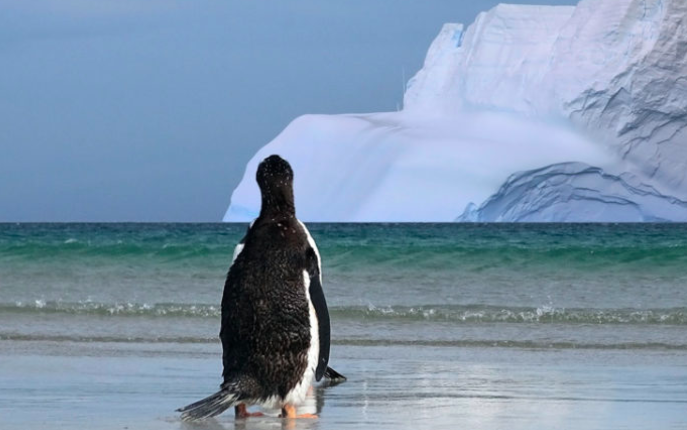
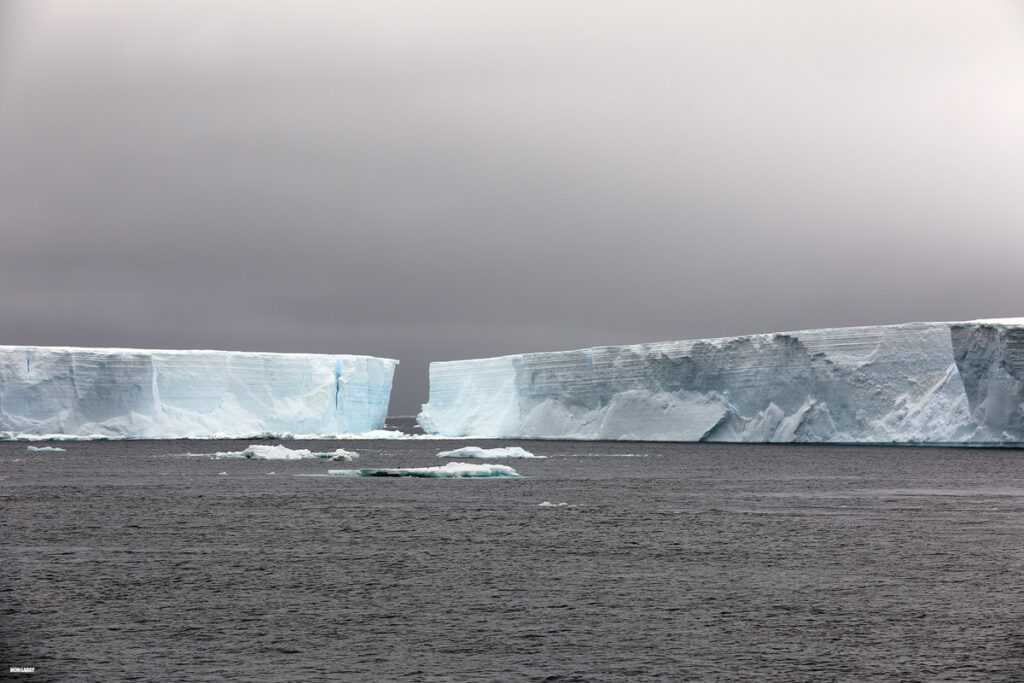
Glaciers and icebergs in Antarctica. Photo credit: Mongabay
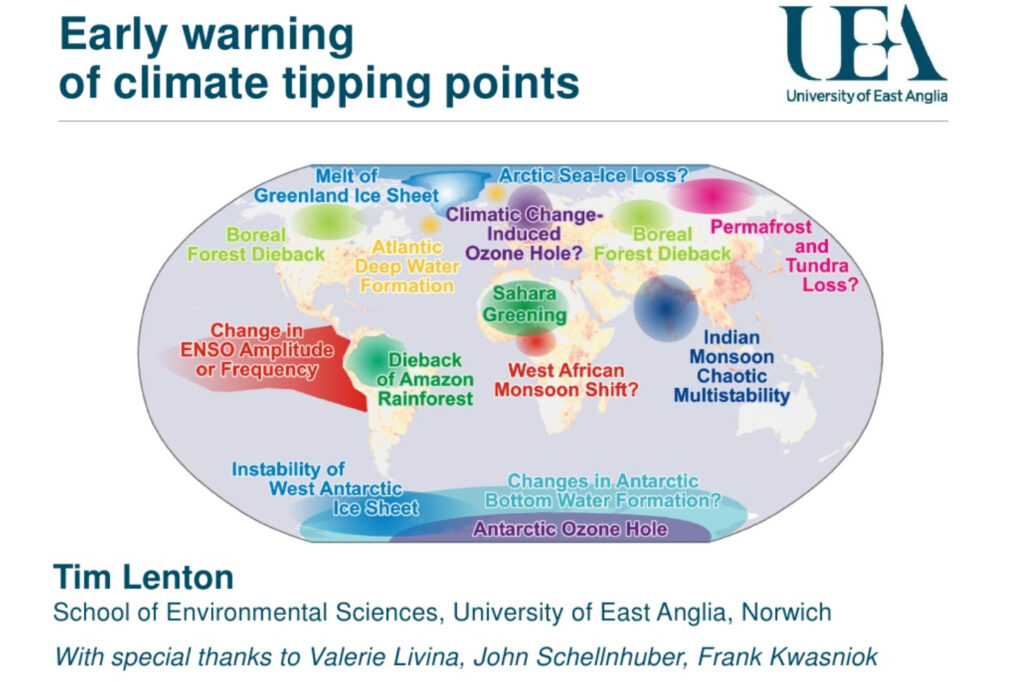
Awareness of climate tipping points has grown in policy circles in recent years in no small part thanks to the work of climate scientist Tim Lenton, who serves as the director of the Global Systems Institute at Britain’s University of Exeter. In 2008 Lenton was the lead author of an influential Proceedings of the National Academy of Sciences (PNAS) paper that identified nine tipping points and ranked them by their near-term likelihood of occurring. These included: Arctic Sea-Ice; the Greenland Ice Sheet; the West Antarctic Ice Sheet; the Atlantic Thermohaline Circulation; the El Niño–Southern Oscillation (ENSO); the Indian Summer Monsoon; the Sahara/Sahel and West African Monsoon; the Amazon Rainforest; and the Boreal Forest. Lenton and his colleagues have since added tropical coral reefs and the East Antarctic Ice Sheet to the list.
When Lenton published the PNAS paper, some aspects of the predictions were still theoretical, but since then, the evidence for some tipping points has strengthened as the rate of disruption has increased and our ability to observe change has improved.
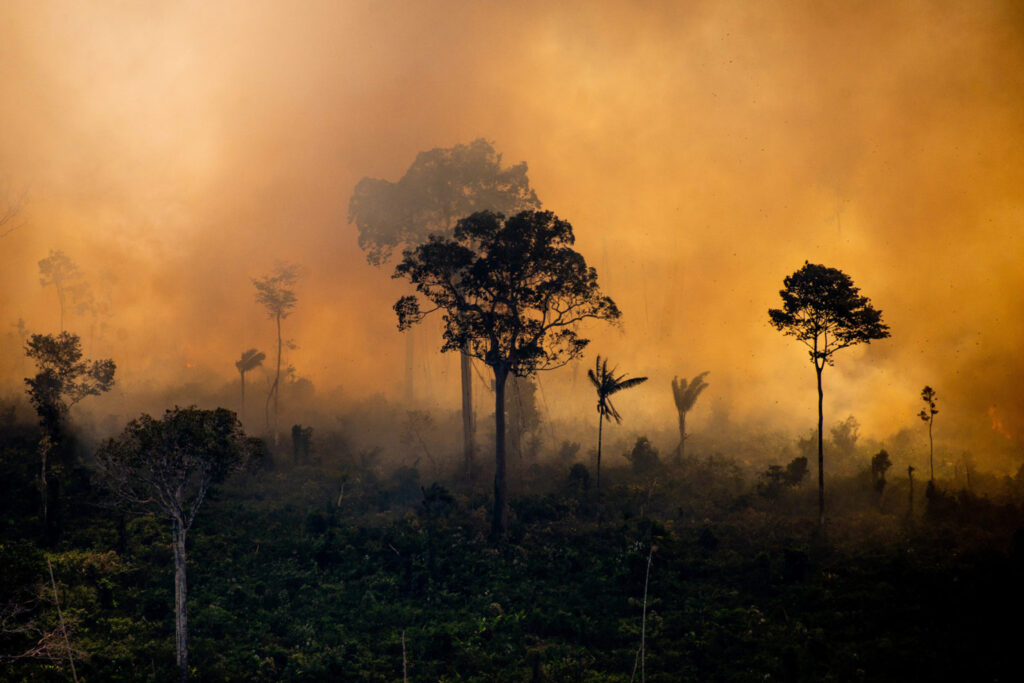
“Some of the tipping elements are changing more rapidly than others,” Lenton told Mongabay during a December 2020 interview. “The most concerning include the West Antarctic Ice Sheet – part of it looks to be in irreversible retreat – and the Amazon rainforest – where droughts and changing fire regimes are accelerating forest loss, alongside renewed human pressures.”
The evidence base of cascading effects between tipping points has also expanded.
“A decade or so ago we identified this as a theoretical possibility with some idea of what the causal interactions could be,” he said. “Now we have more direct evidence of causal interactions, like the role of Arctic sea-ice retreat and resultant warming in permafrost thawing and accelerating Greenland ice sheet melt.”
Lenton says the the rate at which we appear to be approaching several tipping points is now ringing alarm bells, but “most of our current generation of politicians are just not up to this leadership task”.
“Younger generations are looking at them with dismay and rightly rebelling.”
The pandemic however may have caused a shock to the system that could trigger what he calls “positive social tipping points” that “can accelerate the transformative change we need” provided we’re able to empower the right leaders.
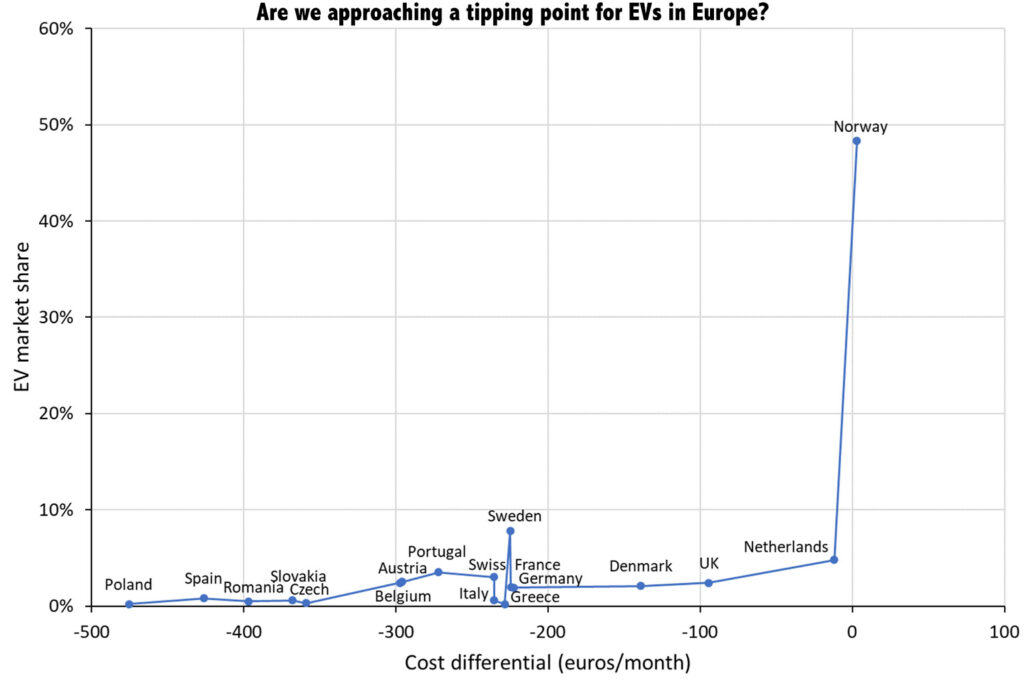
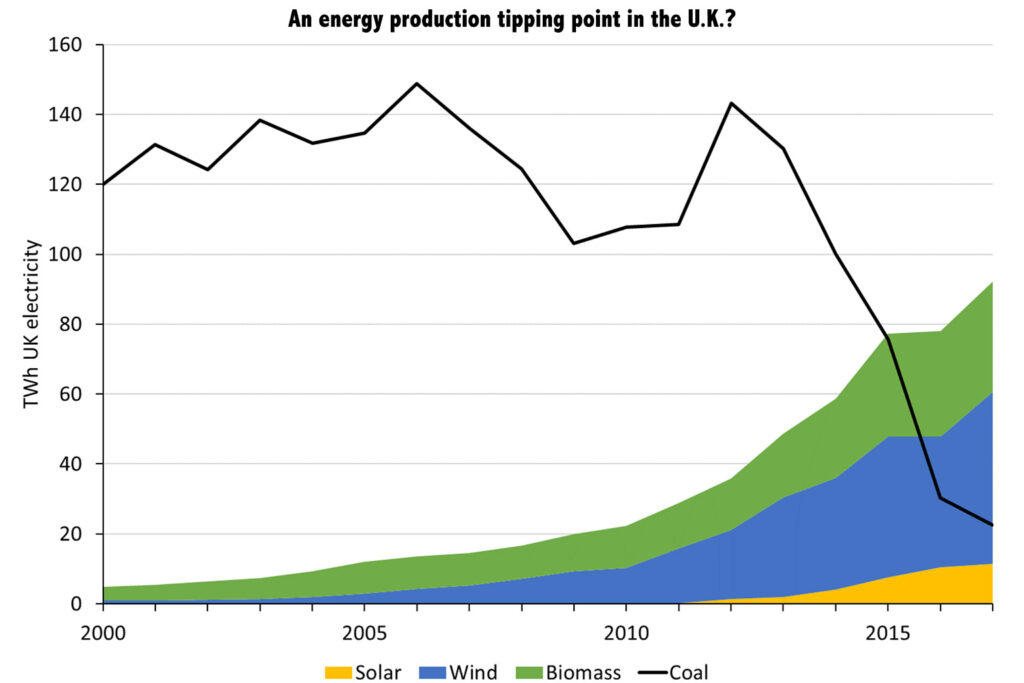
Electric vehicle (EV) market share in a sample of 18 European countries as a function of cost differential expressed as average of equivalent petrol or diesel vehicle minus EV (monthly cost of ownership in euros). Image credit: Sharpe & Lenton (2020)Tipping point for coal in UK power generation. UK electricity generation (TWh) from coal and renewables 2000-2017. Image credit: Sharpe & Lenton (2020)
“The COVID-19 pandemic has taught us that when a threat is truly urgent we can act decisively and put aside neoliberal economics in favor of saving lives. But politicians immediately started talking about ‘building back better’ rather than taking the opportunity to ‘build forward better’ – i.e. to chart a new economic and ecological path.”
Lenton spoke about these issues and more in a conversation with Mongabay Founder Rhett A. Butler.
AN INTERVIEW WITH TIM LENTON
Mongabay: How did you become interested in the idea of tipping points?
Tim Lenton: I started out studying Gaia and identifying how aspects of the Earth system self-regulate. In Jim Lovelock’s models like Daisyworld and in Earth history there are key moments where self-regulation breaks down and strong reinforcing feedbacks take over to propel abrupt change. Although I didn’t call them ‘tipping points’ at the time that’s what they are. When Malcolm Gladwell published ‘The Tipping Point’ it seemed natural to adopt that language.
Mongabay: How does the concept of tipping points intersect with the idea of planetary boundaries?
Tim Lenton: Where undesirable tipping points exist it makes it easier to set a ‘safe’ planetary boundary to avoid them. But not all planetary boundary variables have tipping points. Climate and ocean deoxygenation driven by nutrient inputs clearly do.
Waves breaking on a beach in California. Photo by Rhett A. Butler.
Hence I used those tipping points to help inform the original setting of planetary boundaries for climate and nutrient inputs. But other planetary boundaries lack an obvious tipping point so have to be set in a different way.
Mongabay: In your highly-cited 2008 PNAS paper, you and your co-authors identified several tipping points. Has that list changed since then? And have some of those tipping points progressed more rapidly than others?
Tim Lenton: The list has changed somewhat over time, but not as much as thought it might. I put question marks on some of the original list and map to show I was less sure about them. Tropical coral reefs are now on the list, as is part of the East Antarctic Ice Sheet draining the Wilkes Basin.
Map of potential policy-relevant tipping elements in the climate system in Lenton et al (2008)’s original paper. These have since been updated to include coral reefs and the East Antarctic Ice Sheet.
Some of the tipping elements are changing more rapidly than others. The most concerning include the West Antarctic Ice Sheet – part of it looks to be in irreversible retreat – and the Amazon rainforest – where droughts and changing fire regimes are accelerating forest loss, alongside renewed human pressures.
Mongabay: You’ve warned about the risk of one tipping point potentially triggering another tipping point as a sort of cascading domino effect. How has the science around that idea improved over the past decade?
Tim Lenton: A decade or so ago we identified this as a theoretical possibility with some idea of what the causal interactions could be. Now we have more direct evidence of causal interactions, like the role of Arctic sea-ice retreat and resultant warming in permafrost thawing and accelerating Greenland ice sheet melt. Also the contribution of Greenland melt water to disrupting North Atlantic deep water formation and the Atlantic overturning circulation. Plus we now have some models for how the interactions could play out.
Mongabay: Here in the American West we’re reaching the end of what was a catastrophic fire season and we’re told that we should expect this to be the new normal going forward. Have you identified any tipping point when it comes to forest fire dynamics here?
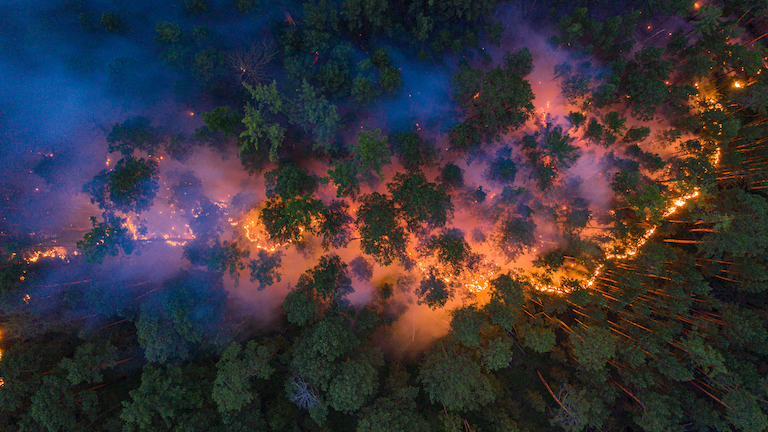
Tim Lenton: Fires generate their own reinforcing feedbacks – drying the fuel load, creating local convection and winds, and even thunderstorms – and such self-amplifying feedbacks are the vital ingredient for creating tipping point dynamics.
Krasnoyarsk, Siberia, is just one region where fires are burning throughout Russia in 2020. Image by Greenpeace International.
Fire regimes in the wet tropics can pass a tipping point from localized fires to much larger ‘mega fires’ – a bit like a phase transition in physics. Such mega-fires now seem to be happening in the American West, Australia and even the Arctic. So there looks to be a localized fire tipping point, and some signs that it is being passed at similar times across large areas – making for a bigger tipping point.
Mongabay: From the appearance of dry forest species like the maned wolf and the rise in drought and fire in the Amazon in recent years, there seems to be increased evidence of significant changes occurring in Earth’s largest rainforest. How will we know when we’re actually near the tipping point?
Tim Lenton: One way to find out is to look for the characteristic early warning signals of approaching a tipping point – the forest ‘slowing down’ in its recovery from perturbations (like the recent drought years). We’ve being analyzing the data and we think we’ve picked up this slowing down signal of the Amazon rainforest losing resilience across large areas. To pinpoint whether we are close to a tipping point one can also look at the least resilient parts of the forest (e.g. in the Southeast) and see if they are locally being tipped into an alternative stable state by droughts or fires – and how easily that tipping happens.
Mongabay: In 2018 you wrote a perspective updating the Gaia theory and proposing that it serve as a “framework for fostering global sustainability.” Can you elaborate on this?
Tim Lenton: Whether you agree or not with the original Gaia theory it is obvious that we are becoming collectively self-aware of the bad consequences of our actions on our own life-support system. My proposal with Bruno Latour is that we could in principle add a bit of self-awareness to the Earth’s self-regulation. At the very least we could sense where things are going wrong better (through satellites etc) and correct our mistakes faster. We could also use the prior Gaia to provide a template for designing a more flourishing sustainable future – including sustainable energy, material recycling, and horizontal information exchange, supporting a rapid learning process.
Mongabay: Arguably, there has been very little progress in curbing carbon emissions since your 2008 tipping points paper despite a growing body of scientific evidence on the need to take action. What do you think it will take to catalyze an appropriate sense of urgency among the general public and politicians? And has the COVID-19 pandemic made any difference on this front?
Tim Lenton: I think there is an appropriate sense of urgency among many in the general public who protested together and forced government declarations of a ‘climate emergency’. The problem is we need urgent action and most of our current generation of politicians are just not up to this leadership task. Younger generations are looking at them with dismay and rightly rebelling.
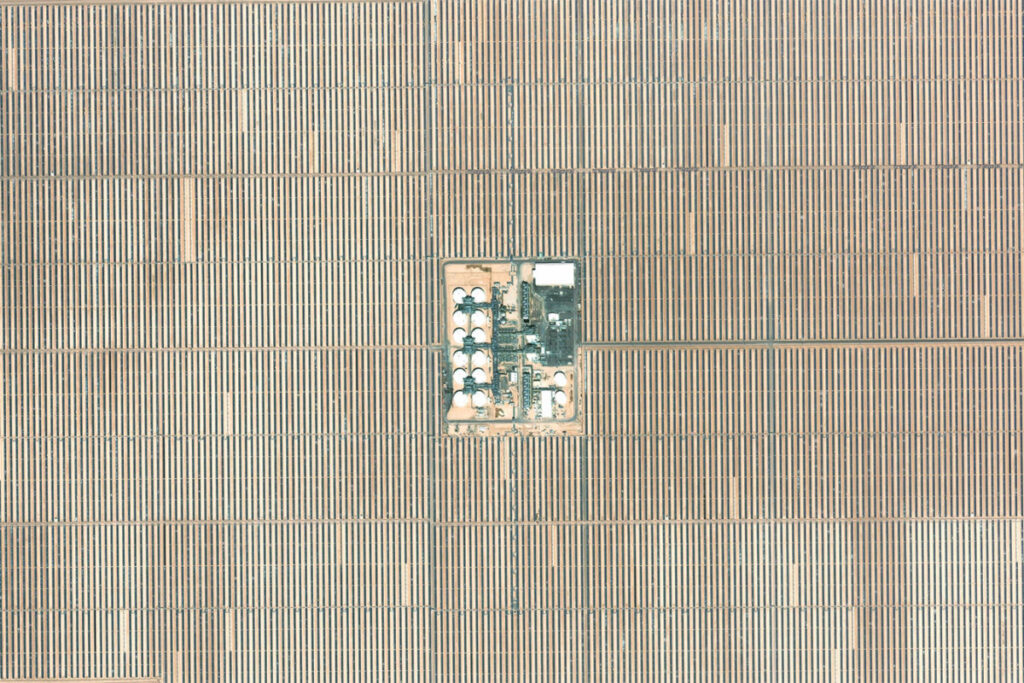
Solar panels at Solana Generating Station in Arizona. Image credit: Microsoft Zoom.Earth
The COVID-19 pandemic has taught us that when a threat is truly urgent we can act decisively and put aside neoliberal economics in favor of saving lives. But politicians immediately started talking about “building back better” rather than taking the opportunity to “build forward better” – i.e. to chart a new economic and ecological path.
Mongabay: In January the United States will have a new President. What would you like the Biden Administration to prioritize?
Tim Lenton: Tackling climate change and inequality through the green new deal. Go to the places where people feel they are going to lose out – the coal belt and the rust belt – and work with the communities there to chart a prosperous alternative future for them, then resource them to get to that greener future – just like we are seeing with the German ‘coal commission’.
Mongabay: Lastly, tipping points seem like a potentially depressing topic. What gives you hope?
Lenton, T. M. et al. “Tipping elements in the Earth’s climate system.” Proceedings of the National Academy of Sciences 105, 1786–1793 (2008).
Sharp, S. and Lenton, T. M. “Upward-scaling tipping cascades to meet climate goals – plausible grounds for hope.” Policy briefing note series 2020/01 (2020).
Loveland Magazine is one of the 400 news outlets worldwide, with a combined audience of over 2 billion people “Covering Climate Now”, a global journalism initiative committed to bringing more and better coverage to the defining story of our time.
The initiative, was co-founded by The Nation and Columbia Journalism Review
Mihaela Manova is “Covering Climate Now” in Loveland, Ohio as an editor for Loveland Magazine
Read Covering Climate Now’s newly published newsletter on new stories, reflections of 2020, and information regarding climate change.
Humanity begins 2021 with a real chance to pull back from the brink of climate catastrophe. The odds get even better if Democrats win both Georgia run-off elections and take control of the US Senate. (At the time of writing, someoutlets had reported a victory for Democratic candidate Jon Ossoff over Republican incumbent David Perdue, based on projections, while others held off.) In any case, strong climate journalism in the year to come is essential to help humanity rise to the challenge.
For the last four years, the world’s largest economy and single-biggest all-time emitter of heat-trapping gases has been in the grips of an aggressive climate denier. The Trump administration slashed environmental regulations, expanded concessions to the oil and gas industry, and withdrew from the Paris Agreement, the hard-won 2015 pact to compel international cooperation on the defining problem of our time. Climate progress did continue in Washington’s absence, but too slowly. Select state and local governments in the US, as well as governments abroad, forged ahead with plans to curb emissions. Thirty-eight countries, including the United Kingdom, Canada, and Japan, declared a “state of climate emergency.” And China, the second-biggest historical emitter behind the US, announced a commitment to achieve carbon neutrality by 2060. Still, obstruction and backsliding in Washington placed the world on track for a hellish future.
With Joe Biden’s inauguration imminent, a new era in the climate story is at hand. And for the press, this new year presents a much-needed opportunity to reinvent our climate coverage—to redouble, not relax, our commitment to telling the climate story so people get it and, moreover, resolve that they and especially their governments do something about it.
Read Mark Hertsgaard’s & Andrew McCormick’s full column, charting a course for the climate story in 2021…
NEW FROM CCNOW:
Talking Shop: Countering Emotional Fatigue & Burnout. Our next Talking Shop webinar is set for January 13 at 12pm US Eastern time. Join us for an hour of candid, collegial discussion about how journalists covering emotionally fraught issues from racial justice to climate change to war zones can cope with burn-out, emotional fatigue, grief, and the other manifestations of the psychological stress such work can bring. Panelists will include Matthew Green, the climate correspondent at Reuters and Dr. Renee Lertzman, a researcher and educator specializing in psychological tools for coping with ecological crises, with additional panelists still to be confirmed. CCNow executive director Mark Hertsgaard will moderate. You can RSVP now here…
Call for stories to share. A reminder to all CCNow partners, at all times we accept stories for republication by others in the collaboration. If you’ve got a strong climate story that might appeal to other audiences, please send it our way using this Google Form. As always, stories available for republication can be found in our Sharing Library (strong stories from last year that remain relevant in 2021 are currently highlighted in yellow).
ESSENTIAL CLIMATE NEWS:
For NBC Nightly News, Al Roker hosts a new multi-part series looking back at all the record-breaking extreme weather in 2020 – and forward to see how communities will cope with and mitigate the climate threat. “We are now in uncharted territory,” Roker says. “This crisis of our changing climate will be, and already is, the story of our time.” From NBC News…
In South Sudan, an intense and protracted rainy season has displaced nearly a million people and now threatens famine. The crisis is a harrowing reminder of how climate change often inflicts the greatest punishment on populations who are least responsible for the problem or equipped to deal with the impacts. Aid from the outside world has been slow and insufficient. From Al Jazeera, via the Associated Press…
Exxon, like many big energy companies, talks a big game about environmental consciousness and new, ostensibly low-emissions projects. Yet internal documents show that the company’s assessments of its environmental impacts differ significantly from what is shared with the public. A new natural gas export facility in Texas, for example, was touted as a gift of clean energy to the world, but the facility’s projected emissions are on par with those of a coal-fired power plant. Exxon’s shareholders are starting to notice. From Bloomberg Green…
In The Nation’s latest print issue, Sunrise Movement co-founder Varshini Prakash argues that Biden should use executive authority to establish an Office of Climate Mobilization, similar to Franklin D. Roosevelt’s Office of Wartime Mobilization. Such an office would have broad decision-making, agenda-setting, and budgeting authorities, Prakash suggests, which Biden will need if his administration indeed intends to make climate its number one priority. From The Nation…
Inside Climate News surveys the “new and unexpected” things we learned about climate change in 2020 – including that the fundamental link between climate science and climate justice has not been researched enough, meaning our shared understanding of how climate change will impact at-risk populations is lacking. Another highlight: eliminating greenhouse gas emissions might halt global warming much sooner than scientists previously believed (a fact which CCNow described last year as “game-changing.” From Inside Climate News…
In The Invading Sea, the opinion branch of the Florida Climate Reporting Network, Florida state lawmaker Chip LaMarca, a Republican, argues for robust coastline policies to meet the environmental threat. LaMarca is one of a growing cadre of Republicans in Florida who buck the national GOP’s climate denialism as more record-breaking hurricanes and sea level rise threaten beaches, property values, and the tourist economy in the state. From The Invading Sea…
NowThis joins a group of Greenpeace researchers documenting the Arctic’s precipitous deterioration, which in 2020 included the splitting off of more than 40 square miles from the world’s largest ice shelf. “We want to make sure that world leaders understand the urgency of the climate crisis, and that they understand the role of healthy oceans in tackling [it],” one researcher says. From NowThis…
THE YEAR THAT WAS AND THE ONE AHEAD:
Many outlets have published stories reviewing the climate lessons of 2020 and looking forward to 2021. Here are some that caught our eyes; perhaps they will help orient your own reporting in the coming weeks and months:
The Society of Environmental Journalists is collecting helpful tip sheets and background resources to help reporters prepare for the year ahead. Tip sheets include environmental justice stories to watch in 2021 and a review of climate policies the executive branch is likely to institute under Biden; backgrounders include the options Biden has to act on climate change, even without Senate support, and a summary of how carmakers are preparing for a shifting regulatory landscape. Keep an eye out for the SEJ’s complete “2021 Journalists’ Guide to Energy & Environment,” which launches January 27. For now, find the tipsheets and background resources here…
—
As we head into this next chapter of climate reporting, Covering Climate Now has modified our newsletter to better serve journalists’ needs. We’re going to treat these emails as a kind of “bulletin board” for climate journalists as well as other folks interested in learning more about climate change. We hope you find the new format helpful and digestible.
If you have any feedback, or know of another event or have news that should be included here, shoot us a note at editors@coveringclimatenow.org.
Loveland Magazine is one of the 400 news outlets worldwide, with a combined audience of over 2 billion people “Covering Climate Now”, a global journalism initiative committed to bringing more and better coverage to the defining story of our time.
The initiative, was co-founded by The Nation and Columbia Journalism Review
Mihaela Manova is “Covering Climate Now” in Loveland, Ohio as an editor for Loveland Magazine
In this Covering Climate Now newsletter written by Mekdela Maskal, Maskal highlights Georgia’s young voters who are fighting for climate change in the upcoming runoff elections.
On January 5, voters in Georgia will decide which political party controls the US Senate and, in turn, how far President-elect Joe Biden will be able to take his ambitious $2 trillion climate plan.
For Democrats to take control of the Senate, Rev. Raphael Warnock and Jon Ossoff both need to win their runoffs against Republican incumbents Kelly Loeffler and David Perdue, respectively. Warnock and Ossoff have plans to address climate change, which poses multiple threats to Georgia, including intensifying hurricanes, sea level rise, higher temperatures, and spreading contamination at some of the nation’s most toxic waste dumps. Their GOP counterparts have all but ignored the climate issue.
Throughout this election season, young voters and activists have forced climate change to center stage, and this final pivotal race is no exception. We spoke with five young people in Georgia to get their take on the issues that matter most and how those are covered (or not) in the media.
Reach out to us for youth activists who are available for interviews.
Edward Aguilar, 17
Aguilar is a high school senior in Alpharetta, Ga. who has been encouraging college students to register to vote through Students for Tomorrow, an organization he co-founded that helps young people understand political issues and why their vote counts.
We started Students for Tomorrow in September. A friend of mine had to leave college because of Covid and was going to move back in with his parents. He called me and one of the questions that he had was, “Where am I going to vote? I’ve been voting from school for the last couple of years. Now, I am going back home, can I even vote there?”
People tend to feel that students are really apathetic when it comes to the political process, but in reality, a lot of them are just disillusioned. They don’t feel like their votes have an impact, and they don’t see themselves represented in media coverage. I think that’s why you’ve historically seen young people also taking to the streets and doing things online, more than just trying to place their vote. By showing them that their vote matters, Students for Tomorrow has helped an estimated 65,000 students register to vote nationwide.
I think students are going to be the key for a lot of progressive policies moving forward, because they are willing to vote based on policy rather than party. Over the last month, we’ve been organizing hundreds of teen volunteers to have conversations with students ahead of the runoffs to clarify how their values and interests align with policies. We’ve been making a lot of calls to Perdue voters and saying, “If you want to live in a place that’s not underwater 40 years from now, you should probably not vote for him.”
Jordan Madden, 16
Madden is a coordinator at Sunrise Movement Clayton County and an intern for State Rep. Becky Evans, a Democrat representing Georgia’s 83rd District. Madden became involved in local climate justice efforts to bring more attention to the state’s environment.
My cousin works at a disposal company, and I’ve gone with him to our local landfill, the Dekalb County Seminole landfill, to see the problems there first-hand. Seeing the neighborhoods that surround the landfill, where we pollute and store our trash, you’re constantly reminded that these issues impact low-income people and are not shared by everyone equally. Knowing that this landfill is just one of many locations like it across the world made me realize that this problem is way bigger than just us.
I want to make the public aware that environmental issues and climate change are real issues that we can solve if we put enough time and effort into them. Older people had a chance, but now it’s definitely our time to try and fix this problem.
One thing that hasn’t been brought up in enough detail throughout the elections is what a just recovery means and whether affected communities will be brought to the table. We hear a lot from politicians and people who have power and money, but we need to hear more from the people who live the realities of climate and environmental injustice every single day. We see news about the temperature and global warming but we need to hear more of, “What can we do to reduce plastic waste in our communities?” “How can we hold the companies releasing toxins here accountable?” I want to see the media shine a light on the corporations that pledge to be green while at the same time hindering climate agendas.
Jakia Cox, 19
Cox is a freshman at Hawai’i Pacific University, originally from Ellenwood, Georgia. She became familiar with the environmental and climate justice movements while navigating her own lived experience.
When I returned to Ellenwood from school, because of Covid, I woke up to this horrible stench. My house is less than half a mile away from the Dekalb County Seminole landfill. My parents bought the house in 2001, when they were told that the landfill would be closing. That was a huge lie. We couldn’t really smell it at first back then. But as time went on, the smell got worse, and now the trash in the landfill is stacked as tall as some trees. Every other day, at least, I have to put my shirt over my nose just to walk around my house.
I decided to email the Georgia Environmental Protection Division and ask why the site remains open next to a neighborhood and about the health effects. I realized most of the neighborhoods surrounding Ellenwood are Black. I also learned of a predominantly white neighborhood nearby where public officials were thinking about creating a landfill that didn’t go through. It then sunk in that I was living with environmental racism. Since then, I’ve been figuring out how to organize with my family and my neighbors. My brother started a petition to close the landfill, but I have to say it’s frustrating, because it feels like we’re not being heard.
To be honest, I haven’t been following the elections that closely. It’s difficult to stay engaged when it feels like the focus isn’t right or isn’t on issues that affect you. The Senate candidates, for example, seem more worried about their image than their constituents and local climate issues. It’s hard to be hopeful. Our stories need to be heard.
Natasha Dorr-Kapcynski, 19
Dorr-Kapcynski is a freshman at the University of Georgia. She is also the co-founder and communications coordinator of Georgia For The Planet, which is dedicated to fighting climate change and injustice in the state.
Climate change is definitely growing in importance to Georgians but it’s still not widely considered a major issue.
The upcoming Senate races are important, but so is the lesser known race for Public Service Commissioner, which also did not have a clear winner on Election Day. The Public Service Commission has been controlled for years by Republicans who determine energy rates, regulate the storage of toxic coal ash, and decide investments in renewables, like solar energy. They don’t seem to have anything but profit in mind. And I don’t see anyone talking about that.
I think if people realized that a lot of the social justice issues in Georgia are tied to environmental issues, they would be more interested in fighting for the environment. For example, I don’t think many people realize that Black people in Atlanta have disproportionately higher rates of asthma from exposure to air pollution, or that they tend to live near contaminated water sources, and how these issues tie together. If you’re worried about getting clean water for your family, and you only see climate news with stereotypical images of polar bears and melting ice caps then it’s hard to make that connection. But we are starting to see that shift happening in the media.
For the last couple of months I’ve been working at my school to create voter guides around climate policy, because we’ve found that navigating the voter process while trying to understand what’s on the ballot can get confusing, especially for young people who haven’t voted before. We’ve put guides up in dining halls and Covid testing centers, and we’ve also circulated them in our group chats and on social media. We’re thinking longer term, too, to 2022, when Georgia will have a governor’s race and a Senate seat [the one currently held by Loeffler] on the ballot.
In the media, I would like to see the candidates be more challenged to get specific on climate and the environment. Perdue and Loeffler often bring up supposed job losses and increased electricity costs from renewables. Ossoff and Warknock bring up the impacts of climate change that we’ll have to deal with, like pollution. But I don’t often see the media fact-checking them. You’re not having a dialogue between those two points, and they’re not measured against reality. On the ground in Georgia, for example, we’re actually seeing solar energy booming. That needs to be addressed when these things are reported locally.
Because it’s all eyes on Georgia now, it seems like the national impacts of the election are taking over more than the needs of Georgians. There’s not as much political conversation about the issues we’re dealing with on a local and state level.
By Mihaela Manova is the Covering Climate Now Editor for Loveland Magazine and lives in Loveland
Calling all parents and teachers! On November 16, 2020, CMRubinWorld announced that Planet Classroom Network, a new addition to their website, will be organizing a six month World’s Fair of Learning on Youtube.
The goal for this virtual fair is to unite young students in learning from different mediums on YouTube, while also focusing on global climate change.
Planet Classroom is dedicated to “supporting youth well-being, unity, inclusivity, and addressing our planet’s global challenges” as told by the CMRubinWorld website.
The program will begin on January 4, 2021 and will be hosted on their YouTube channel. The program will feature over 20 global organizations such as Global Nomads, The Martha Graham Dance Company, and many more. For the full list, visit: https://www.cmrubinworld.com/planet-classroom/
“Research has shown us time and time again that the arts and social impact learning unites people across borders. The COVID-19 pandemic and the ensuing economic and societal consequences have amplified an already existing crisis of youth mental health,” said CMRubinWorld Co-Founder and CEO, Cathy Rubin.
“We came to the conclusion that the world’s youth needed their own Youtube channel where they can work with each other and seek sustainable solutions for their planet.”
The organizations that have partnered up with Planet Classroom will focus on artistic and creative aspects and opportunities. Director Eric Simon talked about his film What To Do About Climate Change?, which will air on the platform.
According to CmRubinWorld, Simon said, “explores avenues available for making progress” and will focus on the passion of protestors and activists battling climate change.
Likewise to Simon’s goals, other topics will be showcased throughout the six month program, including writing, watching documentaries, dance, and a platform for children to tell their stories.
About Planet Classroom Network
The Planet Classroom Network, organized by CMRubinWorld, brings together musicians, dancers, video game creators, filmmakers, learning innovators and emerging technologists from all over the world to entertain, educate and engage youth, and to provide a rich cultural experience at a time when art and learning institutions everywhere are not accessible.
The Planet Classroom Network is by youth for youth. Young people from around the world played a significant role in conceptualizing, creating, and producing the network’s vision and programming.