Tag: #coveringclimatenow

  • President Donald Trump’s Climate Change Record Has Been a Boon for Oil Companies, and a Threat to the Planet/ Covering Climate Now

    President Donald Trump’s Climate Change Record Has Been a Boon for Oil Companies, and a Threat to the Planet/ Covering Climate Now

    Loveland Magazine is one of the 400 news outlets worldwide, with a combined audience of over 2 billion people “Covering Climate Now”, a global journalism initiative committed to bringing more and better coverage to the defining story of our time.
    The initiative, was co-founded by The Nation and Columbia Journalism Review

    Mihaela Manova is “Covering Climate Now” in Loveland, Ohio as an editor for Loveland Magazine

    Pursuing an unrelenting fossil fuel agenda, Trump has scaled back or eliminated over 150 environment measures, expanded Arctic drilling, and denied climate science.

    In the middle of his 44th month in office, two weeks before the start of the Republican convention in late August, President Trump rolled back Barack Obama’s last major environmental regulation, restricting methane leaks.

    The move represented an environmental trifecta of sorts for the president, who had handed the oil and gas industry another gift in his quest for “American energy dominance,” thumbed his nose yet again at climate change and came close to fully dismantling his predecessor’s environment and climate legacy.

    It had been a busy four years, and a breakneck 2020, as Trump and the former industry executives and lobbyists he’d placed in control of the Environmental Protection Agency and the Department of the Interior raced to rollback auto emissions standards, weaken the nation’s most important environmental law, open the Arctic National Wildlife Refuge to drilling and reject stronger air pollution standards, even as research showed a link between those pollutants and an increased risk of death from Covid-19.

    “I applaud and strongly support President Trump’s continued support for the oil and gas industry,” Oklahoma Gov. Kevin Stitt said after the administration proposed its rollback of the Obama methane rules. “During these uncertain times, it makes no sense that we would be placing additional regulatory burdens on our vital industries which are not supported by sound science and do not consider economic impact.”

    Environmental lawyers and climate activists who’ve been battling Trump since day one are in agreement that Trump, beginning with his decision to lead the nation out of the Paris climate accord, has done more to roll back and weaken environmental laws and regulations than any president in history.

    Trump extolled the accomplishment and put a different spin on the superlative during a White House speech in July, saying, “We have removed nearly 25,000 pages of job destroying regulations, more than any other president by far in the history of our country.”

    A few days earlier, as his Democratic rival, Joe Biden, unveiled a $2 trillion plan to combat climate change, Trump promoted what he called a “very dramatic” series of revisions to the National Environmental Policy Act, the foundation of environmental protection in the United States that had been signed into law by President Richard M. Nixon 50 years ago.

    Environmentalists have used the law to block everything from pipelines to the destruction of natural habitats. Trump has now limited environmental reviews under the act to between one and two years and relieved federal agencies from having to consider a project’s impact on climate change during the review and permitting process.

    “While our world is burning, President Trump is adding fuel to the fire by taking away our right to be informed and to protect ourselves from irreparable harm,” Gina McCarthy, Obama’s EPA administrator who now serves as president and CEO of the Natural Resources Defense Council, said of weakening the act.

    By late summer, Columbia University’s Sabin Center for Climate Change Law had counted 159 actions since Trump took office “to scale back or wholly eliminate climate mitigation and adaptation measures.” Many have been slowed or blocked by the courts.

    Trump’s Long Focus on ‘American Energy Dominance’

    When Trump delivered his first major energy speech in the fracking fields of North Dakota as a candidate in May 2016, he called for American domination of global energy supplies.

    “We are going to turn everything around,” Trump declared. “And quickly, very quickly.”

    Once in office, Trump pursued a policy of unfettered support for fossil fuel development. He immediately signed memorandums to revive the Keystone XL and Dakota Access pipelines, projects blocked by Obama.

    In early March 2017, his administration ordered the Environmental Protection Agency to stop gathering data from oil and gas companies needed to rein in leaks of methane, a potent short-lived climate pollutant. Fossil fuel infrastructure adds to greenhouse gas emissions, in part by leaking methane into the atmosphere.

    He followed up, at the end of March, by issuing a sweeping executive order directing all federal agencies to target for elimination any rules that restrict U.S. production of energy. He set guidance to make it more difficult to put future regulations on fossil fuel industries and he moved to discard the use of a rigorous “social cost of carbon,” a regulatory measurement that puts a price on the future damage society will pay for every ton of carbon dioxide emitted.

    As his first year in office came to a close, Trump and Alaska’s Republican senators inserted a provision into his signature tax cut legislation that called for opening the coastal plain of the Arctic National Wildlife Refuge for drilling.

    In 2018, domestic oil production hit a record high. The result of this, among other things, was the reversal of three consecutive years of declining U.S. carbon emissions.

    Many of Trump’s regulations have also been tailored to favor the coal industry, often at the expense of cheaper, cleaner energy. Robert Murray, founder of the now-bankrupt coal company Murray Energy and one of Trump’s closest industry allies, gave the president a “wish list” early on that became a virtual template for the administration’s rollback of regulations.

    The administration swiftly lifted an Obama moratorium on new coal leases on federal lands, to no real benefit. The decline of coal continued unabated, but Trump remained an unapologetic champion of the dirtiest fossil fuel.

    Trump’s War on Science

    When U.S. government scientists released their latest volume of the National Climate Assessment in November 2018, it revealed much about the robust, sobering scientific consensus on climate change.

    It also revealed the striking disconnect between Trump and essentially every authoritative institution on the threat of global warming.

    The president rejected the assessment’s central findings—based on thousands of climate studies and involving 13 federal agencies—that emissions of carbon dioxide are caused by human activities, are already causing lasting economic damage and have to be brought rapidly to zero.

    “I don’t believe it. No, no, I don’t believe it,” Trump told a reporter after the assessment’s release.

    In almost every agency overseeing energy, the environment and health, people with little scientific background, or strong ties to industries they would be regulating, were appointed to scientific leadership positions.

    One of the administration’s first actions was to order scientists and other employees at EPA and other agencies to halt public communications. Several federal scientists working on climate change have said they were silenced, sidelined or demoted.  The words “climate change” have been purged from government reports and other reports have been buried.

    The administration’s mistrust of scientists and its tendency toward science denialism would also become a prominent feature of its response to the coronavirus pandemic, when the president muzzled scientists at the Centers for Disease Control and chafed at the dire predictions of many epidemiological models for Covid-19 deaths.

    With the nation in a state of emergency over the pandemic, Andrew Wheeler, a former coal industry lobbyist who serves as Trump’s administrator of the Environmental Protection Agency, moved in late March to fast-track the “Strengthening Transparency in Regulatory Science” rule. Wheeler replaced Scott Pruitt, an Oklahoma Republican who served as Trump’s first EPA administrator before resigning in 2018 amid an ethics scandal.

    Critics call Wheeler’s transparency proposal Orwellian and say it would actually limit the use of human health science in environmental decision-making, by eliminating studies that rely on patients’ anonymous medical data.

    While Trump and his conservative allies contend that the reliance on such studies amounts to “secret science,” scientists and leading medical authorities respond that it is standard practice to honor patient confidentiality in peer-reviewed studies.

    Numerous studies, including one based on health data from 60 million Medicare recipients, have shown that one of the signature pollutants from the burning of fossil fuels, microscopic particles less than 2.5 microns in width—known as PM 2.5—kill as many as 52,100 Americans prematurely each year.

    Less than a month later, as much of the nation remained locked down to halt the spread of Covid-19, a respiratory disease, the Trump administration rejected a recommendation from government scientists to strengthen the national air quality standard for particulate matter. Trump chose instead to maintain the current PM 2.5 standard, handing the fossil fuel industry a major victory.

    A ‘Concerted Attack’ on Alaska, Public Lands

    The Trump administration knew no bounds for its fossil fuel agenda, pursuing drilling from the outset on pristine public lands in Alaska and the lower 48 states, where oil companies have long sought access.

    Less than four months after taking office, Trump moved to lift Obama’s offshore Arctic drilling ban and, then, in July 2017, gave Italian oil company Eni a quick green light to drill exploratory wells.

    In March 2018, the Trump administration proposed a resumption of leasing in Alaska’s Beaufort Sea. President Obama, shortly before leaving office, had “permanently” withdrawn from drilling there.

    By then, Trump had also carved 2 million acres of land from the Grand Staircase-Escalante and Bears Ears national monuments in southern Utah in what amounted to the most sweeping reductions in protections for public land in U.S. history.

    In September 2018, the Interior Department finalized a rule that loosens methane requirements for oil and gas operations on federal lands. A month later, the administration proposed a regulation to streamline and expedite oil and gas permits on national forest lands.

    The following summer, the administration proposed weakening protections under the Endangered Species Act for threatened species and critical habitat. Shortly thereafter, the Interior Department commenced the public comment period on its plan for oil drilling in the Arctic National Wildlife Refuge that had been included in the 2017 tax bill.

    In early August 2020, the president signed the Great American Outdoors Act appropriating $900 million a year to the Land and Water Conservation Fund and $9.5 billion over five years to reduce maintenance backlogs in the national parks.

    The bipartisan legislation was sponsored by a House Democrat, but Trump extolled its passage as the most significant act in support of parklands since Teddy Roosevelt.

    Still, the administration was preparing, on the eve of the Republican convention, to start selling leases in the Arctic National Wildlife Refuge. The  sale was one of six pending projects in which Trump was pursuing more drilling, logging and mining in Alaska.

    One environmentalist called it the most “concerted attack” in 30 years on Alaska’s natural resources.

    All six of the Trump initiatives could still be blocked or rolled back in the courts, or undone by a new Biden administration working with a Democratic Congress. But for now, they are proceeding, with enormous consequences for Alaska’s environment, and global climate change.

    One by One, Obama’s Main Climate Accomplishments Fell

    The same could be said for President Obama’s environment and climate legacy: Trump’s relentless attacks could be wholly or partially undone by a new administration and Congress. But for now, Trump has accomplished his mission: a near total elimination of his predecessor’s most significant measures.

    After countless piecemeal rollbacks during Trump’s first two and a half years in office, the administration in June 2019 launched its long-awaited attack on Obama’s signature plan to tackle climate change. Designed to cut emissions from coal-fired power plants, Obama called it the Clean Power Plan.

    While the plan was challenged by industry and 27 states and blocked by the U.S. Supreme Court before Obama even left office, it encouraged many states to begin a process of planning for a transition away from coal-fired electricity at a time when cheaper natural gas and renewable energy already were forcing coal plants to shut down.

    Next came Trump’s rollback of Obama’s 2012 automobile fuel efficiency standards, the single largest step any nation had taken to address global warming by cutting carbon emissions from cars and trucks. The weakened Trump plan will allow automakers to deploy fleets that average just 40 miles per gallon by 2025, instead of 54 mpg.

    If Trump’s standard ultimately survives legal challenges, cars and trucks in the United States would emit nearly a billion tons more carbon dioxide during their lifetimes than they would have under the Obama standards.

    Finally, in mid-August, Trump proposed the rollback of the methane rules, the last major Obama environmental regulation still standing. Methane, a super-pollutant, is 86 times more potent in warming the planet than carbon dioxide over a 20-year period.

    The Obama rule required oil and gas companies to monitor methane leaks and fix them. The Trump replacement weakens those requirements, allowing companies to release 4.5 million metric tons more pollution each year. 

    In the climate realm, Obama is best known, of course, as the driving force behind the 2015 Paris climate accord.

    Trump first announced in a Rose Garden speech in June 2017 that the U.S. would withdraw from the accord in three years, as soon as the treaty allowed.

    So, right on cue, two years later, on Nov. 4, 2019, Secretary of State Mike Pompeo notified the United Nations of the formal exit of the United States, activating the final one-year waiting period.

    The actual U.S. withdrawal is set for Nov. 4, 2020, one day after the presidential election.

  • Your introduction to sustainable fashion/ Covering Climate Now

    Your introduction to sustainable fashion/ Covering Climate Now

    Loveland Magazine is one of the 400 news outlets worldwide, with a combined audience of over 2 billion people “Covering Climate Now”, a global journalism initiative committed to bringing more and better coverage to the defining story of our time.
    The initiative, was co-founded by The Nation and Columbia Journalism Review

    Mihaela Manova is “Covering Climate Now” in Loveland, Ohio as an editor for Loveland Magazine

  • The Curse of ‘Both-Sidesism’: How Climate Denial Skewed Media Coverage for 30 Years/ Covering Climate Now

    The Curse of ‘Both-Sidesism’: How Climate Denial Skewed Media Coverage for 30 Years/ Covering Climate Now

    Loveland Magazine is one of the 400 news outlets worldwide, with a combined audience of over 2 billion people “Covering Climate Now”, a global journalism initiative committed to bringing more and better coverage to the defining story of our time.
    The initiative, was co-founded by The Nation and Columbia Journalism Review

    Mihaela Manova is “Covering Climate Now” in Loveland, Ohio as an editor for Loveland Magazine


  • Scientists launch ambitious conservation project to save the Amazon/ Covering Climate Now

    Scientists launch ambitious conservation project to save the Amazon/ Covering Climate Now

    Loveland Magazine is one of the 400 news outlets worldwide, with a combined audience of over 2 billion people “Covering Climate Now”, a global journalism initiative committed to bringing more and better coverage to the defining story of our time.
    The initiative, was co-founded by The Nation and Columbia Journalism Review

    Mihaela Manova is “Covering Climate Now” in Loveland, Ohio as an editor for Loveland Magazine


    Butterflies burst into the sky above an Amazonian river. Image © Fernando Lessa / The Nature Conservancy.

    With the Amazon rainforest predicted to be at, or very close to, its disastrous rainforest-to-savanna tipping point, deforestation escalating at a frightening pace, and governments often worsening the problem, the need for action to secure the future of the rainforest has never been more urgent.

    Now, a group of 150 leading scientific and economic experts on the Amazon basin have taken it upon themselves to launch an ambitious conservation project. The newly founded Science Panel for the Amazon (SPA) aims to consolidate scientific research on the Amazon and propose solutions that will secure the region’s future — including the social and economic well-being of its thirty-five-million inhabitants.

    “Never before has there been such a rigorous scientific evaluation on the Amazon,” said Carlos Nobre, the leading Amazon climatologist and one of the chairs of the Scientific Panel. The newly organized SPA, he adds, will model its work on the style of the authoritative reports produced by the UN Intergovernmental Panel on Climate Change (IPCC) in terms of academic diligence and the depth and breadth of analysis and recommendations.

    The Amazon Panel, is funded by the United Nation’s Sustainable Development Solutions Network and supported by prominent political leaders, such as former Colombian President, Juan Manuel Santos and the elected leader of the Coordinator of Indigenous Organizations of the Amazon River Basin, José Gregorio Díaz Mirabal. The SPA plans to publish its first report by April 2021.

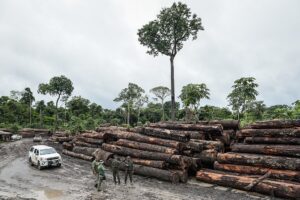
    Timber illegally logged within an indigenous reserve seized by IBAMA, Brazil’s environmental agency, before the election of Jair Bolsonaro. Under the Bolsonaro administration, IBAMA has been largely defunded. Image courtesy of IBAMA.

    Reversing the Amazon Tipping Point

    Over the last five decades, the Amazon rainforest lost almost a fifth of its forest cover, putting the biome on the edge of a dangerous cliff. Studies show that if 3 to 8% more forest cover is lost, then deforestation combined with escalating climate change is likely to cause the Amazon ecosystem to collapse.

    After this point is reached, the lush, biodiverse rainforest will receive too little precipitation to maintain itself and quickly shift from forest into a degraded savanna, causing enormous economic damage across the South American continent, and releasing vast amounts of forest-stored carbon to the atmosphere, further destabilizing the global climate.

    Amazon researchers are now taking a proactive stance to prevent the Amazon Tipping Point: “Our message to political leaders is that there is no time to waste,” Nobre wrote in the SPA’s press release.

    Amid escalating forest loss in the Amazon, propelled by the anti-environmentalist agenda of Brazilian President Jair Bolsonaro, experts fear that this year’s burning season, already underway, may exceed the August 2019 wildfires that shocked the world. Most Amazon basin fires are not natural in cause, but intentionally set, often by land grabbers invading indigenous territories and other conserved lands, and causing massive deforestation.

    “We are burning our own money, resources and biodiversity — it makes no sense,” Sandra Hacon told Mongabay; she is a prominent biologist at the Brazilian biomedical Oswaldo Cruz Foundation and has studied the effects of Amazon forest fires on health. It is expected that air pollution caused by this year’s wildfire’s, when combined with COVID-19 symptoms, will cause severe respiratory impacts across the region.

    Bolivian ecologist Marielos Penã-Claros, notes the far-reaching economic importance of the rainforest: “The deforestation of the Amazon also has a negative effect on the agricultural production of Uruguay or Paraguay, thousands of kilometers away.”

    The climate tipping point, should it be passed, would negatively effect every major stakeholder in the Amazon, likely wrecking the agribusiness and energy production sectors — ironically, the sectors responsible for much of the devastation today.

    “I hope to show evidence to the world of what is happening with land use in the Amazon and alert other governments, as well as state and municipal-level leadership. We have a big challenge ahead, but it’s completely necessary,” said Hacon.

    Cattle ranching is the leading cause of deforestation in the Brazilian Amazon, but researchers say there is enough already degraded land there to support significant cattle expansion without causing further deforestation. The SPA may in its report suggest viable policies for curbing cattle-caused deforestation. Image ©Henrique Manreza / The Nature Conservancy.

    Scientists offer evidence, and also solutions

    Creating a workable blueprint for the sustainable future of the Amazon rainforest is no simple task. The solutions mapped out, according to the Amazon Panel’s scientists, will seek to not only prevent deforestation and curb global climate change, but to generate a new vision and action plan for the Amazon region and its residents — especially, fulfilling development goals via a sustainable standing-forest economy.

    The SPA, Nobre says, will make a critical break with the purely technical approach of the United Nation’s IPCC, which banned policy prescriptions entirely from its reports. In practice, this has meant that while contributing scientists can show the impacts of fossil fuels on the atmosphere, they cannot recommend ending oil subsidies, for example. “We inverted this logic, and the third part of the [SPA] report will be entirely dedicated to searching for policy suggestions,” Nobre says. “We need the forest on its feet, the empowerment of the traditional peoples and solutions on how to reach development goals.”

    Researchers across many academic fields (ranging from climate science and economics to history and meteorology) are collaborating on the SPA Panel, raising hopes that scientific consensus on the Amazon rainforest can be reached, and that conditions for research cooperation will greatly improve.

    Indigenous Munduruku dancers in the Brazilian Amazon. The SPA intends to gather Amazon science and formulate socio-economic solutions in order to make sound recommendations to policymakers. Image by Mauricio Torres / Mongabay.

    SPA participants hope that a thorough scientific analysis of the rainforest’s past, present and future will aid in the formulation of viable public policies designed to preserve the Amazon biome — hopefully leading to scientifically and economically informed political decisions by the governments of Amazonian nations.

    “We are analyzing not only climate but biodiversity, human aspects and preservation beyond the climate issues,” Paulo Artaxo, an atmospheric physicist at the University of São Paulo, told Mongabay.

    Due to the urgency of the COVID-19 pandemic, the initiative’s initial dates for a final report were pushed forward by several months, and a conference in China cancelled entirely. But the 150-strong team is vigorously pushing forward, and the first phase of the project — not publicly available — is expected to be completed by the end of the year.

    The hope on the horizon is that a unified voice from the scientific community will trigger long-lasting positive changes in the Amazon rainforest. “More than ever, we need to hear the voices of the scientists to enable us to understand how to save the Amazon from wanton and unthinking destruction,” said Jeffrey Sachs, the director of the UN Sustainable Development Solutions Network, on the official launch website called The Amazon We Want.

    Banner image: Aerial photo of an Amazon tributary surrounded by rainforest. Image by Rhett A. Butler / Mongabay.

  • Why a ‘feverish’ Arctic will affect everyone on the globe/Covering Climate Now

    Why a ‘feverish’ Arctic will affect everyone on the globe/Covering Climate Now

    Loveland Magazine is one of the 400 news outlets worldwide, with a combined audience of over 2 billion people “Covering Climate Now”, a global journalism initiative committed to bringing more and better coverage to the defining story of our time.
    The initiative, was co-founded by The Nation and Columbia Journalism Review

    Mihaela Manova is “Covering Climate Now” in Loveland, Ohio as an editor for Loveland Magazine


    A

  • Solutions to the Climate Crisis Must Be Rooted in Justice and Equity/Covering Climate Now

    Solutions to the Climate Crisis Must Be Rooted in Justice and Equity/Covering Climate Now

    Loveland Magazine is one of the 400 news outlets worldwide, with a combined audience of over 2 billion people “Covering Climate Now”, a global journalism initiative committed to bringing more and better coverage to the defining story of our time.
    The initiative, was co-founded by The Nation and Columbia Journalism Review

    Mihaela Manova is “Covering Climate Now” in Loveland, Ohio as an editor for Loveland Magazine


    S

    Equity and justice have to be the lens through which we solve [the climate] problem,” Prakash has said. “If it does not work for and benefit the most disadvantaged among us … it will not fix the problem.” The climate problem, in the eyes of this new generation of activists, is systemic and rooted in privilege. The poor, people of color, and women suffer first and worst from the heat waves, droughts, and storms unleashed by global warming, though they did little to cause that warming. The rich, the white, and the comfortable whose investments and lifestyles drive global warming are often shielded from its impacts. The same social systems that drive the climate crisis also perpetuate the racism that killed George Floyd and countless other people of color, and it is those systems that need replacing.

    Days after the Democrats gained control of the US House of Representatives in the 2018 midterm elections, Prakash and dozens of Sunrise members occupied the office of incoming House Speaker Nancy Pelosi, demanding that Democrats back policies that matched the scale and urgency of the climate emergency. After rising Democratic star Representative-elect Alexandria Ocasio-Cortez joined the protesters and applauded their efforts, a handful of articles appeared in Politico and other Washington-focused news outlets. Three months later, after extensive consultations with the Sunrise Movement and others, Ocasio-Cortez and Senator Ed Markey introduced a congressional resolution calling for a Green New Deal. Suddenly, the Green New Deal was national news, with stories running in leading newspapers, magazines, and even network TV news programs.

    Now, Prakash and Ocasio-Corte, along with Vermont Senator Bernie Sanders, are attempting to make a Green New Deal part of the official platform of the Democratic party in the 2020 campaign. Prakash is serving on a task force established by Sanders and former Vice President Joe Biden, the Democrats’ presumptive nominee, to try to devise a climate policy all Democrats can support in November. Biden and Sanders each nominated  members to the task force, including one co-chair: Ocasio-Cortez for Sanders, and John Kerry—who, as Secretary of State under president Barack Obama, helped negotiate the Paris Climate Agreement—for Biden.

    Media coverage of the Green New Deal has been scanty since Ocasio-Cortez and Markey introduced their resolution in February 2019, even as Sanders and most other Democratic candidates endorsed various versions of a Green New Deal during the primaries. Now, as Democrats debate whether to make a Green New Deal part of their argument for defeating Trump, newsrooms have an opportunity to catch up with the story. Americans deserve to know before they vote in November what a Green New Deal is, how it would work, what it would cost, what position the contending political parties and candidates take on it, and what difference it could make in the effort to preserve a livable planet.

    The work of the Biden-Sanders task force is a good place to start. Like most climate activists during the primaries, the Sunrise Movement blasted candidate Biden’s climate proposals as much too weak. Yet after the task force completed its second meeting, Prakash tweeted a video message saying she was “cautiously optimistic” that she and her new colleagues would agree to “a national mobilization this decade that creates tens of millions of good paying jobs with access to a union.” She added that at a time “when we have 30 million unemployed in this country, we can take this opportunity to rebuild from the horrific impacts of COVID-19 stronger, more resilient and more sustainable than before.” And she made a point of praising the contributions of two Biden appointees, including Gina McCarthy, Obama’s former Environmental Protection Agency chief, who reportedly told the task force that the benefits of any climate policy “need to get to people today and tomorrow, not by 2050.”

    The debate around the Green New Deal offers an abundance of news angles. Whether Biden and the Democrats go all in on a Green New Deal is unquestionably a big political story. It’s also a major business story: Which sectors of the economy stand to benefit from a Green New Deal? Which will resist, and why? Local coverage can ask what the mayors, governor, and other key public and private officials in a given region think a Green New Deal would mean for jobs and investment within their jurisdiction. International stories can explore how a justice-centered Green New Deal compares to the green stimulus programs the European Union, the International Monetary Fund, and other pillars of the global establishment have urged to revive coronavirus-battered economies. And looming over everything is a final question: how would a Green New Deal affect our civilization’s chances of surviving what remains, even amid this pandemic, the gravest threat of our time?

    **Covering Climate Now is looking for stories about the intersection of climate and racial and economic justice. If you have recent or evergreen stories on the subject of climate justice that you are willing to share with the CCNow collaboration for republication, please send the links to sharing@coveringclimatenow.org. We will distribute a package of stories in a later email.**

    Important Notice: Covering Climate Now’s interview with the UN Secretary General, like the G7 summit, is being rescheduled. Therefore, CCNow’s planned coverage of green stimulus spending June 5 to 12 will also be delayed. But both items remain on our agenda, and we’ll be in touch soon with more information.

    Now, here’s your weekly sampling of the latest in climate news, from across the Covering Climate Now collaboration.

    • As America grapples with systemic racism, environmental groups are foregrounding climate justice and also confronting their own racist pasts. Many green groups remain overwhelmingly white and focused on such affluent issues as land conservation rather than ensuring clean drinking water for communities of color—but things are beginning to change, Grist reports.

    • On a similar note, ICYMI, in April HuffPost reported on the solar industry’s persistent diversity problem—and the companies fighting to change it.

    • Vox details how Joe Biden’s campaign and the climate movement are finding an unlikely but hopeful union, after candidates who were viewed as stronger on climate failed to win the primary. On the one hand, an appeal to climate voters can help deliver Biden the left, activists say; on the other, Biden’s Main Street appeal, coupled with his focus on jobs and investment, may finally shepherd political centrists to the climate cause. In the words of one environmental group leader: “Joe Biden isn’t the climate champion that the movement wanted, but he may be the champion they need.”

    • In 2020, America consumed more renewable energy than coal for the first time since the 1800s, when wood was used to power ships and trains, Bloomberg Green reports. “This shows us the trend toward renewables is clearly well underway,” said one expert. “We see it speeding up.”

    • Per The Guardian: COP26 talks, originally scheduled for November in Glasgow, will be delayed by a year, due to travel concerns associated with coronavirus. Some country’s representatives expressed concern that the delay  could hinder emissions reductions. The UN climate chief, Patricia Espinosa, however, expressed optimism: “If done right, the [economic] recovery from the Covid-19 crisis can steer us to a more inclusive and sustainable path.”

    Thanks for reading, stay safe, and see you next week!

  • Covering Climate Now Presents… Stephen McClanahan “For the Birds”

    Covering Climate Now Presents… Stephen McClanahan “For the Birds”

    Loveland Magazine is one of the 400 news outlets worldwide, with a combined audience of over 2 billion people “Covering Climate Now”, a global journalism initiative committed to bringing more and better coverage to the defining story of our time.
    The initiative, was co-founded by The Nation and Columbia Journalism Review

    Mihaela Manova is “Covering Climate Now” in Loveland, Ohio as an editor for Loveland Magazine


  • Milankovitch (Orbital) Cycles and Their Role in Earth’s Climate/ Covering Climate Now

    Milankovitch (Orbital) Cycles and Their Role in Earth’s Climate/ Covering Climate Now

    Loveland Magazine is one of the 400 news outlets worldwide, with a combined audience of over 2 billion people “Covering Climate Now”, a global journalism initiative committed to bringing more and better coverage to the defining story of our time.
    The initiative, was co-founded by The Nation and Columbia Journalism Review

    Mihaela Manova is “Covering Climate Now” in Loveland, Ohio as an editor for Loveland Magazine


    O

  • Network news’s climate disappearing act—will 2020 be different?/ Covering Climate Now

    Network news’s climate disappearing act—will 2020 be different?/ Covering Climate Now

    Loveland Magazine is one of the 400 news outlets worldwide, with a combined audience of over 2 billion people “Covering Climate Now”, a global journalism initiative committed to bringing more and better coverage to the defining story of our time.
    The initiative, was co-founded by The Nation and Columbia Journalism Review

    Mihaela Manova is “Covering Climate Now” in Loveland, Ohio as an editor for Loveland Magazine


    The Climate Beat

    A

  • When climate change drove all the men away / Covering Climate Now

    When climate change drove all the men away / Covering Climate Now

    Loveland Magazine is one of the 400 news outlets worldwide, with a combined audience of over 2 billion people “Covering Climate Now”, a global journalism initiative committed to bringing more and better coverage to the defining story of our time.
    The initiative, was co-founded by The Nation and Columbia Journalism Review

    Mihaela Manova is “Covering Climate Now” in Loveland, Ohio as an editor for Loveland Magazine


    K