Loveland Magazine is one of the 400 news outlets worldwide, with a combined audience of over 2 billion people “Covering Climate Now”, a global journalism initiative committed to bringing more and better coverage to the defining story of our time.
The initiative, was co-founded by The Nation and Columbia Journalism Review
Mihaela Manova is “Covering Climate Now” in Loveland, Ohio as an editor for Loveland Magazine
In today’s (reposted) article from Covering Climate Now/Rethinking Schools, Bill Bigelow writes about the scarcity of climate change education in current textbooks.
I was a member of the committee of parents, teachers, students, and activists that pushed for the resolution. In drafting it, we knew that there were a couple of especially egregious texts in Portland classrooms, but until we sat down to formally evaluate 13 middle and high school science and social studies textbooks, we had no idea that every single one of the texts adopted in famously green and liberal Portland misleads young people about the climate crisis.
Few teachers put their faith in multinational behemoths like Pearson and Houghton Mifflin Harcourt. But our Climate Justice Committee needed more than hunches about how these corporations’ profit-first orientation would distort their coverage of climate change — we needed evidence.
Before our committee collected district-adopted textbooks to evaluate, we developed a rubric to evaluate their adequacy, inspired by the work of K. C. Busch at Stanford’s Center for Assessment, Learning, and Equity. Here’s what we came up with:
The text provides stories and examples that help students grasp the immediacy, systemic nature, and gravity of the climate crisis.
The text includes actions that people are taking to address the climate crisis, locally and worldwide.
The text emphasizes that all people are being affected by the climate crisis, but also highlights the inequitable effects of the crisis on certain groups (e.g., Indigenous peoples, people in poverty, Pacific Islanders, people in sub-Saharan Africa, people dependent on glaciers for drinking water and irrigation, etc.)
The text does not use conditional language that expresses doubt about the climate crisis (e.g., “Some scientists believe . . .” or “Human activities may change climate . . .”)
There are discussion and/or writing questions that provoke critical thinking.
Given our climate emergency, meeting these criteria seemed to us to be a reasonable cut score.
Thirteen retired teachers and members of our Portland Public Schools Climate Justice Committee gathered to evaluate the school district’s texts. The first thing we noticed is how difficult it was to find anything about climate change in many of the books. A typical social studies text, History Alive! Pursuing American Ideals, includes no mention of climate change, but offers breathless paeans to fossil fuels: “Oklahoma’s oil reserves are among the largest in the nation. Fossil fuels helped the United States become an industrial giant.” As one committee reviewer wrote, in this and other texts, “there is an opportunity to look at early U.S. history as prologue to the climate crisis, but this book is utterly silent.”
Contemporary Economics: not a word. The iconic Magruder’s American Government: 844 pages with no reference to global warming, climate change, greenhouse gases. One committee reviewer wrote: “How can a book about the U.S. government say nothing about the climate crisis — or environmental policy more broadly? This is egregious, unacceptable.” Despite a focus on industrialization, neither volume of the Advanced Placement text Sources of the Western Tradition includes anything about climate change — as if we can cleave fossil fuel-powered industrialization from its contemporary climate consequences.
Other texts acknowledge the existence, or at least the possibility, of climate change, but the texts’ language is drenched in doubt. Issues and Life Sciences describes global climate change in just one sentence, as a “potential threat to Earth’s biomes.” However, other “threats” to the Earth’s biomes — eight of them — are listed as actual, and climate change a mere potential threat.
The books are littered with conditional language. The high school text Biology: As greenhouse gas concentrations increase, global temperatures “may be affected,” and there might be “potential” for serious environmental problems. And: “Explain how burning of fossil fuels might lead to climate change.” AP World History informs students that the global rise in temperatures “might have serious consequences.”
A key component of Portland’s climate justice resolution is its insistence on student agency: “All Portland Public Schools students should develop confidence and passion when it comes to making a positive difference in society, and come to see themselves as activists and leaders for social and environmental justice — especially through seeing the diversity of people around the world who are fighting the root causes of climate change.” But not a single text our committee reviewed suggests that students or ordinary people can play a role in addressing this growing crisis — or that “frontline communities” are themselves responding to climate destabilization. In its one sentence on climate change, Pursuing American Ideals says that “environmentalists fear” problems like global warming. Similarly, Modern World History acknowledges that “environmentalists are especially concerned . . .” and that “Scientists also are worried about global warming . . .” These are both true, of course, but the resolution’s intent is to emphasize our students’ own role in making the world a better place, rather than assigning concern and action only to scientists and environmentalists.
All 13 of the books earned an F. Our committee is in the midst of sending letters to each publisher informing them that their book is out of compliance with Portland school district policy on climate education. We are also sending letters to teachers who may be using these books, alerting them to our findings and urging them to use alternatives, and to engage students in critical reading activities to dissect the problems with these texts’ ho-hum approach to climate change.
Do we expect to influence these corporations’ treatment of the climate crisis in their textbooks? No. The corporate giants that publish school textbooks have no interest in raising critical questions about the frenzied system of extraction and consumption at the root of climate change — a system from which they benefit. Our aim is to build an argument that we cannot look to conventional sources of curriculum to educate our students about the causes of climate change and the kind of fundamental social transformation needed to address the crisis.
For this, we need a grassroots approach to curriculum development — a partnership among educators, parents, environmental organizations, frontline communities, and our students. We need to demand time for teachers to collaborate, to write new curriculum, to share stories — to learn from one another and from the communities being hit by climate change first and the hardest. The climate crisis threatens life on Earth. Our students have a right to learn about this and to know that they can make a difference.
Loveland Magazine is one of the 400 news outlets worldwide, with a combined audience of over 2 billion people “Covering Climate Now”, a global journalism initiative committed to bringing more and better coverage to the defining story of our time.
The initiative, was co-founded by The Nation and Columbia Journalism Review
Mihaela Manova is “Covering Climate Now” in Loveland, Ohio as an editor for Loveland Magazine
In today’s Covering Climate Now newsletter, the source explains what the future could hold after Trump’s presidency and how the United States will return to battle climate change.
Donald Trump’s defeat in the US presidential election is the biggest development in the climate story in years, if only because it means that the story might not have a hellish ending after all. News columns and Zoom meetings are already abuzz with to-do lists and speculation about what the administration of president-elect Joe Biden will or will not be able to accomplish on climate change. But that is another story for another day.
Like the fall of the Berlin Wall or the Apollo 11 Moon landing, Trump’s impending departure from the most powerful office on earth is an event of epochal importance whose ramifications cannot be fully fathomed at this point, much less confidently forecast. Instead of trying to predict what will come next, this is a time to pause and reflect. Let’s recognize the magnitude of what America’s voters just did and ponder what lessons it holds for the challenges ahead.
Penn State University scientist Michael Mann spoke for many climate experts when he warned before the election that “a second term for Trump would be ‘game over’ for climate.” That was not partisan hyperbole but unsentimental physics and math. To avoid an apocalyptic future—one shaped by intensifying heat waves, droughts, wildfires, and storms—humanity must slash greenhouse gas emissions in half by 2030, scientists with the United Nations Intergovernmental Panel on Climate Change declared in a landmark 2018 report. That remains an immensely difficult challenge, requiring shifts in economic behavior at a scale and speed the scientists called “unprecedented” in human history. But the task would have become outright impossible, Mann explained, if the world’s biggest economy spent a second four years galloping in the wrong direction under a re-elected president Trump, with his pro-fossil fuels policies and rejection of the Paris Agreement.
That is the suicidal scenario humanity just avoided.
But make no mistake: Many more mountains remain to be climbed in order to preserve a livable climate. For example, three of the world’s four biggest economies—the European Union, Japan, and China—have recently pledged to reach net zero carbon emissions by 2050 or, in China’s case, 2060; citizens, public officials, and business leaders will have to push those countries’ governments to make that scientifically correct target a political reality. The US must match these net-zero efforts, starting during the Biden administration and despite all-but-certain opposition from Republicans and other fossil fuel loyalists in Congress, and sustain that progress for decades. Meanwhile, business and financial interests the world over must shift investment and loans away from the climate de-stabilizing status quo and towards clean energy, regenerative agriculture, and other foundations of a post-carbon economy. And all this and more must be accomplished even as the diminished yet still-formidable wealth and power of the fossil-fuel industry continues obstructing progress.
Removing Trump, then, is a necessary first step—but it is only a first step, a prerequisite to the difficult journey ahead. Where to turn next?
Good journalism is vital to answering that question, because the overall US election results, including congressional races, yield decidedly mixed signals about how committed America’s voters are to climate action.
Young activists—with their moral fervor; massive street protests; insistence on the intersectionality of racial, class, gender, and environmental justice; and pathbreaking policy reforms such as the Green New Deal—have upended climate politics in recent years. In the US, the Sunrise Movement and other groups mounted extensive campaigns to register and mobilize voters, especially other young people, to oppose Trump and vote champions of climate action into office. Post-election, activists have claimed considerable credit for the outcome. Observing that the candidate “with the strongest climate plan in history just won the White House with the most votes ever,” Varshini Prakash, the executive director of Sunrise, said that “a big part of the story is an unprecedented level of youth voter turnout, especially among young people of color.”
On the other hand, more than 71 million Americans, very nearly half of the electorate, voted to re-elect a president whose climate policies promised certain death for the world they know and love. They did so even though pre-election polling consistently found that sizable, bipartisan majorities of the American public supported clean energy and other forms of climate action. And while Rep. Alexandria Ocasio-Cortez is correct that Rep. Michael Levin, a fellow co-sponsor of the Green New Deal, kept his seat, quite a few other Green New Deal backers—including Sunrise-backed candidates Mike Siegel in Texas, Beth Doglio in Washington, and Marquita Bradshaw in Tennessee—were handily defeated.
Identifying the ways in which the climate crisis shaped political engagement this election cycle should be a top priority for newsrooms in the weeks ahead. There is no substitute for shoe-leather reporting that talks in-depth with as many voters as possible to understand how and why they voted as they did. Probing, open-minded interviews can drill down into individual races, comparing what political parties, candidates, activist groups and others claim they accomplished with what actual voters say as well as the final election tallies. Don’t put much stock in exit polls, which have increasingly been recognized as methodologically suspect. Better insights come from Pew Research Center analyses that match post-election voter surveys with official voting records. It takes months to produce such analyses, however; in the meantime, newsrooms should be cautious about drawing conclusions about what role climate change did or did not play in the 2020 US elections.
What’s clear is that the fall of Trump propels the climate story into a decisive new era. The world is about to see whether the US government will help humanity grasp a final opportunity to turn down the heat. For journalists on the climate beat, it’s an exciting, important time. There are indeed mountains still to climb in humanity’s quest for a livable climate future. Strong and steadfast journalism is essential to lighting the way.
Now, here’s your weekly sampling of the latest in climate news, from across the CCNow collaboration:
The Guardian examines the climate implications of Republicans possibly maintaining control of the Senate. Under the Biden administration “there will probably still be large-scale spending on green infrastructure, like renewable power, electric vehicles and transit. But any hopes for climate requirements for businesses, like a clean energy standard, would feel much farther off.”
Though a Republican Senate might prove intransigent on climate action, Biden could still use the “bully pulpit” of his office to advance his climate agenda, 350.org co-founder Jamie Henn argues in The Nation. A large majority of Americans favor climate action already, and Biden can use the presidential bully pulpit, Henn says, to keep climate in the spotlight and make opposition politically costly for Republicans.
The U.S. exited the Paris Climate Accord last week. InsideClimate News looks at what Biden, as president, will need to do to rejoin the international agreement. The task is trickier than it might seem—but critical. “If it’s backed up with ambitious domestic climate policies, a green recovery from the pandemic, support from Congress and a renewed push for international collaboration on various climate initiatives, the U.S. reentry could help reinvigorate worldwide efforts to transition to a net-zero carbon economy by 2050,” InsideClimate News explains.
From Bloomberg Green, a review of corporate campaign contributions reveals that a great majority of cash—even from companies that publicly tout their ambitious climate agendas—goes to lawmakers who vote against climate action. Of $68 million given to House and Senate members since 2018, nearly half went to candidates with a lifetime score of 10% or lower from the League of Conservation Voters (meaning the member has voted for environment-friendly legislation 10% or less of the time).
The YEARS Project has a series of strong, explainer-style videos with Rewiring America’s Saul Griffith, suggesting that Americans need not sacrifice their lifestyles to tackle the climate crisis. Powering the U.S. with renewable electricity could actually save families thousands of dollars every year, jump start a post-Covid economy, and create tens of millions of jobs. The key is to provide up-front financing that underwrites a shift of energy production from fossil fuels to electricity generated by solar, wind and other non-carbon sources, Griffith says. Videos here, here, and here.
Loveland Magazine is one of the 400 news outlets worldwide, with a combined audience of over 2 billion people “Covering Climate Now”, a global journalism initiative committed to bringing more and better coverage to the defining story of our time.
The initiative, was co-founded by The Nation and Columbia Journalism Review
Mihaela Manova is “Covering Climate Now” in Loveland, Ohio as an editor for Loveland Magazine
In today’s Covering Climate Now article, Supreme court nominee Amy Coney Barrett chose not to answer questions about the topic of climate change. Article is written by Guardian staff and agency for The Guardian.
Supreme court nominee accuses Democratic senator of soliciting an opinion ‘on a very contentious matter of public debate’
Supreme court nominee Amy Coney Barrett refused to say whether she accepts the science of climate change, under questioning from Kamala Harris, saying she lacked the expertise to know for sure and calling it a topic too controversial to get into.
On Wednesday, Barrett framed acknowledgment of a manmade climate crisis as a matter of policy, not science, when she was pressed at her confirmation hearing by Democratic senator from California.
Barrett said Harris, the Democrats’ vice-presidential nominee as well as a member of the Senate judiciary committee, was trying to get her to state an opinion “on a very contentious matter of public debate, and I will not do that”.
The federal appeals court judge responded that she did think coronavirus was infectious and smoking caused cancer. She rebuffed Harris on the climate change question, however, for seeking to “solicit an opinion” on a “matter of public policy, especially one that is politically controversial”.
Scientists say climate change is a matter of established fact and that the damage is mostly caused by people burning oil, gas and coal. Climate experts, including federal scientists in the Trump administration, say increasingly fierce wildfires, hurricanes and other natural disasters point to the urgency of global warming.
When Harris asked Barrett “is climate change happening?” Barrett responded: “I will not answer that because it is contentious.”
Harris later tweeted: “Amy Coney Barrett will admit that Covid-19 is infectious. She’ll admit that smoking causes cancer. But whether climate change is real? Apparently that’s up for debate.”
Donald Trump, an ardent booster of the coal, oil and and gas industries, routinely questions and mocks the science of climate change, while Democratic rival Joe Biden is proposing a $2tn plan to wean Americans off fossil fuels to tackle the climate crisis.
The Trump administration has rolled back major Obama-era efforts to reduce fossil fuel emissions from cars and trucks and power plants. Many of the administration’s environmental and public health rollbacks are likely to wind up before the supreme court.
On Tuesday, Senator John Kennedy, a Louisiana Republican and another member of the committee considering Barrett’s confirmation, also asked Barrett what she thought about a series of issues, including climate change.
“I’ve read about climate change,” Barrett answered.
“And you have some opinions on climate change that you’ve thought about?” Kennedy asked.
“I’m certainly not a scientist,” Barrett replied, using a frequent refrain of more conservative Republicans on the matter. “I would not say that I have firm views on it.”
Loveland Magazine is one of the 400 news outlets worldwide, with a combined audience of over 2 billion people “Covering Climate Now”, a global journalism initiative committed to bringing more and better coverage to the defining story of our time.
The initiative, was co-founded by The Nation and Columbia Journalism Review
Mihaela Manova is “Covering Climate Now” in Loveland, Ohio as an editor for Loveland Magazine
In today’s Covering Climate Now post, the Environmental Protection Agency has given Oklahoma authority over tribal lands on the basis of environmental issues. The article was written by Ti-Hua Chang for TYT.
Agency Decision Reverses Tribal Sovereignty That Was Recognized in Landmark Supreme Court Ruling
The Environmental Protection Agency (EPA) has granted the state of Oklahoma regulatory control over environmental issues on nearly all tribal lands there, TYT has learned. This strips from 38 tribes in Oklahoma their sovereignty over environmental issues. It also establishes a legal and administrative pathway to potential environmental abuses on tribal land, including dumping hazardous chemicals like carcinogenic PCBs and petroleum spills, with no legal recourse by the tribes, according to a former high-level official of the EPA.
This also includes hazardous chemicals that are byproducts of petroleum procurement and refining. In 2019, Oklahoma had the fourth largest petroleum industry in the US.
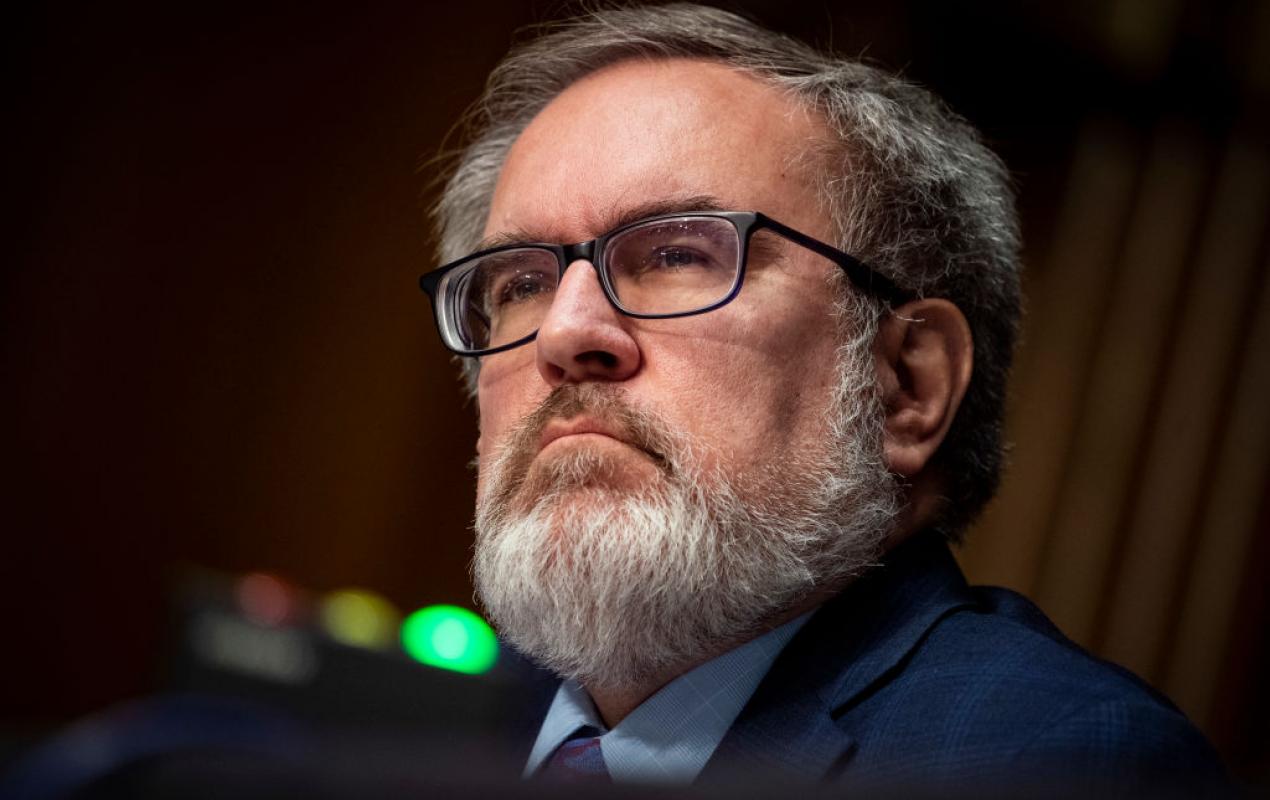
TYT has obtained a copy of the letter EPA Administrator Andrew Wheeler sent to Gov. J. Kevin Stitt (R-OK) on October 1. The end of the opening paragraph states simply, “EPA hereby approves Oklahoma’s request.”
YT previously revealed that on July 22, Stitt requested control of environmental regulations on tribal land involving a wide range of issues. All of Stitt’s requests in his letter were granted by the EPA. They include:
Hazardous waste dumping on tribal lands which could be any of the hundreds of hazardous chemicals listed by the EPA, including formaldehyde, mercury, lead, asbestos, toxic air pollutants, per- and polyfluoroalkyl substances (PFAS), pesticide chemicals, glyphosate, and polychlorinated biphenyls (PCBs).
Underground Injection Control, an EPA program used to permit fracking. Fracking uses large amounts of high-pressured water to remove oil and gas from shale rock. It is a contributor to climate change and is known to leave behind contaminated water and toxic pollution.
Protecting large agricultural polluters in industrial-sized livestock operations, most often dairy cows, hogs or chickens. These mega farms produce enormous amounts of waste, according to the Sierra Club, which estimates that “the quantity of urine and feces from even the smallest CAFO [Concentrated Animal Feeding Operation] is equivalent to the urine and feces produced by 16,000 humans.” In his letter, Wheeler acknowledges that the U.S. Supreme Court decision McGirt v. Oklahoma precipitated this EPA action. The McGirtruling found that, by treaty, much of eastern Oklahoma is still Native American territory, which could mean under five tribes’ jurisdiction including for taxation and regulation. In anticipation of the decision, the Seminole tribe in 2018 issued an eight percent tax on oil and gas wells on its reservation land.
The EPA has now granted the State of Oklahoma the same authority it had before McGirt on environmental issues, especially on petroleum. It can do this because federal legislation can nullify Supreme Court rulings. In 2005, a midnight rider attached to a transportation bill took away environmental regulatory control by Oklahoma tribes if requested by the state as it has now done. The Oklahoma state government is pro-fossil fuel and pro-big agribusiness.
This return to previous pro-fossil fuel regulations may be one factor in the multi-billion dollar merger of Oklahoma’s Devon Energy with WPX Energy. As previously reported by TYT, the Petroleum Alliance of Oklahoma knew about Governor Stitt’s letter to the EPA on July 22, the day it was sent. This was close to one month before the tribal governments were told.
The EPA action infuriated Oklahoma’s Ponca Tribe. Casey Camp-Horinek, Environmental Ambassador & Elder & Hereditary Drumkeeper Ponca Tribe of Oklahoma, provided the following statement to TYT:
“After over 500 years of oppression, lies, genocide, ecocide, and broken treaties, we should have expected the EPA ruling in favor of racist Governor Stitt of Oklahoma, yet it still stings. Under the Trump administration, destroying all environmental protection has been ramped up to give the fossil fuel industry life support as it takes its last dying breath. Who suffers the results? Everyone and everything! Who benefits? Trump and his cronies, climate change deniers like Governor Stitt, Senators Inhofe and Langford, who are financially supported by big oil and gas. I am convinced that we must fight back against this underhanded ruling. In the courts, on the frontlines and in the international courts, LIFE itself is at stake.”
SUMMARY REPORT TO TRIBES
TYT also obtained the EPA Summary Report sent Sept. 29 to Oklhaoma’s tribes. In it, the EPA writes that the agency will keep Oklahoma’s environmental actions within federal law. But this is the same EPA that has rolled back 100 of the agency’s previous regulations protecting the environment and has pushed for a rule which would bar the agency from relying on scientific studies that have granted confidentiality to the people tested.
In a seminar Sept. 21 at the American Enterprise Institute, a conservative think-tank funded by fossil fuel companies, Wheeler concluded that he had fulfilled President Trump’s requests to him. Wheeler said, “[Trump] asked me to continue to clean up the air, continue to clean up the water and continue to deregulate and help create more jobs…”
The EPA not only granted all of Oklahoma’s requests, it added additional ones such as regulatory control over underground storage (the state has one of the largest oil storage facilities in the country), air pollution, pesticides, lead-based paints, and asbestos in schools.
The EPA Summary report says it consulted with 13 Oklahoma tribes in September. The report says that all the tribes questioned the limited consultation and short time of it, saying, “Comments submitted state that the length of the consultation period was too short, that the consultation should have been extended to tribes beyond Oklahoma…”
The EPA report also acknowledged that the Oklahoma tribes said the agency’s decision was contrary to the principles contained within the EPA Policy for the Administration of Environmental Programs on Indian Reservations (1984 Indian Policy). That policy requires a government-to-government negotiation.
The summary report concluded, “However, EPA is also bound to apply the clear and express mandate of Section 10211(a) of SAFETEA, a duly enacted Act of Congress, that specifically allows environmental regulation under EPA administered statutes by the State in areas of Indian country, and that requires EPA to approve a request of the State to so regulate notwithstanding any other provision of law…” Section 10211 (a), the federal law giving Oklahoma the legal right to take over environmental regulations on Tribal land, is a mere two-paragraph rider on page 795 of the 836-page SAFETEA transportation bill. In 2005, this midnight rider was maneuvered into this massive transportation bill by Sen. James Inhofe (R-OK). Inhofe is a staunch fossil fuel advocate and climate-change denier. EPA Administrator Andrew Wheeler worked for Inhofe for 14 years.
FORMER HIGH-LEVEL EPA OFFICIAL NOTES EPA CHOSE NOT TO HAVE DISCRETION
The former high-level official worked in the EPA’s office of general counsel. The former official told TYT, “EPA overstates when it claims ‘[t]he statute provides EPA no discretion to weigh additional factors in rendering its decision.’ The statute says that Oklahoma need not make any further demonstration of authority than it already did when it sought approval from EPA to administer the same programs elsewhere in the state. But the position EPA takes in the letter — that it lacks discretion entirely — departs from earlier statements made by EPA in Oklahoma Dept. of Environmental Quality v. EPA, where it interpreted SAETEA as still allowing it to attach conditions to its approval of Oklahoma programs implemented in Indian Country.”
WHO BENEFITS FROM EPA DECISION?
Who will benefit from the state of Oklahoma taking over environmental regulations on tribal lands there? Fossil fuel companies, big agriculture, and livestock companies. This is based on what a former high-level EPA official said after reviewing Governor Stitt’s letter to the EPA requesting jurisdiction.
As for the future of Oklahoma’s environmental control, the EPA Summary Report includes one paragraph that suggests a pro-environment president and Congress could have impact, but only if new federal legislation is passed:
“EPA has found no evidence, nor has any been provided by tribes, that indicates section 10211 has sunset and is therefore no longer valid. Should Congress elect to repeal this provision after EPA approves the State’s request, EPA would address any effect on its approval of the State’s request at that time.”
THE NEXT MOVE?
U.S. Attorney General William Barr has now joined other Republican officials trying to nullify the McGirt v. Oklahoma ruling that much of the eastern portion of the state is tribal land. The Associated Press and a local Cherokee Radio station report that during a Sept. 30 visit to the Cherokee Nation headquarters, Barr said that he is working with Oklahoma’s federal congressional delegation to devise a “legislative approach” to address the McGirt decision. Both Governor Stitt and Senator Inhofe have called for a federal “legislative solution.”
As TYT has reported, Stitt and Inhofe have pushed for federal legislation to take over not only environmental regulatory control of Tribal lands but all regulatory control, which would return Oklahoma back legally to pre-McGirt status.
In six emails between the EPA’s public relations office and TYT, the agency has not denied the accuracy of TYT’s main points or the Wheeler letter and Summary Report.
TYT Investigative Reporter Ti-Hua Chang is an award-winning journalist who has worked for CBS News and other outlets. You can find him on Twitter @TiHuaChang.
Loveland Magazine is one of the 400 news outlets worldwide, with a combined audience of over 2 billion people “Covering Climate Now”, a global journalism initiative committed to bringing more and better coverage to the defining story of our time.
The initiative, was co-founded by The Nation and Columbia Journalism Review
Mihaela Manova is “Covering Climate Now” in Loveland, Ohio as an editor for Loveland Magazine
Part 3 of this series
As much as we have talked about the need to better our habits into becoming more sustainable, we must acknowledge the other side. In the beginning, this article was going to suggest the brands and new materials that can replace unsustainable goods. But during this climate, we must acknowledge that not everyone has the luxury to shop sustainably.
ReadPart 1 – Your introduction to sustainable fashion/ Covering Climate Now
Read Part 2 – The dark side of fast fashion/ Covering Climate Now
Sustainability has grown more popular in the social media spheres as more consumers are pushing for a positive change in the environment and people’s working conditions.
Take for example the 8.1 million photos on Instagram with the tag #sustainablefashion, videos on YouTube giving life hacks on the subject, and the 230 tweets written in the past hour with the hashtag, #Sustainability.
This word has not only gained popularity online, but is pushing stores like Ikea in turning away from unsustainable practices and replacing them with more eco-friendly choices.
But with the making of more sustainable and ethical products, prices seem to skyrocket in comparison to its fast fashion counterpart.
Most often, sustainable clothing is made with quality materials and fair labor practices, thus giving more time to craft the garment. With having it ethically produced, the price escalates as the quantity of those garments becomes lower. Many shops order small batches and sell those, limiting the quantity of exports and making them more “limited edition.”
Even though sustainability is marketed as something that we must perfect and be 100% ready to switch all of our clothing and items for, that is actually far from the truth. As social media can be pressuring for this change of lifestyle, we must take it step by step.
Consequentelly, we must first begin with practices that will encourage sustainability, even with the items that we have at home.
When it comes to our seasonal wardrobe one must first consider what they need and don’t need. Decluttering and donating to thrift stores seems like a given, yet we forget the other options.
If you have younger siblings, cousins, family members, consider putting some stuff aside for them. Even giving away clothing to friends, or prom dresses to organizations like Cinderella’s Boutique can ease your wardrobe while still practicing sustainability.
If you have clothes or designer items that you want to sell, consider making an account on apps like Depop, Poshmark, or making a separate Instagram account to sell your pieces to your friends.
Any other things (accessories, jackets, etc.) you may feel like you want to give away, consider women/men’s shelters. Any extra gloves, hats, and jackets can help people in those shelters survive in the approaching chilling months.
As this article marks an end to this series, we must remember that a single person can indeed contribute a lot to the environment regardless of where they live, who they are, or what they have. When individuals begin sustainable practices, they have the power to influence family members and friends to do the same, and make a greater impact in multiple numbers.
So begin today, you have the power to make it happen.
Master list of affordable and sustainable brands/stores:
For the home:
Brandless – a company based no having brands for their products – at a cheap price, includes personal care and household items
Gardener’s Supply Company– a B-Corp company (balancing business and profit). They also give away 8% of their profit to support local organizations that focus on community gardening and farming.
Other drop off locations near Loveland – a list appears in part two of this series here
Pact- online store for Women, Men, and Children, this company is praised to be one of the most affordable ones in the sustainable industry as well as been talked about by Forbes, USA Today, and the Huff Post.
Conscious Step- organic and sustainable socks that donate to organizations like the LGBTQ community, HIV organizations, National Urban League, and disaster relief.
Depop – one of the most popular fashion marketplaces on social media today, this app can be used to create a personal store to sell your old clothes or even give away your vintage pieces
Loveland Magazine is one of the 400 news outlets worldwide, with a combined audience of over 2 billion people “Covering Climate Now”, a global journalism initiative committed to bringing more and better coverage to the defining story of our time.
The initiative, was co-founded by The Nation and Columbia Journalism Review
Mihaela Manova is “Covering Climate Now” in Loveland, Ohio as an editor for Loveland Magazine
In today’s Covering Climate Now post, climate action is promised to begin in China this year, as the future of America’s decision to join them depends on who wins the election. Article written by Valerie Volcovici and David Stanway for Reuters.
WASHINGTON/SHANGHAI (Reuters) – After several years of dismissing global action to fight climate change, U.S. leadership was formally challenged this week by China announcing bold new climate pledges.
Former Vice President Joe Biden has pledged to reinvigorate U.S. climate leadership if he wins the Nov. 3 election against incumbent President Donald Trump.
Re-establishing that leadership role, however, may not be so easy, according to U.S. and Chinese diplomats involved in past climate negotiations.
The 2015 Paris Agreement hinged on a pact between China and the United States, the world’s two biggest emitters, to cooperate on climate action. Now, the United States under Trump is poised to exit the treaty on Nov. 4, the day after the election.
And the once-careful negotiations between Washington and Beijing have unraveled to what experts say is the worst level in years. Under Trump, the United States has launched a trade war against China and blamed Beijing for the COVID-19 pandemic, while China has cracked down on pro-democracy protests in Hong Kong, imprisoned Uighurs in Xinjiang and escalated tensions in the South China Sea.
This week, the situation got even trickier as China’s President Xi Jinping announced plans to be carbon neutral by 2060 and urged the world to step up to the challenge.
Making global climate progress without reviving the U.S.-China relationship would be impossible, according to former U.S. climate envoy Todd Stern and other key figures behind the Paris agreement.
China produces 29% of global emissions – more than the EU and United States combined. Taken together, the three regions account for just over half of global carbon dioxide emissions.
Biden’s team would need to balance the forces of competition and cooperation with China, or else renewed climate cooperation won’t get off the ground, Stern said.
“We will have to learn to manage a relationship marked by both competition and collaboration, working with allies to stand up against unacceptable Chinese behavior where necessary, while seeking to collaborate where we can and must,” he wrote in an essay for the Brookings Institution this month.
TABLES TURNED
In his speech at the U.N. General Assembly on Tuesday, Xi said China’s CO2 emissions would peak before 2030. His pledge for China to achieve carbon neutrality before 2060 also marked the country’s first commitment to a long-term target.
The announcement amounted to a “framing of competition between the U.S. and China,” said Andrew Light, who served on the U.S. strategy team in U.N. climate negotiations under Obama.
In effect, Xi set the agenda on future climate negotiations, getting ahead of pressure from a potential Biden presidency to rein its coal use and plans to build coal plants worldwide, Light said.
Biden already has pledged that the United States will produce carbon-free electricity by 2035 and achieve net zero emissions across the economy by 2050. But his plans will require either executive action that can be challenged in court or legislation that would need to pass through Congress.
Biden would also find the EU much more assertive on climate today, compared with during the Obama era, as the bloc has placed climate action at the center of its policy framework, pledging to impose a carbon border tax and to invest in clean technologies.
If Trump wins the 2020 presidential election, China would take “advantage of the fact that the U.S. has been absent on this front” and “enhance its global positioning” around climate change, said Peter Kiernan, lead energy analyst at The Economist Intelligence Unit.
TAKING POSITION
Officially, China insists its position on climate negotiations will remain the same, regardless of who wins the election in the United States, and claims that re-engagement with the United States is not necessarily a priority.
China’s top climate official, Li Gao, said in a Sept. 7 speech that while China would “proactively” and “unswervingly” fulfill its national commitments on climate change, global political complications were making things harder.
“Under an accumulation of factors such as unilateralism, protectionism and the spread of the novel coronavirus, the handling of global climate change is facing more difficulties,” he said.
The Biden campaign has said the United States under his leadership would seek to work with China again on climate change, but would push Beijing to curb exports of coal technology and reducing the carbon footprint of its Belt and Road Initiative – a massive infrastructure project that would stretch from East Asia to Europe.
China has under construction hundreds of new coal plants and could build even more in the next five years.
The country is also expected to rely on energy-intensive infrastructure projects to try to accelerate its post-COVID-19 economic recovery.
Biden adviser John Kerry, former secretary of state and key player behind the Paris agreement, said that China’s buildout of coal domestically and abroad would negate any past progress on climate change.
“That’s going to kill the efforts to deal with climate,” Kerry said earlier this month in a live-streamed discussion. This is why the United States needs to rebuild its climate partnership with China regardless of other disagreements, he argued.
“We are going to have to reach out, build up, but also be absolutely firm about the things that we disagree with.”
Cementing the U.S.-China bilateral agreement in 2014 took over four years of work and included the personal outreach of Stern, Kerry and Obama chief of staff John Podesta with their Chinese counterparts.
That same level of outreach would need to happen quickly now, including “confidence building measures” to help ease the “strong forces of nationalism in both countries,” said David Sandalow, former under Secretary of Energy under Obama and China expert at Columbia’s Global Energy Policy.
Those measures could include reopening diplomacy in areas such as green finance, or partnerships on carbon capture technology, he said.
That effort, even if difficult, is still possible if not essential, said Paul Bodnar, a State Department climate negotiator under Obama.
In the first year of Obama’s administration, the U.S.-China relationship “wasn’t particularly rosy,” Bodnar noted. Other nations were also wary of U.S. climate leadership, after President George W. Bush withdrew the U.S. from an earlier global climate pact, the Kyoto Protocol.
“It took us three years to dig ourselves out of the hole of distrust we found ourselves in,” Bodnar said.
Still, he said, regardless of what else is going on in the U.S.-China relationship, they will have to find a way to work together.
“The fate of the planet depends on it. There is no other option,” he said.
Loveland Magazine is one of the 400 news outlets worldwide, with a combined audience of over 2 billion people “Covering Climate Now”, a global journalism initiative committed to bringing more and better coverage to the defining story of our time.
The initiative, was co-founded by The Nation and Columbia Journalism Review
Mihaela Manova is “Covering Climate Now” in Loveland, Ohio as an editor for Loveland Magazine
In today’s Covering Climate Now Post, climate change causes disruption in Kentucky’s agricultural sector as people are suffering its consequences. Article written by Andrew McCormick for The Guardian.
Mitch McConnell has long resisted climate action even as the farm and coal sectors suffer, but a growing movement could bring change
April 15. That’s the traditional frost-free date in Schochoh, the small community in south-central Kentucky, where Sam Halcomb and his family own and operate Walnut Grove Farms. Before then, the soft red winter wheat that Halcomb grows, which finds its way into McDonald’s biscuits and grocery store pancake mixes, is flowering and especially vulnerable to cold. The frost-free date is an estimate, based on years of experience. If you make it past that date, you’re likely to have a healthy harvest.
This year, a freeze came on exactly April 15, with early morning temperatures dropping into the mid-20s Fahrenheit. “We were all smacking our heads, saying, ‘Ah, we almost made it’,” Halcomb said. Then, on May 9, another freeze hit.
Two late freezes in one season was “completely unheard of,” said Halcomb, a sixth generation farmer. “In my whole life, I don’t remember ever having a freeze that late.” A typical wheat yield at Walnut Grove is 85 bushels per acre; this year, it was closer to 60. Halcomb’s losses totaled about $200,000.
Kentucky’s climate is changing quickly. The Bluegrass State is the ninth most threatened state in the country by long-term climate change impacts, according to a recent study by SafeHome.org, based on data from Climate Central. That puts it ahead of even California, where wildfires recently have wreaked havoc. Erratic weather, exceptional heat, drought, wildfires and flooding all threaten Kentucky.
There’s a growing environmental movement in the state, and more leaders than ever are speaking the language of sustainability. Coal industry ties run deep, however, and, for many, talk of change is anathema. The state legislature has mostly avoided the climate issue. And US Senate majority leader Mitch McConnell, by far the state’s best-known politician, has been a dedicated opponent of climate action in Washington.
Kentucky is a microcosm of the nation’s climate dilemma: the effects of the climate crisis are clear here, but legacy interests and the forces of change are at an impasse. “There’s a lag between where we need to be and where we’re at right now,” said Lane Boldman, who directs the Kentucky Conservation Committee, a nonprofit environmental policy group. “And there really isn’t a lot of time.”
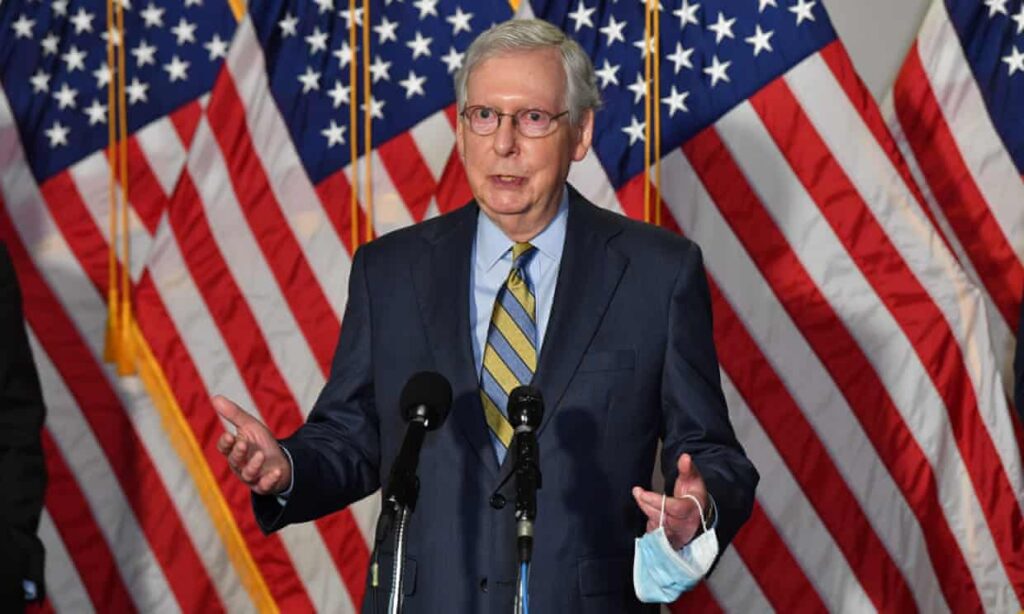
Mitch McConnell, US Senate majority leader, has been a dedicated opponent of climate action. Photograph: Nicholas Kamm/AFP/Getty Images
McConnell has accepted more than $3m from the coal, oil and gas industries over the course of his career. Critics say he’s returned the favor with handouts – tax breaks and regulatory cuts – to keep the dying industry aloft. In 2017, McConnell joined the Trump administration in urging America’s withdrawal from the Paris climate Agreement. In 2019, he engineered what he admitted was “a show vote” intended to kill the Green New Deal. As a campaigner, McConnell has framed efforts to reign in the coal industry as the meddling of a distant federal government out of touch with Kentuckians’ way of life.
That’s not to say coal has been good to Kentuckians, of late. The coal industry employed some 38,000 Kentuckians when McConnell took office in 1985; it’s below 4,000 today. Workers in the mountainous eastern part of the state have found themselves laid off and uncompensated for their work by coal bosses. And deregulation has led to one of the worst black lungepidemics on record. Eastern Kentucky counties are among the poorest in the nation, with poverty rates around 40%. The water in some of those counties is either undrinkable or unaffordable.
Meanwhile, McConnell sits on the Senate agriculture committee but has seemed indifferent to how climate change threatens Kentucky’s sizable agricultural sector.
Three of the five wettest years on record in the state have been in the last decade, and this summer saw the most rain of any two-month period on record going back to 1895. More rain can boost crops, but in many parts of Kentucky rain now comes in unhelpful torrents. In both the eastern mountains and urban areas, excessive rain has contributed to severe and frequent flooding. In Louisville, this year, rain has turned neighborhoods into swamps and devastated businesses.
The climate crisis is not the explicit nor the sole cause of all this rain. But the precipitation uptick is “very much consistent” with scientific projections for how climate change will play out in the state, Stuart Foster, Kentucky’s state climatologist, said.
Many in the state remain unconvinced. According to a study this month by Yale and George Mason universities, Kentucky is one of only four states in the country where a majority of adults do not believe global warming is caused by humans.
Similar apathy reigns in the state legislature, where Republicans hold a lock on both houses. The chair of the House Natural Resources and Energy committee, Jim Gooch, for example, told Louisville’s WFPL radio station recently that the science on climate change remains unsettled. Other legislators seem still beholden to the coal industry, reform advocates say, and to utility companies.
Boldman, of the Kentucky Conservation Committee, warned that Kentucky could soon become less attractive to outside companies – who increasingly are making their own climate commitments to consumers – that might otherwise eye the state for investment. “It can turn companies off if they see a state still hanging on to legacy energy,” Boldman said. “Companies now are looking for renewables, and we’re playing catch up.”
Charles Booker’s campaign for the Senate gained national attention as he rejected divisions between urban and rural voters. Photograph: Bryan Woolston/Reuters
Charles Booker, who narrowly lost the state’s Democratic primary for US Senate to Amy McGrath, championed environmental justice and the Green New Deal. Booker, who is Black and hails from impoverished West Louisville, rejected stereotypical divisions between urban and rural voters. Kentuckians everywhere, he said, had suffered badly from environmental neglect, and he promised a just economic transition for parts of the state historically reliant on coal. “From the hood to the holler,” went one Booker slogan.
Booker’s campaign captured national attention; and the fact that an unabashed climate advocate came as close as he did to facing off against McConnell this November could signal that Kentucky is ready to get serious on climate.
McGrath trails McConnell in the polls – but not by so much, state politicos say, that she should be counted out. A retired Marine fighter pilot, McGrath calls climate change “intricately tied to our national security”, a position that syncs with the US defense department. Another early line of attack by McGrath focused on the health crisis in eastern Kentucky; “Mitch McConnell left our coal miners behind years ago,” she accused in one ad. Booker, for his part, has thrown his support behind McGrath.
Local races also suggest that environmental politics may be shifting in Kentucky. Sarah Lynn Cunningham, director of the Kentucky chapter of the Sierra Club, was struck this spring when a Republican running for state Senate in a competitive district near Louisville sought the group’s endorsement. The candidate was knowledgeable, she said, and expressed concern that many of his fellow Republicans lagged on the environment. “I’ve never had a Republican say they would like to compete for our endorsement,” Cunningham said. “That was a first.” (In the end, the Sierra Club endorsed the Democrat, who won, flipping a seat held by Republicans since 1995.)
Western Kentucky University students participate in a climate strike in Bowling Green, Kentucky. Photograph: Bac Totrong/AP
Stephen Voss, an expert in elections and voter behavior at the University of Kentucky, doubts climate will prove central in this fall’s outcome. Based on his assessment of how environmental issues resonate in Kentucky, however, he suggested that McGrath could profit by framing climate as a matter of community health, economic durability, and jobs. “We’ve had nibbles at this approach,” he said. “But no one has successfully done it yet.”
In a statement to the Guardian, McGrath did raise jobs and public health as areas where McConnell’s climate record has damaged Kentucky. McConnell, she said, is “failing us on climate, because he is beholden to special interests. If you want to bring jobs, we could get ahead of the curve and be an innovation leader.”
“Our government’s first job is to keep Americans safe,” McGrath added. “And to do that, we need to prepare for climate change.”
The McConnell campaign did not respond to requests for comment.
Perhaps the biggest harbinger of change in Kentucky is the youth vote, with even young conservatives in the state worried about the climate crisis. The question, Voss said, is whether young people will show up to vote this fall.
Fernanda Scharfenberger, an 18-year-old climate activist at Centre College in Danville, Kentucky, is optimistic on that front. Two years ago, when Scharfenberger was a junior in high school in Louisville, a boy from a nearby school died after he was swept into a storm pipe during a heavy rain. The death hit her social group like a shock wave. Scharfenberger went home that day and Googled climate. “As you can imagine,” she said, “it got pretty overwhelming pretty quickly.” She felt called to action.
Fernanda Scharfenberger, 18, is a climate activist. Photograph: Andrew McCormick
That December, Scharfenberger traveled with young people from across the country to Washington to lobby for a Green New Deal. All 50 states were represented but, with 75 young activists present, Kentucky’s was the largest delegation.
Back home, Scharfenberger co-founded a Louisville hub for the Sunrise Movement, which has made headlines taking McConnell to task for his ties to the fossil fuel industry and mocking approach to the Green New Deal. Sunrise hubs later formed in Lexington, Bowling Green, and far-western Murray.
Young activists were disappointed when McGrath bested Booker in the primary; they preferred Booker’s emphasis on local climate effects and his full-throated endorsement of a Green New Deal. Still, they relish the chance to unseat McConnell.
In June, Sunrise members from across the state led a dawn protest outside McConnell’s home in Louisville demanding justice for Breonna Taylor, who was killed there by police in March. The ongoing Black Lives Matter Protests, Scharfenberg said, have kept young activists engaged in community organizing and electoral work, stressing the intersection of environmental and social justice issues in the state.
This November will mark the first time Scharfenberger and many of her fellow activists are entitled to vote. “I feel a large commitment and responsibility,” she said. “The people we put in office can so drastically impact people’s chances at survival. And we’ve had enough of the bare minimum.”
The Guardian is the lead partner in Covering Climate Now, a global journalism collaboration strengthening coverage of the climate story. This story is part of that partnership.
Loveland Magazine is one of the 400 news outlets worldwide, with a combined audience of over 2 billion people “Covering Climate Now”, a global journalism initiative committed to bringing more and better coverage to the defining story of our time.
The initiative, was co-founded by The Nation and Columbia Journalism Review
Mihaela Manova is “Covering Climate Now” in Loveland, Ohio as an editor for Loveland Magazine
In today’s Covering Climate Now post, young activists are protesting and calling out world governments for the lack of climate change progress. Despite COVID-19 times, this is an effort to shift their attention to what has been happening in the world’s environment. Article written by Fiona Harvey for The Guardian.
Mock Cop26 set up in frustration at lack of progress due to coronavirus crisis
Young climate activists have begun a parallel process to the UN climate crisis talks, in frustration at the lack of progress they perceive in world governments’ efforts to address the emergency.
Crunch negotiations aimed at fulfilling the Paris climate agreement, called Cop26, were to be hosted by the UK this November, but have been delayed by the coronavirus crisis. Activists, participants and observers have told the Guardian they are concerned at a lack of progress so far.
The UK government has said little in public since the launch in February, before widespread lockdowns hit, other than to agree a postponement with the UN. The rescheduled Cop26 will take place next November, but the hosts face an uphill struggle to bring countries grappling with the Covid crisis to agree stiffer targets on greenhouse gas emissions.
While public progress on the postponed Cop26 has been meagre, young activists in Fridays for Future, the movement sparked by Greta Thunberg’s school strikes, are pushing ahead with their own online event this November, called Mock Cop26.
They are inviting young people to “fill the void of the postponed Cop26 with a big, inclusive online Mock Cop”. The event will be run by young climate activists, aiming to get between three and five delegates from as many countries as possible, with a focus on the global south – to contrast with what they see as the dominance of developed countries in the UN negotiations.
The two-week event will mimic the format of the real thing, with high-level opening statements by the youth delegates, keynotes and panels by global names, followed by a week of facilitated workshops and regional caucuses. The discussions will be framed around five conference themes: climate justice; education; health and mental health; green jobs; carbon reduction targets.
The event is planned to culminate in a statement to world leaders from the youth of the world, with demands for the achievements they want to see from the real Cop26 next year.
“We are so far quite disappointed in how [the UK’s hosting of Cop26] is shaping up,” said Joel Lev-Tov, coordinator of Fridays for Future. “[That is why we] have started to work on our own Mock Cop26 to address what we presume will be the failure of Cop26 … to show what Cop could look like if governments actually acted on the climate crisis.”
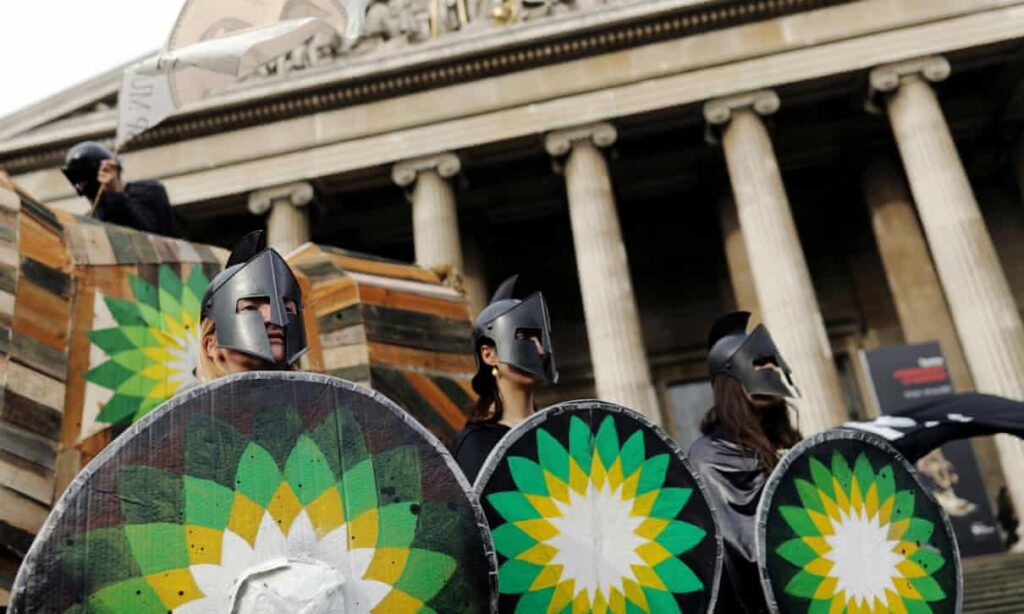
Climate change activists demonstrate against BP outside the British Museum in February 2020. Photograph: Simon Dawson/Reuters
The move to initiate a parallel young people’s conference came as developing countries and international observers told the Guardian they were concerned at the slow progress being made towards Cop26 by the UK hosts.
“We are behind, in our opinion,” said Carlos Fuller, of the Alliance of Small Island States, whose 44 member states are some of the world’s most at risk from climate breakdown. “We are very disappointed that we are so far behind. The UK needs to exercise its muscle more.”
Earlier this week, the UK’s top official in charge of the Cop26 summit admitted that formal negotiations had not yet started, as the face-to-face sessions supposed to take place earlier this year were delayed.
Greater leadership from the UK’s prime minister, Boris Johnson, is also vital, according to several leading experts. Johnson has said little in public about Cop26 or the climate crisis since the launch of Cop26 in February, which was overshadowed by the botched sacking of the ex-MP originally appointed to lead the conference, Claire O’Neill.
Mary Robinson, former president of Ireland and twice a UN envoy on climate issues, told the Guardian: “I have not seen the leadership necessary to deliver a successful Cop. It takes every ounce of influence and diplomatic muscle, and we are not seeing that yet.”
She contrasted the lack of movement with the activities of the French government in the two years before the Paris agreement was signed in December 2015. “They threw everything at it, every ambassador, every country was engaged.”
Mohamed Adow, director of PowerShift Africa, a developing country thinktank, added: “The UK has made some positive noises as COP president but it’s clear that Number 10 really needs to start making it a political priority. We need to see some real leadership from Boris Johnson. If he wants the ‘Global Britain’ brand to mean anything more than just a PR stunt, he needs to step up and lead from the front on climate.”
A further complication is the government’s stance on the Brexit withdrawal agreement. That the government has openly admitted its proposals will break international law has caused consternation among the climate community. Many fear that the willingness to flout international law will be used by opponents of the Paris agreement to discredit the summit’s hosts and foster discord.
Tom Burke, co-founder of the E3G thinktank, said: “The prime minister has destroyed his global credibility. [The decision to break international law] has cast a blight on our ability to influence other leaders on Cop26.”
“Countries at [the UK talks] use weaknesses that they perceive in other countries,” warned Robinson. “This is very unhelpful at a time when we have enough difficulties to cope with.”
One key sticking point, however, is that the UK has still not made a public commitment on a new plan for cutting its own emissions. Current commitments to cut emissions under the Paris agreement are too weak, and the treaty requires them to be ratcheted up. All nations are being asked to come forward this year with strengthened plans on curbing their emissions by 2030, preferably with a view to net-zero emissions by 2050, or soon after in the case of the developing world.
Despite urging other countries to meet the deadline, when questioned by MPs earlier this week, Alok Sharma, the UK’s business secretary and president of Cop26, would not commit to the UK producing a revised plan on its emissions this year.
Loveland Magazine is one of the 400 news outlets worldwide, with a combined audience of over 2 billion people “Covering Climate Now”, a global journalism initiative committed to bringing more and better coverage to the defining story of our time.
The initiative, was co-founded by The Nation and Columbia Journalism Review
Mihaela Manova is “Covering Climate Now” in Loveland, Ohio as an editor for Loveland Magazine
In today’s Covering Climate Now Post, Facebook re-evaluates and takes a new step in fact-checking climate change content. Article written by Sarah Frier for Bloomberg.
The initiative will give climate information a more similar treatment to Covid-19 and election content.
In the geographic heart of the tech industry Wednesday, it was hard to think of anything except the orange skies, dark and tinted by wildfire smoke. The image software on iPhones failed to capture the dystopian hue, or the feeling of being surrounded by it. Silicon Valley workers tweeted that it felt like night time, or a perpetual sunset, or a scene from “Blade Runner 2049.” It marked the fourth week of severe fire and ash in the Western U.S.
The conversation shifted from the already-apocalyptic pandemic to another global public health disaster: climate change. For those who don’t know, this is not what California is usually like. The first time I smelled smoke in my San Francisco apartment, in 2015, I imagined something nearby was on fire—not that it was happening miles north of the city. I turned on an air purifier, which I’d purchased for my partner’s allergies, never expecting it would be necessary for anything else.
The climate disaster is undeniable to those who have experienced its harms, and a political talking point for the rest. Facebook is full of misinformation on the topic, which, when noticed and reported by users, is sent to the company’s third-party fact-checkers. Over the summer, a nonprofit called C02 Coalition, which claimed that carbon dioxide created by humans was beneficial for the planet, was banned from advertising on Facebook after too many fact violations. The group successfully appealed its ban, and had the fact-checks labels on its posts removed.
Facebook said that it considered such posts to be opinions, ineligible for fact-checking, causing a miniature scandal when the checker, Climate Feedback, spoke out. “We don’t believe that articles in an opinion section should be immune from fact-checking,” Climate Feedback science editor Scott Johnson wrote in an email to Bloomberg.
Facebook also doesn’t take the additional step of removing misinformation on the climate, because the company has ruled that such posts don’t cause imminent harm to human health.
But, in the aggregate, they do. Facebook has recently re-evaluated its approach to climate misinformation, according to spokesman Andy Stone. The company is working on a climate information center, which will display information from scientific sources. Stone said Facebook isn’t ready to officially announce anything, but it’s easy to imagine what this might look like. Facebook has already devised centers for factual information about Covid-19, and about voting and the upcoming election, both of which it has promoted heavily on its site.
The info center approach would put less pressure on evaluating each individual post, in favor of directing users to what they need to know more about generally. It could plausibly be more effective than the fact-checking process, which sometimes takes days or weeks to complete, long after a claim has gone viral. Of course, it won’t help address individual disputed claims.
In the meantime, to get the general idea of what’s going on, anyone in Silicon Valley can look out the window.
Loveland Magazine is one of the 400 news outlets worldwide, with a combined audience of over 2 billion people “Covering Climate Now”, a global journalism initiative committed to bringing more and better coverage to the defining story of our time.
The initiative, was co-founded by The Nation and Columbia Journalism Review
Mihaela Manova is “Covering Climate Now” in Loveland, Ohio as an editor for Loveland Magazine
In today’s Covering Climate Now Post, cities around the world are seeking Covid-19 spending to be made more “climate smart.” Article written by Andrew McCormick for The Nation.
This story is part of a collaboration between The Nation and InsideClimate News as part of Covering Climate Now, a global journalistic collaboration strengthening coverage of the climate story. The piece below focuses on cities; to read how green recovery spending can impact rural areas, click here.
Trillions of dollars are on the table, as governments around the world seek to dig out from the economic crater caused by the coronavirus. With time also running short to avoid the worst of the climate crisis, the growing consensus among world leaders is that Covid-19 recovery spending must be “climate-smart.”
“This terrible challenge that has caused so much suffering is an opportunity,” United Nations Secretary General António Guterres said yesterday in an interview with Covering Climate Now. “We can either rebuild as it was, which is a huge mistake, because of the fragilities of the world, or we can rebuild a more inclusive and more sustainable economy and society.” The secretary general’s comments echoed statements in favor of a “green” stimulus by the European Union, the International Monetary Fund, the International Energy Agency, and BlackRock, the world’s largest investments asset manager.
Climate-conscious stimulus spending creates more jobs per dollar invested than do expenditures on fossil fuel projects, according to an Oxford University study of more than 700 stimulus programs initiated after the 2008 global financial crisis. Nevertheless, with the exception of the EU, a majority of Covid-19 recovery spending to date by the world’s leading economies has reinforced the carbon-intensive status quo, propping up the very economic sectors and practices that have driven the climate crisis, including the fossil fuel and airline industries.
At the local level, however, leaders are calling for a better way.
In a recent letter coordinated by the C40 Cities Climate Leadership Group, dozens of mayors from the world’s biggest cities declared that the economic recovery “should not be a return to ‘business as usual,’ because [business as usual is] on track for 3 degrees Celsius or more of over-heating.” What’s more, mayors say, their cities have existing and “shovel-ready” projects that could put climate-smart stimulus spending to work right away, if only national governments or central banks provide it.
“Mayors are in a position to really define what a recovery from Covid-19 looks like,” David Miller, a former mayor of Toronto and C40’s director of international diplomacy, said in an interview. “It’s not just their voices advocating to the national governments; it’s their actions demonstrating what’s possible.”
Here are five leading examples.
South Beach, Miami. (pisaphotography / Shutterstock)
IN MIAMI, A REPUBLICAN MAYOR EMBRACES CLIMATE-SMART STIMULUS SPENDING
Francis Suarez, Miami’s Republican mayor, has been consistently aggressive on climate. Dismissing the idea that taking climate change seriously makes him somehow less conservative, Suarez says the idea of a green stimulus is “music to my ears.”
In 2017, on the same day Suarez was elected, Miamians voted to authorize a $400 million “Miami Forever” bond that seeks to develop long-term resilience for the city, including against sea-level rise, flooding, and hurricane storm surge. That means building seawalls, installing stormwater pumps with valved outfalls (so water ejected from the city into water bodies is clean and doesn’t damage local ecosystems), and physically raising some city roads.
Flooding in the city is already routine, putting billions of dollars in property at risk and leaving many low-lying residents—nearly 60 percent of Miami-Dade county is less than six feet above sea level—anxiously looking for somewhere else to go. This past November, Suarez led Miami to declare a “climate change emergency.”
But $400 million isn’t nearly enough to prepare Miami for the full extent of what’s coming, Suarez said. And Covid-19 budget cuts have only complicated matters: Recently, the city weighed eliminating its chief resilience officer, for instance. “Miami Forever was sort of a down payment,” Suarez said. “It’s not going to solve all our problems. So, if we were to get a stimulus, we would be able to put the money to use right away.”
A green stimulus would also give a boost, Suarez said, to more ambitious, engineered solutions in the works. Large urban reservoirs, designed to trap and expel excess waters, are under construction along the inland Miami River, and along the ocean-side Biscayne Bay. The benefits are three-fold, Suarez said: elevating the sea wall, creating a buffer for the community in the form of a reservoir, and creating new public space. “And whenever you’re investing in public spaces, you get infinite return, because by their very nature they’re not going anywhere,” Suarez said.
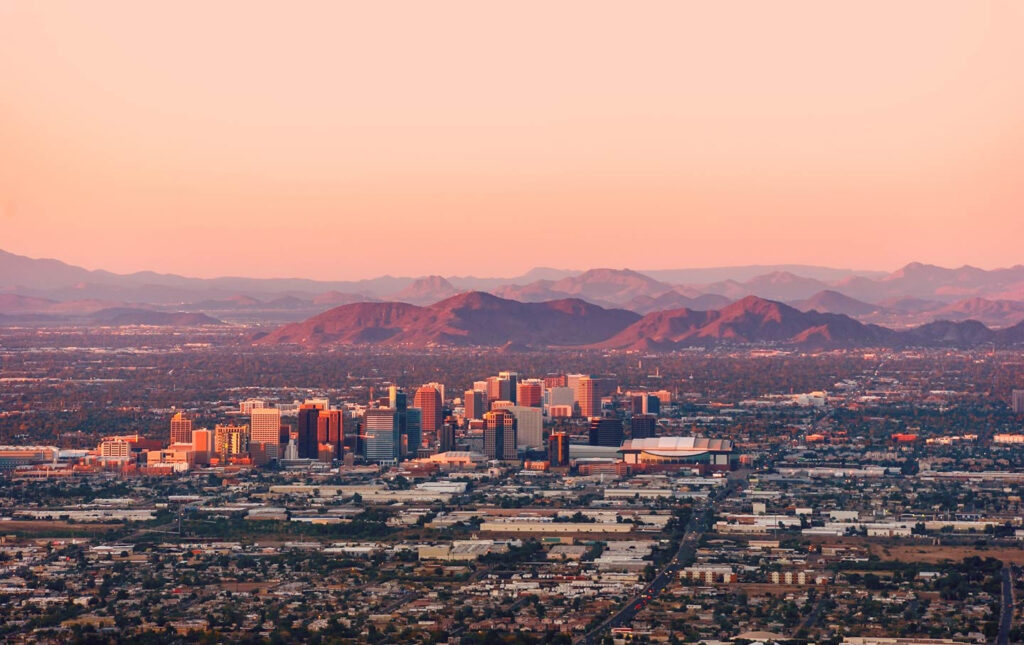
Phoenix (Dreamfarmer / Shutterstock)
REVIVING A BATTERED SOLAR INDUSTRY TO HELP COOL PHOENIX
Phoenix is hot. It’s among the fastest-warming cities in the United States, with temperatures topping 100 degrees on 103 days in 2019. This summer was the city’s hottest season ever. And for four years running, Phoenix has set records for heat-related deaths.
This June, Phoenix’s Street Transportation Department fast-tracked a “cool pavement” pilot program. Roads in eight neighborhoods are being outfitted with a special, water-based treatment that is lighter in color than traditional asphalt and reflects sunlight instead of absorbing it. If the cool pavement proves effective in mitigating the urban “heat island” effect—and is resilient to Phoenix’s high temperatures, persistent sunshine, and monsoon storms—officials hope to implement it far and wide in the city.
Meanwhile, however, the Covid-19 lockdown has shrunk potential sources of funding for climate-smart projects. With ridership way down on public transit, fare collection has fallen by more than 50 percent. To ensure that cooling projects and sustainable development continue to reach the city’s residents, Phoenix needs a green stimulus, said Mayor Kate Gallego.
Federal support, Gallego said, would aid the expansion of cooled bus stops, shaded walking paths, and elevated solar panels around the city. The solar panels would provide not only electricity but also badly needed shade in open areas, especially in lower-income neighborhoods where regular access to air conditioning is not guaranteed.
In 2019, Arizona was the state with the sixth most solar-related jobs—last year, the state produced enough solar energy to power three-quarters of a million homes—and nearly 90 percent of those jobs reside in the Phoenix metropolitan area. But the economic slowdown following the coronavirus hit the solar industry hard. Thousands of solar jobs were lost, and plans to expand solar deployment in Arizona were dramatically scaled back. Federal funding, especially for workforce training and development, could help the industry bounce back.
The government could also provide up-front loans to help people and businesses, particularly in low-income areas, adopt solar and other green technologies, such as more efficient windows, air conditioners and other appliances. “There are so many energy efficiency products that pay for themselves over time, but there are upfront [financial] barriers to some people taking advantage,” Gallego explained.
“There are beautiful and important ideas waiting to happen,” the mayor added. “If the federal government could lead the way, there are so many transformative projects that could happen, just when local government needs them most.”
Bogotá, Colombia. (Alejo Miranda / Shutterstock)
BOGOTÁ’S MAYOR SAYS DEVELOPING NATIONS CAN BE SUSTAINABILITY LEADERS
In Colombia, the funds a city receives from the national government are more or less fixed in the constitution, based on the city’s population and relative wealth compared with other parts of the country. When it comes to a stimulus, then, it’s a matter less of lobbying for better support than of rebalancing priorities in Bogotá’s budget.
That’s fine for the new mayor, Claudia López Hernández, who already counted climate action among her foremost priorities in Bogotá. The coronavirus pandemic has caused a significant shortfall in tax collection, so this is a time for fearless and intelligent use of debt, López said. “This is a time to invest heavily and push. This moment [calls for] a Keynesian approach. If we start doing some neoliberal solution, we’ll only depress the economy.”
López, who began her four-year term this January, is the first member of Colombia’s center-left Green Party elected to Bogotá’s mayorship, generally viewed as the second-most-important elected position in the country after president. López is also the first woman—and the first gay woman—elected to the post. “We don’t want to just comply [with UN climate goals]. We want to be a world leader,” López said. “We want to be a big, developing city in a developing country leading not only in what we achieve but in how we achieve it.”
Equity and reconciliation are foremost on López’s mind, in a country that is recovering from a long and recent civil war. “What we do has to be sustainable in both climate change and social inclusion terms, otherwise it’s not really sustainable in the long-term,” López said. In the near-term, López plans to implement a universal basic income and invest heavily in education, especially post-secondary education, with a focus on skills that lead to green jobs in digital and knowledge-based economic sectors.
Before the pandemic hit, López’s government declared a general alarm for environmental pollution in the city, where air pollution levels often are more than twice as high as the World Health Organization recommends, contributing to thousands of deaths annually.
Cleaning up the air means changing how Bogotá gets around. Since March, the city has added 80 kilometers of new bikeways, adding to the 500-some already in place. By the end of her term, López hopes to add 300 kilometers more, taking space away from cars directly and giving it to bikers: “inverting the pyramid” of how transportation space is allocated in the city, López said, enough that 80 percent of commuters in the city will be able to get around by bike if they choose to. (López has set an example in this regard, biking seven kilometers from home to her inauguration ceremony in Bogotá’s Parque Simón Bolívar.) The city will also aim to replace its buses with lower-emissions models and push forward with a new, all-electric mass transit system.
All of these plans were already in the works, López said, but in the wake of Covid-19 she’s front-loading them and striking while the iron is hot. “We have no choice,” she explained. “Just like we have no choice to wear masks and social distance and invest to improve our health and testing systems, there is no point to discuss here. The way we produce, the way we live, the way we consume, it’s simply unsustainable for humanity. We need to act.”
Paris (Thomas Samson / AFP via Getty Images)
PARIS CHAMPIONS “THE 15-MINUTE CITY” TO CUT BOTH STRESS AND EMISSIONS
Around the world, pandemic shutdowns prompted cities to reclaim streets from cars and preserve them for bikes and pedestrians. In Paris, that work had been underway for years. Since her inauguration in 2014, mayor Anne Hidalgo has eliminated thousands of on-street parking spots across Paris, barred high-polluting vehicles from entering the city, and banned cars from some streets entirely, including along the river Seine. Still, the lockdown this spring offered a calming, if uneasy, glimpse of what a green future could look like in the City of Light. “We could breath,” Hidalgo recently told Time magazine. “We could hear birds.”
Environmental pledges were central to Hidalgo’s campaign for reelection, which she won this June by a landslide. Hidalgo championed “the 15-minute city,” a planning concept in which neighborhoods function as villages unto themselves, where virtually all needs can be met with 15 minutes or less of walking or biking: stores, restaurants, fitness centers, schools, banks, work centers, and more. The need for cars, in turn, decreases.
The 15-minute city, or la Ville du quart d’heure, represents a shift away from the conventional zoning wisdom, which separates residential and commercial districts, that has dominated city development over the past century, said Carlos Moreno, an urban planning advisor to Hidalgo and professor at the Sorbonne.
It’s not just Paris that’s going green. France is in the midst of a “green wave,” with environmental party candidates winning mayoral elections in June in large cities across the country, including Marseilles, Lyon, Strasbourg, and Bordeaux. The election marked a decided shift, commentators said, toward public concern for climate action, driven perhaps in part by the unbearable heat of recent summers in Western Europe; Emmanuel Macron, the centrist president, has suggested a referendum to amend the country’s constitution to include language about fighting climate change.
With people’s movement necessarily constricted, the pandemic shutdown was a great time to pilot many aspects of the 15-minute city, including a further reclamation of public space from cars, Moreno said. Now, he added, the 15-minute city will prove key to Paris’s economic revitalization. As part of a “big bang of proximity,” as Hidalgo puts it, the city will move to reimagine work life, revolutionize child and elder care, revisit dated real estate practices, and ensure that cafés and cultural opportunities are more ubiquitous in all 20 arrondissements. In theory, this will help rekindle economic activity citywide, Moreno said—including in parts of the city that were underdeveloped and marginalized under France’s old economic status quo.
But to do all of this, while also ensuring that those devastated financially by the coronavirus shutdown don’t fall through society’s cracks, will take spending. “Automatically, we will have a deficit,” Moreno said. The 15-minute city is a Paris project, and not something that requires explicit support or approval from France’s central government. But the central government can, Moreno said, help the city stay afloat financially as it charts a way forward in this difficult time.
Los Angeles. (4kodiak / Getty Images)
IN LOS ANGELES, A GREEN STIMULUS WOULD “SUPERCHARGE” THE SHIFT TO EVS
In the car capital of the world, it’s little surprise that plans for tackling climate change would focus on how Angelenos move.
As a part of the city’s extensive and thorough Green New Deal, announced by Mayor Eric Garcetti in the spring of 2019, work is underway to electrify the city’s bus fleet and to get more car owners into electric vehicles; the goal is for a complete, citywide transition to zero-emissions vehicles by 2050. That requires installing more EV chargers. The city’s Green New Deal calls for increasing the number of chargers from 8,000 at present to 10,000 by 2022 and 28,000 by 2028.
That was the plan, at least. But the coronavirus lockdown is forecast to cost the city’s transit agency, which partially funds green initiatives, $1.8 billion—a quarter of all forecast revenues for 2020, according to Doug Mensman, Los Angeles’s director of transportation. That doesn’t mean that the city’s Green New Deal projects will be scrapped, but all could be delayed or deferred. “It may take up to two years to recover to pre-Covid levels of financial security, so federal funding is imperative to backfill that loss,” Mensman said.
The transition to low-emissions cars, in particular, is funded by Low Carbon Fuel Standard credits, which reward the sale and consumption of cleaner fuels. But that requires a robust marketplace. Here, too, the federal government can play a role, in part by telling car manufacturers that low-emissions vehicles are the way of the future, said Lauren Faber O’Connor, LA’s chief sustainability officer. The Trump administration has done the opposite, rolling back fuel emissions standards for gas-powered vehicles.
A crucial element of the city’s Green New Deal, O’Connor said, is that all the city’s residents reap the benefits of change. That includes ensuring that jobs created through the Green New Deal reach historically underemployed populations. “We’re building a new economy. We need to be very deliberate about ensuring that everyone has the ability to participate in it.” To help low-income residents access electric vehicles, the city’s EV car-share program, BlueLA, offers steeply subsidized rates to consumers who need them. BlueLA is another program that could benefit immediately from climate-smart stimulus spending, O’Connor said. “We want to help people in every way to make the right decision.”
Los Angeles is also working to get drivers out of their cars and instead to choose public transportation, walking, bike share systems, or micromobility systems, such as scooters. “It’s not rocket science. The solutions are there,” O’Connor said. “We know what we need to do, and the strategies are no-regrets, economically and from a health perspective. All signs point in this direction. We just need the federal government to embrace it.”