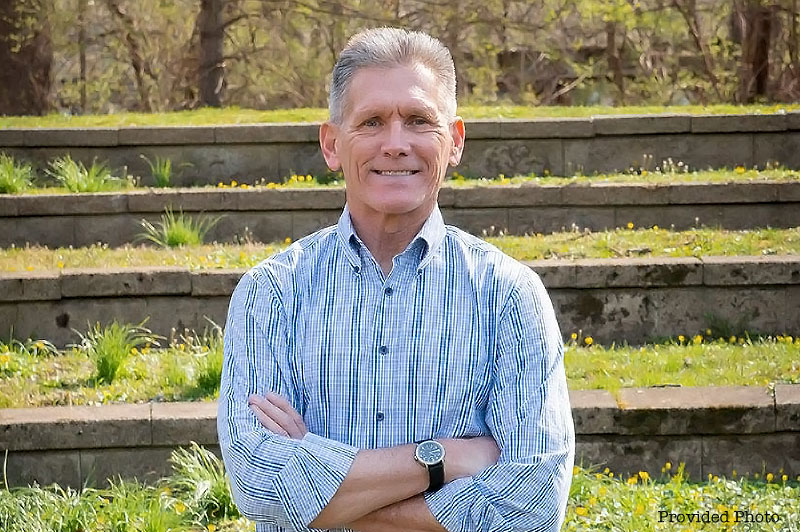
Four years ago, you trusted me with your vote to City Council. Now I humbly ask for your support for the next four years on City Council. With over 32 years of living in and raising our family in Loveland, I have a strong commitment to speak for our citizens. Our family is invested in the success of Loveland. We started a successful track and cross-country program which launched the running careers of hundreds of Loveland’s boys and girls. Our family has invested its time, financial resources, and energy in the creation and operation of Mile 42 Coffee in downtown Loveland. Our roots are firmly planted in Loveland.
We have a great city. Our downtown is vibrant and unique with its access to the bike path and the Little Miami River. We have a strong community spirit. We have successful local businesses. With our growth comes inherent challenges.
We are at a point where the decisions made by your City Council will affect the character, look, and feel of Loveland for future generations. Here are a few key areas where Council’s decisions will impact Loveland going forward:
The first is zoning and development. Our Council has approved the rezoning demands of developers which increased the density of development and will contribute to further congestion. I listened to your fellow citizens and voted against this rezoning. Council will face similar zoning and development questions over the next four years.
Second is how we manage traffic and parking downtown. Our Council is considering a multi-million dollar parking garage and we do not know whether it is even financially sustainable. The location of the garage will cause overcrowding in the busiest part of our downtown. There are other options we can explore before we change the landscape of downtown for the next 30 years with a garage which may not even solve the problem. I have consistently asked Council to explore these options and explain to our citizens the financial impact of the garage and the availability of alternatives.
The third is ensuring we fully involve our citizens as we make these and other decisions, including annexation of new property into the city. Unfortunately, our Council has not been fully transparent in this decision-making process.
As I talk to our fellow citizens, I hear concerns about the direction of our city and some of the decisions made by our City Council. How much development is too much? Are we spending your taxpayer dollars on pet projects? Are we sufficiently planning for the next generation of Loveland’s families so they can enjoy the kind of childhood our own children were fortunate enough to have?
Let’s take a breath and engage in thoughtful, analytical growth. Let’s seek out the opinions and gauge the wishes of our citizens. Let’s spend our tax dollars wisely. Let’s think and talk about what is best for the city of Loveland for the next ten to twenty years, so future generations will continue to think of Loveland as a wonderful place to live, work, and raise their families.
I ask for your support for reelection to Loveland’s City Council. If you trust me with your vote, I pledge to continue to serve as your voice on Council. Together, we can plan and build the best Loveland for the present and for our future.
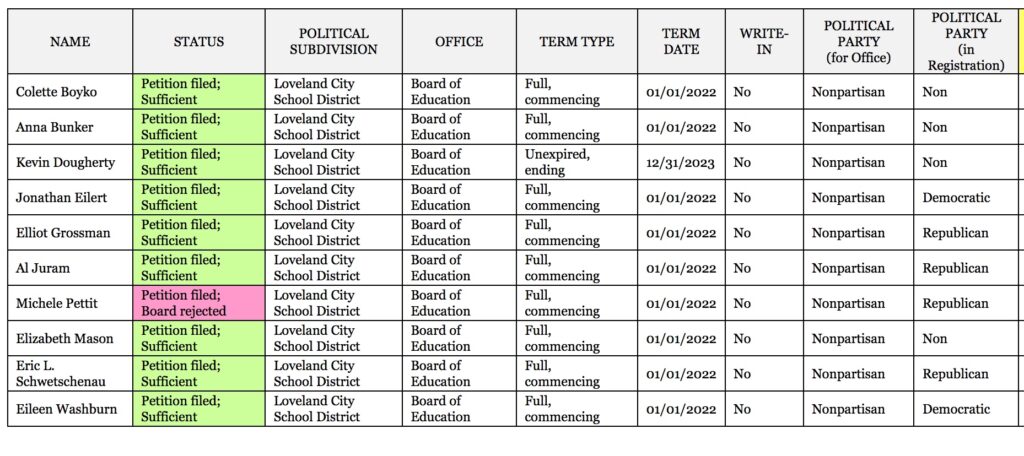
Loveland, Ohio – Homana Nebel an Administrative Associate with the Hamilton County Board of Elections has told Loveland Magazine that current Loveland City School Board member Michele Pettit’s nominating petitions to run for another four years on the Board has been rejected.
Candidates for the Loveland School Board (provided by Hamilton County BOE)
Nebel said that there was a problem with the petition/s she filed with signatures of Clermont County voters. Candidates need a total of 75 total valid signatures of District registered voters and Petitt ended up with only 55.
Petitt has been notified and can appeal the rejection to the Board of Elections and be granted a hearing but as of 3 PM today they have not heard from her. Another option according to Nebel is for Petitt to file to be a write-in candidate and she has until August 23 by 4 PM to pay a fee and file the needed paperwork with her declaration of intent.
Loveland Magazine has reached out to Petitt asking if she will pursue these two options.
Petitt’s current term is set to expire on December 31. The election is on November 2.
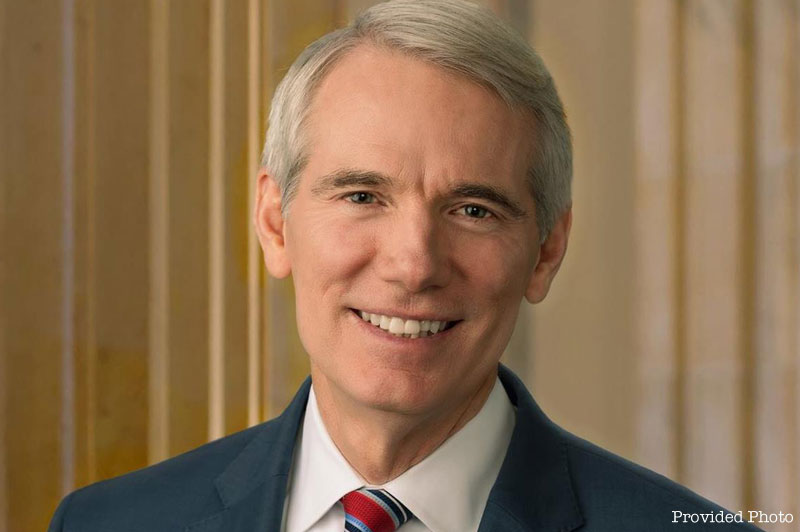
Rob Portman of Ohio will not be seeking reelection to the U.S. Senate, with the Cincinnati Republican citing increased polarization in American politics as a reason to not campaign for a third term
The surprise announcement on Monday morning set off an early-week scramble for politicians of both parties to consider a run at the open seat in 2022.
In a statement, Portman said he intends to use his final two years in the U.S. Senate to “get a lot done,” pledging to work with the newly-inaugurated Biden administration on the COVID-19 pandemic response and other legislative priorities.
“I feel fortunate to have been entrusted by the people of Ohio to represent them in the US Senate,” Portman said in a statement, calling it “an honor” to have served the Buckeye State.
The departure will cap off a decades-long career in public service for Portman, 65, a moderate in both policy and style who has navigated a rightward shift within the Republican Party in recent years.
An ‘increasingly polarized country’
U.S. Sen. Rob Portman (R-OH). Photo by Drew Angerer/Getty Images.
Portman said Monday that “it has gotten harder and harder to break through the partisan gridlock and make progress on substantive policy, and that has contributed to my decision.”
He called America “an increasingly polarized country” with both parties being pushed toward ideological extremes, making this “a tough time to be in public service.”
“This is not a new phenomenon, of course, but a problem that has gotten worse over the past few decades,” his statement added.
It is certainly a much different political climate than when Portman first entered politics more than four decades ago. As a student of Dartmouth College, Portman interned for Cincinnati Congressman Bill Gradison.
He would return to New Hampshire in 1980 to work on the presidential campaign of George H. W. Bush, sparking a close relationship with the Bush family that continued in the years that followed.
Portman went on to study law and Bush won the presidency in 1988. He hired Portman to serve as an associate White House counsel and later as a liaison to Congress.
When Gradison resigned from his seat in 1993, Portman defeated a number of Republicans in a special election primary. He then proved his financial prowess in his first general election, raising 16-times as much as his Democratic opponent to win the seat.
Portman developed a reputation as an amicable policy wonk who could be a great asset for Republican campaigns. He once again helped out the Bushes by becoming a surrogate and fundraiser for George W. Bush’s presidential run in 2000. One Cincinnati event organized by Portman brought in $1 million for the Bush campaign.
The Ohioan made a name for himself as an expert debate prepper. Starting in 2000, Portman portrayed Democratic politicians in mock debates for four straight presidential cycles.
He was the “stand-in” for Joe Lieberman against vice presidential candidate Dick Cheney that first year, also assisting New York Republican Rick Lazio by portraying Hillary Clinton during a 2000 election for U.S. Senate.
Portman would go on to play John Edwards against Bush in 2004 and Barack Obama in both the 2008 and 2012 presidential campaigns, sparring against John McCain and Mitt Romney.
Portman’s coveted debate work was a combination of studious preparation, political knowhow and an innate acting ability, The Guardian quoted a McCain advisor as saying in 2012.
He remained a loyal ally to the Bush administration while in Congress. In 2005, Bush appointed him to serve as U.S. trade representative and later named him director of the Office of Management and Budget.
Portman stepped down as budget chief in mid-2007. He had been commuting home on weekends for over a decade — since being first elected to Congress — and expressed a desire to head back to Ohio. In leaving Washington, Portman did not rule out a future run for governor or senator.
“There’s no finer man in public service than Rob Portman,” President Bush said upon his departure.
Back to Ohio, then back to D.C.
Returning to Ohio, Portman learned to toe the line between a political center and the more hardline elements of his party.
In February 2008, Portman was invited to speak at a Cincinnati rally for McCain’s campaign. Preceding him on stage was conservative radio host Bill Cunningham, who referred to Obama as a “hack” and made disparaging comments about former Secretary of State Madeleine Albright’s looks.
Cunningham even invoked Portman and his wife Jane’s names in making a crude joke about the homosexuality of Massachusetts Congressman Barney Frank.
“Willie,” Portman said in taking the mic, “you’re out of control again. So, what else is new? But we love him. But I’ve got to tell you, Bill Cunningham lending his voice to this campaign is extremely important.”
After the event, McCain denounced Cunningham’s comments and apologized for them. Portman told reporters: “I was backstage so I didn’t hear everything (Cunningham) said.”
Portman jumped back into electoral politics in 2010 in announcing a run for U.S. Senate.
An election cycle centered on outsider politics and the Tea Party movement could have proven to be a challenge for a former Bush appointee. Instead, he benefited from there a Democratic senate primary; a weakened Ohio economy putting pressure on his eventual opponent, Lt. Gov. Lee Fisher; and the Portman trademark of prolific fundraising.
Portman raised more than $13 million for the race and cruised to a comfortable victory in a fortuitous election year for Ohio Republicans. The party took back the governor’s seat and rising stars such as Jon Husted and Josh Mandel were elected to their first statewide offices.
Portman outperformed them all, winning the highest percentage and largest total of votes.
From possible Romney VP to Trump supporter
Early in his first term, Portman was vetted for the vice presidential slot on Mitt Romney’s 2012 ticket.
https://vimeo.com/47758672
This LOVELAND MAGAZINE TV video is from an appearance by Sen Rob Portman introducing Rep. Paul Ryan at a campaign rally at Miami University in August of 2012 after Ryan was selected over Portman to be Mitt Romney’s running mate. Portman was previously on the short list of national pundits to get the nod for Romney’s pick.
Portman’s biggest strength — experience — also proved to be a hindrance. The Romney campaign was skeptical about choosing someone with close connections to the George W. Bush administration.
It was believed Portman could help the ticket carry Ohio, but the Romney camp found little evidence to back up that conclusion. In February 2012, a Quinnipiac University survey of Ohio voters found that President Obama polled slightly ahead of Romney. The poll also asked how Ohioans would vote if Portman was named as Romney’s VP pick — Obama actually gained a percentage point.
Romney ended up going in a different direction.
In 2013, Portman made headlines for becoming the first sitting GOP senator to endorse the legalization of same-sex marriage. He said this support followed his son coming out as gay two years before.
More a workhorse than showhorse in D.C., Portman primarily stayed out of the spotlight during Obama’s two terms. A Quinnipiac Poll from May 2016 found that 42% of registered voters in Ohio said they didn’t know enough about Portman to form an opinion about him.
That was after he had already served a dozen years in the U.S. House of Representatives, two years in the Bush administration and five years as a U.S. Senator.
Ohio U.S. Sen. Rob Portman with Senate Majority Leader Mitch McConnell. Photo by Mark Wilson/Getty Images.
During the Republican presidential primary, Portman first chose to endorse fellow Ohioan John Kasich. He later backed Trump for the general election before rescinding his support after an Access Hollywood tape was published showing Trump in 2005 boasting of grabbing women’s genitals without their consent. Portman said he would vote for vice presidential candidate Mike Pence instead.
Portman is often ranked as one of the most bipartisan senators, in that he frequently co-sponsors bills that are sponsored by Democratic lawmakers. It is also true that Portman became a reliable vote in favor of Trump’s policies as president.
An analysis from the website FiveThirtyEight found that Portman voted in line with Trump’s positions 88% of the time — a higher amount than other Trump allies such as Tom Cotton and Lindsey Graham. It is nearly the identical voting record percentage as Rep. Jim Jordan, R-Urbana, who is considered one of Trump’s top supporters on Capitol Hill.
Portman voted in favor of the Trump tax cuts and sought a repeal of the Affordable Care Act, though he broke with the president in not wanting a repeal without a replacement in place. He voted for Trump’s cabinet members and the Supreme Court nominations of Neil Gorsuch, Brett Kavanaugh and Amy Coney Barrett.
The latter vote was in contrast to Portman’s own legislative precedent he outlined in 2016. When a Supreme Court seat opened up in February of that year, Portman advocated for waiting to confirm a replacement in order to allow “the American people to weigh in on who should make a lifetime appointment that could reshape the Supreme Court for generations.”
When Justice Ruth Bader Ginsburg died six weeks before the 2020 election, Portman reversed course and urged the Republican-led Senate to confirm Barrett.
Portman avoided criticizing the president and dodged questions related to Trump’s conduct, telling reporters he was unfamiliar with the controversies in question. In one exchange, he evaded questioning by saying he was late for lunch.
The president’s Access Hollywood tape all but forgotten, Portman served as a co-chair for Trump’s 2020 reelection campaign and was named a co-captain of its Victory Finance Committee. He joined the president’s daughter for a MAGA rally in Youngstown a week before Election Day.
Nevertheless, Portman was one of the first Republicans in Congress to acknowledge Biden’s victory as being legitimate. He did not object to Biden’s presidential electors as several other Ohio Republicans did and has stated there was no evidence of widespread voter fraud.
Who will run for the open seat?
There is a long list of Democratic and Republican names already identified as potential candidates for the seat.
For Republicans, this announcement provides a newfound opportunity for those who were not otherwise planning to run in a contested primary for the seat. Among those who have already expressed interest or are rumored to be eyeing a campaign include Lt. Gov. Jon Husted; former state treasurer Josh Mandel; Rep. Jordan; Rep. Bill Johnson, R-Marietta; Attorney General Dave Yost; former Rep. Jim Renacci; and others.
Ohio Democrats had created a “Defeat Rob Portman Fund” following the Justice Barrett nomination fight and now have a much different path to winning the seat. Rep. Tim Ryan, D-Niles, tweeted Monday he was “looking seriously” at running, with other possible candidates including Dayton Mayor Nan Whaley, Cincinnati Mayor John Cranley; Ohio House Minority Leader Emilia Sykes of Akron; Dr. Vin Gupta of the Toledo area, and others.
U.S. Rep. Tim Ryan (D-Ohio) said Monday he was “looking seriously” at running for U.S. Senate in 2022.
Some 2022 election ratings predicted Ohio would not be competitive with Portman on the ballot. Kyle Kondik, a political analyst for the University of Virginia’s Center for Politics, believed a Portman race in 2022 would be “potentially competitive” but was likely to lean in the incumbent’s favor.
Kondik tweeted Monday the race remains favored toward the Republican Party, but the shake-up provides an opening to Democrats “under (the) right circumstances.”
Still two years remaining in term
As the dust settles from Portman’s announcement, it remains to be seen how the Republican will approach his final two years in office now that he is unencumbered by any electoral considerations.
Such is the major question, said David Niven, an associate professor of political science at the University of Cincinnati who is a former Democratic Party speechwriter.
Niven outlined two models for how the next two years could go for Portman: Jeff Flake and Lamar Alexander.
Flake, an Arizona Republican, was a vocal Trump critic and frequently spoke his mind after announcing he would not run for reelection in 2018. (Trump responded in kind, and Flake was recently censured by the Arizona Republican Party.)
Alexander, a Tennessee Republican, decided in 2018 not to run for reelection for the 2020 cycle and remained a Trump ally for the rest of his term.
Niven said the next two years will give a clear sense of Portman’s true political leanings without another race in front of him.
The first major test could be the upcoming impeachment trial. While other Republicans in the senate have condemned the impeachment effort — Marco Rubio of Florida called it “stupid” — Portman has adopted a more tempered, open-minded approach.
Portman has said Trump “bears some responsibility for what occurred” during the Jan. 6 insurrection attempt at the U.S. Capitol. In that statement, he said about an impeachment trial: “I will do my duty as a juror and listen to the cases presented by both sides.
Portman, familiar with the delicate negotiation process between the White House and Capitol Hill from his time with the first Bush administration, may play an important role with the current U.S. Senate’s relationship with President Biden.
“In these next two years, I will continue to be actively engaged,” Portman said in his Monday statement, “doing my best to provide hope as we try to get through the devastating coronavirus pandemic and doing my best to help bring our great country together, to help us heal, so we address the many challenges we face together.”
When Colin Kaepernick knelt on a football field to call attention to disparate treatment and unnecessary deaths of blacks by some law enforcement, there was outrage, especially on social media, about the inappropriateness and disrespect in his protest.
When a Congressman and minister ended a prayer before Congress with “amen/awoman”, a playful pun meant as a nod to a record number of women (144) taking office in Congress this term, and to the first female House chaplain being appointed, there were cries that the “Radical Left” are ruining our country.
Yet when Americans stormed the Capitol yesterday, pushing past police and into Senate chambers and offices to disrupt the certification of election results with the intention of demanding that those results be overturned, there was largely silence from those so distraught by a knee and a pun.
“No More Bullshit” flags hung in my community, in many communities, for months prior to the election.
On numerous occasions before November, Trump claimed without evidence that widespread mail-in voting would mean a fraudulent election, and many times, including to a rally of supporters in Oshkosh, Wisconsin, in August, he said, “The only way we’re going to lose this election is if the election is rigged.”
After Biden’s win was made official by Congress last night, Trump said he will leave office on Jan. 20, in the same breath that he again expressed that the election was stolen from him, despite any evidence.
I find it interesting that so many “Pray for our nation” signs suddenly went up after Biden won the election. Shouldn’t the praying have been happening for our nation all along—no matter the leader, or the election results?
Subtleties, after a while, take on all the subtlety of a sledgehammer.
Our divisions are strong. We saw yesterday where unchecked words and actions over time can lead.
I hope Trump fulfills his words in two weeks by stepping aside for his successor. And I hope we’re learning how vital a role we ordinary citizens play in a transfer of power being peaceful, and a nation moving on, by our actions and words every day.
When trying to get away from a violent abuser and keep food on the table, the next election is usually isn’t a priority.
For survivors of domestic violence, keeping their identities and locations a secret is vital for their own livelihood. Survivors don’t always think to grab a driver’s license or their latest utility bill when they’re leaving an abusive situation.
When identification is needed at a polling place and voter registration is public, those who have been abused are hesitant to exercise that particular right.
When identification is needed at a polling place and voter registration is public, those who have been abused are hesitant to exercise that particular right.
“This is one of those barriers to voting that most people don’t think about,” said Audrey Starr, of the YWCA Dayton, which runs the only domestic violence shelters in Montgomery and Preble counties.
Montgomery County ranks third in the state for domestic violence-related law enforcement calls, according to the YWCA. While calls to their 24/7 crisis hotline are down from last year, Starr said the likelihood that callers’ situations end in death or serious injury has tripled.
The most recent domestic violence report released by the Ohio Bureau of Criminal Identification and Investigation is from 2018. It showed a total of 65,845 “reported victims” of domestic violence, 20.6% (13,566 people) of those being live-in partners, and 13.23% (8,714) were wives.
On top of feeling unsafe going to the polls or providing identifying information, some survivors believe elections don’t bring them the change they need.
“I think many of the people we work with often do not feel that either party has their interests at heart,” said Kelly Cooke
“I think many of the people we work with often do not feel that either party has their interests at heart,” said Kelly Cooke, executive director of the Southeast Ohio domestic violence agency My Sister’s Place. “They have experienced a great deal of disappointment with our elected officials, who they see as ignoring their needs.”
Ohio’s domestic violence programs are funded through competitive federal grants and a small portion of county marriage and divorce license fees, according to the Ohio Domestic Violence Network.
In the last Ohio General Assembly, domestic violence received its first ever line-item in the state budget, for a total of $1 million a year for all state programming.
In the last Ohio General Assembly, domestic violence received its first ever line-item in the state budget, for a total of $1 million a year for all state programming. Surrounding states have devoted more money to the cause, with West Virginia allocating $2.5 million from the general fund and Indiana providing $5 million. Kentucky gives $6.7 million and Pennsylvania funds the programs with $15.63 million from government funds, according to ODVN data.
“Our programs have relied on federal grant funding for so long that the Ohio legislature has gotten away with not funding our programs,” said Micaela Deming, policy director and staff attorney for the Ohio Domestic Violence Network.
Safe At Home program
One thing the state has joined other states in doing is creating the Safe At Home program, a confidentiality program run through the Secretary of State’s office.
Through the program, survivors of domestic violence, stalking, human trafficking, rape or sexual battery can get a substitute Post Office box address designated through the Secretary of State’s office to shield an actual residence from public records.
Private entities aren’t required to accept the substitute address, but state governmental entities should, according to the Secretary of State’s office.
The state program was created through an Ohio House bill, and a more recent bill wants to expand the legislation. Currently, the Safe at Home program doesn’t address confidentiality needed when a survivor owns or is purchasing a home, or the use of the substitute address in child support or custody proceedings.
House Bill 429 seeks to address those issues. It was passed in the House in June, and is awaiting consideration by the Senate Local Government, Public Safety and Veterans Affairs Committee.
Votingsafely
Even with the potential risks, advocates and shelter coordinators say this year has been a little different. More clients and shelter residents have been asking how they can vote.
The YWCA in Dayton has worked to educate survivors on their rights and the empowerment that can come from voting in a safe way. The Dayton facility works to make transportation available for those that need or want it to get to the polls.
“We know that when people commit to voting and look at ‘what does that look like for me’ … walking through those steps and writing down the plan makes them much more likely that they’ll go through with it,” Starr said.
Agencies that break down voting into plans and simple steps just as they do getting employment, education or permanent housing, are able to make the task less overwhelming, Starr said.
Susan Tebben is an award-winning journalist with a decade of experience covering Ohio news, including courts and crime, Appalachian social issues, government, education, diversity and culture. She has worked for The Newark Advocate, The Glasgow Daily Times, The Athens Messenger, and WOUB Public Media. She has also had work featured on National Public Radio.
Loveland Magazine is one of the many media organization in Ohio who have joined to share this one-hour debate by candidates for the Ohio Supreme Court presented by the Ohio Debate Commission.
ODC Ohio Supreme Court Judicial Candidates Forum program was recorded live-to-tape this past Friday, October 9, 2020
The Ohio Supreme Court Judicial Candidates Forum was presented by The Ohio Debate Commission, a coalition of news organizations, universities and civic groups that encourage respectful civic dialogue.
The moderators are Curtis Jackson, anchor at Spectrum News, and Karen Kasler, Ohio Public Radio and TV Statehouse News Bureau Chief.
The forum was virtual, with candidates joining via the web.
Four candidates are in races for two seats on the Supreme Court of Ohio.
Incumbent Justice of The Supreme Court of Ohio Sharon Kennedy is challenged by Judge John P. O’Donnell of the Cuyahoga County Court of Common Pleas. And incumbent Justice Judi French of The Supreme Court of Ohio faces challenger Judge Jennifer Brunner of the Ohio Tenth District Court of Appeals.
Loveland, Ohio – During the COVID-19 pandemic, Loveland City School District (LCSD) Board of Education meetings have been live-streamed to provide public viewing. The Board is not meeting in person, instead, they are using the “Zoom” App and putting their meetings on YouTube. At their
last meeting on June 2, a decision was made to leave the videos on-line, instead of deleting them from further public viewing when the meeting is over.
Also, at the meeting, they discussed how the public could again participate in their “Business” meetings and restoring the public participation portion of the meeting that is usually on the agenda.
In a press release issued by the District on June 12, it stated, “The Board is committed to hearing from the public and continues to welcome input through email.”
While meetings are not open for the public to attend, the Board requests that you email your input to the Board of Education at board@lovelandschools.org.
The Board must have received your email by 4 PM on the date of the meeting if you wish to have it read at the beginning of the meeting, and you must indicate that you wish to have the statement read aloud.
Guidelines
Your statement should not be longer than three minutes, should not reference names of employees or students of the district, and should not include any offensive comments or language.
Statements will be read in the order in which they are received, for a total of no more than 30 minutes. All statements will be available to all Board of Education members and those not fitting within the 30-minute limitation will be noted as having been received. All members of the public submitting statements will have their names recorded in the public participation section of the minutes of the meeting.
The next business meeting of the Board of Education is scheduled for Tuesday, June 23.
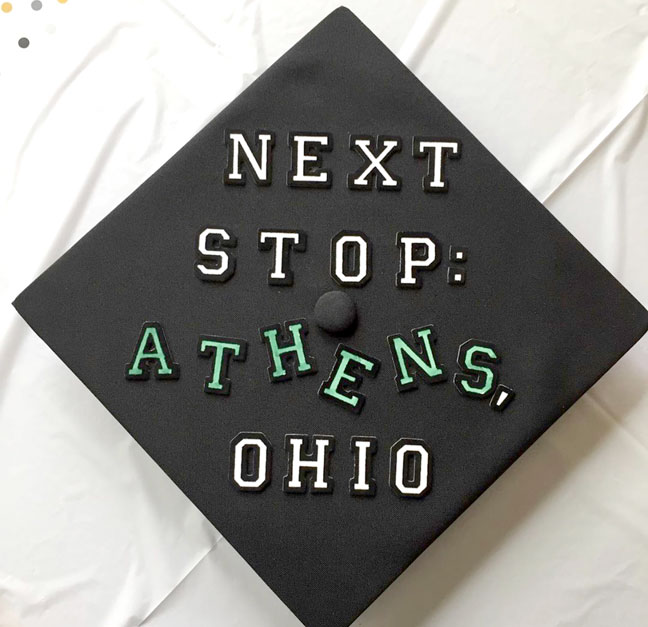
Mihaela Manova is now a Loveland High School Graduate. She joined Loveland Magazine as an Intern in September of 2019 and was soon promoted to be the Editor for our “Covering Climate Now” series. She will study journalism at Miami University.
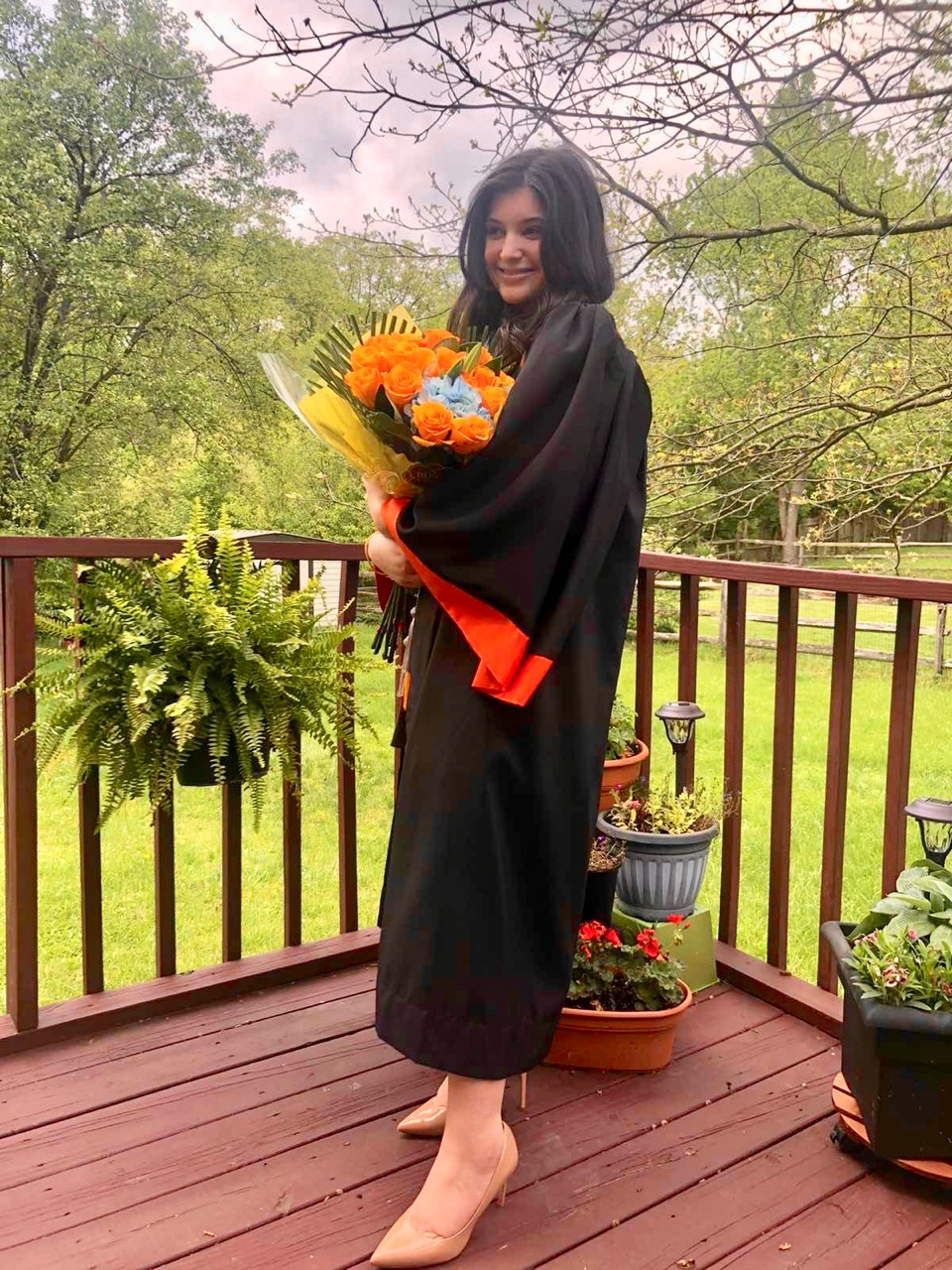
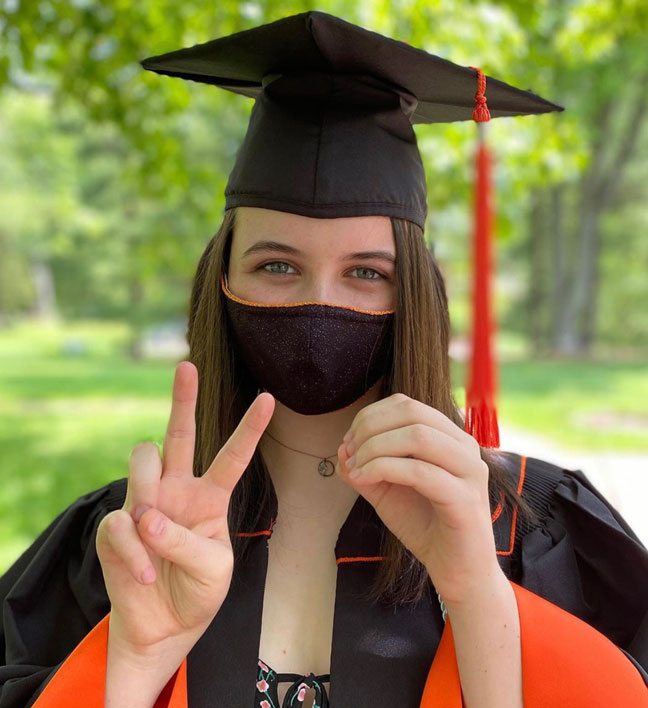
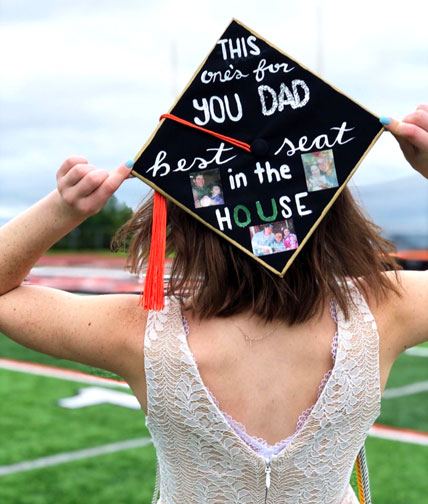
Here is Loveland High School’s 2020 Graduation (my graduation) in photos and videos – you can experience the whole 11-hour day!
By: Mihaela Manova
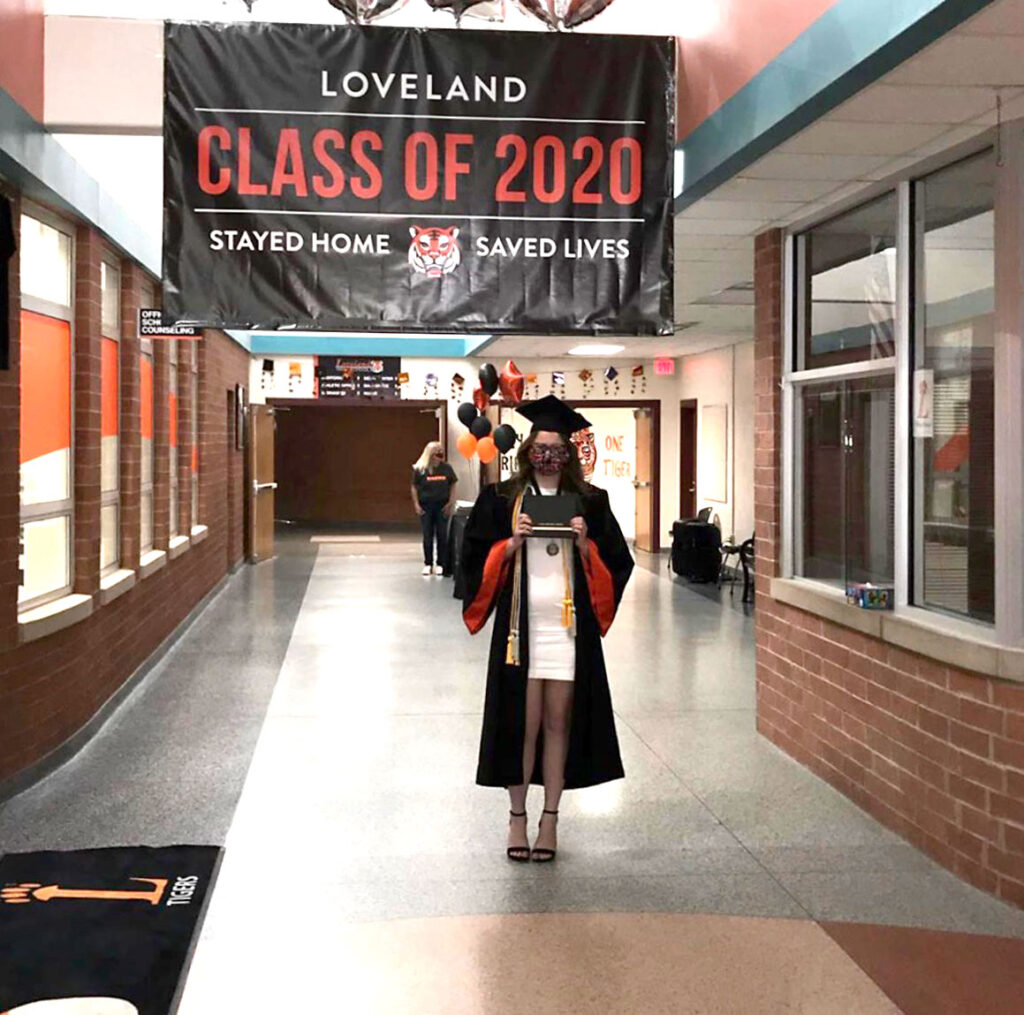
Loveland, Ohio – In the year where all schools have closed and many are awaiting a graduation of some sort, Loveland High School has managed to show to its seniors and their respective family members that Covid-19 will not dictate the end to their academic careers. Here is a piece through the point of view of a 2020 graduate.
Where to begin… this year has proved to us, the student body, our limits and our achievements, the mostly good and the mostly bad. Say you were an athlete competing in the beginning of the year or a straight-A student who dedicated their time to their studies, or you could be even both for all we know. You possess qualities that make you stand out and even though you may not know most of the time, many people see that about you. To the class of 2020, don’t fret, the best years are coming ahead.
Before graduation in May of 2020
In the last few days before graduation, I would assume we had the same thoughts crossing our minds. What would these days have looked like if we were in school? Would I be as happy as I am now? Will I be satisfied when I receive my diploma, even when it is placed into my hands gently and in a sterile manner?
Many, (from what I have observed), do not see our current situation as a stop to their plans. While following protocol, these people have decided to make the best of it, even with the distance that comes between them.
With gratitude towards the health care workers that are around us (and around the world), who are parents, aunts, uncles, and more, it was a sight to see the families coming together in our school, to see a personal milestone be achieved.
(Click on any photo to see it enlarged)
Ella Kiley
Carson Sarver
Mitchell McManis
Allison Rountree
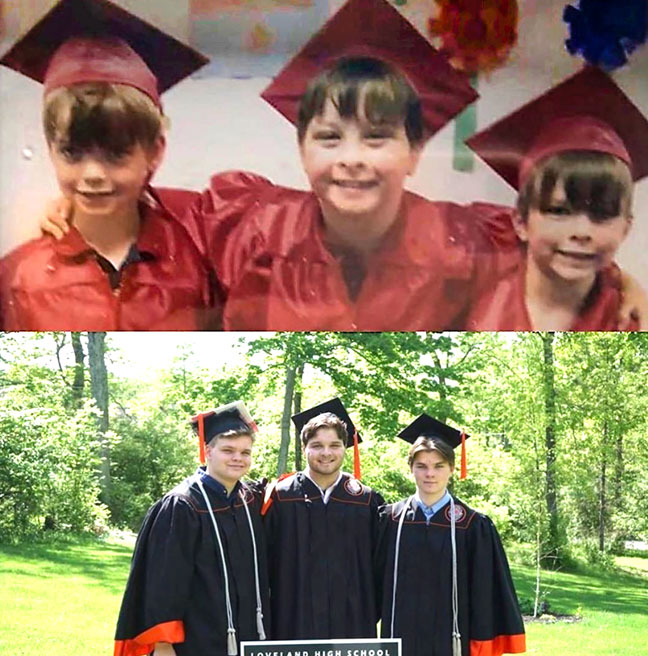
(left to right) Joey Jeffcott, Jack Jeffcott, and Brady Jeffcott
Erin Dickman
So how did our day proceed? Here is a type of journal entry that may suffice, with, of course, 2020 vision.
For starters – graduating Senior students were categorized into time slots for each family to have a personal experience (at a distance) with usually the time being around 30 min – 1 hour depending on the traffic.
The high school itself showcased a labyrinth for the cars that would soon lineup, tape making borders for each car to snake around until it found itself ready to go into the school. While waiting you can see a range of cars decorated with festive balloons and markings often saying “Go Tigers!” or “Graduate 2020” in colors of orange and black. Others would have cars following one another with family members anxiously awaiting their turn.
While the wait was long, it gave time to observe the atmosphere as it is a (hopefully) once in a lifetime spectacle of following strict protocol. You could look out the car window and see the people who were soon going to come in, properly dressed in their orange and black togas with facial masks to match.
When it was our turn to park in the parking lot, kind men with masks spoke of the directions in parking, getting out, and entry to the building. The entrance to our high school included a blown up tiger head that engulfed every individual that walked in, making our last walk inside be memorable.
Staff by the entrance were ready to take pictures of the graduate and their family, and once walking into the building you would hear “Hello!” followed by an excited “Congratulations!”
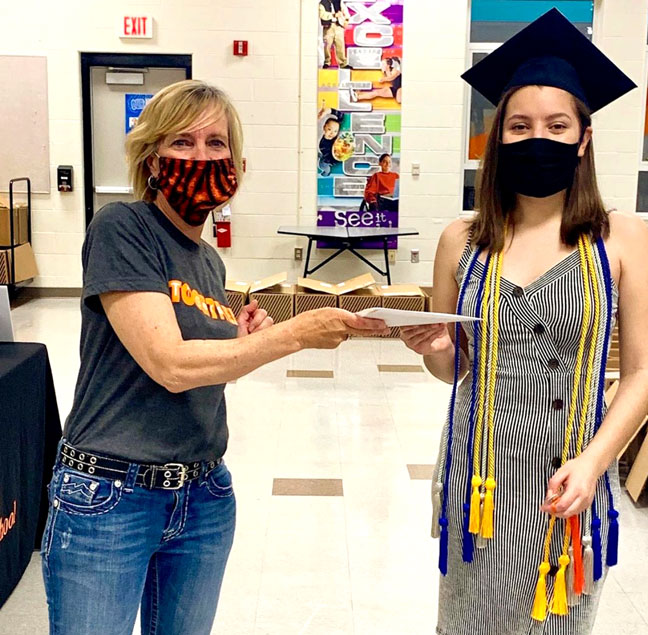
There was no lack of positivity or hints of melancholy anywhere. Once inside the building, each family would wait for another to finish going through all of the stations. The first station was a table with a quick spell-check of the name of the graduate alongside an award for academic excellence this semester if you were excellent.
More greetings ensued as we moved on to the final moment that we were waiting for. With smiles underneath the masks but highlights in all the eyes, it was finally time to hand it off to a family member and walk solitary to the podium leading to the auditorium.
In front of you, principal Peggy Johnson would lead you to the hidden entrance of the podium while behind you, was your family recording every step of the way. In the auditorium, massive posters and lighting donned a dramatic feel to this ceremony, as there were two types of cameras ready for you. One was the video recording of you walking across, and another was for a professional photo when you “turn” the tassel.
Rosa Karl
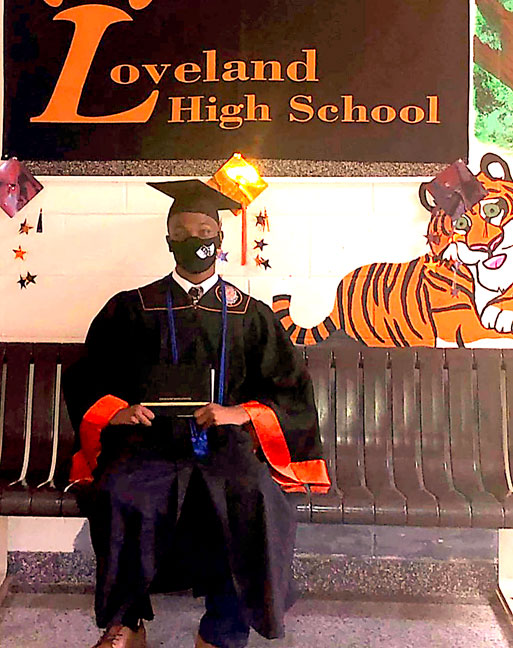
William Gibbs-Heard
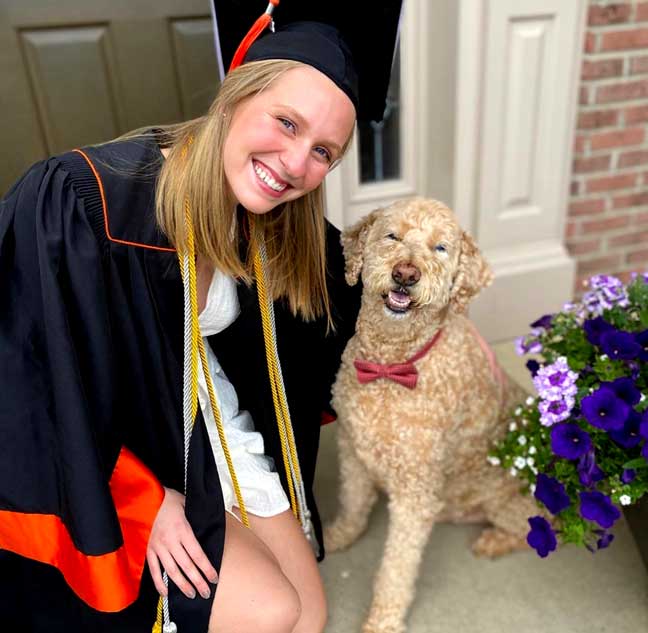
Claire Wallace (2020)
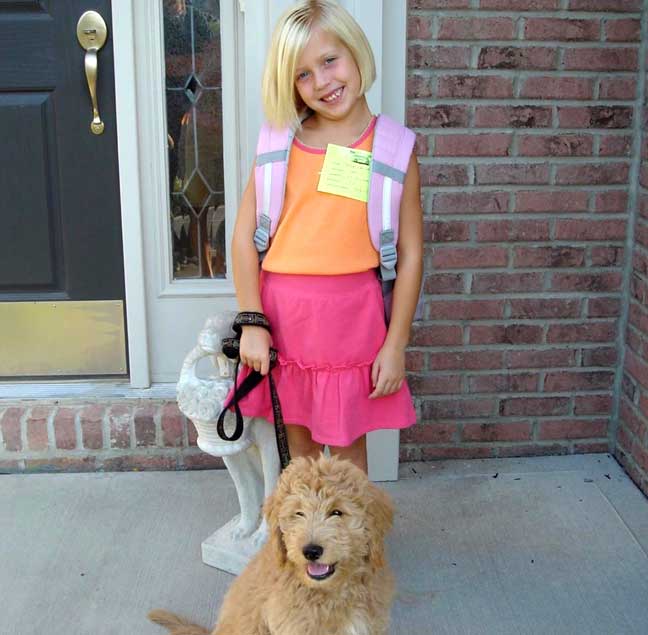
Claire Wallace (young)
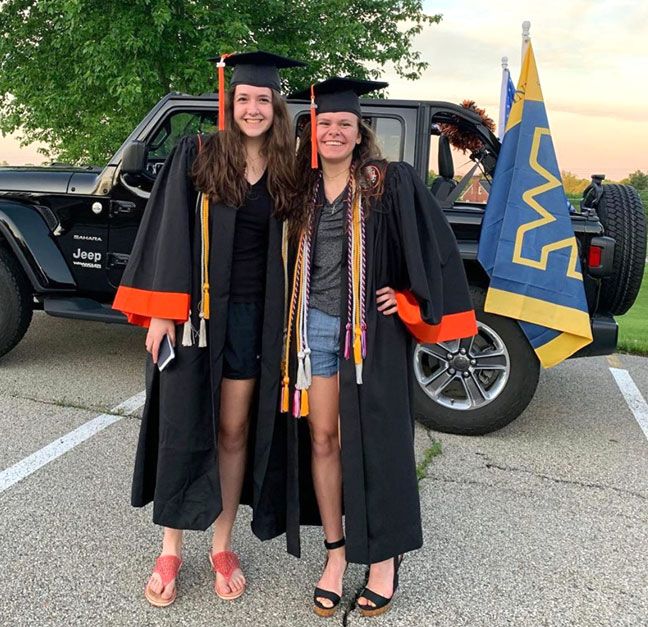
Samantha James and Emily Zirkelbach
(left to right) Calloway Hefner, Ben Russ, Lexi Duff, Greyson Hensley, Christian Morckel
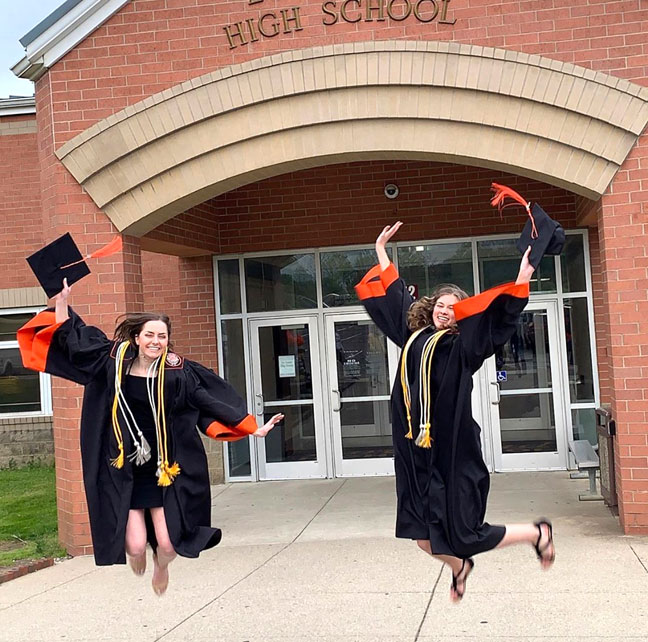
Natalie Drury and Kirstin Thomas
With the moment upon you, you hear your full name announced, so you walk across to the far end of the stage, noticing that every seat wore printed pictures of the staff and teachers. This gesture brings a smile to your face when you know how much these people wanted to be there and how long it took for each portrait to get designed, printed, and taped on the seats.
After stepping off and a rush of pride and adrenaline is expected as you have finally done it! You would now put on your “2020 Mask” again and wait for further instruction and clearing of the cafeteria. With your family, you would go to the cafeteria hearing more “Congratulations” and the dreadful returning of the toga (which you secretly want to keep).
Returning the toga, you immediately get a packet of your diploma and a booklet of all the student names and achievements.
Lastly, you break through the doors of the cafeteria, with more felicitations from a staff member that follows the question, “So what are you doing after this?” as you wait. I wasn’t sure if it was meant to be answered for now or for later but I was happy knowing that good things await…
A note:
Speaking for the class of 2020 and myself we would like to say big, big thank you’s to our school, the organizers, the staff, the people outside helping, and the teachers and volunteers. Without your efforts we would have never had a great graduation like this, so we thank you for adapting to these measures and staying positive for our day!
And we also cannot forget to thank the people working on the front lines and in hospitals at the moment, your efforts will not be forgotten in battling this epidemic. BIG THANK YOU TO ALL!
Sincerely,
Mihaela
Watch these videos of the 2020 Commencement Ceremony that were produced by Loveland High School ( (videography and digital production); Shawn Miller (lighting and sound production); Lane Aylor, Hayden Floyd, David Knapp and John Lape (technical assistants)
As we entered the School
Welcome by Olivia VonDeylen
Carson Sarver Class President
Senior Choir members perform Irish Blessing
Sophia Dillhoff Salutatorian
Ashley George Valedictory Address
National Anthem Tribute by Chamber Orchestra and Show Choirs
Principal Peggy Johnson
Superintendent Dr. Amy Crouse and School Board President Kathy Lorenz
Each student receiving their diploma
Below is the entire video of the LHS Graduation that was produced by the school.
To see each graduate cross the stage drag the slider to the 28:52 minute mark.
The entire video of the Commencement exercise
Also read these stories about the Class with 2020 Vision…












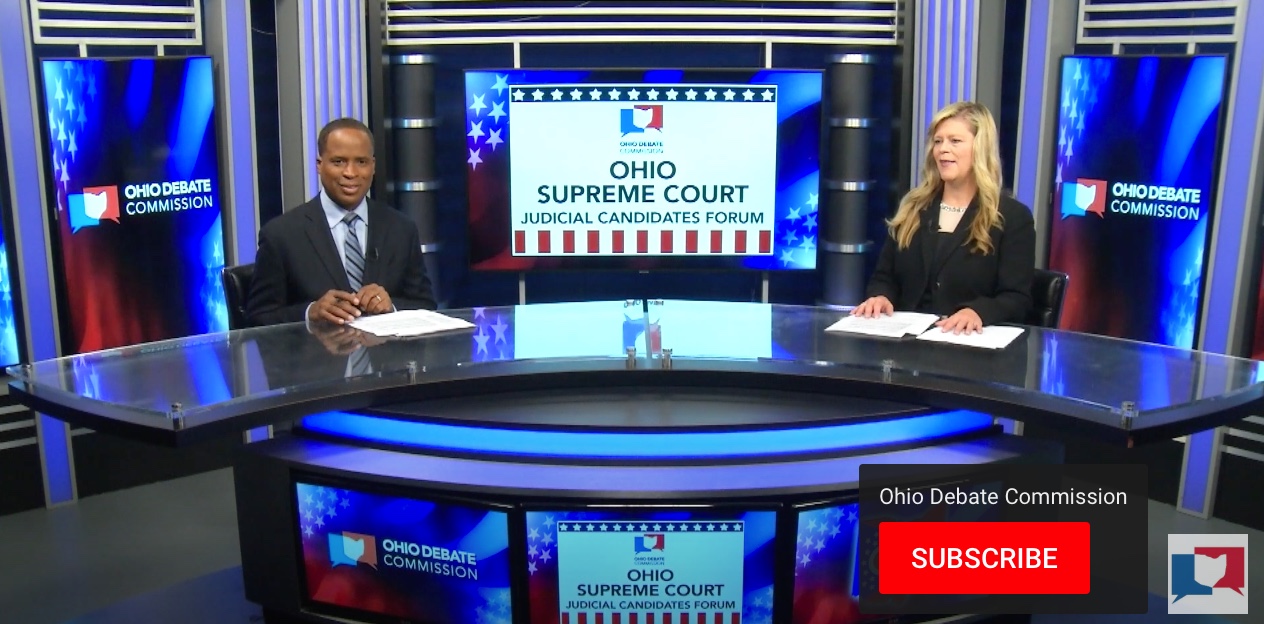
 The Ohio Supreme Court Judicial Candidates Forum was presented by The Ohio Debate Commission, a coalition of news organizations, universities and civic groups that encourage respectful civic dialogue.