I am grateful to share my Natural Wonderings/Wanderings. I write them as time and spirit allow. The idea and title were conceived one day many years ago when exploring outside with my young family. It would be quite a few years more before I began writing them in 2008. There are many connecting points over the years in observations of nature, life, and seasons. One for me is a strong sense of home-place, specifically in our little corner of the world here, in Southwestern Ohio. This sense of place helps carry interrelatedness over time and retains a comforting, familiar thread over endless variations within the cycle of nature and life.
_______________
Tall, stately, and massive, Sycamore Trees glow white against blue, winter skies and shine silver on moonlit nights. To Native Americans, they are the “Ghost Trees.”
They mostly march where the drinking is good, lining the banks of our Ohio rivers and creeks with muscular branches, open to the sky. Smooth roots intertwine and thrust into the water like thirsty elephant trunks, offering complex channels of watery crevices where fish can hide, forage, and reproduce.
Their gigantic leaves invite imaginative play and were a favorite of my children’s “natural wanderings.” Plop one on your head if caught in a shower and dashing for shelter. How about setting afloat an armada of makeshift boats in the creek, or using them as fanciful plates for an impromptu, make-believe picnic or take-along snack?
Hawks and other raptors favor their towering height and open branching, which affords them quite a view. I wonder how it might feel, having so high a perch and so far a view?
Clinging to the bank and sometimes slumping almost horizontally, they can stretch out over the water, creating an inviting spot to creep out and sit, dangling your feet, and daydreaming as the water slips by. By night, these same spots are favorite haunts of raccoons, who leave obvious signs.
For their expansive size, Sycamores sport almost silly, dangling seed balls that drop and disintegrate only as winter fades into spring, leaving behind a potent potential of seed, tiny, fluffy, and easily wind-borne.
Their attributes are the natural world’s beautiful metaphor for a loving parent, always there, arms open wide, strong, steady, and rooted, offering solace, peace, shade, and shelter.
Sycamores are a comfort.
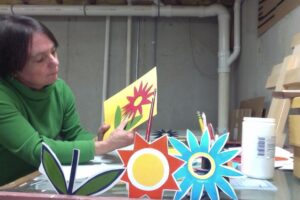
Elizabeth (Schickel) Robinson has always lived in Loveland, married and raised a family here. Family, faith, service, community and creativity are most important to her. She is an artist driven to notice and bring beauty to others including creating commissioned works of art for hospitals and churches. She cares about our culture and wants to build opportunities for community and connection to God, each other and creation. She recently retired as a Registered Nurse at Cincinnati Children’s where she was privileged to care for patients and their families. She strives to live with her eyes wide open, seeing the extraordinary in the ordinary in life and nature that surrounds her.
I am grateful to share my Natural Wonderings/Wanderings. I write them as time and spirit allow. The idea and title were conceived one day many years ago when exploring outside with my young family. It would be quite a few years more before I began writing them in 2008. There are many connecting points over the years in observations of nature, life, and seasons. One for me is a strong sense of home-place, specifically in our little corner of the world here, in Southwestern Ohio. This sense of place helps carry interrelatedness over time and retains a comforting, familiar thread over endless variations within the cycle of nature and life.
_______________
In latest winter, when the world is gray, my spirit longs for sun and spring. Grace arrives with snowdrops nosing up through blotchy snow, and soon, tiniest blue flowers, like wishes come true, sprinkling the greening grasses.
In the parade of spring, thin green blade-like leaves herald the timid crocus. getting bolder in the gathering light, beginning to show off spring colors of lavender, white, and yellow. The forsythia blooms butter yellow. Stepping into the dance, the daffodils and sweet-smelling jonquils, colors ranging from salmon to white to the brightest yellow. I like to name them, fun names like Sweet Smiles and Pipit.
My flowers give added joy by reminding me of the gardening friends who gifted me. Here are Iris from Becky, Woodland Poppies from Cindi, and ferns from brother-in-law Kurt.
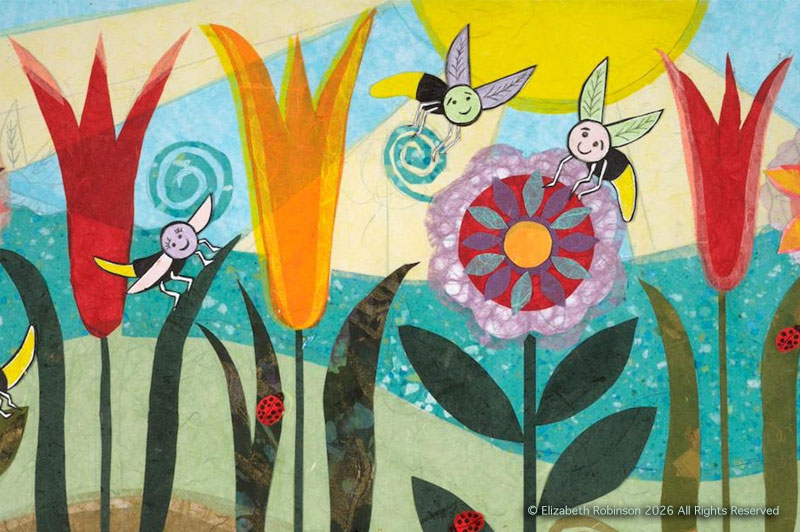
Sometimes, I covet the brightest fire engine red, and nothing shouts “ red” like red tulips. The clumps of 5 -10 planted around the yard last fall don’t disappoint. These make my heart ache, their beauty reminds me of my mother, who loved red and wore it so well.
In the spring shade garden, spring marches on. Pink Bleeding Heart is sending its perfect packet of flowers in greeting beneath a single sky blue Virginia Bluebell. Pushing up from the ground and unfurling are a host of Hosta. Lining my basement steps, Solomon’s Seal quietly exhibits nodding, shy little white bells that march in neat rows up the underside of stems. In shadiest corners, ferns are beginning to unwind their tight little green balls as the False Forget Me Nots are sending up whorls of heavenly blue. Creeping low, is Wild Ginger with perfect, heart-shaped leaves. I will keep an eye out for its unusual blossom, spotted brownish red, and hugging the ground so close it is hidden unless you know to look.
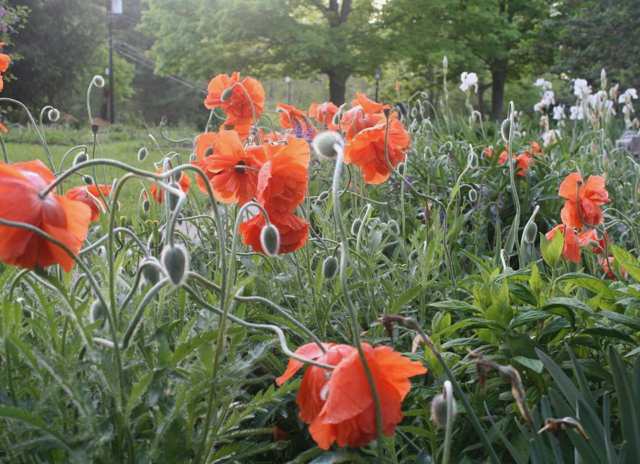
Where the sun is more plentiful, Iris are sending up stately buds. In late April, the first one, deep purple, has bloomed. What is it about Iris? They have presence and class, like ladies of a certain age, elegantly dressed and perfectly accessorized. Nearby, the Poppies are sending up Egyptian-looking shoots wth curving, graceful necks and bobbing fuzzy oval grey green buds. Poppy flowers are garden standouts, in the brightest orange, large and fragile, their petals resembling crinkly crepe paper.. They look so fine paired with the tall, lovely, brilliant, white Iris. Did I mention their smell? Please! Stick your nose right in one and inhale the freshness of springtime, with a definite hint of lemon.
A new Iris, gleaned from a friendly, roadside gardener, bloomed sunset orange this year. For two springs, I have patiently waited for it to grow strong enough to flower. For just such occasions, I carry a small shovel in my car for roadside stops. I hear memories of my kids’ voices, “mom, are you allowed to do that?
My garden gives me buckets of delight and beauty that is a pure gift from God, helped along by neighborly friends.
It rained yesterday. The bright orange Poppy petals litter the sidewalk like crepe paper after a party.
It is a party! It’s Spring!
___________________
Elizabeth (Schickel) Robinson has always lived in Loveland, married and raised a family here. Family, faith, service, community and creativity are most important to her. She is an artist driven to notice and bring beauty to others including creating commissioned works of art for hospitals and churches. She cares about our culture and wants to build opportunities for community and connection to God, each other and creation. She recently retired as a Registered Nurse at Cincinnati Children’s where she was privileged to care for patients and their families. She strives to live with her eyes wide open, seeing the extraordinary in the ordinary in life and nature that surrounds her.
Loveland, Ohio – Elizabeth (Schickel) Robinson says, “All my adult life I have been an artist and wanted to share my gifts with you. Come on In, I hope you love what you see!”
Visit her new ETSY shop and all see all her creations
Gicleé, Archival, Fine Art Prints of my Original Artwork and Calligraphy,
Greeting Cards and Note Cards from Original Artwork,
Guardian Angels: Handcrafted One of a Kind.
Gicleé, Archival, Fine Art Prints of my Original Artwork and Calligraphy,
Greeting Cards and Note Cards from Original Artwork,
Guardian Angels: Handcrafted One of a Kind.
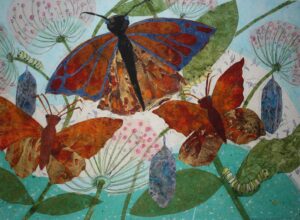
Monarch Butterflies, Giclée Print, Signed, From My Original Artwork, Cycle of Life, Caterpillar, Cocoon, Archival, Thick Fine Art Paper
Low in stock, only 3 left Price:$110.00 (Pay in 4 installments of $27.50.)
______________
Elizabeth (Schickel) Robinson has always lived in Loveland, married and raised a family here. Family, faith, service, community and creativity are most important to her. She is an artist driven to notice and bring beauty to others including creating commissioned works of art for hospitals and churches. She cares about our culture and wants to build opportunities for community and connection to God, each other and creation. She recently retired as a Registered Nurse at Cincinnati Children’s where she was privileged to care for patients and their families. She strives to live with her eyes wide open, seeing the extraordinary in the ordinary in life and nature that surrounds her.
The request must still go before Miami Township and Clermont County leaders
David Miller is the Managing Editor of Loveland Magazine
by David Miller
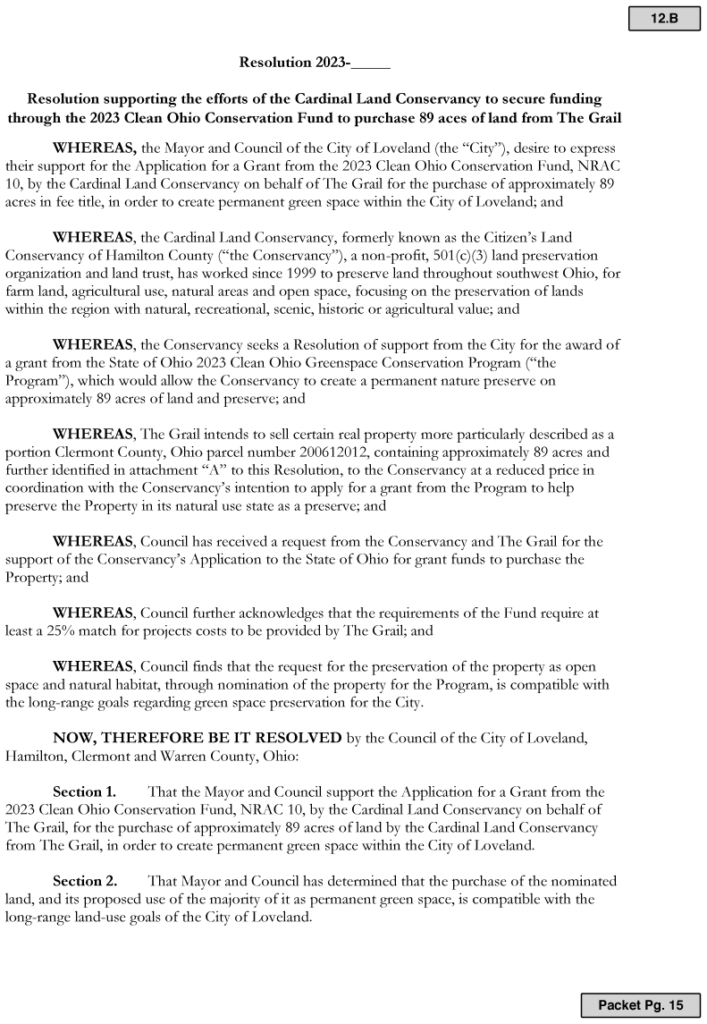
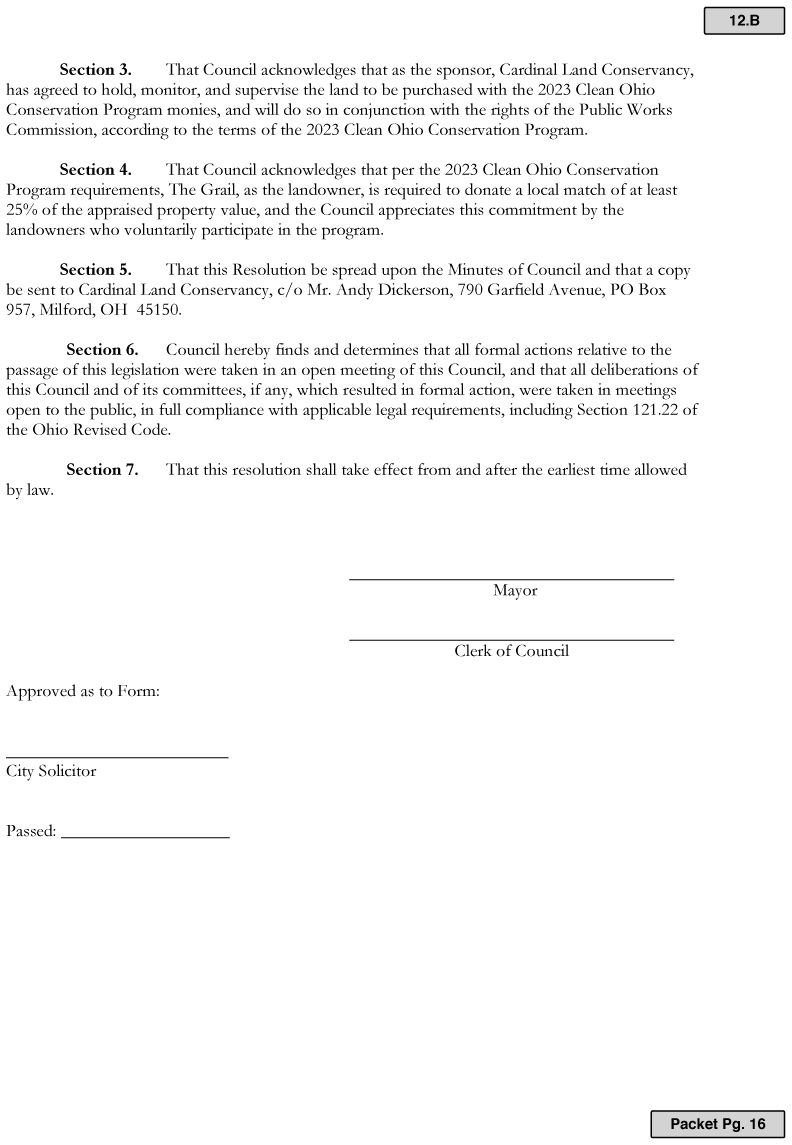
Loveland, Ohio – On Tuesday the Loveland City Council approved a request by the Cardinal Land Conservancy to put their mark of support on a plan that could save 89 acres at Grailville as dedicated green space in perpetuity. Andy Dickerson, on behalf of the Conservancy, appeared at the meeting requesting a vote of support for a grant application that would be submitted to the Clean Ohio Conservation Fund, for funding the purchase of the 89 acres of Grail property that is within the city’s corporation boundaries.
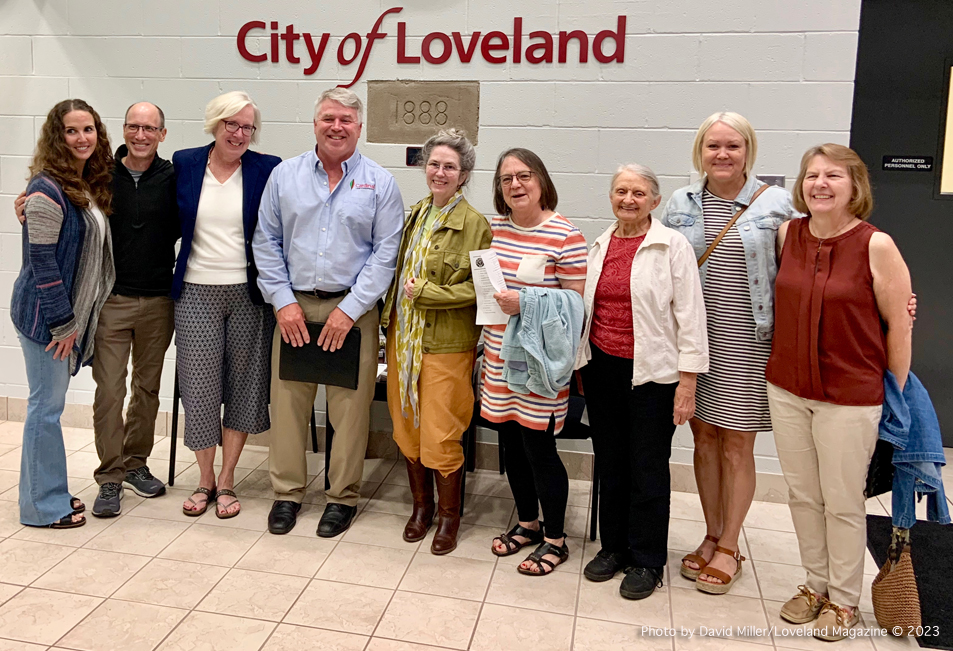
After their successful effort to convince Loveland Council to support the plan they worked on for a year, some members of the Grailville Land Preservation Group posed for a photo. Laurie Kiley, Kevin Kiley, Sharon Scovanner, Andy Dickerson, Elizabeth Murphy, Elizabeth Robinson, Mary Lu Lageman, Jamie Smith, and Loretta Rokey.
After Council unanimously approved the request Dickerson expressed caution because the Conservancy will still need the support of the Miami Township Trustees and the Clermont County Commissioners.
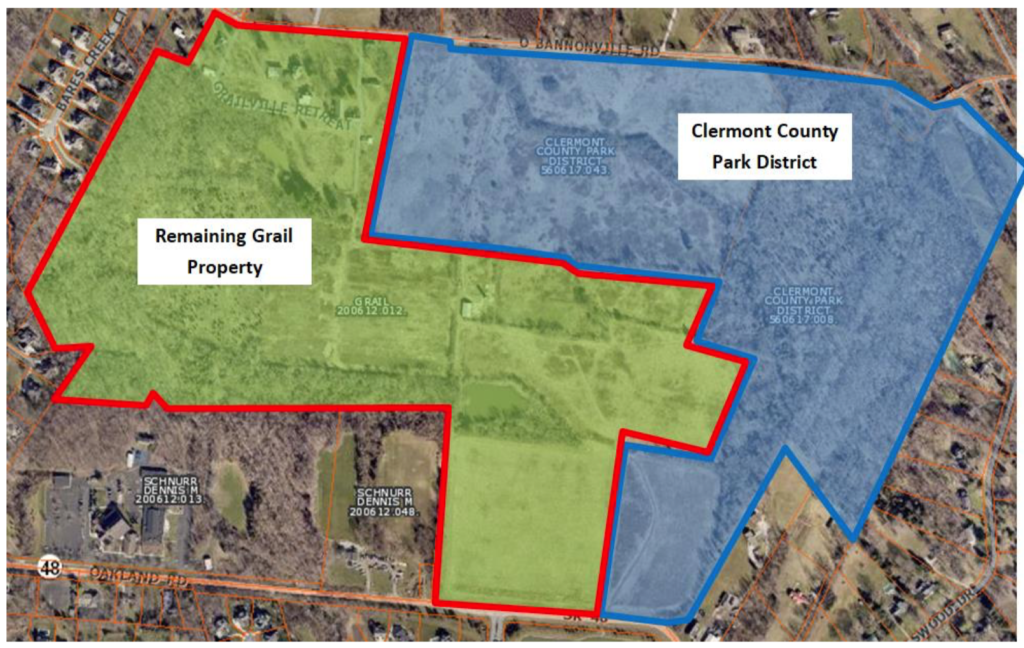
This is the site where Drees Homes was denied the zoning change they requested in 2022 after local residents filled Planning and Zoning chambers to urge that the site be protected. The Kentucky home builder had requested the land become a Special Planning District which could have allowed 209 homes on the site. The same parcel is also where the Loveland City School District proposed building a campus until the funding they wanted was denied by voters in 2019. The site is bounded by O’Bannonville Road and State Route 48 (Oakland Road).
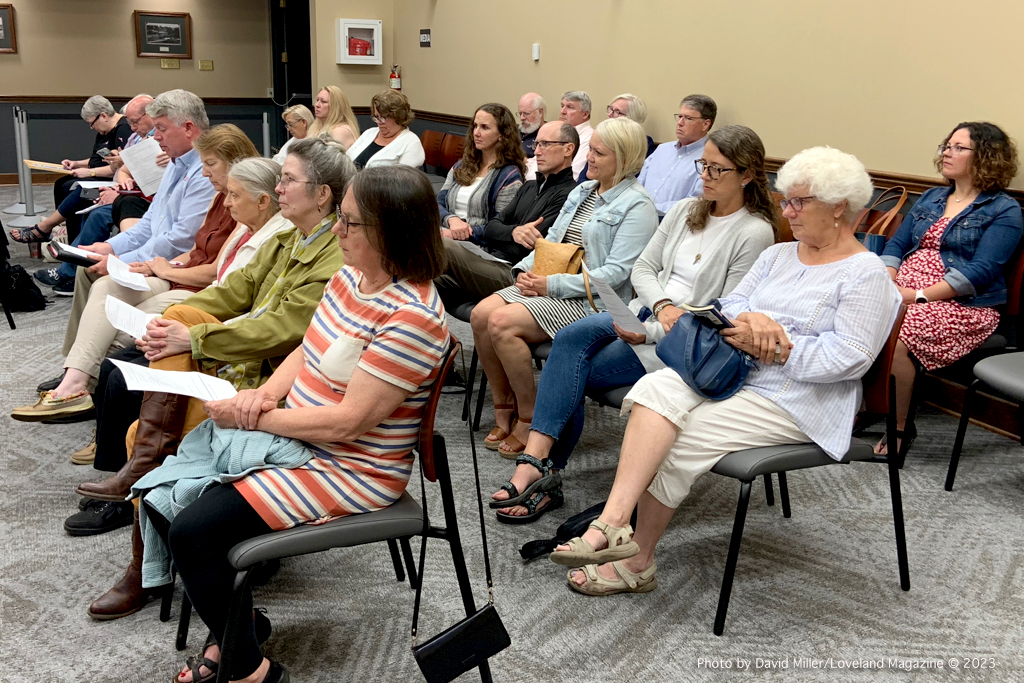
After the re-zoning Drees requested was denied, local Grail members and other local residents coalesced to find the solution that was presented to City Council on Tuesday. Many of them sat in council chambers to hear the presentation.
The Grailville Land Preservation Group worked together to stop the zoning change for Drees. Four members of the conservation subcommittee of the larger group consisted of Lauren Enda, Kevin Kiley, Jamie Smith, and Sharon Scovanner.
Sharon Scovanner told Loveland Magazine today, “I want to make it clear that both the big group and our subcommittee were very important to our success. This was a case of many members of the community coming together with the goal of preserving the land. We are grateful that ‘corporate’ Grail agreed to provide a 25% match for the grant and to the local Grail women, several of who worked alongside us wanted to find a solution. Of course, we have been honored to partner with Cardinal to help facilitate an agreement that is good for the Grail and the community.”
If the grant application is successful, the 89 acres of land would be deeded as dedicated green space in perpetuity. The proposed purchase by the conservancy would be adjacent to the 100-acre Clermont County Park District property, which was also acquired from the Grail using Clean Ohio funding.
In this first LOVELAND MAGAZINE TV video, Andy Dickerson explains the details of the grant and what he was asking the Council to do.
In this second LOVELAND MAGAZINE TV video, Council members ask questions and vote on the resolution of support.
In this third LOVELAND MAGAZINE TV video, residents and Grail members spoke with cautious optimism about the first public step they made in announcing the plan they had worked toward since Drees first proposed building 209 homes on the site.
About Cardinal Land Conservancy
Their address is 790 Garfield Avenue in Milford.
Cardinal Land Conservancy is a private, nonprofit, 501c3 tax-exempt conservation organization, incorporated in September 1999 under the laws of the state of Ohio. Cardinal is a member of the Land Trust Alliance (LTA), a national organization, and Coalition of Ohio Land Trusts (COLT). Cardinal earned LTA accreditation in 2019 and uses LTA’s “Land Trust Standards and Practices” to guide our work as we grow. This accreditation confirms that Cardinal practices sound finances, ethical conduct, responsible governance, and lasting stewardship.
Cardinal Land Conservancy, formerly known as the Citizen’s Land Conservancy of Hamilton County (“the Conservancy”), is a non-profit, 501(c)(3) land preservation organization and land trust. Cardinal holds the title to 11 nature preserves.
Cardinal Land Conservancy is a land conservancy in Southwest Ohio whose mission is to preserve natural habitats, waterways, agricultural lands, and open space in Southwest Ohio.
We protect and restore natural lands with significant habitats that support native wildlife and create scenic vistas for public enjoyment, as well as agricultural lands suitable for the production of food, timber, or other cultivated or natural products. Cardinal acquires conservation interests in real properties which it then monitors and stewards in perpetuity. These include conservation easements, fee simple title, and other conservation interests which are acquired through donations and purchases guided by, and executed through, Cardinal. Once obtained, Cardinal monitors and otherwise stewards the properties and interests through regular oversight, periodic assessment and, if needed, protective action and legal defense. Our service area includes the Southwestern Ohio counties: Adams, Brown, Clermont, Clinton, Hamilton, Highland, and Warren.
Rinsky Woods Nature Preserve
Clermont County
There are few woods like this in the world. Those woods that exist are found only in Southwest Ohio and Southeast Indiana. Rinksy Woods is the second largest woods of this kind in the world. In fact, it has been designated as an Ohio Natural Landmark by the Ohio Department of Natural Resources. These wet flat woods are adjacent to Stonelick State Park, adding to an admirable stretch of greenspace in the area. Details & Trail Map
Todd’s Fork Nature Preserve
Clinton County
Native prairies give way to a 100+ acre woods on this preserve, which also includes the Todd’s Fork of the Little Miami River. Cardinal has several stewardship projects ongoing here including maintenance of the prairie. Maintenance includes prescribed burning which is meant to discourage unwanted invasive plants on an annual basis. Details & Trail Map
Kope Hollow Nature Preserve
Brown County
In Southeast Brown County, the Kope formation (a bedrock formation unique to Southern Ohio and Indiana) runs through incredibly diverse woods. A recent native plant survey listed over 100 native species. This property is also graced with five waterfalls that contribute to Roup’s Run. This water flows into the Ohio River just beyond the bounds of the property. Details & Trail Map
Bortz Family Nature Preserve
Hamilton County
This 119-acre preserve offers respite in deep and cool woods along with views of the wide Ohio and of the Little Miami’s emerald shores. This land appeals to both humans and wildlife because of its diversity. The Ohio Department of Natural Resources determined that this land is likely the home of the endangered Indiana Bat and several endangered species of mussels. Overlooking the confluence of these two great rivers is an American Bald Eagle nest, atop a towering cottonwood tree. Our eagles can be viewed by our Eagle Camera from January to June! Details & Trail Map
Read about the other nature preserve of the Cardinal Land Conservancy.
I want to speak to you about vision and make sure you are aware of an important ongoing process before the Loveland Planning and Zoning Board and Loveland City Council. Drees Homes is requesting a change in the current low-density zoning status on 110 lovely acres of green unspoiled land, with historic buildings, currently owned by Grailville (The Grail). This land sits between where East Loveland Avenue turns into O’Bannonville Road and Rte 48. Drees desires this zoning status change to put 209 homes on this green space.
The Grail Mission and Vision Statement speaks of Care for The Earth. This has always been vital to Grailville/The Grail in its history and practice. Grail members including myself are expressing significant and ongoing distaste that the Grail is seriously considering divesting itself of this land to Drees to build another subdivision in our town.
There are important long-term practical reasons why many Loveland residents have spoken AGAINST enabling a zoning status change proposed by Drees to build 209 homes. They include, among others, an overcapacity school system, aggravating already clogged traffic and infrastructure concerns including sewer and water. (Please reference the below open letter to Loveland residents by Elizabeth Murphy for more details on these pressing issues)
I want to concentrate here on a compelling and magnanimous (great of mind or heart) vision of protection from development such as the proposed Drees subdivision. Standing up for a NO vote on this zoning status change from low density is a very important first step.
If the Grail is determined to divest itself of this land, are we as citizens willing to stand up for a vision that will honor the cultural and spiritual history of the Grail on this land, and also stand up for the inestimable value of added community green space which will do so much more than another subdivision to keep Loveland a treasured place to live into the future?
I wonder: If Loveland has the foresight to reject this proposed Drees zoning change, would The Grail accept significantly less money from the city or other entity committed to a higher vision that cares for the earth and the people of Loveland?
I have lived in Loveland all my life and our Loveland Bike Trail was just such a vision. There were many who could not see the immensely positive difference this green path of natural beauty that intersects our town and all enjoy, would make for the future of Loveland. It is with gratitude we now look back and honor those who had vision and were tenacious, so we could see the flowering of that vision.
Today Loveland is thriving. With that has come some of the problems of success mentioned earlier such as traffic and stress on infrastructure. We can make decisions now that see another subdivision that destroys precious green space and exacerbates traffic and stressed infrastructure will not be a decision that is truly good for the future of Loveland.
Loveland citizens will thank us years from now if we reserve green and natural places for the good of all, as did those bike trail visionaries.
I ask the Loveland Planning and Zoning Commission and Loveland City Council to reject this Drees proposed zoning change. Reject it not only on very real practical matters such as traffic and infrastructure, but to support a greater vision of the intrinsic beauty and value added of green spaces for Lovelanders into the future.
Sincerely,
Elizabeth Robinson
East Loveland Avenue
 April 11, 2022

Dear Fellow Loveland Residents,

It is important that you are aware of a process which is now ongoing involving 110 acres of Grailville land between Rt.48 and O’Bannonville Rd. Loveland City Council and the Zoning Board will have to make a decision on the Drees Homes’ request for a change in the zoning status to allow them to build 209 homes on that land.

The iniPal public hearing drew a standing room only crowd. Everyone who spoke, with the excepPon of the Drees representaPves, requested that the Zoning Board say NO to the Drees proposal. There are important long-term reasons why it is best for our community that the Drees proposal does not go forward.

We all know the traffic situaPon in downtown is bad now. The construcPon of a large subdivision on this Grail land will iniPally cause several years of construcPon trucks and dirt funneling into town from Rt.48 and O’Bannonville Rd. As the houses are built and sold regular traffic of several thousand car “trips” through town will phase in. This will never stop.

Our school system is currently overflowing recommended capacity. Extra trailers are needed for space. It is esPmated that 4-5 addiPonal classrooms of children are likely to be added by this subdivision. We are all painfully aware of the costs that would be incurred to build new schools, as well as the stresses on children and teachers involved in overcrowding. Again, once this increase is allowed to happen it is unlikely to be reversed.

There are also serious general infrastructure issues relaPng to water. The Loveland water system is a series of wells which when run at high demand can drop the water table in a significant way. One must ask at what point will this become a problem. Water pressure has at Pmes been an issue and more homes drawing water cannot but aggravate this.

The other end of this problem is the management of the addiPonal sewage. The sewer line under East Loveland Ave. is outdated, fragile, and it is quesPonable whether it is adequate to handle a large new neighborhood. The receiving Polk Run sewage treatment plant has no more room to expand. There has been no confirmaPon of sewer availability, capacity, or access compliant with MSD standards. Will the City of Loveland be put in a posiPon of providing this infrastructure at Loveland residents' expense? With the Liale Miami River so nearby it is crucial that there be no chance of contaminaPon.
Natural rainwater run-off must also be considered. The land from White Pillars on slopes to the northwest. The homes along O’Bannonville Rd. are all in the path of this natural drainage and vulnerable to surface flows or overflowing of Bares Run Creek in Pmes of heavy rain. The new roads and houses will eliminate acreage which currently absorbs the rainwater and so more will conPnue on downhill.

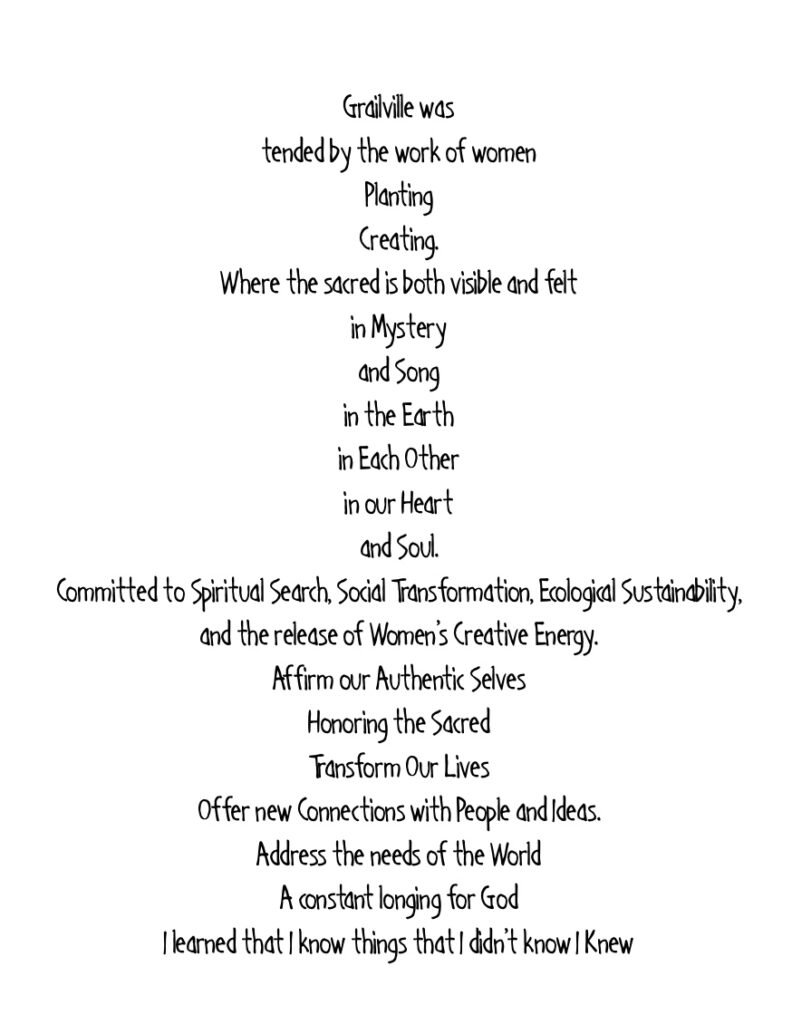
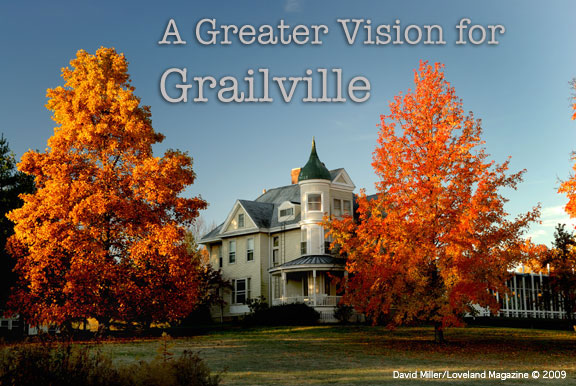
The final thing I need to speak of is the special quality of this parPcular piece of land. For about 80 years women of The Grail have lived or worked there. They have tended the land, holding it, knowing the sacred nature of this place. As the Grail has shared access to their land with others
for walking and connecPng with nature, many have become aware of the spiritual calm which it provides. In today’s world we need this more than ever.

In conclusion, I would encourage everyone who feels that we do not need another big subdivision on this Grailville land, with all the negaPve side-effects, to please make your views known. Aaend the public meePngs (the next is on May 4), write or call members of the Zoning Board and City Council. In our country we have government of ciPzens for ciPzens. Our officials have a duty of honor to listen to the members of the community which they serve. They are us; and therefore, we must speak so they may be guided.

Sincerely,

Elizabeth Murphy - Fallis Road Loveland OH
In 1940, an international movement of women got on a boat. The last boat before Hitler invaded Holland. They made it to America, “by an eyelash” in April of that year.
The Grail from Loveland became a voice in the United Nations.
Grailville was the home of the National Grail movement in the United States; the symbolic heart of the movement.
Will we allow the Grailville farm to be plowed under or will we choose new furrows planted in a way that continues to grow our future as a community?



 day many years ago when exploring outside with my young family. It would be quite a few years more before I began writing them in 2008. There are many connecting points over the years in observations of nature, life, and seasons. One for me is a strong sense of home-place, specifically in our little corner of the world here, in Southwestern Ohio. This sense of place helps carry interrelatedness over time and retains a comforting, familiar thread over endless variations within the cycle of nature and life.
 Loveland, Ohio – Elizabeth (Schickel) Robinson

 About Cardinal Land Conservancy



![[w/video] Grailville: A place of peace, community, balance, growth, sustenance, “Sharing Born with the wisdom of Women.”](https://lovelandmagazine.com/wp-content/uploads/2022/04/grailville-a-place.jpeg)