



Ohio Gov. Mike DeWine and the state’s legislative leaders on Friday announced how they’d allocate almost half of what the state has left in federal coronavirus-relief dollars.
The state has about $1 billion unexpended from its share of the $2.2 trillion CARES Act that Congress passed in March. At least until the feds change the rules, the funds have to be spent by Dec. 31.
Social-service groups that deal with issues of homelessness and hunger have been clamoring for months for a share of the money, as have business groups and others. So it’s been up to DeWine and the legislature to decide what to do with the money while Congress appears stymied over further coronavirus relief.
“We tried to look at what the needs were and what had already been put out,” DeWine said during a remote press conference. “We don’t know whether Congress will pass another bill or not.”
The state is holding about half of the funds for coronavirus testing and contact tracing and other needs while it awaits a possible second round of relief — which may or may not include assistance to state and local governments.
The expenditures announced Friday include:
- $50 million for mortgage and rental assistance to families making 200% or less of the federal poverty level
- $125 million for businesses with up to 25 employees
- $37.5 million for restaurants and bars
- $100 million for colleges and universities to do testing, contact tracing and provide mental-health services
- $62 million for rural and critical-access hospitals
- $25 million for non-profits providing services such a food banks, homeless shelters and other social services
- $20 million for the arts
A good deal more of the money was focused on businesses than on assisting individuals who are suffering most. But several in Friday’s press conference said they hope by helping small businesses keep their doors open, people will be able to get or keep jobs.
“We know some businesses are barely making it,” Lt. Gov. Jon Husted said of that portion of the package. “This is focused on them.”
For their part, some leaders of social-service organizations said they were grateful for the help they will receive.
“We’re pleased that Gov. DeWine finally deployed federal coronavirus relief funds to help people avoid getting evicted during this pandemic,” Bill Faith, executive director of the Coalition on Housing and Homelessness in Ohio, said in a written statement. “And we appreciate (Ohio) Controlling Board members’ support, especially Sen. (Matt) Dolan (R-Chagrin Falls) and Sen. (Jay) Hottinger (R-Newark) who took a personal interest in keeping struggling Ohioans safely in their homes. We look forward to seeing details on how the program will be implemented. Given the Dec. 31 deadline to use these funds, we would welcome the governor’s assistance in advocating for Congress to provide additional rental assistance into 2021.”
The Ohio Poverty Law Center also released a statement praising state leaders for their action. But it warned that it won’t be enough.
“As Ohioans continue to experience job and income loss due to the pandemic, additional federal and state resources will be needed to prevent evictions and keep Ohioans safe, especially as we get closer to the expiration of the Centers for Disease Control and Prevention’s eviction moratorium,” it said. “We hope housing assistance will be among the highest priorities for resources in the coming weeks and months.”









 Mulvey has served the students of Great Oaks Career Campuses for more than 30 years as a math teacher, counselor, career specialist, campus dean, and district administrator. In her current role as Director of Student Services, she has strengthened both physical health and mental health services for students, led the effort to rewrite Board policies, began a summer camp program for younger students, and helped guide the district to record levels of high school enrollment.
 This is Part 2 of a series Loveland resident and Ohio University student,



![[Meeting Videos] Christman Farm sale moves forward after public hearing](https://lovelandmagazine.com/wp-content/uploads/2020/10/feature-HOMEARAMA-1.jpg)

 A Recreation Tax Increment Financing District (TIF) was created by Ordinance 2008-38 to pay off the financing. The TIF consists of approximately 27 acres and includes the taxpayer-owned property known generally as the Christman Farm as well as the Crane property which is privately owned.
 The Crane property would have 20 homes and two styles of “Estate Homes” valued at $850,000 and up on lots that would average 32,000 sq. ft.
 Campbell Berling is proposing that future homeowners be allowed to pay the cost of sewer line extensions over 20-years.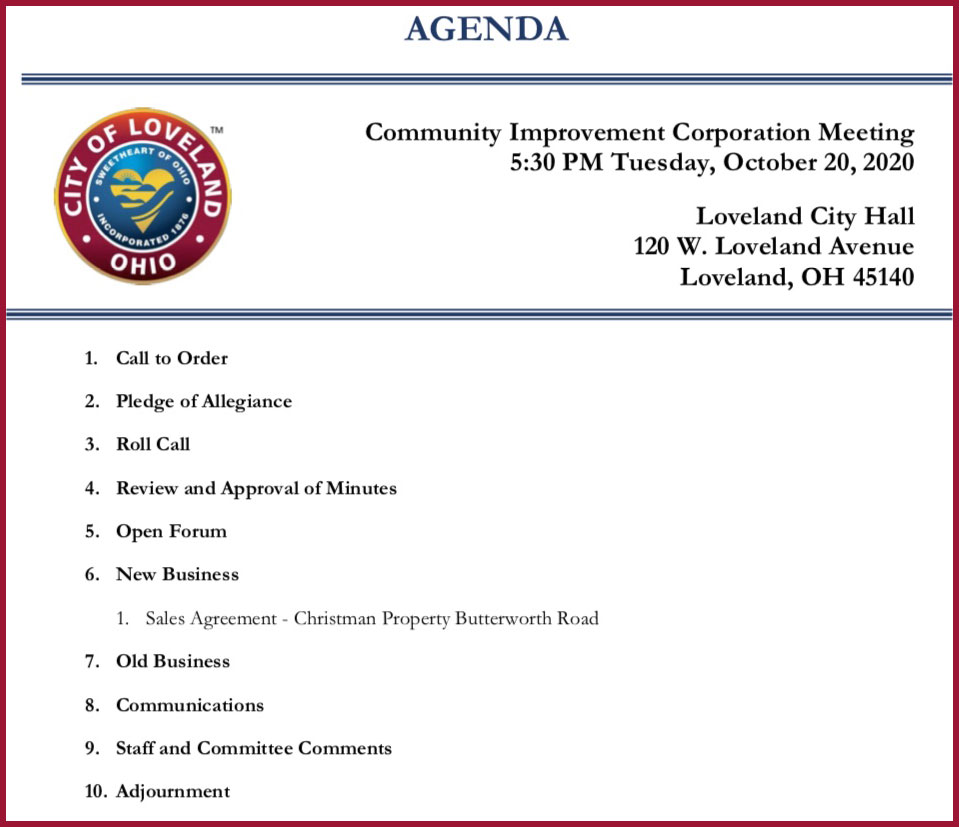
 Kennedy presented this “Fiscal Impact” study in the package of information he presented to City Council:

 The Ohio Supreme Court Judicial Candidates Forum was presented by The Ohio Debate Commission, a coalition of news organizations, universities and civic groups that encourage respectful civic dialogue.