AWinter Reconnect Order is issued by the Public Utilities Commission of Ohio (PUCO) on an annual basis. The order allows residential customers who are disconnected or are threatened with disconnection to pay a maximum amount of $175 to have their service restored or maintained.
Who is eligible to use the Winter Reconnect Order?
Any residential customer who is served by a regulated utility company, regardless of income, may use the Winter Reconnect Order, to establish, maintain or restore service. Customers that have multiple residential accounts may only utilize the winter reconnection order at their primary residence.
Who offers the Winter Reconnect Order?
All regulated natural gas and electric companies must comply with the Winter Reconnect Order. To see the full list of regulated utility companies in Ohio, CLICK HERE.
When can the Winter Reconnect Order be used?
The Winter Reconnect Order may be used once per winter heating season, typically mid October through April 15.
How can a customer sign up for the Winter Reconnect Order?
There is no sign up required. Customers can simply contact their utility and mention the Winter Reconnect Order. Regulated utilities in Ohio are familiar with the order and will be able to guide consumers through the process.
How much is a customer required to pay with the Winter Reconnect Order?
If a residential customer’s service has been disconnected for non-payment or is threatened with disconnection, he or she may pay the required $175, and if applicable, a reconnection fee of no more than $36 up front to restore service and follow the company’s procedures to get reconnected. If paying at an authorized agent, the customer will also need to call their utility with the receipt number to report the payment.
The Winter Reconnect Order payment of $175 can be split between two regulated utility companies if both utilities have been disconnected or are threatened with disconnection. Customers requesting to use a split payment must contact both of their regulated utility companies.
Customers requesting new natural gas or electric service, who have no previous balance with their utility, may establish service under the winter reconnect order by paying $175, rather than paying the required security deposit. Such customers may have the remaining balance of the security deposit added to their next month’s bill.
What is a reconnection charge?
If your utility has a reconnection charge, it is a fee that must be paid before service can begin again. The PUCO approves a reconnection charge for each utility company and the utility is not allowed to charge more than the set amount. Any company that does not have a reconnection charge may not assess one. If the company’s approved reconnection charge is greater than $36, the remaining amount of the reconnection charge may be added to their next month’s bill.
Can the $175 payment be made by a third party?
Yes. Customers who are at or below 175 percent of the , may be eligible to receive funds through the (HEAP) Winter Crisis program. For a complete list of HEAP providers please contact (800) 282-0880.
What if the customer owes more than $175 to the utility company?
Regardless of how much a consumer may owe a utility, if they make the $175 payment, plus a reconnection fee of no more than $36, the utility must restore or maintain their service. Customers who utilize the Winter Reconnect Order are required to enroll on an extended payment plan.
Can the utility company require a security deposit before reconnecting service?
Yes. However, the total amount the company may require a customer to pay to maintain or reestablish service, including the security deposit, may not exceed the Winter Reconnect Order amount of $175, plus a reconnection fee of no more than $36. If the security deposit exceeds the Winter Reconnect Order and any applicable reconnection fee, the remaining amount of the security deposit may be added to the next month’s bill.
Loveland, Ohio – Three St. Columban students earned Broadcom Masters Top 300 recognition for their science fair projects last year. Mario Ferreri is in 8th grade this year and Jake Terrell and Brendan McPheron are now high school freshmen.
Ben McPheron is the junior high science teacher who guided the students as they created their projects.
Broadcom Foundation and Society for Science & the Public has announced the Top 300 MASTERS in their 10th annual Broadcom MASTERS. The program claims it is the nation’s premier Science, Technology, Engineering and Math (STEM) competition for middle school students. They seeks to inspire young scientists, engineers and innovators to solve the grand challenges of the 21st century.
Each of the Top 300 MASTERS will receive a $125 award from DoD STEM. With this new prize, the Department of Defense continues its support of youth in STEM, working towards a more diverse pipeline of highly qualified STEM professionals in the future.
The Top 300 MASTERS were selected from the largest pool of applicants the competition has seen, with 3,476 students from 42 states and Puerto Rico.
Science fairs across the country had to cancel their competitions in the spring of 2020 because of the COVID-19 pandemic. In reaction, the Society and Broadcom Foundation opened up the Broadcom MASTERS competition to any student who registered to compete in a Society-affiliated science fair. Previously, only students who are named in the top 10% of their science fair were eligible to enter.
“Every Middle School student who had the passion and fortitude to complete his or her science or engineering project with hardships imposed to schooling and research is a hero and heroine in our eyes, and the Top 300 Broadcom MASTERS semifinalists exemplify their remarkable grit,” said Paula Golden, President of Broadcom Foundation. “They inspire us all and give us hope for the future.”
In addition to the $125 cash prize, the Top 300 Broadcom MASTERS received a prize package containing an award ribbon; semifinalist certificate of accomplishment; Broadcom MASTERS backpack; a Broadcom MASTERS decal; a specialized Invention Journal, courtesy of The Lemelson Foundation; a one-year subscription to Wolfram Mathematica software, courtesy of Wolfram Research; a special prize from Jeff Glassman, CEO of Covington Capital Management; and a one-year family digital subscription to Science News magazine. In recognition of the role that teachers play in the success of their students, each designated teacher also will receive a Broadcom MASTERS tote bag; a special edition booklet of Science News for Students’ Invention & Innovation articles from The Lemelson Foundation; and a one-year digital subscription to Science News magazine.
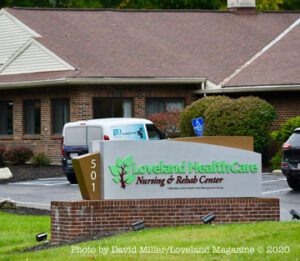
Loveland, Ohio – The Ohio Department of Health released new data for COVID 19 cases at the Loveland Health Care Center (LHCC) today revealing the total cumulative cases of COVID 19 at LHCC went from 60 to 85 in the past week. The health department releases data each Wednesday.
The numbers Loveland Magazine reported yesterday which was from the previous week’s report was 37 residents and 11 staff members with COVID 19 at LHCC. The cumulative case report revealed 39 residents and 21 staff members have had the virus. That was a total 60 of cumulative cases.
Today’s report is 4 residents and 0 staff members with COVID 19 at LHCC, however, today’s cumulative case report reveals 64 residents and 21 staff members have had the virus. That total is 85 cumulative cases.
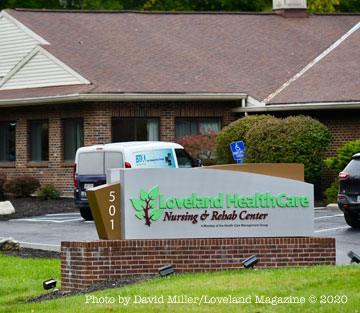
LHCC is a 99-bed nursing home located at 501 North Second Street (St. Rt. 48) in Loveland.
We know that this crisis is particularly challenging for our residents and their families.– Greg Miller
Loveland, Ohio – After Loveland Magazine learned of the high number of COVID 19 cases at the Loveland Health Care Center, their spokesperson Greg Miller with Health Care Management Group said he would send an email response to our questions. (60 cases of COVID 19 at Loveland Health Care Center)
Miller responded by sending this statement to Loveland Magazine this evening at 8:01 PM.
Loveland Health Care Center
MEDIA STATEMENT
September 29, 2020
Our facility appreciates the interest in the COVID-19 status of our residents. We can confirm that we do have staff and/or residents who have tested positive, or who are deemed positive, for COVID-19.
Please note that out of respect to those impacted and, in accordance with privacy laws, we will not be sharing any details regarding the positive cases publicly.
When these cases first developed, we notified our residents and their families, and we immediately involved the appropriate authorities. We continue to work with our local and state departments of health to monitor our active cases, and we have a plan in place to try to limit additional exposures. Our plan includes continuing our no visitor policy, enhanced health screening of residents and staff, and other measures informed by guidance from federal agencies, such as the Centers for Disease Control (CDC). New cases are reported to residents, families and local and federal agencies as required by law.
We know that this crisis is particularly challenging for our residents and their families. We empathize with their feelings of separation and vulnerability, and we want to thank them for their ongoing support and trust. The positive energy they provide to us every day is invaluable.
We also want to thank and acknowledge our heroic staff. While many people are staying home during this crisis, our staff show up every day to do the essential work of caring for our vulnerable residents with dedication and purpose for the greater good.
Thank you as well to our broader community for your concern for the well-being of our residents and our staff. It means so much to us to have the backing of our community at this difficult time.
Here are the questions posed to Miller earlier this afternoon:
• How many patients are normally at LHCC? (bed count?)
• How many staff are normally at LHCC?
• The stats from the Ohio Department of Health from the last reporting date (9/23/20)are – 37 residents and 11 staff members with COVID 19. The cumulative case report reveals 39 residents and 21 staff members.
• Are those the current numbers?
• Has the count increased since that report (9/23/20)?
• Can you give an update on the numbers as of today?
• Can you tell us how you or LHCC reports cases? Who do you report to? Ohio Department of Health? Hamilton County Health? Warren County Health? Other?
• Have there been deaths from COVID 19 among residents or staff?
• It is our understanding that Ohio has eased visiting restrictions for Ohio nursing homes. Have you eased or otherwise changed visiting protocol at LHCC in light of the State’s new orders or the case count at LHCC?
I am teaching 3rd grade through our online academy. I want to share that I am having a great deal of success because of the training opportunities made available through the district instructional technology coaches for years. While these coaches were lost due to cuts from the levy failure, our coaches offered training in many tech skills including the use of Google tools. They even offered support becoming certified as a Level 1 Google educator.
I was able to take advantage of the training offered by the district for years and I earned this certification. The training helped me be highly skilled in the use of Google tools and applications in my classroom prior to COVID. This has made online teaching smoother for myself and my students. My skill with the tools has helped me teach these skills to my students and after 4 weeks, they are confident and capable learners!
I am also supporting several children on IEPs. Between myself, an intervention specialist, and one of our paraprofessionals working remotely, my students have access to an adult all day long. I’ve created a schedule that links every meet into it for ease of access for families. I believe that all of my learners are thriving because technology lets me adapt for their needs in many ways such as providing audio recordings of directions or videos that students can pause or review again. You can’t put a live teacher on pause or listen again! So in many ways, I find the environment more supportive.
It has been about re-imagining what we do as educators. There hasn’t been anything that I would have done in person that I haven’t figured out how to adapt to remote learning.
My goal has been for students to be independent so that all I need parents to do is make sure there is a strong solid connection and devices that work at home (and if they don’t, we work with the district to help figure that too). If a child struggles with a task, then I figure out how to adapt it or support them more. I wouldn’t expect a parent to come to school and ‘teach’ their child under normal circumstances, so why would I ask them to ‘teach’ at home?
I am excited for my 3rd graders and the amazing skills we are learning! I think we are ROCKING it!
Arguing for their right to arm school personnel, 17 schools from 11 counties in Ohio asked the Ohio Supreme Court to allow them to continue using firearms as an option for student safety.
Susan Tebben is an award-winning journalist with a decade of experience covering Ohio news, including courts and crime, Appalachian social issues, government, education, diversity and culture. She has worked for The Newark Advocate, The Glasgow Daily Times, The Athens Messenger, and WOUB Public Media. She has also had work featured on National Public Radio.
The schools are asking for the state’s highest court to reverse an appeals court decision that said state law did not allow boards of education to allow armed personnel without training on the same level as police and security officers.
Four of the schools came from Shelby County, two each represented Hardin and Montgomery counties, and one district each from Tuscarawas, Williams, Adams, Morgan, Noble, Coshocton and Portage counties were listed on a brief to the court.
Boards of education or governing boards for all but one of the districts have authorized certain staff members to carry weapons within school zones as long as they have concealed handgun licenses.
One school, Shelby County’s Jackson Center Local Schools, “is currently taking steps in the process of considering the authorization of staff members to become part of its school safety team and to carry a weapon into a school safety zone,” according to court documents.
The school districts argue that Ohio Revised Code allows anyone to carry a firearm into a school safety zone with the written authorization from the board of education. But they argue, just as Madison Local Schools and Ohio Attorney General Dave Yost argued, the law does not require teachers or anyone other than police and security personnel to be trained to the standard of the Ohio Peace Officer Training Academy (OPOTA).
“By its plain terms, this would apply to law enforcement but not to administrators, teachers, or support staff authorized to carry a firearm in a school safety zone,” the districts wrote in their brief to the court.
The school representatives urged the court to recognize that decisions about student safety “are best left to locally-elected boards of education.”
The schools said giving board of education the right to govern in varying ways is “simply federalism,” calling boards “laboratories of democracy.”
Furthering that argument, the schools said boards were entrusted by the state and the legislature to “serve as a laboratory; and try novel social and economic experiments without risk to the rest of (Ohio),” quoting a U.S. Supreme Court decision in an unrelated case.
Photo by Dan Galvani Sommavilla from Pexels
They criticized the 12th District Court of Appeals decision in the case, saying the court took away the meaning of the Ohio law regarding firearms allowances in schools, and made “arming staff entirely impractical.”
“As a result of the 12th District’s decision, if an Ohio school district desires to arm any administrator, teacher, or support staff, the district is left with two options: (1) hire a police officer to teach English; or (2) send an algebra teacher to the police academy,” the brief from the districts stated.
The schools went so far as to say schools will be “less safe” if the supreme court agrees with the 12th District’s decision, because of the varying amount of resources from school to school. Hiring more school resource officers isn’t always in the budget, they wrote.
They estimate a school resource officer’s salary to be $50,000 per year. They also say sending a school employee to FASTER, a training given by pro-gun lobby Buckeye Firearms Association and marketed specifically to teachers and school staff, costs “a couple thousand dollars.”
“Unsurprisingly, the resource discrepancy between districts in Ohio is largely exacerbated between larger, suburban and urban districts and smaller, rural districts,” the brief states. “This money gap, though, has a direct impact on the ability of a school district to safely protect its students and staff.”
The FASTER program is later called the state’s and country’s “preeminent active school shooter training program” more than once, and the districts say nearly 200 school districts in Ohio have been sent to it. The attorney writing on behalf of the districts, Jonathan Fox, is named as Buckeye Firearms Association member in a story on the BFA website.
The court case is running parallel to proposed legislation that recently passed a state Senate committee regarding armed school personnel
More than 100 inmates and workers in Ohio’s prison system have died from COVID-19, state data shows.
Jake Zuckerman is a statehouse reporter. He spent three years chronicling the West Virginia Legislature for The Charleston Gazette-Mail after covering cops and courts for The Northern Virginia Daily.
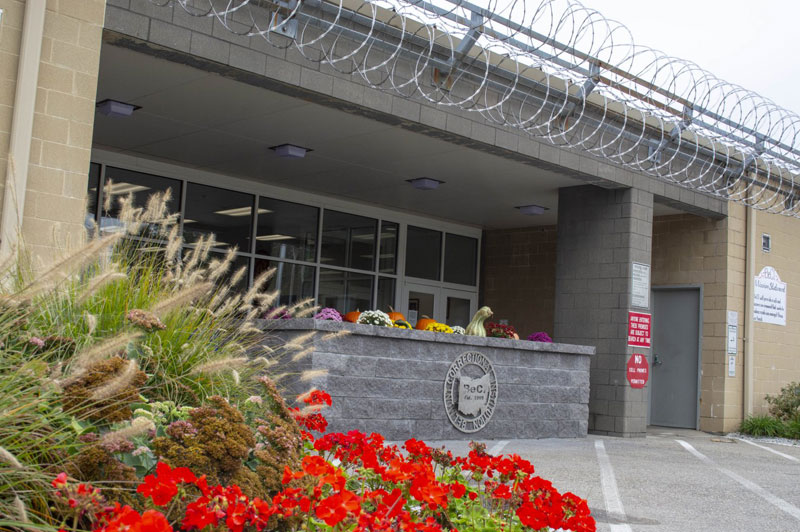
Five prison workers (three corrections officers and two nurses) and 96 inmates have died from the disease that has clobbered the Ohio Department of Rehabilitation and Correction since late March when it was first detected in the system.
Nearly 6,200 inmates have contracted COVID-19, the disease caused by the new coronavirus, though the figure is likely an undercount. After mass testing at Marion and Pickaway correctional institutions detected infections in 80% of inmates, ODRC shifted its strategy away from blanket testing and toward symptom-based testing.
An ODRC spokeswoman said 461 inmates with COVID-19 have been admitted to the hospital, but those people may have been admitted for other causes.
The dead inmates were 66 years old, on average.
At Marion, nearly 2,000 inmates have been infected, 12 of whom died.
At Pickaway, nearly 1,400 inmates have been infected, 35 of whom died.
The two prisons are the third and fourth largest COVID-19 clusters in the nation respectively, according to data from The New York Times.
Gary Daniels, a lobbyist for the ACLU, said there’s more than just a death toll. As more information emerges about long term damage from COVID-19, including “long haulers” who report debilitating symptoms even six months after infection, he questioned the health services ODRC is providing.
According to the CDC, coronavirus infections can cause myocarditis (heart inflammation) among other long term symptoms. While the science is still emerging, the heart damage could explain reported long-term symptoms like shortness of breath, chest pain and heart palpitations.
“How many people in Ohio prisons face this right now?” he said. “You’ve got these 100 people who have died, but that’s nowhere near the whole story.”
The ACLU has pushed for a broad decarceration that would remove people convicted for drug possession or parole violations — at least temporarily.
“It does appear to have plateaued,” Daniels said. “Whether that continues, who knows. Our concern is that after a certain amount of time, we’re going to see that population rise.”
U.S. District Judge Edmund Sargus Jr., in a ruling last month, rejected motions to dismiss the lawsuit. In a blow to the inmates, however, he also struck down a request for a preliminary injunction. He has not ruled on the issue at large.
Though it amounted to a loss for the inmates, Sargus signaled some sympathy for the conditions inside.
“This Court agrees with the other district courts across the country who have found COVID-19 to be an objectively intolerable risk of harm to prisoners when it enters a prison,” Sargus wrote.
Prisons and jails are near ideal places for the coronavirus to spread given the overcrowding, poor sanitation, and preexisting health complications inside.
In April, the Ohio Supreme Court dismissed a lawsuit from an HIV-positive inmate who sought release due to COVID-19.
“The whole of Ohio’s government needs to take serious, unprecedented steps to prevent the catastrophe of unmitigated spread of COVID-19 to the tens of thousands of prisoners in Ohio as well as to the tens of thousands of people who are prison employees along with those living in the households of prison employees,” he said.



 The closure is located between 5970 and 6040 Price Road.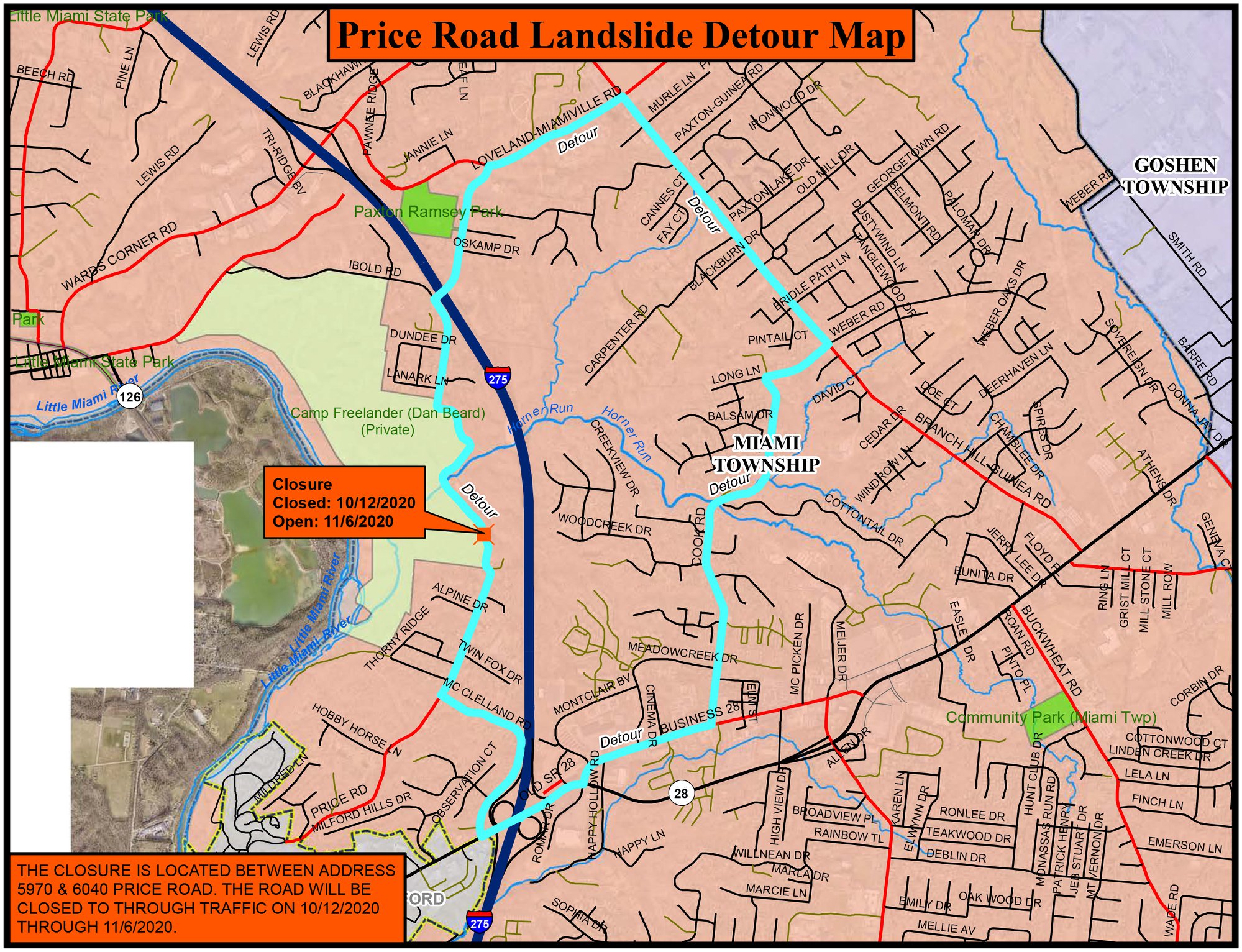




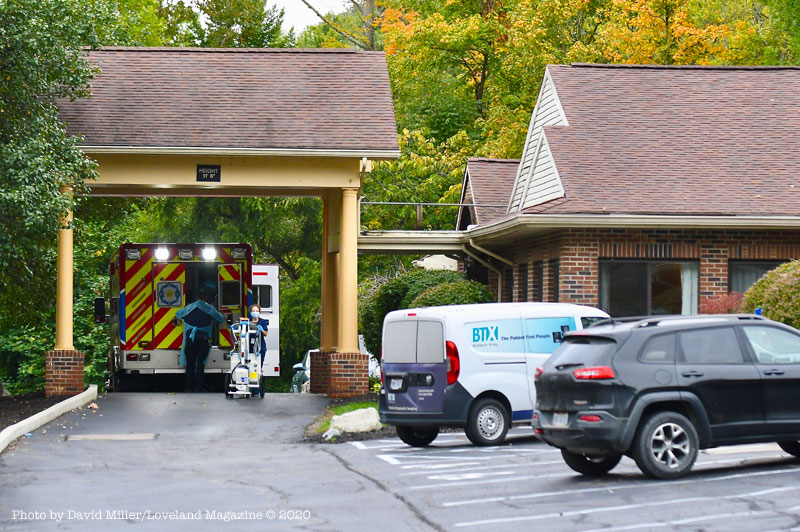
 the total cumulative cases of COVID 19 at LHCC went from 60 to 85 in the past week. The health department releases data each Wednesday.


 Loveland, Ohio – After Loveland Magazine learned of the high number of COVID 19 cases at the Loveland Health Care Center, their spokesperson Greg Miller with Health Care Management Group said he would send an email response to our questions. (

 Susan Tebben is an award-winning journalist with a decade of experience covering Ohio news, including courts and crime, Appalachian social issues, government, education, diversity and culture. She has worked for The Newark Advocate, The Glasgow Daily Times, The Athens Messenger, and WOUB Public Media. She has also had work featured on National Public Radio.
 Jake Zuckerman is a statehouse reporter. He spent three years chronicling the West Virginia Legislature for The Charleston Gazette-Mail after covering cops and courts for The Northern Virginia Daily.