In this Dec. 9, 2015 file photo, the company name of Dupont appears above its trading post on the floor of the New York Stock Exchange. (AP Photo/Richard Drew, File)AP
COLUMBUS, Ohio – The state will receive $110 million from two massive chemical manufacturers for their role unleashing vast sums of toxic PFAs in Southeast Ohio, state officials announced Wednesday.
Gov. Mike DeWine, then the attorney general of Ohio, sued E.I. Du Pont De Nemours and Co. and Chemours in 2018. The lawsuit alleged the companies dumped at least 500,000 pounds of PFOAs (a subset of PFAs) into the Ohio River, along with air releases, which have caused significant damage to human health and the environment.
Moreover, the companies did so despite their longstanding knowledge that PFAs – synthetics known as “forever chemicals” for their environmental staying power – were entering the environment and bear links to liver damage, cancers, pregnancy complications and other adverse human health effects, according to the lawsuit.
The Plain City Public Library asked her to leave in January 2021 for repeatedly refusing to wear her mask, as was state policy at the time.
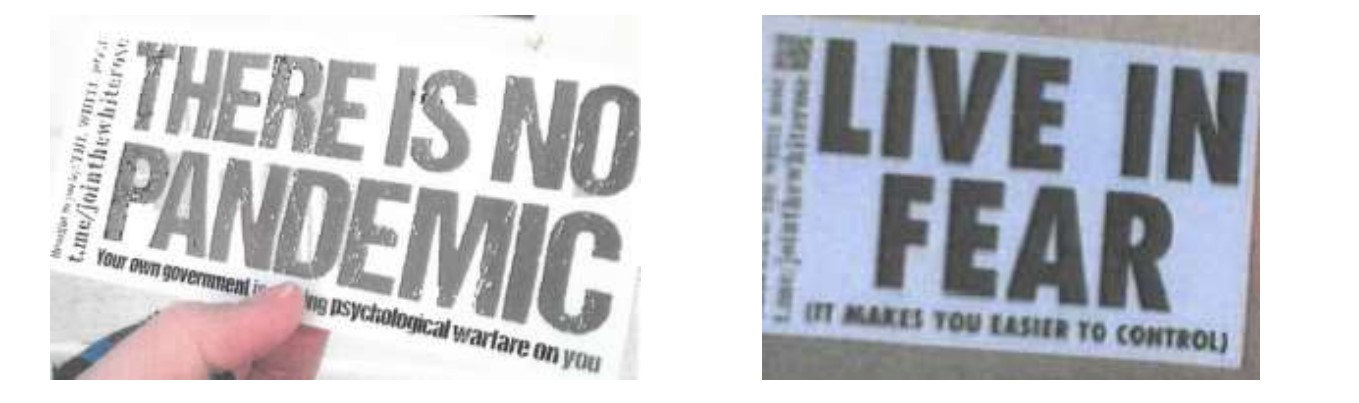
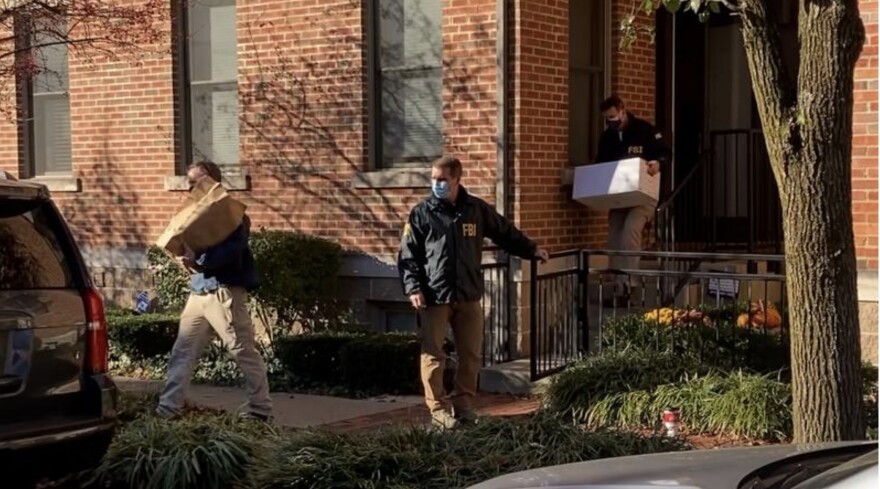
Court records indicate Julie Dean’s “unruly behavior had been a continual issue for the library.” Two months later she came back with her husband and some hard-to-remove stickers.
“THERE IS NO PANDEMIC,” reads the first one. “Your own government is waging psychological warfare on you.”
“LIVE IN FEAR,” reads the other. “(It makes you easier to control.)”
Julie and Samuel Dean were subsequently accused and convicted of misdemeanor criminal charges of trespassing and criminal mischief. Their case set off a bizarre bout of trials and appeals that distill some of the anger and paranoia that continues to dog the coronavirus pandemic.
Their case, which led to a $250 fine and two-day prison sentence, is now pending with the Ohio Supreme Court. The stickers, placed on a library drop box installed during the pandemic, have since only been partially removed.
After the court appointed the Deans an attorney, the couple fired him and chose to represent themselves. They soon filed near-identical motions a judge found nearly impossible to decipher but mentioned an objection to “undertake a medical intervention without any informed consent and without any medical necessity.”
In a pre-trial hearing, Samuel Dean asked that the court dismiss the charges against him, claiming in prepared remarks that his rights under the Americans With Disabilities Act were violated. However, court records state he repeatedly “refused” to say what kind of accommodations he sought. When a judge said he can’t help if he doesn’t know how, Samuel Dean read the same prepared statement again.
“That does nothing for me,” the judge said.
He later found Samuel Dean in contempt for talking over him and fined him $250. The judge then called Julie Dean’s case. She then read the same prepared remarks as her husband before telling the judge that he had “been served.”
“Well, I haven’t,” the judge responded before setting the matter for trial.
The deans then both filed affidavits with the Ohio Supreme Court seeking to disqualify the judge from their case. Those were denied.
The case then went to trial. The Deans acted as their own attorneys. After 20 minutes of deliberation, a jury found each of them guilty on two counts. They each received a $250 fine and 90 days in jail, but they only needed to serve two. They haven’t yet served those sentences.
The trespassing charge against Samuel Dean was dismissed on appeal earlier this month. Judge Stephen Powell of the Twelfth Appellate District found that because he hadn’t been previously banned from the library, he wasn’t trespassing. (A dissenting judge argued his criminal intent to deface the library should have waived his privilege to be on its property.)
On Monday, the Deans appealed their case to the Ohio Supreme Court. L. Bradfield Hughes, an attorney with Porter, Wright, Morris and Arthur, said in court filings that the case raised “questions of public and great general interest.”
They argued they have been improperly denied the use of an ADA coordinator at lower court proceedings. An attorney with the Madison County Prosecuting Attorneys office denied this, noting that both state and federal courts who reviewed the matter ruled there has been no such violation. In the related federal lawsuit, Julie Dean claimed she suffers from hearing and memory loss. Samuel Dean said he suffers PTSD. These disabilities, they said, “substantially limit their life activities” and were ignored by the court. The claims were dismissed.
Attorneys for both sides didn’t respond to phone calls.
Chris Long, director of the library, said in an interview that it’s easy to focus on the loudest blips on the radar. But far more prevalent are ordinary bookworms staying positive in a difficult era.
“Public libraries, we see a lot everyday, pandemic and no,” she said. “For every difficult situation, we encounter dozens more of people wanting to help.”
Gov. Mike DeWine and his administration played a hands-on role passing an allegedly pay-for-play nuclear bailout and appointing an industry-friendly regulator who has since been accused of taking a $4.3 million bribe, documents and messages show.
Calendar records show DeWine, a Republican, met repeatedly to discuss energy policy with FirstEnergy Corp. officials and at least once with GOP House Speaker Larry Householder, who has been criminally accused of taking a separate, multimillion-dollar bribe from the company to pass the bailout.
Despite a cautionary letter from environmental groups and a 198-page dossier from his former campaign staffer warning against the move, DeWine appointed Sam Randazzo in 2019 to the head of the Public Utilities Commission of Ohio. FirstEnergy last summer admitted it paid Randazzo a $4.3 million bribe. Randazzo has not been charged with a crime and denies wrongdoing.
Newly released text messages show FirstEnergy executives describing an open line with the administration on the selection and inside support from Ohio’s chief executive.
“When the Gov Elect asked me about attributes, I listed integrity, work ethic, creativity, thick skin, circumspection in public statements,” FirstEnergy’s then CEO texted Randazzo about the open PUCO seat in December 2018, just before DeWine took office.
“You fit all of those.”
Former FirstEnergy CEO Charles “Chuck” Jones. Source: FirstEnergy, via Flickr
In one text, FirstEnergy executive Mike Dowling credits DeWine and Lt. Gov. Jon Husted with performing “battlefield triage” to save Randazzo’s appointment before a key vote. Both DeWine and Husted have previously denied that a redacted version of the text message that appeared in criminal documents referred to them.
Federal prosecutors accused House Speaker Larry Householder of secretly controlling a nonprofit that took $60 million from FirstEnergy. He allegedly used the money to enrich himself personally and politically and to ensure the passage of House Bill 6, which provided a massive bailout to two nuclear plants owned at the time by FirstEnergy. Householder was charged with racketeering and awaits trial. Two alleged conspirators pleaded guilty.
FirstEnergy admitted last summer to the $60 million payment as well as a separate $4.3 million bribe to Randazzo just before he started as Ohio’s top utility regulator. The payment topped off $22 million in consulting fees to Randazzo since 2010 from the company.
Court documents from prosecutors reveal no focus on DeWine, who has not been charged with any crime. However, a review of records turned over in subpoenas, public records requests for his official calendars by the Energy and Policy Institute, text messages attached to regulatory filings, and others show DeWine and his staff repeatedly influencing and shepherding HB 6 into law.
On the campaign trail in July 2018, DeWine visited one of the nuclear plants that would receive a bailout, his official calendar shows. A month later, he met with FirstEnergy executives at their Akron headquarters. In October of that year, DeWine met with FirstEnergy at a fundraiser for Republican governors.
FirstEnergy contributed about $1 million in total to DeWine’s campaign, political organizations supporting it, and to another nonprofit supporting his daughter’s campaign for county prosecutor, according to the Dayton Daily News.
After winning a close race, DeWine, Husted, Jones and Dowling celebrated over dinner at The Athletic Club in Columbus. The next day, Jones sent Randazzo the text message (above) indicating they discussed the open PUCO seat.
In January of 2019, the FirstEnergy officials texted one another trying to fill not just one but two open PUCO seats, all the while mentioning phone calls with “DeWine guys” about it.
“That’s their plan but nothing certain until Sam’s [Randazzo’s] meeting [with DeWine],” Jones texted Dowling. “Four people in DeWine world, you, Sam, and I know about this.” The PUCO seats would eventually be filled by Randazzo with another commissioner renewed.
Dowling relayed to the other two men a message from Josh Rubin — a DeWine 2018 campaign adviser and a FirstEnergy lobbyist. He said once Randazzo takes office, DeWine will “lean on him on everything.”
Several texts focus on HB 6. The bill (and eventual law) would bail out FirstEnergy’s nuclear plants, subsidize two coal plants owned by other Ohio utility companies, and create a “decoupling” mechanism that effectively put ratepayers on the hook to guarantee certain revenue streams of FirstEnergy’s. Prosecutors estimate the bill as worth about $1.3 billion to the company.
Two days before the bill was introduced, DeWine’s calendar shows a slot for an “Energy Discussion” at the governor’s residence. Later that month, after the bill was repeatedly criticized during an opponent testimony hearing at the statehouse, DeWine, Husted, Randazzo and various staffers all met up at 5 p.m. for what the governor’s calendar calls a “Nuclear Bailout Bill Discussion.”
Over the next month, DeWine’s calendars show two entries for energy policy meetings, plus a call with Householder about HB 6, and another call on the bill.
On June 9, 2019, DeWine showed signs of wavering.
“Sam, what do we know about whether nuclear plants need this boost?” DeWine, using his personal email, wrote to Randazzo. “One editorial suggested testimony was not conclusive.”
Dowling paid a visit to the governor’s residence the next day. Randazzo responded to DeWine’s email on June 11, casting doubt on the studies referenced in the editorials.
On July 1, Dowling texted Jones.
“Just had a long conversation with JHusted just now,” he said, going on to explain that Husted sought to extend the length of the bailout. “All is well.”
Court records contain another text from Jones stating that “State Official 2,” later confirmed to be Husted, joined with others in “fighting to the end” for a beefier bailout.
After a long slog, lawmakers passed HB 6 on July 23, 2019. DeWine signed it into law mere hours later.
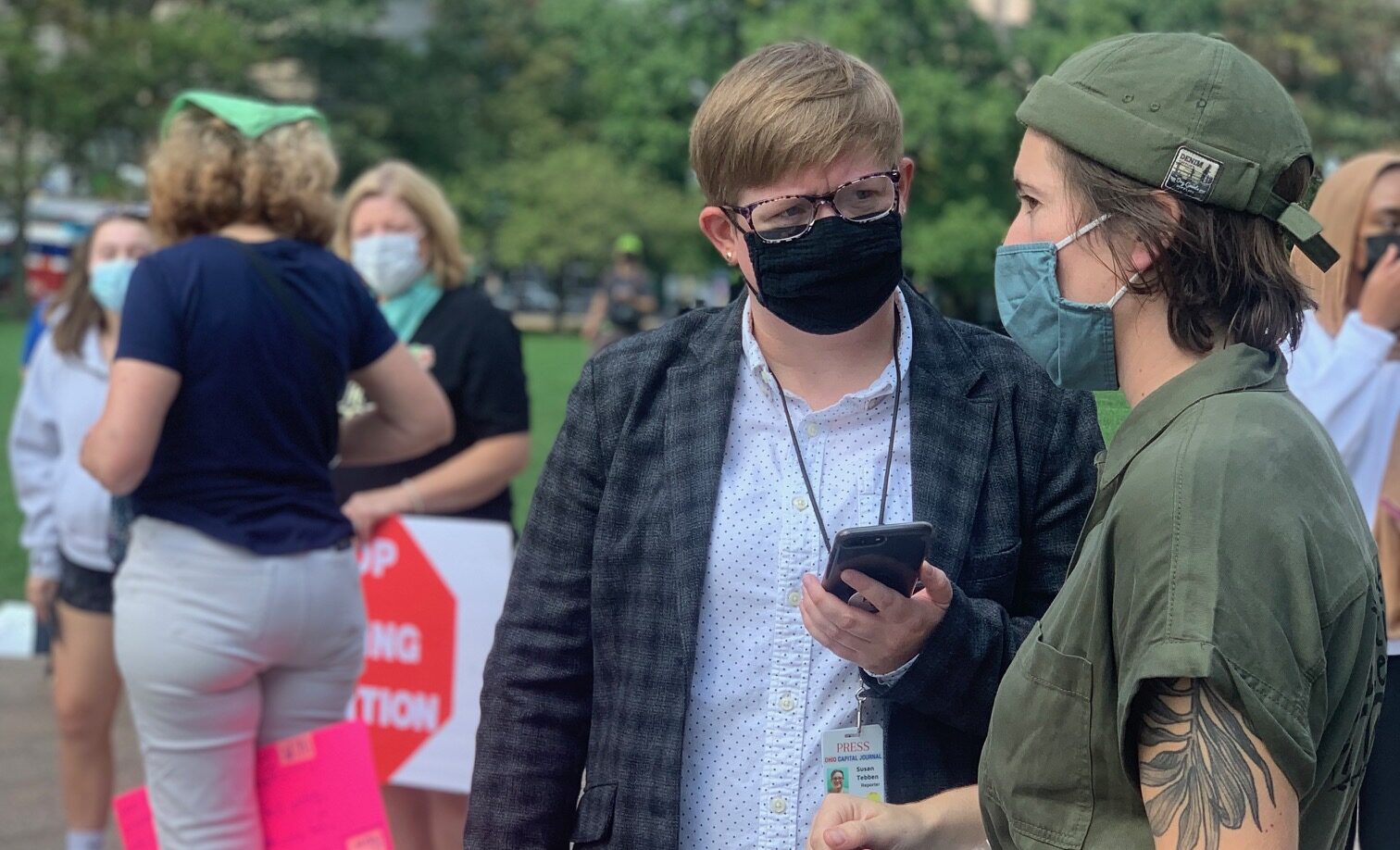
FBI agents remove boxes of materials from PUCO Chairman Sam Randazzo’s condo in Columbus Nov. 17, 2020. Photo courtesy of Daniel Konik/Statehouse News Bureau.
Loyalty to staff and HB 6
As the FBI made its first arrests, DeWine began a pattern of defending HB 6 on the merits and showing unflinching loyalty to his staffers, some of whom have ties to FirstEnergy.
Householder, his political strategist, a prominent GOP lobbyist, and two FirstEnergy lobbyists were arrested and charged with racketeering in connection with HB 6 on July 21, 2020. The next day, DeWine stood by the law he signed.
“Because people did bad things does not mean that the policy is not a good policy,” he said.
He reversed himself the next day and called for a repeal of the bill.
In October, FirstEnergy fired Jones, Dowling, and fellow executive Dennis Chack as it waged an internal investigation. The company fired another two executives days later “due to inaction and conduct that the Board determined was influenced by the improper tone at the top.”
At this point, the public remained unaware of the multimillion-dollar financial arrangement between the embattled FirstEnergy and Randazzo. However, on Nov. 16, 2020, FBI agents were seen raiding Randazzo’s condo and removing boxes of material from inside. The next day, FirstEnergy submitted a little-noticed securities filing outlining the $4.3 million payment.
Despite the images of FBI agents entering Randazzo’s condo, DeWine publicly defended his appointee.
“We have no indication he’s under investigation or he’s the target of an investigation. We’ll wait until we find additional facts,” he said in a Nov. 17, 2020 news conference. “Look, the FBI many times will indicate if someone is a target. They have not indicated he’s a target. I have no reason to think he’s a target. I don’t know. So, we’re waiting for additional information, quite candidly. I hired him. I think he’s a good person. If there is evidence to the contrary, then we’ll act accordingly, but not going to act without facts.”
Randazzo would resign three days after that statement.
Mid-summer 2021, FirstEnergy signed a deferred prosecution agreement with the U.S. Department of Justice. The company agreed to pay a $230 million penalty and cooperate with investigators to avert a charge of honest services wire fraud.
The agreement contained a lengthy set of facts from the company, stating it paid the $64 million in bribes in exchange for official action from Householder and Randazzo.
Days after the agreement was announced, DeWine held a press conference on anti-hazing legislation. Reporters asked questions afterward about the agreement, including a line that refers to “State Official 1” and “State Official 2” lobbying to ensure Randazzo’s appointment. DeWine said he’s “not aware” of anyone in his administration, including himself, appearing in the document. Husted, in a statement, said he too “does not believe” he’s referenced in the document.
Texts obtained by the Ohio Consumers’ Counsel from FirstEnergy and attached to a regulatory filing contain the unredacted version of the text, identifying DeWine and Husted by name.
In 2017, a lobbyist named Dan McCarthy created a nonprofit entity called Partners for Progress to engage in “advocacy in support of nuclear power,” tax records show. FirstEnergy would later admit to paying $25 million to Partners for Progress, some $15 million of which went to Householder’s nonprofit.
DeWine hired McCarthy as his legislative director in 2019, around the time McCarthy stepped down from the organization’s board. In February 2021, after media reports identified McCarthy’s role with Partners for Progress, DeWine defended McCarthy.
“As far as I know, Dan McCarthy has been well-respected for many, many years, long before he started working for me as our legislative director, and I have faith in his integrity,” DeWine said.
McCarthy resigned in September 2021.
DeWine response
In a phone interview, DeWine spokesman Dan Tierney said the OCC-obtained text messages and meetings listed by the Ohio Capital Journal contain no new information.
The texts, he said, in fact show the lack of a role from DeWine and Husted within the scandal. He said prosecutors have not subpoenaed him or any of his employees.
“This all along has been a Larry Householder scandal and a FirstEnergy scandal,” he said.
When asked whether DeWine, a former prosecutor and attorney general, detected any sense of impropriety during all his contacts with Householder and FirstEnergy leading up to the passage of House Bill 6, he declined comment.
Husted offered a similar comment through a spokeswoman, stating that “there is nothing new here” in the texts, emails and meetings.
“This kind of advocacy is well within his responsibilities as a public official, and, as we know, the bill was ultimately passed with bipartisan support,” he said.
A federal judge lambasted a suspect in a criminal public corruption case for posting a FBI informant’s social security number and address on the internet.
U.S. District Judge Timothy Black said he finds it “entirely incredible” that lobbyist and former GOP Chairman Matt Borges accidentally posted the information of the whistleblower online, as Borges claimed.
“Indeed, page 3 of the file alone includes [the informant’s] name, address, phone number, spouse’s name, spouse’s phone number, and [the informant’s] social security number, all of which are listed in large, bold font, at the very top of the page,” Black said, using the visual emphasis in his court order.
“It is virtually impossible for anyone to scroll through the file and not see that it contains unredacted personal identifiers.”
Federal prosecutors have accused Borges of participating in a scheme alongside former GOP House Speaker Larry Householder and three others to take $60 million from FirstEnergy Corp. and enrich themselves while ensuring passage of favorable legislation for the company.
FirstEnergy has since admitted to giving $60 million to a nonprofit secretly controlled by Householder in exchange for his help passing House Bill 6 in 2019. Borges allegedly used $15,000 of the money to bribe a political operative for inside information about a campaign to overturn the recently-passed legislation via a ballot referendum.
Borges worked as a lobbyist for a FirstEnergy subsidiary at the time, with deep Republican connections from his time running the state party.
Prosecutors asked Black earlier this week to modify the conditions of Borges’ bond. They said an FBI agent noticed in June that Borges posted the informant’s employment file online, including his tax documents and photocopies of his social security card and driver’s license. They requested the judge block Borges from posting the information in a continued effort to intimidate a witness.
In charging documents, the informant was not personally identified. However, consultant Tyler Fehrman has since acknowledged he’s the unnamed whistleblower in mediareports.
Prosecutors called Borges’ actions an “attempt to intimidate and retaliate against” the informant. They requested Black forbid him from posting Fehrman’s sensitive information online.
Attorneys for Borges said he obtained the employment file via public records request and sharing the personal identifying information online was “inadvertent.”
Black sided with prosecutors. Besides the financial risks of posting a social security number online, he said, “financial harm is by no means the most severe consequence that could result from publicly exposing and disparaging a confidential government source.”
According to the prosecution, Borges told Fehrman that if he provided inside information from the campaign, Borges would give him a job or money to pay off his debts. Fehrman —who managed field workers soliciting signatures to put the repeal on the ballot — covertly recorded the conversation.
“Borges further indicated that others are getting ‘fat’ off the HB 6 issue, so they might as well benefit, too,” prosecutors alleged in court filings.
Screenshot of a text prosecutors say they obtained from Matt Borges.
Fehrman declined the bribe, according to prosecutors. Borges, in a text message, responses with an order to “No matter what — don’t ever tell anyone about our conversation from earlier.” At the behest of FBI officers, Fehrman went on to accept the bribes and provide information to Borges, who allegedly shared information with others involved in protecting the newly passed HB 6.
The file containing Fehrman’s information appeared on a website Borges created to raise funds for his legal defense. Borges, on the site, accuses the prosecutors of running a “politically motivated” prosecution and claims he told the prosecutors to “go f*ck themselves” when offered a plea deal.
FBI agents remove boxes of materials from PUCO Chairman Sam Randazzo’s condo in Columbus Nov. 17, 2020. Photo courtesy of Daniel Konik/Statehouse News Bureau.
Ohio’s former top utility regulator, who was accused of taking a $4.3 million bribe, quietly spent months helping write a sweeping energy bill that targeted a state watchdog agency that advocates for Ohio’s residential electric customers, records show.
Emails that the Public Utilities Commission of Ohio gave in response to two FBI subpoenas show its former chairman, Sam Randazzo, conferred with the bill sponsor and helped draft legislative language. The bill would have limited the reach of the Ohio Consumers’ Counsel and given often-hostile state legislators control of its board.
The OCC appears at PUCO cases and advocates for residential ratepayers’ interests, which often run counter to those of investor-owned utility companies and industrial-scale energy customers. The agency’s efforts have led to millions in refunds to consumers, including $306 million from FirstEnergy Corp. last year to settle a lawsuit against the company for charging an unlawful profit margin on its customers.
Akron-based FirstEnergy told prosecutors last summer that it paid a business owned by Randazzo $4.3 million before his 2019 appointment in exchange for “official actions.” The company also said it gave a nonprofit secretly controlled by then-GOP House Speaker Larry Householder $60 million to help pass House Bill 6 — energy legislation worth an estimated $1.3 billion to FirstEnergy. Householder has pleaded not guilty and awaits trial. Randazzo has not been charged with a crime.
Records released earlier this year showed some of Randazzo’s behind-the-scenes lobbying work on HB 6. The records released last week show his influence spanned further.
In May 2020, Rep. Nino Vitale, R-Urbana, introduced the text of House Bill 246. The bill would have narrowed the scope of cases the OCC can join and subject the agency to “any reasonable conditions that the commission deems necessary to avoid duplication, repetition or delay.” It also gives state lawmakers appointment power over six of nine seats on the OCC’s board.
The legislation contained a sweep of other changes as well, including creating new ways for utilities to set their prices, modifying setback rules for wind farms, and allowing the Ohio Power Siting Board to create new setback requirements for solar energy sites.
In the six months before Vitale unveiled the bill, Randazzo and PUCO staff met with Vitale, drafted elements of the legislation, and helped edit Vitale’s introductory testimony to lawmakers, the subpoenaed emails show. The emails don’t show Randazzo addressing the OCC provisions directly. But in a statement through his attorney, Randazzo equivocated when asked if he drafted or advised on the section.
“If so but having no recollection of either writing or advising any such language, it would only have been as the result of a request from the legislature,” he said. “It is likely that the utilities had input.”
Sam Randazzo, then a private sector attorney, testifies before the PUCO in March 2018. Source: The Ohio Channel.
The PUCO released the emails after the Ohio Capital Journal filed a public records request and an eventual lawsuit seeking them.
Around Thanksgiving of 2019, Randazzo asked to meet with Maura McClelland, a policy adviser and attorney at the PUCO, to meet and discuss the language of the bill’s “ratemaking piece.”
HB 246 created a new option for utilities to set prices called “alternative rate plans.” According to nonpartisan analysts with the state Legislative Service Commission, the plans can take into account aspects of fair energy pricing that the current model misses like efforts for energy efficiency or cash flow problems from the companies.
“In general, alternative rate plans could lead to higher prices paid by ratepayers,” the LSC analysts wrote. “But presumably, PUCO would only approve those higher costs after examining aggregate effects in accomplishing its policy objectives.”
HB 246 would also allow the PUCO to consolidate parties that it determines have “sufficiently common interests” to speed up cases.
In a memorandum opposing the bill, the Ohio Manufacturers’ Association said the legislation would block its members from meaningful participation at the PUCO. The manufacturers argued the bill in several areas consistently gives utilities the upper hand over their customers, especially via the ratemaking proposal.
“The bill is opaque and no clear reasoning exists for why its proposed changes are needed,” the memorandum states.
Roger Sugarman, an attorney representing Randazzo, said via email that neither Randazzo nor the PUCO were the driving force behind the bill. He said he couldn’t determine if the LSC’s analysis is correct without more details.
“Without knowing what type of alternative rate plan, or the object of your question and the statutory conditions required to secure PUCO approval, it is not possible to evaluate the LSC analysis,” he said. “In general, rate applications filed by utilities, whether alternative or traditional, lead to higher rates; the question is usually about how much higher.”
He said some pieces of the bill wouldn’t have affected much change versus current law. Plus, the bill all but died after its first hearing. Randazzo’s time “was occupied by more pressing and important things than HB 246.”
FBI agents arrested Householder and charged him with racketeering in June 2020. He awaits trial. Agents raided Randazzo’s condo months later. In July 2021, FirstEnergy signed a deferred prosecution agreement with the U.S. Department of Justice. It agreed to pay a $230 million penalty and cooperate with the ongoing investigation into HB 6 to possibly avert a charge of wire fraud.
In a statement of facts paired with the agreement, FirstEnergy said it paid companies controlled by Randazzo $4.3 million in exchange for official action. The company said it hired Randazzo as a consultant and paid him a total of about $22 million since 2010.
Before starting in state government, Randazzo represented industrial scale energy users before the PUCO. He spent years fighting against Ohio energy policies that forced utilities to include more renewable energy in their mixes or make their customers’ homes more energy efficient. He also represented subsidiaries of both CenterPoint Energy and Dominion Energy as a lobbyist, as well as a group of citizens opposing a wind farm in Huron County.
Vitale drew significant media attention via outrageous claims including that Bill Gates invented the novel coronavirus or that Gov. Mike DeWine was bringing “FEMA Concentration Camps” to Ohio in relation to the pandemic. (Randazzo said his position on COVID “pulled in a very direction” than Vitale’s.)
Vitale also, perhaps more subtly, helped guide HB 6 from legislation to law. He co-sponsored the bill and chaired the House Energy and Natural Resources committee that reviewed it. He first won office with $7,700 in financial backing from Householder’s campaign committee. He voted for HB 6 in 2019 and against repealing it after Householder’s arrest. He was one of 21 lawmakers who voted against expelling Householder from office.
Vitale didn’t respond to a phone call or emails to his personal and official accounts.
State Rep. Nino Vitale, R-Urbana. Photo from Ohio House website.
“As you all know, anyone can be indicted for anything. Anything,” he said in a floor speech last year defending Householder.
“However, that person deserves to go in front of a jury of their peers and prove their case. They might be guilty, they might not … That’s what makes us different from a communist country.”
Federal prosecutors alleged that Householder secretly controlled a nonprofit organization that received $60 million from FirstEnergy. He used the money to elect a slate of candidates who would vote him into the House Speaker’s office and in turn support HB 6. He’s also accused of spending the money for personal use. Two alleged conspirators, including Householder’s former political adviser, have pleaded guilty.
When the anti-OCC bill dropped, few knew or suspected of either Randazzo’s financial ties with FirstEnergy or his lobbying work on the bill. However, after Householder’s arrest and the raid on Randazzo’s home, some raised interest in ensuring the bill’s quick death.
“This bill is a danger to anyone in Ohio who pays a utility bill and it remains on the Ohio House docket as a direct attack on the OCC and all Ohio residential utility customers,” wrote former Democratic State Senator Leigh Herington in a November 2020 op-ed in the Columbus Dispatch.
He suggested the legislation was simple retaliation for the OCC’s opposition to House Bill 6 and another bill that allows FirstEnergy a more favorable accounting formula to determine if its collections from customers are “significantly excessive.” (The OCJ previously reported Randazzo lobbied on that legislation as well.)
Utility companies spend big and wield considerable sway in Ohio politics. As Herington noted, the OCC has seen its size dwindle over the years. Its budget dropped from $9.3 million in 2011 to $5.5 million in 2020.
The OCC also suggested the bill was retaliatory in nature due to its opposition to HB 6. Vitale’s bill, the agency said in a resolution, would “weaken the independence” of the board as well as its “utility watchdog role.”
A PUCO spokesman said the emails only show the PUCO working on language related to the agency and the state Power Siting Board. He said he didn’t know why Randazzo and Vitale communicated through personal email accounts.
“The PUCO does not take a position on proposed legislation,” he said. “We will always be responsive to inquiries from members of the General Assembly as they go through the legislative process.”
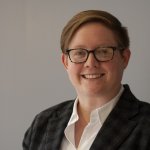
OCJ Reporter Susan Tebben, left, interviews an activist during a protest at the Statehouse. Photo by David DeWitt, OCJ.
LOVELAND MAGAZINE NOTE: If I could, and I cannot think of a quick way tonight, I would tell readers how long we waited to have good journalists tell our readers what was going on at the Ohio State House. I do know that before I discovered the Ohio Capital Journal we had published Loveland Magazine for many, many years and search and searched all those many years for a way to connect Loveland to their state government and its impact on our lives. With much gratitude and appreciation, I congratulate the Journal staff who have been honored with these prestigious awards.
In the “Ohio’s Best Journalism Contest” from the Society of Professional Journalists, the Ohio Capital Journal won five awards, including three first place finishes and two in second place. The contest covered stories and editorial from 2021.
In digital media categories, OCJ Reporter Susan Tebben took home two first-place awards, one for best education issues reporting and one for best government/political reporting. Tebben also nabbed a second-place finish for best news story.
OCJ Reporter Jake Zuckerman won first place for best investigative reporting, and OCJ Editor David DeWitt won second place for best editorial/criticism writing.
We are incredibly honored and grateful for this recognition from our fellow journalists. We are also incredibly grateful for the support we receive from our readers and Ohioans across the state.
Best Investigative Reporting – First Place – Jake Zuckerman
Stories produced within eight days of the Jan. 6 raid on the U.S. Capitol: They include interviews with an Ohio woman who led her paramilitary unit into the building and an Ohio man who kicked in a Capitol window. A third uncovers how a state school board member organized a bus trip to ferry Ohioans to the rally.
Best Government/Political Reporting – First Place – Susan Tebben
Ohio government has been in turmoil amid the pandemic, attacks on democracy, and redistricting. One Ohio lawmaker called to charge Ohio Gov. Mike DeWine with terrorism over pandemic public health measures. An Ohio Board of Education member speaks on participating in the Jan. 6 “Stop the Steal” rally that led to the raid on the U.S. Capitol. And redistricting turned into a mess in 2021 despite Ohio Constitutional reforms passed by voters.
Best Education Issues Reporting – First Place – Susan Tebben
Public education under attack: This series of stories highlights various attacks on public education, from a state school board member accusing the Ohio superintendent of education of being paid by Bill Gates, to the movement to ban race-based focuses in Ohio schools, to investigative reporting showing very few actual complaints about divisive race-based focuses in education.
Best News Story Series – Second Place – Susan Tebben
Three separate stories covering the developments in Ohio gerrymandering: Ohio Republicans on the redistricting commission passing gerrymandered maps; the Senate President defending that gerrymandering, and testimony about redistricting gathered in committee.
Best Editorial/Criticism Writing – Second Place – David DeWitt
Gerrymandering pushes politicians to extremes, denies voters their voice, opens the door to corruption, radicalizes political discourse, kills compromise, and disintegrates democracy. Gerrymandering poisons everything. Nevertheless, Ohio’s Republican leaders have been playing political games with redistricting and cheating voters by gerrymandering their way to undue power. OCJ Editor David DeWitt takes them to task for this anti-democratic, unpatriotic attack.
Sam Cao, 17, at left, seen with Sam Lawrence, 19, at right. The two teenaged Sams are running as Democrats for seats in the Ohio House. Source: Sam Lawrence.
Sam Cao worked out a plan with his principal and superintendent. They had to figure out how Cao could potentially balance constituent work in the Ohio House of Representatives with classwork at Mason High School.
At Miami University, Sam Lawrence mulled a similar plan for his upcoming sophomore year. Ohio University’s Rhyan Goodman is likely doing the same for his junior year.
The three Democrats would be quite young for elected office. Cao is 17 but turns 18 before Election Day, which allows him to run; Lawrence is 19; Goodman was 19 when he announced his run in February.
If elected, they could shape state policy on everything from Ohio’s $74 billion biennial budget, civil and criminal justice, women’s rights, gun policy and countless others. All three are running in districts where Republicans have recently won with commanding margins, leaving them with uphill paths to office.
They can serve in wars and vote. They can’t lawfully buy a drink. And they don’t think their age should preclude them from public office.
“The one thing I’d like to point out is it’s not no experience; it’s different experience,” Lawrence said.
“I would like to ask every one of our legislators if they were attending school while all these terrible school shootings are happening. They were not in school when we had these high-powered assault weapons that could mow down tens of children at a time. Those people don’t have those life experiences.”
Some current incumbents started their terms just a few years older. Sen. Niraj Antani, R-Miamisburg, started in the House in 2018 at 23 years old. Rep. Jena Powell, R-Arcanum, first won in 2018 at 24. Rep. Thomas Hall, R-Madison Twp., won office in 2020 at 25. Rep. Bride Rose Sweeney, D-Cleveland, won in 2018 at 26.
Several (older) Democrats asked about the youthful insurgents rebuffed concerns of a lack of life or work experience from the candidates. They also rejected the trend as any signs of a party unable to attract more established candidates. Instead, they characterized it as a reflection of members of a new generation who are aghast at increasingly extreme legislation coming from the Statehouse and inspired enough to seek to affect change on their own.
“They’re going to be limited based on their life experiences, but at the same time, there is something romantic about it,” said Dennis Willard, a Democratic political consultant.
“In a sane world, this might seem insane. But were not living in a sane world with the Ohio Legislature. I know who I’d vote for.”
There’s some historical precedent too. U.S. Sen. Sherrod Brown, the dean of Ohio’s struggling Democratic Party, won his first state House race at 21 in 1974. In 2000, 18-year-old Derrick Seaver won a seat as a Democrat (he switched parties a few years later).
In an interview, Seaver, now 40 and the director of the San Jose Chamber of Commerce, expressed ambivalence about teenagers running for office. Youth has its perks — young people can be listeners and learners who bring new perspectives to older and pastier general assemblies. Plus, the media attention they attract can make the difference in tough races.
However, they’re less situated to understand the nuances or interconnectedness of public policy, he said. Plus, if they lose an election, they don’t have a college degree or developed work experience to fall back on.
“I will say that since that time, and I don’t want this to come across as discouraging, but certainly I feel that maybe I should have waited until I was older,” he said.
Sam Cao
Ohio’s new 56th House District contains swaths of Warren County including the cities of Lebanon and Mason. More than 62% of its voters are Republican, according to Dave’s Redistricting App.
Cao grew frustrated when COVID-19 grew so prevalent in the county that his high school closed its doors when it ran out of healthy substitute teachers. He tried to contact Zeltwanger, to no avail. Then he tried to contact the Democrat running for the seat, only to learn no such person exists. He credits his AP Government teacher with encouraging him to take a shot for himself.
To prepare, he’s looking to history. For one, there are his role models — Brown, the U.S. Senator; Robert Kennedy, the liberal icon and former U.S. Attorney General; and William Proxmire, another U.S. Senator who famously replaced the demagogic Sen. Joe McCarthy and declared his predecessor a “disgrace to Wisconsin, to the Senate, and to America.”
Cao has also been seeking guidance from the last four Democrats who tried and failed to win the seat.
“You know what you’re entering, kid?” he said, relaying their advice.
“We call this the arena for a reason. You’re a minnow. And sharks come in. These legislators at the Statehouse, they’re not playing with you. They could eat you up.”
His path to the general election ballot is no guarantee — he’s facing Joy Bennett, a freelance writer, in the looming Aug. 2 primary.
In an interview, he boiled his policy goals down to three items. For one, he wants to vote against abortion restrictions and gun rights expansions, which are likely to come in the GOP-dominated legislature. For two, he wants to improve the state’s infrastructure — one example being a lack of roads leading to his own high school, the largest in the state, causing regular traffic jams. Third, he wants to support legislation introduced by Sen. Tina Maharath (another young and Asian-American Democratic lawmaker) to develop curriculum teaching Asian-American history in school classrooms.
“Look beyond our age,” Cao said. “I know our age is like, the wow factor or the pizazz factor about who we are as candidates, but I want you to look at the policies. I want you to look at what values we stand for.”
Sam Lawrence, at left, and Sam Cao at right. Source: Sam Lawrence.
Sam Lawrence
In Hamilton County, Lawrence is running against Rep. Sara Carruthers, a two-term incumbent Republican. It’s a similarly tough district for Democrats — more than 60% of its voters are registered Republicans, according to Dave’s Redistricting App.
His goals in office include protecting abortion access for women, legalizing and taxing marijuana for recreational use, bringing intrastate train access to Ohio, and expanding clean energy generation like wind and solar in Ohio.
He said a House full of only 19-year-olds would likely destroy the state. But having a few of them around has its value — who better to represent the interests of young Ohioans? Who better to understand the realities of seeking student loans in an inflationary economy? Or evaluating recently passed legislation that allows teachers to carry arms in Ohio, which he called “incredibly unpopular” among young people.
He considers former presidential candidate and current U.S. Secretary of Transportation Pete Buttigieg a role model. He has knocked on doors for House Minority Leader Allison Russo, D-Columbus, and volunteered for Congressman Tim Ryan’s U.S. Senate Campaign as well.
“Something everyone should know about us: We are taking this extremely seriously,” he said. “There is a reason that this Democratic process is in place. There is a reason that, by law, you are allowed to run at my age. There is a reason that people have won at my age. I think we should test that theory.”
Rhyan Goodman
Of the three teenagers, Goodman has the best shot at winning as far as the raw demographics go. His Athens County district splits 52-45 for Republicans.
He’ll face Rep. Jay Edwards, R-Nelsonville, a successful fundraiser and former member of House leadership seeking his fourth term in office. Edwards has won in a landslide every election since 2016.
Goodman doesn’t have any campaign website that could be located. He did not respond to calls or text messages seeking an interview.
His nascent political career has already met scandal. In April, he resigned from Ohio University’s student senate before facing an impeachment trial. According to The New Political, a student publication, Goodman was accused of coordinating an effort to remove former Treasurer Simar Kalkat from her position. He allegedly encouraged student senators to accuse Kalkat of intimidation.
Ohio Gov. Mike DeWine plans to re-appoint a longtime anti-abortion lobbyist and COVID-19 skeptic to the Ohio Medical Board, a spokesman said Monday.
Michael Gonidakis, 48, a lawyer and president of Ohio Right to Life, will serve his third five-year term on the board, which is charged with licensing and disciplining physicians and other health care providers.
“I’m honored that the governor has confidence in me to serve,” he said in an interview. “I think there’s no greater service than public service, and I encourage everybody to find a board or commission or way to give back to the state of Ohio.”
Abortion rights advocates have criticized Gonidakis’ appointment in the past, claiming his anti-abortion lobbying intractably clashes with his state responsibilities. More recently, the U.S. Supreme Court’s overturning of Roe v. Wade in June allowed a new abortion restriction in Ohio to take effect that gives enforcement authority to the state medical board.
Ohio’s new abortion law, enacted hours after Roe’s demise, prohibits the procedure starting at about six weeks after a woman’s last period, with narrow exceptions to save the life of the mother. This exemption requires physicians to document their beliefs in writing regarding a woman’s medical emergency and report it to the Ohio Department of Health. The Ohio Medical Board can revoke or suspend a physician’s license for noncompliance, or order the state attorney general to initiate a case seeking up to a $20,000 fine.
Gonidakis sits on the medical board as one of three members who “shall represent the interests of consumers,” per state law. At least two of those members “shall not be a member of, or associated with, a health care provider or profession.”
Besides his anti-abortion advocacy, state lobbying records show Gonidakis has registered to lobby for an array of health care clients before state lawmakers and the executive branch during his time on the board.
A spokeswoman for the state medical board declined to answer whether Gonidakis is complying with the requirements of the consumer representative board seat, only noting that the governor appoints members of the board.
Dan Tierney, a DeWine spokesman, said the appointment doesn’t create any conflict.
“With respect to abortion or marijuana, neither of these have been an issue related to Mr. Gonidakis’ service in his first two terms,” he said. “We trust they will not be an issue in his third term either, as the vast majority, if not almost all, of medical licensure issues are unrelated to abortion or medical marijuana.”
He added the sentiment applies to Gonidakis’ other lobbying clients’ industries as well.
Gonidakis said he recuses himself on issues relating to abortion and medical marijuana when they come up before the Medical Board. He said he believes he’s following the statute, given his clients likely don’t qualify as a “health care provider.”
COVID skeptic
A review of Gonidakis’ comments on social media about COVID-19 show a pattern of skepticism around lockdowns, masks, closing schools, efficacy of vaccines, and vaccination policies.
In February of 2021, Gonidakis shared a Fox News article quoting Dr. Anthony Fauci, the federal government’s top infectious disease expert, warning indoor dining is still unsafe after vaccination given high rates of COVID-19 spread at the time.
“If this is accurate (and I do not believe it is), then there is absolutely no reason to get the vaccine … There is just no justifiable reason whatsoever,” he said.
If this is accurate (and I do not believe it is), then there is absolutely no reason to get the vaccine …. there is no justifiable reason whatsoever. https://t.co/HK9hPevxe6
Around that same time, he shared an article citing a study suggesting hydroxychloroquine could help COVID-19 patients. The drug grew in popularity following praise from former President Donald Trump, despite multiple, large-scale, double-blind studies finding no benefit in treating COVID-19 and possible risk to patients.
“Wonder how many Americans had to die because politicians and the media hated Trump so much & just rejected this drug because Trump promoted it???” he said.
Wonder how many Americans had to die because politicians and the media hated Trump so much & just rejected this drug because Trump promoted it??? …. Some NJ COVID patients benefit from hydroxychloroquine, study shows https://t.co/RAE7FoxVfg
He said in an interview he’s not an “anti-vaxxer” and that he and his family are all vaccinated against COVID-19. He noted the Medical Board doesn’t create policy — it abides by state law. Of his tweets, he said he doesn’t retract any of his comments, but noted they come in his personal capacity and not as a member of the medical board.
“Any Ohioan can be vaccinated and want to protect the health of their family but also question some of the politicians’ decisions that are being made,” he said. “At the medical board, we license and regulate doctors. We don’t set policy as it relates to pandemics.”
A federal judge in Akron has refused to dismiss a lawsuit between FirstEnergy Corp. — which has admitted that it bribed two top Ohio politicians with $64 million — and some of its shareholders.
U.S. District Judge John R. Adams denied a motion Tuesday, filed jointly by the company and its investors, asking him to dismiss the case in light of a proposed settlement preliminarily agreed to by another federal judge.
Adams accused the parties of “forum shopping,” or looking for a friendly judge given his previous skepticism of the settlement. He also implicitly accused FirstEnergy of protecting its former CEO’s riches, and the plaintiff’s lawyers of cashing in without properly investigating the company’s scheme.
The lawsuit traces back to the 2019 passage of state House Bill 6, which included several provisions favorable to FirstEnergy worth an estimated $1.3 billion to the company. This included a massive, ratepayer funded bailout for nuclear plants it owned at the time.
The agreement required the company to admit to a lengthy proffer of facts, cooperate with ongoing criminal probes, and pay a $230 million penalty to avoid a criminal charge of wire fraud.
Shareholders have brought three derivative suits against the company over their losses incurred by the scandal — one in state court and two in federal court. In March, FirstEnergy announced it reached a settlement with the shareholders. It called for the company to oust six board members and receive $180 million from company insurers.
U.S. District Judge Algenon L. Marbley preliminarily approved the settlement in May but said he had no authority over other judges’ cases.
In Adams’ order Tuesday, he expressed incredulity at the lack of investigative efforts from the plaintiffs and the lack of consequences for some of the defendants.
The shareholders’ lawyers have claimed, defending the proposal, that this would be the largest settlement of its type in Ohio.
Big whoop, Adams said.
FirstEnergy already paid a $230 million penalty, he said. The case record indicates shareholders lost more than $1 billion in value when the news of the initial criminal arrests in the scandal broke and the company’s share price plummeted. The insurance payout is a fraction of these losses. He noted that the small army of plaintiffs’ lawyers on the case could take a sizable chunk of the proposed settlement.
“Given that counsel is permitted under the settlement to seek up to $48,600,000 in attorney fees, it is hardly surprising that the parties would seek out what they believe to be a more favorable forum,” he said.
He also noted a finding in a recent regulatory audit that found FirstEnergy could have reclaimed some of the $55 million it paid to then-CEO Chuck Jones during the roughly three-year span of the criminal allegations. Though the company fired Jones, it never invoked the contractual provision allowing it to reclaw the compensation, the audit found.
In his order, Adams also cited uncomplete exchange of evidence between parities, no testimony under oath from any defendants, and an incomplete forensic examination to identify “possible missing communications” from Jones’ phone.
While FirstEnergy as a company faces criminal consequences, its executives to date have not. The deferred prosecution agreement the company entered, meanwhile, doesn’t specifically identify who organized the bribery operation.
Earlier this year, Adams refused to allow any settlement — and at one point stormed off during a hearing — until someone in the case admitted who specifically orchestrated the bribery operation. Counsel representing plaintiffs identified both Jones and fellow executive Mike Dowling as the central operators. The two men are named defendants in the shareholder lawsuit.
John Camillus, an attorney and “liaison counsel” for some of the plaintiffs, declined to comment.
The sponsor of legislation that would ban nearly all abortions in Ohio said babies conceived via rape or incest still have a right to life.
Rep. Jean Schmidt, a Loveland area Republican, said on conservative talk radio earlier this week that her bill is likely to pass in the legislative session after the November elections.
“I do believe we have the votes in both chambers, and we have the full support of the governor on this bill,” she said.
The bill also creates a new misdemeanor crime of “promoting” abortion, for those who make, sell or distribute drugs or devices used to perform illegal abortions. Schmidt said in the interview this could be used to target some of the companies (including in Ohio) that have announced they will cover costs of employee travel to seek an abortion as needed.
When pressed by 700WLW host Bill Cunningham on whether Ohio should pass legislation banning birth control pills or condoms, she said she’ll listen to both sides of the debate.
House Bill 598, which Schmidt introduced, would ban most abortion in Ohio. Current Ohio law allows for abortions up to six weeks after a woman’s last period. The proposed legislation does not provide exceptions for pregnancies conceived by rape or incest.
Providing any abortion under the bill could lead to a fourth degree felony charge. The law allows the accused to mount a defense, however, if they only did so to save the life of the mother. That physician would need to provide written certification of the woman’s medical need along with that of another physician from a separate practice.
Likewise, the legislation requires at least two physicians present during the abortion: one to perform the abortion in the manner that provides the “best opportunity for the unborn child to survive,” and another to care for the fetus.
Schmidt drew national attention in April when she referred to a hypothetical 13-year-old’s pregnancy spawned by rape as an “opportunity.” Her recent comments, however, come after the U.S. Supreme Court last week overturned a landmark 1973 ruling that established a constitutional right to abortion. That decision wiped out the federal protection and returned control over abortion to the states.
A spokesman for Gov. Mike DeWine did not dispute Schmidt’s characterization of DeWine’s support for her bill, and noted that the governor has previously expressed support for conceptually similar legislation. Senate President Matt Huffman, R-Lima, said this week he expects an abortion ban of some sort to pass in late 2022.
Schmidt’s remarks indicate no signs of a softened position, and a sense of opportunity after the removal of a major roadblock to restrictive abortion laws. They, and Cunningham’s questions, have been edited here for length and clarity.
Cunningham: What about rape and incest [as a potential exception to a ban on abortion]?
Schmidt: “Rape and incest is an ugly, ugly, ugly act of violence, and that woman is truly harmed and scarred, and those wounds will never go away and we need to make sure that she has all of the love and help and support. But to end the pregnancy of the child is not going to erase those wounds or those scars. That child still has the right to life.”
So, as a leader in the House of Representatives, you would not vote to ban birth control pills in Ohio?
“You know, that’s another issue for another day, and I’m going to have to listen to both sides of that debate. But right now, what I’m really concerned about is the life of the child, and the fact that we have the opportunity in Ohio to protect it from its conception until its natural death. That’s what I’m most excited about.”
Would you vote against gay marriage in Ohio?
“You know, Bill, that’s another decision for another day. The issue right now is abortion, and that’s one I want to make sure sees its end in Ohio in a very quick fashion.”
[Cunningham for 90 seconds talks about various alternatives to surgical abortion, ending in a statement that companies are starting to “pay” their employees $4,000 to travel to more liberal states that allow them to obtain an abortion and other “workarounds”.]
Do you know what I’m saying?
“If those companies want to do that, they better make sure that they’re complying with the laws of the states that allow them to do that. Because in House Bill 598, it says anybody that promotes an abortion will be under the issues of criminal activity. They might have a problem with sending somebody outside the state with a paycheck in hand, because that would be – in some legal eyes – promoting abortion.”