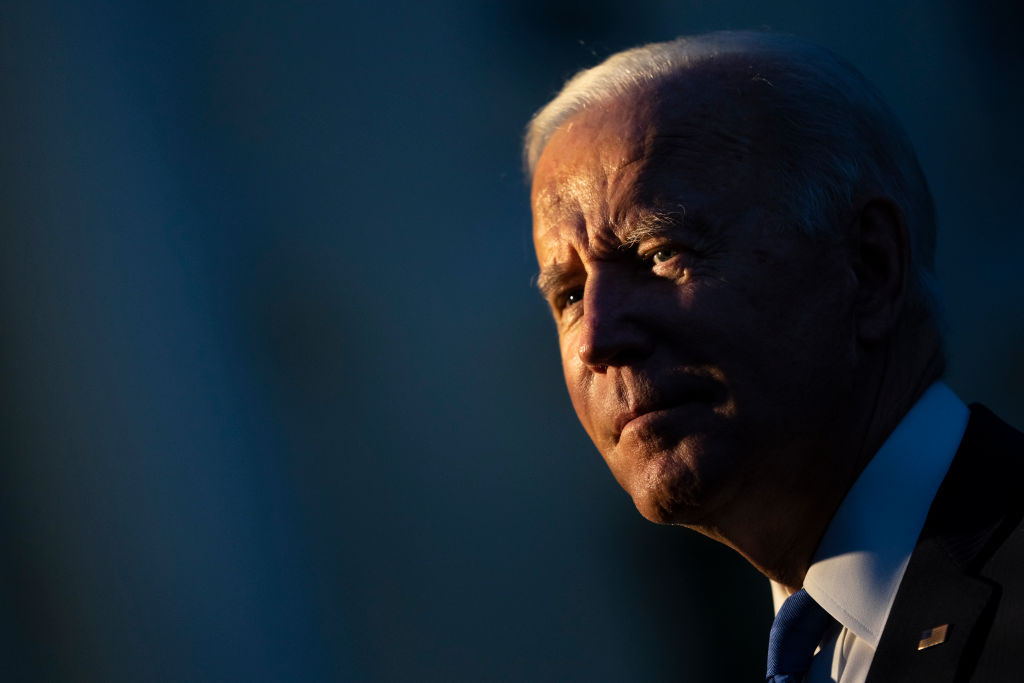
WASHINGTON — President Joe Biden, who has repeatedly been criticized as slow to respond to a widely expected U.S. Supreme Court decision that ended the nationwide right to an abortion, signed an executive order Friday that could preserve some access to abortion in states where the procedure remains legal.
Biden in a White House speech also brought up the case of a 10-year-old rape survivor from Ohio who was forced to travel out of state to access abortion care in Indiana, questioning if that’s actually the will of a majority of the state’s residents.
“Does anyone believe that it’s Ohio’s majority view that that should not be able to be dealt with? Or in any other state in the nation? A 10-year-old girl should be forced to give birth to a rapist’s child?” Biden said. “I can tell you that I don’t. I can’t think of anything that’s much more extreme.”
Ohio Republican Gov. Mike DeWine declined to comment on the state law’s impact in the case this week, saying he had read about it in the paper. He did say he found it “gut-wrenching” that a man raped a child.
Biden, who began his speech from the White House’s Roosevelt Room more than 30 minutes late by talking about the morning’s jobs report, said the fastest way to reestablish nationwide protections for abortion is by voting in November’s midterm election.
“Based on the reasoning of the court, there is no constitutional right to choose — the only way to fulfill and restore that right from women in this country is by voting,” Biden said. “We need two additional pro-choice senators and a pro-choice House to codify Roe at federal law.”
Biden acknowledged the frustration and anger many abortion rights advocates and Democrats expressed after he gave a speech the day of the Supreme Court decision, calling on Americans to vote on the issue in November.
He doubled down on that message during his remarks Friday, saying the Supreme Court opinion in the case, Dobbs v. Jackson Women’s Health Organization, “made clear it will not protect the rights of women.”
“It’s my hope and strong belief that women will in fact turn out in record numbers to reclaim the rights that have taken from them by the court,” Biden said, opting not to call on men, who are needed for pregnancy to take place, to turn out at the ballot box.
Executive order
Biden’s executive order would direct the U.S. Health and Human Services secretary to make sure abortion medication “is as widely accessible as possible,” according to a White House fact sheet.
The president has also “asked the Chair of the Federal Trade Commission to consider taking steps to protect consumers’ privacy” when seeking information about abortion services and will request HHS “consider additional actions” to protect “sensitive information related to reproductive health care.”
As part of those efforts, the administration has posted websites to try to help patients protect information their cell phones may store about reproductive health care and about the type of health care records that are protected under the federal law known as the Health Insurance Portability and Accountability Act, or HIPAA.
The White House is hoping to combat misinformation that has become more common since the Supreme Court’s ruling, with Biden directing the HHS secretary, the attorney general and chair of the Federal Trade Commission “to consider options to address deceptive or fraudulent practices, including online, and protect access to accurate information.”
The executive order, Biden said, would direct the federal government to look into tech privacy.
“Now when you use a search engine, or the app on your phone, companies collect your data, they sell it to other companies and even share it with law enforcement,” Biden said. “There’s an increasing concern that extremist governors and others will try to get that data off of your phone, which is out there in the ether, to find what you’re seeking, where you’re going and what you’re doing with regard to health care.”
House to vote on abortion access
The Democratic-controlled U.S. House is set to vote on two bills next week addressing abortion access, though it’s unlikely either will get past the U.S. Senate’s legislative filibuster.
The first bill, the Women’s Health Protection Act of 2022, would reestablish a nationwide right to an abortion. The second bill, the Ensuring Access to Abortion Act of 2022, would block state governments from making abortion travel illegal and protect health care providers in states where the procedure remains legal.
Congress is also slated to have a series of hearings on the impact of the Supreme Court’s decision to overturn Roe v. Wade, including next week in the U.S. Senate Judiciary Committee as well as the Senate Health, Education, Labor and Pensions panel.
Washington state Democratic Sen. Patty Murray, chair of the HELP panel, said in a written statement Friday following Biden’s speech that while the executive order is an important step, the “fight is far from over.”
“The reality is that the President’s executive authority is limited — so the surest way to protect every woman’s right to abortion is electing two more pro-choice Democratic senators and protecting our pro-choice majority in the House so that we can codify Roe,” Murray said.
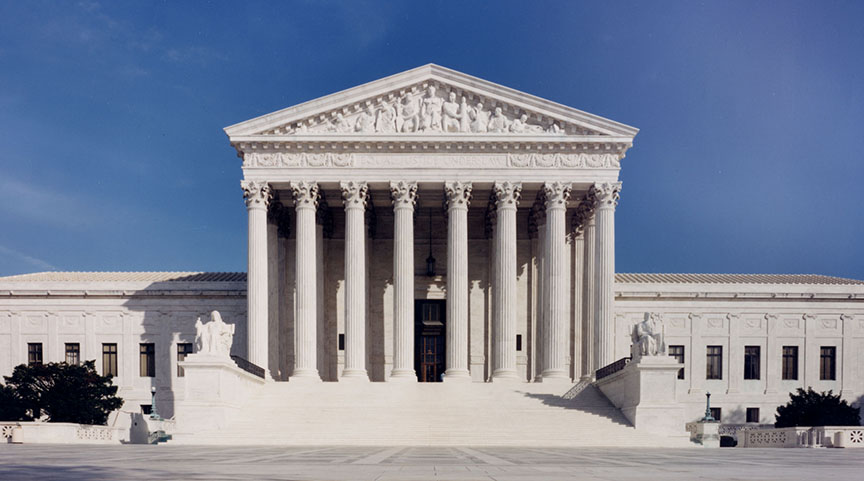
WASHINGTON — The U.S. Supreme Court on Friday overturned the 1973 Roe v. Wade ruling that established abortion as a constitutional right.
The decision by five of the Court’s nine justices will allow each state to set its own abortion laws, leading to a patchwork of access throughout the country. The result is expected to be an uptick in the number of women traveling out of state for abortions, as well as unsafe abortions in states where the medical procedure will now be banned or heavily restricted.
“We hold that Roe and Casey must be overruled,” Justice Samuel Alito wrote in his opinion, joined by Justices Clarence Thomas, Neil Gorsuch, Brett Kavanaugh and Amy Coney Barrett.
Chief Justice John Roberts filed a separate opinion concurring in the judgment about the Mississippi law at the center of the case, making that a 6-3 ruling, but not about overturning the constitutional right to an abortion, making that a 5-4 ruling.
“The Constitution makes no reference to abortion, and no such right is implicitly protected by any constitutional provision, including the one on which the defenders of Roe and Casey now chiefly rely — the Due Process Clause of the Fourteenth Amendment,” Alito continued.
“That provision has been held to guarantee some rights that are not mentioned in the Constitution, but any such right must be ‘deeply rooted in this Nation’s history and tradition’ and ‘implicit in the concept of ordered liberty.’”
Justice Stephen Breyer wrote the dissent in the case for himself, Elena Kagan and Sonia Sotomayor.
“With sorrow — for this Court, but more, for the many millions of American women who have today lost a fundamental constitutional protection — we dissent,” he wrote.
The new status of abortion access on a state-by-state basis, Breyer wrote , “says that from the very moment of fertilization, a woman has no rights to speak of. A State can force her to bring a pregnancy to term, even at the steepest personal and familial costs.”
Breyer later added, “Whatever the exact scope of the coming laws, one result of today’s decision is certain: the curtailment of women’s rights, and of their status as free and equal citizens.”
Twenty-two states have laws that would restrict when and how a patient can terminate a pregnancy, according to the Guttmacher Institute, a reproductive health and rights organization.
Arizona, Michigan and Wisconsin are among the 10 states that have pre-Roe abortion bans that are now expected to take effect. Thirteen states — including Idaho, Louisiana, Missouri and Tennessee — have laws enacted since Roe that will be “triggered” by the court’s decision.
A dozen states, including Maine, Maryland, Nevada and Washington, have laws that would protect abortion access up to the point of viability, usually 22 to 24 weeks into a pregnancy.
Colorado, the District of Columbia, New Jersey, Oregon and Vermont have laws that protect abortion access throughout a pregnancy, according to the Guttmacher Institute.
Thomas targets birth control, same-sex marriage
Justice Thomas wrote his own concurring opinion, arguing that since the court has overturned the constitutional right to an abortion, which was grounded in the 14th Amendment and the due process clause, other cases that have been rooted in the same right to privacy could all be reconsidered.
Those include:
The Griswold v. Connecticut case from 1965 that said states couldn’t bar married couples from making private decisions about birth control use.
The Lawrence v. Texas case from 2003 that said states couldn’t criminalize consensual sexual relations between same-sex partners.
The Obergefell v. Hodges case from 2015 that legalized same-sex marriage.
“For that reason, in future cases, we should reconsider all of this Court’s substantive due process precedents, including Griswold, Lawrence, and Obergefell,” Thomas wrote.
Thomas also wrote of the Dobbs case that “The resolution of this case is thus straightforward. Because the Due Process Clause does not secure any substantive rights, it does not secure a right to abortion.”
Reaction pours in
The Center for Reproductive Rights, which brought the case to the Supreme Court, rebuked the Republican-nominated justices for ending the right to an abortion.
“The Court’s opinion delivers a wrecking ball to the constitutional right to abortion, destroying the protections of Roe v. Wade, and utterly disregarding the one in four women in America who make the decision to end a pregnancy,” said Nancy Northup, president and CEO of the Center for Reproductive Rights.
“Utter chaos lies ahead, as some states race to the bottom with criminal abortion bans, forcing people to travel across multiple state lines and, for those without means to travel, carry their pregnancies to term — dictating their health, lives, and futures. Today’s decision will ignite a public health emergency,” Northup continued.
Susan B. Anthony Pro-Life America, an anti-abortion group, celebrated the decision, while its president called for “an entirely new pro-life movement” to begin.
“Today’s outcome raises the stakes of the midterm elections. Voters will debate and decide this issue and they deserve to know where every candidate in America stands,” Marjorie Dannenfelser said in a statement. “Federal as well as state lawmakers must commit to being consensus builders who advocate for the most ambitious protections possible.”
Mississippi ban
The court heard two hours of arguments in December in Dobbs v. Jackson Women’s Health Organization, which arose after Mississippi enacted a law that banned the vast majority of abortions after 15 weeks of pregnancy.
U.S. Solicitor General Elizabeth B. Prelogar, who argued on behalf of the federal government as a “friend of the Court,” said that the “real-world effects of overruling Roe” and the 1992 Planned Parenthood v. Casey decision that affirmed the right to an abortion “would be severe and swift.”
“Nearly half of the states already have or are expected to enact bans on abortion at all stages of pregnancy, many without exceptions for rape or incest,” Prelogar said. “Women who are unable to travel hundreds of miles to gain access to legal abortion will be required to continue with their pregnancies and give birth, with profound effects on their bodies, their health and the course of their lives.”
Mississippi Solicitor General Scott G. Stewart argued the nine justices should not only uphold Mississippi’s 2018 law, which had yet to go into effect, but overturn the two cases that have kept abortion access legal for nearly 50 years.
“Roe versus Wade and Planned Parenthood versus Casey haunt our country,” he said. “They’ve poisoned the law.”
Abortion rights history
The Supreme Court first ruled that a pregnant person has a constitutional right to abortion in the 1973 Roe v. Wade case that stemmed from a Texas woman being unable to access an abortion in her home state. The decision was 7-2.
Justice Harry Blackmun wrote that the right to an abortion stemmed from the right to privacy under the 14th Amendment. But the court ruled that a person’s fundamental right to terminate their pregnancy must be weighed against the government’s interest in protecting the person’s health and potential life.
The court established a trimester framework that determined when and how governments could impose regulations on abortion access.
In the 1992 Planned Parenthood v. Casey case, a 5-4 ruling, the court upheld a constitutional right to an abortion. But the decision overturned the trimester framework, instead setting viability, about 22 to 24 weeks into a pregnancy, as the line for government regulation.
The court said a person had a right to an abortion before viability without undue interference from the government. After reaching a point of viability, states can regulate abortion as long as it doesn’t affect a person’s health or life.
In the plurality opinion, Justice Sandra Day O’Connor wrote that “Some of us as individuals find abortion offensive to our most basic principles of morality, but that cannot control our decision. Our obligation is to define the liberty of all, not to mandate our own moral code.”
In a dissenting opinion, Justice Thomas wrote for himself, Antonin Scalia and two others that they would have overturned Roe v. Wade, saying the issue in the case was “not whether the power of a woman to abort her unborn child is a ‘liberty’ in the absolute sense; or even whether it is a liberty of great importance to many women. Of course it is both.”
“The issue is whether it is a liberty protected by the Constitution of the United States. I am sure it is not,” he wrote.
Will court survive a ‘stench’?
During oral arguments in December in the Mississippi case the justices ruled on Friday, Justice Sotomayor expressed concern over how the court overturning cases that established abortion access as a constitutional right would impact its reputation.
“Now, the sponsors of this bill, the House bill in Mississippi, said we’re doing it because we have new justices. The newest ban that Mississippi has put in place, the six-week ban, the Senate sponsor said we’re doing it because we have new justices on the Supreme Court,” Sotomayor said.
“Will this institution survive the stench that this creates in the public perception that the Constitution and its reading are just political acts?”
Justice Kagan questioned whether the court overruling Roe and Casey would lead Americans to view the court as “a political institution that will go back and forth, depending on what part of the public yells the loudest or changes to the court’s membership.”
And Justice Breyer read from a decision the entire Supreme Court issued in Casey about when and how justices should overturn watershed cases to avoid a situation that “would subvert the Court’s legitimacy.”
“They say overruling unnecessarily and under pressure would lead to condemnation, the Court’s loss of confidence in the judiciary, the ability of the Court to exercise the judicial power and to function as the Supreme Court of a nation dedicated to the rule of law,” Breyer read.
The Mississippi law at the center of the argument allowed abortions after 15 weeks in cases of “severe fetal abnormality” or medical emergency, but it did not include exceptions for rape or incest.
At the time Mississippi Gov. Phil Bryant signed the bill in March 2018, the 15-week threshold was the earliest abortion ban in the nation.
That has since changed, with several states enacting laws restricting abortion below that benchmark, including an Oklahoma law that makes abortion a felony punishable by up to 10 years in state prison, a maximum fine of $10,000, or both.
Abortion rights organizations have filed lawsuits to stop many of those new laws from going into effect on the basis that they violated the constitutional right to an abortion that the court undid this week.
Politico leak
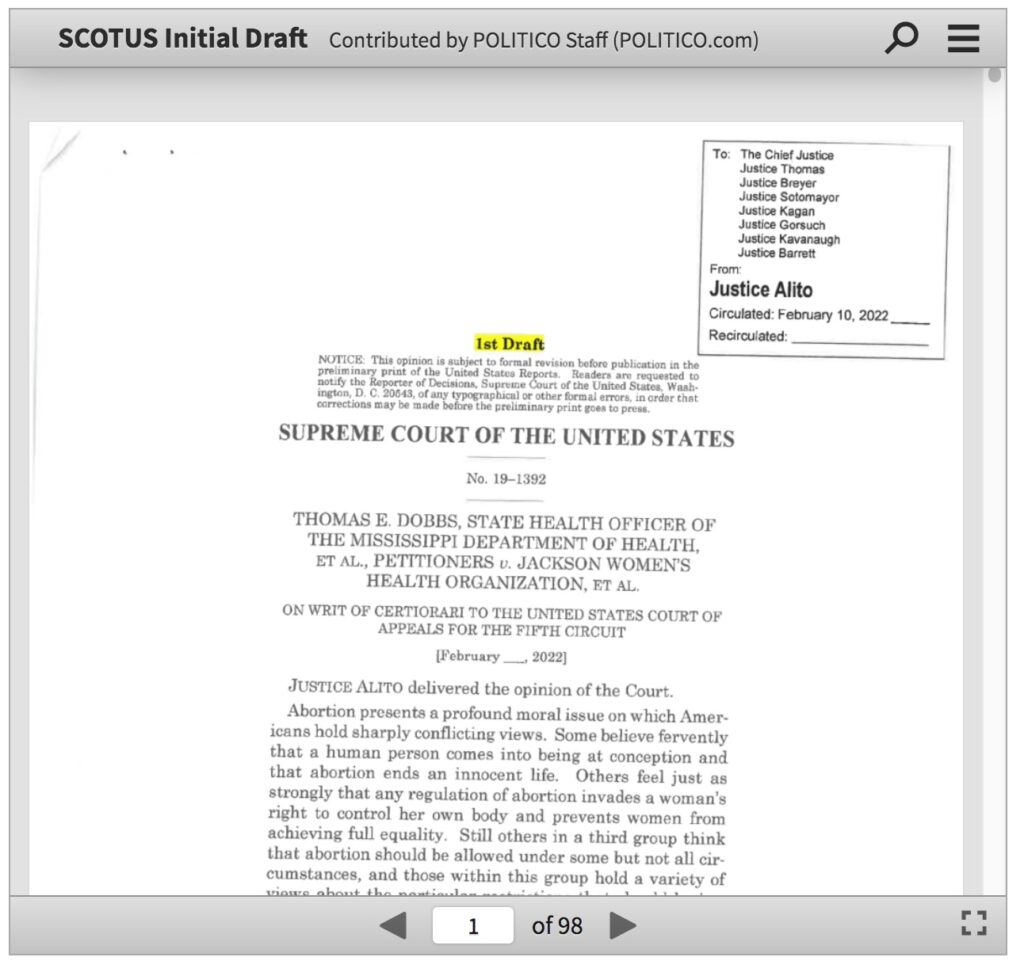
The Supreme Court majority opinion released Friday is similar to a draft version, led by Justice Alito, that was leaked to Politico in early May.
The leak was broadly criticized by Republicans, who at the time didn’t want to talk about the implications of the court overturning Roe, while Democrats rebuked the conservative justices for the expected decision.
Senate Majority Leader Chuck Schumer, a New York Democrat, held a floor vote in May on a bill that would have codified a nationwide right to an abortion.
That legislation couldn’t get past the chamber’s 60-vote legislative filibuster.
Maine Sen. Susan Collins and Alaska Sen. Lisa Murkowski, both Republicans who expressed frustration with how the Trump-nominated justices portrayed their view of Roe as a settled precedent during their confirmation processes, voted against the bill.
West Virginia Democratic Sen. Joe Manchin did as well.
Manchin said in a statement Friday that he was “deeply disappointed that the Supreme Court has voted to overturn Roe v. Wade.”
“I trusted Justice Gorsuch and Justice Kavanaugh when they testified under oath that they also believed Roe v. Wade was settled legal precedent and I am alarmed they chose to reject the stability the ruling has provided for two generations of Americans,” Manchin continued.
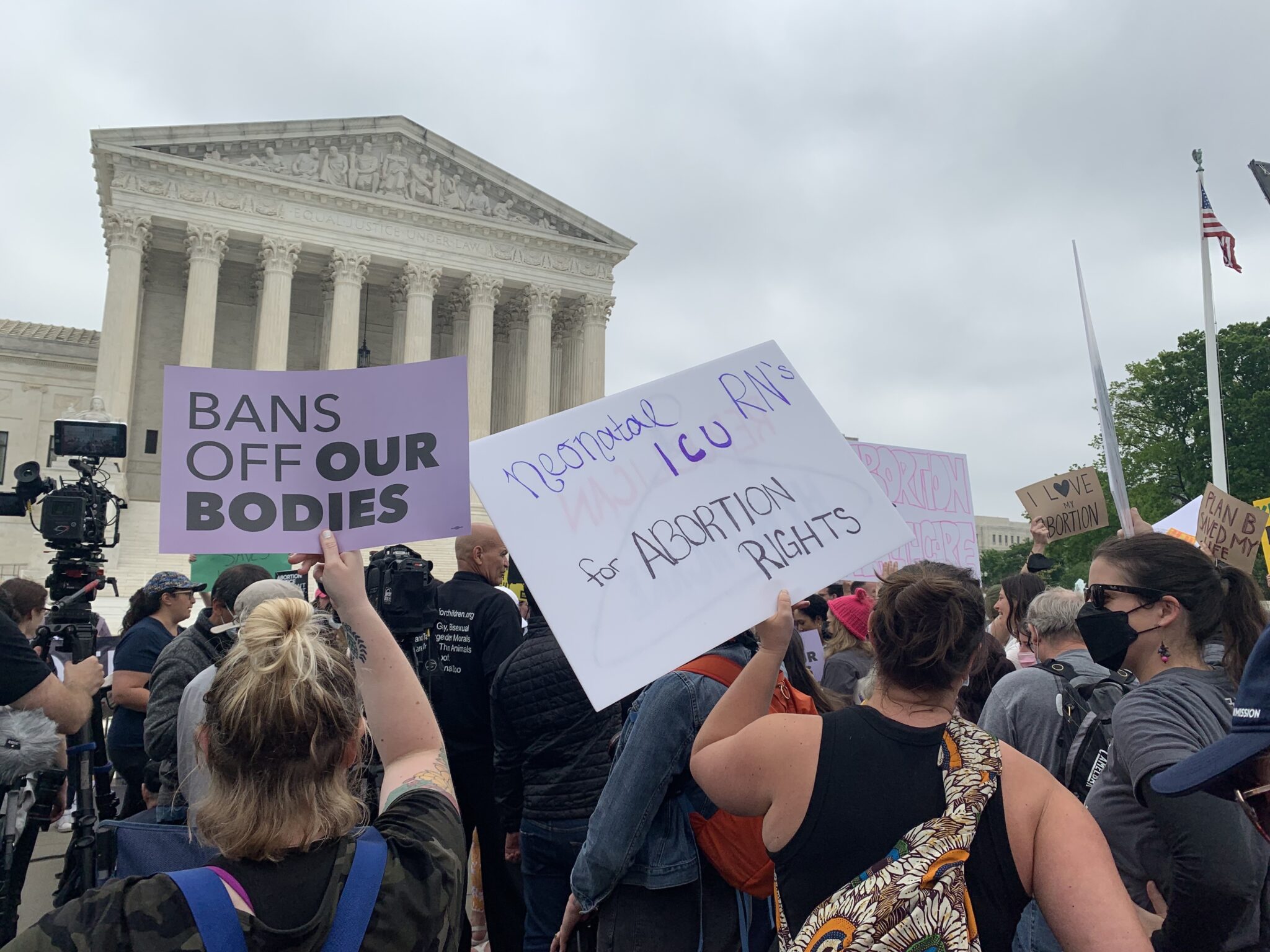
WASHINGTON — U.S. Senate Democrats on Tuesday pledged a new vote codifying the right to an abortion after publication of a draft court ruling that showed the Supreme Court on track to overturn the landmark Roe v. Wade abortion decision.
Democrats, who likely won’t have the votes to advance that bill, also predicted that abortion will emerge as a major issue in the upcoming midterm elections for members of Congress.
Their comments came as abortion rights supporters across the United States reeled in reaction to the disclosure of the initial draft U.S. Supreme Court opinion, led by Justice Samuel Alito and leaked to Politico. While the court ruling is not final until published, the draft states that earlier abortion decisions “must be overruled.”
Senate Majority Leader Chuck Schumer, a New York Democrat, said Tuesday he plans to release a new bill this week that senators will vote on next week to codify Roe v. Wade.
But in the evenly divided Senate, it will run into problems getting past a legislative filibuster that requires 60 votes for legislation to advance.
Were Roe v. Wade to be struck down by the court, which is dominated 6-3 by conservatives, the question would be left up to states, and more than two dozen Republican-led states have been racing to enact abortion bans and restrictions.
Supreme Court Chief Justice John Roberts said the draft, published on Monday night, was authentic, though he cautioned it wasn’t the final opinion, and said he’d directed the Marshal of the Court to investigate the leak.
Republicans called for the Justice Department to also investigate how the draft made its way to two journalists, saying the leak was a violation of the court’s judicial process.
Roberts said the leak of the document was wrong.
“Court employees have an exemplary and important tradition of respecting the confidentiality of the judicial process and upholding the trust of the Court,” Roberts said in the statement. “This was a singular and egregious breach of that trust that is an affront to the Court and the community of public servants who work here.”
The court is expected to release its official ruling in the case, Dobbs v. Jackson Women’s Health Organization, within the next two months, though many organizations have long expected the six conservative justices to at least pare back the constitutional right to an abortion.
Democratic senators on Tuesday said a final decision undoing the constitutional right to an abortion the Supreme Court established five decades ago would be unacceptable and harmful to women.
Montana Democratic Sen. Jon Tester said letting each state, once again, set its own abortion laws would be a “step in the wrong direction.”
“I think that a woman’s right to choose, a woman’s right to make their own health care decisions is really fundamental to who we are as a nation,” Tester said.
Washington Democratic Sen. Patty Murray criticized the conservative justices for moving to undo nationwide protections for people seeking to terminate a pregnancy.
“We do not want this to become a country where women are forced to remain pregnant no matter their personal circumstances and yes, we are talking about situations like rape and incest,” Murray said.
“A country where extreme politicians will control patients’ most private decisions. A country where for the very first time ever the next generation of women will have fewer rights than their mothers.”
Michigan Sen. Gary Peters, chair of the Democratic Senatorial Campaign Committee, said abortion rights will become a “major issue” in November’s midterms elections.
“We’ve seen legislation being passed in state legislatures across the country to limit reproductive freedom for women. But there was always the belief that Roe versus Wade was there,” Peters said. “If Roe versus Wade is overturned, it’s a completely different ballgame.”
60 votes needed
In the Senate, Democrats would need 60 senators to vote to get past the legislative filibuster and actually pass legislation codifying abortion access throughout the country. Those votes would be required to end debate and move on to final passage, which is a simple majority vote.
Peters, asked if Democrats could somehow get to a 60-seat majority in the midterm elections, said “it would be pretty difficult to get there.”
While the entire U.S. House — an increasing number of whom represent gerrymandered districts — will be up for reelection in November, just one-third of the U.S. Senate will face voters.
This year that will be 35 seats, with 14 occupied by Democrats and 21 filled by Republicans.
The Cook Political Report with Amy Walter rates five of those races — Arizona, Georgia, Nevada, Pennsylvania and Wisconsin – as “toss up.” Florida, North Carolina and Ohio are classified as “lean Republican.”
Senators’ positions
Georgia Sen. Raphael Warnock said he’s going to “do everything” he can to “support reproductive rights.”
He’s one of many Senate Democrats who support eliminating the filibuster.
“No Senate procedure should get in the way of basic civil rights — voting rights, reproductive rights,” Warnock said.
Arizona Democratic Sen. Mark Kelly isn’t as convinced that the Senate should change its procedures, but didn’t rule out backing a change to how bills are processed.
“If there is a proposal to change the rules, I will make a decision on what is in the best interest of the country and the folks I represent in Arizona,” Kelly said.
Fellow Arizona Democratic Sen. Kyrsten Sinema doesn’t back such a change and neither does West Virginia Democratic Sen. Joe Manchin III.
That means Senate Democrats don’t have the votes during this Congress to codify abortion rights or change the rules to make it easier to pass abortion rights legislation.
If Democrats lose control of the Senate following the midterm elections, Republicans are expected to keep the filibuster in place.
Minority Leader Mitch McConnell, a Kentucky Republican, said Tuesday he would “absolutely” commit to keeping it intact.
“We don’t want to break the Senate and that’s breaking the Senate,” he said.
McConnell declined to answer questions on how a final Supreme Court decision overturning Roe v. Wade would affect women throughout the country or whether he’d bring legislation to the floor to address federal abortion laws.
“All of this puts the cart before the horse,” he said.
National Republican Senatorial Committee Chairman Rick Scott, a Florida Republican senator, declined to say if the Supreme Court overturning abortion as a fundamental right would affect the election.
“I think this is an important issue to many people, but so is inflation, so is crime, so is the border,” Scott said. “So, these are important to people and people are gonna be passionate about this. And we ought to be passionate about what we believe in.”
Scott — who infuriated many fellow GOP senators earlier this year when he released an 11-point plan without leadership approval — declined to say if the GOP would try to pass a bill banning abortion nationwide if they gain control of the Senate in the midterms.
“We’ll worry about that next year,” Scott said.
‘Inconsistent’ justices
While many Senate Republicans oppose abortion rights and would support the Supreme Court overturning Roe v. Wade, two expressed frustration with the possibility.
Maine Republican Sen. Susan Collins — who voted to confirm Neil Gorsuch and Brett Kavanaugh, but not Amy Coney Barrett— said in a statement that “If this leaked draft opinion is the final decision and this reporting is accurate, it would be completely inconsistent with what Justice Gorsuch and Justice Kavanaugh said in their hearings and in our meetings in my office.”
Collins declined to answer reporters’ questions throughout the morning, simply saying she’d released a statement.
Alaska GOP Sen. Lisa Murkowski — who supported Gorsuch and Barrett, but not Kavanaugh — told reporters that certain justices voting to overturn precedent would erode her confidence in the court.
“If in fact this draft is where the Court ends up being, it has rocked my confidence in the court. That is because I think there were some representations made with regards to precedent and settled,” said Murkowski. “Comments were made to me and to others about Roe being settled and being precedent.”
When the Senate took a procedural vote in February on a House-passed bill that would codify the right to an abortion, Collins, Murkowski and Manchin all voted against moving to final passage.
Schumer said he expects a new vote could be different from the one taken just over two months ago.
“It’s a different world now, the tectonic plates of our politics on women’s choice and on rights in general are changing,” Schumer said.
“Every senator, now under the real glare of Roe v. Wade being repealed by the courts, is going to have to show which side they’re on. And we will find the best way to go forward after that. But don’t think that what happened two (months) ago will be exactly the same.”
WASHINGTON — The U.S. Department of Veterans Affairs is adding nine rare respiratory cancers linked to burn pit exposure to the list of illnesses eligible for disability and health benefits.
President Joe Biden, who has said his son Beau Biden’s exposure to toxic fumes from the pits could have led to his death, announced the policy change Monday, saying in a statement he hopes to avoid repeating mistakes of the past.
“We learned a horrible lesson after Vietnam, when the harmful effects of exposure to Agent Orange sometimes took years to manifest, and too many veterans were left unable to access the care they needed,” Biden said. “I refuse to repeat that mistake when it comes to the veterans of our wars in Iraq and Afghanistan.”
The VA said Monday that it will begin processing disability compensation claims for former U.S. military members who were in Southwest Asia from Aug. 2, 1990, to the present or in Afghanistan, Djibouti, Syria, or Uzbekistan from Sept. 19, 2001, to the present.
The cancers include squamous cell carcinoma of the larynx, squamous cell carcinoma of the trachea, adenocarcinoma of the trachea, salivary gland-type tumors of the trachea, adenosquamous carcinoma of the lung, large cell carcinoma of the lung, salivary gland-type tumors of the lung, sarcomatoid carcinoma of the lung and typical and atypical carcinoid of the lung.
The VA said it plans to contact veterans who fall under the new rule, which will be published on Tuesday, or survivors, to tell them how to apply for benefits.
VA Secretary Denis McDonough said in a statement the change in policy will ensure “veterans who suffer from these rare respiratory cancers will finally get” the health care and benefits they “deserve, without having to prove causality between their service and their condition.”
The VA said “a focused review of scientific and medical evidence” determined that “there is biological plausibility between airborne hazards and carcinogenesis of the respiratory tract — and the unique circumstances of these rare cancers warrant a presumption of service connection.”
At the time, Biden said burn pits — which incinerated medical and hazard material, jet fuel and other substances — were one of the many dangers U.S. soldiers faced during deployments.
“When they came home, many of the world’s fittest and best trained warriors were never the same,” Biden said during his speech. “Headaches. Numbness. Dizziness. A cancer that would put them in a flag-draped coffin.”
Biden, in his State of the Union address and his statement Monday, called on Congress to “pass bipartisan legislation to comprehensively address toxic exposures and further deliver the vital benefits our veterans have earned.”
The U.S. Senate unanimously approved a bipartisan bill from Montana Democratic Sen. Jon Tester and Kansas GOP Sen. Jerry Moran in mid-February that is the first of three pieces of legislation meant to address health care needs linked to burn pits.
When announcing the $1 billion legislation in early February, Moran said that 3.5 million combat veterans have experienced some level of toxic exposure since 9/11.
“This is the first step on a continuum of trying to make certain that those who experienced toxic exposure, and as a result are suffering in their health and well-being, receive medical benefits,” Moran said at the time.
The U.S. House voted 256-174 in early March to approve a separate bill that would be much larger in scope and price.
That legislation, referred to as the Promise to Address Comprehensive Toxics or PACT Act, would cost about $280 billion during the next decade.
House Majority Leader Steny Hoyer, a Maryland Democrat, said during floor debate the legislation would “expand veterans’ health care access and benefits to address the effects of these toxic exposures that occurred during their military service.”
“We asked our veterans to go to battle for America, and they answered that call,” Hoyer said. “When they return home, veterans should not have to go to battle against red tape to receive the medical treatment and benefits they have earned through their service.”
WASHINGTON — Cannabis dispensaries throughout the country came one step closer to using banks the way many other businesses can when the U.S. House on Friday cleared a bill with sweeping changes to banking regulations.
Colorado Democrat Ed Perlmutter and Ohio Republican Dave Joyce, co-sponsors of the legislation, said Friday their proposal would allow medical and recreational marijuana businesses in states that have legalized use to move away from the cash-only business model they’ve been forced to use by U.S. banking laws.
“We need to bring some sense to what is really dangerous right now in this space that so many states allow for dispensaries, for grow operations,” Perlmutter said. “There’s just a lot of cash and that cash can really pose problems.”
While the federal government has mostly left marijuana business regulation and oversight to the states that have legalized it, the nation’s banking system is controlled at the federal level.
The federal government’s classification of marijuana as a Schedule I illegal substance, by definition something with no medical use and a high potential for abuse, means that it’s difficult for cannabis businesses to use banks.
Some marijuana businesses have hired armored vehicles and armed guards to transfer cash to banks, an arrangement that has worked sometimes, but one that comes with more risk than if they were able to use banks the way non-cannabis businesses do.
Others have kept their operations as cash-only, a decision that Perlmutter and Joyce said Friday can lead to upticks in robberies and other crime, even though the businesses are acting within their state laws.
The so-called SAFE Banking Act passed the House on Friday as part of a much larger, separate bill that is geared toward improving U.S. manufacturing and boosting competitiveness with China on several fronts, including semiconductors.
The proposal will, however, need to survive the conference process between the House of Representatives and the Senate.
At the moment neither Joyce or Perlmutter is sure that their provision will remain in the final package, given concerns from some Democrats, including Senate Majority Leader Chuck Schumer and New Jersey Democratic Sen. Cory Booker.
Joyce and Perlmutter said Friday that they differ with the senators about how Congress passing the banking change would impact other marijuana legislation, including bills changing the tax code, changing the criminal justice approach to marijuana, or fully legalizing the plant.
“Our philosophy has been that you need to have something to break the ice. And in the Senate they haven’t had a hearing on cannabis – maybe one half-hearted one – since 1971, much less legislation, much less the votes,” Perlmutter said. “So our job is to familiarize them with the subject and to get them to take some action.”
Some of the Democratic senators, Perlmutter said, believe clearing banking changes will take the “wind out of the sails” on efforts to pass other changes to federal cannabis laws. So they want to broaden the legislation.
But Joyce and Perlmutter said they believe the incremental approach is the best way to send bills to the Biden administration and are concerned that if the bill grows too much some lawmakers may no longer support its passage.
“For every person you gain, you might lose three,” Joyce said. “And so that’s why you want to continue to have a smaller framework in which you can consistently have people adding to the bill versus getting off.”
Getting the marijuana banking amendment added to the larger China competitiveness legislation represented a step forward for the 180 co-sponsors of the marijuana banking legislation, 26 of whom are Republicans. But it’s far from a guarantee.
Backers of the legislation were able to get their language added last year as an amendment to the annual Defense Department policy bill, but it didn’t survive the conference process. The bill has also passed the House as stand-alone legislation.
Perlmutter and Joyce said on Friday if they are blocked again in the Senate, they will keep advocating for the legislation, especially as an amendment to other must-pass bills.
“Every one of these cannabis industries are running according to the laws and regulations that were put in place by that state,” Joyce said. “So why shouldn’t the banking system treat them the same.”