Tag: latest stories

  • FirstEnergy exec tried to keep DeWine aide’s name off of $10M transaction

    FirstEnergy exec tried to keep DeWine aide’s name off of $10M transaction

    BY: MARTY SCHLADEN – Ohio Capital Journal

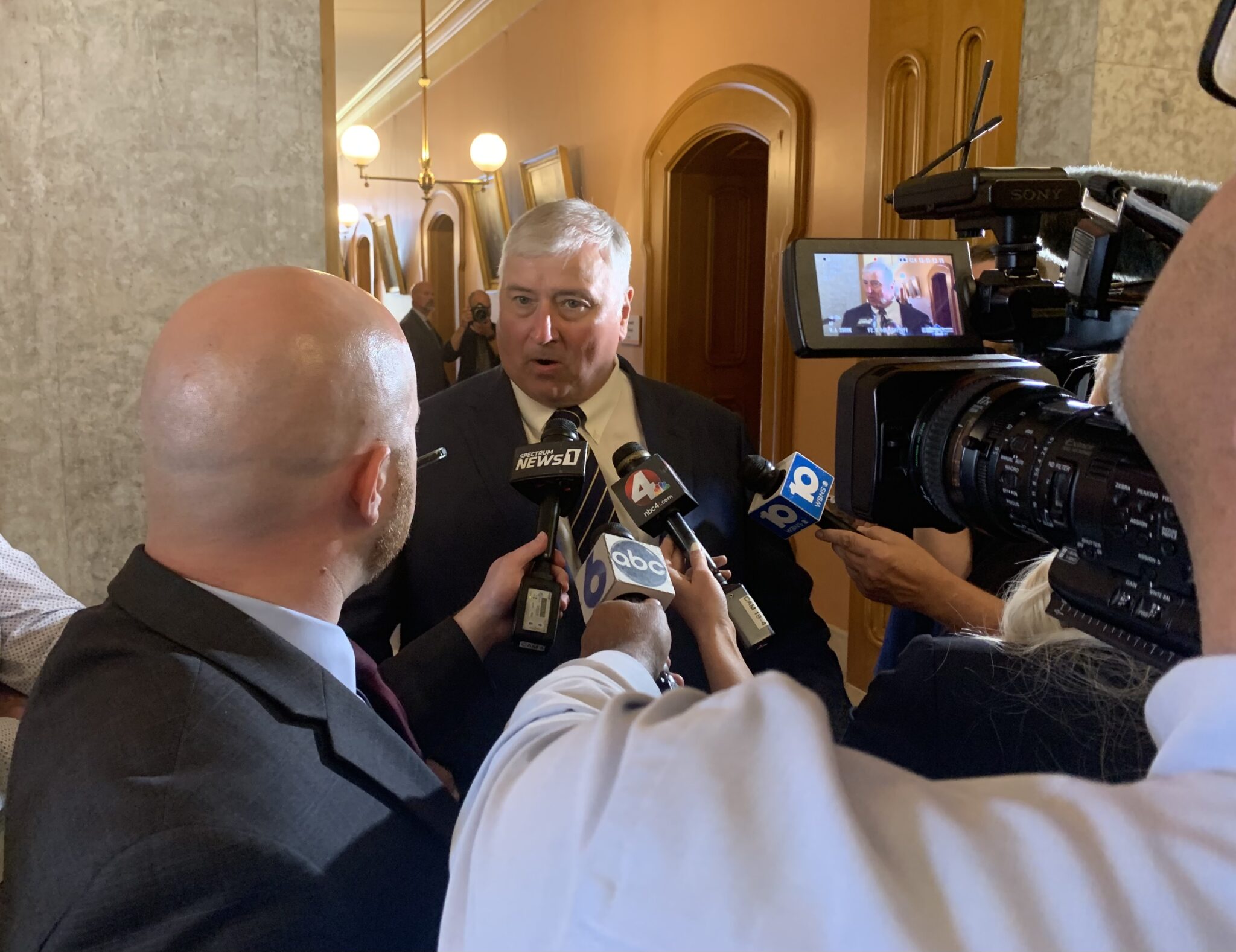
    In October 2019, as a battle raged over an attempt to repeal a $1.3 billion utility bailout, a FirstEnergy executive worked to keep the name of a senior aide to Gov. Mike DeWine off of a $10 million infusion of corporate cash into the fight. 

    The executive, Vice President Michael Dowling, did so even after an assistant told him it would violate IRS rules to not list the DeWine aide on the transaction, according to text messages presented Tuesday in the federal corruption trial of former Ohio House Speaker Larry Householder and lobbyist Matthew Borges. The men are accused of racketeering in a scheme to use $61 million from FirstEnergy in exchange for the massive bailout, most of which went to prop up the company’s failing nuclear and coal plants in order to make them attractive to buyers.

    DeWine has denied involvement in the arrangement even though he met with FirstEnergy executives and visited one of its nuclear plants in 2018 as he was seeking the governorship and FirstEnergy was lavishly funding Householder’s effort to elect sympathetic Republicans who would then vote to make him speaker. For his part, DeWine received $23,000 from the Akron-based utility for his campaign and his inaugural celebration, according to Ohio Citizen Action. He vowed to donate the money to charity following revelations of the scandal.

    The governor appointed as chairman of the Public Utility Commission of Ohio a former FirstEnergy consultant who was paid $4.3 million by the utility just before taking his seat on the commission. Even though he was supposed to be regulating the utility, the official, Sam Randazzo, played a role in writing the bailout legislation, according to documents released by the Ohio House. 

    In early 2019, DeWine also appointed FirstEnergy lobbyist Dan McCarthy to be his legislative affairs director, meaning McCarthy was in charge of representing DeWine’s interests before the General Assembly.

    In early 2017, while McCarthy was still working for FirstEnergy, Householder and his son, along with FirstEnergy CEO Chuck Jones and others, flew corporate jets to Washington, D.C. for fancy dinners and Donald Trump’s inaugural

    Just after that, McCarthy formed a 501(c)(4) group called Partners for Progress. Also known as a “dark money” group, it received $5 million from FirstEnergy within a few weeks of when McCarthy founded it.

    In an affidavit supporting Householder’s arrest, FBI Special Agent Blane Wetzel said Partners for Progress was “designed to conceal the nature, source, ownership, and control of the payments” from FirstEnergy and associated companies. Through the rest of 2018, McCarthy continued as president of Partners for Progress as it pumped FirstEnergy money into a Householder-controlled dark money group and funded the effort to make Householder speaker.

    The following year, McCarthy resigned that role to work for DeWine in the legislature as Householder shepherded the bailout legislation, House Bill 6. When a final version passed in July 2019, DeWine signed it the same day.

    But opponents quickly started a campaign to circulate petitions to put a repeal on the ballot. That prompted FirstEnergy to pump even greater sums into a “decline to sign” campaign aimed at thwarting the petitions.

    It funded xenophobic mailers and broadcast ads claiming without evidence that the repeal effort was a Chinese plot.

    “Who is knocking at your door?” began a mailer read in court Tuesday. “Foreign enemies have infiltrated our energy grid,” it added and said, ominously, that circulators of repeal petitions “are asking for your information.”

    In October 2019, executives with FirstEnergy and its generation-owning subsidiary seemed panicked that the repeal effort might succeed and they were planning to pump $10 million more into the effort to stop it — through Partners for Progress, the dark money group started by McCarthy, who was now a DeWine aide.

    Dowling, the FirstEnergy vice president, seemed to think it wouldn’t be a good look for the name of a DeWine official to show up on paperwork accompanying the huge transaction.

    “Please make sure Dan McCarthy’s name is not on the filing,” Dowling said in a text message to Partners for Progress Treasurer Michael Vanburen that was presented in court Tuesday.

    Vanburen replied that even though McCarthy was no longer president of the dark money group, IRS rules required that his name be on the filing. Dowling didn’t accept that.

    “There must be a creative way to handle this,” he said. “It’s important that (McCarthy’s) name not be listed.”

    Asked if DeWine asked that McCarthy’s name not be used in paperwork regarding the money transfers, Press Secretary Dan Tierney in an email said, “No. Dan McCarthy resigned from Partners for Progress in December 2018. Dowling’s comments, as you have relayed them to me, do not match the timeline of McCarthy’s affiliation with Partners for Progress.”

    DeWine seems to have been in touch with FirstEnergy executives around the time of the repeal effort. Later in October 2019, FirstEnergy CEO Jones texted Vice President Dowling to say, “DeWine’s on board. I talked to him on Wednesday.”

    According to Jones, they talked about whether the repeal HB 6 effort would gather enough valid signatures to get the measure on the ballot.

    “He said their valid rate was less than 30%,” Jones said of DeWine.

    For his part, Tierney said, “The Governor does not have any recollection of such a conversation.”

    In a later text conversation, Jones said he’d received similar assurances from Secretary of State Frank LaRose.

    After arrests were made in the House Bill 6 scandal, DeWine staunchly defended McCarthy and kept him in his administration for more than a year, until Sept. 24, 2021.

    “As far as I know, Dan McCarthy has been well-respected for many, many years, long before he started working for me as our legislative director and I have faith in his integrity,” DeWine said in early 2021 as questions about the role McCarthy’s dark money group played in the bribery and money laundering scandal continued.

    In another trial-related matter, U.S. District Judge Timothy Black on Tuesday said that he had released a second juror, this time for testing positive for COVID. An earlier juror had been released for refusing to wear a mask.

    That brings the number of alternate jurors to two for a trial that is expected to last into early March.


  • An Interview with Julia Wolf: The Wolf Pack’s “Cure Starts Now”

    An Interview with Julia Wolf: The Wolf Pack’s “Cure Starts Now”

    Loveland Magazine President and Publisher Cassie Mattia at her “Table of Discussions”.

    by Cassie Mattia

    Loveland, Ohio – “We know Grant is ‘done with cancer’ but not in the way any of us hoped for,” Sara Wolf said in 2021 after losing her son, Grant Wolf at just 7 years old to Medulloblastoma, a malignant tumor in the cerebellum region of the brain.

    Grant’s twin sister, 9-year-old Julia Wolf, has made it her mission to advocate for childhood cancer research in memory of her brother. This will be the third year that Julia’s “Grant for Grant” fundraiser will be raising money with “The Cure Starts Now” for childhood cancer research.

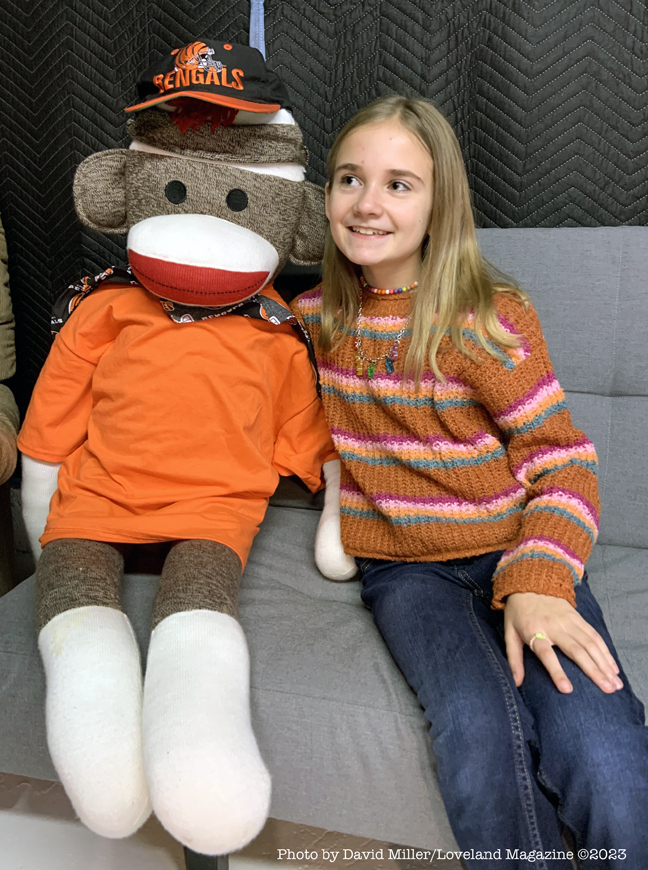
    Julia’s love for stuffed animals was abundantly apparent when immediately after my interview she went to sit with the sock monkey in our studio.

    Julia came up with the idea to fundraise in memory of her brother Grant at his funeral in 2021. Julia had been worried about having a birthday without Grant by her side so she brainstormed and came up with two ideas; donate stuffed dogs to kids with cancer, as she and Grant loved to play with stuffed animals together, and raise money for childhood brain cancer research. Julia’s mom loved the idea and thought what a great way to get “Grant’s Wolf Pack” involved, a group of supporters and advocates for childhood cancer research, and other cancer organizations such as The Cure Starts Now. “She set the fundraising goal at $240. We watched the total grow, and grow and grow and knew that the Grant for Grant fundraiser was going to make a big impact,” Sara said.

    Julia’s first Grant for Grant fundraiser collected $56,000 and the following year the campaign brought in $52,000.

    With Julia and Grant’s 10th birthday coming up and the third year of the Grant for Grant fundraiser in full swing, Julia has been working hard to spread awareness about childhood brain cancer. Julia’s goal this year is to raise at least $50,000 for her A Grant for Grant fundraiser by her and Grant’s birthday on February 11th.

    “Grant was really funny. He loved playing dogs and sports. He was the best twin brother,” Julia said to Loveland Magazine in a 2021 interview, “I really wanted to do something about finding a cure for cancer so that no other kid has to go through these tough times.”

    Here at Loveland Magazine, we wanted to make sure we not only continued to support Julia’s cause but also let our community of readers know how they can support the cause too, so we invited Julia into the Loveland Magazine studios for a one-on-one interview! Click below to listen to the “Send it to the Table” podcast and the on-camera interview featuring Loveland’s sweetheart, Julia Wolf!


    Listen to the “Send it to the Table” Podcast by Cassie Mattia featuring Julia Wolf


    Wolf Family Photos


    The Cure Starts Now represents something truly different – a grassroots effort dedicated to, not just fighting one cancer, but the elimination of ALL cancers. We believe as the experts do; that in order to truly cure cancer you have to focus on:
    • Those cancers that are immune to treatment.
    • Those cancers that also affect children.
    • Those cancers that are the biggest bullies with the highest death rate.

    Learn all about The Cure Starts Now in the video below!

    Learn More

    SAVE THE DATE for one of Cincinnati’s most unique auctions and the premiere fundraiser for The Cure Starts Now

    As the premiere fundraiser for The Cure Starts Now, the Once in a Lifetime Gala is one of Cincinnati’s most unique galas. Join over 900 guests as they enjoy a 3-course gourmet meal, open bar, a 400-package silent auction, a once-in-a-lifetime experience live auction, and entertainment. Please join us as we continue our battle against pediatric brain cancer and honor our cancer warriors.

    100% of the proceeds benefit The Cure Starts Now.  Thanks to events like this, The Cure Starts Now has funded $21,188,327 in pediatric cancer research and support in conjunction with our DIPG/DMG Collaborative Partners.  The proceeds will benefit The Cure Starts Now, a 501(c)(3) non-profit organization dedicated to finding a “home run” cure for cancer through funding of pediatric brain cancer research.

    EARLY BIRD PRICING FOR 2023 

    Receive admission to The Cure Starts Now auction, dinner, and program. Includes complementary beer, wine, and soft drinks.

    Send it to the Table

    If you have a story you would like to bring to my all-new segment, the “Table of Discussions,” where I talk about anything and everything going on locally and nationally, email me at cmattia12@gmail.com. I’d love to sit at my table with you and discuss an issue or listen to your story!


  • Loveland Bike Trail’s O’Bannon Creek Bridge Closure

    Loveland Bike Trail’s O’Bannon Creek Bridge Closure

    by David Miller

    Loveland, Ohio – The O’Bannon Creek Bridge in Historic Downtown on the Loveland Bike Trail (Little Miami Scenic Trail) will be temporarily closed starting March 6th. Little Miami State Park, the division of the Ohio Department of Natural Resources that oversees the trail said that the bridge is nearing the end of its life expectancy and that they are “proactively replacing it before it becomes unsafe”.

    Google Image

    It will open again at the end of March and then close from May to October. There is no designated detour, however, local trail users will know that heading east on West Loveland Avenue and leaving Historic Downtown by heading north on State Route 48, then turning left onto Lyon Avenue will quickly take users to the other side of the closed bridge. From Lyon Avenue take either fork in the road to get back on the trail.

    EDITOR’S NOTE: We have received a message from one of our faithful readers who lives on Maple avenue and she would rather not see people use the street as a detour. She said, “My street isn’t a proper workaround. Maple is a narrow, short dead-end street that doesn’t connect through to the trail, as depicted on the Google map. Our little neighborhood has several families with young children and would appreciate not having all the trail traffic directed our way. If trail users just stay on Lyon (which has just one house and no kids), they will quickly come to its intersection.”

  • Union Cemetery Road to Close for Sanitary Sewer Project

    Union Cemetery Road to Close for Sanitary Sewer Project

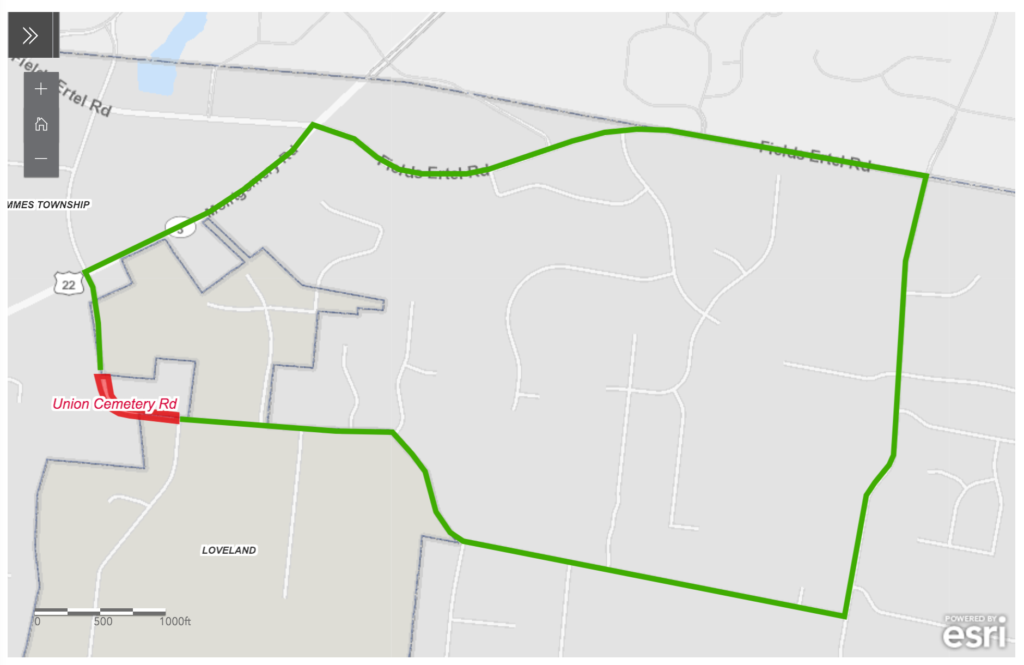
    Symmes Township, Ohio – The Smith Corporation will be installing a sanitary sewer between 9310-9360 Union Cemetery Road beginning Monday, February 6th through March 3rd. The contractor’s detour route will be from Montgomery Road-Fields Ertel Road-Lebanon Road-Union Cemetery Road and vice versa.

    If you should have any issues, contact Jay Smith with Smith Corporation at (513)782-8882 or Kurtis Boggs with the Hamilton County Engineer’s office at (513)946-8430.

  • Queen City Motors offering $2K reward for stolen truck

    Queen City Motors offering $2K reward for stolen truck

    405 Loveland Madeira Rd, Loveland, OH 45140

    +1 513-549-8022

    sales@queencity-motors.com

    https://www.queencity-motors.com


    Loveland Police have another request for assistance…

    Loveland, Ohio – On Friday, January 20 at approximately 3 AM, a 2011 Brown/Gold Dodge Ram 2500 with “Longhorn Trim” was stolen from Queen City Motors at 421 Loveland Madeira Road. A white van may have been involved in the theft.

    If you have any information please call police at 513-583-3000 or contact Detective Jesse Moore 513-774-3009 jmoore@lovelandoh.gov

  • Corruption trial texts: OH AG Yost didn’t speak out against bailout because of utility support

    Corruption trial texts: OH AG Yost didn’t speak out against bailout because of utility support

    BY: MARTY SCHLADEN – Ohio Capital Journal

    CINCINNATI — In June of 2019, Ohio Attorney General Dave Yost thought a proposed utility bailout was a bad law, but he didn’t publicly oppose it because of support he’d received from the bailout’s primary beneficiary, FirstEnergy, according to lobbyists’ text messages displayed in court on Friday.

    Prosecutors displayed the messages as part of the racketeering trial of former House Speaker Larry Householder and Matt Borges, a former Ohio Republican Party Chairman who was acting as a lobbyist at the time the utility bailout was debated and passed. They are accused in a scheme to use $61 million to make Householder speaker in 2019 so he could pass and protect a $1.3 billion bailout that mostly went to protect FirstEnergy’s failing nuclear and coal plants.

    At the time of the men’s July 2020 arrest, federal prosecutors said it was likely the biggest bribery and money laundering scheme in Ohio history. Two months later, as he announced a civil suit against FirstEnergy, Yost echoed those sentiments.

    “Corruption doesn’t happen on an industrial scale like this without cash,” he said in a press conference. “And it’s incredibly important at this moment in our state’s history to send a message that the Ohio political system, the Ohio law-making system, the regulatory environment is not for sale. If you shut off the money spigot, the corruption withers.”

    But behind the scenes 15 months earlier — according to text messages between Borges and lobbyist Juan Cespedes — Yost was pulling his punches on the bailout. Borges said Yost was doing so partly because of $24,000 he received from FirstEnergy and Borges in the cycle leading up to the 2018 election and the subsequent legislative session during which the bailout was passed. 

    Cespedes has pleaded guilty in the scandal and is expected to testify soon in the Householder trial.

    After the scandal broke, Yost announced that he would donate his FirstEnergy-related contributions to charity

    But according to Borges, who had run earlier campaigns for Yost, the FirstEnergy money spigot helped guide the attorney general’s conduct as the bailout was making its way through the legislature. Text messages indicate that Borges was assigned to try to enlist Yost’s help with the bailout.

    The legislation, House Bill 6, passed the Ohio House on May 29, 2019, and by the time of the June 26, 2019, text conversation between Borges and Cespedes, opposition to the bailout was growing as it was being debated in the Senate.

    One source of opposition was from outside groups that were planning a ballot initiative to repeal HB 6 if it passed. Borges and Cespedes discussed trying to make it exempt from repeal by treating it as a revenue bill and calling it a tax — based on a $1 subsidy built into the measure. 

    Cespedes asked Borges what the attorney general thought.

    “He’s sympathetic, but he wants to go back and look at the law,” Borges replied.

    As they discussed the matter further, Borges said “Don’t repeat this,” but Yost believed the bailout was a bad law.

    Yost “‘would be out front (in opposition) if not for (FirstEnergy) support and your involvement,’” Borges quoted Yost as saying.

    As attorney general, Yost also would have to approve any repeal language before it went on the ballot. The AG also wanted to help with that if he could, Borges said.

    “If there’s any way the law will allow him to reject the language, he will do it,” Borges texted.

    Yost has been subpoenaed in the case, and his spokeswoman on Friday declined to comment on the text messages.

    “He was subpoenaed to potentially be a witness in this case,” the spokeswoman, Bethany McCorkle, said in an email. “At this time it is inappropriate for him to comment.”

  • Meijer extending SNAP benefits through March 31 for in-store produce purchase

    Meijer extending SNAP benefits through March 31 for in-store produce purchase

    Loveland, Ohio – The Ohio Department of Job and Family Services (ODJFS) announced that changes in federal law mean that February will be the last month of emergency Supplemental Nutrition Assistance Program (SNAP) allotments. 

    However, through March 31, Meijer is offering SNAP customers a 10 percent discount on produce purchased in-store, helping families stretch their dollars even further on fresh, healthy food. More info:

  • [VIDEO] Loveland High School Winter Athletic Signing Day

    [VIDEO] Loveland High School Winter Athletic Signing Day

    by David Miller

    Loveland, Ohio – The 2023 Loveland High School Winter Athletic Signing Day was on Wednesday, February 1st in the Main Gym.

    Congratulations to the following Student-Athletes, who have committed to play their sport at the collegiate level:

    Ethan Freeland -Football at Georgetown College

    Noah Kline -Football at Valparaiso University

    Victoria Blum -Cheer at Mount St. Joseph University

    Tyler Huff -Baseball at University of Northwestern Ohio

    Jared Werling -Baseball at University of South Carolina-Lancaster

    Emma Kist -Archery at Lindsey Wilson College

    Parker Braddock -Archery at Lindsey Wilson College

    Josh Dues -Lacrosse at Concordia University Ann Arbor


    Also Watch: [VIDEO] A national ritual: 5 LHS Student-Athletes on “National Signing Day” From November 9th, 2022

  • Angling for appeal? Householder attorneys go after judge in corruption trial

    Angling for appeal? Householder attorneys go after judge in corruption trial

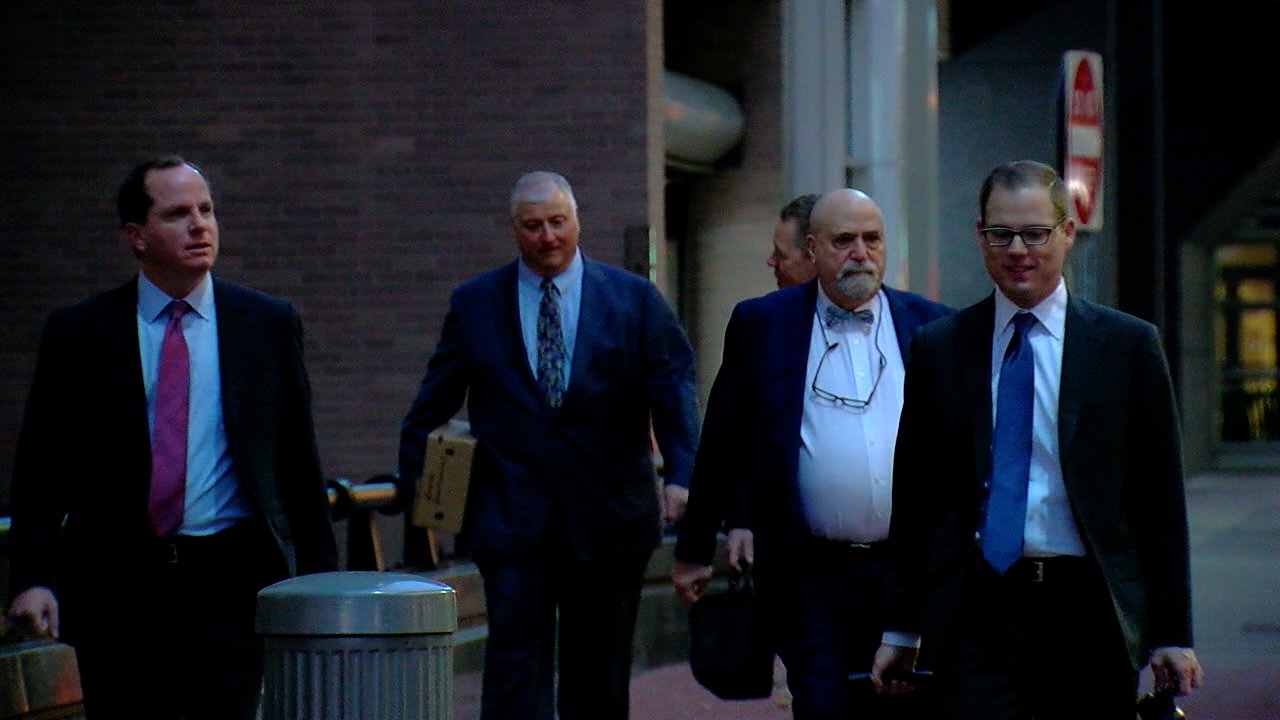
    Former Ohio House Speaker Larry Householder, a Perry County Republican, second from left, with attorneys outside of his racketeering trial. Photo courtesy of WEWS.

    BY: MARTY SCHLADEN – Ohio Capital Journal

    CINCINNATI — There has been speculation since the start of a massive public corruption trial that lawyers for the main defendant — former Ohio House Speaker Larry Householder — were banking on getting any conviction tossed out on appeal.

    There might have been evidence of that on Tuesday when one of the attorneys took the rare step of accusing the judge in the case of bias against his client. The attorney also suggested that the judge harbored a political grudge against Householder going back more than 22 years.

    Testimony resumed Tuesday in the case after repeated delays — first because of weather and then because a juror tested positive for covid. 

    When it did, federal prosecutors continued presenting extensive evidence to support allegations that Ohio utilities paid $61 million into Householder-controlled 501(c)(4) dark money groups and Householder used the money to elect friendly Republicans to make himself speaker in early 2019. Householder is accused of pushing through a $1.3 billion ratepayer bailout that primarily benefited his primary benefactor — Akron-based FirstEnergy — in return.

    Prosecutors have said it was likely the largest bribery and money-laundering scheme in Ohio history.

    Federal prosecutors are known to usually file charges only when they’re almost certain to get a conviction. That’s perhaps even more true when the case is against an elected official.

    And over the course of testimony so far, Assistant U.S. Attorney Emily Glatfelter has introduced reams of evidence in the form of emails and text messages, as well as transcripts of wiretaps and witness testimony — including that of co-defendants who have pleaded guilty.

    Householder’s attorneys have argued that their client raising money and electing candidates who would support his speaker’s bid was just politics as usual. They also argue that Householder only wanted to prop up failing nuclear and coal plants because he wanted to save jobs and protect the tax bases of the communities where they were located.

    Householder also is alleged to have pocketed $500,000 in utility money himself, but his lawyers say those were loans he fully intended to repay.

    However, the attorneys’ conduct on Tuesday might indicate that they’re looking past the jury trial.

    Before the jury entered the courtroom, Householder attorney Mark Marein rose to complain to U.S. District Judge Timothy Black  — about the conduct of Black himself.

    “We all collectively believe that the court holds animosity toward us,” Marein said, referring to Householder’s legal team. He added, “I question whether (Judge Black) should be presiding over this.”

    Black scolded Householder’s lawyers last week for muttering and making faces during Glatfelter’s opening statement. Among his criticisms, Black called the conduct “bush league.”

    The judge also dismissed a juror who refused to wear a mask in court. That prompted speculation that Householder’s lawyers were displeased because such a juror might be more sympathetic to their client, a pro-Trump Republican.

    But Marein gave a wholly different reason for suspecting that the judge was biased against Householder. He said that Black might be holding a grudge from 2000, when Black ran for the Ohio Supreme Court and Householder worked against the candidacy. 

    Both Marein and Black acknowledged that Marein was making the statements simply to get them into the record — presumably so they would be there in the event of an appeal. 

    There is some precedent for overturning public corruption convictions over complaints of judicial bias and prosecutorial misconduct. 

    In 2009, the conviction of former Alaska Senator Ted Stevens was thrown out after the FBI was found to have withheld exculpatory evidence and other misconduct. And in 2016, the U.S. Supreme Court unanimously overturned the conviction of former Virginia Gov. Bob McDonnell, ruling that the trial court judge allowed prosecutors to use an overly broad definition of bribery.

    But accusing a judge of bias in the middle of a trial has risks. Lawyers have said that if one genuinely believes a judge is biased, accusing that person of it in open court could simply make things worse. And in some instances, such accusations have resulted in professional sanctions against the lawyers making them.

    There were a few other developments of interest Tuesday:

    • Prosecutors played a recording of a wiretapped phone conversation between Householder and political operative Neil Clark in December 2017. Clark was also charged in the corruption scandal, but later died by suicide. In a laughing, profanity-strewn passage, the two talked about how Republicans legislators in 2010 drew a portion of Columbus into former U.S. Rep. Pat Tiberi’s district. “Tiberi wanted a safer district,” Householder said, later adding, “He doesn’t like me because he thinks I f*****d with him.” The maps drawn in 2011 were said to have some of the most gerrymandered in the country. Last year, a Republican-controlled panel repeatedly refused orders from the state Supreme Court to draw them more evenly.
    • Householder allies and FirstEnergy officials in August 2017 discussed a third tranche of $250,000 from the company to a Householder-controlled dark-money group at the posh Greenbrier resort in West Virginia, where that state’s Coal Association was holding its annual meeting. The money flowed soon thereafter. That meeting follows a round of swanky dinners in Washington, D.C., involving Householder and FirstEnergy officials the previous January during former President Donald Trump’s inauguration. Two dark-money groups were set up within weeks and one quickly received the first $250,000 from FirstEnergy, even though was hemorrhaging money.

    The trial resumes Wednesday. It’s expected to last into March.

  • Fate of former Ohio House speaker could hinge on whether he took an “official act”

    Fate of former Ohio House speaker could hinge on whether he took an “official act”

    Larry Householder addresses reporters after lawmakers voted to expel him from the General Assembly. He has pleaded not guilty to a racketeering charge and awaits trial. Photo by Jake Zuckerman, OCJ.

    BY: MARTY SCHLADEN – Ohio Capital Journal

    It appears that federal prosecutors have a mountain of evidence they want to present to the jury in their racketeering case against former Ohio House Speaker Larry Householder and former Ohio GOP Chairman Matt Borges. 

    They have emails, text messages, wiretap transcripts, and the testimony of undercover agents and confidential informants. They have so much material that U.S. District Judge Timothy Black said prosecutors and defense attorneys labored mightily before the trial even started to agree on what could be presented to the jury. The process was meant to avoid bogging down what’s already expected to be a six-week ordeal.

    But all that evidence could miss the mark if none of it shows that Householder undertook an “official act” in exchange for all the millions Akron-based FirstEnergy funneled into 501(c)(4) dark money groups to support the effort to elect friendly Republicans who would vote to make Householder speaker. The U.S. Supreme Court overturned a public corruption conviction on that basis just six years ago.

    Householder is accused of masterminding a conspiracy to use $61 million from FirstEnergy and other utilities to make himself speaker and in return ramming through a $1.3 billion ratepayer bailout of failing nuclear and coal plants. His trial began last week, but after two days of testimony it was delayed — first because of weather and then because a juror was diagnosed with COVID.

    But last week, FBI Special Agent Blane Wetzel testified about conduct that made both Householder and FirstEnergy look pretty bad.

    Householder is accused of using about $500,000 from the dark money groups to pay off credit card debt, settle a lawsuit, and repair a Florida home. Meanwhile, FirstEnergy was losing so much money on its nuclear and coal plants that in 2016 it started the process that would send the subsidiary that owned them into bankruptcy.

    But even as the company and Householder were swimming in red ink, he and the company’s CEO flew to Washington, D.C., on private jets in January 2017 for three days of dinners and drinks at some of the city’s swankiest bars and restaurants, Wetzel said. 

    Within two weeks, FirstEnergy money was flowing into Householder-controlled dark-money accounts. In November of 2018, enough Householder-friendly Republicans were elected — many with the help of money from those accounts — to make him speaker the following January. Less than six months later, on May 28, 2019, the House passed its first version of the billion-dollar bailout, House Bill 6. The body passed a final version on July 23, 2019 and Gov. Mike DeWine signed it the same day.

    When former U.S. Attorney David M. DeVillers announced Householder’s arrest almost exactly a year later, he called the scheme with FirstEnergy “likely the largest bribery and money-laundering scheme ever in the state of Ohio.”

    But did Householder undertake an official act in exchange for money corruptly received from FirstEnergy and other Ohio utilities? The answer might not be as straightforward as you think.

    For their part, Householder’s attorneys are arguing that their client was merely raising money like any effective politician would and that he only wanted to subsidize the power plants to save Ohio jobs and the tax bases of school districts.

    In addition, the Supreme Court in 2016 threw out the conviction of former Virginia Gov. Bob McDonnell even though he and his wife took more than $170,000 worth of loans and gifts from a businessman in exchange for hosting him at functions, recommending his product to state agencies, and trying to persuade state universities to study it.

    At issue was whether any of those were “official acts.”

    In that case, Jonnie Williams, CEO of Star Scientific, supported the Virginia Republican’s successful 2009 campaign. Once in office, the gifts really started to flow — including $20,000 worth of designer clothing for McDonnell’s wife, Maureen McDonnell, and a Rolex watch that Maureen gave Bob for Christmas.

    Williams was peddling a compound found in tobacco as a nutritional supplement called Anatabloc. In 2011, the McDonnells hosted an event at the Governor’s Mansion that Williams testified was intended to launch the product. He wanted scientists at the state’s universities to research it, but neither he nor the McDonnells could interest them in the supplement.

    The governor also told the state secretary of administration and the director of the Virginia Department of Human Resources that it would be a good idea for all state employees to take Anatabloc like he was. The officials apparently didn’t take the hint. 

    Investigators caught wind of the McDonnells’ arrangement with Williams and charged them with numerous crimes related to bribery.

    In 2014, they were convicted in federal court and Bob and Maureen were sentenced to two and one year in prison, respectively. They appealed, but the 4th U.S. Circuit Court of Appeals in Richmond upheld the conviction.

    However, when the case made it north to the U.S. Supreme Court, in Washington, D.C., it was overturned. Unanimously.

    Chief Justice John Roberts, the author of the ruling, said that the court took up the case expressly “to clarify the meaning of ‘official act.’” 

    In his trial, “Governor McDonnell had requested the court to further instruct the jury that the ‘fact that an activity is a routine activity, or a ‘settled practice,’ of an office-holder does not alone make it an ‘official act,’ and that ‘merely arranging a meeting, attending an event, hosting a reception, or making a speech are not, standing alone, ‘official acts,’ even if they are settled practices of the official,’ because they ‘are not decisions on matters pending before the government.’” Roberts wrote.

    Instead, McDonnell’s lawyers argued, an official act must be intended to “influence a specific official decision the government actually makes — such as awarding a contract, hiring a government employee, issuing a license, passing a law, or implementing a regulation.”

    In overturning the convictions, the high court agreed, ruling that the McDonnells could still be prosecuted, but the “Government must identify a ‘question, matter, cause, suit, proceeding or controversy’ that ‘may at any time be pending’ or ‘may by law be brought’ before a public official. Second, the Government must prove that the public official made a decision or took an action ‘on’ that question, matter, cause, suit, proceeding, or controversy, or agreed to do so.”

    How much comfort Householder should take from the ruling is uncertain, however. Roberts ended the ruling with what seems to be a warning to politicians thinking of doing shady stuff.

    “There is no doubt that this case is distasteful; it may be worse than that,” he wrote. “But our concern is not with tawdry tales of Ferraris, Rolexes, and ball gowns. It is instead with the broader legal implications of the Government’s boundless interpretation of the federal bribery statute. A more limited interpretation of the term ‘official act’ leaves ample room for prosecuting corruption, while comporting with the text of the statute and the precedent of this Court.”