Loveland, Ohio – Due to the resignation of Kevin Daugherty, the Loveland Board of Education is seeking to fill the vacant seat for the remainder of the term, which is through the end of the current calendar year, 2023.
Qualified candidates must be registered voters residing in the Loveland City School District. If you are interested in applying to serve the remainder of Daugherty’s term, submit a letter of interest including qualifications and contact information to:
Robert Giuffre’, Interim Treasurer
757 S. Lebanon Rd.
Loveland, Ohio 45140
When we first heard about the City of Loveland raising water rates only one of our brows raised, but on closer examination, real-life experiences, and asking questions of Loveland’s City Council Members we went full brow.
Below you will find the questions we asked all seven council members in an email on December 29. Two elected officials, Kip Ping and Andy Bateman, out of the seven responded. We decided to re-send our questions to the remaining five council members, Mayor Kathy Baily, Vice-Mayor Ted Phelps, Kent Blair, Neal Oury, and John Hart, on January 11 to ensure they received them and we received no responses, not even an acknowledgment that they received our questions. All seven members voted for the new water fee.
For publication:

You recently voted for a flat rate increase for water customers. Loveland Magazine is following up on a recent story we published about the increase (Early holiday presents for Loveland homeowners – It’s coal under the tree). Would you kindly respond to these questions/propositions?

It seems you determined the amount you wanted to collect for the infrastructure repairs was $450,000 in year one and to achieve your goal you simply divided that number by the number of units you could bill and are charging a flat rate to all.

The flat rate appears to apply equally to single-family homes, each apartment in a complex, and commercial and industrial users.

The total you determined to need in year one is $450.00.00 and that was divided by 5,000 (estimated number of units).

$450,000 ÷ 5,000 = $90/year

$90 ÷ 12 = $7.50/month/unit

Correct?

It also seems you already know the actual number of gallons of water each unit consumes each month or year. Would not a rather easy math calculation determine each unit's impact on the distribution system based on actual usage?

Why was the rate increase/unit not based on actual gallons consumed?

There seems to have been no consideration based on income, disability of a user, being a senior citizen, or being a retiree on a fixed income.

There seems to have been no consideration based on an individual's commendable water conservation efforts.

You have implemented a proportional rate increase — one that takes the same amount from all income groups regardless of their ability to pay. It is a regressive rate — a rate that takes a larger percentage from low-income groups than from high-income groups.

Why was a progressive rate not used that would charge more for high-income groups than for low-income groups?

Thank you in advance for responding with your thoughts and answers.

Best regards,

David Miller and Cassie Mattia
Cassie Mattia Responds
I have now been a resident in Downtown Loveland at the Loveland Station Apartments for 5 years. To be quite honest, the inflation I have seen citywide and nationally has been shocking.
The city of Loveland announcing a water increase was just the icing on the cake after being alerted that I would have another rent increase as well. My boyfriend and I have worked very hard to get to the point we are at in our lives financially and in our careers, but with all the increases in the city of Loveland, I have had to take on the burden of once again working multiple jobs just to afford to live comfortably in Loveland.
I never would have thought after securing my dream job as the Public Relations Coordinator at the Butler County Board of Developmental Disabilities that I would ever have to go back to working multiple jobs, but that is now a reality I have to accept.
When will enough be enough for my generation? When will we have to stop living paycheck to paycheck even though we were told growing up that getting a college degree would prevent us from experiencing that? When will we be able to buy a home and stop getting hit with rent and utility inflation? I will admit I am one of those people that is money motivated so I am always striving to see how much more I can build my savings, but I think one of the biggest reasons I am that way is that I don’t want live paycheck to paycheck. I want to build a great life for my family, but at age 33 with a great financially stable career that I have worked oh so hard for, why should I still have to live to work?
Council members, Kip Ping and Andy Bateman took the time to respond to our questions about the city of Loveland water rate increase, which David and I both greatly appreciate.
Councilman Kip Ping
Good afternoon David and Cassie,

Thank you for your inquiry. This is an important issue as it is vital that we plan for the future maintenance of our water system rather than waiting until we are in a crisis such as we have seen recently with some other cities. In the past there has been a practice in Loveland of borrowing money to repair the water infrastructure. We are fortunate that much of our water system is newer, so this has not necessarily been an inappropriate approach, but as the system ages it makes less and less sense to continue this way. Even if nothing else were at issue, letting the debt service get out of hand is not a direction we want to take. The new fee will allow a more proactive response which will eventually draw down that debt service and put Loveland in a better position in the long term. While we know of no imminent issues with the system, we do know that each year it gets a little older and prudent planning demands that we address this before it becomes a critical issue. With this in mind, Council made what I think was the correct move in putting this fee in place, all the while knowing that it would not be a popular thing to do.

I agree that the current fee does nothing to promote conservation or reward it, however, the current billing model already does that via the charge for both water and sewer in the usage part of the equation. The new fee is limited to use for maintenance of the actual lines, and conserving water does not affect the cost burden that must be considered for this. We must pay the same for a mile of pipe regardless of how much water goes through it. The system thus becomes more expensive per gallon as water use is decreased.  Keeping these charges separate allows rates to reflect usage costs and the fee to reflect the maintenance cost.

I appreciate your concern for those of modest means and agree that we need to be thoughtful about the impact of this fee on them. Your desire to use a usage based rate to protect these people, though, seems to be built on the presumption that the groups you mention would by necessity have low usage.  I’m not convinced that is the case. I am personally aware of a family on a fixed income who uses more water than my wife and I, though we have substantially more means than they. Putting this in as a usage fee would result in them having a higher bill than my wife and I on top of the already higher consumption fee they pay. This would be the opposite outcome of what you are trying to achieve with the usage method. I am not arguing that this one specific example can be extrapolated to the entire community and would be valid in every case, however, I am arguing that your presumption that water usage is directly proportional to income is not valid in all cases either. Any comparison of empty-nesters in our more affluent neighborhoods like Sentry Hill versus families in less affluent areas like the Heights would likely show that usage is not going to substantially change the extra cost on the bill.

Another aspect of this issue is that of access to usage. Utilities are different than other forms of consumption because of the way the good is distributed. History on these issues has shown that because of this difference there have been some unique problems with regard to fairness. Electric utilities, for example, wanted to charge the farmer more than the city dweller because he used less electricity but required more infrastructure to get the electricity to his farm. This would have resulted in rural consumers being charged more in fees for less in consumption (assuming they could afford the fees). The government by prohibiting this practice dictated to the utilities that having users spread equally the cost of the delivery system was more fair than basing the fee on the cost to the system to each user even though it meant urban users paid more than rural users relative to the demands on the system. Again, I am not arguing that this is applicable to all or even the majority of our water system users, but it does show that there are many factors in the equation when one considers the notion of fairness.

As with any collection of public funds, there will be some that fair more poorly than others. Regardless of the system used, there will be exceptions that we can find and argue as unfair to certain people. Our effort can therefore only be to minimize those situations to the extent possible.  While we may not have chosen the system you feel is best, I assure you that thought was given to the fairness of this fee and how to minimize its impact on the system’s users.  That said, as the subject of taxes and fees is one that is of upmost importance to all taxpayers, I have copied City Manager Kennedy on this email and will follow up with him next week to see if there is any data available that has been inadvertently overlooked and would support your assertion that usage is proportional to income. In the absence of data showing that correlation, I do not foresee changing the fee structure.

Sincerely,
Kip Ping
Cassie Mattia’s Response Continues…
Mr. Ping made some very great points in his email and I of course can understand the thought process behind implementing the water increase citywide. I will admit I am not as educated as Mr. Ping is in regards to the city’s water infrastructure and what the future could hold as the city’s water system “ages,” but I will say that I am a little confused as to why homeowners in Loveland are experiencing on average a 3% increase ($1.50 per month) in their water rate while all those living in apartments within the Downtown Loveland area were informed that there would be a gradual increase over the next few years and the increase in 2023 would start at $7.50 per month tagged onto our bills. We were told the increase would eventually amount to an extra $10 on our bills.
This is not only confusing to those that received this notice but also makes no sense considering someone owning a home would obviously consume more water than a person living in an apartment. The city’s press release vs. what we apartment renters received contradicts one another.
As a Loveland community member, I would love some answers as to why as a renter I’m being penalized not only with another huge rent increase but now a substantial water increase. Within my apartment, I use very minimal utilities in general, but with this $7.50 increase and what my water bill typically sits at, that will put my water at a 5% increase. I am confused as to why this increase is different for renters in the city. We are already paying on average $1,800 for rent (side note we can’t buy a home due to astronomical interest rates and down payments, especially in this area) and up to a 10% increase in other vital bills that have to do with being a renter. We are also A VERY LARGE part of Loveland’s economy and community. I need answers.
Mr. Ping did bring up an excellent point in regard to “access to usage.” He said, ” Electric utilities, for example, wanted to charge the farmer more than the city dweller because he used less electricity but required more infrastructure to get the electricity to his farm. This would have resulted in rural consumers being charged more in fees for less in consumption (assuming they could afford the fees). The government by prohibiting this practice dictated to the utilities that having users spread equally the cost of the delivery system was fairer than basing the fee on the cost of the system to each user even though it meant urban users paid more than rural users relative to the demands on the system.”
With that said, it makes even less sense as to why apartment renters in Loveland are experiencing such a severe increase compared to homeowners when it comes to water rates.
As I mentioned previously, I am absolutely not an expert on city utilities and the ins and outs of the water infrastructure. I am simply a concerned Loveland citizen that will always speak up when things seem in disarray within our community! I can only hope that those in positions of power locally and nationally will begin to look at the issues brought forth by those brutally affected by greed and inflation and begin making decisions that benefit my generation. We will not survive without the support of our local and national governments.
Council Member Andy Bateman’s response:
Councilman Andy Bateman
David,

First, I stand by City Manager David Kennedy’s explanation of the water main replacement fee, during his presentation to council, and in the Nov 29, 2022 press release. Second, I implicitly rely on staff expertise regarding the methodology used to determine the proposal.

Prior to the Ordinance 2022-115, the city’s water maintenance program; too reliant on loans and grants, more reactive than proactive, had, in the view of many on city staff and committees, become unsustainable. Collecting a maximum of $114 annually from each account ensures a dedicated source of revenue to apply toward ongoing replacement of 76 miles of water main. Rather than wait for funding stars to align, or allocate fund dollars to debt service, the WMR fee gives staff an opportunity to be strategic and comprehensive in their planned replacement over the long term.

Serious considerations of various socio-economic factors within the service population veers into the semantics of fairness and equity and given the history of deferred maintenance of the city’s water system, I feel that a proposed solution was overdue, and voted in favor of the legislation.

This is not to say that I am completely unfeeling toward those in a position in which this fee holds a greater financial impact. Certainly, in this inflated economy, the cost of everything gives us all pause. But without this fee structure in place, the city’s water customers could be subject to water rate increases, variable month to month, to fund more immediate water main replacements, acting as a funding band-aid for one council to pass to another down the line as we have been doing.

This council voted for more sustainable infrastructure which delivers its most basic and fundamental services. With that action comes a request that each customer pays its share toward preventative maintenance of that system, and in essentially creating a layer of protection for the future of Loveland’s municipal water service.

Thank you for reaching out and I am available if you have any follow-up questions.

Sincerely,
Andy Bateman
David Miller Responds
I reject out hand Mr. Bateman’s assertion that our concerns are mere, “semantics of fairness and equity.”
I reemphasize my initial concerns.
There seems to have been no consideration based on income, disability of a user, being a senior citizen, or being a retiree on a fixed income. There seems to have been no consideration based on an individual’s commendable water conservation efforts. City Council has implemented a proportional rate increase — one that takes the same amount from all income groups and water users regardless of their ability to pay. It is a regressive rate that takes a more significant percentage from low-income groups and low water users than from high-consuming individuals or corporations. Why was a progressive rate not used that would charge more for high-income individuals and corporate users than for low-income individuals and those who consume less water?
Within this period, any member of our Council should have foreseen that the Loveland Board of Education was heading back to the ballot with a new tax request and indeed they have voted to place a 4.9 mill operating levy on this May’s ballot. The residents of Loveland will be asked to raise their tax rate for the District to receive more dollars for operating expenses and the only way to do so is to ask residents to tax themselves. I believe this action by Loveland Council will subtract from the possible “Yes” votes who would otherwise allow the school children to have more dollars spent on their education.
With disregard for seniors on a fixed income and amid the recent uproar and now three consecutive defeats of Loveland City School District levies over those concerns, our City Council has pulled out the proverbial rug from under the feet of our children.
Concerns over inflation, rising home ownership costs, and seniors being forced from their Loveland homes have been the most cited reasons for the school not receiving the added operating funds they requested from voters.
The flat-rate, permanent water fee will increase the cost to own a home in Loveland by $90/year immediately, and $114/year beginning in 2025.
There is a genuine disconnect between City Hall and the Loveland Schools, the needs of our children, senior citizens, the disabled, those on fixed incomes, millennials, and gen Z.
Even forgetting the concern of the inequity of the water fee, voters don’t forget these things when going to the polls with a yes or no choice of raising their taxes.
Mayor Kathy Baily – No responseVice-Mayor Ted Phelps – No ResponseCouncilman Kent Blair – No responseCouncilman John Hart – No ResponseCouncilman Neal Oury – No Response
Loveland, Ohio – The Loveland Board of Education will conduct a regular and work session meeting on Tuesday, January 31 at 6 PM in the Board of Education Offices at 757 South Lebanon Road.
Action Items
Proposal to Proceed to Levy an Additional Tax for Current Operating Expenses – Millage TBD
The Loveland Board of Education will conduct a special meeting on Thursday, December 10th, 2022, at 8:00 AM in the Board of Education Offices at 757 South Lebanon Rd, Loveland, Ohio 45140, for the purpose of considering the following agenda items:

Action Items
Request to file Modified Tax Budget – Action
Board 2023 Calendar – Potential Action after discussion

Discussion Items
District Finances
Board Officers and Administrative Committees
Board Appointees to Loveland City Committees
Board Meeting Processes, Recordings and Minutes
By-Laws


	The agenda is active on BoardDocs - https://go.boarddocs.com/oh/love/Board.nsf/vpublic?open


Pursuant to Board Policy 0169.1, there will be no Public Participation at this Special Meeting.
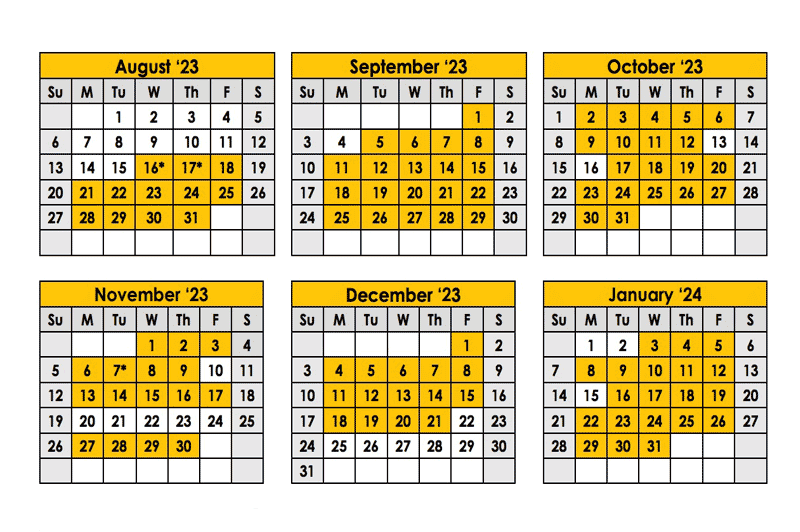
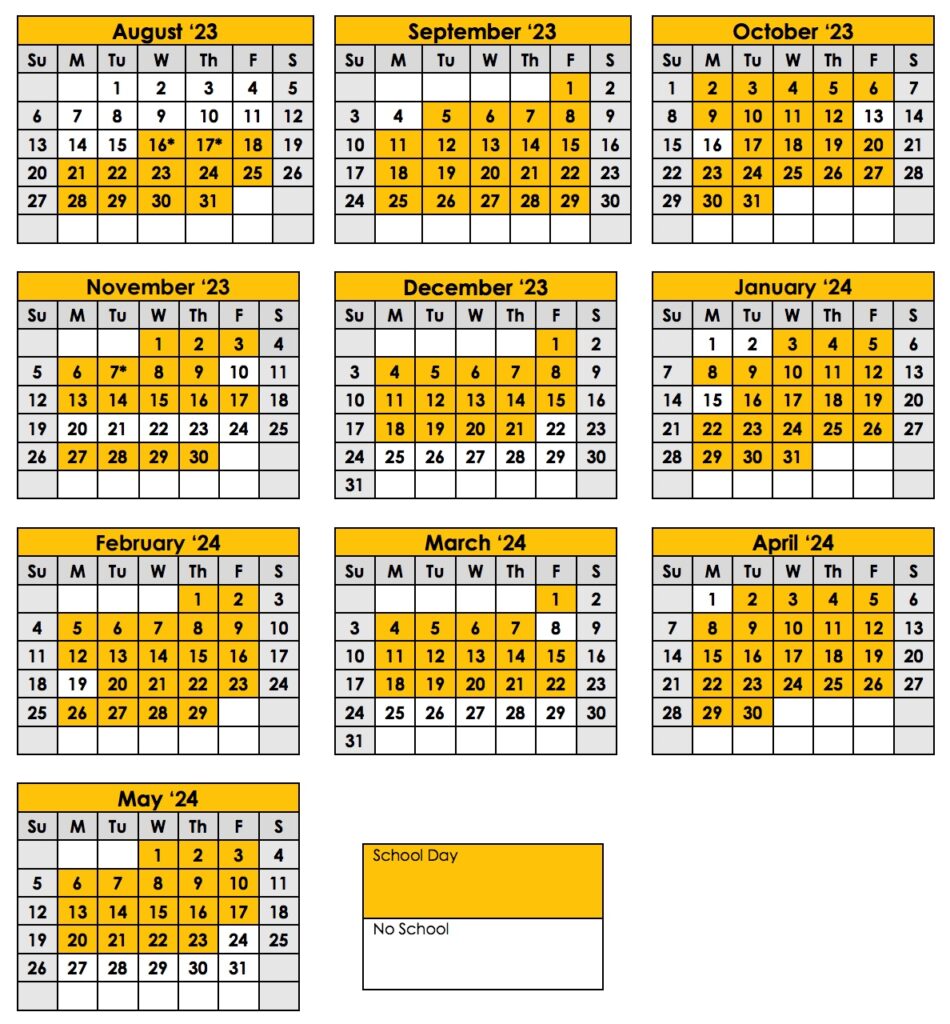
Wednesday, August 16, 2023 – First Day for Students with Last Names A-L Thursday, August 17, 2023 – First Day for Students with Last Names M-Z Monday, September 4, 2023 – No School – Labor Day Thursday, October 12, 2023 – Last Day of the First Quarter Friday, October 13, 2023 – No School – Inservice Day Monday, October 16, 2023 – No School – Inservice Day Tuesday, November 7, 2023 – No School PK-4 – Election Day Friday, November 10, 2023 – No School – Veterans Day (observed) Monday, November 20, 2023 – No School – Fall Break Begins Monday, November 27, 2023 – Students Return – Fall Break Ends Thursday, December 21, 2023 – Last Day of the Second Quarter Friday, December 22, 2023 – No School – Winter Break Begins Wednesday, January 3, 2024 – Students Return – Winter Break Ends Monday, January 15, 2024 – No School – Martin Luther King Jr. Day Monday, February 19, 2024 – No School – Presidents Day Thursday, March 7, 2024 – Last Day of the Third Quarter Friday, March 8, 2024 – No School – Inservice Day Monday, March 25, 2024 – No School – Spring Break Begins Tuesday, April 2, 2024 – Students Return to School – Spring Break Ends Thursday, May 23, 2024 – Last Day of School /Last Day of the Fourth Quarter
“Due to unforeseen circumstances, the Tuesday, June 14, 2022 business meeting of the Loveland City School District Board of Education has been canceled. The new meeting date is Thursday, June 16, 2022, at 6 pm in the Loveland Intermediate School Media Center.”
Loveland, Ohio – The Loveland Board of Education announced at its March 22 Regular Session that it would have a Special Meeting on June 14, at 6 PM in the Loveland Middle/Intermediate School Media Center.
The agenda for this rescheduled regular meeting is available on BoardDocs.
The Board may authorize a Resolution of Necessity to Request Hamilton County Auditor Certification of projected Revenues for a 4.90 Mill Levy for the General Election on November 8.
“First impressions may be lasting.” That was the phrase that Mrs. Erickson, my seventh grade English teacher, calmly used to greet her students on a first day of school more than 25 years ago. It was her cerebral attempt to control a classroom of rambunctious pre-teens, not through threats or punishment, but by suggesting that the way we carry ourselves matters—and that we only get one shot to project a first impression onto others—others who will use it as a glimpse into our true character. While that profound wisdom was largely lost on me at the time, it has stuck with me and proven true in the many years since. But the reflection to follow is not about Mrs. Erickson. It is, however, about another English teacher: Eileen Washburn—incumbent candidate for the Loveland Board of Education.
Before proceeding, I must admit that the apparent irony of sharing a “first” impression of someone who is already well known by this community is not lost on me. As the only candidate on the November 2nd ballot who will soon have fulfilled a full term of service on this board, Eileen has already been tested. Loveland voters have had four years to get to know her; four years to see her in action. But bear with me.
It’s not Eileen who’s new to the scene. It’s me.
Having lived in this district for what feels like five minutes (5 months to be precise), I have come to realize the “sticky” nature of this city. Residents love it here. They are from here, and they stay here. Everyone seems to know everyone. To be clear, I love this about Loveland, and I hope this describes my relationship with this community one day.
But for now, I’m still unpacking boxes and figuring it all out. Given the timing of my arrival in Loveland with the impending election, my lens (and conscience) is clear. My perspective is still fresh and unclouded. I see this as a unique strength in assessing the current pool of candidates.
My family and I moved into the district knowing virtually no one in the Loveland community. We have no family here. We have no political connections here. We have no “levy baggage.” For that I am grateful. There is so much I don’t know yet about this district. But for the sake of this discussion, let me share what I do know.
I know that this school district was a primary reason my family chose Loveland as our new home.
I also know that we moved amid a global pandemic and a period of social and political discord unmatched in our nation’s recent history. We are dealing with hard stuff that will fill history books in years to follow. Despite this, we came here still full of hope. We believed that in Loveland, we could give our kids the absolute best opportunity for a premier public education and a bright future.
Sadly, however, our optimism about Loveland Schools was immediately tested upon our arrival. The strife that greeted us was palpable. The wounds (on both sides) of failed levies were still being licked. The rhetoric was intense, and at times hateful. People who had been friends for 20 years were suddenly no longer speaking. And, people and events that were totally unfamiliar to my family just a few weeks prior were suddenly the only topics anyone we met wanted to discuss; these were seemingly the only things that mattered anymore. The crescendo for us was witnessing the police (yes, the police) respond to help calm the angry crowd at the very first School Board meeting we attended.
In those first few meetings I witnessed screaming. I heard accusations; I heard threats of litigation. I saw a physician flagrantly vote against masks in schools for our youngest students who are still vaccine ineligible. Where did we move, and what is going on here? Our “welcome” to Loveland was not a first impression that I wanted to last.
So, now back to things I do know and have recognized (it’s not all doom and gloom) as an unencumbered newcomer. First, I know we can still have hope. Second, that hope lies in Eileen Washburn.
I have come to know Eileen over the past few months, and who I’ve met is someone who is thoughtful, calm, and measured. When Eileen speaks, I hear a clear voice of reason that surmounts the noise around her. I hear commonsense policymaking, not political pandering. We need this now more than ever.
I know that it can be lonely at the top. Yet, I have seen Eileen bravely break away from the comfort and protection of the crowd, if and when it is in the best interest of the district’s students, families, and staff to do so. Eileen’s morals are unwavering, and her judgment is sound. In decision-making, Eileen chooses what’s right over what’s easy. Her work ethic is unparalleled.
I know that Eileen cares. As a parent of district students, she has a personal family stake in the success of our schools. As a teacher, herself (in a neighboring district), dedication to students is in her blood. Eileen is the teacher who will stay after school to support a student who is nervous about trying out for the basketball team (true story!). She’s also the kind of person who would never brag about that.
In closing, I want to be clear that I am not writing in support of Eileen because I am her neighbor, long-time friend, or family member. I am not writing this because she asked me to. I volunteered. I sought her out because I was impressed with what I saw in her. I am writing this because Eileen showed up for my family when we needed a leader on the board. I know that in her next term, Eileen will continue to advocate for the physical, mental, and emotional health and safety of my kids, and for their long term scholastic success—just like she has already done during our short time here. I also know that she’ll advocate for your kids too…whether you vote for her or not. She just can’t help it; it’s who she is.
And that’s my first impression of Eileen Washburn—one that will last a lifetime.
Kevin Dougherty, Loveland Board of Education Vice-President, posted a short video on his campaign website entitled “Thinking Through How To Choose – A Different Approach”. In it, he identifies the qualities that matter for Board membership as leadership, preparedness, motivation, commitment, and the ability to listen and learn. I agree with all of that – although I question how prepared anyone can be, or ever has been, for stepping into a Board role for the first time.
He goes on to say that “what a candidate supports or doesn’t support doesn’t matter unless he or she can get results.” I half agree with that. It doesn’t much matter what a person is for or against if he doesn’t get results. On the other hand, if a person gets results, what he is for or against is of central importance because that will determine what results he will attempt to achieve. However well the Board members in recent years might have scored with respect to Mr. Dougherty’s list of qualities, they certainly got results. To take only the most salient recent example, in 2019 they succeeded in getting onto the ballot a levy of historic proportions – which was voted down by the community 78% to 22%. Whatever the Board was for or against in 2019, it was clearly misaligned with what the community was for or against. It is hard to argue, then, as Mr. Dougherty suggests, that it doesn’t matter what “it” is as long as “it” gets accomplished. Of course, we want to elect Board members who can get results. For that very reason, it matters very much what those members support or don’t support.
I would actually expand Mr. Dougherty’s list. He mentioned being humble but it didn’t make his top five. Humility is an essential characteristic for being a successful Board member. Independent thinker is also imperative. I would rather see a Board grapple with issues in front of the public rather than come out and uniformly vote on things without much discussion.
Finally, it is essential to me, a voter and taxpayer, that Board members respect parental rights, support strong academics and a challenging curriculum, and respect taxpayers. It’s a tall order, but I think some of the candidates possess these qualities in abundance. Moreover, we have candidates who genuinely care about putting students first without alienating the residential district that foots the bill.
I have seen several candidates dismissed as being “inexperienced”. Obviously, anyone who hasn’t sat on a Board does not have the experience related to being on a Board, and every Board member in history was once in that position. If inexperience were a bar, there would be no Boards.
At the end of the day, an inexperienced Board seeking the right results is incomparably to be preferred to an experienced Board seeking the wrong results. Inexperience tends to correct itself; a bad result does not.
Lesley Hodge is a resident of Symmes Township and the Loveland City School District
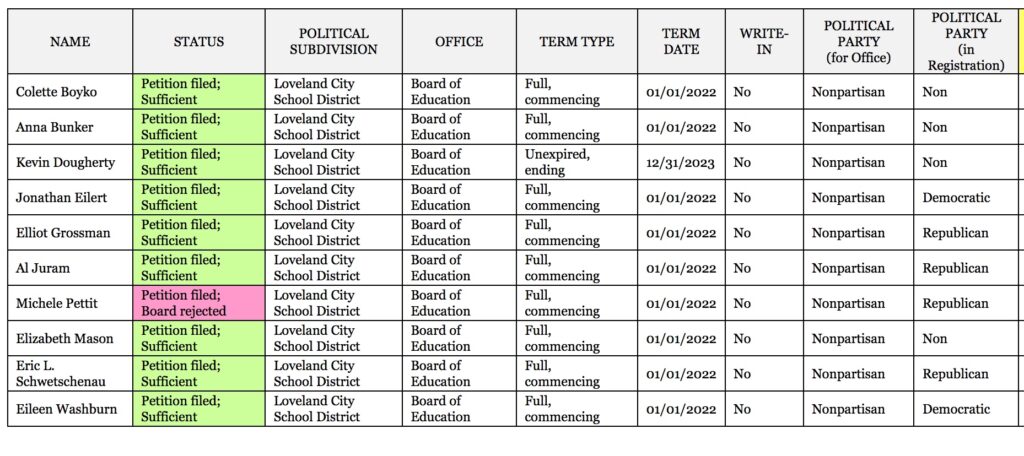
Loveland, Ohio – Homana Nebel an Administrative Associate with the Hamilton County Board of Elections has told Loveland Magazine that current Loveland City School Board member Michele Pettit’s nominating petitions to run for another four years on the Board has been rejected.
Candidates for the Loveland School Board (provided by Hamilton County BOE)
Nebel said that there was a problem with the petition/s she filed with signatures of Clermont County voters. Candidates need a total of 75 total valid signatures of District registered voters and Petitt ended up with only 55.
Petitt has been notified and can appeal the rejection to the Board of Elections and be granted a hearing but as of 3 PM today they have not heard from her. Another option according to Nebel is for Petitt to file to be a write-in candidate and she has until August 23 by 4 PM to pay a fee and file the needed paperwork with her declaration of intent.
Loveland Magazine has reached out to Petitt asking if she will pursue these two options.
Petitt’s current term is set to expire on December 31. The election is on November 2.
Loveland, Ohio – On August 11, the Loveland Board of Education adopted a face covering policy requiring masks for staff and students in grades PreK-12.
All students riding a Loveland school bus must be wearing a face covering/mask when boarding the bus, riding the bus, and departing the bus.
Face coverings/masks must be worn into the building at all times and only removed when directed by the teacher or staff member.
The Board policy states that face coverings/masks are “required and should”…
Fully cover mouth, nose, and chin;
Not create difficulty breathing while worn; and
Be held secure through a tie, elastic, etc. to prevent slipping; and
Be of effective quality (i.e., double-layered, non-permeable, tightly woven fabric without valves).
For the current time, this is the District policy, however, the Administration is also waiting on Ohio’s written orders for the full implementation guidelines of the face covering/mask policy for schools.