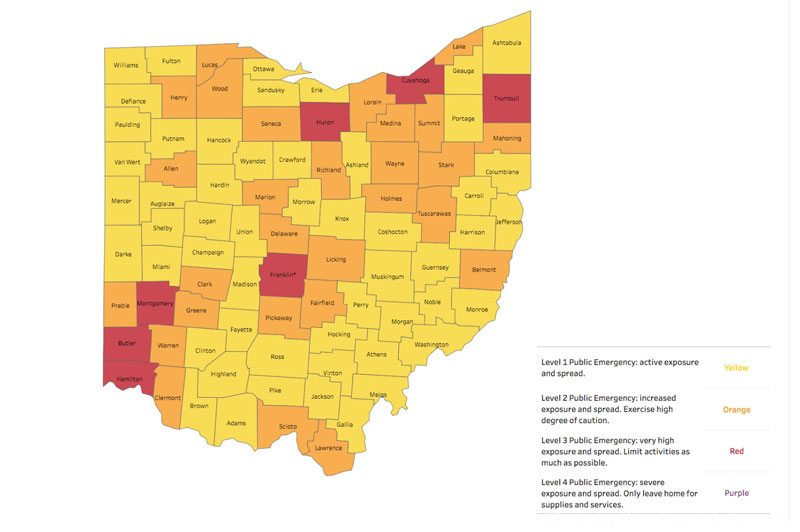
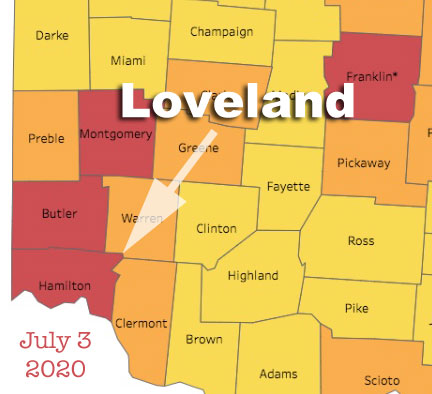
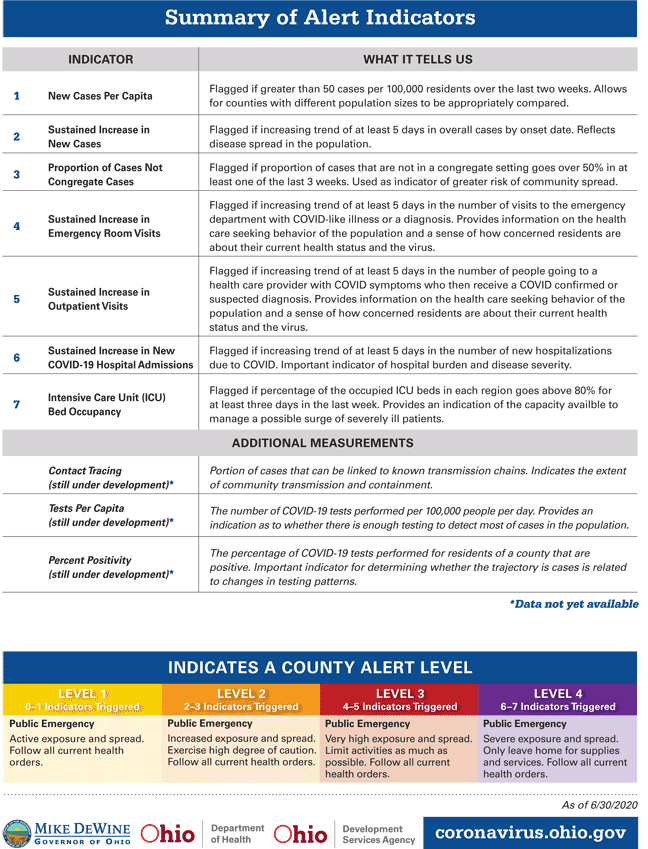
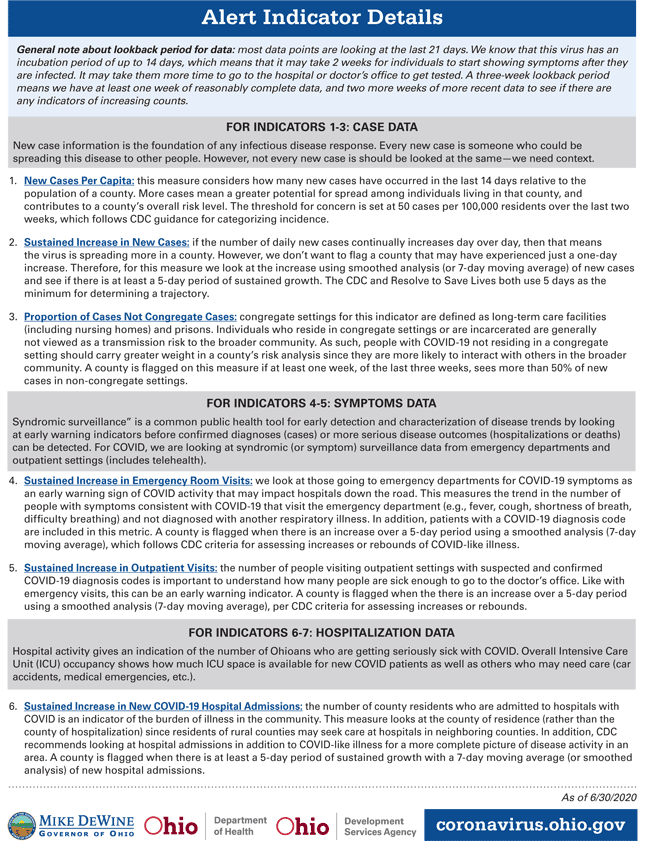
The Public Health Advisory Alert System is a color-coded system designed to supplement existing statewide orders through a data-driven framework to assess the degree of the virus’ spread and to engage and empower individuals, businesses, communities, local governments, and others in their response and actions.
The system consists of four levels that provide Ohioans with guidance as to the severity of the problem in the counties in which they live. The levels are determined by seven data indicators that identify the risk level for each county and a corresponding color code to represent that risk level.
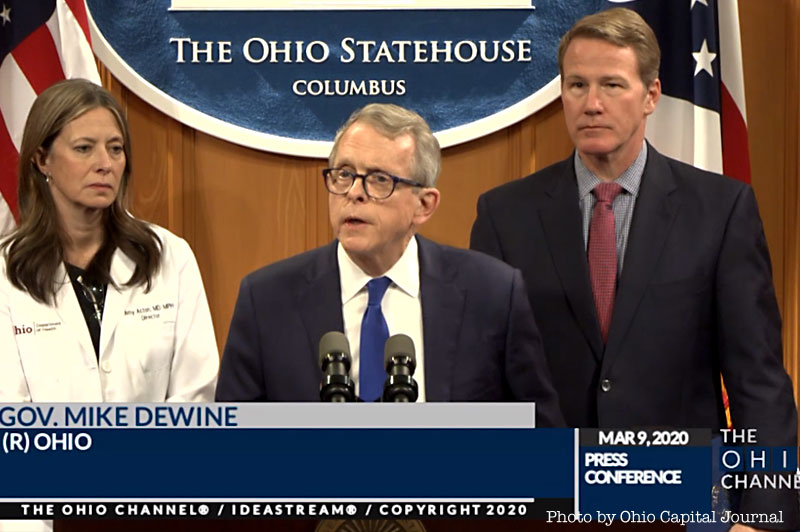
Columbus, Ohio – Governor Mike DeWine Thursday declared that “We’re in a crisis S/state in Ohio.” He was speaking at a COVID 10 news briefing in Columbus.
The governor dithered. The state legislature said no way.
So on Tuesday, the Springfield City Commission took it upon itself to pass a resolution (which lacks the force of law) calling for all residents to cover their faces while indoors, a practice research says will slow the spread of COVID-19 through Ohio.
By Wednesday, Dayton became the first major city in Ohio to require masks by law. Similarly,Yellow Springs passed a resolution andBexley passed a local ordinance requiring masks.
“The mask is a symbol of freedom,” said David Estrop, a Springfield city commissioner, at a hearing, echoing comments from the governor. “It allows us to continue to reopen this state, yet do so in a way that’s safe.”
By Wednesday, Dayton became the first major city in Ohio to require masks by law. Similarly, Yellow Springs passed a resolution and Bexley passed a local ordinance requiring masks.
On Wednesday, the Ohio Department of Health reported more than 1,000 new cases, the first time that stat has reached quadruple digits since officials mass-tested inmates in three state prisons in late April. Wednesday marks 16 days of the coronavirus accelerating its spread, as measured by the 10-day average new caseload.
Despite the worsening coronavirus outlook in Ohio and nationwide, state lawmakers continue to whip up anti-mask fervor. While Gov. Mike DeWine encourages everyone to wear masks, he has refrained from issuing any statewide mandate as the national epidemic worsens and states pause their economic re-openings.
DeWine demurs
In April, Gov. Mike DeWine took a hardline stance on masks, saying they’d be the only way business can reopen after he lifted the stay-at-home order.
Last week, referencing worsening outbreaks in Montgomery and Hamilton counties, DeWine floated the idea of implementing a mask mandate on a county-by-county basis.
However, he has yet to issue any such order. A spokesman declined to say whether DeWine will announce any mask requirement at his next briefing.
In a statement Wednesday, DeWine applauded Dayton Mayor Nan Whaley, a Democrat, for requiring the use of face coverings.
“Wearing a mask will allow us to help keep businesses open and help prevent further spikes,” he said. “I encourage other communities to consider following Dayton’s lead.”
Voted down
Where masks have found friends in the public health community and Ohio cities, they found enemies in the GOP-controlled state General Assembly.
Where masks have found friends in the public health community and Ohio cities, they found enemies in the GOP-controlled state General Assembly.
Both the Speaker of the House and the Senate President have refused to wear masks at legislative functions.
“It’s my RIGHT not to wear a mask, and I do NOT support a government that tries to quarantine the healthy,” he wrote.
Rep. Nino Vitale, R-Urbana, takes to social media regularly to promote baseless conspiracy theories about masks limiting blood oxygen or how they “force virus into the brain.”
Rep. Candice Keller, R-Middletown criticizes Bureau of Workers’ Compensation for distributing masks to Ohio businesses.
Rep. Candice Keller, R-Middletown,produced a Facebook video June 25 criticizing Ohio’s Bureau of Workers’ Compensation for distributing masks to Ohio businesses.
Despite the lawmakers’ claims, research suggests masks are an effective, inexpensive and non-invasive way to slow the spread of COVID-19.
Mason, Ohio – Hakim Oliver graduated from Loveland High School in 1999. He then graduated from Bowling Green State University and is now an intervention specialist working with Seniors at Mason High School.
Hakim Oliver is married to Alison Oliver
On June 20 two Mason Alumni put on the BLM Mason March starting at Pine Hill Lakes Park in Mason going to the municipal building that drew thousands. The protest march with petition signing and speakers was to, “…stand in solidarity with our Black community members in their struggle for justice.” Their goals were to raise funds to support social justice, racial equality, protesters, and other facets of the Black Lives Matter movement.
After the protest march, Oliver approached leaders at Mason City Hall with the idea of holding community conversations in Mason Community Exposure – Bridging Stories. They accepted and embraced the idea. Oliver said, “This is a collaboration with the City of Mason and I’m looking forward to building relationships.”
Mason has announced the community conversations by saying:
Sponsored by the City of Mason and in partnership with Mr. Hakim Oliver this program is intended to facilitate positive intergroup interaction and discussion recognizing individuals are different from others and how we together create a community.
This four part series includes a panel discussion, public input, engagement and interaction helping increase participants perspective by listening and mentally walking in someone else’s shoes. The program aligns with Mason’s mission for building a culture of wellness in the community by helping elevate morale, respect differences, and give a voice to the community.
Community Exposure – Bridging Stories! participants meet each Wednesday July 15 through August 5 from 7:00 p.m. to 8:15 p.m. at the Mason Municipal Center located at 6000 Mason Montgomery Road.
Oliver has since approached Loveland City Hall for their support of similar community forums.
This video is Oliver’s keynote address:
Here is a video of the BLM Mason protest posted on YouTube by K Jackson.
BLM Mason Demands for Change
Today we stand in solidarity with our Black community members in their struggle for justice. On May 25th, 2020 George Floyd was yet another victim of police brutality against the Black community in America. His death following those of Ahmaud Arbery, Breonna Taylor, Nina Pop, and Tony McDade sparked a nationwide demand for racial equality. However, our community has largely stayed silent on such issues despite the international outrage that followed. Times like these are when a community must show its character, and for that reason we have organized a peaceful demonstration to achieve the following:
Goals for protest:
Raise funds to support social justice, racial equality, protestors, and other facets of the Black Lives Matter Movement
Sign petitions to further racial equality and protest safety in America
Demands:
Demand the establishment of two anonymous tip lines, one for the public to utilize, and another for police officers to release statements of other police officer’s misuse of power to both the police department and a third party group.
Demand the redistribution of Mason Police Department funding towards Police Officer Body Worn Cameras and cultural competency training to make Mason PD a progressive role model
Demand that the City of Mason hold an open meeting designated for People of Color to voice their concerns about safety and racism in our community.
The Board of Education has implemented a community-based Planning Commission to be a research and advisory resource for the school district. The Commission will assist the Board by researching and/or evaluating assigned issues and topics, and reporting its findings and recommendations to the Board for consideration. The purpose of the Commission is also to assist the Loveland community in becoming better informed about a variety of issues related to the schools. The Planning Commission has four Sub-Committees:
Communication/Community Engagement Subcommittee
Tasked with researching additional, innovative, and alternative ways to increase communication and engagement between the school district and the community. Members include:
Kelley Deer
Tara Hamilton
Jeff Hawk
Lisa Moorhead
Lynn Oury
Michael Shiverski
Facilities Subcommittee
Tasked with understanding the facilities assessments and current master plan, researching ways to revisit the master plan, and recommending a timeline. Members include:
Daniel Colletto
Brad Combs
Leah Jewell
Kevin Kimnach
Alvin Kressler
Warren Winning
Finance Subcommittee
Tasked with investigating opportunities for Loveland City Schools to increase income that does not raise local property taxes and researching effective practices in reducing expenditures. Members include:
Donel Autin
Brad Goldie
Matthew Hammer
Jill Jones
Craig Lewis
Nathan Libby
Lynn Mangan
Kirk McCracken
School Improvement/Student Experience Subcommittee
Tasked with understanding the current school improvement process and providing input to goals, benchmarks, and comparison districts for the implementation of the Portrait of a Tiger while optimizing our current resources. Members include:
Susan Craig
Lisa Saletta
Alexander Topala
Lindsey Willmann
Natasha Young
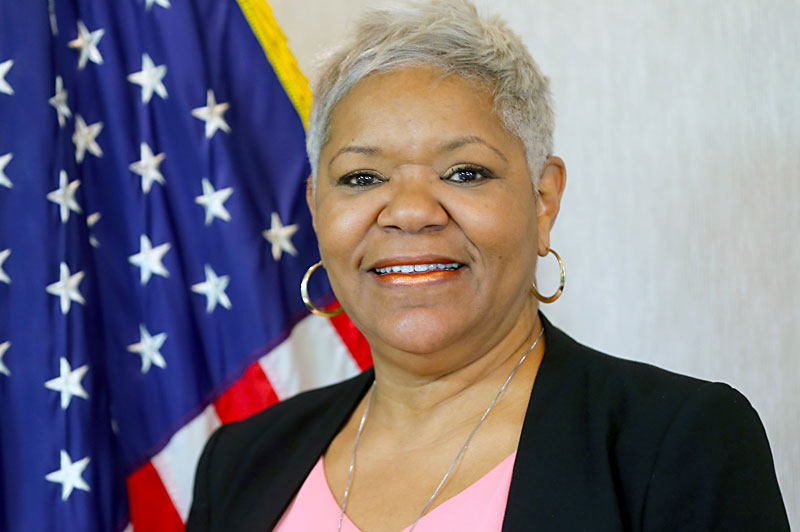
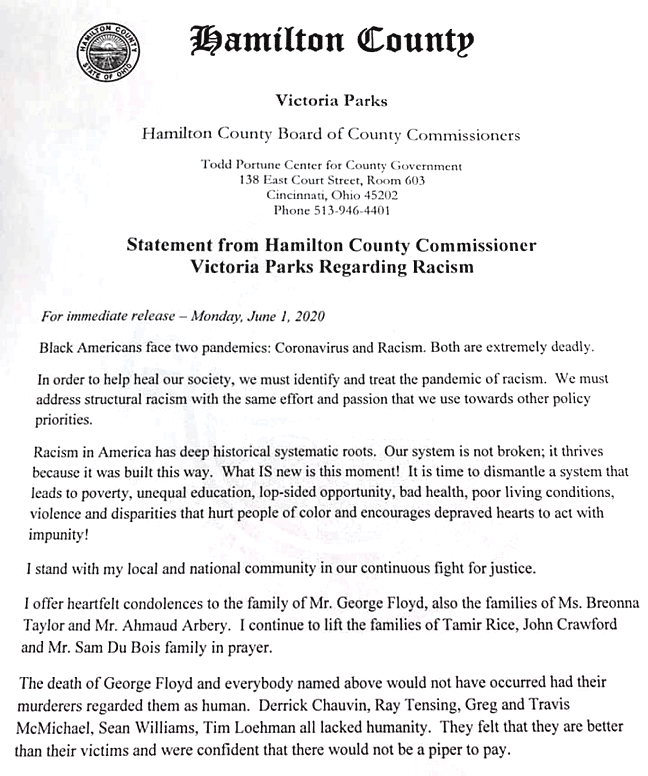
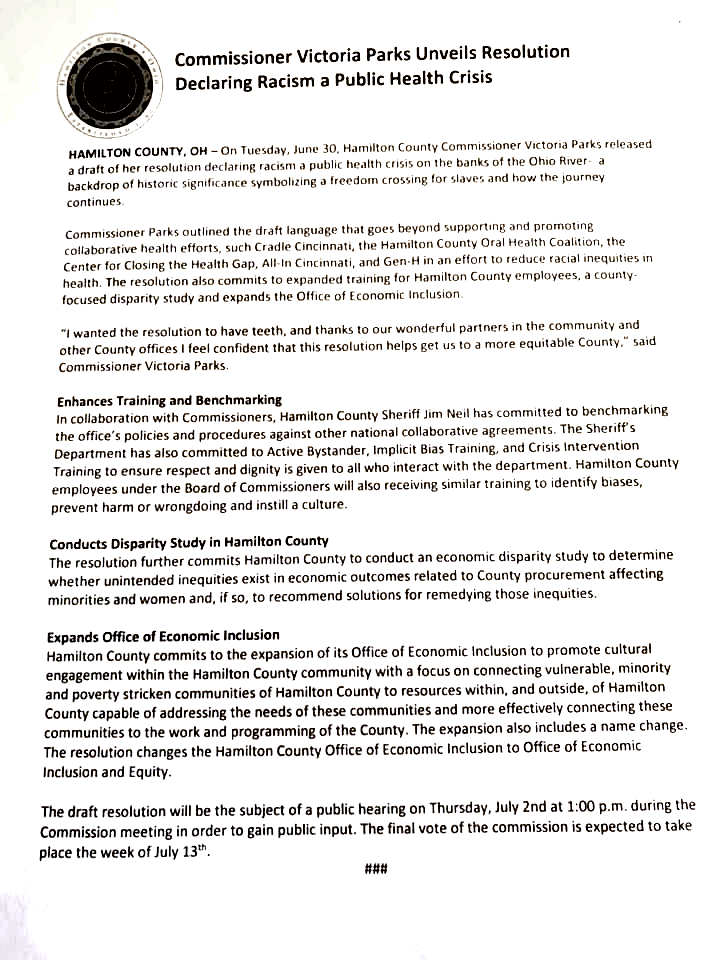
Hamilton County, Ohio – On Tuesday Hamilton County Commissioner Victoria Parks unveiled a resolution to declare Racism a Public Health Crisis.
The resolution was introduced at the National Underground Railroad Freedom Center.
President and COO of the Center, Woodrow Keown, Jr., spoke in support of the resolution:
“The nation was founded on the principles of life, liberty and the pursuit of happiness. Pursuit of happiness is hindered by fear and hatred that is directed daily—overtly and covertly—at black and brown people, simply because of the color of our skin. The deprivation of liberty for Blacks in America is well known and goes by the names of chattel slavery, Jim Crow, “separate but equal”, and systematic or institutionalized racism. Likewise, the simple right of life is threatened by hatred that has led to lynchings, fear that has led to calls of police brutality based largely on implicit biases, and systematic racism that makes the simple fact of being Black hazardous to your health.”
At 1 PM Thursday the Commission will hold a Hearing to consider the Resolution “Declaring Racism a Public Health Crisis”.
You can watch the meeting live or comment on the business the Board will be considering. Scroll to the bottom of this page to view the complete agenda for Thursday’s meeting.
The public is urged to view the commission meetings live on television or online using the following stations/platforms:
NOTICE
In order to keep the public and employees safe during the COVID-19 outbreak, Hamilton County Commissioners are holding commission meetings virtually. The public is urged to view the commission meetings live on television or online using the following stations/platforms:
Resolutions amending the MSD Capital Improvement Program to add a project; authorizing the preparation of detailed plans, specifications, estimate of cost, tentative assessment and/or other relevant documents and appropriating funds for design phase services and related expenses.
Loveland, Ohio – Loveland has always been known as a community that gives back, and ALWAYS takes care of the youth. Over the past few months many have been fighting for the Loveland School levy because, without the appropriate funds, Tiger student-athletes have to “pay-to-play.”
Recently two Loveland School levies failed, leaving both Tiger student-athletes and their parents at a stand-still. Now those Tigers wanting to participate in a sport will have to pay $310. This did not sit well with Loveland Tiger advocate, Tori Morrison, so with the approval of the Loveland Athletic Booster Board she created a Facebook group that would help those athletes that could not afford to pay the sports fees.
“With the recent failure of two school levies, we knew that Pay to Play fees would be increasing this year,” Morrison explained, “In anticipation of that, the Athletic Boosters decided that we needed some way to help the athletes to continue to play. We feel that no tiger should be left out. Fees were previously $105 for all sports except football and lacrosse which were $155. Now all sports will be paying $310 per sport.”
Morrison attended Loveland Schools from 2nd through 6th grade before she moved with her family to New Richmond where she eventually met her husband and moved back to Loveland when her oldest child entered into 3rd grade.
“We have had three children graduate from Loveland schools – Ashlei (03), Chelsei (10), and Ben (20). My kids have been involved in soccer, baseball, softball, basketball, football, lacrosse, yearbook, drama, and choir,” Morrison said, “Over the years I have been a team mom for various sports and most recently organized and planned the Homecoming Parade for the last six years. When my son graduated I decided I was ready to become involved in a different way and decided to run for the Loveland Athletic Booster Board.”
Morrison says that the newly created Facebook Group “Loveland Athletic Boosters” is focusing on raising money for the student-athletes that may not be able to afford the pay-to-play fees.
“We want to share information and we encourage everyone to spread the word,” Morrison said, “The more people that join the group the more Tigers we can help! We want everyone to get a chance to play regardless of their financial situation. It’s going to be really tough for some families to pay the now $310 pay to play fee. Some athletes won’t be able to play at all and others will be forced to pick one sport where they used to be able to play two or three.” Many, many families have more than one child that will want to participate in a sport.
Thus far Morrison told us that the entire Loveland Athletic Boosters (LAB) Board is behind the fundraising efforts including, President Jeff Williams, Vice President Rich Myklebust, Treasurer Stephanie Bashardoust, and Secretary Stacey Lund. Soon LAB will be offering Business Memberships which would be a first for the Board.
I asked Morrison if the new Facebook Group would be holding any fundraising events and she said they are ALWAYS searching for new ideas and ways to raise money. The LAB’s do in fact have some awesome events planned that they hope will bring in a lot of funds for Tiger Student-Athletes.
Learn more about theannual Golf Outing on July 27 at O’Bannon Creek Golf Club.
“Our annual Golf Outing is July 27 at O’Bannon Creek Golf Club.
The Membership drive kicks off on July 1 and fall student-athletes will be selling discount cards that will be good at local restaurants and businesses,” Morrison said, “We will also be having like we do every year in January our Tiger Ball. One hundred percent of the money from these events will go towards helping our student-athletes with fees, gear, and anything else they need.”
Cassie Mattia is the Associate Editor of Loveland Magazine and lives in Historic Downtown
by Cassie Mattia
Loveland, Ohio –It’s that time of year again for the Annual “Stuff the Cruiser” Food Drive sponsored by the Loveland Police Division and the Loveland Citizen Police Academy Alumni Association!
The food drive is scheduled for Saturday, July 18th at the Loveland Kroger store from 9 AM until 1 PM. There will be many smiling volunteers set up outside Kroger to accept all donations. The donations that are collected will be taken to LIFE Food Pantry where they will be both sorted and dated.
LIFE Food Pantry volunteer, Connie Rotterman is more than excited for this particular food drive because there have been so few since February in light of the COVID-19 pandemic.
“This food drive will really help fill our pantry shelves and feed the over 300 families in Loveland that depend on LIFE Food Pantry each month for food,” Rotterman said.
If you would like to provide over 300 families with the food they need please take a few minutes out of your day to stop by Loveland Kroger on July 18th between 9 AM and 1 PM to donate food items!
Click the image below to read about all of the programs offered by LIFE Food Pantry…
From the office of Ohio Congressman Brad Wenstrup:
As a Member of Congress, I have the privilege of nominating exceptional young people for admission to the U.S. Military Academy at West Point, the Naval Academy, the Air Force Academy and the Merchant Marine Academy, known collectively as the U.S. Service Academies. My office also works with students interested in the Coast Guard Academy. The U.S. Service Academies offer opportunities for motivated young men and women to serve their country while receiving an excellent education and developing valuable leadership skills. In place of tuition, the Academies require military service after graduation.
If you’re interested in attending a U.S. Service Academy, check out the resources below. If you have any questions, please contact Annie Cummins in my Cincinnati District Office: (513) 474-7777.
Pathway to an Academy Nomination
Admission to the U.S. Service Academies is highly competitive and selective, as is the process of securing a nomination. Here are some things to consider on your pathway to a nomination and, ultimately, admission to an Academy:
Academic Achievement:
The U.S. Military Academies are looking for candidates who have a strong record of academic achievement. Your high school GPA and class rank are important indicators of your academic record, as are the kinds of courses you take. Consider taking more challenging courses (like AP/Honors classes, math and science classes, etc.) whenever possible.
Leadership and Service:
Candidates for the Academies must demonstrate outstanding leadership both in and outside of the classroom. Participating in extracurricular activities like athletics, clubs, and community service organizations can help you develop and hone your leadership skills.
Summer Programs:
The U.S. Military Academy, the U.S. Air Force Academy, and the U.S. Naval Academy each offer a variety of summer programs for prospective applicants. Participating in one or more of these programs is a great way to become acquainted with life at the Academies. Click on the links below to learn more about these opportunities.
Stay tuned for upcoming Academy Day dates.
Applying for an Academy Nomination
To be considered for a nomination to one of the United States Service Academies for the graduating class of 2025, your application must be received by the Cincinnati District Office by 5:00 p.m. on September 25th, 2020. Your completed file must contain the following:
Completed Application Form
High School Transcript – Transcript must include all course work, GPA, and class rank.
Standardized Test Scores – Please provide official scores from the ACT or SAT, or both, as reflected on a school transcript or in official documentation from ACT or SAT.
High School Recommendation – Please provide a letter of recommendation written by your Guidance Counselor or High School Principal.
Letters of Recommendation – Please provide 2 additional letters of recommendation.
Community & School Activity List – Please list all school, athletic, and community activities and other significant accomplishments/awards.
Essay – Please provide an essay (300 words or less) outlining why you want to attend a United States Service Academy and then serve in the military as a commissioned officer.
Interview – All applicants will be required to attend an interview session conducted by our Academy Panel. Dates, times, and locations will be determined at a later date.
Photograph – Please provide a current 5×7 photograph.
Deadline – Send the above information by September 25, 2020.
The nomination materials referenced above are SEPARATE AND DISTINCT from the application materials you must submit directly to the Academies.
Please make sure to also begin your pre-candidate file with each Academy to which you plan to make application.
The Home Energy Assistance Summer Crisis Program provides a one-time benefit to eligible Ohioans with cooling assistance during the summer months. The program runs from July 1 to September 30.
The focus of the Summer Crisis Program is to provide assistance with electric utility bills, central air conditioning repairs, and air conditioning unit and/or fan purchases.
Households with a household member who is either 60 years of age and older, has been diagnosed with COVID-19, or has a certified medical condition, and households who have a disconnect notice, have been shut off, or are trying to establish new electric service may be eligible for assistance.
Ohioans enrolled in the Percentage of Income Payment Plan Plus (PIPP) Program are eligible for assistance towards their default PIPP payment, first PIPP payment, central air conditioning repairs, or may receive an air conditioning unit and/or fan.
Who is Eligible for the Summer Crisis Program?
Ohioans with a household income at or below 175 percent of the federal poverty guidelines and have a member of the household who is at least 60 years old, has been diagnosed with COVID-19, or can provide physician documentation that cooling assistance is needed for a household member’s health, or households who have a disconnect notice, have been shut off, or are trying to establish new electric service.
Size of Household
Total Household Income 12 Months
1
up to $22,330
2
up to $30,170
3
up to $38,010
4
up to $45,850
5
up to $53,690
6
up to $61,530
7
up to $69,370
8
up to $77,210
For households with more than eight members, add $7,840 for each individual.
How do I apply for the Summer Crisis Program?
You can begin your application online at energyhelp.ohio.gov but will need to set up an appointment with your local Energy Assistance Provider in order to complete the application.
When you apply, you will need to complete the Energy Assistance Application (English or Spanish) and submit copies of the following documents.
copies of your most recent utility bills
a list of all household members (include birth dates and Social Security numbers) and proof of income for everyone in the household over 18 years old for the last 30 days for each member (12 months preferred)
proof of citizenship or legal residency for all household members
proof of medical condition verified by a licensed physician or registered nurse practitioner
You will need to include: proof of income for the past 30 days and 12 months for each member, a copy of your recent fuel/utility bill, proof of medical condition signed by a doctor or nurse practitioner, and a list of all household members (including Social Security Numbers).
Contact your local Energy Assistance Provider for a list of all required documents. Depending on your income type, additional forms may be required. Samples of the additional forms can be found by clicking here.
Frequently Asked Questions
How often can I apply for a HEAP Summer Crisis benefit?
You can apply for assistance through the HEAP Summer Crisis Program once a year.
What if I live in Federally Subsidized Housing?
Families who live in federally subsidized housing are not eligible unless the electric bill is in their name or they have verification that they are responsible for portion of the electric bill.
How do you define household income?
Household income is defined as the total annual gross income before taxes (minus exclusions) of all household members, except earned income of dependent minors under 18 years of age. All income and allowed exclusions must be documented for household members 18 years of age and older regardless of relationship to the primary applicant. Heads of households and spouses may never be considered minors. Gross household income includes wages, interest, dividends, annuities, and pensions.
Included (Countable) Household Income
Active Military Pay (Basic pay)
Adoption Assistance
Alimony
Annuity
Black Lung
Capital Gains – Proceeds from sale of property, home and stock
Cash Withdraws from Individual Retirement Accounts (IRA), Annuities, or other investments
Commissions
Company Disability
Disability Assistance (DA)
Estate and Trust Settlements – minus attorney fees – (one-time payment or lump sum)
Farm Income
Garnished Wages, including Bankruptcy/Chapter 13
Grants/Training Stipends – living expenses only
Immigrant Relocation Allowance
Interest earned from Savings Accounts
Legal Settlements
Lump Sum Distribution
Odd Jobs
Ohio Electronic Childcare (Ohio ECC) – Provider Income
Ohio Works First
Pensions – Government/Veterans/Private Industry
Rental Income earned from rental property
Seasonal Employment Income
Self-Employment Income
Social Security, Supplemental Security Income (SSI) Social Security Disability (SSDI) (Excluding Medicare Deductions)
Strike Benefits
Temporary Assistance to Needy Families (TANF)/General Assistance (GA)
Unearned income paid to or on the behalf of minors
Unemployment Benefits
Utility Allowances (as discretionary income)
Veteran’s Administration Benefits
Wages/Tips
Widows/Widower’s Benefits
Workers’ Compensation
Excluded Household Income
Adoption Assistance
Agent Orange Compensation/Benefit
Assets from bank withdrawals (90-day rule)
Attorney’s fees for Estate & Trust Settlements
Census Wages
Child Support Paid Out
Child Support Received
Education Assistance
FEMA Cash Payments
Food Assistance Benefit – Food Stamps, SNAP, etc. (cash or equivalent)
Funds/training stipends designated for specific purposes (i.e., educational Grants/Training stipends for tuition and/or books only-not living expenses)
Gifts
Handicapped Income – self-sufficiency programs (example: work expenses for the blind)
Health Care Spending Accounts – non-taxable health care spending accounts are allowable
Health Insurance Premiums (dental, vision, health and supplemental insurance)
Income earned by dependent minors less than 18 years of age
Jury Duty
Loans from individuals or institutions requiring repayment of either principle or principal and interest*
Medicaid spend-down
Medicare Part D (prescription premium)
Medicare Payments
Military Allowances for Subsistence, Housing, Family Separation, etc.
Ohio Waiver Program
Prevention, Retention, & Contingency (PRC) – assistance to attempt to divert families from long term financial dependency
Proceeds from reverse mortgages
Reimbursement for work expenses
SS/SSI and SSDI overpayments
Stipend for Foster Care
Tax refunds and rebates
Title III Disaster Relief Emergency Assistance Program (DREAP)
Title V Wages/Senior Community Employment Programs (SCEP) – Older Americans’ Act (Public Law 100-175) Experience Works (formerly Green Thumb), Foster Grandparents Program, Mature Services
Volunteers in Service to America (Vista) or other AmeriCorps Stipends
Work Allowances (i.e., Learning Earning and Parenting [LEAP])
Work programs for people with disabilities
I have applied for HEAP, but I may be disconnected from my utility service. Can I apply for Summer Crisis assistance?
Yes, you can apply for the Summer Crisis Program. Contact your local Energy Assistance Provider to apply.
Who can I call with questions about the Home Energy Assistance Summer Crisis Program?
You can call the Ohio Development Services Agency’s hotline (800) 282-0880 or your local Energy Assistance Provider by clicking here.
Other Programs
If you’re having trouble managing your home energy costs, there is help. Below is a list of programs that can help you manage your utility bills and improve your home’s energy efficiency. You also can find a list of local Energy Assistance Providers and a copy of the program application.
You also can apply for assistance online. Visit energyhelp.ohio.gov to complete your application.
Loveland, Ohio – Its been a tough road for athletes all across Ohio in light of the COVID-19 pandemic. Competitions have been canceled, sports seasons have been postponed, and in-person practicing has been banned. Although this new normal has been hard on many high school athletes and coaches, many were glad to hear that the Ohio Governor and Health Department’s Responsible Restart Ohio implemented a “three-phase process” that would ease both athletes and coaches back into practicing and competing.
LHS’s Athletic Director, Brian Conatser, couldn’t be happier to get the Tiger Athletes and Coaches back into LHS’s athletic facilities, but in the safest way possible!
“We are in Phase 3 of our skills practice which will last until July 6th,” Conatser explained, “Once we get more guidance from the Ohio Governor and OHSAA, we will move forward with those restrictions and guidelines.”
On June 1st, LHS opened its Athletic Facilities in accordance with the OHSAA skills training guidelines.
“Our coaches are extremely committed to working with the Athletic Department to implement COVID-19 procedures and guidelines. As an Athletic Department, we walked through the process as a team, fine-tuning our plan prior to our athletes returning to campus,” Conatser said, “The plan is extremely thorough and detailed, as the safety of our student-athletes and coaches are our primary concern.”
Conatser provided the guidelines given to him by OHSAA that both coaches and student-athletes are following as they begin to return to athletics.
Every student-athlete and coach MUST complete the 2020-21 Final Forms COVID-19 waiver prior to the 1st training session.
Every student-athlete and coach MUST complete the LHS COVID-19 Self-Evaluation Google Form every day prior to each skills training session.
Social distancing includes a 6-foot separation. Entrances and Exits are outlined and over-communicated to avoid congregation and lingering of student-athletes.
Facial coverings must be worn when in the building (gyms, fitness center, athletic training room). Facial coverings may be removed during the training session.
Sanitation products and stations are located at the entry and exit of our inside facilities. We also ask EVERY student to bring: Water bottle, Sanitation wipes, Hand sanitizer, and Facial covering.
All equipment, balls, etc. must be wiped down at the beginning and end of each training session.
Three phases: Phase 1: May 26th – June 8th / Phase 2: June 9th – June 22nd / Phase 3: June 23rd – July 6th
Conatser gave credit to Loveland’s student-athletes, coaches, and parents for playing such an important role in the three-phase process.
“From parents dropping off their kids in designated spots to everyone following the COVID-19 guidelines. The coaches deserve an overwhelming amount of credit,” Conatser said, “These outstanding professionals make sure their programs have all of the information well ahead of time via communication from ZOOM, Google Hangout, email, Twitter, etc. We are looking forward to a safe and productive summer of skill training.”
For more Loveland Tiger sports updates stay tuned to the Sports 411 With Me, Cassie Mattia!






![[VIDEO] LHS grad Hakim Oliver keynotes BLM March in Mason](https://lovelandmagazine.com/wp-content/uploads/2020/07/blm-mason-.jpg)


 by Cassie Mattia
 Click Here To Sign Up Now! to be a Memember of the Loveland Athletic Boosters