Loveland, Ohio – Resident Tom Scovanner has an Army background teaching leadership skills at the United States General Command and Staff College. He went to the open forum podium at the Loveland Council meeting on Tuesday, October 23 to express his thoughts on leadership and the selection of a new mayor that will be made on December 6.
He described the job as teaching Majors and Lt. Colonels so they could lead complex organizations.
Scovanner said that Loveland should move into 2022 with a new Mayor and suggested it should be Tim Butler.
Loveland, Ohio – Loveland resident Kim Lukens went to the open forum podium at the Loveland Council meeting on Tuesday, October 23, to express her views about alcohol consumption and the Council’s promotion of drinking in Historic Downtown.
Lunkens is a licensed professional social worker and counselor. She told Council that they are encouraging “irresponsible alcohol habits.” She asked, “I wonder if you all can think of another way to bring prosperity into our City that doesn’t involve alcohol?”
She added that she doesn’t encourage her adult children to visit Loveland because of the “tremendous” focus on alcohol.
Loveland, Ohio – Resident Sharon Scovanner went to the council meeting on Tuesday, November 23, and addressed concerns about how Mayor Kathy Bailey represents an exchange between the Mayor and resident Dave Stanton and about the Mayor’s use of discretion limiting free speech at council meetings. Scovanner also said that the Mayor has used the Chief of Police to intimidate the press during meetings.
Be swept back in time while visiting Old Historic Loveland on this special day. Everything from Jolly Ole’ St. Nick and Mrs. Claus at the North Pole, to a live Nativity scene, to a Winter Wonderland! This is the time of year that Loveland Businesses give back to the community. This complimentary event offered to the community draws over 3000 individuals each year and is Loveland’s way of saying “Thank you for your Business!!”
Loveland, Ohio – Resident Lauren Enda spoke at the council meeting on Tuesday. Enda said she retired in Loveland after working at the National Security Agency. She began by saying, “After thirty years of doing my part to protect the United States, I did not expect to continue to do that role in retirement, but here I am.”
She continued by outlining instances of Mayor Kathy Baily suppressing free speech at council meetings.
Enda spoke mostly about a proposed parking garage in Historic Downtown and the message she sees sent by voters via the recent election. “One council member indicated he was opposed to that garage and he won the most votes. The message is clear. Loveland voted against the garage,” Enda said.
Enda wants the question of building a garage put to a formal vote. She says Council should determine the will of the residents by putting the question on the May 3, 2022, ballot.
Loveland, Ohio – Resident, Patti Sandmayr went to the open mic at the council meeting last Tuesday and spoke about living in Historic Downtown. She started by saying she sees this town every day and drives through it every day. Speaking directly to the Council she said, “I love it and I intend to keep going as long as I can, encouraging you guys.” She also talked about Mayor Kathy Bailey’s recognition of Sgt. Ryan Bauman on Veterans Day. Baughman was killed in Afghanistan in 2008. Ryan and his family lived in Loveland the first 5 years of his life.
Sandmayr also said that parking was her “number one issue” with living in the Historic District and said she favored building a parking garage.
She also expressed confidence in Council’s, “accuracy and transparency” in regard to annexing the Grailville property into the city and that things “will be done properly”.
“I promise to all those surrounding me including all of you in Loveland I will continue to make this community the absolute best place to live and visit.”
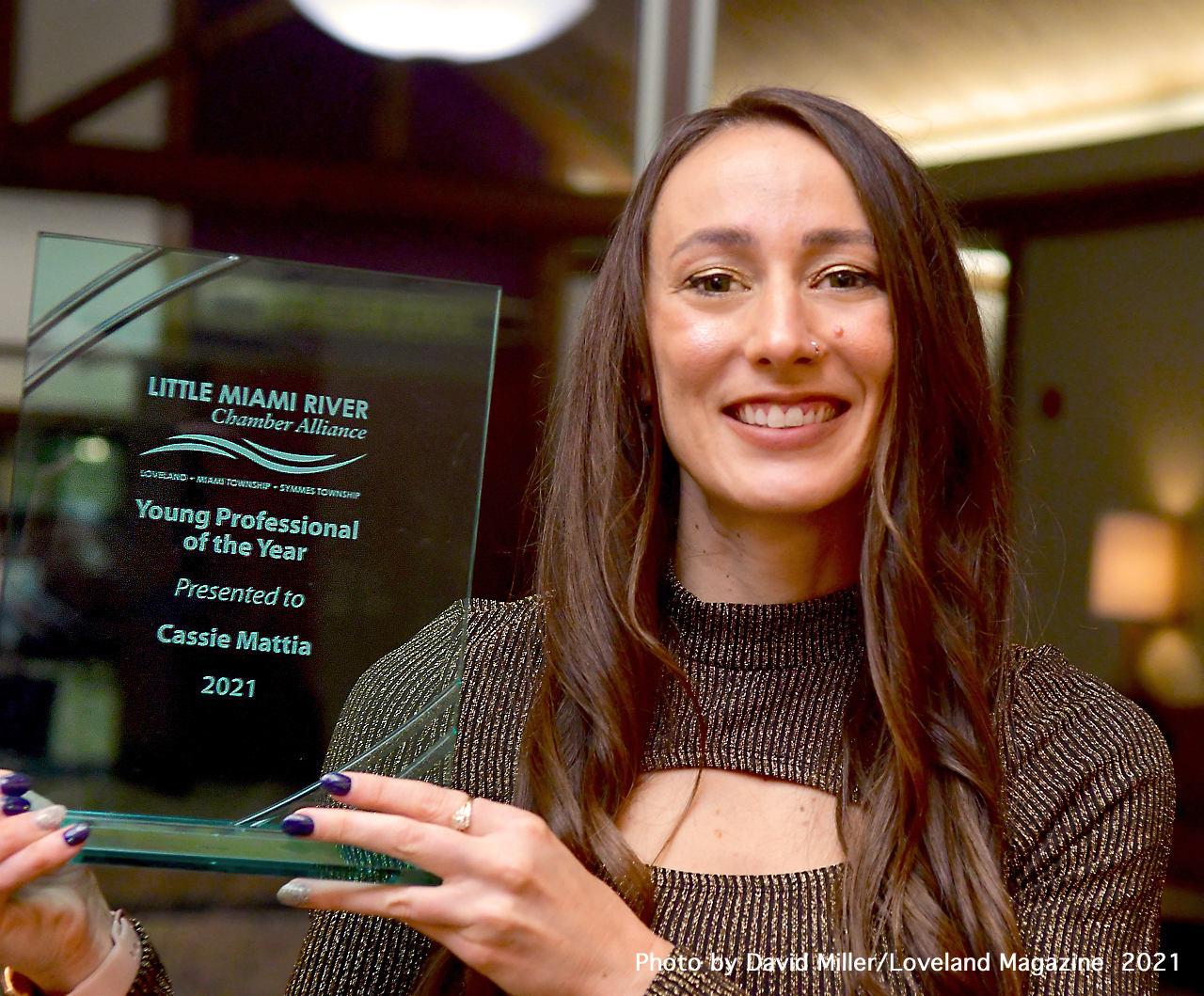
Cassie Mattia
Listen as Cassie Accepts her Award.
______________________________________________
by David Miller
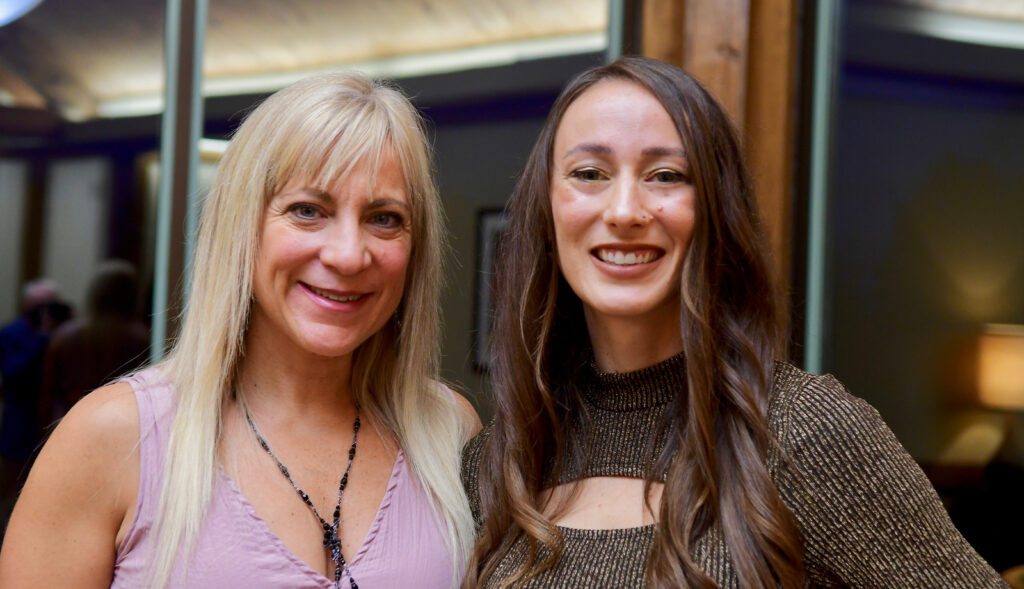
Cassie’s friend Jennifer D’Alberto Kavensky had pre-recorded a video introduction of her that was projected onto a big screen.
Loveland, Ohio – “Words cannot describe how unbelievable the 2021 Little Miami River Chamber Alliance Awards were on Wednesday,” said Loveland Magazine Co-Owner Cassie Mattia. “The atmosphere, the music, the people, the decor, the food, and of course the awards ceremony was the icing on the cake for one of the best years of my life.”
The occasion was the 2021 Annual Awards Dinner, a gala put on by the Little Miami River Chamber Alliance. It is an evening for area businesses to come together and celebrate their successes and community contributions. The celebration was at the Oasis Conference Center.
Cassie was selected as the 2021 Young Professional of the Year.
AND ALL THE WINNERS ARE
Photo by Loveland Lifestyle Magazine/Courtney Kraemer
Business of the Year – Premier Tumbling and Dance
Emerging Business of the Year – Monarch Financial Advisors
Beautification Award – Mile 42 Coffee and Eads Fence Company
Community Involvement Award – Jason Pinson
Business Community Advocate Award – Brittney Frietch Team, Re/Max Preferred Group
Non-Profit of the Year – The Care Center
Woman Owned Business of the Year – Loveland Lifestyle
Young Professional of the Year – Cassie Mattia
Randy K. Stanifer Health, Wellness & Fitness Business of the Year – Loveland Massage Center
Recreation Business of the Year – Grand Sands Volleyball
Community Responder Award – Miami Township Fire/EMS
Chamber Choice Award – Tano Bistro – Loveland
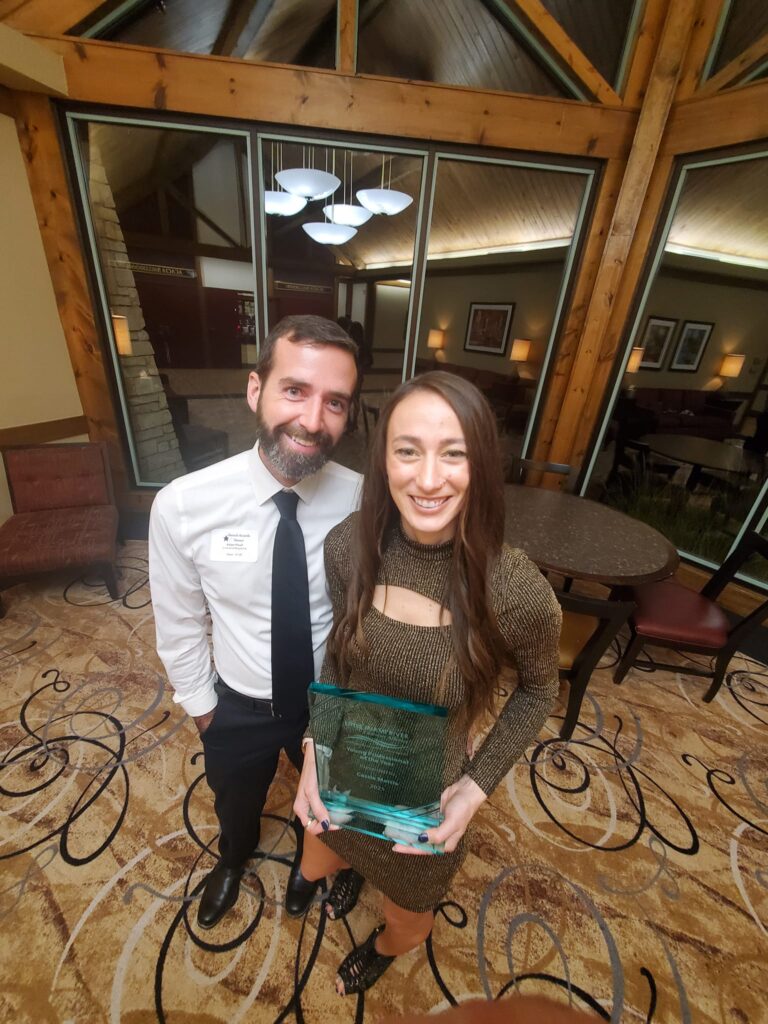
Co-Owners of Loveland Magazine David Miller and Cassie as they enter the Oasis Conference Center.
Proceeds from a silent auction benefited Grant Us Hope, an organization dedicated to youth suicide prevention, and a Chamber Scholarship fund. Emily Barlow with Loveland Lifestyle Magazine was the Emcee.
I could not be more proud to call Cassie my business partner. I’m so very happy that she was recognized for her achievements and as a community leader. She is the Co-owner, Associate Editor, and Director of Marketing for Loveland Magazine.
Cassie said the next day, “Thank you to all those that spent time out of their day to send in nominations and testimonials on my behalf for this award, you have no idea how much it means to me and how eternally grateful I am. I am so excited to see where this unbelievable path takes me and I promise to all those surrounding me including all of you in Loveland I will continue to make this community the absolute best place to live and visit.”
Cassie walked into my life 3-1/2 years ago by knocking on the door and announcing she wanted to write for Loveland Magazine. It was unbelievable fun Wednesday night celebrating with her.
There is more to the story. What she brought with her in that oversized purse she carries was dedication, hard work, kindness that I see every single day, and a devotion to her family and to her boyfriend Adam. She’s the big sister that everyone should have.
Cassie and her boyfriend Adam Ploof
In that bag is forgiveness, is a photographic memory, what just must be an off-the-scale high IQ, writing skills, and her journalism background with degrees she worked so hard to achieve. However, her bag is always 90% packed with positivity, sometimes to overflow.
She recently joked that I was so old that when I ran road races they were on dirt roads. Well… Cassie is so young-of-heart, that she runs each day on sunshine younger than today’s sunrise. A rare personality that anyone older than today, and most people her age, should be so lucky to have.
Thank you so much Cassie for agreeing to be a co-owner of Loveland Magazine. It was such a fun, fun night celebrating with you and Adam.
When we walked under the Oasis portico, before we went in – I pointed in both directions with a sweeping motion and joked “Look Cassie… they reserved this whole country club just for you tonight! Hmm, where’s the red carpet I ordered?”
Adam parked the car and caught up with us and, well, I just went in pretending the three of us were walking on the red carpet and I saw the evening transform into the “Gala” it was billed to be.
And, no one could’ve wiped off the grin I carried the rest of the evening being with my friend and partner, the Loveland Area’s “Young Professional of the Year”.
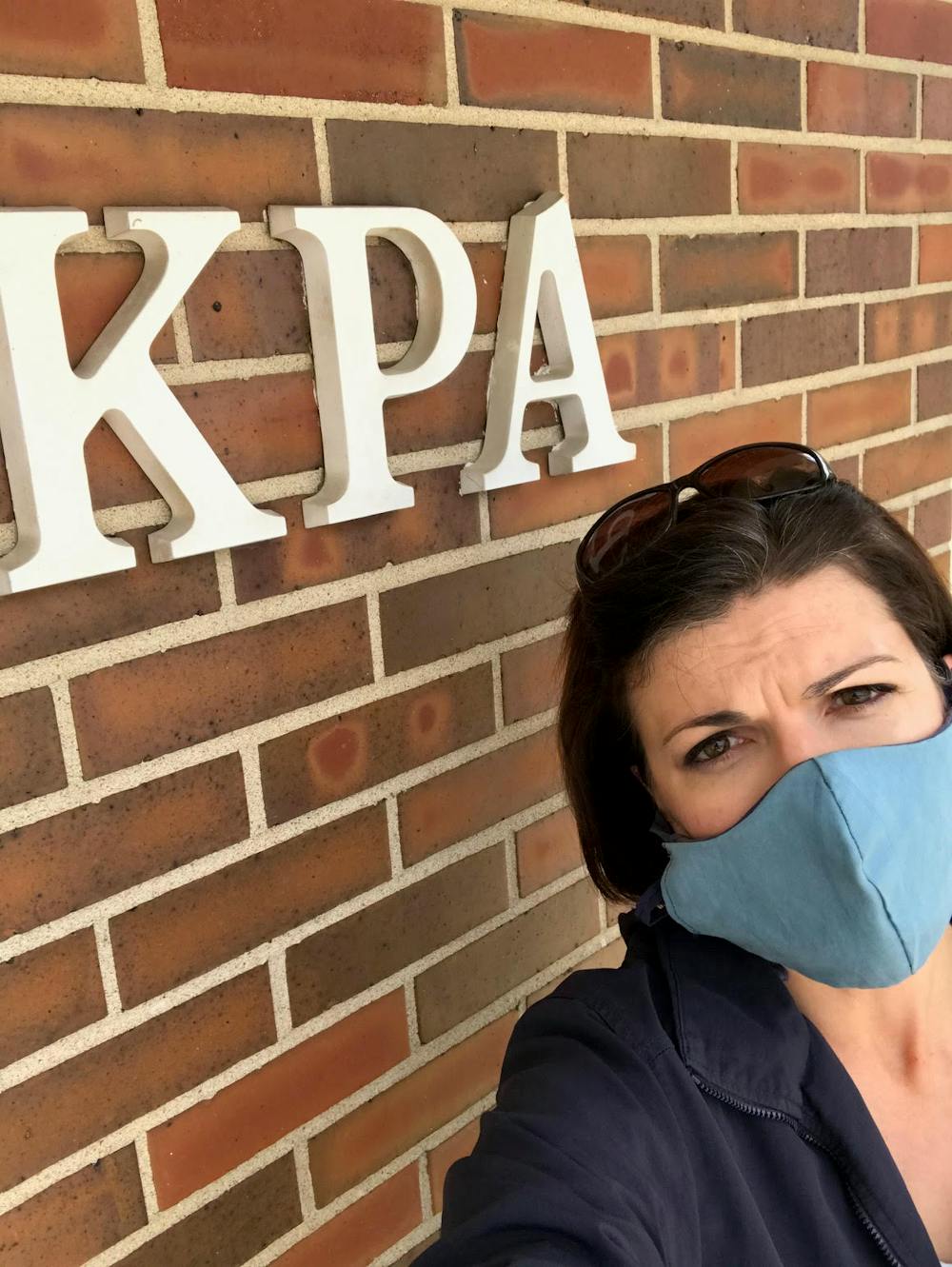
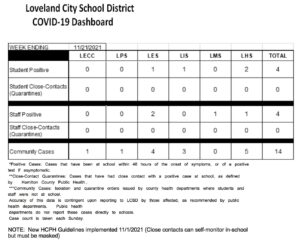
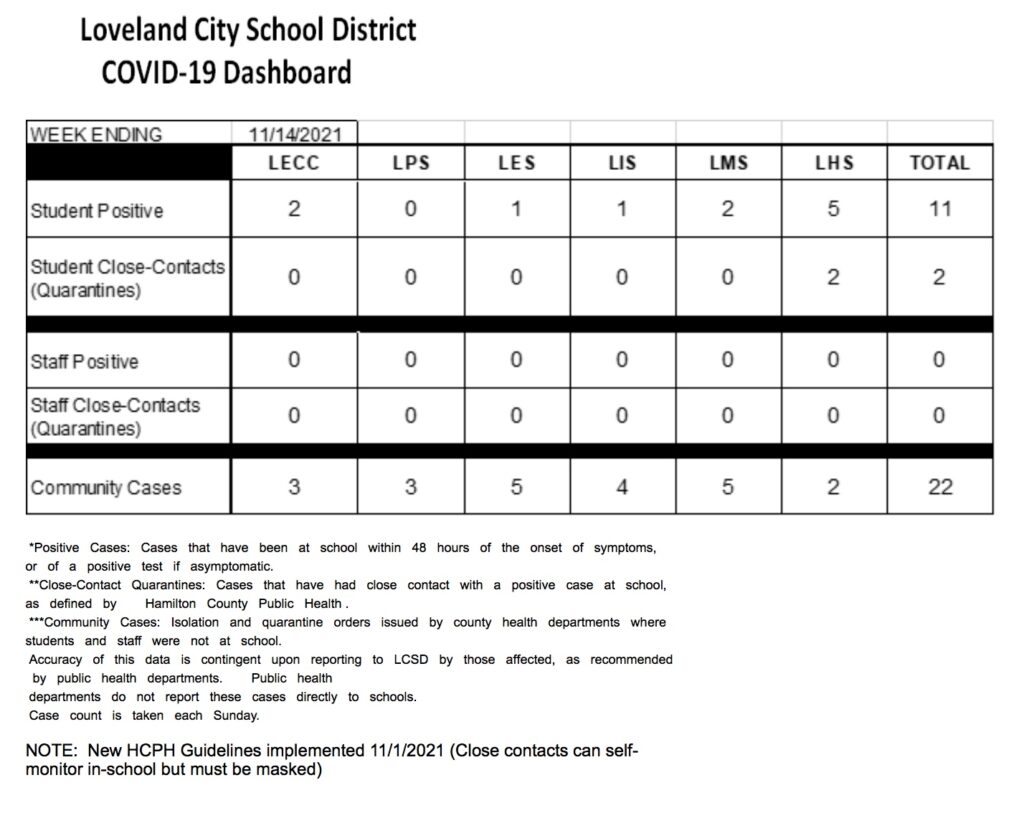
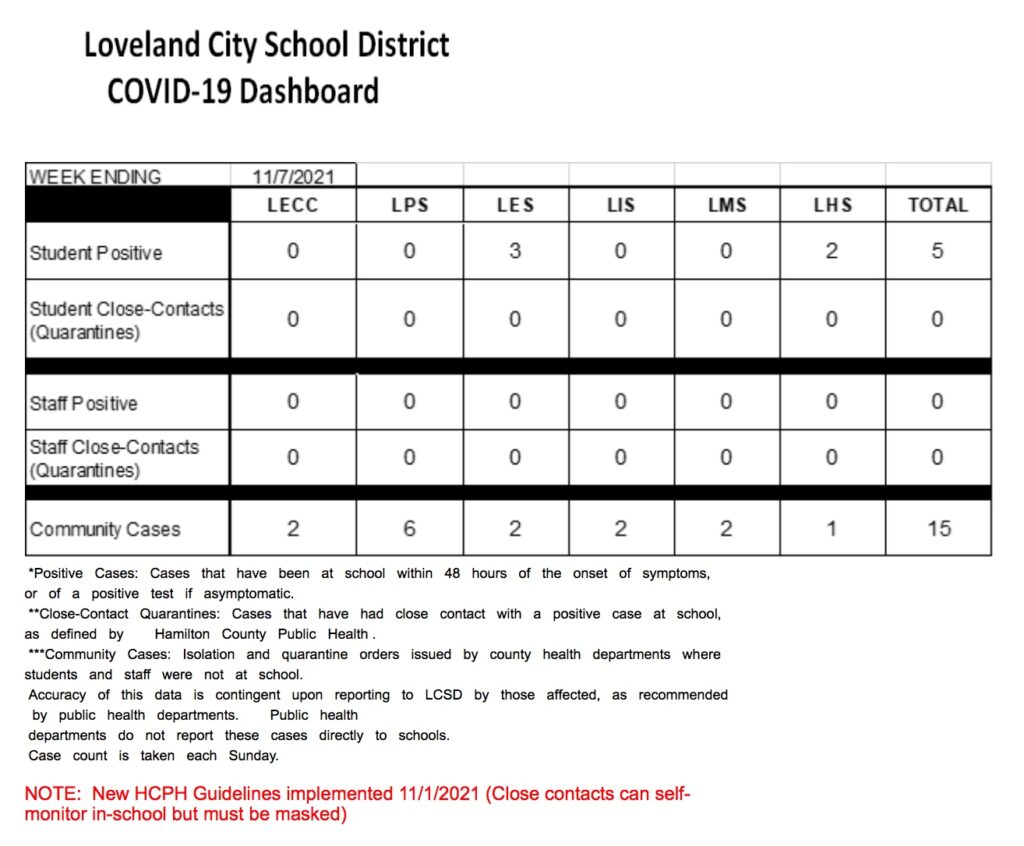
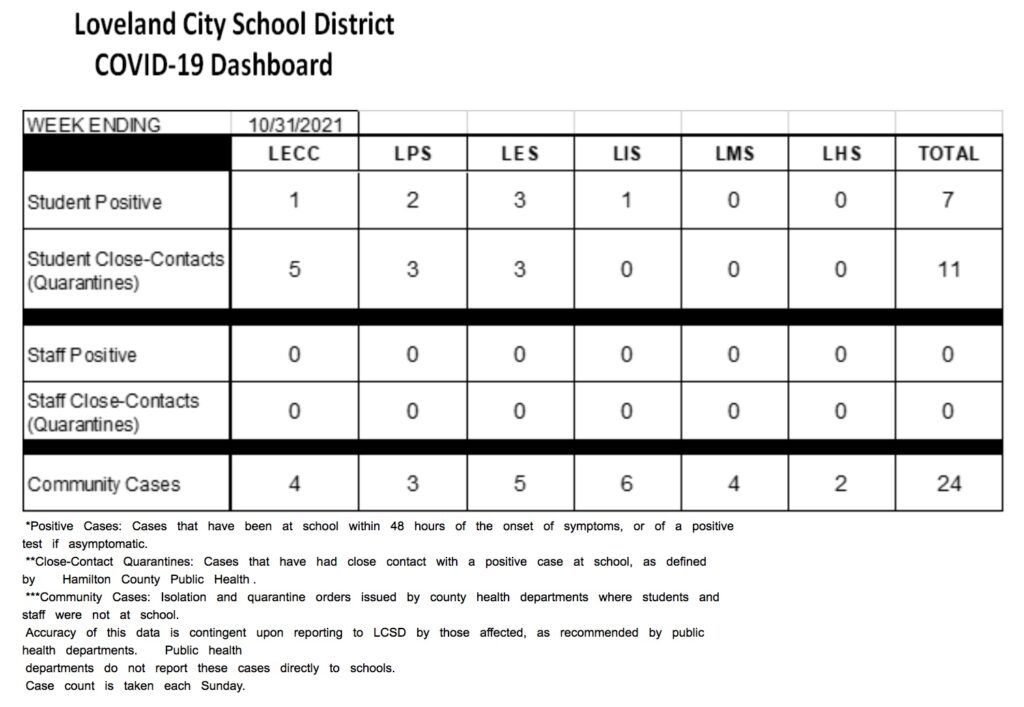
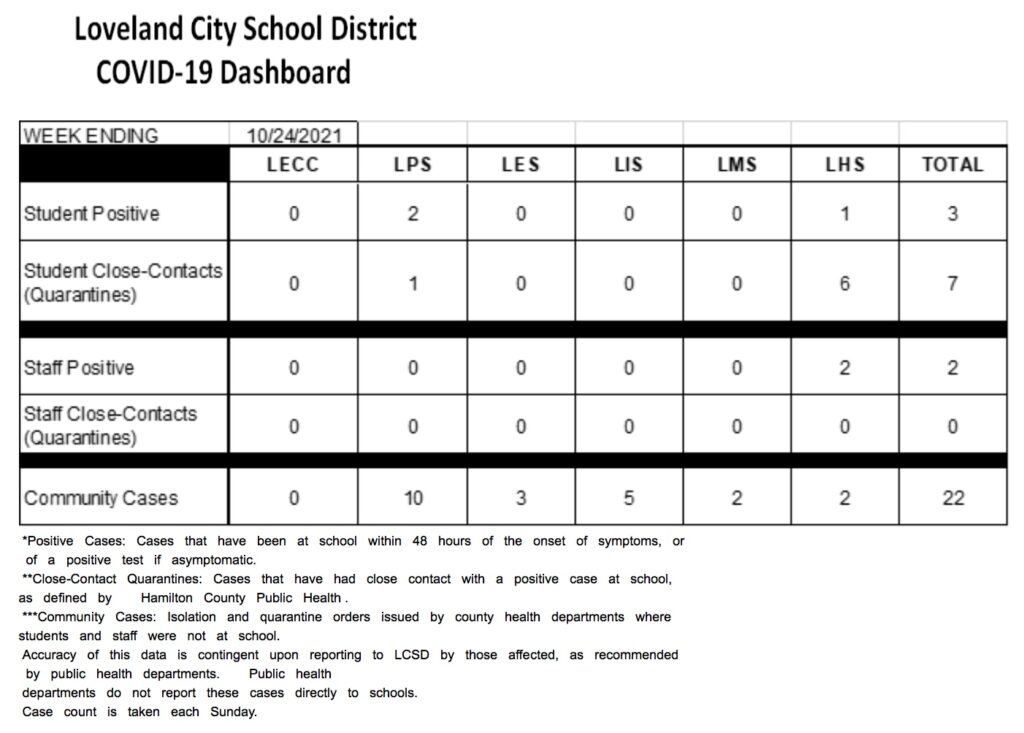
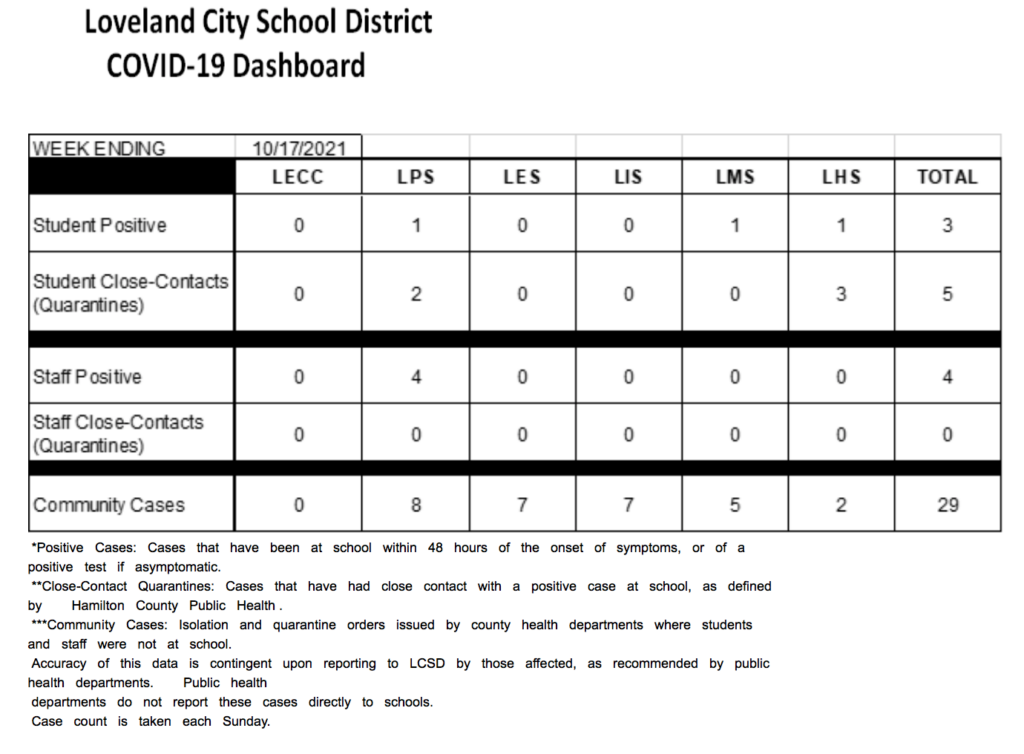
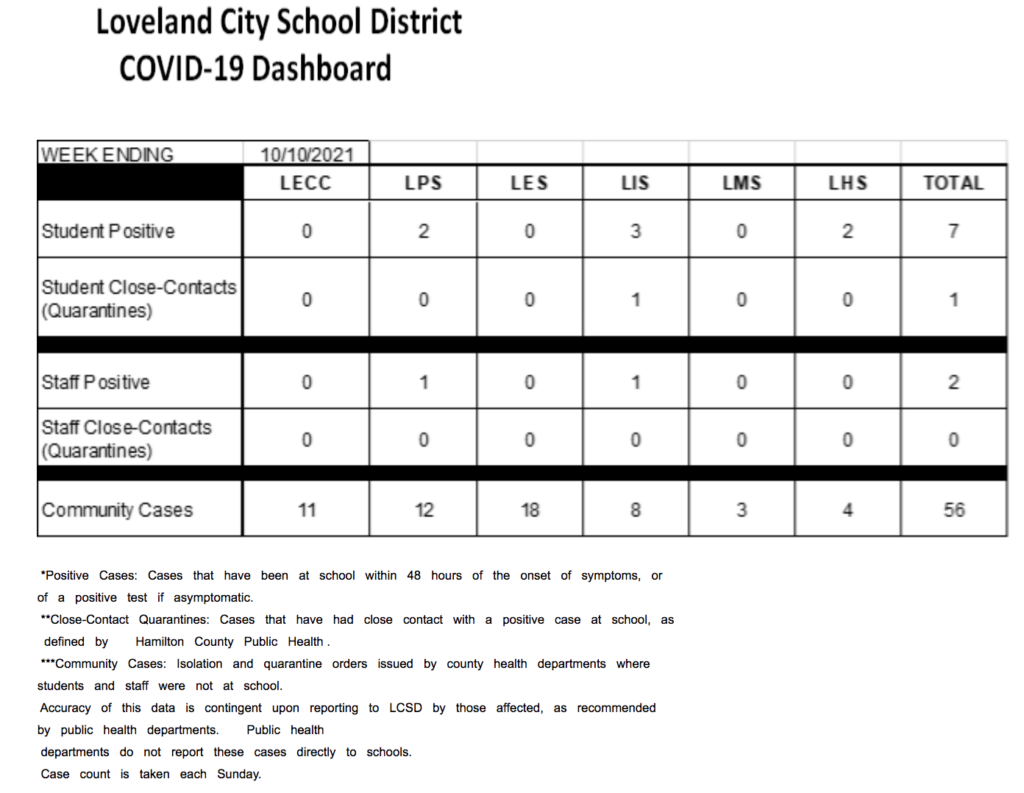
We are pleased people are now researching the Pandemic and how local newspapers survived. Some didn’t. Loveland Magazine did survive, and it was pure everyday persistence, sacrifice, and a dedication to staying alive (literally), and as a local Newspaper. We were early declared “Essential Workers” however that declaration did not provide us anything as the designation was quickly ignored at every level of government when they dolled out relief dollars and the help they could have provided. We stood in line with everyone else at the chance to apply for PPE funds, etc., and at times we were at the back of the lines for eligibility. We were still standing when our own City bought new high-tech water fountains with the COVID relief funds they received. Much of what you read here though is how we did it. What this story misses is an incredible effort it took for local papers in smaller communities to find accurate specific COVID 19 data in a hometown like ours that is in three counties with each county reporting in different formats and on different days of the week.
But how did so many local news organizations – especially newspapers – manage to survive the pandemic? Weeklies beefed up their daily online news coverage, business models were blown up and existing rationales for why journalism matters became more than theoretical to rural journalists.
Their determination to survive and serve as a public health lifeline for their communities fueled an oral history project that my colleague Teri Finnemanand I conducted, interviewing 28 journalists across seven states in the middle of the country. We learned how locally owned and family-owned newspapers made it through COVID-19.
“There’ve been times that we’ve had to reach out to mayors and different cities and communities across the state … to make sure that … they knew that [journalists] were deemed essential workers,” said Ashley Wimberley, executive director of the Arkansas Press Association. That label exempted news workers from stay-at-home orders and designated them as critically needed by their communities.
Oral history grabs the first impressions of history for those living now, looking back at what just happened. It helps people understand the present and how to move forward, out of a crisis. But it also records events for scholars and citizens in the future.
“Always remember that when you’re putting those stories in your newspaper, that you are printing your community’s history,” Amy Johnson, the publisher of the Springview Herald in Nebraska, told us.
Benny Polacca of the Osage News in Oklahoma told us something similar: He encouraged journalists covering some future pandemic to “do your due diligence in order to come to some type of understanding, some type of argument, some type of focus, if you were going to be reporting or researching the time of COVID-19.”
Often, it’s journalism on the coasts that gets the attention of researchers. The New York Times, The Washington Post, the Los Angeles Times – these big news organizations are written about constantly.
By talking to journalists in North Dakota, South Dakota, Nebraska, Kansas, Oklahoma, Arkansas and Louisiana, our project pushed back against this tendency to ignore the middle of the nation and its important journalism. As a kind of new essential worker, journalists found themselves in charge of explaining complicated guidance from state and local officials about COVID-19, how schools would work and where to get help.
“I hope that, through this, that our role as journalism, they [the public] realize how important it is that the information we put out, you know, how it affects them every day,” Johnson said.
Kansas Press Association Executive Director Emily Bradbury had a message for these journalists who were working for news organizations increasingly threatened with being shut down: “I want them to know that in the midst of an emergency, in the midst of what can seem like a hopeless situation, when they look at their financials, that what they’re doing is important. And what they’re doing matters, and that no one else can do what they do, and they look out for their communities like no one else.”
Emily Bradbury, Kansas Press Association Executive Director, tells reporters that ‘what they’re doing is important. And what they’re doing matters…and they look out for their communities like no one else.’ Will Mari and Teri Finneman, Author provided photo.
Loans, side hustles and deals
Reporters and editors found new ways of paying the bills. That meant accepting government subsidies in the form of Paycheck Protection Program loans. It meant, for some, going door to door and asking readers to subscribe, or keep subscribing. It meant consolidating newspapers, putting out more online editions, or taking pay cuts.
“People just don’t understand. It costs a lot of money and time to do this, and I just wish we – there was more value or people appreciate it or understood the value and the cost of really providing this service,” said Bonita Gooch, the publisher of The Community Voice, a Black newspaper based in Wichita, Kansas.
Some publishers took on side hustles to bring in revenue, creating ad copy for local business or doing marketing work.
At The Kingfisher Times & Free Press in Oklahoma, for example, Christine Reid, the paper’s editor, created ads for a local vocational-technical school. “I’ve also tried to use that as an avenue to … generate more ads for the newspaper,” Reid said.
Local publishers did whatever it took to stay afloat. As some of our initial findings have shown, that showed both opportunity and hesitancy about change.
“We’re gonna have to rely less on advertising revenue and more on subscription revenue, and so we’ve got to make sure we’re offering a unique product that they want to pay for,” said Letti Lister, the president and publisher of the Black Hills Pioneer in Spearfish, South Dakota.
We saw tentative signs of hope, as journalists got financial and moral support from their readers during a fraught election. “If anything, it’s rallied the troops, if you will, in our community because they trust us, they know that we’re going to report the news in a timely manner and keep the public up to date,” said Amy Wobbema, publisher of the New Rockford Transcript in North Dakota. Arguably most coverage was calm and steady.
But there was still hesitancy over what newspapers had to do to adapt. Some journalists are uncomfortable with receiving government funding and would rather rely on community support.
As South Dakota Newspaper Association Executive Director Dave Bordewyk put it: “Sort of, ‘Look, contribute to our newspaper … because if you value that importance of local news and journalism, then we need your support beyond just subscribing to the newspaper or advertising, which has gone away.’”
“That’s what we hope. What I hope comes out of this is that readers can understand that, and can … have a renewed value on what that [local] publication has done for their community during this pandemic,” Bradbury told us.


![[Video] Tom Scovanner on leadership and the selection of a new Mayor of Loveland](https://lovelandmagazine.com/wp-content/uploads/2021/11/tom-s.jpg)




![[Video] Kim Lukens is concerned about so much promotion of drinking in Historic Downtown Loveland](https://lovelandmagazine.com/wp-content/uploads/2021/11/kim.jpg)
![[Video] Sharon Scovanner on Mayor Baily limiting speech at council meetings and using Chief of Police to intimidate Press](https://lovelandmagazine.com/wp-content/uploads/2021/11/ss3.jpg)

![[VIDEO] Lauren Enda: Democracy in Loveland is in trouble.](https://lovelandmagazine.com/wp-content/uploads/2021/11/l-3.jpg)
![[Video] Patti Sandmayr thanks Mayor for recognizing Sgt. Ryan Bauman](https://lovelandmagazine.com/wp-content/uploads/2021/11/patti-s.jpg)