Tag: loveland tigers

  • [Photos by Alex Eicher] FC Cincinnati take third straight draw in 1-1 result with New York Red Bulls

    [Photos by Alex Eicher] FC Cincinnati take third straight draw in 1-1 result with New York Red Bulls


    Luciano Acosta, of FC Cincinnati, grabs his leg after being challenged by a Red Bull defender

    Cincinnati, Ohio – FC Cincinnati and the visiting New York Red Bulls played to a 1-1 draw Saturday night in front of 24,476 fans at TQL Stadium, the largest home crowd of the season. 

    FCC move to 7-7-5 (26 points) with the club’s third straight draw. The Red Bulls hold on to first place in the Eastern Conference with a 9-5-6 mark (33 points).

    FC Cincinnati scored first in the 20th minute with the team-high ninth goal of the season from Brandon Vazquez.

    The forward got in behind the Red Bulls defense and ran on to a through ball from Luciano Acosta. Vazquez’s initial shot on target was saved by New York goalkeeper Carlos Coronel, but Vazquez followed up on the rebound and tapped in the contest’s opening goal.

     FC Cincinnati and the visiting New York Red Bulls played to a 1-1 draw Saturday night in front of 24,476 fans at TQL Stadium, the largest home crowd of the season. 

    FCC move to 7-7-5 (26 points) with the club’s third straight draw. The Red Bulls hold on to first place in the Eastern Conference with a 9-5-6 mark (33 points).

    FC Cincinnati scored first in the 20th minute with the team-high ninth goal of the season from Brandon Vazquez.

    The forward got in behind the Red Bulls defense and ran on to a through ball from Luciano Acosta. Vazquez’s initial shot on target was saved by New York goalkeeper Carlos Coronel, but Vazquez followed up on the rebound and tapped in the contest’s opening goal.

    All Photos © 2022 Alex Eicher/Loveland Magazine

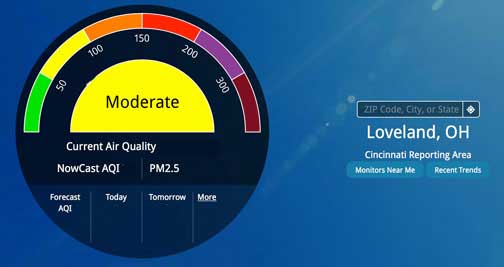
  • Air Quality Alert for Loveland today

    Air Quality Alert for Loveland today

    Check Current Air Quality

    https://www.airnow.gov/?city=Loveland&state=OH&country=USA

    Current Air Quality is the most recent air quality in your area. It’s updated hourly. Check your current air quality to see if now is a good time for outdoor activities. More about Current Air Quality.

    Primary Pollutant

    This pollutant currently has the highest forecasted AQI in the area.

    OZONE

    105

    Unhealthy for Sensitive Groups

    Have flexibility in your schedule?

    Even if the forecast is Orange (unhealthy for sensitive groups), there may be times during the day when air quality is OK for outdoor activities. Ozone is often lower in the morning. Check current air quality to see if now is a good time for you to be active outdoors.

    Can’t change your schedule?

    People with lung disease such as asthma, children and teens, older adults, and people who are routinely active outdoors for six or more hours a day: Reduce your exposure by choosing less strenuous activities or shortening the amount of time you are active outdoors.
    Everyone else: Enjoy your outdoor activities.


    Active children and adults, and people with respiratory diseases, such as asthma, should be avoiding all outdoor exertion; everyone else, especially children, should limit outdoor exertion.

    Activities for children, who can be especially harmed by high levels of ozone because of their developing lungs and that some activities such as sports result in them breathing in quite a large amount of the chemical irritants should be suspended.

    Do Your Share

    • Take the bus, carpool, bike or walk instead of driving
    • Refuel your vehicle after 8 p.m.; do not top off when refueling and tighten the gas cap
    • Avoid idling your vehicle
    • Combine trips or eliminate unnecessary vehicle trips
    • Keep your vehicle maintained with properly inflated tires and timely oil changes
    • Avoid use of gasoline-powered lawn equipment on Air Quality Alert days
    • Avoid use of oil-based paints and stains on Air Quality Alert days
    • Never burn leaves or other yard trimmings
    • Always burn clean, seasoned wood in outdoor fire pits, fireplaces and wood stoves
    • Do not use fire pits or fireplaces for non-essential home heating on Air Quality Alert days
    • Conserve electricity

  • Loveland Care Center’s “Party with a Purpose”

    Loveland Care Center’s “Party with a Purpose”

    Promoted Story

    Join us on August 25th from 6:30 until 9 PM at The Landing Event Center in Historic Downtown Loveland to party with a purpose as we celebrate the lives impacted by the Care Center. There will be great local food, live music, and the opportunity to find out more about the work that we do and how you can partner with us to help even more of our under-resourced neighbors thrive!

    Tickets are $50 each or you can buy 6 or more for $40 each and invite your friends. For more info please visit bit.ly/thrivefundraiser.

    And thanks to our amazing partners for helping sponsor the event including: Calvary Industries, Christian Brothers Automotive (Loveland), Plum Tree Realty, Northstar Church, Loveland Biggby Coffee, Narrow Path Brewing, Tano Bistro – Loveland, and Loveland Symmes Fire Department!

    For the last 15 years the Care Center has been providing care for the whole person to help our neighbors thrive in life.  We offer physical, emotional, educational, relational and spiritual support.  We are available to anyone who has need, no matter where they live.  Check out carecenterinfo.com for hours, directions, services and how you can help.

  • Retired teachers go to court for Ohio pension records

    Retired teachers go to court for Ohio pension records

    BY: MARTY SCHLADEN – Ohio Capital Journal

    An analyst working for Ohio retired teachers went to court last week seeking records relating to the state pension funds. 

    The analyst is trying to determine whether teachers’ pension money is being squandered on high-fee “alternative” investments such as private equity and hedge funds. He is also investigating whether external consultants directing such investments are also being paid by the firms in which retirement system money is being invested.

    Edward Siedle is president of Benchmark Financial Services, which investigates pension funds on behalf of their members. Last week, former Ohio Attorney General Marc Dann filed for a writ of mandamus on Siedle’s behalf to get records from the State Teachers Retirement System. 

    If successful, Ohio’s 10th District Court of Appeals will order the teachers retirement system, or STRS, to turn over a boatload of documents relating to its investments.

    In an interview, Dann said Siedle has been seeking the records since last year.

    “We’re not some gadfly trying to throw a wrench in the operation of STRS,” Dann said. “These are members of STRS who hired a professional to analyze the work that STRS is doing on their behalf. We want documents that will help that expert give an honest and accurate analysis.”

    He added, “To the extent that they say our requests are trade secrets or are too voluminous, it makes you think maybe they don’t want us to look so closely at this.”

    However, STRS spokesman Nick Treneff said that his agency has been working with Siedle and has already turned over many records.

    “We did try to work with Siedle on his request,” Treneff said.

    In a report last year, STRS said it had already turned over a boatload of information.

    “Over a period of three months, from February to May 2021, STRS Ohio sent 24 emails and a thumb drive to counsel, amounting to 812 documents and over 22,000 pages,” it said, adding that remaining requests are “overly broad.”

    Lawyers for Ohio state agencies commonly use such language in response to records requests. It will be up to the court to determine whether in this case STRS is using it, as Dann says, to stonewall. 

    But the stakes are pretty high.

    STRS is managing $92 billion on behalf of 166,000 active members. And, as benefits have become stingier, some of those members have become suspicious that the agency is making dubious investments through politically connected entities.

    The governor and the leaders of the General Assembly appoint “investment experts” to the STRS board of directors, and many of the state’s retired teachers believed the investments made on their behalf have underperformed.

    The distrust was evident in a newsletter written last August by Robin Rayfield, executive director of the Ohio Retired Teachers Association.

    “STRS has overstated investment returns while under-reporting the fees and costs associated with those investments,” he said.

    Part of the distrust surely stems from the fact that the pension fund stopped paying cost-of-living increases in 2017 — although it is planning a 3% increase this year.

    Treneff, the STRS spokesman, said the freeze was due to new rules set down by the legislature in 2012. State and local governments were still reeling from the Great Recession and there were nationwide concerns about unfunded pension liabilities.

    The retired teachers association points out that the General Assembly hasn’t increased its contribution rate to the pension fund in 38 years.

    But it did act to shore STRS up by cutting benefits. The cost-of-living hike was cut from 3% to 2% and teachers were made ineligible for any increases until they’ve been retired for five years. 

    The General Assembly also required that the system have enough assets to pay off any liabilities within 30 years. In 2017, when the fund didn’t appear likely to meet that requirement, the living increase was suspended. 

    Treneff said it was due to reduced investment-return assumptions, longer lifespans and lower-than-expected payroll growth.

    “That was painful for sure,” he said. “It wasn’t an easy decision.”

    But with five STRS employees making salaries and bonuses totaling more than $500,000 in 2020 — and with 64 making more than $200,000 the same year —  frustration and suspicion among Ohio teachers and retirees was perhaps predictable.

    And, with the U.S. Securities and Exchange Commission in January finding a raft of problems with the transparency and honesty of private equity funds, it’s also probably understandable that pension fund members have turned their suspicions on its alternative investments.

    Treneff, the system spokesman, was quick to point out that those investments are providing the system’s second-best returns. 

    The best? The American stock market. 

    Over the past decade, it has provided a 14.8% return on investments, while the system’s alternative investments have provided 11.84% once fees are subtracted, Treneff said.

    So why make a substantially worse-performing investment with teachers’ money? To avoid putting too many eggs in one basket, Treneff said.

    “The goal is to build this (pension) fund as fast as you can without taking wild risks,” he said, adding, “you don’t want one downturn in the stock market to destroy you.”


  • Study shows Ohio K-12 teacher burnout rates higher than any other industry

    Study shows Ohio K-12 teacher burnout rates higher than any other industry

    BY: SUSAN TEBBEN – Ohio Capital Journal


    Ohio educators say burnout is real, but with pending legislation regulating lesson-plan choices and security roles in schools, they feel “demoralized” as well.

    A national survey showed 44% of K-12 teachers in the U.S. “always” or “very often” feel burned out, a stat that has surpassed other industries.

    The Gallup poll showed more than 4 in 10 K-12 workers felt that way, topping college/university employees, retail workers and the government/public policy industry in the survey, conducted in February but released this week.

    Researchers found that K-12 workers have “consistently” been leaders in burn-out in the country, but the COVID-19 pandemic “exacerbated existing challenges,” while also introducing new ones.

    Female teachers reporter higher burnout levels than male teachers, at a split of 55% to 44%.

    “The result is a workforce that is burned out and unfortunately leaving the profession at a high rate,” according to the Gallup poll.

    Those who teach in Ohio agree that the increased workload has taken its toll, but to also see mounting legislation regulating their careers and what they see as a continued lack of appropriate support from the state adds a new amount of weight to educators’ shoulders.

    “When you talk about burnout, you’re talking about when you’ve extinguished a flame,” said Wendi Davis, band director and music teacher at Cory-Rawson Local Schools in northwest Ohio. “Teachers, they love what they do, and when they’re put in situations like what they’re dealing with right now, it’s more demoralization than burnout.”

    Teachers have had to don ever-multiplying caps: as teachers, as standardized test guides, as social workers and as guidance counselors. Faced with all those issues already, teachers then faced a pandemic, according to Shari Obrenski, president of the Cleveland Teachers Union.

    “What the pandemic did was essentially lay bare all of the problems that existed in education,” Obrenski said. “More and more is being put on (a teacher’s) plate and nothing is being taken off.”

    When pandemic learning is combined with legislation currently being considered in the Ohio legislature that would dictate the subjects that teachers can discuss, and a recently passed and governor-signed law that allows teachers to carry weapons in school, Obrenski said educators get pushed to their limits.

    That is, the teachers that are still there. Cleveland is short about 200 teachers going into the new school year, not to mention the ongoing shortage of substitute teachers, in the hundreds as well.

    “And we’re not as bad off as other districts,” Obrenski said.

    As school districts struggle to recruit and retain teachers and substitute teachers, teachers also struggle to be heard in their own districts and in their state government.

    “Teachers need to be empowered at the local level by their administrators,” Davis said. “They need to have a voice at the table.”

    Paying teachers more and funding schools in a way that supports the role they play is definitely a need, according to Obrenski, but so, too, is respecting teachers as professionals in order to keep them in schools.

    “Something that is really important is a teacher’s voice in decision-making; Having teachers be part of the solution instead of condemning them as part of the problem,” Obrenski said.

  • Loveland School Board approves first step to place operating levy on Fall ballot

    Loveland School Board approves first step to place operating levy on Fall ballot

    by David Miller

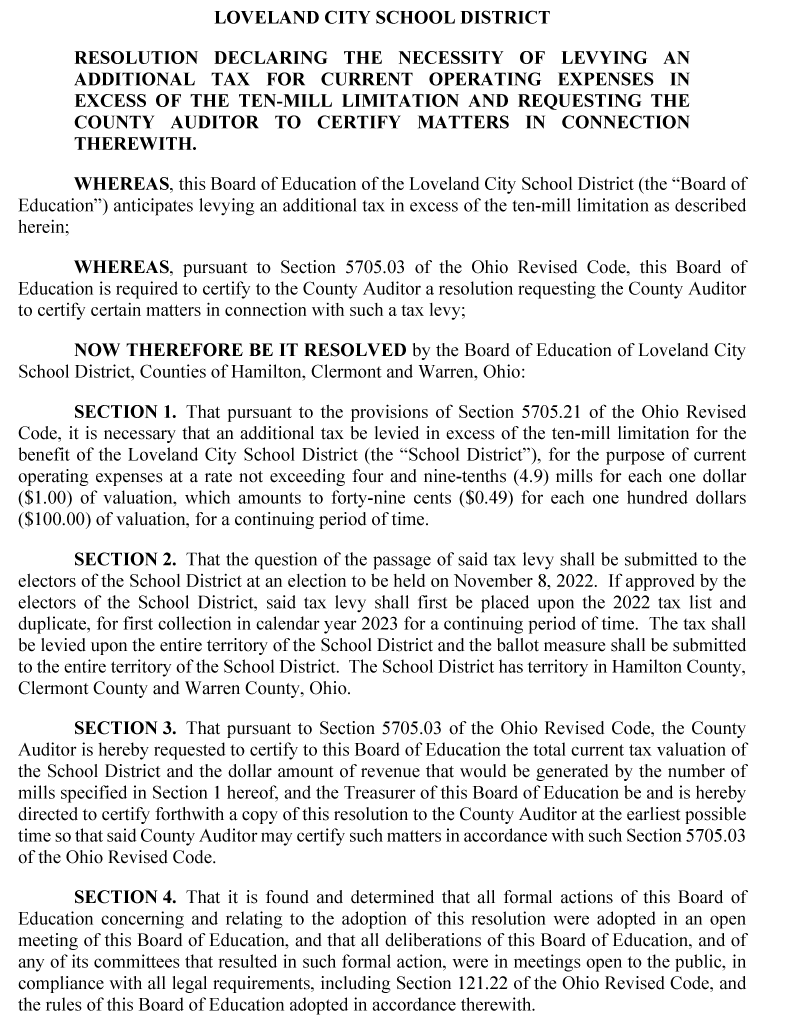
    Loveland, Ohio – Below is the partial draft of the minutes of the Loveland School Board meeting that was held last night. The Board authorized a “Resolution of Necessity” to request that the Hamilton County Auditor certify the projected revenues for a 4.90 Mill levy for the General Election on November 8.

    Members Eileen Washburn. Eric Schwetschenau, Kevin. Dougherty, and Jonathan Eilert voted, “Yes”. Kathryn Lorenz did not attend the meeting.

    This is the first of the two votes needed for the Board to place the operating levy on the ballot.


    The Board of Education of the Loveland City School District, Counties of Hamilton, Clermont and Warren, Ohio, met in regular session at 6:00 P.M, on the 16th day of June, 2022, at the LMS/LIS Media Center, 757 S. Lebanon Road, Loveland, Ohio, with the following members present: 

    Mr. Kevin Dougherty Rev. Jonathan Eilert Dr. Eric  Schwetschenau

    Mrs. Eileen Washburn

    The following members were absent: Dr. Kathryn Lorenz

    Mrs. Washburn moved the adoption of the following resolution:

    LOVELAND CITY SCHOOL DISTRICT

    RESOLUTION NO. 22-69

    RESOLUTION DECLARING THE NECESSITY OF LEVYING AN ADDITIONAL TAX FOR CURRENT OPERATING EXPENSES IN EXCESS OF THE TENMILL LIMITATION AND REQUESTING THE COUNTY AUDITOR TO CERTIFY MATTERS IN CONNECTION THEREWITH.

    WHEREAS, this Board of Education of the Loveland City School District (the “Board of Education”) anticipates levying an additional tax in excess of the ten-mill limitation as described herein;

    WHEREAS, pursuant to Section 5705.03 of the Ohio Revised Code, this Board of Education is required to certify to the County Auditor a resolution requesting the County Auditor to certify certain matters in connection with such a tax levy;

    NOW THEREFORE BE IT RESOLVED by the Board of Education of Loveland City School District, Counties of Hamilton, Clermont and Warren, Ohio:

    That pursuant to the provisions of Section 5705.21 of the Ohio Revised Code, it is necessary that an additional tax be levied in excess of the tenmill limitation for the benefit of the Loveland City School District (the “School District”), for the purpose of current operating expenses at a rate not exceeding four and nine-tenths (4.9) mills for each one dollar ($1.00) of valuation, which amounts to forty-nine cents ($0.49) for each one hundred dollars ($100.00) of valuation, for a continuing period of time.

    That the question of the passage of said tax levy shall be submitted to the electors of the School District at an election to be held on November 8, 2022.  If approved by the electors of the School District, said tax levy shall first be placed upon the 2022 tax list and duplicate, for first collection in calendar year 2023 for a continuing period of time.  The tax shall be levied upon the entire territory of the School District and the ballot measure shall be submitted to the entire territory of the School District.  The School District has territory in Hamilton County, Clermont County and Warren County, Ohio.  

    That pursuant to Section 5705.03 of the Ohio Revised Code, the County Auditor is hereby requested to certify to this Board of Education the total current tax valuation of the School District and the dollar amount of revenue that would be generated by the number of mills specified in Section 1 hereof, and the Treasurer of this Board of Education be and is hereby directed to certify forthwith a copy of this resolution to the County Auditor at the earliest possible time so that said County Auditor may certify such matters in accordance with such Section 5705.03 of the Ohio Revised Code.

    That it is found and determined that all formal actions of this Board of Education concerning and relating to the adoption of this resolution were adopted in an open meeting of this Board of Education, and that all deliberations of this Board of Education, and of any of its committees that resulted in such formal action, were in meetings open to the public, in compliance with all legal requirements, including Section 121.22 of the Ohio Revised Code, and the rules of this Board of Education adopted in accordance therewith.

    Dr. Schwetschenau seconded the motion, and the roll being called upon the question of adoption of the resolution the vote resulted as follows:

    AYE:  Mrs. Washburn, Dr. Schwetschenau, Mr. Dougherty, Rev. Eilert

    NAY:

    ADOPTED this 16th day of June, 2022.

    Robert Giuffre’, Interim Treasurer

    CERTIFICATE 

    The undersigned hereby certifies that the text of the foregoing resolution is taken and copied from the record of proceedings of a meeting of the Board of Education of the Loveland City School District held on June 16, 2022.  The undersigned further certifies that the same has been compared by me with said record and it is a true and correct copy thereof, together with a true and correct copy of excerpts from the minutes of said meeting to the extent pertinent to the consideration and adoption of said resolution.

    Robert Giuffre’, Interim Treasurer

    RECEIPT

    The undersigned hereby acknowledges this day receipt of a certified copy of the foregoing resolution.

    County Auditor, Hamilton County, Ohio

    Date: June ___, 2022

    CERTIFICATE OF COUNTY AUDITOR

    Pursuant to a resolution of the Board of Education of the Loveland City School District, adopted on June 16, 2022, the undersigned county auditor of Hamilton County, Ohio hereby certifies that the total current tax valuation of such school district is $___________________, and that the dollar amount of revenue that would be generated by four and nine-tenths (4.9) mills per year as specified in such resolution is $___________________ per year, assuming that the tax valuation of such school district remains the same throughout the life of the levy.

    County Auditor, Hamilton County, Ohio

    Dated: June ___, 2022

  • Special School Board meeting tomorrow – Vote scheduled on Operating Levy

    Special School Board meeting tomorrow – Vote scheduled on Operating Levy

    NOTICE FROM THE LOVELAND SCHOOL DISTRICT:

    “Due to unforeseen circumstances, the Tuesday, June 14, 2022 business meeting of the Loveland City School District Board of Education has been canceled. The new meeting date is Thursday, June 16, 2022, at 6 pm in the Loveland Intermediate School Media Center.”

    Loveland, Ohio – The Loveland Board of Education announced at its March 22 Regular Session that it would have a Special Meeting on June 14, at 6 PM in the Loveland Middle/Intermediate School Media Center.

    The agenda for this rescheduled regular meeting is available on BoardDocs.

    The Board may authorize a Resolution of Necessity to Request Hamilton County Auditor Certification of projected Revenues for a 4.90 Mill Levy for the General Election on November 8.

    Here is the resolution the Board will consider:

  • Brian Conatser will be Loveland High School’s New Assistant Principal

    Brian Conatser will be Loveland High School’s New Assistant Principal

    Loveland Magazine file photo

    Loveland, Ohio – Current Loveland High School District Director of Student Athletics Brian Conatser will move into the role of LHS Assistant Principal beginning in the 2022-2023 school year. Conatser will take over as Assistant Principal as Eric Fry moves to a similar position at Oak Hills High School. 

    “I am excited and grateful for the opportunity to serve Loveland City School District in a new capacity. We have an incredible student body, staff, and community, and I am very fortunate to have experienced this as a Loveland classroom teacher, coach, Athletic Director, and now as an Assistant Principal. I look forward to the new challenge and am thrilled to continue to be a part of an amazing district,” Conatser said.

    Conatser has served as the District Director of Student Athletics for four years. He was Loveland’s Assistant Director of Student Athletics for two years and spent 15 years as a science teacher and coach at Loveland and Sycamore High Schools. 

    A search will now begin for the next Athletic Director. 

    In the meantime, it has also just been announced that Clay George, the current Assistant Athletic Director will be leaving to become the head athletic director at Ansonia JH/HS.

  • GOP passes bill aiming to root out ‘suspected’ transgender female athletes with genital inspection

    GOP passes bill aiming to root out ‘suspected’ transgender female athletes with genital inspection

    BY: MORGAN TRAU –  Ohio Capital Journal

    The following article was originally published on News5Cleveland.com and is published in the Ohio Capital Journal under a content-sharing agreement. Unlike other OCJ articles, it is not available for free republication by other news outlets as it is owned by WEWS in Cleveland.

    House Republican lawmakers in Ohio passed a bill at 11:15 p.m. Wednesday night that would ban transgender girls and women from participating in high school and college athletics. It also comes with a “verification process” of checking the genitals of those “accused” of being trans.

    “I struggle to understand why we keep discussing bills focusing on children’s genitals.”

    Rep. Dr. Beth Liston

    The ‘Save Women’s Sports Act,’ or House Bill 61, wasn’t supposed to be on the schedule for legislators originally. However, at the last minute, Republican representatives added the language to a completely different bill.

    Read on at Ohio Capital Journal…

  • Jean Schmidt’s newest ‘divisive concepts’ bill enters Ohio House

    Jean Schmidt’s newest ‘divisive concepts’ bill enters Ohio House

    Prohibits all Ohio schools from “teaching or providing training that promotes or endorses divisive or inherently racist concepts.”

    BY: SUSAN TEBBEN –  Ohio Capital Journal

    The newest bill to regulate school curriculums and keep out what legislators see as “divisive concepts” entered the Ohio House on Tuesday.

    State Reps. Jean Schmidt, R-Loveland, and Mike Loychik, R-Bazetta, brought House Bill 616 to the State and Local Committee, which prohibits all Ohio schools from “teaching or providing training that promotes or endorses divisive or inherently racist concepts.”

    Though the co-sponsors said they want to deputize the State Board of Education with making decisions about what those concepts would be, the bill includes “critical race theory,” a misnomer used by conservatives to refer to the teaching of race in American history, and name the “1619 Project,” a New York Times project that laid out the chronology of slavery and racism, as concepts that would be prohibited under the bill.

    “Diversity, equity and inclusion learning outcomes” (DEI) are also named as “divisive or inherently racist concepts” under the bill. When asked to explain DEI and why it’s being prohibited, Loychik connected DEI to “critical race theory,” saying the two are connected based on research he and Schmidt had made.

    “The word ‘critical race theory’ was not very well accepted at that point in time, so it was re-developed into DEI – diversity, equity and inclusion – and based off our research, like I said before, it’s very, very similar to the teachings under critical race theory,” Loychik told the committee.

    DEI trainings have been used in schools to train employees about learning disparities that can happen in education.

    The well-known conservative public policy think tank The Heritage Foundation connects CRT and DEI, saying diversity trainings “pressure employees to become activists or to discuss controversial topics in the workplace.”

    Part of the bill prohibits teaching kindergartners about topics related to gender.

    “It ensures that sexual orientation and gender ideology are not taught in kindergarten through third grade,” Loychik said. “Starting in fourth grade it must be age appropriate.”

    Loychik has made his feelings on gender in schools clear through posts on his Twitter, in which he said “the left thinks a 6-year-old should be able to change their gender but an 18-year-old shouldn’t be able to buy a firearm,” and asks for support not to allow “teaching transgenderism or allowing teachers to discuss their sex life with kindergarteners.”

    Under the newest bill, the State Board of Education would also be required to “establish a procedure by which individuals may file complaints against a teacher, school, administrator, or school district superintendent alleging a violation of the bill’s prohibitions and to adopt rules to govern the implementation of and monitor compliance with the bill’s provisions,” according to Legislative Service Commission analysis of the bill.

    Democratic committee members pushed back on the bill’s language, decrying it as “censorship” and questioning the vague language used, and the state board of education’s role in defining the off-limits topics in school curricula.

    “That’s the responsibility of legislators to define these terms,” said state Rep. Mike Skindell, D-Lakewood.

    The co-sponsors said they would be willing to consider amendments to the bill, but said the focus of the bill is on curriculum, not disciplinary regulations or hallway disagreements.

    Loychik said the school district’s role would be to address disciplinary problems, and “hall monitors” could deal with school-day disagreements regarding “divisive concepts.”

    Schmidt said “invited guests,” such as state legislators, would be allowed to “talk about what they want to talk about,” because it’s not a part of the curriculum, answering a question from state Rep. Tavia Galonski, D-Akron.

    “There is a lot to discuss in the schools, and by no means would any kind of prohibition or any type of censorship be the answer for it,” Galonski said.

    Education groups like Honesty for Ohio Education have criticized the bill as a “nationally coordinated educational gag order.”

    This is the third “divisive concepts” bill to come through the Ohio legislature, with the last bill receiving heavy criticism after one of the co-sponsors said equal time should be given on both sides of Holocaust lessons. Neither bill has passed through the General Assembly.