Ohio Gov. Mike DeWine is cozying up to the people cozying up to a twice-impeached insurrectionist. That’s bad enough. But he’s doing it at our expense in state resources, tax dollars and community safety. He hoped you wouldn’t notice. That’s why news about the governor sending Ohio State Highway Patrol troopers to the Texas-Mexico border garnered three sentences in a press release sure to get scant attention over the Fourth of July holiday. Nothing to see here.
Also on the recent holiday weekend, the governor’s office released a brief mention of another contingent of Ohio National Guard troops going to the southern border. That brings the total to 300 activated at the behest of the federal government and its seemingly endless military border mission. DeWine tried to spin the Ohio deployments to the border as being in Ohio’s best interest. Let’s unpack that, shall we?
Ohio taxpayers are paying to send state highway patrol troopers two thousand miles away on a two-week stint in which they will “assist local law enforcement with border surveillance” but “will not be tasked with making arrests.” So, Ohio communities will be arguably less safe with less troopers just to fulfill a vague and costly border excursion requested by the Texas governor. Plus, Ohio will be down 300 National Guard soldiers, who will be stuck on the Mexico border in a “non-law enforcement support” capacity with no end in sight.
How is this in Ohio’s best interest again, governor? You defended your curiously timed border deployments as “the right thing to do” to stop drugs from Mexico coming into the state. But why now? What changed? Could it be the caravan of Republican politicians jostling to hold photo ops at the border or to join their notorious standard-bearer in railing against the Biden administration for its immigration policies?
Absolutely. Might it be in Mike DeWine’s best interest to jump on the crazy train at the border with a string of Republican governors — including Florida’s Ron DeSantis and South Dakota’s Kristi Noem — to boost his bona fides with party extremists? Ditto. DeWine is already being primaried by at least one right-wing rival and he’s no hit with the MAGA crowd after a year of protested shutdowns and mask mandates. Even the disgraced ex-president slammed DeWine after the governor acknowledged then President-elect Biden when the defeated candidate wouldn’t.
But a missive from two Republican border governors gave the Ohio Republican an opening to regain favor with the Mar-a-Lago menace who still enthralls the party base DeWine needs to win reelection. The joint letter to all 50 governors from Greg Abbott of Texas and Doug Ducey of Arizona leaves little doubt about the political motivation behind their pleas for assistance. “Securing our border with Mexico is the federal government’s responsibility,” they wrote. “But the Biden Administration has proven unwilling or unable to do the job. This failure to enforce federal immigration laws causes harms that spill over into every state.”
What follows are a litany of Republican talking points about the apocalyptic fallout of “the Biden Administration’s open-border disaster” warning of an impending avalanche of drugs and criminals flowing “to far too many of your communities.” The two governors boasted that their states “have stepped up to secure the border in the federal government’s absence” and urged other states “to stand with us.”
To amplify the GOP’s sure-fire campaign message of Democrats being soft on illegal immigration and border security, Gov. Ducey traveled to the border, surrounded by Republicans, and blamed President Biden, his administration and the Democratic Congress for everything going wrong with a decades-old problem. Gov. Abbott did the same with Biden’s shameless predecessor and echoed the rhetoric of his “great friend” in attacking Biden and bemoaning the “unfinished wall.” DeWine presumably wanted the national notoriety he received by being another Republican governor suddenly consumed with securing the southern border. It was apparently a worthwhile gamble to snag some right-wing cred, if not a coveted endorsement from the deposed grifter still lying about a stolen election.
Gubernatorial candidate DeWine packaged his political stunt to send state troopers to the Mexican border as a benefit to Ohio, but taxpayers aren’t getting a thing for their money. And what benefits, exactly, do Ohioans receive from having 300 Ohio National Guard soldiers parked on the border for months waiting for an exit strategy from an undefined operation?
Sorry, governor. Your decision to deploy Ohio forces in an immigration war shaped by Republicans to inflame supporters was to benefit your reelection campaign. Your political incentives could not have been more transparent. Ohioans see right through your trumped-up rationale. Next time, maybe consider a different plan to pander for votes that wouldn’t include taxpayer money and state resources but still score points with the right people.
Perhaps next time the DeWine campaign could just mail a check to help Abbott and Co. build the border wall — provided Steve Bannon isn’t the one cashing it. Just saying. Could be in your best interest.
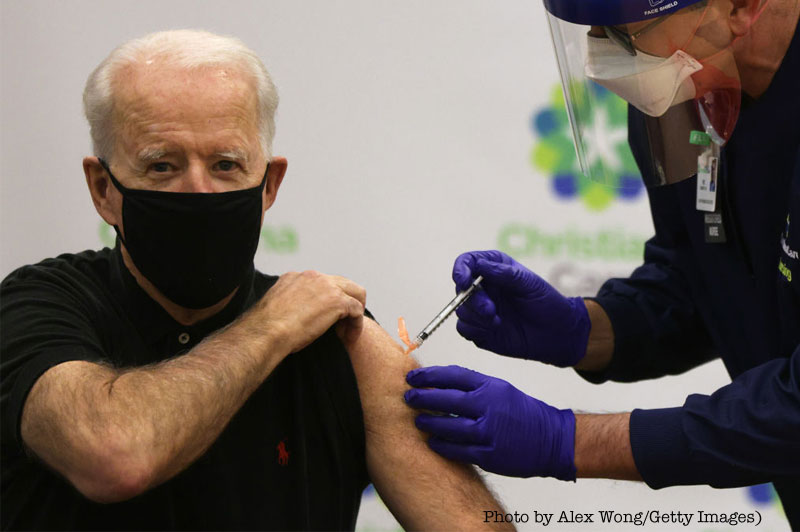
President Joe Biden is directing states to make all adults eligible for the COVID-19 vaccine by May 1, and Ohio Gov. Mike DeWine said over the weekend the state is on track to do thator better.
Biden’s COVID-19 advisers are projecting that enough Americans in priority groups will be able to access the vaccine by the end of April to allow for the lifting of restrictions on who can access the vaccine.
Alaska on Tuesday became the first state to open eligibility to anyone age 16 or older.
The announcement came Thursday on the one-year anniversary of the World Health Organization declaring the COVID-19 outbreak to be a pandemic.
Earlier on Thursday, Biden signed into law a massive pandemic stimulus bill that includes $20 billion to boost vaccination efforts across the country.
He also announced Wednesday that his administration secured another 100 million of the one-dose Johnson & Johnson vaccine, after helping to broker a deal in which Johnson & Johnson will team up with drugmaker Merck to produce doses faster.
More than 81 million vaccines have been administered since Biden took office in January. But state officials seeking to get those shots into arms have been hamstrung by too few doses, antiquated technology for coordinating appointments, and the challenge of securing enough manpower and other resources to meet the demand for vaccinations.
The administration has launched federally run vaccination sites across the country, and will more than double the number of federal mass vaccination centers. More than 4,000 active duty troops will deploy to support those vaccination efforts.
The Biden administration also will expand who is qualified to administer shots, adding dentists, advanced and intermediate emergency medical technicians, midwives, optometrists, paramedics, physician assistants, podiatrists, respiratory therapists, and veterinarians.
The Department of Health and Human Services will launch a new website for individuals to check if they are eligible to volunteer to administer shots.
Biden also will seek to make it easier for Americans to find a vaccination appointment, announcing plans to launch a federal website by May 1 that will show nearby locations that have vaccines, as well as a 1-800 number for those who lack internet access.
The administration also says it will deploy technology teams to states that need assistance in improving the websites they’re using to schedule vaccinations.
On Feb. 1, as Black History Month began in Ohio’s classrooms and virtual classrooms, Gov. Mike DeWine unveiled his proposed budget for the next two years, which continues the education funding policies that systematically underfund public schools that educate Black students and even shift some of that funding away toward unaccountable, for-profit private schools.
Black History Month is an important time for our nation’s educators to focus their curriculum around the contributions that African Americans have made in government, industry, art, science, literature, and every field of human endeavor. However, we do a disservice to our students if we don’t also teach about the harder, more painful history of slavery, segregation, disenfranchisement, and racist violence, and if we do not weave it into our everyday curriculum as deeply as it is woven into the fabric of our country.
Even then, we are not telling the full story if we teach about these topics as relics of the past, as dark chapters of our country’s past that have ended. Racist structures in our society didn’t cease to exist when the Thirteenth, Fourteenth and Fifteenth Amendments were ratified following the Civil War, or after Brown vs. the Board of Education desegregated schools, or after the 1964 Civil Rights Act, or even after Barack Obama’s historic election.
Each of those events has been an important step along the way, but as we are reminded all too often, the vestiges of white supremacy live on in our current institutions. We see it in the over-policing and incarceration of Black, brown, and immigrant communities, we see it in our city neighborhoods that were shaped by redlining, and we see it in Ohio’s school funding system.
When we teach Black history, educators can make the connections about how the racial injustices of the past have turned into the systemic racial disparities of the present, and how we can demolish the underpinnings of injustice. There is no better place to start than with our broken school funding policies which underfund and segregate schools with large populations of Black students.
In Ohio, we underfund schools in Black communities with a school funding formula that was found unconstitutional by the Ohio Supreme Court more than 20 years ago because it relied so heavily on local property taxes that it denied an equitable and adequate education to students in low-income areas.
We segregate schools in Black communities with voucher and charter policies that divert students and drain funding from local public schools. Often cloaked in the language of racial justice, vouchers and charter schools have the opposite effect when put into practice. The NAACP has often opposed these policies because they “divert much needed funding for public education to private or charter schools, thereby further dismantling the viability of the public education system and limiting the number of children who would be afforded the opportunity of an adequate and effective education.”
This vicious cycle of underfunding schools in communities of color, and then punishing them for not being able to meet their students’ needs by underfunding them further, must end. We must stop pitting parents and communities against one another, and instead renew our commitment for high quality public schools for all Ohio students.
Last year, the Ohio House passed the Fair School Funding Plan with an overwhelming bipartisan majority, yet the Senate refused to take the issue up. The Plan would have put Ohio on a six-year path toward equitable funding of public schools in Ohio, and would have immediately ended punitive and harmful deductions for vouchers and charter schools from local public school funds.
This would ensure that public school districts receive money only for the students who are enrolled to attend but without the added penalty of deducting money due to students opting for private or charter schools. These changes would strengthen schools in Ohio’s cities and in our rural areas, giving students from all backgrounds increased opportunities. Despite the Fair School Funding Plan receiving an 84-8 vote in the House, the Ohio Senate allowed the bill to die without even receiving a vote.
DeWine had the opportunity to take the hard work and bipartisan agreement for this new school funding formula and insert it as a framework into his budget proposal. Instead, his proposal continues the status quo which is actively undermining our ability to provide an equitable education.
As educators, we can not teach Black History without also being activists in our own realm, fighting for an education system that gives every child, no matter their race or where they live, equal access to a high quality, free public education.
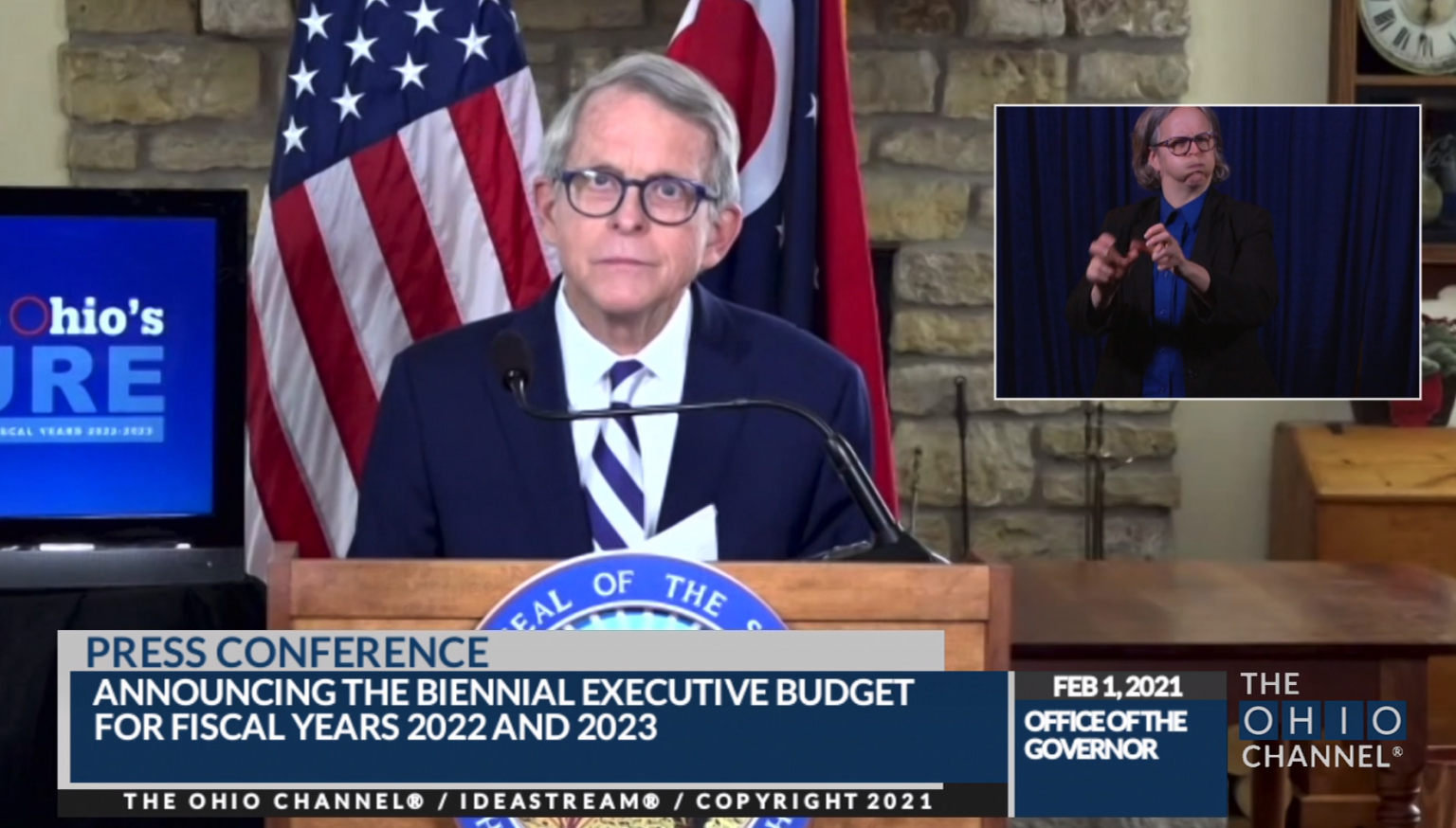
Ohio Gov. Mike DeWine outlined his administration’s proposed state budget on Monday, calling his plan “truly an investment into our future.”
Acknowledging this as being an “extremely challenging time in Ohio,” DeWine nevertheless offered an optimistic view of the coming two years and said 2021 in particular would be a year of recovery.
The governor emphasized the need for targeted investments toward Ohio businesses, communities and workers as the state continues to deal with a pandemic that has left thousands dead and more than a million seeking unemployment aid at some point in the past year.
“We see a bright future ahead,” said Kimberly Murnieks, the state’s chief budget officer, in helping to roll out the budget plan.
The proposal kicks off months of negotiating with the Ohio legislature, which is tasked with approving a state budget this summer.
Here are some main takeaways of how the budget affects everyday Ohioans and some details about the next steps in the budget process:
Big investments in small businesses, expanding broadband access
At the centerpiece of DeWine’s budget proposal is a new economic recovery plan referred to as the “Investing in Ohio Initiative.”
The one-time spending plan includes more than $1 billion toward business grants, community infrastructure projects and workforce development.
A total of $460 million in grants would go toward bars, restaurants, entertainment venues and other small businesses hit hard by the pandemic, DeWine said. Of this money, $20 million would be specially allocated for new businesses started since the beginning of 2020.
Lt. Gov. Jon Husted outlined a number of proposed investments toward improving the state’s workforce training opportunities, benefiting high school students and adult workers alike:
TechCred Investment/Individual Microcredential Assistance Program: ▪️$5M to fund an additional 5,000 credentials in 2021. ▪️$25M for 20,000 tech-focused credentials in 2022/23. ▪️$15M dollars in workforce development efforts in economically distressed rural and urban communities.
Another major component of the Investing in Ohio Initiative is $250 million for broadband expansion throughout the state of Ohio. This is an “incredibly important” priority, Husted said, noting that Ohioans without adequate internet access at home have fewer education, health care and telework opportunities.
This proposed spending is made available, DeWine said, due to money saved by the state government during the pandemic as well as increased federal spending in Ohio that has freed up additional money.
There is one other aspect of the Investing in Ohio Initiative plan.
DeWine wants $50 million public relations campaign
This is a component of the governor’s proposed recovery plan that turned some heads.
DeWine hopes to see the state embark on a $50 million marketing campaign to promote the virtues of Ohio to the rest of America.
The idea, he said, is to convince residents and entrepreneurs living elsewhere to relocate to the Buckeye State.
“We want to position Ohio as the place to be,” DeWine said, saying the campaign should highlight the state’s cultures, cities, universities and workplace opportunities.
No new taxes, but some new fees
The governor and chief budget officer repeatedly made note of the effort to not propose any new taxes with this budget.
It does, however, call for increasing some fees that Ohio residents have to pay at the Bureau of Motor Vehicles. The budget proposes a $10 increase on motor vehicle registration fees and a $2 increase on title fees.
This would raise millions of dollars benefitting the Ohio State Highway Patrol, which Murnieks said is in need of additional funding to pay for its operations and security responsibilities. (The Patrol provides security at the Ohio Statehouse.)
Health and Education
Public health should remain a major funding priority going forward as Ohio navigates the COVID-19 pandemic, DeWine said.
He mentioned a particular need to invest in better data systems for health departments to process and report public health information.
The governor will talk in future detail about the proposed public health spending in his Tuesday pandemic press conference, Murnieks told reporters.
Gov. DeWine said his budget would allocate funding toward improving Ohio health departments’ ability to process data and information. The Ohio Department of Health’s COVID-19 dashboard is seen in a screenshot from Monday afternoon.
The budget proposes a notable increase in state Medicaid spending. Murnieks said this is due to a rise in the number of Ohioans relying on Medicaid during the ongoing health crisis and an expected decrease in federal funding.
Regarding education, DeWine did not include any changes with the K-12 funding formula in his budget proposal, noting that lawmakers are still debating the issue.
Throughout the pandemic, DeWine has said the state would not tap into its $2.7 billion “rainy day fund” unless it was absolutely necessary.
The state opted against doing so for all of 2020, even while instituting hundreds of millions of dollars in cuts to public education last May.
Likewise, the state evidently has no intention of using that money in 2021. DeWine did not propose any funds be used from the rainy day fund in his budget proposal.
Murnieks told reporters that it’s beneficial for Ohio to continue saving it for any future budget catastrophe. She said the state likely would have relied on this money had it not been for the funding assistance provided by the federal government.
What’s next?
The state legislature will now start reviewing the budget proposal.
The negotiating process begins in the two chambers’ Finance Committees. Eventually, the budget will come to a full vote in the Ohio House of Representatives and the Ohio Senate. Members from both chambers will then hash out any differences before a final budget bill heads to the governor’s desk for approval.
The budget must be approved by the start of the new fiscal year (July 1), though it’s not uncommon for negotiations to continue past that date with a temporary budget in place.
More information about the budget proposal is available online at budget.ohio.gov, with information about current state spending available at checkbook.ohio.gov.
Desperate to slow the spread of coronavirus, Ohio Gov. Mike DeWine on Tuesday announced a new curfew intended to decrease person-to-person contacts and new infections.
DeWine said that starting at 10 PM on Thursday, there will be a 21-day statewide overnight curfew from 10 PM until to 5 AM. Bars, restaurants and retail stores will have to close. But there will be exceptions for pharmacies, grocery stores, food delivery, drive-through and pickup service.
Technically, people who violate the curfew could be charged with a second-degree misdemeanor, punishable by 90 days in jail and a $750 fine. But as he has with other covid-related health orders, DeWine said he he’s not eager to see people charged.
“We do not expect law enforcement to go pull people over because they’re out beyond 10 o’clock,” he said. “But if they’re seeing something going on, this is a way they can walk up and say, ‘Hey guys, you’re here… there’s a curfew. Why don’t you just go home?’”
Desperate to slow the spread of coronavirus, Ohio Gov. Mike DeWine on Tuesday announced a new curfew intended to decrease person-to-person contacts and new infections.
The move was greeted with skepticism in some quarters.
DeWine said that starting at 10 p.m. on Thursday, there will be a 21-day statewide curfew from 10 p.m. to 5 a.m. Bars, restaurants and retail stores will have to close. But there will be exceptions for pharmacies, grocery stores, food delivery, drive-through and pickup service.
Technically, people who violate the curfew could be charged with a second-degree misdemeanor, punishable by 90 days in jail and a $750 fine. But as he has with other covid-related health orders, DeWine said he he’s not eager to see people charged.
“We do not expect law enforcement to go pull people over because they’re out beyond 10 o’clock,” he said. “But if they’re seeing something going on, this is a way they can walk up and say, ‘Hey guys, you’re here… there’s a curfew. Why don’t you just go home?’”
The governor added, “No one’s been charged under these health orders,” he said. “That doesn’t mean they couldn’t be, but they haven’t so far.”
The curfew comes as Ohio experiences its most alarming spike in coronavirus infections and hospitalizations since the start of the pandemic early this year.
On Tuesday, state health authorities reported 7,079 new cases over the past 24 hours, a 36% increase over the 21-day average. They also reported 368 new coronavirus hospitalizations, only a little less than the state record of 386 set on Nov. 10.
The swelling numbers have placed Ohio hospital staffs in a “precarious situation,” said Bruce Vanderhoff, chief medical officer for the Ohio Department of Health. He said medical workers are fatigued from fighting the disease since March and they have to balance that work with living in communities and with families where the virus is increasingly prevalent.
DeWine said his goal was to reduce the number of person-to-person contacts and thereby stop the virus from spreading. He asked Ohioans to voluntarily do that through such measures as condensing the number of trips they make to the grocery and buying more when they do. At the same time, he urged people to do what they can to remotely maintain emotional connections.
However, critics noted that the curfew doesn’t go as far as one imposed in the spring. For example, the earlier order imposed limits on how many people can be in stores when they’re open.
Asked what scientific basis he used in issuing the order, DeWine said, “We know the basic science. The basic science is fewer contacts, less spread.”
The likely effectiveness of the curfew was disputed by at least one scientist in the field. Kent State epidemiologist Tara C. Smith tweeted that she didn’t know any professionals who thought it would work.
I haven't met a single public health official who thinks these types of curfews/ 10pm shutdowns will be particularly helpful. Maybe they're out there somewhere–anyone want to explain it to me? I don't know where they're getting their advice from. https://t.co/ZH7OXYhrY3
DeWine, however, might have felt the curfew was as far as he could go. It had the support of the Ohio Restaurant Association, likely meaning that there was some negotiation behind it.
Also, DeWine is a member of a party led by president who in October visited Circleville and said the media were hyping the virus to hurt his reelection chances. The president predicted the media would stop covering coronavirus on Nov. 4 — the day after the election.
Covid skepticism runs so deep in elements of the Republican Party that at the same time that DeWine was announcing the curfew, Ohio Senate President Larry Obhof, R-Medina, was testifying in favor of his bill to repeal an earlier health order requiring bars to stop serving at 10 p.m.
At the exact time @GovMikeDeWine continues to defend/explain his new curfew health order, State Sen. President @LarryObhof is testifying on his bill to reinstate Ohio's normal bar hours
Would rescind the state order prohibiting sales after 10 p.m./consumption after 11 p.m. pic.twitter.com/y0P2ZaCyYS
For his part, DeWine said he hopes the curfew will “push more people toward home.”
“I think if we do these things it gives us a shot at slowing (the coronavirus) down,” the governor said. “Most of what we’re doing and the decisions I’m making are between two bad choices.”
Marty Schladen has been a reporter for decades, working in Indiana, Texas and other places before returning to his native Ohio to work at The Columbus Dispatch in 2017. He’s won state and national journalism awards for investigations into utility regulation, public corruption, the environment, prescription drug spending and other matters.
Marty Schladen has been a reporter for decades, working in Indiana, Texas and other places before returning to his native Ohio to work at The Columbus Dispatch in 2017. He’s won state and national journalism awards for investigations into utility regulation, public corruption, the environment, prescription drug spending and other matters.
Ohio Gov. Mike DeWine and the state’s legislative leaders on Friday announced how they’d allocate almost half of what the state has left in federal coronavirus-relief dollars.
The state has about $1 billion unexpended from its share of the $2.2 trillion CARES Act that Congress passed in March. At least until the feds change the rules, the funds have to be spent by Dec. 31.
Social-service groups that deal with issues of homelessness and hunger have been clamoring for months for a share of the money, as have business groups and others. So it’s been up to DeWine and the legislature to decide what to do with the money while Congress appears stymied over further coronavirus relief.
“We tried to look at what the needs were and what had already been put out,” DeWine said during a remote press conference. “We don’t know whether Congress will pass another bill or not.”
The state is holding about half of the funds for coronavirus testing and contact tracing and other needs while it awaits a possible second round of relief — which may or may not include assistance to state and local governments.
The expenditures announced Friday include:
$50 million for mortgage and rental assistance to families making 200% or less of the federal poverty level
$125 million for businesses with up to 25 employees
$37.5 million for restaurants and bars
$100 million for colleges and universities to do testing, contact tracing and provide mental-health services
$62 million for rural and critical-access hospitals
$25 million for non-profits providing services such a food banks, homeless shelters and other social services
$20 million for the arts
A good deal more of the money was focused on businesses than on assisting individuals who are suffering most. But several in Friday’s press conference said they hope by helping small businesses keep their doors open, people will be able to get or keep jobs.
“We know some businesses are barely making it,” Lt. Gov. Jon Husted said of that portion of the package. “This is focused on them.”
For their part, some leaders of social-service organizations said they were grateful for the help they will receive.
“We’re pleased that Gov. DeWine finally deployed federal coronavirus relief funds to help people avoid getting evicted during this pandemic,” Bill Faith, executive director of the Coalition on Housing and Homelessness in Ohio, said in a written statement. “And we appreciate (Ohio) Controlling Board members’ support, especially Sen. (Matt) Dolan (R-Chagrin Falls) and Sen. (Jay) Hottinger (R-Newark) who took a personal interest in keeping struggling Ohioans safely in their homes. We look forward to seeing details on how the program will be implemented. Given the Dec. 31 deadline to use these funds, we would welcome the governor’s assistance in advocating for Congress to provide additional rental assistance into 2021.”
The Ohio Poverty Law Center also released a statement praising state leaders for their action. But it warned that it won’t be enough.
“As Ohioans continue to experience job and income loss due to the pandemic, additional federal and state resources will be needed to prevent evictions and keep Ohioans safe, especially as we get closer to the expiration of the Centers for Disease Control and Prevention’s eviction moratorium,” it said. “We hope housing assistance will be among the highest priorities for resources in the coming weeks and months.”
A look at how overcrowding and poor design contributed to two of the worst national outbreaks
This article was provided by Eye on Ohio, the nonprofit, nonpartisan Ohio Center for Journalism. Please join their free mailing list as this helps us provide more public service reporting.
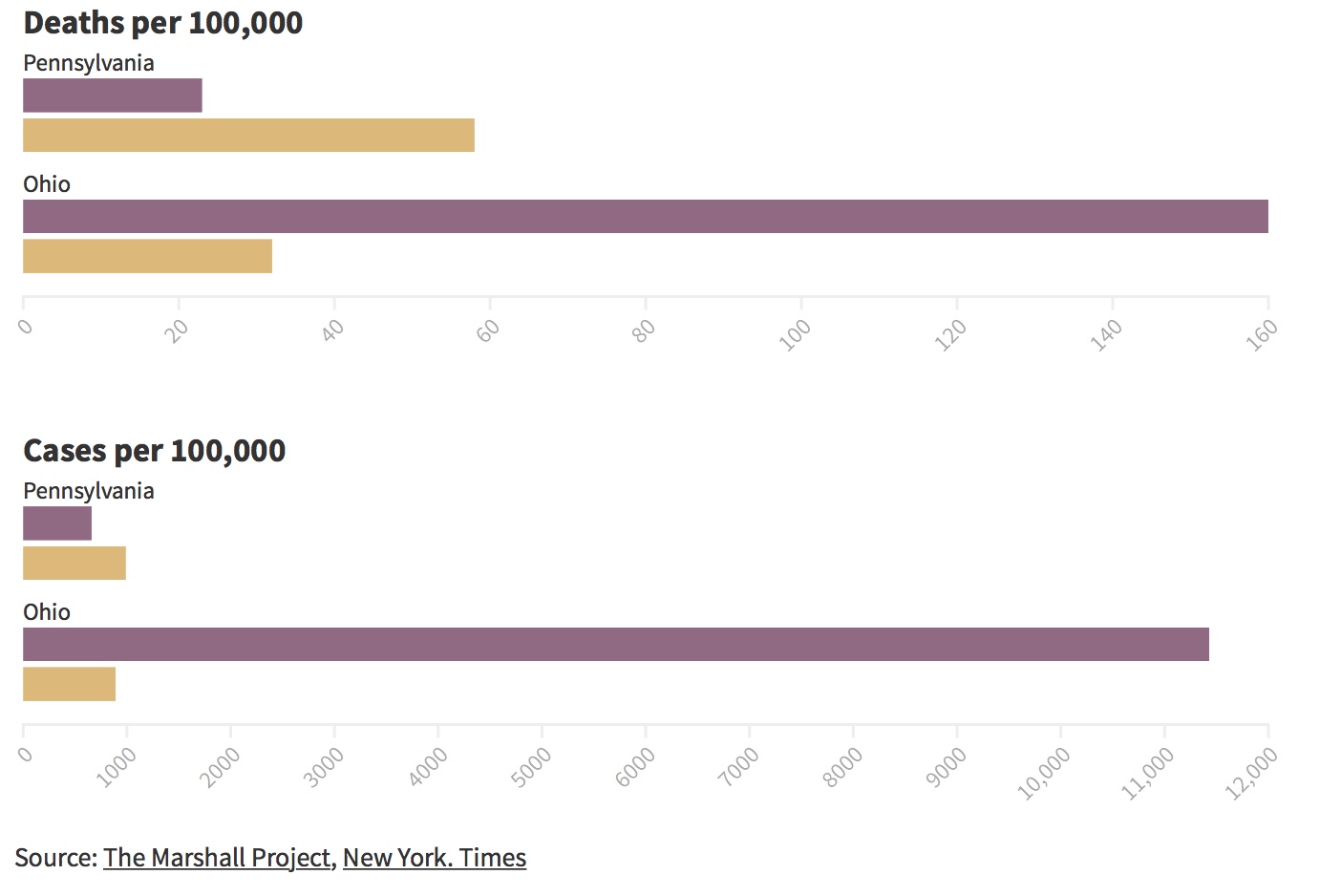
For the first two months after the COVID-19 pandemic hit the U.S., Ohio’s response set an example. Thanks to an early shutdown order, the state’s per-capita deaths from the virus as of late April were less than half of those in neighboring Pennsylvania, a state with similar demographics.
But inside the two states’ prison systems, it was a different story.
By late April , the death rate from COVID-19 in Ohio prisons was 22 per 100,000, a rate more than 4 ½ times the overall Ohio rate and nearly twice the national rate.
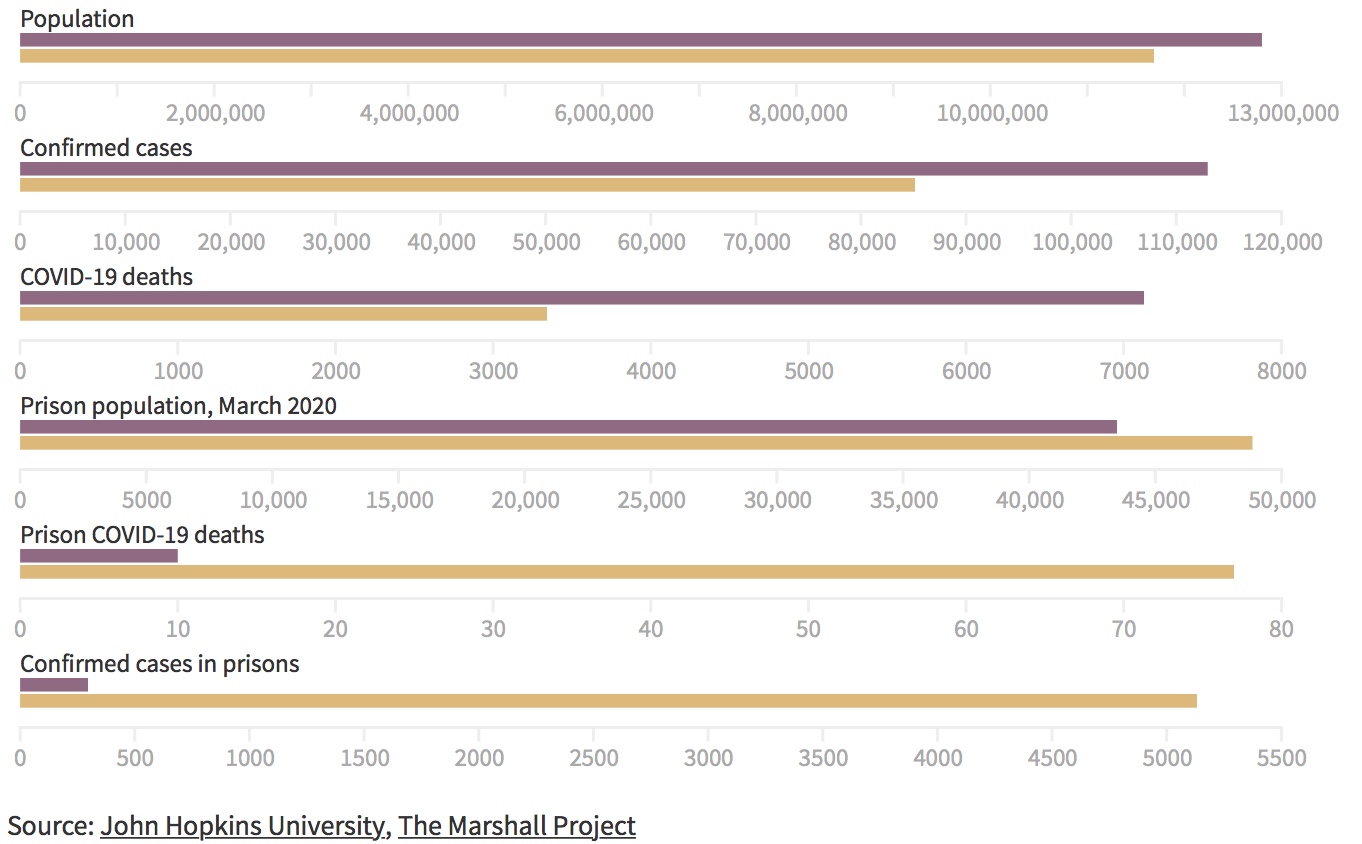
As of August 14, there have been 77 inmate deaths known to be caused by COVID-19, and another 10 suspected— a rate of 160 deaths per 100,000 people. Ohio’s prisons have incubated two of the four largest COVID outbreaks in the nation.
In Pennsylvania’s prison system, which houses about 44,000 inmates at 25 facilities, the death rate was comparatively low— 10 incarcerated people have died as of mid August, for a death rate of 23 per 100,000 people, despite the virus showing up in each state just a few days apart. In fact, a Pennsylvania inmate is less than half as likely to die of COVID-19 as a free Pennsylvanian.
Why have Ohio’s prisons failed so thoroughly to control the spread of COVID-19 when Pennsylvania fared far better?
No state has had a model approach for controlling the virus in prisons. All have made missteps that put inmates’ and staff members’ lives at risk, according to prisoners and prisoner advocates. Prison outbreaks have also spread into the communities outside their walls. But, whether through foresight or luck, factors in some states have kept the virus from running rampant as it has in Ohio prisons. As the country faces new waves of cases, corrections departments may be able to learn from what helped or harmed some states during the first stage of the pandemic.
While advocates for incarcerated people in Pennsylvania caution against holding that state’s experience as a model for how to respond to the pandemic, they agree that the answer may lie both in how crowded the prisons are, and how inmates are housed.
Crowded prisons spread disease
Controlling an outbreak of infectious disease in a prison is never easy. As with other communal living facilities such as nursing homes, once a respiratory illness enters, close quarters gives a virus ample opportunity to spread.
Overcrowding only makes the situation worse.
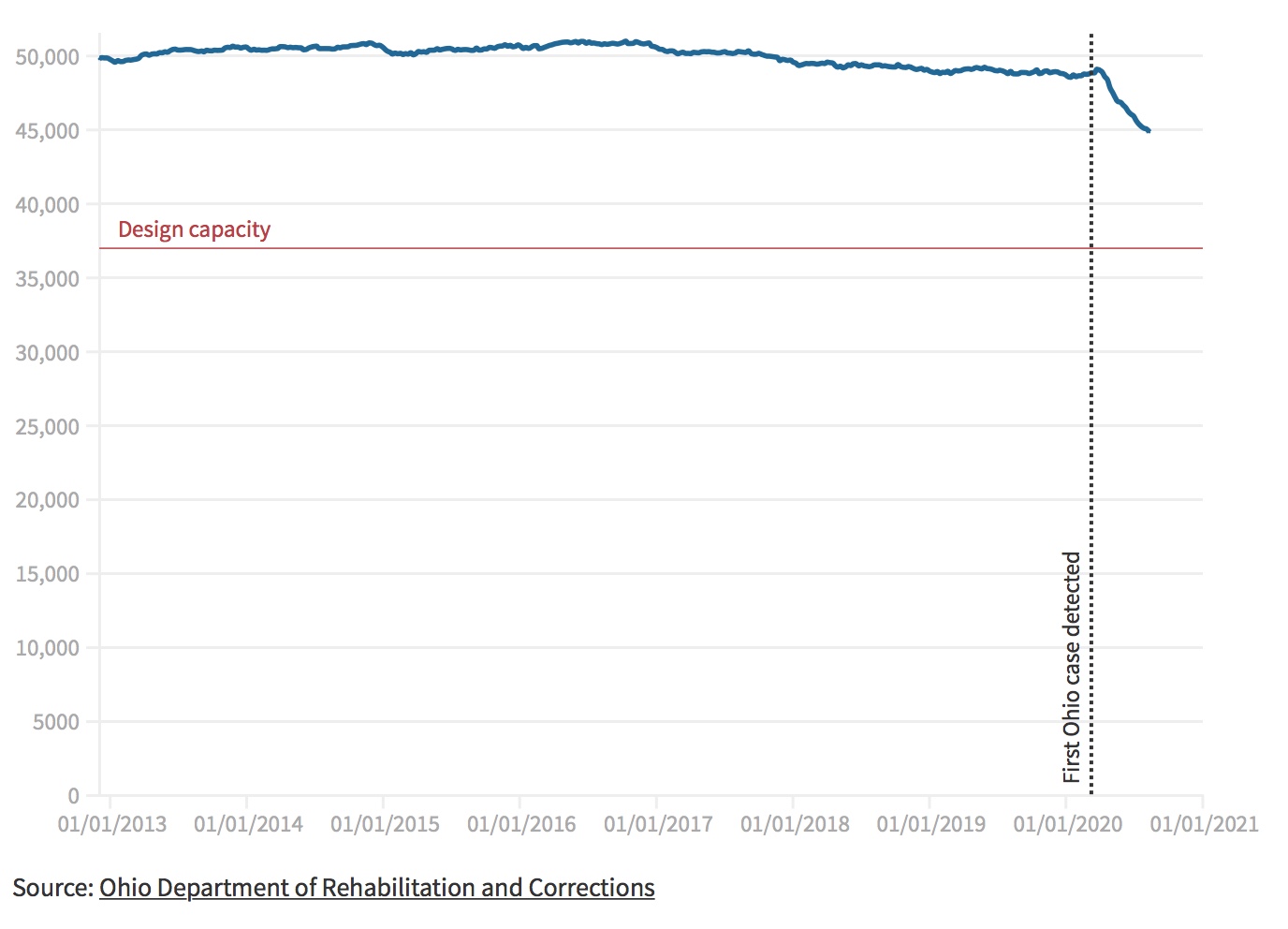
In Ohio, where the prisons were 32% above capacity in February, the virus spread rapidly.
In Pennsylvania’s prisons, at 95% of capacity in February, there were outbreaks in several prisons, but far fewer deaths.
That state’s biggest outbreak to date—183 infections and five deaths among inmates— happened at its oldest prison facility, the 131-year-old State Correctional Institution (SCI) Huntingdon in central Pennsylvania.
“SCI Huntingdon dates from the late 1800’s and has cells with open bars, and four-story housing units with open air shafts to all of the cells,” said Claire Shubik-Richards, executive director of the Pennsylvania Prison Society, a non-profit inmate advocacy organization. “So when the virus came in it spread like wildfire.”
In other, newer Pennsylvania prisons with significant outbreaks, such as SCI Phoenix, the virus proved easier to control. Only 49 inmates at Phoenix, which opened about 2 years ago, have tested positive, and four have died, despite being located in hotspot Montgomery county, just north of Philadelphia.
“The thing about that facility was that the outbreak went up and then went down pretty quickly because it’s a facility where isolating people is pretty easy,” Shubik-Richards said, because it has more single and double-occupancy cells than open dorm units.
In Ohio’s more crowded prison system, the virus was first detected in a staff member in the 66-year-old Marion Correctional Institution on March 29. Less than a month later, nearly 4,000 inmates across the state had tested positive for the virus; 10 were dead, as was one staff member.
Now, the death count is approaching 80. Ohio’s prison system is home to two of the four largest COVID-19 outbreaks in the nation, with 2,440 cases at Marion Correctional Institution in rural central Ohio, and 1,792 at Pickaway Correctional Institution outside Columbus.
Pickaway, built in the 1920s as a mental hospital and converted to a prison in 1984, was designed to hold 1,328 people. As the pandemic began in Mid-March, it held 2,047– 54 percent over capacity.
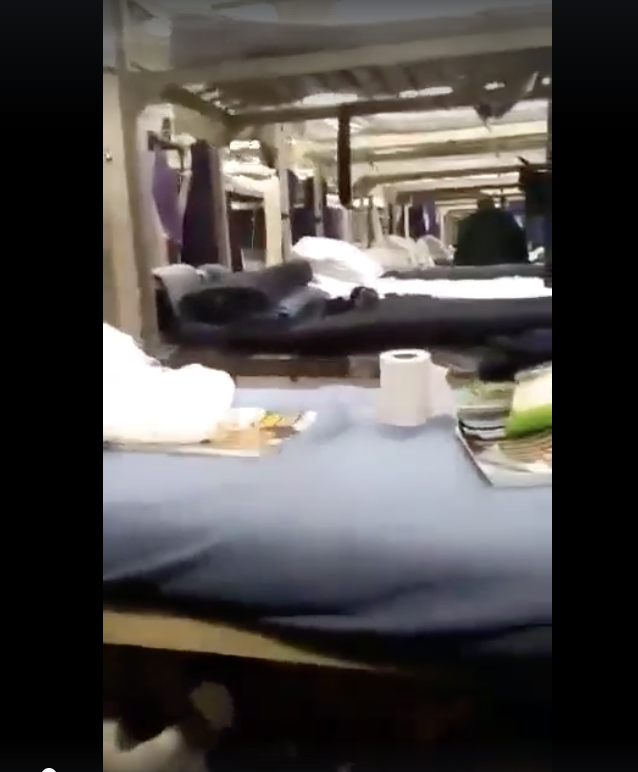
In one cell phone video that purportedly shows the inside of Pickaway, seemingly endless racks of double-bunked beds are visible, with no barriers and little space between.
“Everybody’s stacked on top of each other, man,” says the person wielding the camera. “Ain’t no social distancing in here….They’re playing with our lives, man.”
Picture of Ohio dorms
Virus runs amok in dorms
Pickaway was designed to have 87% of its beds in open double-bunk dorms, described in a 2015 state prison renovation plan as “barrack-style” (sic), where beds were typically three feet apart. When prisons are overcrowded, staff often squeeze even more beds into the dorms than they were designed to hold, said Meghan Novisky, a Cleveland State University professor who studies how prisons impact health.
In the 2015 master plan, state officials acknowledged that the prison’s dorm-style housing was a problem, not because of disease, but because it elevated prisoners’ stress, setting the stage for unrest.
“A critical need is to improve the dormitory living conditions and reduce the very high levels of crowding,” the report said. “The [Strategic Capital Master Plan] recommends the phased conversion of all dormitory living units to a cubicle-type configuration where inmates will have a higher degree of personal space and privacy.”
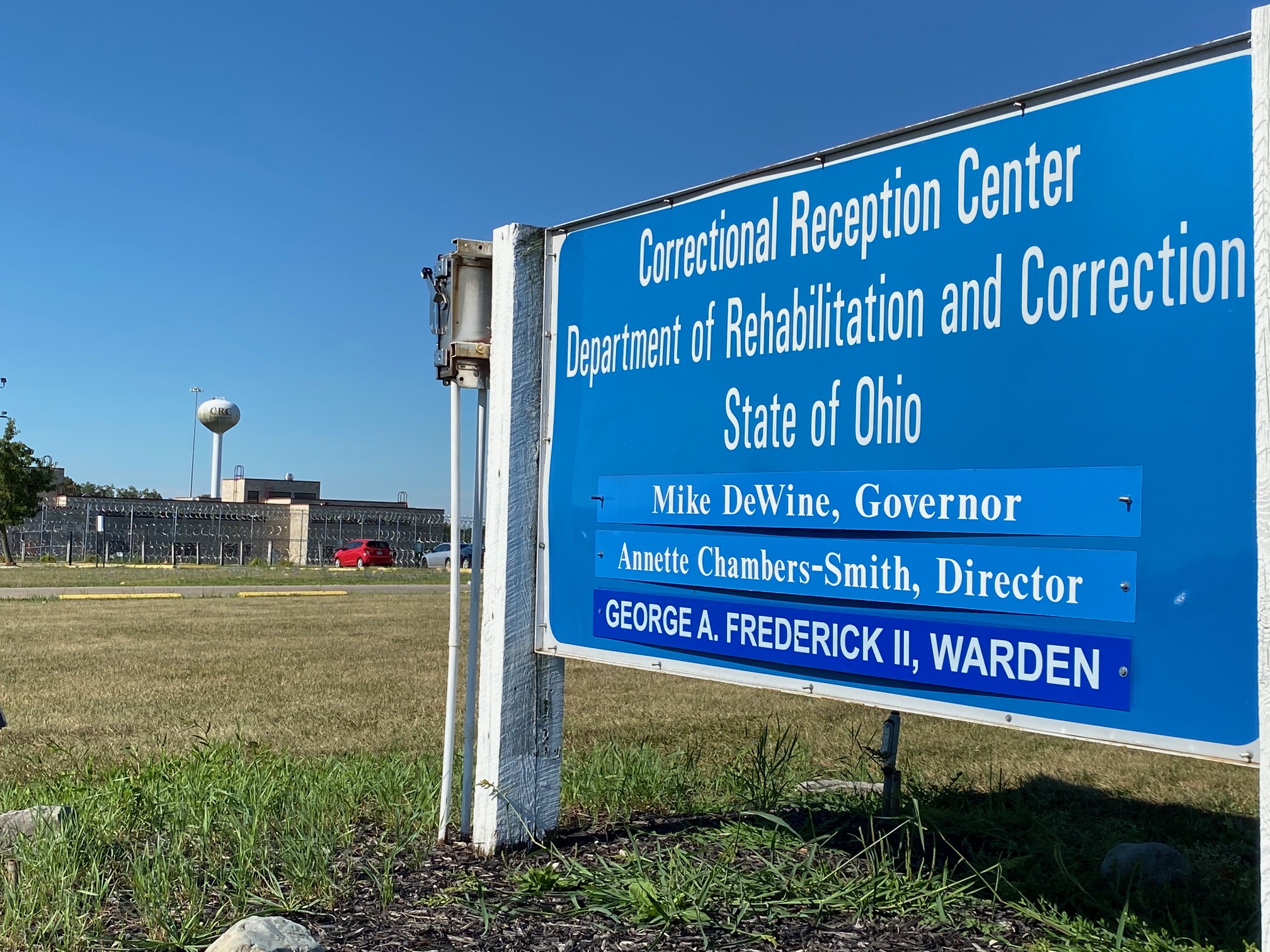
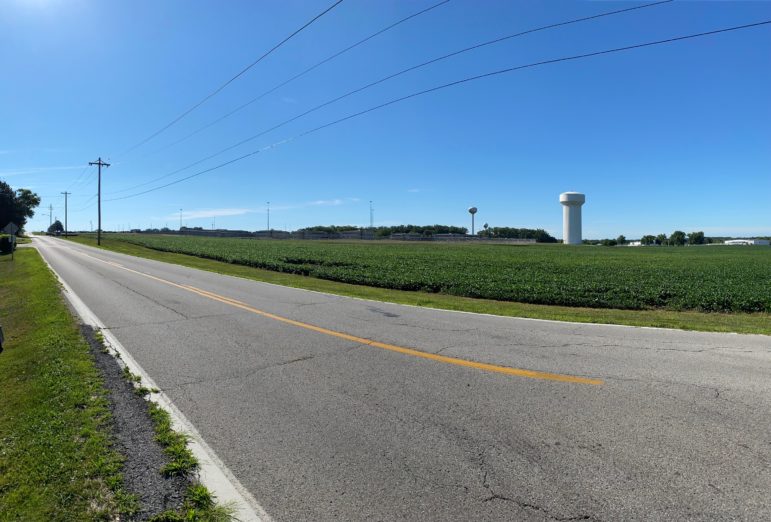
Outside Pickaway Correctional Institution. (Photo Credit Eye on Ohio)
Ohio Department of Rehabilitation and Correction (DRC) spokesperson JoEllen Smith said that some of the plan’s recommendations for Pickaway have been implemented. The Orient Correctional Institution, a prison adjoining Pickaway that hasn’t been used since 2001, was demolished, as was Pickaway’s dilapidated E block of dorms. But construction of a new unit with over a thousand beds is on hold due to the pandemic.
Around March 29, leadership at Marion – designed to hold 73% of its inmates in dorms – declared that prisoners in dorms would sleep arranged head-to-foot. That way their faces would be more than three feet apart, according to an email between the prison’s medical services director and the Marion County public health department, obtained by the Documenting COVID-19project at The Brown Institute for Media Innovation.
According to daily statistics released from Ohio DRC, on April 21, more than 28,000 of the state’s 48,396 inmates were either “isolated” or “quarantined.” But in overcrowded prisons where most inmates lived in dorms, both happened in groups, according to numerous inmates.
Daily coronavirus reports from DRC noted that “isolation” meant keeping infected inmates away from those who weren’t sick, while “quarantine” meant “limiting the movements” of someone who may have been exposed to the virus. Guidance issued by the DRC early in the pandemic said it was preferable to quarantine inmates in the infirmary, but if not enough cells were available, they could be “quarantined” in “an area large enough to hold beds and equipment for a minimum of 50 patients.”
Marion was designed to hold 450 inmates in cells. On April 16, 2,417 inmates there were listed as “in quarantine.”
The close quarters of dorm-style housing is a problem in other Ohio prisons, too, inmates reported.
Javalen Wolfe, an inmate incarcerated in dormitory-style housing at Belmont Correctional Institution in southeastern Ohio, said that every time a flu or a cold enters the prison, there’s no stopping it.
“This is how it works because we live so close together. If one person gets sick, everybody gets sick,” he said. “We are literally two feet, maybe two and a half feet between the next person, and there’s no divider, no wall.”
At least nine Belmont inmates had died of COVID-19 as of Aug. 10. Belmont was designed to have 1,855 beds, over 90% of which would be in dorms. As of March 17, near the beginning of the outbreak in Ohio, 2,719 inmates were crammed into the prison— 146% of the population it was meant to hold.
Of the 77 confirmed COVID-19 deaths in Ohio prisons as of mid-July, 67 of them were in prisons that were designed to hold at least half their inmates in dorms. Of the deaths in prisons made up mostly of cells, 10 were in Franklin Medical Center, a small prison dedicated to caring for the system’s most seriously ill inmates.
The worst Pennsylvania outbreaks were at two prisons where inmates were housed almost exclusively in cells – Huntingdon and Phoenix. But the system overall houses just 19% of its inmates in dorms. Roughly 60% of Ohio’s inmates live in dorms, according to Department of Rehabilitation and Corrections Director Annette Chambers-Smith. Each dorm can hold anywhere from 40 to 300 inmates.
And even Pennsylvania’s worst prison outbreaks paled in comparison to Ohio’s. At Huntingdon, the prison with the most deaths, 359 coronavirus cases were confirmed, out of 1,835 inmates. Phoenix housed 2,825 inmates as of late July, 89 of whom tested positive for COVID-19 at some point.
Since mass testing wasn’t conducted at any of the Pennsylvania prisons, the death toll is probably a more faithful indicator of the spread of the disease. The inmate death rate at Huntingdon was 272 COVID-19 deaths per 100,000 people. At Pickaway, it was 1,709, and at Franklin Medical Center, it was over 2,000.
In an interview with Eye on Ohio, DRC Director Annette Chambers-Smith acknowledged that the open bays make it difficult to control the virus. She said they have attempted to mitigate dorm crowding by spreading inmates out in other areas that aren’t normally used for housing, such as gymnasiums and classrooms.
”They literally installed lavatories and facilities in a building so that it could be used overnight to house people,” she said.
And administrators are experimenting with makeshift barriers between dormitory beds at most of its prisons to reduce transmission.
Reducing overcrowding– release of prisoners
Pennsylvania started the pandemic in a relatively good position in terms of space after years of modest, gradual population reduction. They freed up more space after the pandemic hit by giving 3,500 people sentence reprieves and shutting down the county court system.
Several other states have taken steps to free up space in their prisons since the pandemic began, with 15 reducing their prison populations 10% or more between March and June, according to data from The Marshall Project.
Connecticut has taken the most drastic measures, cutting its inmate population by more than 22%, from 12,364 on March 8, the day the virus was first detected in a Connecticut prison, to 9,604 on August 12. Six inmates have died so far in the Connecticut system, which houses only 12,000 inmates thanks to a decade-long pre-pandemic decarceration effort that reduced the population from about 20,000 in 2008.
Compared to the state’s prison population in March, its per-capita death rate has been less than half that of Ohio’s prisons.
That’s despite the fact that, according to prisoner advocate groups in Connecticut, the state made many of the same missteps as Ohio in their attempts to quarantine and isolate inmates.
Melvin Medina, public policy and advocacy director for the ACLU of Connecticut, said that the CDC has recommended isolating people with laboratory-confirmed COVID-19 together and quarantining close contacts together as a group due to limited space in prisons, but did not indicate how large these groups can or should be.
“Our DOC took that to say that in dorm-style settings if there was one sick person in a dorm of 100 people, that meant that whole block was quarantined together,” he said. “They locked sick and healthy people in together and let the virus run its course. In hindsight, I’m deeply thankful that our death count was really low. We could have had a disaster, and we got very lucky.”
Advocates like Novisky say releasing inmates is the best way to protect them from COVID-19, since any group housing makes it hard to control the spread of disease. Even in places where prison populations have dropped by double-digit percentages, advocates say it’s not enough.
“They need to release those that are medically vulnerable,” based on the CDC’s criteria, not just those who are close to the end of their sentences or incarcerated for non-violent offenses, said Nyssa Taylor, criminal justice policy counsel for the American Civil Liberties Union of Pennsylvania. The state is home to about 4,000 older adults serving life sentences, she said, one of the highest such populations in the country.
“I don’t think we should be politicizing who to release,” she said. “I think it’s really important to look at how to save lives, not just ‘release all the non-violent.”’
Meanwhile, Ohio’s prison population fell by about 5.2% between March and June. By August 11, it had fallen 9%.
“I think part of the problem that they’re running into is we really haven’t taken advantage of options to reduce our population size,” said Novisky.
On April 15, Ohio Gov. Mike DeWine announced he was invoking an overcrowding statute to release some prisoners early. Inmates who were within 90 days of their planned release date could be eligible for early release, but only if they met a list of criteria. That excluded people convicted of most types of violent crime, who had served more than one sentence, who had previously been denied judicial release, or who had committed a serious infraction while in prison.
“It basically eliminated everyone,” Novisky said.
Chambers-Smith said the department has taken multiple steps to reduce the population, including reviewing cases of elderly inmates or those with health conditions that make them especially vulnerable to COVID-19. The list of crimes that disqualify inmates for early release under Ohio’s emergency overcrowding law, she noted, is set by the Ohio legislature. The law would have to be amended to loosen those criteria.
“There are more serious crimes where you wouldn’t want to think about people getting out before they’re ready,” she said. “There’s a balancing act here between keeping the public safe and keeping the people in prisons safe.”
Of the 77 Ohio inmates who have died of COVID-19, 34 — more than half— were in prison for sex offenses. Another 18 had been convicted of murder. The average sentences for rape or murder are more than 20 years. Many of the men killed by the coronavirus had grown old in prison.
But most Ohio inmates are serving time for lesser crimes. Only about 12% of Ohio’s inmates were convicted of murder, and 16% were sex offenders. Meanwhile, 15% of Ohio’s inmates were in prison for drug offenses, with 10% serving time for burglary.
But almost a third of Ohio’s inmates released in 2014 ended up back in prison within three years, according to the most recent recidivism study published by the state. All of those prisoners would have been disqualified by DeWine’s exemptions. And with the prisons packed full of repeat offenders, even low-level ones, it would have been difficult to keep older, more vulnerable inmates serving long sentences for more serious crimes isolated.
A spokesperson clarified that it was a joint decision of the governor’s office and the DRC to disqualify repeat offenders, not a stipulation of the emergency overcrowding law.
The day of his announcement, DeWine said he had found 105 people who were eligible for early release, though he noted that more would be considered as they came within 90 days of the end of their sentence.
Since then, the number of inmates has declined slightly, but more due to court shutdowns meaning fewer people sentenced than the slow trickle of early releases. As of August 11, Ohio’s prison population was still nearly 8,000 people over capacity.
Putting the community at risk
Ohio’s prison pandemics also put those outside of prison walls at risk.
As prisons were cut off from visitors, it may have created the false impression that diseases that spread in prisons would stay in prisons. But the Marion outbreak demonstrated otherwise. County health officials and residents voiced concerns in emails that both staff and inmates who finished their sentences were capable of spreading the virus across multiple counties.
In one email obtained by the Documenting COVID-19 project, Traci Kinsler, the Marion County health commissioner, noted that the Marion prison was not isolating inmates before releasing them. Marion released at least one inmate who was known to be infected with COVID-19. He moved to Ashland County.
Chambers-Smith said the department initially offered staff members the option of staying at the facility where they worked to avoid infecting their families. When that offer had few takers, they contracted with hotels to give prison workers a place to sleep, or at least shower before they went home.
Inmates are tested before their release dates, she said, and those who were selected for early release have their release dates pushed back if they test positive until they are considered recovered— officially defined by the department as 14 days past the onset of symptoms, and 72 hours symptom-free. If they reach their regularly scheduled release date, the department has no authority to keep them incarcerated, but will release COVID-positive people with a quarantine order. She said the department collaborates with health departments and religious organizations to give them a place to liveand supplies so they can self-isolate.
Kinsler told Eye on Ohio that the Marion prison outbreak flooded the Marion Public Health Department with cases all at once, and at first officials in various departments struggled with contact tracing. They were able to contact most of the infected people who were released, though, and alerted the county health departments where they settled.
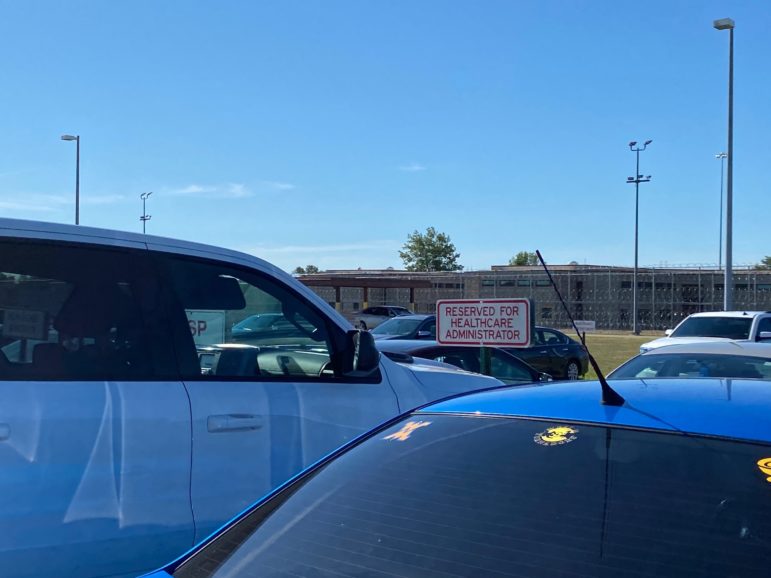
Parking Spot for the Healthcare Administrator at Pickaway Correctional Institution. (Photo Credit Eye on Ohio)
Ultimately, most of the 2,532 people known to be connected to the outbreak at Marion Correctional were either inmates or staff. But the virus made its way to an additional 58 people outside the prison, including family members, health care workers and food workers.
And there could be other cases where health workers simply forgot to label the infection as related to the Marion prison outbreak in the database.
Chambers-Smith said the danger works both ways.
”If there’s COVID out in the community, there’s COVID in the prisons,” she said.
This story is sponsored by the Northeast Ohio Solutions Journalism Collaborative, composed of 16-plus Greater Cleveland news outlets including Eye on Ohio, which covers the whole state.
Make no mistake – the $61 million came from Company A’s ratepayers and ultimately extorted from every residential and commercial electrical utility user in Ohio. The racketeering scheme of lies and deception corrupted Ohio citizen’s ability to overturn corrupt legislation at the ballot box. – David Miller, Loveland Magazine Publisher
By Marty Schladen The Ohio Capital Journal and David Miller/LovelandMagazine
ddd
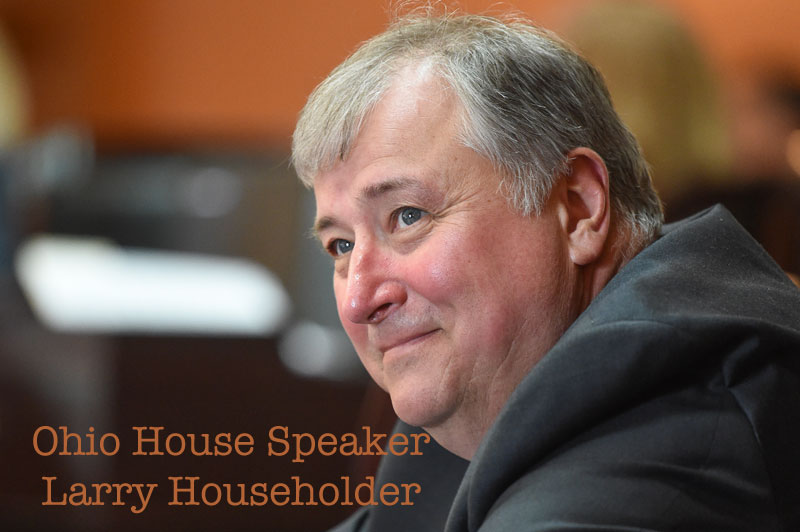
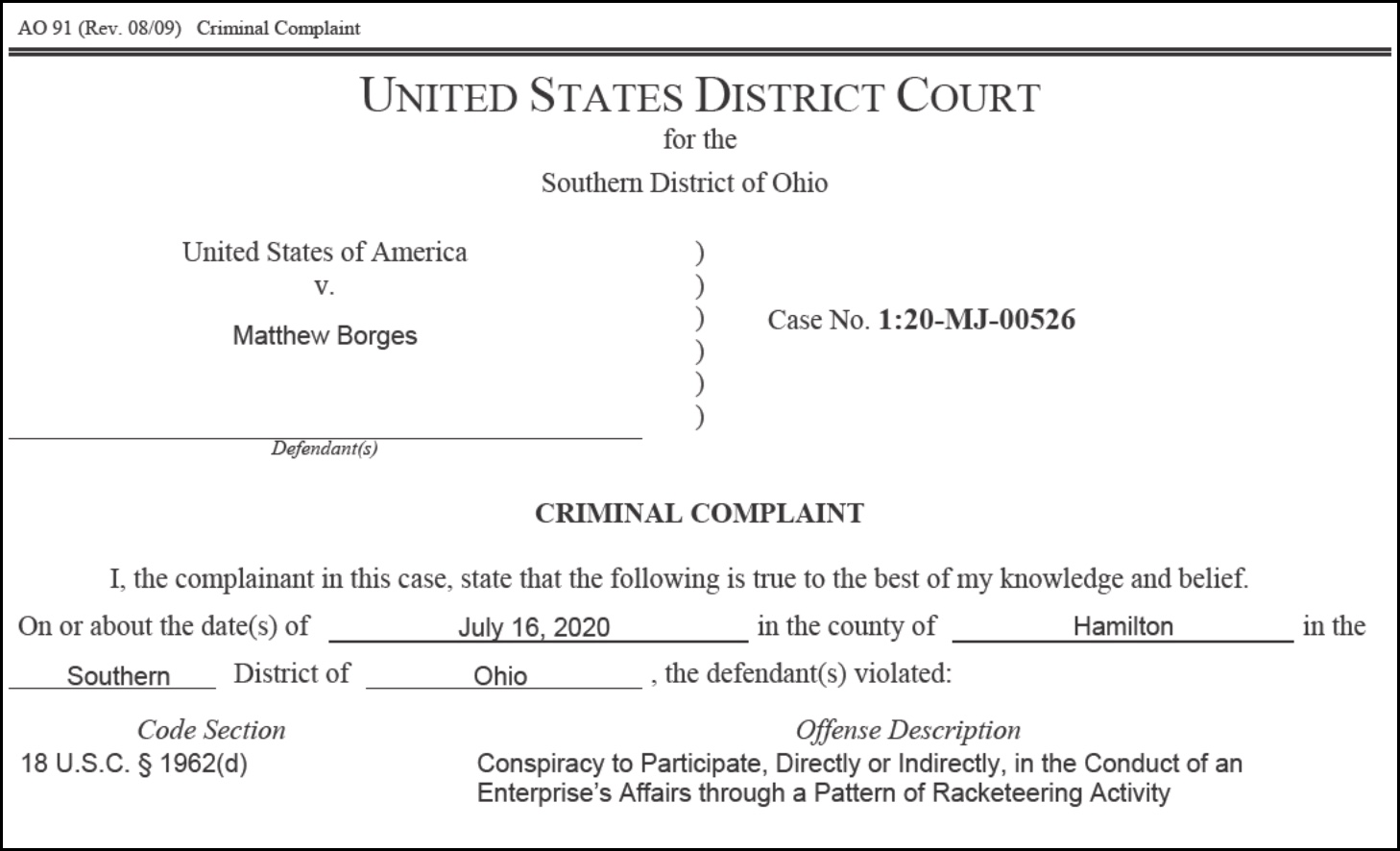
Cincinnati, Ohio – Ohio House Speaker Larry Householder, four political operatives and a dark-money group were charged Tuesday in a criminal complaint that an Ohio energy company paid them $61 million to get a $1.5 billion nuclear bailout from taxpayers.
Read the Press Release issued by the Department of Justice
Neil Clark, a lobbyist who owns Grant Street Consulting – Photo from Grant Street Consulting who exclaim, “Clark’s decades of experience and role in shaping Ohio’s political landscape makes him an indispensable resource to Ohio’s elected leaders, to whom he often serves as a trusted and highly sought after campaign advisor.”
All are charged with racketeering, which carries a prison sentence of up to 20 years.
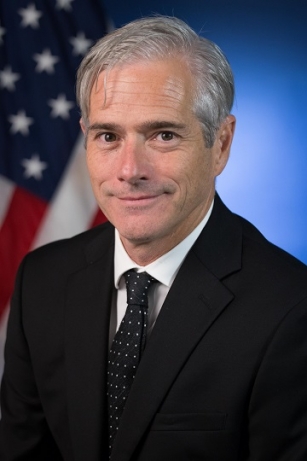
David M. DeVillers, U.S. Attorney for the Southern District of Ohio
The alleged conspiracy, which revolved around the bailout of two failing nuclear plants in Northern Ohio, is “likely the largest bribery and money-laundering scheme ever in the state of Ohio,” David M. DeVillers, U.S. Attorney for the Southern District of Ohio, said at a Tuesday afternoon press conference.
Shortly after the press conference, Ohio Gov. Mike DeWine called on his fellow Republican to step down.
“I am deeply concerned about the allegations of wrongdoing in the criminal complaint issued today by the U.S. Attorney’s Office,” DeWine, who last year signed the bailout into law, said in a written statement. “Every American has the presumption of innocence until proven guilty. Because of the nature of these charges, it will be impossible for Speaker Householder to effectively lead the Ohio House of Representatives; therefore, I am calling on Speaker Householder to resign immediately. This is a sad day for Ohio.”
The criminal complaint says that “Company A,” the former FirstEnergy Solutions of Akron, worked to save its failing nuclear plants by funneling $61 million into Generation Now, a 501(c)(4) “dark money” group controlled by Householder.
On September 9, 2019, President Donald Trump nominated DeVillers for the United States Attorney in the Southern District of Ohio. The Senate confirmed the nomination in October, and DeVillers took his oath on November 1, 2019.
“Make no mistake, this is Larry Householder’s 501(c)(4),” the U.S. attorney said.
The money was used for three general purposes, the complaint said. First it was used to build “Team Householder” through campaign contributions and other measures that helped Householder win the speakership in 2019.
“In exchange for payment from Company A, Householder’s enterprise helped pass House Bill 6, legislation described by an enterprise member as a billion-dollar ‘bailout’ that saved from closure two failing nuclear power plants in Ohio affiliated with company A,” the complaint said
The money was also used for the personal benefit of Householder and the other conspirators, DeVillers said. Householder got about $500,000, he said.
Despite the companies claims of poverty, the interests behind the bailout spent millions — much of it in the form of hard-to-trace dark money on campaign contributions, a xenophobic ad campaign and then on an aggressive effort to stymie a petition drive to repeal the bailout DeWine signed into law a year ago.
And the money was used to fend off a petition effort to repeal HB6, going so far as to buy plane tickets for and pay $1,000 each to people circulating it to get out of town, DeVillers said.
The federal prosecutor said that it was crucial to keep the investigation secret until Tuesday. Now it begins a new phase that might be causing some lawmakers, energy executives and some others to lose sleep.
“We are not done with this case,” he said. “There were things we couldn’t do before. People we couldn’t interview. People we couldn’t subpoena. Documents and search warrants we couldn’t execute.
“As of this morning there are a lot of FBI agents knocking on a lot of doors asking a lot of questions, serving lots of subpoenas. That’s going to go on for days.”
“It takes courage for citizens to assist law enforcement in the ways detailed in the affidavit,” U.S. Attorney David M. DeVillers said. “We are grateful to those who felt a moral duty to work together with agents in bringing to light this alleged, significant public corruption.”
House Bill 6 is adding $1.5 billion in additional taxpayer bailouts to the $10.2 billion that Akron-based FirstEnergy Solutions and its former parent company, FirstEnergy Corp, have received from taxpayers since 1999. Most of the funds have gone to prop up the Davis-Besse and Perry nuclear power plants in Northern Ohio.
The company that owns the plants was renamed Energy Harbor after emerging from bankruptcy earlier this year.
Despite the companies claims of poverty, the interests behind the bailout spent millions — much of it in the form of hard-to-trace dark money on campaign contributions, a xenophobic ad campaign and then on an aggressive effort to stymie a petition drive to repeal the bailout DeWine signed into law a year ago.
The interests behind the nuclear bailout also contributed heavily to the effort at the beginning of 2019 to elect Householder speaker. He ended up winning the support of 26 Republicans and 26 Democrats, His opponent, Ryan Smith, R-Bidwell, got the votes of 34 Republicans and 12 Democrats.
The Ohio Republican Party didn’t respond Tuesday to requests for comment.
The Ohio Democratic Party didn’t respond when asked about the fact that Householder wouldn’t have worn the speakership without Democratic votes. However, the party chairman, David Pepper called on Householder to step down as speaker.
“As the U.S. attorney indicated, this investigation is ongoing, and we will wait to hear all the facts as they emerge. However, given what was revealed in today’s complaint and the taint of corruption over Ohio legislative activity, we believe Speaker Householder should step down from leadership immediately as he avails himself of his due process rights,” Pepper said in a written statement.
House Bill 6, which passed 51-38, was quickly signed into law by Gov. Mike DeWine. Under the bill, from 2021 until 2027, every Ohio electricity customer will have to pay a new monthly surcharge that ranges from 85 cents for residential customers to $2,400 for large industrial plants. Ratepayers around the state would also have to chip in up to $1.50 monthly (and up to $1,500 per month for commercial and industrial users) to subsidize coal plants in Ohio and Indiana run by the Ohio Valley Electric Corporation.- cleveland.com
Starting next January, ratepayers around the state would also have to chip in up to $1.50 monthly (and up to $1,500 per month for commercial and industrial users) to subsidize coal plants in Ohio and Indiana run by the Ohio Valley Electric Corporation.
This isn’t Householder’s first encounter with federal law enforcement.
In 2006, the Justice Department told the FBI that it wouldn’t pursue charges against Householder. The FBI had been told two years earlier that Householder had used his post as head of the House Republican Campaign Committee to overpay some vendors in exchange for kickbacks from them.
Nor is Householder, 61, of Glenford, the first Ohio House speaker to find himself in the FBI’s crosshairs. In 2018, Speaker Cliff Rosenberger, a Republican, resigned amid an FBI probe of his overseas travel. He has not been charged, but the investigation remains open.
Columbus, Ohio – Ohio Gov. Mike DeWine laid out reopening guidelines for state K-12 schools on Thursday, including a mask requirement for teachers, but no such mandate for students.
DeWine said it is “the state’s strong recommendation” that children from the third grade on wear face masks, but maintained that local control for school districts will be in place as reopenings begin.
“A great deal of flexibility is allowed, as it should be,” DeWine said in his Thursday COVID-19 press conference.
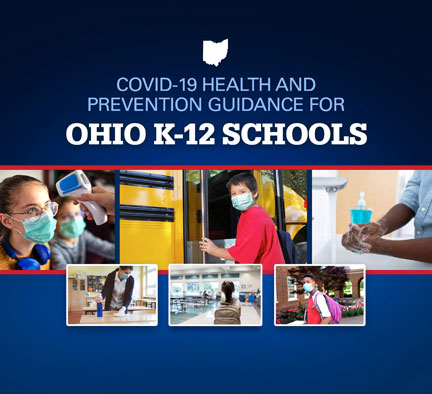
Ohio Department of Education’s 36-page planning guide
The governor announced that the Ohio Department of Education published a 36-page planning guide that includes recommendations on everything testing to field trips and recess precautions.
The guidance is specifically noted as “not mandatory” in the documents and emphasized the need for schools and districts to develop and implement their own protocols, while using the information provided by local and state health departments.
“Planning teams should include school leaders, local health department officials, local school board members, educators, education support professionals, school health professionals, parents, students, community partners and local business leaders,” the planning documents stated.
In developing coronavirus related-protocols, DeWine said before anyone enters a school facility, parents and school officials should “vigilantly assess” symptoms, and take the temperatures of everyone coming into the schools. In the guidance, outside individuals such as delivery personnel, student teachers and faculty of student teachers are all treated the same as official school personnel.
The Loveland District is currently working on models for reopening school in the fall, “which can be adjusted based on the pending guidance from state and local health agencies.”
The planning guide said flare-ups are considered “expected” by state officials, and warns that school buildings may need to close in the event of said flare-up.
Schools were told to work with local health departments to develop a testing strategy, thoroughly clean and sanitize schools, and teach and practice social distancing and hand-washing.
Social distancing in places like school buses will be more difficult, and DeWine said as much distance as is possible will benefit students and staff.
“(Specific measurements of distance is) all relative and it’s somewhat arbitrary,” DeWine said. “But the more distance you can have the better.”
COVID 19 Health and Prevention Guidance for Ohio K-12 Schools
Face coverings are required by staff unless it is unsafe or if doing so “could interfere with the learning process,” DeWine said on Thursday.
Ohio Federation of Teachers Executive Director Melissa Cropper appreciated the moves by the governor, but said the OFT worries about the financial demands of the new protocols.
“We are concerned that local governments and school districts will have to make decisions about the governor’s recommendations at a time when they are anticipating budget crunches and beginning to make spending cuts,” Cropper said in a statement.
DeWine said it “is not right for me or (other departments) to micromanage” school buildings or districts.
The governor did say he plans to meet with House Speaker Larry Householder, Senate President Larry Obhof, and minority leaders to discuss extra funding, along with the use of CARES Act funding.
Cropper said schools would benefit from HEROES Act funding as well, a bank of about $2 billion in monies for K-12 education, but the act is still awaiting U.S. Senate consideration after passing the House.
The guidance comes as the state faces continual growth in coronavirus cases, and data showing that cases are passed through the individuals within the area. DeWine noted that 80% of confirmed cases in Montgomery County have been linked to community spread.





![[POLL] Do you think Dewine’s curfew will amount to a hill of beans?](https://lovelandmagazine.com/wp-content/uploads/2020/11/j.sayin-teeth.jpg)