Tag: Ohio Redistricting Commission

  • Ohio Supreme Court strikes down congressional maps for second time

    Ohio Supreme Court strikes down congressional maps for second time

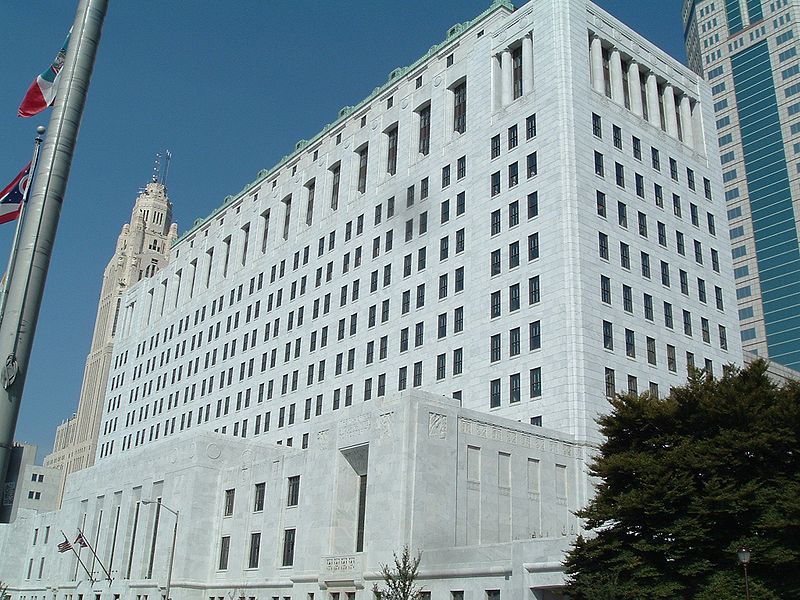
    Pictured is the Thomas J. Moyer Ohio Judicial Center where the Ohio Supreme Court meets. Photo courtesy Wikimedia Commons..

    BY: SUSAN TEBBEN – Ohio Capital Journal


    For the second time, the Ohio Supreme Court rejected a map for congressional districts in the state.

    The court ruled that the map violated the constitution by favoring one political party over another irrespective of election results across the state.

    “We hold that the March 2 plan unduly favors the Republican Party and disfavors the Democratic Party in violation of the (Ohio Constitution),” the majority decision reads.

    The 4-3 decision reflected the other decisions the court has made on redistricting: Chief Justice Maureen O’Connor voted to reject the maps, along with Justice Michael Donnelly, Justice Melody Stewart and Justice Jennifer Brunner. Justices Sharon Kennedy, Patrick DeWine and Patrick Fischer all dissented in the case.

    In ruling against the partisanship in the congressional map, the court called out the commission for creating Democratic districts with razor-thin advantages, while the Republican-leaning seats “comfortably favor Republican candidates.”

    In the most recent congressional map, only three Democratic-leaning seats have more than 52% Dem advantage, whereas all Republican-leaning seats have more than 53% GOP advantage.

    “Considering that Democratic candidates have received about 47% of the vote in recent statewide elections, this probable outcome represents only a modest improvement over the (previously) invalidated plan,” according to the court decision.

    The court pushed back against arguments made by Ohio Redistricting Commission members, including Senate President Matt Huffman and House Speaker Bob Cupp, both of whom have left the commission since then, replaced by state Sen. Rob McColley and state Rep. Jeff LaRe.

    The legislative leaders and their replacements on the commission tried to argue they were not obligated to correct “legal defects” in the original congressional plan while revising the plan.

    “The commission’s constitutional duty is to adopt a congressional district plan to replace the original, invalidated plan,” the court majority wrote. “Indeed, the commission has a constitutional duty to remedy the defects in the previous plan.”

    Huffman, Cupp, McColley and LaRe said fixing the “defects” would “incentivize” Democrats to vote against the plan, and called the article setting forth anti-gerrymandering rules a “safety valve of sorts” for the ORC to adopt a plan that didn’t have to align with the same redistricting rules as the General Assembly.

    “No constitutional language suggests that the voters who approved Article XIX intended to allow the prohibitions against partisan favoritism and unduly splitting governmental units to be avoided so easily,” the majority ruled.

    The lawsuit was filed in March, after the Ohio Supreme Court turned down calls to reject the maps in a previous lawsuit on congressional redistricting. The court said because its previous decision to reject the first congressional map was final, challengers had to file a new lawsuit to challenge the second version.

    The supreme court rejected the first map on the same grounds as the second rejection: partisan favoritism.

    In their dissent to the majority decision, Kennedy and Patrick DeWine said they would have left the plan in place as constitutional and allow its use for the 2024 primary and general elections.

    Kennedy and DeWine said because they would have held that the first congressional map “did not unduly favor Republicans and was constitutional,” they would have done the same for the second plan.

    DeWine, who is Gov. Mike DeWine’s son, has recused himself from any court cases regarding holding the ORC members in contempt of court due to his father’s participation as a commission member. However, he has refused calls for his recusal in all redistricting cases because of his father’s involvement in the process.

    Fischer joined the dissent, but wrote separately to argue that map challengers “do not even meet the lower clear-and-convincing evidence burden of proof or the even lower preponderance-of-the-evidence burden of proof” that the second congressional map unduly favored Republicans.

    He also criticized the process conducted by the state supreme court, saying a lack of hearings “undoubtedly raises concerns among the public regarding this court’s lack of transparency.”

    “This court’s misguided rush to decide these cases has resulted in an unnecessary and truncated procedure that has effectively tied this court’s hands and rendered it unable to make a fully informed decision,” Fischer wrote.

    The court gave the General Assembly 30 days to pass a new map, and if they can’t, the Ohio Redistricting Commission will have another 30 days to do so.

    Since the May primary, which included congressional races, already occurred, a new congressional plan’s impact will go forward to 2024 elections.

    The legislature is currently on summer break, set to come back in the fall. Huffman’s spokesperson did not respond to a request for comment on the ruling, or if they would be reconvening the GA early to deal with the issue.

    A spokesperson for Cupp said the office was reviewing the decision.

    The ORC’s co-chair, Democratic state Sen. Vernon Sykes joined Senate Minority Leader Kenny Yuko in saying the court “made it clear that Republicans have repeatedly used the redistricting process to give themselves an unfair advantage.”

    “Once again, we are ready to follow the law and give Ohioans the fair maps they demanded,” Sykes and Yuko said in a statement. “We hope this time our Republican colleagues will join us, instead of trying to run out the clock.”

    A spokesperson Ohio Secretary of State Frank LaRose, the state’s chief elections officer and a member of the redistricting commission, said LaRose’s office had received the ruling and had a legal team reviewing the decision.

    The League of Women Voters, one of the two parties who challenged the congressional maps, praised the decision and hoped for swift and public action to adopt new congressional maps.

    “We agree that the congressional map is beyond a reasonable doubt gerrymandered, and we stand ready to work with the mapmakers to see a map produced that truly upholds the will of the voters for a free and fair election,” said Jen Miller, executive director of the LWV of Ohio.

    Follow OCJ Reporter Susan Tebben on Twitter.
  • Local election workers tell secretary of state they can’t be ‘complicit in illegitimate elections’

    Local election workers tell secretary of state they can’t be ‘complicit in illegitimate elections’

    BY: SUSAN TEBBEN – Ohio Capital Journal

    A group of election precinct officials have sent a letter to the Ohio Secretary of State say they “cannot defend democracy” when the Ohio Redistricting Commission, including Secretary of State Frank LaRose, aren’t doing the same, they say.

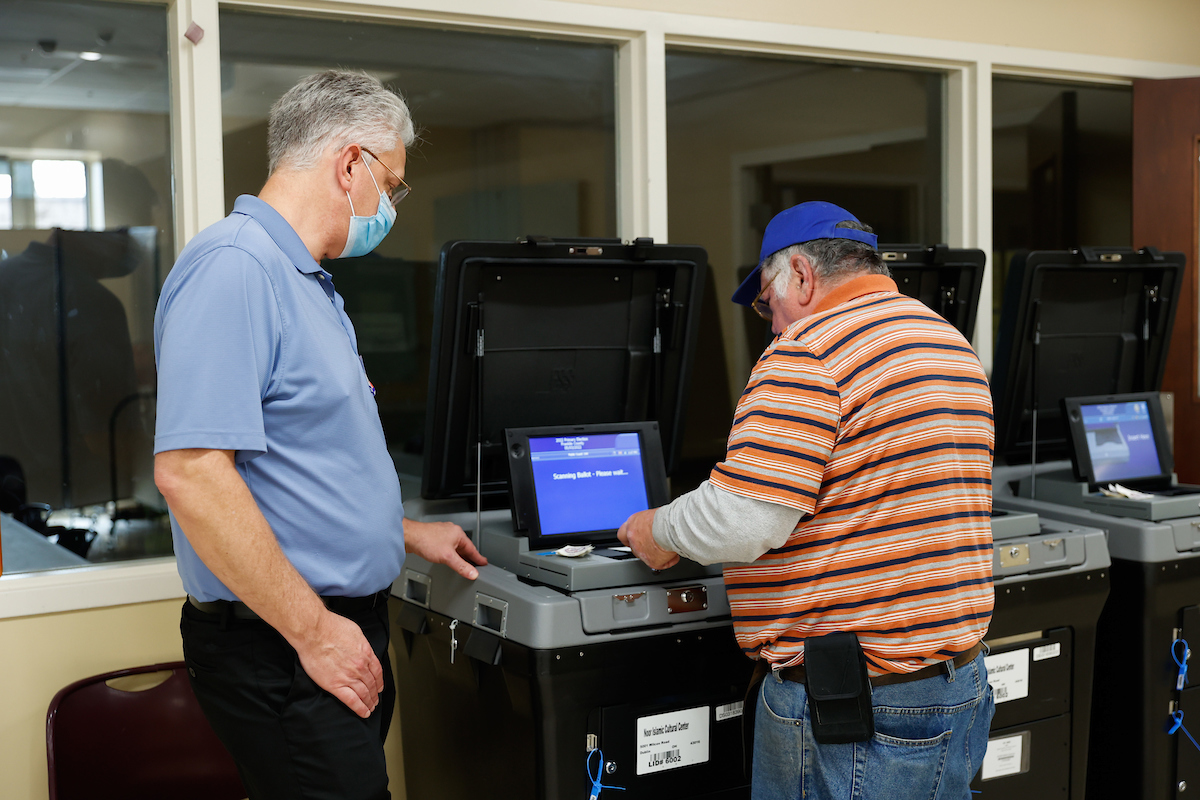
    Election workers in 23 counties signed on to a letter asking the commission and LaRose to heed their warnings that the maps adopted by the commission and pushed along by a federal court are unconstitutional, and therefore would push precinct workers to be a part of elections “when the outcomes of those elections have already been predetermined by politicians who manipulated districts to prevent fair competition.”

    “As precinct election officials, we cannot in good faith participate in a primary election on August 2 if it proceeds with unconstitutionally gerrymandered districts, and we advise our fellow poll workers to not be made complicit in illegitimate elections,” the letter stated.

    The officials said they are continuing to collect signatures on the letter, and cite Ohio Attorney General Dave Yost in arguing more time exists for the General Assembly to change election dates and methods before the November general election.

    The Ohio Redistricting Commission has also been given a June 3 deadline by the Ohio Supreme Court to resubmit a legislative district plan, after finding the maps adopted invalid for the second time.

  • Ohio Redistricting Commission resubmits maps already rejected as illegal by supreme court

    Ohio Redistricting Commission resubmits maps already rejected as illegal by supreme court

    BY: SUSAN TEBBEN – Ohio Capital Journal

    The Ohio Redistricting Commission Thursday voted to resubmit maps to the Ohio Supreme Court that the court has already rejected as illegal and unconstitutional partisan gerrymandering.

    The commission once again passed its third map 4-3 along party lines, with the exception of Republican Auditor Keith Faber, who said he voted no for the same reasons he voted against the map originally, claiming favoritism for Democrats.

    Republicans voting for the maps were Ohio Gov. Mike DeWine, Secretary of State Frank LaRose, state Sen. Rob McColley and state Rep. Jeff LaRe (sitting in for Senate President Matt Huffman and House Speaker Bob Cupp respectively).

    With a U.S. District Court promising to order the third set of maps to be put in place for the 2022 election, the commissioners saw fit to push those maps back into play, despite not one but two rejections by the state’s highest court.

    Indicating the action that was forthcoming from the commission, LaRose read a two-page statement he said explained the “logistical realities” of administering an Aug. 2 primary.

    He said the third map is already programmed in county boards of elections systems, which was done at his order, and he said he “would not instruct the boards to deprogram Map 3 before May 28, risking that the new map could be invalidated with no immediate options to administer a primary election.”

    “Therefore, Map 3 is the only viable option to effectively administer a primary election on Aug. 2, 2022,” LaRose told the commission on Thursday.

    In pushing for passage of the maps, McColley said these maps would be “only for use in the 2022 election.”

     State Rep. Jeff LaRe and state Sen. Vernon Sykes talk during Thursday’s meeting of the Ohio Redistricting Commission.
    (Photo: Susan Tebben, OCJ)

    The constitutional amendment overhauling redistricting processes in the state spelled out the commission’s ability to pass partisan four-year maps or bipartisan 10-year maps. It does not specify a two-year option, which critics say spells trouble in the supreme court battle.

    “We will continue to look at our legal options, and possibly this would only be a two-year map and we will work to get better maps in the future,” said Jen Miller, executive director of the League of Women Voters of Ohio. “But the redistricting commission can’t decide to adopt a two-year map.”

    The Ohio Supreme Court rejected the maps on March 16 for the same reason it rejected all other maps: partisan favoritism.

    “Substantial and compelling evidence shows beyond a reasonable doubt that the main goal of the individuals who drafted the second revised plan was to favor the Republican Party and disfavor the Democratic Party,” the majority wrote in their opinion on those maps.

    Court justices also rejected the maps after they were slightly changed by GOP mapmakers and submitted as the fourth map from the Ohio Redistricting Commission. Huffman introduced revised Map 3 on March 28, after he said it became clear the independent mapmakers maps were not going to be completed on time.

    On Thursday, the Democratic members of the commission, seemingly building up arguments against being held in contempt by the Ohio Supreme Court, introduced changes to a proposed map drawn by independent mapmakers in late March. That map had previously been dismissed by Republican members of the commission who claimed it unduly favored Democrats and didn’t address all the constitutional and court-ordered changes required of new state House and Senate maps.

    House Minority Leader Allison Russo brought up the maps, as she did in a letter earlier Thursday, asking for proposed amendments to the map by Thursday afternoon.

    She told the commissioners those items had been identified and addressed prior to Thursday night’s meeting. No other commission members submitted amendments, she said.

    But Republican commissioners were quick to express their dissatisfaction with these maps during the meeting, even as revised.

    McColley referenced an affidavit by independent mapmaker Dr. Douglas Johnson, saying Johnson acknowledged the maps were not done when he and Dr. Michael McDonald left their posts on March 28, having had their plan dismissed by the commission.

    Russo pushed back on the assertion, saying the maps were finished, but were only “double-checked” after completion.

    “To be clear, this map is finished,” Russo said.

    The Johnson/McDonald map was turned down again by the ORC on Thursday, with a party-line 5-2 vote.

    Russo read a statement at the end of the night, calling the latest journey to Map 3 “a bad-faith effort to punt (Republican) responsibility to another entity,” meaning the federal court.

    “The events that led us back here were not committed through incompetence,” Russo read from the statement. “We are here purposefully.”

    LaRose and DeWine were missing from the commission meeting after a recess following the vote to adopt the third map. Spokespersons said they had other commitments, and because the commission did not have any other voting items, they chose to leave before the meeting adjourned, and before media could ask any questions.

    DeWine’s spokesperson, Dan Tierney, said it was “simply impossible to adopt any map or resubmit any map that an election could be run on August 2.”

    Asked why the commission didn’t meet earlier than two days before the deadline, Tierney said there were “issues coming to compromise.”

    The maps now go to the Ohio Supreme Court for consideration and court challenges, which seem likely.

    As the commission’s newest co-chair, LaRe said with a map passed to cover only the next two-years, the commission still needs to continue its work.

    “We’re only talking about the ’22 election, so there’s more work for the commission to do,” LaRe said. “We’ve got to look at the next election cycle, so we’re not done yet.”

    He did not give a timeline on when the commission will begin working on the next election.

  • Court challengers push contempt charges against redistricting commission

    Court challengers push contempt charges against redistricting commission

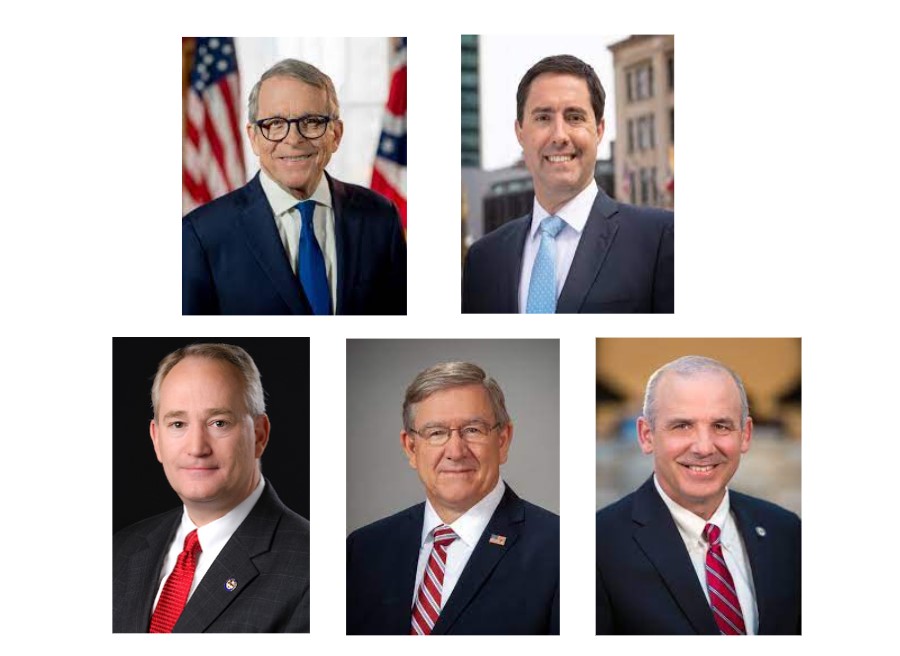
    The Republican majority members of the Ohio Redistricting Commission. Top row from left, Ohio Gov. Mike DeWine and Secretary of State Frank LaRose. Bottom row from left Ohio Auditor Keith Faber, House Speaker Bob Cupp, and Senate President Matt Huffman. Official photos.

    BY: SUSAN TEBBEN – Ohio Capital Journal

    Anti-gerrymandering groups are again asking the Ohio Supreme Court to determine if the Ohio Redistricting Commission should be held in contempt, and to force the commission to meet by the end of the week to redraw legislative maps.

    The ACLU, on behalf of several groups including the League of Women Voters of Ohio and the A. Philip Randolph Institution of Ohio and some individual Ohio voters, asked the court to yet again demand answers from the Ohio Redistricting Commission as to why they shouldn’t be held in contempt for making no moves to meet a deadline to draw “entirely new” legislative maps.

    The fourth effort by the ORC was rejected by the Ohio Supreme Court on April 14, and found not to be an “entirely new map” they were ordered to create, but merely a tweak of the third attempt, which was also rejected as unduly partisan.

    The commission has until May 6 to adopt and submit a map, but the groups say the urgency of the situation has “dramatically increased” because of a federal court’s decision to implement the third map found unconstitutional by the supreme court as the map to use during the 2022 election season. The U.S. District Court said they would order the use of the map, which was found to be unduly advantageous to Republicans, if no plan was adopted by May 28.

    “Based on the commission’s conduct to date, this appears to be exactly what the commission is trying to do,” the ACLU wrote to the supreme court. “The Court should not allow the commission to intentionally avoid its constitutional obligations.”

    GOP members of the commission argued that the court did not have the authority to hold them in contempt for several reasons, most important of which was the fact that the commission had passed a map by the court-ordered March 28 date. They said they conducted their legislative duties, and also were protected by the separation of powers doctrine from being held in contempt.

    One member of the state supreme court, Justice Sharon Kennedy, has consistently sided with the Republican members in saying they should not be held in contempt and the court does not have the power to do so.

    The Ohio Supreme Court rejected a previous request to hold the ORC in contempt at the same time they rejected the fourth map by the group.

    The ACLU, however, argues in their most recent challenge for contempt that legislative immunity is not “unlimited” and separation of powers principles do not “constitute an insurmountable barrier to a contempt order against the majority of the commission.”

    “In ordering (the ORC) to reconvene and to draft and adopt a constitutionally valid General Assembly-district plan, this Court is not ‘asserting control’ over purely legislative duties … but simply ensuring that the commission itself undertake those duties,” attorneys said in their Monday filing.

    GOP members of the ORC told the court in the last debate over contempt that they could not be charged as individuals for something decided by the commission as a whole.

    The ACLU called the argument an “improper attempt to evade responsibility” in their Monday filing. The argument also does not hold when it comes to calling a meeting of the commission, the court challengers said. Calling a meeting only requires three commission members, leaving five others “fully responsible for the defiance of the court’s order,” court documents stated.

    Attorneys urged the court to force the commission to convene no later than Friday if they are held in contempt, as a way to “purge” their contempt charges.

    The commission has not announced any plans to meet on or before the May 6 deadline. Democrats, including commission co-chair state Sen. Vernon Sykes, attempted to bring a meeting together on Monday, but ended up alone in front of the room where the ORC has met in the past, having had their offer rejected by every other member of the commission.

    A representative with House Speaker and commission co-chair Bob Cupp said no meetings have been scheduled, and a spokesperson for Senate President Matt Huffman said meeting dates were up to the co-chairs.

  • No Ohio redistricting meetings in sight, despite Dem demands

    No Ohio redistricting meetings in sight, despite Dem demands

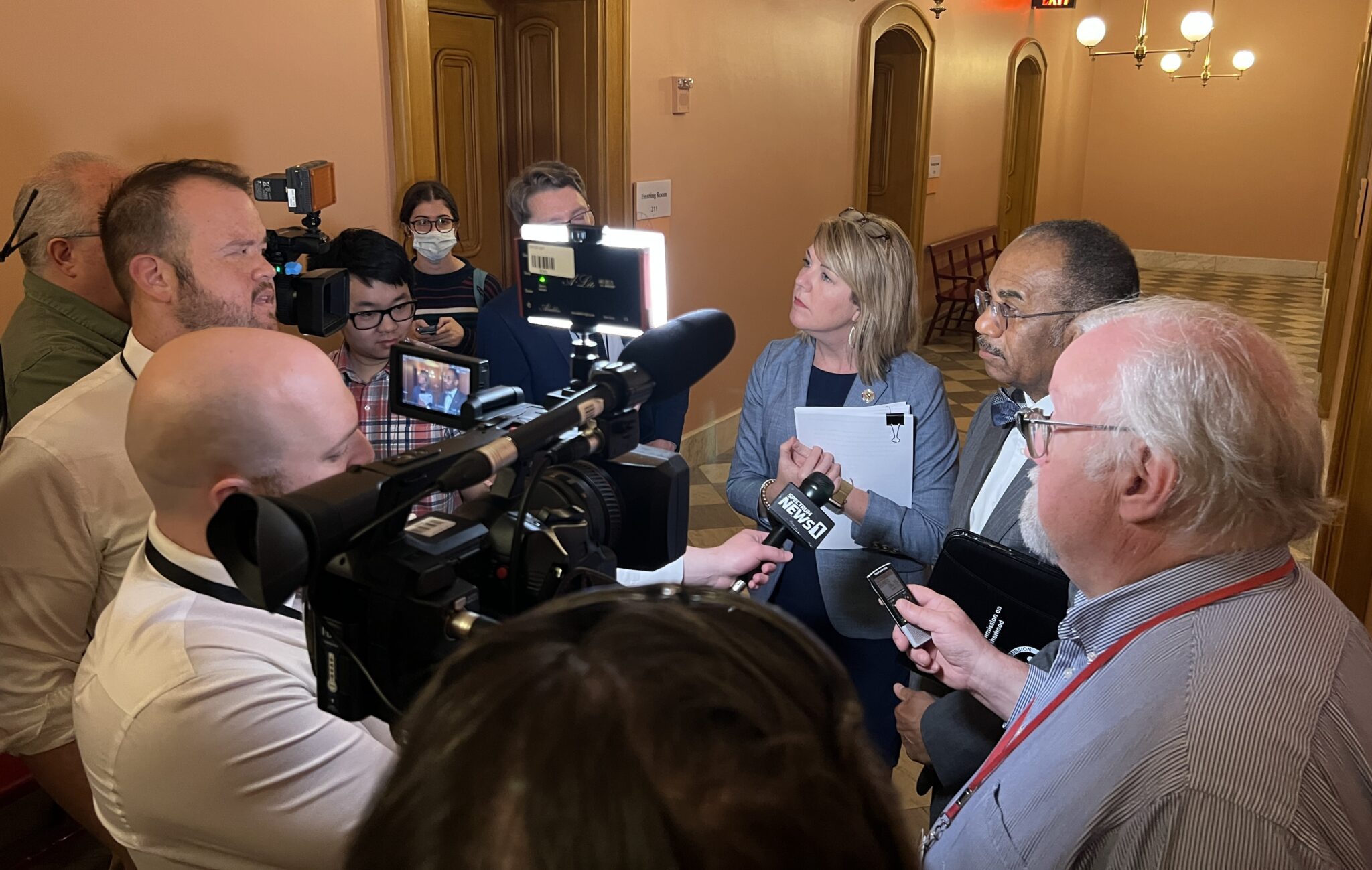
    House Minority Leader Allison Russo and state Sen. Vernon Sykes speak to media outside of Room 313 of the Ohio Statehouse. The two Dem members of the Ohio Redistricting Commission tried to convince GOP members to renew talks on legislative redistricting plans, but no other members showed. (Photo: Susan Tebben, OCJ)

    BY: SUSAN TEBBEN – Ohio Capital Journal

    Members of the Ohio Redistricting Commission have not publicly announced any plans to meet and discuss legislative redistricting, despite requests by Democratic members, and a mandate by the Ohio Supreme Court.

    Commission co-chair, state Sen. Vernon Sykes, D-Akron, and House Minority Leader Allison Russo, D-Upper Arlington, met with reporters Monday outside the committee room that has been used for ORC meetings, the most recent of which was March 28, when a simple majority passed a fourth version of legislative maps.

    Those maps were subsequently rejected as unconstitutional by a majority of Ohio Supreme Court justices, who then gave the commission until May 6 to come up with a new plan.

    Since then, a three-judge panel in U.S. District Court has said unless a plan is in place by May 28, the state will be ordered to use the third set of maps passed by the ORC, also rejected by the state’s high court.

    “This is a state process, these are state legislative maps,” Russo said. “This is, I think, terrible precedent that is being set that we will have federal courts come and overrule what our state process is in these partisan gerrymandering cases.”

    The two Democrats asked the rest of the commission members to meet with them and start the legislative process again, but no other members showed up Monday morning. Commission rules state that three members are needed to call for a meeting of the whole.

    Sykes said fellow co-chair, House Speaker Bob Cupp, agreed to talk with Sykes this week about the future of the process. A spokesperson confirmed the Friday conversation, but said a public meeting has yet to be scheduled.

    “We’ll be sure to let you know when a meeting is scheduled,” said Aaron Mulvey, spokesperson for Cupp.

    Secretary of State Frank LaRose’s spokesperson simply said he had no plans to attend the Monday event with Sykes and Russo, and a spokesperson for Senate President Matt Huffman said there was “no meeting scheduled this morning.”

    Any questions about official meetings would be for the co-chairs, spokesperson John Fortney said.

    Gov. Mike DeWine’s office had previously told reporters he had a scheduling conflict.

    Requests for follow-up comments from Auditor Keith Faber’s office went unanswered, but he had previously stated through a spokesperson he would not be available Monday morning.

    While the date for Statehouse races to be on a primary ballot is still up in the air, all other races in the state are continuing on the May 3 primary ballots. Early and absentee voting is ongoing for those races.

  • Ohio Supreme Court rejects legislative maps, sets fifth redistricting deadline

    Ohio Supreme Court rejects legislative maps, sets fifth redistricting deadline

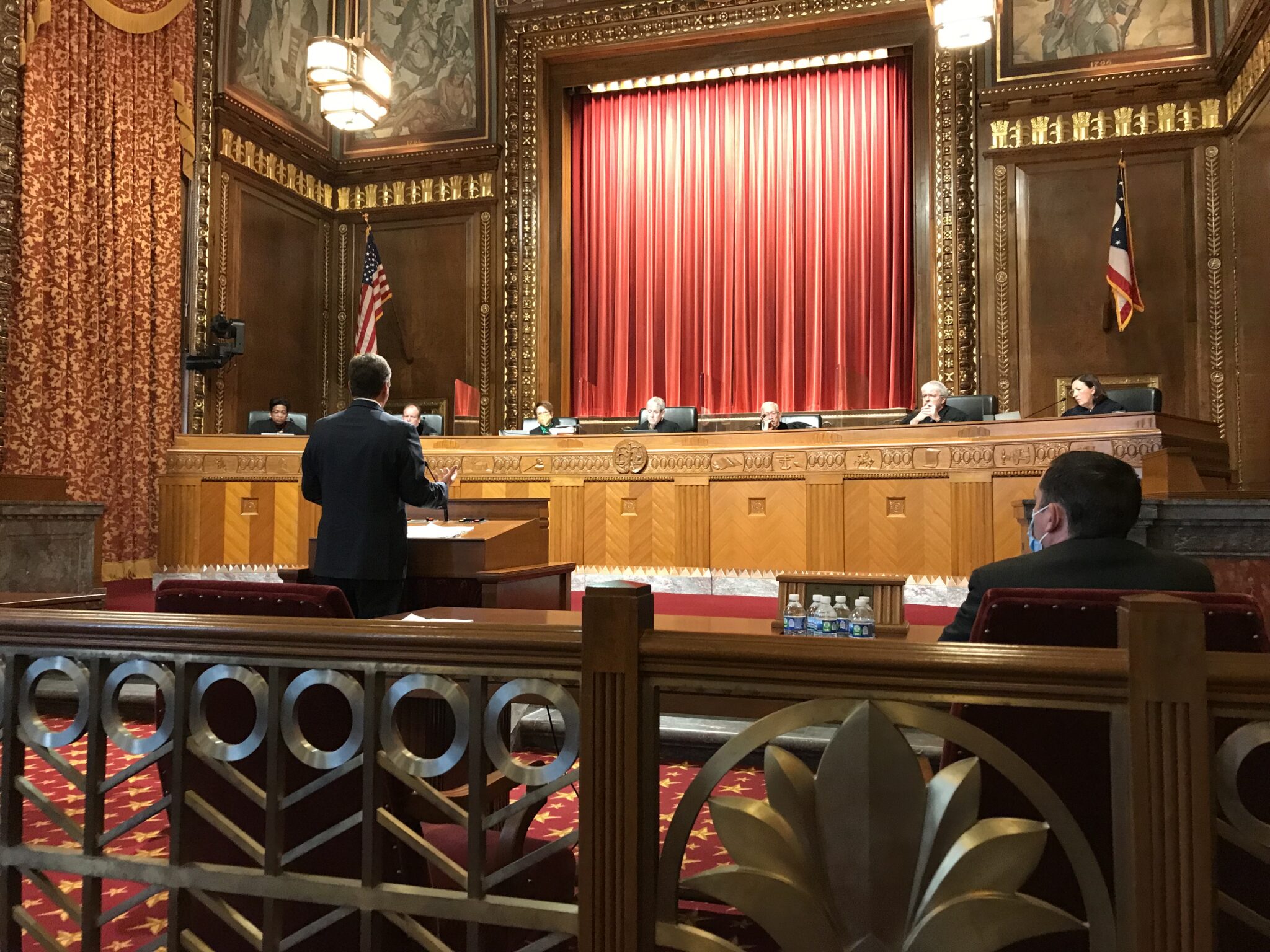
    Attorney Phillip Strach speaks before the Ohio Supreme Court in December, arguing for the constitutionality of legislative district maps. The court heard arguments on three cases asking it to reject the maps approved in September. (Photo: Susan Tebben, OCJ)

    Commission members won’t be held in contempt

    BY: SUSAN TEBBEN – Ohio Capital Journal

    The Ohio Supreme Court turned away a fourth set of redistricting plans from the Ohio Redistricting Commission in a 4-3 decision on Thursday, but left the responsibility with the commission to redraw the maps yet again.

    In a separate announcement, the court also denied requests to hold commissioners in contempt of court for violating court orders. Justice Patrick DeWine, son of governor and commission member Mike DeWine, recused himself from the contempt proceedings, but not from the redistricting rulings.

    The fourth set of maps was similar to the third maps, as admitted by Senate President Matt Huffman, the member of the commission who proposed they be adopted by the ORC at the end of March.

    The supreme court spelled out in its Thursday ruling the way in which objections to the maps showed “beyond a reasonable doubt” that the plan once again violated the constitutional regulations surrounding redistricting, but they didn’t order any other remedies offered by the map challengers, which included taking the map-drawing power away from the ORC.

    The commission started off on the right foot this time, the justices in the majority said, when they “began to heed our suggestions” given in the previous map rejection, which advised the commission to hire independent mapdrawers, hold near-daily meetings, and give mapdrawers “a neutral set of instructions” that they would use to publicly draw maps.

    In the week leading up to the March 28 deadline for the most recent maps, the commission hired Dr. Douglas Johnson, as proposed by the GOP, and Dr. Michael McDonald, as proposed by the Democrats. The two were paid at a rate of $450 per hour, with a cap set at $49,000 each.

    The commission also partnered with the Ohio Channel to set up a room with cameras showing Johnson and McDonald working, and the computers on which they were collecting data and drawing district lines. The commission met several times during that week to answer questions from the mapmakers and give them instructions, up until the day of the deadline.

    On that day, Huffman made a move to bypass the Johnson/McDonald maps because he said time was running short, too short for the commission members to offer amendments and make changes by the deadline.

    The best option, he then said, was to make a few changes to the previously rejected map, and submit it to the court, with the argument that it was better to get a map in on time than to wait for the mapmakers to be done with their map and possibly go past the March 28 date set by the court.

    To do so, he tasked Blake Springhetti, a House GOP staffer who had worked on the previous maps, to make the changes that night.

    “The evidence suggests that Springhetti … modified the second revised plan in one afternoon to produce the (fourth map),” the majority justices wrote in their rejection of the most recent maps.

    Broken ‘parachute’

    Despite the fact that the court told the commission to come up with an “entirely new” map this time, the court said the commission acted as though a tweaked version of an invalidated plan was a “parachute” to get it over the finish line. They also said there was evidence of efforts to block McDonald and Johnson from finishing their maps.

    “The timeline of events demonstrates convincingly that the commission — or at least some members of the commission — when faced with one or more plans that closely matched constitutional requirements in the form of Dr. McDonald’s and Dr. Johnson’s plans, reverted to partisan considerations when time was running short, even though the potential for successful completion was high,” the majority justices wrote.

    “Particularly problematic,” those justices said, was Huffman’s “last-minute insistence” that the mapmakers consider the addresses of incumbent House and Senate members in their district drawing, which the court said “pulled the rug out from under the independent map drawers.”

    In throwing forth the revised version of the third plan, commission members sent the court “a nearly identical one-sided distribution of toss-up districts,” the court rules. The number of toss-up districts — those districts whose partisan “advantage” is less than 2 percentage points — went from 26 to 23 from the third maps to the fourth. The fact remained, though, that all the toss-up districts were considered “Democratic-leaning” in the GOP analysis of the maps, and none were similarly toss-ups for Republican districts.

    “Senate President Huffman and House Speaker Cupp point out that the (fourth plan) improves upon the (third plan),” court justices noted. “While this may be true, the improvement falls short of landing in constitutional territory.”

    The court is now giving the commission until 9 a.m. on May 6 to come up with an “entirely new” plan. They again pushed for transparency and public viewing of the process. They also retained jurisdiction on the map, meaning they hold on to the authority to reject or approve the map as they have in previous instances.  This wasn’t the case in the congressional maps, forcing challengers of that map to file brand new lawsuits to fight against what they see as gerrymandered federal districts.

    Adopting another new plan…again

    The majority justices, while acknowledging that they do not have the power to adopt a map of their own, suggested a more “efficient way” of moving forward with a new plan.

    “No matter what the primary date is to be, time is of the essence,” the justices wrote. “With time in mind, it appears that the most efficient way for the commission to proceed may well be to continue working with Dr. McDonald and Dr. Johnson to complete the plan on which they have made considerable progress — if they are willing and available and if the commission has the authority to timely retain them for additional work.”

    The court argued that “by certain measure” the Johnson/McDonald plan “is on track to being constitutionally compliant.”

    Seemingly responding to sticking points that came up along the way, the court’s majority gave new guidance on adopting a new legislative plan.

    During the late hours of March 28, Cupp and Huffman both argued the commission couldn’t push past the deadline because the court had said it would not allow any other extensions of time. The court was more specific this time in saying no request for extension of time could be filed for objections to the adopted maps.

    The commission, however, could file a motion for an extension to their time with the secretary of state if they can prove it is needed.

    Justices also took time in their decision to argue against a federal intervention in state redistricting, something being discussed by a three-judge panel in U.S. District Court. Those judges are considering a lawsuit by Ohio voters asking that the federal court decide on a map for the state to use, under the argument that voters are losing their constitutional right to do so without a map to establish candidate districts.

    “While the process has proved challenging for the commission, as evidenced by four legislative plans falling short of (the constitution’s) requirements, the difficulty of the task is not a reason for federal-court intervention,” the majority of supreme court justices wrote.

    Dissents

    The three votes against rejecting the maps came from expected sources: Justices Sharon Kennedy, Patrick DeWine and Patrick Fischer, all of whom voted against rejection in the last three court decisions.

    Kennedy, who is running for chief justice in this year’s election, used her Thursday dissent to again discredit the majority opinion for overuse of judicial power. She criticized the justices who rejected the last three maps for moving constitutional goalposts and abusing their power in previous dissents over redistricting.

    “The majority’s continued denial of the limitation of this court’s power may end up costing the taxpayers millions of dollars,” Kennedy wrote in her dissent to the newest ruling. “Money that is being consumed by the never-ending cycle of map drawing, litigation, and now, two primaries, one on May 3 and the other perhaps on Aug. 2, all ordained by the majority’s overreach.”

    Justice Patrick DeWine claimed the majority had “long ago forsaken any concern about the actual words of the Constitution – it simply demands a General Assembly-district plan that achieves its policy goals.”

    “With each iteration of these cases, it becomes more evident that a rogue majority is simply exercising raw political power,” Justice DeWine wrote in his own dissent. “No one should be deceived.”

    The justice goes on to say the authors of the constitutional amendment overhauling redistricting “were overly optimistic,” and the threat of a four-year map instead of 10-year map “was not the stick it was thought to be” to incentivize bipartisan work.

    Whatever the reason for the “mess” redistricting has become, Patrick DeWine said court overreach is not the solution.

    “(The court’s job) is not to impose extraconstitutional standards on the commission in an attempt to achieve political outcomes that the court finds desirable,” DeWine wrote.

  • Common Cause Ohio: “State Supreme Court Rules State Legislative Maps Drawn to Unduly Favor Party in Power”

    Common Cause Ohio: “State Supreme Court Rules State Legislative Maps Drawn to Unduly Favor Party in Power”

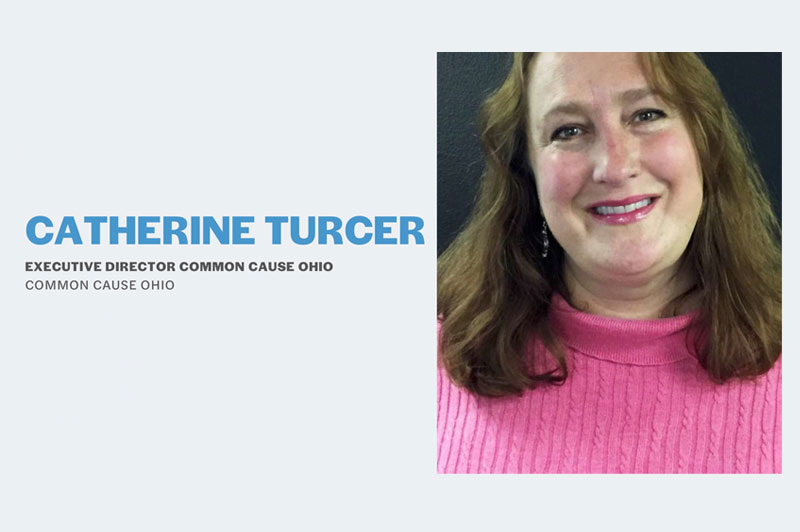
    The statement of Catherine Turcer, Common Cause Ohio Executive Director that was released today.


    Earlier today, the Ohio State Supreme Court struck down gerrymandered Ohio House and Senate maps for an astonishing fourth time. The court’s decision is no surprise since these maps were nearly identical to the previous set of Ohio General Assembly maps that had already been ruled unconstitutional by the court.

    The now-struck-down fourth Ohio House and Senate maps were created not by the Commission or the independent mappers, but by the GOP majority of the Ohio Redistricting Commission (Governor DeWine, Secretary of State LaRose, Speaker Cupp, and Sen. Pres. Huffman) in a secret process that directly contravened the court’s directive to work in a transparent and bipartisan fashion. The maps were produced just hours before the March 28 deadline in a bait-and-switch maneuver that killed the independent mappers’ district plans and sabotaged the first transparent redistricting process in the state.

    Ohio voters are tired of being manipulated. It is time for the Ohio Redistricting Commission to take the orders from the Ohio Supreme Court seriously. We have been waiting for fair districts since 2015—when the new rules for mapmaking were overwhelmingly approved by voters. Ohio voters repudiated gerrymandering and put good rules in the Ohio Constitution to ensure fair maps going forward. We expect the members of the Ohio Redistricting Commission to abide by those rules, follow the Ohio Constitution, and obey the orders of the Ohio Supreme Court. The sooner the majority members of the Commission get to work and do their jobs as required, the sooner this redistricting nightmare will draw to a close, and Ohioans will finally be able to vote using the fair maps they need and deserve. 


  • Ohio House Speaker says no primary election legislation coming soon

    Ohio House Speaker says no primary election legislation coming soon

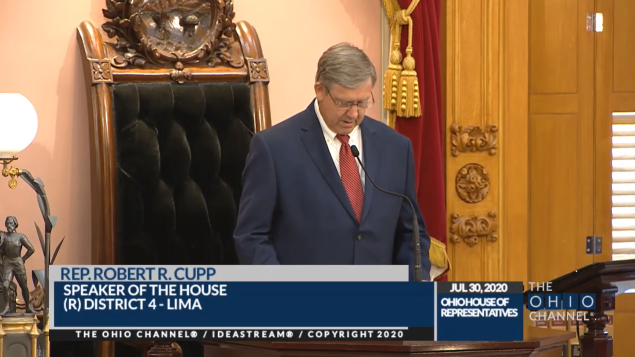
    Speaker of the House Bob Cupp addresses the chamber.

    BY: SUSAN TEBBEN – Ohio Capital Journal

    Ohio’s House Speaker said Wednesday legislation is not coming to change the May primary date.

    Speaker Bob Cupp said the process was “in the hands of the federal court,” despite various court documents in which he argued that the election is a legislative issue and any changes should be made in the General Assembly.

    The Ohio Capital Journal asked Cupp directly to confirm the House had no plans for legislation to set a new primary date in the next two weeks.

    “That is correct, we’re not in session,” Cupp said during a gaggle after Wednesday’s House session.

    He was asked about potential changes to the election earlier in the press gathering, and he deferred the job.

    “We’ll let the federal court process proceed,” Cupp said.

    federal lawsuit was filed by GOP voters earlier this year, claiming voters are losing their right to vote with the chaos surrounding redistricting. Originally, the plaintiffs, including Ohio Right to Life leader Michael Gonidakis, asked for the third map adopted by the Ohio Redistricting Commission to be forced into use by a three-judge panel of the U.S. District Court.

    That map was rejected by the Ohio Supreme Court before the federal lawsuit was filed, but the process of adopting a fourth version of legislative districts had not come to fruition.

    The fourth map ended up being a near-copy of the third, rejected version, with Senate President Matt Huffman acknowledging as he moved for its approval that the map had “97%” similarity to the third version.

    Because the process, which started in September, has taken so long, the Secretary of State’s Office was forced to remove legislative races from ballots for the May 3 primary, all but assuring a split primary.

    Lawsuits have been filed with the Ohio Supreme Court asking for the fourth map to be invalidated for many of the same reasons the third map was, and map challengers have also asked the court to hold GOP commission members in contempt for violating court orders.

    Cupp and Senate President Matt Huffman argued in previous court filings that the power for elections and drawing maps lies solely with the redistricting commission and legislators, seemingly contrary to Cupp’s Wednesday statements.

    “It is the commission and the general assembly who solely possess the legislative authority to create legislative and congressional districts,” attorneys for the legislative leaders wrote in a court filing for lawsuits on congressional districts.

    Secretary of State Frank LaRose in more recent court filings urged the judicial system to stay out of the process. In his filing countering objections to the most recent maps, he posited that the Ohio Redistricting Commission has more time to figure out legislative maps.

    “More importantly, there is still time for the legislature to take steps to extend the time within which such a decision must be made,” LaRose said. “This court should not give up on the constitutional process even if the petitioners have.”

    The federal court has chosen twice not to intervene in the state process to give it time to come to a resolution. The first time the court withheld judgment was just before the March 28 deadline for the commission to complete new maps.

    At a hearing before Chief Judge Algenon Marbley, Judge Benjamin Beaton and Judge Amul Thapar last Wednesday, parties from the Secretary of State’s Office gave Aug. 2 as a potential date for a second primary to include the legislative races.

    The judges entertained the idea of not just the third map, but also the map drawn by independent mapmakers during the latest redistricting commission hearings, and also debated whether or not the 2010 map could be used for one more year.

    They decided to give the state until April 20 to come up with an official map and to give the state’s highest court time to make its rulings. A status conference was scheduled for April 11.

    Jake Zuckerman contributed to this report.

  • Ohio Secretary of State says he didn’t call for Supreme Court chief’s ouster

    Ohio Secretary of State says he didn’t call for Supreme Court chief’s ouster

    (Photo by Susan Tebben, OCJ.) 

    BY: MARTY SCHLADEN – Ohio Capital Journal

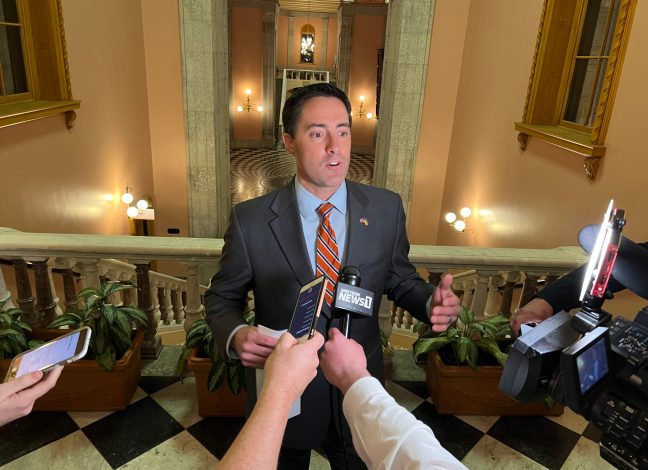
    Ohio Secretary of State Frank LaRose on Tuesday denied that he had called for the impeachment of Ohio Supreme Court Chief Justice Maureen O’Connor after she had repeatedly ruled against LaRose and the rest of her fellow Republicans on the Ohio Redistricting Commission.

    LaRose’s comments come four days  after he told a group of Union County Republicans that Justice O’Connor had “violated her oath of office” and that for the legislature to impeach her  “may be the right thing to do”.

    Audio obtained by the OCJ of Secretary Frank LaRose speaking at a Union County Republicans breakfast last week.

    The state’s top elections official was at the Franklin County Board of Elections on Tuesday as he kicked off early voting for most of this year’s primaries. It won’t include ballots for state legislative candidates because of a dispute over gerrymandering — a fracas over the boundaries of the districts in which members of the state House and Senate will run. 

    Tired, apparently, of partisan gerrymandering, Ohio voters in 2015 overwhelmingly approved a constitutional amendment that requires districts be drawn so that the partisan makeup of the legislature resembles the partisan breakdown in recent statewide elections. 

    That’s not how things stand now. Republicans have won recent elections with about 54% of the vote, but they control 65% of the seats in the state House and 78% of the state Senate.

    This year, using the new system for the first time, the five Republicans on the seven-member redistricting commission have passed four sets of maps that O’Connor and the three Democrats on the Supreme Court have ruled are too partisan.

    Republican Justice Pat DeWine has continued to sit in the case even though several ethics experts have said he has a clear conflict because his father, Gov. Mike DeWine, is a member of the redistricting commission. Justice DeWine has voted in favor of upholding the maps that his father and the other Republicans have passed.

    Meanwhile, Republican frustration with O’Connor, who will leave the court at the end of the year, has been boiling over. Some Republican members of the legislature last month floated the idea of impeachment.

    Gov. DeWine called the notion “extraordinary” and said it’s a bad idea to talk about removing judges whenever one disagrees with their decisions. But LaRose, the secretary of state, wasn’t so reticent on Friday when asked at a Union County Republican breakfast if O’Connor should be impeached.

    “I think that she has not upheld her oath of office, and that to me is a basic test of a public servant,” he said. “That’s up to the state legislature, whether they want to impeach the chief justice or not. I certainly wouldn’t oppose it.”

    LaRose stipulated that any impeachment would take so long that “it may feel really good, and it may be the right thing to do because she’s violated her oath of office by making up what she wants the law to say instead of interpreting what it actually says. But I don’t know if it would accomplish much, but I’d be fine with it if they did.”

    At Tuesday’s event, LaRose tried to draw a distinction between saying impeachment may be the right thing to do and actually calling for it.  

    “The thing that I did was not call for anybody to be impeached,” he said. “I answered a question that was asked at a little breakfast gathering where I was with a group of supporters in Union County and what I said was, ‘It’s up to the state legislature.’ There are 33 senators and 99 representatives. If they gather evidence and hold that trial for an impeachment, if they decide as the people’s representatives to do that, then I don’t oppose that.”

    LaRose and some legislative Republicans are not alone in being frustrated by the redistricting battle. For the second time, the Supreme Court has ordered members of the commission to show why they shouldn’t be held in contempt for failing to pass maps that comply with the court’s interpretation of the state Constitution. Responses were submitted on Monday.

    Some members have argued that they shouldn’t be held individually liable for the actions of a seven-member body they don’t control. And some have argued for the court to simply impose maps on the commission would overstep its powers as a judicial body.

    LaRose on Tuesday said holding contempt proceedings is another overreach.

    “It’s a ridiculous idea that a co-equal branch of government would be held in contempt for doing our job in a way that the court doesn’t like,” he said. “What we have attempted to do all throughout this process is follow the rules that are set out in the Constitution — and not just the one part of the Constitution that the court seems to be focusing on, but all of the line-drawing rules in the Ohio Constitution.”

    LaRose was asked if he was attacking a co-equal body by publicly saying that he, a statewide official, was OK with the impeachment of a Supreme Court justice who had ruled against him.

    “Certainly not,” he said. “The Constitution lays out the process for impeaching and removing a justice from the Ohio Supreme Court or other elected officials. That’s not a power I have. I can express my opinion as a citizen just like any of us can and what I was telling this group of supporters in Union County a couple days ago is that if the state legislature found evidence and carried out that process, then I wouldn’t stand in the way of that.

    “And I certainly have concerns that the court has delved into really the politics of this more than they should have. But that’s a choice up to the General Assembly and certainly not a choice I get to make. I was simply expressing my opinion,” he said.

    Democratic Secretary of State candidate Chelsea Clark said LaRose’s comments about O’Connor make him unfit for his office.

    “It’s now obvious to anyone that Frank LaRose can’t be trusted to administer organized elections and now when he’s called out for the chaos, he wants to blame the referees,” she said in an email. “To claim ‘it would feel good’ to impeach the chief justice because he disagrees with the court’s rendering is pathetic. For someone who claims to believe in separation of powers, Secretary LaRose has no problem trying to overturn the will of the people.”

    LaRose on Tuesday said primary elections for legislative seats most likely will take place in August.

  • Ohio Supreme Court denies Dem request to change primary

    Ohio Supreme Court denies Dem request to change primary

    State Sen. Vernon Sykes, D-Akron, speaks with press alongside House Minority Leader Allison Russo in a February press conference. (Photo: Susan Tebben, OCJ)

    BY: SUSAN TEBBEN – Ohio Capital Journal

    Democrats weren’t successful in convincing the Ohio Supreme Court to change the May 3 primary date, according to a Thursday afternoon filing.

    The motion was filed by House Minority Leader Allison Russo and state Sen. Vernon Sykes, both members of the Ohio Redistricting Commission, who said moving the primary date would help the commission be able to finish their work without worrying about the election deadlines.

    They also said the supreme court had the “inherent” authority to force the change, despite laws that state the General Assembly controls changes to the election dates and times.

    The state’s high court disagreed, firmly planting the power of election dates and times on the Ohio legislature.

    Justice Patrick Fischer made a point to issue an opinion agreeing with the court decision, and emphasizing the General Assembly’s power to establish the date of the primary election, and its authority to “ease the pressure that the commission’s failure to adopt a constitutional redistricting plan has placed on the secretary of state and on court boards of elections by moving the primary election, should that action become necessary.”

    Republicans who responded to the request to move the primary accused Democrats of attempting to “circumvent the power of the General Assembly.”

    “They apparently cannot muster enough support for legislation to move the primary election date so they’ve come here asking this court, improperly, to do it,” Secretary of State Frank LaRose told the court.

    Legislative measures by other Democratic legislators are still pending in the General Assembly. Senate President Matt Huffman said the temperature of at least the Ohio Senate hasn’t changed, meaning there isn’t enough support for changing the primary. He said the situation is “dynamic,” especially as the Ohio Redistricting Commission continues a week of work to revise legislative maps for the fourth time.