Tag: Ohio Redistricting Commission

  • Ohio Supreme Court rejects GOP-drawn Statehouse district maps for the third time

    Ohio Supreme Court rejects GOP-drawn Statehouse district maps for the third time

    Photo courtesy Wikimedia Commons..

    A bipartisan majority on the Ohio Supreme Court has for the third time rejected Statehouse district maps passed along partisan lines by Republicans on the Ohio Redistricting Commission.

    The most recent versions of legislative maps that had been approved by the ORC were struck down in a 4-3 decision Wednesday night by the state’s high court.

    A majority of the court justices said the map challengers had shown “beyond a reasonable doubt” that the most recent maps violated the constitution, particularly the provisions prohibiting partisan favoritism.

    “Substantial and compelling evidence shows beyond a reasonable doubt that the main goal of the individuals who drafted the second revised plan was to favor the Republican Party and disfavor the Democratic Party,” the majority wrote in its Wednesday opinion.

    The court sent the job back to the commission with a March 28 deadline to file an “entirely new” district plan for the General Assembly with the Ohio Secretary of State’s Office. A copy of the plan should then be sent to the court the next day.

    The breakdown of votes matched previous votes by the court striking down maps, with Chief Justice Maureen O’Connor, Justice Michael Donnelly, Justice Melody Stewart and Justice Jennifer Brunner forming the majority opinion. Justices Sharon Kennedy and Patrick Fischer dissented. Also dissenting was Justice Patrick DeWine, son of governor and commission member Mike DeWine.

    Justice DeWine recused himself from an issue in the case in which the commission members could be held in contempt of court for not filing new maps within the last deadline, but did not recuse himself from the entire case.

    The justices in the majority once again pointed to Senate President Matt Huffman and House Speaker Bob Cupp as controllers of the map-making process, saying the evidence in this case “is just as strong, if not stronger” than it was in previous map-making attempts.

    “The Democratic members of the commission had no opportunity to provide input in creating the second revised plan, and they had no meaningful opportunity to review and discuss it or to propose amendments once it was presented at the commission hearing on February 22, 2022,” the majority wrote.

    The court said they have “identified a flawed process” in all three of its rulings on the legislative maps, plans adopted after being the “product of just one political party.”

    “The evidence shows that the individuals who controlled the map-drawing process exercised that control with the overriding intent to maintain as much of an advantage as possible for members of their political party,” according to the ruling.

    With these new maps, the court agreed with arguments made by anti-gerrymandering groups who said a disproportionate number of so-called “Democratic-leaning” districts were actually toss-ups, with less than a 1% advantage for the Democrats.

    The newest plan had 19 House districts considered toss-ups, and seven Senate districts in the same toss-up range.

    “The result is that the 54 percent seat share for Republicans is a floor, while the 46 percent share for Democrats is a ceiling,” the court wrote (italics their own).

    That amount of toss-up districts, the court found, is “evidence of an intentionally biased map,” and is just one piece showing partisan lopsidedness on the part of the GOP.

    Justices also made a point to single out Huffman in saying he appears to have voted against a Democratic map proposal “based, at least in part, on a misunderstanding” of the constitutional provisions regulating redistricting in the state.

    Huffman called out the plan introduced by commission co-chair state Sen. Vernon Sykes and House Minority Leader Allison Russo because, according to him, the plan would have impacted the ability of Republican incumbents to keep their seats.

    “Making that observation demonstrates, beyond a reasonable doubt, that Senate President Huffman misunderstands the requirements of Article XI and the reasons for their adoption,” the majority stated. “Senator Huffman’s concern for protecting incumbents is not grounded in Article XI.”

    Kennedy and DeWine wrote their own dissent, that shamed the majority opinion for issuing a judgment “guaranteed to disrupt an impending election and bring Ohio to the brink of a constitutional crisis.”

    The Ohio Secretary of State, yet another member of the redistricting commission, has issued frequent warning about the lateness of the redistricting effort, though he has yet to go against the Republican majority vote.

    With the May 3 primary approaching quickly, Secretary Frank LaRose all but begged the General Assembly to approve extra money to speed up the delivery of absentee ballots to overseas and military Ohioans, and to extend the amount of time the county boards of elections have to send out the ballots, from 45 days before the election to 30.

    In previous court filings and public comments, LaRose said the primary likely couldn’t withstand another map delay.

    In shutting down the most recent map effort, the dissenting court justices say the majority of the court did much of what it did in previous rejections of redistricting maps by allegedly overriding the power of the constitution with its own interpretation.

    In previous dissents, Kennedy and DeWine accused the majority justices of “moving the goalposts” by putting requirements in the constitution where none could be found, but this time, they say, “the majority tears down those goalposts altogether.”

    “Through its actions today, the majority undermines the democratic process, depriving the voters of the constitutional amendment they enacted and leaving in its place only the majority’s policy preferences,” Kennedy and DeWine wrote. “In so doing, it threatens the very legitimacy of this court.”

    The majority of the court added a new level to the next steps in redistricting by ruling the map-drafting “should occur in public” and that the commissioners should “convene frequent meetings to demonstrate their bipartisan efforts to reach a constitutional plan within the time set by this court.”

    Dissenting justices say that the majority finding the most recent maps unconstitutional because this transparency method didn’t happen the first (or second) time “is ludicrous.”

    “Nothing in the constitution requires the seven commissioners to sit down together to draft the plan – effectively handing each one of them an unbridled veto power,” Kennedy and DeWine wrote in their dissent.

    The majority on the court also had a suggestion for the commission: “The commission should retain an independent map drawer — who answers to all commission members, not only to the Republican legislative leaders — to draft a plan through a transparent process.”

    After the Ohio Redistricting Commission passes a new plan, map challengers will once again have three days to object after the maps are submitted.

    The Secretary of State’s office declined to comment on the court ruling Wednesday night.

    The Ohio Supreme Court’s isn’t done: It is still considering court challenges to congressional maps passed earlier this month. The court also hasn’t said whether it will reschedule a contempt of court hearing it brought up after the ORC didn’t come up with legislative maps by its February 17 deadline.

  • GOP redistricting attorneys ask court to make decision on congressional map after 2022 election

    GOP redistricting attorneys ask court to make decision on congressional map after 2022 election

    Ohio Senate President Matt Huffman and Ohio House Speaker Bob Cupp, both Lima Republicans. Official photos.

    BY: SUSAN TEBBEN – Ohio Capital Journal


    Legislative leaders and the state’s chief elections officer dug their heels in on continuing on with the May primary election, even as Ohio groups seek invalidation of the latest congressional redistricting map.

    Secretary of State Frank LaRose, Senate President Matt Huffman and House Speaker Bob Cupp have responded to requests by the League of Women Voters and a group of Ohio citizens represented by the National Redistricting Action Fund that the Ohio Supreme Court invalidated the newest congressional district map.

    Huffman and Cupp submitted their response together, starting by saying the Ohio Redistricting Commission “does not exist to simply rubberstamp redistricting plans favored by (court challengers).”

    “It is entitled to exercise reasonable discretion in balancing the highly complex factors that go into congressional redistricting,” attorneys for Cupp and Huffman wrote.

    While also arguing that the congressional map passed at the beginning of March is constitutional, Cupp and Huffman’s attorneys took the stance that the commission is the only authority in map-making in the state.

    The LWV and NRAF had differing opinions on next steps if the court invalidated the map, with the NRAF asking the court to take over, but the LWV saying the map should be sent back to the courts for very specific revisions.

    The legislative leaders argued that the Ohio Redistricting Commission is a “creature of the Ohio Constitution,” but with duties provided to it “independent of any other branch of government in Ohio.”

    “It is the commission and the general assembly who solely possess the legislative authority to create legislative and congressional districts,” attorneys wrote.

    It’s not fair, nor is it in line with the law, to compare the commission-adopted map to other maps that may have been submitted to the commission, but were never brought up for a vote or formally considered, Cupp and Huffman state in their court filing.

    In their objections to the map, challengers had offered up maps from Stanford and Harvard political science professors as models for a replacement map.

    Republican leaders flatly disagreed with the idea.

    “It is now plainer than ever that it is dangerous and disingenuous to base Ohio constitutional law and the voting rights of millions of citizens on this untested and contradictory evidence conceived of by paid-for-hire mathematicians and social scientists,” Cupp and Huffman argued.

    LaRose echoed the comments made in Cupp and Huffman’s filings that the map is constitutional and “needs no revision.”

    But if the court rejected the map, LaRose said, it does not have the power to “unilaterally implement its own congressional district plan.”

    “Again, Secretary LaRose will administer the 2022 congressional primary and general elections in accordance with a constitutional congressional district plan,” attorneys for LaRose wrote.

    In this vein, Cupp and Huffman’s attorneys asked that the court “defer any action” on the congressional map until after the 2022 election.

    They blamed the new state redistricting process, along with “significant logistical challenges” and even the U.S. Census delays brought on by the COVID-19 pandemic for exacerbating an “already challenging scenario” and leading to the adoption of the new congressional plan only days before the candidate filing period for the May 3 primary.

    The Ohio Supreme Court is considering court challenges for not only the congressional map, but also the legislative maps. The ORC adopted the maps one week after the court-ordered February 17 deadline, risking contempt charges.

  • Congressional map challengers ask court to stop map use

    Congressional map challengers ask court to stop map use

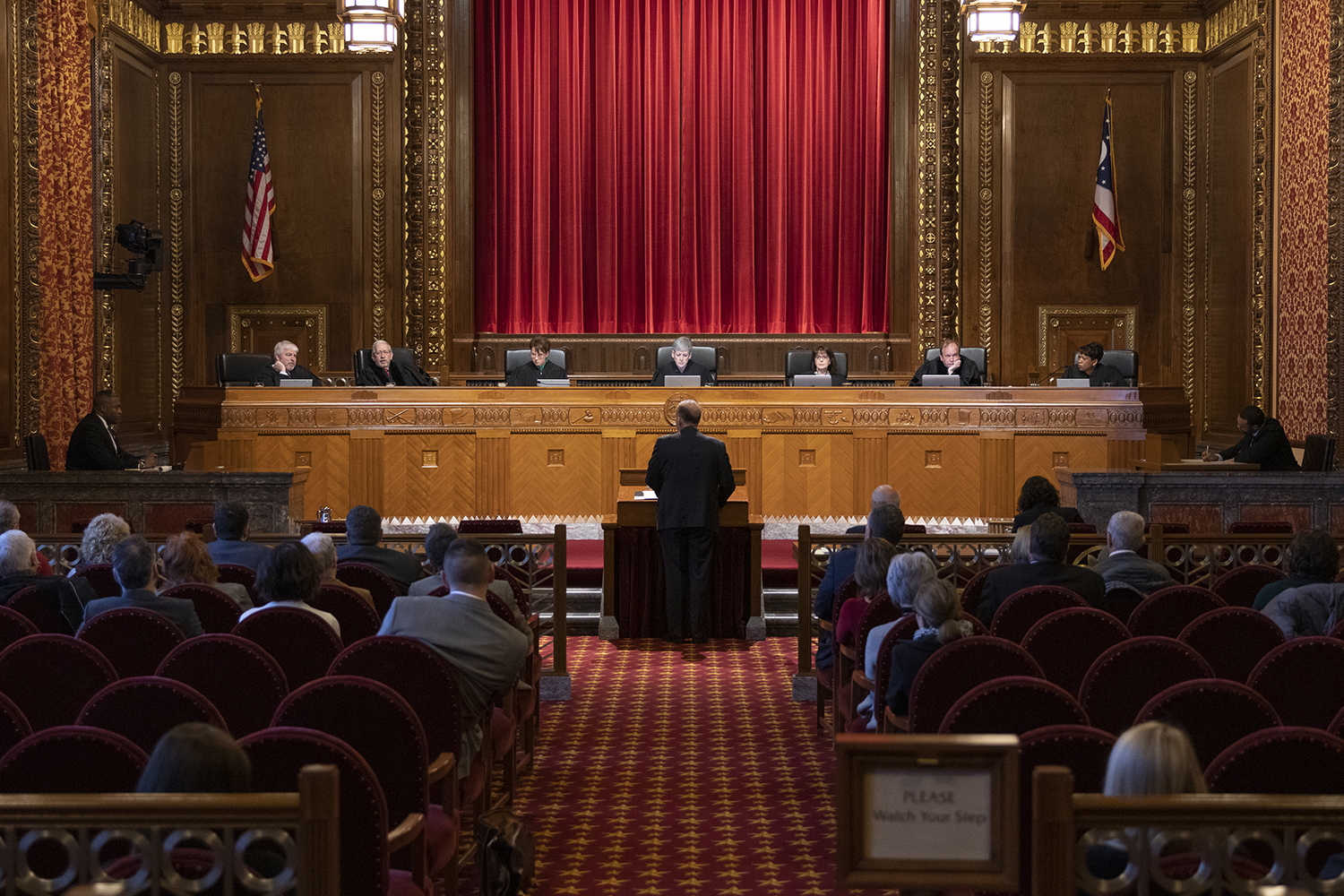
    Photo: Courtesy of the Ohio Supreme Court

    Attorneys for League of Women Voters proposed that the commission be given the maps again, but with specific instructions to fix District 1 in Hamilton County

    BY: SUSAN TEBBEN – Ohio Capital Journal


    The League of Women Voters and a group of Ohioans represented by a national redistricting group have asked the Ohio Supreme Court to keep the state from using recently approved congressional maps.

    “Having embarked on its latest map-drawing journey with an irredeemably broken compass, it is no surprise that the (Ohio Redistricting) Commission has once again found itself lost,” Ohioans led by the National Redistricting Action Fund stated in their court filing.

    The group called the newest map – which breaks the state down into 10 Republican districts, three Democratic districts and two “tossup” districts  – “an extreme partisan outlier again,” putting the state at a “partisan advantage at odds with Ohio’s voting patterns.”

    Because of this, they ask the court to strike down the Ohio Redistricting Commission’s second try at congressional districts, move the candidate filing deadline that was March 4 and “if necessary, itself adopt a constitutional plan as early as March 17.”

    “At this point, the commission cannot be trusted behind the wheel,” attorneys for the group wrote.

    The League of Women Voters stopped short of asking for the court to take over the process, saying “it is premature at this juncture for the court itself to implement a plan.”

    Attorneys for the Ohio league proposed that the commission be given the maps again, but with specific instructions to fix two districts: District 1 in Hamilton and Warren counties and District 15, which stretches from the western and southern sides of Franklin County to the Southern half of Shelby County.

    The LWV, represented by the ACLU of Ohio, also argued an alternative plan written by Harvard professor Dr. Kosuke Imai was brought up to to the commission “but was ignored.”

     A congressional redistricting plan proposed by Harvard professor Dr. Kosuke Imai. The League of Women Voters said this map was “ignored” by the Ohio Redistricting Commission, despite following constitutional redistricting requirements.

    The plan had a 10-6 partisan breakdown, but was never brought up for a formal vote by the commission.

    In court documents included with the LWV’s objection to the newest congressional map, Dr. Imai said his map “demonstrates that it is possible to generate a redistricting plan that is free of partisan bias and compactness problems while complying with the other redistricting criteria.

    Imai was also mentioned in the legislative redistricting court battle, when attorneys said the professor conducted 5,000 simulations of Ohio districts and never came up with the same amount of GOP partisanship in any of the simulations.

    Attorneys for the National Redistricting Action Fund said Ohio’s Republican caucus chose to “let the clock run out” on any efforts by the General Assembly to create a congressional plan, and were slow to act even as the ORC began its first week back after the GA made no decision.

    “The General Assembly seemingly took no action to even attempt to draw a plan itself because it was unwilling to attempt to reach the bipartisan agreement that would be necessary to pass emergency legislation,” Adams’ attorneys wrote.

    After the commission adopted a GOP-created map along party lines, the map challengers say Secretary of State Frank LaRose moved forward with “implementing the new gerrymandered plan,” despite the fact that it hadn’t been (and still hasn’t been) given the go-ahead by the state supreme court.

    The NRAF also argues the map continues to violate the constitution, specifically the provision prohibiting the favoring or disfavoring of one political party over another.

    “This disparity between statewide vote share and congressional seat share is astounding,” attorneys wrote.

    Asking for the court to take over the process is not a new argument state redistricting challengers have made. Attorneys arguing against legislative maps also asked the court to take charge after three attempts by the redistricting commission.

    The NRAF also asked the court to postpone “relevant election deadlines” for the May 3 primary, saying the court has “broad authority to issues orders postponing election deadlines to address harm that would occur if elections were to proceed under an unconstitutional map.”

    Republican commission members have said the power to change elections lies with the General Assembly.

  • GOP congressional maps revealed, vote expected today

    GOP congressional maps revealed, vote expected today

    Senate President Matt Huffman, left, and House Speaker Bob Cupp, right, speak before the Tuesday meeting of the Ohio Redistricting Commission. GOP leaders may move for a vote on new congressional maps as early as Wednesday morning. (Photo: Susan Tebben, OCJ)

    BY: SUSAN TEBBEN – Ohio Capital Journal

    Congressional maps could be voted on as early as Wednesday morning by the Ohio Redistricting Commission.

    Senate President Matt Huffman took the lead in presenting GOP congressional maps in a Tuesday meeting of the ORC. He said he plans to make a motion to adopt the maps at a Wednesday meeting, scheduled to begin at 10 a.m.

     Congressional maps proposed by GOP members of the Ohio Redistricting Commission on Tuesday.

    The maps were released to the public just before the Tuesday meeting, and Democratic members of the commission said they received the maps earlier that day.

    “The map looks pretty crisp and tight, what we have right now,” Huffman told reporters after the meeting.

    The senate president said the map “did not exist until sometime Monday afternoon or Monday night.”

    In terms of partisanship, something that’s been at the forefront of court challenges against legislative and congressional maps, the new maps have a 10-3 GOP advantage. Two districts – District 1 that covers Warren and part of Hamilton County, and District 9 that stretches from Williams and Defiance County, along the top of the state to Erie County – are both within the range considered by experts to be tossups with a slight Democratic advantage.

    District 1 carries a 51%-49% Dem advantage, and the 9th district has a narrow 50.25%-to 49.75% lean toward Democrats.

    Democrats continued to call out Republicans for keeping them out of the process, which Huffman took issue with during Tuesday’s meeting. But Huffman also said disagreement has been a bipartisan affair.

    “In this process, the Senate has a version of the world that they like, the House has their version, you’ve got three independent acting commissioners who all have their version,” Huffman said. “At some point (agreement) does become impossible.”

    Commission co-chair state Sen. Vernon Sykes, D-Akron, said Dems planned to send suggestions and recommendations to the GOP before they came together again on Wednesday, but he still didn’t see the need to rush the process.

    Republicans have said they’d like to get the congressional maps done by the end of the week to accommodate deadlines for the May primary. The Ohio Supreme Court gave the commission until March 14 to submit new congressional plans to them.

    “This time limit … is self-imposed, it can be changed,” Sykes said. “So, if we are seriously concerned with trying to be fair, then we need to take the time that’s necessary to have a good collaboration.”

    One matter that the commission attempted to put to rest on Tuesday was whether or not they needed bipartisan approval to adopt maps this time around. Democrats believe the constitution requires it since the maps have had to come back to the commission.

    House Speaker Bob Cupp said he reached out to state Attorney General Dave Yost for an opinion on the matter, and Yost said a simple majority is all that is needed. All other plans, constitutional and legislative alike, that have come out of the commission have been passed by a simple majority.

    Cupp said the fact that the commission is allowed to use a simple majority vote shouldn’t serve as indication that the ORC doesn’t plan to aim for bipartisan agreement, but the AG’s opinion is “certainly persuasive” in saying the GOP majority could move forward.

    As the congressional map consideration moves ahead, the commission is yet again awaiting a decision from the Supreme Court on its legislative plan. They submitted the plan a week after the Feb. 17 deadline, for which they could face contempt charges.

    A hearing to discuss the contempt charges was scheduled for Tuesday, but the court postponed the hearing without rescheduling it.

  • GOP majority passes third round of Ohio Statehouse maps in 4-3 vote

    GOP majority passes third round of Ohio Statehouse maps in 4-3 vote

    Democrats, Auditor Faber vote against maps

    BY: SUSAN TEBBEN – Ohio Capital Journal

    Four Republican members of the Ohio Redistricting Commission passed a third round of legislative maps Thursday, exactly one week after the Ohio Supreme Court’s deadline passed.

    The maps just introduced Thursday afternoon passed with a 4-3 vote, with both Democrats voting against as with previously passed maps.

    The House map presented on Thursday shows a 54-45 GOP advantage in the House and an 18-15 advantage in the Senate. While 19 of the Democratic House districts and seven in the Senate are considered competitive political “toss-ups” in the 50% to 52% advantage range, none of the Republican districts are, with all of them having a Republican advantage more than 52%.

    Auditor Keith Faber was the lone Republican to vote against the maps, which he said is for the same reasons he didn’t support the Democratic maps last week.

    “I think there are some issues that I have concerns with and so for that reason, I didn’t think, to be consistent, I could overlook them in this map,” Faber said.

    Those issues included compactness and political subdivision splits.

     The Ohio Senate districts as shown on the newest GOP redistricting proposal. The map was brought forward Thursday during a meeting of the Ohio Redistricting Commission.
    Source: Ohio Redistricting Commission

    “I understand the desire to have a map, I understand the desire to send a map to the supreme court that they will uphold, but again, I’m not going to violate my view of the constitution merely to get a map done,” Faber said.

    While the Ohio Redistricting Commission originally met this week to talk congressional maps, for which they have another few weeks to meet the supreme court deadline, legislative maps took the attention away.

    Senate President Matt Huffman joined with Gov. Mike DeWine and Faber in bringing up the legislative matter amidst talks on congressional district lines.

    The commission is constitutionally required to use statewide state and federal elections data from 2016 to 2020 to come up with the data for their maps.

    The passage comes mere days before the commission members must appear before the supreme court and answer for missing the deadline of Feb. 17.

     The Ohio House districts as shown on the GOP map proposal presented during a Thursday meeting of the Ohio Redistricting Commission.
    Source: Ohio Redistricting Commission

    The court asked for all members to come to a March 1 hearing on the possibility of contempt of court for ORC members.

    The commission members adjourned a meeting that deadline day with no maps approved. GOP leaders, including commission co-chair House Speaker Bob Cupp, said no agreement could be made and compliance with the orders of the court and the Ohio Constitution weren’t possible in the 10 day window they were given after the last legislative maps were struck down.

    Democrats maintained throughout Thursday that they were left out of the process, and the map that Republicans presented does not address toss-up districts.

    “We have been and continue to be willing to work with them if they want to collaborate at any time to produce a commission map,” co-chair state Sen. Vernon Sykes, D-Akron.

    In their statement supporting their maps, the GOP refuted the Democratic comments.

    “The final adopted plan contains input from those members of the commission, directly or through their staff, who chose to participate,” Cupp read from the statement.

    Without bipartisan agreement, if the supreme court accepts the maps this time around, they will last four years.

    After the maps were passed, Secretary of State Frank LaRose asked the commission to allow him to distribute a statement for candidates whose residency might change because of the district changes.

    Now the commission will move back to congressional maps. Cupp said the commission plans to meet on Tuesday, the same day as their contempt hearing.

  • Federal redistricting lawsuit filed as notice of impasse hits Ohio Supreme Court

    Federal redistricting lawsuit filed as notice of impasse hits Ohio Supreme Court

    Photo by Getty Image

    BY: SUSAN TEBBEN – Ohio Capital Journal

    Update: The ACLU filed a request with the Ohio Supreme Court to ask for the Ohio Redistricting Commission’s reasoning behind deciding not to file new legislative redistricting maps by the February 17 deadline. Details below:

    The leader of an anti-abortion lobby and other Ohio citizens are suing the Ohio Redistricting Commission and the Secretary of State, accusing them of depriving them of rights under the U.S. Constitution.

    Attorneys from the Columbus firm of Isaac Wiles & Burkholder, LLC, asked the U.S. District Court for the Southern District of Ohio to declare current legislative districts “or lack thereof” in violation of the U.S. Constitution, and to adopt the last plan the ORC approved. That plan, a revision of the first plan struck down by the Ohio Supreme Court, was also struck down by the high court.

    Though not members of the lawsuit in their official capacities, several of the plaintiffs are leaders or staff at Ohio Right to Life, a lobby group who works on anti-abortion measures throughout the state.

    Mike Gonidakis, president of Ohio Right to Life, is the lead plaintiff in the case, along with Mary Parker, OR2L’s director of legislative affairs. Also listed in the lawsuit is Margaret Conditt, who is on the lobby’s website as a “member trustee.”

    Beth Vanderkooi, another plaintiff in the case, is the executive director of Greater Columbus Right to Life, and Ducia Hamm was previously listed as associate director of affiliate services for Heartbeat International, and religious anti-abortion organization.

    After declaring two rounds of previous maps unconstitutional gerrymanders, the state supreme court sent the commission back to work with a Feb. 17 deadline, which the ORC passed by without adopting new maps.

    Ohio’s state legislative districts are not “substantially similar in population,” according to the lawsuit.

    With Thursday’s “impasse” of the Ohio Redistricting Commission members, the plaintiffs in the lawsuit say they “are cut out of the political process.”

    “Either the 2010 legislative districts apply and their votes are diluted by the population growth reflected in the 2020 U.S. Census data,” the lawsuit stated. “Or alternatively, they are not members of any state legislative district and cannot vote for state house of representatives or senate candidates.”

    The commission filed their notice of impasse on Friday, laying out the commission’s actions and non-actions from Feb. 7, when the supreme court invalidated the ORC revised General Assembly plan, until Thursday, when no map was approved.

    “Among other discussion, (Senate) President (Matt) Huffman stated that the commission was at an impasse, as the commission is unable to ascertain and determine a plan that complies with the court’s order and the Ohio Constitution,” the notice, written by the Ohio Attorney General’s Office, informed the supreme court.

    The federal lawsuit filed late Thursday cites the 2020 census, which showed a net gain of more than 250,000 Ohioans over the last 10 years.

    Because “valid redistricting” has yet to occur, the plaintiffs say they can’t decide on candidates to support, make a decision to run for office or “educate themselves or others on the positions of candidates in their districts and prepare to hold those candidates responsible.”

    Gonidakis and the other Ohioans acknowledged that a nearly five-month legal battle on legislative redistricting is unlikely to have a resolution before the voter registration deadline of April 4 for the May primary, which is why they requested the use of a previous map for the primary.

    The parties in the lawsuit said they chose the previously submitted maps, maps adopted without bipartisan support and called unconstitutional by the supreme court, because they “properly distribute voting power and are based on 2020 census data.”

    They worry if elections were allowed to take place before the redistricting process is resulted, overpopulated districts could see vote dilution, and thus a “deprivation of political power and resources.”

    A lack of districts deprives Ohioans of the right to vote, in violation of the U.S. Constitution and fundamental rights of Americans, the lawsuit states.

    “There is no harm in the Redistricting Commission following the U.S. Constitution and plaintiffs receiving the right to vote,” according to the lawsuit.

    The court challengers ask that a three-judge panel be assigned to the case to keep the ORC and the Secretary of State from “acting on their behalf” and implementing, enforcing or conducting elections under the current state of redistricting.

    The lawsuit also asks the court to establish a schedule “to adopt a timely enacted and lawful plan and implement the new plan for Ohio’s state legislative districts.”

    The lawsuit does not allege racial gerrymandering or any vote dilution based on racial discrimination, which the U.S. Supreme Court has set as a standard for taking any redistricting cases.

    Senate President Matt Huffman, a member of the Ohio Redistricting Commission, accused Democrats of drawing maps to favor Dems while using racial gerrymandering. The Dems were the only ones to propose a map at Thursday’s meeting of the commission, and it was voted down along party lines after a lengthy dissection, mainly by Huffman.

    This is the second federal lawsuit to be filed regarding redistricting in Ohio. In December, a pair of Mahoning County residents sued accusing the ORC of discriminating against Black voters in legislative and congressional district lines.

    That lawsuit was put on hold after district lines were invalidated, and is still awaiting court decisions on maps before proceeding.

    Court challengers asks for impasse reasoning

    On Friday, attorneys for the League of Women Voters and other court challengers asked the court to order the commission to explain their “bald refusal” to abide by the February 7 court order.

    “What steps the commission itself undertook to comply with the court’s order – and why there could be no possible plan to comply with the (state) constitution – remain shrouded in generalities,” wrote Freda Levenson, attorney for the ACLU, in a Friday filing with the supreme court.

    Levenson called out Governor Mike DeWine’s comments after the commission adjourned without a map, in which he said it was a “mistake for this commission to stop and basically say that we’re at an impasse,” and that the choice was “not an option that the law gives us.”

    The notice of impasse “provides no concrete statement of any reason why a more proportionate plan could not be enacted,” according to court challengers, and provides no no explanation of steps taken to draw a compliant plan.

    “It provides a bare conclusion, as if it were sufficient to justify the refusal to comply with this court’s order,” the court document stated.

    Levenson asked that the court order the commission to file evidence by February 22 that “must concretely identify why a compliant plan could not be drawn” and specific reasons why the commission did not consider other plans. The court document also asked for a position from the court on whether it can order an extension of the candidate filing deadline for the May primary.

  • Ohio Supreme Court to redistricting commission: Why shouldn’t we hold you in contempt?

    Ohio Supreme Court to redistricting commission: Why shouldn’t we hold you in contempt?

    Attorney Phillip Strach speaks before the Ohio Supreme Court, arguing for the constitutionality of legislative district maps. The court heard arguments on three cases asking it to reject the maps approved in September. (Photo: Susan Tebben, OCJ)

    BY: SUSAN TEBBEN – Ohio Capital Journal

    The Ohio Supreme Court weighed in on the redistricting battle on Friday evening, asking the members of the Ohio Redistricting Commission why it shouldn’t hold them in contempt of court for defying its order.

    Chief Justice Maureen O’Connor signed an entry in all three of the lawsuits against the ORC on legislative redistricting, asking Gov. Mike DeWine, Secretary of State Frank LaRose, Auditor Keith Faber, Senate President Matt Huffman, House Speaker (and commission co-chair) Bob Cupp, state Sen. (and commission co-chair) Vernon Sykes and House Minority Leader Allison Russo, to explain the “failure to comply with this court’s February 7, 2022 order,” and why they shouldn’t face anything from fines to jail time, the consequences for contempt of court.

    The court had been asked by the League of Women Voters, the Ohio Organizing Collaborative and a group of Ohio residents – the parties in the three lawsuits originally filed to challenge maps approved by the ORC – to order the commission to give specific reasons for their choice to adjourn without maps on Feb. 17.

    The ORC members now have until noon on Feb. 23 to tell the court why they shouldn’t be held in contempt.

    The groups also asked for justification for the commission’s lack of action on any sort of map, despite being presented with a map by the Democratic House and Senate caucuses, which they shot down along party lines on the day of the deadline.

    Huffman accused drawers of the Dem map of racial gerrymandering to the benefit of Democrats in certain districts, including the district that holds Lake County, typically a strongly GOP area. Russo wholly denied the accusations.

    The GOP commission members said during the meeting that they could not find a way to draw maps that complied with all the redistricting provisions of the constitution, while also complying with the rules the supreme court had given in their majority opinion invalidating the previous maps. Mainly, the GOP said they couldn’t hit the target of 54-46 partisan breakdown asked for by the court justices, a number based on statewide voter preferences over the last 10 years.

    But some of the commission members, of both parties, disagreed with the decision to leave before approving a map.

    “I think it is a mistake for this commission to stop and basically say that we’re at an impasse,” Gov. Mike DeWine said on Thursday. “I don’t think that is an option that the law gives us.”

    Co-chair Sykes agreed that contempt was a possibility for the commission members, and said he was willing to do whatever could be done to move forward.

    Asked after the commission adjourned if that included contempt of court: “Including whatever we can do.”

    The choice to adjourn didn’t require a majority vote, but was met with no formal objections.

    The supreme court ordered the ORC to come up with “entirely new” maps after invalidating not one but two different sets of legislative district maps. Their deadline to file with the Secretary of State’s Office was Feb. 17, with those maps then being sent to the court for review by the next day.

    The order came the same day a federal lawsuit was filed by Ohio residents, some of whom are also anti-abortion advocates in the statewide lobby group Ohio Right to Life. That lawsuit asks the district court to take over the process, and accuses the redistricting commission of preventing them from advocating for candidates, running for office, and even voting.

  • Redistricting commission punts again, defies court order

    Redistricting commission punts again, defies court order

    The Ohio Redistricting Commission co-chairs, House Speaker Bob Cupp, second from left, and state Sen. Vernon Sykes, second from right, prepare to restart the Ohio Redistricting Commission meeting on Thursday after a recess. The ORC adjourned the meeting without sending a new legislative redistricting map to the Ohio Supreme Court, as they ordered it to do. (Photo: Susan Tebben, OCJ)

    BY: SUSAN TEBBEN –  Ohio Capital Journal


    Heated questioning and behind-the-scenes discussions between Ohio Redistricting commissioners led to a deadline-breaking decision to make no decision Thursday after the Ohio Supreme Court rejected two previous attempts at Statehouse maps as unconstitutional gerrymanders.

    The Ohio Redistricting Commission could now face contempt of court, and the state faces a constitutional crisis after the commission adjourned without adopting a legislative redistricting map to submit by their court-ordered Thursday midnight deadline.

    The GOP members of the commission, of which there are five, did not present a map during Thursday’s meeting. Senate President Matt Huffman, who did most of the talking for the majority party, said there was no reason to, because mapmakers had told commissioners that they could not comply with the supreme court’s directives and all the redistricting provisions of the constitution simultaneously.

    “Under these circumstances, I don’t believe the commission is able to ascertain a General Assembly district plan,” Huffman told the commission before they adjourned.

    Gov. Mike DeWine only spoke at one point during the meeting, which was as the impasse became clear, and a map did not appear to be forthcoming.

    He did not agree that the commission could leave without bringing a map before the court, and did not think that was what the commission should do anyway.

    “I don’t think we have the luxury of saying we’re just quitting,” DeWine said.

    After the meeting adjourned, DeWine doubled down on his opinion that the commission had an obligation, and a legal one at that, to produce some sort of map for the state’s high court to consider.

    I think it is a mistake for this commission to stop and basically say that we’re at an impasse. I don’t think that is an option that the law gives us.

    – Ohio Gov. Mike DeWine

    The commission was offered a map by the two Democrats on it with a 54-45 partisan breakdown, but GOP members voted down the measure along party lines after lengthy and tense criticism by Republicans, for the most part Senate President Matt Huffman.

    Taking the brunt of GOP criticism was House Minority Leader Allison Russo, who made the motion for the commission to accept the Democratic drawn maps.

    Huffman took the commission through the Democrats’ maps region by region, pointing out different GOP-incumbent districts that he said violated the constitutional provision prohibiting the favoring or disfavoring of one political party over another.

    He accused the Democratic caucus of racial gerrymandering in a few districts, specifically the Ohio Senate’s 25th District, made up mostly of Lake County, and House District 44, covering Ottawa and parts of Lucas County. Huffman accused the Democrats of gerrymandering by redrawing the districts and the communities therein to favor their candidates.

    Russo denied any existence of “packing and cracking,” the strategy of packing communities into a smaller area than necessary to benefit one party or another, or spreading a community out among a larger space than necessary to dilute its voting power.

    “What you’re asserting is just simply false,” Russo said.

    Throughout the meeting, she parried with Huffman and other Republicans, consistently asking the commission members to spell out specific constitutional violations in the Democratic maps.

    “If you have a map to propose that achieves this or suggestions to propose that address some of these concerns that you have, so far I have not yet seen a constitutional violation,” Russo said.

    When asked by Russo if the GOP had a map proposal to bring before the commission, Huffman hedged, saying he needed to finish his questions and “see how it goes.”

    He brought up the idea to “let the public decide” on the Democratic maps as he continued his dissection of the map, but said there were hours of testimony to refer to in lieu of more public hearings.

    “I’m not proposing additional public input,” Huffman said.

    What’s next?

    After the commission adjourned without doing as the Ohio Supreme Court asked, legislative leaders didn’t have a plan as to what would come next.

    “I don’t know; I don’t have a next step,” Huffman said.

    Cupp, a former Ohio Supreme Court justice himself, refused to speculate on what the courts might do, but said the commission will “try to keep working and if there’s some ideas that come forward on how to develop a legislative district map,” he said, the commission “would work very hard to do that.”

    Auditor Keith Faber made a motion to change the rules of the commission well into Thursday evening, after the commission went into a recess to discuss the Democrats’ presentation. The change, which was passed 6-1 with only Russo voting against the motion, allows the commission to reconvene at the request of three members of the commission. Those members do not have to be the co-chairs, and it does not have to be a bipartisan request.

    Co-chair state Sen. Vernon Sykes, D-Akron, confirmed that the court can not adopt the maps themselves, but as far as what happens next, he, too, was in the dark.

    He did, however, say it is possible the commission members could be held in contempt of court for failing to follow a court order.

    “I believe that is a possibility,” Sykes said.

    When asked if he would be okay with that happening as a consequence, he said he is “okay with us moving forward, whatever can be done to help us move forward.”

    When pressed on if that included contempt: “Including whatever we can do.”

    Constitutional scholars remain uncertain about the next steps of the process, mostly because the state hasn’t gone through it before.

    “This is a new process, and Ohio voters clearly wanted more collaboration and a more bipartisan process than we’ve seen so far,” said Mike Gentithes, associate professor who teaches constitutional law at the University of Akron.

    The University of Akron’s Seiberling Chair of Constitutional Law, Dr. Tracy Thomas, gave the outside perspective on the situation, saying it was “likely to end up in the courts for a while regardless of the outcome today.”

    Several states have invalidated maps because of partisan favoritism and sent them back for revisions without a solution for a stalemate.

    “In the absence of some constitutional mandate or overriding federal legislation, which we don’t really have, the line-drawing is part of the political process and subject to the usual majoritarian control,” Thomas told the OCJ.

    The Ohio Supreme Court is not likely to let this lack of action slide, in Gentithes’ opinion, and this could potentially lead to yet another overhaul of the process, since it seems the incentive to have 10-year maps with bipartisan agreement didn’t have the desired effect.

    “That might teach us how to restructure an amendment to actually have some teeth,” Gentithes said.

    The primary election is an entirely different bear, and Secretary of State Frank LaRose spent his short time speaking at the commission meeting impressing upon the commission the urgency of making decisions.

    “This challenge is not one that can be met with creativity, and grit and tenacity … instead this one is simply dictated by logistical deadlines,” LaRose said.

    Adding to the threat of legal trouble for the commission, without district lines, LaRose said the commission is in danger of missing a federal deadline to send absentee ballots to Ohio citizens who are overseas or in the military.

    “We are dangerously close to possibly violating federal law,” LaRose said.

    Cupp chuckled at a question about whether or not he accepted the idea of breaking federal law, saying, “I’m not okay with breaking any law.”

    The primary date is unlikely to change, in his mind, because of a lack of support for the idea in his chamber.

    “I don’t think in the House that there is a majority vote for moving the primary election at this time,” Cupp said. “Let alone, the two-thirds vote we would need for it to happen immediately.”

  • Dems: We’ll talk about primaries when fair maps are passed

    Dems: We’ll talk about primaries when fair maps are passed

    State Sen. Vernon Sykes, D-Akron, speaks with press alongside House Minority Leader Allison Russo on Friday. The Dem caucuses pushed their maps and pushed for cooperation in the ongoing redistricting process. (Photo: Susan Tebben, OCJ)

    BY: SUSAN TEBBEN –  Ohio Capital Journal

    After making technical fixes brought up by GOP members of the Ohio Redistricting Commission, Ohio’s Democratic caucuses in the legislature are again pushing for their maps to be a model for redistricting in the state.

    Legislative leaders of the party also still believe a May primary is possible, but until maps are produced with bipartisan agreement, they say they can’t come to the table to talk about other election options.

    House Minority Leader Allison Russo, state Sen. Vernon Sykes, and Democratic redistricting mapmaker Chris Glassburn met at a press conference on Friday to bring up their versions of legislative maps, but also to give Republicans an ultimatum on the process.

    “It is not a lack of ability that is delaying the process, rather Republicans lack the will to do what is constitutionally required to deliver the fair maps that Ohioans overwhelmingly demanded not once, but twice,” Russo said.

    As of Monday evening, spokespeople for Senate President Matt Huffman, Secretary of State Frank LaRose, Auditor Keith Faber and Governor Mike DeWine said they had no information about when the commission would be meeting.

    “Check with the co-chairs,” said Huffman’s spokesperson when asked if Huffman had heard about the commission or provided his own schedule to the commission.

    “Secretary LaRose is ready and willing to meet at the call of the co-chairs,” LaRose’s spokesman told the OCJ. “He is focused on explaining to the General Assembly the risks associated with trying to run a secure, accurate and accessible election on the current timeline without the finality of new districts.”

    A spokesperson for House Speaker and commission co-chair Bob Cupp did not respond to requests for comment on Monday.

    The maps presented on Friday were the same that were released on Tuesday, which Glassburn said didn’t hold major substantive changes. Mostly the maps contained corrections to precinct lines or single census blocks, some of which were requested by Senate President Matt Huffman asked for in the most recent meetings of the Ohio Redistricting Commission.

    Sykes, D-Akron, is the co-chair of the Ohio Redistricting Commission with House Speaker Bob Cupp, R-Lima. The two previous times the ORC met on legislative redistricting, Sykes and the Democrats expressed their frustration with a lack of transparency and a lack of concessions they say the Republicans were willing to provide as the map-making process went on.

    The two legislative redistricting plans that came from the ORC were passed on purely Republican majorities, and each time, Sykes left the process feeling as though Democrats weren’t heard and the GOP was unmovable.

    Still, Sykes said he is “hopeful” about the newest process, now with a court-ordered deadline of February 17. He said staff members have been “exchanging some information.”

    But despite only days until the deadline, Sykes acknowledged getting the commission together is still an uncertainty.

    “Right now, the reason we’re not meeting is because (the Republican commission members) can’t get organized on a date and time and place to do that, so we have not received any indications of what they plan on doing,” Sykes said.

    Gov. Mike DeWine, who convenes the Ohio Redistricting Commission and serves as a member, went to Los Angeles this past weekend to watch the Cincinnati Bengals compete in the Super Bowl.

    He held a media availability in LA on Thursday, “to talk about Super Bowl LVI, all things Cincinnati Bengals, and all things Ohio ahead of the big game on Sunday,” according to his office.

    A spokesperson for fellow ORC member and Senate President Matt Huffman, R-Lima, wasted no time in releasing a statement on behalf of the majority party regarding the Dem maps and criticism of the process.

    “I’m sure at this point, Democrats believe they could draw House and Senate maps in crayon and watercolor and the same four members of the court would approve their unconstitutional maps,” Senate majority director of communications John Fortney wrote in a statement.

    The only specific criticism Fortney gave of the Dem plan was the 1st Senate district, saying the new plan “shoved it into districts that will not have another Senate election until 2024.”

    One thing Dems said they’d be willing to wait on is deciding whether or not a May primary is possible. Russo still believe a primary can be held on May 3 as scheduled “if we take the necessary steps to promptly pass fair, constitutional maps.”

    Republicans, including Huffman, brought up the idea of holding two primaries to take the pressure off the Ohio Secretary of State’s Office and local boards of election should the redistricting process take them past filing deadlines and administrative timelines for the election.

    In court filings with the Ohio Supreme Court asking them to uphold the previous maps, GOP members of the ORC asked the court to allow them to use the unconstitutional maps for the primary or wait to file a decision until after the 2022 general election.

    The Ohio Supreme Court did not move the primary, but reiterated in their rejection of the revised legislative maps that the General Assembly “has the authority to ease the pressure that the commission’s failure to adopt a constitutional redistricting plan has placed on the secretary of state and on county boards of elections by moving the primary election, should that action become necessary.”

    The secretary of state’s office, which both Republicans and Democrats say they’ve met with, has expressed hesitancy to postpone the May 3 election, or to have two separate primaries.

    The nearest deadline for the election is March 19, when the Uniformed and Overseas Citizen Absentee Voting Act says absentee ballots for eligible Ohioans should be sent out. April 5 starts the early voting period for the state under the current election timeline.

    Rob Nichols, spokesperson for Secretary of State Frank LaRose, said discussions on the election are “important, complex and ongoing.”

    “We continue to engage in negotiations over redistricting with those involved,” Nichols told the OCJ.

    The press conference ended a week that started with multiple committee meetings in the House and Senate to discuss congressional redistricting, all of which were canceled as House Speaker Bob Cupp said the GA didn’t have the support needed to pass new maps, as ordered by the Ohio Supreme Court. With the deadline for legislative approval set for Feb. 13, Cupp said the process will now move to the ORC. They will have another 30 days to come up with new maps.

  • Redistricting changes shifted state school board districts before being struck down

    Redistricting changes shifted state school board districts before being struck down

    Melissa Cropper, executive director of the Ohio Federation of Teachers said the decisions DeWine made appear to be pushing out members and candidates who supporters of public education and topics like diversity and inclusion. The lines as established under the unconstitutional maps would impact candidates focused on topics important to the OFT, like diversity and inclusion in education.

    BY: SUSAN TEBBEN – Ohio Capital Journal

    Amid the chaos and uncertainty of the redistricting process, a deadline loomed that would decide representation on the Ohio State Board of Education. It depended on having district lines to reference.

    Legislative and congressional maps are both in limbo after the Ohio Supreme Court rejected both maps, the legislative maps getting sent back for a second time last week.

    Gov. Mike DeWine was forced to assign the Ohio State Board of Education districts himself because the deadline for establishing districts for the board was January 31. Using the state senate map adopted by the Ohio Redistricting Commission on Jan. 22, DeWine signed the letter notifying board members of their districts on the day of the deadline.

    Ohio Revised Code states the board of education districts must be established by Jan. 31 in a redistricting year, and if the General Assembly doesn’t create those districts themselves, the governor must take on the job.

    Each board district has to makeup three contiguous state senate districts.

    “Each state board of education district shall be as compact as practicable,” the state law reads.

     The Ohio State Board of Education districts as they have been prior to redistricting efforts this year.
    Source: Ohio Department of Education

    Many of those districts didn’t change, but the most significant changes seemed to be in four particular districts; the districts represented by Dr. Christina Collins, Dr. Antoinette Miranda, Michelle Newman and Meryl Johnson.

    Collins’ new district would have stretched from Union County through Holmes County, and includes parts of Franklin County in between.

    Being a resident of Medina County, this plan would push her out of her district, and though the board of education races are considered non-partisan, Collins said it put her in a district that voted “overwhelmingly for significantly right-leaning state board candidates,” namely District 1 board member Diana Fessler and two candidates who unsuccessfully ran against Miranda and Newman.

    “The distance presents its own challenges given I do try to be involved in the counties I represent, but I also question my philosophical appeal as a representative to what appear to be this territory’s political preferences,” Collins wrote in an email to the OCJ.

    Newman’s three senate districts would have included her Newark residence in the 31st District, along with the 33rd district that brings her representation all the way to the Pennsylvania border. She would also represent the rural 30th district, that rolls from Jefferson County down the state line to Meigs County.

    Newman said she’s going to continue to serve kids and support public schools whatever her district lines.

    “However, when I saw my new district jump from 13 to 18 counties, lost the compactness of its previous state and also shifted to nearly all rural vs the urban/rural mix I had before, my eyebrows definitely raised,” Newman told the OCJ. “The fact that the Ohio Supreme Court just ruled the new maps unconstitutional proves my wariness was correct.”

    Miranda’s districts were set to go from the Columbus area near Ohio State University to Nelsonville near Ohio University.

     State Senate districts in Northeast Ohio, as shown on the most recently struck down legislative map. State board of education member Meryl Johnson would have represented districts 22, 23 and 24 under this plan, districts separated by another board member’s area in Senate district 27.
    Source: Dave’s Redistricting App

    Johnson’s 11th district would be broken by a peninsula of the 27th Senate district, covered by board member Tim Miller. That break separates the 22nd Senate district, which includes Ashland, Wayne and Medina counties, from the 23rd and 24th, which include pieces of Cleveland proper and Cuyahoga County.

    Only 11 members of the state board are elected, with the other eight appointed by the governor.

    Education officials don’t see the changes as coincidental. They see a connection between the changes made to the districts, and the four board members choices on the board, most importantly, their decision to support (and refuse to rescind) a resolution that condemned racism in state schools.

    “The governor certainly signaled an intent in terms of who they seem to be trying to protect on the board and who they seem to be drawing into competitive districts,” said Scott DiMauro, president of the Ohio Education Association.

    A spokesperson for DeWine corroborated state law that said it was his job to assign districts if the legislature fails to do so, but did not answer questions as to how DeWine decided on the district lines or whether he contacted incumbent members about the changes before making them official.

    Some incumbent members of the legislature were told as the map-drawing process went along what changes would be made to their districts, and were asked for input before the maps were officially presented to the public.

    DiMauro said the state board of education is an important entity to watch because of the power they hold over curriculum decisions, licensure law enforcement and even the hiring/firing process for teachers.

    The message the state board sends in Ohio is important, and curriculum messages some board members have made regarding education on race in schools have a “destructive” effect, according to DiMauro.

    “There’s a sense that you want a state board that is above politics,” DiMauro said.

    Melissa Cropper, executive director of the Ohio Federation of Teachers said the decisions DeWine made appear to be pushing out members and candidates who supporters of public education and topics like diversity and inclusion. The lines as established under the unconstitutional maps would impact candidates focused on topics important to the OFT, like diversity and inclusion in education.

    “I think ideally we wouldn’t even be talking about what the school board lines are until we have fair districts drawn,” Cropper said.

    With the senate maps among the three maps struck down by the Ohio Supreme Court, the education districts are at the mercy of the new redistricting plan, which the court has asked for by Feb. 17.