Tag: Ohio Redistricting Commission

  • Confidence wanes in legislature’s ability to pass new congressional map

    Confidence wanes in legislature’s ability to pass new congressional map

    BY: SUSAN TEBBEN – Ohio Capital Journal

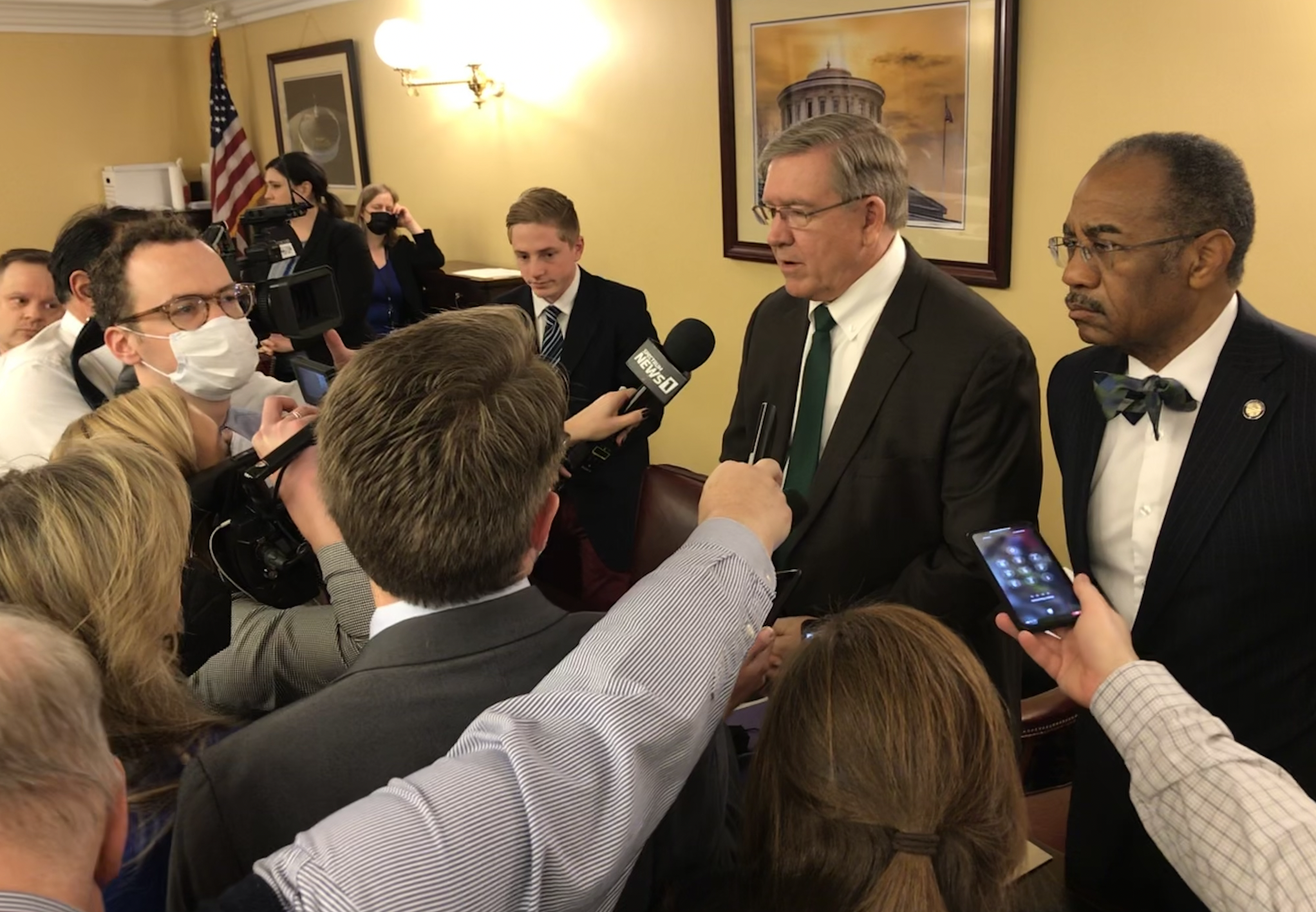
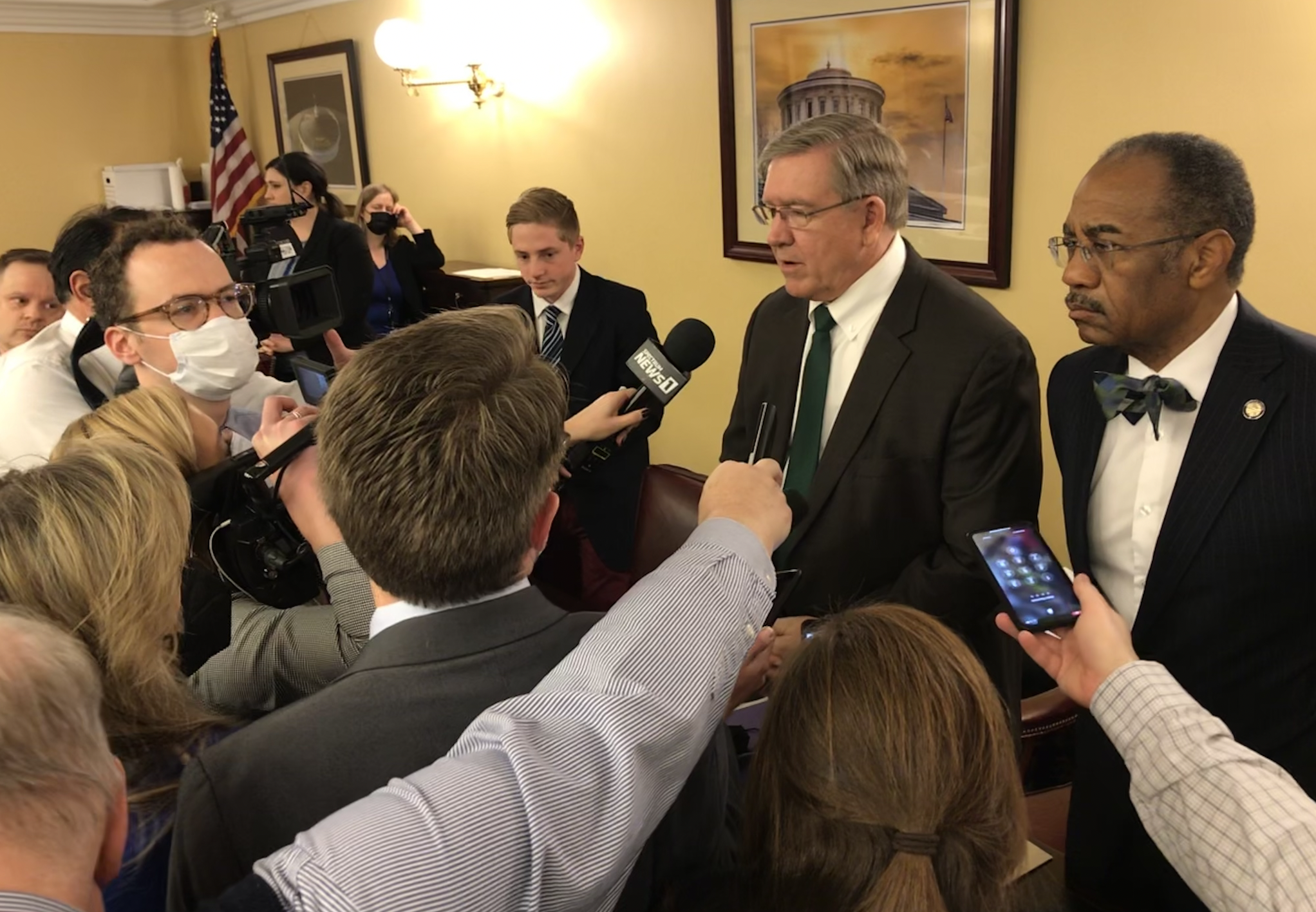
    House Speaker Bob Cupp, center right, and state Sen. Vernon Sykes, far right, co-chairs of the Ohio Redistricting Commission, speak to media after a January meeting to restart the legislative redistricting process. The process is set to start again next week. (Photo: Susan Tebben, OCJ)

    The tide seems to be turning on congressional redistricting, with legislative leaders saying the process lacks needed support in the General Assembly, and will likely head back to the Ohio Redistricting Commission.

    A day after legislative maps were sent back to the ORC for a third time, a co-chair of that commission says the congressional map is headed that way as well.

    House Speaker Bob Cupp told media at the Statehouse on Tuesday that a two-thirds vote would not be possible in the legislature, which is necessary to be able to pass a congressional map in the General Assembly.

    Because of that lack of support, a redistricting plan could not include an emergency clause, which would be needed for the plan to take effect immediately. The legislature was on the clock to pass a revised plan by Feb. 13 (Super Bowl Sunday), and for that plan to become effective in time for the May primary.

    Bills typically take effect 90 days after the governor’s signature, which would conflict with the primary deadlines.

    A spokesperson for Senate President Matt Huffman said because a commission vote doesn’t need an emergency clause, “it makes sense for the congressional map to go to the commission” if a two-thirds vote isn’t possible.

    House Democrats said the GOP made agreement difficult, having never shared a Republican proposal with the other party.

    “Democrats cannot support a map that we have not seen,” Maya Majikas, deputy communications director for the House Democratic Caucus, told the OCJ.

    Yesterday, House Minority Leader Allison Russo spelled out her expectations for the congressional redraw, which included work by the General Assembly.

    “There is a clear path to producing a fair, constitutional map that allows for the equal representation that all Ohio voters deserve. Now, it is the duty of this General Assembly to uphold our Constitutional responsibility and deliver a fair map,” Russo said in a statement.

    Democrats in both chambers spent Tuesday pushing their proposal for congressional districts, releasing a map with a GOP majority 8-7 split. One district covering Cuyahoga County is considered Dem-leaning, according to the caucus numbers, but only gives Dems a 50.9% to 49% advantage.

    Should the legislature continue to hold until the Feb. 13 deadline, the Ohio Redistricting Commission will have 30 days to come up with a congressional plan to replace the one rejected by the court.

    This deadline comes alongside a Feb. 17 deadline for the commission to submit a third version of the legislative district plan to the Ohio Secretary of State’s office, and submit it back to the court for review.

    In their Monday decision striking down the newest version of the legislative maps, the Ohio Supreme Court said they maintain jurisdiction over the maps. They also addressed the timeline for the May primary and 2022 elections in their decision.

    Republican members of the redistricting commission had asked the court to decide the case by Feb. 11 or to hold their decision until after the 2022 general election, using the now-rejected plan until that time.

    In their 4-3 decision, the majority justices on the court said the General Assembly “has the authority to ease the pressure that the commission’s failure to adopt a constitutional redistricting plan has placed on the secretary of state and on county boards of elections by moving the primary election, should that action become necessary.”

    Secretary of State Frank LaRose’s office confirmed that it is solely on the legislature to decide when an election conducted, though the secretary of state can advise them on “cascading events” that would be impacted by changing an election, according to spokesperson Rob Nichols.

    There is precedent for moving an election day, as LaRose did during the COVID-19 pandemic.

    In the ORC response to objections to the legislative maps, the commission laid out the impact the redistricting maelstrom may have on the 2022 election season.

    “Ohio’s expansive early voting framework amounts to an election season that begins with early in-person and absentee voting 29 days before the primary,” they wrote in court documents.

    That date would be April 5 this year, meaning before that date county boards of election need to print and prepare ballots under Uniformed and Overseas Citizen Absentee Voting Act (UOCAVA), for which federal law requires boards to begin mailing the ballots at least 45 days before the primary.

    Those ballots need to be sent by March 19 this year.

    “Though the General Assembly can, and has, temporarily amended Ohio law to move some of Ohio’s election deadlines for the primary election, the federal UOCAVA deadline is set by federal statute (and) it cannot be moved by the General Assembly or the Secretary,” the ORC wrote.

    Without districts to determine the voting precincts for those uniformed and overseas citizens, the ballots can’t be sent.

    Still, LaRose has only asked the General Assembly for the authority to shift some administrative deadlines having to do with the primary, not to move the election entirely.

    “His job right now is to administer an election on May 3,” Nichols told the OCJ.

    LaRose is also a member of the Ohio Redistricting Commission, so he’ll be multi-tasking as the redistricting process continues.
  • Ohio Supreme Court invalidates legislative maps for second time

    Ohio Supreme Court invalidates legislative maps for second time

    BY: SUSAN TEBBEN  Ohio Capital Journal

    The Ohio Supreme Court has sent back the state’s legislative redistricting maps yet again, rebuffing GOP claims that they attempted to bring about a partisan balance.

    “The (Ohio Redistricting Commission’s) choice to avoid a more proportional plan for no explicable reason points unavoidably toward an intent to favor the Republican Party,” the majority wrote in a Monday ruling.

    In a 4-3 split, Chief Justice Maureen O’Connor, Justice Michael Donnelly, Justice Melody Stewart and Justice Jennifer Brunner ordered that the Ohio Redistricting Commission convene for the third time and “draft and adopt an entirely new General Assembly-district plan that conforms with the Ohio Constitution.”

    The ORC now has until Feb. 17 to file a new plan with the Ohio Secretary of State’s office, and a copy with the court by the next morning.

    “We retain jurisdiction for the purpose of reviewing the new plan,” the majority stated in the Monday opinion.

    The court previously rejected the map approved by the commission in September, giving the ORC 10 days to revise the maps. After adopting a new map with a 5-2 party-line vote, the group sent the court a map with a 57-42 split in the House, and a 20-13 split, keeping the GOP majority in both chambers. Several districts were considered “toss up” districts, despite the GOP calling them “Democratic leaning” during their map presentation.

    The GOP said they had made their best attempt at meeting the 54-46 split the supreme court had asked for, with House Speaker and commission co-chair Bob Cupp saying the court was not asking for perfection, but for an attempt at less partisanship.

    The court called up the partisanship standard in their majority opinion on the revised maps, once again observing that the maps were made with GOP favoritism in mind.

    The majority torched mapmakers Ray DiRossi and Blake Springhetti for using the previously invalidated map as a starting point for the revised map, and said that was not what the court wanted when they struck down those maps.

    “DiRossi and Springhetti started with the same plan that we invalidated and then merely adjusted certain districts just enough so that they could nominally be reclassified as ‘Democratic-leaning,” the majority of the court wrote.

    It was clear, according to supreme court justices, that the commission knew the approach of starting with the invalidated map and switching some competitive Republican districts to competitive Dem-leaning districts “would have the dual effect of eliminating weak Republican districts and creating weak Democratic districts.”

    “This was not the process that our decision contemplates, and the commission’s awareness of the partisan effects supports an ‘inference of predominant partisan intent’ similar to the one we found with respect to the original plan,” the majority justices wrote.

    Justices Sharon Kennedy, Patrick DeWine and Patrick Fischer all dissented for many of the same reasons they disagreed with the majority in invalidating the previous legislative maps.

    “It is apparent that in disregard of constitutional standards, four members of this court have now commandeered the redistricting process and that they will continue to reject any General Assembly-district plan until they get the plan they want,” Kennedy and DeWine wrote.

    Kennedy and DeWine argued that the court overextended its power in invalidating the map as a whole, and that the revised map, in their eyes, does not violate the partisanship standard within the constitution. They said the court should “not demand exact proportionality when there is scant evidence that it is possible to draw districts that are exactly proportional to the partisan preferences of Ohio voters” without violating other constitutional map-drawing requirements.

    DeWine, who is the son of ORC member and Governor Mike DeWine, chose not to recuse himself from the case, saying he saw no conflict of interest in judging the case.

    Fischer agreed in a separate dissent that the majority “does not follow the text of the Ohio Constitution.”

    “The majority opinion again attempts to exercise authority not granted to this court by the state Constitution,” Fischer wrote.

    Because the majority opinion does not allow the map to stand as a four-year map, as the constitution states happens with a simple majority vote for adoption, Fischer said invalidating the maps “impinges upon the citizens’ right to vote in two General Assembly elections according to the terms of (redistricting constitutional amendment) Article XI.”

    He also argued that the constitution does not define the “threshold to having been drawn ‘primarily to favor’ a political party,” yet another reason he said the court should not be making the blanket decision to invalidate the maps.

    Fischer accused the majority justices of being “seemingly more interested in making policy than enforcing the Constitution’s text as written.”

    Objections will be allowed in this third attempt, just as they were in the second revision of the map. Those wanting to file an objection to the map have three days after the plan is filed with the court.

  • Ohio Supreme Court allows Dems’ redistricting objection

    Ohio Supreme Court allows Dems’ redistricting objection

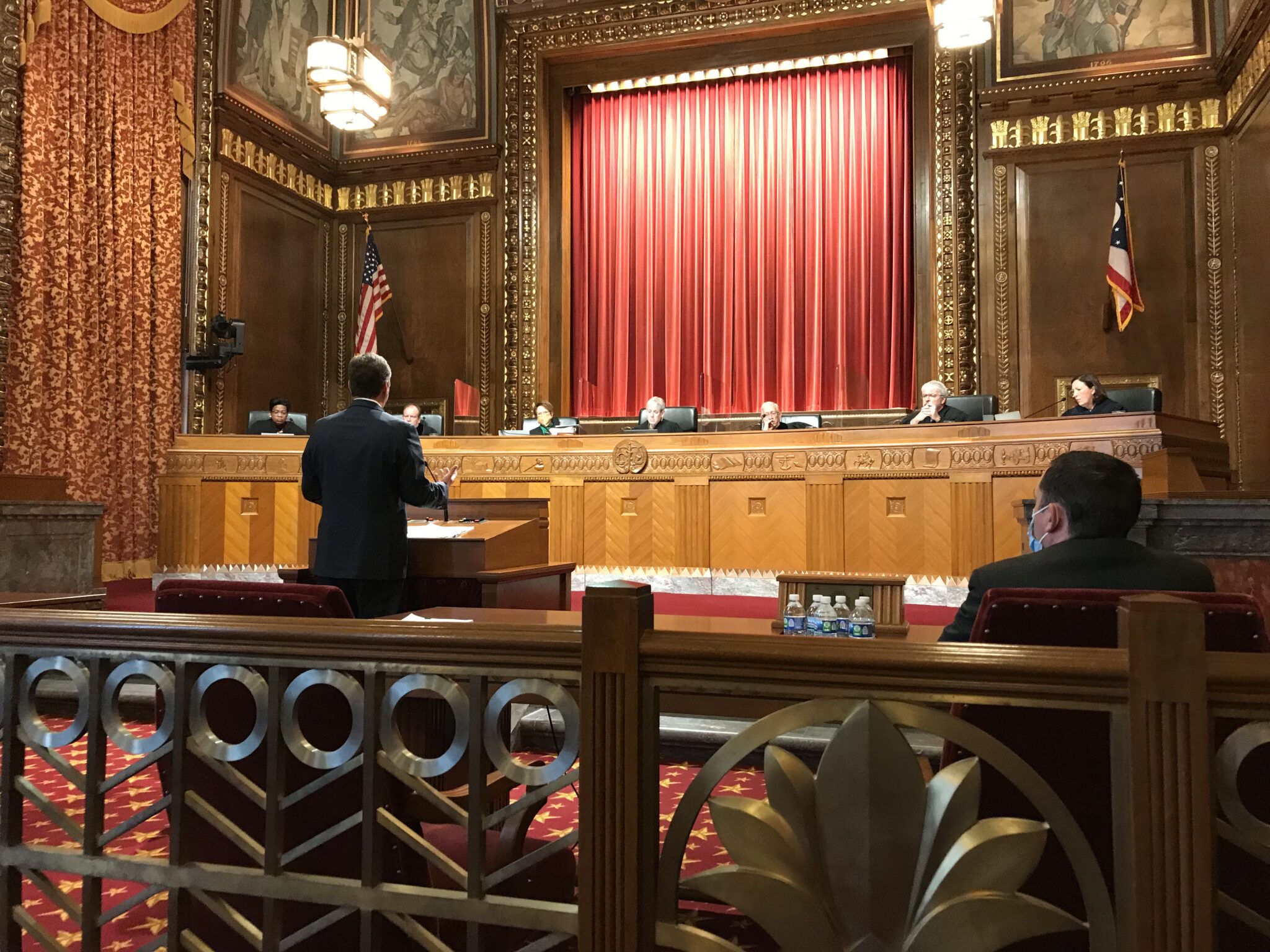
    Attorney Phillip Strach speaks before the Ohio Supreme Court, arguing for the constitutionality of legislative district maps. The court heard arguments on three cases asking it to reject the maps approved in September. (Photo: Susan Tebben, OCJ)

    BY: SUSAN TEBBEN – Ohio Capital Journal

    The Ohio Supreme Court has rejected a request by the state’s Attorney General to reduce Democratic redistricting leaders’ court filing to a “friends of the court” brief.

    In a short ruling released Friday evening, the court denied a motion to convert the brief, filed by Ohio Redistricting Commission co-chair state Sen. Vernon Sykes, D-Akron, and House Minority Leader and commission member Allison Russo, D-Upper Arlington.

    Russo and Sykes filed the objection to the newest legislative redistricting maps without an attorney, which they said was the fault of Attorney General Dave Yost. The Democrats say he refused to allow them to consult attorneys for the Ice Miller law firm.

    Yost asked that the brief be considered amicus of “friend of the court” brief rather than an official response by state officials. “Friend of the court” briefs are typically filed by non-parties in lawsuits, who want to provide the court input but aren’t necessarily connected to the case.

    The ruling by the supreme court did grant Yost’s motion for “limited intervention” in the case, meaning he maintains his position as a legal representative for all state officials in the lawsuits. Yost told the court the limited intervention was needed “to protect his powers as Chief Law Officer of the State of Ohio.”

    He said Russo and Sykes are being sued in their official capacities, therefore filing court documents saying they don’t have an attorney undermines his authority.

    Russo and Sykes are both mentioned in the lawsuit as members of the Ohio Redistricting Commission, along with Governor Mike DeWine, Senate President Matt Huffman, House Speaker (and commission co-chair) Bob Cupp, Secretary of State Frank LaRose and Auditor Keith Faber.

    Chief Justice Maureen O’Connor was the only justice to differ from the majority in the ruling. O’Connor, it was noted, would have denied the motion for Yost to intervene in addition to denying the conversion of the Democratic brief.

    Russo released a statement saying she was “relieved to see that a fair process is continuing in the courts.”

    “Now, we wait the Court’s decision on the submitted maps and let the process play out with greater transparency,” Russo said in the statement.

    The Ohio Redistricting Commission revised the legislative maps with a 5-2 vote along party lines in January after the court sent them back to the drawing board, calling their original plan unconstitutional.

    Republicans commission members responded to objections made by the League of Women Voters, the Ohio Organizing Collaborative and a group of Ohio residents. They said they made appropriate attempts to get to the court’s desired 54% GOP to 46% Dem split, based on statewide voter preferences for the last 10 years.

    The maps sent back to the court have a 57-42 split.

  • Ranking Dem says GOP attorney general blocked her from lawyers in redistricting suit

    Ranking Dem says GOP attorney general blocked her from lawyers in redistricting suit

    Ohio Attorney General Dave Yost. (Photo by Justin Merriman/Getty Images)

    BY: JAKE ZUCKERMAN – Ohio Capital Journal

    Columbus, Ohio – The ranking Democrat in the Ohio House said Attorney General Dave Yost has blocked her from legal representation as the Ohio Supreme Court reviews the latest redistricting proposal from state lawmakers.

    The Ohio Redistricting Commission voted 5-2 along party lines Saturday to send over a revised map after the court overturned its first effort, determining it to be an unconstitutional gerrymander.

    Democrats on the commission have previously been represented by their own counsel and submitted their own arguments — distinct from Republicans on the committee. House Minority Leader Allison Russo, D-Columbus, said in a statement Wednesday however that Yost has since blocked them from their legal representation. This comes as a deadline looms for the state officials to respond to objections to the GOP-approved map submitted for the court’s review.

    Through spokeswoman Maya Majikas, Russo said Yost is “denying” her “the ability to consult with her legal counsel,” two attorneys with the Ice Miller law firm in Columbus retained through the attorney general’s office.

    “Leader Russo is being denied her outside counsel representation at this stage of the litigation period,” Majikas said. “Ice Miller is not permitted by the AG to provide Democrats counsel/bills for any service to us.”

    Yost seemed to confirm Russo’s central claim through spokeswoman Bethany McCorkle on Wednesday evening.

    “The Ohio Supreme Court ordered the Commission to draw a new map, which is why one counsel will respond to the court on behalf of the entire commission,” McCorkle said. “None of the individual members will respond separately.”

    Democratic members of the commission are technically named as defendants in the lawsuit. However, their interests largely align with the plaintiffs — a spread of special interest and voting rights organizations — and against Republicans on the commission who defended the maps.

    This has put the Democrats in the unusual position of arguing, as a defendant in the case, that the court should do what the plaintiffs want.

    “The Republican Legislative Commissioners prepared maps so lopsided that Republicans are essentially guaranteed veto-proof majorities in the General Assembly no matter how many votes Democrats earn,” the Democrats’ lawyers wrote in court filings.

    The Supreme Court, overturning the legislative maps, found they likely guaranteed Republicans a supermajority in defiance of voter’s preferences, as required by the constitution. They ordered the commission to draw a map as close as possible to the state’s 54% Republican to 46% Democratic partisan tilt.

    The newest proposal would create a projected 57-42 split in the House and 20-13 split in the Senate, far more advantageous for Democrats than the original. However, the Democrats’ margins are much tighter. For instance, in the House, 12 of the “Democratic leaning” seats in the latest map could also be considered tossups, with a Democratic edge of only 50-51%. All of the GOP-leaning seats favor Republicans by more than 52%.

    The plaintiffs who challenged the first map filed objections to the Ohio Supreme Court over the edited version this week. They argued it still disproportionately favors Republicans in violation of anti-gerrymandering Constitutional amendment approved by voters.

    The Ohio Redistricting Commission — comprised of four, bipartisan legislative appointees along with the governor, state auditor and secretary of state — was ordered to respond to the objections by Friday.

    The commission itself is represented by two lawyers. The statewide officeholders and Republicans on the commission have their own lawyers as well. Even if, as Yost said, the commission’s members don’t respond individually, it’s likely that Republicans who control it will likely shape its arguments.

    Sen. Vernon Sykes, D-Akron, the other Democrat on the committee, did not respond to an inquiry to his office.

  • Deja Vu: Republicans use simple majority to pass 4-year maps

    Deja Vu: Republicans use simple majority to pass 4-year maps

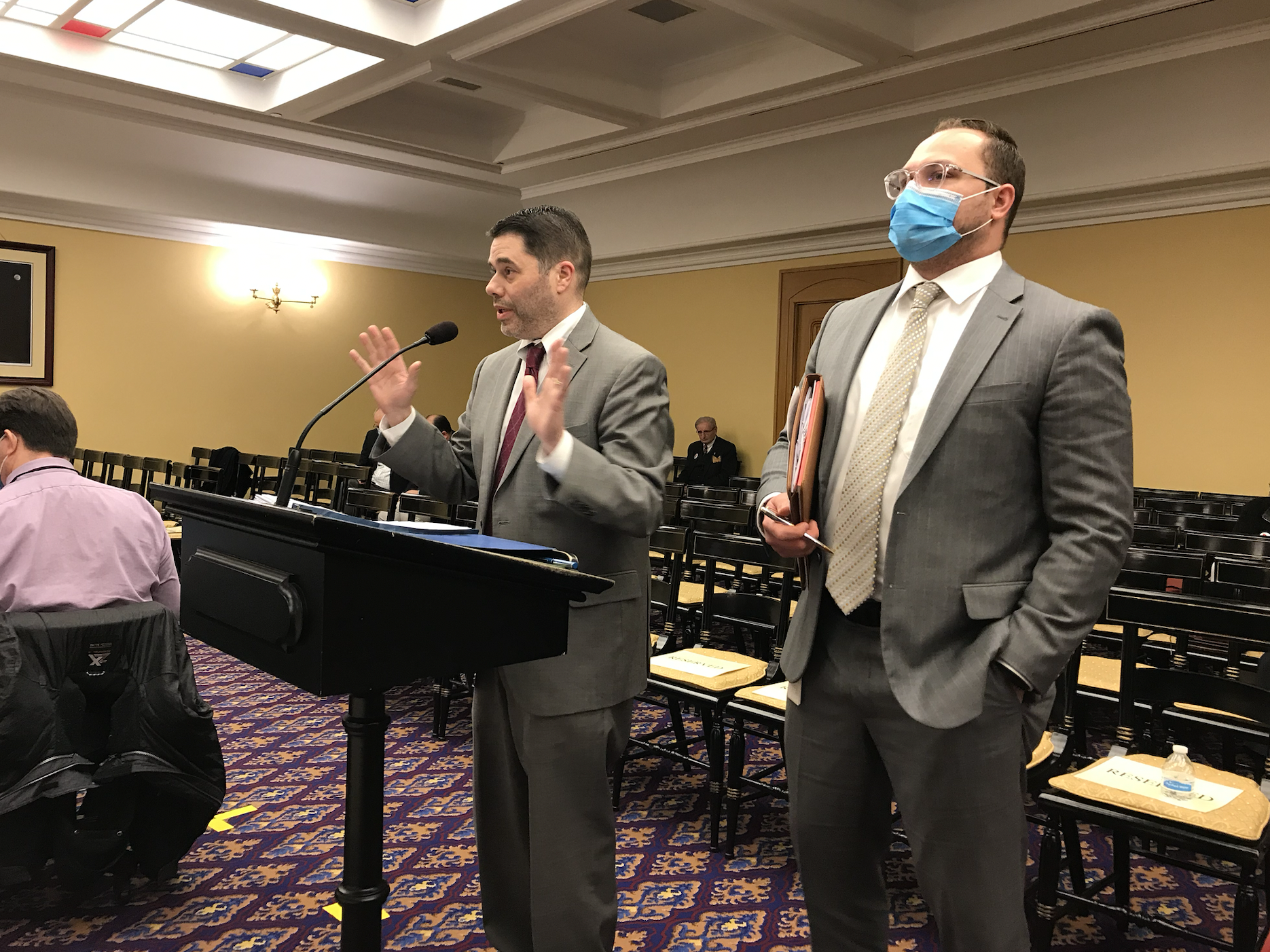
    Republican mapmakers Ray DiRossi, at podium, and Blake Springhetti present the GOP legislative map proposals to the Ohio Redistricting Commission on Saturday. The commission passed the GOP maps on a 5-2 simple majority. (Photo: Susan Tebben, OCJ)

    BY: SUSAN TEBBEN – Ohio Capital Journal

    After two more days of discussion and debate, the GOP majority on the Ohio Redistricting Commission adopted four-year legislative maps Saturday night with a 5-2 simple majority, setting up the time table for potential objections and court review.

    The Ohio Redistricting Commission meeting went into Saturday night after recessing Thursday and not meeting again until 2:30 p.m. Saturday afternoon.

     Ohio House districts, as proposed by the GOP majority and adopted by the Ohio Redistricting Commission on Saturday. (Right-Click to open in a new tab to view larger)

    During the Saturday afternoon session, Republicans and Democrats presented separate maps, though the Democratic co-chair of the commission, state Sen. Vernon Sykes, D-Akron, said the purpose of the Democratic caucus effort was not to present separate maps as much as it was an exercise to prove constitutionally proportional representation could be done.

    It became clear as the day went along that disagreement was still threatening the process. House Speaker Bob Cupp said even in the last hour of the commission’s time on Saturday, when they recessed to discuss each plan, the co-chairs were discussing whether or not it was worth it to continue negotiations or try to amend the maps.

    “A majority of the commission felt that that was just, while it may have been a good thing, was not possible to do,” Cupp said.

    Earlier in the day, the Democratic co-chair said members of his caucus were still operating under the idea that agreement and common compliance to the constitution was at the end of the redistricting tunnel.

    “Not until just a day or two ago was I told that there was a feeling that we could not meet the proportionality requirements,” Sykes said.

    The Ohio Supreme Court told the commission they needed to come back with a map that followed Section 6 of the constitution, the part of the redistricting process that prohibits overt partisanship. The court said the commission had to endeavor as much as possible to get to a 54% Republican to 46% Democratic split in statewide voter preferences.

    The Republican maps adopted had a 57 GOP to 42 Dem split in the Ohio House, and a 20 GOP to 13 Dem breakdown in the Senate. Four of the Democratic-leaning seats give the Dems a narrow 50-51% advantage, considered a tossup by many. All but one of the Senate seats in the plan were above 54%.

    In the House, 12 of the “Democratic leaning” seats in the GOP plan could also be considered tossups, with a Dem favor of only 50-51%. All of the GOP-leaning seats favor Republicans by more than 52%.

    The Democratic attempt had 45 Dem-leaning seats in the House and 54 GOP districts, with 18 GOP districts in the Senate and 15 Democratic districts.

    After the vote, Cupp argued that while 54-46 was a goal expressed by the supreme court, perfection was not. He denied that the constitution or the court order spoke to an “absolute ideal,” instead saying the court wanted a plan to “closely correspond.”

    “If the ideal is 55 House seats or 54 House seats, we have 57 leaning Republican,” Cupp said. “That is just three seats off and in a 99-member legislature, that is essentially 97% to the goal.”

    The minority side released an opposition statement, read at the end of the ORC meeting by House Minority Leader-Elect Allison Russo, D-Upper Arlington, which accused the Republican commissioners of “a lack of political courage and a blatant disregard for the court’s order and the will of the Ohio voters.”

    She also touched on the same concern that Democratic mapmaker Chris Glassburn brought up in the last few days of commission hearings, the “razor-thin margins,” those districts considered tossups, within the maps.

    He spoke on the topic again, saying the Democratic proposal has less tossup districts, which leads to less concern that the Ohio Supreme Court could consider the map “asymmetrical” in its partisanship.

    Glassburn also maintained his previous stance that the majority party wasn’t working to the same ends as the Democrats.

     Ohio Senate districts, adopted by a 5-2 simple majority of the Ohio Redistricting Commission on Saturday. (Right-Click to open in a new tab to view larger)

    Republican mapmakers Ray DiRossi and Blake Springhetti presented the map before the commission, saying they spent the week attempting to bring the maps into compliance with the constitution and the supreme court order.

    “The decisions were centered around complying with the court order, and closely corresponding with Section 6, and we did this,” Springhetti told the commission.

    The Republicans also released a statement to comply with a constitutional requirement explaining why a 4-year map was passed with a simple majority, rather than a 10-year, bipartisan map.

    “The commission believes that the number of Republican-leaning districts and Democratic-leaning districts closely corresponds to strict proportionality, particularly in light of the distribution of voters and geography of Ohio,” the statement reads.

    The adoption of the maps sends them back to the state’s high court for review, and sets the stage for a three-day window in which objections can be filed with the Ohio Supreme Court, who said in their decision rejecting the previous maps that they would oversee the process yet again.

    Anti-gerrymandering groups have already come out in force against the maps, criticizing not only the final product but the lack of public process along the 10-day stretch.

    “I knew it would be a challenge, but it certainly becomes a challenge when you don’t engage in a public process, when you don’t actually discuss regionally,” said Catherine Turcer, executive director of Common Cause Ohio.

  • Ohio Redistricting Commission begins again after court order

    Ohio Redistricting Commission begins again after court order

    House Speaker Bob Cupp, center right, and state Sen. Vernon Sykes, far right, co-chairs of the Ohio Redistricting Commission, speak to media after Tuesday’s meeting to restart the legislative redistricting process. (Photo: Susan Tebben, OCJ)

    BY: SUSAN TEBBEN – Ohio Capital Journal

    The Ohio Redistricting Commission began anew on Tuesday, though the details of their newest legislative mapping process are still up in the air.

    In its Tuesday meeting of the ORC, commission co-chairs House Speaker Bob Cupp and state Sen. Vernon Sykes said work to correct problems identified by the Ohio Supreme Court with legislative district maps has already begun between the Democratic and Republican caucuses.

    The commission is working on a deadline of Saturday, which is 10 days from the date the supreme court made their decision. Cupp said the commission is keeping in mind meeting the deadline so that the maps can be considered for any objections, which have to be submitted within three days of map approval.

    “This is a very time-sensitive matter, and we’re well aware of that,” Cupp said.

    Secretary of State (and ORC member) Frank LaRose said more than one deadline needs to be met in the process.

    “The General Assembly has ordered me to conduct an election on May 3, and I am committed to making sure that that happens,” LaRose told the commission. “But without finality on maps, that starts to become mechanically impossible very soon.”

    Some deadlines are already doomed because of how much time the redistricting process has taken, LaRose said. This weekend is the deadline for the state to submit the Federal Write-In Absentee Ballot forms for the next election.

    “That’s not going to be met because we’re not going to be ready to do that this weekend,” LaRose said.

    Because of the timeline, LaRose said he’s asked the legislature for temporary authority to adjust the administrative deadlines between the candidate filing deadline at the beginning of February and the May primary.

    The request is similar to the one approved under Senate Bill 258, the bill that approved the congressional district lines in November, that moved deadlines for the congressional elections.

    However, Cupp said he doesn’t sense “any appetite to change either the filing deadline or the primary election,” even if administrative deadlines change.

    The commission has about a week to come up with new maps that follow all constitutional regulations for redistricting, and aim for a 54% Republican/46% Democratic balance in the state aligned with statewide voter preferences. Sykes said the commission has agreed and shared data to be used in the mapmaking process, which will be the 2016 to 2020 statewide election data.

    Cupp said the commission is committed to working toward that 54-46 ratio.

    “(The supreme court has) determined that that needs to be closely followed,” Cupp said.

    Last week, in a 4-3 decision, the state’s highest court rejected maps approved by the commission in September 2021. Justices in the majority vote said the commission did not even attempt to meet constitutional standards to create a map that doesn’t favor or disfavor one political party over another, or use the proper data to calculate the statewide voter preferences.

    The court found that Cupp and Senate President Matt Huffman were the only two commission members “involved when the plan that was ultimately adopted was drawn,” and the principal mapmakers were not asked to comply with Section 6 of the constitution, which prohibits partisanship.

    At the Tuesday meeting, Gov. Mike DeWine – father of Supreme Court Justice Patrick DeWine and dissenter in the redistricting ruling – took time to read over the court’s decision on legislative redistricting and level-set the commission on the task at hand. He said the commission should “take affirmative steps” to comply with the constitutional standards, and make certain everyone from commission members to staffers know they need to comply.

    “So, anybody who is drawing a map, anybody who works with any members of this commission should be instructed by the individual commission members to do that,” DeWine said.

    The newest member of the commission, newly minted Democratic Ohio House leader state Rep. Allison Russo, D-Upper Arlington, was sworn in to fill the position left vacant by former House Minority Leader Emilia Sykes. She said the commission should take its second chance at the maps “to do what is right by Ohioans and deliver bipartisan 10-year maps.”

    “We should start with the assumption that it is absolutely possible, and move forward,” Russo said after the meeting.

    Russo told commission members during the meeting and the press afterward that she is pushing for public meetings to be scheduled quickly before the ORC loses the opportunity.

    The commission did not set up any future meetings or give any indication of how the map-making process is going during Tuesday’s meeting. Cupp said he and Sykes will be meeting to discuss a schedule for future meetings “as business would warrant us to.”

    “Obviously this is a little uncertain process, it’s new,” Cupp said. “We’re kind of feeling our way as we go.”

    Anti-gerrymandering advocates attended the meeting and said they were encouraged to hear the court’s expectations playing into the first meeting, but saw a lack of public input as the process started.

    “It would be better to have an understanding of what maps they’re starting with, when hearings will be, how the public can participate, and so it’s my hope that even within the next 24 hours we get a lot more information,” said Jen Miller, executive director of the League of Women Voters of Ohio.

  • Statehouse Republicans introduce congressional map heavily favoring GOP

    Statehouse Republicans introduce congressional map heavily favoring GOP

     Senate President Matt Huffman, R-Lima. Photo from the Ohio Channel.

    BY: DAVID DEWITT – Ohio Capital Journal

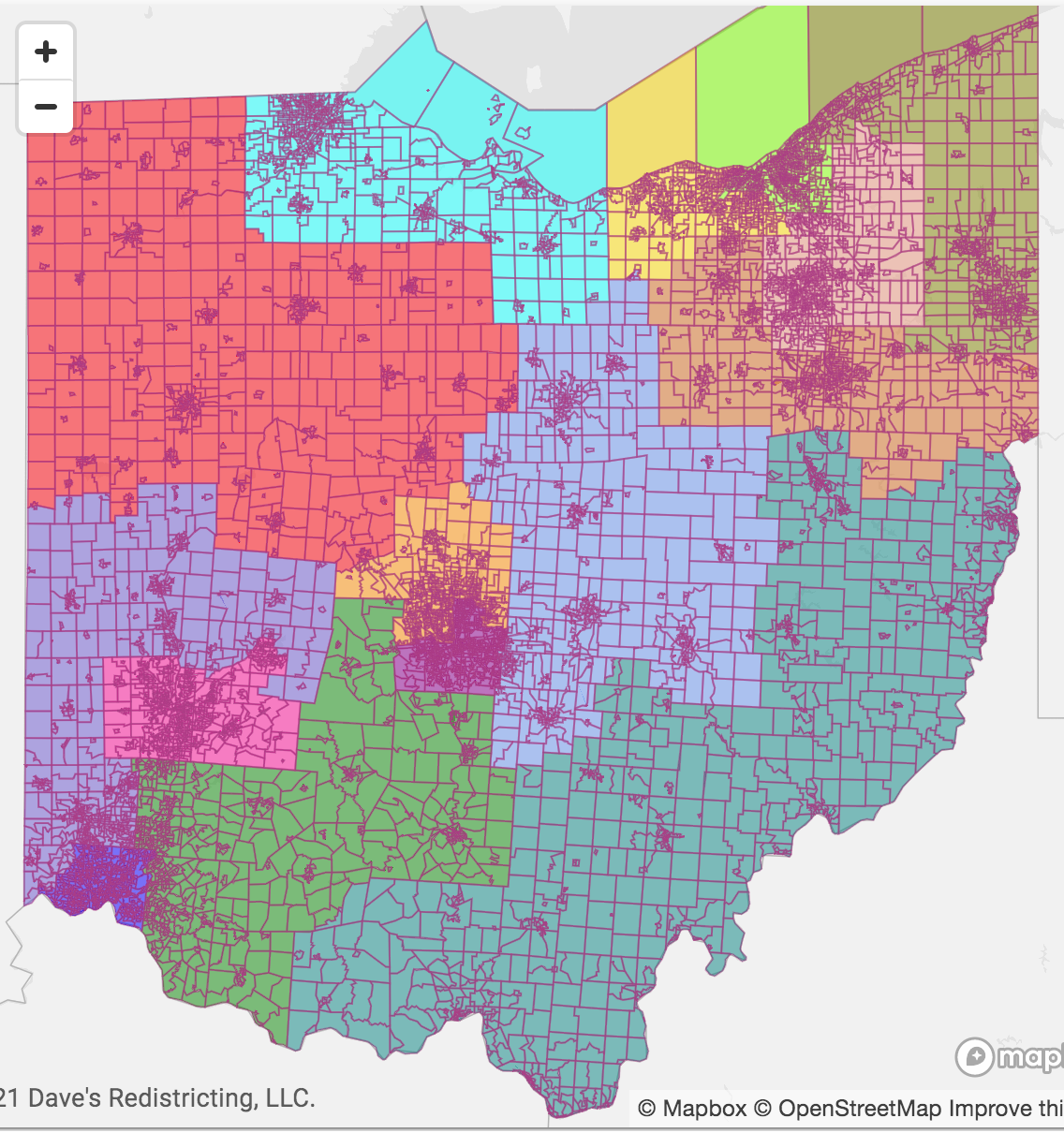
    Statehouse Republicans introduced a newly drawn map for Ohio’s districts in U.S. Congress Monday night that maintains a firm GOP majority.

    While amendments are possible, the map is poised to pass out of a Senate committee Tuesday with a full Senate session to follow, and House sessions planned for Wednesday and Thursday.

    Data behind the map were not made available Monday evening for full analysis, but it appears to show two safely Democratic seats based in Cleveland and Columbus and a majority of others being solidly Republican or leaning Republican and one district that could be a toss-up.

    That district is one of three splitting Cuyahoga County, including the southwestern portions of it in a district with all of Medina County and Akron in Summit County.

    Hamilton County is also split into three districts, with all of Republican Warren County connected to the city of Cincinnati and an eastern portion of the county included in a district that stretches east out to Meigs County. The map also takes a chunk out of central Hamilton County for a district that stretches along the western Ohio border from Butler up to Darke County.

    Click to open in a new tab and view larger

    While the center of Franklin County in the map would be a safely Democratic seat, outlying areas in a C-shape along the northern, western, and southern portion would be included in a Republican-leaning district that stretches westward to Clark County and southward to include Clinton, Fayette and parts of Ross County.

    The map combines Montgomery County with Greene County and the central part of Clark, creates a district that stretches from Trumbull and Mahoning counties down along the Ohio River on the eastern border to Washington County, and puts Toledo and Lucas County in with Defiance, Williams, Henry, Fulton, Ottawa, Sandusky and Erie counties.

    Statehouse Republicans claim the map presents seven competitive districts and noted that it keeps seven of eight of Ohio’s largest cities whole while dividing only 12 counties.

    On Twitter, a number of Statehouse Democrats panned the proposal.

    Without bipartisan support, Republican legislators could vote through four-year maps. Any maps will have to be approved by Gov. Mike DeWine. If four-year maps go through, court challenges are likely.

    State legislative maps passed in September by the Ohio Redistricting Commission are currently before the Ohio Supreme Court after three lawsuits were filed against them. The court has four Republicans and three Democrats. Republican Chief Justice Maureen O’Connor ruled against Ohio’s current maps in 2012, and is considered a possible swing vote.

  • Fair Districts Ohio Submits Contest Winning Maps to Redistricting Commission

    Fair Districts Ohio Submits Contest Winning Maps to Redistricting Commission

    The 1st Place  map created by John Hagner of Yellow Springs, Ohio 

    Today, Fair District Ohio announced that they have officially submitted winners from their Fair Districts Mapping Competition to the Ohio Redistricting Commission for consideration. Each of these maps were evaluated by the Princeton Gerrymandering Project and garnered Bs — the highest grade awarded to any Ohio map so far. The Princeton project grades maps using the following criteria: geography, as measured by compactness and county splits; competitiveness; partisan fairness; and minority composition. 

    Fair Districts Congressional Mapping Competition Winners:  

    The congressional maps approved by the state legislature in 2011 divided communities and split counties unnecessarily. In 2018, Ohio voters overwhelmingly passed congressional redistricting reform which focused on keeping counties whole as much as possible.  

    Congressional Map  Number of County Splits  
    1st place map by John Hagner 14 county splits a total of 14 times 
    2nd place map by Paul Nieves 12 county splits a total of 12 times 
    3rd place map by Riley Jones  14 county splits a total of 15 times 
    2012-2020 congressional maps  23 county splits a total of 32 times 

    “Each of the winning maps has much to like and all are far superior to the existing Ohio congressional map. The winning maps make thoughtful and deliberate choices in establishing districts that are highly proportional while minimizing county and community splits,” said Dr. Chris Cusack, technical manager of the Fair Districts Mapping Competition. “Indeed, they serve as exemplars for the Ohio Redistricting Commission to match or surpass.” 

    Districts identified as “competitive” fall within the 45-55% competitive range. Fair Districts Ohio identifies as “hypercompetitive” those where the difference between Republican and Democratic shares of the total vote is less than 3%. 

    Congressional Map  Districts that lean Republican  Districts that lean Democratic  District falls within the 45-55% competitive range 
    1st place map by John Hagner 
    2nd place map by Paul Nieves 
    3rd place map by Riley Jones  
    2012-2020 congressional maps  12 
    Congressional Map  Districts that lean Republican  Districts that lean Democratic  District falls within the hypercompetitive range 
    1st place map by John Hagner 
    2nd place map by Paul Nieves 
    3rd place map by Riley Jones  
    2012-2020 congressional maps  12 

    “Each of the winners provided clear overviews explaining the choices that they made in the creation of the congressional maps. The upcoming webinars are an opportunity to take a deeper dive and explore how these maps can be improved,” said Catherine Turcer, executive director of Common Cause Ohio. “The Ohio Redistricting Commission is now tasked with drawing congressional maps. We call for the Commission to review and discuss any proposed voting districts in detail in a similar fashion.”  

    Fair Districts Ohio has two webinars to dig deeper into the map-making process and give our competition winners a chance to explain their choices, receive feedback, and adapt their maps. Please join us for what we’re sure will be fascinating discussions, as follows: 

    • Fair Districts Congressional Map Winners: Our Maps & Choices, Weds, 10/13, Noon. Register HERE. Join competition winners as they discuss their congressional maps and talk us through the choices and tradeoffs they made when drawing lines. Come with your questions and comments about the winning maps. This webinar is only 60 minutes. 
    • Fair Districts Congressional Map Winners: Updates Based on Public Input, Weds, 10/20, Noon. Register HERE. Join competition winners as they show us updated congressional maps based on public comment and input from our 10/13 webinar. This webinar is only 60 minutes. 
    • Submit feedback about the maps HERE

    For more information about the competition, rules, and mapping criteria, click here.

  • Lawsuit accuses Ohio Redistricting Commission of violating constitution

    Lawsuit accuses Ohio Redistricting Commission of violating constitution

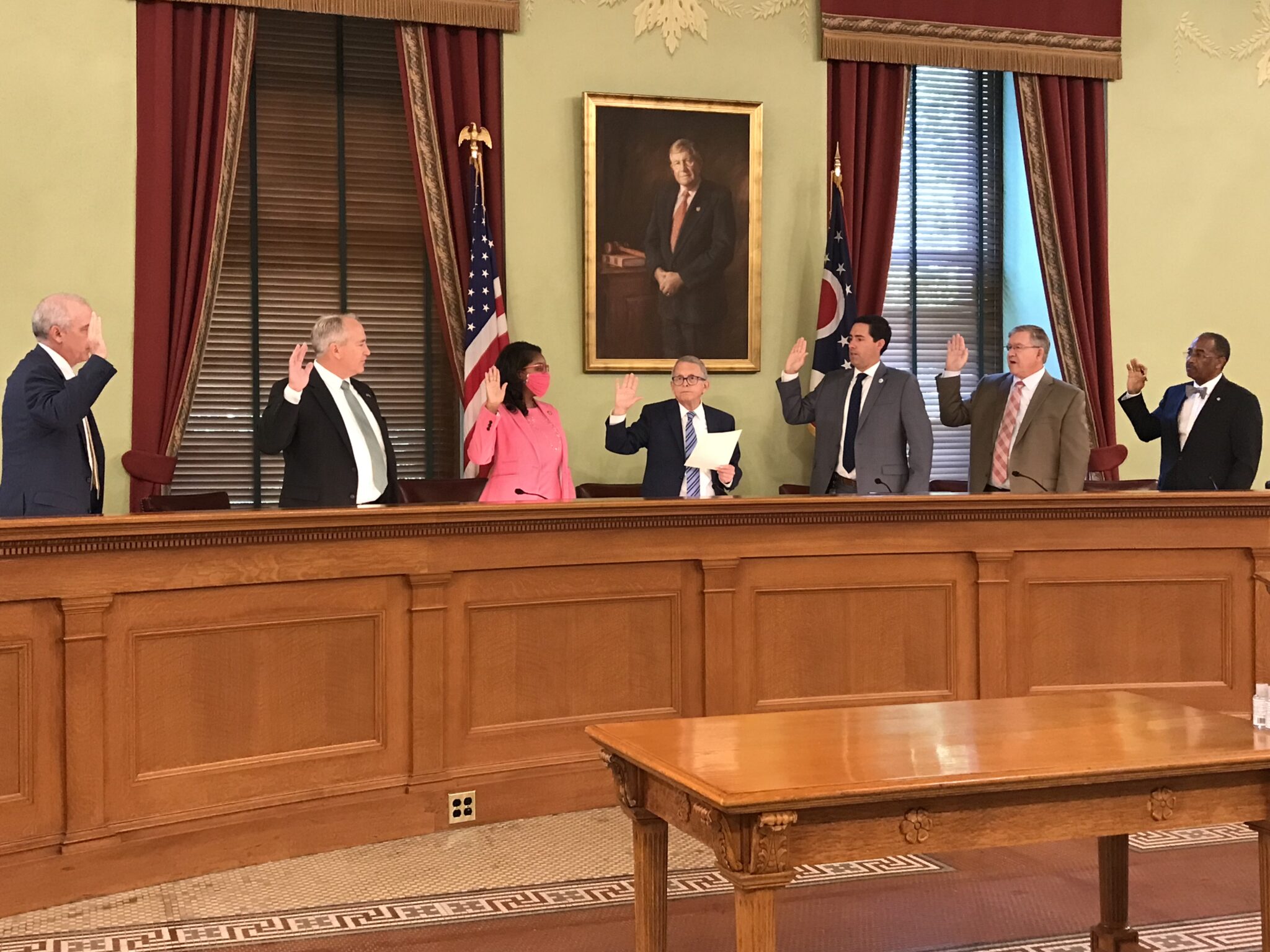
    Members of the Ohio Redistricting Commission are sworn in at the Ohio Statehouse. From left, Senate President Matt Huffman, state Auditor Keith Faber, House Minority Leader Emilia Sykes, Gov. Mike DeWine, Secretary of State Frank LaRose, House Speaker Bob Cupp and Sen. Vernon Sykes. Photo by Susan Tebben

    BY: and Ohio Capital Journal

    The ACLU has filed an expected lawsuit disputing the partisan legislative redistricting maps passed earlier this month by the Ohio Redistricting Commission.

    The Ohio and national chapters of the American Civil Liberties Union, along with law firm Covington & Burling, LLP, announced the lawsuit Thursday afternoon, accusing the Republican majority of “disrespecting the letter and spirit of the constitutional reforms passed overwhelmingly by Ohio voters in 2015.”

    The ACLU and Covington & Burling are presenting the lawsuit on behalf of the Ohio Chapter of the A. Philip Randolph Institute, unnamed individual plaintiffs and the League of Women Voters of Ohio.

    The parties in the court challenge contend that the maps violate the constitution by not accounting for the “partisan balance of House and Senate districts correspond closely to the statewide preferences of the voters of Ohio.”

    “This is an illegal map, plain and simple,” said Robert Fram, of Covington & Burling, in a statement.

    The lawsuit accuses the commission of a “brazen manipulation of district lines for extreme partisan advantage” that “doubly dishonors the honors of this state.”

    “After decades of working to end partisan gerrymandering in the Buckeye State, the League of Women Voters of Ohio asks the Ohio Supreme Court to defend the rights of everyday Ohioans to have legislative districts that serve and represent them rather (than) be rigged to favor the short-sighted and selfish interests of political parties and candidates,” said Jen Miller, president of the League of Women Voters said in a statement.

    A spokesperson for Senate President Matt Huffman, who presented the maps that were eventually approved by the redistricting commission on Sept. 16, said Senate Republicans “are confident the maps approved by the Redistricting Commission are constitutional and compliant.”

    Redistricting Commission co-chair state Sen. Vernon Sykes, one of the two Democrats to vote against the map said he, too, believes the maps are not constitutional.

    “Unfortunately, the maps adopted last week by the Republican members of the Redistricting Commission do not comply with those requirements,” he said in a statement. “They favor one political party and do not meet the litmus test of fairness and proportionality described by the Constitution.”

    A spokesperson for fellow co-chair and House Speaker Bob Cupp also defended the maps.

    “Lawsuits happen every time there is a new map,” said Aaron Mulvey deputy press secretary for the House GOP. “We knew this was coming, and the state will defend the constitutional maps approved by the Redistricting Commission.”

    If the Ohio Supreme Court finds the maps to be unconstitutional, they would return to the commission for a second time.

    The lawsuit comes as congressional redistricting is set to begin this month. If the state legislature can’t come to an agreement by Sept. 30, those maps will also go to the commission for consideration.

    Republican majority gerrymanders Ohio for another four years


    SUSAN TEBBEN is an award-winning journalist with a decade of experience covering Ohio news, including courts and crime, Appalachian social issues, government, education, diversity and culture. She has worked for The Newark Advocate, The Glasgow Daily Times, The Athens Messenger, and WOUB Public Media. She has also had work featured on National Public Radio.
  • Republican majority gerrymanders Ohio for another four years

    Republican majority gerrymanders Ohio for another four years

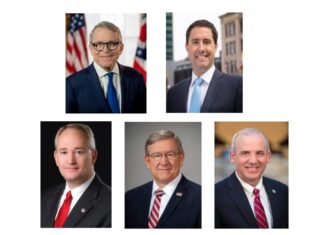
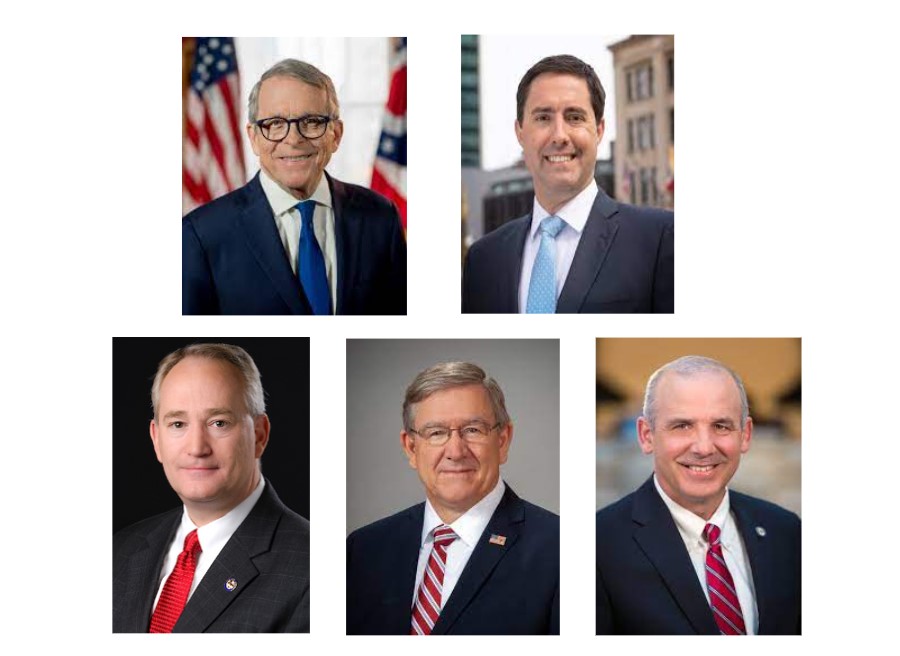
    The Republican majority members of the Ohio Redistricting Commission. Top row from left, Ohio Gov. Mike DeWine and Secretary of State Frank LaRose. Bottom row from left Ohio Auditor Keith Faber, House Speaker Bob Cupp, and Senate President Matt Huffman. Official photos.

    BY: SUSAN TEBBEN and Ohio Capital Journal

    With some using words like “disappointment” and “unease,” Republican majority members of the Ohio Redistricting Commission passed maps of General Assembly districts on Thursday heavily favoring GOP supermajorities that will last four years, if they make it through the courts.

    In a process that bypassed the midnight deadline by minutes, the commission split along party lines 5-2 and passed GOP-produced maps that they said were presented to the commission the night before.

    Currently, Republicans hold a 64-35 supermajority in the Ohio House, and a 25-8 supermajority in the Ohio Senate. The new maps continue the supermajorities, which require 60+ seats and 22+ seats respectively.

    Republicans said the maps for the House and Senate approved early Thursday morning reduced the GOP stronghold with a House breakdown of 62 seats to 37 Dems, and 23 to 10 in the Senate. Democrats and Dave’s Redistricting App project a 65-seat GOP supermajority in the House.

    Anti-gerrymandering advocates have repeatedly called for representation that actually reflects the make-up of voters. And Ohio voters amended the state constitution in 2015 to implement reform intended to produce bipartisan and fair districts, with 71.47% of voters supporting.

    In an average of the last 16 statewide elections not including non-partisan judicial races, Republicans have won a 54% to 46% advantage.

    As of 2020, 1.9 million Ohioans were registered Republican while 1.6 million were registered Democratic, for a ratio also of 54% to 46%. More than 4.5 million voters remain unaffiliated.

    Nevertheless, the Republican majority said in a statement that because they’ve won 13 of 16 statewide elections they could be entitled to up to 81% of representation of the people, despite them only winning the average of 54% of the votes in those elections.

    The GOP committee majority includes Ohio Gov. Mike DeWine, Secretary of State Frank LaRose, Auditor Keith Faber, Ohio House Speaker Bob Cupp and Ohio Senate President Matt Huffman. Voting against the maps were Democratic House Leader Emilia Sykes and Democratic state Sen. Vernon Sykes.

     The Republican majority’s four-year Ohio House map.
     The Republican majority’s four-year Ohio Senate map.

    The only bipartisan agreement was a condemnation of how the process had gone, and the fact that there seemed to be no way to reach a 10-year map.

    “Tonight, it has become clear to me that there will not be a compromise,” said DeWine. “It’s clear in talking to both sides that there’s not going to be an agreement, and that we could go tomorrow or the next day or the next day, and it simply was not going to occur.”

    The Democratic legislators on the commission both objected to the maps as presented, with commission co-chair Sen. Vernon Sykes saying the map proposal “falls far below what’s considered to be fair.”

    House Minority Leader Emilia Sykes said the maps were an affront to women who had to earn the right to vote, and minorities who are protected by the Voting Rights Act.

    “To have before today a map that summarily and arrogantly eliminates the ability for women like me…to engage in a process and have their votes heard is not only offensive, it is plain wrong,” Sykes said.

    The criticism of the process was broad, with Auditor Faber and Secretary of State LaRose both urging the commission to learn from its mistakes before congressional redistricting begins next month.

    “I’m casting my ‘yes’ vote with great unease,” LaRose said. “I fear we’ll be back in this room very soon.”

    The expectation of lawsuits was brought up quickly and early, with DeWine and others acknowledging that the courts would ultimately decide whether the maps fit the bill, or if the process was constitutional.

    “I’m not judging the bill one way or another, that’s up for a court to do,” DeWine said.

    The condemnation from redistricting advocacy groups was also swift, though analysis of the maps is still ongoing.

    “The Commission didn’t reconvene until forty-five minutes before the midnight deadline and then enacted a map along party lines that disregards the letter and spirit of the reforms passed in 2015,” wrote Common Cause Ohio executive director Catherine Turcer in a statement sent out by the Fair Districts Ohio coalition. “We are disappointed in both the process and the result.”

    Past court challenges, the discussion now turns to congressional districts representing the state, a process that should start in the next few weeks.