Loveland, Ohio – This week only 1/2 of the dynamic duo was able to get a recording in, and Chris of course used it to talk about the Cleveland Cavaliers, a topic that doesn’t get mentioned much here in Southwestern Ohio. And it’s really a shame, too, because the Cavaliers are the most recent non-college Ohio team to win a Championship, and they are real contenders to do so again.
Chris explains just what has changed this season to transform Cleveland from a middle of the pack Eastern Conference team into one that is already counted among one of the league’s best. It all starts with the hiring of Kenny Atkinson as head coach. His system and coaching style have this team maximizing its potential. And with General Manager Koby Altman making all the right moves in terms of trades and draft picks, the success isn’t just for the short term.
So have a listen, get your NBA and Cavaliers fix, and very soon Chris and Mark will get down to a deep dive into the upcoming Reds season, as well as what the future holds for the Bearcats on the basketball court. The Wolverines also looked prime to make a good run in the NCAA Tournament, so there will be plenty to discuss in the coming weeks!
Have a listen and don’t forget to leave your comments and feedback!
_______________________
Hey readers… have an opinion about sports? How about a topic you’d like to see written about in Loveland Magazine or a thought about one of our articles?
Just need to vent and get out your frustration about the Reds, Bengals, or any other sports issues?
Christopher Ball is a longtime Loveland resident and an attorney. He graduated from Loveland High School in 2003 and was a member of the football team before going on to become a coach’s assistant at DePauw University in Greencastle, Indiana. He has been following and rooting for the Reds and Bengals since the early 1990s and has been through the many ups and downs that fandom has wrought over the years.
Loveland, Ohio – Join Paxton’s Grill to celebrate an AMAZING 20 YEARS of raising critical funds for CancerFree KIDS!
The 20th Anniversary golf outing will again be a three-day event. As they done for the past several years, the annual weekend outing will be held Friday, June 6th and Saturday, June 7th, 2025 at Hickory Woods Golf Course.
The mission of CancerFree KIDS is to eradicate cancer as a life-threatening disease in children by funding promising research that might otherwise go unfunded. Your support of this amazing mission by playing in and/or sponsoring this year’s expanded event is greatly appreciated. Visit www.cancerfreekids.org for more information.
Since the inception of this event more than 19 years ago the golf outing has raised over $700,000 with the goal this year to exceed our 2024 total and raise over $100,000.
CancerFree KIDS aims to find more effective and gentler treatments for childhood cancer by funding innovative research projects in the early stages of development. New ideas need money to grow, yet potential breakthrough treatment methods often go unfunded because pediatric cancer research is drastically limited. CancerFree KIDS provides grants to high-risk/high-reward childhood cancer research projects in these crucial early stages, which allows researchers to prove their concept, secure additional funding, and eventually create new treatments for kids.
Loveland, Ohio – Team CoUREage 6.0 is a group of Loveland students dedicated to raising money for The Leukemia & Lymphoma Society. If you’d like to support them in their quest , here are some opportunities:
• Online Auction ends March 2nd, check out the great items
• Friday, 2/28, Cappy’s giveback night
• Saturday, 3/1 Fly Bungee Fitness class
• More info on all activities can be found on their website
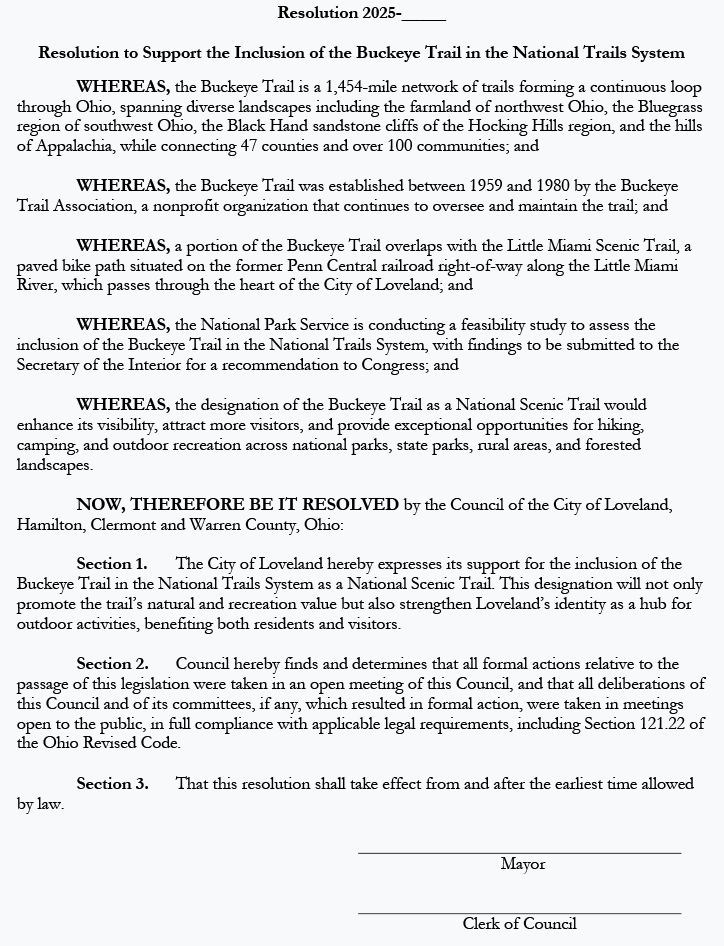
Loveland, Ohio – On January 28th the Loveland City Council voted to send a resolution to the National Park Service in support of the Buckeye Trail becoming a National Scenic Trail. The Loveland Bike Trail is part of the Buckeye Trail that runs through Historic Downtown Loveland. The Loveland trail runs adjacent to the State and National Scenic Little Miami River and is officially called the Little Miami Scenic Trail and is part of Little Miami State Park.
The National Park Service is conducting a feasibility study to determine if the Buckeye Trail should be designated as a National Scenic Trail. It spans 1,454 miles, connecting 47 counties and over 100 communities across Ohio, including Loveland.
In introducing the resolution, Clerk of Council Misty Clark said, “If designated, it would join an elite group of just 11 National Scenic Trails, and it would become the fifth largest in the nation. It would also be the only loop trail and the first to receive this designation since 2009. Clark added that the designation would bring “significant benefits, including increased federal support, enhanced visibility, and expanded opportunities for community and economic development throughout Ohio.”
The study was approved with bipartisan support Congress. In 2022 Congress directed the Secretary of the Interior to study the feasibility and suitability of designating the Buckeye Trail as a National Scenic Trail.
A roll call vote was taken at the Loveland council meeting and the resolution was adopted by a vote of 7-0.
The action by City Council came after Loveland Magazine Editor David Miller sent an email to City Manager Dave Kennedy alerting him of the opportunity.
About the Buckeye TrailSince its establishment in 1959, the Buckeye Trail has grown from a 500-mile route into the nation’s largest loop trail, closing the loop in Cuyahoga Valley National Park in 1980. Free and open to all, 1,454 miles of the Buckeye Trail pass through 21 designated Buckeye Trail Towns and landmarks such as Wayne National Forest, Serpent Mound, and Fort Ancient, a UNESCO World Heritage Site. The Buckeye Trail is within 90 minutes of every Ohioan, providing an accessible connection to Ohio’s Great Outdoors and showcasing the state’s scenic and historical diversity. buckeyetrail.org
About the Buckeye Trail Association
Established in 1959, the Buckeye Trail Association builds, maintains, preserves, and promotes Ohio’s Buckeye Trail as a sustainable resource connecting people to the state’s scenic and historical diversity. The BTA inspires conservation and outdoor recreation across the state. buckeyetrail.org
Wallace Keck, Public domain, via Wikimedia Commons
by Julie Watson
If you’ve been noticing a foul odor in the air recently, you’re not alone. Unpleasant as it may be there is a natural cause for your nose to be offended. In Ohio, February is breeding season for skunks.
During this time of year, male skunks will visit several females, and each female may mate with multiple males. A litter of 2-10 kits are typically born furless and blind between April and June. At around six weeks old the young ones are weaned and will accompany their mother on hunts. The young will go their own away at about a year of age when they are mature and ready to breed on their own.
Although there are several species of skunk throughout the world, only one, the striped skunk (Mephitis mephitis) is native to Ohio. Striped skunks are about the size of a house cat and are easily recognized by their black bodies marked with a white ‘cap’ and two white stripes running down the length of their back. However, there are color variations that exist including, all black, cream, cinnamon, and albino.
Skunks have five slightly webbed toes on each foot and their front toes are equipped with long, curved claws that allow them to dig. When the ground is soft, they dig for grubs, roots and insects. They also dig dens.
Claws aren’t the only tool that skunks are equipped with. They have sharp teeth, although skunk bites are rare. They also have thick fur that protects them from stings. But the most infamous tool at a skunk’s disposal is its musk. Although there are other mammals that have musk glands, skunks are the only ones that can project their musk into a spray. Skunks have good aim and can hit their target from about 15 feet away. The musk is oily which makes it persistent and very pungent. Besides the strong odor, a direct hit to the eyes can cause temporary blindness.
Because a skunk’s anal glands carry only a small amount of musk, spraying is used as a last resort. At the first sign of danger, a skunk will hold up it’s tail as a warning flag. Even if its aggressor is color blind, the black and white contrast is an effective attention getter. Skunks will flee when possible. If either of these tactics don’t work, a threatened skunk will stomp its front feet as another warning. When all else fails, a skunk’s last and most effective line of defense is to spray.
Great Horned Owl (Wikipedia Creative Commons)
Most animals learn to leave them alone after an encounter. However, skunks do have natural predators. The most common skunk predator here in Ohio is the great horned owl. Fishers, which are making a comeback in the Buckeye State are also effective skunk predators.
Skunks are omnivorous meaning they eat both plants and animals. They often eat pests that are harmful to gardens and crops. They will dig up and consume underground yellow jacket nests as well.
Here are some fun, skunk facts:
Because of its staying power, skunk musk was once used in making perfume
Striped skunks are found in all 88 Ohio counties
Skunks are not true hibernators but may stay in their winter dens for long periods
Skunk tracks resemble bear tracks only much smaller
Skunks can spray when they are only 1 month old
Skunks are very adaptable and can live in several different habitats from farms to urban neighborhoods
Skunks make a variety of sounds including chirps, growls, grunts, and squeals
Skunks are excellent swimmers
Striped skunks are not great climbers, unlike their cousins, spotted skunks who climb trees to raid nests
In Ohio it is illegal to release a captured skunk onto another property
It is legal in Ohio to own a domesticated skunk as a pet. However, additional permits may be required, and they demand a lot of attention and time.
Loveland, Ohio – Don’t look now, but the Bearcats have some life! They’ve won 3 straight games, and scored 84 or more points in each of them. Jizzle James is dominating on offense, and the Cats are getting back to their dominance on the glass. Their offense is playing to its strengths once again, and what seemed like a program on the brink just a short few weeks ago has a pulse, and a realistic chance to make the NCAA Tournament. Mark and Chris talk you through exactly what the numbers look like, and just how Cincinnati has pulled itself back into the hunt. They are still behind the eight ball with very tough tests upcoming against Iowa State, Baylor, and Houston, but there is still hope in the Queen City.
The guys next talk about the Michigan Wolverine’s big home win against the top 10 Purdue Boilermakers, avenging a huge blowout lost a few weeks ago in West Lafayette. Dusty May has transformed a program that won just 8 games last year into one that now sits atop the Big 10. Although the Wolverines turn the ball over far too much, Mark and Chris explain why some of these turnovers are the result of the offense the Wolverines run, and just how efficient they can be if they are cleaned up. Ahead of a big matchup with Ohio State this weekend, Michigan looks to keep the momentum rolling as they climb in the polls.
Finally, the guys bring you a recap of the Super Bowl and a tough loss for the Kansas City Chiefs. Jaylen Hurts answered the call and led the Eagles to victory as Saquon Barkley was relatively quiet. Though Patrick Mahomes had an uncharacteristically poor performance, he surely had no help from his line, running backs, or receivers. In the wake of this loss, Kansas City has plenty of holes to fill, and we will see if they can return to the title game in 2026.
Have a listen and don’t forget to leave your comments and feedback!
Hey readers… have an opinion about sports? How about a topic you’d like to see written about in Loveland Magazine or a thought about one of our articles?
Just need to vent and get out your frustration about the Reds, Bengals, or any other sports issues?
Christopher Ball is a longtime Loveland resident and an attorney. He graduated from Loveland High School in 2003 and was a member of the football team before going on to become a coach’s assistant at DePauw University in Greencastle, Indiana. He has been following and rooting for the Reds and Bengals since the early 1990s and has been through the many ups and downs that fandom has wrought over the years.
This story was updated at 7:37 PM (2/12/25) after receiving more appropriate guidance for those who work with poultry.
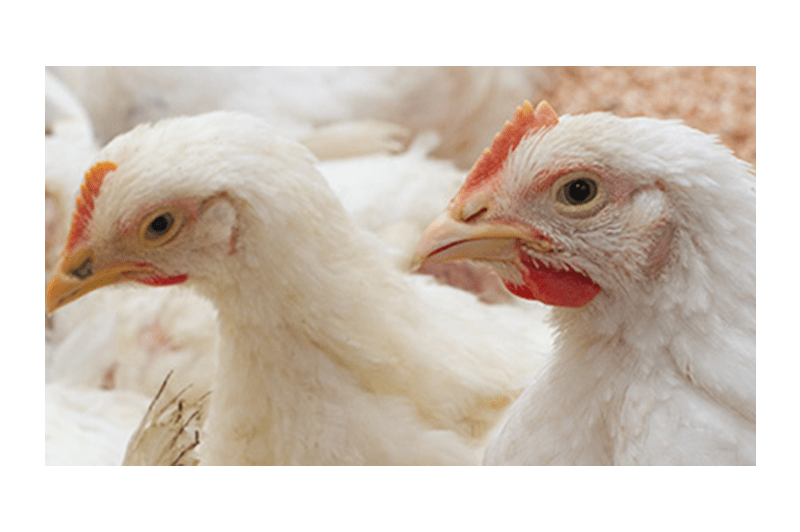
Loveland, Ohio – The Ohio Department of Health (ODH) is reporting the state’s first probable human case of influenza A(H5), also known as Highly Pathogenic Avian Influenza (HPAI), or bird flu. An adult male Mercer County farm worker who was in contact with deceased commercial poultry was infected with the virus.
The Centers for Disease Control and Prevention (CDC) considers the current risk of bird flu for the general public to be low. However, people with close and prolonged, unprotected contact with infected birds are at greater risk.
ODH Guidance for the General Public
ODH reports that the risk of acquiring bird flu to the general U.S. population is low. “The best way to prevent bird flu is to avoid exposure whenever possible. As a general precaution, whenever possible, people should avoid direct contact with wild birds or sick or dead poultry or other animals.”
They recommend that you contact your local health department or local veterinarian for further guidance before you approach sick or dead poultry or wild birds.
ODH Guidance for Those Who Work With Birds
Commercial poultry owners should practice good biosecurity and prevent contact between their poultry and wild birds, specifically migratory waterfowl.
Avoid handling sick birds or other animals and immediately report unusual signs of disease or unexpected deaths to Ohio Poultry Association at (614) 882-6111 or the Ohio Department of Agriculture at (614) 728-6220 or after hours at (888) 456-3405.
According to the Ohio Department of Agriculture, best biosecurity practices for commercial poultry owners include:
• Keep visitors to a minimum. Only allow those who care for your poultry to have contact with them and make sure they follow biosecurity principles.
• Wash your hands before and after contact with live poultry. Use soap and water. If using a hand sanitizer, first remove manure, feathers, and other materials from your hands.
• Provide disposable boot covers (preferred) and/or disinfectant footbaths for anyone having contact with your flock. If using a footbath, remove all droppings, mud or debris from boots and shoes using a long-handled brush BEFORE stepping in. Always keep it clean.
• Establish a rodent and pest control program. Deliver, store, and maintain feed, ingredients, bedding and litter to limit exposure to and contamination from wild animals.
• Use drinking water sourced from a contained supply (well or municipal system). Do not use surface water for drinking or cleaning.
• Clean and disinfect tools and equipment before moving them to a new poultry facility. Trucks, tractors, tools and equipment should be cleaned and disinfected prior to exiting the property. Do not move or reuse anything that cannot be cleaned.
• Look for signs of illness. Monitor egg production and death loss, discoloration and/or swelling of legs, wattles and combs, labored breathing, reduced feed/water consumption.
ODH Provided Background on Bird Flu Cases in Humans
Nationally, there have been 68 confirmed human cases of HPAI in 11 states since the beginning of 2024, which included one death in Louisiana. All but three of these cases involved exposures related to commercial agriculture and related operations or wild birds. In Ohio, one dairy herd and numerous poultry flocks have been infected since the outbreak began in 2022.
There are no known cases of human-to-human transmission.
“While the risk to Ohioans is low, the best way to prevent bird flu is to avoid unprotected exposures to sick or dead birds or to their environment,” said ODH Director Bruce Vanderhoff, MD, MBA. “People should avoid direct contact with poultry or wild birds and take proper precautions, including reaching out for guidance regarding personal protection and safe handling, if you must be around sick or dead birds.”
“Ohio is experiencing the largest outbreak of positive detections in commercial poultry to date, which requires critical action from our department and our federal partners, to contain and prevent the spread of disease,” said ODA Director Brian Baldridge. “As we continue to respond to these incidents, our staff on site continues to educate farmers and their workers on best biosecurity practices. We strongly encourage all Ohio farmers to use good biosecurity to help keep disease away from the farm.”
Additional ODH Information
It is safe to eat properly cooked poultry and pasteurized dairy products. Generally, people should follow food safety practices – poultry, eggs, and beef should be cooked to a safe internal temperature to kill bacteria and viruses. The CDC’s safer foods table contains a complete list of safe internal temperatures.
If people have been exposed to a sick or dead bird, they should monitor themselves for any new respiratory symptoms and contact their healthcare provider or local health department should they develop symptoms. Ohioans can report sick or dead wild birds to the Ohio Department of Natural Resources (ODNR) at 1-800-WILDLIFE and sick or dead poultry to the ODA at 614-728-6220.
Source: CDCSource: CDC
More information on HPAI can be found on both the ODH and ODA websites.
Loveland, Ohio – A short message from Stephanie and the Do-It for Jack – Jack Quehl Foundation. Click below to watch.
Stephanie says, “Our St. Patty’s Day t-shirts are in-stock and ready to gift. Send this super soft shirt to your college student, young adult or even get one for yourself. You won’t regret it. We will ship to your family and friends with a message from us. Wear this shirt and let it be a reminder of Jack and to make good choices on this festive day.”
Order now so we can get the merchandise back to you ASAP.
March 15th is the Leprechaun Chase 5K in Loveland (volunteers needed) Sign up here. Learn more here.
The Jack Quehl Foundation Is on a Mission to Educate Our Community About The Dangers of Fentanyl Poisoning
Decision Based on Community Feedback and Mental Health Research
Loveland, Ohio – Loveland High School will implement a 30-minute later start time for the upcoming school year. This change follows recommendations from community engagement sessions conducted by the District’s Community Advisory team.
Superintendent Mike Broadwater emphasized the importance of adequate sleep for adolescents, citing research on mental health. “The goal is that our students come to school ready to go,” Broadwater stated.
Loveland, Ohio – The Charter of the City of Loveland mandates that an annual report be prepared and made available to the public. It provides an overview of city finances, personnel, police, fire, public works, and economic development. In addition, the 2024 report highlights capital projects.


 Christopher Ball is a longtime Loveland resident and an attorney. He graduated from Loveland High School in 2003 and was a member of the football team before going on to become a coach’s assistant at DePauw University in Greencastle, Indiana. He has been following and rooting for the Reds and Bengals since the early 1990s and has been through the many ups and downs that fandom has wrought over the years.





 In introducing the resolution, Clerk of Council Misty Clark said, “If designated, it would join an elite group of just 11 National Scenic Trails, and it would become the fifth largest in the nation. It would also be the only loop trail and the first to receive this designation since 2009. Clark added that the designation would bring “significant benefits, including increased federal support, enhanced visibility, and expanded opportunities for community and economic development throughout Ohio.”













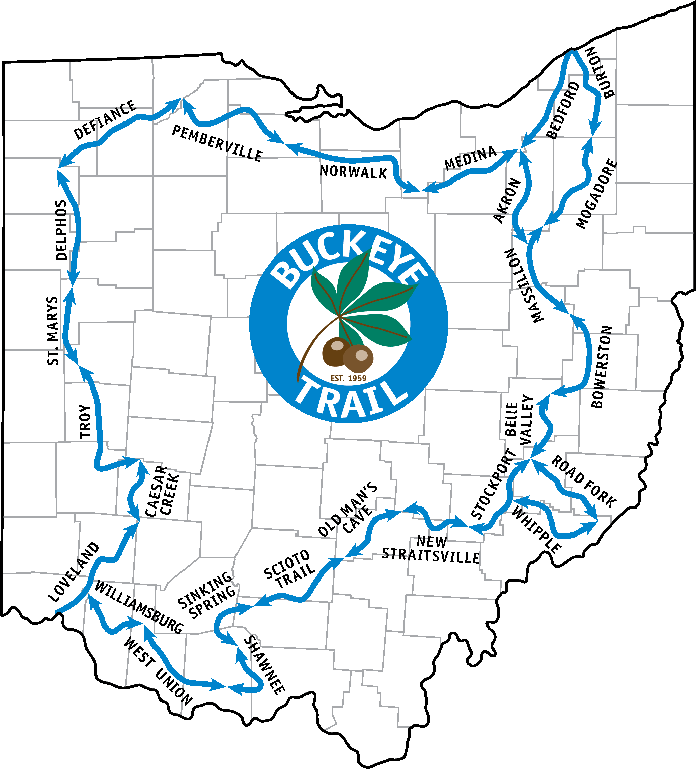 Since its establishment in 1959, the Buckeye Trail has grown from a 500-mile route into the nation’s largest loop trail, closing the loop in Cuyahoga Valley National Park in 1980. Free and open to all, 1,454 miles of the Buckeye Trail pass through 21 designated Buckeye Trail Towns and landmarks such as Wayne National Forest, Serpent Mound, and Fort Ancient, a UNESCO World Heritage Site. The Buckeye Trail is within 90 minutes of every Ohioan, providing an accessible connection to Ohio’s Great Outdoors and showcasing the state’s scenic and historical diversity.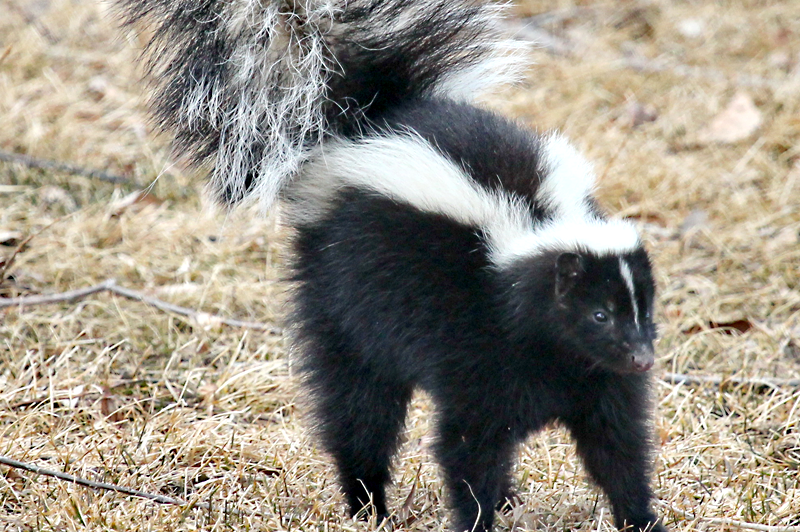
 by Julie Watson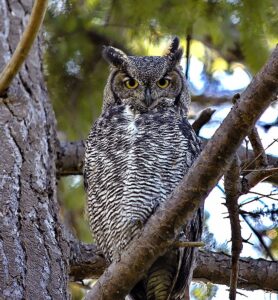




 The
The