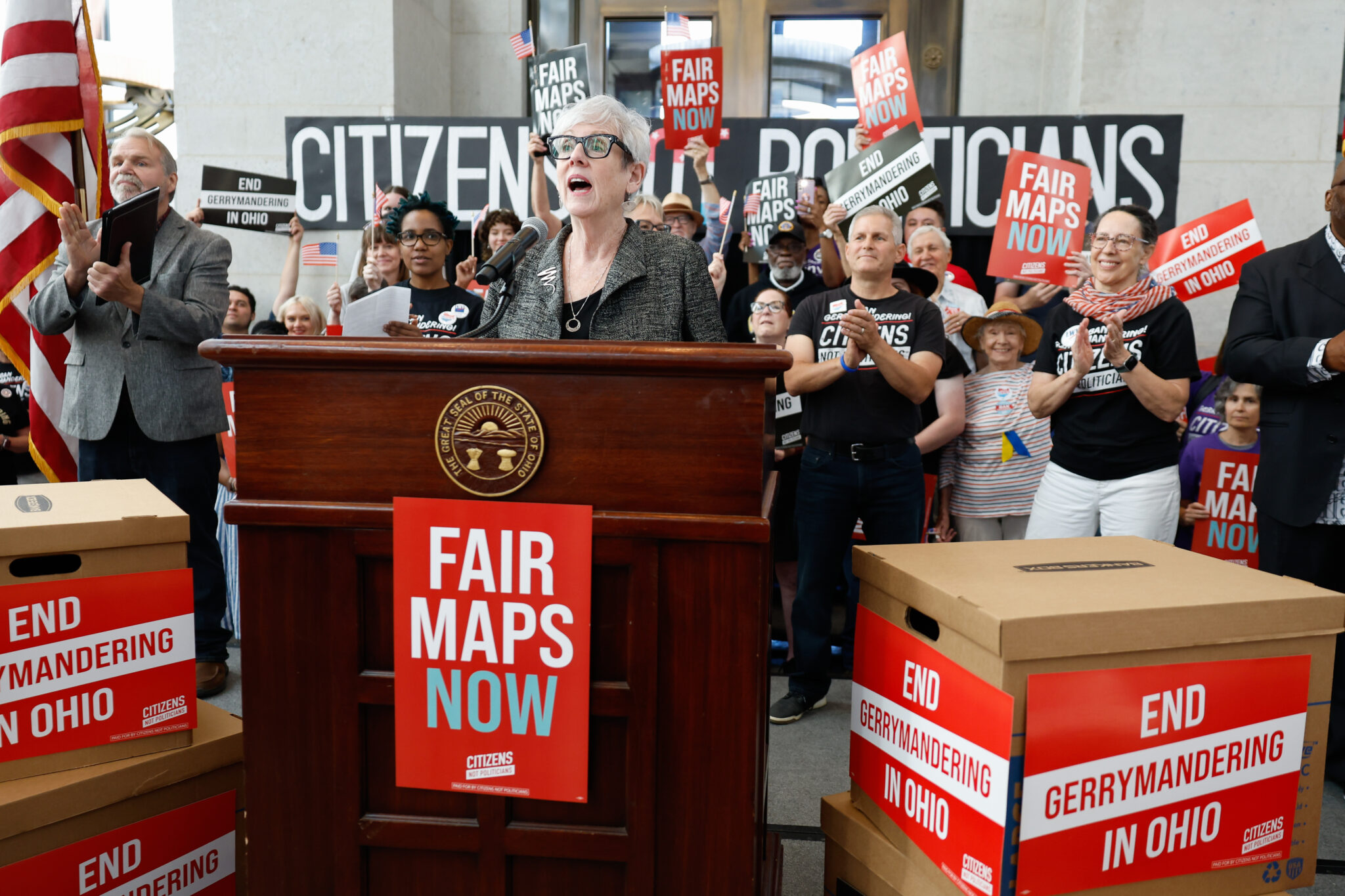
There may be some drawbacks, but increasing Ohio’s minimum wage to $15 an hour would save 4,000 lives and create a $25 billion benefit to the state economy by 2036, according to a study released last month by Scioto Analysis.
A group proposing to increase the minimum wage from the current $10.45 an hour to $12.45 and then to $15 did not submit petitions last week for the November ballot, and is now looking to bring the proposal to voters in 2025. The cost-benefit analysis by Scioto found that such an increase would reduce suicides, homicides, infant mortality and low-birthweight babies — phenomena that are associated with economic stress.
The analysis identified two downsides to the proposed increase in Ohio.
It would cost an estimated 73,000 jobs from employers who are likely to calculate that they can’t afford to pay the extra money. It also found that 89,000 fewer Ohioans would get associates and bachelors degrees, if national estimates are correct that increases in the minimum wage correlate to a 4% decrease in college enrollment.
However, the analysis said those costs are far outweighed by the benefits of increasing the minimum wage.
“We find increasing Ohio’s minimum wage to $15 per hour will result in a net benefit to society between $5 and $45 billion over the next ten years, with an average expected net benefit of $25 billion” it said. “The benefit will be driven by saved lives, with the minimum wage leading to an estimated total of 4,000 suicides, firearm homicides, and infant deaths avoided from 2027 to 2036.”
The reasoning behind some the analysis’ estimated benefits:
• Suicides — They relied on a 2020 study that said every $1 increase in the minimum wage corresponded to a 3.4% to 5.9% decrease in the suicide rate among adults with a high school education or less. Coupling that with the $9 million in value to the economy that the Federal Emergency Management Agency assigns to a single life, they found that suicides prevented would be worth $14 billion over 10 years in Ohio.
• Gun violence — Economic insecurity is associated with homicide, and a Johns Hopkins University study this year found that every 1% increase in the state minimum wage relative to the state median income corresponded to a 1.3% decrease in firearm homicide rates. Given that roughly 820 Ohioans are killed by homicide each year, the state’s proposed minimum wage increase can be expected to save roughly 1,500 lives over the coming decade, creating a $13 billion benefit over 10 years under Ohio’s proposed increase.
• Infant mortality — A study published last year in the Journal of the American Medical Association found that every $1 increase in the minimum wage is associated with a 4% decrease in infant mortality. With nearly 600 Ohio children between 28 and 364 days old dying in 2021, just over 1,000 infant lives would be saved over the next decade, creating a $9.1 billion benefit, the analysis said.
MARTY SCHLADEN
Marty Schladen has been a reporter for decades, working in Indiana, Texas and other places before returning to his native Ohio to work at The Columbus Dispatch in 2017. He’s won state and national journalism awards for investigations into utility regulation, public corruption, the environment, prescription drug spending and other matters.
Ohio Capital Journal is part of States Newsroom, the nation’s largest state-focused nonprofit news organization.
Many societal structures and systems can be drivers of violent crimes, according to a new report by the Health Policy Institute of Ohio.
More than 30,000 violent crimes — including homicide, rape, robbery and aggravated assault — were reported in Ohio in 2023.
“Even with laws and penalties such as arrest and incarceration in place, violent crime persists and causes significant harm to victims and communities,” the report states. “Community conditions and societal structures can support or prevent violent crime. Since the research evidence is clear that arrests and incarceration are detrimental to the health of individuals, families and communities, it is important to take an upstream approach for violence prevention.”
“We can then also be preventative and treat it as a public health issue by addressing those underlying root causes of violence,” she said.
Violent crimes in Ohio
Ohio ranks 34th in the nation in homicides and 80% were gun-related in 2022, according to the report.
Homicides peaked in Ohio during the COVID-19 pandemic, but have not returned to pre-pandemic rates, according to the report. Two of Columbus’ deadliest years on records were 2021 with 204 homicides and 2020 with 175 homicides. Cleveland had 192 homicides in 2020 and 165 in 2021.
There were 18,742 incoming domestic violence cases in Ohio in 2014 — a number that has increased almost every year since with the exception of 2020 — and there were 24,534 cases in 2023.
Societal Structures and Systems
Racism, income inequality, zoning and neighborhood planning, gender-related social norms, education, employment, healthcare, housing and criminal justice are all structures and systems that can contribute to violent crime, according to the report.
“All of these structures and systems are also interconnected and interrelated, whether we have typical and current ongoing racist policies that have shaped the way communities are structured and the resources that people have access to,” Oberly said. “All of that aligns with income inequality, with how neighborhoods are shaped, and funding that goes into them, and that, of course, ties into the systems that drives violent crime as well.”
Redlining and the building the Interstate Highway System through communities of color in the 1950s are two examples of historical policies and practices.
“These … resulted in poor community stability, lower home valuations, increased foreclosures and limited economic mobility in majority-Black, Hispanic and Asian neighborhoods,” the report said. “As a result, many of these communities experienced concentrated disadvantage, which includes limited educational and employment opportunities and higher rates of poverty, unemployment and food insecurity that continue today.”
Ohio ranks 30th when it comes to income inequality, which puts people at risk for a shortened life span, poor health and increased neighborhood and interpersonal violence.
The report illustrates that increases in income supports — such as increased minimum wage, Earned Income Tax Credits and the Supplemental Nutrition Assistance Program — have been shown to lower violence and result in less firearm homicides.
Zoning and neighborhood planning can also play a role in the amount of violence in a particular area.
The report explained the relationship between alcohol outlet density and violent crime in a neighborhood. Off-premise outlets such as liquor and convenience stores are associated with higher rates of violent crime compared to on-premise outlets such as bars and restaurants.
“Alcohol outlet density is a prime example of how zoning impacts violence,” according to the report. “Due to inequitable zoning codes and weakened political power, communities of color and low-income neighborhoods are more likely to have a high density of alcohol outlets.”
Ohio’s liquor sales have increased 98% in the past two decades while the state’s adult population has gone up 8%. Ohio ranks 34th in the nation for excessive drinking.
Legislative actions
There have been legislative attempts to curb violent crimes.
The DeWine administration gave $20 million in grants to support more than three dozen community-based intervention programs to reduce violence and help victims of crime as part of the Community Violence Prevention Grant Program, according to the report.
DeWine recently signed a bill into law that will go into effect in September that aims to help formerly incarcerated people find stable housing.
House Bill 420 would create the Office of Firearm Violence Prevention within the Ohio Department of Children and Youth which would administer grant programs to reduce firearm violence. Reps. Darnell T. Brewer, D-Cleveland, and Munira Abdullahi, D-Columbus introduced the bill earlier this year, which is in the House Finance Committee.
The report recommends implementing evidence-based firearm safety policies that includes child access prevention laws and firearm licensing laws.
Ohio is not one of the 30 states with child-access prevention laws nor is Ohio one of the 14 states that require checks at the point of transfer for all firearms.
The report also recommends increasing housing affordability, alcohol policies, including density zoning and pricing; and education, employment and criminal justice reform.
Megan Henry is a reporter for the Ohio Capital Journal and has spent the past five years reporting in Ohio on various topics including education, healthcare, business and crime. She previously worked at The Columbus Dispatch, part of the USA Today Network.
Ohio Capital Journal is part of States Newsroom, the nation’s largest state-focused nonprofit news organization.
Loveland, Ohio – Cassie remains beyond excited that she was back for another year to be “live” on FaceBook to narrate the annual Loveland 4th of July Parade. For those of you that couldn’t make it to the celebration this year Cassie hopes that she can make you feel as though you had front-row seats at the parade and feel you were a part of all the patriotic action!
It was the largest 4th of July Parade to date! If you missed it, watch now!
The July 4 weekend means Ohio’s roads will be packed with holiday travelers. AAA projects almost 61 million will hit the road and another 10 million have other travel plans. A recent report digging through a decade of traffic fatality data offers a reminder to be patient behind the wheel.
The Roadway Information Program, or TRIP, study has some good news and some bad. The transportation research nonprofit found that in the 10 years between 2013 and 2023, traffic fatalities have jumped substantially nationwide. But zeroing in on the past three, deaths have begun to decline from their peak during the COVID-19 pandemic.
In a press release, TRIP executive director Dave Kearby argued, “While it is good news that the number of traffic fatalities is trending downward in recent years, the sharp increase in traffic fatalities over the past decade must be addressed.”
In Ohio specifically, the number of fatalities has increased by 26% over the past decade, rising from 989 in 2013 to 1,242 in 2023. Those 2023 figures are 8% lower than the state’s peak in 2021. Applying the raw numbers to travel patterns, Ohio’s fatality rate per 100 million vehicle miles of travel amounts to an increase of 23% over the past ten years and a decline of 10% over the past three years.
Causes
TRIP’s report is based on data from the National Highway Traffic Safety Administration, and researchers highlighted a handful of behaviors driving traffic deaths.
Over the past five years, speeding related crashes rose by 21% around the U.S. and accounted for more than a quarter of traffic deaths in 2023. Between 2018 and 2022, alcohol-involved crashes rose by 29%, and fatalities from distracted driving increased by 16%. The study’s authors are quick to note while cellphone use is often cited as an example of distracted driving, it’s not the only culprit — eating, talking, and adjusting controls can all take attention away from the road.
The study’s authors note in 2023, pedestrian and bicyclist fatalities in the U.S. made up about a fifth of the total. Motorcyclists, which account for less than 1% of annual travel in the country, represent 16% of its traffic fatalities. Motorcycle deaths have also seen a marked increase recently as the share of those riding without helmets has climbed.
All of those data points relate to national trends, but one area where researchers provided state level data is work zone fatalities. Ohio ranks tenth among states, with 106 fatalities over the past five years.
Jake Nelson, who heads up AAA’s traffic safety advocacy, argued, “Despite a drop in U.S. crash fatalities, we know that drivers continue to engage in dangerous behaviors like speeding or driving under the influence.”
“The funds to improve our nation’s transportation system are available, which means there is no excuse not to improve the safety of our roadways,” Nelson continued. “We must also push for real change in communities where deaths are the highest and ensure that funds are directed to those areas where they are most needed.”
Dollars and cents
The study also applies NHTSA’s traffic cost methodology to determine how much major crashes and fatalities cost us. NHTSA splits costs into two buckets. Tangible economic costs cover expenses like medical care, property damage and emergency services. Quality of life costs have to do with longer term impacts like ongoing physical impairments, chronic pain and loss of lifespan.
At the national level, TRIP estimates 2023 crashes tallied $460 billion in tangible economic costs, and almost 1.4 trillion more in quality-of-life costs. In Ohio, researchers put the figures at $15.5 billion and $47.1 billion respectively.
Meanwhile, TRIP applauds U.S. Department of Transportation investments in safety through legislation like the 2021 Infrastructure Investment and Jobs Act. That measure put $454 billion toward highway and transit improvements over a five-year period.
TRIP executive director Kearby argued, “making a commitment to eliminating fatal and serious injuries on the nation’s roadways will require robust investment and coordinated activities by transportation and safety-related agencies in providing the needed layers of protection for the nation’s motorists, pedestrians and bicyclists, including safe road users, safe roads, safe vehicles, safe speeds and high-quality post-crash care.”
Tuesday, Gov. Mike DeWine announced several projects receiving funding through the Ohio Department of Transportation’s Safe Routes to School program. In all, those infrastructure improvements will cost about $8 million. Two of the projects also qualified for funding through a program included in the federal infrastructure bill.
“Creating the opportunity for children to walk and bike to school is so important, and this funding will help communities ensure that these routes are as safe as possible,” DeWine said in a press release. “Motorists should also do their part by paying attention, especially in and around schools.”
Improvements to sidewalks, crosswalk and signage in Fostoria and Akron will receive $425,000 from the federal legislation.
NICK EVANS
Nick Evans has spent the past seven years reporting for NPR member stations in Florida and Ohio. He got his start in Tallahassee, covering issues like redistricting, same sex marriage and medical marijuana. Since arriving in Columbus in 2018, he has covered everything from city council to football. His work on Ohio politics and local policing have been featured numerous times on NPR.
Ohio Capital Journal is part of States Newsroom, the nation’s largest state-focused nonprofit news organization.
Loveland Magazine file photo of the now closes CVS
Cincinnati Children’s secured a long-term lease for the building in the Symmes Gate Station shopping center, which previously housed a CVS pharmacy.
Loveland, Ohio – Cincinnati Children’s Loveland Primary Care will open in spring 2025. Pediatric services will be available to families who now drive longer distances to other locations operated by the nation’s No. 1 health system for children.
Work is to begin soon on interior renovations to an existing building at 10554 Loveland-Madeira Road. The location, near the intersection with East Kemper Road, is easily accessible from Interstate 275’s Exit 52 by Lake Isabella.
Cincinnati Children’s secured a long-term lease for the building in the Symmes Gate Station shopping center, which previously housed a CVS pharmacy.
“Many families who live in Loveland or surrounding areas such as Symmes Township depend on pediatric primary care from Cincinnati Children’s, and they soon will have a much closer option for this service,” said Evaline Alessandrini, MD, chief operating officer. “We are making this investment to ensure families have convenient access to world-class healthcare.”
Cincinnati Children’s Loveland Primary Care will eventually accommodate up to 25,000 patient visits annually, said Jeff Anderson, MD, senior vice president and chief Population Health officer. That will include children from newborn through adolescence.
“Our goal is to ensure that the region’s children are the healthiest in the nation, and part of that goal is to provide families with close-to-home options – including excellent primary care for kids,” Anderson said. “Our primary care providers work closely with pediatric specialists at Cincinnati Children’s for more advanced care options if needed.”
Initially, over a dozen Cincinnati Children’s employees will work at the Loveland location, including a physician, nurse practitioners, registered nurses, a behavioral health counselor, medical assistants and patient access representatives. The workforce will expand with the patient base, Anderson said.
Cincinnati Children’s Loveland Primary Care encompasses 10,125 square feet, which affords space to accommodate growth. Cincinnati Children’s estimates design and renovation of the building will cost about $6 million. Design partners are GBBN Architects, KFI Engineers, RCF Group and Kolar Design. The project will be built out by Triversity Construction.
Cincinnati Children’s already offers pediatric primary care in Anderson Township, Avondale, Batesville, Cold Spring, Fairfield, Florence, Greensburg, Kenwood, Liberty Township, Mason, North Fairmount, Southgate and Springdale as well as at three school-based health centers in Cincinnati.
In addition, Cincinnati Children’s has begun construction on a medical building that will include pediatric primary care in the Boone County city of Union, Ky.
Kris Hansen had never before spoken publicly about what happened in 3M’s environmental lab — until now.
How 3M Executives Convinced a Scientist the Forever Chemicals She Found in Human Blood Were Safe
Decades ago, Kris Hansen showed 3M that its PFAS chemicals were in people’s bodies. Her bosses halted her work. As the EPA now forces the removal of the chemicals from drinking water, she wrestles with the secrets that 3M kept from her and the world.
Re-published here in Loveland Magazine with the permission of ProPublicia and the New Yorker magazine. Video files added by Loveland Magazine.
_________________
Kris Hansen had never before spoken publicly about what happened in 3M’s environmental lab — until now.
Kris Hansen had worked as a chemist at the 3M Corporation for about a year when her boss, an affable senior scientist named Jim Johnson, gave her a strange assignment. 3M had invented Scotch Tape and Post-it notes; it sold everything from sandpaper to kitchen sponges. But on this day, in 1997, Johnson wanted Hansen to test human blood for chemical contamination.
Several of 3M’s most successful products contained man-made compounds called fluorochemicals. In a spray called Scotchgard, fluorochemicals protected leather and fabric from stains. In a coating known as Scotchban, they prevented food packaging from getting soggy. In a soapy foam used by firefighters, they helped extinguish jet-fuel fires. Johnson explained to Hansen that one of the company’s fluorochemicals, PFOS — short for perfluorooctanesulfonic acid — often found its way into the bodies of 3M factory workers. Although he said that they were unharmed, he had recently hired an outside lab to measure the levels in their blood. The lab had just reported something odd, however. For the sake of comparison, it had tested blood samples from the American Red Cross, which came from the general population and should have been free of fluorochemicals. Instead, it kept finding a contaminant in the blood.
Johnson asked Hansen to figure out whether the lab had made a mistake. Detecting trace levels of chemicals was her specialty: She had recently written a doctoral dissertation about tiny particles in the atmosphere. Hansen’s team of lab technicians and junior scientists fetched a blood sample from a lab-supply company and prepped it for analysis. Then Hansen switched on an oven-size box known as a mass spectrometer, which weighs molecules so that scientists can identify them.
As the lab equipment hummed around her, Hansen loaded a sample into the machine. A graph appeared on the mass spectrometer’s display; it suggested that there was a compound in the blood that could be PFOS. That’s weird, Hansen thought. Why would a chemical produced by 3M show up in people who had never worked for the company?
Hansen didn’t want to share her results until she was certain that they were correct, so she and her team spent several weeks analyzing more blood, often in time-consuming overnight tests. All the samples appeared to be contaminated. When Hansen used a more precise method, liquid chromatography, the results left little doubt that the chemical in the Red Cross blood was PFOS.
Hansen now felt obligated to update her boss. Johnson was a towering, bearded man, and she liked him: He seemed to trust her expertise, and he found something to laugh about in most conversations. But, when she shared her findings, his response was cryptic. “This changes everything,” he said. Before she could ask him what he meant, he went into his office and closed the door.
This was not the first time that Hansen had found a chemical where it didn’t belong. A wiry woman who grew up skiing competitively, Hansen had always liked to spend time outdoors; for her chemistry thesis at Williams College, she had kayaked around the former site of an electric company on the Hoosic River, collecting crayfish and testing them for industrial pollutants called polychlorinated biphenyls, or PCBs. Her research, which showed that a drainage ditch at the site was leaking the chemicals, prompted a news story and contributed to a cleanup effort overseen by the Massachusetts Department of Environmental Protection. At 3M, Hansen assumed that her bosses would respond to her findings with the same kind of diligence and care.
Hansen stayed near Johnson’s office for the rest of the day, anxiously waiting for him to react to her research. He never did. In the days that followed, Hansen sensed that Johnson had notified some of his superiors. She remembers his boss, Dale Bacon, a paunchy fellow with gray hair, stopping by her desk and suggesting that she had made a mistake. “I don’t think so,” she told him. In subsequent weeks, Hansen and her team ordered fresh blood samples from every supplier that 3M worked with. Each of the samples tested positive for PFOS.
3M Global Headquarters in Maplewood, Minnesota
In the middle of this testing, Johnson suddenly announced that he would be taking early retirement. After he packed up his office and left, Hansen felt adrift. She was so new to corporate life that her office clothes — pleated pants and dress shirts — still felt like a costume. Johnson had always guided her research, and he hadn’t told Hansen what she should do next. She reminded herself of what he had said — that the chemical wasn’t harmful in factory workers. But she couldn’t be sure that it was harmless. She knew that PCBs, for example, were mass-produced for years before studies showed that they accumulate in the food chain and cause a range of health issues, including damage to the brain. The most reliable way to gauge the safety of chemicals is to study them over time, in animals and, if possible, in humans.
What Hansen didn’t know was that 3M had already conducted animal studies — two decades earlier. They had shown PFOS to be toxic, yet the results remained secret, even to many at the company. In one early experiment, conducted in the late ’70s, a group of 3M scientists fed PFOS to rats on a daily basis. Starting at the second-lowest dose that the scientists tested, about 10 milligrams for every kilogram of body weight, the rats showed signs of possible harm to their livers, and half of them died. At higher doses, every rat died. Soon afterward, 3M scientists found that a relatively low daily dose, 4.5 milligrams for every kilogram of body weight, could kill a monkey within weeks. (Based on this result, the chemical would currently fall into the highest of five toxicity levels recognized by the United Nations.) This daily dose of PFOS was orders of magnitude greater than the amount that the average person would ingest, but it was still relatively low — roughly comparable to the dose of aspirin in a standard tablet.
In 1979, an internal company report deemed PFOS “certainly more toxic than anticipated” and recommended longer-term studies. That year, 3M executives flew to San Francisco to consult Harold Hodge, a respected toxicologist. They told Hodge only part of what they knew: that PFOS had sickened and even killed laboratory animals and had caused liver abnormalities in factory workers. According to a 3M document that was marked “CONFIDENTIAL,” Hodge urged the executives to study whether the company’s fluorochemicals caused reproductive issues or cancer. After reviewing more data, he told one of them to find out whether the chemicals were present “in man,” and he added, “If the levels are high and widespread and the half-life is long, we could have a serious problem.” Yet Hodge’s warning was omitted from official meeting notes, and the company’s fluorochemical production increased over time.
Hansen’s bosses never told her that PFOS was toxic. In the weeks after Johnson left 3M, however, she felt that she was under a new level of scrutiny. One of her superiors suggested that her equipment might be contaminated, so she cleaned the mass spectrometer and then the entire lab. Her results didn’t change. Another encouraged her to repeatedly analyze her syringes, bags and test tubes, in case they had tainted the blood. (They had not.) Her managers were less concerned about PFOS, it seemed to Hansen, than about the chance that she was wrong.
Sometimes Hansen doubted herself. She was 28 and had only recently earned her Ph.D. But she continued her experiments, if only to respond to the questions of her managers. 3M bought three additional mass spectrometers, which each cost more than a car, and Hansen used them to test more blood samples. In late 1997, her new boss, Bacon, even had her fly out to the company that manufactured the machines, so that she could repeat her tests there. She studied the blood of hundreds of people from more than a dozen blood banks in various states. Each sample contained PFOS. The chemical seemed to be everywhere.
When 3M was founded, in 1902, it was known as the Minnesota Mining and Manufacturing Company. After its mining operations flopped, the company pivoted to sandpaper and then to a series of clever inventions aimed at improving everyday life. An early employee noticed that autoworkers were struggling to paint two-tone cars, which were popular at the time; he eventually invented masking tape, using crêpe paper and cabinetmaker’s glue. Another 3M employee created Post-it notes to help him bookmark passages in his church hymnal. An official history of 3M, published for the company’s 100th anniversary, celebrated its “tolerance for tinkerers.”
Fluorochemicals had their origins in the American effort to build the atomic bomb. During the Second World War, scientists for the Manhattan Project developed one of the first safe processes for bonding carbon to fluorine, a dangerously reactive element that experts had nicknamed “the wildest hellcat” of chemistry. After the war, 3M hired some Manhattan Project chemists and began mass-producing chains of carbon atoms bonded to fluorine atoms. The resulting chemicals proved to be astonishingly versatile, in part because they resist oil, water and heat. They are also incredibly long-lasting, earning them the moniker “forever chemicals.”
In the early ’50s, 3M began selling one of its fluorochemicals, PFOA, to the chemical company DuPont for use in Teflon. Then, a couple of years later, a dollop of fluorochemical goo landed on a 3M employee’s tennis shoe, where it proved impervious to stains and impossible to wipe off. 3M now had the idea for Scotchgard and Scotchban. By the time Hansen was in elementary school, in the ’70s, both products were ubiquitous. Restaurants served French fries in Scotchban-treated packaging. Hansen’s mother sprayed Scotchgard on the living-room couch.
Hansen grew up in Lake Elmo, Minnesota, not far from 3M’s headquarters. Her father was one of the company’s star engineers and was even inducted into its hall of fame in 1979; he had helped to create Scotch-Brite scouring pads and Coban wrap, a soft alternative to sticky bandages. Once, he molded some fibers into cups, thinking that they might make a good bra. They turned out to be miserably uncomfortable, so he and his colleagues placed them over their mouths, giving the company the inspiration for its signature N95 mask.
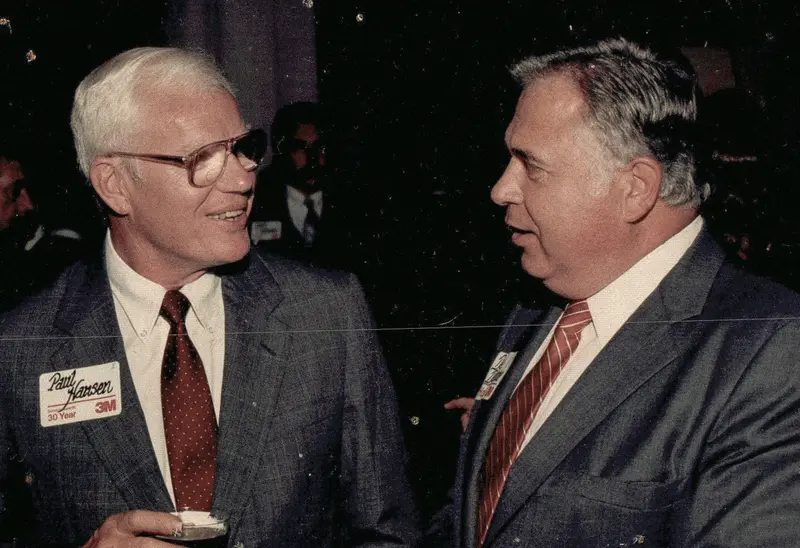
First image: Lake Elmo, Minnesota, the town not far from 3M headquarters where Kris Hansen grew up. Second image: Family photos of Paul Hansen, Kris’ father, at 3M functions over the years.
Hansen never intended to follow her father to the company. She spent her childhood summers catching turtles and leopard frogs at the lake and hoped to have a career in environmental conservation. Her first job after earning her chemistry Ph.D. was on a boat, which took her to remote parts of the Pacific Ocean. But the voyage left her so seasick that she lost 20 pounds, and she soon retreated to Minnesota. In 1996, at her father’s suggestion, Hansen applied for a position in 3M’s environmental lab.
After Hansen started her PFOS research, her relationships with some colleagues seemed to deteriorate. One afternoon in 1998, a trim 3M epidemiologist named Geary Olsen arrived with several vials of blood and asked her to test them. The next morning, she read the results to him and several colleagues — positive for PFOS. As Hansen remembers it, Olsen looked triumphant. “Those samples came from my horse,” he said — and his horse certainly wasn’t eating at McDonald’s or trotting on Scotchgarded carpets. Hansen felt that he was trying to humiliate her. (Olsen did not respond to requests for comment.) What Hansen wanted to know was how PFOS was making its way into animals.
She found an answer in data from lab rats, which also appeared to have fluorochemicals in their blood. Rats that had more fish meal in their diets, she discovered, tended to have higher levels of PFOS, suggesting that the chemical had spread through the food chain and perhaps through water. In male lab rats, PFOS levels rose with age, indicating that the chemical accumulated in the body. But, curiously, in female rats the levels sometimes fell. Hansen was unsettled when toxicology reports indicated why: Mother rats seemed to be offloading the chemical to their pups. Exposure to PFOS could begin before birth.
Another study confirmed that Scotchban and Scotchgard were sources of the chemical. PFOS wasn’t an official ingredient in either product, but both contained other fluorochemicals that, the study showed, broke down into PFOS in the bodies of lab rats. Hansen and her team ultimately found PFOS in eagles, chickens, rabbits, cows, pigs and other animals. They also found 14 additional fluorochemicals in human blood, including several produced by 3M. Some were present in wastewater from a 3M factory.
At one point, Hansen told her father, Paul, that she was frustrated by the way senior colleagues kept questioning her work. Paul had recently retired, but he had confidence in 3M’s top executives, and he suggested that she take her findings directly to them. But as a relatively new employee — and one of the few women scientists at a company of about 75,000 people — Hansen found the idea preposterous. When Paul offered to talk to some of 3M’s executives himself, she was mortified at the idea of her father interceding.
Hansen knew that if she could find a blood sample that didn’t contain PFOS then she might be able to convince her colleagues that the other samples did. She and her team began to study historical blood from the early decades of PFOS production. They soon found the chemical in blood from a 1969-71 Michigan breast cancer study. Then they ran an overnight test on blood that had been collected in rural China during the ’80s and ’90s. If any place were PFOS-free, she figured, it would be somewhere remote, where 3M products weren’t in widespread use.
The next morning, anxious to see the results, Hansen arrived at the lab before anyone else. For the first time since she had begun testing blood, some of the samples showed no trace of PFOS. She was so struck that she called her husband. There was nothing wrong with her equipment or methodology; PFOS, a man-made chemical produced by her employer, really was in human blood, practically everywhere. Hansen’s team found it in Swedish blood samples from 1957 and 1971. After that, her lab analyzed blood that had been collected before 3M created PFOS. It tested negative. Apparently, fluorochemicals had entered human blood after the company started selling products that contained them. They had leached out of 3M’s sprays, coatings and factories — and into all of us.
That summer, an in-house librarian at 3M delivered a surprising article to Hansen’s office mailbox. It had been written in 1981 by 3M scientists, and it described a method for measuring fluorine in blood, indicating that even back then the company was testing for fluorochemicals. One scientist mentioned in the article, Richard Newmark, still worked for 3M, in a low-lying structure nicknamed the “nerdy building.” Hansen arranged to meet with him there.
Newmark, a collegial man with a compact build, told Hansen that, more than 20 years before, two academic scientists, Donald Taves and Warren Guy, had discovered a fluorochemical in human blood. They had wondered whether Scotchgard might be its source, so they approached 3M. Newmark told her that his subsequent experiments had confirmed their suspicions — the chemical was PFOS — but 3M lawyers had urged his lab not to admit it.
As Hansen wrote all this down in a notebook, she felt anger rising inside her. Why had so many colleagues doubted the soundness of her results if earlier 3M experiments had already proved the same thing? After the meeting, she hurried back to the lab to find Bacon. “He knew!” she told him.
Bacon’s face remained expressionless. He told Hansen to type up her notes for him. She remembers him telling her not to email them. (In response to questions about Hansen’s account, Bacon said that he didn’t remember specifics. When I called Newmark, he told me that he could not remember her or anything about PFOS. “It’s been a very long time, and I’m in my mid-80s, and just do not remember stuff that well,” he said.)
A few months later, in early 1999, Bacon invited Hansen to an extraordinary meeting: She would have the chance to present her findings to 3M’s CEO, Livio D. DeSimone. Hansen spent several days rehearsing while driving and making dinner. On the day of the meeting, she took an elevator up to the executive suite; her stomach turned as a secretary pointed her to a conference room. Men in suits sat around a long table. Her boss, Bacon, was there. DeSimone, a portly man with white hair, sat at the head of the table.
A photo that Kris Hansen saved shows her father, Paul, with 3M CEO Livio D. DeSimone.
Almost as soon as Hansen placed her first transparency on the projector, the attendees began interrogating her: Why did she do this research? Who directed her to do it? Whom did she inform of the results? The executives seemed to view her diligence as a betrayal: Her data could be damaging to the company. She remembers defending herself, mentioning Newmark’s similar work in the ’70s and trying, unsuccessfully, to direct the conversation back to her research. While the executives talked over her, Hansen noticed that DeSimone’s eyes had closed and that his chin was resting on his dress shirt. The CEO appeared to have fallen asleep. (DeSimone died in 2017. A company spokesperson did not answer my questions about the meeting.)
After that meeting, Hansen remembers learning from Bacon that her job would be changing. She would only be allowed to do experiments that a supervisor had specifically requested, and she was to share her data with only that person. She would spend most of her time analyzing samples for studies that other employees were conducting, and she should not ask questions about what the results meant. Several members of her team were also being reassigned. Bacon explained that a different scientist at 3M would lead research into PFOS going forward. Hansen felt that she was being punished and struggled not to cry.
Even as Hansen was being sidelined, the results of her research were quietly making their way into the files of the Environmental Protection Agency. Since the ’70s, federal law has required that companies tell the EPA about any evidence indicating that a company’s products present “a substantial risk of injury to health or the environment.” In May 1998, 3M officials notified the agency, without informing Hansen, that the company had measured PFOS in blood samples from around the U.S. — a clear reference to Hansen’s work. It did not mention its animal research from the ’70s, and it said that the chemical caused “no adverse effects” at the levels the company had measured in its workers. A year later, 3M sent the EPA another letter, again without telling Hansen. This time, it informed the agency about the 14 other fluorochemicals, several of them made by 3M, that Hansen’s team had detected in human blood. The company reiterated that it did not believe that its products presented a substantial risk to human health.
Hansen recalls that in the summer of 1999, at an annual picnic that her parents hosted for 3M scientists, she was grilling corn when one of the creators of Scotchgard, a gray-haired man in glasses, confronted her. He accused her of trying to tear down the work of her colleagues. Did it make her feel powerful ruining other people’s careers? he asked. Hansen didn’t know how to respond, and he walked away.
Several of Hansen’s superiors had stopped greeting her in the hallways. When she presented a poster of her research at a 3M event, nobody asked her about it. She lost her appetite, and her pleated pants grew baggy. She started to worry that an angry co-worker might confront or even harm her in the company’s dark parking lot. She got into the habit of calling her husband before walking to her car.
A year after Hansen’s meeting with the CEO, 3M, under pressure from the EPA, made a very costly decision: It was going to discontinue its entire portfolio of PFOS-related chemicals. In May 2000, for the first time, 3M officials revealed to the press that it had detected the chemical in blood banks. One executive claimed that the discovery was a “complete surprise.” The company’s medical director told The New York Times, “This isn’t a health issue now, and it won’t be a health issue.” But the newspaper also quoted a professor of toxicology. “The real issue is this stuff accumulates,” the professor said. “No chemical is totally innocuous, and it seems inconceivable that anything that accumulates would not eventually become toxic.”
Hansen was now pregnant with twins. Although she was heartened by 3M’s announcement — she saw it as evidence that her work had forced the company to act — she was also ready to leave the environmental lab, where she felt marginalized. After giving birth, she joined 3M’s medical devices team. But first, she decided to have one last blood sample tested for PFOS: her own. The results showed one of the lowest readings she’d seen in human blood. Immediately, she thought of the rats that had passed the chemical on to their pups.
Hansen told me that, for the next 19 years, she avoided the subject of fluorochemicals with the same intensity with which she had once pursued it. She focused on raising her kids and coaching a cross-country ski team; she worked a variety of jobs at 3M, none related to fluorochemicals. In 2002, when 3M announced that it would be replacing PFOS with another fluorochemical, PFBS, Hansen knew that it, too, would remain in the environment indefinitely. Still, she decided not to involve herself. She skipped over articles about the chemicals in scientific journals and newspapers, where they were starting to be linked to possible developmental, immune system and liver problems. (In 2006, after the EPA accused 3M of violating the Toxic Substances Control Act, in part by repeatedly failing to disclose the harms of fluorochemicals promptly, the company agreed to pay a small penalty of $1.5 million, without admitting wrongdoing.)
During that time, forever chemicals gained a new scientific name — per- and polyfluoroalkyl substances, or PFAS, an acronym that is vexingly similar to the specific fluorochemical PFOS. A swath of 150 square miles around 3M’s headquarters was found to be polluted with PFAS; scientists discovered PFOS and PFBS in local fish and various fluorochemicals in water that roughly 125,000 Minnesotans drank. Hansen’s husband, Peter, told me that, when friends asked Hansen about PFAS, she would change the subject. Still, she repeatedly told him — and herself — that the chemicals were safe.
First image: Hansen. Second image: A sign warns against consuming fish from Eagle Point Lake in Lake Elmo Park Reserve because of PFAS contamination.
In the 2016 book “Secrecy at Work,” two management theorists, Jana Costas and Christopher Grey, argue that there is nothing inherently wrong or harmful about keeping secrets. Trade secrets, for example, are protected by federal and state law on the grounds that they promote innovation and contribute to the economy. The authors draw on a large body of sociological research to illustrate the many ways that information can be concealed. An organization can compartmentalize a secret by slicing it into smaller components, preventing any one person from piecing together the whole. Managers who don’t want to disclose sensitive information may employ “stone-faced silence.” Secret-keepers can form a kind of tribe, dependent on one another’s continued discretion; in this way, even the existence of a secret can be kept secret. Such techniques become pernicious, Costas and Grey write, when a company keeps a dark secret, a secret about wrongdoing.
Certain unpredictable events — a leak, a lawsuit, a news story — can start to unspool a secret. In the case of forever chemicals, the unspooling began on a cattle farm. In 1998, a West Virginia farmer told a lawyer, Robert Bilott, that wastewater from a DuPont site seemed to be poisoning his cows: They had started to foam at the mouth, their teeth grew black and more than a hundred eventually fell over and died. Bilott sued and obtained tens of thousands of internal documents, which helped push forever chemicals into the public consciousness. The documents revealed that the farm’s water contained PFOA, the fluorochemical that DuPont had bought from 3M, and that both companies had long understood it to be toxic. (The lawsuit, which ended in a settlement, was dramatized in the film “Dark Waters,” starring Mark Ruffalo as Bilott.) Bilott later sued 3M over contamination in Minnesota, but the judge prohibited discussion of health repercussions; a jury ultimately decided in 3M’s favor. Finally, in 2010, the Minnesota attorney general’s office filed its own suit, alleging that 3M had harmed the environment and polluted drinking water. The company paid $850 million in a settlement, without an admission of fault or liability. The AG also released thousands more internal 3M records to the public.
The AG’s records helped me report a series of stories for The Intercept about forever chemicals. Much of my reporting, which started in 2015, focused on what 3M and DuPont knew, even as they continued to produce PFAS. But, as I reported on the cover-up, I wondered what it meant for a sprawling multinational company to know that its products were dangerous. Who knew? How much, exactly, did they know? And how had the company kept its secret? For many years, no one inside 3M would agree to speak with me.
Then, in 2021, John Oliver did a segment on his comedy news show, “Last Week Tonight,” about forever chemicals. The segment, which mentioned my reporting, said that they could cause cancer, immune-system issues and other problems. “The world is basically soaked in the Devil’s piss right now,” Oliver said. “And not in a remotely hot way.” One of Hansen’s former professors sent her the segment, and Hansen watched it at her kitchen table — a moment that would eventually lead her to me.
(This video contains mature language some may find offensive)
“This actually made me sad as there are so many inaccuracies,” Hansen wrote to her professor in response. But, when the professor asked her what was incorrect, Hansen didn’t know what to say. For the first time, she Googled the health effects of PFOS.
Hansen was deeply troubled by what she read. One paper, published in 2012 in the Journal of the American Medical Association, found that, in children, as PFOS levels rose so did the chance that vaccines were ineffective. Children with high levels of PFOS and other fluorochemicals were more likely to experience fevers, according to a 2016 study. Other research linked the chemicals to increased rates of infectious diseases, food allergies and asthma in children. Dozens of scientific papers had found that, in adults, even very low levels of PFOS could interfere with hormones, fertility, liver and thyroid function, cholesterol levels and fetal development. Even PFBS, the chemical that 3M chose as a replacement for PFOS, caused developmental and reproductive irregularities in animals, according to the Minnesota Department of Health.
Reading these studies, Hansen felt a paradoxical kind of relief: As bad as PFOS seemed to be, at least independent scientists were studying it. But she also felt enraged at the company and at herself. For years, she had repeated the company’s claim that PFOS was not harmful. “I’m not proud of that,” she told me. She felt “dirty” for ever collecting a 3M paycheck. When she read the documents released by the Minnesota AG, she was horrified by how much the company had known and how little it had told her. She found records of studies that she had conducted, as well as the typed notes from her meeting with Newmark.
In October 2022, after Hansen had been at 3M for 26 years, her job was eliminated, and she chose not to apply for a new one. Three months later, she wrote me an email, offering to speak about what she had witnessed inside the company. “If you’d be interested in talking further, please let me know,” she wrote. The next day, we had the first of dozens of conversations.
When Hansen first told me about her experiences, I felt conflicted. Her work seemed to have helped force 3M to stop making a number of toxic chemicals, but I kept thinking about the 20 years in which she had kept quiet. During my first visit to Hansen’s home, in February 2023, we sat in her kitchen, eating bread that her husband had just baked. She showed me pictures of her father and shared a color-coded timeline of 3M’s history with forever chemicals. On a bitterly cold walk in a local park, we tried to figure out if any of her colleagues, besides Newmark, had known that PFOS was in everyone’s blood. She often sprinkled her stories with such Midwesternisms as “holy buckets!”
Hansen at her home in Minnesota
During my second trip, this past August, I asked her why, as a scientist who was trained to ask questions, she hadn’t been more skeptical of claims that PFOS was harmless. In the awkward silence that followed, I looked out the window at some hummingbirds.
Hansen’s superiors had given her the same explanation that they gave journalists, she finally said — that factory workers were fine, so people with lower levels would be, too. Her specialty was the detection of chemicals, not their harms. “You’ve got literally the medical director of 3M saying, ‘We studied this, there are no effects,’” she told me. “I wasn’t about to challenge that.” Her income had helped to support a family of five. Perhaps, I wondered aloud, she hadn’t really wanted to know whether her company was poisoning the public.
To my surprise, Hansen readily agreed. “It almost would have been too much to bear at the time,” she told me. 3M had successfully compartmentalized its secret; Hansen had only seen one slice. (When I sent the company detailed questions about Hansen’s account, a spokesperson responded without answering most of them or mentioning Hansen by name.)
Recently, I thought back on Taves and Guy, the academic scientists who, in the ’70s, came so close to proving that 3M’s chemicals were accumulating in humans. Taves is 97, but when I called him he told me that he still remembers clearly when company representatives visited his lab at the University of Rochester. “They wanted to know everything about what we were doing,” he told me. But the exchange was not reciprocal. “I soon found out that they weren’t going to tell me anything.” 3M never confirmed to Taves or Guy, who was a postdoctoral student at the time, that its fluorochemicals were in human blood. “I’m sort of kicking myself for not having followed up on this more, but I didn’t have any research money,” Guy told me. He eventually became a dentist to support his wife and family. (He died this year at 81.) Taves, too, left the field, to become a psychiatrist, and the trail ended there.
Last year, while reading about the thousands of PFAS-related lawsuits that 3M was facing, I was intrigued to learn that one of them, filed by cities and towns with polluted water, had produced a new set of internal 3M documents. When I requested several from the plaintiff’s legal team, I saw two names that I recognized. In a document from 1991, a 3M scientist talked about using a mass spectrometer — the same tool that Hansen would use years later — to devise a technique for measuring PFOS in biological fluid. The author was Jim Johnson — and he had sent the report to his boss, Dale Bacon.
This revelation made me gasp. Johnson had been Hansen’s first boss and had instigated her research into PFOS. Bacon had questioned her findings and ultimately told her to stop her work. (In a sworn deposition, Bacon said that by the ’80s he had heard, during a water-cooler chat with a colleague, that Taves and Guy had found PFOS in human blood.) What I couldn’t understand was why Johnson would ask Hansen to investigate something that he had already studied himself — and then act surprised by the results.
Jim Johnson, who is now an 81-year-old widower, lives with several dogs in a pale-yellow house in North Dakota. When I first called him, he said that he had begun researching PFOS in the ’70s. “I did a lot of the very original work on it,” he told me. He said that when he saw the chemical’s structure he understood “within 20 minutes” that it would not break down in nature. Shortly thereafter, one of his experiments revealed that PFOS was binding to proteins in the body, causing the chemical to accumulate over time. He told me that he also looked for PFOS in an informal test of blood from the general population, around the late ’70s, and was not surprised when he found it there.
Johnson initially cited “480 pounds of dog” as a reason that I shouldn’t visit him, but he later relented. When I arrived, on a chilly day in November, we spent a few minutes standing outside his house, watching Snozzle, Sadie and Junkyard press their slobbery snouts against his living room window. Then we decamped to the nearest IHOP. Johnson, who was dressed in jeans and a flannel shirt, was so tall that he couldn’t comfortably fit into a booth. We sat at a table and ordered two bottomless coffees.
In an experiment in the early ’80s, Johnson fed a component of Scotchban to rats and found that PFOS accumulated in their livers, a result that suggested how the chemical would behave in humans. When I asked why that mattered to the company, he took a sip of coffee and said, “It meant they were screwed.”
At the time, Johnson said, he didn’t think PFOS caused significant health problems. Still, he told me, “it was obviously bad,” because man-made compounds from household products didn’t belong in the human body. He said that he argued against using fluorochemicals in toothpaste and diapers. Contractors working for 3M had shaved rabbits, he said, and smeared them with the company’s fluorochemicals to see if PFOS showed up in their bodies. “They’d send me the livers and, yup, there it was,” he told me. “I killed a lot of rabbits.” But he considered his efforts largely futile. “These idiots were already putting it in food packaging,” he said.
Johnson told me, with seeming pride, that one reason he didn’t do more was that he was a “loyal soldier,” committed to protecting 3M from liability. Some of his assignments had come directly from company lawyers, he added, and he couldn’t discuss them with me. “I didn’t even report it to my boss, or anybody,” he said. “There are some things you take to your grave.” At one point, he also told me that, if he were asked to testify in a PFOS-related lawsuit, he would probably be of little help. “I’m an old man, and so I think they would find that I got extremely forgetful all of a sudden,” he said, and chuckled.
Out the windows of IHOP, I watched a light dusting of snow fall on the parking lot. In Johnson’s telling, a tacit rule prevailed at 3M: Not all questions needed to be asked, or answered. His realization that PFOS was in the general public’s blood “wasn’t something anyone cared to hear,” he said. He wasn’t, for instance, putting his research on posters and expecting a warm reception. Over the years, he tried to convince several executives to stop making PFOS altogether, he told me, but they had good reason not to. “These people were selling fluorochemicals,” he said. He retired as the second-highest-ranked scientist in his division, but he claimed that important business decisions were out of his control. “It wasn’t for me to jump up and start saying, ‘This is bullshit!’” he said, and he was “not really too interested in getting my butt fired.” And so his portion of 3M’s secret stayed in a compartment, both known and not known.
3M is among the largest employers in Minnesota.
Johnson said that he eventually tired of arguing with the few colleagues with whom he could speak openly about PFOS. “It was time,” he said. So he hired an outside lab to look for the chemical in the blood of 3M workers, knowing that it would also test blood bank samples for comparison — the first domino in a chain that would ultimately take the compound off the market. Oddly, he compared the head of the lab to a vending machine. “He gave me what I paid for,” Johnson said. “I knew what would happen.” Then Johnson tasked Hansen with something that he had long avoided: going beyond his initial experiments and meticulously documenting the chemical’s ubiquity. While Hansen took the heat, he took early retirement.
Johnson described Hansen as though she were a vending machine, too. “She did what she was supposed to do with the tools I left her,” he said.
I pointed out that Hansen had suffered professionally and personally, and that she now feels those experiences tainted her career. “I didn’t say I was a nice guy,” Johnson replied, and laughed. After four hours, we were nearing the bottom of our bottomless coffees.
Johnson has strayed from evidence-based science in recent years. He now believes, for instance, that the theory of evolution is wrong, and that COVID-19 vaccines cause “turbo-cancers.” But his account of what happened at 3M closely matched Hansen’s, and when I asked him about meetings and experiments described in court documents he remembered them clearly.
When I called Hansen about my conversation with Johnson, she grew angrier than I’d ever heard her. “He knew the whole time!” she said. Then she had to get off the phone for an appointment. “So glad I’m going to see my therapist,” she added, and hung up.
I once thought of secrets as discrete, explosive truths that a heroic person could suddenly reveal. In the 1983 film “Silkwood,” which is based on real events, Karen Silkwood, a worker at a plutonium plant, assembles a thick folder documenting her employer’s shoddy safety practices; while driving to share them with a reporter, she dies in a mysterious one-car crash. In another adaptation of a true story, the 2015 film “Spotlight,” a source delivers a box of critical documents to The Boston Globe, helping the paper to publish an investigation into child sexual abuse within the Catholic Church. Talking to Hansen and Johnson, though, I saw that the truth can come out piecemeal over many years, and that the same people who keep secrets can help divulge them. Some slices of 3M’s secret are only now coming to light, and others may never come out.
Between 1951 and 2000, 3M produced at least 100 million pounds of PFOS and chemicals that degrade into PFOS. This is roughly the weight of the Titanic. After the late ’70s, when 3M scientists established that the chemical was toxic in animals and was accumulating in humans, it produced millions of pounds per year. Scientists are still struggling to grasp all the biological consequences. They have learned, just as Johnson did decades ago, that proteins in the body bind to PFOS. It enters our cells and organs, where even tiny amounts can cause stress and interfere with basic biological functions. It contributes to diseases that take many years to develop; at the time of a diagnosis, one’s PFOS level may have fallen, making it difficult to establish causation with any certainty.
The other day, I called Brad Creacey, who became an Air Force firefighter in the ’70s at the age of 18. He told me that several times a year, for practice, he and his comrades put on rubber boots and heavy silver uniforms that looked like spacesuits. Then a “torch man,” holding a stick tipped with a burning rag, ignited jet fuel that had been poured into an open-air pit. To extinguish the 100-foot-tall flames, Creacey and his colleagues sprayed them with aqueous film-forming foam, or AFFF. 3M manufactured it from several forever chemicals, including PFOS.
Creacey remembers that AFFF felt slick and sudsy, almost like soap, and dried out the skin on his hands until it cracked. To celebrate his last day on a military base in Germany, his friends dumped a ceremonial bucket on him. Only later, after working with firefighting foam at an airport in Monterey, California, did he start to wonder if a string of ailments — cysts on his liver, a nodule near his thyroid — were connected to the foam. He had high cholesterol, which diet and exercise were unable to change. Then he was diagnosed with thyroid cancer. “It makes me feel like I was a lab rat, like we were all disposable,” Creacey told me. “I’ve lost faith in human beings.”
To celebrate Air Force firefighter Brad Creacey’s last day on a military base in Germany, his friends doused him with a bucket of the same aqueous film-forming foam they used to extinguish fires. Later, Creacey wondered if a string of ailments was connected to his many years of contact with the foam.Credit:Courtesy of Brad Creacey
It may be tempting to think of Creacey and his peers as unwitting research subjects; indeed, recent studies show that PFOS is associated with an increased risk of thyroid cancer and, in Air Force servicemen, an elevated risk of testicular cancer. But it is probably more accurate to say that we are all part of the experiment. Average levels of PFOS are falling, but nearly all people have at least one forever chemical in their blood, according to the Centers for Disease Control and Prevention. “When you have a contaminated site, you can clean it up,” Elsie Sunderland, an environmental chemist at Harvard University, told me. “When you ubiquitously introduce a toxicant at a global scale, so that it’s detectable in everyone … we’re reducing public health on an incredibly large scale.” Once everyone’s blood is contaminated, there is no control group with which to compare, making it difficult to establish responsibility.
New health effects continue to be discovered. Researchers have found that exposure to PFAS during pregnancy can lead to developmental delays in children. Numerous recent studies have linked the chemicals to diabetes and obesity. This year, a study discovered 13 forever chemicals, including PFOS, in weeks-old fetuses from terminated pregnancies and linked the chemicals to biomarkers associated with liver problems. A team of New York University researchers estimated in 2018 that the costs of just two forever chemicals, PFOA and PFOS — in terms of disease burden, disability and health-care expenses — amounted to as much as $62 billion in a single year. This exceeds the current market value of 3M.
Philippe Grandjean, a physician who helped discover that PFAS harm the immune system, believes that anyone exposed to these chemicals — essentially everyone — may have an elevated risk of cancer. Our immune systems often find and kill abnormal cells before they turn into tumors. “PFAS interfere with the immune system, and likely also this critical function,” he told me. Grandjean, who served as an expert witness in the Minnesota AG’s case, has studied many environmental contaminants, including mercury. The impact of PFAS was so much more extreme, he said, that one of his colleagues initially thought it was the result of nuclear radiation.
In April, the EPA took two historic steps to reduce exposure to PFAS. It said that PFOS and PFOA are “likely to cause cancer” and that no level of either chemical is considered safe; it deemed them hazardous substances under the Superfund law, increasing the government’s power to force polluters to clean them up. The agency also set limits for six PFAS in drinking water. In a few years, when the EPA begins enforcing the new regulations, local utilities will be required to test their water and remove any amount of PFOS or PFOA which exceeds four parts per trillion — the equivalent of one drop dissolved in several Olympic swimming pools. 3M has produced enough PFOS and chemicals that degrade into PFOS to exceed this level in all of the freshwater on earth. Meanwhile, many other PFAS continue to be used, and companies are still developing new ones. Thousands of the compounds have been produced; the Department of Defense still depends on many for use in explosives, semiconductors, cleaning fluids and batteries. PFAS can be found in nonstick cookware, guitar strings, dental floss, makeup, hand sanitizer, brake fluid, ski wax, fishing lines and countless other products.
In a statement, a 3M spokesperson told me that the company “is proactively managing PFAS,” and that 3M’s approach to the chemicals has evolved along with “the science and technology of PFAS, societal and regulatory expectations, and our expectations of ourselves.” He directed me to a fact sheet about their continued importance in society. “These substances are critical to multiple industries — including the cars we drive, planes we fly, computers and smart phones we use to stay connected, and more,” the fact sheet read.
Recently, 3M settled the lawsuit filed by cities and towns with polluted water. It will pay up to $12.5 billion to cover the costs of filtering out PFAS, depending on how many water systems need the chemicals removed. The settlement, however, doesn’t approach the scale of the problem. At least 45% of U.S. tap water is estimated to contain one or more forever chemicals, and one drinking water expert told me that the cost of removing them all would likely reach $100 billion.
In 2022, 3M said that it would stop making PFAS and would “work to discontinue the use of PFAS across its product portfolio,” by the end of 2025 — a pledge that it called “another example of how we are positioning 3M for continued sustainable growth.” But it acknowledged that more than 16,000 of its products still contained PFAS. Direct sales of the chemicals were generating $1.3 billion annually. 3M’s regulatory filings also allow for the possibility that a full phaseout won’t happen — for example, if 3M fails to find substitutes. “We are continuing to make progress on our announcement to exit PFAS manufacturing,” 3M’s spokesperson told me. The company and its scientists have not admitted wrongdoing or faced criminal liability for producing forever chemicals or for concealing their harms.
A photo of the Hansens: Paul, Kris and her mother, Nancy
Hansen often wonders what her father would say about 3M if he were still alive. A few years ago, he began to show signs of dementia, which worsened during the COVID-19 pandemic. Every time Hansen explained to him that a novel coronavirus was sickening people around the world, he asked how he might contribute — forgetting that the N95 mask he helped to create was already protecting millions of people from infection. When he died, in January 2021, Hansen noticed some Coban wrap on his arm. It was shielding his delicate skin from tears, just as he had designed it to. “He invented that,” Hansen told the hospice nurse, who smiled politely.
After she left 3M, Hansen began volunteering at a local nature preserve, where she works to clear paths and protect native plants. Last August, she took me there, and we walked to a creek where she often spends time. The water is home to three species of trout, she told me. It is also polluted by forever chemicals that 3M once dumped upstream.
For most of our hike, a thick wall of flowers — purple joe-pye weed and goldenrod — made it impossible to see the creek bank. Then we came to a wooden bench. I climbed on top of it and looked down on the creek. As I listened to the gurgling of water and the buzzing of insects, I thought I understood why Hansen liked to come here. It was too late to save the creek from pollution; 3M’s chemicals could be there for thousands of years to come. Hansen just wanted to appreciate what was left and to leave the place a little better than she’d found it.
The conservancy where Kris Hansen began volunteering after leaving 3M. The creek is polluted with forever chemicals that 3M once dumped upstream.
Sharon Lerner covers health and the environment. Previously, as an investigative reporter at The Intercept, she focused on failures of the environmental regulatory process as well as biosafety and pandemic profiteering.
These laws have been challenged in Florida, Oklahoma, Idaho, and Tennessee. The U.S. Court of Appeals for the 9th Circuit blocked Idaho’s law in the fall.
Ohio’s bill would require K-12 schools and universities to mandate that students only be able to use the bathroom or locker room that matches their gender assigned at birth. It would not prohibit a school from having single-occupancy facilities and it would not apply to someone helping a person with a disability or a child younger than 10 years old being assisted by a parent, guardian, or family member.
The bathroom ban bill, which was tucked into Senate Bill 104 at the end of a marathon House session, heads back to the Ohio Senate for concurrence. The lawmakers are currently on summer break, so that won’t happen anytime soon.
Ohio Gov. Mike DeWine has indicated he would sign the bill if it came to his desk.
“As it stands now, I would sign the bill,” he told reporters on Friday.
Lawsuits would be filed if Ohio passes the bill, said Cleveland attorney Robert Chaloupka.
“There’s good reason to believe that if the (Ohio) Attorney General decides to defend this case, they’re going to lose, which means we’re spending taxpayer money on something that we have a good sense of how it’s going to go,” he said.
Chaloupka sees lots of legal challenges with Ohio’s bill.
“My most critical point about this is who’s going to police this?” Chaloupka asked.
He thinks this would be especially challenging in a university setting where there are non-traditional students.
“You’re going to regulate where a 75 year olds trans individual goes to the bathroom?” Chaloupka said.
The Supreme Court declined to weigh in earlier this year on whether schools can ban transgender students from using a restroom that reflects their gender identity. That denial left in place a U.S. Court of Appeals for the 7th Circuit decision that allowed a transgender middle school Indiana boy to use the boys’ restroom.
The American Medical Association officially opposes policies preventing transgender individuals from accessing basic human services and public facilities consistent with gender identity.
“Banning transgender students from freely and safely accessing public places, like bathrooms and changing rooms, sends the message that transgender children do not belong,” Ash Orr, spokesperson for the National Center for Transgender Equality, said in an email. “Everybody should be able to safely access public places without fear of persecution or harassment.”
Utah’s bathroom ban law — which went into effect in May— applies to K-12 schools and all government-owned buildings.
“Using the bathroom is a human function that everybody needs to be able to do, and bathrooms can tend to feel like vulnerable spaces, so I think the real concern is that people will feel uncomfortable in a bathroom setting and choose not to use the bathroom at all, which obviously can lead to health issues,” said Equality Utah’s Policy Director Marina Lowe.
What happened in North Carolina?
North Carolina was the first state to limit bathroom access to transgender people in 2016 when they enacted a law that banned transgender people from using the restroom that matched their gender identity in most public spaces.
Megan Henry is a reporter for the Ohio Capital Journal and has spent the past five years reporting in Ohio on various topics including education, healthcare, business and crime. She previously worked at The Columbus Dispatch, part of the USA Today Network.
Ohio Capital Journal is part of States Newsroom, the nation’s largest state-focused nonprofit news organization.
Reporting more than 731,000 signatures submitted to the Ohio Secretary of State’s Office, Citizens Not Politicians said it cleared a massive hurdle in their plan to reform the state’s redistricting process by replacing politicians with a citizen commission.
The group hoping to get a citizen-led redistricting commission inserted as an amendment to the Ohio Constitution was required to collect 413,487 signatures by July 3 in order to qualify for the Nov. 5 general election. That number accounts for 10% of the total votes cast in the last gubernatorial election, a threshold state law requires for ballot initiatives.
Ohio also requires petitions to receive at least 5% of the vote in at least 44 counties. Citizens Not Politicians said it did this in 57 counties, while also collecting signatures in all 88 counties in the state.
During a rally celebrating the submission of the signatures on Monday, retired Republican Ohio Supreme Court Chief Justice Maureen O’Connor told a crowd of hundreds in the Statehouse atrium that the initiative received the third highest signature total the state has seen in more than a century. She said it was “one of the most widely supported citizen-initiated constitutional amendments in Ohio’s history.”
“Ladies and gentlemen, let me let you in on a little secret,” she told supporters who attended the rally. “This amendment will pass. We will prevail.”
The signatures will now be verified by the Secretary of State’s Office, to filter out possible duplicate or invalid voter signatures, before a final count will be released.
O’Connor joined in on the redistricting reform process after being chief justice of a supreme court that rejected six different maps adopted by the Ohio Redistricting Commission, a commission made up of elected officials.
The current seven-member Ohio Redistricting Commission includes the Ohio House Speaker and Ohio Senate President, along with the governor, secretary of state, auditor of state, and two minority party legislative leaders. If approved by the voters, the amendment would replace the politician commission with the Ohio Citizens Redistricting Commission, which would have 15 members, five matching the political party of the governor at the time, five from the party of the gubernatorial candidate who received the second-most votes in the most recent election, and five unaffiliated members.
The most recent map adopted by the current redistricting commission was cleared by the state’s highest court after O’Connor left due to age limits, and the head chair was taken up by Republican Chief Justice Sharon Kennedy.
The rally and the reason for it brought out all sorts, from education and nurses association members to bricklayers and religious leaders.
Maria Montanez is a part of the Ohio Organizing Collaborative’s Building Freedom Ohio, which works with residents who have been a part of the criminal justice system.
Montanez said she is a convicted felon, but one who served her time while also obtaining a Bachelor’s degree in business administration.
“When I got out of prison, I wasn’t given a fair chance,” Montanez said. “Even though I came out with an accolade and prepared myself to be a productive citizen within the community, I’m still looked at as a felon.”
She wants to see changes to collateral sanctions in Ohio, and thinks making changes to voting rules and making voting districts representative can help make that happen.
“There’s plenty of people that look like me, feel like me and are living the same civil debt that I am living today,” she said.
For Cleveland-area school nurse David Spanos, changing the way redistricting is done could help bring more funding to public schools, and lift fair partisan representation into reality, rather than map manipulations meant to help incumbents hold on to power.
“I don’t think Ohio would be a Republican state if it weren’t for gerrymandering,” Spanos said.
Cincinnati resident and salon owner Desirae Futel works hard to help her customers learn where and when to vote, and what their voice means when it comes to change in politics.
“Gerrymandering has long silenced communities like mine, but today, we stand to change that,” she told the crowd.
With the signatures now submitted, the campaign to get voters to the ballot in support of the measure begins. That strategy includes battling against those who oppose the new redistricting plan, according to O’Connor.
“They’re going to scheme and spread disinformation, and try and muddy the waters and confuse the voters,” she said.
But if the motivation encapsulated in the Statehouse atrium spreads to the rest of Ohio voters, Montanez said the votes will go their way.
“It’s in the numbers that we move this, it’s in the capacity, it’s not just one person,” she said.
SUSAN TEBBEN
Susan Tebben is an award-winning journalist with a decade of experience covering Ohio news, including courts and crime, Appalachian social issues, government, education, diversity and culture. She has worked for The Newark Advocate, The Glasgow (KY) Daily Times, The Athens Messenger, and WOUB Public Media. She has also had work featured on National Public Radio.
Ohio Capital Journal is part of States Newsroom, the nation’s largest state-focused nonprofit news organization.
Loveland, Ohio – A six-unit, 3-story apartment development to be located on Railroad Avenue, with three units facing Railroad Avenue and three facing first Street is proposed adjacent to Nisbet Park on the Loveland Bike Trail in Historic Downtown Loveland. Roof decks are part of the design. The apartments are proposed by John Hill Construction.
The proposed project encompasses two parcels, one a vacant parcel, and another with an existing single story residential structure.
Rear view of parcelsExisting home to be demolished
Read the proposal as presented to the Historic Preservation and Planning Commission Meeting.
[pdf-embedder url=”https://lovelandmagazine.com/wp-content/uploads/2024/07/2024-06-26-Historic-Preservation-and-Planning-Commission-Full-Agenda-1822.pdf” title=”2024-06-26 Historic Preservation and Planning Commission – Full Agenda-1822″]
Loveland, Ohio– Cincinnati Reds Hall of Famer George Foster has been named Grand Marshal of the City of Loveland’s Independence Day Celebration parade!
He will lead the parade on Thursday, July 4 at 7 PM, cruising in a 1959 Corvette convertible. We’re rooting for a shiny red Vette designed for convoy escort duty!
George Arthur Foster was born in Tuscaloosa, Alabama on December 1, 1948 and played in Major League Baseball as an outfielder from 1969-1986, most notably with the Cincinnati Reds with whom he won two World Series championships as part of the “Big Red Machine.” He is a five-time All Star, and he earned the league’s Most Valuable Player Award in 1977. In 2003, Foster was inducted into the Cincinnati Reds Hall of Fame.
“Foster was one of the most feared right-handed sluggers of his era, leading the National League in home runs in 1977 and 1978, and in RBIs in 1976, 1977, and 1978. He won the National League’s Most Valuable Player Award in 1977 and a Silver Slugger Award in 1981.” (Wikipedia)
On September 23, 1977 in the ninth inning of the Reds’ 5–1 victory over the Atlanta Braves, Foster hit his fiftieth home run of the season off Buzz Capra, making him the first player since Willie Mays in 1965 to hit fifty in a season.[20]
___________________
David and Cassie will be heading to the Historic District to bring you the Parade “Live” on our FaceBook channel.


















 Sharon Lerner