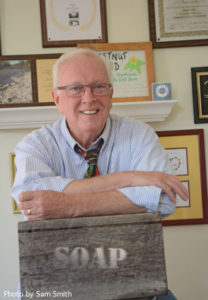
David Miller is the Managing Editor of Loveland Magazine
by David Miller
Loveland, Ohio – Word on the street is that the 7-week campaign was such an eye-opening experience and they are grateful to have experienced it together. They couldn’t have accomplished what they did without family, school, and community support!
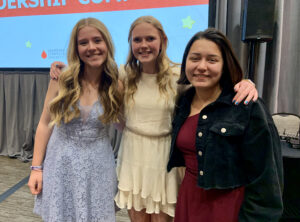
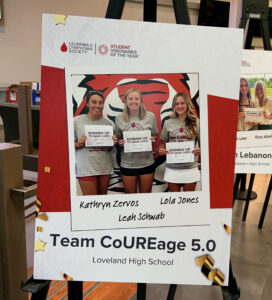
Loveland High School’s Kathryn Zervos, Leah Schwab, and, Lola Jones and their Team CoUREage 5.0 raised $95,243.00 for the Leukemia & Lymphoma Society.
Loveland Magazine was invited by the Loveland team to “The Grand Finale Celebration” held on March 16 at the Sharonville Convention Center. The evening was hosted by the LLS-Ohio River Valley Region to celebrate the successful 7-week campaigns by area high school teams to raise awareness and dollars to cure Leukemia, Lymphoma, Hodgkin’s disease, and Myeloma. The funds support research and to support and improve the quality of life for patients and families.
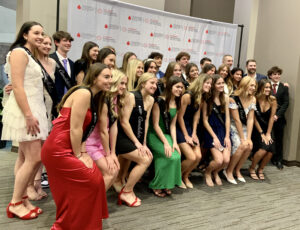
All of the “Students Visionaries of the Year” as they are called, were celebrated and given a standing ovation with loud cheers.
Zervos, Schwab, and, Lola Jones led Team CoUREage 5.0 and a team of volunteers. They asked Loveland Magazine to extend their appreciation to Britney Frietch Reality, Zicka Homes, Hyperdrive, The Ben Morrison Foundation, Loveland Magazine, and Bishops Quarter. The Team raised funds through give-back nights, raffle baskets, split the pot, and online auctions.
The Co-Chairs for the LLS-Ohio River Valley Region are Dino Dillhoff and Jenn Rampage, both Loveland residents.
The hosts for the evening were Emma Steiner a Senior at Loveland High School and a member of last year’s Loveland – 2023’s Team CoUREage 4.0 and Maddie Lippert, a Junior at Saint Ursula Academy. Emma’s Team CoUREage 4.0 was the top fundraising team last year raising a staggering $214,000.00.
Connor Bell, a Senior attending Elder High School, and his Westside Warriors were the top Student Visionaries of the Year for 2014. Combined, all of the Cincinnati Area student visionaries raised $758,942.00 this year.
Loveland High School’s next team, Team CoUREage 6.0 attended. They are Payton Brown, Macy Steiner, and Caitlyn Ferrer.
Thank you, Kathryn, Leah, and, Lola for inviting Loveland Magazine to your celebration! It was an AWL-inspiring evening that encouraged and left me full of faith about yours and my future! Our community and country are in good shape with you in it.
In this video you will hear the inspiring stories of Conner Bell representing the West Side Warriors the top fundraising team, Dino Dillhoff and Jenn Rampage the Co-Chairs, Co-Hosts Emma Steiner and Maddie Lippert, Scott Carroll representing the LSS National Board of Directors, and Gracie the honored hometown hero and survivor.
__________
Watch Cassie Mattia’s Table of Discussions interview with Team Coureage_5.0
Loveland, Ohio – The Spring brush pickup program has begun. Brush must be placed in the grass near the roadside. Public Works will collect brush for approximately two weeks.
Guidelines
The following are guidelines established for the brush pick-up program:
Brush must be placed in the grass behind the curb or edge of roadway. Do not place brush in the roadway, gutter, ditches, or on sidewalks.
Do not block fire hydrants.
Please remove basketball hoops from sidewalks, cul-de-sacs, the end of your driveway, etc. In many neighborhoods, basketball hoops make it difficult for crews to navigate the route and make turns.
Limbs cannot exceed 10 inches in diameter at the cut section.
Limbs should be placed with the cut section facing the street and all limbs should be facing the same direction. This makes it easier and faster to handle.
No leaves, pine needles, grass clippings, bamboo, ornamental grass, or other yard waste will be collected. These items clog or bind up the chipper.
Small twigs and sticks should be tied with twine in bundles 12 inches in diameter. Twigs or sticks can also be placed in a container, but no other yard waste should be in the containers. No loose piles of sticks and debris, please.
Any material not meeting these requirements cannot be collected and will be left.
Outside the regular pick-up schedule, residents are encouraged to visit City Hall to get a free voucher to drop off any yard waste to Evans Landscaping.
Wood chips may be available. Anyone in the city who would like a load of wood chips should call (513) 774-3067.
Jack grew up here in Loveland, went to elementary school at St. Columban and high school at Moeller. He played football and was a National Merit Scholar. Jack loved music, travel, reading, and his friends. He graduated from the University of South Carolina’s Darla Moore Business School and moved to Baltimore for his first job. A month later, Jack was dead.
Jack made one bad decision, and it killed him.
One night, Jack was with friends, and someone brought out a party drug. Jack didn’t say no. None of them knew the drug had been cut with deadly fentanyl. On Sunday, September 19, 2021, Jack was found unresponsive, and one of his friends was dead. Jack’s parents Tom and Stephanie rushed to his side, but it was too late. Jack wasn’t an addict, he wasn’t a habitual drug user, and he never intended to take fentanyl. But he did, and it took his future.
Fentanyl is the leading cause of death for Americans ages 18-45.
Illicit fentanyl is cheap and easy to make, and it pours into our country every day. It’s 50 times stronger than heroin, 100 times stronger than morphine, and is highly addictive. Cartels add it to illegal and recreational drugs and to fake pills made to look like Xanax and other prescription medications. In 2023, DEA seized more than 68 million fentanyl-laced fake pills and more than 11,010 pounds of fentanyl powder. That’s equivalent to more than 336.3 million fatal doses.
7 out of 10 fake pills contain a lethal dose of fentanyl.
Tom and Stephanie Quehl don’t want another family to be devastated by fentanyl. In November 2022, they founded DOITFORJACK and the Jack Quehl Foundation. DOITFORJACK is committed to educating our community about the threat of fentanyl poisoning by sharing Jack’s story. To learn more about our mission, please visit us at DOITFORJACK.ORG. (embed https://www.doitforjack.org)
Help DOITFORJACK stop fentanyl from taking someone else’s Jack.
Christina Collins’ journey to become an educator started when she helped her grandfather read his mail.
He had dropped out in middle school, and had trouble with reading and understanding words, even ones specifically written for him.
Collins’ dad and brother both struggled in school as well, and it was through their struggles that she saw “how hard it was for some people to be successful.”
“So, those moments all kind of led to, for me, believing that literacy is a key civil rights issue,” Collins told the Capital Journal. “I mean, the ability to participate in the world around you is to be a literate human being.”
The Gahanna native became a high school English teacher, and cherished the interactions she’d have with students, the kids who seemed to be doing fine and the kids who struggled or made trouble.
“I was always very driven about recognizing every student, and getting other people to recognize every student to help support every student,” Collins said.
To this day, she gets messages from students who have moved on to become educators themselves.
That new generation of teachers is facing a whole host of new challenges, from culture war battles to ever-changing education standards, and Collins sees the developments in education statewide and nationally as a departure from the true aims of the field.
“Our pendulum has swung way too far over to seeing kids as test scores,” she said. “We should be finding every kid’s talents and getting them going in the right direction.”
Joining the board
While Collins was an educator, she taught her classes, kept up with the curriculum and all the other everyday roles of a high school teacher.
But she realized that, for other teachers, those roles didn’t include staying up all night reading legislation.
“I thought that was just a thing all teachers did,” she said. “I thought ‘well this is part of education, everybody’s reading legislation.’”
When her colleagues dispelled that belief, she realized perhaps her next move might be toward honing the policy that came from the statehouse into local school districts.
She became an administrator with the purpose of “being a filter for the noise” coming out of Columbus via policy mandates and standard changes, from Race to the Top and performance evaluations to the third-grade reading guarantee.
“There was a time when I was in a district as curriculum director where in five years there were four different sets of graduation requirements,” Collins said.
Feeling the impact of constant and rapid changes coming from legislative bodies who included many non-educators compelled Collins to run for a spot on the Ohio State Board of Education. She took her spot on the board right as one of the biggest level-sets ever to happen to Ohio education unfolded: the COVID-19 pandemic.
The pandemic brought school closures, virtual learning, a scramble to decide whether testing made sense among uncertain learning environments, and a reckoning when it came to what kids really needed from their educational facilities.
Amid the stress of teachers learning new roles, and parents learning what it takes to be a teacher, Collins saw the era as a point of hope, as a needed reflection period for policymakers and districts alike.
“I saw it as a key moment where we could just blank-slate reset and think differently about our education system,” she said.
Surely, she thought, the adaptation that students had gone through in their methods of socialization and learning will lead to changes in the way education is conducted. Surely things like student hunger and poverty that were so starkly spotlighted amid a global pandemic would stay at the forefront of the minds of leadership as they move forward.
“My experience on the board, especially that first year, I was like ‘can we think differently, can we think about competency-based learning models, how can we meet their needs?’”
As a member of the board, she was part of many discussions when it came to coming out of the pandemic and the needs of the education system. But those discussions didn’t go the way she’d hoped.
“It was like the rush to return to normal was the sole focus, and that was coming straight from the statehouse,” she said.
She wasn’t naive to the fact that the state Board of Education, whose candidates appear on nonpartisan ballots, had its conservative and liberal members. But discussions during the pandemic were markedly bipartisan, with some “more known conservative members” hearing the ideas of education reform related to pandemic-era impacts and thinking “maybe we should think differently,” according to Collins.
“Coming out of the pandemic, this culture of kids has changed, and I don’t think that we’re focused on the right things to meet their needs,” she said.
The tune coming to Collins and the rest of the board was the return of state testing and the return of “normal” in-person instruction, despite a years-long pivot to learning alternatives.
“At no point did (the state) slow down and address how we’re throwing (the students) all back together,” Collins said.
The legislature paused testing amid the pandemic, and policymakers sought to allow schools to move forward without reflection on the tests that were conducted, some through federal mandate, at least for a while. But as 2022 rolled around, the restart of testing became a discussion at the legislative level again, a decision Collins thinks should have been put on the back-burner a little longer.
“That was a moment where we should have delayed, there should have been a bit longer before that happened again,” she said.
Culture wars over change
When the pandemic seemed to be in the rearview mirror, the board’s work didn’t slow down, instead shifting to an area Collins wasn’t quite expecting: culture wars.
She hadn’t been fully caught off-guard when anti-racism resolutions brought white-hot debate to the board’s door, or when proposed Title IX language changes brought along talk of transgender rights in schools. Her seat on the board was barely warm when she started receiving emails accusing her of being anti-American and even socialist, all based purely on the fact that she was an educator, she said.
“I think I’m still a little shocked that in Ohio we’re at a point where we’ve had those kinds of culture war issues,” Collins said. “I don’t believe the majority of Ohioans want those issues to be at the forefront.”
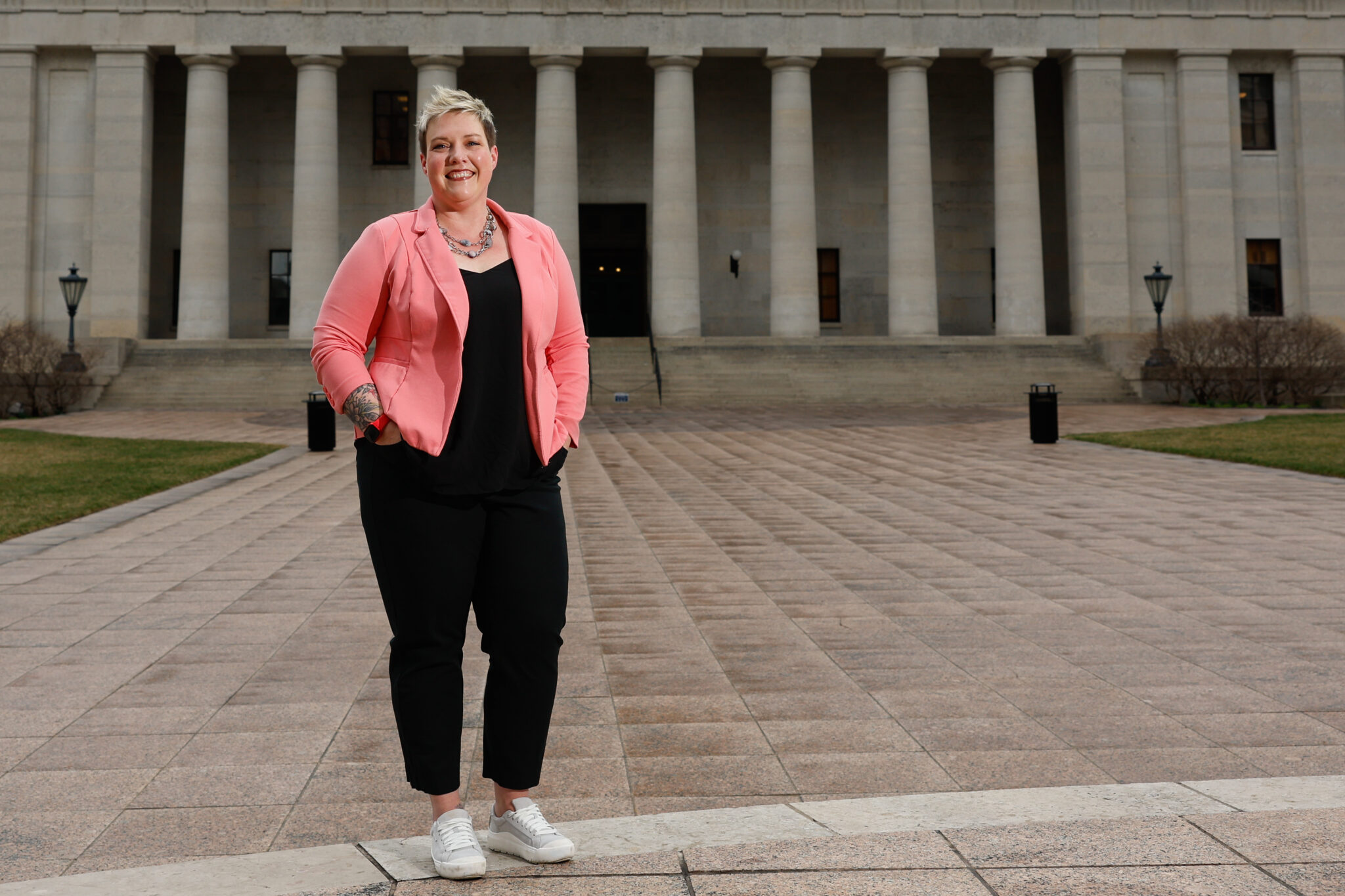
COLUMBUS, OH — MARCH 05: Christina Collins, former State Board of Education member and currently the head of Honesty for Ohio Education a pro-public schools organization that testifies in favor of fair school funding, March 5, 2024, outside the Statehouse in Columbus, Ohio. (Photo by Graham Stokes for Ohio Capital Journal. Republish photo only with original article.)
Having those issues, which Collins acknowledged weren’t necessarily within the board’s purview, become months-long debates with resolution approval, then reversal, meant other things that the board could have been doing within the education space weren’t seeing the light of day.
“All of that was happening at the same time, which I think is how we lost that potential for change,” she said.
A bigger change was headed for the board, that would remove many of its responsibilities, and cause a shift that would eventually convince Collins to move on.
A bill had been floating in the Ohio legislature for more than a year. The more than 2,000-page policy would not only change the name of the Ohio Department of Education to the Ohio Department of Education and Workforce, but it would restructure the department to have two leaders under the umbrella of the governor’s cabinet, one for education and another for workforce.
The ODEW would still include the State Board of Education, but board members would be mainly focused on teacher licensure, educator disciplinary actions and district territory disputes.
State Sen. Andrew Brenner, R-Delaware, an ex-officio member of the board of education, was not the main sponsor of the bill, but pushed hard for it as chairman of the Ohio Senate Education Committee.
Arguments were made that the board was ineffectual and inefficient. Collins sees no reason to place blame for the way the board has worked, but from her perspective, the board filters legislative measures to the local districts as another cog in a wheel that needs improvement.
“The board’s seeming inability to get things done – which I don’t believe, but the rhetoric around it – I think that’s a reflection of what our local districts are dealing with because they are struggling to implement all of the things,” Collins said.
During committee hearings on the bill, members of the state board, including Collins, submitted testimony against the changes, saying putting the leaders under the governor’s cabinet would decrease the level of accountability they could have to districts and voters.
Collins brought up the many mandates under which the board had guided local districts, and the source of any and all of those mandates.
“These were all legislated efforts, but you’re still saying our schools are failing,” she wrote in her testimony. “I ask, who holds this (General) Assembly accountable when the unending educational initiatives it doles out do not work?”
The overhaul of the ODE did not play out in the first General Assembly in which it was introduced, but shortly after a new General Assembly came to work, the push for Senate Bill 1 and the changes to the department were introduced again.
Teachers unions, board of education members and advocacy groups alike all came out in opposition to the bill, representing hours of testimony in committee. Supporters of the bill included the Ohio Chamber of Commerce.
The bill passed the Senate last March, but it wasn’t until it was inserted into the state budget in the summer of 2023 that it saw full passage.
Collins was one of a number of board members who signed a letter asking Gov. Mike DeWine to line-item veto the changes to the state board’s roles in the budget document.
“From my experience being on the board, I think the way that (SB 1) was shoved through and how it was shoved through and when it was shoved through was a little bit unbelievable,” Collins told the Capital Journal. “Something that had essentially stalled in process was added (to the budget) and pushed through the way it was, and then that quickly it was (passed).”
Honesty for Ohio Education
As the board faced drastic legislative changes and a significant reduction in the authority it held, Collins started to wonder if being a member would help her make the most change, something she says she looks for in any career move she makes.
Armed with a superintendent’s license, she debated going back into schools. Ultimately, the departure of Honesty for Ohio Education’s executive director at the end of 2023, and the fact that she’d just had a baby that November made Collins reflect on all the aspects of education and the changes needed.
“It’s a scary time as a parent, it’s a scary time for education,” she said. “I’m worried about my own kids, I’m worried about everyone else’s kids.”
As a staunch supporter of public education, the changes being made on a state level with the transformation of the ODEW and the implementation of near-universal private school vouchers made her nervous about the future of her chosen field.
But like the times with her grandfather years ago, the connection between education and civic duty floated to the top of her mind.
“On a grander scale, I’m really, really, really worried that we’re losing our democracy, and for me education and democracy are in this reciprocal relationship,” Collins said.
Honesty for Ohio Education started in 2021 as a reaction to “critical race theory” bills that sought to keep children from learning the connection between race and American history, with claims that the bills would protect children from feeling guilt for history.
The group started small, but as they began testifying against CRT bills, among others, the group’s numbers grew, and now the coalition “has outgrown itself” from its nascent days, according to Collins.
“That’s a response to the attacks on education, it’s the attacks on LGBTQ+ kids, it’s the attacks on multi-racial education, it’s the attacks on honest history,” she said. “All of that … has created this avalanche with Honesty where we’re at this influx, where we have to decide how we step into adulthood, essentially.”
But as the coalition makes its next moves, Collins said it plans to stay focused on things like state curriculum, fights against book bans and how schools can work better, even for the 10% of students outside of the public school system.
“It’s not just public education … it’s about the kids everywhere in any educational environment who deserve to be safe and have honest and diverse, inclusive education,” Collins told the Capital Journal.
The coalition focuses on content in schools, but Collins said the ability for school districts to succeed certainly comes down to how well they’re funded and supported by state and local sources.
Public education is a “common good” for Collins, and that means the 90% of Ohio children in public education should be taken care of in the way the Ohio Constitution dictates. For public education unions, advocacy groups and for Collins, that includes full implementation of the Fair School Funding Plan.
That reform of the state’s public school funding model emphasizes a formula based around the needs of individual school districts, to allow schools who have more need than others to build up their performance.
The plan as it is now began it’s push through the legislature in August 2020 but negotiations and the hesitance of legislative leaders like Senate President Matt Huffman to push out the entire $10 billion per year plan in one shot led to a six-year phase-in. The plan is currently up to about 66% implementation.
Meanwhile, however, the General Assembly fully funded what amounts to a near-universal private school voucher program in the last budget cycle, allowing students in what are considered under-performing public school districts to leave and take state-funded scholarships with them to nearby private schools if their household income is up to 450% of the federal poverty level, or $135,000 for a family of four.
“When we pass universal voucher bills that give more money to students when they leave the school than a lot of the schools receive for that student, that’s a sign of the value that at least our legislature places on public education kids,” Collins said.
SUSAN TEBBEN
Susan Tebben is an award-winning journalist with a decade of experience covering Ohio news, including courts and crime, Appalachian social issues, government, education, diversity and culture. She has worked for The Newark Advocate, The Glasgow (KY) Daily Times, The Athens Messenger, and WOUB Public Media. She has also had work featured on National Public Radio.
Loveland, Ohio – The Loveland Athletic Boosters support the Loveland City School District athletic programs. Support of the student athletes includes donating equipment to the athletic department, sponsoring activities to promote school spirit, and enthusiasm, and funding major capital improvements. The Boosters support more than 1,000 7th through 12th grades girls & boys.
Four options of premium mulch provided by Bzak Landscaping
Queen City Gold – this is our most popular mulch its triple shredded and dark brown in color – $5.25per bag
Black Dyed Double Shredded Mulch – All dyed mulch is processed with a water based dye. It will hold color longer than the natural hardwood mulch. – $5.75 per bag
Red Dyed Double Shredded Mulch – All dyed mulch is processed with a water based dye. It will hold color longer than the natural hardwood mulch. – $5.75 per bag
Longneedle Pinestraw Bales – covers approximately 45 sq. ft per bale. All natural product. Hand baled. – $14 per bale
*10 Bag Minimum Order
*Free local delivery of your order will be provided by Loveland Student Athletes
*Individual bags will be delivered starting Friday, April 5th (between 5P-8P & and Saturday, April 6th (between 10A-12P)
*Full pallets and straw will be delivered on or by April 13th
*Satisfaction guaranteed
Learn to make a variety of clay creatures and animals, and even get a chance to use the potter’s wheel.
It is five days of instructor-lead classes, a 3-hour class per day. Camp is a great way to keep children busy, entertained, and learning a new skill set. Camp is limited to eight children and we will have a campfire & marshmallow roast on the last day of camp.
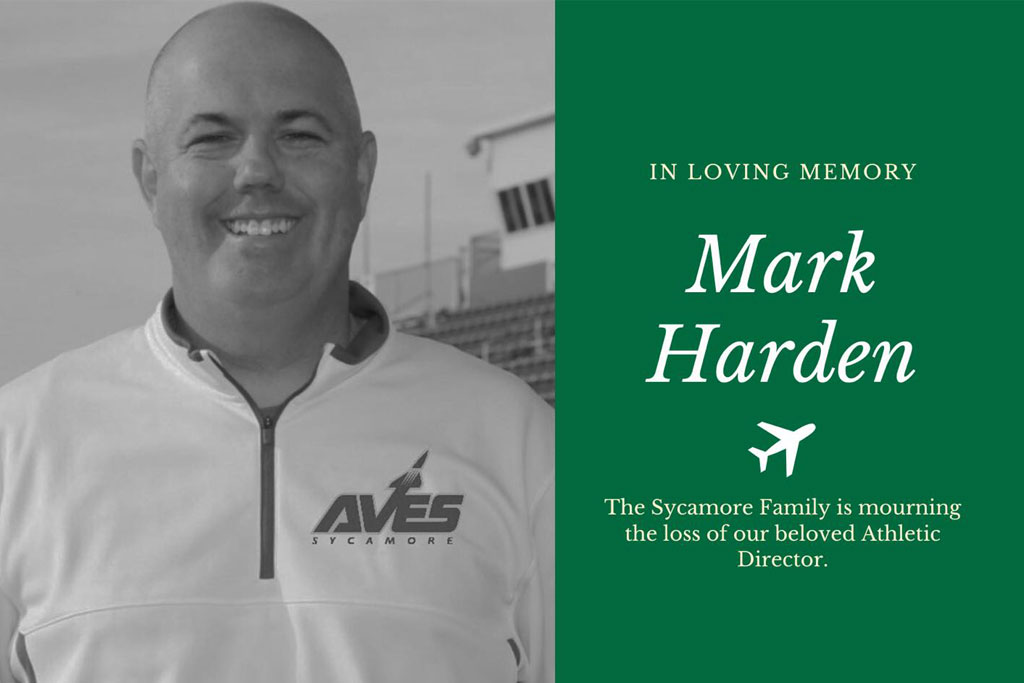
Blue Ash, Ohio – In statements to the school community, the Sycamore District said:
The Sycamore Family is deeply saddened by the loss of Sycamore High School’s beloved athletic director, Mark Harden. His passion, dedication, and spirit will forever be remembered.
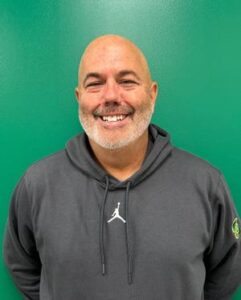
Harden 52, was pronounced dead at the scene of a crash on southbound I-75 Wednesday afternoon.
The Greater Miami Athletic Conference said on X:
It is with a heavy heart the Greater Miami Conference mourns the untimely passing of Sycamore Athletics Director Mark Harden. Mark was involved in auto accident this afternoon on I75 which took his life. His presence and leadership will be difficult to replace.
Loveland, Ohio – The City of Loveland income tax is a 1% earnings tax on persons who live or work in the City. A credit is given to residents who pay taxes to other municipalities. According to City Hall, “residents who work in areas imposing less than a 1% earnings tax must pay the difference to Loveland.” All residents must file a return by April 15 even if no tax is owed.
Info Provided by City Hall
Not sure if you live in Loveland? View the street listing Street Listing (PDF) to view all streets that are in Loveland.
Filing Your Local Income Tax Returns
The City of Loveland uses the Regional Income Tax Agency (RITA) to collect local income taxes. Residents and businesses can file their local income tax returns with RITA using the following methods:
RITA eFile: Click “My Account” to securely file your return through RITA’s website.
Individual Paper Forms: Click to download and print the appropriate return form and mail to RITA at the address listed on the form.
Business Paper Forms: Click to download and print the appropriate return form and mail to RITA at the address listed on the form.
Interest Rate
Ohio House Bill 5 (ORC 718.27) requires municipalities to publish the interest rate for tax underpayments by October 31st, for the next calendar year. The Regional Income Tax Agency has addressed this requirement on the City of Loveland’s behalf by posting this information to the RITA website. Based on the calculations required by House Bill 5, the annual interest rate will be as follows:
2016: 5%
2017: 6%
2018: 6%
2019: 7%
2020: 7%
2021: 5%
2022: 5%
2023: 7%
2024: 10%
Estimated Taxes
For tax years 2015 and prior, the Loveland Income Tax Code (Chapter 183, Section .07) requires individual taxpayers having estimated taxes due in excess of $100.00 to pay on a quarterly billing schedule. Noncompliance results in a penalty equal to 10% of the tax remaining due over $100.00 after the estimated payment deadline of January 31. To avoid assessment of such a penalty, the code provides “safe harbor” options:
Owe less than $100 when you file the annual return, and all required payments were made timely.
Pay at least 100% of your previous year’s tax liability.
Pay at least 90% of the current year’s tax liability through the same means as #2.
The taxpayer is an individual who resides in the city but was not domiciled there on the first day of January.
Starting Tax Year 2016, quarterly payments of estimated tax are required if the total tax liability is $200 or more. The new due dates for estimated payments are April 15, June 15, September 15, and January 15. Noncompliance results in a penalty equal to 15% of the tax remaining due after the estimated payment deadline of December 15. To avoid assessment of such a penalty, the code provides three “safe harbor” options:
The taxpayer is an individual who resides in the city but was not domiciled there on the first day of January,
Pay at least 100% of your previous year’s tax liability, or,
Pay at least 90% of the current year’s tax liability.
Extension Requests
For taxpayers on a federal extension, a separate request for a municipal extension is not required. Submit a copy of the federal extension with the filing of the extended municipal return.
For taxpayers not on a federal extension, an extension request must be submitted on or before the date of the municipal income tax return is due. Visit the RITA website for the extension request form.
Please remember that an extension only extends the time allowed to file an annual return, not the time allowed for payment.
After an Alabama Supreme Court decision that ruled frozen embryos housed outside of a human body were still considered children, states across the country are debating the implications of such a decision.
Ohio legislative leaders are saying bills that would ban IVF are not being considered, but one lawmaker who has introduced a “personhood” bill in the past says it’s still “great policy” that’s being blocked by politics.
National groups have said the Alabama decision will have impacts on the work that embryologists do, with the Society of Reproductive Biologists and Technologists saying the state’s supreme court ruling “stands in stark contrast to scientific understanding and the experiences of individuals navigating fertility treatments.”
The concept of “fetal personhood” is not a new one for Ohio. Long before the Alabama decision threw into question the concept of in-vitro fertilization treatments in that state, legislators in the Buckeye state were considering a bill that would consider life’s beginning at conception, a theory conservatives and pro-life politicians have long pushed.
Ohio House Bill 704 was introduced in 2022 by state Rep. Gary Click, R-Vickery, who claimed “one class of people has erroneously been denied their constitutional rights: the unborn.”
“From the moment of fertilization, that zygote, embryo or whichever depersonalizing term you choose to use is not merely a potential human but rather (a) human with potential,” Click said in a statement announcing the legislation.
The bill died as the General Assembly’s two-year session ended, but the fact that the idea was broached is still being brought up by Democrats and pro-choice groups around the state.
Click himself didn’t rule out the idea of reintroducing his personhood legislation, saying in a Feb. 23 tweet that reintroducing it has “not been my plan at the moment.”
“But plans do change,” the tweet went on.
The legislator — who was also the creator of a successful bill that bans gender-affirming care for transgender minors, a controversial bill that succeeded with a veto-override in January — also told the Statehouse News Bureau in February that while he supported IVF if all embryos are used, he considered his personhood bill “great policy” blocked by politics.
Since Click’s bill was introduced (and subsequently foiled by time limits), however, 57% of Ohio voters passed November’s Issue 1, which not only enshrined abortion rights into the Ohio Constitution, but also listed “fertility treatment” as one of the rights Ohio individuals have to “make and carry out one’s own reproductive decisions,” according to the amendment.
But Republican legislators in particular have not seen this development as the roadblock to reproductive rights legislation one might expect, as policymakers at the Statehouse have continued to push anti-abortion legislation and bills that target the rights now protected under the state constitution.
The state’s legal representatives are also still pushing against a lawsuit that seeks to eliminate a six-week abortion ban that became law in 2019 (and has been tied up in court ever since).
Still, Ohio’s legislative leaders have said the Alabama decision has yet to spur any policy in the state at this point.
Left, Ohio House Speaker Jason Stephens. Right, Ohio Senate President Matt Huffman. (Photos by Graham Stokes for the Ohio Capital Journal. Republish only with original article.)
House Speaker Jason Stephens, R-Kitts Hill, said the chamber is “monitoring any potential ramifications the Alabama decision may have in Ohio,” but also said, from his perspective, “IVF provides hope and is 100% pro-family.”
“We look forward to advancing our values and continuing our pro-life legislative agenda,” Stephens told the OCJ in a statement.
Senate President Matt Huffman said he has not heard of any legislation and there hasn’t been “any discussion by any member of my caucus or anybody else as far as in the state of Ohio as far as I know.”
“We seem to be in this national culture that if some court in Alabama or some other state says something that we all should be reacting to it,” Huffman said.
The senate leader acknowledged that “we have a constitutional amendment that affects some of this.”
“But you know, with other things going on right now, it’s just not a discussion that’s taking place,” he said.
A spokesperson for Gov. Mike DeWine said his office would “continue to monitor any bills in this policy area,” but they were not aware of any at the moment.
DeWine’s office did not respond to questions as to whether or not the governor supported the consideration of frozen embryos as children.
Megan Henry contributed to this story.
_____________
SUSAN TEBBEN
Susan Tebben is an award-winning journalist with a decade of experience covering Ohio news, including courts and crime, Appalachian social issues, government, education, diversity and culture. She has worked for The Newark Advocate, The Glasgow (KY) Daily Times, The Athens Messenger, and WOUB Public Media. She has also had work featured on National Public Radio.


![[Exclusive Video] LHS’s Kathryn Zervos, Leah Schwab, and, Lola Jones raise $95,243 for Leukemia & Lymphoma Society](https://lovelandmagazine.com/wp-content/uploads/2024/03/lls-featire.jpg)























 Collins’ dad and brother both struggled in school as well, and it was through their struggles that she saw “how hard it was for some people to be successful.”


 Queen City Gold – this is our most popular mulch its triple shredded and dark brown in color – $5.25 per bag

 Afternoon Camp: 1pm to 4pm (ages 12 and older)
 Harden 52, was pronounced dead at the scene of a crash on southbound I-75 Wednesday afternoon.