Tag: ohio

  • Ohio Launches New Skills-Based Job Search Feature

    Ohio Launches New Skills-Based Job Search Feature

    Online tool helps applicants find positions based on experience and skills

    Columbus, Ohio – Ohio Governor Mike DeWine and Lt. Governor Jon Husted today announced the launch of a new tool that helps applicants for state government positions locate openings based on their specific experiences, skills, and training, not just academic degrees. The new skills-based search function on Careers.Ohio.gov was developed in response to Governor Mike DeWine’s Executive Order 2023-10D establishing the State of Ohio as a Model Employer for Skills-Based Hiring Practices. Ohio is one of the first states in the country to adopt the skill-based hiring practice to recruit employees according to a press release from the Govenor’s office.

    “To drive our economy forward it will take workers with diverse skill sets to meet the demands of 21st century jobs,” said Governor DeWine. “This new skills-based approach will help job seekers more easily identify the types of jobs available and employers attract employees with the skills needed to succeed.”

    “The most important qualification is whether someone has the skills and temperament to get the job done,” said Lt. Governor Husted, Director of the Governor’s Office of Workforce Transformation.”For most jobs, there are many ways to acquire those skills and a college degree shouldn’t be an artificial barrier for employers to find the best person for the job. Nor should a degree requirement be a barrier to entry for someone who has the right skills, but does not have a college diploma.”

    Skills-based hiring prioritizes a candidate’s skills over more traditional qualifications like academic degrees. Beginning today, state job postings now display a primary job skill on each opening and additional technical and professional skills associated with the positions. To use the new feature, applicants need to create an account, if they do not already have one, and then can begin customizing their profile with their skills and other preferences to find open positions that match their profile.

    About 62 percent of adults in the U.S. do not have a bachelor’s degree, according to the latest data from the U.S. Census Bureau. Currently, there are slightly more state employees without an academic degree, according to the Ohio Department of Administrative Services (DAS), which manages the site as well as statewide human resources operations and talent acquisition activities for agencies, boards, and commissions.

    “Ohio’s new skills-based job search feature will make it easier for applicants to find state positions they may be qualified for and help the state hire a highly skilled workforce that will reflect the talent of all citizens,” said DAS Director Kathleen C. Madden.

    To learn more and to utilize this new resource, go to Careers.Ohio.gov.

  • ID R Kids for Safety

    ID R Kids for Safety

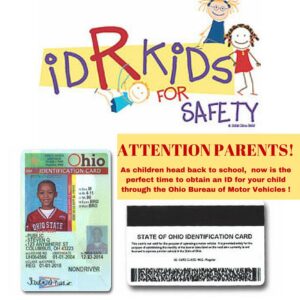
    There is no minimum age for an Ohio ID card. According to the Ohio Bureau of Motor Vehicles, obtaining an ID card for your child has many advantages, including that it may assist police if a child is reported missing. You may apply for an Ohio ID card for your child through the Ohio Bureau of Motor Vehicles.

    You may also apply for an Ohio ID card for your child at any deputy registrar location.

    • Ohio ID cards are used for identification purposes only.
    • Ohio photo ID cards for children may assist police if a child is reported missing.

    What do you need to bring?

    You must provide proof of your child’s:

    • Full legal name
    • Date of birth
    • Social Security number (if ever assigned)
    • Legal presence
    • Ohio residency

    Any child under age 18 must be accompanied by a parent or guardian with an Ohio driver license or ID card. If the parent or guardian does not have an Ohio driver license or ID card, then they must also provide proof of:

    • Full legal name
    • Date of birth
    • Social Security number (if assigned)
    • Legal presence
    • Ohio residency

    Go to our Acceptable Documents page for a full list of identity documents and links to use our interactive process to assist you with what to bring to a deputy registrar agency.

    How much does an Ohio ID cost?

    $10.00

    The bureau says, “Don’t forget to include a listing for your child’s Next of Kin in connection with his or her state ID. It will help police get in touch with parents or guardians.”
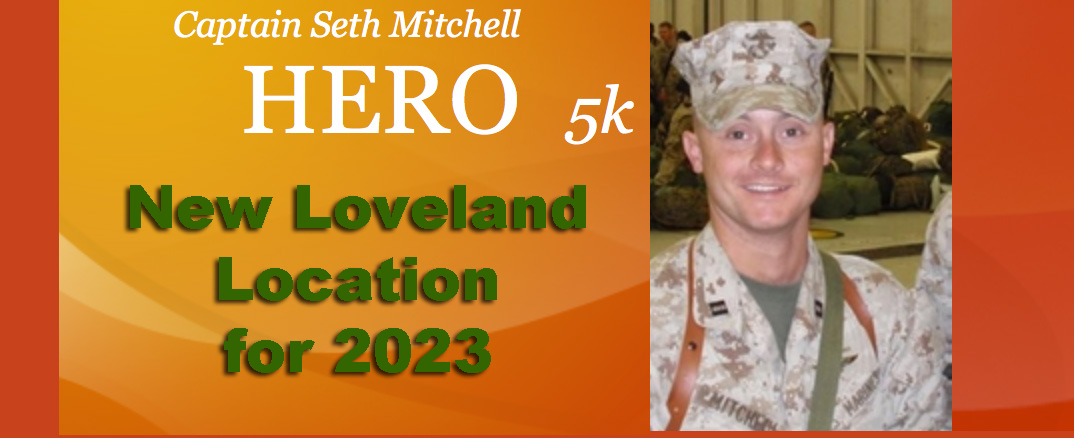
  • 13th running of the Captain Seth Mitchell Hero 5K is Saturday

    13th running of the Captain Seth Mitchell Hero 5K is Saturday

    Loveland, Ohio – Due to planned construction in Nisbet Park we will meet and begin the 5K at the Linda Cox Trailside Parking Lot, near Loveland Canoe and Kayakat at 10 AM.

    Run for your HEROES  in downtown Loveland  as we remember Loveland High School graduate Capt. David Seth Mitchell, who was killed in action in Afghanistan on 26 October, 2009.

    5K Run/Walk

    $25Price increases after October 13, 2023 at 11:59pm EDT
    Virtual 5K

    Virtual 5K

    $15Registration ends October 14, 2023 at 11:59pm EDT

    Virtual – Carolina Beach

    $25Price increases after October 13, 2023 at 11:59pm EDT

    Special Youth Pricing

    Special Youth pricing is available.

    Youth Pricing: Kids 18 receive a $5 discount off of the cost of an adult registration.

    All Discounts  will  be taken at checkout.

    Place

    Linda J Cox parking lot
    174 S Karl Brown Way
    Loveland, OH US 45140

    Complete Information Here: (including age groups, awards, registration details, directions etc.)

    Official Capt. Seth Mitchell Website

    Benefit:

    All proceeds benefit the Capt. Seth Mitchell Memorial Scholarship through Loveland Schools Foundation.

    Course:

    3.1 mile run and walk to begin and end at Nisbet Park in Historic Loveland.

    Run/Walk Divisions:

    18 and under, 19-29, 30-39, 40-49, 45-49, 50-59 and 60/over. No age group awards for 2023. Challenge coins will be given to all participants.

    Chip Timing:

    This year’s race will be chip timed with MyLaps Bibtags. No need to turn in your chip.

    Awards:

    Awards to the Overall Male and Female Runners

    We will post age-group standings in the online results.

    After the Race:

    Join us for a festival after the race! Food, Games, and more..

    Race Results:

    Results will be posted online here following the race.

    Virtual Option:

    If you cannot join us in person, please join us Virtually. Complete your own 5K at the location of your choosing sometime in the month of October. Post your time (optional) on our virtual results page. We thank you for your support.

    Pre-Registration:

    5K Run/Walk: Kids (18 and under) $20, Adults $25. All entries include chip timing and a lunch ticket, Race T-shirt and finisher challenge coin.

    Virtual Option: Kids (18 and under) $10, Adults $15. Registration includes a commemorative challenge coin.

    Online-registration:

    Online Registration is available through Race Day for 2023

    Late/Race-Day Registration:

    Kids $25, Adults $30

    Packet pick up and late registration:

    There is no early packet pick up for this event. All pick ups will be handled on day of event.

    Race-Day Check-in and /Number Pickup:

    8:30 – 9::45 am

    Location:

    For 2023, we will be assembling at Linda J Cox parking lot in downtown Loveland near Loveland Canoe and Kayak.

    GPS Coordinates: 39.265349, -84.260309

    ***** NO REFUNDS*****

    Course Map 2023

    Course Starts and ends on the bike trail next to the Linda Cox parking lot.

    Chip Timing

    This year’s event will be timed by Running Time Race Services using MyLaps Disposable bib tags. The chip will be on the bib number. No need to turn in pull tags or return the timing chip.

  • Being a good leader is truly being empathetic to each of your employees

    Being a good leader is truly being empathetic to each of your employees

    by CeeCee Collins

    Lately, I have been hearing a lot about empathy in the workplace and the importance its role has in a business’s success.

    The Little Miami River Chamber Alliance is part of another organization in Ohio called the Southern Ohio Chamber Alliance (SOCA). Basically, they take many chambers and pull them together to provide additional benefits to the chamber’s members. This organization is optional. One of the largest benefits SOCA provides is affordable health insurance to small to medium sized businesses through their Anthem plan. I do know that it is a comprehensive health plan and businesses can join at different levels of coverage…this is where I hand it over to the brokers as I do not handle health insurance.

    I mentioned the Health insurance plan to give you an idea of the types of programs SOCA brings to the table, I believe they have close to 14 different benefits including: BWC coverage, credit card processing, clean energy program, legal shield, HR Business Advisors, 401 K plans, shipping plans, certificate of origin, payroll programs, a student debt to build wealth program and last but not least a program to build empathy in the workplace.

    One may think that you listen to employees and treat them well, but the fact is everyone is different. You may have a student right out of college that is money driven or an almost retired employee that simply comes to the office to fill their day. Regardless, part of being a good leader is truly being empathetic to each of your employees. You may wonder why empathy is so important to your business success. It ties in with retention. Most of us spend the majority of our waking hours/days at work. When we fully understand or feel understood that creates a more relaxed productive work environment. That environment is obviously good for business and your employees want to stay around. Empathy is the key to building a strong culture!

    You may believe you listen to your employees, but read this article or reach out to SOCA for this science-based learning program.

    We can connect you and they will provide training to all of your employees. I promise it will help. Many of us think we’re good listeners but empathy goes beyond just listening, it’s action in the workplace.

    For all of the Southern Ohio Chamber Alliance programs, check out this website.

    __________________

    CeeCee Collins is President of the Little Miami River Chamber Alliance.

    She was born and raised in Beavercreek, Ohio, CeeCee Collins attended Carroll High School and has been a swimmer her entire life. She received her undergraduate degree at Xavier University where she also participated on the swim team for four years. She graduated from college in 1989 and began working at USA Today Newspaper as a Regional Marketing Manager. After marrying James Collins IV, they moved to Tampa, FL where she worked for the Tampa Metropolitan Area YMCA for 6 years as an Executive Director.

    CeeCee and her family moved back to the tri-state area after her second child’s birth. She continued to work for the Greater Cincinnati YMCA for 10 years part-time. CeeCee then pursued full-time work and became the Development Director at Ohio Valley Voices for 6 years. Throughout her years at the YMCA and Ohio Valley Voices she was active in the Little Miami River Chamber Alliance (formerly the Loveland Area Chamber of Commerce). She became the President of the Chamber in 2013.

    CeeCee continues to enjoy working at the chamber and keeping up with her three children.  She and Jim live in Miami Township.

  • Steve Rumberg had a bucket list, but got ALS, so… “Operation Stadium Skeleton” builds MLB ballparks around Loveland for him

    Steve Rumberg had a bucket list, but got ALS, so… “Operation Stadium Skeleton” builds MLB ballparks around Loveland for him

    by David Miller

    Loveland, Ohio – In August 2022, Loveland resident Steve Rumberg was diagnosed with amyotrophic lateral sclerosis (ALS) at the age of 51. His family was devastated and slowly began to share the diagnosis with friends and family.

    On Sunday, September 17, they participated in the ALS Cincinnati Walk to Defeat ALS. The Rumbergs organized a team to walk in the Cincinnati Walk to Defeat ALS and welcomed friends and family to join in the mission. The team had approximately 80 team members join the walk and was recognized in the top 3 teams, raising over $19,000.

    They have now launched a Non-Profit called “Pals for pALS” (palsforpals.org) and the community of Loveland and the surrounding area is now participating in an activity called Operation Stadium Skeleton to support the family.

    Steve Rumberg and his Zombie Baseball Fan got a lot of attention at the Loveland Homecoming Parade in September. (Photo by David Miller)

    The idea for Pals for pALS began when offers of support started to pour in, including an offer from Steve’s fraternity brothers to set up a GoFundMe page to help raise money for medical bills and college tuition for his daughter, Eliana. Steve and his wife, Orly, discussed the offer and decided to go a different route.

    Steve learned a lot about community service while active in his college fraternity and he and Orly have been involved in community service throughout their adult lives. They wanted to be able to help other families affected by ALS and not just themselves.

    Steve and Orly came up with the idea of Pals for pALS based on their own needs. Steve did most of the cooking during the week. A few months after diagnosis, Steve no longer had the hand strength to cook and Orly was going to have to take over cooking, in addition to all of the other family responsibilities that she was taking over.

    The idea for Pals for pALS grew from their need to have assistance continuing to provide home-cooked meals for the family.

    Pals for pALS recognizes that each family affected by an ALS diagnosis has different needs that arise after an ALS diagnosis and seeks to provide help to these families to fill these needs.

    Pals for pALS is just getting started and the Rumberg family says they are excited to see how its mission will evolve.

    The pALS Mission

    Pals for pALS was formed for the purpose of supporting families in the Greater Cincinnati Area who are affected by an ALS diagnosis.

    Pals for pALS hopes to provide support to pALS and their families to address needs that are not currently addressed by medical insurance or other organizations.

    Operation Stadium Skeleton brings MLB ballparks TO Steve

    Steve had a bucket list of seeing a baseball game at every MLB ballpark with his son.

    Here are photos provided by the family of some of the ballparks they have visited:

    While they were able to visit 21 out of 30 real MLB stadiums, travel has become difficult. Steve loves baseball but also loves Halloween. This fall, the community is bringing Operation Stadium Skeleton to Steve and his family.

    The intent of this activity is three-fold: a) provide Steve and his family an activity to do together outside of their home, b) demonstrate a show of support for him and his family in a very personal way, and c) raise awareness of ALS and the non-profit, Pals for pALS.

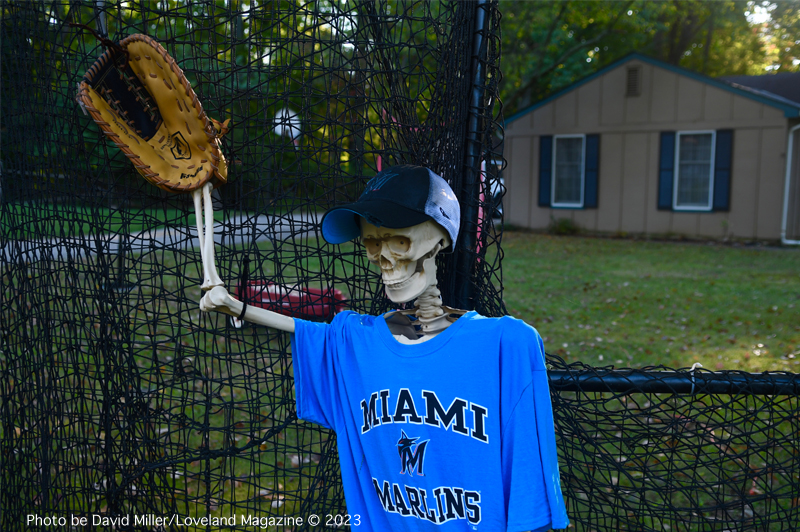
    Members of the community, including business partners and friends, are showing support by displaying a skeleton dressed for each of the 30 MLB teams in their yard. In addition to representing all 30 MLB stadiums, others are displaying Zombie baseball fans to join in the show of support. While all 30 MLB teams are spoken for and on display, the community can still get involved!

    How you can show your support: 
    Donate to Pals for Pals and display a Zombie Baseball Fan in your yard! Just purchase or use a skeleton you already have and decorate it as a baseball fan and display it in your yard to honor Steve.

    PROGRAM DETAILS – See if you, a family member, or someone you know would qualify for help.

    Here are a few of the Operation Stadium Skeleton MLB Ballparks around town.

    WHAT IS ALS?

    Amyotrophic lateral sclerosis (ALS) (also known as Lou Gehrig’s disease) is a progressive, fatal neuromuscular disease that slowly robs the body of its ability to walk, speak, swallow and breathe.

    Every 90 minutes a person in this country is diagnosed with ALS and every 90 minutes another person will lose their battle against this disease.

    The life expectancy of a person with ALS averages 3 to 6 years from the time of diagnosis.

    ALS can strike anyone. ALS occurs throughout the world with no gender, racial, ethnic, or socioeconomic boundaries.

    Presently there is no known cause of the disease, yet it still costs loved ones an average of $250,000 a year to provide the care people living with ALS need.  Medical insurance coverage does not come close to providing the range of support that an individual with ALS needs. Pals for pALS hopes to fill gaps in support that are not covered by medical insurance or other organizations.

    For more information on ALS and local resources, click the link below.

  • New Safer Ohio School Tip Line smartphone app

    New Safer Ohio School Tip Line smartphone app

    Additional upgrades to the Safer Ohio School Tip Line include more flexibility for schools and law enforcement to increase the number of staff members who receive immediate tips.

    Ohio Governor Mike DeWine today announced several enhancements to the state’s free Safer Ohio School Tip Line (1-844-SAFEROH) that will make it easier for Ohioans to report school safety concerns.

    In addition to calling and texting the tip line, Ohioans anywhere in the state can now report school safety information through a new smartphone app and online web form.

    “Not everyone wants to make a phone call or send a text – some are more likely to report concerns by sending a message through an app or website,” said Governor DeWine. “We’re making these upgrades so that it’s as simple as possible for all Ohioans to quickly and anonymously report any potential school safety threats in a manner that makes them comfortable.”

    The new Safer Ohio School Tip Line smartphone app, available both on iOS and Android devices, and the online web form include pre-populated prompts to help users quickly upload information.

    The tip line will also be newly staffed by crisis response professionals who are trained to help individuals contemplating self-harm.

    “Intelligence analysts previously manned the tip line, but we felt that it was important to staff the call center with individuals experienced in helping those with immediate mental health needs,” said Emily Torok, OSSC Executive Director. “Now, instead of referring those who need urgent help to other sources of support, crisis response professionals with the Safer Ohio School Tip Line can immediately provide intervention support and notify first responders to conduct a wellness check.”

    Additional upgrades to the Safer Ohio School Tip Line include more flexibility for schools and law enforcement to increase the number of staff members who receive immediate tips. The call center, which is staffed by multilingual team members fluent in Spanish, French, Portuguese, Russian, German, and Arabic, is now also equipped with telephonic language translation for additional languages including Chinese, Japanese, Pennsylvania Dutch, Somali, Twi, and Vietnamese.

    School students, staff, parents, and community members associated with any school in Ohio are encouraged to report any school safety concerns to the tip line including, but not limited to:

    • Bullying incidents;
    • Withdrawn student behaviors;
    • Verbal or written threats observed toward students, faculty, or schools;
    • Hazing;
    • Weapons/suspicious devices on or near school grounds;
    • Gang-related activities;
    • Unusual/suspicious behavior of students or staff;
    • Self-harm or suicidal sentiments;

    Those who report tips can choose to remain anonymous.

    October 2023 marks the second annual Ohio School Safety Month. This year’s theme is “Relationships for Safety,” which recognizes the impact that positive relationships between school staff and students play in maintaining a safe learning environment.

    Governor DeWine developed the Ohio School Safety Center within the Ohio Department of Public Safety to be a comprehensive, statewide office focused exclusively on enhancing the safety of Ohio schools. In addition to maintaining and promoting the Safer Ohio School Tip Line, the center assists schools and first responders in preventing, preparing for, and responding to threats and acts of violence including self-harm. Staff also proactively scans social media and websites to identify threats against schools.

  • Tamara Huson MD now accepting new patients

    Tamara Huson MD now accepting new patients

    Advertisement

    Loveland, Ohio – Tamara Huson MD is a primary care and family medicine practitioner.

    “I chose to practice family medicine because of my passion for treating patients of all ages, from newborns all the way through to the end of life. Family medicine allows me to care for entire families.”

    Huson speaks English and Spanish.

    Age Groups Seen

      • Pediatrics

      • Teenagers

      • Adults

      • Geriatrics

    Hospital Affiliations

      • The Jewish Hospital – Mercy Health

      • Mercy Health Physicians Cincinnati, LLC

      • Mercy Health – Anderson Hospital

      • Mercy Health – Clermont Hospital

      • Mercy Health – Fairfield Hospital

    Her office is at Mercy Health — Loveland Primary Care at 10562 Loveland Madeira Road, Loveland, OH 45140.

    Hours:
    Monday 8:00 AM – 5:00 PM
    Tuesday 8:00 AM – 5:00 PM
    Wednesday 8:00 AM – 5:00 PM
    Thursday 8:00 AM – 5:00 PM
    Friday 8:00 AM – 5:00 PM
    Saturday Closed
    Sunday Closed
  • Jane Gonzales and Patty Lawrence return and talk about the “new” Issue 1

    Jane Gonzales and Patty Lawrence return and talk about the “new” Issue 1


    “Right to Make Reproductive Decisions Including Abortion”

    by David Miller

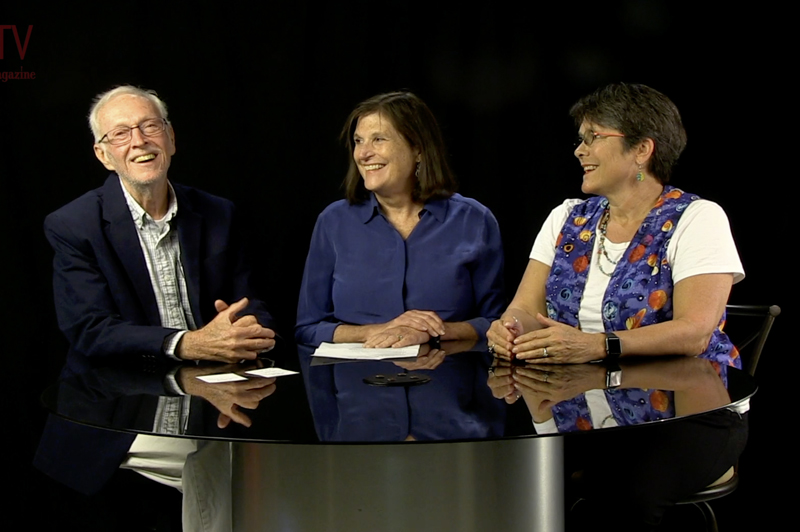
    Loveland, Ohio – Jane Gonzales from Loveland and Patty Lawrence from Miami Township returned to the LOVELAND MAGAZINE TV studio last week to talk about current politics and the activities they have been engaged in in recent months in the community.

    They discussed and answered questions about Ohio Issue 1 which will be on the General Election ballot on November 7. Yes, they talked about Issue 1 when they were last in the studio, and that Republican-led measure was soundly defeated.

    This November, Issue 1, which was a citizen-led effort, will ask voters to amend the Ohio Constitution to enshrine a woman’s “Right to Make Reproductive Decisions Including Abortion”.

    In this interview, Gonzales and Lawrence tell viewers what their reaction was when the attempt to make it harder to circulate initiative petitions and would have raised the bar for citizen-led amendments to a 60% threshold failed in the special election in August. Both women campaigned against the change simultaneously while collecting signatures to have the right to make reproductive decisions including abortion on the Fall ballot. They opposed the August Issue 1. They are encouraging a “YES” vote on the citizen-led amendment.

    In this new interview, they discuss what the current Issue 1 will and won’t do and why they are encouraging voters to vote “YES” on the constitutional amendment.

    ____________________

    The amendment as it would be in the Ohio Constitution

    [pdf-embedder url=”https://lovelandmagazine.com/wp-content/uploads/2023/10/The-Right-to-Reproductive-Freedom-with-Protections-for-Health-and-Safety.pdf”]

    ________________

    ISSUE 1 BASICS (Leauge of Women Voters of Ohio)

    WHAT IS ISSUE 1 ABOUT?

    • Issue 1 relates to reproductive health care. Also known as “The Right to Reproductive Freedom with Protections for Health and Safety”, it would amend the Ohio Constitution, if passed by voters in November. 


    WHAT DOES IT MEAN TO VOTE YES ON ISSUE 1?

    • A “yes” vote supports amending the Ohio Constitution to restore the right to an abortion, as well as other reproductive health care such as fertility or miscarriage treatment : 

      • establish a state constitutional right to “make and carry out one’s own reproductive decisions,”including decisions about abortion, contraception, fertility treatment, miscarriage care, and continuing pregnancy; 

      • prohibit the state of Ohio from interfering with this constitutional right, except when the state demonstrates “that it is using the least restrictive means to advance the individual’s health in accordance with widely accepted and evidence-based standards of care;” 

      • allow the state to restrict abortion after fetal viability, defined as “the point in a pregnancy when, in the professional judgment of the pregnant patient’s treating physician, the fetus has a significant likelihood of survival outside the uterus with reasonable measures;” and 

      • prohibit the state of Ohio from banning abortion when, in the professional judgment of a physician, an abortion “is necessary to protect the pregnant patient’s life or health.” 


    WHAT DOES IT MEAN TO VOTE NO ON ISSUE 1? 

    • A “no” vote opposes amending the Ohio Constitution to establish the constitutional right to “make and carry out one’s own reproductive decisions.” This would allow the state to continue to create legislation relating to abortion and other reproductive health actions.


    WHAT HAPPENS IF ISSUE 1 PASSES? 

    • Abortion would go back to being legal up until viability of the fetus — as it had been for nearly half a century since Roe v. Wade.  Access to miscarriage care, to contraception, and to fertility treatments, as well as the right to remain pregnant, would also be protected under this amendment. Under this amendment, the state would be allowed to restrict abortion beyond viability, with exceptions made when a physician deems abortion necessary for the life or health of the pregnant patient.

    ​WHAT HAPPENS IF ISSUE 1 DOES NOT PASS?

    • Laws around abortion and other reproductive health care would continue to be made by state government. 

    • Right now, Ohio has a ban on abortion after the 6th week of pregnancy in place, but this ban has been temporarily blocked by a judge. The judgment blocking the ban has been challenged by the Ohio Attorney General on behalf of the state of Ohio, and is under review with the Ohio Supreme Court. If the Court rules in the state’s favor, the 6 week abortion ban will resume, making abortion after 6 weeks of pregnancy illegal. This includes pregnancies resulting from rape or incest. 


    WHO IS LEADING THE CAMPAIGN TO PASS ISSUE 1? 

    • An organization named OURR – Ohioans United for Reproductive Rights– is heading Issue 1. According to their website, this is a coalition of statewide organizations that includes ACLU of Ohio, Abortion Fund of Ohio, Ohio Physicians for Reproductive Rights, New Voices for Reproductive Justice, Ohio Women’s Alliance, Planned Parenthood Advocates of Ohio, Preterm-Cleveland, Pro-Choice Ohio, and URGE. 


    WHO IS LEADING THE CAMPAIGN OPPOSING ISSUE 1? 

    • An organization named Protect Women Ohio is heading the opposition against Issue 1. According to their website, this is a coalition of people and organizations; no names are identified. 


    WHO ARE SOME SUPPORTERS OF ISSUE 1? 

    • American Association of Obstetricians and Gynecologists (ACOG), Ohio Section

    • National Association of Social Workers 

    • Society for Maternal-Fetal Medicine


    WHO ARE SOME OPPONENTS OF ISSUE 1?

    • Center for Christian Virtue 

    • Ohio Catholic Conference 

    • Ohio Right to Life 

    ABORTION IN OHIO 

    WHAT IS THE CURRENT LEGAL STATUS OF ABORTION IN OHIO? 

    • On June 24, 2023, immediately after the Dobbs ruling, a federal judge lifted an injunction that had been placed on a law that made abortion after 6 weeks illegal in Ohio, including for pregnancies resulting from rape or incest. That law had originally been passed in 2019 but blocked in court because it was unconstitutional according to Roe v. Wade; after Dobbs, the law was no longer unconstitutional. 

    • On September 14, 2023, a different judge blocked the 6 week ban, restoring abortion rights to Ohioans temporarily. Ohio Attorney General Dave Yost, representing the state, has challenged this ruling, and the Ohio Supreme Court is set to hear arguments later this month. If the Court rules in favor of the state, who brought the suit, abortion will again be banned after 6 weeks. 


    WOULD THE AMENDMENT AFFECT ANYTHING OTHER THAN ABORTION?

    • Yes. 

    • In addition to guaranteeing the right to abortion, the amendment would also protect the right to other reproductive health actions such as access to contraception, fertility treatment, and miscarriage care, as well as the right to continue a pregnancy. 

    ISSUE 1: FACTS vs. MISINFORMATION 

    CAN A PREGNANCY BE TERMINATED AT ANY TIME DURING A PREGNANCY? 

    • The amendment maintains the standard set by the 1973 Supreme Court decision Roe v. Wade, which prohibits abortion after viability (which most doctors say is around 24 weeks), except in cases when the patient’s life or physical health would be endangered by maintaining the pregnancy. In those instances, determined by the patient’s physician, abortion would be a protected option.

    • Historically, abortion after viability is very, very rare, with 93.1% of abortions happening before 13 weeks gestation in 2020, and less than 1% over 21 weeks gestation. (CDC). Typically, abortion during this period only happen when there are severe fetal anomalies and/or the patient’s life or physical health is in danger. 


    HOW WOULD THIS AMENDMENT AFFECT PARENTAL RIGHTS? 

    • It wouldn’t. There is nothing in the amendment that changes Ohio laws around parental consent. 

    • Ohio law requires minors under the age of 18 to get consent from at least one parent when seeking an abortion. Minors who believe they are unable to tell a parent must get a court order from a judge through a process called judicial bypass. There is nothing in the amendment that would change this. 

    HOW WOULD THIS AMENDMENT AFFECT GENDER-AFFIRMING CARE? 

    • It doesn’t. There is nothing in the amendment that has anything to do with gender-affirming care.

    ______________________

    Ohio’s county boards of elections have begun distributing ballots to active duty military and overseas voters, officially opening the November 7 general election.


    OCTOBER 31st:  DEADLINE TO REQUEST YOUR MAIL-IN BALLOT


    _______________________


  • Ohio politicians used redistricting for gerrymandered horse-trading. Kick them out of the process

    Ohio politicians used redistricting for gerrymandered horse-trading. Kick them out of the process

    COMMENTARY

    by David DeWitt

    It should be abundantly clear to all fair-minded Ohioans at this point that politicians have no business being involved in the redistricting process after lawmakers used the latest round of Ohio House and Senate district mapmaking to strike a bipartisan deal that amounts to little more than gerrymandered horse-trading.

    Fittingly under the cover of darkness late Tuesday night, Ohio Republican and Democratic politicians conducted a shrewd, self-serving negotiation to once again gerrymander Ohio’s Statehouse maps in behalf of their own short-term political power interests, instead of all working earnestly toward fair, representative maps.

    Ohio Democratic commissioners had a choice of whether to get whatever they could for now and hope voters pass reform, or to get raked by Republicans on the commission with worse maps than we have now, but this time likely destined to be rubber-stamped by a partisan right-wing Ohio Supreme Court. They chose the former.

    The Ohio Redistricting Commission’s bipartisan agreement among politicians show a Republican advantage of 61 to 38 in the Ohio House under the new map, with eight competitive Democratic toss-up seats and three competitive GOP toss-ups.

    In the Ohio Senate, the new map shows a 23 to 10 Republican advantage, with three competitive Republican toss-up seats and one competitive Democratic toss-up seat.

    Compare this to Ohio’s current unconstitutionally gerrymandered maps forced upon voters in 2022. Before the 2022 Election, the current gerrymandered districts showed a Republican advantage in 56 House seats. In the Ohio House, all 19 competitive districts under the current maps were Democratic, with zero competitive Republican districts.

    That meant that Democrats had to spend money and resources in 19 House districts and win every single one in order to maximize their House seats. Republicans didn’t have to “defend” a single seat, and could focus all of their money and resources on “pick-ups” — taking seats that lean Democratic on-paper.

    The Republicans’ unconstitutionally partisan mapmaking paid off. The 2022 Election saw Ohio Republicans winning 67 state House seats.

    In the Ohio Senate under the current maps, Republicans before the election looked to hold an edge in 18 Senate seats, and there were seven competitive toss-ups. Republicans ended up winning 26 Senate seats last November, while Democrats won seven seats total.

    So what are we looking at here with Tuesday night’s agreement among the bipartisan politicians?

    Democrats don’t have to spend the money and resources to defend nearly as many seats in the Ohio House. Instead of defending 19 seats, they will be defending eight seats and targeting three GOP seats. Essentially, their political resource management and allocation will be easier. Same thing in the Senate. They will be able to focus their resources on attempting to defend one seat and to pick up three GOP seats.

    Best case scenario for Democrats under the new maps: They pick-up six Senate seats total over their current number of seven, for a 20-13 Republican chamber; and/or they pick up nine seats total in the Ohio House over their current 32 seats by protecting their eight competitive seats and winning three GOP-leaning targets, for a 58-41 Republican chamber.

    That best case scenario for Democrats would break the GOP’s supermajorities; however, if Democrats were to not win the competitive Republican-leaning seats, the GOP would retain supermajorities of 61-38 in the Ohio House and 23-10 in the Ohio Senate.

    The best case scenario for Republicans would be not only to hold on to their supermajorities, but to win as many competitive Democratic-leaning districts as possible. If they were to defend their three competitive seats and win six out of the eight Dem-leaning competitive districts in the House, for instance, they would retain their current 67-32 advantage. Keep in mind that in 2022, they won 11 Dem-leaning competitive House seats.

    So by striking this deal on more gerrymandered maps, Democratic politicians gave themselves an easier time with money and resource allocation in 2024 and a very difficult but still possible shot to take away GOP supermajorities, and the GOP gave themselves a good chance to retain their supermajorities in both chambers while still having the opportunity to possibly expand them even further than the maps suggest now on-paper.

    But there’s more.

    Beyond this gerrymandered horse-trading on the Ohio House and Senate numbers, Democrats are indicating they are putting faith in the idea that the impact of gerrymandering lessens over time as the data used to draw the maps become outdated — so this deal prevents the GOP from both punishing Democrats severely right now, and from coming back for another redraw with fresh data to more efficiently gerrymander the maps again. Democrats also advocated Tuesday night for 2024 anti-gerrymandering reform, indicating they see this deal as a stop-gap measure before real reforms can take place thanks to voters.

    Republicans meanwhile have obtained a strong political cudgel to wield against that very effort to replace the Ohio Redistricting Commission made up of politicians with an Ohio Citizens Redistricting Commission that kicks the politicians out of the process. Republicans will say that the process worked, they obtained bipartisan agreement just as voters in 2015 intended with redistricting reform, that these maps are not gerrymandered, and in 2024, they’ll say something along the lines of, “Far-left special interests want to hijack the constitution and put power in the hands of unelected bureaucrats.”

    This process did not work.

    Redistricting in Ohio has been a two-year travesty with an ignominious conclusion for everyone involved, Republican and Democratic politicians alike.

    The prevailing motivation of every politician Tuesday night was shrewd political self-interest, not sacred obligation and duty to the public.

    No matter what anybody thinks of the advantages or disadvantages of the deal that was struck, it’s clear that these incentives for political horse-trading must be removed.

    The only incentive for mapmakers should be fair and representative maps that evenly maximize competitiveness.

    The way to remove these bad incentives to make these kind of damned-if-you-do, damned-if-you-don’t deals is to kick all of these politicians out of the process.

    Whether it’s partisan or bipartisan, gerrymandering must end. On Tuesday night in Ohio, it did not.


    David DeWitt
    DAVID DEWITT

    Ohio Capital Journal Editor-in-Chief and Columnist David DeWitt has been covering government, politics, and policy in Ohio since 2007, including education, health care, crime and courts, poverty, state and local government, business, labor, energy, environment, and social issues. He has worked for the National Journal, The New York Observer, The Athens NEWS, and Plunderbund.com. He holds a bachelor’s degree from Ohio University’s E.W. Scripps School of Journalism and is a board member of the E.W. Scripps Society of Alumni and Friends. He can be found on Twitter @DC_DeWitt

    MORE FROM AUTHOR

  • Brush Drop Off in Symmes Township

    Brush Drop Off in Symmes Township

    Symmes Township, Ohio – The Township has a contract with Irvine Wood Recovery, 110 Glendale Milford Road, Miamiville, to accept yard waste from May 1st through October 31st. The hours of operation are Monday through Friday from 8 AM until 5 PM and Saturday from 8 AM until noon (weather permitting).