“Meticulously researched and compulsively readable, You Must Stand Up documents in searing detail the challenges and horrors of the post-Roe landscape. This is required reading for anyone trying to make sense of our current moment.”
—Melissa Murray, author of #1 New York Times bestseller The Trump Indictments: The Historic Charging Documents with Commentary
Loveland, Ohio– Loveland Magazine recently started publishing news stories by Loveland native Amanda Becker. In 2024 Becker released a book titled, You Must Stand Up: The Fight for Abortion Rights in Post-Dobbs America.
Chapter 12 is set in Ohio.
Nieman Fellow Amanda Becker provides a real-time portrait of the creative resistance that unfolded in America’s first year without the protections of Roe v. Wade. Amidst daily shifts in health care access, new legal battles coming before partisan courts, and up-for-grabs state constitutions, Becker follows the leaders who rose to meet these challenges – doctors and staffers turning to new financial and medical models to remain open and providing abortions, volunteers who campaigned against antiabortion ballot initiatives, and medical students who fought to learn and provide what can be lifesaving care.
By depicting the splintered reality of post-Dobbs America, and by capturing how Americans have developed new ways to best protect their constitutional rights, Becker ultimately shows how outrage can beget hope, and give rise to a new movement.
“You Must Stand Up documents post-Roe America with care and nuance; it’s a necessary book for anyone who cares about the attacks on our bodies. Amanda Becker’s vivid retelling of on-the-ground activism reminds readers not only of what’s at stake—but what it takes to win.”
—Jessica Valenti, author of New York Times bestseller Sex Object: A Memoir and founder of Abortion, Every Day
Ohio Attorney General Dave Yost will appeal a Hamilton County court’s decision to strike down the state’s six-week abortion ban with no exceptions for rape or incest that was put into effect for several months after Roe v. Wade was overturned in 2022.
Yost, along with Ohio Department of Health director Bruce Vanderhoff and the State Medical Board of Ohio’s Kim Rothermel and Bruce Saferin, were listed in the notice of appeal filed this week in the 1st District Court of Appeals. The 1st District is the appellate court that oversees Hamilton County.
GET THE MORNING HEADLINES.
Ohio Attorney General Dave YostThe state attorney general is appealing Hamilton County Judge Christian Jenkins’ decision in October which struck down a 2019 law that banned abortions after six weeks gestation, a time at which supporters of the law said fetal cardiac activity could be detected.
The law was blocked in court almost from the moment it was enacted, with abortion rights advocates suing to stop enforcement of the law.
When the U.S. Supreme Court overturned Roe v. Wade in the summer of 2022, Yost asked a federal court the same day for the law to be released from its injunction.
The law then went into effect for several months, but was then tied up in court again after abortion rights advocates like Preterm Cleveland and Planned Parenthood Southwest Ohio Region asked the Ohio Supreme Court, and then a Hamilton County court, to stop the law once again.
When 57% of Ohio voters approved a reproductive rights constitutional amendment in November 2023, attorneys for the abortions rights groups sought to get the law permanently overturned, with the rights enshrined in the new amendment.
During the case, after the amendment was passed by voters, Yost argued that the law shouldn’t be thrown out entirely. He argued that some provisions didn’t conflict with the amendment passed by voters and should be kept, such as mandatory waiting periods and multiple appointments required for abortion care.
This past October, Jenkins agreed with the groups, saying the new amendment “now unequivocally protects the right to abortion” and that the law should be permanently overturned “to give meaning to the voice of Ohio’s voters.”
“Unlike the Ohio Attorney General, this court will uphold the Ohio Constitution’s protection of abortion rights,” Jenkins wrote in his decision. “The will of the people of Ohio will be given effect.”
Jenkins used Yost’s own legal analysis of the amendment (written prior to its passage) against him in the ruling. Yost wrote in the analysis that the amendment “would give greater protection to abortion to be free from regulation than at any time in Ohio’s history.”
“Ohio would no longer have the ability to limit abortions at any time before a fetus is viable,” Yost wrote. “Passage of Issue 1 would invalidate the Heartbeat Act, which restricts abortions (with health and other exceptions) after a fetal heartbeat is detected, which is usually at about six weeks.”
Jessie Hill, cooperating attorney for the ACLU of Ohio, who represented abortion rights groups in the case, said they intend to “keep fighting to ensure that the amendment is enforced, and Ohioans’ rights are protected.”
“We are disappointed that the attorney general continues to spend taxpayer money on this lawsuit and disregard the very clear message that Ohioans sent when an overwhelming majority approved the Reproductive Freedom Amendment to our constitution,” Hill said in a statement Tuesday afternoon.
The Capital Journal has reached out to the Attorney General’s Office for comment.
YOU MAKE OUR WORK POSSIBLE.
__________
Susan Tebben
Susan Tebben is an award-winning journalist with a decade of experience covering Ohio news, including courts and crime, Appalachian social issues, government, education, diversity and culture. She has worked for The Newark Advocate, The Glasgow (KY) Daily Times, The Athens Messenger, and WOUB Public Media. She has also had work featured on National Public Radio.
Ohio Capital Journal is part of States Newsroom, the nation’s largest state-focused nonprofit news organization.
The U.S. Supreme Court ruling in Dobbs v. Jackson Women’s Health Organization in June 2022 ended federal abortion rights. (Photo by Sofia Resnick/States Newsroom.)
The Ohio Attorney General’s Office says state has 30 days to “determine next steps.” The law will remain struck down unless Attorney General Dave Yost appeals the decision
A Hamilton County judge has permanently overturned Ohio’s six-week abortion ban that had been tied up in court since its inception in 2019, but was put into effect for several months after Roe. v. Wade was overturned.
Hamilton County Judge Christian A. Jenkins had already temporarily stopped enforcement of the law when the case entered his courtroom in the fall of 2022 several months after the Dobbs decision overturning national abortion rights established in Roe.
Thursday’s decision means the law is struck down unless the Ohio Attorney General decides to appeal the decision.
In November 2023, Ohio voters passed a reproductive rights amendment with 57% support.
“Ohio’s Attorney General evidently didn’t get the memo,” Jenkins wrote. “For even after a large majority of Ohio’s voters … presumably both women and men — approved an amendment to the Ohio Constitution protecting the right to pre-viability abortion on November 8, 2023, the Attorney General urges this court to leave ‘untouched’ all but one provision of the so-called ‘Heartbeat Act’ clearly rejected by Ohio voters.”
Hours after the Dobbs decision came down in June 2022, Ohio Attorney General Dave Yost asked a federal court reinstate the six-week abortion ban law, which was approved by the court quickly after the request was made. The ban included no exceptions for rape or incest.
GET THE OHIO CAPITAL JOURNAL MORNING HEADLINES.
Just as quickly, though, the law was then shoved back into court by abortion rights advocates. At first, advocates asked the Ohio Supreme Court to rule on the case, but after a period of inaction by the state’s high court, they chose to challenge the law locally, specifically in Hamilton County.
With the approval of the reproductive rights amendment in Ohio, attorneys had a new avenue to challenge the six-week ban. They used the language — which allowed abortion to the point of fetal viability, a determination to be made by the pregnant person’s physician, rather than at a point determined by state law — as a tipping point for arguments that the six-week ban was now unconstitutional. Fetal viability typically comes in a range between 24 to 26 weeks.
Yost pushed back, saying the reproductive rights amendment could not be used to negate any law or provision that was remotely related to abortion rights.
However, he also acknowledged it would be quite a battle to argue that the six-week ban did not violate the new constitutional amendment.
In a legal analysis on the reproductive rights amendment before the vote, that has often been used against him in the year since, Yost said the amendment “will make it harder for Ohio to maintain the kinds of law already upheld as valid prior to last year’s decision in Dobbs.”
“In other words, the Amendment would give greater protection to abortion to be free from regulation than at any time in Ohio’s history,” Yost wrote.
He went on to say that “many Ohio laws would probably be invalidated,” and that “others might be at risk to varying degrees.”
That included the so-called Heartbeat Act, according to him.
“Ohio would no longer have the ability to limit abortions at any time before a fetus is viable,” he wrote. “Passage of Issue 1 would invalidate the Heartbeat Act, which restricts abortions (with health and other exceptions) after a fetal heartbeat is detected, which is usually at about six weeks.”
Even so, Yost attempted to argue in the case that certain provisions included in the law should be allowed to stand.
Jenkins disagreed, saying the state constitution “now unequivocally protects the right to abortion” and that “to give meaning to the voice of Ohio’s voters, the Amendment must be given full effect, and laws such as those enacted by (Senate Bill) 23 must be permanently enjoined.”
He said that if Ohio courts adopted the state’s arguments, Ohio doctors who provide abortion care would continue to be at risk of felony criminal charges, $20,000 fines, medical license suspensions and renovations, and civil claims for wrongful death.
“Patients seeking abortion-care would still be required to make two in-person visits to their provider, wait twenty-four hours to receive abortion care, receive state-mandated information designed to discourage abortion and have the reason for their abortion recorded and reprinted,” Jenkins wrote. “Unlike the Ohio Attorney General, this Court will uphold the Ohio Constitution’s protection of abortion rights. The will of the people of Ohio will be given effect.”
ACLU of Ohio cooperating attorney Jessie Hill, who led the legal challenge in the case, called the ruling “momentous” and a show of “the power of Ohio’s new Reproductive Freedom Amendment in practice.”
Dr. Sharon Liner, medical director for Planned Parenthood Southwest Ohio Region and one of the parties in the case, said the ruling was “an important step in the right direction for access.”
“The permanent blocking of the six-week ban brings us one step closer to getting our patients the access they deserve,” Liner wrote in a statement.
A spokesperson for Yost’s office said in a Friday morning statement that the state has up to 30 days to “determine next steps.”
“This is a very long, complicated decision covering many issues, many of which are issues of first impression,” spokesperson Hannah Hundley told the Capital Journal.
Ohio Right to Life and the Center for Christian Virtue were contacted and have not yet provided a response.
Asked if Gov. Mike DeWine had any comment on the ruling, a spokesperson stated, “No.”
Susan Tebben
Susan Tebben is an award-winning journalist with a decade of experience covering Ohio news, including courts and crime, Appalachian social issues, government, education, diversity and culture. She has worked for The Newark Advocate, The Glasgow (KY) Daily Times, The Athens Messenger, and WOUB Public Media. She has also had work featured on National Public Radio.
Ohio Capital Journal is part of States Newsroom, the nation’s largest state-focused nonprofit news organization.
A long-standing lawsuit challenging Ohio law with regard to telehealth abortions might now challenge other abortion-related laws in the state, according to a new filing.
The ACLU, the Planned Parenthood Federation of America and two other law firms filed an amendment to their original lawsuit, asking a Hamilton County Court of Common Pleas judge to add new complaints against state laws that keep certain medical professionals from prescribing a drug called mifepristone, commonly used in combination with misoprostol for medication abortions.
A separate law being challenged prohibits physician assistants, nurse practitioners and certified nurse midwives from providing medication abortions, according to a press release by the ACLU announcing the new challenges.
The amended complaint is an update to a lawsuit that has been active since 2021 in Hamilton County. The suit started out as a case against a law banning telehealth abortion services, that is, medication abortion appointments conducted virtually.
Senate Bill 260
Back in April 2021, Planned Parenthood groups sued to stop Senate Bill 260, which had been passed months prior to ban the telehealth option for medication abortions, requiring in-person visits with a physician to receive medication abortion treatment and making it a fourth-degree felony for a physician to violate the law.
Hamilton County Common Pleas Judge Alison Hatheway has twice granted a preliminary injunction in the case, which keeps SB 260 from being enforced. The most recent preliminary injunction was put in place “until final judgment is entered in this case,” according to Hatheway’s order.
When the health clinics first sued the state over the law, they argued the law “irrationally prohibits abortion providers from using telemedicine to provide medication abortion to Ohioans.”
The clinics also said the law violates the state constitution’s due process, equal protection and “free choice in health care” guarantees.
An attorney for the Ohio Attorney General’s Office argued at the time that there was “no fundamental right at issue” in the case, and that the law impacted “a very narrow subset” of patients seeking abortions.
As of November of last year, there’s a new amendment in the Ohio Constitution, one that protects the right to reproductive health, including abortion and miscarriage care. The mifepristone-misoprostol treatment can also be used in miscarriages, which are referred to in medical terms as “spontaneous abortions.”
Attorneys hope to use the newest constitutional amendment as an argument against not only the telehealth law, but the other laws they’ve added in as well.
“The Amendment therefore creates a new cause of action that applies directly to the challenged law … further rendering it unconstitutional,” attorneys wrote in the most recent court filing.
They call the amendment’s passage “a major legal development” that “establishes a clear and unequivocal right to abortion” while also barring the state from interfering in abortion care.
“Individually and collectively, the challenged laws ‘burden, penalize … interfere with, (and) discriminate against’ both Ohioans who seek to exercise their fundamental right to abortion and plaintiffs who assist Ohioans in exercising that right by providing abortion care, by delaying, impeding and restricting access to medication abortion,” court documents stated.
Other law(suits)
Ohio law already requires a minimum of two visits to a provider before an abortion can take place, identification of fetal cardiac activity before the procedure and a 24-hour waiting period before the procedure is conducted. All of these laws are now being challenged in one court case or another.
In Franklin County, a lawsuit asks the court to eliminate the 24-hour waiting period before an abortion can take place and the requirements that doctors provide certain information and a fetal heartbeat exam before they can provide an abortion.
A separate lawsuit is still chugging along in Hamilton County as well, seeking to kill the six-week abortion ban enacted in 2019. The law was almost immediately challenged, but the state was able to bring the ban back after the Dobbs decision by the U.S. Supreme Court that overturned the national abortion legalization in Roe. v. Wade.
After the Ohio Supreme Court didn’t act on a lawsuit submitted to them, clinics moved the lawsuit to Hamilton County, where they successfully got the ban paused as the lawsuit continues.
The state tried to appeal the pause to the state’s highest court, but the court cited “a change in law” when it rejected the appeal.
Ohio Attorney General Dave Yost has pushed back against the Franklin County lawsuit, along with certain aspects of the six-week abortion ban suit.
In both cases, he acknowledged the constitutional amendment “invalidated” the six-week ban, but he pushed back on arguments that the amendment covers abortion issues as broadly as abortion rights advocates think it does.
In a filing related to the six-week abortion ban case, Yost said the amendment does not bar “all laws that touch on abortion – and even some laws that have nothing to do with abortion or anything else the amendment mentions.”
Telehealth abortions went up following the U.S. Supreme Court decision in Dobbs. A national study from the Society of Family Planning showed 16% of abortions were conducted via telehealth as of September 2023, up from 4% pre-Dobbs.
SUSAN TEBBEN
Susan Tebben is an award-winning journalist with a decade of experience covering Ohio news, including courts and crime, Appalachian social issues, government, education, diversity and culture. She has worked for The Newark Advocate, The Glasgow (KY) Daily Times, The Athens Messenger, and WOUB Public Media. She has also had work featured on National Public Radio.
Ohio Capital Journal is part of States Newsroom, the nation’s largest state-focused nonprofit news organization.
Because of Idaho’s abortion ban and a court decision that does not protect emergency room physicians from prosecution under that law, some Idaho physicians are advising their pregnant patients, or those trying to become pregnant, to purchase memberships with companies like Life Flight Network or Air St. Luke’s in the Boise area to avoid potentially significant costs if they need air transport in an emergency. (Courtesy of Life Flight)
A federal law that allows emergency departments to treat patients without regard to their ability to pay will be under U.S. Supreme Court scrutiny this week, and Ohio doctors are concerned about the case’s local impact on emergency abortion care.
The nation’s highest court will hear oral arguments in Idaho v. United States, an appeal in which the state is questioning elements of a 1986 law called the Emergency Medical Treatment and Labor Act (EMTALA). The law compels emergency rooms to treat all patients who are experiencing emergency medical conditions and stabilize or transfer those patients, whether or not insurance or financial payment has been confirmed.
“It is the only guarantee of universal health care in the United States, and it only applies to emergency departments,” Dr. Laurel Barr, a practicing emergency physician in central Ohio, said at a press conference discussing EMTALA and the Supreme Court case.
The U.S. Department of Justice sued after Idaho passed their own abortion ban that only provides exceptions for the life of the pregnant individual. The DOJ argued the EMTALA preempts any such law.
After the 2022 decision by the court in Dobbs — which overturned the nationwide right to abortion care and returned the decision to the states — the U.S. Department Health and Human Services sent out a memo with guidelines telling medical professionals that EMTALA still preempted state laws, including in the use of medically necessary abortions.
“If a pregnant patient is experiencing an emergency medical condition and abortion is the stabilizing treatment necessary to resolve that condition, the physician must provide that treatment to stabilize that patient,” said Ohio health care attorney Jennifer Nelson Carney.
At issue in the Idaho case is whether or not abortions can be considered a stabilizing treatment, but Carney said depending on how the Supreme Court rules, the case could have ripple effects far beyond reproductive health.
“(Plaintiffs) think that what they’re asking for is to have the court rule that abortion is not a possible treatment to stabilize, but the likelihood is that, if the court were to go that way, that it would be a much broader implication that would result in people not being treated at all,” Carney said.
She called it the “classic legal analysis of slippery slope,” and potentially criminalizing conduct covered under EMTALA “places health care providers in a very grim situation of risking criminal liability if they follow just their expertise, training and ethical obligations.”
“If the opinion says that states can decide what health care services are subject to EMTALA and what aren’t, that is just a brand new health care framework that we haven’t seen in 40 years,” Carney said.
Ohio is already too familiar with conflicting regulations for physicians, which can cause hesitation when it comes to providing needed care. Though voters approved a constitutional amendment establishing the right to reproductive care such as abortion and miscarriage treatment with 57% of the vote last November, laws still remain on the books in the state that require a 24-hour waiting period before an abortion can take place and for doctors to have hospital privileges within a certain distance from a health clinic that provides abortions services.
“The big problem right now for us is that Issue 1 has passed … and yet we have seen nothing done with the laws in Ohio,” said Dr. Amy Burkett, an OB/GYN who also served on the board of directors for Ohio Physicians for Reproductive Rights, a leader in the campaign to pass Issue 1.
To that end, abortion clinics have joined with the ACLU of Ohio in lawsuits to undo regulations that conflict with the recently minted constitutional rights. Most recently, the groups filed a lawsuit in the Franklin County Court of Common Pleas to eliminate “several Ohio laws that together force abortion patients to wait a minimum of 24 hours after receiving unnecessary state-mandated information in person before they can access their desired abortion care,” the clinics said in announcing the suit.
A separate lawsuit that has been active in one form or another since the fall of Roe v. Wade asks a Hamilton County court to permanently strike down a six-week abortion ban still enacted in the state, though the various court cases targeting it have largely prohibited its enforcement.
With those lawsuits still working their way through the courts, Dr. Marcelo Azevedo, also a member of OPRR as part of its executive committee, said the EMTALA decision from the Supreme Court could have the same effect that the undoing of Roe v. Wade had on Ohio medicine.
“I would prepare ourselves for having that same level of confusion that we had after the decision in Dobbs,” Azevedo said.
That confusion could filter directly from hospital administration decisions to the patients. Barr said before EMTALA, a trend of “patient dumping” was present in hospitals. The term refers to private hospitals who transferred patients to public hospitals after finding out they couldn’t pay or didn’t have the needed insurance.
Without EMTALA, the situation could return to those days, even when it comes to conditions that don’t involve pregnancy. For those who are stable but need a refill of their insulin prescription, for example, “hospitals will have no financial incentive to treat you when you’re sick, so then they won’t let me provide that prescription unless you swipe a credit card,” according to Barr.
“It will become an issue where if you can pay, you’ll get your care,” Barr said. “If you can’t, you’ll die.”
The U.S. Supreme Court is set to hear oral arguments in the Idaho case on Wednesday, April 24.
SUSAN TEBBEN
Susan Tebben is an award-winning journalist with a decade of experience covering Ohio news, including courts and crime, Appalachian social issues, government, education, diversity and culture. She has worked for The Newark Advocate, The Glasgow (KY) Daily Times, The Athens Messenger, and WOUB Public Media. She has also had work featured on National Public Radio.
Ohio Capital Journal is part of States Newsroom, the nation’s largest state-focused nonprofit news organization.
The three Ohio Republican candidates competing for their party’s U.S. Senate nomination met Monday in the race’s first televised statewide debate.
State Sen. Matt Dolan, R-Chagrin Falls, Ohio Sec. of State Frank LaRose, and Cleveland-area businessman Bernie Moreno tussled over issues like immigration, abortion and the economy. Each insists they should be the state’s Republican standard bearer, while their competitors would fall flat against Ohio Democratic U.S. Sen. Sherrod Brown.
The debate sets the stage for what could be a consequential and highly competitive race. While presidential campaigns have largely moved away from Ohio to focus on other battlegrounds, the state could help determine who controls the closely divided Senate.
Ohio’s primary election is March 19.
Ohio’s first televised statewide U.S. Senate debate for 2024. (Photo courtesy of WCMH-TV.)
Immigration
The debate kicked off with a discussion of immigration and the U.S.-Mexico border. It’s been a perennial issue for Republicans and one that all three candidates have made a centerpiece of their campaigns. But the rhetoric has grown sharper since Ohio’s last U.S. Senate campaign in 2022.
During the last cycle, now-U.S. Sen. J.D. Vance, R-OH, argued cartels should be designated terrorist organizations. Now, all three Republican candidates embrace the idea.
Does LaRose agree the U.S. should use drone strikes against them? “100%,” he said, adding, “we must define these cartels as foreign terrorist organizations and use the full force of the U.S. military and the U.S. federal government to kill them so that they can’t kill our fellow Americans.”
LaRose has also proposed deploying three military divisions to the border.
Moreno criticized that rhetoric as “irresponsible.”
“We have to work with Mexico to give Mexico the option,” he argued, “They can be our largest legal trading partner or our largest illegal trading partner — they can’t be both.”
Similarly, Dolan argued the administration should threaten to withhold aid and trade with Mexico to compel its participation in fighting cartels.
But all three candidates readily staked out an even more radical position — ending birthright citizenship. “Birthright citizenship is a bad idea,” LaRose argued, adding people who came to the country illegally should not be able to “take advantage of that.”
Sec. of State Frank LaRose, left, and Bernie Moreno. (Photo courtesy of WCMH-TV.)
Abortion
The candidates also made their case for a national abortion ban — even if they quibbled with the terminology.
“You’re using that word, I’m not,” Moreno argued before pitching “a 15-week floor where there’s common sense restrictions after 15 weeks.”
Dolan signed on to 15 weeks, with “the three exceptions,” presumably rape, incest, and health of the mother.
LaRose argued “it’s not enough to be pro-birth” and insisted “we need to make sure there are supports available” for prospective mothers.
Still, like the others, LaRose argued, “the states can set their own standards, but there should be a bare minimum that we look at at the federal level.”
But after the U.S. Supreme Court’s decision overturning Roe v. Wade sent abortion policy back to the states, the moderators pressed the candidates on why they believe federal lawmakers should be involved at all.
“I don’t want it to be a federal issue,” Dolan insisted, “but I don’t want late term abortions to be the norm in the United States of America because that is out of touch.”
A few minutes later, however, the moderators asked Dolan whether federal lawmakers should pursue anti-trans legislation and he offered a different argument.
“No,” he said, “the Tenth Amendment makes it clear. The issues that are not expressly stated in the Constitution are left to the states and in Ohio.”
OH Sec. of State Frank LaRose, speaking, and Bernie Moreno. (Photo courtesy of WCMH-TV.)
The economy and federal spending
When it comes to backing stopgap continuing resolutions to keep the federal government funded, LaRose and Moreno both readily embraced shutting down the federal government as a negotiation tactic.
“You would never run a business that way,” Moreno said, dismissing the approach as kicking the can down the road. “Republicans need to go into a negotiation with nothing off the table,” he added.
LaRose insisted “if the Democrats are unwilling to join us on border security, if they’re unwilling to get the out-of-control spending under control, you bet I’m willing to shut down the government.”
He added it’s not something to “relish” but “absolutely a tool we have to be willing to use.”
Dolan stands out for his experience actually drafting budgets as the Ohio Senate’s Finance committee chair. And while he said he wouldn’t use continuing resolutions, he emphasized his ability to get agreement.
“You have to be willing to make difficult choices and I have a career where I have made difficult choices,” Dolan argued, “They always haven’t been the best political choice for me, but they’ve always been the best for Ohio.”
Bernie Moreno, left, and state Sen. Matt Dolan, R-Chagrin Falls. (Photo courtesy of WCMH-TV.)
The Trump factor
Moreno got the former president’s endorsement late last month — a boon for the candidate after Trump’s backing helped propel Vance’s primary victory in 2022.
LaRose had sought Trump’s endorsement as well, and after falling short, argued what matters is who will have the president’s back in the Senate. But Moreno pushed back.
“The reality is he did endorse me,” Moreno insisted. “He knows who Frank LaRose is and doesn’t think that Frank will have his back and understands that dynamic.”
In this campaign, and his unsuccessful run in 2022, Dolan has made a point of not seeking Trump’s approval. He insists “I’m about enacting Trump policies,” but that his chief focus is on Ohio voters.
“They know that I will fight for Ohio,” Dolan argued, “and they also know the only thing you can trust about my two opponents is that when the political winds change, they will change with it.”
It’s one of the few areas in which the candidates diverge, even if it’s more a matter of style than substance.
A much more significant divergence is evident when it comes to funding for Ukraine. All three have vocally supported aid for Israel — LaRose quoting the Bible in doing so. But when it comes to Ukraine, LaRose contends “not another penny will go to Ukraine until we’ve secured the southern border.”
“The world’s most exceptional nation can do things to make sure that our world is safer and more importantly, that America is more secure,” LaRose argued, “and that means that we need to create the circumstances where the fight in Ukraine can end very rapidly.”
Moreno wants nothing to do with additional aid to Ukraine, arguing instead “what we need to do is drive towards peace and end the killing in Ukraine.”
But Dolan, noting he represents a substantial Ukrainian population, said he views the issue differently. “This isn’t a balance sheet war for them,” he said, “this is real.”
“If the United States does not continue to provide ammunition, weaponry, and aid to Ukraine, then Ohio boys and girls will be fighting Russia, in Poland, Western Europe or the Baltics,” Dolan argued.
“That is a result of their policies,” he said of LaRose and Moreno.
Democratic prebuttal
Meanwhile, Democrats in Ohio are feeling a bit optimistic after recent victories for marijuana and abortion rights ballot measures. After voters approved Issue 1, enshrining abortion access in the state constitution, the Ohio Democratic Party began arguing abortion would be on the ballot again in 2024. All three Republican candidates, party chair Liz Walters argued, support a national abortion ban.
Even as Republicans have tried to steer the race onto more favorable territory, former President Donald Trump has dragged it back — calling the repeal of Roe v. Wade during his administration “a miracle.”
In a call with reporters before Monday’s debate, the party aimed to keep the issue front and center. Dr. Catherine Romanos, a family doctor in Columbus, said her patients “breathed a sigh of relief” after the passage of Issue 1 last November.
“They asked me less often if what they’re doing is breaking the law and they seem confident to come and get the care that they need,” she said.
Echoing the warning that Republican candidates would support national abortion restrictions, Romanos argued “They think they know better than Ohioans. They’re wrong.”
Nick Evans has spent the past seven years reporting for NPR member stations in Florida and Ohio. He got his start in Tallahassee, covering issues like redistricting, same sex marriage and medical marijuana. Since arriving in Columbus in 2018, he has covered everything from city council to football. His work on Ohio politics and local policing have been featured numerous times on NPR.
Editor’s Note: This article is part of a series looking at the language of Ohio Issue 1 and the reproductive rights it would impact. The full language of the amendment can be found here.
__________
The topic of parental rights does not appear in Ohio Issue 1 on the ballot Nov. 7.
There is no mention of denying any rights to parents in the process of enshrining reproductive rights like abortion, contraception, miscarriage care and infertility treatment into the Ohio Constitution.
“I don’t think Issue 1 would affect parent’s rights at all,” said Tracy Thomas, the Seiberling Chair for Constitutional Law and director of the University of Akron’s Center for Constitutional Law.
Having studied reproductive rights cases in Ohio and nationwide, including the Dobbs case that overturned Roe v. Wade, Thomas said historically, “parental rights have consistently been retained.”
“I would expect that those (rights) can all stay consistent,” Thomas told the Capital Journal.
Ohio Attorney General Dave Yost also acknowledged that previous abortion rights court cases have upheld parental consent in a legal analysis of Issue 1 he released in early October.
Yost went on to say “the amendment does not specifically address parental consent.”
But, Yost argued, that consent “would certainly be challenged on the basis that Issue 1 gives abortion rights to any pregnant ‘individual,’ not just to a ‘woman.’”
The term “individual” is currently used 36 times in the Ohio Constitution, including in the definition of “health care system,” the eligibility of officeholders, and clauses on temporary housing and corporate property.
Only one use of the word “individual” is connected to a gender specifier: the constitutional language on marriage status “only one man and one woman” can be in a marriage “valid or recognized by this state,” and “relationships of unmarried individuals” can not hold the same legal status.
COLUMBUS, Ohio — OCTOBER 06: Sister Amor of the Bridgettine Sisters of Columbus holds a sign on High Street during the Ohio March for Life against November’s Issue 1 reproductive rights amendment, October 6, 2023, outside the Statehouse in Columbus, Ohio. (Photo by Graham Stokes for Ohio Capital Journal. Republish photo only with original article.)
Still, Religious lobbies and anti-abortion rights groups that oppose the amendment have used that message as one of their primary arguments against the measure since the effort to get it on the ballot began.
In a new ad for the Issue 1 opposition group Protect Women Ohio, a coalition including Ohio Right to Life and other anti-abortion rights groups, Gov. Mike DeWine and First Lady Fran DeWine feature as leaders against the measure.
Fran DeWine is shown in the ad saying Issue 1 “would deny parents the right to be involved when their daughter is making the most important decision of her life.”
Gov. DeWine admits in the ad that Ohioans “are divided on the issue of abortion,” but calls Issue 1 “not right for Ohio.”
The Catholic Conference of Ohio pointed to the first line of the proposed amendment and the word “individual,” saying the use of the word would allow anyone under age 18 to “have an abortion, or make any reproductive decision without their parents’ consent or notification.”
State Sen. Kristina Roegner, R-Hudson, the sponsor of the six-week abortion ban law that is currently on hold as court cases determine its fate, co-sponsored a resolution in the Ohio Senate on Oct. 11 officially standing against Issue 1.
In opposing Issue 1, she said the measure was “extreme, nefarious” and would “harm women and take away parental rights.”
The resolution passed with the GOP majority unanimously approving it. The seven Democratic senators all voted against the measure.
The resolution itself proclaims “parents are the ultimate arbiter of what is best for their children.”
In one paragraph of the resolution, sponsors Roegner and state Sen. Michele Reynolds, R-Canal Winchester, write that Issue 1 “will eliminate many, if not all, state laws regarding abortion,” including “parental notification requirements.”
In the next paragraph, the resolution states Issue 1 “may” eliminate parental rights.
Senate Minority Leader Nickie Antonio, D-Lakewood, pushed back against the resolution by bringing up a decade-old legal process present in Ohio called “judicial bypass.”
Judicial bypass, as it stands now, has been around since 2012 in the state, after then-Gov. John Kasich signed a law that prohibits forcing a minor to have an abortion, but leaves in place a legal way for minors to petition juvenile court to bypass parental consent.
The Ohio Supreme Court explained the process in Rule 23 of a 2015 amendment to its “rules of superintendence,” an internal operations document for all Ohio courts.
The legal method uses the court system to allow underage individuals to make decisions for themselves where parental consent would typically be necessary, such as in cases of abuse.
“If the court finds by clear and convincing evidence that the minor is sufficiently mature and well enough informed to decide intelligently whether to have an abortion, the court shall grant the petition and permit the minor to consent to the abortion,” the law states.
Susan Tebben is an award-winning journalist with a decade of experience covering Ohio news, including courts and crime, Appalachian social issues, government, education, diversity and culture. She has worked for The Newark Advocate, The Glasgow (KY) Daily Times, The Athens Messenger, and WOUB Public Media. She has also had work featured on National Public Radio.
Editor’s Note: This article is part of a series looking at the language of Ohio Issue 1 and the reproductive rights it would impact. The full language of the amendment can be found here.
When Roe v. Wade was overturned in June 2022, the physicians at Ohio Reproductive Medicine took to their website, hoping to reassure patients that their care would still be available.
“It is truly hard to fathom that in 2022, our reproductive freedom, a fundamental human right, is now at risk,” the statement on the website read.
Though the Columbus business said it strongly opposed the overturning of Roe as a whole, the focus of their statement was on those undergoing or considering fertility treatments.
“We ardently stand alongside our current and past patients — as well as anyone who wishes to build a family in the future with the help of fertility treatments,” according to the statement.
The effects that repealing nationwide abortion access would have on fertility treatments like in-vitro fertilization (IVF) weren’t clearly spelled out by the U.S. Supreme Court in its Dobbs decision, but physicians have worried about what various bans mean when it comes to fertilized embryos and the definition of the start of life.
A hard-fought battle
Infertility can happen for 10% to 15% of couples, according to the American Society for Reproductive Medicine, and CDC data found 1 in 5 women in the U.S. couldn’t get pregnant after a year of trying.
For those who have insurance and/or can afford fertility treatments, the process is long, arduous, and often involves disappointment along the way if an implanted embryo fails to turn into a pregnancy, or becomes a medical complication.
Ohioans have expressed worry that they won’t be able to utilize fertility treatments in the same way if abortion is banned in the state, whether that be at six-weeks under current law (though that law is held up in court and not currently being enforced), or if other regulations fall into place keeping physicians from treating life-threatening ectopic pregnancies or miscarriages, which are considered “spontaneous abortions” by the medical community.
After the Dobbs v. Jackson Women’s Health Organization ruling from the U.S. Supreme Court overturning nationwide abortion rights, the fears regarding fertility treatments came closer to home, as state Rep. Gary Click, R-Vickery, introduced a bill that would have considered the start of “personhood” to be the moment of conception.
That, physicians said, could include fertilized embryos sitting in cryogenic chambers at their facilities.
The “life begins at conception” message has been used by anti-abortion groups nationwide for many years, though the medical community does not universally agree on the beginning of life, or if there’s one certain point when cardiac activity begins in a fetus.
At a rally one year ago to support anti-abortion causes, state Rep. Jena Powell, R-Arcanum, spoke of ways to “abolish abortion” in the state, making the claim that the “science is crystal clear” that “life begins at conception.”
Powell urged support for the “personhood” bill.
“The shackles are no longer holding us back as state legislators, and we can and we must be a voice for the unborn child in Ohio,” Powell said at the time.
The cost of access
Fertility treatments and the freezing of embryos has become a common practice, but that doesn’t mean it’s available to everyone, because it’s a costly endeavor with complicated insurance regulations.
The Center for Reproductive Rights says barriers to access include “limited information, restrictive laws and policies, stigma, high costs and more.”
“Issues surrounding assisted reproduction implicate core human rights — including the rights to health, sexual and reproductive health, decision making about reproductive life (such as if and when to have children), benefit from scientific progress, equality and non-discrimination and informed consent,” the center said in a statement.
The center’s research on infertility and IVF access in the United States showed that in 2020, clinical infertility impacted about 12% of women ages 15-44, but only 24% of people in the U.S. seeking care for infertility could access it.
“The limited number of private insurance markets and public programs covering infertility services, combined with high out-of-pocket expenses, result in significant economic barriers to needed infertility treatment,” the CRR stated in the report.
Self-pay packages at the University Hospitals Fertility Center in Northeast Ohio, for example, price IVF, including lab work and one embryo transfer at $12,775.
An egg donor package runs $14,030 for self-pay patients, and a surrogate (also called a “gestational carrier”) is priced at more than $15,000.
Ohio law mandates that private health insurance cover basic services, including “medically necessary” services that could fall under fertility treatment. The Ohio Revised Code includes “infertility services” under “preventative health care services.”
Though this could include the diagnosis of infertility and treatment of reproductive system problems, other services involved in the process may not be included.
“Many procedures fall into a gray zone, including IVF, which leaves much interpretation and denial of claims,” according to Ohio Reproductive Medicine.
In 2021, Ohio added “reproductive health services” into the Ohio Administrative Code, allowing Medicaid-eligible individuals access to “pregnancy prevention services,” including “contraceptive management,” pregnancy testing and “fertility awareness.”
What is not covered under Medicaid is infertility treatment, including IVF, “assisted reproductive technologies,” artificial insemination, or surgery to “promote or restore fertility.”
Ohio is not alone in keeping Medicaid recipients out of the fertility treatment landscape, as very few states nationally extend those services through Medicaid.
Susan Tebben is an award-winning journalist with a decade of experience covering Ohio news, including courts and crime, Appalachian social issues, government, education, diversity and culture. She has worked for The Newark Advocate, The Glasgow (KY) Daily Times, The Athens Messenger, and WOUB Public Media. She has also had work featured on National Public Radio.
Editor’s Note: This article is part of a series looking at the language of Ohio Issue 1 and the reproductive rights it would impact. The full language of the amendment can be found here.
In the Nov. 7 general election, Ohioans will decide whether or not to approve Issue 1, a constitutional amendment for reproductive rights.
While the language of the amendment focuses primarily on abortion, it also lists other rights that would be cemented into the state constitution, including miscarriage care, fertility treatments, contraception, and the right to continue one’s own pregnancy. Today we will look at how and why the proposed amendment seeks to protect access to contraception.
The use of contraception is not illegal in Ohio, and though it’s commonly called “birth control,” the medications are also used for other conditions, like ovarian cysts, polycystic ovary syndrome and endometriosis symptoms.
Push to ‘reconsider’ contraception case
Contraception has long been a target of debate, with fears of further regulations increasing after U.S. Supreme Court Justice Clarence Thomas brought up Griswold v. Connecticut during his concurrence to Dobbs v. Jackson Women’s Health, the 2022 decision that overturned the half-century of abortion legalization given in Roe v. Wade.
The ruling in Griswold overturned a Connecticut law from the 1800s that banned the use of “any drug, medical device or other instrument in furthering contraception,” particularly in marriages. The question at the heart of the Griswold case: “Does the Constitution protect the right to marital privacy against state restrictions on a couple’s ability to be counseled in the use of contraceptives?”
The court found that the right to privacy held in the Bill of Rights prohibited states from banning contraception for married couples.
However, in agreeing with the Dobbs decision, Thomas said the nation’s highest court should also “reconsider” cases such as Griswold, with new reflection on the 14th Amendment.
“After overruling these demonstrably erroneous decisions, the question would remain whether other constitutional provisions guarantee the myriad rights that our substantive due process cases have generated,” Thomas wrote in his 2022 concurrence.
A congressional effort that was put forth in July 2022 to codify birth control access passed the U.S. House. The effort had unanimous Democratic support, but only had the support of one Ohio GOP representative, former Rep. Anthony Gonzalez.
There is federal law that requires health insurance coverage for prescription female contraceptives, but federal law also allows for a refusal clause “that allows churches, associations of churches, religiously affiliated elementary and secondary schools and, potentially, some religious charities and universities to refuse,” according to an analysis by the Guttmacher Institute.
The institute’s analysis also showed that, as of September 2023, Ohio’s only state-level regulation is an insurance coverage requirement for extended supplies of contraception.
“The state’s law allows pharmacists to dispense the full amount of a prescription at one time, including contraception, but there is no requirement that health insurance plans cover the cost of accessing a year’s worth of contraceptives at one time,” the Guttmacher research stated.
Medicaid recipients are allowed access to “pregnancy prevention services” under the Ohio Administrative Code, including “contraceptive management,” along with “fertility awareness, natural family planning (the use of fertility awareness to track ovulation), and risk factor reduction,” according to the code.
In an August debate on the previous Issue 1, Secretary of State Frank LaRose joined Ohio Right to Life leader Mike Gonidakis in calling claims that contraception regulations could be on the table in the state “fear-mongering,” saying “no reasonable person is talking about banning the use of contraceptives.”
Researchers and advocacy groups say abstinence-only education and anti-abortion politics have already had their impact in the state, and the need to keep contraception at the forefront continues.
Even in his analysis of Issue 1, Ohio Attorney General Dave Yost spoke of access to contraception (and other rights listed in the proposed amendment), saying those topics “are harder to assess because Ohio does not have specific statutes addressing minors’ access to these medical treatments or products.”
When Roe v. Wade — the landmark U.S. Supreme Court case that legalized abortion nationwide — was overturned in 2022, Ohio groups immediately feared the already inconsistent sex education standards in the state would take a hit as well.
State law requires Ohio schools to emphasize abstinence, but does not require them to include lessons on consent, sexual orientation, or gender identity, according to a review by the Sexuality Information and Education Council of the United States (SIECUS).
In fact, Ohio House GOP members introduced a bill in 2022 that would ban the use of sexual orientation and gender identity as a topic in Ohio schools. State Rep. Mike Loychik, R-Bazetta, the bill’s co-sponsor, said at the time that the bill would “ensure that sexual orientation and gender ideology are not taught in kindergarten through third grade.”
But bills like House Bill 616 could also “impact age-appropriate sex education,” according to SEICUS, which said those and other policies pushing abstinence-only or no education at all to certain ages can result in district-by-district decisions on sex education.
“Local control over sex education presents unique challenges that have resulted in glaring disparities in the quality of sex education that students receive,” SEICUS said in an Ohio analysis.
The March 2023 research used CDC data from the 2019-2020 school year that showed only 38.3% of Ohio’s schools required a course on methods of contraception other than condoms in grades 6, 7 or 8, whereas 82.5% taught high schoolers about methods other than condoms.
According to the CDC data, only 37% of Ohio schools grades 6 through 12 require more than one health education course.
The impact of a lack of standardized sex education could have longterm effects, advocates suggest, particularly in the area of unintended pregnancies.
The U.S. Department of Health and Human Services encourages the use of contraception in its “Healthy People 2030” objective, to help with pregnancy planning and prevention of unintended pregnancies.
“Nearly half of pregnancies in the United States are unintended, and unintended pregnancy is linked to many negative outcomes for both women and infants,” the federal agency stated on its Healthy People 2030 website.
Though they acknowledge that teen pregnancy has gone down in the U.S., they cite data that shows “close to 200,000 babies are born to teen mothers every year in the United States.”
“Adolescents are at especially high risk for unintended pregnancy,” HHS stated.
This article clarifies the vote of Ohio’s U.S. Representatives on the federal birth control bill.
SUSAN TEBBEN
Susan Tebben is an award-winning journalist with a decade of experience covering Ohio news, including courts and crime, Appalachian social issues, government, education, diversity and culture. She has worked for The Newark Advocate, The Glasgow (KY) Daily Times, The Athens Messenger, and WOUB Public Media. She has also had work featured on National Public Radio.
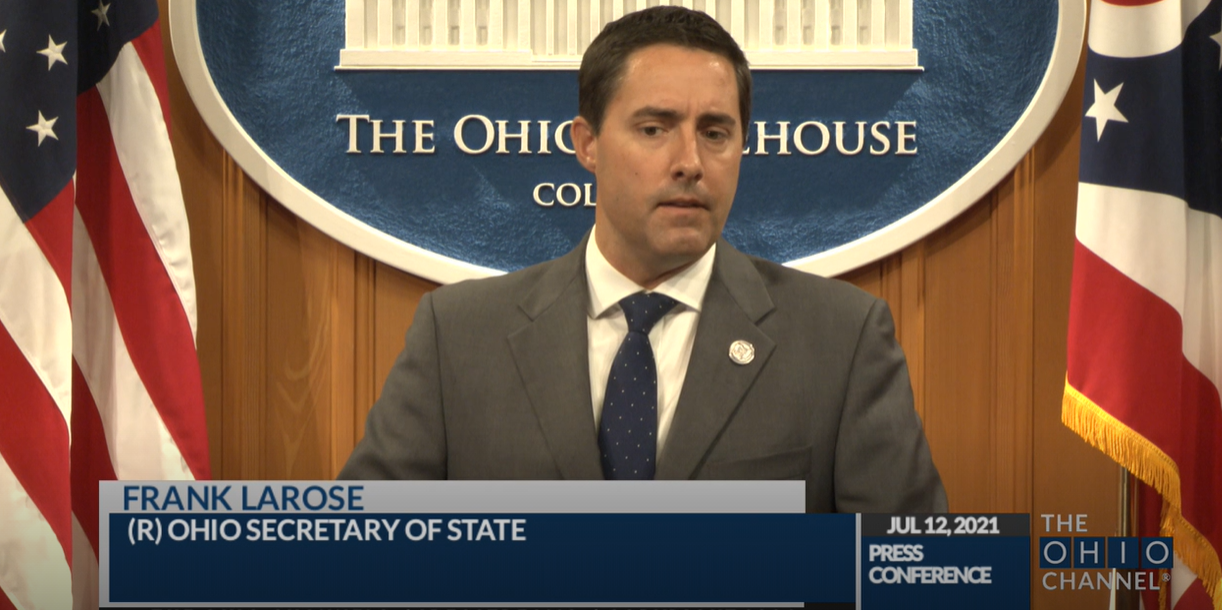
Secretary of State Frank LaRose announces the referral of 117 cases of alleged voting and voter registration fraud stemming from the 2020 elections. Photo courtesy The Ohio Channel.
Ohio Secretary of State Frank LaRose on Wednesday offered another rationale for making it much more difficult for voters to amend the Ohio Constitution. Now he’s saying it’s needed to fight a possible power grab like one that grew out of a massive bribery and money-laundering scandal.
But LaRose didn’t mention in his op-ed that his name came up repeatedly in a criminal trial related to the scandal and that he appeared to be in close communication with some of its central figures.
Nor did his office respond when asked whether LaRose ever spoke out against the corrupt utility bailout before the FBI started arresting people in July 2020.
Slippery explanations
The secretary of state — who is said to be eyeing a run for U.S. Senate next year — has been pushing to increase the portion of votes needed for a citizen-initiated amendment from 50% to 60%. As he and his allies have, they’ve given a shifting set of reasons for why that’s needed.
Last November, during a lame-duck session of the legislature, LaRose and state Rep. Brian Stewart, R-Ashville, held a press conference saying that the change was necessary to prevent wanton amendments to the Ohio Constitution by monied special interests. But they didn’t point to any examples of how that had happened in the past.
Many suspected an ulterior motive.
LaRose sat on a Republican-dominated redistricting commission that last year ignored seven Ohio Supreme Court rulings saying that the legislative and congressional maps the commission produced violated anti-gerrymandering amendments overwhelmingly approved by Ohio voters. That prompted Maureen O’Connor, the outgoing Republican chief justice, to urge Ohioans to pass new, more-tightly written amendments this year.
Ohio was also roiled when a highly restrictive abortion law took effect last June just after the U.S. Supreme Court overturned Roe v. Wade and horror stories poured out of abortion clinics and hospitals. An effort quickly started to get an amendment on the ballot protecting abortion rights after other protections easily passed in other states.
But at last year’s presser, LaRose denied that his goal was to block anti-gerrymandering or abortion-rights amendments. The constitutional change he was advocating was a long-term, fundamental one that he didn’t seek to block such short-term disputes, he claimed.
Just weeks later, however, Stewart, LaRose’s sidekick at the presser, sent a letter to his GOP colleagues in the House explaining the real reasons for making it harder for Ohioans to amend their constitution: to stop abortion-rights and anti-gerrymandering amendments that appear to be favored by strong majorities of Ohioans.
[/vc_column_text][vc_raw_html]JTNDYmxvY2txdW90ZSUyMGNsYXNzJTNEJTIydHdpdHRlci10d2VldCUyMiUzRSUzQ3AlMjBsYW5nJTNEJTIyZW4lMjIlMjBkaXIlM0QlMjJsdHIlMjIlM0VIZXJlJTI2JTIzMzklM0JzJTIwdGhlJTIwZnVsbCUyMGxldHRlci4lMjBJdCUyMGFsc28lMjB0aWVzJTIwdGhlJTIwaXNzdWUlMjB0byUyMHJlZGlzdHJpY3RpbmclMjByZWZvcm0lMkMlMjBhbmQlMjByZXNwb25kcyUyMHRvJTIwdGhlJTIwb3JnYW5pemVkJTIwbGFib3IlMjBncm91cHMlMjB0aGF0JTIwcmFsbGllZCUyMGF0JTIwdGhlJTIwT2hpbyUyMFN0YXRlaG91c2UlMjB5ZXN0ZXJkYXkuJTIwJTNDYSUyMGhyZWYlM0QlMjJodHRwcyUzQSUyRiUyRnQuY28lMkZpbGhXTFBpV00wJTIyJTNFcGljLnR3aXR0ZXIuY29tJTJGaWxoV0xQaVdNMCUzQyUyRmElM0UlM0MlMkZwJTNFJTI2bWRhc2glM0IlMjBBbmRyZXclMjBUb2JpYXMlMjAlMjglNDBBbmRyZXdKVG9iaWFzJTI5JTIwJTNDYSUyMGhyZWYlM0QlMjJodHRwcyUzQSUyRiUyRnR3aXR0ZXIuY29tJTJGQW5kcmV3SlRvYmlhcyUyRnN0YXR1cyUyRjE2MDMxMzAzODQ3NDQ1MzQwMTYlM0ZyZWZfc3JjJTNEdHdzcmMlMjU1RXRmdyUyMiUzRURlY2VtYmVyJTIwMTQlMkMlMjAyMDIyJTNDJTJGYSUzRSUzQyUyRmJsb2NrcXVvdGUlM0UlMjAlM0NzY3JpcHQlMjBhc3luYyUyMHNyYyUzRCUyMmh0dHBzJTNBJTJGJTJGcGxhdGZvcm0udHdpdHRlci5jb20lMkZ3aWRnZXRzLmpzJTIyJTIwY2hhcnNldCUzRCUyMnV0Zi04JTIyJTNFJTNDJTJGc2NyaXB0JTNF[/vc_raw_html][vc_column_text]The attempt to rush a bill through lame duck last year failed.
Now Stewart, LaRose and their allies are trying to pass it through Ohio’s now-unconstitutionally gerrymandered legislature. If it passes, it would put the measure requiring 60% of the vote to amend the state constitution on the ballot. And, since the vote would be under the existing rules, it would require just 50% of the vote to pass.
Also on the pile of accusations that it’s a naked power grab is that LaRose, Stewart and their allies want to put the measure on the ballot in a low-turnout August election. They’re doing so just months after passing a bill that had LaRose’s support to eliminate such elections as costly and unnecessary — and three months before the abortion amendment is expected to hit the ballot.
A new reason
While he’s being accused of attempting a power grab, LaRose says he’s trying to stop them.
On Tuesday, The Columbus Dispatch published an op-ed in which he furnished yet another reason to make it harder for voters to change the state Constitution. He cited an attempt by former House Speaker Larry Householder to pass an amendment changing the state’s term limits so Householder could stay speaker for another 16 years.
It was part of a breathtaking scheme in which Householder and his allies took more than $61 million from Akron-based FirstEnergy and other utilities, used the money to make him speaker in January 2019, and then pass and protect a $1.3 billion ratepayer bailout that mostly went to FirstEnergy.
Fresh off the passage of the bailout, Householder raised millions in early 2020 from FirstEnergy and AEP for his scheme that would allow him to stay longer in office. But it died with his arrest that July.
It might seem ironic that LaRose would use a corruption scandal to gut a 1912 reform measure that was aimed at curbing corrupt, unresponsive government, but that’s what he argued. He said all it takes to change the Constitution now “is a well-funded, dishonest political campaign and a simple majority vote.”
LaRose added that Householder planned to call his tenure-extension scheme “Ohioans for Legislative Term Limits, a deceptive name for a constitutional amendment that would more than double his term in office. It should come as no surprise that FirstEnergy Corporation, the company at the center of Householder’s racketeering scandal, agreed to bankroll the amendment campaign.”
Significant omissions
While he accused his opponents of “hysterical hyperbole” as he tries to make it 20% harder for voters to succeed in the already difficult process to amend the Ohio Constitution, there were some important things LaRose didn’t say in his Op-Ed.
For starters, FirstEnergy didn’t only bankroll Householder in 2018 as the now-convicted former speaker elected a team of lieutenants who would hand him the speaker’s gavel. The utility also bankrolled LaRose to the tune of $25,000 that year as he ran for secretary of state.
It was part of nearly $50,000 that the energy company — which signed a deferred prosecution agreement in the Householder scandal — has given LaRose, the campaign-finance tracker FollowTheMoney.org reports.
And while LaRose is decrying the bailout now that there have been arrests and convictions, there was reason to know there was something wrong with it well before they took place.
Insiders knew that somebody was burying Capitol Square in cash throughout the 2019 passage of House Bill 6, the corrupt utility bailout. That was especially true as FirstEnergy dumped what the FBI later determined was $36 million into a blatantly-dishonest-but-successful fight to beat back a repeal.
Because the funds were non-disclosable 501(c)(4) dark money, it was impossible for the public to know exactly where they were coming from until the feds stepped in and used subpoenas and other special powers to find out.
But HB 6 was such bad legislation and the campaign to stop the repeal so over-the-top that there was plenty of reason to suspect that somebody was being bought off to pass it. It was a massive corporate bailout that Householder and others were trying to officially declare a tax. Republican lawmakers who didn’t want to cast such a damaging vote described withering pressure from House leadership.
Former friends
LaRose’s office didn’t answer Wednesday when asked if the secretary of state ever spoke out against HB 6 before the FBI started making arrests.
In the Cincinnati corruption trial that ran from late January to mid-March, federal prosecutors presented several communications to the jury that might indicate that LaRose was actually sympathetic to the effort to pass and protect the corrupt bailout.
On July 23, 2019, as the repeal effort got underway, text messages flew between two prominent figures in the scandal: Matt Borges, the former Ohio Republican Party chairman who was convicted along with Householder; and Juan Cespedes, a lobbyist who pleaded guilty and cooperated with prosecutors.
Borges told Cespedes he had received “a message from the secretary of state on the ballot-measure issue.”
The men were hoping for help from LaRose. He’s chairman of the Ohio Ballot Board, which, along with Attorney General Dave Yost, has to approve the language of constitutional amendments before they’re circulated for the hundreds of thousands of needed voter signatures — and before they’re placed on the ballot.
In the case of the HB 6 repeal, Yost initially sent the language back for revisions, then he and the ballot board approved it. But that wasn’t before the original 90 days opponents had to gather the signatures was whittled down to 53.
In the end, time ran out before opponents could gather them. But at the beginning of the effort, Borges seemed to be talking to LaRose about what LaRose needed in exchange for his help.
“LaRose is expecting us to be publicly supportive of him,” Borges said. “Apparently petitioners (for the repeal of HB 6) are going to call on him to step down from the ballot board because of ‘conflicts.’ He can be our friend in this process, so let’s be prepared to speak for him.”
Continuing communication
Later in the repeal fight, FirstEnergy’s two top executives discussed asking LaRose’s help with Yost. In addition to hamstringing the petition effort, supporters of the corrupt bailout wanted to have it officially declared a tax, and thus legally exempt from repeal.
“I’ve been asked by (subsidiary FirstEnergy Solutions) to call Frank LaRose to get Frank to call Dave Yost,” Vice President Michael Dowling texted CEO Chuck Jones, according to messages put into evidence by prosecutors. “If Frank tells Yost that he believes HB 6 is a tax, Yost will come out publicly and say it, which (FirstEnergy Solutions) thinks helps with the Supreme Court. Frank is reluctant to make the call. I have a call in to Frank and I will ask him to do it.”
LaRose may have been reluctant about making that call. But he apparently wasn’t reluctant to keep talking to the people who funded the scandal he’s now condemning and using as a reason to make it harder for voters to amend the Ohio Constitution.
In October 2019 — shortly before the repeal effort failed — Jones sent a text to John Kiani, the chairman of the FirstEnergy subsidiary that was to receive $1 billion of the bailout. It indicated that both LaRose and Householder had been providing the FirstEnergy CEO with “private” information on the repeal effort.
“For what it’s worth, LaRose and Householder think it’s game over,” Jones told Kiani. “But that is a private conversation unless they’ve told you the same thing. And Householder has a ‘quick fix’ anyway.”
And then in November 2019 — just after the repeal failed — other messages indicated that LaRose wanted to cement a relationship with Kiani, the hard-charging former Enron executive whom Cespedes testified stood to make $100 million off the sale of FirstEnergy’s bailed-out nuclear and coal plants.
Borges texted Cespedes that LaRose, “told me he wants to get to know Kiani, and I said, ‘Are you sure about that?’”
Cespedes replied, “He will live to regret that.”[/vc_column_text][/vc_column][/vc_row]
____________________________________
MARTY SCHLADEN
Marty Schladen has been a reporter for decades, working in Indiana, Texas and other places before returning to his native Ohio to work at The Columbus Dispatch in 2017. He’s won state and national journalism awards for investigations into utility regulation, public corruption, the environment, prescription drug spending and other matters.

















 MARTY SCHLADEN