WASHINGTON — President Joe Biden, who has repeatedly been criticized as slow to respond to a widely expected U.S. Supreme Court decision that ended the nationwide right to an abortion, signed an executive order Friday that could preserve some access to abortion in states where the procedure remains legal.
Biden in a White House speech also brought up the case of a 10-year-old rape survivor from Ohio who was forced to travel out of state to access abortion care in Indiana, questioning if that’s actually the will of a majority of the state’s residents.
“Does anyone believe that it’s Ohio’s majority view that that should not be able to be dealt with? Or in any other state in the nation? A 10-year-old girl should be forced to give birth to a rapist’s child?” Biden said. “I can tell you that I don’t. I can’t think of anything that’s much more extreme.”
Ohio Republican Gov. Mike DeWine declined to comment on the state law’s impact in the case this week, saying he had read about it in the paper. He did say he found it “gut-wrenching” that a man raped a child.
Biden, who began his speech from the White House’s Roosevelt Room more than 30 minutes late by talking about the morning’s jobs report, said the fastest way to reestablish nationwide protections for abortion is by voting in November’s midterm election.
“Based on the reasoning of the court, there is no constitutional right to choose — the only way to fulfill and restore that right from women in this country is by voting,” Biden said. “We need two additional pro-choice senators and a pro-choice House to codify Roe at federal law.”
Biden acknowledged the frustration and anger many abortion rights advocates and Democrats expressed after he gave a speech the day of the Supreme Court decision, calling on Americans to vote on the issue in November.
He doubled down on that message during his remarks Friday, saying the Supreme Court opinion in the case, Dobbs v. Jackson Women’s Health Organization, “made clear it will not protect the rights of women.”
“It’s my hope and strong belief that women will in fact turn out in record numbers to reclaim the rights that have taken from them by the court,” Biden said, opting not to call on men, who are needed for pregnancy to take place, to turn out at the ballot box.
Executive order
Biden’s executive order would direct the U.S. Health and Human Services secretary to make sure abortion medication “is as widely accessible as possible,” according to a White House fact sheet.
The president has also “asked the Chair of the Federal Trade Commission to consider taking steps to protect consumers’ privacy” when seeking information about abortion services and will request HHS “consider additional actions” to protect “sensitive information related to reproductive health care.”
As part of those efforts, the administration has posted websites to try to help patients protect information their cell phones may store about reproductive health care and about the type of health care records that are protected under the federal law known as the Health Insurance Portability and Accountability Act, or HIPAA.
The White House is hoping to combat misinformation that has become more common since the Supreme Court’s ruling, with Biden directing the HHS secretary, the attorney general and chair of the Federal Trade Commission “to consider options to address deceptive or fraudulent practices, including online, and protect access to accurate information.”
The executive order, Biden said, would direct the federal government to look into tech privacy.
“Now when you use a search engine, or the app on your phone, companies collect your data, they sell it to other companies and even share it with law enforcement,” Biden said. “There’s an increasing concern that extremist governors and others will try to get that data off of your phone, which is out there in the ether, to find what you’re seeking, where you’re going and what you’re doing with regard to health care.”
House to vote on abortion access
The Democratic-controlled U.S. House is set to vote on two bills next week addressing abortion access, though it’s unlikely either will get past the U.S. Senate’s legislative filibuster.
The first bill, the Women’s Health Protection Act of 2022, would reestablish a nationwide right to an abortion. The second bill, the Ensuring Access to Abortion Act of 2022, would block state governments from making abortion travel illegal and protect health care providers in states where the procedure remains legal.
Congress is also slated to have a series of hearings on the impact of the Supreme Court’s decision to overturn Roe v. Wade, including next week in the U.S. Senate Judiciary Committee as well as the Senate Health, Education, Labor and Pensions panel.
Washington state Democratic Sen. Patty Murray, chair of the HELP panel, said in a written statement Friday following Biden’s speech that while the executive order is an important step, the “fight is far from over.”
“The reality is that the President’s executive authority is limited — so the surest way to protect every woman’s right to abortion is electing two more pro-choice Democratic senators and protecting our pro-choice majority in the House so that we can codify Roe,” Murray said.
Protesters gathered at the statehouse to voice opposition to the Dobbs decision overturning Roe v. Wade. (photo by Nick Evans)
The Ohio Supreme Court has denied an attempt by abortion clinics to stop a six-week abortion ban from being enforced.
In a Friday ruling, the court denied a motion for an emergency stay of Senate Bill 23, legislation signed into law in 2019 that banned abortion up to six-weeks gestation.
The lawsuit is still ongoing, but denial of the emergency stay means abortion clinics won’t be able to conduct abortions past six weeks as the case continues. The announcement did not indicate whether the denial was unanimous.
The court asked for responses by Thursday to the lawsuit’s request to stay the law, and received briefs from state officials, prosecutors and academics.
In a “friend of the court brief” filed Thursday, professors of public health, sociology, epidemiology and public affairs from The Ohio State University and the University of Cincinnati joined with the ACLU and Planned Parenthood in pushing for an end to Senate Bill 23, which was implemented on Friday, hours after the U.S. Supreme Court overturned Roe v. Wade.
“Instead of reflecting the Ohioan majority view that supports abortion rights, SB 23 caters to the minority fraction of Ohioans that are unsupportive of these rights,” the brief states.
The researchers cite polling data on support of abortion rights from three different universities: Suffolk University, Baldwin Wallace University and Quinnipiac University. All of the surveys found a majority of survey-takers supported abortion rights, and the professors argued that the polls proved that public opinion is on the side of abortion rights.
“While abortion attitudes arise out of complex combination of interlocking feelings toward gender, religion, politics, morality, science and many other facets, SB 23 allows from none of this nuance,” the professors wrote.
Prosecutors from Cuyahoga County and Franklin County aren’t going to stand in the way of the lawsuit. Both Michael O’Malley and Gary Tyack filed documents with the court saying they “do not oppose” granting an emergency stay of the law.
O’Malley previously signed on to a letter with other national prosecutors and attorneys pledging not to enforce abortion bans following the Supreme Court decision.
Attorney General Dave Yost also responded to the lawsuit, calling the request for emergency stay of the law “substantively and procedurally flawed,” citing the Roe v. Wade ruling last week in Dobbs v. Jackson Women’s Health Org.
“With this holding, the court extricated itself from having to repeatedly decide policy matters that the Constitution leaves to the states and the political branches,” Yost wrote.
Any contention that Ohio’s constitution holds the right to abortion is “indefensible,” the attorney general stated, “no matter the theory of constitutional interpretation one might embrace.”
Doctors fighting to keep their patients alive are worried about new abortion-related paperwork and legal advice that would hold up necessary care for their patients.
Consulting lawyers and keeping complicated documentation is a part of life now that the U.S. Supreme Court overturned Roe v. Wade and Ohio put a six-week abortion ban in place.
“If (patients) are in the midst of a pregnancy loss and a heartbeat is present… we then have to do the same paperwork for someone who was having an elective termination (abortion),” said Dr. Amy Burkett, an OB/GYN hospitalist in Northeast Ohio.
Doctors face potential criminal charges and risks to their medical licenses because of what they say are unclear regulations and specifications on abortion. Beyond that, the changes to the health care landscape nationally and in Ohio create an environment where doctors who know a pregnancy isn’t viable may have to watch a parent carry the pregnancy anyway.
“Being forced to go down the path is just an unequivocal nightmare, especially if you think of someone going through an entire pregnancy against their will when they know the fetus is going to die,” said Dr. David Hackney, maternal fetal medicine specialist in the Cleveland area, and chair of the American College of Obstetrics and Gynecologist’s Ohio chapter.
Hackney, who works with high risk pregnancies and diagnoses birth defects, said abortion bans can increase the complication rate in pregnancies merely by increasing the number of pregnancies coming to term.
Abortion for *lethal* fetal anomalies is now *illegal* in Ohio
I’m a high-risk obstetrician here. I diagnose birth defects
So some point soon I may look someone in the eyes & say that they, against their will, will carry to term, undergo delivery & then have their child die
— David N Hackney MD, FACOG (@DavidNHackney) June 27, 2022
As Roe v. Wade was overturned Friday and Ohio implemented its six-week abortion ban, Hackney was on call, and went to sleep that night unsure how he would proceed with medical care the next day.
“It’s a Friday night, and all of a sudden the legal ground has changed entirely beneath my feet,” Hackney said.
With cases that can include time-sensitive care and bleeding that must be dealt with urgently, Hackney said not having a plan in place can cause distractions with dangerous impacts on infant and parent health. That plan may now have to include referrals to other health systems, and even other states for legal options.
“When it comes to a lot of these legal issues, the most important thing to have is a plan before something awful happens,” Hackney said. “We are even now still working out the details and trying to figure out processes.”
Abortion bans could have impacts on pregnancy-related procedures that have nothing to do with abortion as well, according to doctors. Dr. Tom Burwinkel, a reproductive endocrinologist who also works on in-vitro fertilization, says bills like HB 598 — a proposed complete abortion ban in Ohio — could cause legal confusion and liabilities for facilities storing embryos or working with those embryos.
Because the bill, which is currently sitting in a House committee, says an “unborn child” is defined at the time of fertilization, embryos that are damaged even accidentally or through natural occurrences in the IVF process could be held against the doctors conducting the work.
“If we have embryos stored and something happens to the liquid nitrogen tanks, are the physicians and the people that own the facilities on the hook for the loss of thousands of embryos?” Burwinkle posed.
Though IVF isn’t impacted by the six-week abortion ban, Burwinkle worries about the future of the IVF field and other pregnancy medicine, as laws and bills in the state focus on ideological ideas of life rather than the medicine involved.
“Obviously the legislature wants to take things a step further … and that’s somebody imposing their religious beliefs on others. I thought this country was founded on religious freedoms,” Burwinkle said.
Comments made by U.S. Supreme Court Justice Clarence Thomas in support of overturning Roe v. Wade are giving physicians further reason to be concerned about the future of gynecology, especially contraceptives.
Burkett said it’s important for the public to understand that contraceptives are not considered abortion medication, even as legislation might couple things like Plan B with abortion-inducing drugs, and misinformation exists coupling IUDs with abortion.
“IUDs are not considered abortion medications,” Burkett said. “Plan B is also not considered an abortion medication. Neither are medically considered abortifacients.”
Misinformation about contraceptives does not just impact the public who may not have done enough research, but a part of legislation sponsored by non-medical professionals who may not be listening to the medical community. Hackney said ACOG representatives are always willing to serve as a resource for legislators.
“In general, most of this legislation happens without meaningful, or certainly not with mainstream medical input,” Hackney said.
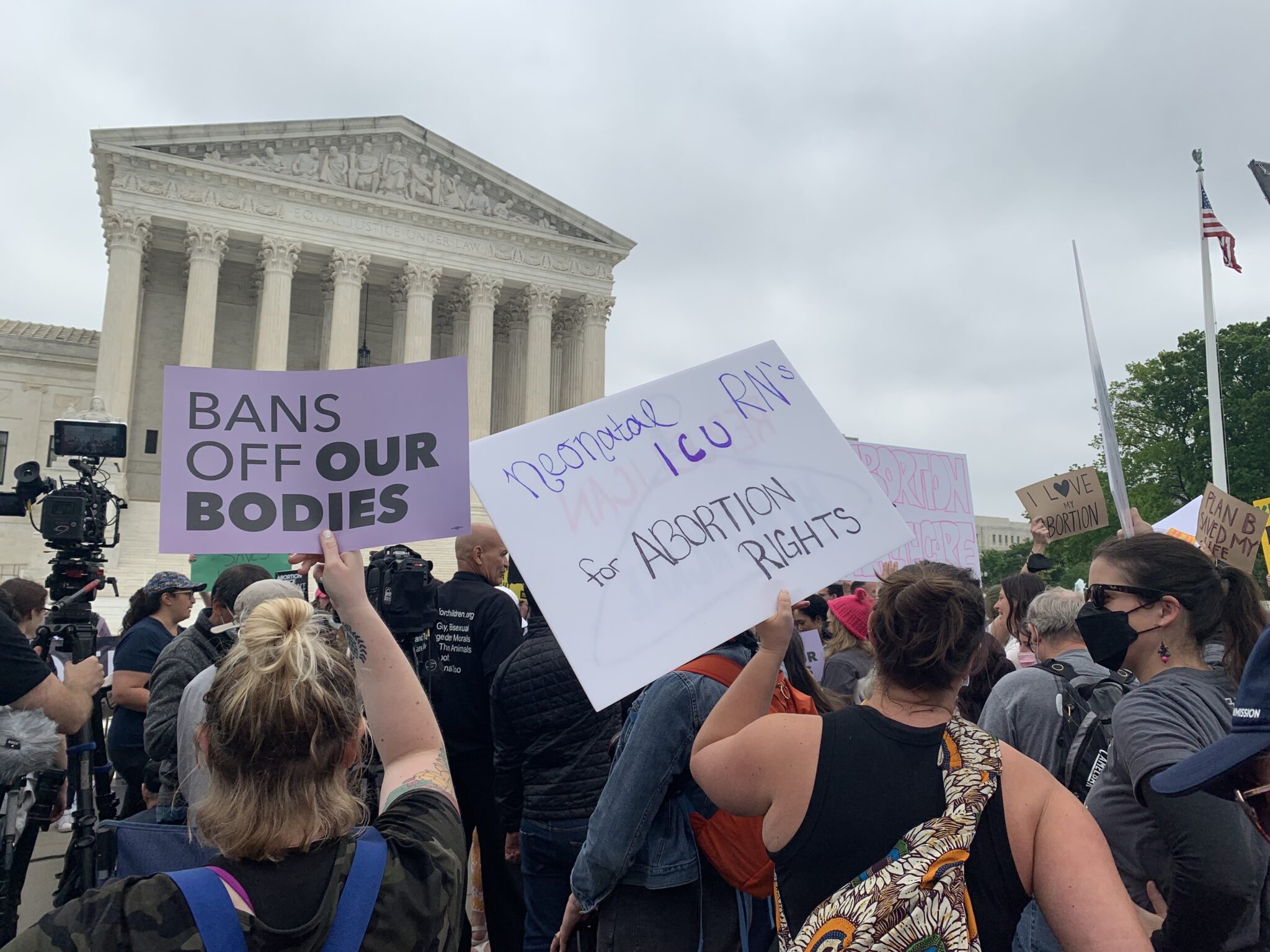
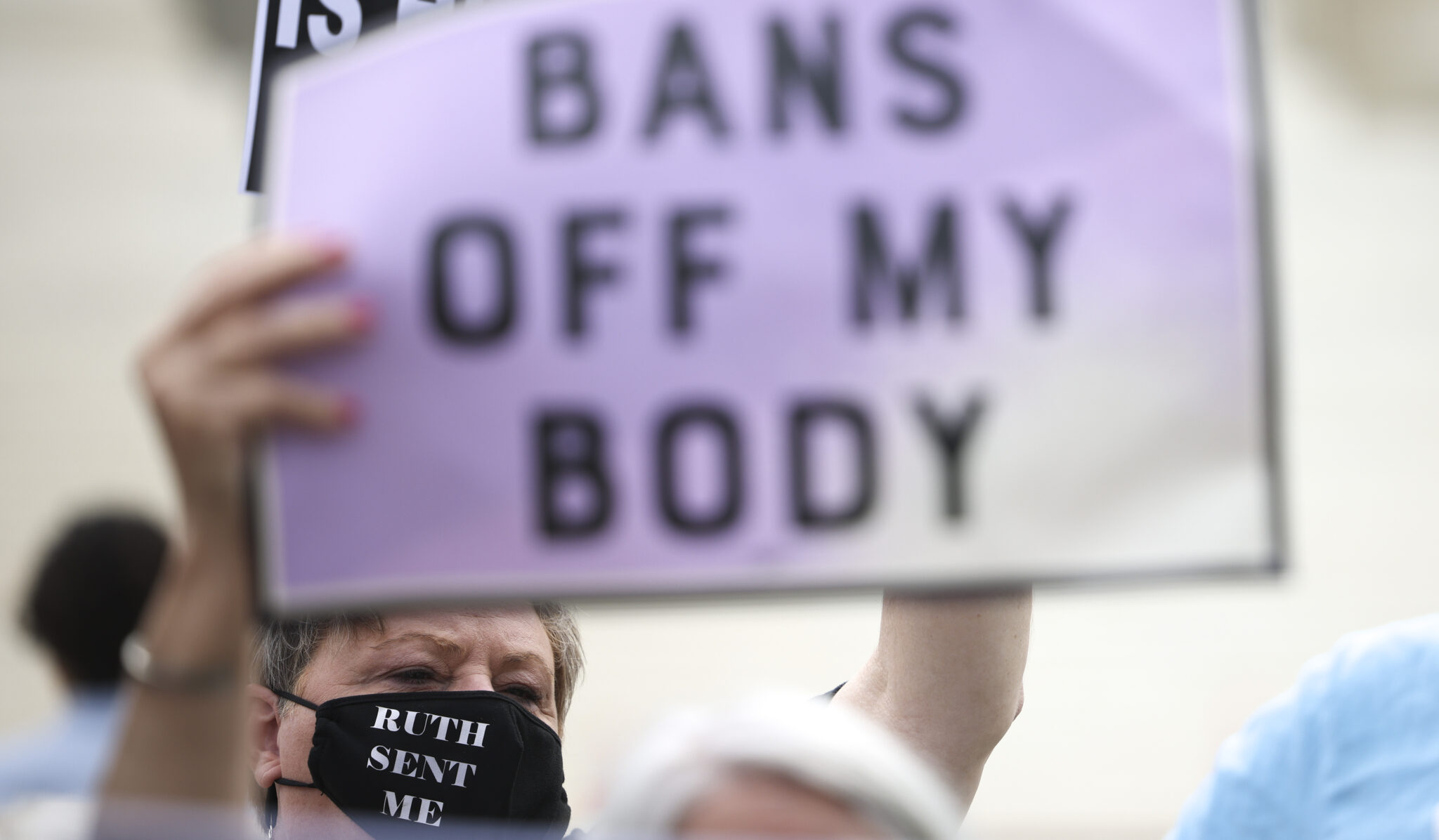
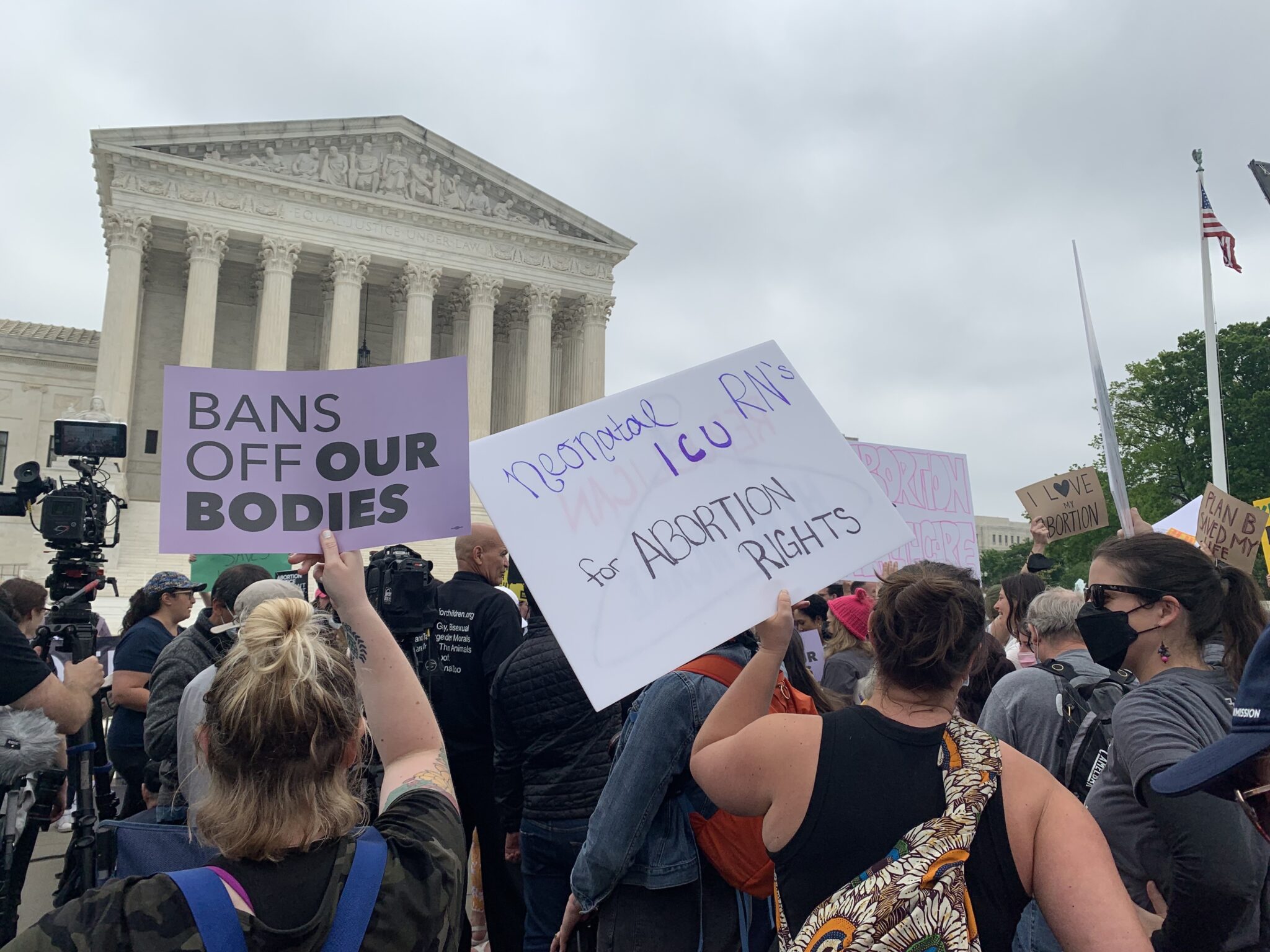
Over the weekend protesters rallied in demonstrations large and small voicing their opposition to the U.S. Supreme Court’s decision overturning Roe v. Wade.
The Attorney General
Saturday afternoon a couple dozen people gathered near the end of a sleepy street in Beechwold. Demonstrators brought bullhorns, pots and pans, even a vuvuzela, and organizers handed out pamphlets describing what areas are and aren’t public property. Then they marched up a narrow side street to Attorney General Dave Yost’s home.
Protesters demonstrating outside the home of Attorney General Dave Yost. (Photo by Nick Evans, OCJ.)
“After his workday, he comes home, kicks his feet up, has real nice evening,” organizer Mandy Shunnarah-Reed told the group before they set out. “Meanwhile, the rest of us have to live with the consequences of the decisions he’s made about our bodies and our livelihoods, 24-7, 365. We don’t get to just not worry about it, because it’s not business hours.”
“So that is why we are annoying him on a Saturday,” she said.
The group grew to about 50 and they made a racket of chants, whistles and smashing cookware at the foot of Yost’s driveway while a security agent from the AG’s office looked on. The cacophony was short lived though — after about twenty minutes they learned Yost wasn’t home.
Some Ohioans employed similar tactics to voice opposition to COVID-19 restrictions and to intimidate then-health director Amy Acton early in the pandemic. But Katie McKeel and her husband John were quick to draw a distinction.
Katie carried a sign that read “my body, my rights, my vote, my voice will be heard in 2022.” But the “22” was taped on. She first made the sign in 2018 for the women’s march in Washington D.C.
“If my right to my choice and my self-autonomy and what I do with my own body is not as important as the airspace of our elected officials, I find that to be completely out of whack,” Katie said.
“We haven’t threatened Dave Yost. Amy Acton got death threats,” John chimed in. “That’s a big difference.”
Christy Williams came to the protest with her daughter, and she argued that banning abortions won’t reduce the number that occur, it will just make them more dangerous. Like the McKeels, she believed their right to protest should take precedence.
“This is a civil right,” she said. “You can do this.”
The Statehouse
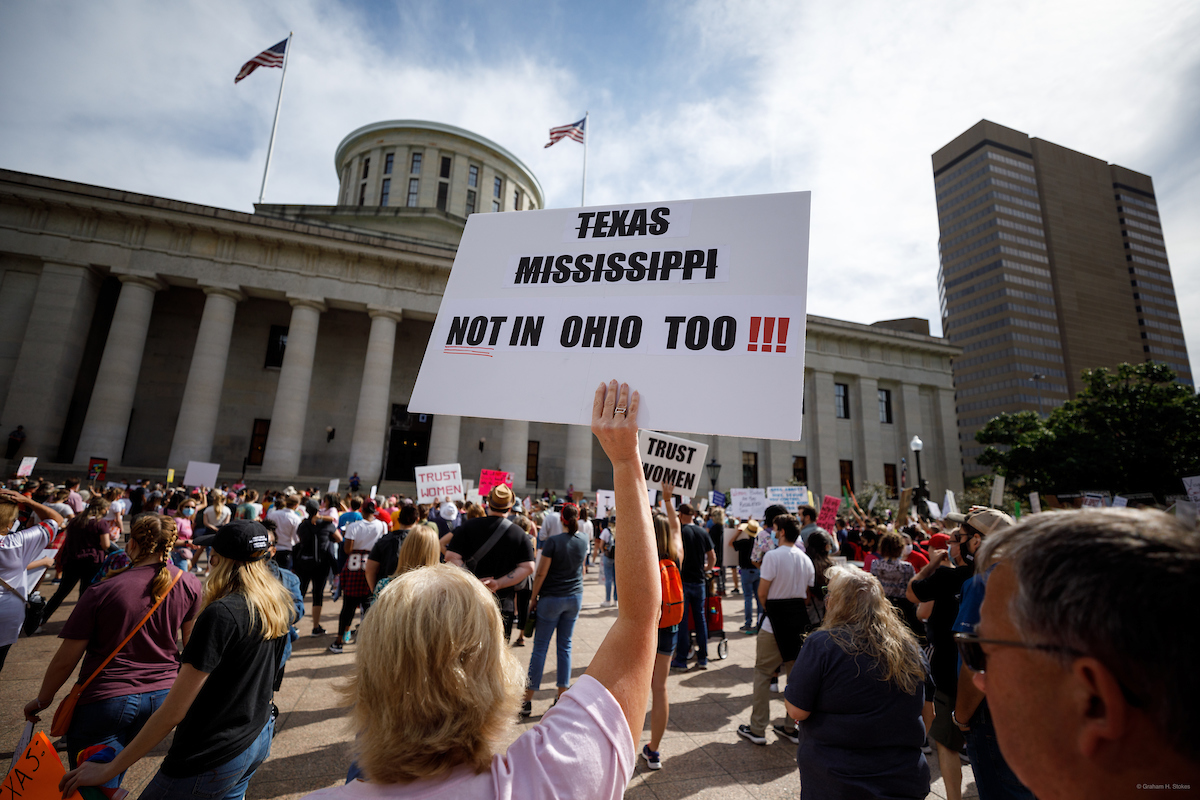
Sunday morning thousands of people turned up at the Statehouse for a rally put on by the Ohio Democratic Party. Notably, although not surprisingly, many of the groups spanned generations. Mothers with daughters and even granddaughters showed up together waving handmade signs. Picking up on that, U.S. Sen. Sherrod Brown noted up he was there with his wife, his daughters and grandkids. Brown told the crowd “we need a plan,” and argued for electing two new Democratic U.S. Senators and maintaining the Democratic majority in the House.
“If we can carry out this plan, by this time next year the Senate and the House of Representatives will have codified Roe v. Wade,” Brown argued.
The problem is, picking up Senate seats while keeping the House is a pretty tall order for a midterm election amid persistent inflation. The court’s decision to overturn Roe surely changes the political calculus, but it’s unclear how much.
The other issue, as people like Nina Turner have pointed out, is that Democrats already have control of all the levers of power they need to codify abortion protections — they simply haven’t acted because some Democratic senators oppose ending the filibuster.
Speaking afterward, Brown acknowledged some members of his caucus are “not in the right place” when it comes to the filibuster, but he insisted with two new members the party would act.
“If we have two more Democrats, we will change the filibuster rules, so that a majority can speak,” Brown said. “All we’re asking for is majority rule.”
One candidate looking to flip a Senate seat in Brown’s plan spoke to the crowd as well. Ohio Democratic U.S. Senate nominee Tim Ryan described the whiplash of marching to the Supreme Court building on Friday to protest with his 18-year-old daughter, in D.C. for an internship, alongside fellow congresswomen who were part of the fight that led to Roe in the first place.
“This is a struggle,” Ryan said. “This is a struggle for this election, and the next election, and the next election in the decades to come because we’re gonna turn this around, and we’re gonna make sure that this never happens again.”
Tim Ryan addressing the crowd outside the statehouse. (Photo by Nick Evans, OCJ.)
Ryan acknowledged afterward that some voters might feel pessimistic in light of Democrats’ unwillingness to roll back the filibuster and take action to protect abortion access at the federal level. But he urged them not to check out.
“So I would say you have a chance now,” Ryan said. “We are where we are. You have a chance to actually make that difference right here in Ohio.”
While Ryan and Brown made the case for federal action, Democratic gubernatorial nominee Nan Whaley made a more immediate, explicit argument.
“Ohio is ground zero for this fight,” Whaley insisted. “We are one of the largest states in the country where abortion is on the ballot.
Whaley called Gov. Mike DeWine the “most anti-choice governor in the country” and chastised him for urging people to be civil in the wake of the decision. What’s civil about taking away rights, forcing women to maintain a pregnancy or risk dying on an operating table she asked.
Like Brown and Ryan she drew a bright line from the court decision to the ballot box.
“This is not a drill. This is not a hypothetical,” Whaley told the crowd. “Our lives and our children’s lives are on the line. I refuse to go back and I know I am not alone.”
Now that Roe v. Wade has been overturned by the U.S. Supreme Court, the Ohio legislature is set up to move forward with abortion bans in the state.
The U.S. Supreme Court ruled Friday morning that “The Constitution does not confer a right to abortion; Roe and Casey are overruled; and the authority to regulate abortion is returned to the people and their elected representatives.”
Legislative leaders said they were prepared to wait until the decision was released before moving forward with legislation to eliminate abortion services. As of Friday night, abortion is legal in Ohio up to six weeks into a pregnancy.
“The most important thing that Ohioans need to know today is that abortion is still legal in Ohio,” said Kellie Copeland, executive director of Pro-Choice Ohio. “There are nine clinics across the state and several in neighboring states that can safely and legally provide abortion care for patients. Today’s ruling is devastating, but it is not the end.”
Gov. Mike DeWine agreed that it would be “prudent” to wait until the Dobbs decision was made, and implement the previously-passed six-week abortion ban before moving on to new legislation.
“While noting those conditions, the Governor has expressed support for additional legislation depending on the details of the Dobbs decision,” a spokesperson for DeWine told the OCJ.
The Ohio Policy Evaluation Network, a group of researchers working with The Ohio State University, the University of Cincinnati and Case Western Reserve University, said in a fact-sheet that it expects Ohio to ask for immediate implementation of the six-week abortion ban enacted in 2019.
The ban does not include exceptions for rape or incest, and only allows doctors to present an “affirmative defense,” legal arguments that could only come into play after a doctor has been charged with an offense, if the life of the pregnant person was at risk at the time of the abortion. The defense only works if the abortion happened in a hospital, and does not allow for risks that involve mental health.
Columbus-area OB/GYN Dr. Anita Somani said a ban at six weeks could eliminate the chance of an abortion before a pregnant person is aware of the pregnancy.
“If you don’t know you’re six-weeks pregnant, and you find out at eight or 10 weeks, then you have to look at going to a neighboring state,” Somani said. “At that point, you have to have money and time, as a patient, when you may have other children or just can’t afford it.”
The most recent abortion trigger ban, House Bill 598, was introduced by state Rep. Jean Schmidt, R-Loveland, would make abortion a fourth-degree felony, and promotion of abortion a misdemeanor offense.
The charges are targeted at the medical professionals providing the abortions, and provides no exemptions for cases of incest or rape. “Affirmative defenses” would be allowed in cases where the pregnancy presented a serious risk to the pregnant person.
Civil lawsuits could also be filed against physicians who perform abortions under the bill, and medical licenses could be at risk.
Senate President Matt Huffman celebrated the decision as “a long overdue turning point in our nation’s history.”
“I look forward to reviewing the specific details in the opinion, so that as we move forward, any legislation we pass in the Ohio Senate follows the guidance of the court, protecting life, and upholding the Constitution,” Huffman said.
House Speaker Bob Cupp said in a Friday statement that the “process of reviewing the decision is underway, including what steps should be taken at the state level and the timeline for doing so.”
“We will be working closely with Governor DeWine, Attorney General Dave Yost and our colleagues in the Ohio Senate on this matter,” Cupp’s statement read.
DeWine has been consistently pro-life in his support of legislation and funding choices, including an executive order that allocated $3 million in Temporary Assistance for Needy Families (TANF) dollars to organizations who assisted pregnant Ohioans without promoting abortion as an option.
Attorney General Dave Yost said the decision “returns abortion policy to the place it has always belonged: to the elected policy branches of government.”
“Roe was poorly reasoned, a doctrine of shifting sands that invited perpetual litigation,” Yost said in a statement.
Meanwhile, the impacts of abortion bans in the state could create significant health care barriers and increased transportation costs to access care, according to researchers. These impacts could disproportionately impact low-income communities and people of color.
Iris Harvey, CEO and president of Planned Parenthood of Greater Ohio, said the Supreme Court decision will give politicians power over Ohio bodies, including how they receive care.
“This dangerous and chilling decision can have devastating consequences in Ohio, forcing people to travel hundreds, sometimes thousands, of miles for care or remain pregnant,” Harvey said in a statement.
WASHINGTON — The U.S. Supreme Court on Friday overturned the 1973 Roe v. Wade ruling that established abortion as a constitutional right.
The decision by five of the Court’s nine justices will allow each state to set its own abortion laws, leading to a patchwork of access throughout the country. The result is expected to be an uptick in the number of women traveling out of state for abortions, as well as unsafe abortions in states where the medical procedure will now be banned or heavily restricted.
“We hold that Roe and Casey must be overruled,” Justice Samuel Alito wrote in his opinion, joined by Justices Clarence Thomas, Neil Gorsuch, Brett Kavanaugh and Amy Coney Barrett.
Chief Justice John Roberts filed a separate opinion concurring in the judgment about the Mississippi law at the center of the case, making that a 6-3 ruling, but not about overturning the constitutional right to an abortion, making that a 5-4 ruling.
“The Constitution makes no reference to abortion, and no such right is implicitly protected by any constitutional provision, including the one on which the defenders of Roe and Casey now chiefly rely — the Due Process Clause of the Fourteenth Amendment,” Alito continued.
“That provision has been held to guarantee some rights that are not mentioned in the Constitution, but any such right must be ‘deeply rooted in this Nation’s history and tradition’ and ‘implicit in the concept of ordered liberty.’”
Justice Stephen Breyer wrote the dissent in the case for himself, Elena Kagan and Sonia Sotomayor.
“With sorrow — for this Court, but more, for the many millions of American women who have today lost a fundamental constitutional protection — we dissent,” he wrote.
The new status of abortion access on a state-by-state basis, Breyer wrote , “says that from the very moment of fertilization, a woman has no rights to speak of. A State can force her to bring a pregnancy to term, even at the steepest personal and familial costs.”
Breyer later added, “Whatever the exact scope of the coming laws, one result of today’s decision is certain: the curtailment of women’s rights, and of their status as free and equal citizens.”
Twenty-two states have laws that would restrict when and how a patient can terminate a pregnancy, according to the Guttmacher Institute, a reproductive health and rights organization.
Arizona, Michigan and Wisconsin are among the 10 states that have pre-Roe abortion bans that are now expected to take effect. Thirteen states — including Idaho, Louisiana, Missouri and Tennessee — have laws enacted since Roe that will be “triggered” by the court’s decision.
A dozen states, including Maine, Maryland, Nevada and Washington, have laws that would protect abortion access up to the point of viability, usually 22 to 24 weeks into a pregnancy.
Colorado, the District of Columbia, New Jersey, Oregon and Vermont have laws that protect abortion access throughout a pregnancy, according to the Guttmacher Institute.
Thomas targets birth control, same-sex marriage
Justice Thomas wrote his own concurring opinion, arguing that since the court has overturned the constitutional right to an abortion, which was grounded in the 14th Amendment and the due process clause, other cases that have been rooted in the same right to privacy could all be reconsidered.
Those include:
The Griswold v. Connecticut case from 1965 that said states couldn’t bar married couples from making private decisions about birth control use.
The Lawrence v. Texas case from 2003 that said states couldn’t criminalize consensual sexual relations between same-sex partners.
The Obergefell v. Hodges case from 2015 that legalized same-sex marriage.
“For that reason, in future cases, we should reconsider all of this Court’s substantive due process precedents, including Griswold, Lawrence, and Obergefell,” Thomas wrote.
Thomas also wrote of the Dobbs case that “The resolution of this case is thus straightforward. Because the Due Process Clause does not secure any substantive rights, it does not secure a right to abortion.”
Reaction pours in
The Center for Reproductive Rights, which brought the case to the Supreme Court, rebuked the Republican-nominated justices for ending the right to an abortion.
“The Court’s opinion delivers a wrecking ball to the constitutional right to abortion, destroying the protections of Roe v. Wade, and utterly disregarding the one in four women in America who make the decision to end a pregnancy,” said Nancy Northup, president and CEO of the Center for Reproductive Rights.
“Utter chaos lies ahead, as some states race to the bottom with criminal abortion bans, forcing people to travel across multiple state lines and, for those without means to travel, carry their pregnancies to term — dictating their health, lives, and futures. Today’s decision will ignite a public health emergency,” Northup continued.
Susan B. Anthony Pro-Life America, an anti-abortion group, celebrated the decision, while its president called for “an entirely new pro-life movement” to begin.
“Today’s outcome raises the stakes of the midterm elections. Voters will debate and decide this issue and they deserve to know where every candidate in America stands,” Marjorie Dannenfelser said in a statement. “Federal as well as state lawmakers must commit to being consensus builders who advocate for the most ambitious protections possible.”
Mississippi ban
The court heard two hours of arguments in December in Dobbs v. Jackson Women’s Health Organization, which arose after Mississippi enacted a law that banned the vast majority of abortions after 15 weeks of pregnancy.
U.S. Solicitor General Elizabeth B. Prelogar, who argued on behalf of the federal government as a “friend of the Court,” said that the “real-world effects of overruling Roe” and the 1992 Planned Parenthood v. Casey decision that affirmed the right to an abortion “would be severe and swift.”
“Nearly half of the states already have or are expected to enact bans on abortion at all stages of pregnancy, many without exceptions for rape or incest,” Prelogar said. “Women who are unable to travel hundreds of miles to gain access to legal abortion will be required to continue with their pregnancies and give birth, with profound effects on their bodies, their health and the course of their lives.”
Mississippi Solicitor General Scott G. Stewart argued the nine justices should not only uphold Mississippi’s 2018 law, which had yet to go into effect, but overturn the two cases that have kept abortion access legal for nearly 50 years.
“Roe versus Wade and Planned Parenthood versus Casey haunt our country,” he said. “They’ve poisoned the law.”
Abortion rights history
The Supreme Court first ruled that a pregnant person has a constitutional right to abortion in the 1973 Roe v. Wade case that stemmed from a Texas woman being unable to access an abortion in her home state. The decision was 7-2.
Justice Harry Blackmun wrote that the right to an abortion stemmed from the right to privacy under the 14th Amendment. But the court ruled that a person’s fundamental right to terminate their pregnancy must be weighed against the government’s interest in protecting the person’s health and potential life.
The court established a trimester framework that determined when and how governments could impose regulations on abortion access.
In the 1992 Planned Parenthood v. Casey case, a 5-4 ruling, the court upheld a constitutional right to an abortion. But the decision overturned the trimester framework, instead setting viability, about 22 to 24 weeks into a pregnancy, as the line for government regulation.
The court said a person had a right to an abortion before viability without undue interference from the government. After reaching a point of viability, states can regulate abortion as long as it doesn’t affect a person’s health or life.
In the plurality opinion, Justice Sandra Day O’Connor wrote that “Some of us as individuals find abortion offensive to our most basic principles of morality, but that cannot control our decision. Our obligation is to define the liberty of all, not to mandate our own moral code.”
In a dissenting opinion, Justice Thomas wrote for himself, Antonin Scalia and two others that they would have overturned Roe v. Wade, saying the issue in the case was “not whether the power of a woman to abort her unborn child is a ‘liberty’ in the absolute sense; or even whether it is a liberty of great importance to many women. Of course it is both.”
“The issue is whether it is a liberty protected by the Constitution of the United States. I am sure it is not,” he wrote.
Will court survive a ‘stench’?
During oral arguments in December in the Mississippi case the justices ruled on Friday, Justice Sotomayor expressed concern over how the court overturning cases that established abortion access as a constitutional right would impact its reputation.
“Now, the sponsors of this bill, the House bill in Mississippi, said we’re doing it because we have new justices. The newest ban that Mississippi has put in place, the six-week ban, the Senate sponsor said we’re doing it because we have new justices on the Supreme Court,” Sotomayor said.
“Will this institution survive the stench that this creates in the public perception that the Constitution and its reading are just political acts?”
Justice Kagan questioned whether the court overruling Roe and Casey would lead Americans to view the court as “a political institution that will go back and forth, depending on what part of the public yells the loudest or changes to the court’s membership.”
And Justice Breyer read from a decision the entire Supreme Court issued in Casey about when and how justices should overturn watershed cases to avoid a situation that “would subvert the Court’s legitimacy.”
“They say overruling unnecessarily and under pressure would lead to condemnation, the Court’s loss of confidence in the judiciary, the ability of the Court to exercise the judicial power and to function as the Supreme Court of a nation dedicated to the rule of law,” Breyer read.
The Mississippi law at the center of the argument allowed abortions after 15 weeks in cases of “severe fetal abnormality” or medical emergency, but it did not include exceptions for rape or incest.
At the time Mississippi Gov. Phil Bryant signed the bill in March 2018, the 15-week threshold was the earliest abortion ban in the nation.
That has since changed, with several states enacting laws restricting abortion below that benchmark, including an Oklahoma law that makes abortion a felony punishable by up to 10 years in state prison, a maximum fine of $10,000, or both.
Abortion rights organizations have filed lawsuits to stop many of those new laws from going into effect on the basis that they violated the constitutional right to an abortion that the court undid this week.
Politico leak
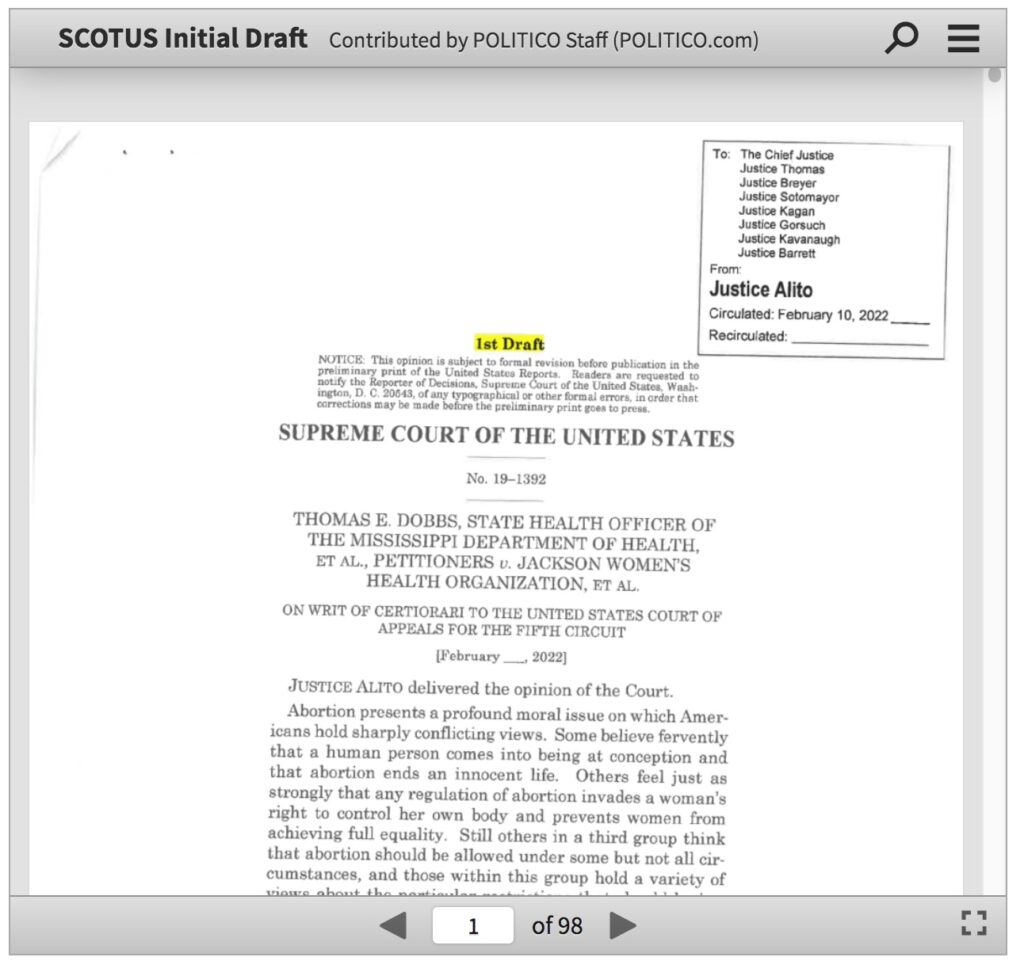
The Supreme Court majority opinion released Friday is similar to a draft version, led by Justice Alito, that was leaked to Politico in early May.
The leak was broadly criticized by Republicans, who at the time didn’t want to talk about the implications of the court overturning Roe, while Democrats rebuked the conservative justices for the expected decision.
Senate Majority Leader Chuck Schumer, a New York Democrat, held a floor vote in May on a bill that would have codified a nationwide right to an abortion.
That legislation couldn’t get past the chamber’s 60-vote legislative filibuster.
Maine Sen. Susan Collins and Alaska Sen. Lisa Murkowski, both Republicans who expressed frustration with how the Trump-nominated justices portrayed their view of Roe as a settled precedent during their confirmation processes, voted against the bill.
West Virginia Democratic Sen. Joe Manchin did as well.
Manchin said in a statement Friday that he was “deeply disappointed that the Supreme Court has voted to overturn Roe v. Wade.”
“I trusted Justice Gorsuch and Justice Kavanaugh when they testified under oath that they also believed Roe v. Wade was settled legal precedent and I am alarmed they chose to reject the stability the ruling has provided for two generations of Americans,” Manchin continued.
Ohio House legislators say the intend to flip the legislative narrative in the state, pushing for a state constitutional amendment legalizing abortion in opposition to the many bans being considered.
State Reps. Michele Lepore-Hagan, D-Youngstown, and Jessica Miranda, D-Forest Park, face a hard fight to get the measure through a General Assembly currently encompassed by a Republican supermajority, and one that has introduced multiple “trigger” bans that, if passed, would take effect in the event the U.S. Supreme Court decision in Roe v. Wade is overturned or changed.
Under the amendment, which would be voted on by Ohioans if passed by the House and Senate, surgical and medical abortion services would be cemented into the Ohio Revised Code, along with contraceptives.
The representatives said the attempt at an amendment came after a draft ruling from U.S. Justice Samuel Alito implied a future ruling that could limit or eliminate abortion legality nationwide. The opinion, though not the final opinion of the court, “presents a 50-year reversal on safe and legal access to abortion in the United States,” Lepore-Hagan and Miranda stated in announcing their proposed amendment.
“I will not stand by and allow political extremists to take us back to a time where individuals were unable to make their own health care decisions and access the care they need in their communities,” Lepore-Hagan said in a statement. “No one should be forced to carry a pregnancy against their will.”
A constitutional amendment requires a three-fifths vote of the legislature for passage, and has to be received 90 days before an election to be placed on the ballot.
A companion resolution is also planned in the state Senate, led by state Sens. Nickie Antonio, D-Lakewood and Sandra Williams, D-Cleveland. Success in the Senate would depend on Republican support, just as a win in the House would.
“In overturning a woman’s right to choose, I share the concern that we will have laid a roadmap to upend other civil rights, including protections for the LGBTQ community,” Antonio wrote in her own statement.
Sponsors of the amendment are still in the process of gathering co-sponsors, and drafting bill language, after which it will be formally introduced and moved to a committee.
WASHINGTON — U.S. Senate Democrats on Tuesday pledged a new vote codifying the right to an abortion after publication of a draft court ruling that showed the Supreme Court on track to overturn the landmark Roe v. Wade abortion decision.
Democrats, who likely won’t have the votes to advance that bill, also predicted that abortion will emerge as a major issue in the upcoming midterm elections for members of Congress.
Their comments came as abortion rights supporters across the United States reeled in reaction to the disclosure of the initial draft U.S. Supreme Court opinion, led by Justice Samuel Alito and leaked to Politico. While the court ruling is not final until published, the draft states that earlier abortion decisions “must be overruled.”
Senate Majority Leader Chuck Schumer, a New York Democrat, said Tuesday he plans to release a new bill this week that senators will vote on next week to codify Roe v. Wade.
But in the evenly divided Senate, it will run into problems getting past a legislative filibuster that requires 60 votes for legislation to advance.
Were Roe v. Wade to be struck down by the court, which is dominated 6-3 by conservatives, the question would be left up to states, and more than two dozen Republican-led states have been racing to enact abortion bans and restrictions.
Supreme Court Chief Justice John Roberts said the draft, published on Monday night, was authentic, though he cautioned it wasn’t the final opinion, and said he’d directed the Marshal of the Court to investigate the leak.
Republicans called for the Justice Department to also investigate how the draft made its way to two journalists, saying the leak was a violation of the court’s judicial process.
Roberts said the leak of the document was wrong.
“Court employees have an exemplary and important tradition of respecting the confidentiality of the judicial process and upholding the trust of the Court,” Roberts said in the statement. “This was a singular and egregious breach of that trust that is an affront to the Court and the community of public servants who work here.”
The court is expected to release its official ruling in the case, Dobbs v. Jackson Women’s Health Organization, within the next two months, though many organizations have long expected the six conservative justices to at least pare back the constitutional right to an abortion.
Democratic senators on Tuesday said a final decision undoing the constitutional right to an abortion the Supreme Court established five decades ago would be unacceptable and harmful to women.
Montana Democratic Sen. Jon Tester said letting each state, once again, set its own abortion laws would be a “step in the wrong direction.”
“I think that a woman’s right to choose, a woman’s right to make their own health care decisions is really fundamental to who we are as a nation,” Tester said.
Washington Democratic Sen. Patty Murray criticized the conservative justices for moving to undo nationwide protections for people seeking to terminate a pregnancy.
“We do not want this to become a country where women are forced to remain pregnant no matter their personal circumstances and yes, we are talking about situations like rape and incest,” Murray said.
“A country where extreme politicians will control patients’ most private decisions. A country where for the very first time ever the next generation of women will have fewer rights than their mothers.”
Michigan Sen. Gary Peters, chair of the Democratic Senatorial Campaign Committee, said abortion rights will become a “major issue” in November’s midterms elections.
“We’ve seen legislation being passed in state legislatures across the country to limit reproductive freedom for women. But there was always the belief that Roe versus Wade was there,” Peters said. “If Roe versus Wade is overturned, it’s a completely different ballgame.”
60 votes needed
In the Senate, Democrats would need 60 senators to vote to get past the legislative filibuster and actually pass legislation codifying abortion access throughout the country. Those votes would be required to end debate and move on to final passage, which is a simple majority vote.
Peters, asked if Democrats could somehow get to a 60-seat majority in the midterm elections, said “it would be pretty difficult to get there.”
While the entire U.S. House — an increasing number of whom represent gerrymandered districts — will be up for reelection in November, just one-third of the U.S. Senate will face voters.
This year that will be 35 seats, with 14 occupied by Democrats and 21 filled by Republicans.
The Cook Political Report with Amy Walter rates five of those races — Arizona, Georgia, Nevada, Pennsylvania and Wisconsin – as “toss up.” Florida, North Carolina and Ohio are classified as “lean Republican.”
Senators’ positions
Georgia Sen. Raphael Warnock said he’s going to “do everything” he can to “support reproductive rights.”
He’s one of many Senate Democrats who support eliminating the filibuster.
“No Senate procedure should get in the way of basic civil rights — voting rights, reproductive rights,” Warnock said.
Arizona Democratic Sen. Mark Kelly isn’t as convinced that the Senate should change its procedures, but didn’t rule out backing a change to how bills are processed.
“If there is a proposal to change the rules, I will make a decision on what is in the best interest of the country and the folks I represent in Arizona,” Kelly said.
Fellow Arizona Democratic Sen. Kyrsten Sinema doesn’t back such a change and neither does West Virginia Democratic Sen. Joe Manchin III.
That means Senate Democrats don’t have the votes during this Congress to codify abortion rights or change the rules to make it easier to pass abortion rights legislation.
If Democrats lose control of the Senate following the midterm elections, Republicans are expected to keep the filibuster in place.
Minority Leader Mitch McConnell, a Kentucky Republican, said Tuesday he would “absolutely” commit to keeping it intact.
“We don’t want to break the Senate and that’s breaking the Senate,” he said.
McConnell declined to answer questions on how a final Supreme Court decision overturning Roe v. Wade would affect women throughout the country or whether he’d bring legislation to the floor to address federal abortion laws.
“All of this puts the cart before the horse,” he said.
National Republican Senatorial Committee Chairman Rick Scott, a Florida Republican senator, declined to say if the Supreme Court overturning abortion as a fundamental right would affect the election.
“I think this is an important issue to many people, but so is inflation, so is crime, so is the border,” Scott said. “So, these are important to people and people are gonna be passionate about this. And we ought to be passionate about what we believe in.”
Scott — who infuriated many fellow GOP senators earlier this year when he released an 11-point plan without leadership approval — declined to say if the GOP would try to pass a bill banning abortion nationwide if they gain control of the Senate in the midterms.
“We’ll worry about that next year,” Scott said.
‘Inconsistent’ justices
While many Senate Republicans oppose abortion rights and would support the Supreme Court overturning Roe v. Wade, two expressed frustration with the possibility.
Maine Republican Sen. Susan Collins — who voted to confirm Neil Gorsuch and Brett Kavanaugh, but not Amy Coney Barrett— said in a statement that “If this leaked draft opinion is the final decision and this reporting is accurate, it would be completely inconsistent with what Justice Gorsuch and Justice Kavanaugh said in their hearings and in our meetings in my office.”
Collins declined to answer reporters’ questions throughout the morning, simply saying she’d released a statement.
Alaska GOP Sen. Lisa Murkowski — who supported Gorsuch and Barrett, but not Kavanaugh — told reporters that certain justices voting to overturn precedent would erode her confidence in the court.
“If in fact this draft is where the Court ends up being, it has rocked my confidence in the court. That is because I think there were some representations made with regards to precedent and settled,” said Murkowski. “Comments were made to me and to others about Roe being settled and being precedent.”
When the Senate took a procedural vote in February on a House-passed bill that would codify the right to an abortion, Collins, Murkowski and Manchin all voted against moving to final passage.
Schumer said he expects a new vote could be different from the one taken just over two months ago.
“It’s a different world now, the tectonic plates of our politics on women’s choice and on rights in general are changing,” Schumer said.
“Every senator, now under the real glare of Roe v. Wade being repealed by the courts, is going to have to show which side they’re on. And we will find the best way to go forward after that. But don’t think that what happened two (months) ago will be exactly the same.”
Ohio Gov. Mike DeWine signed a new abortion law on Wednesday that looks likely to close Southwest Ohio abortion clinics.
DeWine signed Senate Bill 157 without further comment, along with several other bills that passed through the legislature in their last work week before the holidays.
The bill was condemned by abortion providers, who said not only that portions of the bill that direct doctors on the amount of care they should give babies born as a result of a “failed abortion” are already part of medical oaths and Ohio law, but that the bill would impact wanted pregnancies in which complications become a factor.
“At this moment, we’re at a crisis point for abortion access in Ohio and across the country,” said Kersha Deibel, CEO of Planned Parenthood Southwest Ohio. “…Stripping abortion care from Southwest Ohio will cause havoc that disproportionately impacts our communities.”
The Southwest Ohio region of Planned Parenthood also opposes the legislation because of changes to hospital transfer variance agreements between abortion providers and physicians, prohibiting for doctors who are funded by Ohio’s public medical schools from participating.
“There is no medical justification for disallowing qualified, experienced physicians from agreeing to provide backup coverage for abortion providers under a variance,” said Dr. Adarsh Krishen, chief medical officer for Planned Parenthood of Greater Ohio. “In fact, if the state was genuinely concerned for patient safety, such physicians would be ideal. Instead, this provision is only meant to make it more challenging for abortion providers to remain licensed and operational.”
The religious policy lobby Center for Christian Virtue praised the law and the potential shut down of Women’s Med Center in Dayton and Planned Parenthood of Southwest Ohio’s clinic, saying the state “has made a bold statement about where our values lie.”
DeWine did not comment on the bill with his announcement that the bill had been signed.
The bill is one of a few pieces of abortion legislation brought by the legislature this year. Another measure would make abortion illegal with the rollback of the U.S. Supreme Court decision in Roe v. Wade.
Jean Schmidt representing the Loveland Area is a co-sponsor
A new abortion ban bill created in conjunction with a Virginia-based anti-abortion group has been introduced in Ohio that mimics a Texas law currently before the U.S. Supreme Court, but goes further by proposing to ban nearly all abortions.
State Rep. Jena Powell, R-Arcanum, introduced House Bill 480 on Tuesday, which allows civil lawsuits against anyone who “knowingly engages in conduct that aids or abets the performance or inducement of an abortion,” including paying for an abortion even through the use of insurance, according to the language of the bill. State Rep. Thomas Hall, R-Madison Twp., is also a sponsor.
State Rep. Jena Powell, R-Arcanum
The bill allows a defense against civil action for abortions “designed or intended to prevent the death of a pregnant mother and the physician made reasonable medical efforts under the circumstances to preserve both the life of the mother and the life of her unborn child in a manner consistent with conventional medical practice.”
In announcing the bill, Powell called the 1973 Roe v. Wade U.S. Supreme Court decision that legalized abortion nationwide a “constitutional fiction,” saying her bill “utilizes the enforcement mechanism from the successful Texas Heartbeat Act,” currently under court challenge with the U.S. Supreme Court.
State Rep. Thomas Hall, R-Madison Twp.
While the Texas case revolves around the detection of a noise during ultrasounds early in pregnancy that doctors describe as electric activity and anti-abortion advocates call a heartbeat — a characterization physicians say is inaccurate — Powell’s proposed legislation has no such standard and would constitute a near total abortion ban. With 33 Republican cosponsors alongside the two sponsors, support for the bill represents more than half the GOP caucus.
The bill comes after Powell spoke at a Los Angeles event for the Arlington, Virginia-based anti-abortion non-profit LiveAction, which said they are partnering with “leaders across the nation starting with Representative Powell” in conjunction with the launch of their campaign.
“The campaign, which kicked off in front of thousands at the Santa Monica Pier, aims to ensure every American knows that abortion is the leading cause of death for children, and to ultimately save every child,” LiveAction said in a press release about the bill.
The CDC does not list abortion as a leading cause of death for children from age 1 to 14 years old. It lists accidents, “congenital malformations, deformations and chromosomal abnormalities” and cancer as the leading causes for children from age 1 to 9, with intentional self-harm (suicide) replacing congenital issues as a leading cause for children 10 to 14 years old.
Ohio’s 2020 abortion report from the Ohio Department of Health showed 20,605 abortions in 2020, more than half of which were induced at less than nine weeks gestation. Of the 441 abortions induced in 19 or more weeks gestation, none were considered viable in medical testing, including ultrasounds.
Abortion is legal in Ohio up to 22 weeks gestation.
Planned Parenthood Advocates of Ohio say banning abortion would be catastrophic to communities across Ohio.
“Lawmakers and anti-abortion vigilantes have no business making personal medical decisions for their neighbors,” said Lauren Blauvelt-Copelin, Vice President of Government Affairs and Public Advocacy for PPAO.
Advocacy group NARAL Pro-Choice Ohio said the bill would have “dangerous” impacts on already marginalized communities in the state, and continue a targeted trend for elected officials in the state.
“If all dominos fall in the wrong direction, abortion could be illegal in Ohio by July,” said NARAL executive director Kellie Copeland in a statement. “Every pro-choice Ohioans must register and vote.”
The bill has all-Republican support, which gives it better odds of passage with the legislature’s Republican supermajority.
The abortion ban is one of several pieces of abortion legislation making their way through Ohio’s General Assembly. A “trigger” bill that would ban abortion if Roe v. Wade is overturned is currently in Senate committee, and a bill targeting what sponsors called “failed” abortions, a statistically rare occurrence in Ohio, passed through the state Senate, and is headed for House consideration.