Tag: Tigers

  • “Pandemic Preparedness and Planning” report for Loveland Middle School

    “Pandemic Preparedness and Planning” report for Loveland Middle School

    Loveland, Ohio – Here are the “Pandemic Preparedness and Planning” reports for the Loveland Middle School that were obtained through a public records request to the District.

    Loveland Magazine asked the Superintendent to provide Loveland Magazine with the report “Pandemic Preparedness and Planning” that LJB Inc. prepared for the District. LJB was awarded a contract in July for $66,250 for “Pandemic Preparedness and Planning” services. The report was prepared under the previous CDC definition of “close contact”.

    Also read: “Pandemic Preparedness and Planning” reports for Loveland Intermediate School


  • COVID-19 up-date for Loveland’s 3 counties

    COVID-19 up-date for Loveland’s 3 counties

    Loveland, Ohio –  Although Hamilton County is no longer listed on Ohio’s watch list to turn PURPLE, there are still serious concerns about spread of the coronavirus new health data compiled by the Ohio Department of Health reveals.

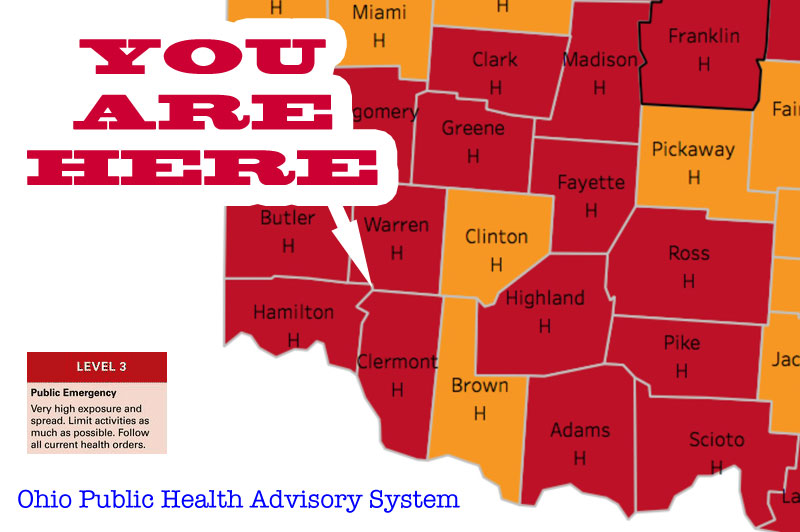
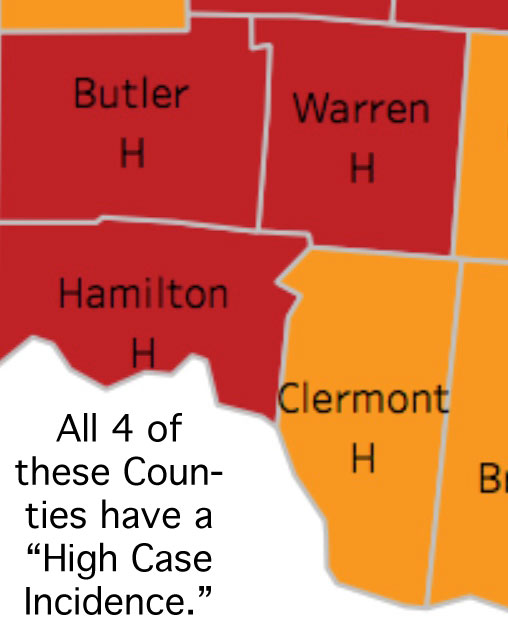
    Clermont County is now a RED County.

    Hamilton County remains RED.

    Warren County remains RED.

    Level 3 (RED) on the Risk Level Indicator means there has been a public emergency declared and there is very high level of spread and exposure in the county.

    The Ohio Department of Health guidance in a RED county is to:

    • Conduct a daily health/symptom self-evaluation and stay at home if symptomatic.

    • Maintain social distancing of at least 6 feet from non-household members.

    • Wear face coverings in public, especially when social distancing is difficult to maintain.

    • Increase caution when interacting with others not practicing social distancing or wearing face covers.

    • Avoid traveling to high-risk areas.

    • Follow good hygiene standards, including:

    Wash hands frequently with soap and water for at least 20 seconds.

    Use hand sanitizer frequently.

    Avoid touching your face.

    Cover coughs or sneezes (e.g., into a tissue, or elbow).

    Symptom self-evaluation monitoring.

    • Avoid contact with anyone who is considered high-risk.

    • High-risk individuals should take extra care to follow precautions.

    • Decrease in-person interactions outside household.

    • Seek medical care as needed, but limit or avoid unnecessary visits to hospitals, nursing homes, and residential care facilities to see others as much as possible.

    • Decrease in-person interactions with others
    • Consider necessary travel only
    • Limit attending gatherings of any number

    Forty-three Ohio counties currently have a very high risk of exposure and spread (Red Level 3), up from 38 counties last week. This represents the highest number of Red Level 3 counties since the launch of the advisory system in July. As of today, 78 percent of Ohioans are living in a Red Level 3 county. Less than 1 percent of Ohioans live in a Yellow Level 1 county.

    “The virus is raging throughout the state, and there is no place to hide,” said Governor DeWine today. “We must face this virus head-on with the tools that we know can beat this virus back: masks, social distancing, washing hands frequently, and good ventilation when inside.”

    DeWine announced today that Ohio has now hit a record number of cases reported in a single 24-hour period. Between yesterday and today, health officials have reported a total of 3,590 new positive coronavirus cases in Ohio which is more than 700 cases more than the previous high number of cases reported last Saturday. A total of 194 new hospitalizations were also reported in the past 24 hours, the third-highest number of hospitalizations reported in a single day so far.

    Meanwhile, the Loveland School District reported today that they were notified that two more Loveland High School students have tested positive for COVID-19. One student was last at school on Thursday, 10/22/20, and the other on Monday, 10/26/20. (Also read: COVID-19 Positive Cases in Loveland Schools)

    Loveland PK-8 grades are in the “Full Capacity” mode of attendance for students not enrolled in the remote academy. Loveland High School remains in a blended mode of attendance for students not enrolled in the remote academy.

    COVID-19 Case Rates Per County as of Oct. 28, 2020


    County

    Color

    Cases Per 100 K

    Case Count

    Population

    Clermont
    RED (H)
    219.9

    454

    206,428

    Hamilton
    RED (H)
    261.4

    2,137

    817,473

    Warren
    RED (H)
    303.5

    712

    234,602

    “H” indicates there is “High Incidence”
    The 14-day period used for this table covers data from Oct. 14 to Oct. 27. The data were pulled on Oct. 28 and exclude incarcerated individuals.
    Source: Ohio Disease Reporting System (ODRS). Population from 2019, U.S. Census Bureau.

    There are currently 96 Clermont County cases in the 45140, 45147, and 45150 Zip Code areas. Forty have died in Clermont County and there are 340 current active cases.

    Hamilton County is reporting that there have been 320 cases in the 45140 Zip Code. There are currently 177 cases in the county and 235 deaths recorded. The 7-day average for new cases is 177.

    In Warren county there are currently 295 hospitalizations and 642 new cases in the last 14 days. Sixty-six have died and 3 have died in the last 14 days. There is an average of 72 new cases per day in the county. No zip code level data is available for Warren County.

    (While the city of Loveland lies partially in Clermont County, the city’s public health services are contracted with Hamilton County Public Health. So, if a resident lives in the city of Loveland and tests positive for COVID-19, that case would be counted in Hamilton County Public Health’s statistics, not Clermont County’s.)

    Per CDC

    Among adults the risk for severe illness from COVID-19 increases with age, with older adults at highest risk. People of any age with the following conditions are at increased risk of severe illness: chronic kidney disease; chronic obstructive pulmonary disease; weakened immune system from solid organ transplant; obesity (body mass index of 30 or higher); serious heart conditions such as heart failure, coronary artery disease, or cardiomyopathies; Sickle cell disease; and Type 2 diabetes mellitus.

    Children who are medically complex, who have neurologic, genetic, metabolic conditions, or who have congenital heart disease are at higher risk for severe illness from COVID-19 than other children.

    People who need to take extra precautions include racial and ethnic minority groups; people experiencing homelessness; women who are pregnant or breastfeeding; people with disabilities; and people with developmental and behavioral disorders.

    More information is available at https://www.cdc.gov/coronavirus/2019-ncov/need-extra-precautions/index.html.

  • COVID-19 Positive Cases in Loveland Schools

    COVID-19 Positive Cases in Loveland Schools

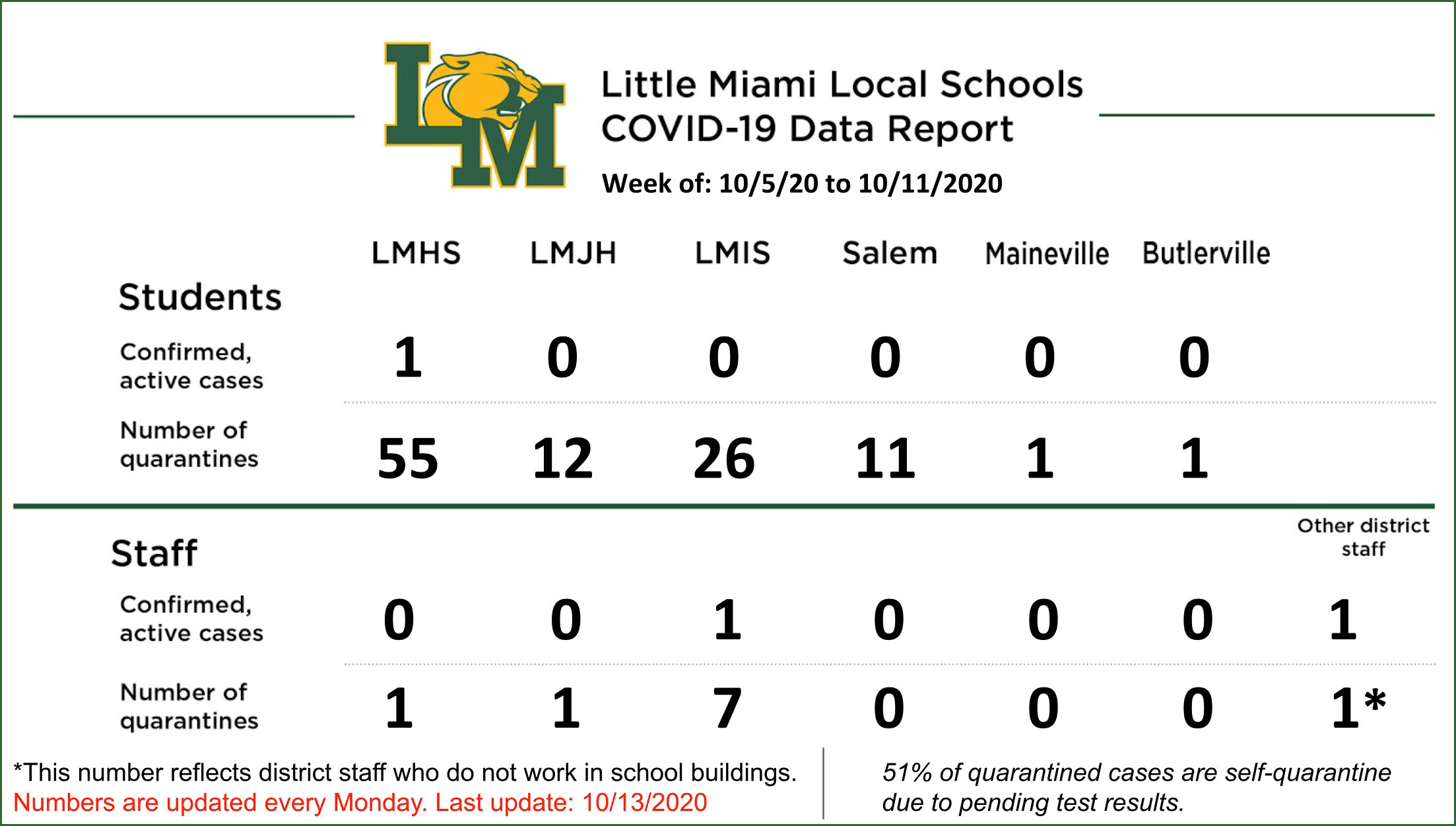
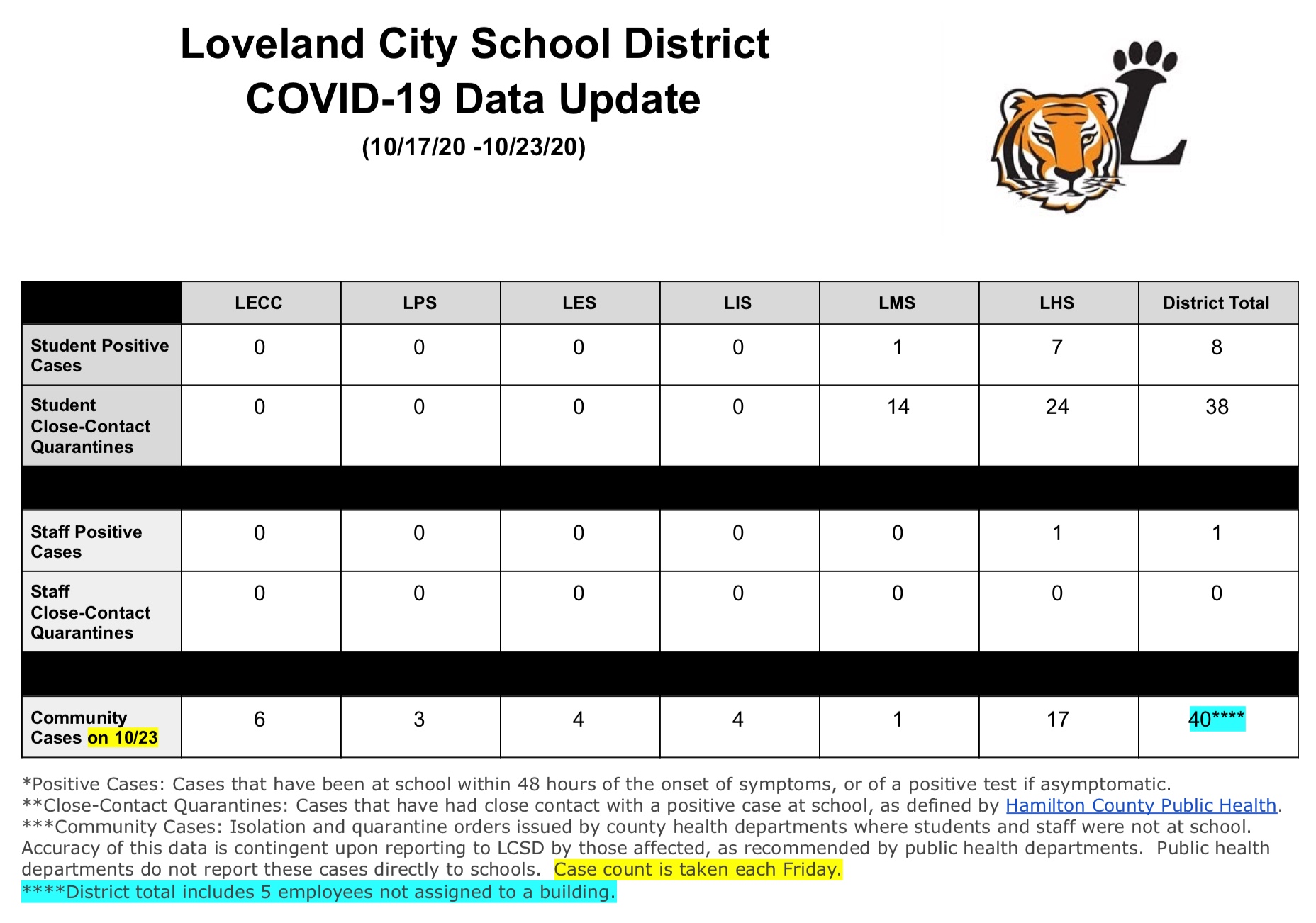
    Loveland, Ohio – The Loveland School District sends notification when positive COVID 19 cases are reported to District officials. They only release quarantine numbers on Fridays.

    In the evening of Wednesday, 10/21/20, the district was notified that one student at Loveland High School tested positive for COVID-19. This student was last present at school on Saturday, 10/17/20.

    On Thursday, 10/22/20, the district was notified that one student at Loveland High School tested positive for COVID-19. This student was last present at school on Monday, 10/19/20.

    On Thursday, 10/22/20, the district was notified that one student at Loveland Middle School tested positive for COVID-19. This student was last present at school on Tuesday, 10/20/20.

    On Friday, 10/23/20, the district was notified that one student at Loveland High School tested positive for COVID-19. This student was last present at school on Tuesday, 10/20/20.

    On Friday, 10/23/20, the district was notified that one non-teaching staff member at Loveland High School tested positive for COVID-19. This staff member was last present at school on Tuesday, 10/20/20.

    On the evening of Friday 10/23/20, the district was notified that one student at Loveland High School tested positive for COVID-19. This student was last present at school on Monday, 10/19/20.

    On Tuesday, 10/27/20, the district was notified that one student at Loveland High School tested positive for COVID-19. This student was last present at school on Thursday, 10/22/20.

    On Wednesday 10/28/20, the district was notified that one student at Loveland Middle School tested positive for COVID-19. This student was last present at school on Tuesday, 10/27/20.

    On Wednesday, 10/28/20, the district was notified that two students at Loveland High School tested positive for COVID-19. One student was last at school on Wednesday, 10/21/20, and the other on Thursday, 10/22/20.

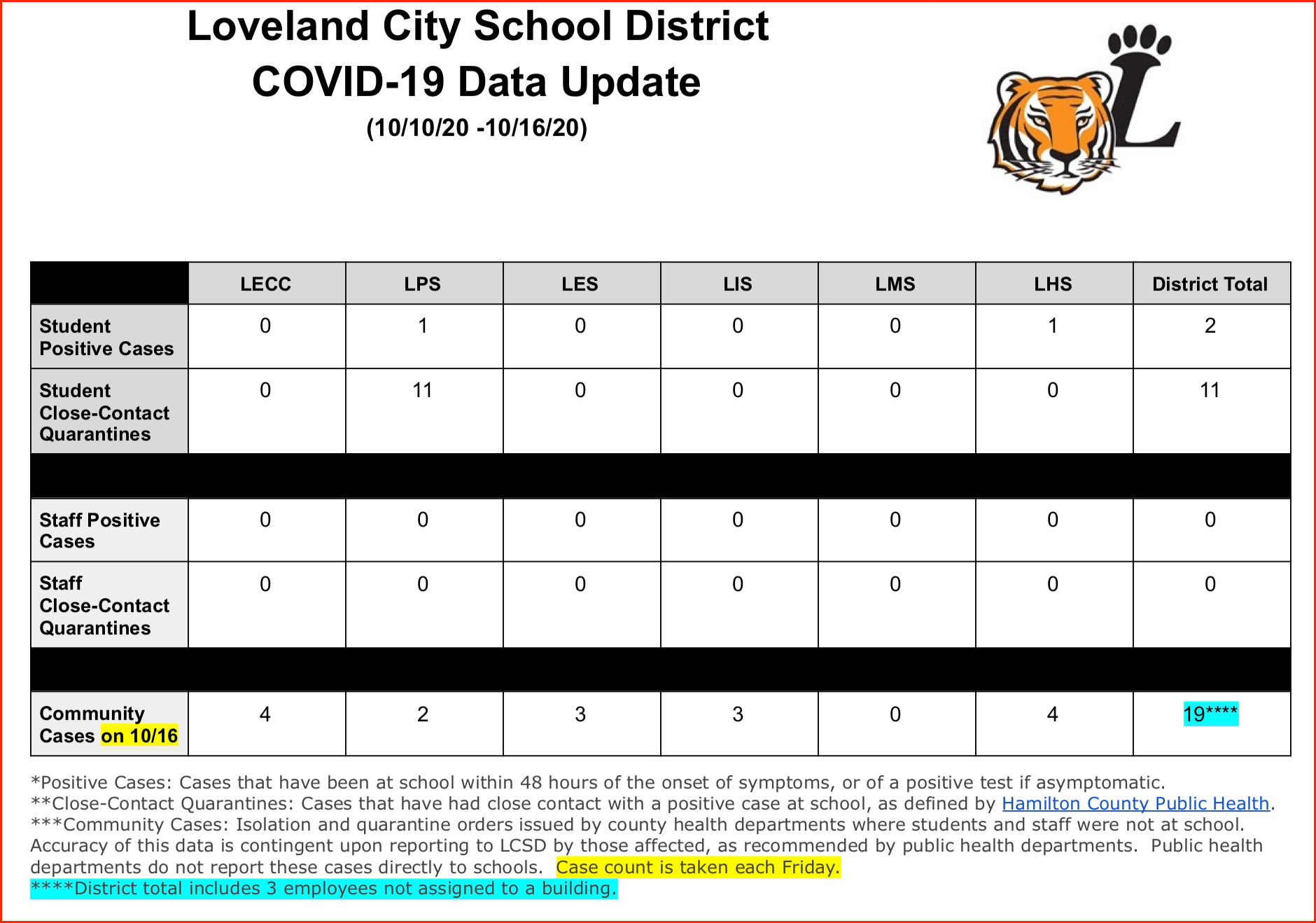
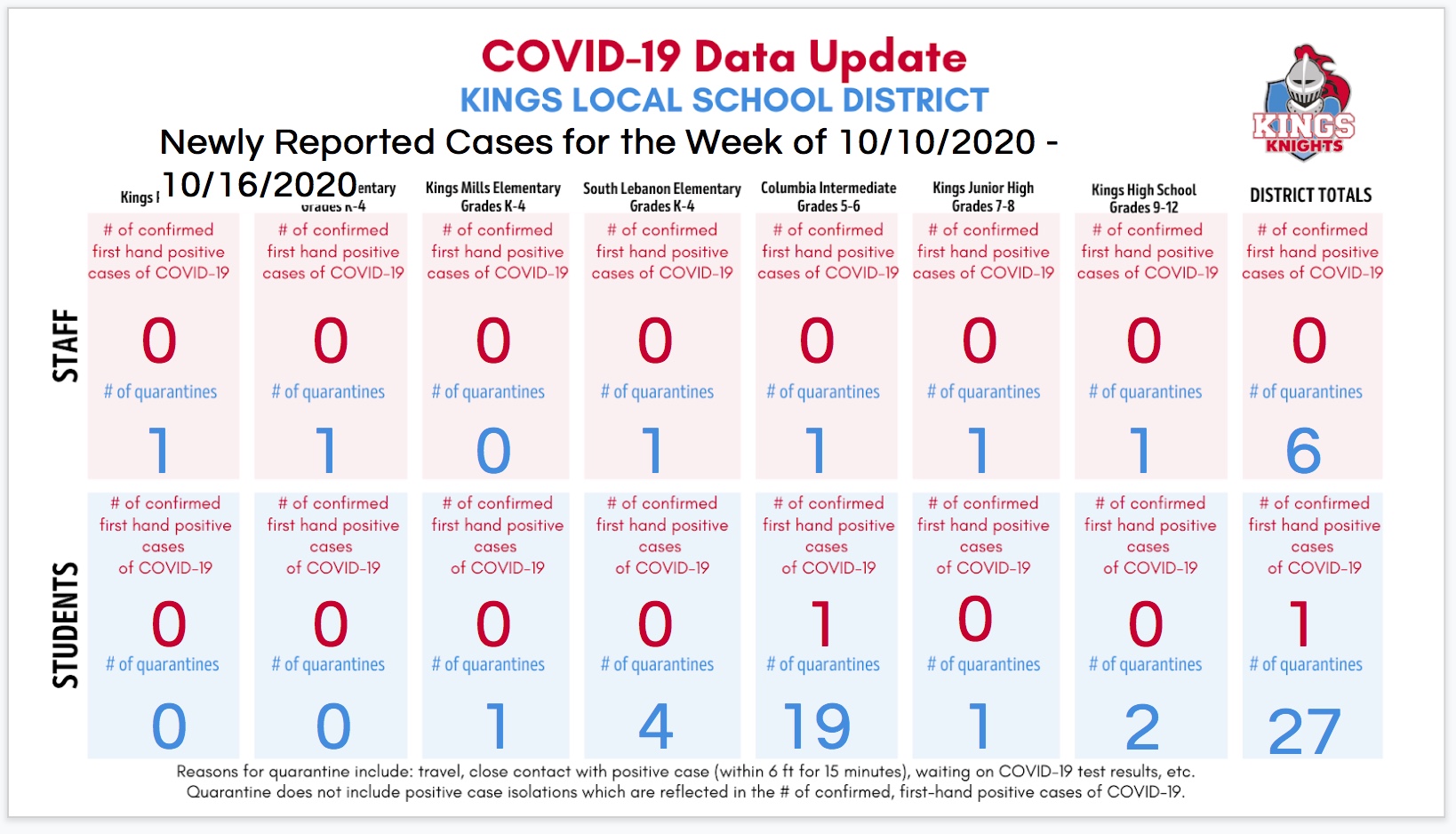
    Below is the last COVID 19 Dashboard published by the District. It was published on Friday, October 23. The District will not release another Dashboard until this Friday afternoon. (Right Click to open in a new tab to see a larger view)

  • “Pandemic Preparedness and Planning” reports for Loveland Intermediate School

    “Pandemic Preparedness and Planning” reports for Loveland Intermediate School

    Loveland, Ohio – Here are the “Pandemic Preparedness and Planning” reports for the Loveland Intermediate School that were obtained through a public records request to the District.

    Loveland Magazine asked the Superintendent to provide Loveland Magazine with the report “Pandemic Preparedness and Planning” that LJB Inc. prepared for the District. LJB was awarded a contract in July for $66,250 for “Pandemic Preparedness and Planning” services. The report was prepared under the previous CDC definition of “close contact”.

    Here is what was prepared for the Loveland Middle School

    FINAL R0119763A LIS

    DRAFT Deliverable R0119763A LIS

    0119763A LIS Cafeteria

    LIS General Classroom Room Controls-Procedures

    LIS Art Room Controls-Procedures

    LIS Boys Restroom Room Controls-Procedures

    LIS Girls Restroom Room Controls-Procedures

    LIS Cafeteria Room Controls-Procedures

    LIS Gym Room Controls-Procedures

    LIS Visit Summary and Photo Reference

  • Loveland Schools release COVID 19 up-date but won’t release the Pandemic Preparedness report

    Loveland Schools release COVID 19 up-date but won’t release the Pandemic Preparedness report

    On October 21 Loveland Magazine asked the Loveland school superintendent why they only release quarantine numbers on Fridays. She said that she has forwarded the question about quarantines and the procedures for sharing those on a single day to her health team. Loveland Magazine is awaiting the response.

    Loveland, Ohio – On Friday the Loveland School District published a new Covid-19 Data Up-Date even as in their Loveland Reopening Plan FAQs they continue to state:

    Is COVID-19 spreading in our schools?

    When positive cases have been reported to the district, there have been no instances of other students or staff becoming symptomatic or testing positive which means the virus is not being spread at school.

    And;

    What should I do if I’ve been told my child has been in close contact with someone who tested positive?

    Current Ohio Department of Health and Centers for Disease Control guidance calls for quarantine for 14 days for people who are in close contact with an infected person. Close contact is defined as being within 6 feet of a confirmed case for 15 minutes or more. Since students are not allowed to come to school when quarantined, we have grade-specific family and student instructions when quarantined information you can access here.

    And as;

    The Centers for Disease Control and Prevention (CDC) has updated language for the close contact definition, the Loveland School District continues to define “Close Contact” as being within 6 feet of a confirmed case for 15 minutes or more.

    Centers for Disease Control and Prevention (CDC) has new guidance clarifying what exactly “close contact” means when it comes to transmission of SARS-Cov-2, the virus that causes COVID-19. The previous guidance suggested that a close contact occurred when a person was within six feet of an infectious individual for 15 consecutive minutes. Now, the CDC is acknowledging that even brief contact can lead to transmission. Specifically, the new guidance suggests that those spending a total of 15 minutes of contact with an infectious person over the course of a 24-hour period should be considered in close contact. (Read full article)

    Close Contact as now defined by the CDC

    Someone who was within 6 feet of an infected person for a cumulative total of 15 minutes or more over a 24-hour period* starting from 2 days before illness onset (or, for asymptomatic patients, 2 days prior to test specimen collection) until the time the patient is isolated.

    * Individual exposures added together over a 24-hour period (e.g., three 5-minute exposures for a total of 15 minutes). Data are limited, making it difficult to precisely define “close contact;” however, 15 cumulative minutes of exposure at a distance of 6 feet or less can be used as an operational definition for contact investigation. Factors to consider when defining close contact include proximity (closer distance likely increases exposure risk), the duration of exposure (longer exposure time likely increases exposure risk), whether the infected individual has symptoms (the period around onset of symptoms is associated with the highest levels of viral shedding), if the infected person was likely to generate respiratory aerosols (e.g., was coughing, singing, shouting), and other environmental factors (crowding, adequacy of ventilation, whether exposure was indoors or outdoors). Because the general public has not received training on proper selection and use of respiratory PPE, such as an N95, the determination of close contact should generally be made irrespective of whether the contact was wearing respiratory PPE.  At this time, differential determination of close contact for those using fabric face coverings is not recommended.

    Quarantine is used to keep someone who might have been exposed to COVID-19 away from others. Quarantine helps prevent spread of disease that can occur before a person knows they are sick or if they are infected with the virus without feeling symptoms. People in quarantine should stay home, separate themselves from others, monitor their health, and follow directions from their state or local health department. (Source CDC)

    On Oct 15 Loveland Magazine asked Superintendent, Dr. Amy Crouse,”Can you tell me how the District is defining ‘Close Contact’ in the buildings, on buses, on athletic fields/athletic courts, or administrative offices?” We asked because the District moved to double the number of students in the classrooms in PK-8. Those schools returned to “full in-person” learning on Monday, October 12.

    Dr. Crouse responded, “The district maintains updated definitions and protocols on our website here:  https://www.lovelandschools.org/NewHealthProtocols.aspx. Contact tracing protocols do not change with a change in capacity. Those protocols still say, ‘Close contact is defined as being within 6 feet of a confirmed case for 15 minutes or more.”

    At the same time we asked the Superintendent to provide Loveland Magazine with the report “Pandemic Preparedness and Planning” that LJB Inc. prepared for the District. LJB was awarded a contract in July for $66,250 for “Pandemic Preparedness and Planning” services. The report was prepared under the previous CDC definition of “close contact”.

    Last Friday, following a Loveland Magazine editorial that criticized the Superintendent for not answering questions, not releasing COVID 19 quarantine data, and not releasing the LJB report, the District released a “Tiger Talk” that heavily relied on the LJB report to assure the public that the District is taking an appropriate response to the pandemic. 

    Loveland Magazine is still awaiting the LJB report and the explanation has been that it is the Business Manager’s office and Superintendent can not send it until he returns to work. Crouse sent our request for the public document to the Treasure who responded, “The documents that you are requesting are in the Business Manager’s office and he is currently out of the office. I will get them to you as soon as I can.”

    The report belongs to the public. District taxpayers funded the report and it will show what the experts recommended when they studied how many students and teachers should be in classrooms under the hybrid and full capacity models. Students, parents, teachers, staff, and the community have a right to know exactly how many students are not attending classes on a timely basis , what the quarantine guidelines are, and what the LJB report recommended at the time it was prepared .


    Tiger Talk

    News from Loveland Schools – October 23, 2020
    COVID-19 Communication

    Loveland Tiger Families,

    The decisions we are all tasked with during this difficult time provide no easy answers. We have provided weekly updates, while increasing our understanding of how this virus spreads and how to best protect the health and safety of our students, staff, teachers and community. We have many parents who have expressed their concerns about student safety, and others who want students to have the most possible access to in-class instruction.

    These decisions are not made lightly and our decision making process was developed in collaboration with outside help. This summer we contracted with LJB to gather professional health and safety expertise, work through decision-making to manage and mitigate risk, and develop a comprehensive safety plan. This plan was constructed with the goal of maintaining staff and student safety, while avoiding going fully remote.

    With their guidance and ongoing counsel, Loveland City School District was able to create and maintain a healthy and safe environment for teachers, staff and students, identify any potential health and safety hazards and make appropriate purchasing decisions for materials and supplies.

    Our work with LJB helped us reduce costs by more efficiently scheduling our existing staff which eliminated the need to hire additional cleaning staff. We increased face-to-face time during our hybrid plan by eliminating the full remote day during hybrid for cleaning. Our proactive health and safety measures were the primary reason we avoided many financial and resource strains when we began experiencing positive COVID cases and concerns. The benefits of this work are evident each day, and will continue serving us in the months ahead.

    Our goal has been to return to 5 day, in-person learning, but only if it did not present unacceptable risk levels. So far, we have moved to bring our youngest students back to 5 day, in-person learning and are currently waiting on bringing back our high school students, because of concerns around an increasing and on-going spread that is taking place outside of school involving our high school students.

    Through October 23, we have had 18 students or staff test positive for COVID-19, and that has resulted in 50 close-contact quarantines. All indications are that people are contracting COVID outside of our schools, and that because of our masking, distancing and hygiene bundle, it is not being spread inside our schools.

    Now that we have made it through the first quarter, we can see that our students are learning and performing well. Our MAP fall benchmark scores for grades 1-8 consistently show that students this fall are on par with where students were last fall. The education of our students is going strong. Students are actively participating in their areas of specialty in interest beyond the classroom, with students active in fall sports, music and performing. Clubs have started and continue to work on creative ways to provide the full Tiger experience for our students and families.


    COVID-19 Update From the District COVID-19 Update Newsletters
    • In the evening on 10/23/20, the district was notified that a student at Loveland High School tested positive for COVID-19. This student was last present at school on Monday, 10/19/20.
    • On 10/23/20, the district was notified that a student at Loveland High School tested positive for COVID-19. This student was last present at school on Tuesday, 10/20/20.
    • On 10/23/20, the district was notified that a non-teaching staff member at Loveland High School tested positive for COVID-19. This staff member was last present at school on Tuesday, 10/20/20.
    • In the evening on 10/21/20, the district was notified that a student at Loveland High School tested positive for COVID-19.
    • On 10/22/20, the district was notified that a student at Loveland High School tested positive for COVID-19.
    • On 10/22/20, the district was notified that a student at Loveland Middle School tested positive for COVID-19.
    • In the evening on 10/19/20, the district was notified that a student at Loveland High School tested positive for COVID-19.
    • On 10/20/20, the district was also notified that two additional students at Loveland High School tested positive for COVID-19.
    • On 10/19/20, the district was notified that a student at Loveland High School tested positive for COVID-19.
    • On 10/13/20, the district was notified that a student at Loveland High School tested positive for COVID-19.
    • The district was notified that a student at Loveland Primary School tested positive for COVID-19.
    • On Thursday, 10/8/20, the district was notified that a student at Loveland High School tested positive for COVID-19.
    • On Tuesday evening, 10/6/20, the district was notified that two students at Loveland High School tested positive for COVID-19.
    • On Sunday, 10/4/20, the district was notified that a non-teaching staff member at Loveland Elementary School has tested positive for COVID-19.
    • On Monday, 10/5/20, the district was notified that a student at Loveland High School has also tested positive for COVID-19.
    • On Saturday, September 19, 2020, the district was notified that a student member of Loveland Middle School tested positive for COVID-19.
    • (September 14) This weekend, the district was notified that one of our bus drivers has tested positive for COVID-19.

    *Community cases (isolation and quarantine orders issued by county boards of health for students and staff who have not been at school within 48 hours of the onset of symptoms, or of a positive test if asymptomatic)


  • As Loveland High to remain in hybrid learning District fails to provide full data

    As Loveland High to remain in hybrid learning District fails to provide full data

    David Miller is the Editor and Publisher of Loveland Magazine

    by David Miller

    Loveland, Ohio– Yesterday, the Loveland School District described their newsletter that was issued at 4:34 PM as an “Urgent LHS Schedule Update”. In the release, they announced that Loveland High School will remain on the current hybrid learning model through Friday, November 6.

    The students were scheduled to go to 5-day in-person learning (for all students that have chosen to attend in-person classes) this Monday, October 26.

    Students in PK-8 will remain in their current “full in-person” learning model which began Monday, October 12.

    An important note is that some students at all grade levels have not been attending any in-person classes and have enrolled in the District’s Remote Learning Academy, so none of the school buildings are at, or will be at, “full in-person” or 100% student capacity.

    The in-person, high school students have been in a “blended” model of attendance since the start of the school year which means individual students have been alternating between in-person and remote learning activities at home.

    The District has been regularly reporting in the afternoon when student or staff positive COVID 19 cases have been reported to the schools, but have refused to release data during the week about how many students or staff are under quarantine. In response to questions to Superintendent, Dr. Amy Crouse, she only says that the quarantine numbers will be released when they publish a new “dashboard” on Fridays. She was asked for the quarantine numbers on Tuesday and Wednesday this week when new positive cases were reported. When she refused, she was then asked, “What is the reason you will not answer the question or release this information to Loveland Magazine?” Her answer was, “I will forward the question about quarantines and our procedures for sharing those on a single day to our health team. They do all the contact tracing, communications, and protocols.”

    Loveland Magazine is waiting on the answer.

    In yesterday’s “Urgent LHS Schedule Update” the District said, “Due to a recent rise in LHS student cases and subsequent quarantines because of events outside of school, next week will operate like this week. As the district has continued to receive more information, we are concerned that more student cases may arise.”

    The District says that their change of plans for the high school is based in part on “quarantines” and we believe students, parents, teachers, staff, and the community have a right to know how exactly how many students are not attending classes today because they are under quarantine.

    The District has repeatedly emphasized how important it is for children to have an in-person educational learning opportunity. We believe that the quarantine numbers are important for the public to have when evaluating how effective the in-person model actually is.

    Loveland Magazine has also asked for the report “Pandemic Preparedness and Planning” that LJB Inc. prepared for the District.

    LBJ was awarded a contract in July for $66,250 for “Pandemic Preparedness and Planning” services. We have not received that report after repeated attempts. All we are being told is that the report is in the business manager’s office and he is out of his office and we should receive the report when he returns. Loveland Magazine sent the public records request directly to the Superintendent because we believe she certainly has a digital file of the report on her server and sending it to us should take but a click of her mouse.

    The report belongs to the public. District taxpayers funded the report and they have a right to see what the experts recommended when they studied how many students and teachers should be in classrooms under the hybrid and full capacity models.

    The Superintendent is making unilateral decisions based in part on quarantine data and should release the data and the “Pandemic Preparedness and Planning” report immediately.


    From the District COVID-19 Update Newsletters

    • In the evening on 10/21/20, the district was notified that a student at Loveland High School tested positive for COVID-19.
    • On 10/22/20, the district was notified that a student at Loveland High School tested positive for COVID-19.
    • On 10/22/20, the district was notified that a student at Loveland Middle School tested positive for COVID-19.
    • In the evening on 10/19/20, the district was notified that a student at Loveland High School tested positive for COVID-19.
    • On 10/20/20, the district was also notified that two additional students at Loveland High School tested positive for COVID-19.
    • On 10/19/20, the district was notified that a student at Loveland High School tested positive for COVID-19.
    • On 10/13/20, the district was notified that a student at Loveland High School tested positive for COVID-19.
    • The district was notified that a student at Loveland Primary School tested positive for COVID-19.
    • On Thursday, 10/8/20, the district was notified that a student at Loveland High School tested positive for COVID-19.
    • On Tuesday evening, 10/6/20, the district was notified that two students at Loveland High School tested positive for COVID-19.
    • On Sunday, 10/4/20, the district was notified that a non-teaching staff member at Loveland Elementary School has tested positive for COVID-19.
    • On Monday, 10/5/20, the district was notified that a student at Loveland High School has also tested positive for COVID-19.
    • On Saturday, September 19, 2020, the district was notified that a student member of Loveland Middle School tested positive for COVID-19. 
    • (September 14) This weekend, the district was notified that one of our bus drivers has tested positive for COVID-19.


  • Socktober sock drive to help homeless shelters

    Socktober sock drive to help homeless shelters

     
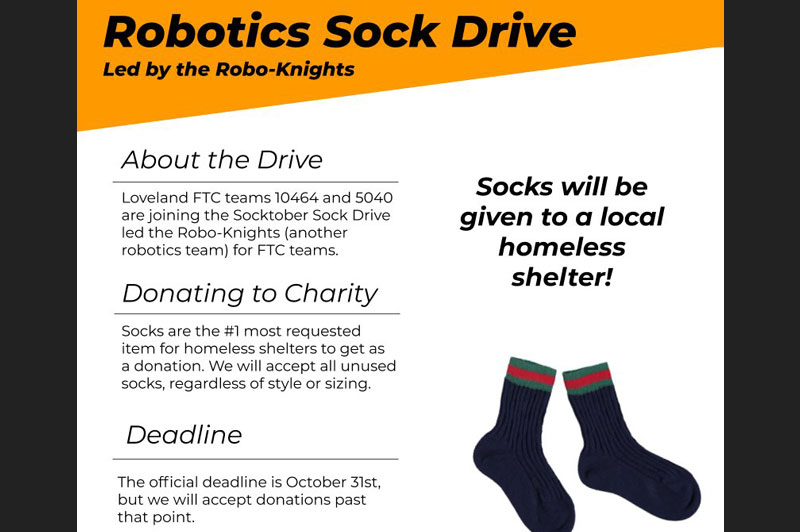
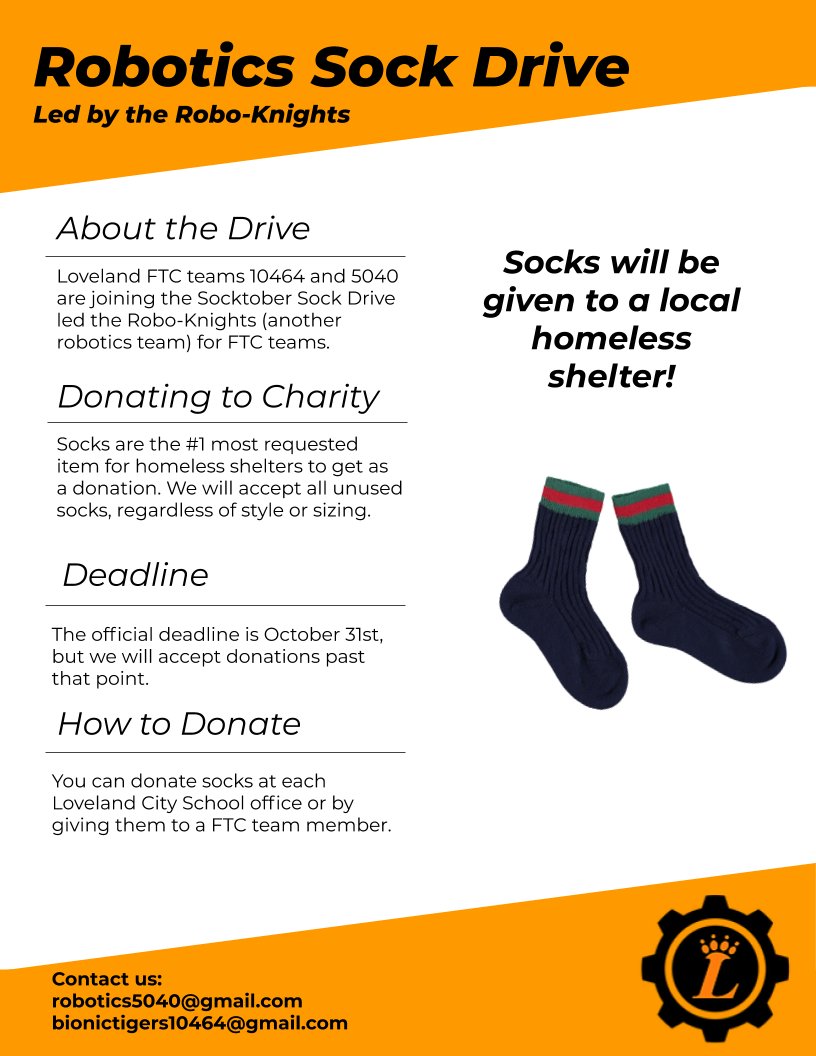
    @BionicTigersFTC are participating in a sock drive led by @CRoboknights to donate to homeless shelters. If you would like to donate, there are boxes at LECC, LPS, LIS, and LMS, or you can ask a team member. 
     
  • A RED TIDE: 65% of Ohioans now living in counties with ‘very high’ levels of COVID-19

    A RED TIDE: 65% of Ohioans now living in counties with ‘very high’ levels of COVID-19

    Jake Zuckerman is a statehouse reporter. He spent three years chronicling the West Virginia Legislature for The Charleston Gazette-Mail after covering cops and courts for The Northern Virginia Daily.
     
    This story was written by Jake Zuckerman with local news added by Loveland Magazine staff.

    Thursday was Ohio’s worst day of the pandemic and all evidence suggests things are likely to worsen, according to interviews and new state data.

    Nearly 2,200 new COVID-19 infections were reported Thursday, the state’s third record breaking day last week.

    There were 1,041 Ohioans in the hospital with COVID-19 — about 100 shy of the all-time high set in late July. The COVID-19-hospitalized population has nearly doubled since mid-September.

    A “Public Emergency” has been declared in RED counties – with very high exposure and spread.

    On Thursday, Governor DeWine released Ohio’s updated Public Health Advisory System map. New health data compiled by the Ohio Department of Health found that 29 counties currently have a very high risk of exposure and spread (Level 3): Hamilton, Butler, and Warren are among the “RED” counties.

    “We’ve gone up dramatically in a relatively short period of time,” Gov. Mike DeWine said to reporters Thursday.

    “What you’re seeing in today’s numbers should get our attention,” DeWine said. “There’s a red tide flowing all over the state of Ohio.”

    The good news: More Ohioans than ever are being tested for the new coronavirus. The bad news: The rate at which those tests are coming back positive has doubled since Sept. 23, a sign the virus is growing more prevalent.

    Thirteen new counties turned red this week indicating “very high exposure and spread” on the Ohio Public Health Advisory System — a product of seven inputs like hospital visits, outpatient care visits in a county, population-adjusted infection rates and others. Twenty-nine counties are red, spanning about two-thirds of the state’s population.

    “What you’re seeing in today’s numbers should get our attention,” DeWine said. “There’s a red tide flowing all over the state of Ohio.”


    DeWine said some of the newly-turned red counties are slated to host community events like political rallies, pub crawls and social gatherings and that “now is really the time to rethink whether these are in the best interest of the community.”

    He did not address his own administration’s decision to exempt recent rallies for President Donald Trump from the statewide mask requirement.

    View previous week’s DATA

    While DeWine said there are no plans in store for any kind of statewide stay-at-home order, he declined to promise against instituting the policy down the line.

    All told, nearly 176,000 Ohioans have contracted COVID-19. Nearly 17,000 have been hospitalized, and 5,038 have died since March.

    In red counties, health department staff said they continue to see spread at family gatherings like bonfires, birthday parties and barbeques.

    Jennifer Hiestand, a public information officer at the Zanesville-Muskingum County Health Department, estimated 60% of people in public are wearing masks. Contact tracers have found “mini outbreaks” that are seemingly the result of people letting their guards down.

    In red counties, health department staff said they continue to see spread at family gatherings like bonfires, birthday parties and barbeques.

    “People just made the decisions not to social distance or not to wear a mask, those things that they probably should have,” she said.

    Mahoning County Health Commissioner Ryan Tekac said he is seeing a lot of the county’s progress this summer start to erode as cold weather drives people inside.

    “I think there are some concerns right now that individuals are putting their guards down,” he said.

    Ohio’s recent case surge fits in with a national trend. The New York Times reports cases are trending upward in 41 states, especially in the Midwest.

    Sycamore Aves mom reminds us of the importance to stay home if you’re experiencing COVID-19 symptoms. These next few weeks will be crucial. Please do your part so we can stay in school!

    Two holidays are coming up that will test Ohio’s public health discipline — Halloween and Thanksgiving.

    Tekac said there’s a lot of concern, especially with Thanksgiving, about the potential for outbreaks. However, he said people know the guidance; wear masks, keep your distance, wash your hands, outside is better than inside.

    He said at a certain point it comes to individuals making their own good decisions.

    Dr. Anthony Fauci, the top infectious disease expert at the National Institute of Health, told CBS News it’s an “unfortunate fact” that Thanksgiving will cause a lot of spread and suggested skipping out on the tradition this year.

    “I think given the fluid and dynamic nature of what’s going on right now and the spread and uptick of infections, I think people should be very careful and prudent about social gatherings,” he said.

  • Local author offers a holiday recipe collection

    Local author offers a holiday recipe collection

    Cincinnati, Ohio – Loveland native and debut author Laurie Stroup Smith has compiled a collection of holiday recipes from some of your favorite Amish authors.

    Image may contain: text that says 'LAURIESTROUPSMITH.COM Join the List Subscribe to my newsletter and receive a FREE digital collection of holiday recipes from some of your favorite Amish authors!'By subscribing to her newsletter, readers will receive this exclusive digital content for free. In addition to exciting updates about reader events, giveaways, and upcoming book releases, Smith also includes access to the first chapter of Pockets of Promise, Book #1 in The Pocket Quilt Series. Your privacy is protected. She will never give your information to anyone. Visit lauriestroupsmith.com and sign up today.

    Kelly Irvin, award-winning author of Mountains of Grace and a Long Bridge Home, says, “With her debut novel, Pockets of Promise, Laurie Stroup Smith has elevated a lovely Amish romance to a universal coming-of-age story.”

    Smith was named a Finalist in the 2017 ACFW First Impressions Contest for this story and a Semi-Finalist in the 2018 and 2019 ACFW Genesis Contests for additional writing.

    Released by Vinspire Publishing on April 30, 2020, Pockets of Promise is about a young Amish woman—torn between two worlds and two men—who travels to the Amish snowbird community of Pinecraft, Florida, where she receives wisdom and guidance through secret letters tucked into the pockets of a special quilt.

    Kelly Irvin, award-winning author of Mountains of Grace and a Long Bridge Home, says, “With her debut novel, Pockets of Promise, Laurie Stroup Smith has elevated a lovely Amish romance to a universal coming-of-age story.” 

    Vannetta Chapman, award-winning author of Agatha’s Amish B&B Series, agrees, saying, “A fresh new voice in Amish fiction…Smith pulls us straight into the confusion of an Amish rumspringa…touching, authentic, and sweet.” 

    Purchase digital and paperback copies are available. Amazon, Barnes and Noble, BAM, Smashwords, and Kobo.

    Visit lauriestroupsmith.com for more information. Smith looks forward to connecting with readers on Facebook and Instagram.


    Title:    Pockets of Promise, Book #1 in The Pocket Quilt Series
    Author:   Laurie Stroup Smith
    Pub Date:   April 30, 2020
    Paperback and ebook available at:    Amazon
    Barnes and Noble
    Smashwords
    Kobo
    ISBN:    978-1734150742
    Price:   $14.99
    Pages:   200
    Genre:   Amish

  • Residents urge BOE to form a Diversity Advisory Board

    Residents urge BOE to form a Diversity Advisory Board

    This statement was delivered by Leah Marcus at the Loveland Board of Education Meeting on 9/22/2020 on behalf of John Coburn, Julie Gebhart, Leah Marcus, Jennifer Shaftel, and Molly Simons, representing the Loveland Diversity Advisory Board (DAB) and the voices of their supporters in the Loveland Community.

    by Leah Marcus

    At the Loveland Board of Education Meeting on 9/22/2020 a group of community members, identifying as the Loveland Diversity Advisory Board made initial requests regarding the need to implement a Diversity, Equity, and Inclusion initiative within the School District. The statements delivered by community members are below:

    “As a part of the Diversity Advisory Board, I want to thank the Loveland Board of Education for hearing me today. This is a new group that started in the Loveland Area recently and our request is that there be an Advisory Board that looks at Diversity, Equity, and Inclusion concerns in our community, and more so, in our Loveland City School District. This effort would consist of school administrators working with the Advisory Board to talk and try to resolve some of these issues.

    I want to take a little bit of time to talk about my experiences in Loveland. I have lived here for six years and I want to talk about some things that have happened to me.

    One thing, when my wife and I first moved in, a neighbor asked my wife if we were the new neighbors.

    “Yes, we are the new neighbors.”

    “Oh, I will come by and ​see​ you.”

    I can’t tell you who that neighbor is.

    I have another neighbor. We just don’t talk. He doesn’t talk to me. I have said “Hi” to him, but we just don’t talk. He talks to the other neighbors-just not, to me.

    I have been at a stoplight here recently and I was called a “Nigger” when someone rolled their window down and felt like that was appropriate to do.

    There was another time that I was at a meeting, here in a Loveland school building, and I walked out with a couple of parents. We got lost in the building and we ended up going down a dark hallway. A community person walked up and said, “Oh, you’re used to being in dark places.”

    I think about that, and I think about the community where I grew up.

    I grew up in a community called Webster Groves, Missouri. I don’t know if anyone is familiar with that place, but it has similar demographics to what we have here, but we had a sense of belonging. Which I don’t necessarily feel here.

    This was in the 1970s, so Whites and Blacks got along. We talked to each other. We went to each other’s homes. We ate dinner together. We got to know each other, our parents got to know each other, and I don’t feel that sense of community here.

    Now don’t get me wrong, there are some wonderful things here in Loveland. There are wonderful things to do. I have met some wonderful people, but I am just saying that I don’t feel that.

    So when I think about my experiences I realize that I live in Loveland, but I work outside of Loveland. My church is outside of Loveland and my friends are outside of Loveland. I think about the kids that are in this environment every single day and I am wondering what data we are using to talk to the kids about their experiences that are here in the schools every single day.

    And again, I am just starting to become engaged in this environment. So let’s think about the long term ramifications of not having a Diversity, Equity, and Inclusion initiative.

    I am big on just reading my bible, and I pulled out a verse that says, “Whoever does not love their brother and sister, whom they have seen, cannot love G-d, whom they have not seen” (1 John 4:20). So what are those long-term ramifications and what are we teaching our kids? What kind of legacy are we leaving them? What if we don’t teach them that it is okay to engage with people who don’t look like them, whether it be someone who has special needs, or someone who identifies as LGBTQ, or someone who is Black or Brown?

    What kind of legacy are we leaving our children if we don’t say it is okay to engage with others that don’t look like you?​

    We are here tonight representing a diverse group of LCSD parents and community stakeholders to respectfully request the district’s action on two proposed initiatives:

    First

    We respectfully request that the District support a resolution to form a Diversity Advisory Board.

    Second

    We ask that the Board of Education facilitate a relationship between this group and school building administrators, so that a formal plan to address issues related to diversity, equity, and inclusion, that is, DEI, can be established, with parent input, and implemented, in the schools.

    We acknowledge that conversations regarding inclusion and diversity are already happening in the community with great frequency, whether that be on social media, our local written media, in our private homes, or  public forums such as this summer’s organized Peace Walk.

    Beyond these events, parents in our district, including many here tonight, have been meeting informally to educate ourselves and to understand how we can better leverage community resources to support our schools when it comes to creating an inclusive learning environment that prepares all students to succeed in an increasingly diverse workforce and world.

    Although our district’s values indirectly point to a shared commitment for inclusive education, informal and indirect commitment is not enough to make inclusion a reality in our schools. Achieving inclusion requires intention, including formal structures for engaging parents, students, and staff in conversations about what is needed to achieve this reality.

    Educational institutions have long acknowledged DEI initiatives as essential components of Social-Emotional Curriculum. Loveland, however, has yet to implement a permanent and intentional diversity statement or initiative. In fact, Loveland is one of only a handful of local districts with absolutely no DEI initiatives to speak of. The following districts have long-established comprehensive DEI plans: Sycamore, Indian Hill, Lebanon, Wyoming, Mason, Madeira, Kings, Cincinnati Public, Mariemont, Northwest, Fairfield, Forest Hills, Princeton, and Lakota.

    Compared to our neighboring districts, Loveland seems to be falling behind in this regard. It is time for Loveland to formally commit to addressing these issues.

    Institutional support for Inclusion and Diversity efforts have been shown to have positive outcomes for all students, including benefiting students’ critical thinking, decision making and cognitive skills, student success and engagement, as well as fostering a sense of belonging. On the flip-side, lack of DEI plans has been shown to result in hostile school and community environments, a lack of cohesion and consistency in dealing with district DEI issues, and, in some cases, costly lawsuits.

    Our Loveland Tigers do not want to be defined by a negative community incident, when we could be defined by the innovative, diverse leaders we educate in our district.

    Here, we present to you our proposal, along with letters from parents and community stakeholders who would like to see these initiatives come to fruition.”

    John Coburn, Julie Gebhart, Leah Marcus, Jennifer Shaftel, and Molly Simons, representing the Loveland Diversity Advisory Board (DAB) and the voices of our supporters in the Loveland Community.