Tag: voting

  • For some religious Ohioans, Issue 1 about autonomy more than beliefs

    For some religious Ohioans, Issue 1 about autonomy more than beliefs

    Members of the Jewish community have spoken out against abortion bans in Ohio, saying it infringes on their religious freedom. Photo by Morgan Trau, WEWS.

    BY:  AND Ohio Capital Journal

    Religious variations abound in the state of Ohio, and some members of different churches are taking what they’ve learned in their lives and through decades of experience into the ballot box as they vote on Issue 1, the reproductive rights constitutional amendment.

    For Catholics like Alexandra Belcher and Jennifer Perry, Issue 1 is a choice between the opinions of their religious leaders and their experiences with bodily autonomy.

    For Perry, a physician assistant from Tiffin, growing up Catholic meant she believed in pro-life messages up until she voted in her first election.

    “I voted Republican because that’s what the religious leaders said supported pro-life values,” Perry said.

    Now that she works in medicine and has gone through multiple complicated pregnancies, Perry developed a perspective built on her experiences and not the values of far-away leaders.

    “My view of what defines pro-life and what defines pro-choice has become just so much broader, and it’s not a black and white issue at all,” Perry told the OCJ.

    With the “narrow” view that life begins at conception, Perry said she felt her belief system did “a disservice” to her in preparing for the future.

    “We weren’t given both sides of the coin,” she said. “We weren’t given both perspectives.”

    Struggling with infertility, and losing a “desperately wanted” child in a second-trimester miscarriage brought her new light on the struggles even individuals who want to become parents must go through.

    “I desperately wanted that child, my husband desperately wanted that child, and I had to go through labor and delivery knowing that child wasn’t going to be ours,” Perry said. “To think that a mother … would have to go through that out-of-state, not with her family and friends or her chosen doctor, that’s just excruciating to me.”

    Perry is still a practicing Catholic, and feels strongly that she and those like her should stay in the church and help bring those perspectives to fellow parishioners, in hopes of bringing change to the opinions of the religion.

    The Catholic Conference of Ohio, which calls itself “the official voice of the Catholic Church in Ohio on matters of public policy,” has taken a strong opposing stance on Issue 1. The conference produced a letter signed by nine leaders in Ohio dioceses including Cincinnati, Cleveland, Toledo, Steubenville, Columbus, Youngstown, Canton and Parma.

    “The Church must not be silent and cannot remain on the sidelines when confronted with such a clear threat to human life,” the letter from Feb. 28 stated.

     COLUMBUS, OH — MAY 14, 2022: Hundreds gather at a rally to support abortion rights less than two weeks after a leaked Supreme Court draft opinion showed a likely reversal of Roe v. Wade, May 14, 2022, at the Ohio Statehouse, Columbus, Ohio. (Photo by Graham Stokes for the Ohio Capital Journal. Republish photo only with original article.) 

    For Cleveland-area pharmacist Alexandra Belcher, she has no problem ignoring the opinions the church has on abortion, but remains open to talking with her friends and fellow parishioners about the nuances of reproductive health.

    “The more I grew up, the more I realized this can not be up to somebody else,” Belcher told the OCJ.

    Belcher went to Catholic school for 12 years, and is still a practicing Catholic, but nothing could have prepared her for her ectopic pregnancy, an unviable pregnancy that can be life-threatening for the pregnant person.

    “In my medical chart, the resolution is coded as an abortion,” she said.

    But that resolution involved medication that was administered in a hospital, so Belcher could be monitored by a doctor.

    “The awful thing about those drugs is that they take you into labor and delivery,” she said. “So all you can hear is crying babies, the song they play (when a baby is born), and I sat there for hours while they made sure everything was going well with my medication.”

    Even after leaving the hospital, Belcher suffered “excruciating” pain, so much so that when she went into labor in her next pregnancy, she was surprised to find how much less severe the pain of childbirth was for her.

    “Nobody is going into a decision to have an abortion joyfully, whatever has happened to get them to the point of an abortion,” Belcher said. “It’s still not a joyful decision.”

    Members of other religions, including faith leaders, are thinking about Issue 1 with a focus on the freedom to decide rather than the wrath of a higher power.

    Rev. Timothy Ahrens showed his support for Issue 1 in an ad by Ohioans United For Reproductive Rights.

    “As a pastor I’ve counseled families on the most important personal decisions, even abortion,” he said in the 30-second ad. “Abortion is a private family decision. Government needs to stay out of family decision making.”

    Ahrens is the senior minister of the First Congregational Church of the United Church of Christ in downtown Columbus, a role he has served in since 2000. He has been a pastor for nearly 40 years.

    The United Church of Christ supports reproductive issues and a woman’s right to have an abortion, according to the denomination’s general synod and statements regarding freedom of choice.

    “The laws of Ohio right now hurt my mother, my sister, my sister-in-law, my wife, my daughters, my daughter-in-laws and my granddaughters,” Ahrens said. “I feel very strongly that the government needs to get out of trying to manage people’s lives in relation to reproductive freedom.”

    Ahrens acknowledged that other Christians denominations disagree with his stance on abortion.

    “Those who stand against abortion do so based on biblical, foundational thoughts,” Ahrens. “I don’t look at what they’re saying as groundless.”

    He mentioned Psalm 139 as a passage that mentions God “knit me together in my mother’s womb.”

    “It never says I knew you at the moment of conception,” Ahrens said. “This has a range of perspectives, if we really sat down and boiled it down to the moment of conception.”

    While it’s clear what most religious denominations think abortion, it’s ultimately up to the individual members of a congregation to cast their ballot on Issue 1.

    “It comes down to how closely people who are part of religious congregations are listening to the cues that they are being given,” said Kim Conger, University of Cincinnati’s director of the masters of public administration, who studies how religious advocacy groups impact politics.

    “There seems to be more variation across different parishes about how strongly a priest is pushing on the idea of not just that abortion is a sin, but voting for issue 1 would be a sin,” Conger said.

    The idea of one religion stepping up to tell individuals what they should believe about reproductive health doesn’t sit well with Belcher or Perry, and as medical professionals, they don’t agree with the state getting involved either.

    “The reasoning is not because it’s in the best interest, or because there is evidence-based medicine, the reasoning is this magical belief that this group of cells is a person who has rights,” Belcher said.

    For Perry, the reproductive debate comes down to American roots in religious freedom and the necessity for separation of church and state.

    “Because we allow for so many different expressions of religion, or at least we’re supposed to, if that starts to crumble, I feel like the fabric or the foundation of what America was build on starts to crumble,” Perry said.

    Watching battles with insurance companies and socio-economic issues for patients having necessary medical treatment, Perry also sees much bigger issues the state could be addressing instead.

    “It’s very hard to be in health care right now, and this is another huge burden you’re placing on these providers,” she said.

    Having faced these moral and professional questions, Perry and Belcher both hope for a future for their children where medical decisions are made between a patient and a medical provider, without the intervention of either the government or their chosen religion.

    “I think that when it comes down to it, if I’m ever faced with the pearly gates, the God that I believe in will understand,” Belcher said.


    Megan Henry
    MEGAN HENRY

    Megan Henry is a reporter for the Ohio Capital Journal and has spent the past five years reporting in Ohio on various topics including education, healthcare, business and crime. She previously worked at The Columbus Dispatch, part of the USA Today Network.

    MORE FROM AUTHOR

    Susan Tebben
    SUSAN TEBBEN

    Susan Tebben is an award-winning journalist with a decade of experience covering Ohio news, including courts and crime, Appalachian social issues, government, education, diversity and culture. She has worked for The Newark Advocate, The Glasgow (KY) Daily Times, The Athens Messenger, and WOUB Public Media. She has also had work featured on National Public Radio.

    MORE FROM AUTHOR

  • Ohio Issue 1: Official ballot language, explanation, arguments for/against, and full text

    Ohio Issue 1: Official ballot language, explanation, arguments for/against, and full text

    [vc_row][vc_column][vc_column_text]Loveland, Ohio – For the upcoming Tuesday, August 8 Special Election next week, Ohio voters will have the chance to vote on a statewide ballot issue: Issue 1 – Raising the standards to qualify for an initiated constitutional amendment and raising the bar to pass any constitutional amendment at the ballot box.

    This “Satewide Issue Report”, from the Ohio Secretary of State includes the official ballot language, explanation, arguments for and against, and the full text of Issue 1.

    [pdf-embedder url=”https://lovelandmagazine.com/wp-content/uploads/2023/08/Issue-1.pdf” title=”Issue 1″][/vc_column_text][/vc_column][/vc_row]

  • Loveland Magazine seeking Issue 1 proponents for video interview

    Loveland Magazine seeking Issue 1 proponents for video interview

    Loveland, Ohio – Loveland Magazine seeking Issue 1 proponents for a sit-down video interview in our LOVELAND MAGAZINE TV studio. Must be a Loveland Area resident and preferably actively working in the community to get Issue 1 passed.

    Ohio Issue 1, is a ballot measure regarding the process for proposing and approving amendments to the Ohio state constitution. It will be before voters in a special election on August 8.

    Reply with an email.

    Background


  • Ohio Chamber won’t discuss its allies in effort to lock down state Constitution

    Ohio Chamber won’t discuss its allies in effort to lock down state Constitution

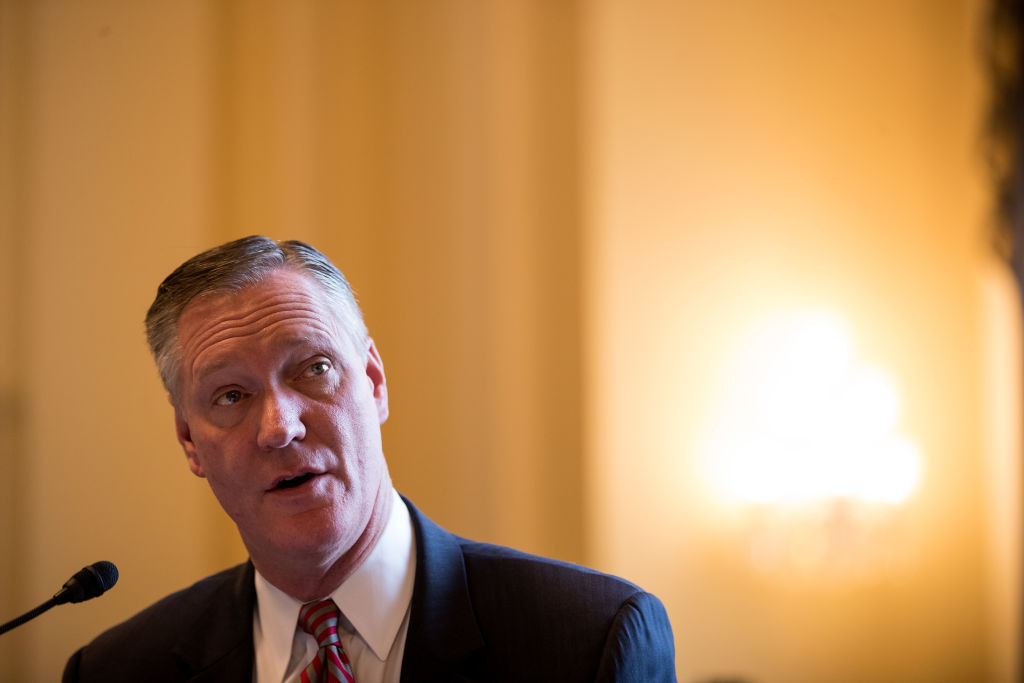
    Ohio Chamber of Commerce President Steve Stivers. (Photo by Drew Angerer/Getty Images, 2017.)

    They include abortion foes, gun-rights groups, an election denier, and the gerrymandered legislature

    BY:  Ohio Capital Journal

    The Ohio Chamber of Commerce is supporting a proposed amendment to the state Constitution that has huge implications for such issues as abortion, gun control, and even democracy itself.

    But Steve Stivers, president and CEO of the chamber, isn’t willing to talk about those things as his organization joins the effort to make it much harder for voters to amend the Ohio Constitution.

    The Chamber last month came out in support of a proposal by Ohio’s Republican-controlled legislature that would make it far harder for voters to gather enough signatures to put a constitutional amendment on the ballot. It would also require a majority of at least 60% to pass it instead of the current 50%. In doing so, the Chamber is joining forces with Ohio Right to Life, the Buckeye Firearms Association, and an out-of-state, election-denying billionaire.

    The measure, Issue 1, will be on the ballot Aug. 8 because Republicans in the legislature last month reversed a ban on such elections that they passed just last year because voter turnout in the dog days of summer is typically abysmal. In August 2022 it was 7.9%.

    On May 11, Stivers issued a statement saying the Chamber takes no position on abortion rights — even though the measure it’s supporting is intended to block a voter-initiated abortion-rights amendment that is expected to appear on the November ballot. Stivers also said the group isn’t taking a position on other “social” issues that are popular with voters, but the Republican supermajority in the state legislature — declared an unconstitutional gerrymander multiple times by a bipartisan Ohio Supreme Court — seems determined to stymie.

    “The Ohio Chamber Board voted today to take no position on the November election’s reproductive rights issue,” Stivers said. “The Ohio Chamber is a business association and takes positions on business issues, not social issues. While we support protecting our constitution in August, this has everything to do with subjects like minimum wage, employment at-will, and other business issues.”

    That ignores businesses’ interest in avoiding unpopular legislation such as Ohio’s harsh abortion restrictions passed out of an extremely gerrymandered legislatureA survey conducted last August indicated that a third of job seekers wouldn’t even consider working in states with strict abortion limitations and that 27% percent of workers in states with the most restrictive abortion laws wanted to leave.

    But Stivers, a former Republican congressman, has declined to discuss such things. Since issuing the May 11 statement, the Chamber hasn’t responded to requests for an interview with Stivers, and it ignored written questions that were sent as a follow-up.

    Lack of transparency

    The refusal of the state’s most prominent business organization to discuss the ramifications of a constitutional change it’s supporting adds another undemocratic layer to an initiative that already has many, said Catherine Turcer, executive director of Common Cause Ohio, which opposes State Issue 1. She said the Chamber and its members will sink lots of corporate money into the fight to cut voters’ power, but it doesn’t want to be open with them.

    “One of the challenges with corporate donations and business organizations is that the money does the talking,” Turcer said. “It gets spent on elections, but we don’t hear directly from the people behind it. And we should expect to hear that because at the end of the day, a corporation doesn’t get to vote. At the end of the day, a corporation is an artificial entity. (Behind them are) human beings making decisions and we should understand what is happening. Or at least the press should have an opportunity to ask questions.”

    The position the Chamber is taking in favor of State Issue 1 is out of step with four former governors of both parties, five former Ohio attorneys general, and more than 240 organizations — such as Turcer’s — who are adamantly opposed to the measure because they believe it would effectively lock Ohio voters out of their state Constitution.

    The provision Issue 1 seeks to change was championed by former President Theodore Roosevelt as a way to force an unresponsive government to address the public’s concerns.

    Adopted in 1912, it sets a high bar for voters to gain access to the Ohio Constitution. It requires supporters of an amendment to gather a large number of voter signatures (413,000 for the abortion-rights amendment planned for the November ballot) and it requires that a given number of them be gathered in each of 44 counties in the various regions of the state. After all that, it also has to gain a majority of the vote to become part of the Constitution.

    Under Issue 1, Republicans in the legislature, anti-abortion groups, pro-gun groups — and the Chamber — want to require 60% of the vote for an amendment to pass, even as they try to pass the restriction under the current, 50% requirement. In other words, they’re trying to get a simple majority in a low-turnout Aug. 8 election to pass an amendment saying that a 40% minority can quash future amendments supported by 59.9% of Ohio voters.

    Issue 1 “is a proposal to substantially diminish the most significant power held by the people, the power of initiative petition to amend the Ohio Constitution. Our Constitution leaves no doubt about this,” Ohio Supreme Court Justice Jennifer Brunner, wrote in a partial dissent published on Monday. She was dissenting because she thought the court didn’t go far enough in ruling that parts of Issue 1 are “likely to mislead voters.”

    Like Brunner, Turcer argues that the effort to enhance the power of the gerrymandered legislature relative to the voters is undemocratic. And — along with former Republican Gov. Bob Taft — she argues that even from the standpoint of its supporters, the measure is shortsighted.

    “It’s problematic that organizations decided to make it harder for citizens to change the Constitution because they don’t like specific policies. But it’s not always going to be 2023,” Turcer said. “There are a number of different ways we can improve the state and leaving that to a minority of Ohio voters is really scary. It’s really scary to think that a majority of voters — whether it’s 55% or 58% — approve of something, but they can’t actually put that policy in place.”

    Misleading claims

    Adding to accusations that the proposed change is anti-democratic are the misleading reasons proponents have given for needing it.

    Stivers, Ohio Secretary of State Frank LaRose, and other proponents argue that voter access needs to be ratcheted down to “protect” the Ohio Constitution from monied out-of-state interests. But when he announced an earlier version of the measure last year, LaRose couldn’t point to any examples of such interests amending the Constitution in the past.

    Nor will LaRose or Stivers comment on an out-of-state special interest who has donated more than $1 million in support of their effort to lock Ohio voters out of the state Constitution. That’s Illinois billionaire Richard Uihlein, who helped fund the rally that preceded the violent Jan. 6, 2021 riot at the U.S. Capitol, and who has since spent millions funding candidates who falsely claim Donald Trump won the 2020 election.

    At the same press conference last year in which LaRose claimed he was trying to protect the Constitution, he also claimed that he was thinking long-term. He said he wasn’t trying to block the expected amendment protecting abortion rights.

     The Republican majority members of the Ohio Redistricting Commission in 2021 and 2022. Top row from left, Ohio Gov. Mike DeWine and Secretary of State Frank LaRose. Bottom row from left Ohio Auditor Keith Faber, then-House Speaker Bob Cupp, and Senate President Matt Huffman. Official photos. 

    LaRose also denied that he wanted to foil another attempt by Ohio voters to stop extreme gerrymandering after he and other Republicans on the state Redistricting Commission ignored repeated orders by the state Supreme Court to follow earlier amendments passed with 70% of the vote. The Republican commissioners last year ran out the clock on the process and lawmakers in the consequently unconstitutional districts voted to put the amendment that would make it much harder for Ohio voters to amend the Constitution on the Aug. 8 ballot.

    In her dissenting opinion Monday, Justice Brunner said that by ignoring constitutional prohibitions against gerrymandering, Republican leaders make it easy to come up with the needed votes for the legislature to put a constitutional amendment on the ballot while making it almost impossible for voters to do the same.

    “If the General Assembly continues to ignore (anti-gerrymandering) orders of this court regarding the state legislative redistricting process, gaining a three-fifths vote should not be difficult for it to accomplish,” she wrote.

    Lack of candor

    Turcer of Common Cause said that business groups such as the Chamber ignore issues like gerrymandering at their peril. That’s because lawmakers from gerrymandered districts have every incentive to cater to the most charged-up elements of their base and ignore everybody else. It‘s an engine that produces extreme legislation that can prompt boycottsprotests and require businesses to provide special benefits to protect employees.

    “The folks who do support Issue 1 and the special election clearly don’t care about gerrymandering — the manipulation of district lines to manipulate elections and policy,” Turcer said. “Gerrymandering has a profound consequence for our business leaders and the business community. It is extremely short-sighted to not think about how challenging it will be to do a citizen initiative with the news rules that are in place.”

    LaRose again demonstrated in May that he was being less than forthright when he claimed his support for the effort was only out of concern for the future integrity of the Ohio Constitution, and not current fights over abortion and gerrymandering.

    “That’s not what this kind of a change should ever be about,” LaRose said last November.

    But last month, the state’s top elections official told Seneca County Republicans “It’s 100% about keeping a radical pro-abortion amendment out of our constitution,” WEWS reported.

    The lack of candor about their reasons for wanting to effectively lock Ohio voters out of the state Constitution seems to extend even to the name of the campaign committee supporting the measure: Save Our Constitution.

    “A more accurate name might be Save Our Constitution from Ideas We Don’t Like,” veteran Ohio political reporter Howard Wilkinson opined earlier this month.

    It’s possible that Stivers, the Chamber, and other business interests are narrowly focused on stopping a minimum wage hike to $15 an hour — which enjoys the support from 60% of the public.

    The Chamber might also be responding to pressure from legislative Republicans. The Cleveland Plain Dealer reported that GOP leaders last month put the arm on corporate lobbyists to contribute to the Issue 1 push as they draw up a multi-billion dollar state budget that is of great interest to the companies the lobbyists represent.

    Either way, Turcer said, the Chamber and its members are trying to water down democracy for their own, narrow purposes.

    “For political expediency, they would like to make it harder for us to participate in direct democracy,” she said. “They would prefer to dilute the power of voters rather than promote their own policy agenda with voters.”


    Marty Schladen
    MARTY SCHLADEN

    Marty Schladen has been a reporter for decades, working in Indiana, Texas and other places before returning to his native Ohio to work at The Columbus Dispatch in 2017. He’s won state and national journalism awards for investigations into utility regulation, public corruption, the environment, prescription drug spending and other matters.

    MORE FROM AUTHOR

  • A perspective on the Loveland School District levy

    A perspective on the Loveland School District levy

    by Tom Allen

    I’d like to take a few minutes of your time to share my perspective on the school levy that will be on the May ballot.

    I’m a 60-year-old, 30-year Loveland area resident with a home in the Loveland school district. I’m semi-retired and our children, who attended Loveland schools from K-12, are grown. Being semi-retired means, like many of you, I watch my spending closely. As someone who has always been proud of the Loveland Schools’ reputation and performance, the divide in our community from the past few levies has been disheartening. I have friends and neighbors on both sides of this issue. I have voted no in the past and I understand why people feel as they do about the situation.

    The perspective I want to share is fairly simple, and one that as fellow property owners I hope you will consider. I firmly believe it’s in all of our best interests to be more aligned this May.

    The premise is this: I understand that property values are subject to a variety of factors. I believe that school district performance is among the leading considerations of families looking to move to a new community. The way l see it a school district that does not support reasonable funding requests is destined for declining property values over time, as school performance and reputation declines. The reality is that things do cost more over time and it does cost to attract and retain top talent.

    Let’s say for the sake of argument that property values drop 10 percent over the next ten years. If your Loveland home was valued at the current Zillow average of $355,000, you will take a $35,500 hit when you sell it. That is a very significant loss. I would prefer to pay a few hundred dollars more each year to help maintain the good reputation of our schools, protect our property values and provide our students with a well-rounded educational experience.

    While each of us has reasons that affect our decisions about these levies, I believe what we have in common is that we all prosper when we have a high performing school district. I would like our state to provide a better funding mechanism for our public schools, but unfortunately, it doesn’t. I trust that our current school leaders are good stewards of our hard earned tax dollars and I believe that they reacted appropriately to our feedback when the District overreached.

    After voting against the oversized levy a few years ago, I will be voting yes on the May levy that will be on the ballot, mostly to help protect our property values. I’m willing to find the additional hundreds of dollars per year as an investment in education, our community and in all of our property values.

    I appreciate you giving this issue further consideration and I respect that each of you has the right to vote for what you believe is best for your situation.

  • [Updated] 2022 Loveland Area Mid-Term Election Results

    [Updated] 2022 Loveland Area Mid-Term Election Results

    EDITOR’S NOTE: The totals for the Loveland School Levy have now been updated (11-10-2022) to reflect revised counts by the BOE’s.

    Loveland, OhioAround midnight we made a preliminary election report because of delays in Hamilton County vote tabulations. Not all of their precincts had yet reported.

    We can now bring you this updated tally.

    This update does not reflect any change to the tally we reported last night for the Loveland City School District operating levy.

    We publish our results as soon as the three counties Loveland is in, Clermont, Hamilton, and Warren report their “Unofficial” counts and when 100% of precinct votes have been tabulated by each county BOE.

    These new results are, as of 7:38 AM Wednesday, November 9.

    The state-wide, and U.S. House and Senate tabulations are from the report of the Ohio Secretary of State.

    The results below are the “Unofficial” count. There are still outstanding ballots left to be counted. Absentee ballots must be postmarked by the 7th and received by the BOE’s no later than November 18. Write-in votes are not counted on election night.

    The Official Count occurs between 11 and 21 days after election day.

    The election must be “certified” by November 29th and this will include all election-day ballots, on-time ballots not yet counted, and all valid provisional ballots.

  • How we will report the 2022 November 8 Mid-Term Election results

    How we will report the 2022 November 8 Mid-Term Election results

    Loveland, Ohio – On the night of the 2022 November 8 Mid-Term Election, Loveland Magazine will begin tabulating the local results we feel are of most interest to our Loveland Area readers.

    As usual, we will probably be at the calculator and election board websites late into the night, and into the early morning if results come in slowly.

    When readers awake on Wednesday morning we want to give you as complete a picture of the results as possible in an easy-to-read format.

    Below is our preliminary spreadsheet of how our report will look.

    If you see corrections that need to be made or races or issues we have left out, please do let us know. You can send your comments to editor@lovelandmagazine.com.

    NOTE: We will publish our results as soon as the three counties Loveland is in, Clermont, Hamilton, and Warren report their “Unofficial” counts and when 100% of precinct votes have been tabulated by each county BOE.

  • Why we need to support Loveland students this election season

    Why we need to support Loveland students this election season

    by Allison Kiehl

    Since the failure of the 2020 tax levy in support of Loveland City Schools, it’s no secret that there has been a divide in the Loveland community. Through that election and for weeks after, vote yes and vote no signs dotted homeowners’ front lawns and businesses as if a symbol of pride for people on both sides of the issue.

    This divisive spirit was reinvigorated back in August of 2022 when the district once again announced that a school levy tax would be displayed on this year’s midterm ballot.

    Make no mistake, there were problems with the levy when it was presented back in 2020 that led to its doomful demise led to its failure rate of over 60%.

    Recognizing that voters were not ready to build a new campus at Grailville, the Board placed a 6.95 mill operating-only levy on the March 2020 ballot, however, it also failed by a wide margin.

    The school district has faced the repercussions of budget constraints. This most noticeably led to the loss of staff members and revoking of bussing for high school students, among other consequences.

    However, the past failures then need to pave a pathway to success for this year’s initiative: a 4.9 mill operating levy for Loveland City Schools.

    This initiative is about the school’s current operational funding. It is about the individual students and teachers who would face the repercussions of further budget cuts including the looming potential of even more courses and staffing cuts within the district.

    “The state of Ohio is the only state without any inflationary adjustment for education funding. In order to maintain local control, we must either ask our community for additional funding or make substantial cuts,” reads the school’s website. “Before making cuts, and eliminating programs, we feel it is important to give the voters an opportunity to approve additional funding.”

    While the district has confirmed that if the levy does not pass, it will be “eliminating programs,” there is no confirmation as to what those programs will be. However, based on national trends, the possibility of the loss of music education within Loveland City Schools is a real, yet alarming prospect.

    According to the Arts Education Data Project, only 83% percent of schools in their area of research, which includes Ohio, have music programs offered to students. Nationally, the project projects there are over 2 million students without access to arts education.

    This number of students and schools without access to music education is expected to only go up, as The Trinity Voice reports that there has been a steady decline in music programs nationwide.

    After the fall of the 2020 levy, the music department suffered, by losing staff members and the remaining educators being burdened with additional responsibilities. Classes were cut, and students lost out on opportunities that have previously been offered.

    For example, guitar classes are one of the music electives that fell victim to budget cuts. Neither beginning or advanced guitar opportunities are available to students.

    Voters should not and cannot let this happen again because the students of Loveland deserve the very best education that the community can offer. They deserve to participate in music classes if not for the experience, then to gain the proven benefits of social-emotional learning, improved mental health, and increased test scores.

    According to the Journal of Research in Music Education, students ages who are involved with music are also better students. They generate higher standardized testing in studies conducted in both elementary school and secondary schools.

    More importantly, student participation in music is proven to make students happy. Research conducted by California State University San Marcos with middle and high school choir students at a mid-sized suburban school district.

    Students reported they liked the accepting class climate, the community and connections made between their classmates and teacher, and the subject matter’s activities that improve the student’s mood by making them happy and decreasing their stress, all aspects that increased their mood and success in school.

    According to the research, the independent variable of whether students joined the choir positively affected the dependent variable of whether students experienced an impact in their success in school.

    Whatever opinions the community holds about the levy, it is important to understand the ballot language and what the initiative requires of the community. The ballot language of Issue four for 2022 reads as follows:

    “An additional tax for the benefit of the Loveland City School District for the purpose of current operating expenses at a rate not exceeding 4.9 mills for each one dollar of valuation, which amounts to $0.49 for each one hundred dollars of valuation, for a continuing period of time, commencing in 2022, first due in the calendar year 2023.”

    The levy is asking 4.9 mills for each dollar of valuation from the community, which is the smallest school levy that voters in Hamilton County will decide on this season. The money goes primarily toward staff salaries and benefits, along with various operating costs, according to Loveland City Schools.

    That cost varies depending on the household within the Loveland District, however, according to Redfin, the average home value within Loveland is around $300,000. Based on that average, the levy would cost the homeowner a little over $500 per year.

    The opposition to the levy speaks of issues with transparency, trust, and timing. However, if this levy does not pass, the students will be facing real consequences of “substantial budget cuts” as soon as the upcoming school year.

    For more information on what will be on your ballot this November or to find an in-person voting location nearest to you, please HERE for Hamilton County, HERE for Warren County, and HERE for Clermont County.

    This Election Day, November 8, at the polls, vote with students in mind. Your vote is one more ballot to help support music education and supports the students of Loveland City Schools because, we as a community, cannot sit back and watch further repercussions of failed-levy budget cuts.

  • OHSAA rejects Name, Image, and Likeness proposal

    OHSAA rejects Name, Image, and Likeness proposal

    Columbus, Ohio – The Name, Image, and Likeness (NIL) proposal failed by a margin of 538 to 254 in voting conducted by the Ohio High School Athletic Association to amend their Constitution and Bylaws.

    The proposal mirrored recent changes made at the collegiate level and would have allowed student-athletes to sign endorsement agreements so long as their teams, schools and/or the OHSAA logo were not used, the endorsements did not happen on school property or in school uniform, and provided there were no endorsements with companies that do not support the mission of education-based athletics, such as casinos, gambling, alcohol, drugs and tobacco. By rejecting the proposal, Ohio’s student-athletes remain unable sign endorsement deals without losing their amateur status.

  • Ohio Supreme Court to redistricting commission: Why shouldn’t we hold you in contempt?

    Ohio Supreme Court to redistricting commission: Why shouldn’t we hold you in contempt?

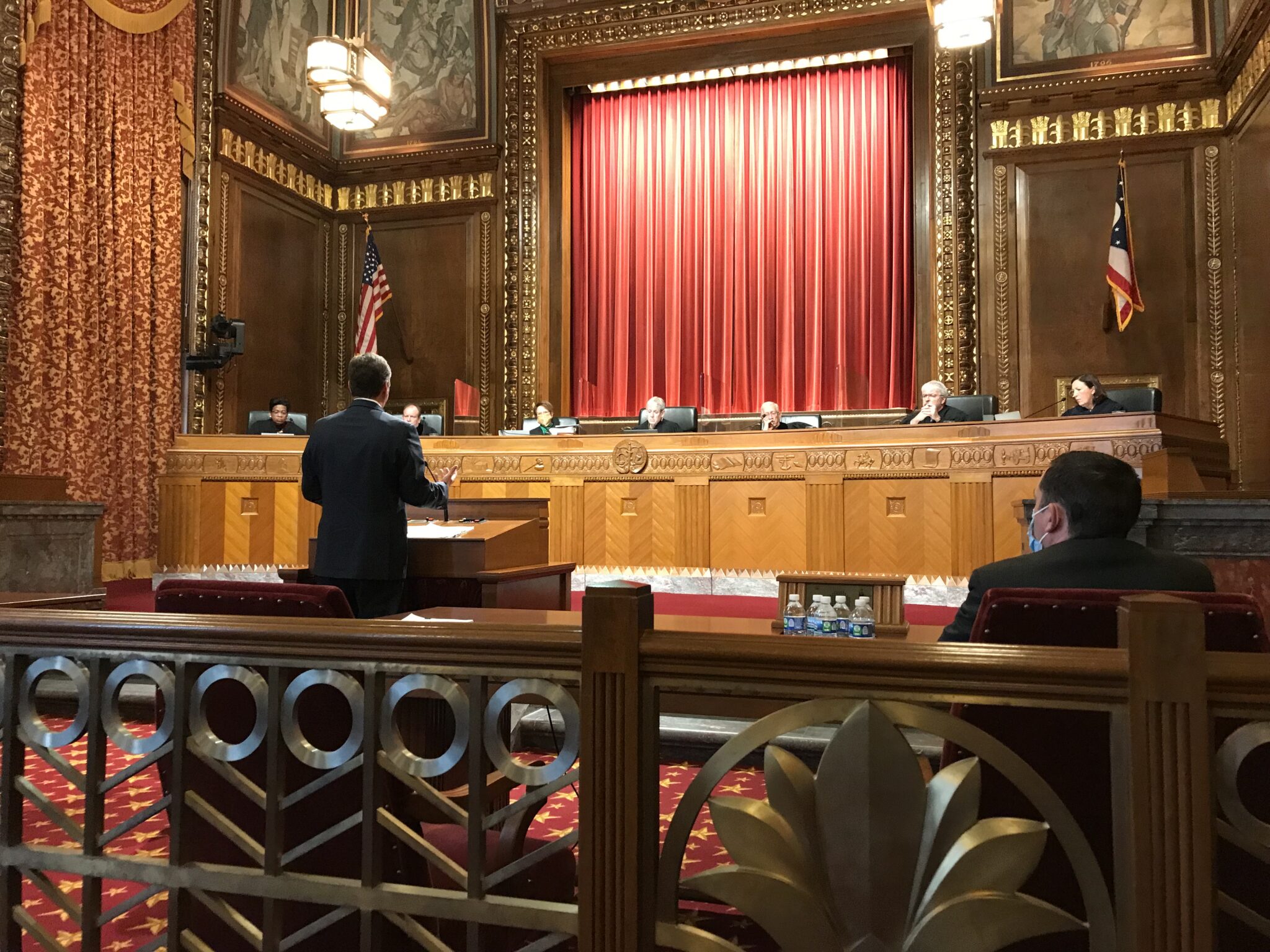
    Attorney Phillip Strach speaks before the Ohio Supreme Court, arguing for the constitutionality of legislative district maps. The court heard arguments on three cases asking it to reject the maps approved in September. (Photo: Susan Tebben, OCJ)

    BY: SUSAN TEBBEN – Ohio Capital Journal

    The Ohio Supreme Court weighed in on the redistricting battle on Friday evening, asking the members of the Ohio Redistricting Commission why it shouldn’t hold them in contempt of court for defying its order.

    Chief Justice Maureen O’Connor signed an entry in all three of the lawsuits against the ORC on legislative redistricting, asking Gov. Mike DeWine, Secretary of State Frank LaRose, Auditor Keith Faber, Senate President Matt Huffman, House Speaker (and commission co-chair) Bob Cupp, state Sen. (and commission co-chair) Vernon Sykes and House Minority Leader Allison Russo, to explain the “failure to comply with this court’s February 7, 2022 order,” and why they shouldn’t face anything from fines to jail time, the consequences for contempt of court.

    The court had been asked by the League of Women Voters, the Ohio Organizing Collaborative and a group of Ohio residents – the parties in the three lawsuits originally filed to challenge maps approved by the ORC – to order the commission to give specific reasons for their choice to adjourn without maps on Feb. 17.

    The ORC members now have until noon on Feb. 23 to tell the court why they shouldn’t be held in contempt.

    The groups also asked for justification for the commission’s lack of action on any sort of map, despite being presented with a map by the Democratic House and Senate caucuses, which they shot down along party lines on the day of the deadline.

    Huffman accused drawers of the Dem map of racial gerrymandering to the benefit of Democrats in certain districts, including the district that holds Lake County, typically a strongly GOP area. Russo wholly denied the accusations.

    The GOP commission members said during the meeting that they could not find a way to draw maps that complied with all the redistricting provisions of the constitution, while also complying with the rules the supreme court had given in their majority opinion invalidating the previous maps. Mainly, the GOP said they couldn’t hit the target of 54-46 partisan breakdown asked for by the court justices, a number based on statewide voter preferences over the last 10 years.

    But some of the commission members, of both parties, disagreed with the decision to leave before approving a map.

    “I think it is a mistake for this commission to stop and basically say that we’re at an impasse,” Gov. Mike DeWine said on Thursday. “I don’t think that is an option that the law gives us.”

    Co-chair Sykes agreed that contempt was a possibility for the commission members, and said he was willing to do whatever could be done to move forward.

    Asked after the commission adjourned if that included contempt of court: “Including whatever we can do.”

    The choice to adjourn didn’t require a majority vote, but was met with no formal objections.

    The supreme court ordered the ORC to come up with “entirely new” maps after invalidating not one but two different sets of legislative district maps. Their deadline to file with the Secretary of State’s Office was Feb. 17, with those maps then being sent to the court for review by the next day.

    The order came the same day a federal lawsuit was filed by Ohio residents, some of whom are also anti-abortion advocates in the statewide lobby group Ohio Right to Life. That lawsuit asks the district court to take over the process, and accuses the redistricting commission of preventing them from advocating for candidates, running for office, and even voting.