Year: 2024

  • Daylight Savings Time ending

    Daylight Savings Time ending

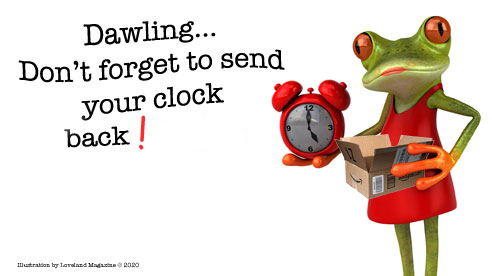
    Loveland, Ohio – Daylight Savings Time ends this Sunday, Nov. 3, at 2 AM when clocks are turned backward 1 hour to 1 AM.

    Sunrise and sunset will be about 1 hour earlier than the day before. There will be more light in the morning.

    Also called Fall Back and Winter Time.

  • Claire Mirkowski-Purdy interviews world renown author and artist Trina Paulus

    Claire Mirkowski-Purdy interviews world renown author and artist Trina Paulus

    Claire Mirkowski-Purdy

    by Claire Mirkowski-Purdy

    Published in 1972 and winning the Chistopher Award for the most inspirational book of the year, Trina Paulus’s Hope For The Flowers has been one of the most powerful books published in our time. The story of two caterpillars following the crowd to the top of the caterpillar pillar is a versatile metaphor that can apply to all of our lives, and at any age.

    I had the opportunity to visit the HOPE Celebration at The Grail in Loveland. Upon walking into the oratory, I was stunned by the gorgeous setup. Illustrations of Hope For The Flowers were spun across all four walls, in the order of the story. Right at the front of the oratory was an adorable set of yellow flowers and sketches of butterflies.

    Photo provided by Grailville

    At the celebration, I was able to converse with Trina. Needless to say, Trina is an amazingly successful woman, and it seems to me like she was destined for the greatness she has achieved. As a child, Trina would, “draw pictures of a caterpillar, a cocoon, and a butterfly” when someone would pass away. She has always loved the idea that once a caterpillar is brave enough to complete the stages of metamorphosis, they come out the other side a dazzling new creature.

    A while back, before the publication of Hope For The Flowers, Trina embarked on a journey in Egypt, doing what she does best: helping and inspiring others. Her work in Egypt is still alive today, helping women and young girls in Upper Egypt learn to embroider and weave, among other things.

    On this visit, Trina revisited her “second home” in Loveland, she went straight to work, doing art projects and readings with children and adults. Trina visited Loveland Primary School and Loveland Elementary School, helping the young students with Hope For The Flowers-inspired art projects, only using the colors yellow and black. As an artist, Trina taught me that there are different kinds of black: some that are more red and some that are more blue. Trina taught the young students to make the green that is in Hope For The Flowers only using black and yellow. Greatness can be achieved, even with a scant amount of resources.

    Trina Paulus is one of the kindest people I have ever come across. Her cordial demeanor and positivity make for the most pleasant of interactions. Trina’s inspiring and commendable background of working at The Grail, creating Hope For The Flowers, activism, and sculpting is something many people never even dream of. What can’t she do?

    In this LOVELAND MAGAZINE TV video Paulus talks about the current public exhibition of her Abraham and Isaac statue which was once hidden from the public and stored in a garage at Grailville.

    To learn more about Trina and Hope For The Flowers, visit https://www.hopefortheflowers.com

    To get your own copy of Hope For The Flowers, visit https://www.amazon.com/Hope-Flowers-Trina-Paualus/dp/0809117541

    _______________

    Below you can watch the interview with Trina Paulus by Alana Johnson conducted on December 09, 2011.

    The Trina Paulus Abraham and Isaac statue is a poignant and significant piece of art. It is wretched, distressing, tragic – and beautiful. It was stored temporarily for several years just outside of Loveland. Loveland Magazine Reporter Alana Johnson went with Paulus to an unlit garage at the Grailville Conference and Retreat Center to see it for the first time. Paulus hadn’t seen her statue for several years.

    Paulus said at the time, “Over here you will see a hand with the knife in it… and over here… you’ll see the hand with his son. I’ve done a lot of thinking about this over the years – the great Christian mystery of the crucifixion and the resurrection and… The very unpleasant thing that God can ask everything of us sometimes… The whole mystery of why we die, and why we die so miserably sometimes… In our time it’s a very unpopular story.”

  • Kemper Road in Symmes Township along Little Miami to close for 2 days

    Kemper Road in Symmes Township along Little Miami to close for 2 days

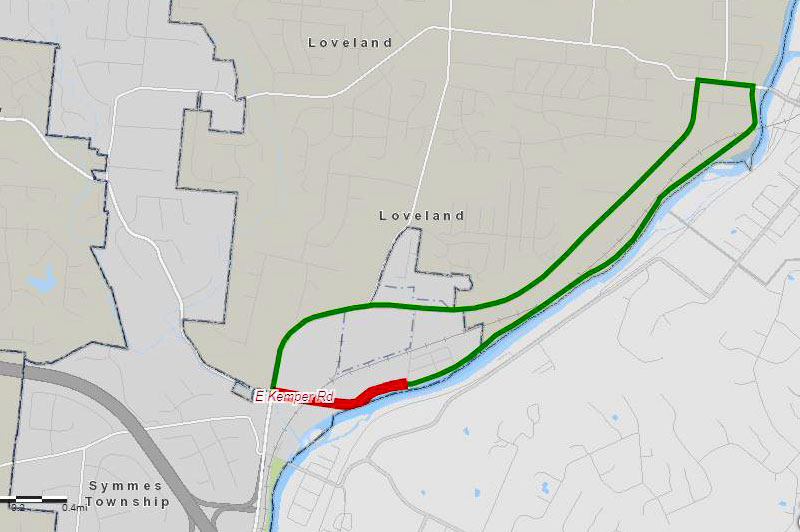
    Symmes Township, Ohio – From Nov. 10 at 5 PM through Nov. 12 at 5 PM (weather permitting), a sanitary sewer will be installed along East Kemper Road between Loveland-Madeira Road and Twightwee Road in Symmes Township. The contractor’s detour route will be Loveland-Madeira Road — West Loveland Avenue — South Riverside Avenue to East Kemper Road — and vice versa. If you have questions, please contact the Hamilton County Engineer’s Office at (513) 946-8430.

  • Board of Zoning Appeals will meet Wednesday to decide fate of home in Historic Downtown

    Board of Zoning Appeals will meet Wednesday to decide fate of home in Historic Downtown

    The Loveland’s Historic Preservation and Planning Commission has voted to allow the demolition of this home at 200 Railroad Avenue.

    Loveland, Ohio – The Board of Zoning Appeals will meet at 5:30 PM on Wednesday, October 30 at Loveland City Hall to decide the fate of a home in Historic Downtown that is at 200 Railroad Avenue.

    After the Loveland Historic Planing District gave the approval to demolish the house, Loveland resident Deidre Hazelbaker appealed the decision.

    Read Background Stories:

    Demolition of historic home in Loveland’s Historic District under appeal

    Demolition of home in Loveland Historic District causing uproar

    Scroll to see the full agenda and supporting documents that Hazelbaker submitted to the Board.

    [pdf-embedder url=”https://lovelandmagazine.com/wp-content/uploads/2024/10/2024-10-30-Board-of-Zoning-Appeals-Full-Agenda-1866.pdf” title=”2024-10-30 Board of Zoning Appeals – Full Agenda-1866″]


  • Anti-gerrymandering groups warn that Ohio’s ballot language is misleading voters

    Anti-gerrymandering groups warn that Ohio’s ballot language is misleading voters

    Mike Ahern, an Independent voter from Blacklick speaks to supporters at the Citizens Not Politicians rally, July 1, 2024, at the Statehouse in Columbus, Ohio. (Photo by Graham Stokes for Ohio Capital Journal. Republish photo only with original story.)

    By:  Ohio Capital Journal

    This article was originally published in Bolts, a nonprofit newsroom covering the nuts and bolts of power and political change, from the local up.

    When Songgu Kwon went to the polls earlier this month, he was eager to help Ohio adopt an independent redistricting commission. The comic book writer and illustrator, who lives near Athens, dislikes the process with which politicians have carved up Ohio into congressional and legislative districts that favor them, enabling Republicans to lock in large majorities. So he was pleased that voting rights groups had placed Issue 1, a proposal meant to create fairer maps, on the Ohio ballot this fall.

    “I’m in support of any measures that make the process more fair to reflect the will of the people, instead of letting the politicians decide how to gerrymander,” says Kwon.

    In the voting booth, he reviewed the text in front of him. His ballot read that voting ‘yes’ would set up a panel “required to gerrymander the boundaries of state legislative and congressional districts,” and that it would “repeal constitutional protections against gerrymandering.”

    So Kwon voted ‘no’ on the measure—given what he’d just read, he thought, that had to be the way to signal support for independent redistricting. He’d gone in planning to vote ‘yes,’ but he was thrown off by this language he saw; he guessed that he must have been wrong or missed some recent development. “The language seemed really specific that if you vote ‘yes’, you’re for gerrymandering,” he now recalls in frustration.


    But when he left the polling station and compared notes with his wife, he quickly figured out that he’d made a mistake: He had just voted to preserve the status quo. To bring about the new independent process and remove redistricting from elected officials, as was his intention, he would have had to vote ‘yes.’

    Kwon says he got confused by the language that was crafted and placed on the ballot by Republican Ohio officials. The official most directly responsible for this language, Secretary of State Frank LaRose, had a direct hand in drawing the gerrymandered maps that Kwon opposes and that the reform would unwind.

    “I didn’t think that they would go so far as to just straight up lie and use a word that means one thing to describe something else,” Kwon told me. “They are using the term gerrymandering to describe an attempt to actually fix the gerrymandering.”

    He added, “I thought this was a serious document, and that there would be some standard.” Other Ohioans have come forward with similar stories in recent days, complaining they meant to vote ‘yes’ but got tricked by the ballot language into not doing so.

    Now the fate of Ohio’s redistricting reform hinges on whether its proponents can dispel this confusion and get the word out to all the residents who intend to support it.

    The result will determine who gets to draw future state congressional and legislative districts, and it may shift seats as early as 2026. But more than that, the dispute adds to a larger saga over the viability of direct democracy in Ohio. Just last summer, the GOP pushed an amendment that would have made it much less likely for future citizen-initiated measures to succeed. That proposal failed, but Mia Lewis, associate director of Common Cause Ohio, told me at the time that she expected Republican leaders to “come back and try again” this year. Now she says that’s exactly what they did when they skewed this latest measure’s ballot language.

    Lewis helped organize Issue 1 this year. And just like in the summer of 2023, she said, state officials “are threatened by the idea that the people of Ohio would have power.”

    “They have understood that Ohioans don’t want gerrymandering, they have nothing good to say about voting ‘no’,” she said, “so the only thing they can say is, if you vote ‘yes,’ on this, you’re requiring gerrymandering, which is the exact opposite of the truth.”


    Issue 1 would amend the state constitution to create a new panel to draw Ohio districts. It would be made up of 15 citizens selected by retired judges from a pool of applicants; the body would need to include five registered Republicans, five registered Democrats, and five people who are neither. Elected officials would be barred from serving on the commission.

    An independent commission would mark a huge change from current law, which grants the authority to draw districts to a panel of elected officials, including the governor, the secretary of state, and appointees of legislative leaders. The constitution already requires that new maps respect certain principles of fairness. But when Ohio’s high court in 2022 struck down GOP gerrymanders seven separate times, ordering the process to be more equitable, GOP leaders ignored the rulings and ran out the clock until they landed a more conservative court in the 2022 midterms. Issue 1 would also codify more stringent fairness criteria for the new commission to respect.

    The coalition that drafted Issue 1 collected enough signatures to put it on the ballot. But as the secretary of state, LaRose got the opportunity to write the measure’s official summary. LaRose had been an active player in the redistricting process that drew the current maps that favor the GOP, but wrote his proposed summary in a way that suggested Issue 1 would make it likelier that Ohio gets gerrymandered. Proponents of Issue 1 immediately complained that his text was misleading.

    They got more angry after LaRose’s draft went up for review in front of the Ohio Ballot Board, a five-person body that includes LaRose and has a GOP majority. During that process, Republican state Senator and board member Theresa Gavarone proposed the specific wording that Kwon says tripped him up most: She suggested using the term “gerrymander” to describe the way Issue 1 would require a commission to divide up the state.

    Gavarone’s proposed tweak was met by gasps and startled laughter from the audience. (This can be heard in the recording’s 1:35:20 mark.) State Representative Terrence Upchurch, one of two Democrats on the board, then laughed in bewilderment when given the opportunity to respond to Gavarone. Still, a majority of the board approved LaRose’s draft and Gavarone’s amendment.

     Ohio Ballot Board Chair, Secretary of State Frank LaRose listens to board member State Sen. Theresa Gavarone, R-Bowling Green at a meeting of the Ohio Ballot Board. (Photo by Graham Stokes for Ohio Capital Journal. Republish photo only with original story.) 

    Voting rights groups rushed to court, asking for the language to be struck down. But the state supreme court, which has a narrow GOP majority, rebuffed them in September and upheld most of the ballot summary.

    The four Republican justices said it was accurate to say that the new independent commission would “gerrymander” Ohio since it would be tasked with taking partisanship into account, even if it’s to draw a more evenly divided map.

    The three Democratic justices disagreed furiously. Justice Jennifer Brunner wrote in a dissent, “We should be requiring a nearly complete redrafting of what is perhaps the most stunningly stilted ballot language that Ohio voters will have ever seen.”

    According to Derek Clinger, an Ohio-based lawyer who has litigated past ballot language cases in front of the Ohio Supreme Court, many states use a system like Ohio’s: They ask elected partisan officials to draft ballot summaries. Still, some do it differently. Oregon, for instance, randomly selects citizens to meet and write statements summarizing each ballot measure.

    But what frustrates Clinger is that Ohio’s state constitution does contain “workable standards” that are meant to enable oversight onto the decisions made by state officials; it states that language on the ballot can’t “mislead, deceive, or defraud the voters.” Clinger said, “You have this standard, but you had a majority [on the state supreme court] that disregarded that.”

    Some Ohio justices take the view that they’re not supposed to play a strong oversight role. Pat DeWine, a Republican justice who is also the son of Ohio’s governor, even has a forthcoming law review essay on the matter. DeWine admits that the Ohio Ballot Board “is composed of partisan actors who may have incentives to draft language that at least subtly favors one side or the other.” But the court should be wary of second guessing them, he writes: It “polices only the outer boundaries of the board’s discretion.”

    Clinger, who now works at the State Democracy Research Initiative, a research hub at the University of Wisconsin Law School, disagrees. He points to a separate dispute that unfolded in Utah this fall: There, Republicans advanced a referendum meant to allow lawmakers to more easily overturn citizen-initiated measures, while also crafting ballot language claiming that their proposal would “strengthen the initiative process.”

    The Utah supreme court voided this measure in September, writing that a referendum must be placed “on the ballot in such words and in such form that the voters are not confused thereby.”

    “Despite the partisan implications of the case, the Utah Supreme Court seemed able to assess in good faith whether the ballot language fairly described the proposal,” Clinger said. “The big takeaway for me is that the personnel of the court is so important.”

    The composition of Ohio’s supreme court is on the line this fall since the state is holding elections for three of its seven seats. The GOP could expand its majority from 4-3 to 6-1, but Democrats also have an opportunity to flip the court in their favor.

    Neither Gavarone nor LaRose responded to Bolts’ requests for comment for this story. LaRose said in a statement last month that the court’s decision was “a huge win for Ohio voters, who deserve an honest explanation of what they’re being asked to decide.”


    If Issue 1 passes, the state would have to quickly set up a new commission to create new maps by the 2026 midterms. But for now, proponents of the reform are focused on getting the measure across the finish line.

    A poll conducted this month by YouGov found that support for Issue 1 had a large lead of over 20 percentage points. But the survey did not use the actual language that people are seeing on their ballot; instead, it asked how respondents would vote after telling them that “a ‘yes’ vote would establish a new bipartisan redistricting commission” and “ban partisan gerrymandering.” That’s precisely the explanation that proponents are fretting won’t be on the measure.

    “I’m not going to rest easy at all until election results have come in,” Lewis said. She says she is worried about “a lot of confusion and purposeful misinformation” during the campaign, like the incorrect claims by GOP opponents of the measure that law enforcement officers and veterans would not be eligible to be on the redistricting commission, for instance.

     Mia Lewis, right, and other Ohio advocates on the day they turned in signatures for Issue 1 in July (Photo from Paul Becker, Becker1999/Flickr) 

    Citizens Not Politicians, the committee running the “yes” campaign, is working to reach voters and explain what the measure actually does. The group launched an ad this fall in which former Chief Justice Maureen O’Connor tells voters that politicians opposed to Issue 1 have “lied” to them. O’Connor, a Republican, voted to strike down GOP gerrymanders in 2022; since leaving office two years ago, she has helped champion Issue 1.

    The committee behind the “no” campaign, Ohio Works, is running ads as well. They have used the same strategy as the Ohio Ballot Board, of trying to associate Issue 1 with gerrymandering. In response to the criticism that some voters feel tricked by this characterization, a spokesperson for Ohio Works has said that, “If people go in and intend to vote for Issue 1, read the ballot language and vote no, they are not confused.”

    But Kwon, the comic book writer, gives this warning to other Ohio voters: “Be careful. When you read the description, they’re going to refer to any attempt to change the current districting as gerrymandering. That’s what really threw me.”

    “I would just say that, if you’re voting ‘yes,’ you’re voting to reform the current districting system,” he added.

    Kwon feels frustrated that he unintentionally undercut a reform he supports and canceled out his wife’s vote. But together they’ve been burning up their friend network ever since to share word of his misfortune.

    He said, “If me sharing the story prevents somebody from getting tricked like I was, or one or two people from getting tricked, hopefully that will balance it out.”


    Daniel Nichanian, Bolts
    Daniel Nichanian, Bolts

    Daniel Nichanian is the founder and editor-in-chief of Bolts.

    MORE FROM AUTHOR

  • Can the Cincinnati Bengals Salvage Their Season?

    Can the Cincinnati Bengals Salvage Their Season?

    by Chris Ball

    Loveland, Ohio

    After the Bengals dug themselves into a 1-4 hole to start the season, everyone knew that it would take grit, determination, and focus to lift the team out. Back-to-back games against two struggling opponents helped propel Cincinnati to within one game of .500. But even in those wins, something looked off about the offense.

    Joe Burrow and company scored 30 more points in three straight games in weeks three through five. In each of those contests they had more than 350 yards and put up over 400 against both Washington and Baltimore. The only thing missing was complimentary performances by the Bengals’ defenders.

    The return of defensive tackles BJ Hill and Sheldon Rankins certainly addressed that lack of production. Lou Anarumo’s players needed confidence, and they played like they had plenty of it against the Giants and Browns. The hope was that playing better against admittedly inferior offenses might lead to a positive change of some kind moving forward.

    But Sunday’s matchup against the Eagles made it crystal clear that the Bengals defense is not ready to contend against any of the even remotely competent competition. And what was worse, Zac Taylor and the Bengals’ offense continued their lack of mediocre play and also failed to meet the moment in a game that this team could ill-afford to lose. But then again, when you played as poorly as Cincinnati did to start this year, they are all must-win games going forward.

    The Bengals Defense Takes a Step Backwards

    After their first bit of success at stopping the run last week against the Browns, Saquon Barkley carved them up like a Thanksgiving turkey. He and the Eagles ploughed their way to 161 rush yards, the fourth time this year Cincinnati has allowed over 150 yards on the ground.

    Jalen Hurts had so much time to throw the football that he could have taken some additional time to check out his stock portfolio. Against a line that was porous in giving up pressure and quarterback hits, Trey Hendrickson and company not only managed zero sacks, but they didn’t even register a quarterback hit. It was a stunning indictment against a line that was finally healthy and looking to prove it had the chops to be a factor.

    All in all, Philadelphia pummeled the Bengals to the tune of 397 total yards and 37 points. Though it would have been nice to give the defense the benefit of the doubt, their performance on Sunday makes it nearly impossible to do as the season continues. It’s hard not to paint them as an extreme liability that will force Joe Burrow and the Bengals offense to carry this team in their remaining games.

    Has Zac Taylor Broken the Bengals Offense?

    There comes a time in every coach’s tenure when he has to be honest with himself if times get tough. To his credit this past week, Cleveland Browns coach Kevin Stefanski acknowledged how poorly his offense was performing under his leadership. He did what a leader does, and stepped aside from his play calling duties for Ken Dorsey because that was what gave the team a better chance to succeed. And lo and behold the following week his Browns pulled off a win from the cellar, taking down the Baltimore Ravens.

    Joe Burrow is healthy, as is Ja’Marr Chase. The offensive line, a malady for years, is playing better and protecting their franchise quarterback. And yet here we are, watching this team, with all its weapons, go backwards on fourth and a yard, and put up less than 300 yards of offense in back-to-back games. For as bad as the fourth down call may have been, the play that preceded it might have been worse.

    Watching Nick Siriani and the Eagles instantly line up and take advantage of fourth and short situations with such success is all the more galling because it comes from a simple “tush push” concept that isn’t hard to scheme or understand. And yet Zac Taylor, with all of the weapons, speed, and power available to him, can’t scheme up a play that has the prayer of a clean napkin at a barbeque festival.

    How many weeks will the front office allow a Ferrari of an offense to perform like a Ford Fiesta? It is apparent that the Bengals defense is not going to magically unlock any hidden talent and begin to be counted on to limit their opponents to less than 25 points. This makes a functioning offense not only preferable, but a requirement to have any chance at all. It puts a great deal of pressure on Joe and company but it is the reality that we are now living in given the disaster we now are facing under Lou Anarumo’s watch.

    In terms of yards per game, the Bengals still have to face the likes of Tennessee (#1 overall), Los Angeles (#9 overall), Pittsburgh twice (#6 overall) and Denver (#3 overall). These are teams whose offenses are still good enough to run circles around Cincinnati and so there are real questions as to whether Taylor has the ability to help this offense find the form it had earlier this year. Unfortunately, the offense is trending away from the explosiveness and effectiveness that it showed previously.

    We’ve all seen the magic that Joe Burrow and Ja’Marr Chase have managed to show on the field week in and week out. Their talent and ability are not the problem. And yet this offense is nowhere near where it needs to be. It’s fair to ask where the deficiencies rest, and as the head coach and the one who draws up the plays that are supposed to unlock the potential of this offense, Zac Taylor must either improve drastically or step aside from those responsibilities.

    What is the Future Like for the 2024 Bengals?

    There was a lot of buzz about the Bengals making a deep playoff run in 2024 or maybe even making it back to the Super Bowl. But those who are honest with themselves after what they’ve seen so far this year can only shake their heads when hearing such talk now. We are eight games into this year and have seen what this team has and what its players can do. There are likely no surprise turnarounds in store for the defense who have no more players to count on to return, and no indication that they have any signs of life to rush the passer or contain any team with an offensive pulse.

    The hope, then, is the same hope that Bengals fans are all too familiar with: putting faith in Joe Burrow to carry this team as far as he can. It’s unfair in this day and age given the athletic pass rushers that stand ready to demolish quarterbacks who drop back too frequently, or the opportunistic defensive backs who can pick off any pass that is remotely close. But unfortunately, there is no other real path to success apart from what Burrow can manage.

    For as much as the future may look bright for Chase Brown, there is no actual track record that he can have sustained success to put a game on his back like Barkley did on Sunday. The offensive line and the run scheme in general just seem uncapable of gashing big plays on a consistent basis. And the defense is going to leak like a sieve from this point forward.

    Put simply, we can only go as far as Joe Burrow’s arm can take us. And if he cannot manage such a herculean effort essentially on his own, it’s absolutely understandable. That is because he’s been failed by so many around him. From the front office who refuse to sign players, to the personnel department who simply cannot draft key players on defense, to his coaches who cannot put together a game plan to put him in a position to succeed.


    ———————-

    Hey readers… have an opinion about sports? How about a topic you’d like to see written about in Loveland Magazine or a thought about one of our articles?

    Just need to vent and get out your frustration about the Reds, Bengals, or any other sports issues?

    Feel free to share with an email to lovelandmagazinesports@gmail.com!

    We would love to hear from our readers, and we thank you for your support and engagement.

    Also, don’t forget to follow us at The Loveland Sports Desk at the below links:

    For Facebook, click here.

    For X, click here.

    For Instagram, click here


    Christopher Ball is a longtime Loveland resident and an attorney. He graduated from Loveland High School in 2003 and was a member of the football team before going on to become a coach’s assistant at DePauw University in Greencastle, Indiana. He has been following and rooting for the Reds and Bengals since the early 1990s and has been through the many ups and downs that fandom has wrought over the years.

  • Attend the Grail’s 80th Anniversary celebration

    Attend the Grail’s 80th Anniversary celebration

    Saturday, November 2, 12:00 pm – 5:00 pm

    FREE, Casual, & Family-friendly

    Loveland, Ohio – For over 80 years The Grail has been active in Ohio and across the US. In that time, they have enjoyed partnerships and collaborations, supported activities, and shared resources and goals with MANY community-based and nonprofit organizations as well as local businesses.

    YOU are invited to join the party as they celebrate these friendships forged through mutual respect and shared missions.

    This will be a festival-style event with live music, Blossim Donuts food truck, and 20+ of our Friends will be there sharing their story—and what they do to make our world a little better.

    These Friends represent the five key areas of The Grail: women, social justice, environment, faith,  & art.

    History of the Grail

  • Pete Rose Visitation

    Pete Rose Visitation

    Great American Ball Park – Sunday, Nov. 10, 2024 – 7 am to 9 pm

    The Reds will host the 14-hour visitation — honoring the number he wore for Cincinnati, Philadelphia and Montreal during his 24-year career in the Major Leagues — on Nov. 10 from 7 a.m. to 9 p.m. ET. It is free and open to the public.

    Pete Rose Day will be held at GABP on May 14, the statement also said. Cincinnati hosts the White Sox that day. Details will be forthcoming.

    Statement from Fawn Rose on behalf of the Pete Rose Family

    We are deeply moved by the overwhelming love and support from the people of Cincinnati, the entire baseball community, and fans across the world as we mourn the loss of our beloved Dad, Grandpa, and Brother, Pete Rose.

    Baseball was his greatest passion, and he loved playing the game for the fans. We know that bringing “Charlie Hustle” home to Cincinnati, the city where he was born and where his legendary career began, is the perfect way to honor his love and devotion to the fans. 

    With the help of the Reds, our family will host a Visitation lasting 14 hours at Great American Ball Park on Sunday, Nov. 10 from 7 am to 9 pm.

    This free, open-to-all event will be a time for those who admired and loved the “Hit King” to come together, honor his incredible legacy, and say their goodbyes before our family lays him to rest privately.

    We will also celebrate Pete’s life and career with a special “Pete Rose Day” at the Reds game on Wednesday, May 14, 2025. We will share more details about the game and other tributes as the date approaches.

    Thank you for your continued support, love, and understanding as we navigate this difficult time.

    ___________

    Guests will enter Great American Ball Park through the main gates on Crosley Terrace and will be directed to queue lines leading to the Visitation area that will overlook the field from the main concourse.

  • Another private equity group is buying an Ohio coal plant. Will anything change?

    Another private equity group is buying an Ohio coal plant. Will anything change?

     A field of coal is seen near the Gavin Power Plant in Cheshire, Ohio. (Photo by Stephanie Keith/Getty Images)

    By:  Ohio Capital Journal

    Another private equity group is in the process of buying a coal-fired generation plant along the Ohio River that is estimated to be the nation’s most deadly via pollution.

    The prospective owners boast of a focus on helping fossil fuel plants make the transition to sustainability. But it’s unclear that anything will change at the 50-year-old facility.

    Presently owned by Blackstone and ArcLight Capital Partners, the 2,600 megawatt Gavin plant in Cheshire is in the process of being purchased by two other private equity firms, Energy Capital Partners and Javelin. Because the plant is estimated to produce the deadliest emissions in the United States — and because it has a $40 million liability to clean up toxic coal ash — watchdogs are concerned about ongoing health threats. They’re also worried that taxpayers will have to pay for any cleanup.

    Private equity groups have long been accused of the most ruthless moneymaking. They often buy assets in deals that quickly recoup their investments, then frequently sell off the most valuable parts of an enterprise, and then walk away either by selling or declaring bankruptcy. Whether people needlessly lose jobs or consumers lose choices is not a consideration, critics say.

    Such firms are heavily invested in fossil fuel-powered electricity generation.

    Earlier this month, Private Equity Climate Risks — a consortium of clean-energy advocates — published a scorecard. It said the annual emissions of private-equity owned fossil fuel plants exceed those of the global airline industry and is on a scale with the catastrophic Canadian wildfires of 2023.

    Ohio’s Gavin Plant is a particular polluter.

    A 2023 analysis by the Sierra Club looked at coal-plant emissions and weather patterns. It concluded that because it sends a plume of toxins over populous areas in the eastern United States, the Gavin plant is the deadliest in the country, killing an estimated 244 people a year.

    Blackstone, one of its current owners, has ties to the Republican presidential ticket. CEO Stephen Schwarzman in May endorsed former President Donald Trump, and it’s the 10th-largest contributor to Ohio Sen. J.D. Vance’s PAC, Working for Ohio, according to OpenSecrets.com.

    Blackstone in August disputed critics’ assertions that it was seeking political influence to avoid compensating for the harms caused by the plant. To the contrary, it said it had spent $1 billion on air quality improvements.

    But now that it appears poised to be sold to yet another private-equity group, critics continue to worry that the Gavin Plant will keep on spewing toxins and that its $40 million coal-ash problem will go unaddressed.

    “I think we’ve seen over the past several years how unpopular and deadly coal is,” said Alissa Jean Schafer, climate director of the Private Equity Stakeholder Project, a group critical of private equity practices. “You’ve certainly had a front-row seat to that in Ohio. Increasingly, coal is being seen as, A) a really bad investment, and B) a poisonous form of energy.”

    Indeed, companies are retiring coal-fired power plants or converting them to cleaner natural gas even faster than the federal government estimates, the Institute for Energy Economics and Financial Analysis reported on Tuesday.

    According to its research, 69,000 megawatts of coal generation will be retired or converted between 2025 and 2030 — nearly double the 36,000 megawatts estimated by the U.S. Energy Information Administration in September.

    “Blackstone wasn’t completely able to ignore that, so Blackstone now is following the typical (private equity) playbook where they swooped in, took (the Gavin Plant), tried to see what profit they could get out of it, didn’t respond to any of the pressure to retire the plant or invest in a clean-energy transition,” Schafer said. “Now Blackstone is passing the buck to the next firm. We’ll see what (Energy Capital Partners) does with it.”

    Schafer and her colleagues at the Private Equity Stakeholders Project said the sale of the Gavin Plant is under consideration by the Federal Energy Regulatory Commission, and details of the deal and its timeline for the deal to close are unknown.

    On its website, Energy Capital Partners says it focuses on converting facilities to cleaner generation.

    “Energy Capital Partners (ECP) is a leading credit and equity investor across energy transition infrastructure, with a focus on investing in electricity and sustainability infrastructure, providing reliable, affordable clean energy,” it says.

     A photo of the coal ash pond at the James Gavin Power Plant in Cheshire, Ohio included in documents to the EPA. 

    However, the firm didn’t respond when asked whether it planned to convert or retire Gavin, or what might be done about the plant’s coal ash.

    The scorecard published earlier this month by Private Equity Climate Risks said that ECP is invested in 14 energy companies and that 64% of them have fossil fuel generation. The consortium — which includes the Private Equity Stakeholders Project — gave ECP a grade of C when it comes to such things as transparency in disclosing emissions and political spending, having a clear plan to transition to clean energy, and plans to do its part to meet the global goal of limiting global warming to 1.5 degrees celsius by the end of the century.

    One of the major critiques of private equity firms is that they use average people’s money to invest in things like fossil fuels that harm those same people. That’s so, the argument goes, because much of the money comes from institutional investors such as public pension funds.

    According to data used in the Private Equity Climate Risks scorecard, at least six of Ohio’s public pensions are invested in private equity funds that support fossil fuels. By far the biggest investor is the State Teachers Retirement System at nearly $1.3 billion.

    Already under fire for paltry benefit increases, big staff bonuses and high-fee “alternative” investments, the pension system is invested in at least three private equity funds that support coal or natural gas:

    • $812 million with Ares Management, which owns 14 fossil fuel companies that spew 55 million tons of carbon dioxide equivalents each year. The scorecard gave it a grade of C, when it comes to meeting climate and transparency goals.
    • $450 million with Apollo Global Management, which owns three fossil fuel companies that emit 3.5M tons of carbon dioxide equivalents. It received a grade of B.
    • $10 million with EnCap Investments. It’s invested in 34 fossil fuel companies that emit 92 million carbon dioxide equivalents a year. It received a D grade on the Private Equity Climate Risks scorecard.

    At least one official is trying to end investments by public pensions in fossil fuels. On Tuesday, New York City Comptroller Brad Lander proposed ending investments by city employee pensions in fossil fuel infrastructure.

    ________

    Marty Schladen
    Marty Schladen

    Marty Schladen has been a reporter for decades, working in Indiana, Texas and other places before returning to his native Ohio to work at The Columbus Dispatch in 2017. He’s won state and national journalism awards for investigations into utility regulation, public corruption, the environment, prescription drug spending and other matters.

    Ohio Capital Journal is part of States Newsroom, the nation’s largest state-focused nonprofit news organization.

    MORE FROM AUTHOR

  • Ohio spent nearly a billion dollars on private school voucher scholarships in 2024

    Ohio spent nearly a billion dollars on private school voucher scholarships in 2024

    Getty Images.

    By:  Ohio Capital Journal

    Ohio spent nearly a billion dollars on private school scholarship programs for the 2024 fiscal year, the first full year with near-universal school vouchers.

    The total scholarship amount for Ohio’s five private school scholarship programs was $970.7 million, according to final data from the Ohio Department of Education and Workforce. Well more than a third that money ($406.7 million) was from Education Choice Expansion scholarships.

    “I think this does have potentially a negative impact on students, on public schools around the margins, as you see those enrollment trends, but then in the big picture, when you have close to a billion dollars in public money that’s going to private schools, that means a billion dollars in state money that’s not available to meet the needs of the nearly 90% of kids that attend our public schools,” said Ohio Education Association President Scott DiMauro.

    The $970.7 million number is higher than the estimated $964.5 million the nonpartisan Ohio Legislative Service Commission predicted when it came to the scholarship programs.

    The five private school scholarship programs are the Autism Scholarship Program, the Jon Peterson Special Needs Scholarship Program, the Cleveland Scholarship, the Education Choice Scholarship and the Educational Choice Expansion Scholarship Program.

    Students on the autism spectrum are eligible to receive vouchers up to $32,455 for the Autism Scholarship Program. Students who have an Individualized Education Program (IEP) from their district are eligible for the Jon Peterson Special Needs Scholarship. The Cleveland Scholarship is for all students living in the boundaries of Cleveland Metropolitan School District. Students living in the boundaries of a low-performing school district are eligible for Education Choice scholarships.

    Lawmakers expanded the Education Choice-Expansion eligibility to 450% of the poverty line last year through the state budget — creating near-universal school vouchers. This means a family of four above the $135,000 income threshold can still be eligible for at least 10% of the maximum scholarship.

    K-8 students can receive a $6,165 scholarship and high schoolers can receive a $8,407 scholarship in state funding under the expansion.

    There were 93,159 applicants for the EdChoice Expansion scholarships and 89,794 were awarded scholarships, according to ODEW data. The amount of EdChoice-Expansion scholarship payments more than tripled from fiscal year 2023 to fiscal year 2024.

    For the traditional EdChoice scholarships, there were 44,020 applicants and 42,779 were awarded scholarships — totaling $273.1 million, according to ODEW data.

    During this time, nonpublic school enrollment increased about 2%, going from 169,807 in fiscal year 2023 to 173,156 in fiscal year 2024, according to ODEW data.

    Public school enrollment declined slightly — dropping about 6,000 students from the 2022-23 school year to the 2023-24 school year.

    Most of these new EdChoice Expansion scholarships are students who were already attending private schools, DiMauro said. Ohio’s voucher program started with the Cleveland Scholarships back in 1996.

    “This was intended to help students who didn’t have the resources to have options outside of public schools,” DiMauro said. “(The EdChoice Expansion) is clearly intended to benefit people that had long ago made the decision to send their kids to private schools.”

    In some cases, the universal vouchers have allowed private schools to increase tuition, he said.

    GET THE MORNING HEADLINES.


    “The increased revenue comes at the expense of the state,” DiMauro said. “It’s the private schools themselves that are directly being subsidized through this program, even more than families are.”

    If private schools are going to accept vouchers, DiMauro wishes there was more transparency when it comes to private school tuition.

    The OLSC predicts the five scholarship programs’ payment total will exceed a billion dollars next year.

    Aaron Churchill, Ohio’s research director for the Thomas B. Fordham Institute, thinks these scholarship payment figures are sustainable year-to-year.

    “I do think we can walk and chew gum at the same time,” he said. “We can support great public schools. We can provide the resources for them. … We can also empower families with greater choice. And I think that’s the direction that Ohio is moving.”

    Total payments for the five scholarship programs for the past five fiscal years, according to ODEW data:

    • $610.2 million in fiscal year 2023
    • $554.5 million in fiscal year 2022
    • $444.5 million in fiscal year 2021
    • $394.2 million in fiscal year 2020
    • $346.6 million In fiscal year 2019

    Remaining scholarships

    For the Cleveland Scholarship this fiscal year, there were 8,626 applicants and 8,361 scholarships were given — totaling $53.6 million, according to ODEW data.

    There were 5,610 applicants for the Autism Scholarship and 5,385 were awarded for $141.7 million, according to ODEW data.

    For the Jon Peterson Scholarship, there were 9,439 applicants and 9,082 scholarships were awarded, totaling $95.6 million, according to ODEW data.

    Follow OCJ Reporter Megan Henry on X.


    Megan Henry
    Megan Henry

    Megan Henry is a reporter for the Ohio Capital Journal and has spent the past five years reporting in Ohio on various topics including education, healthcare, business and crime. She previously worked at The Columbus Dispatch, part of the USA Today Network.

    Ohio Capital Journal is part of States Newsroom, the nation’s largest state-focused nonprofit news organization.

    MORE FROM AUTHOR