Author: Loveland Magazine

  • The Secret IRS Files: Trove of Never-Before-Seen Records Reveal How the Wealthiest Avoid Income Tax

    The Secret IRS Files: Trove of Never-Before-Seen Records Reveal How the Wealthiest Avoid Income Tax

    This story was originally published by ProPublica

    by Jesse Eisinger, Jeff Ernsthausen and Paul Kiel

    ProPublica is a Pulitzer Prize-winning investigative newsroom. Sign up for The Big Story newsletter to receive stories like this one in your inbox.

    To take the deepest dive into what ProPublica has uncovered in the “secret” IRS Files read this story and see the graphics and graphs directly on their Web Site.

    Series:
    The Secret IRS Files

    Inside the Tax Records of the .001%

    In 2007, Jeff Bezos, then a multibillionaire and now the world’s richest man, did not pay a penny in federal income taxes. He achieved the feat again in 2011. In 2018, Tesla founder Elon Musk, the second-richest person in the world, also paid no federal income taxes.

    Michael Bloomberg managed to do the same in recent years. Billionaire investor Carl Icahn did it twice. George Soros paid no federal income tax three years in a row.

    ProPublica has obtained a vast trove of Internal Revenue Service data on the tax returns of thousands of the nation’s wealthiest people, covering more than 15 years. The data provides an unprecedented look inside the financial lives of America’s titans, including Warren Buffett, Bill Gates, Rupert Murdoch and Mark Zuckerberg. It shows not just their income and taxes, but also their investments, stock trades, gambling winnings and even the results of audits.

    Taken together, it demolishes the cornerstone myth of the American tax system: that everyone pays their fair share and the richest Americans pay the most. The IRS records show that the wealthiest can — perfectly legally — pay income taxes that are only a tiny fraction of the hundreds of millions, if not billions, their fortunes grow each year.

    Many Americans live paycheck to paycheck, amassing little wealth and paying the federal government a percentage of their income that rises if they earn more. In recent years, the median American household earned about $70,000 annually and paid 14% in federal taxes. The highest income tax rate, 37%, kicked in this year, for couples, on earnings above $628,300.

    The confidential tax records obtained by ProPublica show that the ultrarich effectively sidestep this system.

    America’s billionaires avail themselves of tax-avoidance strategies beyond the reach of ordinary people. Their wealth derives from the skyrocketing value of their assets, like stock and property. Those gains are not defined by U.S. laws as taxable income unless and until the billionaires sell.

    To capture the financial reality of the richest Americans, ProPublica undertook an analysis that has never been done before. We compared how much in taxes the 25 richest Americans paid each year to how much Forbes estimated their wealth grew in that same time period.

    We’re going to call this their true tax rate.

    The results are stark. According to Forbes, those 25 people saw their worth rise a collective $401 billion from 2014 to 2018. They paid a total of $13.6 billion in federal income taxes in those five years, the IRS data shows. That’s a staggering sum, but it amounts to a true tax rate of only 3.4%.

    It’s a completely different picture for middle-class Americans, for example, wage earners in their early 40s who have amassed a typical amount of wealth for people their age. From 2014 to 2018, such households saw their net worth expand by about $65,000 after taxes on average, mostly due to the rise in value of their homes. But because the vast bulk of their earnings were salaries, their tax bills were almost as much, nearly $62,000, over that five-year period.

    No one among the 25 wealthiest avoided as much tax as Buffett, the grandfatherly centibillionaire. That’s perhaps surprising, given his public stance as an advocate of higher taxes for the rich. According to Forbes, his riches rose $24.3 billion between 2014 and 2018. Over those years, the data shows, Buffett reported paying $23.7 million in taxes.

    That works out to a true tax rate of 0.1%, or less than 10 cents for every $100 he added to his wealth.

    In the coming months, ProPublica will use the IRS data we have obtained to explore in detail how the ultrawealthy avoid taxes, exploit loopholes and escape scrutiny from federal auditors.

    Experts have long understood the broad outlines of how little the wealthy are taxed in the United States, and many lay people have long suspected the same thing.

    But few specifics about individuals ever emerge in public. Tax information is among the most zealously guarded secrets in the federal government. ProPublica has decided to reveal individual tax information of some of the wealthiest Americans because it is only by seeing specifics that the public can understand the realities of the country’s tax system.

    Consider Bezos’ 2007, one of the years he paid zero in federal income taxes. Amazon’s stock more than doubled. Bezos’ fortune leapt $3.8 billion, according to Forbes, whose wealth estimates are widely cited. How did a person enjoying that sort of wealth explosion end up paying no income tax?

    In that year, Bezos, who filed his taxes jointly with his then-wife, MacKenzie Scott, reported a paltry (for him) $46 million in income, largely from interest and dividend payments on outside investments. He was able to offset every penny he earned with losses from side investments and various deductions, like interest expenses on debts and the vague catchall category of “other expenses.”

    In 2011, a year in which his wealth held roughly steady at $18 billion, Bezos filed a tax return reporting he lost money — his income that year was more than offset by investment losses. What’s more, because, according to the tax law, he made so little, he even claimed and received a $4,000 tax credit for his children.

    His tax avoidance is even more striking if you examine 2006 to 2018, a period for which ProPublica has complete data. Bezos’ wealth increased by $127 billion, according to Forbes, but he reported a total of $6.5 billion in income. The $1.4 billion he paid in personal federal taxes is a massive number — yet it amounts to a 1.1% true tax rate on the rise in his fortune.

    The revelations provided by the IRS data come at a crucial moment. Wealth inequality has become one of the defining issues of our age. The president and Congress are considering the most ambitious tax increases in decades on those with high incomes. But the American tax conversation has been dominated by debate over incremental changes, such as whether the top tax rate should be 39.6% rather than 37%.

    ProPublica’s data shows that while some wealthy Americans, such as hedge fund managers, would pay more taxes under the current Biden administration proposals, the vast majority of the top 25 would see little change.

    The tax data was provided to ProPublica after we published a series of articles scrutinizing the IRS. The articles exposed how years of budget cuts have hobbled the agency’s ability to enforce the law and how the largest corporations and the rich have benefited from the IRS’ weakness. They also showed how people in poor regions are now more likely to be audited than those in affluent areas.

    ProPublica is not disclosing how it obtained the data, which was given to us in raw form, with no conditions or conclusions. ProPublica reporters spent months processing and analyzing the material to transform it into a usable database.

    We then verified the information by comparing elements of it with dozens of already public tax details (in court documents, politicians’ financial disclosures and news stories) as well as by vetting it with individuals whose tax information is contained in the trove. Every person whose tax information is described in this story was asked to comment. Those who responded, including Buffett, Bloomberg and Icahn, all said they had paid the taxes they owed.

    A spokesman for Soros said in a statement: “Between 2016 and 2018 George Soros lost money on his investments, therefore he did not owe federal income taxes in those years. Mr. Soros has long supported higher taxes for wealthy Americans.” Personal and corporate representatives of Bezos declined to receive detailed questions about the matter. ProPublica attempted to reach Scott through her divorce attorney, a personal representative and family members; she did not respond. Musk responded to an initial query with a lone punctuation mark: “?” After we sent detailed questions to him, he did not reply.

    One of the billionaires mentioned in this article objected, arguing that publishing personal tax information is a violation of privacy. We have concluded that the public interest in knowing this information at this pivotal moment outweighs that legitimate concern.

    The consequences of allowing the most prosperous to game the tax system have been profound. Federal budgets, apart from military spending, have been constrained for decades. Roads and bridges have crumbled, social services have withered and the solvency of Social Security and Medicare is perpetually in question.

    There is an even more fundamental issue than which programs get funded or not: Taxes are a kind of collective sacrifice. No one loves giving their hard-earned money to the government. But the system works only as long as it’s perceived to be fair.

    Our analysis of tax data for the 25 richest Americans quantifies just how unfair the system has become.

    By the end of 2018, the 25 were worth $1.1 trillion.

    For comparison, it would take 14.3 million ordinary American wage earners put together to equal that same amount of wealth.

    The personal federal tax bill for the top 25 in 2018: $1.9 billion.

    The bill for the wage earners: $143 billion.

    The idea of a regular tax on income, much less on wealth, does not appear in the country’s founding documents. In fact, Article 1 of the U.S. Constitution explicitly prohibits “direct” taxes on citizens under most circumstances. This meant that for decades, the U.S. government mainly funded itself through “indirect” taxes: tariffs and levies on consumer goods like tobacco and alcohol.

    With the costs of the Civil War looming, Congress imposed a national income tax in 1861. The wealthy helped force its repeal soon after the war ended. (Their pique could only have been exacerbated by the fact that the law required public disclosure. The annual income of the moguls of the day — $1.3 million for William Astor; $576,000 for Cornelius Vanderbilt — was listed in the pages of The New York Times in 1865.)

    By the late 19th and early 20th century, wealth inequality was acute and the political climate was changing. The federal government began expanding, creating agencies to protect food, workers and more. It needed funding, but tariffs were pinching regular Americans more than the rich. The Supreme Court had rejected an 1894 law that would have created an income tax. So Congress moved to amend the Constitution. The 16th Amendment was ratified in 1913 and gave the government power “to lay and collect taxes on incomes, from whatever source derived.”

    In the early years, the personal income tax worked as Congress intended, falling squarely on the richest. In 1918, only 15% of American families owed any tax. The top 1% paid 80% of the revenue raised, according to historian W. Elliot Brownlee.

    But a question remained: What would count as income and what wouldn’t? In 1916, a woman named Myrtle Macomber received a dividend for her Standard Oil of California shares. She owed taxes, thanks to the new law. The dividend had not come in cash, however. It came in the form of an additional share for every two shares she already held. She paid the taxes and then brought a court challenge: Yes, she’d gotten a bit richer, but she hadn’t received any money. Therefore, she argued, she’d received no “income.”

    Four years later, the Supreme Court agreed. In Eisner v. Macomber, the high court ruled that income derived only from proceeds. A person needed to sell an asset — stock, bond or building — and reap some money before it could be taxed.

    Since then, the concept that income comes only from proceeds — when gains are “realized” — has been the bedrock of the U.S. tax system. Wages are taxed. Cash dividends are taxed. Gains from selling assets are taxed. But if a taxpayer hasn’t sold anything, there is no income and therefore no tax.

    Contemporary critics of Macomber were plentiful and prescient. Cordell Hull, the congressman known as the “father” of the income tax, assailed the decision, according to scholar Marjorie Kornhauser. Hull predicted that tax avoidance would become common. The ruling opened a gaping loophole, Hull warned, allowing industrialists to build a company and borrow against the stock to pay living expenses. Anyone could “live upon the value” of their company stock “without selling it, and of course, without ever paying” tax, he said.

    Hull’s prediction would reach full flower only decades later, spurred by a series of epochal economic, legal and cultural changes that began to gather momentum in the 1970s. Antitrust enforcers increasingly accepted mergers and stopped trying to break up huge corporations. For their part, companies came to obsess over the value of their stock to the exclusion of nearly everything else. That helped give rise in the last 40 years to a series of corporate monoliths — beginning with Microsoft and Oracle in the 1980s and 1990s and continuing to Amazon, Google, Facebook and Apple today — that often have concentrated ownership, high profit margins and rich share prices. The winner-take-all economy has created modern fortunes that by some measures eclipse those of John D. Rockefeller, J.P. Morgan and Andrew Carnegie.

    In the here and now, the ultrawealthy use an array of techniques that aren’t available to those of lesser means to get around the tax system.

    Certainly, there are illegal tax evaders among them, but it turns out billionaires don’t have to evade taxes exotically and illicitly — they can avoid them routinely and legally.

    Most Americans have to work to live. When they do, they get paid — and they get taxed. The federal government considers almost every dollar workers earn to be “income,” and employers take taxes directly out of their paychecks.

    The Bezoses of the world have no need to be paid a salary. Bezos’ Amazon wages have long been set at the middle-class level of around $80,000 a year.

    For years, there’s been something of a competition among elite founder-CEOs to go even lower. Steve Jobs took $1 in salary when he returned to Apple in the 1990s. Facebook’s Zuckerberg, Oracle’s Larry Ellison and Google’s Larry Page have all done the same.

    Yet this is not the self-effacing gesture it appears to be: Wages are taxed at a high rate. The top 25 wealthiest Americans reported $158 million in wages in 2018, according to the IRS data. That’s a mere 1.1% of what they listed on their tax forms as their total reported income. The rest mostly came from dividends and the sale of stock, bonds or other investments, which are taxed at lower rates than wages.

    As Congressman Hull envisioned long ago, the ultrawealthy typically hold fast to shares in the companies they’ve founded. Many titans of the 21st century sit on mountains of what are known as unrealized gains, the total size of which fluctuates each day as stock prices rise and fall. Of the $4.25 trillion in wealth held by U.S. billionaires, some $2.7 trillion is unrealized, according to Emmanuel Saez and Gabriel Zucman, economists at the University of California, Berkeley.

    Buffett has famously held onto his stock in the company he founded, Berkshire Hathaway, the conglomerate that owns Geico, Duracell and significant stakes in American Express and Coca-Cola. That has allowed Buffett to largely avoid transforming his wealth into income. From 2015 through 2018, he reported annual income ranging from $11.6 million to $25 million. That may seem like a lot, but Buffett ranks as roughly the world’s sixth-richest person — he’s worth $110 billion as of Forbes’ estimate in May 2021. At least 14,000 U.S. taxpayers in 2015 reported higher income than him, according to IRS data.

    There’s also a second strategy Buffett relies on that minimizes income, and therefore, taxes. Berkshire does not pay a dividend, the sum (a piece of the profits, in theory) that many companies pay each quarter to those who own their stock. Buffett has always argued that it is better to use that money to find investments for Berkshire that will further boost the value of shares held by him and other investors. If Berkshire had offered anywhere close to the average dividend in recent years, Buffett would have received over $1 billion in dividend income and owed hundreds of millions in taxes each year.

    Many Silicon Valley and infotech companies have emulated Buffett’s model, eschewing stock dividends, at least for a time. In the 1980s and 1990s, companies like Microsoft and Oracle offered shareholders rocketing growth and profits but did not pay dividends. Google, Facebook, Amazon and Tesla do not pay dividends.

    In a detailed written response, Buffett defended his practices but did not directly address ProPublica’s true tax rate calculation. “I continue to believe that the tax code should be changed substantially,” he wrote, adding that he thought “huge dynastic wealth is not desirable for our society.”

    The decision not to have Berkshire pay dividends has been supported by the vast majority of his shareholders. “I can’t think of any large public company with shareholders so united in their reinvestment beliefs,” he wrote. And he pointed out that Berkshire Hathaway pays significant corporate taxes, accounting for 1.5% of total U.S. corporate taxes in 2019 and 2020.

    Buffett reiterated that he has begun giving his enormous fortune away and ultimately plans to donate 99.5% of it to charity. “I believe the money will be of more use to society if disbursed philanthropically than if it is used to slightly reduce an ever-increasing U.S. debt,” he wrote.

    So how do megabillionaires pay their megabills while opting for $1 salaries and hanging onto their stock? According to public documents and experts, the answer for some is borrowing money — lots of it.

    For regular people, borrowing money is often something done out of necessity, say for a car or a home. But for the ultrawealthy, it can be a way to access billions without producing income, and thus, income tax.

    The tax math provides a clear incentive for this. If you own a company and take a huge salary, you’ll pay 37% in income tax on the bulk of it. Sell stock and you’ll pay 20% in capital gains tax — and lose some control over your company. But take out a loan, and these days you’ll pay a single-digit interest rate and no tax; since loans must be paid back, the IRS doesn’t consider them income. Banks typically require collateral, but the wealthy have plenty of that.

    The vast majority of the ultrawealthy’s loans do not appear in the tax records obtained by ProPublica since they are generally not disclosed to the IRS. But occasionally, the loans are disclosed in securities filings. In 2014, for example, Oracle revealed that its CEO, Ellison, had a credit line secured by about $10 billion of his shares.

    Last year Tesla reported that Musk had pledged some 92 million shares, which were worth about $57.7 billion as of May 29, 2021, as collateral for personal loans.

    With the exception of one year when he exercised more than a billion dollars in stock options, Musk’s tax bills in no way reflect the fortune he has at his disposal. In 2015, he paid $68,000 in federal income tax. In 2017, it was $65,000, and in 2018 he paid no federal income tax. Between 2014 and 2018, he had a true tax rate of 3.27%.

    The IRS records provide glimpses of other massive loans. In both 2016 and 2017, investor Carl Icahn, who ranks as the 40th-wealthiest American on the Forbes list, paid no federal income taxes despite reporting a total of $544 million in adjusted gross income (which the IRS defines as earnings minus items like student loan interest payments or alimony). Icahn had an outstanding loan of $1.2 billion with Bank of America among other loans, according to the IRS data. It was technically a mortgage because it was secured, at least in part, by Manhattan penthouse apartments and other properties.

    Borrowing offers multiple benefits to Icahn: He gets huge tranches of cash to turbocharge his investment returns. Then he gets to deduct the interest from his taxes. In an interview, Icahn explained that he reports the profits and losses of his business empire on his personal taxes.

    Icahn acknowledged that he is a “big borrower. I do borrow a lot of money.” Asked if he takes out loans also to lower his tax bill, Icahn said: “No, not at all. My borrowing is to win. I enjoy the competition. I enjoy winning.”

    He said adjusted gross income was a misleading figure for him. After taking hundreds of millions in deductions for the interest on his loans, he registered tax losses for both years, he said. “I didn’t make money because, unfortunately for me, my interest was higher than my whole adjusted income.”

    Asked whether it was appropriate that he had paid no income tax in certain years, Icahn said he was perplexed by the question. “There’s a reason it’s called income tax,” he said. “The reason is if, if you’re a poor person, a rich person, if you are Apple — if you have no income, you don’t pay taxes.” He added: “Do you think a rich person should pay taxes no matter what? I don’t think it’s germane. How can you ask me that question?”

    Skeptics might question our analysis of how little the superrich pay in taxes. For one, they might argue that owners of companies get hit by corporate taxes. They also might counter that some billionaires cannot avoid income — and therefore taxes. And after death, the common understanding goes, there’s a final no-escape clause: the estate tax, which imposes a steep tax rate on sums over $11.7 million.

    ProPublica found that none of these factors alter the fundamental picture.

    Take corporate taxes. When companies pay them, economists say, these costs are passed on to the companies’ owners, workers or even consumers. Models differ, but they generally assume big stockholders shoulder the lion’s share.

    Corporate taxes, however, have plummeted in recent decades in what has become a golden age of corporate tax avoidance. By sending profits abroad, companies like Google, Facebook, Microsoft and Apple have often paid little or no U.S. corporate tax.

    For some of the nation’s wealthiest people, particularly Bezos and Musk, adding corporate taxes to the equation would hardly change anything at all. Other companies like Berkshire Hathaway and Walmart do pay more, which means that for people like Buffett and the Waltons, corporate tax could add significantly to their burden.

    It is also true that some billionaires don’t avoid taxes by avoiding incomes. In 2018, nine of the 25 wealthiest Americans reported more than $500 million in income and three more than $1 billion.

    In such cases, though, the data obtained by ProPublica shows billionaires have a palette of tax-avoidance options to offset their gains using credits, deductions (which can include charitable donations) or losses to lower or even zero out their tax bills. Some own sports teams that offer such lucrative write-offs that owners often end up paying far lower tax rates than their millionaire players. Others own commercial buildings that steadily rise in value but nevertheless can be used to throw off paper losses that offset income.

    Michael Bloomberg, the 13th-richest American on the Forbes list, often reports high income because the profits of the private company he controls flow mainly to him.

    In 2018, he reported income of $1.9 billion. When it came to his taxes, Bloomberg managed to slash his bill by using deductions made possible by tax cuts passed during the Trump administration, charitable donations of $968.3 million and credits for having paid foreign taxes. The end result was that he paid $70.7 million in income tax on that almost $2 billion in income. That amounts to just a 3.7% conventional income tax rate. Between 2014 and 2018, Bloomberg had a true tax rate of 1.30%.

    In a statement, a spokesman for Bloomberg noted that as a candidate, Bloomberg had advocated for a variety of tax hikes on the wealthy. “Mike Bloomberg pays the maximum tax rate on all federal, state, local and international taxable income as prescribed by law,” the spokesman wrote. And he cited Bloomberg’s philanthropic giving, offering the calculation that “taken together, what Mike gives to charity and pays in taxes amounts to approximately 75% of his annual income.”

    The statement also noted: “The release of a private citizen’s tax returns should raise real privacy concerns regardless of political affiliation or views on tax policy. In the United States no private citizen should fear the illegal release of their taxes. We intend to use all legal means at our disposal to determine which individual or government entity leaked these and ensure that they are held responsible.”

    Ultimately, after decades of wealth accumulation, the estate tax is supposed to serve as a backstop, allowing authorities an opportunity to finally take a piece of giant fortunes before they pass to a new generation. But in reality, preparing for death is more like the last stage of tax avoidance for the ultrawealthy.

    University of Southern California tax law professor Edward McCaffery has summarized the entire arc with the catchphrase “buy, borrow, die.”

    The notion of dying as a tax benefit seems paradoxical. Normally when someone sells an asset, even a minute before they die, they owe 20% capital gains tax. But at death, that changes. Any capital gains till that moment are not taxed. This allows the ultrarich and their heirs to avoid paying billions in taxes. The “step-up in basis” is widely recognized by experts across the political spectrum as a flaw in the code.

    Then comes the estate tax, which, at 40%, is among the highest in the federal code. This tax is supposed to give the government one last chance to get a piece of all those unrealized gains and other assets the wealthiest Americans accumulate over their lifetimes.

    It’s clear, though, from aggregate IRS data, tax research and what little trickles into the public arena about estate planning of the wealthy that they can readily escape turning over almost half of the value of their estates. Many of the richest create foundations for philanthropic giving, which provide large charitable tax deductions during their lifetimes and bypass the estate tax when they die.

    Wealth managers offer clients a range of opaque and complicated trusts that allow the wealthiest Americans to give large sums to their heirs without paying estate taxes. The IRS data obtained by ProPublica gives some insight into the ultrawealthy’s estate planning, showing hundreds of these trusts.

    The result is that large fortunes can pass largely intact from one generation to the next. Of the 25 richest people in America today, about a quarter are heirs: three are Waltons, two are scions of the Mars candy fortune and one is the son of Estée Lauder.

    In the past year and a half, hundreds of thousands of Americans have died from COVID-19, while millions were thrown out of work. But one of the bleakest periods in American history turned out to be one of the most lucrative for billionaires. They added $1.2 trillion to their fortunes from January 2020 to the end of April of this year, according to Forbes.

    That windfall is among the many factors that have led the country to an inflection point, one that traces back to a half-century of growing wealth inequality and the financial crisis of 2008, which left many with lasting economic damage. American history is rich with such turns. There have been famous acts of tax resistance, like the Boston Tea Party, countered by less well-known efforts to have the rich pay more.

    One such incident, over half a century ago, appeared as if it might spark great change. President Lyndon Johnson’s outgoing treasury secretary, Joseph Barr, shocked the nation when he revealed that 155 Americans making over $200,000 (about $1.6 million today) had paid no taxes. That group, he told the Senate, included 21 millionaires.

    “We face now the possibility of a taxpayer revolt if we do not soon make major reforms in our income taxes,” Barr said. Members of Congress received more furious letters about the tax scofflaws that year than they did about the Vietnam War.

    Congress did pass some reforms, but the long-term trend was a revolt in the opposite direction, which then accelerated with the election of Ronald Reagan in 1980. Since then, through a combination of political donations, lobbying, charitable giving and even direct bids for political office, the ultrawealthy have helped shape the debate about taxation in their favor.

    One apparent exception: Buffett, who broke ranks with his billionaire cohort to call for higher taxes on the rich. In a famous New York Times op-ed in 2011, Buffett wrote, “My friends and I have been coddled long enough by a billionaire-friendly Congress. It’s time for our government to get serious about shared sacrifice.”

    Buffett did something in that article that few Americans do: He publicly revealed how much he had paid in personal federal taxes the previous year ($6.9 million). Separately, Forbes estimated his fortune had risen $3 billion that year. Using that information, an observer could have calculated his true tax rate; it was 0.2%. But then, as now, the discussion that ensued on taxes was centered on the traditional income tax rate.

    In 2011, President Barack Obama proposed legislation, known as the Buffett Rule. It would have raised income tax rates on people reporting over a million dollars a year. It didn’t pass. Even if it had, however, the Buffett Rule wouldn’t have raised Buffett’s taxes significantly. If you can avoid income, you can avoid taxes.

    Today, just a few years after Republicans passed a massive tax cut that disproportionately benefited the wealthy, the country may be facing another swing of the pendulum, back toward a popular demand to raise taxes on the wealthy. In the face of growing inequality and with spending ambitions that rival those of Franklin D. Roosevelt or Johnson, the Biden administration has proposed a slate of changes. These include raising the tax rates on people making over $400,000 and bumping the top income tax rate from 37% to 39.6%, with a top rate for long-term capital gains to match that. The administration also wants to up the corporate tax rate and to increase the IRS’ budget.

    Some Democrats have gone further, floating ideas that challenge the tax structure as it’s existed for the last century. Oregon Sen. Ron Wyden, the chairman of the Senate Finance Committee, has proposed taxing unrealized capital gains, a shot through the heart of Macomber. Sens. Elizabeth Warren and Bernie Sanders have proposed wealth taxes.

    Aggressive new laws would likely inspire new, sophisticated avoidance techniques. A few countries, including Switzerland and Spain, have wealth taxes on a small scale. Several, most recently France, have abandoned them as unworkable. Opponents contend that they are complicated to administer, as it is hard to value assets, particularly of private companies and property.

    What it would take for a fundamental overhaul of the U.S. tax system is not clear. But the IRS data obtained by ProPublica illuminates that all of these conversations have been taking place in a vacuum. Neither political leaders nor the public have ever had an accurate picture of how comprehensively the wealthiest Americans avoid paying taxes.

    Buffett and his fellow billionaires have known this secret for a long time. As Buffett put it in 2011: “There’s been class warfare going on for the last 20 years, and my class has won.”

  • Milford’s Ryan Peery finally wins Top Fuel at Dragway

    Milford’s Ryan Peery finally wins Top Fuel at Dragway

    Rockingham, N.C. – For the second straight year, Milford, Ohio’s Ryan Peery dominated Top Fuel racing in the AHDRA Nitro Summer Nationals at Rockingham Dragway. This time, though, he left with the trophy.

    The No. 1 qualifier, Peery was quickest in every round of competition Sunday and beat Jimmy McMillon of Deland, Fla., in the final after McMillon had upset two-time former IHRA and NHRA World Champion Jay Turner of Julian in round one and his teammate, two-time former NHRA Nitro Harley champ Tii Tharpe of East Bend, in the semifinals.

    Read on in the Richmond Country Daily Journal…

  • DeWine issues urgent appeal to COVID-19 vaccine providers

    DeWine issues urgent appeal to COVID-19 vaccine providers

    Columbus, Ohio – With approximately 200,000 doses of Johnson & Johnson vaccine in Ohio set to expire on June 23, Governor Mike DeWine issued an urgent communication to vaccine providers today asking them to distribute as many doses as possible to eligible Ohioans, as quickly as possible.

    Governor DeWine also is appealing to Ohioans who have not been vaccinated yet: “The time to act is now.”

    “For Ohioans who have been waiting to get their vaccine, I urge you to take action now. There are many opportunities throughout the state to get a vaccine,” Governor DeWine said. “The Johnson & Johnson vaccine is one of those options. It is safe and effective and only requires one shot. In just two weeks, you could be protected from this virus. Getting vaccinated is the quickest way out of the pandemic and the fastest way for us to return to the lives we remember.”

    DeWine said today that at this time, Ohio does not have legal options for sending the vaccine elsewhere, either to other states or other countries.

    The Ohio Department of Health (ODH) has directed all providers to follow a first-in, first-out process for vaccine to ensure doses with the soonest expiration dates are being used first.

    ODH also has been working with COVID-19 vaccine providers across the state to identify tactics to use as many doses of the single-dose Johnson & Johnson vaccine before they expire. Some of these tactics include forming community partnerships to offer special vaccination clinics, offering more mobile vaccination opportunities in partnering with community groups at community events and for homebound individuals, and offering the vaccine as part of ongoing maintenance programs with congregate setting staff and residents, as well as correctional/detention centers.

    According to a release issued today, “More than 5.3 million Ohioans have started the COVID-19 vaccination process, and more than 4.7 million are fully vaccinated. On June 5, Ohio hit a benchmark we’ve long awaited: fewer than 50 cases per 100,000 residents in Ohio. While these are positive signs, the threat of COVID-19 still remains.” (Ohio’s unvaccinated might be in as much danger now as they were in February. But state officials can’t directly track them)

    The release also said that the risk of going unvaccinated impacts not only those who choose not to be vaccinated, but to those around them. “Lower vaccination rates put children under 12, who don’t yet have a COVID-19 vaccine authorized for their age group, at risk, as well as the small percentage of Ohioans who can’t be vaccinated, or those with certain immune disorders. The more Ohioans who are vaccinated, the more we can protect ourselves, and one another.”

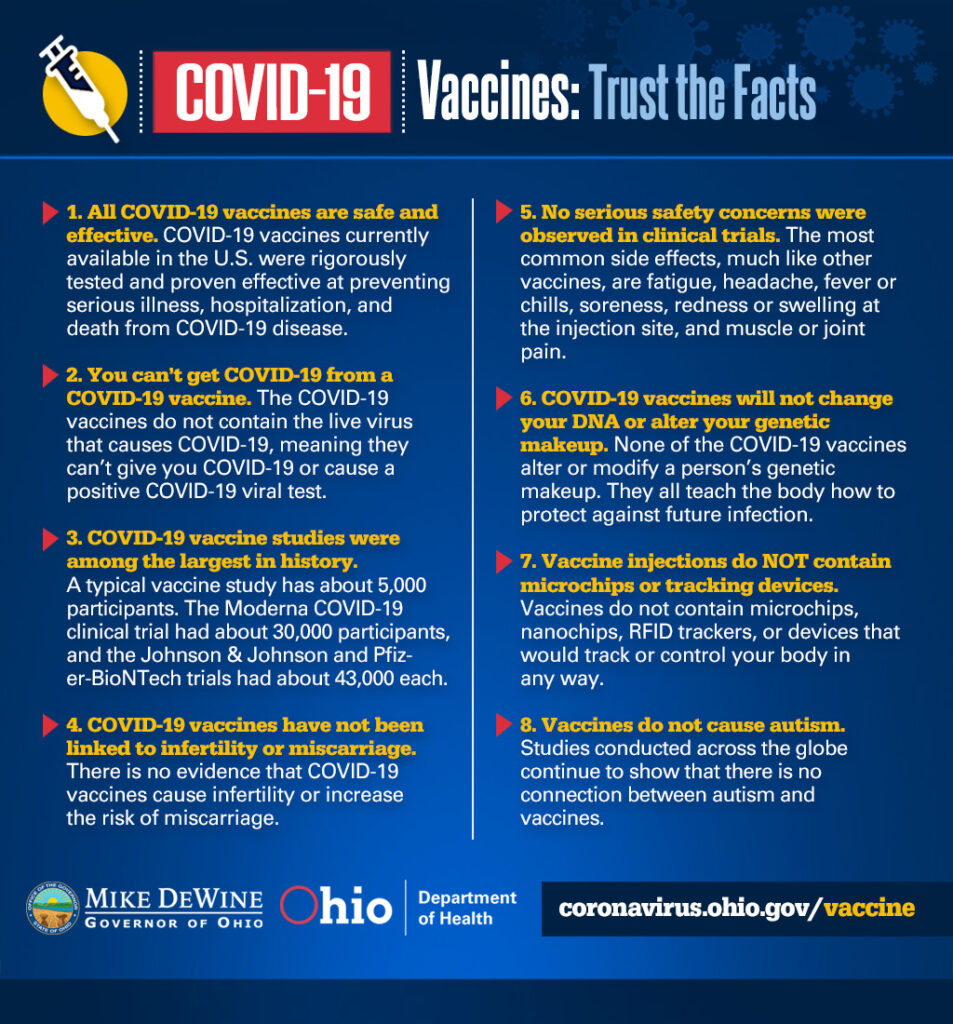
    All of the COVID-19 vaccines have been proven to be highly effective at preventing severe disease and against known variants. The Johnson & Johnson vaccine is a single-dose vaccine for individuals ages 18 and older. Because the vaccine is available in one dose, you will be fully immunized just two weeks after receiving the vaccine. This means you can safely and quickly resume activities that you did prior to the pandemic.

    The Johnson & Johnson vaccine is available at provider locations around the state, including local health departments, pharmacies and mass vaccination sites. Visit gettheshot.coronavirus.ohio.gov to find a provider near you and schedule an appointment. Most providers list the available vaccine on their websites and/or social media pages. Many providers will also accept walk-in appointments.

    More information about the vaccine is available at coronavirus.ohio.gov.

  • Ohio’s unvaccinated might be in as much danger now as they were in February. But state officials can’t directly track them

    Ohio’s unvaccinated might be in as much danger now as they were in February. But state officials can’t directly track them

    By Marty Schladen and Ohio Capital Journal

    More than 5 million Ohioans have started getting vaccinated against the coronavirus — and a few lucky ones will win a million bucks or a free ride to college for doing so.

    That has overall disease, hospitalization and death numbers plummeting as Ohio Gov. Mike DeWine ends covid restrictions on Wednesday. 

    But the 64% of Ohioans who haven’t begun their vaccinations appear to be in as much danger as they were in the deadly days of February. That’s when nearly 2,000 Ohioans were hospitalized with covid — about three times the 622 who were hospitalized with the disease on Tuesday.

    In other words, unvaccinated Ohioans might not be getting the right message from good coronavirus news because it doesn’t seem to apply to them. 

    Unfortunately, state health officials can’t say for sure.

    The Washington Post last week published a state-by-state analysis assuming that vaccinations were at least 85% effective at keeping people out of the hospital with covid. It recalculated covid metrics excluding 85% of vaccinated people and compared resulting rates to what they were for the general population before vaccines were widely available.

    Ohio came out in the middle of the pack, which isn’t great. It showed that among the unvaccinated, the state’s daily rate of covid hospitalizations of 40 per 100,000 people is similar to what it was for the population as a whole on Feb. 16.

    Most of Ohio’s neighbors have similar hospitalization rates among the unvaccinated. In Indiana, West Virginia and Kentucky it’s 40 per 100,000.

    Neighboring Michigan for months has been hammered with a fast-spreading variant and its unvaccinated population is estimated to have 60 hospitalizations per 100,000. Pennsylvania also has an unvaccinated hospitalization rate of 60 per 100,000, the analysis said.

    The analysis used conservative assumptions about how effective the vaccines are based on scientific data. Even so, they’re still just estimates.

    Tantalizingly, officials with the Ohio Department of Health have data about who’s sick and who’s been vaccinated, but not the technology to match them up. 

    “Within the disease reporting system (ODRS), there is a notation for whether someone is vaccinated or not,” spokeswoman Megan Smith said in an email. “However, it is not possible to run a report by vaccine status at the state level because of the limitations of the system.”

    Meanwhile, state leaders are continuing to try to persuade Ohioans to get vaccinated. They have credited the Vax-a-Million promotion for a 28% vaccination increase during the first two weeks of the promotion among people who could have gotten shots before it was announced.

    “Ohio’s Vax-a-Million drawing was designed to bring attention and excitement to vaccination efforts around the state,” ODH Director Stephanie McCloud said in a statement. “This data showing significant increases in vaccination numbers during the two weeks since the contest was announced demonstrates it is working. Vaccines are our best tool to return to the lives we remember from before the pandemic.”

  • [Alex Eicher Photo Album] MLS SOCCER: New England Revolution 1, FC Cincinnati 0

    [Alex Eicher Photo Album] MLS SOCCER: New England Revolution 1, FC Cincinnati 0

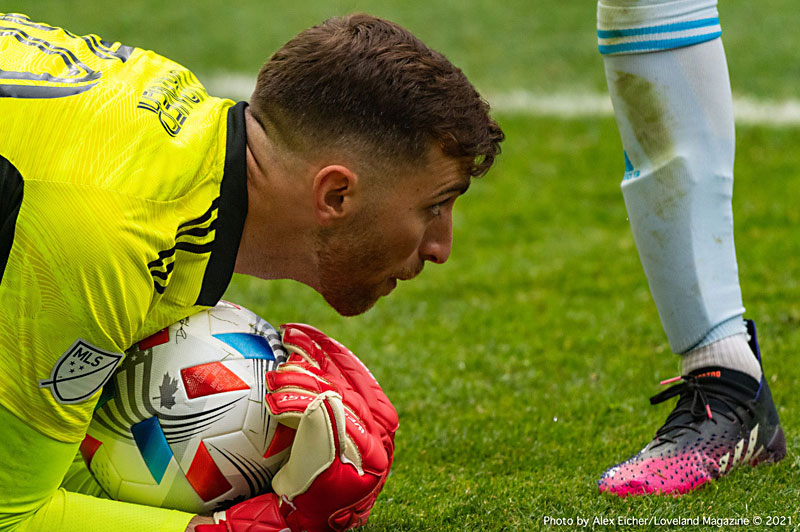
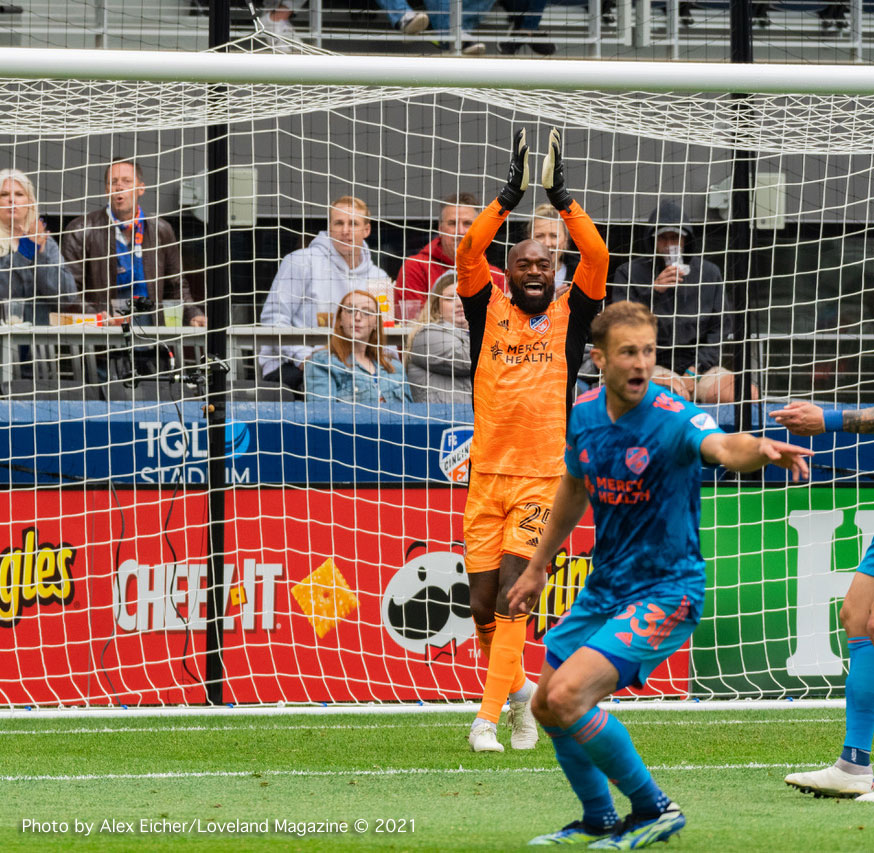
    FC Cincinnati fell to the New England Revolution, 0-1, at TQL Stadium on Saturday afternoon. 

    Cincinnati, Ohio – New England Revolution (5-1-2, 17 pts.) capitalized off a free kick and was able to break the deadlock in the 70th minute. New England’s Carles Gil swung in a cross, and Adam Buksa connected with a header to give the away team the lead. FC Cincinnati (1-4-1, 4 pts.) pushed forward and had various opportunities to find the back of the net. 

    Brenner ripped a shot from outside the penalty box, but the ball grazed over the crossbar. The most notable chance for the Orange and Blue came in the 82nd minute. Alvaro Barreal found Brandon Vazquez, whose right footed shot forced New England’s Matt Turner to make a save. 

    FC Cincinnati is heading into a break and will not return to action until Saturday, June 19 when the club hosts Colorado Rapids at TQL Stadium.  Kickoff is set for 7:30 p.m. ET, and the game will be televised on WSTR 64, carried on the radio on ESPN1530, streamed regionally on fccincinnati.com/stream, out of market on ESPN+, while an audio stream will be available via the iHeartRadio app.

    Information about seating options at TQL Stadium is now available at TQLstadium.com. For more information about 2021 Season Ticket Memberships, which are now on sale to the general public, visit TQLstadium.com or the stadium’s social properties on Twitter, Facebook or Instagram at @TQLStadium, or by calling the team’s sales and service staff at 513-977-5425.

    All photos © 2021 Alex Eicher/Loveland Magazine

  • DeWine reminds unvaccinated Ohioans to continue wearing masks

    DeWine reminds unvaccinated Ohioans to continue wearing masks

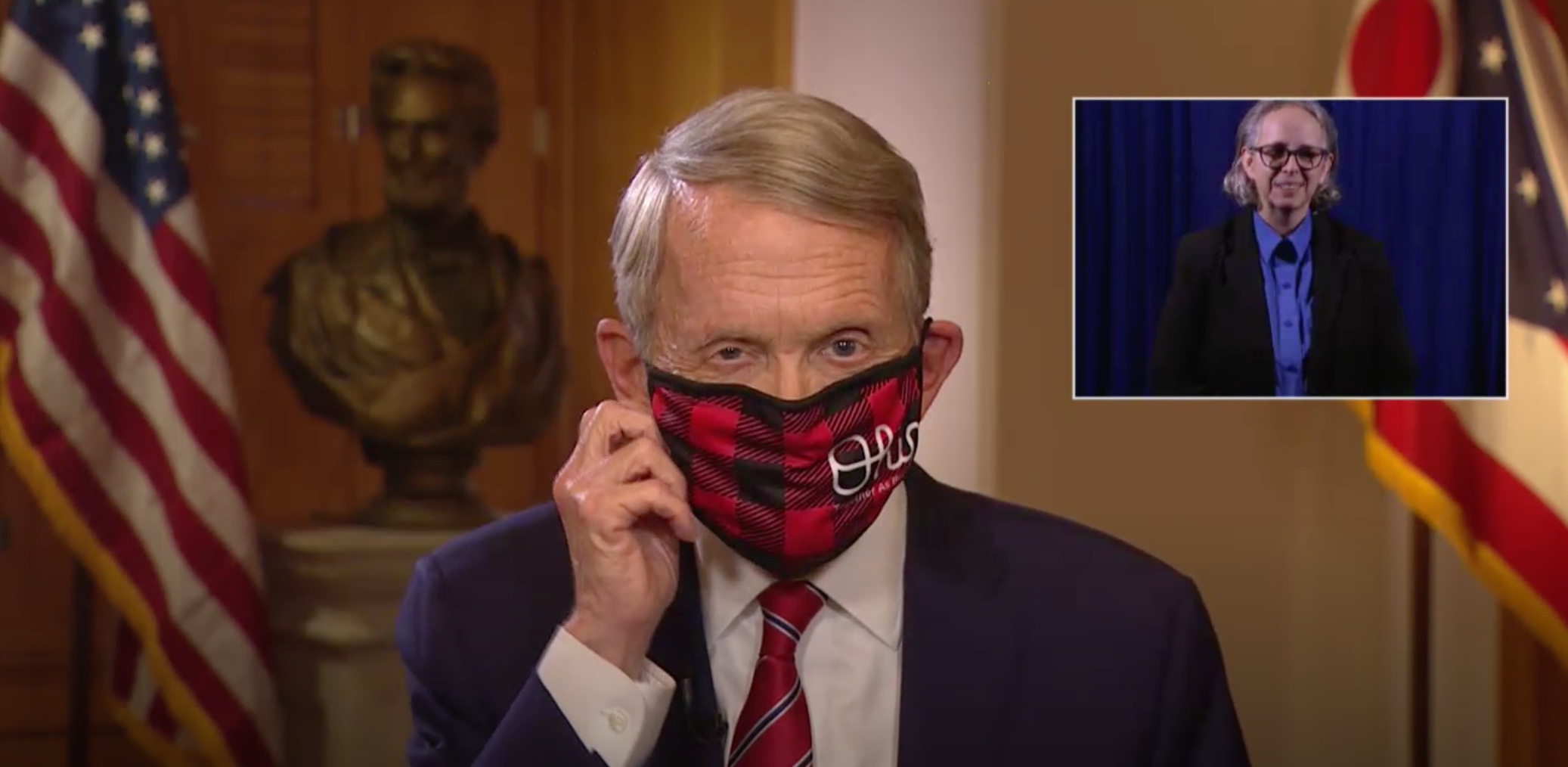
    Columbus and Loveland, Ohio – Ohio Governor Mike DeWine today reminded Ohioans of the importance of getting vaccinated against COVID-19 and for those that are not fully-vaccinated to wear masks indoors, as statewide mask mandates lift tomorrow.

    “Ohioans have done a great job during the pandemic. And, with more than 5 million Ohioans who have received at least the first dose of the COVID-19 vaccine, we are getting back to living the lives we want. However, it is important that we all still remember that there are a significant number of Ohioans who remain unvaccinated and are at-risk, including everyone under the age of 12. It’s important that those not fully vaccinated continue to wear masks indoors and follow other preventative measures to keep themselves as healthy as possible,” said Governor Mike DeWine.

    More than 5.3 million Ohioans have received their first vaccinations and 4.6 million have completed the vaccination series.

    An individual is considered fully vaccinated two weeks after their second dose of Pfizer or Moderna COVID-19 vaccines or two weeks after the single dose of the Johnson & Johnson vaccine.

    For businesses and organizations looking to update signage in their facilities, appropriate signs are available at coronavirus.ohio.gov.

    Ohioans can find the vaccination site nearest them at gettheshot.coronavirus.ohio.gov.

    American Flag Over Blue Paper Texture Background
  • Numerous LHS athletes compete in State Track Championship starting Friday

    Numerous LHS athletes compete in State Track Championship starting Friday

    Madison Conatser and Jessie Gibbins

    Loveland, Ohio – For the 1st time in Loveland High School history, two State qualifiers will be running in the same event at the Ohio Track and Field Championship. Sophomore, Madison Conatser (2:20.50) and Junior, Jessie Gibbins (2:20.60) placed 3rd and 4th respectively in the 800 meter run at the Regional Championships. The pair also qualified in the 4×800 meter relay team with teammates Emmy Sager, and Sarah Madix.

    The track and field state tournament is Friday and Saturday at three Central Ohio high schools, since Jesse Owens Memorial Stadium at The Ohio State University is not available due to the COVID-19 pandemic. The Division I meet, featuring the Tiger athletes will be held at Hilliard Darby High School. State meet running events live on the NFHS Network: https://www.nfhsnetwork.com/states/OH Tournament Schedule

    Based on his time in the 1600 meter run, Junior, Ryan Chevalier qualified for an at large spot . He also qualified in the 3200 meter relay with teammates, J.P. Tew, Brady Steiner, and Ajay Stutz.

  • Marriage shouldn’t negate rape, bill supporters say

    Marriage shouldn’t negate rape, bill supporters say

    By Susan Tebben and Ohio Capital Journal

    Supporters of a bill removing a loophole for spousal rape and sexual assault say the state needs to stop the double-standard that exists when it comes to sex crimes.

    Heather McComas-Harrison said she spoke from experience when imploring a House committee on Thursday to pass House Bill 121, to remove language in Ohio law that excepts spouses in offenses such as rape, sexual battery and gross sexual imposition.

    McComas-Harrison said it’s unfair that her husband shouldn’t be charged for sex crimes she said were perpetrated against her over many years and resulting in physical and emotional injuries, because of the mere existence of a marriage license.

    “Perfect strangers come across each other and one rapes the other, society gasps and is appalled and wants justice for the person who was raped,” McComas-Harrison told the House Criminal Justice Committee. “Yet when two people…have vowed to honor each other and the like, (they) have zero rights to justice when raped by their lifetime partner.”

    McComas-Harrison said it’s wrong of the state to allow a request for a divorce on the grounds of rape, but not give survivors rights or even the right of the spouse to receive treatment through the Ohio Department of Rehabilitation and Corrections.

    Micaela Deming, policy director and staff attorney for the Ohio Domestic Violence Network, said House Bill 121 gives equal access to the law for those experiencing rape, within marriages and outside of them.

    Citing a National Institute of Justice report, Deming said 40 to 45% of women in abusive relationships are sexually assaulted by their abusive partner, with more than half of those women assaulted multiple times. Even with these statistics, Deming said married women have less legal protection from rape than unmarried women.

    “Indeed, current law serves as a disincentive for women to enter into marriage, knowing that they will lose legal protection if their spouse decides to be violent,” Deming testified to the committee.

    Louis Tobin, executive director of the Ohio Prosecuting Attorneys Association, agrees that the presence of a legal document designating two people as spouses should not make the difference when it comes to sex crimes.

    “Ultimately, someone with a viable allegation of spousal sexual abuse should not be prevented from seeking and obtaining justice out of concern that some other individuals will try to abuse our criminal justice system by making false allegations,” Tobin testified to the committee.

    The law would also allow a person’s spouse to testify in the prosecution of those alleged crimes.

    Tobin was asked by state Rep. Bill Seitz, R-Cincinnati, whether, for example, a contentious divorce would be considered when looking at allegations of sexual misconduct against a spouse.

    “Down the line, somewhere in that 25-year period (the statute of limitations for rape in Ohio), they get divorced, they got fights over the kids, and the spouse says ‘well, here’s a wonderful idea, let’s run down to my friendly local prosecutor and charge this other spouse with spousal rape or gross sexual imposition,’” Seitz posed to Tobin.

    Tobin said in any legal case, an allegation still has to rise to the level of probable cause and eventually proof beyond a reasonable doubt, no matter the source of the allegation.

    “I think there’s no difference between a woman who was in a relationship 12 years ago showing up to make that allegation (and) a woman who was married 12 years ago showing up to make the allegations,” Tobin said. “Prosecutors have to sort that stuff out and just because you’ve got a marriage document, I think, doesn’t make the…rape or the sexual assault any different.”

    The bill is one of two currently circulating in the statehouse that address spousal rape, and another of several attempts to amend Ohio law on the topic.

  • Do you owe ODJFS because of a Pandemic Unemployment Assistance overpayment?

    Do you owe ODJFS because of a Pandemic Unemployment Assistance overpayment?

    State made $1.2 billion in accidental payments, which could be forgiven

    This article is from Eye on Ohio, the nonprofit, nonpartisan Ohio Center for Journalism. Please join their free mailing list, as this helps provide more public service reporting.


    When Matthew Bishop started getting Pandemic Unemployment Assistance a year ago, it pulled him out of a tight spot. Bishop, who runs a small company called Gutenberg Author Services, lost all his customers when the economy imploded in March, and had moved out of his group house and in with his parents because he couldn’t make rent. PUA was a lifeline.

    But in April, the state told him he owes $20,000 because he was overpaid.

    Tens of thousands of Ohioans could be eligible to have their debt to the Department of Jobs and Family Services for unemployment assistance overpayments wiped out. But when ODJFS tells people they’ve been overpaid, the notices don’t mention that a repayment waiver might be available.

    That’s leaving people like Bishop in a panic as they stare down bills they can’t possibly pay. Bishop said he contacted both his Ohio representative and senator, and filed an appeal online, but he hasn’t gotten a hearing date.

    “I don’t have a lawyer,” Bishop said. “I don’t really know what I’m doing.”

    Over 1 million Ohioans have received PUA assistance. In the months since the system was launched, however, the Department of Jobs and Family Services found that it approved some people by mistake, or didn’t have enough paperwork to make a determination.

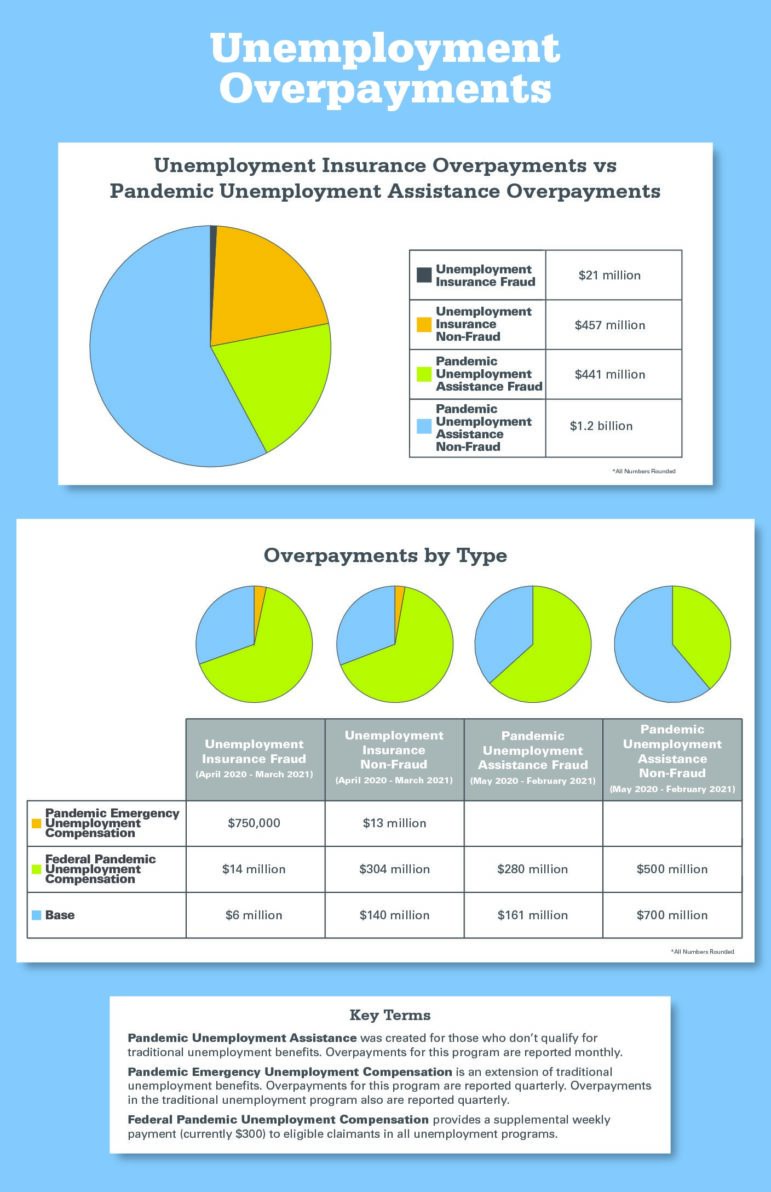
    After seven requests for PUA overpayment data between March 12 and April 26, ODJFS spokesman Bret Crow said he expected data to be available in “a few weeks.” In a press conference announced Monday, ODJFS interim director Matt Damschroder said the state gave out $1.2 billion in accidental PUA payments between the launch of the system last May and February of this year. Non-fraud overpayments, Damschroder said, could include a case where someone wasn’t aware they were supposed to report any money they made each week, or where an ODJFS employee mistakenly waved through an application that had a problem.  That’s not including fraudulent payments, where a claimant deliberately lied to get money they weren’t entitled to have.

    The state has always had the option to waive overpayments for traditional unemployment insurance if the mistake happened on the state’s side, and the unemployed person would have trouble repaying. When the PUA program launched, the state didn’t have the same flexibility to forgive overpayments, but Congress changed that when it passed the CARES Act extension in December 2020.

    Damschroder said ODJFS only received guidance from the federal Department of Labor about waivers recently, so Ohio is still sussing out what waiver requirements could be, or whether ODJFS will forgive some overpayments automatically through a blanket waiver. He said there will be more information about that “soon.”

    Source: ODJFS

    Michelle Wrona, with Community Legal Aid in Youngstown, said many of the clients who ask her organization for help don’t know they can ask for a waiver. Every week, the state takes back half of the benefits they qualify for to pay down the overpayment balance. And, Wrona says, if they don’t clear the balance, they may not be able to get unemployment assistance for the next three years.

    “That safety net is gone for years to come,” Wrona said. “We can’t have people three years out to the future after the pandemic still feeling the financial effect.”

    According to Wrona, ODJFS officials told Legal Aid representatives early in 2021 that the agency would set up a formal process for requesting a waiver through their website. But, four months after Congress allowed PUA overpayment waivers, there’s still no formal pipeline. ODJFS didn’t answer repeated questions about whether it was still planning to institute a waiver process.

    Rep. Lisa Sobecki proposed a bill in February to automatically waive any overpayment caused by a mistake by ODJFS, but the bill hasn’t moved since it was referred to the Insurance Subcommittee later that month.

    For now, Wrona said, the best way to get an overpayment waiver is to log in on the ODJFS online portal, find a notice about the claimant’s overpayment status, and click an option to file a late appeal.

    Jeri Lindner says that’s how she got her overpayment waived – though it wasn’t easy. She said she filed seven appeals before she was finally given a hearing date for February. After a ten-minute conversation with the hearing officer, she received a notice that her PUA balance had been waived. She got a notice that the waiver went through on March 10.

    But that hasn’t put an end to her problems. Repayments are still being deducted from her weekly benefits.

    “I have contacted [ODJFS] every day since, and I am starting back at the beginning,” she said. “No one knows anything.”

    She said that one ODJFS representative she spoke to on the phone said she’d never heard of overpayment waivers and didn’t think they existed.

    For people like Bishop and Lindner, Damschroder recommended patience.

    “Certainly for individuals who have experienced an overpayment – again by no fault of their own,” Damschroder said, “as hard as it is to hear, the best thing I can say is, ‘Hold tight.’ We’re working on the policy.”

    This article first appeared on Eye on Ohio and is republished here under a Creative Commons license.

  • It felt imperative to somehow have a Memorial Day Service in Loveland in 2020

    It felt imperative to somehow have a Memorial Day Service in Loveland in 2020

    by David Miller

    Loveland, Ohio – COVID-OR-NOT, in 2020 when the local Memorial Day ceremonies were cancelled, Loveland Magazine decided to hold one anyway.

    I didn’t do too much head-scratching before I remembered Ryan Linday’s Memorial Day address in Loveland in 2017 because it was a very good one – the best one of my recollection. Ryan quickly agreed to record a message and brought Steve Bow to play taps.

    I also remembered young Paul Laufersweiler the eighth-grade student from St. Columban School who read a speech at a Veterans Day service in Loveland. I contacted his mom and asked her if Paul would like to record a speech for 2020’s Memorial Day. Almost immediately she responded, “Just tell us where to meet you.”

    Below is the story Loveland Magazine published last year on Memorial Day with the speeches by Ryan and Paul and Taps played by Steve.


    [2 Videos] We hope you will watch Loveland Magazine’s Memorial Day Service

    A Memorial Day observance with speeches

    COVID-or-not – it felt imperative to somehow have a Memorial Day Service in Loveland 

    by David Miller

    Monday marks the nation’s most significant holiday, so it should not go without remembrance. For many, it’s quite sobering and you may want to think twice about saying, “Happy Memorial Day” if you want to avoid blank awkward stares.

    Traditionally the area has annual gatherings with speeches given on the stage of the Loveland Veterans’ Memorial or at the monument at Veterans’ Memorial Plaza in Home of the Brave Park, however because of COVID 19 and an Ohio ban of large gatherings the annual Memorial Day ceremonies were canceled this year. Before the Loveland Memorial was built in the West Loveland Historic District the event was held on the lawn in front of the Loveland Elementary School.

    Given the National Holiday’s significance, because without the ultimate, life-giving sacrifice of young men and women there would be no other holidays celebrated in this country, including Independence Day, Christmas, Easter, or Labor Day, it felt imperative to somehow have a Memorial Day observance non-the-less, COVID-or-not.

    I didn’t do too much head-scratching before I remembered Ryan Linday’s Memorial Day address in 2017 because it was a very good one – the best one of my recollection. Ryan is a “third-generation Veteran” and his uncle died in Vietnam. Ryan quickly agreed to record a message and brought Steve Bow to play taps.

    I also remembered young Paul Laufersweiler the eighth-grade student from St. Columban School who read a speech at last November’s Veterans Day service in Loveland, The service is put on by students who walk from their school to the Veterans’ Memorial each fall to lay wreaths and honor current and past veterans. So, I contacted his mom Stephanie who I also met that day and asked her if Paul would like to record a speech for this year’s Memorial Day. Almost immediately she responded, “Just tell us where to meet you.”

    Much of the morning that Ryan, Steve, and I spent while at the Chapel at Union Cemetery in Symmes Township centered around a conversation about how many more Veterans in recent years have died by suicide than in battlefield combat. Truthfully, it was Steve and Ryan doing the lamenting with me just listening. They remembered those lives with sobriety and respect for their pain and suffering, their endless dark days, and the families in these recent years who lost their Veteran but never received a Gold Star to put in the home’s window.

    To those numerous families in Loveland I want you to know that the loss of these young souls and your pain was memorialized with quiet somber reflection at our three-person Memorial Day service at the cemetery yesterday.

    Monday, Ryan and Steve will visit other local cemeteries and return to Union Cemetery to lay wreaths and Steve will play Taps to honor the greatest of our community’s heroes – including yours.

    When I was with Paul and his mom on Friday to record Paul’s speech we didn’t chat about such somber subjects – I don’t have those things in common with the young man. Our conversation was about Paul’s promising future and his dreams. I believe we all have a responsibility to Paul to turn them into reality. Thank you Paul for recognizing at such a young age who it was that came before you who allows the possibility of your aspirations.

    Let’s make a mission statement after hearing Paul’s last sentence of his speech – to make it so for him and all of our children. To make is so for all the Gold Star Families and those who did not receive the Gold Star but deserve it as much as anyone.

    We really must make Paul a promise that we will make this country and community live up to the promise now laid at our feet, by so many lost lives who held the same dreams and potential as he has.

    This photo was taken when Paul read a speech last November on Veterans Day

    Meet Paul Laufersweiler

    Paul just graduated from eighth grade at St. Columban school and will be attending Loveland High School in the Fall. He has already successfully auditioned to be in the marching and symphonic bands. He has two sisters, Emily still attending St. Columban as a sixth-grader and Amy who will be a junior at LHS who is in the Show Choir.

    Paul said he is interested in studying science, however, he is also really interested in learning more about communicating so he might be taking those courses as well.

    “When I was really little I wanted to be a pizza pilot where I would fly around in a plane and drop down pizzas to people.” I asked him if he would throw them like frisbees and he said, “Yes, I’ll get a thin crust, real crispy, so they won’t flop around.”

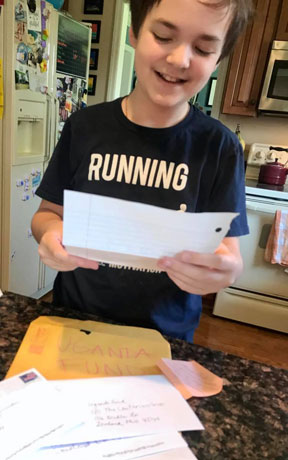
    Paul was the student council President at St. Columban this year. Annually they raise money for school supplies for St. Julie School in Uganda, but because of COVID 19 they were not able to complete all of their fundraising activities. At the urging of his little sister Emily, they decided the canceled Walk-A-Thon should still take place, but by the students walking in their own neighborhoods. This photo (right) provided by his mom is Paul opening donations and notes from St. Columban families who contributed to the “Virtual” Walk-A-Thon. In the end, they raised $1,000.

    <


    Meet
    Ryan Lindsay

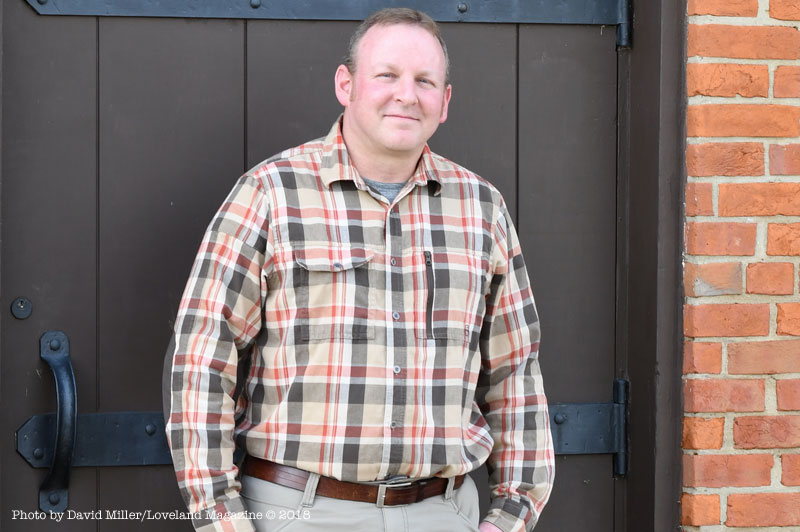
    Ryan is a lifelong Loveland resident and 1994 Graduate of LSH. He enlisted the Army right out os high school and served until 1998. Since, he has been a self-described “civilian-slave for the system.” Ryan told me, “Im proud to be a resident and citizen of the City.” For the past 15 years he has been an office manager for a heating and cooling company.

    When I asked Ryan what he plans on doing with the rest of his life he said, ”Work, and then do lots of fun things when we are again allowed to do them. I go to Indy car races, sport car races, and concerts.”

    I asked him if he ever raced and he said laughing, “No, that’s a rich man’s sport and I want to keep my money for when I retire. I know I would like it so much but I know how much it costs so I would probably bankrupt myself. It’s funner to watch somebody else spend that money so I’d rather watch ‘em do it. do it and that way if there’s a wreck I won’t have a bill to pay or anything like that.” He said he would probably try out a “Driving School” in a professional setting just to try it out to see how his skills stack up. “I would love to race cars, but then you see the price tag.”

    He did race bicycles from the late nineties until 2012. “I kinda got too old and too busy with work to keep doing that. I did travel all over the country and would still like to do it but there isn’t enough time now to train and keep fit.”

    Ryan will spend his Memorial Day with other veterans making their annual pilgrimage to local cemeteries, praying, and laying wreaths.

    Meet Steve Bow

    Steve has lived in Loveland since 2012 and has played the trumpet for 41 years. He is a technical specialist with a German company and works from home doing quality control and business and sales development. He does travel to South Carolina and Tennessee to consult with large companies such as Volvo and Volkswagen about quality and technical problems.

    Steve was born in 1967 and grew up in Texas. His dad was an engineer for Dow Chemical for “the better part of 40 years.” The family moved to Columbus in 1980. He graduated from Ohio State in 1990 with a degree in metallurgical engineering and he’s been in the steel industry for a little going on 21 years. Steve’s father, Kenneth E. Bow, is a retired Army, Lt Col.

    “I consider myself an Ohioan because I was in seventh grade when I first lived here,” Steve said. He attended OSU for five years and was in the marching band for four playing trumpet and in the “S Row” on the field.

    Steve is the Assistant State Director, SW/NW Ohio District of Bugles Across America, an all-volunteer Taps organization. Bugles Across America (BAA) offers live/real bugle/trumpet players to sound Taps at Veterans funerals and events so the electronic device can be avoided. Steve has sounded Taps for around 300 “Missions” despite having a full-time job.

    Recently, Steve has sounded Taps in Normandy in 2015, Arlington National Cemetery in 2013 and 2016, the D-Day Memorial in Bedford, VA, and various other Veterans events, including participating in a Full Honors funeral with the US Army and last year he played at Dayton National Cemetery.

    In 2018, Steve and his daughter Claudia, a Music Ed major at NKU, sounded echo taps at the Normandy American Cemetery. They have also sounded Taps on Omaha Beach.

    Steve said, “In addition to my full-time job and the BAA, I also own an art business on the side where I paint Military aircraft nose art from WW2 and aircraft insignia art on aluminum panels to replicate the originals.” He has shipped his artwork to clients around the world. “I also do leather jackets and I have been painting since 2012. My company is STB Aviation Art LLC.”

    Steve will spend his Memorial Day with other veterans making their annual pilgrimage to local cemeteries, praying, and laying wreaths, and of course Steve will sound Taps.