Author: Loveland Magazine

  • Luke Waddell  first-team ALL-ACC

    Luke Waddell first-team ALL-ACC

    From Georgia Tech Athletics

    GREENSBORO, N.C. – Georgia Tech baseball was lauded in the annual end-of-year Atlantic Coast Conference honors as four student-athletes were named all-conference, the league announced Monday.

    The Yellow Jackets’ and Loveland High School grad, Luke Waddell was a first-team selection.

    Rated as the No. 7 shortstop in the country, Waddell has been Georgia Tech’s table setter and lockdown defender throughout the regular season. As tough-nosed at the plate as he is in the field, the Loveland, Ohio native is currently the toughest to strikeout in the ACC and the sixth-toughest in the nation, averaging 14.2 at-bats per strikeout. He’s second on the team with a .322 average and six home runs, and has a .419 on-base percentage. He’s also eighth in the ACC in double plays fielded (25). Waddell has been red-hot in the month of May, leading the team by hitting .431 and reaching base at a .508 clip.

    Read the entire story at Georgia Tech Athletics…

    Waddell Stats

    Waddell’s 411

    Before Tech: A three-sport athlete at Loveland High School … Was a four-year letterwinner and a two-time team captain in baseball under head coach Ken Reed … Rated as the No. 3 shortstop and the No. 11 overall prospect in the state of Ohio for the class of 2017 by Perfect Game … Also ranked as high as No. 141 nationally overall at the shortstop position by PG … A 2017 Rawlings-Perfect Game honorable mention all-American … Also a 2017 central region honorable mention selection by PG … A two-time Perfect Game underclassmen high honorable mention all-American (2015, 2016) … A two-time All-Ohio all-state selection and a two-time all-district honoree … Named the 2017 Eastern Cincinnati Conference (ECC) Baseball Athlete of the Year his senior season … Also a four-time ECC first-team all-conference selection on the baseball diamond … Played in the 2017 East vs. West All-Star game … Holds the school record in career games played, hits and doubles … Helped lead his Loveland High School team to a 21-6 overall record and a 13-3 conference record in 2016 as a junior …

    Photo by David Miller/Loveland Magazine © 2018

    Also lettered in football and basketball at Loveland High School … Led his football team to the state championship title, district title and ECC conference title in 2013 … Holds the Loveland High School football records in career rushing yards, receiving yards, touchdowns and points scored … Also holds the football school records with the most rushing yards and touchdowns in a single season … Tabbed a MaxPreps second-team freshman all-American in 2013 on the football field … Also a four-time first-team all-conference selection in football … A member of the Midland Redskins summer team for three seasons … A member of the National Honor Society and the high honor roll.

    2020 CoSIDA/Google Cloud Second-Team Academic All-American
    2020 CoSIDA/Google Cloud First-Team Academic All-District
    2019-20 ACC Academic Honor Roll
    2019 Brooks Wallace Shortstop of the Year Semifinalist
    2019 All-ACC Academic Team
    2018-19 ACC Academic Honor Roll
    2017-18 ACC Academic Honor Roll

    2020 (Junior): Started all 16 games at shortstop as one of the nation’s top table setters … Hit .300 for the year, recording 18 hits – including four extra-base knocks – for nine RBI … Drew seven walks to average a .419 on-base percentage during his junior campaign … Struck out just seven times, drawing seven walks as well … Led the team by reaching base each of the final 10 games of the season … Finished the year on a five-game hitting streak – good for fourth-longest on the team … Finished tied for second with four multi-hit games … Went 2-for-3 in the season opener against St. Peter’s (Feb. 14) … Drove in two runs on two hits against Ohio State (Feb. 21) … Recorded three hits, including an RBI double at then-No. 4 Georgia (Feb. 28) … Drove in three runs on his lone home run of the season, coming against Tennessee Tech (March 3) … Also had two hits in the ACC opener against Virginia Tech (March 6) … Knocked in the go-ahead run in the eighth inning of Game 2 during the ACC’s opening weekend against Virginia Tech (March 7).

    2019 (Sophomore): Appeared in 58 games, starting in all of them … Started year at second base before moving to shortstop full-time against Virginia (March 16), forming one of the most dynamic middle infield duo with teammate Austin Wilhite for the season … Finished the season hitting .322 with 75 hits, 12 doubles, two triples and homers for 34 RBI … Held the team’s longest hitting streak (14) and reached base streak (39) … One of the toughest to strikeout in the nation, averaging 10.6 at-bats per strikeout, which was good for third in the ACC and 45th in the country … struck out in back-to-back games only twice all year … Hit .321 in May to close out the regular-season … Hit .337 in 19 road games, amassing 28 hits, three doubles a triple and 10 RBI to reach base .417 percent … Struck out just 10 times in 83 at-bats on the road … Hit .318 for the month of April, striking out just seven times in 66 at-bats … Finished the season with 20 multi-hit games, including two four-hit performances … Had one of his best games in the elimination game of the Atlanta Regional, facing Coastal Carolina (June 2) where he went 4-fot-5 with two runs and a walk … Also went 4-for-6 with one RBI and two runs at eventual Athens Regional team Mercer (March 19 … Recorded three hits and an RBI against Miami (Fla.) (March 12), while also stealing a base in the rubber match game … Caught fire against Virginia, going 3-for-5 for two RBI on March 16 before going 2-for-3 for one RBI and three runs on March 17 … Finished 3-for-5 to help Tech clinch the series at then-No. 4 and eventual College World Series team Louisville (March 23) … Also helped Tech clinch Clean, Old-Fashioned Hate against Georgia (April 23), going 3-for-4 for three RBI, finishing a home run away from a cycle in front of the largest regular-season college baseball crowd (18,861) … Recorded back-to-back two-hit games in the ACC Tournament (Duke – May 24; NC State – May 25), scoring three times against Duke … Drew three walks five times on the season to amass 45 on the year (Northwestern – March 2; at Louisville – March 24; Notre Dame – March 31; Clemson – April 26; Western Carolina – May 3) … Spent his offseason competing on the USA Collegiate National Team, one of only five ACC players to help lead the United States to an 8-6 record in Japan … Hit .320 over the course of the 14 games, getting 16 hits, three doubles and five RBI, reaching base .404 … Was first Yellow Jacket to make Collegiate National Team since Derek Dietrich in 2008.

    2018 (Freshman): Played in 42 games, making 31 starts on the season as a true freshman … Saw time at third base, second base and shortstop throughout the year … Hit .283 with a home run, a triple, eight doubles, 10 walks, 10 RBIs and 20 runs scored … Posted an on-base percentage of .348 on the season … Recorded a season-high five-game hitting streak and a six-game on-base streak for the year … Totaled nine multi-hit games and two multi-RBI games … Made his collegiate debut in the season opener versus Minnesota (Feb. 16) … Picked up his first career hit in the opening-weekend contest versus Bradley (Feb. 17), going 2-for-4 with two doubles, two RBIs and a run scored … Also drove in two RBIs in the road win at Georgia Southern (Feb. 20) … Scored a season-high two runs in the Friday night win against Virginia Tech (March 16), going 2-for-4 with a home run … Went 2-for-4 with a run scored in game two of the doubleheader with Dartmouth (Feb. 24) … Also went 2-for-3 with a double and a walk in the home win over Arkansas-Pine Bluff (Feb. 27) … Was a combined 4-for-11 with a double and three runs scored in the series win over Illinois-Chicago (March 2-4) … Went 3-for-12 with a home run, two RBIs and two runs scored in three starts versus Virginia Tech (March 16-18) … Drove in an RBI and scored a run in the Jackets’ home win over No. 6 Auburn (March 20) … Went 1-for-1 with a triple in game one versus Miami (March 30) before leaving the game with an injury … Was 2-for-5 with an RBI and a run scored in the double-digit win over Kennesaw State (April 18) … Went a combined 3-for-9 with two doubles, a walk and two runs scored in the ACC series at No. 8 North Carolina (April 20-22) … Was also 3-for-9 with a double, an RBI and a run scored in the series win over Wake Forest (April 27-29) … Went a perfect 2-for-2 with an RBI and a run scored off the bench in Tech’s regular-season finale versus No. 10 Duke (May 19).

    Personal: Has an older brother … Also lived in Memphis, Tenn. … Enjoys playing ping pong … Chose Tech because of the coaching staff, the great academics and the chance to play in the ACC … Intends to major in business administration.

  • House reps try to force out indicted Republican; most of GOP stays silent

    House reps try to force out indicted Republican; most of GOP stays silent

    By Jake Zuckerman and Ohio Capital Journal

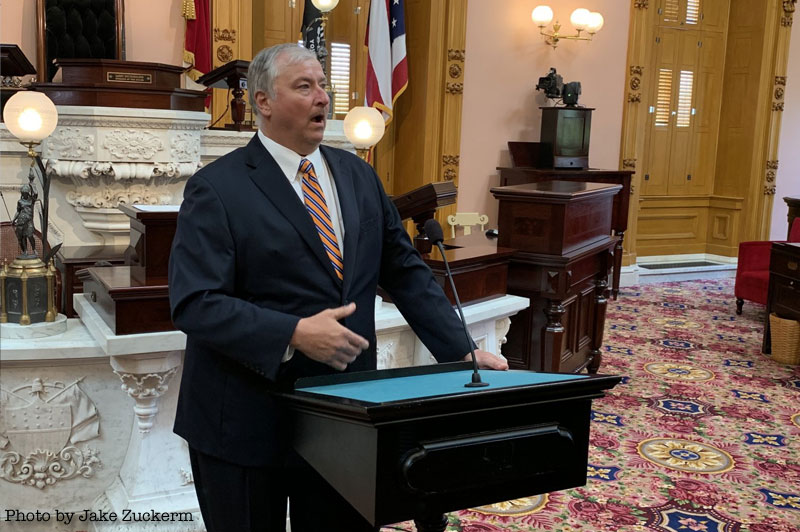
    The quest to expel a Republican lawmaker who was criminally accused in what’s described as the largest public corruption scandal in state history gained new life Wednesday as lawmakers launched bipartisan efforts aimed at his ouster.

    Two House Democrats — Jeff Crossman, of Parma, and Michele Lepore-Hagan, of Youngstown — triggered the action Tuesday after announcing plans to introduce a formal resolution to banish former House Speaker Larry Householder from the chamber.

    Two House Republicans — Reps. Brian Stewart of Ashville and Mark Fraizer of Newark — introduced an expulsion resolution of their own shortly afterward. The two have publicly spoken out about the need to remove Householder, who has pleaded not guilty to racketeering charges, in the past.

    “Let the process play out,” Householder said, sidling past reporters on his way to a House session.

    Federal prosecutors accused Householder of secretly accepting $61 million from FirstEnergy Corp. and using it to support candidates to help elect him Speaker and pass a bailout worth an estimated $1.3 billion to the utility. He also allegedly used the funds to enrich himself personally, and thwart a ballot referendum to overturn the law. Four others were indicted alongside him, two of whom have pleaded guilty.

    The next steps forward depend in large part on Householder’s political support in the caucus. If the resolution stalls in committee without a hearing for 30 days or more, a petition with signatures of 50 members can force it to the floor. Until then, Democrats would need buy-in from dozens of Republicans or House leadership.

    In interviews Wednesday, 12 House Republicans (not including Householder) declined to state whether they’d vote to unseat Householder.

    “I just really haven’t thought about it,” said Rep. Brett Hudson Hillyer, R-Urlichsville.

    Rep. Bob Cupp, R-Lima, who succeeded Householder as House Speaker, said in a statement there’s differing opinion among members on how to proceed. However, he declined to provide details on his own thinking, or even whether the matter would come up for a vote before the General Assembly recesses for the summer.

    “I have consistently maintained that Larry Householder should resign from the Ohio House of Representatives,” he said. “The resolutions filed will receive the appropriate process according to House rules.”

    Democrats held a press briefing to trumpet their movement on Householder, whose charges have loomed over the Statehouse since July 21, 2020.

    They took credit for applying enough pressure on the issue to spur Stewart and Fraizer to act. Crossman said even if Householder were criminally acquitted, enough evidence (and three guilty pleas from alleged conspirators) has come to light to merit removal from the chamber — which he said requires a lower standard of evidence than a criminal conviction.

    “I have no idea why my Republican colleagues are stonewalling,” Lepore-Hagan said. “Some in the Republican Party are downplaying the seriousness of this charge. Others might not want to stand up to the person who financed their campaigns.”

    Stewart said he has been working on this since the session began in January.

    Ideally, he said Cupp would put the matter up for a vote soon. However, Stewart said he wouldn’t rule out a discharge petition — which would amount to a challenge to Cupp, the leader of his caucus.

    “We have tried to let people kick the tires on this as long as they could and have a full and fair open debate, but at some point, enough is enough. It’s time to act,” he said. “We’ve asked and answered all the questions we’re gonna ask and answer.”

    In interviews with 16 House Republicans Wednesday, only one — House Majority Leader Bill Seitz, a vocal defender of parts of the legislation at the heart of the case against Householder — defended the former Speaker.

    Seitz knocked the Democrats’ moves, saying they’re better at press conferences than legislation. He said even if the allegations against Householder are true, they don’t qualify as “disorderly conduct,” an undefined term for which the Ohio Constitution allows for expulsion.

    “Disorderly conduct means disorderly conduct on the floor. That’s the only time it was successfully invoked, when one representative hit another representative in the face on the floor,” Seitz said.

    Indeed, the last representative to be expelled was Rep. John P. Slough, a Cincinnati Democrat who punched Ashtabula County Republican Darius Caldwell in the face during a floor session in 1857.

    Other Republican lawmakers surveyed on whether they’d vote to expel Householder on Wednesday include:

    Expel

    • Kyle Koehler: “I’m ready to vote when they call it to the floor … I think it should have been taken care of January 4.”
    • Rodney Creech: “I’m gonna vote him out, but I really don’t want to talk about it.”

    Declined to answer

    • Brian Baldridge: “That’s between me and the vote.”
    • Jamie Callender: “I will support leadership.”
    • Riordan McClain (referred to prior statement requesting that Householder resign)
    • Adam Bird (referred to prior statement requesting that Householder resign)
    • Tim Ginter: “I’m going to follow the lead of the Speaker.”
    • Dick Stein: “We’re having a discussion. We’ll have caucus over the next couple weeks to determine what’s going to happen.”
    • Sara Fowler Arthur
    • Sharon Ray
    • Don Jones
    • Jay Edwards
  • K-12 funding boost headed to districts, ACT/SAT opt-out bill headed to the House

    K-12 funding boost headed to districts, ACT/SAT opt-out bill headed to the House

    By Susan Tebben and Ohio Capital Journal

    Columbus, Ohio – The Ohio legislature approved COVID-19 pandemic-related measures to bring more federal monies to K-12 schools, and the House will review another bill to reduce testing requirements for students.

    The Ohio Senate unanimously passed House Bill 170 on Wednesday, with the House promptly agreeing to the Senate’s version of the bill the same day.

    “Parents, teachers and students in the communities that we represent are depending on this,” said state Sen. Teresa Fedor, D-Toledo, during the Senate session on Wednesday.

    The bill provides a total of $857 million to the Ohio Department of Education in federal CARES Act funding to K-12 schools.

    Included in the bill is $7 million for duties performed by the Ohio National Guard during the pandemic, and $173 million for the state Department of Health to expand COVID-19 testing and support.

    Another $154.9 million will go to the Emergency Assistance to Non-Public Schools, and $633 million to the Elementary and Secondary Relief (ESSER) funds.

    The bill also permits the Auditor of State to audit the spending by the Ohio Department of Education and each school district for money appropriated for fiscal year 2021 and funds received via COVID-19 stimulus packages, the CARES Act and the American Rescue Plan.

    A piece of legislation helping students and their schools avoid using standardized testing as a metric of learning is on its way for a full House full vote.

    House Bill 82 was quickly passed out of the House Primary & Secondary Committee this week, moving forward a measure to allow students to opt out of state-funded administration of the ACT and SATs.

    There was no discussion of the bill before it was passed out of committee, but the bill had the support of the Ohio School Counselor Association and the Ohio Education Association. The bill’s sponsors, GOP state Reps. Jon Cross and Don Jones, said the stress of the tests on students and a trend in higher education of making ACT/SAT scores optional for admission make state spending on the tests unnecessary.

    Currently, all high school juniors are required to take a college admission test as part of the state’s College and Work Ready Assessment System. The state pays $40 per student for the ACT and $36.35 per student for the SAT, according to an analysis by the Legislative Service Commission.

    That amounts to $4.9 million in state spending in fiscal year 2019, most of which was used for the ACT.

    Should the bill be passed and go into effect during the 2021-22 school year, the first class to be allowed to opt out would be the class of 2026.

  • Republican AGs object to U.S. Department of Education proposal on teaching about racism

    Republican AGs object to U.S. Department of Education proposal on teaching about racism

    By Ariana Figueroa and Ohio Capital Journal

    Washington — More than two dozen Republican attorneys general including Ohio’s Dave Yost are voicing their disapproval over the Department of Education’s proposed priorities for teaching K-12 students about American history and civics education because they would include references to systemic racism and how the history of slavery has shaped the U.S.

    The state attorneys general argue in a May 19 letter to Education Secretary Miguel Cardona that public schools should not be given grant funds to teach about critical race theory, “including any projects that characterize the United States as irredeemably racist or founded on principles of racism (as opposed to principles of equality) or that purport to ascribe character traits, values, privileges, status, or beliefs, or that assign fault, blame, or bias, to a particular race or to an individual because of his or her race.”

    Critical race theory says that racism is systematic and embedded in policies and the legal system. Scholars who study the issue focus on understanding how racism has shaped U.S. laws and how those actions have affected Black communities and communities of color.

    “Though the Department does not overtly refer to (Critical Race Theory) in its priorities, it is prioritizing teaching this highly controversial ideology through the vehicle of this grant program,” the AGs wrote. “This is hardly what Congress intended when it authorized this program.”

    The attorneys general also warn against approving grants for teachings of the Pulitzer Prize-winning 1619 project from the New York Times Magazine.

    The Department of Education did not respond to requests for comment.

    The attorneys general who signed the letter include Mark Brnovich of Arizona, Christopher Carr of Georgia, Lawrence Wasden of Idaho, Derek Schmidt of Kansas, Jeff Landry of Louisiana, Eric Schmitt of Missouri, Austin Knudsen of Montana and Dave Yost of Ohio, among others.

  • For hundreds of thousands of Ohioans, the pandemic isn’t over. Is anybody thinking about them?

    For hundreds of thousands of Ohioans, the pandemic isn’t over. Is anybody thinking about them?

    By Marty Schladen and Ohio Capital Journal

    For many of us, getting vaccinated means freedom from the tyranny of the coronavirus. 

    We now can go hang indoors with our vaccinated friends and not bother with masks in most settings. We can even touch each other without a panicked search for the nearest bottle of hand sanitizer.

    Getting vaccinated also seemed a liberation from endless, mindless culture wars. 

    Wear a mask. Don’t wear a mask. Get vaccinated. Don’t get vaccinated. What do I care? I’m safe.

    But rumbling in the background are thousands of reasons why we should care — if we want to consider our neighbors in addition to ourselves.

    In addition to the hundreds of thousands or millions of Ohioans who refuse to be vaccinated are thousands and thousands more who, when they get vaccinated, the shot appears to be ineffective.

    Columbus AIDs patient Eddie Hamilton has been vaccinated, but it’s not clear it had an effect. He wonders if state and federal officials are considering the millions like him as coronavirus health orders are wiped away. Submitted photo.

    Earlier this month, The U.S. Centers for Disease Control and Prevention abruptly and controversially changed its guidance to say that fully vaccinated people don’t need to wear masks except in healthcare settings and on public transit. The agency recommended that unvaccinated people continue to cover their faces.

    Ohio Gov. Mike DeWine quickly followed suit, amending Ohio health orders to fit with the CDC guidance. He had already promised to end all coronavirus health orders on June 2.

    But then the Washington Post last week reported on a population that the new orders will only drive further into the shadows. Those are the millions of Americans who have had transplants or have other conditions that require them to take immunosupressant drugs or who have diseases such as AIDs that compromise their immune systems.

    Their defenses are already weakened, and the vaccines might not give them much protection from the deadly disease.

    Eddie Hamilton, 58, is a two-time cancer survivor who also suffers from AIDs, the disease caused by Human Immunodeficiency Virus. He got the one-dose Johnson & Johnson vaccine on March 8.

    “Then I figured I’d go for an antibody test and I came up blank,” the Columbus AIDs activist said.

    That was alarming because Hamilton consulted with his doctor and waited until his vaccinated body had time to produce coronavirus-fighting antibodies. The lack of a response is something that’s been seen with many AIDs, cancer and transplant patients, the Post reported.

    It’s not clear if the absence of antibodies means a person is completely vulnerable to the coronavirus. Hamilton’s doctor and other scientists have said effects of the vaccine other than antibody production might be protective.

    As they raced to develop safe, effective vaccines for the general population, researchers excluded immunocompromised people like Hamilton from their clinical trials, although piecemeal research is now underway.

    “So what in the hell am I supposed to do in the meantime?” Hamilton asked. “Are they basically going to keep us on house arrest?”

    Hamilton only recently has started venturing into indoor public settings such as the grocery store, masking heavily and going late in the evening when it’s not going to be crowded.

    “You just assume everybody’s transmissible,” he said.

    So far, big chains such as Kroger are maintaining their mask orders. But in the absence of a state order there might be slipping compliance and Hamilton is questioning whether he’ll go back — or simply hunker further down in his home.

    He’s far from alone in being forced to be alone. There are more than 25,000 people with HIV/AIDS in Ohio and the Post estimated that 3% to 4% of Americans suffer immune-weakening conditions of all types. In Ohio, that could be almost half a million people.

    DeWine’s office was asked if those numbers prompted the governor to question the wisdom of the CDC order, or if they caused him to rethink his own decision to eliminate health orders. DeWine’s spokesman didn’t address Ohioans for whom the vaccines might not be effective.

    “For most Ohioans moving forward, the vaccine will be protecting them from the virus instead of masks and distancing,” Press Secretary Dan Tierney said in an email. “The CDC still recommends masking and distancing for those who have not been vaccinated, and the Governor strongly echoes that recommendation.”

    Tierney also said: “The June 2nd date for orders expiring reflects that we have now had a significant number of Ohioans vaccinated which is dramatically decreasing COVID case rates and that Ohioans have had a significant amount of time to get the vaccine, with supply now outpacing demand. The June 2nd date also reflects providing Ohioans who are not vaccinated a reasonable period before mask and distancing protocols were removed.”

    The state’s not going to make you. But until a lot more is known about whether vaccinated people can spread the virus, the community-minded thing might be to keep masking up in settings like grocery and convenience stores.

    You can’t know if you’re hurting the person next to you if you don’t.

  • Tiger Women’s Lacrosse Compete for Regional Championship Thursday

    Tiger Women’s Lacrosse Compete for Regional Championship Thursday

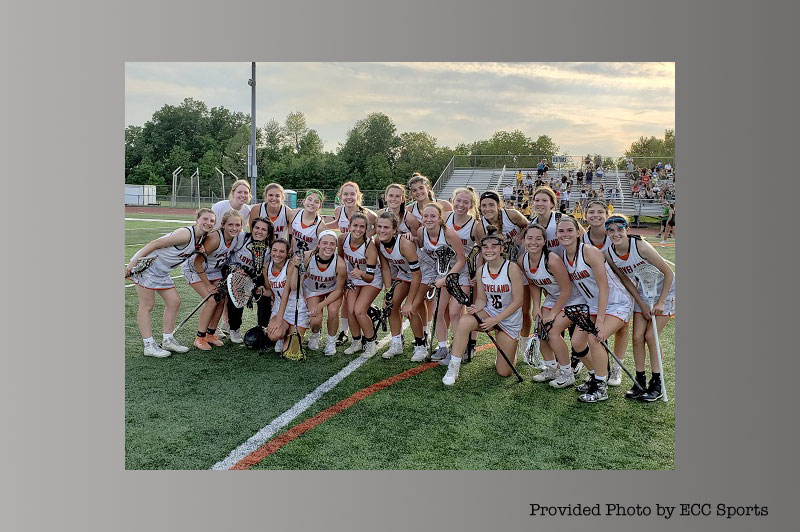
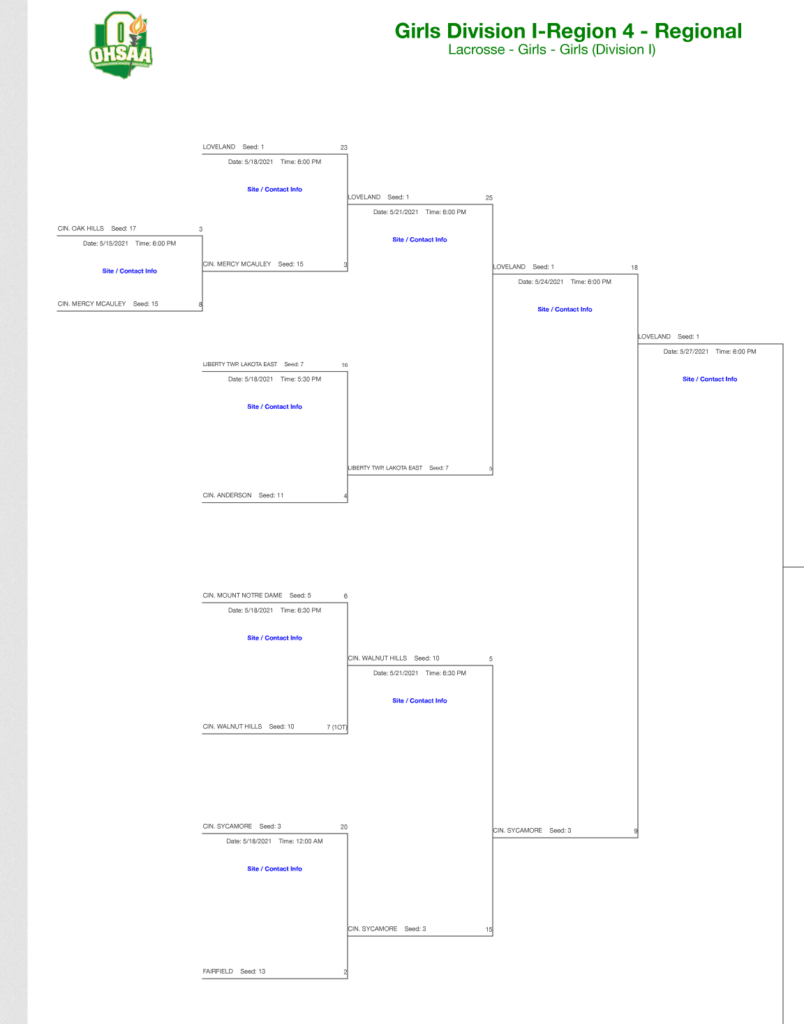
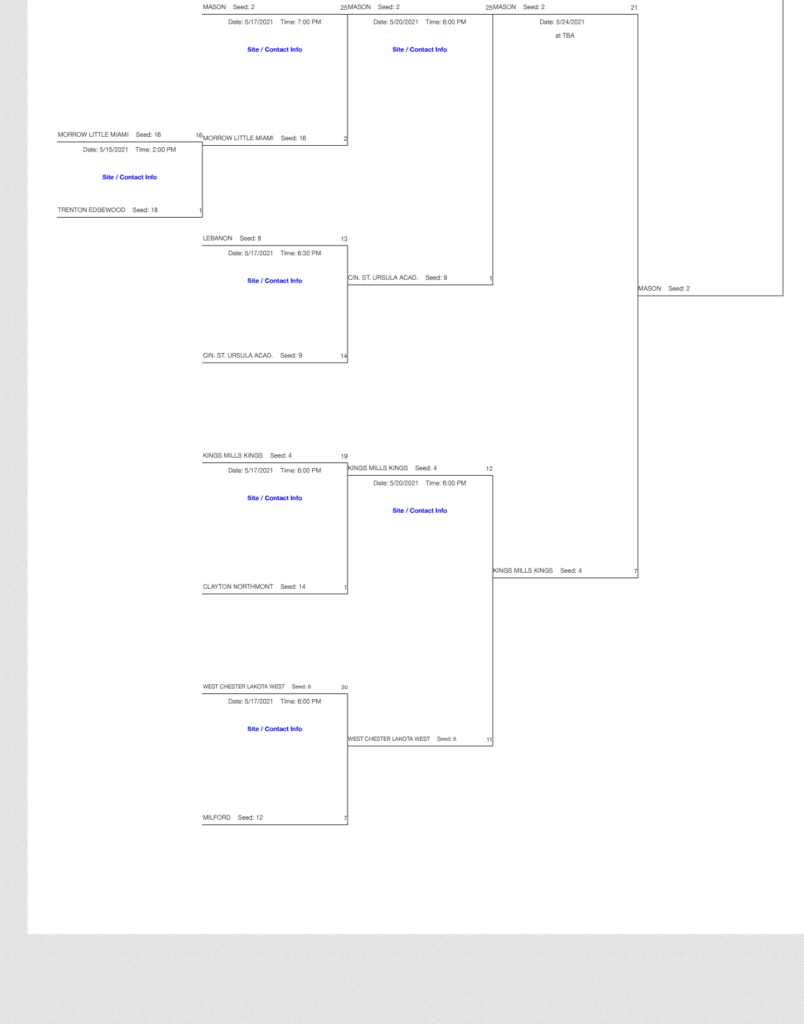
    Loveland, Ohio – After defeating Sycamore 18-9 Monday at Tiger Stadium the Loveland High School Women’s Lacrosse team (16-4) will have the home-field advantage as they defend their home-turf against Mason (18-3) on Thursday evening.

    The Regional Championship game will start at 6 PM.

    Loveland secured its third ECC championship with a perfect 7-0 record in conference play this season.

    Thursday
    MAY 27
    6:00 PM

    GET TICKETS

    Rankings

    (Stats provided by Max Preps)

    Full Rankings

    Ohio #9
    Ohio Division I #8
    National #89

    Loveland Girls Lacrosse

    OVERALL 16-4

    LEAGUE 10-01

    HOME 10-2

    AWAY 6-2

    NEUTRAL 0-0

    PF 315

    PA 154

    STREAK 3W

    OH High School Girls Lacrosse Rankings

    1Upper Arlington (Columbus)19-030.012.9
    2Thomas Worthington (Worthington)17-326.314.9
    3New Albany18-326.013.8+1
    4Jackson (Massillon)16-225.712.6-1
    5Mason18-322.56.9
    6Medina14-420.410.6
    7Mariemont (Cincinnati)15-320.37.8
    8Dublin Jerome (Dublin)11-620.115.8+2
    9Loveland16-420.18.8
    10Hudson16-519.810.8+2

    Playoff Prediction

    MaxPreps used its rankings algorithm to predict which teams have the best chance of winning the Ohio Division I girls lacrosse title.

    Last update: 5/25/2021, Minimum Games Played: 4

    #SchoolOverallLeagueRatingStrength
    1Upper Arlington (Columbus, OH)19-08-030.012.9
    2Thomas Worthington (Worthington, OH)17-38-126.314.9
    3New Albany (OH)18-37-026.013.8
    4Jackson (Massillon, OH)16-27-025.712.6
    5Mason (OH)18-39-122.56.9
    6Medina (OH)14-45-020.410.6
    7Dublin Jerome (Dublin, OH)11-63-420.115.8
    8Loveland (OH)16-410-020.18.8
    9Hudson (OH)16-58-119.810.8
    10Dublin Coffman (Dublin, OH)15-57-219.611.4
    Right-Click to see larger view
    Right-Click to see larger view
  • Receive COVID-19 Vaccine June 1 in Linda Cox Parking lot

    Receive COVID-19 Vaccine June 1 in Linda Cox Parking lot

    No Cost | Walk-ins Accepted | No Insurance Required

    Where: Loveland, Ohio

    Address: 205 Broadway Street

    When: June 1, 2021 from 3-6pm

    Open to the public. 18 and older eligible

    Questions? Contact us at 513-946-7800

    Hosted by Hamilton County Public Health and the Ohio Department of Health

  • Air Quality Unhealthy for Sensitive Groups on Tuesday

    Air Quality Unhealthy for Sensitive Groups on Tuesday

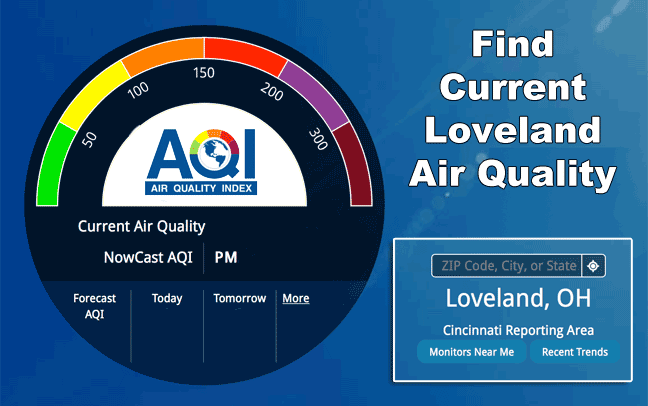
    Loveland, Ohio – in anticipation of elevated ozone concentrations for the Loveland, Ohio Area on Tuesday, May 25, an Air Quality Alert has been issue.

    Tuesday, May 25:105 AQIUnhealthy for Sensitive GroupsOzone

    Active children and adults, and people with respiratory diseases, such as asthma, should avoid all outdoor exertion; everyone else, especially children, should limit outdoor exertion.

    Do Your Share! Take these steps:

    • Take the bus, carpool, bike or walk instead of driving
    • Refuel your vehicle after 8 p.m.; do not top off when refueling and tighten the gas cap
    • Avoid idling your vehicle
    • Combine trips or eliminate unnecessary vehicle trips
    • Keep your vehicle maintained with properly inflated tires and timely oil changes
    • Avoid use of gasoline-powered lawn equipment on Air Quality Advisory days
    • Avoid use of oil-based paints and stains on Air Quality Advisory days
    • Never burn leaves or other yard trimmings
    • Always burn clean, seasoned wood in outdoor fire pits, fireplaces and wood stoves
    • Do not use fire pits or fireplaces for non-essential home heating on Air Quality Advisory days
    • Conserve electricity

    Click to see real-time air quality data – 24/7

  • Consumer protection? New DeWine regulatory chief says most overcharges can’t be refunded

    Consumer protection? New DeWine regulatory chief says most overcharges can’t be refunded

    Getty Images

    By Marty Schladen and Ohio Capital Journal

    Gov. Mike DeWine’s latest appointee to lead Ohio’s scandal-plagued utility regulator last week raised concerns among some lawmakers and consumer watchdogs. She claimed that her agency has only a very limited ability to make electric companies refund billions in improper charges to ratepayers.

    There was always going to be scrutiny when Jenifer French made her first appearance last Wednesday before the Ohio Senate and Public Utilities Committee. 

    DeWine appointed her in March to chair the Public Utilities Commission of Ohio. DeWine’s first appointee, Sam Randazzo, resigned in November after the public learned that a lobbyist believed to be Randazzo got a $4.3 million payment from Akron’s FirstEnergy just as Randazzo took over as Ohio’s top utility regulator. 

    For its part, FirstEnergy last year fired its top executives after discovering the payment to Randazzo — and after federal prosecutors accused it of being at the center of a $61 million bribery scandal that resulted in a $1.3 billion bailout that greatly benefited FirstEnergy and associated companies.

    French, a former Franklin County Common Pleas judge, told the Senate committee that she wanted to use her background to restore public confidence in the agency. 

    But Sen. Mark Romanchuk, R-Ontario, wanted to get down to specifics.

    “You mentioned something about public trust and public trust, I believe, is fixing this refund problem,” he said. “Since 2009, there has been about about $1.5 billion that has been deemed improper at the court and that money was not refundable back to the ratepayers — the people who paid that money.”

    Romanchuk was referring to charges that the PUCO allowed, but that the Ohio Supreme Court later struck down as illegal. 

    The funds include $456 million FirstEnergy got, supposedly to modernize the utility grid. But at least some of the money was placed into a pool that FirstEnergy’s out-of-state utilities could borrow from. 

    Allowing electric companies to pocket improper proceeds from ratepayers is not a business-friendly practice, Romanchuk told French.

    “That was $1.5 billion that was pulled out of our economy, and I would argue that’s not a good thing as we compete with other states and other countries around the world,” he said.

    French replied, in essence, that while her agency has the power to allow rate increases, it has scant power to get the money back when the increases are ruled to be illegal. 

    At issue is why the PUCO, when it grants rate increases, doesn’t routinely say they’ll have to be refunded if the courts strike them down or if the utilities don’t use the money as they promise.

    “My understanding is that there are very limited circumstances in which the PUCO can set rates that are capable of being refunded at the end,” French said. “For the most part, it’s the call of the legislature.”

    Romanchuk disputed that. He pointed to a 2019 Ohio Supreme Court decision saying that if the PUCO had built a refund mechanism into the “rider” that allowed FirstEnergy to collect $456 million, it could have forced the company to pay it back when an audit showed the money wasn’t used for its stated purpose.

    The decision said that a 1953 law “bars any refund of recovered rates unless the tariff applicable to those rates sets forth a refund mechanism… FirstEnergy’s tariffs for the modernization charge, however, contain no refund mechanism.”

    French said she was unfamiliar with that decision. 

    A year before, the court said something similar in a case in which FirstEnergy was allowed to make yet another upcharge. In that case, the PUCO was asking that the company refund $43 million in “imprudent” purchases of renewable energy credits.

    Referring back to its 1957 Keco Industries v Cincinnati decision, the court said that refunds would amount to illegal “retroactive ratemaking” because the fees the utilities ended up collecting would differ from those filed in the original tariffs. In other words, once a rate is legally set, the PUCO can’t change it willy-nilly, the decision said.

    But the 2018 decision additionally said this: “FirstEnergy also asserts that the plain language of (the 1953 law) bars any refund in this case because the ($43 million) rider did not specify a refund process. We agree.”

    So why wouldn’t refunds be legal under Keco if a provision for them is a part of the original order?

    French said it was her understanding of the Keco case that unless a rate increase was of a special type — a “reconciled rider” — the only way refunds can happen is if the General Assembly changes the law.

    “If it is not provided for in a law… or a reconciled rider, refunds would require a statutory change,” she said. “I think the Supreme Court was very clear about that. If there are opportunities for us by statute to be permitted to determine whether a rider is refundable or not, certainly that is something we would look into.”

    That rationale can be hard to understand. In emails, PUCO spokesman Matt Schilling was asked why his agency doesn’t routinely make a refund mechanism part of any rate increase.

    He said the decisions to which French and Romanchuk were referring relied on two separate authorities. French was talking about the Keco decision, while Romanchuk was talking about a decision based on the 1953 statute, Ohio Revised Code 4905.32.

    Neither, however, uses the term “rider” and none of the subsequent Supreme Court decisions Schilling provided contains the term “reconciled rider.”

    The state’s official consumer watchdog, the Ohio Consumers’ Counsel, said nothing stops the PUCO from building refund mechanisms into rate hikes that are later ruled to be unlawful.

     “In the words of former Supreme Court Justice Paul Pfeifer, it ‘boggles the mind’ that Ohio consumers are denied refunds of utility charges after the court finds a PUCO order to be improper,” spokesman J.P. Blackwood said in an email. He added that PUCO commissioners seem to be substituting their own judgement for that of the Supreme Court. 

    “That PUCO commissioners have protected utilities more than consumers by not making certain charges refundable, further shows that the selection process for PUCO commissioners needs reform,” he said. 

    Last Wednesday, Sen. Teresa Fedor, D-Toledo, put those sentiments more succinctly.

    “It’s time for the board members of the PUCO to start siding with the citizens of Ohio,” she said.