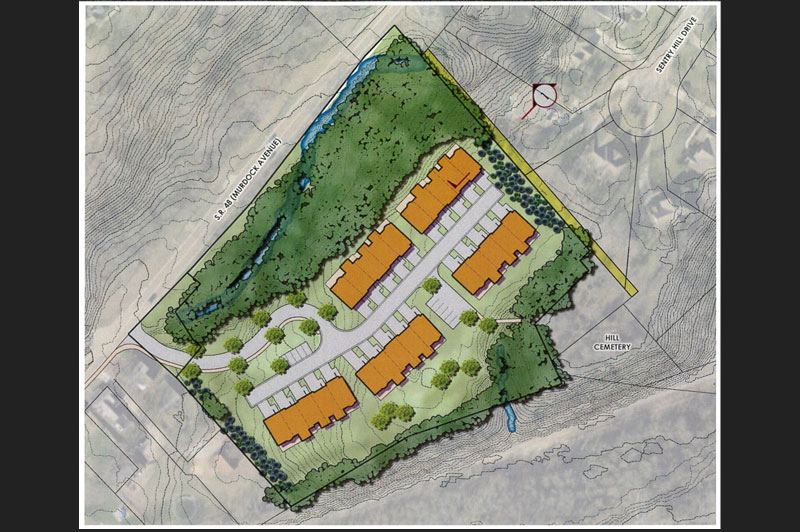
Loveland, Ohio – Joe Farruggia with Zicka Homes has been trying to rezone property off North Second Street (St. Rt. 48) south of the Sentry Hill subdivision with the potential use to build a 28-unit condominium development called the Blossom Hill Project since the first week in June. He has submitted three variations of the proposal, the latest on October 20. The current proposal is to limit the project to 25 or fewer individual units.
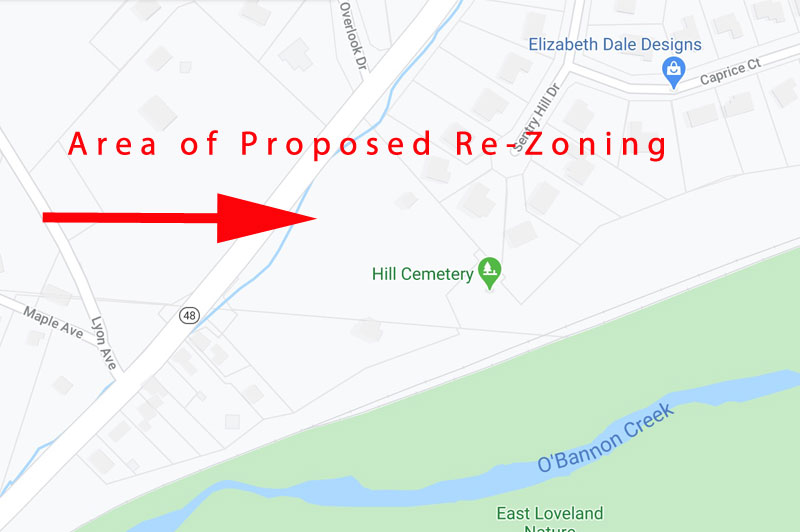
The site is approximately 5.5 acres on St. Rt. 48 adjacent to the Sentry Hill subdivision and on the opposite side of the street of the Loveland Health Care facility.
Previously, on June 24th and July 21, the Planning and Zoning Commission held public hearings for the zoning map amendment and recommended approval of the amendment. However, each time, Farruggia chose not to move forward with the processes which would be to have a public hearing before the City Council.
The latest iteration was also approved by the Planning Commission last week and sent to City Council for their consideration. The recommendation from Assistant City Manager Tom Smith is for Council to schedule a public hearing for the re-zoning on November 24.
The developer is asking for changes to the Loveland Zoning Map from the current zoning of Medium Density Residential to Residential Multi-Family.
The recommendation of the Commission according to Smith included the following conditions:
The proposed housing development for the property as submitted o Planning and Zoning Commission must be actively under construction within eighteen (18) months from the date of approval by City Council in order to maintain the zoning;
The approval shall be withdrawn, and the zoning shall revert to Residential Medium Density (R-MD) should the eighteen (18) month condition lapse.
Approval shall be exclusive to this applicant. No transferees or assignees of the applicant are subject to this approval.
Smith also said the developer agreed to requests made by Sentry Hill resident, Dave Stanton. These items were also part of the Planning and Zoning Commission’s motion for recommendation:
Construct a four to five-inch earth berm, fully landscaped with trees and grass, to be constructed along the property line of the two homes in the Sentry Hill subdivision and maintained by the new subdivision’s HOA.
Street lighting and exterior lighting on the townhomes be designed to prevent light pollution into the Sentry Hill Subdivision.
Townhomes to be constructed, at 40 feet, shall not exceed the height of the referenced home of 214 Sentry Hill Drive.
Limit the number of townhomes to be built at 25 or less.
No dumpsters or centralized garage collection. Individual residential trash and recycling pickup to be consistent with all the residential surrounding areas.
No stand-alone garages or sheds.
Exterior architecture and materials (brick, stone, and Hardie Plank) shall be consistent with the look and feel of neighboring communities.
Even though there are COVID 19 restrictions for the number of audience members in the hearing chamber, five residents appeared to express their displeasure with the re-zoning. No residents spoke in favor of the rezoning or the condos.
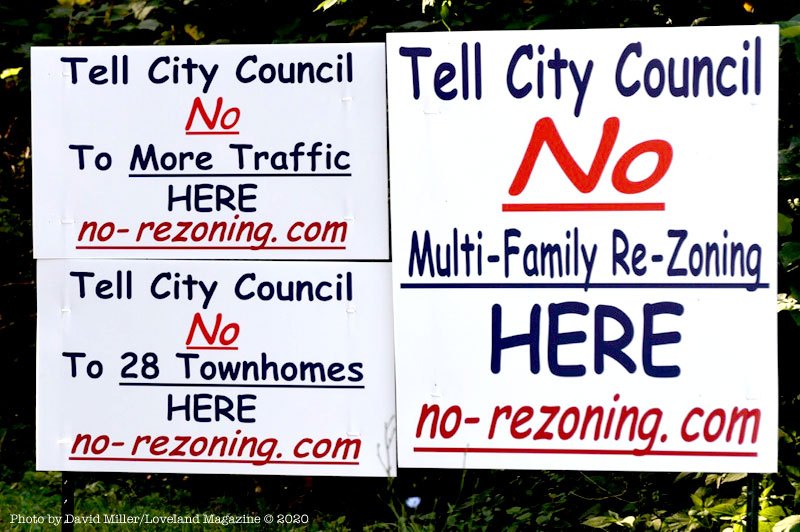
These signs were erected in July by citizens opposed to multi-family zoning adjacent to their homes on St. Route 48 in North Loveland.
Residents have pointed out that the proposal must follow the guidance of the City Master Plan specifically for North State Route 48. They say the project must maintain similar development densities, preserve open space, a rural atmosphere, and assure that there is adequate infrastructure to support the development as mandated in the current plan. They cite the current gridlock of Historic Downtown that must be addressed before the development moves forward.
City Manager Dave Kennedy has argued that the current Comprehensive Strategic Plan (2002) is old and not in line with the current needs of the City. The City is currently rewriting a new master plan for the City. Residents say re-writing the plan is well and good, but until there is a new plan the City and Zicka are governed by the one that exists.
Residents of South 48 also protest that adding so many residential units will add to their already current traffic nightmares of trying drive into and out of Historic Downtown.
During the hearing, Tom Scovanner told the Commission they should be skeptical of the studies Zicka presented to them. One presenter represented that they had prepared their study for the Commission, and Scovanner said, “No, they represent Zicka.” He posed the question to the Commission of whether they would have ever seen the study if it did not turn out favorably to the developer.
Scovanner, a litigator for Clermont County also said in no uncertain terms that the P&Z cannot do anything the Loveland law doesn’t allow them to do. Holding up the code, he said, “You’re bound by these codes. This doesn’t comport with the Comprehensive Master Plan.”
Tom Scovanner spoke to Planning Commission against the re-zoning for condos on Rt. 48.
Dave Stanton spoke to Planning Commission against the re-zoning for condos on Rt. 48.
Sue Ann Walker spoke to Planning Commission against the re-zoning for condos on Rt. 48.
Allen Brooks spoke to Planning Commission against the re-zoning for condos on Rt. 48.
Courtney Hauck spoke to Planning Commission against the re-zoning for 28 condos on Rt. 48.
Symmes Township, Ohio – Loveland photographer Cindy Wilmes said after taking a walk through Symmes Park on Saturday, “I love it when the floor of the woods is covered with a bed of leaves! Perfect day for a fall walk through the woods!”
Marty Schladen has been a reporter for decades, working in Indiana, Texas and other places before returning to his native Ohio to work at The Columbus Dispatch in 2017. He’s won state and national journalism awards for investigations into utility regulation, public corruption, the environment, prescription drug spending and other matters.
Ohio Gov. Mike DeWine and the state’s legislative leaders on Friday announced how they’d allocate almost half of what the state has left in federal coronavirus-relief dollars.
The state has about $1 billion unexpended from its share of the $2.2 trillion CARES Act that Congress passed in March. At least until the feds change the rules, the funds have to be spent by Dec. 31.
Social-service groups that deal with issues of homelessness and hunger have been clamoring for months for a share of the money, as have business groups and others. So it’s been up to DeWine and the legislature to decide what to do with the money while Congress appears stymied over further coronavirus relief.
“We tried to look at what the needs were and what had already been put out,” DeWine said during a remote press conference. “We don’t know whether Congress will pass another bill or not.”
The state is holding about half of the funds for coronavirus testing and contact tracing and other needs while it awaits a possible second round of relief — which may or may not include assistance to state and local governments.
The expenditures announced Friday include:
$50 million for mortgage and rental assistance to families making 200% or less of the federal poverty level
$125 million for businesses with up to 25 employees
$37.5 million for restaurants and bars
$100 million for colleges and universities to do testing, contact tracing and provide mental-health services
$62 million for rural and critical-access hospitals
$25 million for non-profits providing services such a food banks, homeless shelters and other social services
$20 million for the arts
A good deal more of the money was focused on businesses than on assisting individuals who are suffering most. But several in Friday’s press conference said they hope by helping small businesses keep their doors open, people will be able to get or keep jobs.
“We know some businesses are barely making it,” Lt. Gov. Jon Husted said of that portion of the package. “This is focused on them.”
For their part, some leaders of social-service organizations said they were grateful for the help they will receive.
“We’re pleased that Gov. DeWine finally deployed federal coronavirus relief funds to help people avoid getting evicted during this pandemic,” Bill Faith, executive director of the Coalition on Housing and Homelessness in Ohio, said in a written statement. “And we appreciate (Ohio) Controlling Board members’ support, especially Sen. (Matt) Dolan (R-Chagrin Falls) and Sen. (Jay) Hottinger (R-Newark) who took a personal interest in keeping struggling Ohioans safely in their homes. We look forward to seeing details on how the program will be implemented. Given the Dec. 31 deadline to use these funds, we would welcome the governor’s assistance in advocating for Congress to provide additional rental assistance into 2021.”
The Ohio Poverty Law Center also released a statement praising state leaders for their action. But it warned that it won’t be enough.
“As Ohioans continue to experience job and income loss due to the pandemic, additional federal and state resources will be needed to prevent evictions and keep Ohioans safe, especially as we get closer to the expiration of the Centers for Disease Control and Prevention’s eviction moratorium,” it said. “We hope housing assistance will be among the highest priorities for resources in the coming weeks and months.”
On October 21 Loveland Magazine asked the Loveland school superintendent why they only release quarantine numbers on Fridays. She said that she has forwarded the question about quarantines and the procedures for sharing those on a single day to her health team. Loveland Magazine is awaiting the response.
Loveland, Ohio – On Friday the Loveland School District published a new Covid-19 Data Up-Date even as in their Loveland Reopening Plan FAQs they continue to state:
Is COVID-19 spreading in our schools?
When positive cases have been reported to the district, there have been no instances of other students or staff becoming symptomatic or testing positive which means the virus is not being spread at school.
And;
What should I do if I’ve been told my child has been in close contact with someone who tested positive?
Current Ohio Department of Health and Centers for Disease Control guidance calls for quarantine for 14 days for people who are in close contact with an infected person. Close contact is defined as being within 6 feet of a confirmed case for 15 minutes or more. Since students are not allowed to come to school when quarantined, we have grade-specific family and student instructions when quarantined information you can access here.
And as;
The Centers for Disease Control and Prevention (CDC) has updated language for the close contact definition, the Loveland School District continues to define “Close Contact” as being within 6 feet of a confirmed case for 15 minutes or more.
Centers for Disease Control and Prevention (CDC) has new guidance clarifying what exactly “close contact” means when it comes to transmission of SARS-Cov-2, the virus that causes COVID-19. The previous guidance suggested that a close contact occurred when a person was within six feet of an infectious individual for 15 consecutive minutes. Now, the CDC is acknowledging that even brief contact can lead to transmission. Specifically, the new guidance suggests that those spending a total of 15 minutes of contact with an infectious person over the course of a 24-hour period should be considered in close contact. (Read full article)
Someone who was within 6 feet of an infected person for a cumulative total of 15 minutes or more over a 24-hour period* starting from 2 days before illness onset (or, for asymptomatic patients, 2 days prior to test specimen collection) until the time the patient is isolated.
* Individual exposures added together over a 24-hour period (e.g., three 5-minute exposures for a total of 15 minutes). Data are limited, making it difficult to precisely define “close contact;” however, 15 cumulative minutes of exposure at a distance of 6 feet or less can be used as an operational definition for contact investigation. Factors to consider when defining close contact include proximity (closer distance likely increases exposure risk), the duration of exposure (longer exposure time likely increases exposure risk), whether the infected individual has symptoms (the period around onset of symptoms is associated with the highest levels of viral shedding), if the infected person was likely to generate respiratory aerosols (e.g., was coughing, singing, shouting), and other environmental factors (crowding, adequacy of ventilation, whether exposure was indoors or outdoors). Because the general public has not received training on proper selection and use of respiratory PPE, such as an N95, the determination of close contact should generally be made irrespective of whether the contact was wearing respiratory PPE. At this time, differential determination of close contact for those using fabric face coverings is not recommended.
Quarantine is used to keep someone who might have beenexposedto COVID-19 away from others. Quarantine helps prevent spread of disease that can occur before a person knows they are sick or if they are infected with the virus without feeling symptoms. People in quarantine should stay home, separate themselves from others, monitor their health, and follow directions from their state or local health department. (Source CDC)
On Oct 15 Loveland Magazine asked Superintendent, Dr. Amy Crouse,”Can you tell me how the District is defining ‘Close Contact’ in the buildings, on buses, on athletic fields/athletic courts, or administrative offices?” We asked because the District moved to double the number of students in the classrooms in PK-8. Those schools returned to “full in-person” learning on Monday, October 12.
Dr. Crouse responded, “The district maintains updated definitions and protocols on our website here: https://www.lovelandschools.org/NewHealthProtocols.aspx. Contact tracing protocols do not change with a change in capacity. Those protocols still say, ‘Close contact is defined as being within 6 feet of a confirmed case for 15 minutes or more.”
At the same time we asked the Superintendent to provide Loveland Magazine with the report “Pandemic Preparedness and Planning” that LJB Inc. prepared for the District. LJB was awarded a contract in July for $66,250 for “Pandemic Preparedness and Planning” services. The report was prepared under the previous CDC definition of “close contact”.
Last Friday, following a Loveland Magazine editorial that criticized the Superintendent for not answering questions, not releasing COVID 19 quarantine data, and not releasing the LJB report, the District released a “Tiger Talk” that heavily relied on the LJB report to assure the public that the District is taking an appropriate response to the pandemic.
Loveland Magazine is still awaiting the LJB report and the explanation has been that it is the Business Manager’s office and Superintendent can not send it until he returns to work. Crouse sent our request for the public document to the Treasure who responded, “The documents that you are requesting are in the Business Manager’s office and he is currently out of the office. I will get them to you as soon as I can.”
The report belongs to the public. District taxpayers funded the report and it will show what the experts recommended when they studied how many students and teachers should be in classrooms under the hybrid and full capacity models. Students, parents, teachers, staff, and the community have a right to know exactly how many students are not attending classes on a timely basis , what the quarantine guidelines are, and what the LJB report recommended at the time it was prepared .
Tiger Talk
News from Loveland Schools – October 23, 2020
COVID-19 Communication
Loveland Tiger Families,
The decisions we are all tasked with during this difficult time provide no easy answers. We have provided weekly updates, while increasing our understanding of how this virus spreads and how to best protect the health and safety of our students, staff, teachers and community. We have many parents who have expressed their concerns about student safety, and others who want students to have the most possible access to in-class instruction.
These decisions are not made lightly and our decision making process was developed in collaboration with outside help. This summer we contracted with LJB to gather professional health and safety expertise, work through decision-making to manage and mitigate risk, and develop a comprehensive safety plan. This plan was constructed with the goal of maintaining staff and student safety, while avoiding going fully remote.
With their guidance and ongoing counsel, Loveland City School District was able to create and maintain a healthy and safe environment for teachers, staff and students, identify any potential health and safety hazards and make appropriate purchasing decisions for materials and supplies.
Our work with LJB helped us reduce costs by more efficiently scheduling our existing staff which eliminated the need to hire additional cleaning staff. We increased face-to-face time during our hybrid plan by eliminating the full remote day during hybrid for cleaning. Our proactive health and safety measures were the primary reason we avoided many financial and resource strains when we began experiencing positive COVID cases and concerns. The benefits of this work are evident each day, and will continue serving us in the months ahead.
Our goal has been to return to 5 day, in-person learning, but only if it did not present unacceptable risk levels. So far, we have moved to bring our youngest students back to 5 day, in-person learning and are currently waiting on bringing back our high school students, because of concerns around an increasing and on-going spread that is taking place outside of school involving our high school students.
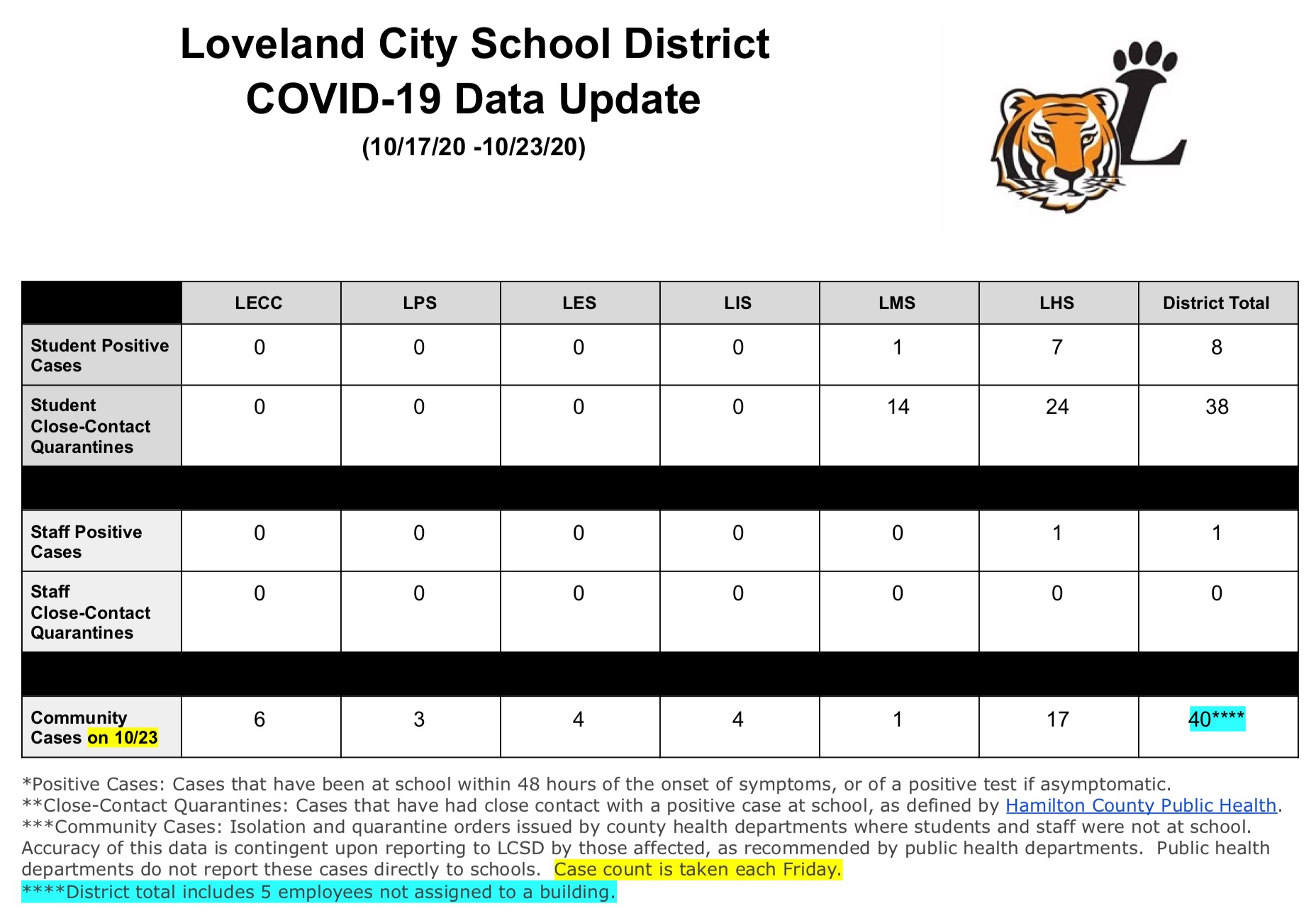
Through October 23, we have had 18 students or staff test positive for COVID-19, and that has resulted in 50 close-contact quarantines. All indications are that people are contracting COVID outside of our schools, and that because of our masking, distancing and hygiene bundle, it is not being spread inside our schools.
Now that we have made it through the first quarter, we can see that our students are learning and performing well. Our MAP fall benchmark scores for grades 1-8 consistently show that students this fall are on par with where students were last fall. The education of our students is going strong. Students are actively participating in their areas of specialty in interest beyond the classroom, with students active in fall sports, music and performing. Clubs have started and continue to work on creative ways to provide the full Tiger experience for our students and families.
COVID-19 Update From the District COVID-19 Update Newsletters
In the evening on 10/23/20, the district was notified that a student at Loveland High School tested positive for COVID-19. This student was last present at school on Monday, 10/19/20.
On 10/23/20, the district was notified that a student at Loveland High School tested positive for COVID-19. This student was last present at school on Tuesday, 10/20/20.
On 10/23/20, the district was notified that a non-teaching staff member at Loveland High School tested positive for COVID-19. This staff member was last present at school on Tuesday, 10/20/20.
In the evening on 10/21/20, the district was notified that a student at Loveland High School tested positive for COVID-19.
On 10/22/20, the district was notified that a student at Loveland High School tested positive for COVID-19.
On 10/22/20, the district was notified that a student at Loveland Middle School tested positive for COVID-19.
In the evening on 10/19/20, the district was notified that a student at Loveland High School tested positive for COVID-19.
On 10/20/20, the district was also notified that two additional students at Loveland High School tested positive for COVID-19.
On 10/19/20, the district was notified that a student at Loveland High School tested positive for COVID-19.
On 10/13/20, the district was notified that a student at Loveland High School tested positive for COVID-19.
The district was notified that a student at Loveland Primary School tested positive for COVID-19.
On Thursday, 10/8/20, the district was notified that a student at Loveland High School tested positive for COVID-19.
On Tuesday evening, 10/6/20, the district was notified that two students at Loveland High School tested positive for COVID-19.
On Sunday, 10/4/20, the district was notified that a non-teaching staff member at Loveland Elementary School has tested positive for COVID-19.
On Monday, 10/5/20, the district was notified that a student at Loveland High School has also tested positive for COVID-19.
On Saturday, September 19, 2020, the district was notified that a student member of Loveland Middle School tested positive for COVID-19.
(September 14) This weekend, the district was notified that one of our bus drivers has tested positive for COVID-19.
*Community cases (isolation and quarantine orders issued by county boards of health for students and staff who have not been at school within 48 hours of the onset of symptoms, or of a positive test if asymptomatic)
Piqua, Ohio – A Miami County resident reported to police being recruited to take part in a citizen’s arrest of Gov. Mike DeWine at his Cedarville home a week ago, but the plot evidently never materialized.
The plot is alleged to have involved Renea Turner, a former write-in candidate for governor who ran against DeWine in 2018. A state representative says he recently met with Turner prior to the alleged call and she inquired about the governor’s home, the Ohio Capital Journal has learned.
The Ohio State Highway Patrol, which handles security for the governor and his residences, was notified of the report by local law enforcement and is investigating.
At a press conference Friday afternoon to discuss allocation of CARES Act funding in Ohio, DeWine told reporters he was unaware of the alleged plot and had not been briefed on it to that point.
This report to police came just a week after 13 men were arrested for reportedly planning to kidnap Michigan Gov. Gretchen Whitmer and it follows months of protests against DeWine and state health officials.
According to a Piqua Police Department report from Oct. 16, a citizen told an officer about being called earlier that morning by Turner, a Springfield native who is an outspoken critic of DeWine. Turner reportedly asked if they wanted to take part in an attempt to arrest the governor at his home later that weekend and try him for allegations of tyranny.
The Ohio Capital Journal initially declined to identify Turner as the alleged caller, as law enforcement would not confirm if she had been under investigation or charged with a crime and she could not be reached by the Ohio Capital Journal for comment.
The Ohio State Highway Patrol has been made aware of the police report but would not say if an investigation has been launched.
Since the original publication of this story, Turner has spoken on the record with cleveland.com about the call, which she confirmed took place. She told the outlet that she did speak to the Miami County person about placing DeWine under house arrest, but reportedly denied discussing any specific plans.
The Capital Journal is not identifying the person who reported the incident to police after the person asked to remain anonymous for safety reasons, having already followed up with Piqua law enforcement about a threat made against them online.
The person who reported the call told Ohio Capital News that the plot stemmed from anger toward the governor’s response to the COVID-19 pandemic. The person said they too are a critic of DeWine and claimed to have recently filed a citizen affidavit seeking criminal charges against the governor. State Rep. John Becker, R-Union Twp., who has led an impeachment effort against DeWine in the Statehouse, has urged Ohioans to submit such affidavits about the governor.
“Do I think (DeWine) needs to be arrested? Absolutely,” the person said. “But all that needs to happen within the confines of the law.”
They claimed they were initially excited when receiving the call last Friday, thinking the conversation would be about the ongoing search from DeWine critics to find a prosecutor willing to bring charges against him.
“(The caller) said ‘no, we the people, we’re going to arrest him,’” the source said.
According to this person, the caller described several supposed penalties for a citizen’s trial on tyranny — permanent exile or execution.
According to this person, the caller described several supposed penalties for a citizen’s trial on tyranny — permanent exile or execution.
Soon after the call, they decided to contact the police.
“If I don’t do something about this and something happens, I’m either legally culpable or at least I’m going to feel bad,” they said. “Not that I have any love lost between me and Gov. Mike DeWine. Again, I think he needs to be in prison. But again, if (the caller) had done something … I would have felt ethically responsible, right?”
State legislator says Turner recently asked about DeWine’s home in private chat
Becker told the Capital Journal he met with Turner a few weeks ago in Columbus at her request to speak about theoretical criminal charges against the governor. While his focus has been on locating a willing prosecutor, he said Turner spoke about finding a county sheriff to make the arrest.
“I just kind of shrugged my shoulders and said, ‘good luck with that,’” Becker recalled.
Then came an unusual change in subject: Turner wanted to know more about the governor’s residence in Cedarville. Becker said Turner asked whether the personal residence constituted public property during DeWine’s term as governor.
“It was kind of a strange question,” Becker said.
John Becker aided Turner by providing information about DeWine’s residence and if it constituted public property.
After the conversation ended, Becker asked Turner’s question to the Legislative Service Commission, a nonpartisan group which gives private law research to lawmakers. He learned the home remains a private residence, and passed that information along to her.
Becker did not hear again from Turner after that. Earlier this week, he heard from the Miami County resident about the alleged plot. The person told him about Turner and Becker recognized her name from their recent meeting.
Becker said he informed the Statehouse’s sergeant at arms about the situation when returning to work earlier this week. He later posted a YouTube video about the incident, referring to the person who reported the call to police as a “hero.”
Becker confirmed to the Capital Journal he was contacted by the Ohio State Highway Patrol on Friday. The lawmaker said he described to the Patrol his interactions with Turner and the Miami County resident.
Piqua Police Chief Rick Byron told the Capital Journal on Thursday the citizen’s report was turned over to the Patrol.
“At this point, we have not followed up with them and have no plans to do so,” Byron said, noting the alleged caller is not from Piqua and therefore his department does not have jurisdiction. “We’re pretty confident that (the Patrol is) going to handle this situation.”
Dan Tierney, a spokesperson for the governor’s office, referred questions about the situation to the Patrol.
In a brief statement on Thursday, Lt. Tiffany Meeks told the Capital Journal: “For security, the Patrol does not discuss threats or security operations involving the governor.” The Patrol later confirmed to the Dayton Daily News it was “currently investigating the incident.”
Cleveland.com quoted Turner on Friday as saying officials with the Patrol came to her home that morning “to check out my temperament and what my plans are.”
Since the report was made on Oct. 16, the governor has hosted three press conferences at his Cedarville home: his traditional virus-related updates on Oct. 20 and 22, and the CARES Act press conference with legislative leaders on Friday.
After this story was first published, reporters asked DeWine during his CARES Act press conference about his reaction to the alleged plot.
“I don’t know the details of the so-called plan,” he said. “I can’t really comment on that.”
Asked if he was shocked to learn about such a plot, DeWine answered: “No. I’m not shocked by it. At this point in my life, not much shocks me anymore. It’s a sad thing.”
This is the latest in a series of alleged plots targeting political leaders in 2020 for their responses to the pandemic. In Michigan, state and federal law enforcement foiled a plot to kidnap and try Gov. Whitmer, with seven of the men being charged under the state’s anti-terrorism law.
Police in that case have alleged the Whitmer plot was hatched in a meeting held in Dublin, Ohio this summer. The same groupof men also hoped to target Virginia Gov. Ralph Northam.
There is no known connection between these plots and the one reported in Piqua.
Turner is former governor candidate
Turner, of Springfield in Clark County, campaigned for governor as a write-in candidate in 2018.
Turner encountered DeWine on the campaign trail, later posting a picture of themselves together to social media. A post on her Facebook page claims she pretended to be a supporter of DeWine’s, then told him after the picture was taken she was actually campaigning against him.
Turner received 185 votes in the 2018 general election, including one from the person who later reported her call to Piqua police.
Turner has shared several posts from state Rep. Nino Vitale, R-Urbana, who has made headlines throughout 2020 for posting falsehoods about the virus — such as an April claim that it may have been created by Bill Gates.
Turner received 128 more votes as a write-in candidate for Springfield mayor in 2019 before turning her attention back to DeWine amid the coronavirus pandemic.
Her social media pages are littered with conspiracy theories involving the virus, government microchips and vaccine mandates. Many of the posts have been flagged by Facebook as spreading misinformation.
Turner has shared several posts from state Rep. Nino Vitale, R-Urbana, who has made headlines throughout 2020 for posting falsehoods about the virus — such as an April claim that it may have been created by Bill Gates.
Turner shared one post by Vitale from May 18, in which he accused DeWine of “giving himself total dictatorial power.” Vitale also falsely suggested the governor knew about the virus in March 2019, many months before the novel coronavirus was ever discovered.
In July, Turner posted photos of herself protesting health orders at the Ohio Statehouse with a signs referring to the governor as Hitler.
Turner took to the Statehouse again on Thursday, proclaiming she had removed the governor from office through a self-issued declaration. A video shared to Facebook shows Turner taking an oath of office, with a signed sheet of paper claiming her to be the next governor of Ohio.
Turner did not address the Thursday incident in her interview with cleveland.com.
‘It’s wrong morally, it’s wrong legally’
DeWine reiterated on Friday that the plot against Whitmer was “despicable” and added he denounced any effort by people to subvert the legal system and target public officials.
“We are seeing people out there who believe that,” the governor said. “We have an obligation, each one of us as elected officials, opinion leaders, to denounce that and say ‘that is wrong.’ It’s wrong morally, it’s wrong legally, it’s anti-democratic, it’s anti-everything this country stands for.”
While DeWine has enjoyed widespread, bipartisan support throughout 2020 for his response to the pandemic, his administration has also been the subject of intense condemnation. Four legislators have endorsed his impeachment, and dozens of others have supported various bills seeking to limit the executive’s power to handle an infectious disease.
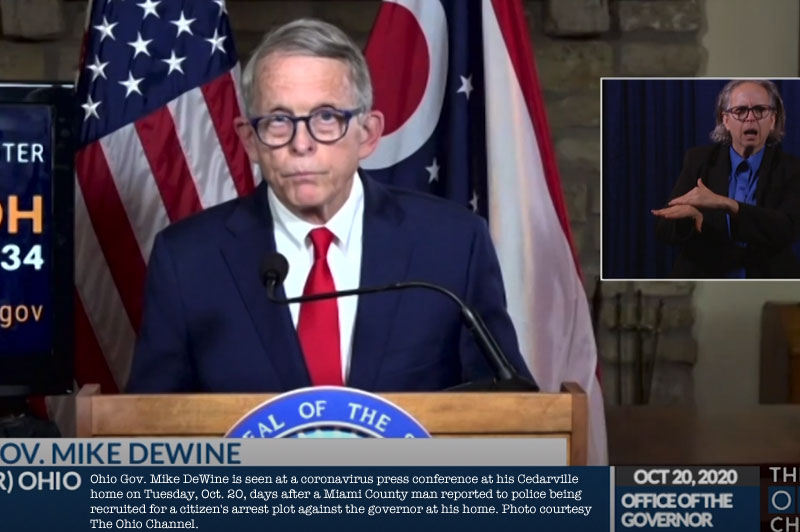
Ohio Gov. Mike DeWine in a Zoom call with reporters in August outside his Cedarville home. Screenshot by Marty Schladen, Ohio Capital Journal.
Repeated protests at the Statehouse led DeWine to move his press conferences from Capitol Square to a government building elsewhere due to “security reasons,” WKYC reported in April.
That same month, Cleveland.com reported that Ohioans protesting the state’s public health orders were seen “driving by DeWine’s Greene County house, filming it and counting cars.” The outlet quoted a DeWine spokesperson as saying security officials were aware of this surveillance but could not comment further.
In May, protesters repeatedly targeted the home of Dr. Amy Acton, who was then serving as director of the Ohio Department of Health. There were reports that some of the protesters were armed with guns, and one person was photographed carrying an anti-Semitic sign. Not long after, Acton resigned as state health director.
In May, protesters repeatedly targeted the home of Dr. Amy Acton, who was then serving as director of the Ohio Department of Health. There were reports that some of the protesters were armed with guns, and one person was photographed carrying an anti-Semitic sign. Not long after, Acton resigned as state health director.
The state has been without a permanent health director in the months since. A replacement was announced in September, but the person selected withdrew from consideration after learning of the harassment leveled against Acton. The Ohio Department of Health continues to be led by an interim director.
Also in May, Democratic House Minority Leader Emilia Sykes reported a phone call to police threatening to kill her father, state Sen. Vernon Sykes, if she did not “step aside” politically.
(This story was edited by Loveland Magazine)
Tyler Buchanan is an award-winning journalist who has covered Ohio politics and government for the past decade. A Bellevue native and graduate of Bowling Green State University, he most recently spent 6 1/2 years as a reporter and editor of The Athens Messenger and Vinton-Jackson Courier newspapers. He is a member of the BG News Alumni Society Board and was a 2019 fellow in the Kiplinger Program in Public Affairs Journalism.
Dylan Bodley is a professional musician residing in Nashville. He graduated from Belmont in May of 2016 as a Commercial Guitarist.
Loveland native and LHS grad Dylan Bodey and friends present…
Another fun weekend filming with The Bengal Boys
Bengals Growl | Backstreet Boys edition
Bengal Boys Members:
Dylan Bodley – Loveland HS Grad (2012)
Alex Dolezal – Loveland HS Grad (2012)
Parker Phillips – Loveland HS Grad (2012)
Colin Cooper – CHCA Grad (2010)
The Bengals Boys – “The boy band that only knows one song. Showing our love for the Cincinnati Bengals by presenting the Cincy renowned fight song, “Bengals Growl” by George Bird, in a different genre/style every week.”
Dylan Bodley is a Cincinnati, OH native who is now residing in Nashville, TN. In 2012, Dylan began attending Belmont University to study guitar and the music business. During his time at Belmont, Dylan was fortunate enough to intern with renowned producer, Jay Joyce, and record label, Big Loud. He also played in Belmont’s 2016 Country Showcase with artists Kayla Woodson and Kassi Ashton as well as the Best of the Best Showcase with Kassi Ashton. In May of 2016, he received his Bachelors of Music Degree.
Dylan specializes in jazz, rock, pop, blues, country, and funk. With influences ranging from Jimi Hendrix, Eric Johnson, Duane Allman, Pat Metheny, and Brent Mason, Dylan combines their individual styles to create an entirely unique sound. Now, Dylan plays with country artist, Kayla Woodson, and is in a funk/rock/pop band called Trapped On Earth. HE has also done studio work for Grammy winning producer, Joey Moi. You can hear his work on their debut album, Hotel Earth. He is currently endorsed by Waits Instruments and is in the process of creating his own signature guitar with them.
Feel free to contact Dylan for lessons, corporate events, weddings, sessions, touring, and any other performance opportunity you can imagine!
Lt. Governor Jon Husted announced the launch of the “Dayton MASKots” campaign facilitated through the Dayton Area Chamber of Commerce to slow the spread of the coronavirus while supporting Ohio sports.
This campaign challenges team mascots around the region and state to “mask up” and post a picture of their mascot with a mask on. This could be for a K-12 school, college or university, or other sports team.
Or, even a local newspaper with a mascot?
Ohioans can use the hashtag #DaytonMASKots to join this effort.
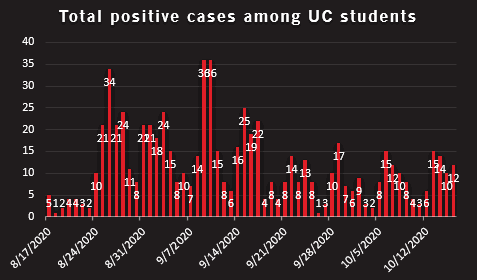
As Ohio experiences a spike in hospitalizations not seen since the pandemic began in March, positive cases of COVID-19 continue to rise at the University of Cincinnati (UC).
The university has recorded 742 positive cases among members of the students body since campus reopened in August, according to the university’s COVID-19 dashboard.
A total of 519 positive cases have been recorded among students living off campus and another 223 cases were recorded among students living in university housing.
There are currently 10 UC residential students living in isolation and 24 students living in quarantine. The university has a total of 247 beds available for quarantine and isolation.
So far, 39 university employees have tested positive.
The university is recording a seven day moving average of approximately 10 cases per day.
Trick-or-Treat at RP Diamond the week of Halloween! Stop by the store anytime next week in costume and receive a KING SIZE candy bar! Happy Halloween from RP Diamond!
RP Diamond is the exclusive retailer of LOVELAND HIGH SCHOOL SPIRIT WEAR. We specialize in spirit wear for schools, sports, clubs and organizations of any size.














 Dylan Bodley is a professional musician residing in Nashville. He graduated from Belmont in May of 2016 as a Commercial Guitarist.