Author: Loveland Magazine

  • Think tank blasts Ohio flat tax proposal

    Think tank blasts Ohio flat tax proposal

    [vc_row][vc_column][vc_column_text]

    The Oho Statehouse, Columbus, Ohio. (Photo by Graham Stokes for the Ohio Capital Journal. Republish photo only with original story.)

    The way that the law is written would only complicate the state’s school-funding woes, take money from libraries, and increase property taxes for farmers and homeowners, it added.

    BY:  – Ohio Capital Journal

    It sounds fair. If everybody paid income taxes at the same rate, the rich would pay more because of their higher incomes and the poor would pay less because they make less in the first place.

    But an Ohio proposal to enact such a “flat” state income tax ignores a host of other taxes, said a progressive public policy think tank. And the way that the law is written would only complicate the state’s school-funding woes, take money from libraries, and increase property taxes for farmers and homeowners, it added.

    “One of the myths that we have to dispel is that flat taxes make things fair,” said Guillermo Bervejillo, a state policy fellow at Policy Matters Ohio. “It’s quite the opposite. One of the things people forget when they talk about income taxes is that there’s a whole array of state taxes.”

    Bervejillo was speaking in reference to House Bill 1, which, as the bill number implies, is a top priority of the Ohio House’s Republican leadership. A spokesperson for that leadership didn’t respond to questions about the many criticisms that Policy Matters made of the bill.

    One is that many economists have long argued that so-called “flat” income taxes add to the overall tax burden shouldered by the poor and act as yet another means of lightning that of the wealthy.

    “There’s use taxes, sales taxes, excise taxes, taxes that are generally focused around consumption and use,” Bervejillo said.

     Graphic from the Center on Budget and Policy Priorities. 

    He explained that those kinds of taxes are the same for everybody, no matter her or his income. Buy a $100 pair of shoes in Ohio and you pay $5.75 in state sales tax regardless of whether you make $100 in a minute or in a whole day of work.

    “You can only buy so much toilet paper,” Bervejillo said, explaining why sales and excise taxes fall more heavily on the poor. “You can only drive so many miles.”

    The cumulative impact of those taxes is that the poor pay much more as a percentage of their income in state and local taxes than do the rich.

    “On average, the lowest-income 20% of taxpayers face a state and local tax rate more than 50% higher than the top 1% of households,” the Institute on Taxation and Economic Policy said in a report, Who Pays? “The nationwide average effective state and local tax rate is 11.4% for the lowest-income 20% of individuals and families, 9.9% for the middle 20 percent, and 7.4 percent for the top 1%.”

    Federal and state income taxes are the few exceptions that were originally structured to be “progressive.” In other words, they were intended to fall most heavily on those with the greatest ability to pay.

    And it’s true that if you take those and all other taxes into account, the richest Americans pay a bigger portion of their incomes out in taxes than poorer Americans. But the spread isn’t very wide.

    In 2019, the poorest 20% of Americans paid 20.2% of their incomes in taxes, while the richest 1% paid 33.7%, the Institute on Taxation and Economic Policy reported.

    But in Ohio if you take just state and local taxes into account, the script is flipped. In 2018, the poorest 20% paid almost twice as much of their income in such taxes — 12.3% — as the richest 1%, who paid just 6.5% of their lavish incomes in state and local taxes, the institute reported.

    And if Ohio were to enact a flat income tax, it would come on the heels of other measures in which the state has foregone large sources of revenue largely to the benefit of the wealthy.

    Ohio is giving up about $1 billion a year on a tax break for limited liability corporations. It was sold as a way to incentivize mom-and-pop businesses, but a 2017 analysis by the Ohio Legislative Service Commission found that as much as $450 million of that annual benefit was going to the highest 0.5% of Ohio wage earners.

    Meanwhile, there’s been no evidence that the cut improved Ohio’s jobs picture. It was 39th among states for job growth in February 2003 — well before the LLC tax cut was implemented, according to data compiled by Arizona State University’s Seidman Institute. By last month, Ohio ranked 46th in year-over-year job growth.

    And former Gov. John Kasich created JobsOhio by diverting funds from the state liquor monopoly. It’s spent more than $1 billion on things like incentives for wealthy businesses to locate to Ohio, but the agency has struggled to show that those expenditures have made much of a difference to the state’s jobs picture.

    But aside from fairness, Policy Matters raised another objection to HB 1 — it’s not paid for. Working from a fiscal analysis of the bill by the Legislative Services Commission, the group found that after the initial phase-in:

    • Property taxes on farmers and homeowners would increase at least $600 million a year because of “changes in the bill and the operation of Ohio’s existing property tax limit, known as House Bill 920.”
    • Schools, libraries and local governments would lose hundreds of millions of dollars a year.
    • There would be $780 million in annual net losses to the state that are not paid for in the bill.

    Bervejillo said it’s not hard to understand why pain would spread to large swaths of Ohioans from the flat-tax proposal.

    “At the end of the day, there’s only two things you can do when you cut taxes on the wealthy,” he said. “You can either cut services — and who depends more on services than low-income people? Or you increase sales and use taxes and gas taxes and cigarette taxes that fall disproportionately on low-income and working-class Ohioans.”

    _________________________________

    Marty Schladen
    MARTY SCHLADEN

    Marty Schladen has been a reporter for decades, working in Indiana, Texas and other places before returning to his native Ohio to work at The Columbus Dispatch in 2017. He’s won state and national journalism awards for investigations into utility regulation, public corruption, the environment, prescription drug spending and other matters.

    MORE FROM AUTHOR

    [/vc_column_text][/vc_column][/vc_row]

  • Starting Today, April 4: New Ohio rules for cell phone use while driving

    Starting Today, April 4: New Ohio rules for cell phone use while driving

    [vc_row][vc_column][vc_video link=”https://youtu.be/Mma5DkAYsCo”][vc_column_text]

    Loveland, Ohio – As of April 4, 2023, it is illegal to use or hold a cell phone or electronic device in your hand, lap, or other parts of the body while driving on Ohio roads. If an officer sees a violation, they can pull you over.

    Below is what the Ohio Department of Transportation wants you yo know about the new law:

    Drivers over 18 years old can make or receive calls via hands-free devices, including:

    • Speakerphone
    • Earpiece
    • Wireless headset
    • Electronic watch
    • Connecting phone to vehicle

    In most cases, anything more than a single touch or swipe is against the law.

    CAN I STILL USE BLUETOOTH?

    This new law allows drivers over 18 to make or receive phone calls using “hands-free” technology such as Bluetooth or integrated systems within the vehicle, as long as you don’t hold or support the device or manually enter letters, numbers, or symbols. If you must physically manipulate your device, you should pull over to a safe location and park your car before handling.

    WHAT’S OFF-LIMITS?

    With very few exceptions, anything that involves using, holding, or supporting a device while driving is off-limits. This could include:

    • Dialing a phone number

    • Sending a text message

              (voice to text is legal via a “hands free” method)

    • Updating or browsing social media

    • Video calls or FaceTime

    • Browsing the Internet

    • Watching videos

              (GPS/navigational displays are allowed)

    • Playing games

    • Recording or streaming video

              Drivers can listen to audio streaming apps and use navigational equipment if they turn them on before getting on the road or use a single touch or swipe to activate, modify, or deactivate them.

    Remember, drivers under the age of 18 are still restricted from using their devices in any way, including hands-free features.

    Exceptions include: 

    • Drivers reporting an emergency to law enforcement, a hospital, health care provider, fire department, or similar emergency entity.
    • Drivers holding a phone to their ear only during phone conversations, if the call is started or stopped with a single touch or swipe.
    • Drivers holding or using cell phones and other electronic devices while stopped at a traffic light or parked on a road or highway during an emergency or road closure.
    • First responders (law enforcement, fire, EMS), using electronic devices as part of their official duties.
    • Utility workers operating utility vehicles in certain emergency or outage situations.
    • Licensed operators using an amateur radio.
    • Commercial truck drivers using a mobile data terminal.

    Enforcement

    When the new distracted driving law takes effect on April 4, 2023, the Ohio State Highway Patrol and local law enforcement will issue warnings for six months for violations as part of the effort to educate and help motorists adapt to the new law.

    Beginning October 5, 2023, law enforcement will start issuing citations for violating this law.

    Penalties

    • 1st offense in two years: 2 points assessed to driver’s license, up to a $150 fine.*
    • 2nd offense in two years: 3 points assessed to license, up to a $250 fine.
    • 3rd or more offense in two years: 4 points assessed to license, up to a $500 fine, possible 90-day suspension of driver license.
    • Fines doubled if the violation occurs in a work zone.

     * Completion of a distracted driving course can help avoid the fine and points.

    The Law

    The new distracted driving law can be found in Section 4511.204 of the Ohio Revised Code.

    Download and print the “Fact Sheet”.

    Frequently asked questions.[/vc_column_text][/vc_column][/vc_row]

  • Ohio BMV will refund disabled veterans after incorrectly charging for license plates

    Ohio BMV will refund disabled veterans after incorrectly charging for license plates

    [vc_row][vc_column][vc_column_text]

    Photo from Wikimedia Commons by “Mister Upstate.”

    BY:  – Ohio Capital Journal

    The Ohio Bureau of Motor Vehicles will issue refunds to nearly 2,000 disabled veterans who were wrongly charged for specialty license plates.

    The BMV recently realized it did not implement a change in Ohio law that went into effect in October 2019 that allows certain disabled veterans to receive up to two free disabled veteran license plates/military license plates, the BMV said in a release Thursday.

    The average refund will be $60, although the exact amount of each refund will vary based on local fees and taxes.

    “The BMV deeply regrets this error,” Charlie Norman, Ohio BMV Registrar, said in a news release. “We are undertaking an internal review to determine why the legislative change wasn’t adopted in a timely manner to ensure that this will not happen in the future.”

    The BMV will be contacting all veterans who were improperly charged and refunds will be processed within the next month. The BMV is implementing a “processing change” so veterans who qualify for free disabled and military license plates are not charged in the future.

    The law applied to veterans with a service-connected disability who are declared 100% disabled by the U.S. Department of Veterans Affairs, and does not apply to personalized specialty disabled/military license plates.

    Follow OCJ Reporter Megan Henry on Twitter.

    Megan Henry
    MEGAN HENRY

    Megan is a reporter for the Ohio Capital Journal.

    MORE FROM AUTHOR

    [/vc_column_text][/vc_column][/vc_row]

  • U.S. judge rules insurers don’t have to cover many free preventive health services

    U.S. judge rules insurers don’t have to cover many free preventive health services

    [vc_row][vc_column][vc_column_text]

    Getty Images

    BY: ,  AND  

    WASHINGTON — Health insurance companies may no longer need to cover a wide swath of preventive health care services that were required by the 2010 Affordable Care Act, under a federal judge’s ruling issued Thursday in Texas.

    The decision could affect millions of Americans’ access to no-cost preventive health care — including pregnancy-related care, cancer screenings, HIV prevention pharmaceuticals and more — that a federal agency given new powers under Obamacare required health insurance companies to cover.

    It was not immediately clear when or how the decision could take effect in consumer insurance plans. The Biden administration is likely to appeal the case.

    U.S. Senate Majority Leader Chuck Schumer called for an immediate stay and appeal of the ruling and for insurance providers to “publicly commit they will retain free preventive care.”

    “This ruling is not only misguided, it is outright dangerous and could cost lives,” Schumer, a New York Democrat, said in a statement.

    New Jersey Democratic Rep. Frank Pallone, ranking member on the U.S. House Energy and Commerce Committee, said in a written statement the judge’s decision “imperils access to lifesaving care including mammograms, lung cancer and skin cancer screenings, screenings for pregnant women and newborns, and PrEP.”

    “It has no basis in the law, will unnecessarily cause confusion, and will put lives at risk if people are forced to forgo routine screenings and treatment,” he added. “The Department of Justice should immediately move to appeal this reckless decision and have it stayed so that Americans do not lose access to care.”

    The U.S. Justice Department and the Department of Health and Human Services did not respond to requests for comment Thursday morning on the case, Braidwood Management v. Becerra. The White House also did not return a request for comment on the ruling.

    Judge Reed O’Connor, from the U.S. District Court in the Northern District of Texas, wrote in his ruling that preventive services required by the U.S. Preventive Services Task Force to be covered are unlawful because they violate the Appointments Clause.

    That section of the Constitution requires the president to nominate certain positions, sometimes referred to as principal officers, that the U.S. Senate then confirms.

    Government officials whose positions are generally considered “inferior” are often left for the president, Cabinet secretaries, or others in the executive branch to hire without Senate involvement.

    The conservative Christian business owners who filed the lawsuit argue the preventive care measure mandates are unconstitutional, due to a lack of oversight on how recommendations are made by the U.S. Preventive Services Task Force.

    The business owners argue that because the ACA does not allow the secretary of HHS — or other leaders of the agency — to reject recommendations made by that committee, it has insufficient oversight.

    O’Connor, nominated by former president George W. Bush, sided in his ruling with the businesses owners, who want to provide health insurance without coverage for “PrEP drugs, the HPV vaccine, contraceptives, and screenings and behavioral counseling for STDs and drug use.” They argued their employees had no need for such coverage and that it violated their religious beliefs under the Religious Freedom Restoration Act.

    PrEP, also known as pre-exposure prophylaxis, are drugs that have a 99% prevention rate for HIV, and are used by all Americans, but primarily by men who have sex with men. The Centers for Disease Control and Prevention found the drugs “played a part in recent decreases in new HIV infections.” The CDC estimates that 1.2 million Americans are eligible for PrEP.

    The business owners argue that requiring health insurance to cover preventive HIV medication, such as PrEP, violates their faith. They also argue it’s unconstitutional for the federal government to recommend covered preventive services.

    O’Connor wrote in Thursday’s ruling that Braidwood Management Inc. and Kelley Orthodontics, as well as others “need not comply with the preventive care coverage recommendations of the U.S. Preventive Services Task Force issued on or after March 23, 2010, because the members of the Task Force have not been appointed in a manner consistent with Article II’s Appointments Clause.” The Affordable Care Act was signed into law on that date.

    Numerous medical groups — the American Medical Association, The American College of Obstetricians and Gynecologists, the Society for Maternal-Fetal Medicine, the American Academy of Pediatrics, the American Medical Women’s Association, the American Academy of Family Physicians, the National Medical Association and the Infectious Diseases Society of America — warned against revoking no-cost preventive care services in a brief filed in November.

    “​​Ultimately, if this Court invalidates the Task Force’s recommendations nationwide, physicians and healthcare professionals will be left in an untenable situation,” they wrote.

    “Amici will struggle to encourage their patients to accept services that they know will save lives and to help their patients navigate a new and confusing insurance situation,” they added. “Amici will see many of their patients, including some of their most vulnerable, turn down medically indicated services because of the very financial barriers that Congress sought to remove.”

    “The past ten years have shown the benefits of no-cost preventive coverage, and amici ask that the Court hesitate before ordering a remedy that could upset that substantial progress,” they said.

    The preventive care services  in question receive either an “A” or “B” rating from the Preventive Services Task Force. They include domestic violence counseling, postpartum depression counseling, breastfeeding support, and treatment for heart disease.

    Some of the screenings for cancer include breast, colorectal, ovarian, lung and skin for patients as young as 6 months to 24-year-olds with fair skin.

    HHS estimated in 2020 that nearly 152 million people had access to preventive care services under the law. That breaks down to about 58 million women, 57 million men, and 37 million children, according to HHS data.

    Health experts weigh in

    Health policy experts at the Kaiser Family Foundation said during a briefing Thursday afternoon the ruling’s impacts aren’t likely to be immediate, since health insurance companies typically set plans for a full year and the Biden administration is expected to both request a stay of the ruling and appeal it to the 5th Circuit Court of Appeals.

    In the event the case is appealed to the U.S. Supreme Court and the justices side with this judge’s ruling, Larry Levitt, executive vice president for health policy, said health insurance companies will likely keep coverage for prevention activities covered under the ruling, but that patients could have to pay some of the cost.

    How much someone pays for one of those health care services would depend on the type of insurance they have, their deductible and several other factors.

    Laurie Sobel, associate director of women’s health policy, said it wouldn’t be especially challenging for Congress to fix the issue at the heart of the lawsuit.

    “The main argument is that the agency, that Health and Human Services, has no power to approve or reject the recommendations by USPSTF, so a fix could be that you just include that (HHS has) to approve the recommendations,” Sobel said. “So it makes it clear that USPSTF is in an advisory role and not actually determining what has to be covered.”

    Levitt, however, noted that the ACA is a “political lightning rod,” making any changes in a divided Congress somewhat unlikely.

    “It does not require a lot of words to fix this in legislation, but it potentially requires very difficult politics,” Levitt said.

    Alina Salganicoff, senior vice president and director of women’s health policy, said because the judge’s ruling didn’t impact the Health Resources and Services Administration, or the Advisory Committee on Immunization Practices there are still several preventive services that insurance companies must cover.

    “An important message is that mammograms will likely still be covered without cost sharing, so people shouldn’t fear that they won’t have coverage for their mammogram at this point,” Salganicoff said, noting those are under the Health Resources and Services Administration recommendations.

    There are also several other cancer screenings and types of preventive care that will be covered, since the judge’s ruling applies to recommendations the U.S. Preventive Services Task Force made on or after March 23, 2010.

    One issue with that is health care providers have updated the types of screenings available as well as timing in the 13 years since.

    Sexually transmitted infection testing is one of the recommendations, Salganicoff said, that pre-dates March 2010, though public health experts have tweaked and adjusted it over the years.

    “These are updated every five years, so those will likely still be covered,” Salganicoff said.

    “I think it’s too soon to tell how insurance plans are going to respond to some of the tweaks over time,” Salganicoff added. “My anticipation would be that clinicians and plans do want to have coverage to current standards rather than requirement to standards set based on research that was conducted 13 years ago or before.”

    Other legal challenges to ACA coverage

    Several cases challenging whether employers should have to comply with the ACA’s birth control mandate have come before the U.S. Supreme Court. Thursday’s ruling does not change that section of the ACA.

    In 2020 the court granted a victory to those opposed to offering health plans that cover contraception.

    In a 7-2 decision, with an opinion written by Justice Clarence Thomas, the Supreme Court ruled in favor of the Little Sisters of the Poor, which challenged that the mandate violated its rights under the Religious Freedom Restoration Act.

    The case brought by the nonprofit Catholic religious organization, which operates homes for the elderly, upheld a Trump administration expansion of an exemption under the ACA that allowed private employers to object to the birth control mandate for religious or moral reasons.

    The Trump administration widened the exemptions in November 2018.

    In 2016, the Supreme Court unanimously returned a case brought by a Pittsburgh-based Catholic priest to the lower court level.

    Bishop David Zubik, the main plaintiff, had argued that religious freedoms were violated by the contraceptive mandate. Zubik argued that a special carve-out exemption for religious organizations did not go far enough and therefore burdened the exercise of their religious freedoms. The Catholic Diocese of Pittsburgh and Erie, as well as the nonprofit Catholic Charities, joined as plaintiffs.

    In 2014, Hobby Lobby, a Christian-owned craft supply retailer, won at the Supreme Court level after it became the first high-profile plaintiff to challenge coverage of birth control under the ACA.

    In a 5-4 decision, Justice Samuel Alito wrote in the majority opinion that a requirement for “closely held” for-profit corporations to provide employees with access to no-cost contraception under ACA plans violated the Religious Freedom and Restoration Act.

    Jennifer Shutt
    JENNIFER SHUTT

    Jennifer covers the nation’s capital as a senior reporter for States Newsroom. Her coverage areas include congressional policy, politics and legal challenges with a focus on health care, unemployment, housing and aid to families.

    MORE FROM AUTHOR

    Ariana Figueroa
    ARIANA FIGUEROA

    Ariana covers the nation’s capital for States Newsroom. Her areas of coverage include politics and policy, lobbying, elections and campaign finance.

    MORE FROM AUTHOR

    Ashley Murray
    ASHLEY MURRAY

    Ashley Murray covers the nation’s capital as a senior reporter for States Newsroom. Her coverage areas include domestic policy and appropriations.

    MORE FROM AUTHOR

    [/vc_column_text][/vc_column][/vc_row]

  • Ohio Right to Life makes spurious, anti-trans argument in favor of supermajority amendment

    Ohio Right to Life makes spurious, anti-trans argument in favor of supermajority amendment

    [vc_row][vc_column][vc_column_text]

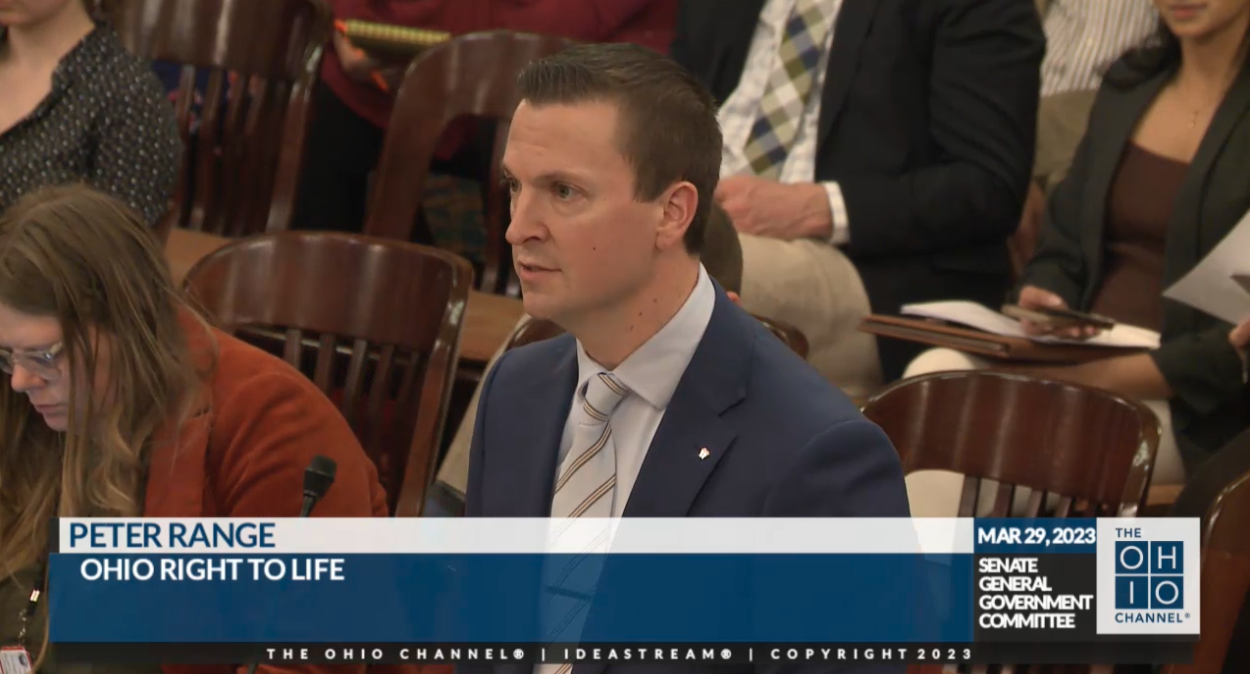
    Ohio Right to Life CEO Peter Range speaking before the Senate General Government committee in favor of SJR 2. (Screen grab from the Ohio Channel)

    [/vc_column_text][vc_column_text]

    Right to Life officials claim a reproductive rights amendment would allow youth to receive gender affirming care without parental notification

    BY:  – Ohio Capital Journal

    Late last year, Rep. Brian Stewart, R-Ashville, and Secretary of State Frank LaRose introduced their plan requiring supermajority for constitutional amendments. It didn’t take long for opponents to check the calendar and argue the resolution was advancing — and advancing now — to block an abortion rights amendment on the horizon.

    Despite Stewart and LaRose’s contentions to the contrary, Republican leaders have given up the charade that the two ballot measures are unconnected. On Wednesday in a Senate committee hearing for SJR 2, outside conservative organizations doubled down. A 60% threshold for future constitutional amendments is necessary, they argued, to head off the reproductive rights amendment before November.

    But they went a step further, too.

    Speakers from Ohio Right to Life argued — without evidence — that the reproductive rights amendment would open the door to minors receiving gender affirming care without parental notification.

    It’s a specious argument that presages an exceptionally bitter march to November, marked by disinformation and fear-mongering, with critics of the argument noting that nothing in the proposed amendment mentions or supersedes Ohio’s parental consent laws.

    A “healthy tension”

    Unlike the last year’s attempt to establish a supermajority threshold, numerous proponents showed up to speak in favor of the idea.

    Some, like University of Toledo professor Lee Strang, stuck to the policy,

    “Ohio adopted this initiative mechanism for a variety of reasons,” he explained. “The most common reason was the belief that the state legislature was not sufficiently responsive to average Ohioans and was instead subject to control of large nationwide trusts.”

    Of course, that might sound familiar. Ohio’s last redistricting became a debacle in which Republican leaders repeatedly defied the state supreme court. It’s been less than a month since a jury convicted former House speaker Larry Householder in a multimillion-dollar bribery scheme funded by two major utilities.

    Strang contends the amendment process needs to maintain a “healthy tension” between two ideals: stability and flexibility. The higher threshold would insulate the constitution from provisions that belong in statutes, he said.

    Other speakers, however, wandered farther afield.

    Right to Life

    Ohio Right to Life CEO Peter Range argued passing SJR 2 is about “building a culture of life.” His testimony made no bones about wanting the higher threshold to undermine the reproductive rights amendment. But he also injected one of the latest rallying cries of the culture war.

    “This amendment that’s coming up in November will wipe away parental rights to be engaged in their teenagers decision to get an abortion or not, in their teenagers decision to get sex change operation or not.”

    He wasn’t the only right to life official to make a “parental rights” argument tied to trans youth. Kate Batra insisted, “I’m not being hyperbolic at all, when I say lives are stake.”

    “If this extreme amendment is passed, parents will have their rights obliterated,” Batra argued. “So moms and dads won’t be notified, let alone be able to consent, to their underage daughters undergoing abortion procedures. This also opens the door for adolescents to pursue controversial sex change operations, puberty blockers, sterilization procedures and the like—all without the parents’ knowledge or consent.”

    The amendment itself, however, makes no mention of gender affirming care. It’s first section reads, in full:

    “Every individual has a right to make and carry out one’s own reproductive decisions, including but not limited to decisions on contraception; fertility treatment; continuing ones own pregnancy; miscarriage care; and abortion.”

    It goes on to prohibit state interference except that abortion “may be prohibited after fetal viability.” The amendment carries an exception for the life or health of the mother.

    After the committee hearing, Sen. Rob McColley, R-Napoleon, who is one of the resolution’s sponsors, offered a tepid response to the parental rights argument.

    “There’s been an argument proffered by some that says they’re concerned with the language that says ‘but not limited to,’” he explained. “I’m not 100% well versed on that argument, so I can’t really opine on it.”

    “Demonstrably and totally false”

    Organizers leading the push for the reproductive rights amendment didn’t seem surprised by the line of argument.

    Television ads from the dark money organization Protect Women Ohio make the same spurious allegations about parental rights. The ad’s script actually leads with trans fear-mongering.

    “Your daughter is young, vulnerable, online,” the narrartor says. “You fear the worst: pushed to change her sex or to get an abortion.”

    Executive director of Ohio Physicians for Reproductive Rights, Dr. Lauren Beene, pushed back forcefully on the ad’s claims.

    “The ad is demonstrably and totally false. There is absolutely nothing in the amendment that mentions or supersedes Ohio’s parental consent laws,” she said.

    In a recent NBC4 factcheck, a Capital University law school professor rated Protect Women Ohio’s claims as four out of four Pinocchios.

    “Their intentionally deceptive ad is the beginning of a multi-million-dollar disinformation campaign,” she added, “designed to raise unsubstantiated fears and distract from the fact that the amendment will ensure Ohioans have access to comprehensive reproductive health care, including abortion, and preserve the sanctity of the doctor-patient relationship.”

    Equality Ohio executive director Alana Jochum criticized the ad as well for making “false claims” and “ignoring the facts.”

    “Not only does the proposed amendment have nothing to do with gender affirming healthcare, those arguing that it does are implying that life-saving healthcare is something nefarious,” she said. “The ballot initiative being referenced specifically protects the right to abortion, another form of lifesaving medical care that Ohioans deserve to have access to.”

    “False claims about what the proposed abortion amendment would do attempt to mislead voters by spreading lies that have been debunked by legal experts,” she added. “They are once again dragging precious children, their families, and their health care providers into a conversation that has nothing to do with them — especially when we should actually be talking about protecting democracy.”

    Cincinnati attorney David Langdon registered Protect Women Ohio as an Ohio non-profit a little over a month ago. Langdon helped draft the 2004 Ohio constitutional amendment defining marriage as between one man and one woman. He has also represented the Center for Christian Virtue — another organization pushing for the supermajority threshold.

    Follow OCJ Reporter Nick Evans on Twitter.[/vc_column_text][vc_separator border_width=”10″][vc_column_text]

    Nick Evans has spent the past seven years reporting for NPR member stations in Florida and Ohio. He got his start in Tallahassee, covering issues like redistricting, same sex marriage and medical marijuana. Since arriving in Columbus in 2018, he has covered everything from city council to football. His work on Ohio politics and local policing have been featured numerous times on NPR.

    MORE FROM AUTHOR[/vc_column_text][/vc_column][/vc_row]

  • Trump indicted by Manhattan grand jury, according to reports

    Trump indicted by Manhattan grand jury, according to reports

    [vc_row][vc_column][vc_column_text]BY:  – Ohio Capital Journal

    WASHINGTON — A New York criminal grand jury has indicted former President Donald Trump, according to multiple news reports Thursday night citing persons familiar with the case.

    A former president has never been indicted before. Trump is also a Republican candidate in the 2024 race for the presidency.

    The New York Times and Washington Post reported Manhattan District Attorney Alvin Bragg has been investigating payments Trump paid to adult film actor Stormy Daniels in return for her silence during the 2016 election about an affair.

    Members of Congress quickly began to react, along partisan lines, as news reached them Thursday.

    Many House Republicans who have allied themselves with Trump took aim at Bragg. Reps. Tim Walberg of Michigan, Andy Biggs of Arizona and Matt Gaetz of Florida accused Bragg of targeting the former president.

    “A majority of Americans know Alvin Bragg’s witch hunt is a politically motivated,” Gaetz wrote on Twitter.

    Ohio Republican Rep. Jim Jordan, chairman of the House Judiciary Committee, tweeted, “Outrageous.”

    Colorado GOP Rep Lauren Boebert tweeted the indictment “is another political witch hunt targeting the people’s President.”

    California Democratic Rep. Adam Schiff, who led one of the impeachment trials against Trump, wrote on Twitter the “indictment of a former president is unprecedented.”

    “But so too is the unlawful conduct in which Trump has been engaged,” Schiff wrote. “A nation of laws must hold the rich and powerful accountable, even when they hold high office. Especially when they do. To do otherwise is not democracy.”

    North Carolina Democratic Rep. Alma Adams released a statement saying that the promise that “no one is above the law” in the United States was kept with Trump’s indictment.

    “Mr. Trump, like every other American, is entitled to due process,” Adams wrote. “That is another core promise of our Constitution. The State of New York has spent years meticulously building their case, and they secured an indictment not from political power brokers or the media, but from a grand jury of ordinary citizens.”

    Sen. Thom Tillis, a North Carolina Republican, wrote on Twitter that he was skeptical.

    “This is the same District Attorney who is notorious for letting violent criminals off the hook in Manhattan, but has been laser-focused on pursuing a politicized prosecution of a former president,” he wrote. “Politics should never tip the scales of justice, and Congress has every right to investigate the conduct and decision-making of the Manhattan D.A.’s office.”

    This is a developing story and will be updated.[/vc_column_text][vc_separator border_width=”10″][vc_message]

    JACOB FISCHLER

    Jacob covers federal policy as a senior reporter for States Newsroom. Based in Oregon, he focuses on Western issues. His coverage areas include climate, energy development, public lands and infrastructure.

    MORE FROM AUTHOR[/vc_message][/vc_column][/vc_row]

  • Ohio Senate begins hearings for supermajority amendment, August elections

    Ohio Senate begins hearings for supermajority amendment, August elections

    [vc_row][vc_column][vc_column_text]BY:  –  Ohio Capital Journal

    Ohio state senators began hearings Tuesday for their measure to impose a 60% supermajority to pass constitutional amendments. If the proposal passes both chambers with the support three-fifths of members, it goes to the ballot.

    The sponsors of the resolution are also backing a bill to revive August elections — just in time for their supermajority ballot measure. They introduced that bill on Tuesday, as well.

    The supermajority resolution, SJR 2

    In committee, state Sens. Theresa Gavarone, R-Bowling Green, and Rob McColley, R-Napoleon, described their proposal as an idea whose time has come.

     COLUMBUS, OH — FEBRUARY 22: State Sen. William DeMora, D-Columbus, speaks against SB21 during the Ohio Senate session, February 22, 2023, at the Statehouse in Columbus, Ohio. (Photo by Graham Stokes for Ohio Capital Journal) 

    “SJR 2 preserves the ability of any group to propose amendments to the Constitution,” Gavarone argued. “But it also ensures that all communities are represented for purposes of determining what ideas will make it to the ballot.”

    Gavarone recently sponsored a suite of new voter restrictions in Ohio elections that was passed by the Ohio General Assembly and signed by Ohio Gov. Mike DeWine, and she is sponsoring a host of other, new election changes.

    Although Gavarone’s Senate resolution establishes the same 60% threshold for passing constitutional amendments included in the House version, it doesn’t carry other provisions. The House resolution, HJR 1 would require organizers gather signatures from all 88 counties. Current law requires signatures from 44. The measure would also eliminate the “cure period” in which signature gatherers can collect additional petitions if their first effort falls short.

    Democrats on the committee criticized the idea of subverting majority rule. Sen. Bill DeMora, D-Columbus, asked the sponsors if they’d be willing to apply the same standard in the legislature.

    “Are the sponsors okay with 14 members of the Senate or 40 members of the House, stopping any the bill from getting passed?” he pressed. “Because that’s what this is doing. It’s allowing 40% of the population to stop what the clear majority wants to pass.”

    McColley called that a “false equivalency” because, he said, their resolution changes the process of amending the constitution, not proposing initiated statutes.

     COLUMBUS, OH — FEBRUARY 22: Senate Majority Floor Leader Rob McColley, R-Napoleon, speaks in favor of SB21 during the Ohio Senate session, February 22, 2023, at the Statehouse in Columbus, Ohio. (Photo by Graham Stokes for Ohio Capital Journal. Republish photo only with original story.)August elections

    When lawmakers scrapped August elections, they made two arguments for the idea — the expense and the abysmal turnout. In the most recent example, statewide turnout was just 8%.

    Secretary of State Frank LaRose was among those urging lawmakers to remove that Tuesday in August from the elections calendar. But this Tuesday, LaRose made a different case.

    “Allowing local municipalities for example, or local school districts or local sewer districts or whatever else, to have a sneaky levy when nobody’s paying attention is problematic,” LaRose said. “A statewide issue is a very different thing.”

    “There will be very few people in the state not aware that there is a constitutional question on the ballot in August,” he argued. “You’d have to be in a cave to perhaps not realize that that issue was there.”

    In committee, McColley and Gavarone defended the move. They argued they’re only adding one more instance to the list of allowable August special elections.

    “What this legislation does is it broadens that language it opens the door slightly more,” McColley argued, “to specifically include general assembly initiated constitutional amendments.”

    “We are not reinventing the wheel with this legislation,” McColley added.

    For all their effort to downplay the change, allowing constitutional amendments on the August ballot is exceptionally rare.

    The last time — and the only time — that happened was in 1926. The measure authorizing municipalities levy assessments to cover the cost of improvements failed.

     COLUMBUS, OH — FEBRUARY 08: State Sen. Michael Rulli, R-Salem, during the Ohio Senate session, February 8, 2023, in the Senate Chamber at the Statehouse in Columbus, Ohio. (Photo by Graham Stokes for Ohio Capital Journal) 

    Looking ahead

    Sen. Michael Rulli, R-Salem, who chairs the committee, is moving forward quickly: hosting hearings for the supermajority resolution and the August elections bill on successive days. The committee hears from proponents Wednesday. During the previous attempt to pass the supermajority requirement, only one outside group showed up in person to testify in favor of the idea.

    Asked if proponents are planning to show up this time, Rulli said, “we have started lining them up.” He also committed to making time for supporters and opponents to have their say on the proposals. Rulli pointed to ongoing hearings for a medical marijuana overhaul as an example.

     Ohio Chamber president Steve Stivers, speaking alongside Sen. Michael Rulli, R-Salem, left, and Secretary of State Frank LaRose. (photo by Nick Evans for OCJ) 

    “I think I gave a good taste of how I think everyone’s voice needs to be heard,” he said. “We’re gonna give them the five to eight minutes. If there’s 10 we welcome them, if there’s 50 we welcome them. We want everyone’s voices heard.”

    One organization unlikely to offer its support by Wednesday is the Ohio Chamber of Commerce. At a press conference for a different measure alongside Rulli and LaRose, Chamber president Steve Stivers said he’s still polling members.

    “We’re evaluating both of those proposals, and we have not taken a position on either the August (elections) or the 60% threshold as they currently exist,” Stivers said. “But (we) are talking to our members to figure out what the right approach is for us.”

    In a nod to the abiding critique of the supermajority resolution — that it’s a thinly veiled attempt to undermine an abortion rights amendment — Stivers insisted the Chamber’s interest is only in business.

    “I want to be very clear we do not take a position on social issues,” Stivers said. “Protecting the Ohio Constitution, to the Chamber, means protecting it from things that would make Ohio less competitive as a place to do business.”

    Follow OCJ Reporter Nick Evans on Twitter.

    [/vc_column_text][vc_column_text css=”.vc_custom_1680113821062{background-color: #d1d1d1 !important;}”]

    Nick Evans has spent the past seven years reporting for NPR member stations in Florida and Ohio. He got his start in Tallahassee, covering issues like redistricting, same sex marriage and medical marijuana. Since arriving in Columbus in 2018, he has covered everything from city council to football. His work on Ohio politics and local policing have been featured numerous times on NPR.

    MORE FROM AUTHOR

    [/vc_column_text][/vc_column][/vc_row]

  • New bill would eliminate retention under Ohio’s Third Grade Reading Guarantee

    New bill would eliminate retention under Ohio’s Third Grade Reading Guarantee

    [vc_row][vc_column width=”2/3″][vc_column_text]

    Getty Images

    House Bill 117 is almost identical to a previous bill that died in the last General Assembly.

    BY:  – Ohio Capital Journal

    A new bill would eliminate retention under Ohio’s Third Grade Reading Guarantee and is almost identical to a previous bill that died in the last General Assembly.

    House Bill 117 was introduced last week by state Rep. Gayle Manning, R-North Ridgeville, and state Rep. Phil Robinson, D-Solon.

    “I have nothing against retention,” Manning said. “But we just feel that a parent should have a voice in that.”

    The Ohio Third Grade Reading Guarantee, which was enacted in 2012, requires third graders pass a reading test to advance to fourth grade. Third grade students need to score at least a 685 on the test for this current school year to move on to fourth grade. For English language arts, the scale scores range between 650 and 850.

    Manning, who was a teacher for 37 years and taught third grade for most of her career, said the English Language Arts Assessment would still be administered once a year under HB 117.

    “Retention in kindergarten or first grade isn’t as noticeable and isn’t as detrimental to a child,” she said. “But a lot of those (third graders) if they’re retained, it’s extremely difficult for them. Kids are making fun of them years later.”

    Ohio Gov. Mike DeWine said on Tuesday that it’s important to focus on early childhood literacy, “so the issue of retention does not come up in a student’s life.”

    “There is just no reason that we cannot get a lot more of our students reading at grade level by third grade,” he said.

    A small percentage of students each school year do not meet the Third Grade Reading Guarantee’s promotion threshold, according to the Ohio Department of Education.

    About 1% of third grade students did not meet the promotion threshold for the 2021-22 school year; 1.38% for the 2020-21 school year; 1% for the 2019-20 school year; 5% for the 2018-19 school year; 5% for the 2017-18 school year; 6.1% for the 2016-17 school year; and 6.6% for the 2015-16 school year.

    Ohio educators support HB 117

    Both of Ohio’s teacher union associations are in favor of HB 117.

    “What we don’t want to be doing is sucking the joy out of learning, particularly sucking the joy out of learning to read for our students,” said Scott DiMauro, president of the Ohio Education Association. “We don’t want the pressures of a single test on a single day and all the things that go into how a student performs to outweigh what teachers who work with kids everyday in the classroom know what their kids are able to do.”

    Melissa Cropper, president of the Ohio Federation of Teachers, fears holding students back because of a standardized test could have unintended consequences.

    “You’re putting a student on the pathway to dropping out further down the road because they’re further behind their peers,” she said.

    Studies show holding students produces short-term academic gains that wain over time. Studies also show that students who repeat a grade are more likely to be suspended, and students who are old for their grade are more likely to be bullied or exhibit bullying behaviors.

    Cropper thinks the emphasis should be on literacy, not standardized testing.

    “What we need to be doing is focusing on what we are teaching children, making sure that they have the proper supports that they need, and focusing less on standardized testing, and more on making sure that we have enough intervention specialists and enough resources and supports to be able to give students the individual help that they might need,” she said.

    Manning and Robinson co-sponsored the previous iteration of the bill — House Bill 497, which passed 82-10 in the House of Representatives in June, but never made it of out the Senate.

    Even though the bill died last session, Manning is optimistic the bill will pass this time around.

    “We’re hoping we just ran out of time when we got over to the Senate,” she said. “I’m hoping that if we can get it over there early enough, we’ll have enough time to get it done before they break.”

    State Rep. Riordan McClain, R-Upper Sandusky, voted against HB 497.

    “Reading is foundational to educational success and I have concerns about the effects of removing its prioritization,” he said in an email.

    McClain recently introduced a “backpack bill” that would make all public, nonpublic, and homeschool students in grades K-12 eligible for a state scholarship that would be funded through an education savings account (ESA) to go to a participating nonpublic school or receive home schooling. Parents could use the ESA to pay for tuition, fees, uniforms, and books.

    Ohio’s English Language Arts test

    The percentage of students who tested at least proficient in Ohio’s third grade English Language Arts test has fluctuated in recent years, but the number of students tested also dipped, according to ODE.

    About 61% of students scored at least proficient in 2017-18; 66.7% in 2018-19; 44.2% in 2019-20; 51.9% in 2020-21; and 59.8% in 2021-22.

    In December 2021, DeWine signed a bill that exempted school districts from the retention requirements of the Third Grade Reading Guarantee for the 2021-22 school year. Students may still have been held back if their parents, principal, and teacher agreed that the student was reading below grade level and not prepared for fourth grade.

    Ohio reading scores decreased on the nation’s report card administered by the National Center for Education Statistics. Ohio’s fourth graders reading proficiency dropped from 38% in 2019 to 33% in 2022, and the eighth graders also went from 38% in 2019 to 33% in 2022.

    DeWine’s focus on literacy

    DeWine’s proposed budget that he unveiled earlier this year prioritizes education and childhood literacy and includes a $162 million science of reading proposal that includes $64 million for science of reading curricula, $43 million each year for the next two years to offer science of reading instruction for educators and $12 million to support 100 literacy coaches in schools and districts.

    The science of reading is decades of research that shows how the human brain learns how to read.

    “Unfortunately, we still have some schools in the state of Ohio, they’re not following the best science,” DeWine said. “We need to make sure that every child in the state of Ohio has that opportunity to read based on the best science.”

    MEGAN HENRY

    Megan is a reporter for the Ohio Capital Journal.

    MORE FROM AUTHOR

    [/vc_column_text][/vc_column][vc_column width=”1/3″][vc_widget_sidebar sidebar_id=”td-default”][/vc_column][/vc_row]

  • Ohio senators working to resurrect recently eliminated August elections to fight abortion amendment

    Ohio senators working to resurrect recently eliminated August elections to fight abortion amendment

    “If we save 30,000 lives as a result of spending $20 million,” Senate President Matt Huffman argued, “I think that’s a great thing.”

    BY: NICK EVANS – Ohio Capital Journal

    Only about three months ago, Ohio lawmakers passed a wide-ranging elections bill that will require voters present a photo ID when they cast a ballot. But it didn’t start out that way. Lawmakers bolted on the photo ID requirements only at the last minute.

    The bill began as a proposal to eliminate August special elections. The bill’s sponsor, Rep. Thomas Hall, R-Madison Township, argued there should only be two elections a year “a primary election, and a general election.”

    “August special elections are costly to taxpayers and fail to engage a meaningful amount of the electorate in the process,” he argued.

    So why are lawmakers now preparing to un-eliminate the elections they just scrapped?

    The Senate’s proposal

    Sens. Rob McColley, R-Napoleon, and Theresa Gavarone, R-Bowling Green, introduced a bill Wednesday that would, once again, allow August special elections.

     COLUMBUS, Ohio — MARCH 22: State Rep. Allison Russo, D-Upper Arlington, speaks to reporters after the House Constitutional Resolutions committee meeting first hearing on HJR 1 that would require 60% vote to approve any constitutional amendment, March 22, 2023, at the Statehouse in Columbus, Ohio. (Photo by Graham Stokes for Ohio Capital Journal. Republish photo only with original story.)

    Despite the most recent August election barely clearing 8% in statewide voter turnout, the sponsors specifically add legislature-initiated amendments to the brief list of proposals that can go on an August ballot. Citizen-led amendments can still only go before voters in November

    McColley and Gavarone’s change of heart has to do with one such proposal working its way through the Ohio House. That resolution would put a proposal on the ballot raising the threshold for passage of all future amendments from a simple majority to 60%.

    After that resolution’s hearing, House minority leader Allison Russo criticized the unnecessary expense.  Of Republicans’ about face, she said, “the hypocrisy here has no bounds.”

    “Really what this is about is silencing the voice of voters and shutting down direct democracy,” she argued, “Because again, this is a legislature who has no interest in being checked by voters — they picked their voters.”

    The sponsors readily acknowledge the expense of their gambit. The bill appropriates $20 million to help county boards conduct a special election. If lawmakers were to wait about three months, they could save that money. As it happens, there’s an election every November, and it’s relatively cheap to add one more question.

    But Senate president Matt Huffman is calculating the question differently, and to him, the math adds up.

    Huffman’s take

    “If we save 30,000 lives as a result of spending $20 million, I think that’s a great thing,” Huffman told reporters after a Senate session Thursday. “Now I know a lot of people don’t look at it that way, but that’s the way I look at it.”

    His comments are an explicit connection between efforts to raise the threshold for amending the constitution and undermining an abortion rights amendment. Organizers are currently gathering signatures for that proposal and hope to have it on the ballot this November.

    The senate president over-shot the mark, however. Department of Health statistics put the number of induced abortions at more like 21,000-22,000 per year on average.

    Huffman defended the push for an August election. He said he’d expected the House to have the supermajority resolution passed in time for the May primaries.

     COLUMBUS, OH — JANUARY 03: Newly elected Ohio House Speaker Rep. Jason Stephens (R-Kitts Hill) gives brief remarks at the opening day ceremonies of the 135th General Assembly of the State of Ohio, January 3, 2023, in the House Chamber at the Statehouse in Columbus, Ohio. (Photo by Graham Stokes for Ohio Capital Journal. Republish photo only with original story.)

    Still Huffman attempted to draw a distinction between the current proposal and lawmakers eliminating August elections as a standing “as-needed” date on the election calendar.

    “Do I have turnout concerns in school levies in August because very few people come out, and they’re done when people are on vacation, and they don’t know about it? And liquor permits and things like that, that typically happen? Yeah.” Huffman said.

    “But I think in this case, it’s something that a lot of people are going to be very fired up about,” he added.

    Huffman said he plans to have the special elections measure passed by mid to late April. He wants the House to have “ample consideration,” before the deadline to get the supermajority amendment on the ballot.

    House headwinds

    If House Speaker Jason Stephens has his way, though, the special elections bill may be dead on arrival.

    “We just voted to not have those anymore just a few months ago,” Stephens told reporters Thursday. “The county election officials I’ve talked to are not interested in having it.”

    “I’m frankly not interested in having an election in August,” he said.

    Follow OCJ Reporter Nick Evans on Twitter.

  • Ohio Ballot Board sued over approval of proposed abortion rights constitutional amendment

    Ohio Ballot Board sued over approval of proposed abortion rights constitutional amendment

    Gavel,” a sculpture by Andrew F. Scott, outside the Supreme Court of Ohio. Credit: Sam Howzit / Creative Commons.

    Meanwhile, Ohio Senate president eyes August for proposal to raise threshold for voters to pass constitutional amendments

    BY: SUSAN TEBBEN – Ohio Capital Journal

    A new lawsuit claims the Ohio Ballot Board made the wrong call when they approved the validity of a constitutional amendment proposal on abortion.

    In the lawsuit, filed this week with the Ohio Supreme Court, Cincinnati attorney Curt Hartman asks the court to demand the ballot board vacate their March 13 decision, in which they said the proposed ballot language to cement abortion rights in the Ohio Constitution attempts to make changes to only one constitutional issue.

    The lawsuit also wants the state Ballot Board to “issue a determination that the foregoing initiative petition contains more than one proposed amendment to the Ohio Constitution,” divide the petition into separate initiatives and certify those with the Ohio Attorney General.

    To prove the separate issues, the lawsuit cites the overturned legalization of abortion in Roe v. Wade, in which abortion was described as “inherently different” than other personal rights. Because abortion is “inherently different,” parties in the lawsuit argue it represents a different issue than “one’s own reproductive decisions,” which is part of the ballot initiative, therefore “does not and cannot relate to a single general object or purpose.”

    The lawsuit acknowledges in a footnote that supporters of the ballot initiative “have not, to date, provided any explanation of the distinction between a decision concerning ‘continuing one’s own pregnancy’ versus concerning ‘abortion.’

    Ohio Attorney General Dave Yost saw the initiative before the board, and certified the amendment proposal in a separate process. In his letter confirming that the proposal could then move on to the ballot board, Yost made his own comments on the issue.

    “I cannot base my determination on the wisdom or folly of a proposed amendment as a matter of public policy,” Yost wrote in his letter on the amendment proposal.

    The lawsuit now sets the state, specifically Yost, up to defend the decision of the ballot board, despite any personal feelings he may have on the initiative itself.

    The board made no decisions on the merits of the issue, though state Sen. Theresa Gavarone, R-Bowling Green, made a point to speak out against the issue during the board meeting, saying she was “horrified at the thought of this amendment.”

    Hartman is representing Margaret DeBlase and John Giroux, both members of the Cincinnati Right to Life. Giroux spoke during the Ohio Ballot Board meeting.

    “If this is about one issue, this amendment is about abortion, and that’s plain and simple,” Giroux told the board. “They want to advance abortion in our state constitution.”

    In the lawsuit, Hartman argues there was “absolutely no discussion or debate whatsoever” by the members of the board, other than Gavarone’s comments.

    Parties challenging the decision say the ballot board’s action, or lack thereof, “constitutes an abuse of discretion and/or an act in clear disregard of applicable legal provisions.”

    The Ohio Supreme Court has not decided whether or not they will accept the lawsuit for review.

    Pro-abortion rights groups are facing a July 5 deadline to gather signatures in support of placing the petition on the ballot in November. That deadline might also lie in the shadow of an August special election now, with Senate President Matt Huffman expressing interest in placing a measure on the ballot that month to increase the threshold needed to amend the constitution by changing it to 50% plus one vote to 60%.