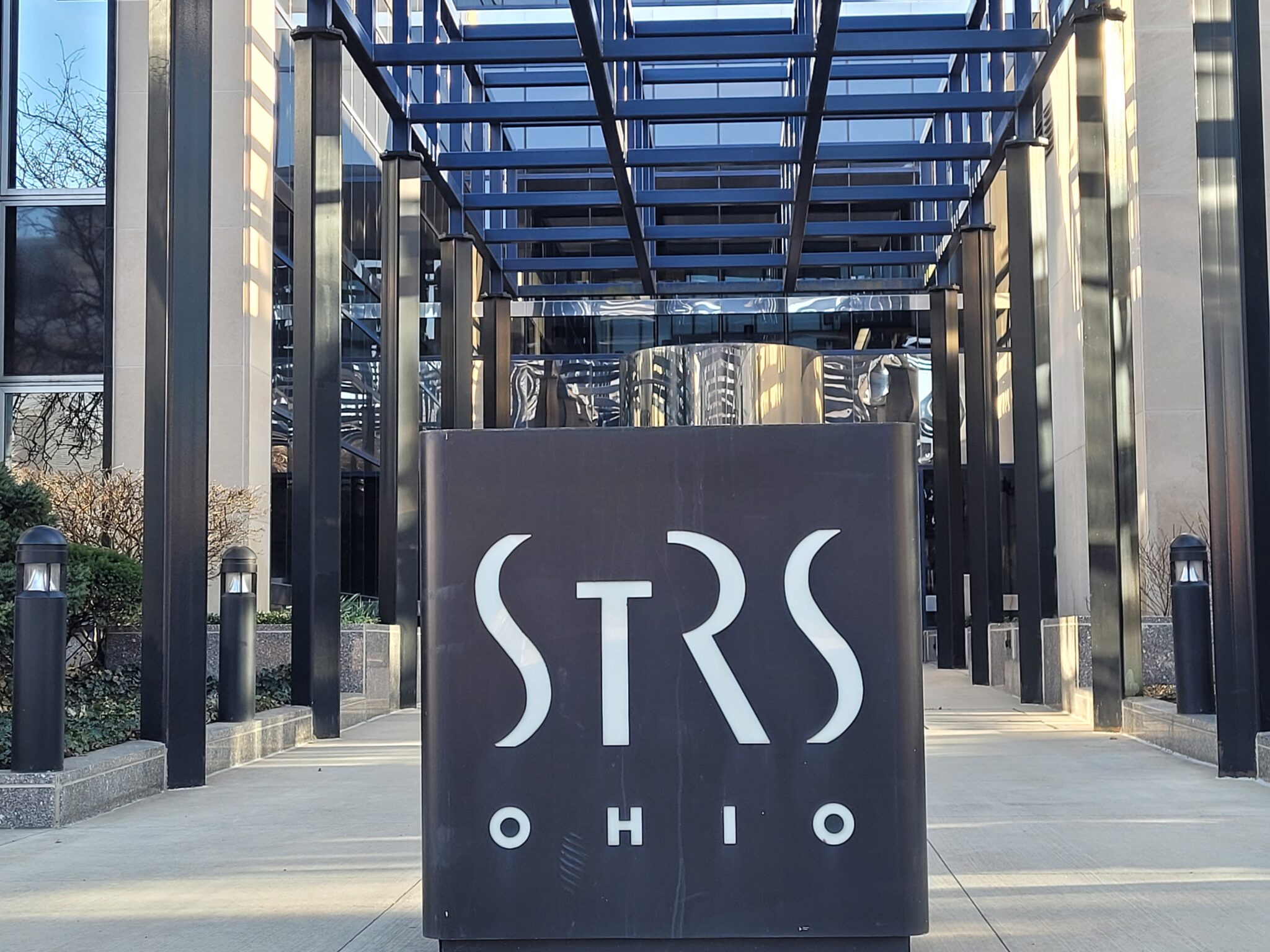
The entrance to the Ohio State Teachers Retirement System headquarters in Columbus. Photo by Marty Schladen, Ohio Capital Journal.
The Ohio State Teachers Retirement System still hasn’t said exactly how much of its members’ money it lost when Silicon Valley Bank failed last weekend.
The system is already under fire for big salaries and for paying $10 million in bonuses last August — two months before actual losses of $5.3 billion came in for the prior year. That was 77% higher than some of the employees receiving bonuses estimated. And many of those paying into the system are rankled because the big money is going out to system employees while retirees have gotten only one, 3% cost-of-living increase since 2017.
The federal government and banks around the world have been scrambling to maintain investor confidence since last week, when Silicon Valley Bank made a series of desperate moves to shore up its balance sheet. That prompted a run on its deposits and ultimately its failure.
The Ohio State Teachers Retirement System, or STRS, manages much of the $90 billion it controls in-house instead of farming it out to big firms. The system has already lost big on other investments that on the surface looked risky.
When news of the Silicon Valley Bank, or SVB, failure broke, the teachers retirement system put out a statement that might have sought to minimize its loss.
“As of last Wednesday, STRS Ohio held shares of Silicon Valley Bank (SVB) worth $27.2 million or 0.03% of STRS Ohio’s total fund,” the statement, issued on Tuesday, said. “Many other public pension funds held shares of SVB, the nation’s 16th largest bank and a component of both the S&P 500 and Russell 3000 indices.”
It also noted investments the system didn’t make.
“STRS Ohio did not own shares of Signature or Silvergate — two other financial institutions involved in the current crisis,” the statement said.
The figure reported by STRS might be far less than its actual losses. Wednesday of last week was when SVB went into free fall, meaning that the value of its stock was likely much lower than when STRS bought it.
In a tweet on Monday, the executive director of a public pension watchdog said STRS owned 171,000 shares worth almost $40 million, which would have made it the largest such loss by a public pension system in the United States.
In an article published on Wednesday, the watchdog, Anthony Randazzo, updated his list using the $27.2 figure stated by STRS as the value of the stock in SVB as of last Wednesday. That put it at No. 2 on the list and far behind the California Public Employees Retirement Fund, which reported an updated number of $67 million.
Also on the list were the Ohio Public Employees Retirement System, with a $7 million investment in SVB, and the Ohio School Employees Retirement System, with an updated amount of $421,000.
But it’s still not publicly known how much STRS actually lost in the fiasco. In other words, what were the shares worth when the system bought them?
STRS spokesman Dan Minnich was asked on Wednesday morning and again on Thursday morning for that figure.
“As with your previous questions, I will forward these to the appropriate persons,” he replied on Thursday. “When I receive information back, I will provide it to you.”
STRS also didn’t answer questions about $10 million it lost last year when the cryptocurrency platform FDX imploded. Crypto investments are uninsured and largely unregulated, so it’s perhaps unsurprising that at least one company involved with it failed. On Thursday, there were reports that the company’s founder plundered the company of more than $2 billion in investors’ money.
In 2021, the Dayton Daily News reported on another STRS investment that lost far more teacher money than the SVB and FTX investments combined. It lost $525 million on Panda Power Investments, a private equity firm.
It was one of the system’s high-fee “alternative” investments that are riskier than its traditional investments. In addition, they have performed almost three percentage points worse over the previous decade, spokesman Nick Treneff said last summer.
Asked in 2021 by the Daily News about STRS’s giant loss in Panda, Treneff responded by pointing out that 85% of the system’s alternative investments make money.
Loveland, Ohio – What better way to know spring has sprung than to see yard sales springing up around town? And, this is the topper with jewelry, collectibles, furniture, tools, electronics, household stuff, and much more.
March 25 is the Loveland Presbyterian Church’s Giant Yard Sale
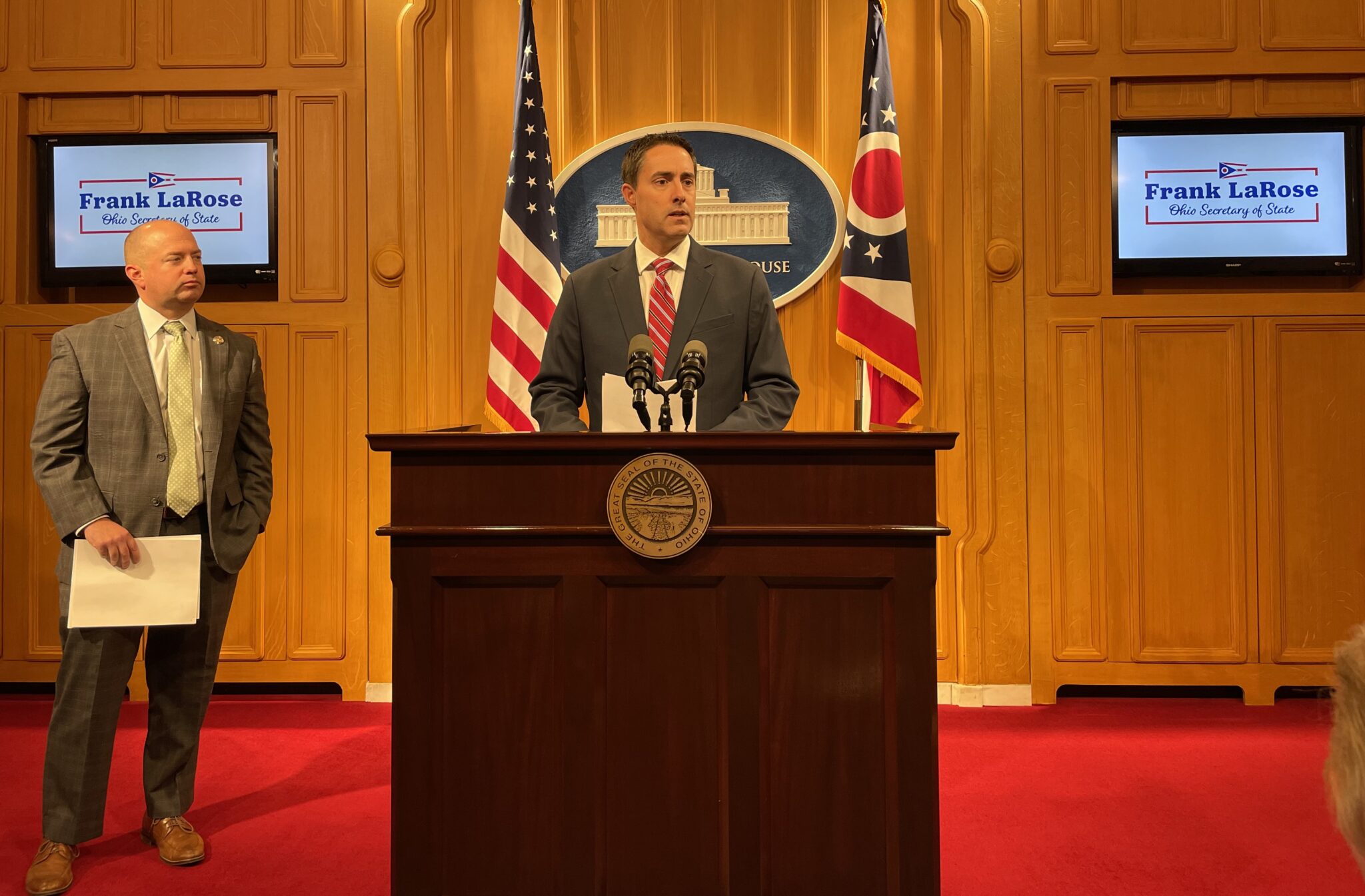
Secretary of State Frank LaRose (speaking) alongside Rep. Brian Stewart, R-Ashville, introducing a constitutional amendment requiring a 60% supermajority for all future citizen-led ballot amendments. (Photo by Nick Evans, OCJ.)
Just before lawmakers took off for Thanksgiving last year, Secretary of State Frank LaRose and state Rep. Brian Stewart, R-Ashville, held a press conference. Details ahead of time were scant, but the advisory promised “reforms which will better protect Ohio’s constitution.”
What they unveiled would dominate the chaotic final weeks of the lame duck legislative session and drive a wedge into the Republican supermajority.
This January, when Kitts Hill Republican Jason Stephens decided to make an upset bid for House Speaker, Democrats had little trouble discerning which candidate would be better for them.
Communications between Secretary LaRose, Rep. Stewart, and their staffers shed light on the behind-the-scenes maneuvering to introduce and advance House Joint Resolution 6. The effort forced a fight that’s still playing out in the Ohio House as Republican factions struggle for control.
Sixty percent
It all started with a game of phone tag. On the morning of Friday, Nov. 11 last year, Stewart turned down an apparent phone call from LaRose.
“About to give a Veterans Day speech, lol. Call you back,” Stewart texted.
Both men are veterans, and LaRose joked back that it’s “not exactly a day off” for them. By the time Stewart returned the call, LaRose was in a meeting. When LaRose called Stewart back, he didn’t pick up.
Saturday morning, Stewart sent a screen shot of an email to the Legislative Service Commission. In it, he requested a draft amendment to raise the threshold to 60% for passing citizen-initiated constitutional amendments.
“Since it is a small drafting change,” he wrote, “my hope is that it could be ready this week.”
Stewart’s next message went over talking points. He laid out their case for not applying that higher threshold to amendments initiated in the General Assembly. The change, he argued, put “interest group” amendments “on the same footing as GA-initiated amendments which require the super-majority vote at the outset.” He also asked LaRose’s office for data on constitutional amendments since 2000.
LaRose’s team got right to work, returning with a spreadsheet breakdown of all 33 proposals during that timeframe. But his chief legal counsel, D. Michael Grodhaus, warned limiting the scope to citizen-initiated measures might leave the proposal open to court challenge.
“It is possible that it may be challenged as violating Ohio’s version of the Equal Protection Clause,” he wrote, “I have not researched that point, but presumably LSC will.”
In a text message, LaRose said “one piece of good news is that the vast majority pass with over 60%.” They arranged a video conference to go over details the next day. Their press conference unveiling what would become HJR 6 was the day after that.
Building support
Before LaRose and Stewart introduced their plan publicly, they began working on legislative leaders.
The Monday after their discussion began, Stewart suggested they touch base with House Speaker Bob Cupp and Senate President Matt Huffman. LaRose said he’d already started.
“I had a tentative conversation at the OSU game with the speaker (but didn’t tell him that I was working with you on it because I didn’t want to preempt you),” LaRose wrote. “I presented it to him as ‘an idea l’ve been thinking about and want to work with you guys to get done.’”
“That’s perfect,” Stewart replied, adding that he would let the speaker know about his involvement and discuss timing. LaRose noted Cupp sounded supportive of the policy but worried about the politics.
“Seems to think it will have opponents from both the left and the right,” LaRose said.
“He had to be dragged to kicking and screaming to do the party labels for the Supreme Court as well,” Stewart responded, “but he saw the light eventually.”
The next day, Stewart relayed a conversation with Attorney General Dave Yost.
“He likes moving to 60% but thinks we will have a weak PR argument on only doing it for citizen initiatives and not legislative,” Stewart said. “He said he won’t weigh in against it, but thinks we should give that some thought.”
LaRose, meanwhile, described his exchange with Huffman. The Senate President was enthusiastic enough that he patched in chief of staff John Barron and chief legal counsel Frank Strigari. As for whether to apply the higher threshold across the board, LaRose said they discussed the idea, but it was “not conclusive.”
“He said he’d prefer 60% for initiative and 50% for legislative referral ‘if we can sell it,’” LaRose said.
Aaron Baer, president of the Center for Christian Virtue, talks in an October press conference about a “backpack” bill to change a private school voucher program in Ohio. Behind Baer are state Rep. Marilyn John, left, and state Rep. Riordan McClain, center, who are co-sponsoring the bill. (Photo by Susan Tebben, OCJ)
Working outside the Statehouse
But at the very earliest stages — before legislative language was even complete — LaRose and Stewart were consulting power brokers outside of the Statehouse.
At the same time they were discussing Speaker Cupp’s reticence, they were also talking about Center for Christian Virtue president Aaron Baer’s involvement.
In an exchange with Stewart three days before they announced their proposal publicly, LaRose texted “I know that the life community is interested in this and Aaron Baer spoke with Huffman over the weekend.”
“Baer and I discussed it before you called me initially, too,” Stewart said.
The day before unveiling the resolution, LaRose reported speaking to Steve Stivers, who heads up the Ohio Chamber of Commerce.
“He’s for it with some additional nuance I can explain later but he’s for it,” LaRose said.
They picked up more conservative supporters after introducing the idea, but the response wasn’t unanimous.
A few hours after their introductory press conference, LaRose shared a picture of a text exchange with American Policy Roundtable vice president Rob Walgate. He had reached out to say APR would oppose the effort. “Didn’t want it to be a surprise,” Walgate said.
LaRose tried to win him over.
“Kind of surprised that you’re not part of the group of many other conservatives who believe like that me that it’s just far too easy to amend our state constitution,” LaRose wrote.
Other supporters, though, were a bit too enthusiastic. Chris Long from the Ohio Christian Alliance pitched Stewart on holding a press conference in support of the resolution.
“I think I persuaded him to work more behind the scenes directly with members without a public statement yet,” Stewart said.
LaRose agreed writing, “he should help work the conservative circles behind the scenes, but not make a big splash publicly.”
Ohio House Speaker Bob Cupp (R-Lima) (right) December 13, 2022, at the Ohio Statehouse in Columbus, Ohio. (Photo by Graham Stokes for Ohio Capital Journal. Republish photo only with original story.)
Heading to committee
The Tuesday after Thanksgiving, Stewart made his pitch to the Republican caucus. He told LaRose that while the caucus was supportive, Cupp was still “dragging feet.”
“But the sentiment in the room was that we should go to 60% for adoption across the board and undercut the ‘hypocrisy’ argument,” Stewart said.
“Can you get Cupp some reassurance that resources will be spent to advance this in May?” Stewart added.
LaRose said shifting to 60% across the board was fine with him, and that any reassurance for Cupp should come from the business community. He mentioned Steve Stivers and Ohio Business Roundtable president Pat Tiberi.
“They both told me they’re behind this 100%,” LaRose said. “I guess at this point I need to ask them to tell the speaker that, too.”
The Ohio Chamber submitted testimony in favor of HJR 6, but the Ohio Business Roundtable never took a formal position on the measure. Later that day, Stewart reported they would get their first committee hearing that week.
He explained the chairman, Rep. Shane Wilkin, R-Hillsboro, and Rep. Bill Seitz, R-Cincinnati, both wanted to see the higher threshold applied to all amendments, regardless of whether they’re initiated by lawmakers or citizens. “Without them we don’t get it out of committee,” Stewart said, adding that he planned to introduce a sub bill with those changes at the start of the hearing.
By the next day, before holding a single hearing, they’d already set their course to eventual passage.
“Tomorrow is just sponsor (testimony),” Stewart said about the committee hearing on Thursday. “Plan I think (Wilkin was talking to Speaker) is for proponent/opponent to occur next week, and voted out at the end of next week or early the week of the 12th.”
This was less than two weeks after the press conference introducing the resolution.
Presaging the rift that would eventually consume the party, Stewart noted “Stephens told me he’s a no.”
A few weeks earlier the caucus had selected Rep. Derek Merrin, R-Monclova Township, to be the next House speaker over Rep. Jason Stephens, R-Kitts Hill, and Rep. Phil Plummer, R-Dayton.
“I’m going to try to ferret out if there’s more,” Stewart wrote, “There may be some post Speaker vote hangover here we are dealing with.”
Rep. Brian Stewart, R-Ashville, speaking in committee. Photo by Nick Evans, OCJ.
Meanwhile, they notched a significant endorsement as Heritage Action announced it “fully supports” the measure. In a text message, CCV’s Aaron Baer took credit, saying “a productive trip to Washington yesterday” with a link to the press release.
LaRose promised to submit written testimony to the committee but wouldn’t be there in person. “First family vacation in close to two years,” he explained.
“Honestly, I spent an hour engaging with them,” Stewart replied, “There’s not much ground left to plow in person.”
The following Tuesday Stewart asked if they should get proponents to speak at a hearing scheduled for the next day.
“I think the more the merrier who can come in and speak in favor… You know the opposition is going to pack the room,” LaRose wrote back.
This story relies on numerous images of LaRose and Stewart’s text exchanges collected through a public records request. In the initial version, many of those images are blurry and at times illegible. When LaRose’s office provided a new, legible copy those messages cut off at Dec. 6.
The original version included a few more messages stretching into the following week.
On Dec. 7, LaRose sent Stewart the contact card for the associate director of the American Petroleum Institute, without any additional comment.
The following week, LaRose reached out to talk. His message appears to read that they “may be taking a tactical pause,” adding later “I heard we’re short on votes.”
In his response, however, Stewart remained optimistic. He wrote back to LaRose, “Merrin and I already scheduled multiple session days in January.” He added they could pass the resolution quickly “when we’ve got 67 votes” and what appears to be “several fewer hard heads to wrangle.”
COLUMBUS, OH — FEBRUARY 15: State Rep. Brian Stewart, R-Ashville, flanked by House Republicans, talks to the press about the Ohio House Republican leadership, February 15, 2023, at the Statehouse in Columbus, Ohio. (Photo by Graham Stokes for Ohio Capital Journal. Republish photo only with original story.)
A little more than a week after Stephens took the gavel, Merrin and Stewart got their allies together at the statehouse to file a new version of the resolution. Merrin has repeatedly invoked that legislation since then as a point of differentiation between his allies and Stephens’ supporters.
The proposal now requires organizers get signatures from all 88 counties instead of the 44 required under current law. It also eliminates the cure period in which organizations can collect additional signatures if their first submission falls short.
However, the Feb. 1 deadline for amendments to get on the May ballot came and went without lawmakers holding a single hearing on Stewart’s resolution.
Stephens said he’s “confident” the chairman of a new committee devoted to constitutional amendments “will be able to handle the gravity of this issue.” Still, he didn’t even refer the measure to the committee until Feb. 16.
Supporters now set sights on collecting enough signatures by July to put the measure to Ohio voters in November
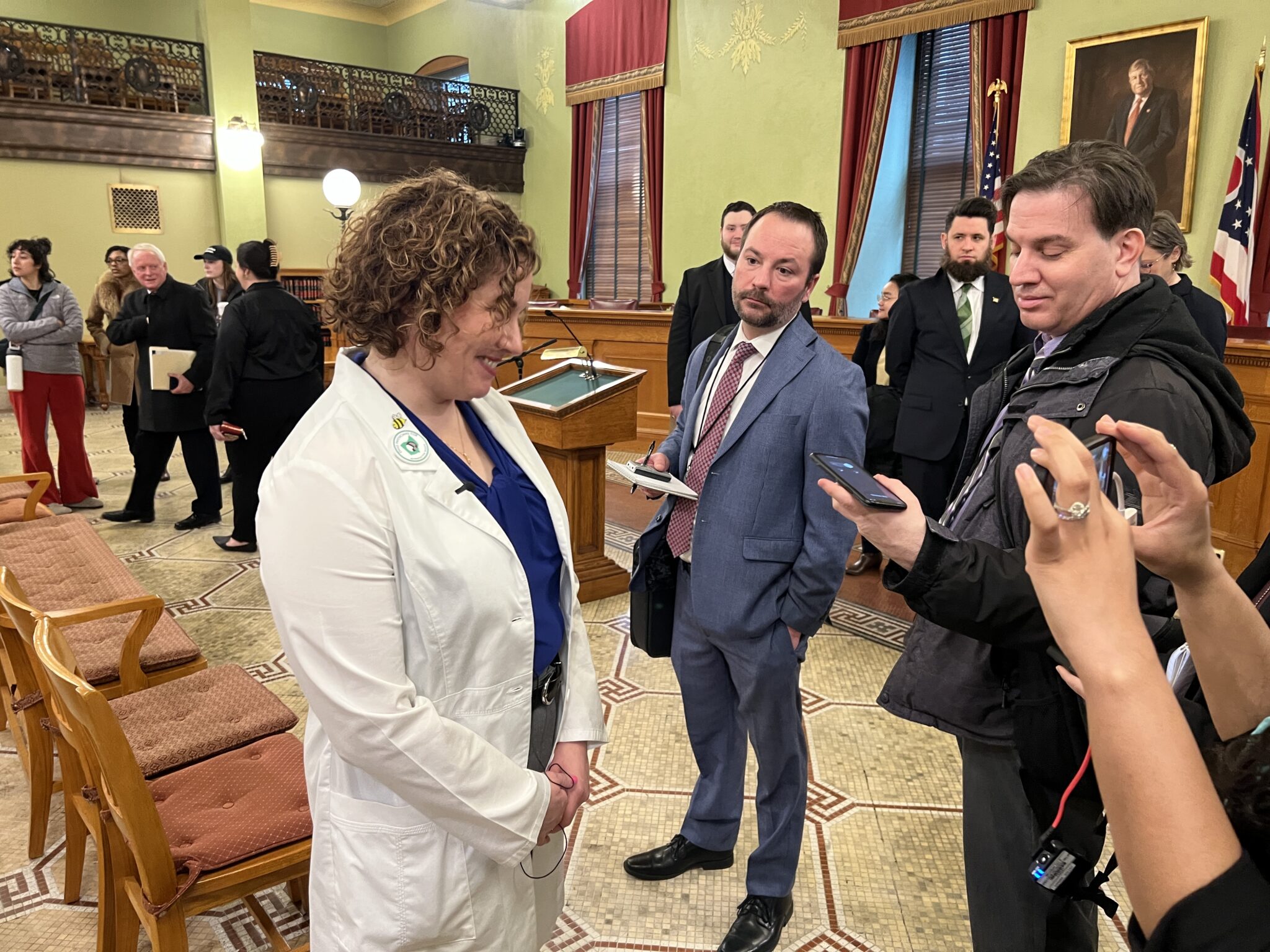
Dr. Amy Burkett, OB/GYN and member of Ohio Physicians for Reproductive Rights, speaks to media Monday following the Ohio Ballot Board’s vote to verify the language of a proposed constitutional amendment on abortion. Photo: Susan Tebben, OCJ
This article has been updated to include the proposed constitutional amendment (bottom)
The Ohio Ballot Board verified Monday that a proposed amendment for the November ballot to cement abortion rights in the Ohio Constitution can now move forward to the full signature-gathering stage.
In a short Monday meeting, the board, composed of Secretary of State Frank LaRose; Republican state Sen. Theresa Gavarone, Democratic state Sen. Paula Hicks-Hudson, Democratic state Rep. Elliot Forhan, and Bill Morgan, voted unanimously that the proposed ballot initiative only involved one constitutional issue.
The board only heard from two people outside of the board after LaRose insisted that content be kept away from the merits of the amendment or opinions about abortion itself.
John Grove, of Cincinnati Right to Life, still took time to try to discredit the amendment itself, called it “intentionally unjust and misleading.”
Attorney Don McTigue spoke on behalf of the groups proposing the amendment, choosing not to dive into the legal aspects of the amendment, instead saying the “common purpose of the amendment” was individuals having control of one’s own reproductive decisions.
Gavarone acknowledged that the purpose of the Ballot Board business was “procedural,” but still input her opinion before the unanimous vote was recorded.
COLUMBUS, OH — FEBRUARY 22: State Sen. Theresa Gavarone, R-Bowling Green, during the Ohio Senate session, February 22, 2023, at the Statehouse in Columbus, Ohio. (Photo by Graham Stokes for Ohio Capital Journal. Republish photo only with original story.)
“I am horrified at the thought of this amendment, I mean, the right to kill babies being put into Ohio’s constitution,” Gavarone said.
Now that the proposal has been certified by the Ohio Attorney General and verified by the Ohio Ballot Board, groups attempting to get the measure on the ballot can move forward with collecting the more than 400,000 valid signatures needed to officially get the measure to statewide voters.
Laura Strietmann, executive director for Cincinnati Right to Life, said pro-life organizations throughout the state have joined together as well, with a full strategy to fight against the measure.
“We are unified in protecting women in Ohio, in stopping this bill from becoming law,” Strietmann said after the vote.
Abortion rights groups say they are prepared to go forward with field planning, volunteers and petition circulators as early as the end of this week, according to Jordyn Close, deputy director for the Ohio Women’s Alliance and board president for Abortion Fund of Ohio.
The organizations are planning to hit the ground running to get more than enough signatures in a short amount of time. The deadline to submit signatures so the proposal can appear on the November ballot is July.
Part of the plan to bring support to the measure includes informing voters about the true aims of the constitutional amendment on which they would be voting. Claims have already been made by opposition groups that the amendment would bar all abortions, including for baby’s who have reached full term, something supporters of the amendment say won’t happen.
“We are not interested in doing full-term abortion,” said Dr. Amy Burkett, board-certified OB/GYN in northeast Ohio, and member of Ohio Physicians for Reproductive Rights. “This is about protecting the rights to reproductive health care including abortion, up to viability.”
Viability, Burkett said, should be determined by the physician and patient “based on the technology that is available at the time.”
Amendment supporters aren’t shying away from their pro-abortion stance, despite the trend toward using “pro-choice” as a way of including all options.
“When we talk about reproductive freedom and bodily autonomy, we have to be really specific about what (opposition groups) are attacking,” Close said. “And that is abortion access.”
————————-
Amendment Summary and Text:
TITLE: The Right to Reproductive Freedom with Protections for Health and Safety
SUMMARY The Amendment would amend Article I of the Ohio Constitution by adding Section 22, titled “The Right to Reproductive Freedom with Protections for Health and Safety.”
The Amendment provides that: 1. Every individual has a right to make and carry out one’s own reproductive decisions, including but not limited to decisions on contraception, fertility treatment, continuing one’s own pregnancy, miscarriage care, and abortion. 2. The State shall not, directly or indirectly, burden, penalize, prohibit, interfere with, or discriminate against either an individual’s voluntary exercise of this right or a person or entity that assists an individual exercising this right, unless the State demonstrates that it is using the least restrictive means to advance the individual’s health in accordance with widely accepted and evidence-based standards of care. 3. However, abortion may be prohibited after fetal viability. But in no case may such an abortion be prohibited if in the professional judgment of the pregnant patient’s treating physician it is necessary to protect the pregnant patient’s life or health. 4. As used in this Section, “Fetal viability” means “the point in a pregnancy when, in the professional judgment of the pregnant patient’s treating physician, the fetus has a significant likelihood of survival outside the uterus with reasonable measures. This is determined on a case-by-case basis”; and “State” includes any governmental entity and political subdivision. 5. This Section is self-executing.
FULL TEXT OF PROPOSED AMENDMENT
Be it Resolved by the People of the State of Ohio that Article I of the Ohio Constitution is amended to add the following Section: Article I, Section 22. The Right to Reproductive Freedom with Protections for Health and Safety
A. Every individual has a right to make and carry out one’s own reproductive decisions, including but not limited to decisions on:
contraception;
fertility treatment;
continuing one’s own pregnancy;
miscarriage care; and
abortion.
B. The State shall not, directly or indirectly, burden, penalize, prohibit, interfere with, or discriminate against either:
An individual’s voluntary exercise of this right or
A person or entity that assists an individual exercising this right, unless the State demonstrates that it is using the least restrictive means to advance the individual’s health in accordance with widely accepted and evidence-based standards of care. However, abortion may be prohibited after fetal viability. But in no case may such an abortion be prohibited if in the professional judgment of the pregnant patient’s treating physician it is necessary to protect the pregnant patient’s life or health.
C. As used in this Section:
“Fetal viability” means “the point in a pregnancy when, in the professional judgment of the pregnant patient’s treating physician, the fetus has a significant likelihood of survival outside the uterus with reasonable measures. This is determined on a case-by-case basis.”
“State” includes any governmental entity and any political subdivision.
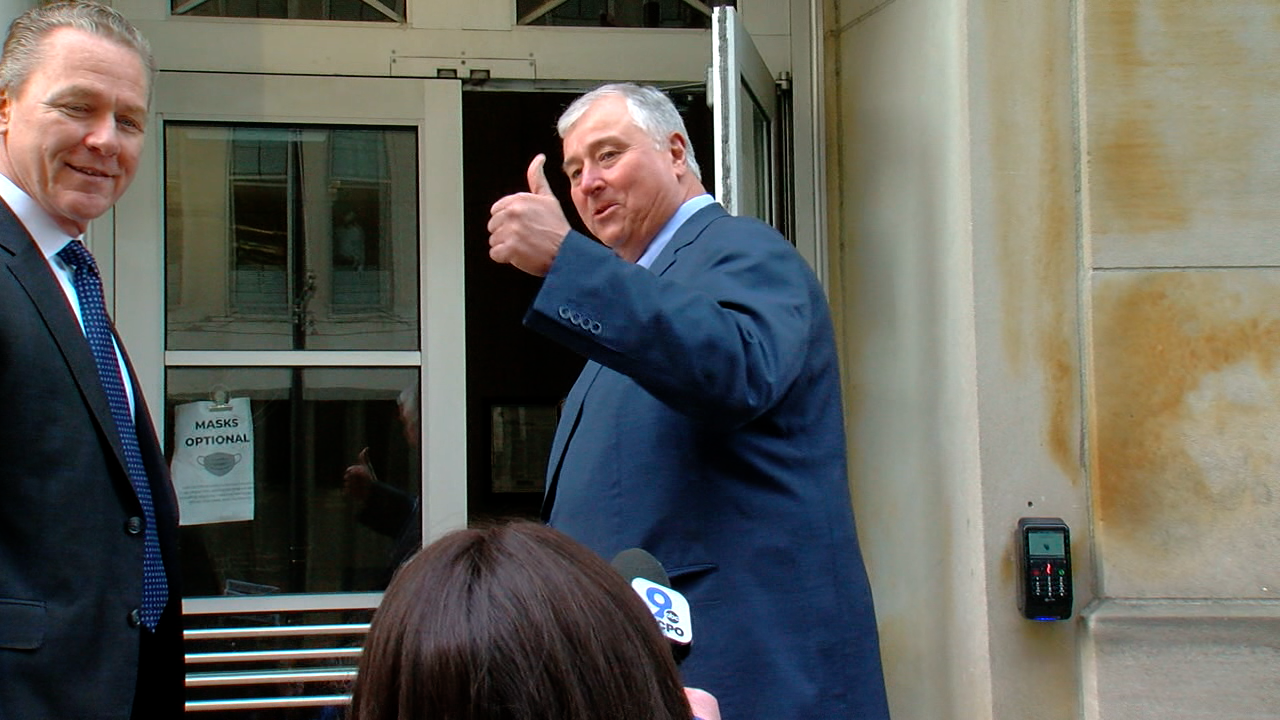
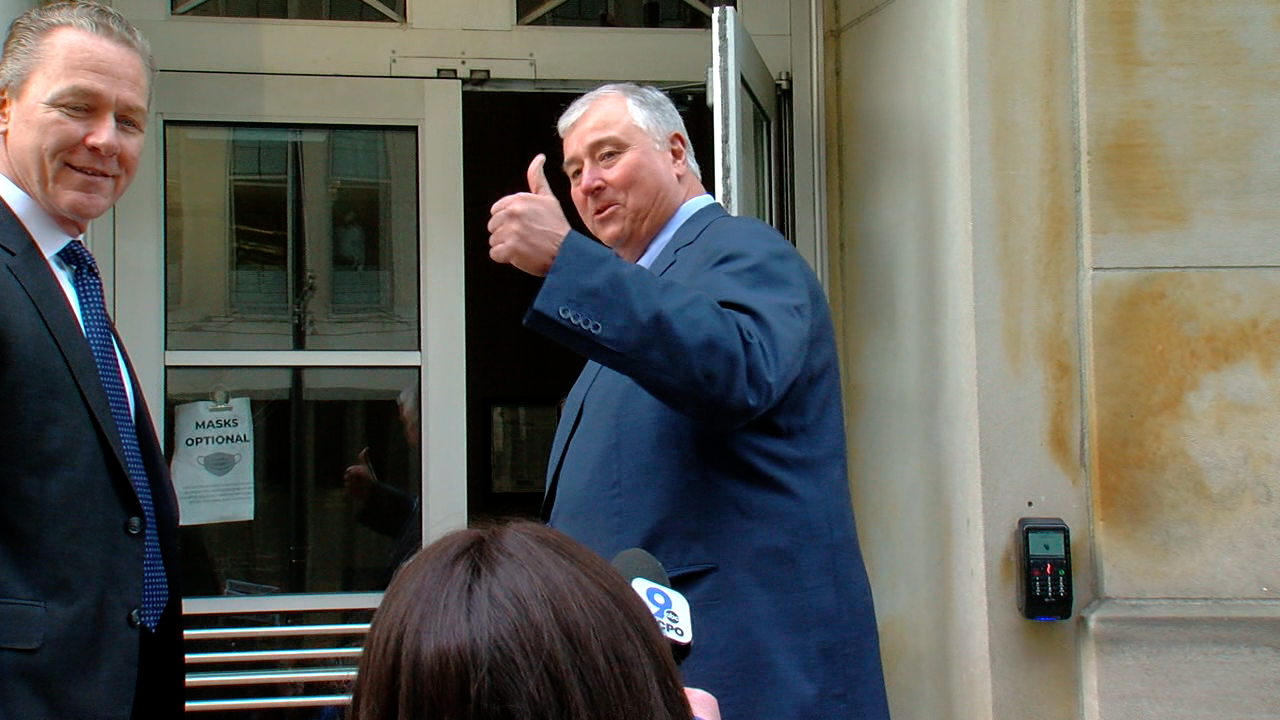
Former Ohio House Speaker Larry Householder gives the thumbs up as he enters the courthouse where he is expected to testify Wednesday, March 1, 2023. Photo from WEWS.
CINCINNATI — After more than nine hours of deliberation, a jury on Thursday found former Ohio House Speaker Larry Householder and state Republican Chairman Matt Borges guilty of felony racketeering charges in connection with a billion-dollar utility bailout that was passed in 2019.
After the verdict, one of Householder’s attorneys, Steven Bradley, confirmed what observers have suspected almost from the start of testimony.
“Of course we’re going to appeal the verdict,” he told reporters minutes after the jury left the courtroom. Householder stood off to the side in a blue business suit, clutching a camouflage trucker cap.
He affirmed that he would continue to fight the charges.
Convicted felon Larry Householder outside the federal courthouse in Cincinnati where a jury found him guilty of racketeering. Photo by Marty Schladen, Ohio Capital Journal.
“This is just the first step in the process,” Householder said. “Stay tuned.”
As part of the racketeering scheme, Akron-based FirstEnergy and other utilities paid tens of millions into an effort to elect friendly lawmakers in 2018 who would vote to make Householder speaker the following year. Immediately after taking the speaker’s gavel, Householder worked furiously to pass a $1.3 billion bailout, the vast majority of which benefited FirstEnergy subsidiary FirstEnergy Services.
The company was being dragged down by losses from its nuclear and coal plants and executives were seeking a bailout. While it got more than $1 billion out of the deal, Householder got political power as well as more than $500,000 personally, jurors found. Borges played a smaller role, but he paid a $15,000 bribe to help defeat an attempt to repeal the bailout and he received more than $100,000 in funds that originated with FirstEnergy, prosecutors said.
The verdict could have far-reaching implications for the use of “dark money” — funds paid into 501(c)(4) organizations that don’t have to reveal the sources of their funding. In the wake of the 2010 U.S. Supreme Court decision Citizens United v FEC, the use of such funds has become ubiquitous in state and national politics.
Thursday’s verdict might start to start to draw some boundaries around such expenditures.
In the case of the Ohio bailout, a financially strapped Householder found common cause with a financially ailing FirstEnergy. After paying billions to prop up a subsidiary with failing and nuclear and coal plants, the parent corporation in 2016 decided to send the subsidiary into bankruptcy. They wanted a ratepayer subsidy for the failing nuclear and coal plants so they could be sold off after the subsidiary emerged from bankruptcy.
FirstEnergy’s top executives were seeking a bailout at the same time a financially strapped Householder was seeking a return to the Ohio speakership. Their relationship grew in luxurious settings that belied the financial problems besetting both.
Householder attended a World Series game in November 2016 in the FirstEnergy box in Cleveland with CEO Chuck Jones. Two months later, Householder flew to Donald Trump’s inauguration aboard FirstEnergy’s private jet and stayed in the same $500-a-night hotel as Jones. Prosecutors showed the jury photos of Householder’s son and a FirstEnergy executive in the back of a limousine just outside a fancy steakhouse dinner.
Within weeks of the inauguration, Householder’s underling set up Generation Now, a 501(c)(4) dark money group into which FirstEnergy almost immediately started pouring what would become tens of millions of dollars.
The money was used to fund support staff for candidates who would vote to make Householder speaker and to finance attack ads against their opponents.
When opponents started gathering signatures to repeal the bailout law, House Bill 6, FirstEnergy poured $36 million into an effort to block it. Householder took control of the push to block the repeal, while Borges assisted — both by pressuring Attorney General Dave Yost and by paying $15,000 for inside information about the petition campaign.
Center, former Ohio Republican Party chair, and statehouse lobbyist, Matt Borges with his attorneys outside of the federal courthouse. Photo courtesy of WEWS.
That money was used to finance a torrent of misleading, anti-China ads and a petition-blocking effort that in some cases devolved into outright battery, witnesses testified.
And because it was dark money, the public couldn’t know that it was FirstEnergy that was financing the gargantuan fight to pass and protect a much larger bailout from which it benefited — until federal law enforcement stepped in. During the trial, investigators from the FBI described how they used accountants, informants, subpoenas and wiretaps to unravel the tangle of dark money groups and political-action committees that were used to obscure the origins of the funds that were used in the scheme.
“Today was a victory for the people of Ohio,” U.S. Attorney Kenneth L. Parker said on the steps of the Potter Stewart U.S. Courthouse shortly after the verdict. Parker declined to answer whether further indictments can be expected in the case — including for Jones and other FirstEnergy executives who paid the money that the jury on Thursday determined to be bribes.
Also unknown is whether Gov. Mike DeWine’s first appointee to chair the Public Utilities Commission of Ohio, Sam Randazzo, will be charged. Randazzo took $4.3 million from FirstEnergy shortly before being nominated to the post and once nominated, he helped write the bailout law, House Bill 6. He resigned shortly after the FBI searched his Columbus condo in 2020.
The verdict might be sending shock waves around Capitol Square and other power centers because defense attorneys for Householder and Borges argued that the conduct described by prosecutors was perfectly legal — politics as usual.
In a statement, Parker offered a different take.
“As presented by the trial team, Larry Householder illegally sold the statehouse, and thus he ultimately betrayed the great people of Ohio he was elected to serve,” the U.S. attorney said. “Matt Borges was a willing co-conspirator, who paid bribe money for insider information to assist Householder. Through its verdict today, the jury reaffirmed that the illegal acts committed by both men will not be tolerated and that they should be held accountable.”
Outside the courthouse, Householder said that he will go back to his Perry County farm to plant a garden and fish with his kids while federal authorities complete a pre-sentence report and a sentencing hearing is scheduled.
That his attorneys plan to appeal has been suspected almost since testimony began on Jan. 23. On Feb. 1, they undertook the risky gambit of accusing Judge Black of being biased against their client in open court.
They also took a risk by placing Householder on the stand to testify in his own behalf. During cross examination, Assistant U.S. Attorney Emily Glatfelter confronted Householder with numerous inconsistencies and apparent falsehoods.
Householder was asked just after the verdict if he thought the decision to testify was a mistake. He said it wasn’t
“I waited two-and-a-half years to tell my story,” he said. “I wanted the opportunity to speak.”
CINCINNATI — A jury was sent home Wednesday after about six hours of deliberation in Ohio’s massive public corruption trial.
Former Ohio House Speaker Larry Householder and state Republican Party Chairman Matt Borges are accused of racketeering in a scheme to use more than $60 million in money from Akron-based FirstEnergy to make Householder speaker in 2019. Householder led the charge to pass and protect a $1.3 billion that mostly benefited FirstEnergy’s failing nuclear and coal plants.
It is perhaps unsurprising that the jury didn’t immediately come to a verdict. They have more than six weeks of testimony and a mountain of evidence in a complex case to consider.
On Wednesday, U.S. District Judge Timothy Black instructed the 12 jurors to begin deliberations about 10:30 a.m.
Before that, Assistant U.S. Attorney Megan Gaffney Painter gave an hour-long rebuttal to closing arguments made by the defendants’ lawyers on Tuesday. In her talk, Painter tried to reinforce the prosecution’s narrative as well as rebut some of the doubts raised by the defense attorneys.
One way she did so was by highlighting the perks Householder enjoyed from FirstEnergy executives and how quickly after they started the political money started to flow into Householder’s operation.
Steven Bradley, one of Householder’s attorneys, on Tuesday said that Householder only met FirstEnergy CEO Chuck Jones shortly before the conspiracy supposedly started and then only casually. He also argued that Householder didn’t have much contact with FirstEnergy executives in the months leading up to the start of Generation Now, Householder’s 501(c)(4) dark money group into which tens of millions of FirstEnergy money would flow.
When he testified, Householder said he met Jones in the FirstEnergy executive box in Cleveland during a rain delay in Game 7 of the World Series. That was on Nov. 2, 2016.
Painter derided Householder’s account of how casual the meeting was “when he just happened to wander into the FirstEnergy executive box.”
She cited a text message Jones sent shortly thereafter to Cleveland businessman Tony George. Referring to Householder, Jones said, “When we were talking on Wednesday, I told him there was going to be a sense of urgency.”
George, a friend to both, responded, “He’s more than ready to craft something.”
Painter pointed out that it was George who invited Householder to fly a few months later to Donald Trump’s inauguration aboard a FirstEnergy jet with George and FirstEnergy Vice President Michael Dowling.
And George was “the same person who booked Larry Householder and Chuck Jones into the same hotel in Washington, D.C.,” Painter said. Records presented at the trial indicate that George made those reservations within a minute of one another.
A few weeks after the inauguration, in February 2017, Householder’s fixer, Jeffrey Longstreth, set up Generation Now. FirstEnergy would pay $1 million into it through the remainder of the year.
Into 2020, the company and its subsidiary would pump in tens of millions more. It would first be used to pay people to raise funds, knock on doors and provide other services for Householder-friendly candidates, while producing ads that attacked their opponents.
In early 2019, after the bailout was introduced, it bought ads providing “cover” to lawmakers who supported the unpopular bill, while attacking those who opposed it. Then, when a repeal campaign got underway in July 2019, Generation Now financed an ugly campaign in opposition that included misleading, anti-Chinese commercials and in some cases, outright assault of petition circulators, witnesses testified.
And because Generation Now was a 501(c)(4) dark money group, it didn’t have to report its donors. That means the public couldn’t know that the huge effort to pass and protect the bailout was secretly being bankrolled by the company that stood to benefit most from it.
While FirstEnergy was pumping money into Generation Now, Longstreth used more than $500,000 from it to pay Householder’s personal bills. Stevens, Householder’s attorney, on Tuesday said it was a loan and reminded jurors that legal papers were drawn up to that effect. But Painter on Wednesday reminded them that “Mr. Longstreth told you he tried to get Mr. Householder to sign them, but there was always a delay.”
Defense lawyers argued that while some of the activities in support of House Bill 6 might seem grubby, there’s nothing illegal about them. Borges’ lawyer, Karl Schneider, also argued that his client couldn’t have been involved in racketeering — in part because he and Householder were old enemies and also because Borges wasn’t involved in any of the early stages of the alleged conspiracy.
To refute that, Painter divided what she called a four-year conspiracy into “a story in three parts:”
Getting the power — The period from 2016 through 2018, during which friendly candidates were recruited and elected using FirstEnergy money to make Householder speaker in January 2019.
Using the power — Passage of the bailout law, House Bill 6, in July 2019, and beating back a repeal attempt that failed the following October, again using FirstEnergy money.
Keeping the power — An effort Householder for which started raising money from FirstEnergy and other utilities in late 2019 and into 2020. It was aimed at changing term limit rules in the Ohio Constitution so he could possibly stay speaker for another 16 years, prosecutors said.
Painter said that Borges didn’t need to know about or participate in the entire conspiracy to be a part of it. She said it was enough that he was paid with dollars that originated with Generation Now to pressure Attorney General Dave Yost to keep the repeal off the ballot and to pay for inside information about the repeal effort.
The prosecutor said whether Borges and Householder were friends was beside the point; their relationship was based on something else.
“It’s not about their liking each other,” she said. “It’s about keeping Larry Householder in power so all the pigs can feed at the trough.”
Deliberations are expected to resume at 9 a.m. Thursday.
As abortion rights groups prepare to collect the amount of signatures needed to place a constitutional amendment on the ballot, anti-abortion rights groups may have shed light on statements they plan to use against the initiative.
In three separate press releases sent by anti-abortion groups after the Ohio Attorney General approved proposed amendment language, the issue of parental rights came out in strikingly similar fashion as they spoke out against the measure.
“If passed, it would cancel parental rights and measures in place to protect young girls; basic health and safety protections for women would be wiped out,” Ohio Right to Life CEO Peter Range was quoted as saying in a Thursday statement.
“If passed, this amendment would cancel parental rights and measures in place to protect young girls; basic health and safety protections for women would be wiped out,” read a statement attributed to Mark Harrington, president of Created Equal.
“It completely abolishes current Ohio law guaranteeing parental involvement before any abortion is performed on their minor daughter,” said religious lobby Center for Christian Virtue’s Ruth Edmonds, also in an email statement.
The summary and proposed amendment approved by the Ohio AG does not mention minors or parental consent among the issues to be changed in Article I of the Ohio Constitution.
“Every individual has a right to make and carry out one’s own reproductive decisions, including but not limited to decisions on contraception, fertility treatment, continuing one’s own pregnancy, miscarriage care and abortion,” the first part of the proposal states.
The amendment would bar the state from doing anything to “directly or indirectly burden, penalize, prohibit, interfere with, or discriminate against either an individual’s voluntary exercise of this right or a person … unless the State demonstrates that it is using the least restrictive means to advance the individual’s health in accordance with widely accepted and evidence-based standards of care.”
The anti-abortion groups did not specify how they came to the conclusion that parental consent was in danger with the proposed amendment.
The issue could stem from a long-standing legal option called judicial bypass, in which a minor can get a judge to sign off on an abortion if the judge deems the minor to be “sufficiently mature and well enough informed to decide intelligently ” to consent to an abortion.
Ohio Attorney General Dave Yost threw his opinion in the mix in a notification to attorneys that the amendment summary language was approved on March 2. Yost emphasized his statutory duty to objectively review ballot initiatives, all while mentioning his personal views, publicly known to be against abortion.
“I cannot base my determination on the wisdom or folly of a proposed amendment as a matter of public policy,” Yost wrote.
The attorney general continued his letter with paragraphs about the rule of law and requirements that attorneys general use “a narrow law to make a decision about the truthfulness of a summary.”
“In this matter, I am constrained by a duty to rule upon a narrow question, not to use the authority of my office to effect a good policy, or to impede a bad one,” the letter stated.
The statements were abnormal for a certification statement coming out of Yost’s office. Since 2020, 12 initiative petitions (some of which were resubmissions) have been certified by the AG’s office, with issues ranging from medical rights, marijuana regulation, elections, and wage increases.
None of the other certifications stretching back to 2020 included mentions of Yost’s personal opinion on the matter, or examinations of the attorney general’s duties. Those certifications were one-page approvals, specifying the Ohio Revised Code articles relevant to petition certification and a short certification statement.
In concluding the letter affirming the certification of the abortion rights petition, Yost said included another warning to petition creators.
“Indeed, there are significant problems with the proposed amendment, and if adopted it will not end the long-running litigation on this topic, but simply transform it,” he wrote.
The Ohio Attorney General’s Office has certified petition summary language for a proposed amendment to protect abortion rights in the state constitution, which organizers hope to place on the November ballot.
The Ohio Ballot Board will now determine whether or not the initiative only involves changing only one amendment, as required. If approved by the Ballot Board, it gets sent back to the Attorney General, who turns it in to the Ohio Secretary of State’s Office, at which point full signature-gathering can begin.
Advocates must collect signatures from 44 out of 88 counties equal to at least 5% of the total vote cast for the office of governor in that county at the last gubernatorial election. Overall, the petition must gather at least 10% of the total vote cast statewide for the office of governor at the last gubernatorial election. This math means that the group needs at least 442,958 valid signatures.
The drive to protect access to abortion care in Ohio is being spearheaded by Ohioans for Reproductive Freedom and Ohio Physicians for Reproductive Rights.
However, once it gets out of court, it will likely head to the Ohio Supreme Court. An OCJ/WEWS investigation revealed how those justices already told Right to Life groups that abortion isn’t a Constitutional right.
If the proposed amendment gets to the ballot and is approved by voters, this amendment wouldn’t change existing laws automatically, but it would be the law that applies in all of the pending litigation.
If passed by voters, Article 1 of the Ohio Constitution would be amended to allow “the right to reproductive freedom,” in a change similar to one approved by Michigan voters last year.
The groups supporting the ballot initiative are racing to bring the issue before voters before any changes can be made to the threshold needed to place a measure on the ballot. A GOP effort to raise the bar from 50% plus one to 60% plus one has been ongoing, though it’s unclear how long that might take.
Michigan’s amendment passed with 56.6% of the vote.
Percentage abortion was protected in other states last year:
Kentucky — 52.3%
Montana — 52.5%
Michigan — 56.6%
Kansas — 59%
California — 66%
Vermont — 76.7%
Reporting from OCJ’s Susan Tebben and WEWS’ Morgan Trau contributed to this article.
Former Ohio House Speaker Larry Householder gives the thumbs up as he enters the courthouse where he is expected to testify Wednesday, March 1, 2023. Photo from WEWS.
The cross examination prompted some observers to say Householder badly damaged his defense against federal racketeering charges by using the risky tactic of testifying in his own defense. It marked the end of the evidentiary phase of the trial. Closing arguments will begin Tuesday.
Householder and former Republican Party Chairman Matt Borges are accused in a scheme to use $61 million in funds mostly from Akron-based FirstEnergy to make Householder speaker and then to pass and protect a $1.3 billion bailout that primarily went to prop up a subsidiary’s failing nuclear plants.
Over more than five weeks of testimony, prosecutors have put on evidence they say proves Householder passed the bailout in return for massive 501(c)(4) “dark money” contributions and for more than $500,000 in personal benefits. Perhaps as a sign that they didn’t believe things were going well, Householder and his defense team took the controversial step of putting him on the witness stand on Wednesday.
Defense attorneys are usually reluctant to put their clients on the stand because prosecutors can use cross examination to catch them in lies. That seemed to be Assistant U.S. Attorney Emily Glatfelter’s goal as she cross-examined Householder on Thursday.
Hardball
Glatfelter played secret recordings of conversations that jarringly contradicted Householder’s claims that as speaker, he wanted to be a peacemaker. Under its earlier leadership, Householder said, the House Republican Caucus was too “divisive.”
“I didn’t want enemies. I wanted friends,” Householder said Wednesday, trying to refute claims that he was an autocratic leader who demanded unstinting loyalty from lawmakers and contributors.
Glatfelter played a wiretap recording of a conversation between Householder and Neil Clark, a lobbyist who was charged in the conspiracy and later died by suicide.
“We like war and you know that Neil,” Householder told Clark. Then referring to Republican Reps. Dave Greenspan and Scott Lipps, whom Householder considered insufficiently supportive, he said, “If you f**k with me, I’ll f**k with your kids.”
Former House Speaker Larry Householder, R-Glenford. Source: Ohio General Assembly.
The former speaker had earlier denied being involved in using dark, or “C4” money to make attack ads, but when Clark asked “You’re talking about C4 money?” Householder responded, “Yeah.”
When Glatfelter asked Householder if he punished contributors and lawmakers who supported his foes instead of him, Householder said, “I can’t think of any consequences” he had meted out to non-supporters.
Then Glatfelter played a recording between Householder and Clark in which they discussed what to do about non-supporters.
“We can f**k them over later,” Householder said.
In the dark about dark money
The prosecutor also didn’t buy Householder’s claim of general ignorance about the operations of Generation Now, a 501(c)(4) dark money group into which FirstEnergy pumped scores of millions to pass and protect the bailout legislation. The entity was created and controlled by Jeffrey Longstreth, Householder’s underling, a few weeks after Householder flew with FirstEnergy Vice President Michael Dowling to Donald Trump’s 2017 inauguration aboard FirstEnergy’s corporate jet.
Householder claimed that he was so new to the dark money game that Longstreth had to explain how such groups worked.
And, as he did through much of the cross examination, Householder answered questions repetitively and seemingly grudgingly. When asked by Glatfelter what the former speaker thought the purpose of Generation Now was, Householder responded, “To educate the public on important issues and support candidates who support those issues.”
Records and testimony from Longstreth — who pleaded guilty in the case — indicated that dark money from Generation Now was used to make and run ferocious attack ads against opponents of “Team Householder.” Then it was used to claim without evidence that an effort to repeal the bailout was really a Chinese effort to take over the Ohio energy grid.
Because such groups don’t have to disclose their contributors, FirstEnergy was able to keep its fingerprints off its involvement in passing and protecting legislation of such interest to the company.
Prosecutors also played recordings and showed written messages indicating that Householder was involved in planning Generation Now-funded messages. But asked by Glatfelter several times on Thursday what he believed the dark money group actually did, Householder tried not to move far from his initial answer.
The group was for “educating the public on issues that are important to Ohio and me and supporting candidates who support those issues,” he said.
Champagne travel for a “country Republican”
The former speaker and the prosecutor also clashed over Householder’s flight to the Trump inaugural. Householder and his son were invited to do so by Cleveland businessman Tony George.
Former FirstEnergy CEO Charles “Chuck” Jones. Source: FirstEnergy, via Flickr
Glatfelter asked what George’s relationship with FirstEnergy was. Householder said George “knew Chuck” — referring to FirstEnergy CEO Chuck Jones.
Incredulous, Glatfelter said, “There’s a difference between knowing somebody and having access to his company jet, right?”
Householder said that the only reason Dowling, the FirstEnergy vice president, flew with the group is because George said someone from the company had to be on the flight. The implication, apparently, was that the trip wasn’t part of the plan for a FirstEnergy bailout.
Householder said he agreed to take the flight to save time. But traveling by private jet might not fit with his explanation earlier in the day of the difference between him and Borges.
“He’s a country club Republican and I’m more of a country Republican,” Householder said.
The former speaker also claimed that he didn’t intend to fly free.
“From day 1, I was going to pay for that flight,” he said.
More than two months later, Householder paid FirstEnergy $2,647. He said he paid then because that’s how long it took for FirstEnergy to send him a bill — not because the Dayton Daily News had written a story about the flight and the questionable appearance that it made.
That Householder would take a private jet without knowing what the cost would be is difficult to square with another statement he made about himself when he testified a day earlier.
“Anybody who’s been around me knows I’m cheap,” Householder said. “I drive a 2001 GMC Sonoma and I don’t like to spend money.”
Glatfelter punched other holes in Householder’s attempts Wednesday to distance himself from FirstEnergy executives on the trip to the Trump inaugural. She showed that George reserved rooms at the same hotel for Householder and CEO Jones within a minute of each other and paid the same amount for both — $1,500.
Householder said he believed the Ohio Republican Party paid for his room.
Personal payments, questionable sources
Observers have said that one of the most damning kinds of evidence against Householder is that Longstreth had paid more than $500,000 to settle a lawsuit against the speaker, repair a house he owned in Florida, and to retire credit card debt. Longstreth said he had papers drawn up to formalize the payments as loans, but Householder never would sign them.
Householder said his plan was to pay Longstreth when the Florida house was sold. When it finally did sell — for nearly $700,000 — Householder said he couldn’t pay Longstreth because both had been arrested in July 2020 and he believed any payments to a co-defendant could be used against him. The former speaker said he planned to pay Longstreth when the case is over.
Householder also showed a curious lack of interest in the sources of Longstreth’s money.
Longstreth testified that he received millions in FirstEnergy money through Generation Now and into a separate account that he used to pay Householder’s debts, hire contractors, pay himself, and the like.
Glatfelter asked Householder where Longstreth got the money to pay Householder’s debts and to run the sweeping political operation.
“His business wasn’t my business,” Householder said of the man he hired to recruit candidates, get them elected, and then get them to vote to make him speaker.
Lack of disclosure
Glatfelter also took Householder to task for not disclosing debts and gifts in compliance with state ethics laws.
He didn’t disclose a $1.89 million judgment against him over a failed Alabama coal mine. Nor did he disclose 2016 World Series tickets that were given him at a discount from the going rate of $2,500 apiece, Glatfelter said. And he failed to report the $1,500 hotel room George got him for Trump’s inauguration.
Householder testified that his attorney filed the disclosures and that he had only “glanced over” them.
Glatfelter pointed him to the portion of the disclosures in which the filer says he or she knows the contents of the disclosure and has to swear it’s accurate — a legally binding attestation similar to the one Householder made before testifying. She asked Householder if the documents bore his electronic signature.
“I don’t even know what an electronic signature is,” he replied.
Pressed, Householder responded with several versions of, “I relied on the advice of my attorney.”
A bill to allow children to work later hours was passed through an Ohio Senate committee Thursday with bipartisan support.
Senate Bill 30, which passed the committee after three hearings and with no testimony against the bill, would allow a 14 or 15-year-old to work until 9 p.m. year round. Current law prohibits the later hours during the school year.
An amendment made to the bill during a recent hearing in the Senate Workforce & Higher Education Committee requires a “minor work hour notification form” to be signed by a parent or legal guardian.
State Sen. Catherine Ingram, D-Cincinnati, proposed the amendment as a way to make sure parents are away of the changes and activities of their children.
“I think it’s a good thing (to extend the hours), kids are probably hanging out, playing games until 9 o’clock,” Ingram said. “But I don’t want us to take advantage of the fact that these are 14, 15-year-olds.”
State Sen. Bill Reineke, R-Tiffin, did not object to the amendment, but said parental guidance isn’t always a good thing when it comes to children working.
“I am concerned about that, in the long term, those kids who really want to do something with their lives, want to get a job, can still do it, even if they can’t get their parents to cooperate with them,” Reineke said.
A Dairy Queen franchisee, Michael Todd, testified in support of the bill this week, saying many of the applications he receives are from the age group targeted by SB 30. He called the bill a “rare win-win-win.”
“By giving Ohio’s 14 and 15-year-olds the choice to work until 9 p.m. during the school year, you give Ohio’s businesses a larger pool to provide jobs,” Todd said.
The teens would still be required to obtain a work permit from the superintendent of their school district or the chief administrative officer for a nonpublic or community school they attend.
The permit must include commitment from the employer to employ the child during hours as prescribed by law and to allow the minor to attend school. It must also include proof of the minor’s age and a certificate from a health care provider verifying the child’s fitness to work.
The bill passed the committee, along with a joint concurrent resolution asking the federal government to change the Fair Labor Standards Act with regard to child labor.
Currently, the federal law bars 14 and 15-year-olds from working past 7 p.m., except during summer months, between June 1 and Labor Day.
SCR 2 urges Congress to change that rule, allowing anyone under the age of 16 to work from 7 p.m. to 9 p.m. during the school year., matching SB 30’s language.
The resolution argued the need for the change based on job losses from the COVID-19 pandemic and the ongoing staffing shortages. Ohio, the resolution states, lost nearly about 900,000 jobs as of April 2020 and still has 105,000 jobs to recover.
It states teenage workers “are becoming a larger portion of the United States workforce” and expanding their hours could help business owners “more quickly return to regular operations.”
SCR 2 also passed with bipartisan support. Both SB 30 and SCR 2 now move to the full Senate for approval.