Author: Loveland Magazine

  • Corruption trial delayed by COVID

    Corruption trial delayed by COVID

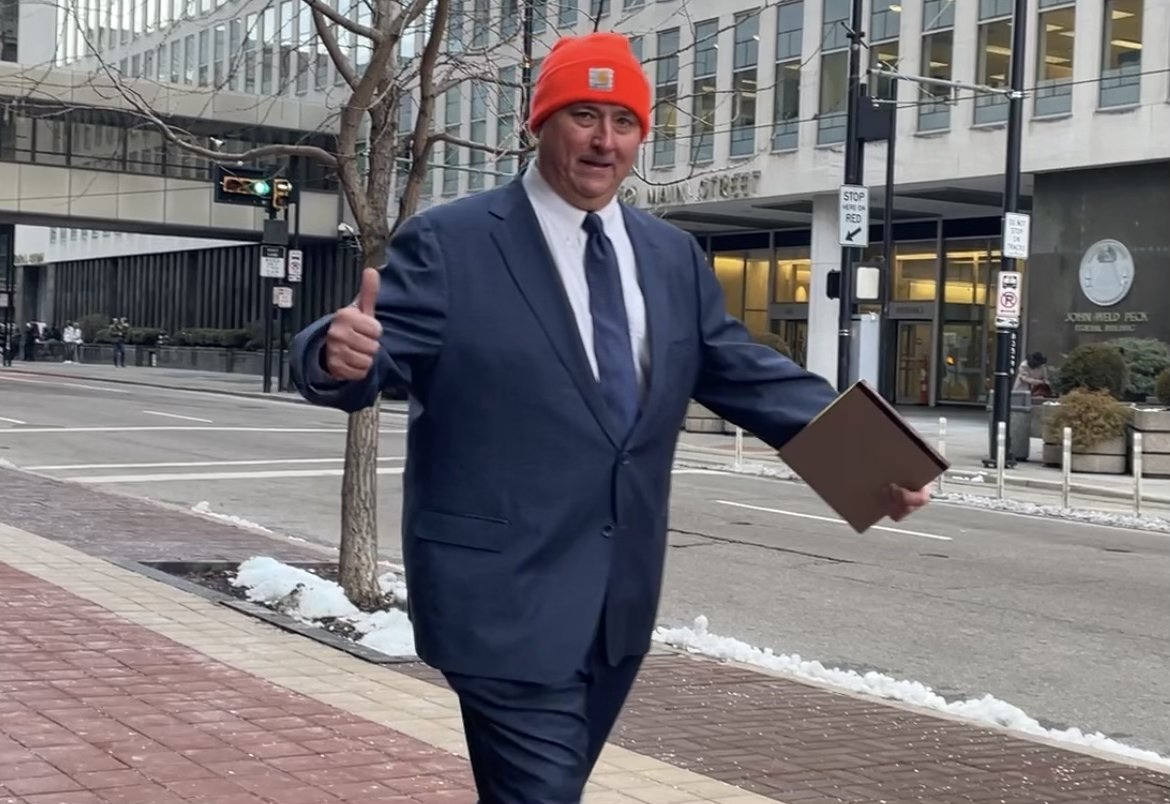
    Former Ohio House speaker Larry Householder arrives for day two of his racketeering trial. Photo by Morgan Trau, WEWS.

    BY: MARTY SCHLADEN – Ohio Capital Journal

    CINCINNATI — A federal court trial over allegations of epic public corruption has been interrupted at least until Monday after a juror was diagnosed with COVID on Wednesday.

    “The Court was advised this afternoon that a juror has tested positive for COVID-19,” U.S. District Judge Timothy Black wrote in an order Wednesday evening. “In an effort to ensure everyone’s safety, jury trial will not convene for the duration of the week. The recess is CONTINUED until Monday, 1/30/2023 at 9:30 a.m.”

    In the trial, former Ohio House Speaker Larry Householder and lobbyist Matt Borges are accused of racketeering. 

    Householder is accused of masterminding a scheme in which $61 million — mostly from Akron-based FirstEnergy — was used to help elect Republican lawmakers who would make Householder speaker in 2019. In exchange, prosecutors say, Householder shepherded through a $1.3 billion utility bailout package and then protected it from a ballot initiative intended to repeal the measure.

    Borges is accused of acting corruptly in the successful effort to block the repeal.

    The great majority of the ratepayer money was intended to prop up two failing nuclear plants in Northern Ohio owned by FirstEnergy subsidiary FirstEnergy Services. Some went to “recession proof” coal-fired plants owned by the subsidiary that FirstEnergy management regarded as unsellable. 

    Even though the law was billed as a “clean air” measure, the rest of the package went to subsidize coal plants owned by utilities other than FirstEnergy — including a plant that’s not even in Ohio. Of the three tranches of subsidies, that is the only one that’s still in effect after FirstEnergy entered into a deferred-prosecution agreement.

  • Air pollution impacting maternal, infant health of Ohioans

    Air pollution impacting maternal, infant health of Ohioans

    BY: SUSAN TEBBEN Ohio Capital Journal

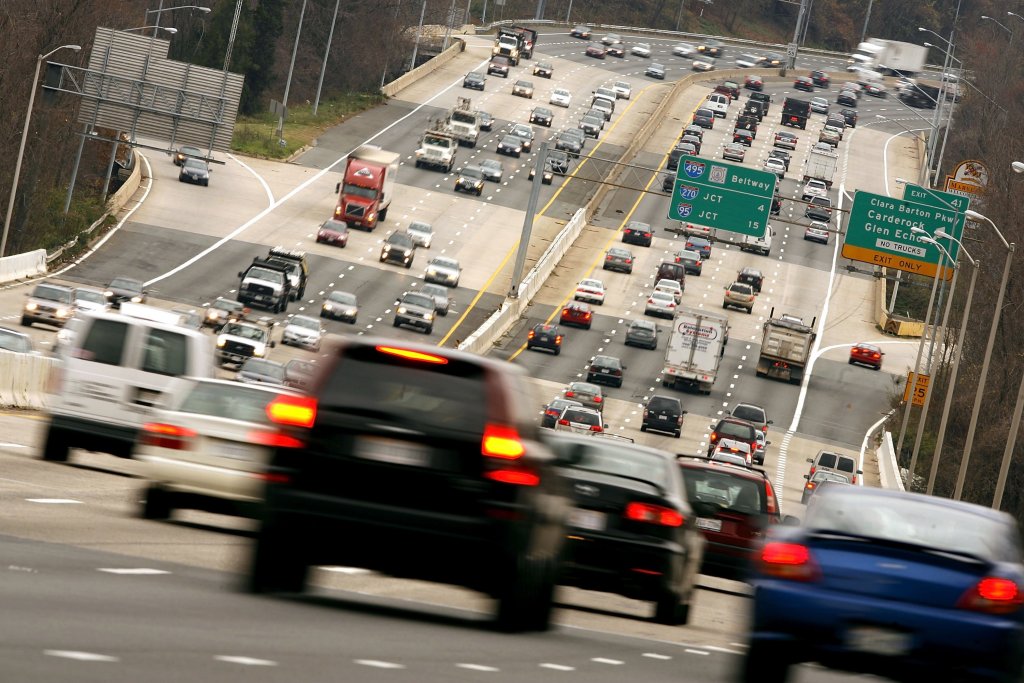
    Traffic on a highway. Photo by Chip Somodevilla/Getty Images.

    Improving air quality in the state would lead to better health for Ohioans, and could be done through policy changes, according to a policy think tank.

    In a recent examination of the connections between air pollution and health, the Health Policy Institute focused on maternal and infant health, lung and heart conditions and cognitive conditions, all of which could see better outcomes with increased monitoring and control of air pollutants.

    “Exposure to air pollution can also increase the severity, lethality and prevalence of COVID-19 due to its negative impact on cardiopulmonary diseases and immune responses,” the HPIO said in a policy brief on the issue.

    Sources of air pollution range from power plants to vehicle exhaust, and even natural sources like dust.

    Improvements have been made through the federal Clean Air Act in 1970, which sought to regulate emissions through EPA oversight, and through implementation of plans in each individual state.

    “The EPA can also take civil or criminal action against an entity that has violated environmental law, such as not installing a required air pollution control device,” the HPIO stated.

    But Ohio “ranks poorly on outdoor air quality” according to the institute’s research, and performs worse than most other states.

     Graph provided by the Health Policy Institute.

    More than 32% of Ohioans commute more than 30 minutes to work alone, verses 4.1% who walk, cycle or use public transportation, according to a 2021 Health Value Dashboard cited in the policy brief.

    But more than the choice of commute, some Ohioans are unwittingly in danger of air pollution effects based solely on where they live and the zoning policies in those communities. Even “redlining,” the use of discriminatory practice of denying mortgages and other financial services based on race or ethnicity, can cause minorities to end up in more polluted areas.

    “Historically, zoning policies and redlining placed industrial plants and highways closer to predominantly Black neighborhoods and prohibited Black people from living in areas that did not have these sources of pollution near them,” the HPIO stated.

    According to research from the National Equity Atlas, Black Ohioans face a risk of air pollution 1.5 times higher than white residents of the state.

    Part of the problem in Ohio was the passage of the scandal-ridden House Bill 6, a bailout of energy companies that led to, among other things, a bribery investigation and, beginning this month, the criminal trial of former House Speaker Larry Householder.

    Parts of the legislation were repealed in March 2021 related to the bailout, but measures that severely cut energy-efficiency programs and standards for renewable energy stayed in place.

    “By reducing the renewable energy benchmark, Ohioans are more likely to continue to use fossil fuel-based energy and be more at risk of air pollution exposure,” the HPIO policy brief stated.

    Ohio’s legislature also passed Senate Bill 52 in 2021, which hampers the development of energy sources such as wind farms and solar facilities and allows local governments to turn down wind and solar proposals.

    Local governments have done their part to reduce air pollution, however, with the Central Ohio Transportation Authority planning a fleet transition to non-diesel by 2025 after receiving federal funding for the effort.

    After a settlement between Volkswagen and the U.S. Environmental Protection Agency over an emissions scandal, Ohio is set to receive $75 million over 10 years to be used to fund emission-reduction projects.

    “The latest round of grants, awarded in November 2021, were estimated to remove 33 tons of nitrogen oxides and 16 tons of other air pollutants annually,” the HPIO stated.

    Moving forward, the policy institute said more legislation could set targets for “renewable energy procurement” and use air quality monitors to capture data on exposure. Increased funding for public transportation and an “environmental legislature review process” were also recommended by the HPIO.

    Follow Susan Tebben on Twitter.

  • Federal funding coming to Ohio for kindergarten readiness

    Federal funding coming to Ohio for kindergarten readiness

    BY: SUSAN TEBBEN – Ohio Capital Journal

    An infusion of federal funds is coming to Ohio, targeted at improving kindergarten readiness.

    The Ohio Department of Job and Family Services is set to receive a total of $48 million over three years as part of the U.S. Department of Health and Human Services’ Preschool Development Grant, according to an announcement from Gov. Mike DeWine’s office.

    ODJFS Director Matt Damschroder said plans for the grant are “expansive,” and will include “culturally appropriate trauma training, credentialing and parent supports,” along with “creating long-term and sustainable local, state and federal funding for early childhood education programs.”

    Through a partnership with the state departments of education, health, mental health and addiction, Medicaid and developmental disabilities, the grant will also be used to expand child care for special needs, homeless and English language learners.

  • New Ohio voter ID law also excludes state veterans’ IDs

    New Ohio voter ID law also excludes state veterans’ IDs

    A Veterans Day parade. (Photo by Spencer Platt/Getty Images.)

    BY: MARTY SCHLADEN – Ohio Capital Journal

    Franklin County Recorder Daniel O’Connor is blasting Ohio’s Republican leaders for excluding county-issued veterans’ identification from the list of IDs one can use to vote under the state’s controversial new law.

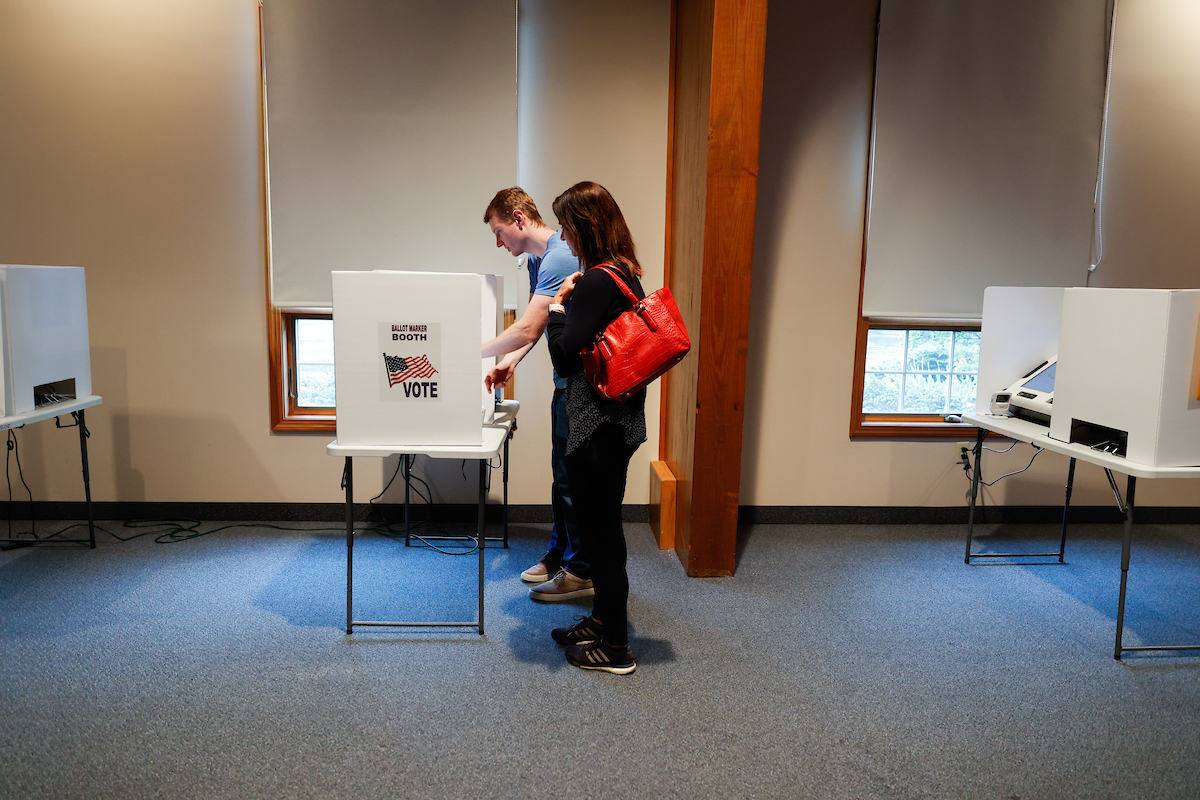
    Gov. Mike DeWine signed House Bill 458 earlier this month after it was rushed through a lame-duck session by the heavily gerrymandered legislature in December. In previous elections, voters could establish their identities not only with valid drivers’ licenses, but also with documents such as utility bills and the county-issued vets IDs. 

    It might be hard to see significant problems with the old system. Secretary of State Frank LaRose found possible fraud in just one of every 222,000 votes cast in the 2020 election. But the state’s GOP leaders enacted HB 458 anyway, requiring Ohioans to have a driver’s license, state ID, passport or military ID to cast a vote.

    So far, it’s been tricky for researchers to show that strict voter ID laws suppress turnout because of problems with data and methodology. But voting rights advocates say that it only stands to reason that such laws would disproportionately affect the poor and communities of color.

    Those groups are less likely to have driver’s licenses or the documents needed to get one in the first place. And a report last year by the Legal Aid Society of Cleveland showed that a million Ohioans have licenses that are suspended because of debts relating traffic fees and fines and unpaid child support. That’s a number equal to one-eighth of the state’s registered voters.

    Those suspensions fall overwhelmingly on poor urban communities that — perhaps not coincidentally — are much more likely to vote for Democrats.

    In terms of military IDs, HB 458 allows people with federally issued military and veterans’ ID cards to use those to vote. It also allows Ohio National Guard IDs. 

    But it doesn’t appear to allow veterans’ cards that are issued by county recorders’ or veterans’ services offices under a 2016 law. To be issued one, a veteran has to produce a discharge form — DD-214 — and other forms of identification.

    O’Connor spokeswoman Hanna Detwiler said that about 5,000 Franklin County residents have such IDs, but it isn’t clear how many will be disenfranchised under HB 458.

    “I’m not sure how many veterans have our card as their only form of ID,” she said in an email. “But obviously things happen — like losing a wallet — where this might be the only form they have after showing the two additional forms of ID when initially getting the card.”

    Asked about the omission, DeWine Press Secretary Dan Tierney in an email said, “the bill did reduce the number of forms of identification that could be used and instead specified state-issued (and certain federal-issued) photo IDs. The bill provided for the (Bureau of Motor Vehicles) issued state identification cards as the photo IDs available at no cost to Ohio voters.” 

    Tierney added, “My understanding from legislative testimony is that, by far, the most common ID used for voting in Ohio are state-issued drivers’ licenses.”

    O’Connor, the Democratic county recorder, in a statement slammed GOP officials for not publicly announcing that this form of veterans’ ID will no longer be accepted at polling places.

    “It’s bad enough that in the middle of the night, the Ohio legislature decided to target our right to vote,” he said. “But specifically invalidating the free state-issued ID our office provides to retired service members is unacceptable, and I will not stay silent about it.”

  • In a state with 1M license suspensions, Ohio voter ID law could depress turnout

    In a state with 1M license suspensions, Ohio voter ID law could depress turnout

    New report says debt-related suspensions affect poor and minorities

    BY: MARTY SCHLADEN – Ohio Capital Journal

    When Gov. Mike DeWine last week signed what’s been called the nation’s strictest voter ID law, it raised fears that it would disenfranchise large numbers of voters in poor communities where people are less likely to meet the new requirements.

    Those fears seem to be supported by a September report that estimates 1 million Ohioans have suspended licenses because of debts from things such as a lack of insurance, unpaid fines, and court costs. That’s in a state with 8 million registered voters.

    The analysis, by the Legal Aid Society of Cleveland, said the suspensions by far fall most heavily on impoverished urban communities of color. In other words, debt-related suspensions disproportionately affect some of the communities least likely to vote for the Republican officials who passed and signed the voter ID law.

    DeWine and legislative sponsors sold the state’s controversial law by saying that it would boost public confidence in elections. That confidence, however, has likely been undermined by numerous lies by former President Donald Trump, and by dubious voting claims by Secretary of State Frank LaRose, Ohio Auditor Keith Faber, and others.

    Meanwhile, LaRose found the rate of possible fraud in the 2020 Ohio General Election to be a vanishingly small 0.0005%.

    “There is absolutely no evidence that we need a voter ID law to prevent voter fraud,” said Collin Marozzi, deputy policy director of the American Civil Liberties Union of Ohio, which opposes the law.

    Even so, the voter ID law, House Bill 458, makes it considerably harder for many of the poorest to vote in Ohio. While voters previously could use documents such as bank statements and utility bills to establish their identity, they now must have a driver’s license, state ID, passport or military ID to cast a vote.

    Perhaps tellingly, college and university IDs didn’t make the list of acceptable IDs approved by Ohio’s heavily gerrymandered Republican legislature. College students were credited with helping to deliver victories to Democrats in key races around the country in the November election.

    Ohio’s voter ID law is already facing a legal challenge, which remains pending.

    Afflicting the afflicted

    While of questionable necessity, it’s unclear whether voter ID laws suppress turnout among the poor and communities of color as much as some advocates claim. MIT’s ​​Election Data and Science Lab says research into the matter has produced mixed results, citing “deficiencies in data quality and sensitivity of results to choices made in statistical estimation.”

    However, the analysis Legal Aid Society of Cleveland report shows that huge numbers of Ohioans have licenses that are suspended for debt-related reasons — and they face a steep climb in getting their licenses reinstated or to get a state-issued ID.

    “We have many examples of clients who are trapped by debt-related suspensions,” said Anne Sweeney, one of the report’s authors.

    The researchers issued open records requests to the Ohio Bureau of Motor Vehicles to gather data showing that for each year between 2016 and 2020, more than 1 million drivers had licenses suspended because of debts related to traffic fines and fees and unpaid child support. In addition, the average suspended driver has multiple suspensions, with 3 million suspensions a year in the state, the report said.

    “Debt-related suspensions trap drivers with limited resources in a vicious cycle,” the report said. “Fines and fees related to seemingly minor traffic stops can easily spiral into thousands of dollars owed to the State. Drivers unable to pay these debts cannot get their licenses back, which for most Ohioans means they cannot drive to work to earn the money needed to pay down the debt, without risking even more driving restrictions, fines, fees, or even jail.”

    Unsurprisingly, such suspensions are concentrated most heavily in impoverished urban communities of color.

    For example, 53% of the residents in Cleveland’s 44104 zip code live below the federal poverty line, 98% are people of color, and there are 1,535 suspensions per 1,000 people old enough to drive (because a given person can have more than one suspension), the report said. 

    Voters in that zip code likely support Democrats far more than they do Republicans. While DeWine won the 2022 governor’s race by a whopping 25  percentage points statewide, he lost Cuyahoga County by 14 points.

    The Legal Aid Society report was written before DeWine signed the voter ID bill and it focuses on the cycle of debt in which Ohio’s system places ever-greater burdens on people who can’t pay fees and fines related to their driver’s licenses and vehicle registrations.

    “The way it steamrolls is hugely problematic,” Sweeney said as she described how unpaid debts often compound from the hundreds to the thousands of dollars and sometimes into criminal penalties.

    And, she pointed out, most Ohioans with suspended licenses have to choose between quitting their jobs, finding a ride, or driving to them illegally and risking still more fines and fees. All of which can sap a person’s ability to pay the debts he or she already has.

    “For someone who has no way to get to a job, you can’t make payments to get your license back so you can get to the job you do not have,” she said.

    Overall, the analysis said Ohio’s system placed the biggest burden by far on the communities with the least ability to shoulder it. Zip codes with the highest rates of people of color experienced more than 100 times as many suspensions as the areas with the fewest people of color  — 6.9 million versus fewer than 51,000, the report said.

    It added, “Debt-related suspensions cost residents of Ohio’s highest poverty zip codes an average of $7.9 million each year. Debt-related suspensions cost residents of Ohio’s zip codes with the highest percentages of people of color an average of $12 million each year.”

    In all, total outstanding debt across the state each year totals nearly $1 billion, the report said.

    Asked about Ohio’s system that catches up so many Ohioans, DeWine Press Secretary Dan Tierney said, “The General Assembly could certainly debate whether to change the ability of courts to issue such sanctions, I am not aware of any movement to remove these penalties.”

    Are existing reforms adequate?

    Tierney was asked whether the governor was concerned that the Ohio system condemns the state’s poor and communities of color to a debt trap and now — with the voter ID law DeWine just signed — disenfranchisement. He responded by sending an article from The Columbus Dispatch about a state amnesty program that BMV officials say put 100,000 drivers back on the road — or roughly a tenth of the number of Ohioans the Legal Aid Society analysis says have suspended licenses in a given year. 

    In addition, the Legal Aid Society analysis points out, “Drivers are not eligible (for amnesty) until 18 months have passed since the end of their court-ordered suspension and must provide proof of insurance to utilize the program. The BMV automatically notifies eligible drivers of the reduction; drivers eligible for a complete amnesty waiver of reinstatement fees must complete an application and provide proof of qualifying benefits, such as Medicaid or (Supplemental Nutrition Assistance Program benefits.)”

    Sweeney added that producing the documentation required by the amnesty program also is much harder for the poor.

    “Access to documents and identification is a huge problem for our clients all the time,” she said. “The amount of time it takes to navigate the system when you have limited means is inordinately longer.”

    Asked about the limited reach of the program, Tierney said one should “remember that these are court-imposed fees and punishments issued by courts. They amnesty program is intended to help those in specific situations and provide them an opportunity to comply with the court-ordered sanctions on terms that can pay-off the debt and eventually restore license privileges, ultimately bringing these citizens in compliance with the law.”

    While some GOP officials have said the availability of a state ID card will enable Ohioans without valid driver’s license to vote, critics cite several obstacles. One is the just-cited difficulty in getting the needed documents. Another is the fact that one need get them from the BMV — an agency that people with outstanding fines and fees might be reluctant to deal with. And a third is that people struggling just to be able to drive legally might have more pressing things to do than get a state ID so they can vote.

    Marozzi of the ACLU, said that it stands to reason that a disproportionate number of license suspensions are in urban communities of color.

    “It happens most frequently in urban areas that are over-policed,” he said.

    And while DeWine’s spokesman didn’t address whether the new law will take away voting rights from many Ohioans with suspended licenses, Marozzi said, “I think there’s a very good chance that a significant number of Ohioans are going to get disenfranchised because of this bill.”


  • Ohio coalition moves forward with plans for abortion ballot measure

    Ohio coalition moves forward with plans for abortion ballot measure

    BY: SUSAN TEBBEN – Ohio Capital Journal

    A coalition of reproductive rights groups, along with the ACLU of Ohio say they plan to have a pro-abortion ballot initiative on the Ohio Attorney General’s desk by February.

    Ohioans for Reproductive Freedom announced the plan to do this with the help of a recently hired “general consultant” with experience boosting ballot initiatives on the topic in two other states.

    The coalition – made up of Planned Parenthood Advocates of Ohio, Abortion Fund of Ohio, New Voices for Reproductive Justice, the Ohio Women’s Alliance, Preterm-Cleveland, Pro-Choice Ohio and Unite for Reproductive & Gender Equity (URGE), along with the ACLU of Ohio – said the amendment would “explicitly protect reproductive freedom for all Ohioans.”

    “We are working expeditiously and prudently because we know that skipping steps or rushing the process would be a reckless approach when stakes are so high,” said Erin Scott, co-founder and director of the Ohio Women’s Alliance, in a joint statement of ORP members.

    Mission Control, Inc., was hired by the group to help with the effort, after previously working on ballot initiative campaigns in Kansas and Kentucky, both of which showed voters in support of abortion rights. The company has offices in Washington, D.C., Connecticut, Colorado and California.

    ORP said it has “completed initial language drafting and is now moving into comprehensive qualitative and quantitative research and message testing.”

    Anti-abortion groups were quick to criticize the effort, saying support for the measure wouldn’t come in Ohio.

    “Any attempt to change Ohio’s constitution by these large out-of-state abortion groups will ultimately fail here in Ohio,” said Peter Range, Ohio Right to Life CEO, in a statement.

    The religious lobby group Center for Christian Virtue acknowledged Mission Control’s success in other states, but also said the Ohio effort is “doomed to fail.”

    CCV president Aaron Baer used his statement against the measure to support a joint resolution that would make it harder for the state constitution to be amended by raising the voting threshold to 60%. The measure was HJR 6 in the last General Assembly, and is now being led by state Rep. Brian Stewart, R-Ashville, and state Rep. Derrick Merrin, R-Monclova.

  • Ohio House Republican faction brings back proposal making it harder for voters to pass amendments

    Ohio House Republican faction brings back proposal making it harder for voters to pass amendments

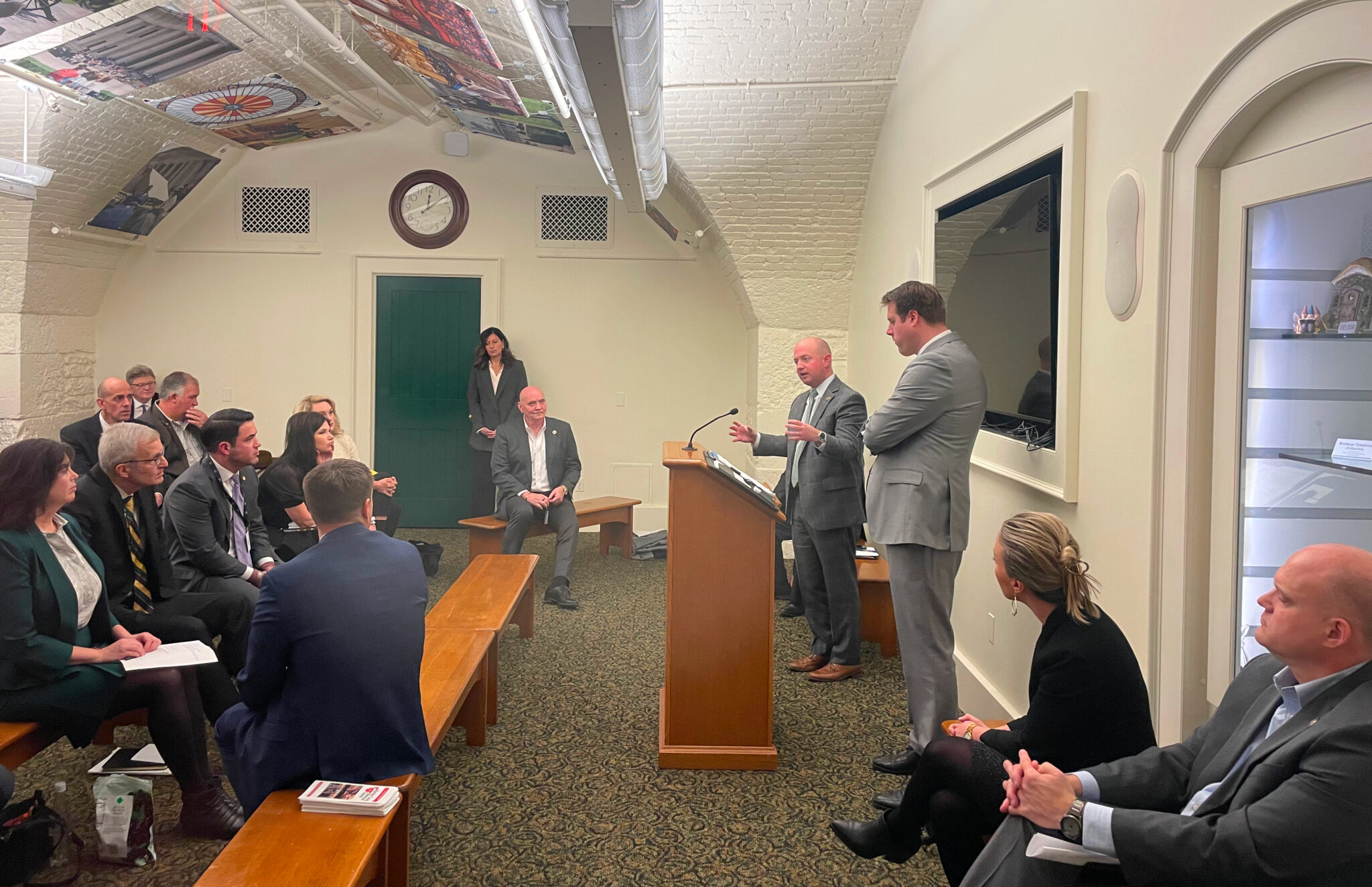
    Rep. Brian Stewart, R-Ashville, speaking to fellow Republicans in a closed door meeting. (Photo by Nick Evans, OCJ.)

    Secretary of State Frank LaRose says he talked to House Speaker Stephens about ‘the importance of getting this done’

    BY: NICK EVANS – Ohio Capital Journal

    After more than hour behind closed doors, a bloc of Ohio Republicans led by state Rep. Derek Merrin, Monclova Twp., trooped through the Ohio Statehouse.

    The faction — thirty-odd lawmakers who wound up on the losing side of the House Speaker’s race last week— climbed three floors and squeezed into the clerk’s office.

    After pausing for photos they filed a new version of their proposal to make it harder for Ohioans to pass constitutional amendments.

    The proposal asks voters to raise the passage threshold for future amendments. The idea proved controversial and ran out of steam at the tail end of the last legislative session.

    But with the resolution taking center stage now, as spurned Republicans lock horns with new Speaker Jason Stephens, it seems clear many in the party aren’t ready to drop the issue.

    New Year’s resolution

    Right after his plan went off the rails, sponsor Rep. Brian Stewart, R-Ashville, said he was “Looking forward to January.” Stewart noted then that Republican numbers were thin — a point he’d warned about previously — but argued there was plenty of support in the caucus.

    The outlook got a bit murkier after the speaker vote. Stewart, an ally of presumptive speaker Merrin, was set to be a part of leadership this term. After the floor revolt gave the gavel to Stephens, Stewart seemed to indicate his proposal was collateral damage.

    Wednesday, though, Stewart filed his “Ohio Constitution Protection Amendment” alongside more than 30 GOP co-sponsors. He noted two substantive changes from the previous version.

    “The new version would require that signatures come from all 88 counties instead of just 44,” Stewart said. “If an amendment is going to apply to every Ohio and then every community should have a hand in putting that potential constitution amendment on the ballot.

    “We’re also going to eliminate the cure period for constitutional amendments,” Stewart added. That period allows citizen-led organizations to gather additional signatures if their initial batch doesn’t meet requirements to make the ballot.

    Even with Wednesday’s show of force, Stewart has a long way to go to get his resolution on the ballot. Three-fifths of the members in both chambers have to approve the resolution first. In the House, that’s 60 votes. Only 45 Republicans voted for Merrin in speaker’s race, and only 38 participated in Wednesday’s rogue caucus meeting — a handful of them over the phone.

     Ohio Secretary of State Frank LaRose. (Photo by Justin Merriman/Getty Images)

    Getting the band back together

    While Stewart counts votes, supporters outside the House appear to be gearing up for another try, too. After previously deferring to House lawmakers, Secretary of State Frank LaRose seems to be on board. Monday at Gov. Mike DeWine’s inaugural celebration, LaRose said he wasn’t done pursuing changes.

    “What I was talking to the new speaker about and to Rep. Stewart about was the importance of getting this done,” LaRose explained.

    LaRose introduced the plan alongside Stewart last November, and he trotted out a version of the argument they’ve offered before.

    “Today people might want to pretend or think that it’s about, abortion or redistricting or whatever issue, but 50 years from now, it could be about holograms and flying cars,” LaRose said. “We just don’t know what the things are that are going to come up, but if it can’t get 60% it probably belongs in the Ohio Revised Code and not in the Ohio Constitution.”

    Shortly before HJR 6 stalled out, Cleveland.com obtained a memo written by Stewart urging GOP members to back the proposal. In it, he directly tied the effort to short-circuiting future abortion and redistricting ballot measures.

    Opponents are lining up, too. In a statement Wednesday, Jen Miller from the League of Women Voters of Ohio promised a fight.

    “For over a century, everyday Ohioans have had the freedom to collect signatures and pass ballot initiatives that make our lives better,” she said. “This resolution is unnecessary, unpopular, and undemocratic, and our broad coalition stands ready to defeat it.”

    Deadlines

    Democratic House Leader Allison Russo addressed the issue with reporters on Monday as well. She acknowledged “throughout even lame duck, speaking with both (Rep.) Merrin and Speaker Stephens, (the proposed amendment threshold change) was something that I expressed concern about.”

    She didn’t directly address whether killing any future proposal was part of a deal with Speaker Stephens.

    Stewart’s initial plan was to get the question on the ballot this May. To make that happen, lawmakers would need to pass the resolution by Feb. 1. Russo noted with leadership still figuring out committee membership, that’s not looking likely.

    Stewart, though, argued his colleagues are ready to advance the resolution, and he put the ball in Speaker Stephens’ court.

    “We certainly believe in introducing it today that we have ample opportunity to do that again,” Stewart said. “So we’re ready to pass it. It’s a question of whether the current leadership’s appetite is there as well.”

    “What Representative Stewart deserves and what the citizens Ohio deserve is a debate on this issue,” Merrin chipped in. “We want to have a debate and see where see where the votes are at.”

     Left to right, state Reps. Phil Plummer, R-Dayton, Derek Merrin, R-Monclova Township, Brian Stewart, R-Ashville. (Photo by Nick Evans, OCJ.)

    The math

    For all their bluster, Merrin’s camp faces some challenging math. The chances of them peeling off a single Democratic vote are virtually nonexistent. Even if all 45 Republicans who didn’t back Stephens are on their side, they still can’t force a floor vote.

    That maneuver, known as a discharge motion, requires a majority of members to sign on — at least under previous House rules. Convincing five members to back a discharge motion, and then fifteen to back a controversial ballot measure, may not be an insurmountable task, but it’s far from likely.

    Speaking Wednesday, Merrin and Rep. Phil Plummer, R-Dayton, put special emphasis on the rules package for the coming session. They argued the House should set rules giving greater latitude to individual members and sap some of the speaker’s power to control the process or punish members.

    Whether they’ll propose making it easier to force a vote is unclear. Why Speaker Stephens would go along with it if they did is similarly unclear.

    For his part, LaRose kept things positive — focusing on the goal rather than the ways and means. He wants to see the idea advance “whether it’s in the next few weeks or the next few months.” And in a feat of understatement, LaRose brushed off its previous failure.

    “The goal here was always to start a conversation,” LaRose said. “We’ve certainly done that.”

    Follow OCJ Reporter Nick Evans on Twitter.

  • Law removing harmful language on mental health, disabilities praised by advocates

    Law removing harmful language on mental health, disabilities praised by advocates

    BY: SUSAN TEBBEN – Ohio Capital Journal

    A law recently signed by Ohio Gov. Mike DeWine finally removes derogatory language about people with disabilities from state law, a move years in the making.

    Advocates praised the passage and signing of the Mental Health and Disability Terminology Act, introduced with bipartisan sponsors as House Bill 281.

    The bill was years in the making, and removes words like “idiot,” “lunatics,” and “derangement” that were still a part of Ohio Revised Code.

    “The words are very stigmatizing, they’re very traumatizing and antiquated,” said Katherine Yoder, executive director of Ohio’s Adult Advocacy Centers. “It’s one of those things that as society … and as people’s humanity evolves, language is the most obvious thing that changes.”

    As the work began in 2021 to get the bill into the Ohio House, legislators reacted with surprise, mainly because they thought the changes had already been made.

    State agencies were renamed in 2009 to remove the word “mental retardation” from county and state agencies, but the language remained in revised code.

    Yoder said it’s common for people to think these language changes have been made to eliminate words so commonly known as pejorative, but those not working directly with people with disabilities may overlook changes that haven’t been made.

    So, when the attempt to remove the language was put together in 2021, Yoder was relieved to find the legislative push led by organizations doing the work. It’s one thing to be supportive of the moves and take charge without knowing the world in which people with disabilities live, Yoder said.

    “It’s another thing to kind of step back and allow that community or that cultural group to make the necessary changes and advocate for themselves,” Yoder said.

    Part of the measure’s journey through the Ohio House and Senate was educating legislators in committee meetings. HB 281 passed quickly through the House with state Reps. Dontavius Jarrells, D-Columbus, and Tom Young, R-Washington Twp. at the helm.

    “It’s something that obviously you have to seek out and you have to learn,” Yoder said.

    The legislation was bolstered by a host of organizations, such as Nationwide Children’s Hospital, the Ohio Association of County Behavioral Health Authorities, the Ohio Developmental Disabilities Council, Disability Rights Ohio, and the Mental Health & Addiction Advocacy Coalition.

    “Emphasizing a person’s humanity and individuality rather than defining them solely by a specific characteristic fosters understanding and inclusion, and the use of people-first language in statute will promote more equitable access to the benefits of our laws and civil society,” said Erich Bittner, director of government relations for the Ohio Association of County Boards of Developmental Disabilities, during a November meeting of the Senate Health Committee.

    For the Adult Advocacy Centers, language is particularly important because of the work they do helping crime victims who have developmental disabilities. Language is a “foundational piece” to avoid marginalizing individuals, and when Ohio Revised Code can be cited with antiquated language still included, equity is hard to achieve, according to Yoder.

    In criminal justice, Yoder said there’s a gap in training for those investigating crimes where the victim has disabilities. From talking to victims to creating accessibility at courthouse for those attending court cases, the many layers of changes needed to help start with allowing the voices of the victims to be heard.

    “The justice system was never set up with people with disabilities in mind,” Yoder said.

    With the language changes approved, advocates are hoping to move forward with more changes, like increased representation in criminal justice with forensic interviewers, more specifically trained to help those with disabilities through criminal cases.

    “The goal or the focus (of forensic interviewing) is not helping people with developmental disabilities find their voice,” Yoder said. “They already have their voice. It’s about allowing their voice to be heard.”

    As the year goes along, advocates also hope to receive some of the remaining American Rescue Plan funds to help build facilities for advocacy work, and to tackle crimes like benefits trafficking – the victimization of people with disabilities for their government assistance checks.

  • Bengals Look To Make First Back-To-Back Division Crowns ‘Real’ Against Ravens

    Bengals Look To Make First Back-To-Back Division Crowns ‘Real’ Against Ravens

    Photo by Bengals.com

    by Geoff Hobson Senior Writer at Bengals.com

    When is a division title not a division title?

    The NFL powers-that-be threw that riddle at the Bengals Friday when the owners voted to potentially send the AFC North champion and 11-4 Bengals on the road to Baltimore for next week’s Wild Card playoff game if they lose Sunday’s season finale at Paycor Stadium (1 p.m.-Cincinnati’s Local 12) against the 10-6 Ravens and then lose a coin flip for home field.

    Despite a better winning percentage no matter the outcome, the only way the Bengals can secure a Paycor playoff game next week is with a win over a Baltimore team that doesn’t have quarterback Lamar Jackson (knee) for the fifth straight game and maybe not backup Tyler Huntley (throwing shoulder), limited all week and called questionable by head coach John Harbaugh.

    Read on at Bengals.com…


    The Bills at Bengals Game Has Been Canceled

    The League announced the Bills at Bengals game will not be resumed and has been canceled.

    Refunds

    Ticketholders for the game can go to bengals.com/refund for more information.

    Playoff Implications

    The Bengals will compete for the second or third seed this Sunday, January 8 at 1 p.m. against the Baltimore Ravens.

    Division Implications

    This game ruling declares the Bengals as the AFC North Champions.

  • Teachers’ pension system touts clean audit. Retirees unimpressed

    Teachers’ pension system touts clean audit. Retirees unimpressed

    BY: MARTY SCHLADEN – Ohio Capital Journal

    The State Teachers Retirement System of Ohio has been flagging the results of a special audit conducted in response to complaints from some teachers and retirees. But for its part, the group representing the state’s retired teachers isn’t backing down from its critiques of the system.

    The examination, conducted by state Auditor Keith Faber, was prompted by retirees who have received few cost-of-living adjustments in recent years while retirement system employees have gotten big salaries and bonuses. And, in the most recent fiscal year, they did so as their investments lost billions.

    In a Dec. 29 statement, the retirement system noted that the probe found no evidence of illegal conduct.

    “The special audit found no evidence of fraud, illegal acts or data manipulation related to the funds held in trust by STRS Ohio for its members,” the statement said. 

    It added, “The special audit’s findings include, ‘STRS’ organizational structure, control environment and operations are suitably designed and well monitored, both internally and by independent experts. These experts help assure that STRS follows applicable asset and liability measurement, reporting, investing and cash management laws, professional standards, and best practices. Our conclusions are consistent with the findings of these independent firms.’” 

    The same statement quoted STRS Executive Director Bill Neville as saying, “It is noteworthy that the special audit’s findings refute much of the inaccurate information circulated about STRS Ohio over the past two years, and the report provides extensive detail and analysis in support of its conclusions.”

    However, at least some of the complaints retirees have been raising don’t involve claims of criminality.

    At least 200 of the retirement system’s 500 employees make more than $100,000 a year. And, with bonuses, in the 2021-2022 fiscal year 33 of the system’s employees made more than $300,000. Nine made more than $500,000. 

    Meanwhile, the average public teacher salary in 2022 is $67,000 a year, according to the Ohio Department of Education.

    The retirement system manages about $90 million in teachers’ assets. The system makes traditional investments, while also putting money into high-fee “alternative” investments such as private equity and hedge funds. 

    In making such investments, the system is effectively trying to beat the stock market. STRS spokesman Nick Treneff has said alternative investments also allow for a more diversified portfolio, which can help to manage risk.

    But over at least the medium term, the stock market has proven to be the better investment.

    Over the past decade, it has provided a 14.8% return on investments, while the system’s alternative investments have provided 11.84% once fees are subtracted, Treneff said in July.

    Retirement system salaries and bonuses have grown large as retiree benefits have stagnated. 

    The latter group got a 3% cost-of-living bump in their benefits last year — their first since 2017. Treneff has explained that the freeze was due to new rules set down by the legislature in 2012. State and local governments were still reeling from the Great Recession and there were nationwide concerns about unfunded pension liabilities.

    In addition, the General Assembly hasn’t increased its contribution rate to the pension fund in 38 years.

    But what really has retirees incensed is the way the STRS board handled staff bonuses last year. In August, it awarded $10 million in bonuses even though it estimated that it would lose $3 billion in an environment that was brutal for investors. 

    Then in October, the actual numbers for alternative investments came in. System losses were 77% higher than original estimates — $5.3 billion. 

    For perspective, the losses follow $22.3 billion in gains a year earlier, according to the system’s financial statements. 

    However, the retired teachers union argued, if staffers are going to do well in times of plenty, they shouldn’t do so well when times are bad. Also, the group argued, the system’s board should have delayed awarding bonuses until after the actual loss figures came in instead of using a big underestimate.

    In light of those occurrences, the Ohio Retired Teachers Association wasn’t mollified by a clean audit

    “As expected, the State Auditor confirmed that a broken system yields broken results,” ORTA’s Executive Director Robin Rayfield said in a statement. “Although finding no direct evidence of criminal activity, the Auditor confirmed that the board allowed the staff to use an accounting gimmick to pay themselves $10 million in bonuses despite losing $5.3 billion last year. For years, the board’s bad policies have yielded bad results for teachers, who are working longer and paying more for less, while enriching STRS staff. The only way to change bad policies is to change the STRS board, which teachers will do in this Spring’s election.”