Author: Loveland Magazine

  • Climate, pandemic conspire against hungry Ohioans

    Climate, pandemic conspire against hungry Ohioans

    BY: MARTY SCHLADEN – Ohio Capital Journal

    In addition to overseas wars and continuing supply-chain disruptions, diseases and climate-driven storms are making it hard to feed the hungriest Ohioans, Ohio’s top food bank official said Friday.

    And that’s even as continuing inflation is creating ever more of them, she said.

    “We’re just not seeing a return to normal at all,” said Lisa Hamler-Fugitt, executive director of the Ohio Association of Foodbanks. 

    Throughout the pandemic, Ohio’s food banks have seen record demand. Now, with costs of essentials like food and utilities continuing to increase, things are only getting worse. 

    “We thought we were at the high-water mark for demand,” Hamler-Fugitt said. “We’re way past that.”

    She said that in the quarter ending Sept. 30, Ohio’s overstretched food banks saw 50% more children than they had in the same quarter of an unusually busy 2021. They also saw 31% more seniors, she said.

    “Once people start getting these high heating costs, this will continue,” she said. “Seniors are just outliving their resources.”

    In addition, Putin’s war in Ukraine continues to keep grain and other agricultural products off the market and while gas prices are coming down, prices for the fuel mostly used to transport food — diesel — remain high. All those factors increase food prices at the same time that food banks are having to buy more because USDA food donations have been cut substantially.

    To help with those purchases, Gov. Mike DeWine in October announced that food banks would get $15 million in unexpended federal coronavirus funds — money that Hamler-Fugitt said is going to buy protein-rich food like beef, ham, poultry, eggs and dairy products. Last week, the legislature announced another $25 million for the food banks, which Hamler-Fugitt said would be evenly split between proteins and plant-based foods.

    But as the food suppliers of last result scramble to meet demand, mother nature seems to be conspiring against them.

    “Most of our vegetable production this time of year shifts to the South and the West Coast,” Hamler-Fugitt said.

    But things are not well in those regions.

    When Hurricane Ian hit Florida in September, it ruined an estimated 40% to 50% of the citrus crop and devastated the state’s bee colonies. California and Texas, both major producers and fruits and vegetables, continue to be gripped by drought. And a rash of late-season tornadoes are destroying crops in the Southeast.

    In addition, the coronavirus isn’t the only disease increasing food costs. An avian flu outbreak has impacted more than 44 million birds, trebled egg prices and also inflated the cost of Thanksgiving and Christmas turkeys.

    All of which adds to the burden shouldered by foodbanks. Hamler-Fugitt acknowledged that she’s been appealing for help since the start of the pandemic and said she understands that covid fatigue set in long ago. But she said the number of hungry Ohioans is still growing.

    “We’re just bracing and hoping that something else doesn’t happen,” she said.

  • Ohio Senate passes education overhaul

    Ohio Senate passes education overhaul

    BY: SUSAN TEBBEN – Ohio Capital Journal

    The Ohio Senate passed an overhaul of the state Department of Education and Board of Education on Wednesday with heavy criticism for what bill supporters say has been years of dysfunction.

    The measure passed 22-7, and now moves on for House consideration.

     Ohio Senate President Matt Huffman. Official photo.

    Senate President Matt Huffman came down from the dais just to support the measure, which renames the education department to include a workforce element and pares down the roles of the state board of education. It was just passed out of committee the day before, against objections from education advocates.

    Huffman called out the Ohio Department of Education for what he called a lack of accountability.

    “Most of us don’t have contact with the people at the Ohio Department of Education, and there’s a good reason for that: They don’t work for us, they work for the state Board of Education,” Huffman said in a Wednesday floor speech.

    In particular, Huffman said there is a certain “malevolence” within the education department when it comes to school choice and EdChoice private school voucher program processes.

    He believes that discord won’t happen if the department leadership is moved within the executive branch’s purview.

    “If this is a cabinet-level position, under the governor … there is going to be a response to this body and the members of the House, the elected representatives of the people,” Huffman said. “Because governors have an incentive to respond to the legislature.”

    Democrats stood in opposition not to changes to the state’s education system, but how the changes are being made.

    State Sen. Vernon Sykes, D-Akron, a member of the Senate Primary and Secondary Education Committee from which the bill originated, said school governance has been debated “almost the whole time that I’ve been a member of the General Assembly.”

    Is change needed? He says yes.

    “I believe we need to review and revise our education governance structure, but we need an intensive and extensive review, giving all stakeholders adequate opportunity to consider proposals and to give input,” Sykes told his fellow Senate members.

    Responding to criticism that the bill is happening too fast for a proper review, state Sen. Andrew Brenner, R-Delaware, said the bill was crafted over “months” and attempts to make changes have happened multiple times over the years, including the institution of academic distress commissions. Many of the problems, such as decreases in reading comprehension test scores and a lack of an official state superintendent for public instruction, have been years in the making.

    Without immediate action, students will continue to lose learning time and Ohio’s workforce will not be prepared for the new opportunities coming from places like Intel.

    “If kids aren’t literate, they’re not going to be able to do those jobs,” Brenner said.

    Two Republicans, state Sens. Kristina Roegner and Niraj Antani, voted against the measure, but did not make comments during the session.

    State Representatives will need to move fast to get the measure passed by the end of the year, which also marks the end of the 134th General Assembly. If it doesn’t pass, the effort starts over at the beginning of the year.

    House Speaker Bob Cupp said he has yet to look at the bill or discuss it with House colleagues, according to Huffman.

    “We talked generally about it and I expressed the fact that I’m in favor of it and Governor (Mike) DeWine expressed that also,” Huffman said after the Senate vote.

    The Senate president said he does think there is support for it already in the House, but if it doesn’t pass, that won’t spell the end of the matter.

    “I’d like to move that this year and if, for whatever reason, that doesn’t happen in the House, it’ll be coming right back in February,” Huffman said after the Senate vote.

    After the vote, groups on either side of the education debate spoke out on the measure.

    Public school education coalition Honesty for Ohio Education panned the fast-tracked vote.

    “Instead of collaborating with policymakers, the Department of Education, educators, administrators, and communities to build a sustainable solution that would address these very complicated issues, lawmakers are prioritizing a solution that creates more problems than it solves,” said coalition director Cynthia Peeples.

    The Buckeye Institute, a think tank that supported the bill in committee, said passage of the bill was an opportunity for Ohio.

    “By reforming the State Board of Education and the Ohio Department of Education, Senate Bill 178 will better align education with the needs of employers and help overcome historic learning loss in the wake of the pandemic,” said Greg Lawson, research fellow for the institute.

    A spokesperson for the Ohio Department of Education declined to comment on the statements made Wednesday in the Senate or on the bill itself.

  • Ohio Senate bill passed with provisions for fertility fraud

    Ohio Senate bill passed with provisions for fertility fraud

    BY: CHANTAL BROWN –  Ohio Capital Journal

    Ohioans may soon get protections from fertility fraud after an extensive criminal justice reform bill was passed by the Senate last Wednesday. 

    A 27-2 bipartisan vote sent the bill to the House where lawmakers will further scrutinize it before being sent to Gov. Mike DeWine for final approval. The bill was first introduced in February by state Sen. Nathan Manning. 

    “Some of the aspects of this bill will be labeled as tougher on crime. Increasing penalties and looking at ways to make sure that our society is safe in the short term. A lot of this bill is long-term and making sure that people that have entered our judicial system, exit the judicial system as better people,” Manning said.

    Manning said that he had been working on such criminal justice reform bill for two years. However, it includes some of the changes based on recommendations of the Ohio Criminal Justice Recodification Committee from its Final Proposal issued on June 15, 2017. The original 1,792-page bill was shaved down to 975 pages by the time Manning and his colleagues were set to vote.

    The bill focuses on various aspects of criminal law regarding crimes and correctional facilities, trial procedures, correctional officers and employees, coroner records, inmate internet access, and civil protection orders. It also has provisions for delinquent child adjudications and case transfers, youthful offender parole review, traffic offenses, certificates of qualification for employment, licensing collateral sanctions, criminal record sealing and expungement, State Criminal Sentencing Commission duties, and certain assisted reproduction matters.

    One assisted reproductive matter includes when a health care professional uses reproductive material from a person or source that the parties receiving the procedure did not consent to. This is also known as fertility fraud.

    An example of fertility fraud is a health care professional using his sperm to fertilize the egg of one of his patients, despite the patient having only consented to use the sperm of another donor. Currently, Ohio law does not prohibit a doctor from using his sperm to impregnate a patient or other misrepresentations about the donor, and provides no legal protection for women and their children who find out years later.

    Manning shared his reactions on the Senate floor Wednesday and said he watched the 2019 Netflix documentary, “Our Father.”

    The documentary detailed a woman discovering that she had 90 half-siblings all fathered by fertility doctor Donald Cline.

    “This is something I was not aware of,” Manning said. “It was shocking to me that this was happening and even more shocking that under the law, with talking to prosecutors and legal experts, that this was not illegal.” 

    One of the proponents of the bill was Betsie Norris. Norris is the executive director and founder of Adoption Network Cleveland. In her testimony in a committee hearing Tuesday, she explained that fertility fraud can have harmful implications on communities and adoptees. 

    “Although fertility fraud may seem unrelated to adoption, in reality, adoptees share many of the same concerns as donor-conceived individuals,” Norris said. 

    Norris said that there have been laws established in nine other states to protect people from this act amongst the increased awareness of the issue since the 2019 documentary.

    “With the advent of 23 And Me and other similar companies, this phenomenon has only recently come to light, so corrective legislative action is both timely and appropriate,” Norris said. 

    Carrie Lauterbach, a resident of Oakwood, Ohio, explained that this was all too familiar to her in her testimony.

    “After taking a direct-to-consumer DNA test, I discovered I had six half-siblings and consequently discovered all the half-siblings are related to the fertility doctor our mothers used to conceive us,” Lauterbach said.

    Lauterbach said that she can provide a unique perspective on the situation because not only is she a product of fertility fraud, she is a medical professional and has sought treatment for herself. 

    “Because of my experience with fertility treatment, and understanding the oaths medical professionals take, I find the doctor’s actions particularly reprehensible,” Lauterbach said. 

    According to an analysis by the Ohio Legislative Service Commission, any person who violates the bill’s prohibition can be charged with a third-degree felony. The court must also notify any professional licensing board of the health care professional if they plead guilty or are convicted.

  • Minimum wage increase brought to Ohio House committee

    Minimum wage increase brought to Ohio House committee

    BY: SUSAN TEBBEN – Ohio Capital Journal

    A new push for a $15 minimum wage was introduced in the Ohio House, attempting to speed up the progress of a constitutional amendment passed nearly two decades ago.

    Democratic state Reps. Dontavius Jarrells and Brigid Kelly said their new bill not only addresses criticisms of quick implementation of a minimum wage increase, but also make a difference for struggling Ohioans.

    “We heard concerns of colleagues and made a longer runway for the increases,” Kelly told the House committee on Commerce and Labor. “But the longer we wait to act, the less impactful this action will be.”

    House Bill 69 would phase in those increases to reach $15 per hour by 2027.

    Since the bill never received a hearing after it was initially filed in February of 2021, an amendment would be needed to change the language, which set the first increase to happen on Jan. 1, 2022.

    The sponsors pointed to a constitutional amendment passed in 2006 that raised minimum wage in Ohio yearly with the rate of inflation. With inflation at the highest level since the Reagan administration, the minimum wage starting January 2023 will be $10.10 per hour, and $5.05 for tipped employees.

    “The bottom line is this: When people have more money in their pockets, they spend it and they spend it in businesses and communities all across Ohio,” Kelly said.

    Jarrells said he receives calls to his office often talking about hard decisions families in Ohio are making, like putting food on the table in lieu of needed medications, because affording both isn’t an option.

    “When we think about the impact of just not thinking critically about how do we make sure salary or wages match our productivity, there are families who simply are going without,” Jarrells said.

    Debate in the committee centered around whether adding more money would solve problems, namely bringing people back to the workforce.

    State Rep. Don Jones, R-Freeport, argued that some businesses are offering more than $15 per hour, or at least increasing pay, and still aren’t able to bring more employees in. He said the issue was the workforce, not the wage.

    “We can sit here and raise the minimum wage to $15 an hour, and people are going to want $20,” Jones said.

    He used the example of a McDonald’s offering $13 an hour, though he didn’t specify whether the job was full-time or part-time.

    Kelly said though food serve and retail workers are among those struggling to pay bills because of low wages or low hours, the problem extends to other categories of workers, like home health services. She and Jarrells agreed that while they see wage as a fixable issue on its own, there’s no reason not to work on both wage and workforce.

    “We can think about what we would like aspirationally to be true, or we can think about what people are experiencing right now, which a lot of time is multiple part-time jobs, no benefits, challenges with transportation, challenges with housing security, and also working with governmental agencies to get benefits that aren’t necessarily aligned with one another,” Kelly said.

    The bill is flanked by a proposed ballot initiative, which would bring the minimum wage to $15 per hour in 2028.

    But if neither the bill — which faces a Republican supermajority and a quick timeline with the General Assembly set to end Dec. 31 — nor the ballot initiative are successful, that doesn’t mean more legislative measures aren’t on the horizon. Kelly expressed confidence that Jarrells would continue the efforts in the next General Assembly.

    “We can continue to ignore it at our own peril, but Ohioans deserve better, they’ve earned and deserve a raise,” Kelly said.

  • COVID-19 Treatments and Medications

    COVID-19 Treatments and Medications

    From the CDC: What You Need to Know

    • If you test positive for COVID-19 and are more likely to get very sick, treatments are available that can reduce your chances of hospitalization and death.
    • Don’t delay: Treatment must be started within days after you first develop symptoms to be effective.
    • Other medications can help reduce symptoms and help you manage your illness.
    • The Treatment Locator (hhs.gov) can help you find a location that offers testing and treatment or a pharmacy where you can fill your prescription.

    Treating COVID-19

    illustration of older woman speaking on mobile phone with doctor

    If you test positive and are more likely to get very sick from COVID-19, treatments are availableexternal icon that can reduce your chances of being hospitalized or dying from the disease. Medications to treat COVID-19 must be prescribed by a healthcare provider and started as soon as possible after diagnosis to be effective. Contact a healthcare provider right away to determine if you are eligible for treatment, even if your symptoms are mild right now.

    Don’t delay: Treatment must be started within days of when you first develop symptoms to be effective.

    People who are more likely to get very sick include older adults (ages 50 years or more, with risk increasing with age), people who are unvaccinated, and people with certain medical conditions, such as chronic lung disease, heart disease, or a weakened immune system. Being vaccinated makes you much less likely to get very sick. Still, some vaccinated people, especially those ages 65 years or older or who have other risk factors for severe disease, may benefit from treatment if they get COVID-19. A healthcare provider will help decide which treatment, if any, is right for you. Check with your healthcare provider or pharmacist if you are taking other medications to make sure the COVID-19 treatments can be safely taken at the same time.

    Types of Treatments

    person receiving treatment pamphlet from healthcare provider

    The FDA has authorized certain antiviral medications and monoclonal antibodies to treat mild to moderate COVID-19 in people who are more likely to get very sick.

    • Antiviral treatments target specific parts of the virus to stop it from multiplying in the body, helping to prevent severe illness and death.
    • Monoclonal antibodies help the immune system recognize and respond more effectively to the virus.

    The National Institutes of Health (NIH) provides COVID-19 Treatment Guidelines for healthcare providers to help them work with their patients and determine the best treatment options for them. Several options are available for treating COVID-19. They include:

    Treament • Who • When • How


    Nirmatrelvir with Ritonavir (Paxlovid) – Antiviral

    Adults; children ages 12 years and older

    Start as soon as possible; must begin within 5 days of when symptoms start

    Taken at home by mouth (orally)


    Remdesivir (Veklury) – Antiviral

    Adults and children

    Start as soon as possible; must begin within 7 days of when symptoms start

    Intravenous (IV) infusions at a healthcare facility for 3 consecutive days

    Bebtelovimab – Monoclonal antibody


    Adults; children ages 12 years and older

    Start as soon as possible; must begin within 7 days of when symptoms start

    Single IV injection


    Molnupiravir (Lagevrio) – Antiviral

    Adults

    Start as soon as possible; must begin within 5 days of when symptoms start

    Taken at home by mouth (orally)


    Some treatments might have side effects or interact with other medications you are taking. Ask a healthcare provider if medications to treat COVID-19 are right for you. If you don’t have a healthcare provider, visit a Test to Treat location or contact your local community health center or health department.

    If you are hospitalized, your healthcare provider might use other types of treatments, depending on how sick you are. These could include medications to treat the virus, reduce an overactive immune response, or treat COVID-19 complications.

    Managing COVID-19 symptoms

    person experiencing symptoms from COVID-19 infection

    Most people with COVID-19 have mild illness and can recover at home. You can treat symptoms with over-the-counter medicines, such as acetaminophen (Tylenol) or ibuprofen (Motrin, Advil), to help you feel better.

    Learn more about what to do if you are sick.


    Treatment Locator

    Click the link below or call 1-800-232-0233 (TTY 1-888-720-7489) to find a location that offers testing and treatment or a pharmacy where you can fill your prescription.

    View Locations


    Preventing COVID-19

    COVID-19 vaccines

    COVID-19 vaccines available in the United States effectively protect people from getting seriously ill, being hospitalized, and even dying—especially people who are boosted. As with vaccines for other diseases, you are protected best when you stay up to date. CDC recommends that everyone who is eligible stay up to date on their COVID-19 vaccines.

    To find COVID-19 vaccine locations near you: Search vaccines.gov, text your ZIP code to 438829, or call 1-800-232-0233.

    Preventive medications

    The FDA has issued an emergency use authorization for tixagevimab plus cilgavimab (EVUSHELDTM), a medicine that can help protect you from getting COVID-19. EVUSHELDTM contains two different antibodies and is given as two separate consecutive intramuscular (IM) injections at a doctor’s office or healthcare facility before you are exposed or test positive for COVID-19. If you are moderately or severely immunocompromised, or severely allergic to COVID-19 vaccines, you may be eligible for EVUSHELDTM  every 6 months. EVUSHELDTM  may offer less protection against certain strains of the Omicron variant. It is important that even if you receive EVUSHELDTM  you take multiple prevention measures. Additionally, you should undergo testing and seek medical attention if you develop symptoms of COVID-19, and start treatment for COVID-19 as appropriate. Talk to your healthcare provider to determine if EVUSHELDTM  is right for you.

    The right medications for COVID-19 can help. People have been seriously harmed and even died after taking products not approved for use to treat or prevent COVID-19, even products approved or prescribed for other uses. Talk to a healthcare provider about taking medications to treat COVID-19.

    For Healthcare Professionals

    General Treatment Resources

    Oral Antiviral Treatment Resources

    Monoclonal Antibody Treatment Resources

    Other Resources

  • Anti-LGBTQ discrimination bill with bipartisan support introduced again in Ohio House committee

    Anti-LGBTQ discrimination bill with bipartisan support introduced again in Ohio House committee

    A LGBTQ+ rights demonstration. Photo by Susan J. Demas, Michigan Advance, States Newsroom.

    BY: SUSAN TEBBEN – Ohio Capital Journal

    State Rep. Michael Skindell, D-Lakewood, set off Tuesday on his 20th year leading the charge to provide anti-discrimination protections to LGBTQ Ohioans.

    With the introduction of HB 208 in the Ohio House Commerce & Labor Committee, Skindell and his Republican co-sponsor, state Rep. Brett Hillyer, said they have more bipartisan support than they’ve ever had in the past, though the uphill battle of the GOP supermajority isn’t without its challenges.

    The bill before the committee now, also called the Ohio Fairness Act, has been awaiting consideration since March 2021. It would change any part of the Ohio Revised Code regarding discrimination to include not just “sex,” but also “sexual orientation” and “gender identity or expression.”

    Existing religious exemptions would still be a part of law if the bill is passed.

    The earliest iterations of the bill didn’t have the support of businesses across the state, which Skindell said was a barrier to passage for the previous versions.

    Now, the sponsors say businesses are behind the bill, and employment laws that are inclusive to LGBTQ individuals are part of the “scoring” Hillyer said companies use to decide locations for expansion and job creation.

    Ohio Business Competes, a coalition in support non-discrimination policies for LGBTQ Ohioans, has seen its membership triple to more than 1,000 businesses, according to Skindell.

    “It is also important to mention that the Ohio Chamber of Commerce, the Ohio Manufacturing Association, Greater Cleveland Partnership, Columbus Chamber of Commerce, and the Cincinnati USA Regional Chamber of Commerce support this pro-business, non-discrimination legislation,” Skindell told the committee on Tuesday.

    Along with business support, 37 cities in the state have passed their own local ordinances against sexual orientation and gender identity discrimination in categories like housing and employment.

    While Hillyer acknowledges the bipartisan support isn’t overwhelming for the bill, he expects to see more GOP backing based on the party’s desire to keep Ohio economically competitive.

    “Unfortunately, this particular issue, the issue that is in front of us, divides us,” Hillyer said. “It hurts our caucus, it hurts Ohioans when you start talking about what do we stand for as representatives and people.”

    To truly be business friendly, Hillyer said the party, and the legislature as a whole, has to “get back down to supply economics” and not fight anti-discrimination measures.

    “Let’s go fight our real battles that we want to argue about and hit each other over the head with all day, but let’s leave this issue off the table and make Ohio open for business,” Hillyer said.

  • Legislative effort to support pregnancy doulas has bipartisan support

    Legislative effort to support pregnancy doulas has bipartisan support

    BY: SUSAN TEBBEN – Ohio Capital Journal

    Maternal and infant health advocates and certified doulas alike expressed their support Monday for a bill currently awaiting consideration by the Ohio Senate to bring doula services into the state’s Medicaid program.

    Participants in a meeting of the Ohio Legislative Children’s Caucus met with organizations employing and promoting the use of doulas as part of the childbirth process in Ohio, before, during and after a baby is born.

    Caucus co-vice chair, state Rep. Susan Manchester, R-Waynesville, brought up a 2022 March of Dimes report card which gave Ohio a D+ in the area of preterm birth. Ohio has a 10.6% preterm birth rate, according to the report.

    “Further opportunities to ensure access to appropriate health care services before, during, and after childbirth cannot be left on the table when the 134th General Assembly ends,” Manchester told the caucus at their Monday meeting.

    Doulas are individuals with non-medical training, who are there to act as educators, resource coordinators, and advocates for their patients as they go through pregnancy and postpartum life. They work alongside a medical team, including a midwife, the medical professional who serves as complement to a doula.

    Doulas are there to provide everything from sex education to postpartum depression screening, and everything in between, to provide emotional and physical support.

    “We’re attending appointments with them, and then we’re going to review what the clinicians have said to them to make sure they’re actually understanding what they heard, and that they’re not just being spoken at,” said Jazmin Long, CEO of Birthing Beautiful Communities, a Cleveland and Akron-based non-profit.

    Doulas go through rigorous training, with BBC providing an 80-hour training program, with the requirement that participants score 90% or higher on the certification exam to move forward with the organization. Long said BBC’s perinatal doulas are paid between $500 and $800 per birth.

    With proper training, doulas are a “vital person in the care team,” according to Meredith Strayhorn, a certified doula who is also a student midwife and financial and operations director for the Cincinnati-based collective Blaq Birth Circle. The collective partners with Cradle Cincinnati and Caresource to provide doula services in the area.

    “It’s especially important navigating through the hospital system, where we know there is a lot of systemic racism, there are a lot of providers who do not listen to clients, and I have actually seen that happen several times, which is really heartbreaking,” Strayhorn said.

    Doulas can increase positive birth outcomes, which can mean less spending on health care. Strayhorn said research shows continuous doula support during and after pregnancy can decrease risk of cesarean sections and the use of pain medications, and increases patient satisfaction.

    As part of the effort to make doulas more accessible to more Ohioans, Long and Strayhorn said House Bill 142 would be a good start, as it would establish five-year coverage programs for doula services for the state’s Medicaid program and within the Department of Rehabilitation and Correction.

    The ODRC program would allow doula services to “inmates participating in any prison nursery program,” according to an analysis of the bill conducted by the Legislative Service Commission.

    “From what I’m hearing, everyone’s been supportive,” said state Rep. Tom Brinkman, R-Mt. Lookout, who created the bill along with former Democratic state Rep. Erica Crawley.

    Under the bill, doulas would have to hold a certificate from the Ohio Board of Nursing, and a “valid provider agreement.”

    A registry of doulas would also be created by HB 142 within the Board of Nursing, along with a “doula advisory board” within the board, specifically for those serving the Medicaid program.

    The board is to be made up of at least 13 members, all appointed by the Board of Nursing, with the requirement that at least three be members “representing communities most impacted by negative maternal and fetal health outcomes,” and at least six members who are currently certified doulas.

    HB 142 passed the Ohio House, proving bipartisan support with a GOP supermajority present in the House. The Senate has a GOP supermajority as well, and Brinkman said he is hopeful the support will continue.

    “The funding is there, and I think that once we do it … I think the insurance plans that provide private care will see that this is a savings in the number of C-sections and prescription medicine and epidurals,” Brinkman said.

    As the legislation goes forward, the Ohio Department of Medicaid announced their own plan to implement doula services as part of a Maternal and Infant Support program, with the doula program to roll out at the end of a 2-3 year phase-in, announced in 2021.

    The ODM doesn’t cover doula care as a billable service currently, but provided $1 million in Ohio Equity Institute grants to groups in Cuyahoga, Franklin and Lucas counties for such services between 2020 and 2021, according to the department.

    The bill is not up for a hearing this week, but Brinkman said he is set to meet with Senate Health Committee chairman Steve Huffman, R-Tipp City, this week to discuss next steps for the bill.

  • Holiday Tree Lighting this Saturday in Historic Downtown

    Holiday Tree Lighting this Saturday in Historic Downtown

    Loveland, Ohio – Tree lighting and caroling will begin at 7 PM this Saturday, Dec. 3 at the Jackson Street Market in Historic Downtown. The market is on the Loveland Bike Trail. Non-perishable food donations will be collected for Loveland LIFE Food Pantry. There will be food trucks, live music, and holiday treats. Admission is free to the event that will run from 4 until 8 PM.

  • LaRose wants to make it harder for voters to amend constitution but evidence of a problem is lacking

    LaRose wants to make it harder for voters to amend constitution but evidence of a problem is lacking

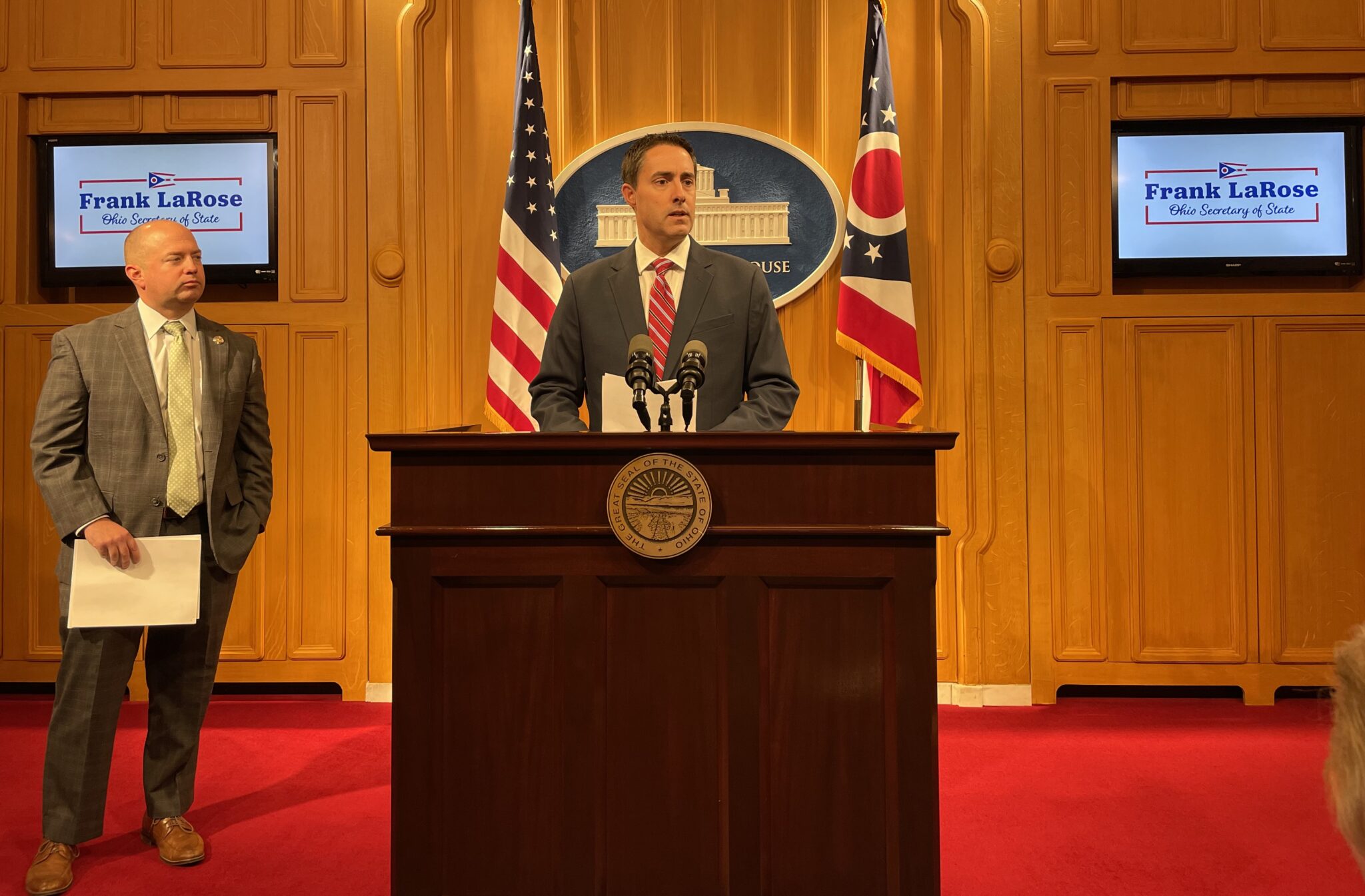
     Secretary of State Frank LaRose (speaking) alongside Rep. Brian Stewart, R-Ashville, introducing a constitutional amendment requiring a 60% supermajority for all future citizen-led ballot amendments. (Photo by Nick Evans, OCJ.)

    BY: MARTY SCHLADEN – Ohio Capital Journal

    Ohio Secretary of State Frank LaRose denied that he wanted to block abortion protections or anti-gerrymandering measures when he announced that he wanted to hustle through a measure that would make it harder for voters to amend the Ohio Constitution.

    But he’s failed to point to a single amendment in the Constitution as an example of what he’s trying to protect against by changing rules that have been in place for more than a century.

    LaRose is proposing that — after advocates clear the already high hurdles to get proposed constitutional amendments on the ballot — they also be required to get at least 60% of the vote instead of the 50% plus one vote that’s currently needed.

    Meanwhile, amendments initiated by Ohio’s gerrymandered legislature would continue to need only 50% of the popular vote to make their way into the state Constitution. Ironically, the amendment LaRose wants that would make it harder to pass voter-initiated amendments falls into that latter, easier-to-pass category.

    LaRose’s stated reason why citizens should lose some of their ability to change the Ohio Constitution: It’s badly needed to protect against wealthy interest groups that want to insert self-serving measures into what LaRose called “the state’s founding document.”

    “If someone is a special interest and they want to create a monopoly for themselves let’s say, or to try to do something that narrowly benefits their own interest, maybe it will make them think twice before they try to amend the Constitution,” LaRose said during a press conference on Nov. 17.

    So how many times have such powerful special interests actually succeeded in initiating a harmful constitutional amendment?

    LaRose didn’t cite any during his press conference. Instead, he said that of the 16 citizen-initiated amendments proposed in the past 22 years, just five have passed. And in response to a question, the secretary of state conceded that of the ones that passed, just two failed to get less than 60% of the vote.

    LaRose’s office didn’t respond when asked for an example of a problematic amendment in the Ohio Constitution that his proposal would have prevented  — or to other questions for this story. But while he and his staff didn’t cite any such examples, there are some citizen-initiated amendments coming that LaRose and the state’s other Republican leaders may well oppose.

    One is a measure that would amend the Ohio Constitution to protect abortion rights. 

    When the U.S. Supreme Court in June overturned Roe v Wade, a 2019 law signed by Gov. Mike DeWine took effect. It outlawed the vast majority of abortions months earlier than they had been and almost immediately, horror stories started to pile up.

    They include a 10-year-old and two other under-18 rape victims who couldn’t get abortions in Ohio; women with cancer who couldn’t get abortions in order to start chemotherapy; women whose fetuses couldn’t survive but still had to continue their pregnancies. The list goes on.

    This month’s elections showed that in states where abortion was on the ballot, it proved to be a powerful motivator for supporters of abortion rights. And, with the Republican dominated legislature expected to pass even stricter restrictions, abortion-rights groups are planning to seek a voter-initiated amendment to protect those rights.

    At the same time, LaRose’s fellow Republicans in 2021 and 2022 ignored voter-initiated amendments against gerrymandering that passed with more than 70% of the popular vote. The Republican-dominated Redistricting Commission drew state legislative maps that were rejected five times by the Ohio Supreme Court as unconstitutionally gerrymandered. LaRose sits on the commission and voted for each of the maps that have been declared unconstitutional by a bipartisan court majority.

    GOP members of the commission complained that the changes the court was demanding were unconstitutional. That ignores the fact that it’s the job of the Supreme Court to decide what is or is not constitutional — not members of the executive and the legislative branches who were litigating a dispute before it. 

    In April, LaRose told a group of Union County Republicans that he’d “be fine with” impeaching Republican Chief Justice Maureen O’Connor for voting with the court’s three Democrats to strike down the Republican-drawn maps. LaRose claimed O’Connor had violated her oath of office in ruling against his party. 

    The Republicans succeeded in running out the clock and starting next year, the party’s representatives in the state legislature will continue to be wildly overrepresented compared to the partisan mix of the state as a whole. And they’ll be representing districts that are officially unconstitutional.

    The chief justice, who is retiring, has said that citizens need to come up with new citizen-initiated amendments with fewer loopholes if Ohioans want to end extreme gerrymandering.

    In his press conference last week, LaRose claimed that he’s not seeking to block amendments supporting abortion rights or ending gerrymandering. Such short-term goals weren’t good reasons for undertaking something as weighty as amending the Ohio Constitution, he said.

    “If you’re going to amend the Constitution, you need to be thinking about the long term,” he said. “So anybody who’s thinking about shorter or transient goals in the next year or two or three years, that’s not what this kind of a change should ever be about.”

    LaRose added, “If we’re talking about amending the Constitution probably for the rest of our lifetimes, that’s something that should be taken very seriously.”

    But among the questions his office wouldn’t answer this week: Why — if this should be such a deliberative process — did he wait until late November to announce that he would try to ram the measure through in a weeks-long, lame-duck session with an eye toward getting it on the ballot in May? Only about five months would elapse between the time the public first learned of the proposal and when it could alter the state Constitution, as LaRose said, “probably for the rest of our lifetimes.”

    In his press conference, LaRose denied that he was trying to hurry the measure through.

    “I don’t think it’s a rush necessarily,” he said. “It’s an idea whose time has come.”

    Ohio Democrats have denounced LaRose’s push as a “power grab.”

    But at the same time he was proposing to make it harder for voters to change the Ohio Constitution, LaRose seemed to say he was doing it in support of democracy.

    “That’s the beauty of this, is that all the power rests with the people of Ohio,” he said.

    Follow Marty Schladen on Twitter.

  • Student loan repayment pause extended by White House amid legal battles over relief plan

    Student loan repayment pause extended by White House amid legal battles over relief plan

    BY: ARIANA FIGUEROA – Ohio Capital Journal

    The Department of Education announced on Tuesday it is extending the pandemic-era pause on federal student loan repayments until June 30 while legal challenges to the administration’s student debt relief program are fought over in the courts.

    The agency said if the student debt relief program has not been put in place by June 30, and if litigation is still tied up in the courts, student loan payments will begin 60 days after that.

    “Payments will resume 60 days after the Department is permitted to implement the program or the litigation is resolved, which will give the Supreme Court an opportunity to resolve the case during its current Term,” the department said in a statement.  “If the program has not been implemented and the litigation has not been resolved by June 30, 2023 — payments will resume 60 days after that.”

    Earlier the administration had said the pandemic-era pause would expire on New Year’s Eve. Two lawsuits blocking the Biden plan, including one brought by six GOP-led states, have been appealed by the Justice Department, but it’s unclear how long the legal process could take.

    “We’re extending the payment pause because it would be deeply unfair to ask borrowers to pay a debt that they wouldn’t have to pay, were it not for the baseless lawsuits brought by Republican officials and special interests,” U.S. Secretary of Education Miguel Cardona said in a statement.

    President Joe Biden, in a Tuesday tweet, said the extension will give “the Supreme Court time to hear the case in its current term.”

    “I’m confident that our student debt relief plan is legal,” he said on Twitter.

    Before the announcement, more than 200 advocacy groups had urged Biden to extend the pause.

    In a Monday letter, the groups argued that if student loan repayments restart, it would be a financial setback for borrowers, especially at a time of record high inflation.

    “We, the undersigned 225 organizations, urge you to immediately extend the payment pause until your Administration is able to fully implement debt relief for all eligible borrowers and to continue to use every legal authority at your disposal to make this relief real,” according to the letter.

    “We cannot allow these blatantly political lawsuits to throw millions of borrowers into financial catastrophe,” the letter said. “Throwing millions of borrowers back into repayment as the state of debt relief remains uncertain is a recipe for disaster and will result in widespread confusion and set borrowers up for failure.”

    Most of the organizations that signed onto the letter include labor groups like the AFL-CIO, legal organizations like the ACLU and NAACP, and debt cancellation advocacy groups such as the Debt Collective and Student Debt Crisis Center.

    Multiple extensions

    The Trump administration implemented the pause on student loan repayments due to the coronavirus pandemic and the Biden administration has extended it multiple times.

    A federal appeals court issued a nationwide injunction that barred the Biden administration from carrying out its student debt relief plan following the challenge by the six GOP-led states — Nebraska, Missouri, Arkansas, Iowa, Kansas and South Carolina.

    The Biden administration has asked the U.S. Supreme Court to vacate the nationwide injunction.

    “The Eighth Circuit’s erroneous injunction leaves millions of economically vulnerable borrowers in limbo, uncertain about the size of their debt and unable to make financial decisions with an accurate understanding of their future repayment obligations,” Solicitor General Elizabeth Prelogar wrote in the filing to the U.S. Supreme Court.

    In late August, Biden announced he would cancel up to $20,000 in federal student loan debt for Pell Grant borrowers and up to $10,000 for all other borrowers with an income of less than $125,000 for an individual and $250,000 for a household.

    The program would only apply to current borrowers, not future ones, and income levels for the 2020 and 2021 tax years would be considered. Student loan borrowers who have private student loans would not be eligible.

    The attorneys general from the states that launched the legal challenge argued that the loan relief program threatens those states’ future tax revenues and that the plan overrode congressional authority.

    ​​More than 43 million Americans have student loan debt, and the Federal Reserve estimates that the total U.S. student loan debt is more than $1.76 trillion.

    The three-panel judge from the 8th Circuit Court of Appeals in St. Louis put the injunction in place “until further order of this court or the Supreme Court of the United States.”

    Those judges are Bobby E. Shepherd and Ralph R. Erickson, both President George W. Bush appointees, and L. Steven Grasz, a President Donald Trump appointee.

    Following the decision, White House press secretary Karine Jean-Pierre said the White House believes it has the legal authority to carry out the program.

    “The Administration will continue to fight these baseless lawsuits by Republican officials and special interests and will never stop fighting to support working and middle class Americans,” she said in a statement.

    26 million applicants

    More than 26 million student loan borrowers have applied for the program, and 16 million have been accepted, according to the Department of Education.

    The nonpartisan Congressional Budget Office found that the program would add $400 billion to the national deficit over the span of 30 years. The agency found that the pause on federal student loan repayments has cost $20 billion from September to December 2022.

    Adam Looney, a senior fellow at the Brookings Institute — a left-leaning think tank — said while the cost seems high, for borrowers who qualify it comes out to a monthly average savings of about $59.

    Looney previously was a senior economist for public finance and tax policy with former President Barack Obama’s Council of Economic Advisers, and was an economist at the Federal Reserve Board.

    “It’s like a tax cut,” Looney said of student loan borrowers who would qualify for debt relief.

    Second lawsuit

    The Biden administration stopped accepting applications for student debt relief following a second decision from a federal judge in Texas who separately ruled the program was unlawful.

    In Fort Worth, U.S. District Judge Mark Pittman, an appointee of former President Donald Trump, ruled that the program was an “unconstitutional exercise of Congress’s legislative power.” He ruled in favor of two borrowers, backed by a conservative advocacy group, who brought the challenge.

    The Department of Justice has already filed an appeal to that ruling.

    Pittman wrote in his opinion that “[w]hether the Program constitutes good public policy is not the role of this Court to determine.”

    Sabrina Calazans, the outreach director at the Student Debt Crisis Center, said prior to Tuesday’s announcement that the Biden administration should resume its pause on student loan repayment. The center also signed onto the letter to the White House from the more than 200 organizations.

    “We’re advocating for an extension to the payment pause until student debt cancellation is applied to borrowers’ accounts,” she said. “We believe that borrowers should be able to get their debt canceled and not have to make any payments until that happens because they’ve been promised this relief.”

    Calazans, who has student loan debt herself — federal and private loans — and is a first-generation college student, said the pause on repayments has been a lifeline for her and her family. The pause did not include private loans, which she has, so she’s had to continue those payments throughout the pandemic.

    “Folks were struggling before the pandemic started,” she said of student loan debt. “This was already a crisis that people were dealing with beforehand, so this has been around for a long time, not just recently.”

    Calazans said those student loan borrowers who applied to the Department of Education for debt relief are starting to get emails that their applications for student debt cancellation were approved, but the lawsuits are blocking it.

    “Folks are excited about the prospect of having their debt canceled — whether it’s all of it or a portion of it — and now that hope that they had is now suddenly stopped for now because of the blocking of this plan,” she said. “Borrowers are in this limbo.”

    Emails sent out

    The Department of Education has sent out emails to student loan borrowers who applied, and were approved for the debt relief program with the subject line: “Your Student Loan Debt Relief Application Has Been Approved.”

    However, the body of the email reads: “Unfortunately, a number of lawsuits have been filed challenging the program, which have blocked our ability to discharge your debt at present.”

    “We believe strongly that the lawsuits are meritless, and the Department of Justice has appealed on our behalf,” according to the email. “We will keep your application information and will continue our review of your eligibility if and when we prevail in court. We will update you when there are new developments.”